𝗙𝗨𝗟𝗟 𝗦𝗧𝗢𝗥𝗬 My Stepmother’s Smile Vanished When the Judge Looked at One Signature
𝗙𝗨𝗟𝗟 𝗦𝗧𝗢𝗥𝗬
I looked at her.
“That doesn’t stop them from talking.”
“No. But you’re not required to attend every argument you’re invited to.”
I smiled.
She slipped her arm through mine.
“Your father doesn’t know how to ask questions without making them sound like accusations. And Vivian is more interested in being right than in being curious.”
“You make them sound like children.”
“Sometimes they behave like children.”
I laughed.
Grandma squeezed my arm.
“Just remember that somebody else’s inability to see your life clearly doesn’t make that life any less valuable.”
I didn’t know it then, but those words would eventually become the foundation of everything that happened after her death.
Grandma died five months before the hearing.
She’d been eighty-four, fiercely independent, and remarkably unwilling to acknowledge that her body was becoming less cooperative.
During her final year, I visited whenever my assignments allowed.
We spent afternoons sorting photographs, arguing about whether she’d ever throw away her ancient sewing machine, and discussing the veterans’ scholarship fund my grandfather had established decades earlier.
That fund mattered to her.
It had helped former service members return to school, complete professional certifications, and establish careers after leaving the military.
But after Grandpa died, it had gradually become inactive.
Grandma wanted it restored.
She asked me about it repeatedly.
“What would it take to get something like that working properly again?”
“Money. Administration. Somebody willing to manage the details.”
She smiled.
“Sounds like something you’re good at.”
“Grandma, I’m not taking on another job.”
“I didn’t ask you to.”
She stirred her tea.
“But it’s nice knowing you’d understand why it matters.”
I should have recognized that she was thinking about the future.
Instead, I assumed she simply wanted to talk about something that had been important to her husband.
When her health deteriorated, I took leave to spend time with her.
One afternoon, she asked me to bring her a particular folder from the cabinet beside her bed.
It contained estate documents.
I immediately grew uncomfortable.
“Grandma, I don’t need to know what you’re leaving anybody.”
She smiled.
“That’s fortunate. Because I’m not asking for your permission.”
I sat beside her.
She placed a hand over mine.
“Promise me something.”
“Anything.”
“Don’t let this family turn my funeral into a competition.”
I laughed nervously.
“That’s a strange thing to ask.”
“Is it?”
I couldn’t answer.
She squeezed my fingers.
“And don’t let anybody tell you that you have to prove you’re worthy of being loved.”
Those were among the last substantial conversations we had.
When she died, I felt as though the one place where I could stop defending every aspect of my life had disappeared.
Her funeral was held on a cold, clear morning.
My father delivered a speech about family values.
Vivian cried into an embroidered handkerchief.
I sat near the front and stared at the polished wooden casket, remembering how Grandma used to sneak extra cookies onto my plate whenever Dad complained that I was eating too much.
I had no idea that she’d already taken steps to protect me from the people sitting two seats away.
The will reading took place three weeks later.
My father’s attorney reviewed the estate documents while Vivian sat beside him, looking composed and expectant.
Grandma had left Dad a paid-off rental property and an investment account sufficient to provide long-term financial security.
She left smaller gifts to several relatives.
The family home, surrounding acreage, and controlling interest in several investments went to me.
For several seconds after the attorney finished reading, nobody spoke.
Then Vivian laughed.
It was a short, disbelieving sound.
“I’m sorry. That can’t be right.”
The attorney looked up.
“Which provision concerns you?”
“The house.”
He checked the document.
“The property is bequeathed to Amelia Carter.”
My father sat very still.
Vivian looked toward me.
“Amelia doesn’t even live here.”
“That’s correct,” I said.
“She isn’t married. She doesn’t have children. What on earth is she supposed to do with a property like that?”
I stared at her.
The attorney cleared his throat.
“Mrs. Carter, the disposition of the estate reflects Eleanor’s written instructions.”
Vivian leaned toward Dad.
He remained silent.
Then she looked directly at me.
“You must have talked her into this.”
I felt something tighten inside my chest.
“Grandma made her own decisions.”
“She was old, Amelia.”
“And she knew exactly what she was doing.”
Vivian’s expression hardened.
My father finally spoke.
“Let’s not argue about this today.”
I almost laughed.
He had no objection to his wife accusing me of manipulating a dying woman.
He simply wanted the conversation to end before he had to choose a side.
I collected my documents and left.
I assumed they’d eventually accept the terms of the will.
I was wrong.
The first email arrived eleven days later.
Vivian wrote that she was concerned about my emotional well-being.
She mentioned that I frequently traveled without providing my itinerary, refused to discuss my finances, and had become increasingly secretive.
At the bottom, she suggested that I speak with someone about my inability to maintain normal family relationships.
I deleted it.
Then my father sent a message.
He wanted to know whether I was receiving regular income.
I answered that I was financially independent.
He asked whether I had debts.
I declined to discuss my personal accounts.
Two days later, Vivian sent another email.
She said my unwillingness to answer reasonable questions was increasing their concern.
I forwarded it to an attorney.
His name was Daniel Mercer.
He’d represented military personnel before and understood how easily legitimate professional confidentiality could be misrepresented by people unfamiliar with it.
He read the messages.
Then he looked at me.
“Do you have any reason to think your father intends to challenge the estate?”
“Other than the fact that he believes I’m an unemployed disappointment who somehow manipulated his mother into leaving me her house?”
Daniel didn’t smile.
“Yes. Other than that.”
I hesitated.
“Vivian doesn’t like losing.”
He closed the folder.
“Then we should start preserving everything.”
Within two months of Grandma’s death, my father and Vivian had assembled an astonishing collection of supposedly troubling information about me.
Emails from relatives describing my strange behavior.
Statements from family friends claiming I appeared withdrawn.
Edited recordings of conversations in which I sounded irritated after being questioned repeatedly about matters I wasn’t permitted to discuss.
Vivian even obtained photographs showing surgical scars on my body.
She presented those injuries as evidence that I might be harming myself.
Then they filed a petition asking the court to declare me financially incompetent.
My father sought temporary control over the estate assets I’d inherited.
They also requested a protective order, describing me as unstable and potentially dangerous.
I remember sitting in Daniel’s office when he showed me the petition.
For several minutes, I simply stared at the words.
Financially incompetent.
Emotionally unstable.
Potentially violent.
My father had signed his name beneath statements describing a daughter he apparently didn’t recognize.
“How can he believe this?” I whispered.
Daniel waited.
“He’s known me my entire life.”
“He’s also accepted someone else’s interpretation of your life for a very long time.”
I looked down at the papers.
“She says I don’t have a stable job.”
“Then we’ll document your employment.”
“She says I’m financially dependent on him.”
“Then we’ll document your finances.”
I turned another page.
Then stopped.
Vivian had described the scars on my shoulder and side.
My stomach tightened.
“She has photographs.”
Daniel studied my face.
“Do you know where she got them?”
I thought about a family gathering the previous summer.
I’d been wearing a sleeveless dress. Vivian had insisted on taking photographs and made several comments about the marks on my shoulder.
At the time, I’d assumed she was simply being unpleasant.
Now I understood she’d been collecting material she could use against me.
“She thinks those scars mean I’m hurting myself.”
Daniel looked at the document.
“She’ll have to substantiate that claim.”
I turned toward the window.
The scars had been difficult enough to acquire.
Now my family was using them to suggest that I wasn’t capable of controlling my own life.
I looked back at him.
“What do we need?”
Daniel opened a fresh legal pad.
“Facts. Original files. Financial records. Properly authenticated evidence.”
I took a breath.
He looked directly at me.
“And Amelia, I need you to understand something. You don’t have to defend your entire life against every insult they’ve ever made. We only need to answer the allegations they’ve placed before the court.”
I nodded.
That distinction helped.
Because I wasn’t going to court to prove that my father should be proud of me.
I was going because he was trying to take control of property my grandmother had deliberately left in my care.
And I had no intention of allowing him to succeed.
The morning of the hearing, I woke at four-thirty.
An old habit.
I made coffee, checked the documents I’d already checked three times the previous night, and stood in front of my bedroom mirror trying to decide what to wear.
I’d planned on a dark suit.
Conservative.
Unremarkable.
Nothing that would draw attention away from the evidence.
But then I thought about Vivian’s photographs.
The medical accusations.
The way she’d transformed years of injuries and recovery into a story about a woman who supposedly couldn’t control herself.
I chose a sleeveless blouse beneath my coat.
I wasn’t looking forward to explaining my scars in front of strangers.
Some of those injuries were connected to experiences I rarely discussed, even with people I trusted. I’d spent years learning to live with their physical consequences without allowing them to define every other part of my life.
But Vivian had made them part of the legal case.
And I wasn’t going to let her tell the court what they meant.
When Daniel met me outside the courthouse, he glanced at my clothes.
“You’re ready?”
“As ready as I’m going to be.”
He studied my face.
“You don’t have to make this personal.”
I gave him a tired smile.
“They made it personal when they turned my medical history into an accusation.”
He nodded.
“Then we’ll deal with the accusation. Not the performance.”
We walked inside.
My father and Vivian were already seated at their table.
She wore pearls, a carefully tailored jacket, and an expression of such rehearsed concern that I could almost imagine her practicing it in the mirror.
Dad looked tired.
For one moment, I wondered whether he regretted what he’d done.
Then his attorney handed him a document.
He looked at it, nodded, and turned away from me.
Whatever he was feeling, he’d chosen to proceed.
When the judge entered, everyone stood.
The hearing began with my father’s attorney outlining the petition.
According to him, my family had become increasingly concerned about my unusual behavior, unexplained absences, unstable employment, and apparent inability to manage the substantial inheritance I’d received.
He referred to the protective-order request, emphasizing the need to safeguard my father and Vivian from possible aggression.
I listened.
Every allegation was familiar by then.
But hearing them recited in a courtroom was different from reading them in an email.
Someone had taken the story my family told about me at Thanksgiving and wrapped it in legal language.
My father was called to speak.
He looked toward the judge.
“My daughter needs help. She’s always been independent, but lately she refuses to accept reality.”
The judge asked what he meant.
Dad described my failure to discuss my employment.
My frequent travel.
My unwillingness to share financial information.
He told the court that he believed I’d isolated myself from my family and that he feared I was incapable of handling Grandma’s estate responsibly.
“Has your daughter ever requested financial assistance from you?” Daniel asked when his turn came.
Dad hesitated.
“Not recently.”
“Has she requested money at any point in the last five years?”
He looked toward Vivian.
“I’d have to check.”
“Did she ask you to pay any of her bills?”
“I don’t remember.”
Daniel made a note.
Then he asked whether Dad had direct knowledge of my income.
“No.”
“Her employment status?”
“She tells us she works for the government.”
“So you don’t actually know what she does.”
Dad’s expression tightened.
“She’s extremely secretive.”
“That wasn’t my question.”
My father looked uncomfortable.
“No. I don’t know exactly what she does.”
Daniel nodded.
“Thank you.”
Then Vivian spoke.
She was much more confident.
She described my absences as disappearances.
My reluctance to discuss classified or sensitive work became evidence of paranoia.
My refusal to share personal financial records became evidence that I had something to hide.
And when the judge asked what made her believe I might be dangerous, Vivian delivered the accusation she’d apparently been saving.
“Amelia has unexplained injuries all over her body. We’ve become concerned that she may be harming herself.”
My stomach tightened.
Dad lowered his eyes.
“I’ve tried to protect her dignity,” he murmured.
I stared at him.
He couldn’t look directly at me.
Yet he’d allowed himself to be part of a proceeding in which my stepmother was using injuries I’d sustained in military service to undermine my legal rights.
Daniel rose.
“Your Honor, my client would like permission to respond to the allegations concerning her medical history and employment.”
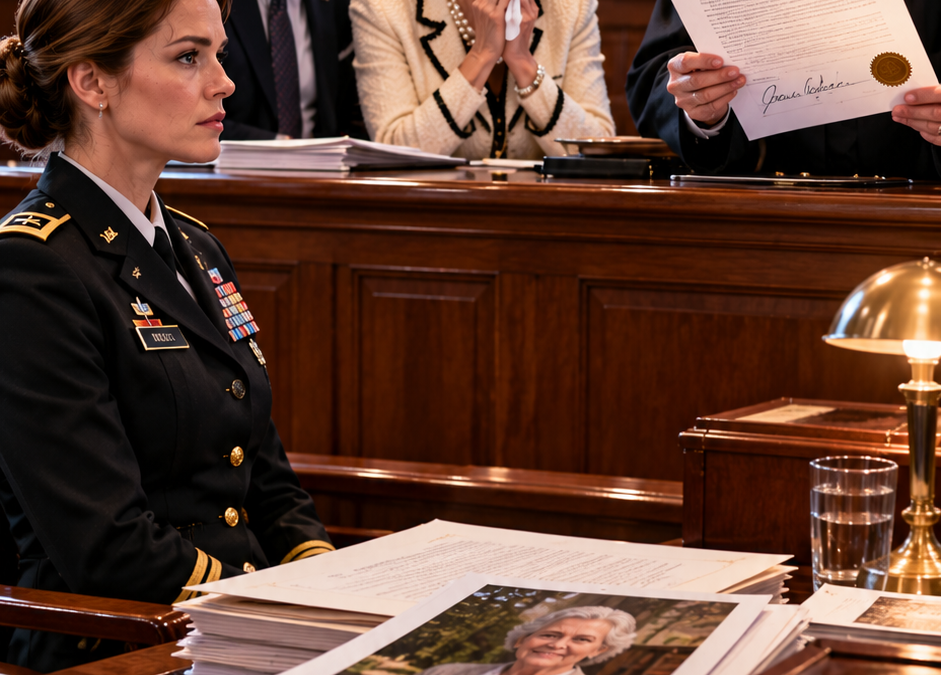
The judge nodded.
I stood.
Then I removed my coat.
A faint murmur moved through the courtroom.
The scar below my shoulder was the most visible.
A surgical line ran along my side.
Several smaller marks remained near my upper arm and ribs.
I’d carried those scars for years.
Some had faded considerably. Others would always be noticeable.
For a moment, I was acutely aware of everyone looking at me.
Then I reminded myself why I was standing there.
“Your Honor, these are the injuries Mrs. Carter has characterized as evidence that I may be harming myself. I’d like to explain their documented history.”
The judge allowed me to continue.
I indicated the scar near my shoulder.
“Eleven years ago.”
Then my side.
“Eight years ago.”
My upper arm.
“Five years ago.”
Vivian let out a nervous laugh.
“Are we supposed to believe you remember every little injury?”
I turned toward her.
“Yes.”
“Why?”
I looked back at the judge.
“Because the United States Army documented every one of them.”
The courtroom became very quiet.
Daniel had already arranged for authenticated, releasable portions of my service records to be presented through the appropriate channels. The records were sufficient to establish my career, rank, income, relevant medical history, and professional evaluations without disclosing information I wasn’t authorized to make public.
Two uniformed officers entered with the sealed materials.
I watched my father turn in his chair.
His expression was almost comical.
He stared at the officers, then at me, as though he’d accidentally wandered into the wrong hearing.
The judge examined the documentation.
She reviewed my service history, command appointments, income verification, medical evaluations, and the records establishing the origins of the injuries Vivian had described.
Then she looked up.
“Colonel Carter?”
“Yes, Your Honor.”
My father went completely still.
I watched the title register.
Then the uniformed officers.
Then the documents.
For almost twenty years, he’d treated my career as an insignificant government job.
Now he was hearing an officer formally addressed as his daughter.
He leaned toward his attorney and whispered something.
The judge continued reviewing the records.
My father stared at me.
“You were in the Army this entire time?”
I looked at him.
“Yes.”
For a moment, I thought he might apologize.
Instead, he looked offended.
“Why didn’t you tell me?”
I felt an old, familiar exhaustion.
Even now, he was more concerned about not knowing than about having tried to take control of my life without bothering to learn the truth.
The judge directed us to remain focused on the legal questions.
Daniel introduced my financial records.
Regular income.
Verified savings.
Property ownership.
A history of paying my own expenses.
Then he presented evidence that directly contradicted the claim that I’d depended on my father for financial assistance.
Five years earlier, I’d paid a substantial portion of the cost of replacing his roof after storm damage.
I’d transferred the money without expecting repayment.
At Christmas that year, Vivian had told relatives that Dad was helping me get back on my feet.
I hadn’t realized until much later that she’d allowed them to believe he’d been financially supporting me.
Now Daniel presented the bank record documenting exactly what had happened.
My father stared at it.
“I didn’t know she thought—”
He stopped.
Vivian avoided looking at him.
The judge made a note.
Then Daniel turned to the recordings my family had submitted.
He played the edited excerpts first.
They made me sound angry, suspicious, and unwilling to engage with perfectly reasonable questions.
Then he played the originals.
The full recordings included the repeated accusations, interruptions, and insulting comments that had preceded my responses.
The difference was unmistakable.
The judge listened without revealing much of what she thought.
Daniel continued with the witness statements.
Several contained strikingly similar language.
Certain sentences were nearly identical.
He introduced the correspondence showing that Vivian had circulated suggested wording to relatives before they submitted their statements.
Then came the messages between Vivian and my father.
They discussed how to obtain control of Grandma’s assets.
How to challenge my ability to manage the estate.
How to portray my work-related absences as evidence of instability.
One message included Vivian’s instruction to make me appear dangerous enough that the court would accept their request.
Another was even more explicit.
Once the court thinks she is unstable, she won’t be able to stop us.
My father stared at the message.
I wasn’t certain whether he’d forgotten it existed or simply never imagined anyone else would read it.
Vivian whispered urgently to her attorney.
The judge reviewed the correspondence.
Then she stopped at one of the supporting documents.
It was an affidavit accompanied by a statement purportedly written and signed by my grandmother before her death.
The statement suggested that Grandma had expressed concern about my judgment and financial decisions.
I’d already told Daniel I didn’t believe she’d written it.
The language was wrong.
Grandma had never described me that way.
But my suspicions weren’t enough to establish forgery.
The judge examined the signature.
Then looked toward the clerk.
“I want this authenticated.”
Vivian turned toward my father so quickly that I almost missed the expression that passed between them.
Fear.
Not irritation.
Not embarrassment.
Fear.
The clerk collected the disputed document.
The judge announced a forty-five-minute recess.
Daniel touched my elbow as we stood.
“Come on.”
I put my coat back on.
As we walked into the corridor, I heard my father call my name.
I didn’t stop.
Outside the courtroom, ordinary life continued.
Lawyers hurried between hearings.
Families waited on wooden benches.
Somebody was arguing into a telephone near the elevators.
I followed Daniel into an empty conference room and sat down.
He closed the door.
“You did well.”
I looked at him.
“I stood up and showed a room full of strangers my scars.”
“You answered the allegation they brought against you.”
I stared at the table.
“I feel as though I took off more than my coat.”
Daniel sat opposite me.
He’d represented service members before. That was one of the reasons I’d chosen him.
He understood that surviving something didn’t necessarily mean wanting the experience turned into public information.
“You don’t have to feel comfortable with what happened,” he said. “You only have to know why you chose to do it.”
I looked through the narrow glass panel beside the door.
My father was standing alone near a row of windows.
Vivian was nowhere beside him.
For a moment, I watched him.
“I thought he knew.”
Daniel followed my gaze.
“Knew what?”
“Not everything. But something. I thought there had to be a part of him that understood I wasn’t the person Vivian described.”
Daniel leaned back.
“He may have believed what was easiest for him to believe.”
“That sounds worse.”
“Sometimes it is.”
A few minutes later, his phone vibrated.
He read the message.
“The court’s examiner is comparing the disputed signature with authenticated samples from your grandmother’s estate records.”
“And?”
“Nothing conclusive yet.”
He put down the phone.
“There’s something else. The judge wants the probate file.”
I looked at him.
“Why?”
“If the statement about your grandmother was forged, she wants to know whether similar documents were used elsewhere in the estate proceedings.”
A cold thought moved through me.
I remembered the way Grandma had filed everything.
The labeled drawers.
The carefully preserved receipts.
The absolute confidence with which she could produce a document that contradicted somebody else’s memory.
If anyone had tried to forge her signature, she’d have considered it personally offensive.
Then the conference room door opened.
My father stood in the entrance.
Daniel immediately rose.
“Mr. Carter, any discussion of this case needs to go through counsel.”
Dad nodded.
“I know. I just want to ask Amelia one question.”
Daniel looked toward me.
I could have refused.
Perhaps I should have.
Instead, I nodded.
“One.”
My father swallowed.
“Were you already a colonel when your grandmother died?”
“Yes.”
He stared at me.
“And when I told everybody you couldn’t hold a real job?”
“Yes.”
The answer seemed to hurt him.
Good, I thought.
Then immediately hated myself for thinking it.
He looked down.
“I didn’t know.”
“No.”
“Why didn’t you tell me?”
I stared at him.
“Because I couldn’t discuss much of my work. And because every time I gave you information you were entitled to know, Vivian treated it as an invitation to demand something else.”
He looked toward the floor.
“I would’ve understood.”
“Would you?”
He didn’t answer.
I leaned forward.
“You told Aunt Denise that I was borrowing money from you.”
His eyes moved back to mine.
“That was years ago.”
“I paid for your roof that year.”
He stared.
“I transferred the money to your account. I remember the amount. I remember the date. I remember you telling me how grateful you were.”
He swallowed.
“Vivian said—”
“That’s the problem.”
He stopped.
“You thought Vivian knew everything. You thought the relatives knew everything. You thought Grandma was worried about me. You accepted whatever anyone said, provided it allowed you to avoid asking me directly.”
His shoulders sagged.
For a moment, I saw the father I’d known before Vivian.
The man who’d taught me to ride a bicycle.
The man who’d stayed up late helping me prepare for difficult examinations.
The man who’d once told me I could achieve anything if I worked hard enough.
I wondered when he’d stopped believing it.
Then Daniel stepped forward.
“That’s enough for now.”
Dad nodded.
Before leaving, he turned back.
“Amelia.”
I waited.
“I’m sorry I asked about your rank first.”
I hadn’t expected that.
He looked at me for another moment.
Then he left.
Forty minutes later, we returned to the courtroom.
Vivian was seated beside her attorney.
My father sat next to her, but their chairs were no longer touching.
The judge reviewed the preliminary findings concerning the disputed signature.
She explained that the comparison raised sufficient questions to warrant further investigation, although a final forensic determination would require additional work.
Vivian’s attorney immediately stated that his client hadn’t personally prepared the document.
The judge regarded him calmly.
“That may become important.”
Then she ruled on the immediate requests before her.
The petition seeking emergency control over my assets was denied.
The request for a protective order was also denied at that time.
Given the inconsistencies in the evidence, she directed the parties to preserve all relevant records and communications and indicated that the disputed materials would be referred for appropriate review.
I felt a breath escape my chest.
Daniel touched the edge of my folder.
A quiet reminder.
We weren’t finished.
Then the judge announced something I hadn’t expected.
Grandma had deposited a sealed memorandum with the probate court.
Its instructions authorized release to my counsel if an immediate family member challenged my capacity or my right to inherit.
I turned toward Daniel.
He leaned closer.
“We found the reference yesterday. I wasn’t certain the court would release it.”
The clerk brought forward a cream-colored envelope.
Grandma’s handwriting appeared across the front.
FOR AMELIA, IF THEY MAKE YOU PROVE YOURSELF.
For the first time that day, I nearly lost my composure.
Grandma had known.
Not necessarily every detail.
Not the precise accusations Vivian would make or the statements my father would sign.
But she’d anticipated that somebody might use my privacy against me.
And she’d left instructions for what should happen if they did.
When the hearing ended, Daniel accepted the envelope.
We didn’t open it in the courthouse.
I couldn’t.
Instead, we drove to Grandma’s house.
The maple tree in the front yard had begun turning yellow.
A few leaves lay across the porch.
Inside, the house still smelled faintly of cedar, furniture polish, and the lavender sachets Grandma tucked into every drawer she owned.
I walked into the kitchen.
The same clock hung above the doorway.
Her favorite ceramic mug stood on the shelf.
For a moment, I wanted her to come downstairs and ask why I’d arrived looking so miserable.
But the house remained quiet.
Daniel waited beside the table.
“Do you want me to stay?”
I looked at the envelope.
“Yes.”
We sat together.
I carefully opened it.
Inside were twelve handwritten pages and a small brass key taped to the final sheet.
The letter began with a sentence that made me laugh and cry at the same time.
My dear Amelia, if you’re reading this, somebody in our family has confused silence with weakness again.
I read the opening line twice.
Then I looked up at Daniel.
“She knew me.”
He smiled.
“Apparently, she knew your family too.”
I wiped my face and continued.
Grandma explained that she’d revised her estate plan three years before her death.
She’d done so deliberately, after reviewing her finances and considering what she wanted her property to accomplish after she was gone.
She hadn’t disinherited my father.
In fact, she’d made sure he received enough to live comfortably, including a paid-off rental property and a substantial investment account.
She’d underlined the part explaining that she loved him.
Twice.
But she didn’t believe that leaving him her entire estate would honor the life she and Grandpa had built.
The family home and surrounding acreage were important to her. So were the investments they’d accumulated over decades of careful planning.
And there was something she’d wanted to accomplish with them.
My grandfather’s scholarship fund.
I stopped reading when I reached that section.
For years, I’d known about the fund without understanding how deeply Grandma regretted allowing it to become inactive.
She described former service members who’d returned home struggling to translate their military experience into civilian opportunities.
Some needed money for college.
Others needed professional training or certifications.
Grandpa had wanted the fund to give them choices.
Grandma believed I would understand that purpose and be capable of restoring it.
I stared at the page.
“She didn’t leave me the estate because she thought I needed the money.”
Daniel looked up.
“Why did she leave it to you?”
“She wanted me to bring Grandpa’s scholarship fund back.”
For the first time since the will reading, I understood why she’d repeatedly asked questions about educational programs and the administration of charitable funds.
She hadn’t simply been making conversation.
She’d been deciding whether I was willing to carry forward something that mattered to her.
And apparently, she’d decided I was.
Grandma’s letter continued.
She wrote about my father with more compassion than I thought I could manage.
She described him as someone who loved people by trying to arrange their lives for them.
When his intentions were good, he could be generous.
When he was frightened or uncertain, he became controlling.
He disliked not knowing what was happening.
And when he felt excluded, he often interpreted other people’s privacy as evidence that they were rejecting him.
I closed my eyes.
That was my father in a single paragraph.
Then she wrote about Vivian.
Vivian has spent much of her life believing that security comes from controlling everything around her. I don’t think she has ever understood how much damage that can do to people who refuse to be controlled.
I read the sentence twice.
Grandma hadn’t hated Vivian.
She’d invited her to family gatherings, remembered her birthday, and treated her politely throughout her marriage to Dad.
But she’d never completely trusted her.
Now I was beginning to understand why.
The next page described an incident that had occurred six months before Grandma changed her will.
Someone had attempted to obtain a loan using part of her property as collateral.
The application hadn’t been completed.
No funds had been released.
But copies of Grandma’s property records had been requested without her permission.
She’d discovered the request when she received an inquiry from a financial institution asking her to verify information she hadn’t provided.
Daniel leaned forward.
“Did you know about this?”
I shook my head.
Grandma had investigated quietly.
She’d written that she believed Dad knew something about the request, but she didn’t think he’d initiated it.
She hadn’t named Vivian as the person responsible.
Instead, she’d included a sentence that made me pause.
I refuse to accuse anyone without evidence. I’ve seen enough families destroyed by suspicion masquerading as certainty.
I looked toward the window.
My grandmother had apparently been concerned enough to change her estate plan, yet she’d refused to turn that concern into an unsupported accusation.
Meanwhile, my father and Vivian had been willing to accuse me of financial incompetence and dangerous behavior based on manipulated recordings and misleading statements.
I kept reading.
Grandma instructed me not to allow the inheritance to turn me into the family bank.
She asked me to protect the scholarship fund.
And she reminded me that whatever I decided to do with the property, I should make that decision because it reflected my own values.
Not because somebody demanded it.
Not because I felt guilty.
And certainly not because I believed I had to purchase my family’s approval.
Then I reached the final page.
I know you think your father stopped seeing you years ago. I suspect he stopped seeing himself first.
I felt my throat tighten.
Whether you forgive him is your decision, sweetheart. But before you decide, open the blue cabinet in my sewing room. There’s something Robert gave me in 2009 that he was too ashamed to give you.
I lowered the letter.
A small brass key was taped beneath the final paragraph.
Daniel looked at it.
“What’s in the cabinet?”
“I have no idea.”
“Do you know what happened in 2009?”
I did.
It was the year my father and I stopped speaking regularly.
I’d returned from an overseas assignment exhausted, withdrawn, and unwilling to explain much about what I’d experienced.
Dad had interpreted my silence as rejection.
I’d interpreted his questions as criticism.
We’d argued repeatedly.
Then Vivian became a more permanent part of his life.
She hadn’t created the distance between us.
But she’d been remarkably effective at making it wider.
I stood.
“Come on.”
Grandma’s sewing room was upstairs.
It was exactly as she’d left it.
Her machine stood beside the window.
Fabric squares were stacked by color.
A dress pattern lay open on the worktable.
For a moment, I imagined her sitting there in her old cardigan, telling me not to touch anything because she’d finally managed to organize the room.
The blue cabinet stood against the far wall.
I inserted the brass key.
The lock turned easily.
Inside were tax records, family photographs, old Christmas cards, and a narrow wooden box.
My name was written across the lid.
AMELIA.
I carried it downstairs.
We returned to the kitchen table.
Inside, beneath layers of tissue paper, was a photograph from my military academy graduation.
I was twenty-two.
My hair was pulled back, my expression was painfully serious, and I remembered spending most of the ceremony trying not to cry.
Grandma had attended.
My father hadn’t.
He’d told me afterward that an unexpected work commitment had prevented him from traveling.
I’d accepted the explanation.
But I’d never forgotten how empty the seat beside Grandma had looked.
Beneath the photograph lay an envelope.
The handwriting wasn’t Grandma’s.
It was my father’s.
I unfolded the letter.
November 3, 2009.
Amelia,
I’ve rewritten this six times because I don’t know how to talk to you anymore.
My stomach tightened.
I continued.
My father wrote that he knew I believed he was embarrassed by me.
He admitted he’d done very little to challenge that impression.
When I’d returned from my assignment, he’d wanted me to tell him everything.
Where I’d been.
What I’d done.
Why I was so quiet.
Why I’d lost weight.
Why I seemed more comfortable speaking with other service members than with him.
When I couldn’t answer, he felt excluded.
And when he felt excluded, he became angry.
I remembered our last major argument.
We’d been standing in his kitchen.
Vivian wasn’t living with him yet, but she’d begun appearing more frequently.
Dad had accused me of treating my family as though we were incapable of understanding my important government work.
I’d told him that understanding wasn’t the issue.
Respecting the limits on what I could discuss was.
He’d said I’d become arrogant.
I’d left.
And for months, neither of us had made a serious attempt to repair the damage.
Now I was reading his explanation.
You think I’m embarrassed by you. The truth is that I’m embarrassed by myself.
I stopped.
Daniel watched me quietly.
I continued reading.
My father wrote that he’d driven seven hours to visit me shortly after our argument.
He’d reached the building where I was temporarily staying.
Then he’d seen me through the lobby window speaking with two officers.
I remembered that weekend.
I’d spent most of Saturday alone, reading the same page of a book repeatedly because I couldn’t concentrate.
I’d wanted to call him.
But I hadn’t known what to say.
Apparently, he’d been standing outside.
Watching.
Trying to decide whether he still belonged in my life.
Then he’d gone home without knocking.
I read his explanation.
You looked as though you’d found a place where you belonged. I suddenly felt like I’d missed too much to deserve walking back into it.
Tears blurred the page.
For years, I’d believed he’d stopped visiting because he didn’t care.
But he’d been ashamed.
He’d allowed that shame to become distance.
And eventually, distance had become a story he told himself about his daughter.
I was private.
I was difficult.
I didn’t need anyone.
I hadn’t accomplished anything he understood.
It was apparently easier to believe those things than to confront the possibility that I’d built a life in which he had no meaningful place.
Near the end of the letter, he admitted that Grandma had encouraged him to give it to me.
He’d refused.
He was afraid I’d read it and decide he’d waited too long.
I lowered the paper.
“He gave this to her instead.”
Daniel nodded.
“And she kept it.”
“Seventeen years.”
We sat quietly.
I wasn’t ready to forgive my father.
The letter didn’t erase what he’d done.
He’d still participated in a legal effort to take control of my inheritance.
He’d still allowed Vivian to make damaging accusations about my mental health and financial independence.
And he’d still signed documents containing statements he had no direct knowledge to support.
But the letter complicated the simple explanation I’d constructed for his behavior.
I’d believed he thought I was a failure because he’d always considered me inadequate.
Now I was beginning to wonder whether he’d spent years diminishing my achievements because acknowledging them would force him to confront how much of my life he’d missed.
I folded the letter carefully.
Then my phone rang.
Dad.
I watched his name on the screen.
Once.
Twice.
Three times.
I let it go to voicemail.
A minute later, a message appeared.
Amelia, I found something at home. It’s about your grandmother. I think Vivian has been hiding it from both of us. Before I give anything to my lawyer, I think you should see it.
I read the message again.
Then another arrived.
A photograph.
It showed an old bank envelope, yellowed with age.
Across the front, in Grandma’s handwriting, were six words.
ROBERT — IF VIVIAN ASKS AGAIN, SAY NO.
I stared at the photograph.
The disputed signature.
The attempted property loan.
Grandma’s revised will.
The sudden petition questioning my competence.
For months, I’d believed the case began when Vivian discovered I was the primary beneficiary of Grandma’s estate.
But the attempted loan suggested the conflict had begun years earlier.
Long before the funeral.
Long before the petition.
Perhaps even before my father understood what he’d agreed to.
I called him.
He answered immediately.
“Amelia?”
“I saw the envelope.”
His breathing sounded unsteady.
“There’s more.”
“How much more?”
“I’m not sure.”
“Where are you?”
“At home.”
“Is Vivian there?”
“No.”
I looked toward Daniel.
He nodded once.
I stood.
“I’m coming over. Daniel’s coming with me.”
My father exhaled.
“All right.”
I was about to end the call when he spoke again.
“Amelia?”
“What?”
“Your grandmother knew.”
I stopped.
“Knew what?”
“That someone might challenge your inheritance by claiming you couldn’t manage it.”
My blood ran cold.
“Before she died?”
“Yes.”
I looked around Grandma’s kitchen.
At the labeled drawers.
The carefully preserved documents.
The envelope she’d left for the exact moment my family made me defend myself in court.
“What did she know?”
My father’s voice broke.
“I think that’s what Vivian has been trying to keep us from finding out.”
My father opened the door before I reached the porch.
He was still wearing the suit he’d worn to court, although his tie was gone and his shirt sleeves were rolled to his elbows.
He looked older than he had that morning.
Perhaps it was the exhaustion.
Perhaps it was the absence of Vivian, who’d spent so many years speaking for him that I could barely remember the last time we’d been alone in a room.
He glanced at Daniel.
“I’m glad you came.”
“We’re here to see the documents,” Daniel said.
Dad nodded.
“Of course.”
We followed him into the dining room.
A stack of papers lay across the table.
I recognized Grandma’s handwriting on several envelopes.
Dad had also found a folder containing old bank correspondence, an incomplete loan application, and copies of emails exchanged years earlier.
He sat down.
“I need to explain what happened.”
I remained standing.
“Start with the loan.”
He lowered his eyes.
Three and a half years earlier, Vivian had experienced serious financial difficulties involving a business she’d invested in.
She’d borrowed money to keep it operating.
When the business failed, she was left with substantial debts.
She hadn’t told Dad the full extent of the problem until creditors began contacting their house.
“She wanted your grandmother to help,” he said.
I glanced toward the loan application.
“By using Grandma’s land as collateral?”
He nodded.
“Vivian said it would be temporary. She told me we could repay everything once she sold the remaining business assets.”
“What did Grandma say?”
“No.”
“Then why was an application submitted?”
Dad stared at the table.
“Vivian thought we could start the process and convince her afterward.”
I looked at him.
“You knew?”
He didn’t answer immediately.
Then he nodded.
“I knew she was contacting the bank.”
I felt my anger rising.
“Did Grandma authorize any of it?”
“No.”
“Did you tell Vivian to stop?”
“Not firmly enough.”
I almost laughed.
Not firmly enough.
My father had spent years speaking to me as though every decision I made required his approval.
Yet when his wife attempted to borrow money against his mother’s property, he’d apparently been incapable of telling her she had no right to do it.
Daniel examined the correspondence.
“What happened to the application?”
“The bank contacted Mom directly to verify the authorization. She refused.”
“Was any money released?”
“No.”
Dad pushed an old letter toward me.
Grandma had written it shortly afterward.
She’d told him she wouldn’t put her home or land at risk to rescue Vivian from debts she hadn’t disclosed honestly.
She’d also warned him not to sign any documents involving her assets without discussing them with her attorney.
Near the bottom, she’d written that she expected him to protect his marriage without asking her to surrender her financial independence.
I could almost hear her saying it.
Then I reached the final paragraph.
Robert, if Vivian asks again, say no. A person who refuses to accept an answer doesn’t become entitled to a different one simply because they keep asking.
I looked at Dad.
“She was trying to protect you too.”
His eyes filled.
“I know that now.”
I returned to the documents.
“How does this connect to the petition against me?”
Dad rubbed his forehead.
“After Mom changed her will, Vivian became convinced you’d persuaded her to do it.”
“Grandma changed her will three years before she died.”
“Yes.”
“Then Vivian had years to challenge her decision while she was alive.”
He looked away.
“She didn’t think she’d succeed.”
I felt my stomach tighten.
“Why?”
“Because Mom knew exactly what she wanted.”
That was the first honest thing he’d said all afternoon.
Grandma hadn’t been confused.
She hadn’t been incapable of making decisions.
And she certainly hadn’t needed Vivian to explain what should happen to her property.
She’d made a choice Vivian disliked.
So Vivian had apparently decided the problem wasn’t Grandma’s decision.
It was me.
Dad pushed another folder toward us.
Inside was an early draft of a petition seeking control over my finances and inheritance.
It had been prepared months before Grandma died.
I stared at the date.
Then at the allegations.
Unexplained absences.
Unstable employment.
Possible self-inflicted injuries.
Dangerous behavior.
The same accusations they’d eventually submitted to the court.
I looked up slowly.
“She was preparing this while Grandma was still alive?”
Dad nodded.
“She said we needed to protect the estate.”
“From me?”
He covered his face.
“Yes.”
I stood very still.
Vivian hadn’t invented her concerns in the weeks after the funeral.
She’d been developing the story long before then.
Every family gathering.
Every intrusive question about my work.
Every photograph she took of my scars.
Every argument she tried to provoke.
I’d interpreted those incidents as unpleasant expressions of her personality.
Now I had reason to wonder how many had been attempts to collect information she could eventually use.
Daniel examined the draft.
“Did Eleanor know this document existed?”
Dad nodded.
“She found out shortly before she died.”
“How?”
“Vivian sent an earlier version to someone she believed would help us. That person contacted Mom’s attorney instead.”
I stared at him.
“And Grandma confronted you?”
“Yes.”
“What did she say?”
My father’s eyes filled again.
“She asked whether I genuinely believed you were incapable of managing your own life.”
I waited.
“She asked when I’d last spoken to you without Vivian in the room.”
He swallowed.
“I couldn’t remember.”
The answer hurt more than I expected.
Dad reached for a folded letter.
“Mom gave me this afterward.”
Grandma had written that she was disappointed by the proposed petition and by the attempt to use my professional privacy as evidence of incompetence.
She instructed him to stop participating in the effort.
She also warned that any attempt to interfere improperly with her estate would be challenged.
Then came a sentence that made my throat tighten.
You don’t have to understand every part of Amelia’s life to respect her right to live it.
I sat down.
Grandma had known about the plan.
And she’d taken steps to ensure I wouldn’t have to face it without evidence.
The sealed memorandum.
The preserved correspondence.
The properly executed will.
The documentation establishing why she’d chosen me to administer the portion of the estate intended to support her charitable goals.
She hadn’t been preparing a trap.
She’d been protecting a decision she had every right to make.
But there was still something I didn’t understand.
“The affidavit,” I said. “The one with her signature.”
Dad looked toward Vivian’s old office at the end of the hallway.
“I never saw it before she filed the petition.”
“Do you believe Grandma signed it?”
He shook his head.
“No.”
“Then why did you support it?”
His eyes filled.
“Because Vivian told me Mom had changed her mind.”
I stared at him.
“She’d already shown you a draft attacking my competence. Grandma had already told you to stop. And you accepted Vivian’s explanation without asking another question?”
He couldn’t look at me.
“Yes.”
I felt an overwhelming wave of exhaustion.
For years, I’d wondered why my father seemed so willing to believe terrible things about me.
Now I had my answer.
He preferred accepting someone else’s certainty to doing the uncomfortable work of finding out the truth.
Daniel collected the documents we could lawfully preserve for further review.
He instructed Dad to retain the originals and avoid discussing the evidence with Vivian outside the advice of his own attorney.
My father agreed.
Then, as we prepared to leave, he called my name.
“Amelia.”
I stopped near the door.
“I read Grandma’s letter from 2009,” I said.
He stared at me.
“The one you gave her instead of me.”
His expression crumpled.
“I never knew whether she kept it.”
“She did.”
For a moment, he looked relieved.
Then he seemed to remember why I’d finally received it.
“I drove all that way,” he whispered. “I sat in the parking lot for almost an hour.”
“I know.”
“I wanted to come inside.”
“Then why didn’t you?”
He stared at the floor.
“Because I thought you didn’t need me anymore.”
I felt my eyes burn.
“Dad, needing somebody and wanting them in your life aren’t the same thing.”
He looked up.
“I wanted you there.”
The words came out more sharply than I intended.
“I wanted you at my graduation. I wanted you to call when I came home from overseas. I wanted you to ask whether I was okay without demanding explanations I couldn’t give you.”
He began crying.
“I know.”
“No. You didn’t.”
I took a breath.
“And when you finally had an opportunity to learn about my life, you chose to sign a petition claiming I couldn’t manage it.”
He lowered his head.
I didn’t hug him.
I wasn’t ready.
Daniel and I left.
The investigation into the disputed documents continued over the following months.
The forensic examination established significant discrepancies between Grandma’s authentic signatures and the signature on the statement Vivian had submitted.
The electronic records were equally troubling.
Investigators obtained files showing that the disputed statement had been assembled after Grandma’s death, using material copied from older estate documents.
Additional correspondence connected the preparation of that statement to Vivian.
The emails and drafts also established that she’d been developing allegations about my supposed instability long before Grandma died.
My father eventually provided a complete account of his involvement.
He acknowledged supporting the petition without independently verifying its claims.
He also admitted that he’d known about Vivian’s earlier attempt to obtain financing using Grandma’s property.
His cooperation didn’t erase his responsibility.
But it helped establish what had happened.
The civil court maintained its denial of the emergency requests and took further action concerning the improper filings.
The relevant materials were referred to investigators, and Vivian faced separate proceedings involving the falsified documents and attempted financial misconduct.
By then, the story she’d spent months constructing about me had become impossible to sustain.
The evidence established my employment.
My finances.
My medical history.
The origins of my injuries.
And the fact that my grandmother had deliberately revised her estate plan while capable of making her own decisions.
The petition seeking control over my inheritance was ultimately withdrawn.
The probate court upheld Grandma’s will.
Vivian’s case continued separately, and she eventually entered a guilty plea to offenses arising from her use of falsified documents.
I didn’t attend every hearing.
I had already spent enough time allowing her actions to dictate where I needed to be.
When the legal proceedings finally reached their conclusion, I was sitting in my office reviewing a training schedule.
Daniel called.
“It’s finished, Amelia.”
I leaned back.
For several seconds, I couldn’t think of anything to say.
I’d imagined that moment so many times.
I thought I’d feel victorious.
Vindicated.
Perhaps even pleased that Vivian had finally faced consequences for what she’d done.
Instead, I felt tired.
And extraordinarily grateful that I could finally think about something other than defending the life I’d built.
“What about Grandma’s estate?”
“You’re free to proceed with the plans you’ve discussed with the estate advisers.”
I closed my eyes.
The scholarship fund.
I’d almost forgotten how happy Grandma had been whenever we talked about reviving it.
“Thank you, Daniel.”
“You don’t need to thank me.”
“I know.”
I smiled.
“That’s why I’m doing it.”
Over the following year, I worked with financial advisers and administrators to restore the veterans’ scholarship program my grandfather had established.
We gave it a new name.
The Eleanor and Thomas Carter Veterans Education Fund.
Its purpose remained the same.
To help veterans pursue education, professional training, and opportunities that might otherwise be financially out of reach.
I remembered the way Grandma had looked at me during our last summer together.
The questions she’d asked.
The knowing smile whenever I told her that managing a scholarship program would require a considerable amount of work.
She’d known exactly what she was doing.
The first time the fund awarded scholarships under its restored program, I attended the ceremony.
I wore my Army dress uniform.
Not because I wanted people to see my rank.
Because Grandma had always loved seeing me in it.
Afterward, I returned to her house.
I’d decided to keep the property.
Not because I believed I had to preserve every object inside it.
Not because I wanted to prove something to my father.
But because I’d begun to understand that the house could serve a purpose beyond being a reminder of the person I’d lost.
I converted part of the property into offices and meeting space for the scholarship program while retaining the family residence.
Grandma’s sewing room remained almost exactly as she’d left it.
Her old machine still sat by the window.
The blue cabinet remained against the far wall.
And the cream-colored envelope she’d left for me was stored safely with the rest of the estate records.
Sometimes, when I had a difficult day, I sat at her kitchen table and reread the first paragraph.
If you’re reading this, someone in our family has confused silence with weakness again.
It always made me smile.
My father and I didn’t immediately repair our relationship.
He wrote several letters.
At first, I read them without answering.
Then I replied to one.
I told him I appreciated his decision to cooperate with the investigation and that I hoped he’d use the experience to reconsider the way he approached his relationships.
But I also told him that trust wasn’t something he could demand simply because he regretted losing it.
For months, we communicated only occasionally.
Eventually, I agreed to meet him for coffee.
He arrived early.
When I entered the café, he stood.
For a moment, neither of us knew what to say.
Then he looked at me.
“How’s the scholarship program?”
I stared at him.
It was the first question he’d asked about something important in my life without immediately trying to turn the conversation toward himself.
“Good,” I said. “We have our first group of recipients.”
He smiled.
“Your grandmother would’ve loved that.”
“She would’ve.”
We sat down.
The conversation was awkward.
Sometimes we fell silent.
Sometimes he asked questions he should have asked years earlier.
But he listened to the answers.
When I told him there were details of my work I still couldn’t discuss, he simply nodded.
“I understand.”
I wasn’t sure whether our relationship would ever become what it might have been if he’d knocked on my door in 2009.
But for the first time, he seemed willing to know the person I actually was instead of defending the person he’d imagined me to be.
That was enough to begin.
Several months later, on the anniversary of Grandma’s death, I visited her grave.
I brought flowers.
Then I sat on the bench nearby and thought about the morning I’d stood in court with my coat in my hands.
My father had believed that revealing my rank would somehow answer every question about my life.
Vivian had believed that showing my scars would make everyone question my stability.
They’d both been wrong.
My career wasn’t proof that I deserved respect.
My scars weren’t proof that I lacked it.
The truth was considerably simpler.
I had been entitled to control my own life, manage my own finances, and make my own decisions long before anyone discovered I was a colonel.
Grandma had understood that.
She’d seen the woman I was when I came home exhausted, wore old clothes, and sat silently on her porch because I didn’t have the energy to explain why I’d had a difficult day.
She’d loved me without requiring an impressive story.
And when she realized that other people might eventually try to take control of what she’d left me, she’d done the thing she’d always believed was necessary.
She’d preserved the truth.
I stood beside her grave for a long time.
Then I reached into my coat pocket and unfolded a copy of the final paragraph from her letter.
You don’t have to spend the rest of your life proving that you deserve what you’ve earned. I know who you are, sweetheart. I always have.
I read it once.
Then folded it carefully.
For most of my adult life, I’d believed that if I worked hard enough, accomplished enough, and became someone sufficiently important, my father would eventually stop being disappointed in me.
I’d earned my rank.
Led soldiers.
Survived injuries.
Built a career.
And still, I’d walked into family gatherings feeling like the daughter who wasn’t quite good enough.
It took a courtroom, a forged signature, and twelve handwritten pages from my grandmother to make me understand that I had been asking the wrong people to determine my worth.
I looked down at her gravestone.
“Thanks, Grandma.”
Then I turned and walked toward my car.
I had a scholarship program to run, soldiers depending on me, and a life that belonged to me.
And for the first time, I wasn’t carrying the burden of proving any of it to my family.








