𝗙𝗨𝗟𝗟 𝗦𝗧𝗢𝗥𝗬 My Stepmother Broke Into My Home That Night Because She Was Terrified of What I Might Discover
𝗙𝗨𝗟𝗟 𝗦𝗧𝗢𝗥𝗬
Brooke froze.
Lenora’s expression changed.
And my father looked toward the doorway as though he’d finally realized that standing silently beside the people who’d assaulted me wasn’t going to make him invisible.
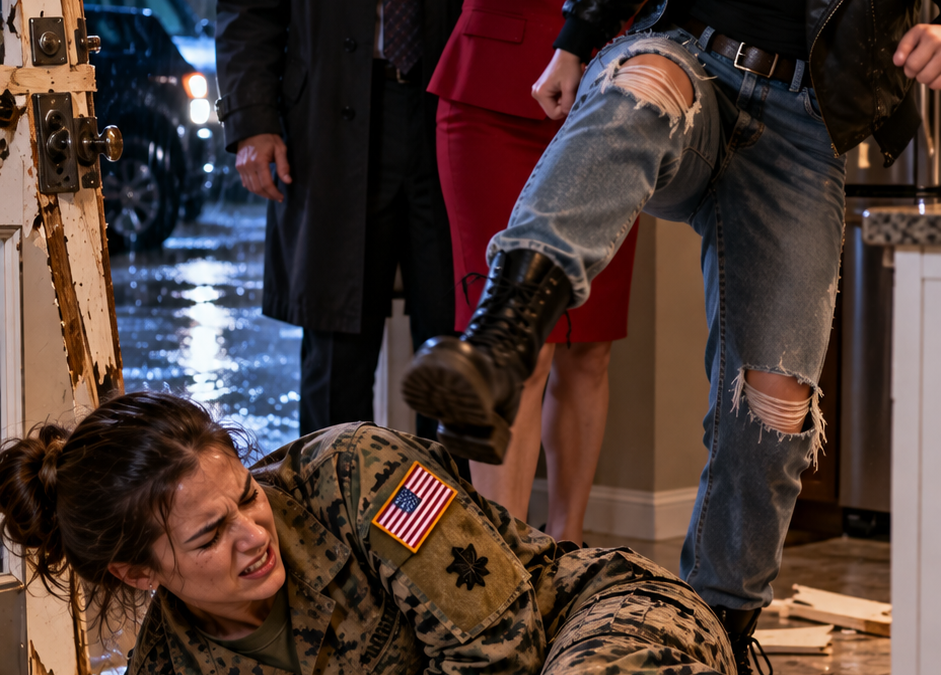
Four military police officers entered with the kind of controlled urgency that made everyone else seem to move in slow motion.
Two approached Brooke.
Another directed Lenora away from me.
The fourth crouched beside my shoulder.
“Ma’am, can you hear me?”
I nodded.
“Are you injured?”
“My ribs.”
“Anywhere else?”
I cautiously moved my left shoulder.
Pain shot through it, but I could still move my arm.
“I think that’s it.”
He called for a medic.
Across the kitchen, Brooke had already begun talking.
“This is a family misunderstanding.”
“Keep your hands where I can see them,” one of the officers instructed.
“I’m her sister!”
“That doesn’t change what I just told you.”
Lenora recovered faster.
She always did.
“We came because we were worried about her,” she explained calmly. “There’s been a very difficult situation involving her father.”
The officer glanced toward the shattered doorframe.
“At two in the morning?”
Lenora didn’t answer.
My father stood near the wall.
His eyes met mine briefly.
Then he looked down.
A medic entered a few minutes later.
His name tag read ALVAREZ.
He was young, with steady eyes and a voice that remained calm while he examined me.
“I’m going to check your breathing, Staff Sergeant.”
I nodded.
He checked my pulse, oxygen level, and the painful area along my ribs.
Then he asked me to take a slow breath.
I tried.
Pain tightened beneath my side.
He looked concerned.
“You need imaging.”
“I have duty tomorrow.”
He stared at me.
“No, you don’t.”
Under different circumstances, I might have laughed.
Instead, I closed my eyes.
I’d imagined for years what it would feel like if somebody finally intervened when my family crossed a line.
I thought I’d feel triumphant.
Maybe even vindicated.
Instead, I felt exhausted.
And embarrassed.
Not because I’d called for help.
Because strangers were standing inside my home, looking at the life I’d worked so hard to build.
My deployment photographs.
My training manuals.
The coffee mug Sergeant Torres had given me after our last exercise.
The blue quilt folded across the sofa.
Every object belonged to the life I’d created after leaving my family’s house.
Now Brooke and Lenora had forced their way into it.
For a moment, I wanted to apologize to everyone for the inconvenience.
Then one of the officers approached.
“Staff Sergeant Mercer?”
“Yes.”
“Captain Harlan is on her way.”
My stomach tightened.
Captain Elise Harlan was my company commander.
She was professional, demanding, and exceptionally good at recognizing when a Marine was pretending to be fine.
She was also the last person I wanted to see me sitting on my kitchen floor at three in the morning with blood on my lip.
“Why?” I asked.
The officer looked surprised.
“Because you’re one of her Marines.”
I stared at him.
One of her Marines.
Not my father’s disappointing daughter.
Not Brooke’s favorite target.
Not the unwanted reminder that Lenora had married a man who already had a child.
I belonged somewhere.
And the people in that place weren’t going to ignore what had happened to me.
Alvarez helped me sit upright.
Across the room, Brooke had finally stopped arguing.
Then my father spoke.
“Claire.”
I looked at him.
His face had gone pale.
“There’s something you should know.”
Lenora turned sharply.
“Daniel.”
He flinched.
For one brief moment, I thought he might actually say whatever had been buried beneath his silence for years.
Then he lowered his eyes.
“Nothing.”
Lenora continued watching him.
Something passed between them.
Recognition.
Fear.
A secret.
Before I could ask what he meant, Captain Harlan arrived.
She entered through my broken doorway wearing a rain jacket over civilian clothes.
Her dark hair was pulled into a loose knot, and her expression was unusually serious.
She glanced around the room.
Brooke.
Lenora.
My father.
Then me.
She came straight to my chair.
“Are you all right?”
“I’ve been better, ma’am.”
“I can see that.”
Her gaze shifted to the shattered door.
“Hospital first.”
“I can explain.”
“Later.”
“It’s complicated.”
“Family usually is.”
There was no judgment in her voice.
That helped more than I wanted to admit.
By three-thirty, Brooke and Lenora had been taken for formal questioning.
My father was escorted separately to give his account.
I was transported to the base hospital.
The rain followed us.
It hammered against the ambulance roof and blurred the installation’s streetlights into pale streaks.
Alvarez sat beside me.
“You have somebody we can call?”
“No.”
“A friend?”
“I’m fine.”
He gave me a patient look.
“That wasn’t the question.”
I almost said Javier Torres.
He was the closest friend I’d made in the Marines, the person I trusted whenever something went wrong.
But it was nearly four in the morning.
I didn’t want to wake him.
I didn’t want to explain why my family had broken into my housing unit.
So I shook my head.
Alvarez didn’t push.
The hospital scans showed no fractures.
I had substantial bruising and muscle strain around my ribs, along with a painful shoulder and a cut inside my mouth.
The physician prescribed treatment, explained the recovery precautions, and advised me to avoid strenuous activity while the injuries healed.
I should have been relieved.
Instead, when he said I could be discharged, I realized I had nowhere I wanted to go.
My housing unit was a crime scene.
My front door was broken.
And every time I imagined walking into that kitchen again, I could hear Brooke’s boot striking my ribs.
At five that morning, Captain Harlan found me sitting beside a vending machine.
She was carrying two paper cups.
“Coffee.”
“I’m not supposed to mix caffeine with the medication they gave me.”
“Tea.”
I accepted the cup.
Steam warmed my hands.
For a few minutes, we sat without speaking.
Then she said, “You don’t have to tell me anything tonight.”
“It’s morning.”
“That’s your first useful observation since I got here.”
I smiled.
Then immediately regretted it when my ribs protested.
Harlan waited until I stopped wincing.
“Before you start worrying about your career, I want you to understand something.”
I stared into my tea.
“You did not cause this.”
I looked up.
“Ma’am—”
“Your home was entered without permission. You were injured. You called for help. That is not misconduct.”
“I know.”
“Do you?”
I looked away.
She waited.
Finally, I admitted, “I don’t like people knowing what my family is like.”
Harlan took a sip of coffee.
“When I was twenty-six, my older brother borrowed eight thousand dollars from me and disappeared for nine months.”
I blinked.
She shrugged.
“Families can be complicated.”
“That’s different.”
“Yes.”
She looked at me.
“Because it happened to me.”
I laughed.
My ribs immediately objected.
She smiled faintly.
Then her expression softened.
“The authorities will handle the legal questions, Claire. You don’t have to decide what happens to your relatives this morning.”
I looked down.
“What am I supposed to decide?”
“Whether you want them in your life.”
She paused.
“That’s a separate question.”
Those words stayed with me long after she left.
At seven, Sergeant Javier Torres arrived carrying a paper bag from the diner outside the west gate.
He took one look at me.
“You look terrible.”
“Thank you.”
“I brought pancakes.”
“I forgive you.”
He sat beside me and opened the bag.
For several minutes, we ate in silence.
Then he asked, “What happened?”
I told him the simplified version.
My family had arrived without permission.
They’d forced the door.
Brooke had assaulted me.
I’d called for help.
Military police had responded.
He listened without interrupting.
When I finished, he handed me another pancake.
“That’s not the whole story.”
“No.”
“Want to tell me the rest?”
“No.”
“All right.”
That was why Torres was my closest friend.
He understood that caring about someone didn’t entitle him to every painful memory they possessed.
We finished breakfast.
Then my phone vibrated.
An unknown number.
A message appeared.
CLAIRE, THIS IS YOUR FATHER. PLEASE DON’T BLOCK THIS NUMBER. I NEED TO SPEAK TO YOU ALONE.
I stared at it.
Torres noticed.
“Who is it?”
I showed him.
He frowned.
“Want me to answer?”
“No.”
Another message arrived.
THERE ARE THINGS ABOUT YOUR MOTHER YOU WERE NEVER TOLD.
Everything inside me went still.
My mother, Sarah Mercer, had died when I was nine.
Or at least, that was the story my father had always told me.
A car accident on a rain-soaked highway outside Richmond.
I remembered very little about that day.
White flowers.
A funeral.
My father’s hand shaking when he held mine.
A closed casket.
Then years of silence.
I remembered Lenora and Brooke entering our lives three years later.
At least, that was how I’d always understood it.
I handed Torres the phone.
He read the message.
“Could be manipulation,” he said.
“I know.”
“Could also be true.”
“I know.”
He returned the phone.
“What do you want to do?”
I looked down at my bruised hands.
I wasn’t ready to hear another explanation from a father who’d watched his wife and stepdaughter assault me.
But I couldn’t ignore the possibility that he knew something about my mother.
So I typed two words.
NOT TODAY.
His answer arrived immediately.
I UNDERSTAND.
Then another message appeared.
WHEN YOU’RE READY, ASK ME ABOUT THE BLUE BOX.
I stopped breathing.
The blue box.
I knew exactly what he meant.
And suddenly, what had happened in my kitchen seemed connected to something much older than Brooke’s cruelty.
I was nine when I last saw the blue box.
It had been made of wood and painted a pale, powdery blue. The brass latch never closed properly, and my mother used to keep it on the highest shelf in her bedroom closet.
Sometimes, when she thought I was asleep, she’d bring it downstairs and write letters at the kitchen table.
I remembered watching her once from the hallway.
She had been wearing an old yellow sweater, and a glass of water sat beside her elbow. She’d looked tired, but when she noticed me, she’d smiled.
“Can’t sleep, sweetheart?”
“What are you writing?”
“Letters.”
“To who?”
She’d held out her arms.
“To somebody I love very much.”
I ran toward her, convinced she meant my father.
She laughed and kissed the top of my head.
I hadn’t thought about that conversation in years.
After she died, the blue box disappeared.
When I asked Dad where it had gone, he told me he’d thrown it away while clearing out her belongings.
I cried for almost an hour.
He told me it was only a box.
Eventually, I stopped asking.
Now, seventeen years later, my father was telling me to ask about it.
I looked at Torres.
“He lied about getting rid of something my mother left.”
Torres didn’t ask me to explain.
He simply folded the empty pancake bag and dropped it into the trash.
“Then he has some explaining to do.”
By early afternoon, the command had arranged temporary lodging for me while maintenance personnel secured my housing unit and replaced the damaged doorframe.
The room was small, with cheap curtains, a narrow bed, and a kitchenette barely large enough to prepare breakfast.
I slept for five hours.
When I woke, sunlight was pouring through the blinds.
For a moment, I forgot everything.
Then I tried to sit up.
Pain tightened around my ribs.
The memory of Brooke’s boot returned immediately.
I reached for my phone.
Seventeen messages.
Several were from Marines in my unit.
Staff Sergeant, need anything?
We left food at the front desk.
No need to respond. Just checking on you.
There was a message from Captain Harlan.
Your door is secured. Housing will replace the frame tomorrow. You’re off duty for two days.
I stared at it.
I’d spent years teaching junior Marines that injuries needed to be reported and treated properly. Yet my first instinct was to return to work before anyone had time to ask how I was doing.
I put the phone down.
Then I picked it up again and called the investigating officer.
He explained the next steps without making promises he couldn’t keep.
There would be statements, evidence collection, and coordination with the appropriate civilian authorities because my relatives weren’t service members.
My injuries had been documented.
The broken doorframe had been photographed.
The responding officers had recorded the condition of my home and the behavior of everyone present.
I asked whether my father would be charged.
The officer explained that his role was still being examined.
I didn’t press for an answer.
For once, I was willing to let someone else do their job.
At six that evening, Torres knocked on my door.
He was carrying a grocery bag and a small toolbox.
“You’re not allowed to repair government housing,” I told him.
“I know.”
“Then why do you have tools?”
“In case anything unrelated to government housing needs fixing.”
“Such as?”
He raised an eyebrow.
“Are you going to let me in or conduct a formal inspection?”
I stepped aside.
He entered and immediately opened my refrigerator.
He stared at its contents.
“Yogurt, mustard, and half an orange.”
“I’ve been here for less than a day.”
“That’s not a meal.”
He began unpacking groceries.
Soup.
Bread.
Fruit.
Coffee.
A carton of eggs.
I watched him.
“Javier, you didn’t have to do this.”
He glanced at me.
“I know.”
Two ordinary words.
I know.
Not because we’re related.
Not because you owe me.
Not because I expect something in return.
He’d simply chosen to help.
We ate soup at the little table beside the window.
Afterward, he noticed that I kept looking at my phone.
“Your dad?”
I nodded.
“Want advice?”
“No.”
“Good. I don’t have any.”
I laughed.
Then winced.
Torres waited.
“Whatever he tells you, Claire, remember something.”
“What?”
“Information might explain why somebody behaved a certain way. It doesn’t automatically excuse what they did.”
I looked at him.
He stood and picked up his jacket.
“Call me if you need anything.”
After he left, I sat alone for nearly an hour.
Then I called my father.
He answered before the second ring.
“Claire.”
His voice sounded smaller than it had in my kitchen.
“Where are you?”
“A motel outside Fredericksburg.”
“Where’s Lenora?”
“Her attorney told me not to contact her.”
“And Brooke?”
“Same.”
I took a breath.
“Tell me about the blue box.”
For several seconds, I heard nothing.
Then he exhaled.
“I kept it.”
“Why did you tell me you threw it away?”
“I was afraid you’d read the letters.”
I stared at the wall.
“They were Mom’s.”
“Yes.”
“Then why wouldn’t I read them?”
He hesitated.
“Because some of them weren’t written to me.”
A cold sensation moved through my chest.
“Who were they written to?”
“You.”
I stood so quickly that pain shot through my side.
I gripped the edge of the table.
“My mother wrote letters to me?”
“Yes.”
“How many?”
“Twenty. Maybe more.”
“When?”
“During the last year before she died.”
I sat down again.
“What kind of letters?”
My father was quiet.
Then he told me something I should have known seventeen years earlier.
My mother had been diagnosed with cardiomyopathy two years before the accident that killed her.
Her doctors had warned her that her condition might worsen.
She’d continued receiving treatment, but the diagnosis had frightened her.
She knew there was a possibility she might not live to see me grow up.
So she began writing letters.
For my birthdays.
My graduation.
The day I left home.
Milestones she desperately wanted to experience with me but feared she might miss.
I pressed a hand against my forehead.
“You never told me she was sick.”
“She didn’t want you frightened.”
“I was nine. I’m twenty-six now.”
“I know.”
“You’ve had seventeen years to tell me.”
“I know.”
I stared at the blank television screen across the room.
All those birthdays.
All those promotions.
All the evenings when I’d sat alone, wondering what my mother would have thought about the woman I was becoming.
She’d left me letters.
And my father had hidden them.
“Why?”
My voice broke.
“Why would you do that to me?”
He was silent for so long that I thought the call had disconnected.
Then he said, “Because the first letter terrified me.”
“What did it say?”
“That if anything happened to her, I wasn’t supposed to let grief turn me into someone you couldn’t rely on.”
I closed my eyes.
He continued.
“Your mother knew me, Claire. She knew I hated confrontation. She knew I withdrew whenever something became difficult.”
“You certainly proved her right.”
“Yes.”
His willingness to agree startled me.
“I read three letters after she died,” he said. “Then I locked the box.”
“Why?”
“Because they were full of everything she believed you could become. Brave. Curious. Stubborn. She said you’d probably spend your life trying to protect people who didn’t ask you to.”
I felt my eyes burn.
That sounded like my mother.
Or at least, like the woman I remembered.
“What does any of this have to do with Lenora?”
My father’s breathing changed.
“She found the box.”
“When?”
“Years ago.”
“Did she read the letters?”
“I don’t know how many.”
“What did she do?”
“She told me I needed to stop living in the past. She wanted me to get rid of everything.”
“Did you?”
“No.”
I was surprised.
For once, he’d refused her.
“Where is it?”
“In a storage unit in North Richmond.”
“Then I want it.”
“Of course.”
“And you’re not bringing it to my house.”
“I understand.”
“We meet outside the installation. Somewhere public. Torres is coming with me.”
“All right.”
“If I decide afterward that I never want to see you again, you accept that.”
There was a long pause.
“Yes.”
I closed my eyes.
“Tomorrow. Ten in the morning.”
“I’ll be there.”
I was about to end the call when he spoke again.
“Claire?”
“What?”
“I’m sorry.”
I looked at the dark screen of the television.
“I don’t know what to do with that yet.”
“I understand.”
I ended the call.
My hands were shaking.
The following morning, Torres arrived at nine-thirty with coffee and sunglasses.
He didn’t ask whether I was nervous.
He didn’t remind me that I could change my mind.
He simply drove.
We met my father in a public visitors’ parking area outside the base.
He was standing beside an aging sedan.
Without Lenora next to him, he looked older than I remembered.
His shoulders curved inward, and gray had overtaken most of his hair.
But I barely noticed his appearance.
Both of his hands were resting on a pale-blue wooden box.
The paint was chipped.
The brass latch sat crooked on the front.
And across the lid, in my mother’s handwriting, was my name.
CLAIRE.
My breath caught.
For several seconds, I couldn’t move.
Then I approached him.
“You kept it all these years.”
He nodded.
“Yes.”
“Why?”
He looked at the pavement.
“Because throwing it away felt unforgivable.”
“And hiding it didn’t?”
He lifted his eyes.
“No.”
No explanation.
No excuse.
For once, he simply accepted what he’d done.
He offered me the box.
I didn’t take it immediately.
“Is everything inside?”
“Everything I kept.”
Something about his answer bothered me.
“What does that mean?”
He rubbed his hands together.
“Three letters are missing.”
I stared at him.
“Missing?”
“Lenora took them.”
“When?”
“Years ago.”
“Why didn’t you get them back?”
He looked away.
“I was afraid to confront her.”
I felt the familiar anger rising.
“Which letters?”
“One marked for your twenty-first birthday.”
I swallowed.
I remembered that birthday.
I’d been completing a difficult training rotation, and I’d spent most of the day exhausted and wondering whether I belonged in the Marine Corps.
A letter from my mother would have meant everything.
My father continued.
“One marked for your wedding.”
I gave a humorless laugh.
“I’m not married.”
“I know.”
“And the third?”
He hesitated.
“It didn’t have a label.”
“What was inside?”
“I never read it.”
I stared at him.
“You expect me to believe Lenora randomly took three letters?”
“No.”
“Then why those three?”
My father looked toward Torres.
Then back at me.
“I think she was looking for something.”
“What?”
“I don’t know.”
I nearly turned away.
Then he reached inside his coat and removed an old envelope.
“But I found this last week.”
I looked at it.
“What is it?”
“A receipt for a safe-deposit box.”
I frowned.
“Whose?”
“Your mother’s.”
I took it carefully.
The receipt was from Richmond Community Bank.
The original branch had closed years earlier following a merger with Commonwealth Federal.
My father explained that he’d discovered the receipt inside one of my mother’s old notebooks while looking for the blue box.
“Did you know she had a safe-deposit box?”
“No.”
“Have you contacted the bank?”
“Not yet.”
I looked at Torres.
He was watching the exchange without interrupting.
My father gestured toward the wooden box.
“There are other documents inside.”
I opened it.
The smell of old paper rose from within.
Letters were stacked neatly together.
Some were tied with faded ribbon.
Others had handwritten labels.
CLAIRE — AGE SIXTEEN.
CLAIRE — HIGH SCHOOL GRADUATION.
CLAIRE — WHEN YOU LEAVE HOME.
I swallowed.
All those years.
All those milestones.
My mother had thought about them.
She’d imagined the person I might become.
And she’d written messages for a future she knew she might not be able to share with me.
Beneath the letters were several documents and an old photograph.
My mother was standing beside a woman I didn’t recognize.
They looked young.
Happy.
Their arms were around each other, and both were laughing at whoever had taken the picture.
On the back, my mother had written:
Sarah and Mara, 1998.
I showed it to my father.
“Who’s Mara?”
“Mara Ellison. Your mother’s closest friend.”
“I’ve never heard of her.”
“I know.”
“Why?”
He lowered his eyes.
“Lenora hated when I talked about Sarah.”
I stared at him.
“That never stopped you from speaking.”
He looked directly at me.
“Yes, Claire. It did.”
I hated how much truth there was in his answer.
I returned to the box.
Beneath an old birthday card was a deposit slip bearing the name Commonwealth Federal.
I unfolded it.
Then I stopped.
The account was labeled:
SARAH MERCER / MARA ELLISON EDUCATION TRUST.
Beneath that were two words.
Beneficiary: Claire Mercer.
I read the document twice.
Then I looked up.
“What is this?”
My father’s face drained of color.
“I’ve never seen that.”
“Mom created an education trust?”
“I didn’t know.”
“Did I ever receive anything from it?”
He shook his head.
I’d paid for my community college courses before enlisting.
Every textbook.
Every certification.
Every dollar I’d needed to begin building a life outside my father’s house.
Meanwhile, my mother might have left something specifically intended to help me.
Torres stepped closer.
“Claire, look at the date.”
I checked.
Two years before my mother’s death.
He pointed toward the safe-deposit receipt.
“Same bank.”
My father nodded.
A terrible thought began forming.
“Could Lenora have known about this?”
My father closed his eyes.
“I don’t know.”
I searched the box again.
At the very bottom, beneath the remaining letters, I found another envelope.
It had been forwarded years earlier from Commonwealth Federal to my father’s address.
He stared at it.
“I’ve never seen that.”
I opened it carefully.
Inside was a notice explaining that the original safe-deposit lease had been transferred after the bank merger.
It listed the authorized signatories.
Sarah Mercer.
Mara Ellison.
And a third name, added six months before my mother’s death.
Lenora Vale.
For several seconds, nobody spoke.
I read the name again.
Then a third time.
My stepmother.
The woman who’d entered my life three years after Sarah Mercer died.
According to my father, that was when they’d first met.
I held out the document.
“You told me you didn’t know Lenora until three years after Mom’s accident.”
He stared at the page.
“That’s what I believed.”
“Then explain this.”
His hands began trembling.
“I can’t.”
I looked at Torres.
He was studying the document with an expression I hadn’t seen on his face before.
Concern.
Not surprise at the existence of a bank account.
Concern that something much larger might have been hidden inside my father’s family.
I looked back at Daniel.
“Why was Lenora authorized to access my mother’s safe-deposit box before Mom died?”
He swallowed.
“I don’t know.”
This time, I believed him.
Because for the first time in my life, the fear on my father’s face didn’t appear to come from Lenora.
It came from the possibility that the woman he’d married had known his first wife long before she ever admitted it.
And that she’d spent years hiding something Sarah Mercer had intended for me.
Torres was the first to speak.
“Claire, I think you need an attorney before you start contacting the bank.”
I looked at him.
“You think there’s money missing?”
“I think you’ve found documents that deserve a proper explanation.”
He glanced toward my father.
“And if Lenora had access to your mother’s records before she died, you need to find out exactly what that access allowed her to do.”
I looked down at the blue box.
For years, I’d believed the worst thing Lenora had taken from me was my relationship with my father.
Now I was staring at the possibility that she’d also interfered with the last things my mother had tried to leave me.
I closed the box.
Then I turned toward Daniel.
“Did you tell Lenora you were looking for this?”
He nodded slowly.
“Last week.”
“What did she say?”
“She became upset. She wanted to know why I was bringing up Sarah again.”
I stared at him.
“Did you mention the safe-deposit receipt?”
He hesitated.
“Yes.”
“And what happened?”
“She demanded that I give her the box.”
My chest tightened.
“Did you?”
“No. I told her I wanted to contact you.”
I thought about the previous night.
The broken door.
Brooke’s boot.
Lenora standing in my kitchen, telling me I belonged to her family.
“Is that why you came to my house?”
Daniel looked away.
“She said we needed to settle everything before you started asking questions.”
I felt sick.
“And you went along with it.”
He didn’t answer.
I stepped backward.
“Claire, I never thought Brooke would hurt you like that.”
I looked directly at him.
“She threatened to break my leg before she kicked me. Lenora ordered her to break my arm. And you stood there.”
His face crumpled.
“I know.”
I picked up the blue box.
“You’re not coming into my home again.”
He nodded.
“I understand.”
“And you’re going to tell the investigators everything you know. Including what Lenora said before you came to the base.”
“All right.”
I started toward Torres’s truck.
My father called after me.
“Claire, I’m sorry.”
I stopped.
For one moment, I almost turned around.
Then I remembered myself lying on the kitchen floor, waiting for him to protect me.
“I’m not ready to hear that from you.”
I walked away.
The following week, an attorney helped me begin the process of obtaining the old bank records.
We also provided the safe-deposit documents to the investigators handling the assault and unauthorized entry into my housing unit.
The financial questions eventually required a separate investigation.
I didn’t try to solve everything myself.
I was still recovering from my injuries, and Captain Harlan had made it abundantly clear that I wasn’t going to turn medical leave into another demanding assignment.
Torres agreed with her.
Enthusiastically.
One afternoon, he found me sitting in temporary lodging with bank correspondence spread across the table.
He looked at the papers.
Then at me.
“Absolutely not.”
“What?”
“You’re supposed to be resting.”
“I’m sitting down.”
“You’re sitting down aggressively.”
I stared at him.
He collected the empty coffee cups from the table.
“Let the attorney do the attorney work.”
I hated that he was right.
But little by little, I began allowing other people to help.
Captain Harlan coordinated with housing personnel to have my door repaired.
My command arranged for me to speak with a victim advocate.
Torres continued showing up with groceries, terrible jokes, and an almost insulting belief that I couldn’t be trusted to prepare a proper meal.
For the first time in my adult life, I was surrounded by people who offered assistance without making me feel indebted to them.
Meanwhile, the bank records revealed something that changed everything.
The education trust had been real.
My mother and Mara Ellison had established it when I was young, using money Sarah had inherited from her own parents and additional savings she’d set aside for my future.
The account had been intended to help with my education and eventually provide me with financial independence.
Mara had been involved in establishing it.
Lenora’s name, however, appeared on the safe-deposit lease because she’d been authorized to access documents kept there.
That authorization had not made her the owner of the trust.
And it hadn’t entitled her to its money.
The next question was how she’d obtained access in the first place.
My attorney eventually located Mara Ellison.
She was living in North Carolina.
When she learned who I was, she began crying.
“Claire?”
Her voice trembled over the telephone.
“Oh, sweetheart. You sound just like your mother.”
For a moment, I couldn’t speak.
Then I asked whether she’d known Lenora.
“Yes.”
My hand tightened around the phone.
“How?”
Mara explained that she’d met Lenora during the final years of my mother’s life.
Sarah had been attending medical appointments while managing her heart condition, and Lenora had become acquainted with her through a local patient-support organization.
My mother had liked her.
Lenora had seemed compassionate, dependable, and willing to help whenever Sarah needed transportation or assistance with paperwork.
My father had been traveling frequently for work during that period.
Mara had also moved away temporarily.
When Sarah needed someone nearby who could retrieve documents in an emergency, she’d agreed to add Lenora as an authorized person on her safe-deposit lease.
I stared at the notes I’d been taking.
“So Lenora knew my mother.”
“Yes.”
“Before she died.”
“Yes.”
“And she knew about the trust?”
Mara hesitated.
“She knew it existed. Sarah trusted her with certain documents.”
I felt nauseated.
“Did she know who I was?”
“Of course.”
I closed my eyes.
For years, Lenora had spoken about my mother as though she’d been nothing more than an inconvenient memory.
She’d complained whenever my father mentioned Sarah.
She’d discouraged me from keeping photographs of her.
And she’d insisted that I should be grateful to have a new family.
All that time, she’d known exactly who my mother was.
She’d known about the trust.
She’d known that Sarah had written letters for me.
And she’d never told me.
“Why did you lose contact with my father?” I asked.
Mara sighed.
“After Sarah died, everything fell apart. I moved. Daniel stopped returning calls. When I tried to reach you later, I was told the family wanted privacy.”
“Who told you?”
There was a long silence.
Then she answered.
“Lenora.”
I stared at the wall.
My stepmother had been separating me from my mother’s past long before I understood there was anything to separate me from.
The financial investigation continued.
Bank records showed that a substantial distribution from the trust had been processed after my eighteenth birthday.
The paperwork represented that I’d authorized the transaction and received the money for educational expenses.
I hadn’t.
I’d paid for my courses myself.
The signature on the beneficiary acknowledgment wasn’t mine.
And the money hadn’t gone into any account I’d ever controlled.
Investigators traced the distribution to accounts associated with Lenora.
Some of it had subsequently been used for household expenses and Brooke’s education.
When my attorney told me, I sat quietly for a long time.
I wasn’t thinking about the amount.
I was thinking about the nights I’d spent studying after exhausting shifts because I couldn’t afford to reduce my working hours.
The books I’d purchased secondhand.
The courses I’d delayed.
The financial stress I’d carried while believing my mother had left me nothing except memories.
Lenora had known.
My father had been too frightened to challenge her.
And I’d grown up thinking I had to earn every opportunity without help.
That night, I opened the blue box again.
I selected the letter marked for my high school graduation.
My mother had written it when I was still a little girl.
She’d imagined me walking across a stage, receiving a diploma, and beginning to make decisions about my own future.
She told me she hoped I would discover something I loved enough to work hard for.
She wrote that I didn’t have to become a doctor, a lawyer, or anything else that sounded impressive.
She simply wanted me to live a life that felt like mine.
Near the end, there was a sentence that made me cry.
I hope you never mistake someone’s unwillingness to love you properly for evidence that you are difficult to love.
I read it again.
Then I closed my eyes.
For seventeen years, I’d needed those words.
She’d written them for me.
And they’d been sitting inside a box while I struggled to understand why my family treated me the way it did.
I cried until my ribs hurt.
Then I carefully folded the letter and placed it beside my bed.
It took several months for the investigations to reach their conclusions.
The evidence concerning the assault was substantial.
My damaged door.
The photographs taken by military police.
My medical records.
The statements of the responding officers.
And the account my father eventually gave investigators.
He acknowledged that Lenora had demanded they confront me after discovering that he intended to turn over my mother’s records.
He admitted that he’d accompanied them even though he knew I’d refused their earlier attempts to contact me.
He also admitted that he’d watched Brooke assault me and had done nothing to stop her.
I listened to his recorded statement through the appropriate process.
For once, he didn’t claim he’d misunderstood what had happened.
He didn’t describe it as a family disagreement.
He simply admitted the truth.
It was too late to change that night.
But at least he was no longer asking everyone else to participate in his silence.
Brooke eventually entered a guilty plea for her role in the unlawful entry and assault.
Lenora faced separate proceedings arising from the assault-related incident and the financial misconduct uncovered afterward.
Additional records obtained during the financial investigation supported the evidence that she’d knowingly used fraudulent documents to divert money intended for me.
The case also led investigators to the three missing letters.
They were recovered from a locked file cabinet containing old bank records and copies of the paperwork used to process the trust distribution.
I’d wondered for months why she’d taken those particular letters.
The answer was painfully simple.
The letter intended for my twenty-first birthday referred directly to the education trust.
My mother had written that she hoped the money would give me choices she’d never had when she was young.
She explained where the trust documents were kept and told me to contact Mara if I ever had questions.
The letter intended for my wedding mentioned a small collection of jewelry stored alongside the trust paperwork.
The third letter contained additional instructions about my mother’s financial arrangements, including information that helped investigators compare the genuine records with the documents later submitted in my name.
Lenora had taken the letters because they connected me to the inheritance she’d diverted.
But I didn’t believe that was her only reason.
Those letters also connected me to a mother she’d spent years trying to erase.
They proved that Sarah Mercer had imagined my future with love and tenderness long before Lenora entered our home.
And they proved that my mother hadn’t forgotten me.
She’d simply never had the chance to give me what she’d prepared.
I eventually learned that there was no evidence connecting Lenora to my mother’s fatal car accident.
That mattered.
For several terrible weeks, I’d been afraid the discovery of her earlier relationship with Sarah meant something far darker had happened.
The investigators found no basis for that fear.
My mother had died in an accident.
Lenora’s wrongdoing had involved what she did with the trust, the documents, and the relationships my mother left behind.
Knowing the distinction didn’t make me forgive her.
But it allowed me to stop imagining horrors for which there was no evidence.
The financial case resulted in an order requiring restitution, and my attorney continued working to recover the remaining funds.
Not everything happened quickly.
Not every dollar was immediately available.
But the documents finally established that the trust had belonged to me.
And for the first time, I had complete access to the truth about what my mother had tried to provide.
My father wrote several letters after the proceedings began.
I read the first.
In it, he acknowledged that he’d allowed Lenora to control his relationship with me.
He admitted that he’d spent years avoiding conflict because confronting his wife frightened him.
Then he wrote something I hadn’t expected.
He said he had always known I was brave.
He’d admired the fact that I’d joined the Marines and built a life for myself.
But he’d also resented the independence I’d developed because it reminded him how little courage he’d shown when I needed him.
I read that paragraph several times.
Understanding his feelings didn’t erase his decisions.
He’d watched me being hurt.
He’d concealed my mother’s letters.
He’d allowed Lenora to isolate me from people who might have told me the truth.
And he’d accompanied her to my home on the night she decided to force her way inside.
I wasn’t ready to forgive him.
I wrote back once.
I told him I appreciated his decision to cooperate with the investigation.
I also told him that I needed distance and that he should respect my choice not to maintain a relationship with him.
He replied with a single sentence.
I understand, Claire, and I won’t ask you to change your mind.
For once, I believed him.
When I returned to my housing unit, the front door had been repaired.
The broken frame was gone.
The damaged tiles had been replaced.
And somebody from my unit had left a small plant on the kitchen counter with a note that read:
Welcome home, Staff Sergeant.
I stood in the doorway for several minutes.
Then I carried my bag upstairs.
It took time before the house felt like mine again.
For a while, I checked the locks repeatedly before bed.
Thunderstorms made me tense.
Unexpected knocks at the door sent my heart racing.
But I kept going to my appointments, spending time with friends, and allowing myself to recover without pretending I was unaffected.
One evening, Torres came over for dinner.
He looked around the living room.
“You’re finally putting everything back.”
I followed his gaze.
My deployment photographs had returned to the walls.
The certification manuals were back on their shelves.
The blue quilt lay folded across the sofa.
And beside the window stood a small table holding my mother’s photograph.
Sarah Mercer.
Smiling beside Mara in the sunlight.
Torres approached it.
“That’s your mom?”
I nodded.
“Yeah.”
He studied the picture.
“You look like her.”
I smiled.
“Everybody keeps saying that.”
“Well, they’re right.”
We ate dinner, argued about a training exercise, and spent most of the evening discussing things that had absolutely nothing to do with my family.
It was wonderful.
After Torres left, I sat beside the window with the blue box on my lap.
I’d begun reading one of my mother’s letters every Sunday.
Not because I wanted to finish them quickly.
Because I finally had the opportunity to know her at my own pace.
Some were funny.
Some were full of advice I probably would have ignored as a teenager.
Others were heartbreakingly ordinary.
She wondered whether I’d like reading as much as she did.
Whether I’d learn to drive before my father felt comfortable giving me the car keys.
Whether I’d fall in love.
Whether I’d find friends who made me laugh until my stomach hurt.
She hadn’t known I would become a Marine.
She hadn’t known I’d earn the rank of staff sergeant or spend years learning to lead people through difficult situations.
But she’d known something far more important.
She’d known I would become my own person.
And she’d loved that person before either of us knew exactly who she would be.
I opened the final letter I’d chosen for that evening.
It wasn’t attached to a birthday or a particular milestone.
At the top, my mother had written:
For the day you feel alone.
I sat very still.
Then I began reading.
She wrote that there might be days when I questioned whether I belonged anywhere.
Days when people who were supposed to protect me disappointed me.
Days when I felt that being strong meant never asking for help.
She wanted me to remember that I didn’t have to earn love by enduring cruelty.
That people who genuinely cared about me would respect my choices, even when they didn’t understand them.
And that if I ever found myself surrounded by people who treated me as though I were worthless, I should remember that their opinions weren’t the measure of my life.
I lowered the letter.
Outside, the base was quiet.
A few cars passed beneath the streetlights.
Somewhere down the road, I could hear Marines laughing as they returned from an evening out.
I thought about Captain Harlan arriving at my house because I was one of her Marines.
About Alvarez checking my breathing.
About Torres showing up with pancakes at seven in the morning and groceries that evening.
About Mara crying when she heard my voice for the first time in seventeen years.
And about my mother, who’d written letters because she was afraid she wouldn’t be there to tell me those things herself.
For so long, I’d believed that the people who shared my blood were the people whose approval I needed most.
Now I understood how mistaken I’d been.
My father could regret his choices.
Brooke and Lenora could face the consequences of theirs.
I could learn the truth about my mother’s life and reclaim what she’d intended for me.
But I didn’t have to return to the family that had hurt me simply because they finally acknowledged what they’d done.
I carefully placed the letter back inside the blue box.
Then I carried it to the bookshelf beside my mother’s photograph.
My front door was locked.
My home was quiet.
And for the first time since the night my family forced its way inside, the silence didn’t frighten me.
It belonged to me.








