𝗙𝗨𝗟𝗟 𝗦𝗧𝗢𝗥𝗬 My Radio Kept Calling My Name While a Police Officer Reached for His Handcuffs
𝗙𝗨𝗟𝗟 𝗦𝗧𝗢𝗥𝗬
I pointed toward the ladder truck.
“That’s where I need to be. Captain Foster is coordinating the eastern sector until I arrive.”
Briggs stepped closer.
“You’re wearing a street jacket, driving a private vehicle, and walking through my perimeter like the rules don’t apply.”
I kept my voice even.
“The rules apply. That’s why I’m asking you to verify my name instead of simply letting me pass.”
He frowned.
“Don’t tell me how to do my job.”
I glanced toward the eastern building.
Another surge of dark smoke pushed from beneath the roofline.
“Officer, there’s a serious fire developing less than a hundred feet from us. Call dispatch or ask somebody at that command post. They’ll confirm who I am.”
He didn’t move.
“Back behind the tape.”
I looked at the radio in his hand, then toward the firefighters gathering near the ladder truck.
I’d spent three decades working alongside police officers during emergencies.
Most understood that a secure perimeter and effective fire command were complementary responsibilities. Police kept unauthorized people out, protected evacuation routes, and gave firefighters room to work.
Sometimes senior emergency personnel arrived in unmarked vehicles or without their complete uniforms.
A quick verification solved the problem.
This should have been one of those situations.
But Briggs seemed increasingly offended by the fact that I was offering a solution instead of simply leaving.
A younger officer stood beside the rear of a nearby cruiser.
His nameplate read RUIZ.
He was watching my hands and equipment with more interest than Briggs had shown.
“Officer,” I said again, “my radio is department-issued. My turnout gear is standard. My identification is available. Contact fire command.”
Briggs looked at the radio.
Then he looked at me.
“Anybody can buy that stuff.”
I felt the first stirrings of frustration.
But frustration wasn’t useful.
Not here.
Not with a building burning behind him.
I took a slow breath.
“Then verify it.”
He folded his arms.
“You’re not going anywhere.”
My radio crackled.
“Eastern Sector to Battalion One. Do you copy?”
I recognized the unit identifier.
Captain Lena Foster.
She was a twenty-two-year veteran of the department and one of the most reliable fire officers I’d ever worked with.
When Lena became concerned about a developing fire condition, I listened.
I raised the radio slightly.
“Battalion One, go ahead.”
Briggs stepped toward me.
“I told you to stay behind the line.”
“I’m answering fire command.”
“You can answer it from the other side.”
“Officer, I need to hear their report.”
He looked toward the burning buildings.
Then back at me.
For an instant, I thought he’d finally recognize the urgency.
Instead, his expression hardened.
“You’re making this more complicated than it needs to be.”
My radio crackled again.
Lena’s voice was less clear this time.
She was reporting worsening conditions above the eastern building’s third floor.
I caught the words attic involvement and rescue team standing by.
My attention shifted immediately.
Fire spreading through an attic void can travel far beyond the area where flames are visible. It can weaken structural members above firefighters who believe they’re operating beneath a stable ceiling.
If the roof assembly was deteriorating, Lena needed a command decision about whether to continue interior rescue operations.
I looked directly at Briggs.
“That transmission concerns the building behind you. I need to reach my command post now.”
He stepped closer.
“You’re going to do exactly what I tell you.”
“I’ll comply with reasonable perimeter procedures. But somebody needs to verify my identity immediately.”
“Stop arguing.”
“I’m not arguing. I’m explaining why this matters.”
His hand moved toward his duty belt.
I noticed the gesture.
So did Officer Ruiz.
I kept both hands visible.
“There’s no reason for this to become physical.”
Briggs stared at me.
Then he pointed toward the public sidewalk.
“Last chance. Get behind the tape.”
My radio called again.
“Battalion One, Eastern Sector. Need confirmation on command location.”
I raised it.
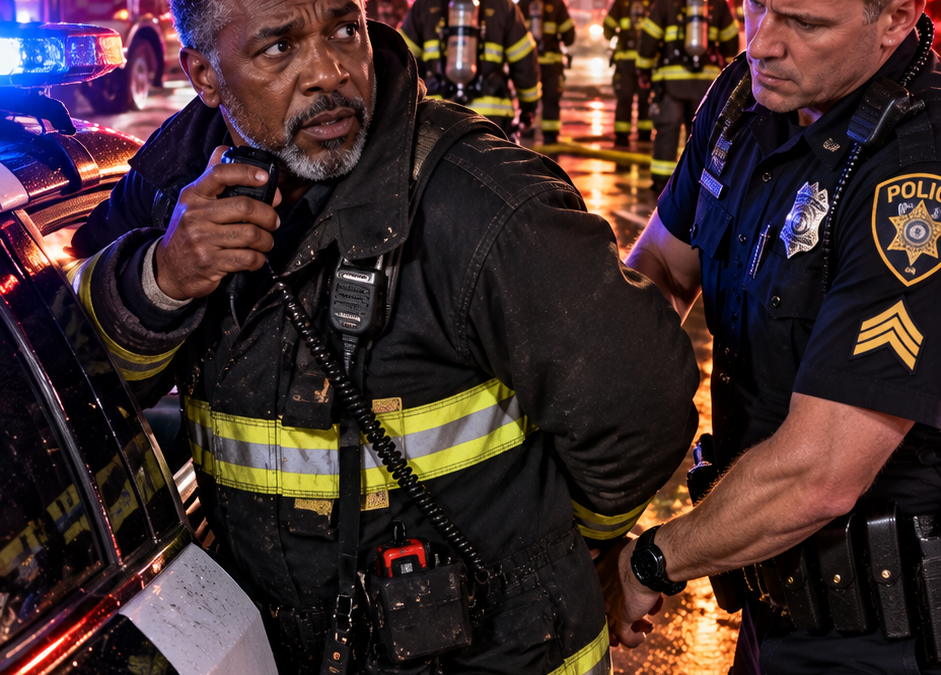
Before I could answer, Briggs lunged forward and snatched it from my hand.
The sudden force twisted my shoulder.
“Officer, give that back!”
He grabbed my right wrist.
“Turn around.”
I didn’t attempt to pull away.
“You’re taking a fire department radio during an active emergency. Contact your supervisor.”
“Turn around!”
He twisted my arm behind my back.
I felt the muscles across my shoulder tighten painfully.
Then he drove me toward the nearest patrol car.
My palms struck the hood.
Cold metal pressed against my hands.
“Stop resisting!”
“I’m not resisting!”
His forearm pressed between my shoulder blades.
I could hear people shouting behind the police tape.
I could also hear my confiscated radio crackling in his other hand.
Another transmission.
Another request.
Another decision waiting for me at a burning apartment building.
“Officer Briggs,” I said as calmly as I could, “I am Battalion Chief Marcus Grant. Call fire command. They’ll verify me.”
He tightened his grip.
“I don’t care what you claim to be.”
The first handcuff closed around my right wrist.
I felt the metal press against the bone.
Then he pulled my left arm behind me.
The second cuff clicked shut.
For a moment, I couldn’t believe what had happened.
I’d entered burning buildings.
I’d supervised dangerous rescue operations.
I’d stood in front of families while they waited to hear whether someone they loved had survived.
Yet there I was, handcuffed against a police cruiser while my firefighters were trying to reach me over the radio.
Briggs leaned closer.
“Maybe next time you’ll follow instructions.”
I turned my head enough to look at him.
“There may not be a next time for the people inside that building.”
He didn’t answer.
Instead, he maintained pressure against my back.
The heat from the fire rolled across the parking lot.
Through gaps between the emergency vehicles, I could see heavy smoke collecting above the eastern apartments.
It was growing darker.
More concentrated.
Exactly the development Lena had been warning about.
Officer Ruiz stepped closer.
“Tyler, hold on.”
Briggs looked toward him.
“What?”
Ruiz examined my turnout pants.
Then my boots.
Then the radio still clutched in Briggs’s hand.
“Let me see that.”
Briggs frowned.
“Why?”
“Just let me see it.”
He reluctantly handed over the device.
Ruiz turned it around.
A laminated department identifier was attached beneath the battery housing.
My surname appeared beside my battalion designation and equipment number.
Ruiz looked at me.
“Marcus Grant?”
“Yes.”
He studied the identifier again.
“Battalion chief?”
“That’s what I’ve been telling you.”
Briggs gave an irritated laugh.
“Anybody can put a label on a radio.”
Ruiz glanced toward the fire command area.
“Tyler, he’s wearing legitimate turnout gear, and the radio looks authentic. We need to verify this.”
“I already stopped him from entering a restricted area.”
“That’s fine. But we should confirm his identity before taking him anywhere.”
Briggs’s expression tightened.
He’d already made his decision.
Reconsidering it now would mean acknowledging that he might have escalated the encounter unnecessarily.
I understood that psychological trap.
I’d seen firefighters make dangerous mistakes when they became more interested in defending an initial decision than responding to new information.
But on a fireground, pride could kill people.
And right then, I was watching an officer allow his pride to become an operational hazard.
Ruiz stepped away and raised his patrol radio.
“Dispatch, this is Unit Twelve. Requesting identity confirmation for a possible fire department battalion chief at Pine Hollow.”
Static answered.
The police frequency was overwhelmed.
Evacuation requests.
Traffic-control updates.
Medical calls.
Units trying to locate displaced residents.
Ruiz repeated the request.
I could hear the strain in his voice.
Behind him, several residents were gathering along the police tape.
A woman wrapped in a gray blanket raised her phone.
An eleven-year-old boy stood beside her, clutching her sleeve while staring toward the burning apartments.
I would later learn that they were Angela Morris and her son, Caleb.
Angela had lived at Pine Hollow for several years.
The previous autumn, she’d attended a community fire-safety demonstration after an elderly neighbor experienced a kitchen fire.
I’d supervised part of that event.
Angela recognized my face before she remembered my name.
Now she was watching the same man who had explained fire evacuation procedures being held against a patrol car while an actual apartment fire raged nearby.
She kept recording.
Caleb pointed toward me.
“Mom, isn’t that the firefighter who came to our building?”
Angela looked from my face to the radio in Ruiz’s hand.
“I think it is, baby.”
“Why are they arresting him?”
She didn’t know how to answer.
Then something behind us exploded with a tremendous cracking sound.
I turned my head.
A section of the western building’s burning roof had folded inward.
Orange sparks erupted through the smoke.
Residents screamed and moved backward behind the tape.
Firefighters near the structure shifted equipment away from the collapse area.
Briggs instinctively looked toward the noise.
I didn’t.
My attention remained on the eastern building.
The western roof had already failed.
That was terrible, but it was no longer the immediate uncertainty I needed to resolve.
The eastern roof was still standing.
And somewhere beneath it, a rescue crew was waiting for authorization to search for a missing resident.
I could hear pieces of fire traffic from the radio in Ruiz’s hand.
A third-floor apartment.
Possible occupant.
Increasing heat above the rear corridor.
A structural engineer warning about overhead conditions.
I knew enough to understand the decision Lena was facing.
Entering immediately might save a life.
Entering without sufficient protection might cost several more.
She was doing what a responsible officer should do.
Holding the search team at the threshold until command could evaluate the available information.
But she didn’t know I was less than a hundred feet away.
Handcuffed against a police car.
“Officer Ruiz,” I said, “tell dispatch to contact Eastern Sector directly. Captain Foster is waiting for me.”
He nodded and tried again.
Briggs shifted his weight.
“That’s enough. We’re moving him away from the scene.”
I felt his hand settle near the chain between my cuffs.
“No.”
The word came out more forcefully than I’d intended.
Briggs tightened his grip.
“What did you say?”
I turned my head.
“If you move me away from this incident without verifying my identity, you’re going to interfere with an active rescue operation.”
His face hardened.
“You’re not threatening me.”
“I’m explaining the consequences of what you’re doing.”
“You’re done explaining.”
He began repositioning me.
My shoulder protested.
I kept my feet planted to avoid falling.
Ruiz stepped toward us.
“Tyler, Sergeant Harper is on her way. We should wait.”
Briggs looked furious.
“You called a supervisor?”
“Yes.”
“Why?”
“Because this isn’t adding up.”
For a moment, the two officers stared at each other.
I could feel the tension changing.
Ruiz was no longer merely uncertain about my identity.
He was becoming concerned about his partner’s behavior.
But before their argument could continue, my radio transmitted another urgent update.
“Command, Eastern Sector. Possible occupant still on the third floor. Need battalion authorization.”
I closed my eyes briefly.
Somebody was still inside.
I didn’t know their name yet.
I didn’t know whether they were conscious.
I didn’t know whether they had reached a window or were trapped behind a closed apartment door.
But I knew the people trying to rescue them were running out of time.
“Please,” I said quietly. “Just give me my radio.”
Briggs ignored me.
Ruiz looked toward the command post.
Then he raised his own radio again.
Across the parking lot, Captain Lena Foster was studying a tactical board beside a ladder truck.
She had soot streaked across one cheek and her helmet tilted slightly backward as she listened to the structural engineer’s latest assessment.
I later learned that a resident had approached her near an ambulance and reported that Dorothy Ellis, an elderly woman living on the third floor of the eastern building, might still be inside.
Dorothy was seventy-four.
She’d recently undergone hip surgery and had limited mobility.
Her neighbors described her as fiercely independent, the kind of woman who would rather spend an hour struggling with something than ask another person to do it for her.
Nobody could confirm whether she’d escaped before the evacuation began.
Lena had a search team ready.
Lieutenant Aaron Mitchell was already masked and equipped.
Firefighter Jason Reed stood beside him.
They were prepared to enter.
But the thermal readings above the third floor were worsening.
The fire appeared to be spreading through concealed attic space.
And the structural engineer was warning that continued heat exposure could weaken the roof assembly.
Lena needed to decide whether the remaining rescue opportunity justified the risk.
She also needed the battalion chief who’d been requested to take command.
She looked at the clock.
Then she looked toward the parking lot.
I should have arrived several minutes earlier.
She turned to another firefighter.
“Has anyone seen Chief Grant?”
“No, Captain.”
“He acknowledged the call.”
“Yes, ma’am.”
She looked past the ladder truck.
Smoke drifted between the emergency vehicles.
For a moment, the police line was hidden.
Then the wind shifted.
And Lena saw me.
Tan turnout pants.
Dark civilian jacket.
Gray hair.
Bent over the hood of a patrol car with both wrists handcuffed behind my back.
She stared for less than a second.
Then she started running.
Aaron and Jason followed her.
I didn’t see them immediately.
I heard somebody shouting my name.
“Chief!”
I lifted my head.
Lena was running across the parking lot, dodging a hose line and pushing through the drifting smoke.
“Chief Grant!”
Briggs turned.
Three firefighters in full turnout gear were heading directly toward us.
He looked from them to me.
Then toward Ruiz.
Lena reached the cruiser first.
“What in God’s name is happening?”
Briggs straightened.
“Ma’am, this individual attempted to cross a restricted police perimeter without proper authorization.”
Lena stared at him.
“Individual?”
She pointed toward me.
“That’s Battalion Chief Marcus Grant!”
Aaron stepped beside her.
“Chief, we’ve been trying to reach you.”
Jason looked at the handcuffs.
His expression shifted from confusion to disbelief.
“Why is he cuffed?”
Briggs glanced between them.
“He refused to comply with instructions.”
I lifted my head.
“Lena, give me the eastern building’s status.”
She understood immediately.
Whatever anger she felt about what she was seeing would have to wait.
“Possible occupant on the third floor. Rear corridor. Attic temperatures are climbing, and the structural engineer is concerned about the roof assembly.”
“Search team?”
“Staged at the eastern entrance.”
“Backup?”
“Available but not committed.”
I looked toward the building.
“Has anybody confirmed the rear stairwell remains protected?”
“Not yet.”
“Then don’t send them in until we establish that exit.”
Lena nodded.
Briggs was staring at us.
He had finally begun to understand why I’d been trying to reach the command post.
But he still hadn’t released me.
A woman in a police sergeant’s uniform approached from the northern perimeter.
Sergeant Melissa Harper.
She took in the scene quickly.
Me against the cruiser.
Briggs standing beside me.
Ruiz holding my department radio.
Three firefighters looking at their commander in handcuffs.
“Officer Briggs,” she said, “step back.”
“Sergeant, he crossed my perimeter.”
“I understand your explanation. Step back.”
Briggs hesitated.
Then he moved away.
Melissa looked toward Lena.
“Can you verify this man’s identity?”
Lena almost laughed.
“Sergeant, that’s our battalion chief. He’s the officer we requested to command this incident.”
Aaron nodded.
“I’ve worked under him for years.”
Jason pointed toward my radio.
“That’s his assigned department equipment.”
Melissa looked at Briggs.
“Did you attempt verification?”
“He wouldn’t follow my instructions.”
“That’s not what I asked.”
Briggs said nothing.
Before Melissa could continue, another group of emergency vehicles entered the complex.
I heard a familiar engine.
Then a car door slammed.
Fire Commissioner Robert Hail had arrived.
Robert was sixty-one and had spent thirty-six years in the fire service.
He was a large man with close-cut white hair and a reputation for speaking quietly until there was a very good reason not to.
He’d been summoned because the incident now involved multiple buildings and expanding evacuation requirements.
When he stepped out of his vehicle, he expected to find me at the command post.
Instead, he saw Lena and two firefighters gathered around a police cruiser.
He walked toward us.
Then he recognized me.
His pace increased.
“Marcus?”
I turned my head.
“Commissioner.”
Robert looked at the handcuffs.
Then at Briggs.
Then at the confiscated radio.
His face hardened.
“Why is my battalion chief restrained against a patrol car while his rescue crews are waiting for command?”
Briggs opened his mouth.
Robert didn’t give him time to launch into another speech.
“Sergeant, I need him released immediately. We have a possible life still inside that building.”
Melissa stepped behind me.
I felt her unlock the first cuff.
Then the second.
The metal released its grip on my wrists.
I straightened carefully, feeling the ache in my shoulder and the red pressure marks around my hands.
Ruiz returned my radio.
I checked that it was still functioning.
Then I looked toward Lena.
“Let’s move.”
I didn’t ask Briggs for an apology.
I didn’t lecture him.
I didn’t threaten to have him fired.
There would be time to address what had happened.
Right then, somebody needed us.
I crossed the parking lot with Lena and Robert beside me.
The heat intensified as we approached the eastern building.
Flames from the western structure were still threatening to spread across the narrow parking lane.
Water streamed from upper windows.
Firefighters moved hose lines around abandoned cars.
A ladder truck was positioned near the eastern corner, and the portable command board stood beneath a floodlight.
Lena handed me the latest building diagram.
Twelve apartments.
Three floors.
A central stairwell.
A rear corridor serving several units on the upper level.
Dorothy Ellis occupied an apartment near the rear of the third floor.
I studied the diagram.
“Last confirmed sighting?”
“A neighbor saw her inside shortly before the alarm. Nobody knows whether she evacuated.”
“Mobility?”
“Recent hip surgery. Limited walking ability.”
I looked toward the thermal report.
The attic temperature was rising rapidly.
The engineer’s assessment suggested we had only a limited opportunity before the roof conditions became unacceptable.
I thought about what that meant.
A woman in her seventies might be conscious and trying to reach the stairs.
Or she might have collapsed before she got there.
Either way, we couldn’t treat the building as empty merely because we hadn’t confirmed her location.
But we also couldn’t sacrifice firefighters on an uncontrolled search.
I looked at Lena.
“Protect the eastern stairwell. I want a backup team positioned outside the entrance and another crew assigned to maintain the exit route.”
She repeated the assignments over the radio.
I turned toward Aaron.
“You know the third-floor layout?”
“Yes, Chief.”
“Rear corridor first. Search the apartment and immediate access areas. Stay within the protected route.”
He nodded.
“Understood.”
“The moment roof conditions exceed our safety threshold, you’re coming out. I don’t care how close you think you are.”
“Yes, Chief.”
I looked at Jason.
“Keep track of your air. Stay with your lieutenant. Nobody separates.”
He adjusted his mask.
“Yes, sir.”
Lena confirmed that the backup team was in position.
The structural engineer gave us an updated assessment.
The protected stairwell remained viable, but the attic conditions were deteriorating.
I weighed the information for several seconds.
Then I keyed my radio.
“Battalion One to Eastern Search. Controlled entry authorized. Maintain your withdrawal route and report every significant change.”
Aaron acknowledged.
The team disappeared through the eastern doorway.
I watched their lights vanish into the smoke.
There is a particular kind of fear that comes with sending firefighters into a building you cannot personally see inside.
You know their names.
You know their families.
You know the jokes they tell in the station, the food they hate, and which of them always forgets to refill the coffee pot.
You know which firefighter just became a father and which one is saving money for a wedding.
Then, during an emergency, all that humanity disappears beneath turnout gear and breathing apparatus.
They become voices on a radio.
And you have to make decisions that could determine whether those voices come back.
I stood beside the command board, listening.
“Search Team entering eastern stairwell.”
I looked at Lena.
“Backup status?”
“Ready.”
“Structural monitoring?”
“Continuous.”
A moment later, Aaron’s voice returned.
“Second floor clear. Moving toward the third.”
Smoke continued pushing from beneath the roof.
A firefighter outside adjusted the hose protecting the stairwell.
The engineer watched the roofline through binoculars.
I followed his gaze.
The building looked stable from a distance.
That was what worried me.
Fire can destroy a structure internally long before the exterior reveals how much strength has been lost.
Aaron called again.
“Third-floor landing reached. Heavy smoke. Limited visibility.”
“Copy. Maintain orientation to the protected stairwell.”
I could hear his breathing through the radio.
Then another transmission.
“Beginning rear corridor search.”
The next thirty seconds felt longer than the entire confrontation at the police cruiser.
I watched the time.
I watched the thermal readings.
I watched the roof.
And I waited.
Then Aaron’s voice came through.
“Command, we have a possible occupant.”
My chest tightened.
“Status?”
“Female. Conscious but disoriented. Located near the rear corridor outside her apartment.”
Dorothy.
I closed my eyes for one brief moment.
“Can she walk?”
“Limited mobility. We’re assisting her.”
“Get her onto the protected exit route. No additional search beyond your assigned area.”
“Understood.”
Lena moved closer.
Her face was tense.
I could tell she was thinking about the friend she’d lost years earlier during a roof collapse caused by concealed attic fire.
She’d told me about that incident only once.
It had changed the way she evaluated overhead conditions.
I’d always respected her for refusing to confuse bravery with recklessness.
Now I could see exactly why she’d been reluctant to commit the rescue team before I arrived.
The engineer stepped toward us.
“Chief, heat exposure is increasing above the rear corridor.”
I looked toward the roof.
“What are you seeing?”
“Possible movement along the rear assembly. Nothing definitive yet, but I don’t like it.”
Neither did I.
I keyed the radio.
“Search Team, expedite your withdrawal. Roof conditions are deteriorating.”
Aaron acknowledged.
A few seconds later, he reported that an emergency hood had been placed over Dorothy’s face.
They were guiding her toward the stairwell.
She was conscious, but confused and struggling to move.
I could hear voices in the background of the transmission.
Someone reassuring her.
Someone telling her to keep moving.
Someone reporting the remaining distance to the exit.
Then the structural engineer shouted.
“Chief!”
I turned.
He pointed toward the rear roofline.
A subtle movement had become visible near the section above the third-floor corridor.
I raised my radio.
“Search Team, priority traffic. Immediate withdrawal. Confirm your location.”
Aaron answered.
“Third-floor landing. Occupant with us. Beginning descent.”
“Copy. Keep moving.”
Lena turned toward the backup crew.
“Prepare to assist at the entrance.”
I watched the smoke thicken.
For several seconds, no new transmission came through.
I felt every muscle in my body tighten.
Then Aaron’s voice returned.
“Second floor. Continuing down.”
I looked at the engineer.
He was still watching the roof.
“What’s the margin?”
“Not enough for another entry.”
I nodded.
“There won’t be another entry.”
A minute later, the eastern doorway opened.
Jason emerged first.
Aaron followed, supporting Dorothy with another firefighter.
Her face was partially obscured by the emergency hood, and her legs barely supported her weight.
The backup team moved forward to help.
Paramedics were waiting nearby.
They took her onto a stretcher and immediately began evaluating her breathing and other injuries.
I counted the firefighters as they emerged.
One.
Two.
Three.
Four.
Everyone accounted for.
“All personnel clear?” I asked.
Lena checked the radio reports.
“All clear, Chief.”
I keyed my radio.
“Battalion One to all Eastern Sector units. Withdraw from interior operations. Establish defensive positions. No further entry.”
The acknowledgment came back almost immediately.
Then, behind the eastern building, a sharp cracking sound split the night.
The rear roof assembly shifted.
A section sagged inward.
Flames and sparks surged through the opening as firefighters repositioned away from the collapse area.
Residents behind the police tape screamed.
I watched the smoke billow upward.
Then I looked toward the ambulance where Dorothy was receiving treatment.
We had cleared the building.
Everyone who’d entered had come back out.
And the woman we’d risked so much to find was alive.
For the first time since I’d heard the dispatch call at home, I felt my shoulders begin to relax.
Lena stood beside me.
“That was close.”
I nodded.
“Too close.”
She looked toward the police cruisers.
Her expression hardened.
“If you’d been delayed much longer…”
She didn’t finish.
She didn’t need to.
I knew what she was thinking.
I was thinking the same thing.
The search team’s entry had been approved only after we established a protected withdrawal route.
The roof deteriorated moments after they cleared the most exposed section.
Every minute lost before that decision had narrowed our options.
And I’d spent several of those minutes handcuffed against a patrol car because an officer wouldn’t verify my identity.
I looked toward the ambulance.
Dorothy was still conscious.
A paramedic was speaking to her.
Her hands were shaking.
Her face was streaked with soot.
But she was breathing.
That was enough for the moment.
The fire continued burning through the night.
Our crews shifted to defensive operations around the most severely damaged sections while protecting neighboring buildings from further spread.
Additional engines supplied water.
Utility teams isolated damaged electrical and gas systems.
Police helped maintain evacuation routes and kept residents away from unstable structures.
By early morning, the main fire had been contained.
Exhausted firefighters began packing equipment beneath portable lights.
The western building had suffered extensive damage.
Several apartments in the eastern structure were badly affected.
Dozens of families would be displaced.
But Dorothy had survived, and no firefighter had been killed or trapped during the rescue.
I stood near the command vehicle reviewing the final operational reports when Commissioner Hail approached.
He looked toward my wrists.
Red marks were still visible.
“How’s your shoulder?”
“Sore.”
“Have you had it checked?”
“Briefly.”
He gave me a familiar look.
“Marcus.”
“I’ll get it checked again.”
He stood beside me for a moment.
Then he looked toward the damaged eastern building.
“You’re going to need to give a statement.”
“I know.”
“I’m requesting an independent city review.”
I nodded.
“Good.”
He studied my face.
“You’re remarkably calm about what happened.”
I looked at the exhausted firefighters moving around the ladder truck.
“I wasn’t calm when it happened.”
He waited.
“I was trying to be useful.”
Robert understood.
He’d spent more than three decades dealing with emergencies where anger was understandable but often unhelpful.
Still, he wasn’t prepared to let the incident disappear simply because we’d completed the rescue.
“I want every recording preserved,” he said. “Body cameras, dispatch traffic, fire communications, the complex’s security system. Everything.”
“Agreed.”
“And you shouldn’t have to spend the next month defending your right to reach your own command post.”
I rubbed one wrist.
“Then let’s make sure the review addresses why it happened.”
He nodded.
“That’s exactly what I intend.”
I didn’t yet know how widely the video of my detention had spread.
Angela Morris had recorded much of the incident from behind the police tape.
Her phone captured me being held against the cruiser while engines and firefighters operated in the background.
Later, she’d filmed Lena and the others running toward the officers and identifying me as their battalion chief.
A local television crew had arrived while I was still restrained.
Reporter Rachel Kim noticed the unusual activity beside the police cruiser and directed her cameraman away from the burning roof.
Their footage captured the moments when the firefighters confronted Briggs and Commissioner Hail arrived.
The apartment complex’s security system had also recorded my approach to the perimeter.
One camera faced the entrance where I’d parked.
It showed me leaving my personal SUV, moving directly toward the command post, and stopping when Briggs stepped into my path.
Most importantly, the body camera mounted on Briggs’s own chest had recorded the entire encounter.
My repeated identification.
My requests for verification.
The department radio.
His decision to seize it.
The physical restraint.
The handcuffs.
And my continuing cooperation while the fire developed behind him.
There would be no need to depend on anyone’s selective memory.
By the time I finished my duties at Pine Hollow, copies of Angela’s video were circulating through neighborhood social media groups.
Someone sent it to Nicole before I had a chance to call her.
I was walking toward my SUV when my phone rang.
The screen displayed my daughter’s name.
I answered immediately.
“Hey, sweetheart.”
“Dad?”
Her voice was strained.
“What’s wrong?”
“Are you hurt?”
I stopped walking.
She’d seen it.
“Nicole, I’m fine.”
“Don’t do that.”
I closed my eyes.
“Do what?”
“Tell me you’re fine before you know what I’m asking.”
I could hear her breathing.
She was trying to remain composed, but I knew my daughter.
She’d inherited my ability to sound calm under pressure.
She’d also inherited her mother’s determination to keep asking questions until she received an honest answer.
“I saw a video,” she said.
“I know.”
“They had you handcuffed against a police car.”
“Yes.”
“At a fire.”
“Yes.”
“While people were still inside?”
I looked toward the eastern building.
“One woman was unaccounted for. We got her out.”
Nicole was silent.
Then she asked the question I’d been dreading.
“What if you hadn’t?”
I swallowed.
“We did.”
“That’s not what I asked.”
I sat down on the edge of the SUV’s open door.
For the first time that night, I felt the exhaustion settle completely over me.
“I don’t know, sweetheart.”
Her voice broke.
“I watched that officer push you down. I watched him take your radio. And you just kept telling him who you were.”
“I was trying not to make it worse.”
“But he was hurting you.”
“I know.”
There was a long silence.
Then she asked, “Did you at least get your shoulder checked?”
I almost laughed.
Even furious, she was still a nurse.
“Yes.”
“Properly?”
“Nicole.”
“That’s not an answer.”
I smiled tiredly.
“I’ll have it checked again before I go home.”
“Promise?”
“Promise.”
She exhaled.
Then her voice grew harder.
“People are sharing that video everywhere. Somebody needs to make sure that officer doesn’t get away with what he did.”
“There will be an independent review.”
“Dad, he handcuffed you while a building was burning.”
“I know exactly what happened.”
“Then why do you sound like you’re defending him?”
I looked toward the firefighters loading their equipment.
“I’m not defending him. I’m making sure what happened gets investigated properly.”
She remained silent.
I continued.
“I don’t want our family spending the next month fighting strangers online. I want the evidence preserved. I want the decisions examined. And I want the next firefighter who arrives without a marked vehicle to be able to reach a command post without going through what I did.”
Nicole’s voice softened.
“You’re always thinking about the next person.”
I looked at the dark sky.
“That’s part of the job.”
“No, Dad.”
She paused.
“Sometimes you’re allowed to think about yourself, too.”
That stayed with me.
After thirty years in the fire service, I’d become very good at separating my own discomfort from the needs of the people around me.
Sometimes that was necessary.
Sometimes it was simply easier than acknowledging how deeply something had affected me.
Being handcuffed had frightened me.
Not because I believed Briggs could overpower me.
Because I understood what could happen if I made one movement he interpreted incorrectly.
I had seen dangerous confrontations escalate over less.
And the entire time, I could hear my firefighters calling for me.
I hadn’t told Nicole how helpless that made me feel.
I wasn’t ready to say it aloud.
But later that morning, sitting in my kitchen with my shoulder aching and both wrists swollen, I finally admitted it to myself.
I’d been afraid.
And I was angry.
Not only about the humiliation.
I was angry that my fire service credentials had been dismissed.
Angry that an officer could treat my explanation as resistance.
And angry that his refusal to verify my identity had stolen minutes from a rescue operation that could easily have ended differently.
I didn’t want revenge.
I wanted those minutes accounted for.
The independent review began almost immediately.
Deputy Inspector Elaine Carter was assigned to supervise the administrative inquiry.
She’d spent twenty-seven years examining critical incidents, first as a prosecutor and later in municipal professional standards.
She had a reputation for resisting public pressure long enough to establish an accurate timeline.
I respected that approach.
Public anger can expose a serious problem.
But the investigation that follows must be strong enough to withstand scrutiny after the anger fades.
Elaine and her team assembled the available evidence.
Briggs’s body-camera footage.
Ruiz’s recording.
Dispatch communications.
Fire department radio traffic.
The apartment complex’s exterior surveillance.
Angela’s video.
The television crew’s recording.
My identification records.
And the operational timeline documenting when I was requested, when I arrived, and when I finally reached command.
They interviewed witnesses separately.
They reviewed the perimeter instructions issued to police officers that night.
They examined the briefing Briggs had received before assuming his post.
And they reconstructed the entire encounter, beginning before I reached the police line.
I gave my statement several days after the fire.
Elaine asked me to describe what I’d said when Briggs first stopped me.
I told her.
She asked whether I had attempted to pass him.
“No.”
“Did you touch him?”
“No.”
“Did you threaten him?”
“No.”
“Did you explain how your identity could be confirmed?”
“Several times.”
She opened a folder.
“Why didn’t you immediately show him a credential?”
“I offered to. He was focused on ordering me away from the perimeter. My department radio was already in my hand, and I directed him toward fire command.”
She nodded.
Then she asked something I appreciated.
“Do you believe he had a legitimate reason to stop an unidentified person from entering an active fire scene?”
“Of course.”
She looked up.
“Explain.”
“An emergency perimeter is there for a reason. People who don’t belong inside a dangerous scene can interfere with rescue operations or become victims themselves. Officers have to control access.”
“And when did his response become inappropriate?”
“When I stopped, identified myself, and offered several reasonable methods of verification, but he continued treating my explanation as defiance.”
I looked at the folder in front of her.
“Stopping me was his job. Refusing to listen after I’d stopped was his decision.”
Elaine made a note.
I continued.
“Once he took my radio and handcuffed me, he prevented me from receiving operational updates. The consequence wasn’t simply that I was detained. It was that my firefighters were waiting for a command decision during rapidly deteriorating conditions.”
She nodded again.
“That’s a distinction we’re examining carefully.”
I was relieved to hear it.
I didn’t want the official finding to suggest that officers should automatically believe anyone who claimed to be an emergency commander.
That would create another kind of danger.
Impersonation is possible.
Unauthorized people do try to enter restricted scenes.
And the police have a responsibility to protect firefighters from distractions and interference.
But verification and control aren’t opposing responsibilities.
A perimeter can remain secure while an officer checks a name.
A person can remain outside the operational area while a supervisor is contacted.
And uncertainty can be addressed without immediately resorting to handcuffs.
That was what Briggs had failed to recognize.
The review also examined Ruiz’s conduct.
He’d noticed my turnout pants, boots, and marked radio before Briggs restrained me.
He’d observed that my hands remained visible and that I hadn’t behaved aggressively.
But he’d hesitated while his partner escalated the encounter.
When Elaine interviewed him, Ruiz acknowledged that hesitation.
“I should have challenged the decision earlier,” he told investigators.
He didn’t try to portray himself as the officer who’d saved the situation.
He explained that he’d recognized warning signs but initially assumed Briggs had information he didn’t.
Only after the radio was taken and the handcuffs appeared did he actively seek verification.
By then, the confrontation had already become physical.
His later actions mattered.
He preserved his body-camera footage.
He gave an accurate statement.
He didn’t alter his recollection to protect Briggs.
And he cooperated fully with investigators examining the incident.
But he also accepted that he’d missed an opportunity to intervene sooner.
I respected him for acknowledging that.
The fire service has its own version of the same problem.
A junior firefighter sees something dangerous developing but hesitates to challenge a more experienced officer.
A supervisor makes an initial decision and becomes reluctant to revise it.
Someone notices a discrepancy in the information but assumes another person must already have addressed it.
Those moments can become catastrophic if nobody is willing to speak.
I had spent years telling young firefighters that they had a responsibility to raise safety concerns, even when doing so felt uncomfortable.
Ruiz’s experience demonstrated why the same principle mattered in policing.
The evidence concerning Briggs was more direct.
His body camera showed me identifying myself by name and rank.
It recorded my requests for dispatch verification.
It showed my visible compliance.
It captured him taking the radio from my hand and using physical force before my identity had been checked.
And it showed that I’d continued trying to communicate about the fire while restrained.
The investigation also examined his prior experience.
Several years earlier, he’d encountered an intoxicated man who had forced his way toward an ambulance during another emergency.
That incident had reinforced his belief that perimeter violations needed immediate intervention.
His initial concern at Pine Hollow had therefore been understandable.
But over time, he’d become less willing to distinguish between an actual threat and a person offering an explanation.
At my encounter, he’d treated uncertainty as evidence of deception.
He’d been so determined to control the situation that he ignored multiple opportunities to resolve it.
The final administrative decision included formal discipline.
Briggs was removed from field assignments while completing mandatory de-escalation training and instruction in interagency emergency coordination.
Before returning to independent patrol duties, he would have to complete supervised scenario training involving firefighters, paramedics, utility supervisors, and emergency commanders arriving in personal vehicles or without full uniforms.
I agreed with the emphasis.
The objective wasn’t to teach officers to accept every claimed title.
It was to teach them how to verify information without turning every uncertainty into a confrontation.
I also understood that a serious mistake required consequences.
If the department had simply returned Briggs to the same assignment without addressing his conduct, the investigation would have been meaningless.
But I didn’t demand that his career automatically end.
Thirty years in emergency service had taught me that capable people sometimes make dangerous decisions under pressure.
What matters afterward is whether those decisions are examined honestly, whether consequences are appropriate, and whether the person involved demonstrates the ability to change.
The city wasn’t required to make that judgment according to my personal feelings.
It had to make it according to the evidence.
Meanwhile, Commissioner Hail was working with police leadership to change the procedures governing large-scale emergencies across the Atlanta area.
Senior fire officers received updated identification credentials designed for quick recognition in poor lighting and chaotic conditions.
Dispatch centers established faster cross-agency verification procedures.
Officers assigned to emergency perimeters were given clearer instructions for contacting fire command when an unfamiliar person claimed operational authority.
And police and fire departments began conducting joint exercises.
Not ceremonial demonstrations.
Actual scenarios designed to reproduce the problems we’d encountered at Pine Hollow.
A battalion chief arriving in a private vehicle.
A paramedic carrying urgent supplies through a crowded evacuation area.
A utility supervisor trying to reach a damaged electrical installation.
A firefighter arriving without full protective equipment after being recalled from home.
The officers had to secure the scene.
The emergency personnel had to communicate their identities.
And both agencies had to resolve uncertainty without compromising public safety.
I participated in several of those exercises.
Some officers were understandably defensive when the Pine Hollow incident was mentioned.
Nobody likes having a colleague’s mistake become an example in training.
But Melissa Harper handled those conversations carefully.
She didn’t portray Briggs as a villain whose every decision had been malicious.
She explained the encounter chronologically.
Where the initial stop was reasonable.
Where verification became necessary.
Where warning signs were ignored.
And where physical force transformed an ordinary access-control problem into an operational failure.
That approach encouraged people to examine their own decisions rather than simply distance themselves from Briggs.
Ruiz attended several exercises too.
He’d become much quicker to question assumptions when the facts didn’t fit the initial explanation.
I saw him one afternoon during a simulated hazardous-materials incident.
An actor playing a utility supervisor approached a restricted area in civilian clothing and explained that a damaged electrical control system needed immediate attention.
The supervising officer initially refused entry.
Ruiz stepped forward.
“Let’s verify his identification with utility command before we decide what happens next.”
The exercise continued without confrontation.
Afterward, he caught up with me near the training building.
“Chief Grant?”
I turned.
“Officer Ruiz.”
He looked uncomfortable.
“I wanted to thank you for not treating me like I was the same person who handcuffed you.”
I studied him.
“You were part of the encounter.”
“I know.”
“And your decisions deserved examination.”
He nodded.
“But you weren’t the one who grabbed my radio. You weren’t the one who refused every opportunity to verify me.”
I paused.
“Your responsibility was to act when you recognized something was wrong. That’s the part you have to carry forward.”
He looked toward the training area.
“I intend to.”
I believed him.
Not because he said it confidently.
Because I’d just watched him do it.
The residents of Pine Hollow had a much longer recovery ahead of them.
Several apartments had been destroyed.
Dozens required major repairs.
Families moved between relatives’ homes, temporary housing, hotels, and emergency accommodation programs.
Some lost nearly everything they owned.
Others returned to discover smoke damage in rooms the flames had never reached.
For weeks, the complex remained a construction site filled with damaged walls, temporary fencing, and workers hauling debris.
I visited periodically with fire investigators and recovery personnel.
Angela Morris and Caleb received temporary housing through a relief fund organized by local churches, neighborhood groups, and emergency assistance agencies.
When I saw them again, Angela was helping distribute supplies at a community center.
She recognized me immediately.
“Chief Grant.”
I smiled.
“Angela.”
She looked toward my wrists.
“Are you doing all right?”
“Much better.”
She nodded.
“I never expected that video to become such a big thing.”
“You did the right thing by preserving it.”
She hesitated.
“I was afraid they’d tell me to stop recording.”
I understood.
“Sometimes documenting what happened is the most useful thing a witness can do.”
Caleb stood beside her holding a plastic bag filled with donated school supplies.
He looked up at me.
“Chief?”
“Yes, sir?”
“Why didn’t you fight the police officer?”
His mother looked embarrassed.
“Caleb!”
“It’s all right.”
I crouched slightly so we were closer to eye level.
“Because fighting him wouldn’t have helped me get to the fire.”
He thought about that.
“But he was hurting you.”
“Yes.”
“Wasn’t that wrong?”
I nodded.
“It was. And that’s why people are reviewing what happened.”
He looked at his mother.
Then back at me.
“I thought firefighters were supposed to be brave.”
I smiled gently.
“Being brave doesn’t always mean fighting, Caleb. Sometimes it means staying calm long enough to make the safest decision.”
He considered that for a moment.
Then he nodded.
I stood and shook Angela’s hand.
I didn’t tell them how much their video had helped establish the truth.
They already knew.
But I wanted them to understand that their decision to keep recording had mattered.
Dorothy Ellis recovered more slowly.
She’d suffered smoke inhalation and dehydration, and her limited mobility complicated her rehabilitation.
But she survived.
After a short hospital stay, she moved temporarily into her niece’s home while her apartment building underwent repairs.
I visited her during rehabilitation.
She was sitting in a chair beside a window when I arrived, a blanket over her knees and a small stack of crossword puzzles on the table.
Her niece introduced me.
“Mrs. Ellis, this is Battalion Chief Marcus Grant.”
Dorothy looked up.
Then she frowned.
“You’re the one they handcuffed?”
I laughed.
“Apparently that’s what everybody remembers.”
She shook her head.
“Good Lord. What were they thinking?”
“That’s still being examined.”
She reached for my hand.
“Well, they shouldn’t have wasted your time. I was trying to get out of that apartment.”
I sat beside her.
“What do you remember?”
She looked toward the window.
“I heard the alarm. I thought I could get to the stairs by myself.”
Her voice became quieter.
“My hip wasn’t cooperating.”
She explained that she’d made it into the hallway before the smoke became too thick.
She’d tried to return to her apartment, but she’d become disoriented.
Eventually, she’d sat down near the wall because standing made her dizzy.
“I kept thinking somebody would come.”
I swallowed.
“And they did.”
She squeezed my hand.
“Yes, they did.”
For a moment, neither of us spoke.
Then she looked at me.
“Tell those young men who carried me out that I’m grateful.”
“I will.”
“And tell them they need to eat more. One of them looked skinny as a fence post.”
I laughed.
“That would be Jason.”
She nodded firmly.
“Feed him.”
I promised I would pass along the message.
When I returned to the station, I told Jason that the woman he’d helped rescue was worried he wasn’t eating enough.
The entire crew laughed.
Jason looked offended.
“I eat plenty, Chief.”
Aaron shook his head.
“Not according to Dorothy.”
For the first time since the fire, the laughter around the station felt entirely uncomplicated.
Nobody was laughing at the incident.
We were laughing because a woman who’d come frighteningly close to dying in a burning apartment was recovering well enough to worry about a young firefighter’s dinner.
That was worth celebrating.
Four months after the fire, I returned to Pine Hollow for a community safety event.
It was a clear Saturday afternoon.
The cold October darkness had been replaced by warm sunlight, and the apartment complex was beginning to look like a place where families could live again.
New framing rose behind temporary construction fencing.
Repaired windows reflected the bright sky.
Workers had replaced damaged siding along several buildings, and residents were gradually returning to apartments that had passed inspection.
I wore my department uniform.
The same style of radio rested against my side.
Firefighters demonstrated evacuation procedures while police officers helped children identify safe gathering areas.
Parents gathered around displays explaining smoke alarms, blocked stairwells, and emergency escape planning.
I watched a young firefighter demonstrate how to crawl beneath smoke while Caleb enthusiastically volunteered to try.
Angela stood nearby, laughing.
Then Dorothy arrived.
She was thinner than I remembered and walked with a cane, but her expression was determined.
Her niece supported her as they approached the gathering.
The moment Jason saw her, he hurried over.
“Mrs. Ellis!”
She looked him up and down.
“You’re still too skinny.”
Aaron burst out laughing.
Jason shook his head.
“I knew you were going to say that.”
Dorothy hugged him.
Then she hugged Aaron.
I stood nearby, watching the woman we’d spent those terrifying minutes trying to reach embrace the firefighters who’d carried her out.
My chest tightened.
There are moments in this profession that remind you why you endure the sleepless nights, the physical exhaustion, and the responsibility of making decisions with imperfect information.
That was one of them.
Nicole arrived later that afternoon.
She’d insisted on attending because she wanted to meet the people who’d helped preserve the truth about my detention.
She found Angela first.
My daughter hugged her so tightly that Angela laughed in surprise.
“Thank you for recording,” Nicole said.
Angela smiled.
“I’m just glad your dad made it to the fire.”
“So am I.”
Then Nicole approached me.
She looked around at the reconstructed apartments, the firefighters laughing with residents, and the children practicing evacuation procedures.
“It’s good to see this place like this.”
I nodded.
“Four months ago, I wasn’t sure how much of it would still be standing.”
She glanced toward the rebuilt eastern entrance.
“Is that where they found Dorothy?”
“Third floor. Rear corridor.”
Nicole studied the building.
Then she looked at me.
“You still think about that night?”
“Sometimes.”
“The handcuffs?”
I looked toward the far end of the parking lot.
The patrol cars were positioned differently now.
The temporary perimeter from that October night was long gone.
But I could still identify the spot where Briggs had stopped me.
“Not as much as you’d think.”
She waited.
“I think about the time we lost.”
Nicole nodded slowly.
“Six minutes?”
“Something like that.”
“That doesn’t sound like much.”
“Not until you’ve spent it waiting for somebody to come out of a burning building.”
She slipped her arm through mine.
We stood quietly for a while.
Then Commissioner Hail approached and asked whether I’d say a few words before the final safety demonstration.
I considered declining.
I’d spent months avoiding interviews and public arguments about what happened.
But this wasn’t a press conference.
It was a gathering of people rebuilding their lives.
People who had survived a terrible night.
Firefighters who had returned from a dangerous rescue.
Police officers who were learning how to work more effectively alongside us.
And families who deserved to feel safer in their own homes.
I agreed.
A few minutes later, I stood before a small crowd near the reconstructed apartment building.
Angela and Caleb were in the front.
Dorothy sat beside her niece.
Aaron, Jason, and Lena stood with the firefighters.
Melissa Harper was there with several officers participating in the joint safety program.
My daughter stood near the edge of the gathering, watching me with the same expression she’d worn when she was a little girl waiting for me to come home after a night shift.
I looked at the people in front of me.
Then I began.
“Four months ago, this community experienced one of the worst nights in its history.”
I paused.
“Some of you lost your homes. Some lost possessions you can never replace. Many of you spent that night wondering whether the people you loved were going to make it out safely.”
Several residents nodded.
“I want you to know that the firefighters who responded here remember what happened. We remember the decisions we had to make. We remember the risks. And we remember the people who trusted us to bring their families home.”
I looked toward Dorothy.
She smiled faintly.
“That night also taught us something important about working together during emergencies.”
I glanced toward the police officers.
“Police officers have a responsibility to secure dangerous scenes. Firefighters have a responsibility to conduct rescue operations. Emergency medical personnel have their own responsibilities. We don’t accomplish any of those things by pretending one profession can operate effectively without the others.”
Melissa nodded.
“Sometimes we’re going to encounter people we don’t recognize. Sometimes they’ll arrive without the vehicles or uniforms we’re expecting. Sometimes instructions will be incomplete, radios will be overloaded, and people will be frightened.”
I looked around the gathering.
“That’s when judgment matters most.”
Nobody interrupted.
“Securing a scene doesn’t mean refusing to verify information. Asking questions doesn’t mean surrendering authority. And admitting uncertainty doesn’t mean someone has failed.”
I thought about the officers who’d been involved in my detention.
About Ruiz acknowledging his hesitation.
About Melissa arriving and insisting that we establish the facts.
About the training exercises we’d implemented afterward.
And about the very real consequences Briggs had faced because he’d chosen control over verification.
“The strongest emergency teams aren’t the ones where nobody ever makes a mistake,” I continued. “They’re the ones where people recognize mistakes, speak up, and correct them before somebody gets hurt.”
I looked toward the rebuilt eastern building.
“That night, firefighters brought a woman out of a dangerous structure just before conditions became too unstable for continued rescue operations. They did it because they worked together, followed their training, and understood when to move forward and when to withdraw.”
Aaron lowered his head.
Jason stood a little straighter.
“And the changes we’ve made since then are meant to ensure that the next emergency runs more safely than the last.”
I paused.
“That’s what accountability is supposed to accomplish.”
When I finished, the crowd applauded.
I stepped away from the small platform and returned to my daughter.
She hugged me.
“That was good, Dad.”
I smiled.
“You sound surprised.”
“I’m not surprised.”
She glanced toward the rebuilt apartments.
“I’m proud.”
We spent the rest of the afternoon speaking with residents, answering questions about fire safety, and watching children explore the emergency vehicles.
At one point, Caleb asked whether he could sit inside a fire engine.
Jason helped him climb into the cab.
Angela took a photograph.
Dorothy insisted on having a picture with Aaron and Jason.
Then she told them both to stand up straight.
Lena laughed so hard that she nearly dropped her helmet.
For a few hours, Pine Hollow felt like a community again rather than the site of a disaster.
People shared food.
Neighbors talked.
Children ran between the demonstration areas.
And the rebuilt windows reflected sunlight instead of emergency lights.
Near the end of the event, I walked alone toward the eastern building.
The new construction had changed its appearance, but I could still recognize the layout.
The entrance.
The stairwell.
The rear section of the third floor where Dorothy had been found.
I stood there for several minutes, listening to the ordinary sounds of a Saturday afternoon.
Somewhere behind me, a firefighter laughed.
A police radio crackled.
A child shouted excitedly from inside a fire engine.
I reached down and touched the department radio clipped to my uniform.
Four months earlier, Officer Briggs had pulled a similar radio from my hand and decided that the man holding it couldn’t possibly be who he claimed to be.
He’d been so determined to defend his authority that he hadn’t recognized a straightforward opportunity to verify mine.
But the lasting lesson of that night wasn’t that he had accidentally handcuffed someone with a more important title.
It was that he’d turned a situation requiring communication into a confrontation while people were depending on us to work together.
A few seconds of verification had become minutes of unnecessary delay.
And during a major fire, those minutes had mattered.
I looked toward the eastern roof.
New framing stood where damaged structural members had once threatened to collapse above our search team.
Dorothy was alive.
My firefighters had returned safely.
And the next time a senior emergency commander arrived at a police perimeter, the officers there would have a faster, clearer way to establish who belonged inside.
I couldn’t undo the handcuffs.
I couldn’t recover the minutes we’d lost.
But I could make certain that the department learned from them.
As I turned to leave, Lena called from across the parking lot.
“Chief!”
I looked back.
She was standing beside the fire engine with Aaron and Jason.
“We’re getting ready to head out. You coming?”
I smiled.
“Right behind you.”
Then I crossed the same parking lot where I’d once stood helplessly against a patrol car, with my radio finally in my own hand and the people who trusted me waiting on the other side.








