𝗙𝗨𝗟𝗟 𝗦𝗧𝗢𝗥𝗬 My Professor Called Me to the Board in Front of Thirty Students Because He Was Certain I Would Fail
𝗙𝗨𝗟𝗟 𝗦𝗧𝗢𝗥𝗬
His friends laughed.
Owen smiled, but his attention lingered on my notebook.
There were no copied solutions in it.
Only pages of calculations, crossed-out assumptions, arrows connecting unfinished arguments, and questions that sometimes occupied me for months.
I closed it before he could lean closer.
That evening, I carried groceries up three flights of stairs to the apartment I shared with my mother.
Maya Brooks worked nights at St. Catherine’s Hospital. She had spent most of my childhood balancing two jobs, overdue bills, and an almost unreasonable determination to make certain I never confused our financial circumstances with my potential.
When I was six, she found me arranging bottle caps into groups of prime numbers on our living-room floor.
At eleven, I became obsessed with improving our neighborhood’s bus schedule using network theory.
At fourteen, I discovered an error in an online university lecture and emailed the professor who had recorded it.
Three weeks later, he replied.
Instead of being embarrassed, he wanted to know how I had found the mistake.
I carried that email in my backpack for almost a year.
It was the first time someone outside my family had treated my curiosity as something valuable.
When I reached home that evening, my mother was sleeping before her shift.
I put away the groceries, replaced the burned-out lightbulb above the stove, and spread my books across our small kitchen table.
She appeared around eleven, already wearing her blue scrubs.
“Did you eat?”
“Yes, ma’am.”
She opened the refrigerator and discovered the untouched container of soup I’d put there.
“Elijah.”
“I ate something.”
“Something is not dinner.”
She heated the soup while I continued working.
“How’s that famous university?”
“The buildings are impressive.”
“And the professors?”
I hesitated.
“Some of them.”
She placed the bowl beside me.
“You know you’re allowed to tell me when something is wrong.”
“I know.”
“Then don’t wait until it becomes something you can’t handle.”
I looked at her tired face, the lines beneath her eyes, and the hands that had spent years washing hospital sheets, disinfecting equipment, and cleaning up after people whose salaries exceeded hers several times over.
I didn’t tell her about Whitman’s accusation.
Not yet.
I didn’t want to become another problem she had to solve before going to work.
After she left, I finished my assigned problem set in forty minutes.
Then I opened my notebook to a problem I’d been developing independently.
It concerned the behavior of an unstable boundary condition inside a transformed nonlinear system.
I wanted to know whether I could isolate the instability without changing the behavior of the original series.
The question had nothing to do with Whitman’s course.
No one had assigned it.
No one would grade it.
I worked until nearly three in the morning.
For those few hours, there were no scholarship committees, no condescending professors, and no classmates wondering whether I belonged.
There was only a question, an incomplete argument, and the quiet possibility that I might discover something.
Over the following month, Whitman’s behavior toward me became increasingly obvious.
If I raised my hand, he usually selected someone else.
If the class couldn’t answer a question, he called on me without warning.
“Perhaps Mr. Brooks can rescue us.”
When I answered correctly, he demanded another explanation, followed by another question.
When Owen answered correctly, Whitman called it sufficient.
One Tuesday, the professor presented a proof that contained a circular assumption.
I waited until he explicitly asked whether anyone could identify a problem.
Then I raised my hand.
“The third line assumes the conclusion we’re trying to establish.”
He stared at me.
“Explain.”
I did.
He examined the board.
“That’s one interpretation.”
“No, sir. If that statement is true, the conclusion has already been assumed.”
Nina stopped writing.
Whitman slowly erased the offending line.
“There are more diplomatic ways to ask for clarification, Mr. Brooks.”
“You asked whether there was a problem.”
“And you seem unusually eager to find one.”
The next week, he gave me a seventy-four on homework for which I could identify no mathematical errors.
Across the top, in red ink, he’d written two words.
Insufficient justification.
I compared every step with the grading rubric.
Then I went to his office.
He was sitting behind an enormous wooden desk surrounded by leather-bound journals and photographs of himself accepting academic awards.
I placed the homework in front of him.
“Could you explain which steps need more justification?”
He barely glanced at it.
“If you can’t identify the weakness yourself, that’s part of the weakness.”
“I compared it with the rubric.”
“The rubric is a floor, not a ceiling.”
“Then could you show me the ceiling?”
His expression hardened.
“You have a confrontational way of asking for help.”
“I’m asking how the work was graded.”
“And I’m telling you that mathematical maturity includes recognizing what you don’t know.”
I opened my notebook and pointed to the full derivation.
“Is this step incorrect?”
He looked at it.
“That’s not the point.”
“It’s the only point that would explain the deduction.”
For several seconds, he said nothing.
Then he grabbed my homework, crossed out the seventy-four, and replaced it with an eighty-two.
“I’m giving you the benefit of the doubt.”
I looked at the new number.
“You still haven’t identified an error.”
“Office hours are over.”
The clock on his wall read 2:41.
According to the schedule posted outside his door, office hours ended at three.
I packed my notebook.
As I turned to leave, I noticed a yellow folder lying partially beneath his lecture notes.
Its faded label read Qualifying Examination, 1998.
I barely thought about it.
At the time, it was just another collection of old papers in a professor’s office.
I had no reason to remember it.
By midterms, I had the highest average in the class despite Whitman’s deductions.
Nina had climbed to fourth after we began studying twice a week.
Owen remained second.
Whitman designed the final question on our midterm to consume almost half the examination period.
The obvious method led nowhere. To solve it efficiently, students needed to recognize the failure, return to a definition introduced six weeks earlier, and rebuild the argument from there.
Owen filled four pages without reaching a conclusion.
Nina found the correct starting point but ran out of time.
I completed the proof in eleven lines.
When Whitman returned our examinations, he placed mine facedown on my desk.
“See me after class.”
I heard someone behind me whisper.
Nobody laughed.
After everyone else began leaving, Whitman approached me.
“Your solution to the last problem isn’t a method I taught.”
“No, sir.”
“Where did you get it?”
“I derived it during the examination.”
He tapped the paper.
“Students don’t simply invent this kind of compression under time pressure.”
“One did.”
“Be careful, Mr. Brooks.”
“About what?”
He lowered his voice.
“About mistaking a temporary advantage for immunity.”
Nina was still packing her bag at the back of the classroom.
I knew she could hear us.
“My derivation is documented,” I told him. “Every step is there.”
“So you keep saying.”
“Because you keep pretending it isn’t.”
His jaw tightened.
“You may go.”
Nina caught me in the corridor.
“You need to report him.”
“Report what?”
“Everything.”
“He hasn’t directly accused me of cheating.”
“Because he’s too careful to say it outright.”
Owen emerged behind us.
“Whitman’s like that with everybody,” he said. “He grilled me in linear algebra last year.”
Nina turned toward him.
“Did he accuse you of cheating every time you got something right?”
Owen looked uncomfortable.
“I’m just saying he likes putting people under pressure.”
I faced him.
“Pressure is supposed to show you what something is made of. It isn’t supposed to change depending on who you’re testing.”
Owen didn’t answer.
I walked away believing the worst thing Whitman could do was make my semester miserable.
I was wrong.
The following Thursday, rain tapped against the tall windows of our lecture hall.
Everyone was exhausted from midterms.
I was reviewing my notes when Whitman entered carrying the same yellow folder I’d seen in his office.
He placed it on his desk instead of opening his lecture materials.
“Since some students seem particularly eager to impress,” he announced, “perhaps it’s time we attempted something worthy of applause.”
He turned toward the board.
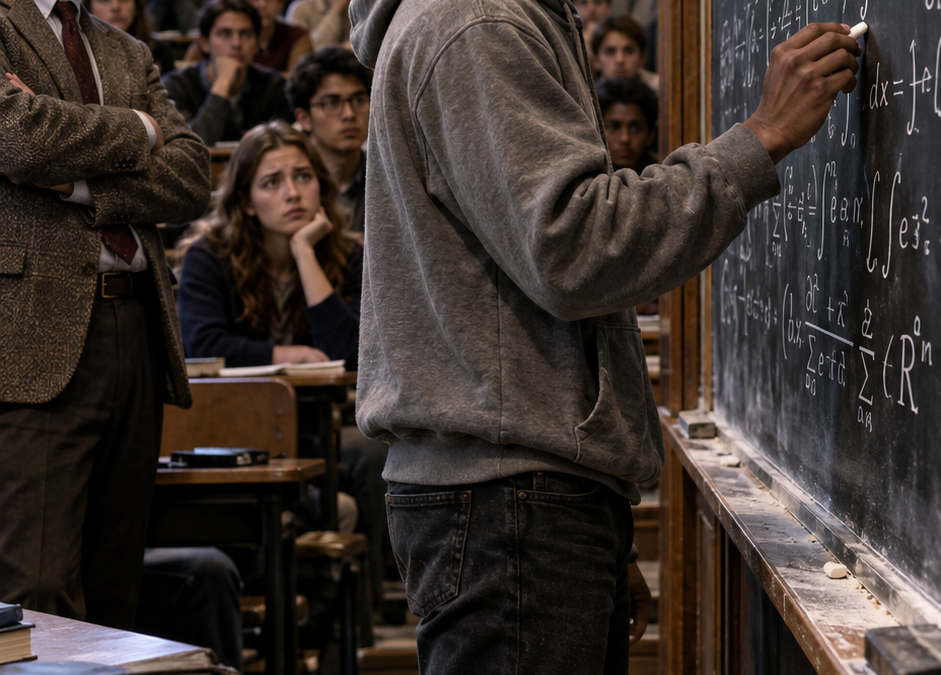
The first expression was an infinite series nested inside a nonlinear transformation.
The second introduced a boundary function that seemed to destroy the symmetry of the original expression.
He continued writing.
By the fourth line, the problem covered nearly two entire blackboards.
Then he introduced a limiting condition and a final integral whose upper bound depended on the very function we were supposed to isolate.
Around me, students stopped taking notes.
Owen leaned toward his neighbor.
“What even is that?”
Whitman heard him.
For once, he didn’t object.
He placed the chalk on the tray and turned toward us.
“This problem comes from an old research qualifying examination. It was designed for doctoral candidates.”
He let his eyes travel over the classroom.
“No one here should be capable of solving it.”
Then he looked directly at me.
“But perhaps Mr. Brooks would like to try.”
I felt thirty pairs of eyes turn in my direction.
Nina looked from the yellow folder to the board.
I understood what Whitman was doing.
He had selected a problem outside our syllabus, announced that nobody at our level should be able to solve it, and singled me out to demonstrate the difference between my supposed confidence and my actual ability.
For a moment, I considered remaining seated.
I could refuse.
I could report the incident afterward.
No reasonable person could demand that an undergraduate solve a doctoral qualifying problem without preparation.
But I could already imagine the story Whitman would tell.
The scholarship student who believed he was exceptional had finally been confronted with real mathematics.
And he’d refused to face it.
I closed my notebook.
Then I stood.
My heart was beating harder than I wanted to admit.
I walked toward the board, hearing the rain against the windows and the faint electric hum of the lights overhead.
Whitman stepped aside.
“Take your time.”
He smiled.
I looked at the equation.
At first, all I saw was complexity.
The overlapping conditions, the long series, the integral, the boundary term that seemed to make the entire expression unstable.
I read the first line again.
Then the second.
Something in the arrangement bothered me.
Not because it was unfamiliar.
Because it wasn’t.
There, hidden beneath the additional terms, was a structure I’d spent countless nights studying at our kitchen table.
The boundary condition that appeared to make the problem impossible was also revealing precisely where the expression needed to be separated.
I remembered the pages in my notebook.
The failed substitutions.
The experiments with nonlinear transformations.
The moment when I’d begun treating instability not as an obstacle but as information.
I picked up the chalk.
Whitman folded his arms.
I wrote the boundary case first.
Then I introduced a transformed variable and drew a vertical line through the original expression.
Behind me, someone shifted in a chair.
Whitman stepped closer.
I separated the boundary term before attempting the series expansion.
One line became three.
Three became seven.
The unnecessary complexity began disappearing.
I didn’t look at the clock.
For the first time that semester, I forgot Whitman was standing beside me.
I wasn’t performing for him anymore.
I was solving a problem.
“You’re assuming convergence too early,” he interrupted.
I shook my head.
“No, sir. I’m separating the boundary case before applying the transformation.”
I underlined the new variable.
“The dependence disappears under this substitution.”
He leaned closer.
“Only if the mapping remains continuous.”
“That’s established here.”
I pointed to the condition I’d written near the top.
He fell silent.
I returned to the board.
The next transformation removed the need for a complicated approximation.
Two additional terms became equivalent under the new variable.
Then the longest expression on the board collapsed into something small enough to fit on a single line.
I heard Nina whisper something.
I couldn’t make out the words.
I boxed an intermediate result.
Behind me, Whitman opened his yellow folder.
The archived solution inside it required nearly two pages of calculations and a lengthy approximation.
My approach bypassed that approximation entirely.
I finished the final step, circled the answer, and set down the chalk.
Five minutes.
That was all it had taken.
The classroom was completely silent.
Whitman walked toward the board.
He read the derivation from the beginning.
Then he returned to the fourth line.
He lifted the chalk as though preparing to correct something, but stopped.
I watched his expression.
The smile was gone.
Owen let out a breath that almost became a laugh.
“No way.”
Nina stared at the board.
“He actually did it.”
Whitman turned around.
“Silence.”
Then he faced me.
“Where did you see this problem before?”
“I didn’t.”
“That’s not believable.”
“It’s true.”
He placed the chalk on the tray so hard that it broke.
“Explain line four.”
I turned toward the board and explained why fixing the boundary before the transformation would require an invalid approximation.
He listened, visibly searching for a weakness.
“And line eight?”
“Those terms become equivalent under the transformed variable.”
“Only if the mapping remains continuous.”
I pointed to the condition again.
“I already established that.”
Several students began following the derivation in their notebooks.
Whitman examined the board for another minute.
Then he did something I hadn’t expected.
He stopped discussing the mathematics.
“I find it difficult to believe,” he said, loud enough for the entire room to hear, “that a student with your background could arrive at this level of reasoning independently.”
I felt something inside me go still.
Not because I hadn’t heard versions of that sentence before.
Because I had.
From counselors who questioned my test scores.
From teachers who assumed my mother had hired someone to complete my projects.
From people who looked at the neighborhood printed on my school records and decided they already understood my limitations.
But I’d never heard it spoken so plainly by someone entrusted with judging my academic work.
“What exactly does my background have to do with the mathematics?”
Whitman straightened.
“I’m discussing preparation. Academic foundation. Statistical probability.”
“No, Professor.”
I looked directly at him.
“You’re discussing me.”
Someone near the back of the classroom whispered an uncomfortable exclamation.
Nina’s face had gone pale.
Owen was staring at his desk.
Whitman opened his mouth.
Before he could speak, the classroom door moved.
Dean Laura Bennett was standing in the doorway.
She had been passing through the corridor on her way to a faculty meeting.
I would later learn that she’d heard Whitman demanding to know where I’d seen the problem before.
Then she’d heard his remark about my background.
Now she stood looking at the blackboard, the yellow folder, and the thirty silent students.
“Is there a problem here?”
Whitman recovered first.
“Dean Bennett. We’re in the middle of an advanced mathematical demonstration.”
Nina turned around.
“No, we’re not.”
Whitman stared at her.
“Miss Flores.”
Her voice trembled, but she continued.
“You put that problem on the board to embarrass Elijah. He solved it. Then you said someone with his background couldn’t possibly have done it alone.”
Bennett stepped inside and closed the door.
Whitman began talking immediately.
He described the exercise as rigorous, spontaneous, and academically appropriate.
He claimed his remarks had been misunderstood.
Bennett waited until he finished.
“Did you say the words ‘a student with your background’?”
“The phrase is being removed from its academic context.”
“Did you say it?”
Whitman glanced around the room.
Thirty students were watching him.
“Yes, but—”
“Then we’ll establish the context carefully.”
She looked at the blackboard.
“Who produced this solution?”
“Mr. Brooks wrote the displayed derivation,” Whitman replied.
He emphasized the word wrote.
I felt my jaw tighten.
“I solved it.”
Bennett looked at me.
“On your own?”
“Yes, ma’am.”
Whitman started to interrupt.
She raised one hand.
“Professor, I believe that’s precisely the issue we need to preserve.”
Then she asked everyone to remain seated.
She called the department office and requested the associate chair and an administrative witness.
Before anyone arrived, she photographed the entire blackboard from several angles.
“Do not erase anything,” she instructed Whitman.
He looked offended.
I returned to my seat.
My hands were covered in chalk dust.
Nina slid a tissue across the aisle.
I barely noticed.
I kept looking at my proof.
The equation itself hadn’t changed.
Every line remained exactly where I’d written it.
Yet the room felt completely different.
Six minutes later, Professor Priya Raman entered with Marcus Lee, a university compliance officer.
Raman specialized in nonlinear analysis.
She was also one of the few faculty members who regularly challenged Whitman during departmental meetings.
She stopped when she saw the board.
“Whose work is this?”
Whitman answered immediately.
“The problem comes from an archived qualifying examination. Mr. Brooks claims the solution.”
Raman ignored his wording.
She walked closer.
For several minutes, she studied the transformation and the boundary argument.
Then she turned toward me.
“Why did you separate the boundary condition before expanding the series?”
“Because the instability tells us which substitution preserves the original structure.”
She looked back at the board.
“Yes.”
Another pause.
“This isn’t the archived solution.”
Whitman’s expression tightened.
“I’m aware.”
“It’s considerably cleaner.”
A quiet murmur moved through the classroom.
Whitman crossed his arms.
“A correct result doesn’t resolve how he obtained it.”
“He just explained how he obtained it,” Nina said.
Bennett intervened before the argument could continue.
She asked Marcus Lee to collect preliminary statements from everyone who had witnessed the exchange.
Students would also receive a secure form for longer written accounts.
She made it clear that retaliation against anyone involved would be taken seriously.
Whitman gave a short, humorless laugh.
“Retaliation? This has become absurd.”
Marcus Lee looked at him.
“That warning applies to everyone, Professor.”
One by one, students began describing what they’d seen.
Nina repeated Whitman’s remarks.
Owen confirmed that the professor had announced nobody in the class should be able to solve the problem before inviting only me to attempt it.
Grace Kim recalled the day Whitman had implied I’d cheated on the diagnostic examination.
Others described the surprise questions, the unusual scrutiny, and the way my correct answers seemed to provoke suspicion rather than approval.
I listened as moments I’d spent weeks trying to dismiss accumulated into a recognizable pattern.
I’d told myself he was demanding.
I’d told myself he challenged everyone.
I’d told myself that if I kept doing the work, eventually the work would speak for itself.
Now I was listening to other people explain why none of those excuses had been sufficient.
Whitman interrupted the fourth student’s statement.
“This is a coordinated reinterpretation by young people who resent high standards.”
Bennett turned toward him.
“You’ve been asked not to influence the statements.”
“I’m correcting falsehoods.”
“You’ll have a formal opportunity to respond.”
He glanced at the clock.
“I have a class to teach.”
Bennett looked at the board.
“Not today.”
Whitman gathered his lecture notes.
He left the yellow folder on his desk.
At the doorway, he turned toward me.
For an instant, he looked almost frightened.
Then his face hardened.
“You have no idea what you’ve started.”
Marcus Lee stepped between us.
“That statement will also be included in the record.”
Whitman walked out.
I sat motionless.
Bennett came over to my desk.
“What would you like your statement to reflect, Elijah?”
I thought about my mother.
About the scholarship.
About the years I’d spent studying in a kitchen barely large enough for two chairs.
About the exhaustion of being treated like an unanswered question whenever I succeeded.
“That I came here to learn,” I told her. “I answered the problem the same way anybody else would have if they knew the material. Being questioned is one thing. Being mocked because of who I am is something else.”
Bennett nodded.
“We’ll make certain that’s documented.”
The university released us after four.
I packed my notebook and stepped into the corridor.
Owen caught up with me.
“Elijah.”
I turned around.
He looked genuinely uncomfortable.
“I laughed that first day.”
“I remember.”
“I thought Whitman was just being Whitman.”
“That’s what you said after the midterm.”
He nodded.
“I was wrong.”
For several seconds, he looked as though he wanted to say something that would repair the entire semester.
Then he stopped trying.
“I’ll put everything I saw in my statement.”
“Do it because it’s true,” I told him. “Not because you want me to forgive you.”
He accepted that.
“Okay.”
I walked away.
Outside, the rain had stopped.
The campus steps glistened beneath the old lamps.
Nina came running after me.
“Elijah, wait.”
She held out her phone.
“I took a picture.”
“Of what?”
“The board. Right after you finished.”
The image showed almost my entire derivation.
At the edge of the frame stood Whitman, holding the open yellow folder.
I stared at it.
“Keep the original.”
“Obviously.”
“Don’t edit it. And don’t post it anywhere.”
She frowned.
“Why?”
“Because he’s going to tell a different story about what happened.”
Neither of us knew how quickly that would begin.
Our phones vibrated almost simultaneously.
An email from Professor Harold Whitman had arrived in every student’s university inbox.
The subject line read:
Notice of Suspected Academic Misconduct.
Nina opened it first.
Her expression changed.
“Oh, you’ve got to be kidding me.”
Whitman had formally accused me of obtaining an unauthorized solution to the qualifying examination.
He claimed that the extraordinary sophistication of my work suggested access to materials beyond the course syllabus.
He wrote that archived examination documents might have been compromised.
He asked students to preserve relevant communications.
He didn’t mention his remark about my background.
He didn’t mention Dean Bennett.
He didn’t even identify me by name.
He didn’t have to.
At the bottom, he included one final sentence warning that knowingly supporting a false account could itself violate the university’s code of conduct.
Nina read it twice.
“He’s threatening us.”
“He’s calling it a reminder.”
Marcus Lee appeared at the classroom doorway.
We showed him the message.
His expression remained controlled until he reached the final sentence.
“Forward me the original. Don’t reply to it.”
“Can he do this?” Nina demanded.
“He already has. Whether he was permitted to is another matter.”
I looked at Lee.
“What happens to my grade?”
He paused.
That hesitation frightened me more than anything Whitman had said.
“The academic integrity allegation has to be reviewed separately. Professor Whitman filed it through the official portal twelve minutes ago.”
“What does that mean for me?”
“Until the initial review, your midterm grade and course status may be held. Some research opportunities could also be delayed.”
I stared at him.
“He challenged me in front of thirty people. I solved his problem. And now solving it is evidence that I cheated?”
“It’s an allegation, Elijah. Not proof.”
“But it still affects me.”
Lee didn’t try to soften the truth.
“Yes. For now, it does.”
By the time I reached the bus stop, my phone was filling with messages.
Some classmates offered support.
Others asked whether I thought Whitman would be fired.
Someone wanted to know whether Nina would release the photograph.
I answered none of them.
My university email remained open.
Suspected Academic Misconduct.
I kept reading those words.
A serious cheating finding could cost me my scholarship.
Without it, I couldn’t afford Bellweather.
Even an unresolved investigation could complicate future research applications.
Whitman had taken the first moment in that classroom when everyone was forced to acknowledge my ability and turned it into an accusation against my integrity.
I rode home in silence.
My mother was standing at the stove when I entered the apartment.
She turned around, saw my face, and immediately switched off the burner.
“Tell me.”
I put my backpack beside the kitchen table.
At first, I told her about the equation.
I described the boundary condition, the substitution, and the moment I recognized the underlying structure.
For a brief second, I became excited again.
She smiled.
“You solved it?”
“In about five minutes.”
“Baby, that’s wonderful.”
Then I told her what Whitman had said.
Her smile disappeared.
I explained the confrontation, Dean Bennett’s arrival, and the accusation that had followed.
By the time I finished, my mother was sitting across from me.
The apartment radiator clicked.
A bus stopped on the street below.
Neither of us spoke for a long time.
Finally, she asked me two questions.
“Did you steal anything?”
“No.”
“Had you seen that problem before today?”
“No.”
She nodded.
“Then that’s where we start.”
I leaned back in my chair.
“Starting there doesn’t stop him from putting an accusation in my record.”
“No.”
She reached across the table.
“But his accusation doesn’t become your truth just because he has the power to write it down.”
I looked away.
She squeezed my hand.
“Did he make you feel small?”
I didn’t answer immediately.
Then I whispered, “For a second.”
My mother leaned toward me.
“A second is human, Elijah. Just don’t let him decide who you are.”
Her phone alarm sounded.
She had fourteen minutes before she needed to leave for another night shift.
She stood, found an old legal pad, and placed it in front of me.
“Write everything down. Dates, conversations, exactly what people said, who was there.”
I looked at the pad.
“You sound like a lawyer.”
“I’ve spent twenty years cleaning up after surgeons. Being exact is how people stay alive.”
When she left, I opened my notebook.
I began reconstructing the semester.
Every questionable grade.
Every public insinuation.
Every conversation I could remember.
And everything that had happened in the classroom that afternoon.
I didn’t sleep.
At eight the following morning, Dean Bennett held an emergency meeting with Professor Raman, Marcus Lee, the academic integrity chair, and the university’s legal counsel.
Whitman attended by video with an attorney representing him through the faculty association.
He appeared remarkably composed.
According to the meeting record, he claimed he’d selected the qualifying examination because my midterm solution suggested familiarity with graduate-level techniques.
He said the classroom demonstration had been designed to establish whether I possessed exceptional ability or had merely memorized sophisticated work.
When I produced a novel solution, he claimed, his suspicions increased.
Raman asked him what evidence made the result suspicious.
Whitman cited my academic history.
Mercer East High School, he explained, offered no advanced mathematical analysis courses.
Neither did most public high schools.
But he continued.
I had no published research, no prestigious national mathematics title, and no formal graduate instruction.
To Whitman, the absence of those credentials made my independent work statistically improbable.
Then he introduced what he described as objective evidence.
The previous Sunday night, my university identification card had been used to enter Partridge Hall at 9:17 p.m.
The building housed the mathematics faculty offices.
Whitman claimed that when he arrived the following Monday, the yellow qualifying examination folder appeared to have been disturbed.
Bennett asked whether he had evidence that I’d entered his office.
He didn’t.
Had the folder been stolen?
No.
Had the office door been forced?
No.
Did the building’s exterior access log identify which room a student entered?
No.
Still, he’d built an accusation around the idea that I’d had an opportunity to obtain the archived solution.
The meeting ended without a resolution.
An academic integrity hearing was scheduled for Monday.
Whitman was placed on paid administrative leave from classroom duties while the separate discrimination inquiry proceeded.
He retained access to his records so he could prepare his defense.
That decision nearly allowed him to erase the most important evidence against him.
I spent Friday morning with Miriam Cole, a case adviser in Bellweather’s student advocacy office.
She explained that the academic integrity committee would use a preponderance-of-evidence standard.
In ordinary language, the panel would decide whether misconduct was more likely than not.
I sat staring at a brightly colored poster about fairness and belonging.
“He has a card swipe and a crooked folder.”
“He has a card swipe,” Miriam corrected. “The condition of the folder is his statement.”
“He was my professor.”
She understood.
His title carried authority that mine did not.
“That’s why we need more than your denial. Why were you in Partridge Hall that night?”
“I was tutoring Nina.”
“In which room?”
“Two fourteen.”
“Can she confirm that?”
“Yes, but she left around nine.”
Miriam looked up.
“And your card was used at 9:17.”
“I stepped outside to take a call from my mother. The door locked behind me, so I used my card to get back inside.”
“How long did you stay?”
“Until around eleven thirty.”
“Doing what?”
I opened my backpack and removed the notebook.
“This.”
I showed her several pages containing the boundary transformation I’d been studying long before Whitman challenged me.
There were dated entries, rough arguments, and crossed-out attempts.
Miriam examined them carefully.
“Can the dates be independently verified?”
“They’re written in ink.”
She nodded slowly.
“Then he’ll argue you added them later.”
I felt my stomach tighten.
I’d spent years developing ideas alone because solitude was where I worked best.
Now that solitude was being used to make my work appear suspicious.
“Did you email any of this to someone? Photograph it? Discuss it with another student?”
I thought carefully.
“No.”
Miriam closed the notebook.
“Then we’ll find another way to establish the timeline.”
That afternoon, Nina received an email from Whitman’s personal account.
He suggested that emotion might have distorted her recollection of the classroom incident.
He encouraged her to consider whether I’d ever discussed archived examinations or unauthorized access to faculty materials.
Then he reminded her that her future in the department shouldn’t be compromised by a hasty statement.
Nina forwarded the message to Marcus Lee.
Owen received a different email.
Whitman praised his academic preparation and reminded him that recommendations for competitive graduate programs depended on faculty evaluations.
He suggested that the accuracy of Owen’s testimony would be remembered.
Owen sent that email to Lee, too.
By Friday afternoon, the retaliation inquiry had acquired two additional pieces of evidence.
At 4:36 p.m., it acquired a third.
Grace Kim contacted the compliance office.
She explained that she’d returned to the classroom the previous afternoon to search for her missing umbrella.
Through the open doorway, she’d seen Whitman return with a department assistant.
He told the assistant that the yellow qualifying examination folder needed to be secured as evidence.
When the assistant left to find a storage envelope, Grace watched Whitman remove several pages from the folder and slip them into his briefcase.
She hadn’t understood the significance until she received his academic misconduct accusation.
Marcus Lee immediately requested preservation of Whitman’s office and digital accounts.
That evening, the university’s information security team discovered an empty directory on his faculty drive.
Its name was simply Brooks.
The directory had been deleted at 5:02 p.m.
Twenty-six minutes after Grace had submitted her statement.
The university disabled Whitman’s account at 5:19.
Investigators preserved the faculty drive, email server, and office computer.
Although the deleted files couldn’t immediately be opened, their names remained visible in a backup index.
There were six documents.
Background notes about me.
A spreadsheet containing grading observations.
A document labeled Challenge Options.
A draft academic integrity report.
A scanned copy of the qualifying examination.
And a document concerning the classroom response.
The fourth file attracted immediate attention.
Whitman had told the university that he’d filed his accusation only after I produced an extraordinary solution.
If the misconduct report had existed before Thursday’s class, that explanation would become difficult to defend.
But investigators needed time to recover it.
My hearing was scheduled for Monday morning.
For the rest of the weekend, I lived with the possibility that the truth might arrive too late.
On Saturday, I tried studying in the university library.
I opened a textbook.
I read the same paragraph four times without understanding a word.
Every time someone walked behind me, I wondered whether they’d seen the email or heard about the investigation.
At a nearby table, two students recognized me.
One whispered something.
The other turned around.
I closed my book.
By noon, someone had posted the photograph of my proof on a private mathematics forum.
The image had circulated despite my request that it remain private.
Comments quickly identified Bellweather and our course.
Strangers began debating whether the derivation could plausibly belong to an undergraduate.
Some called it brilliant.
Others suggested that no student from an ordinary high school could independently discover that substitution.
One anonymous commenter argued that lowering university admission standards inevitably produced academic fraud.
I stared at the screen.
Even the people defending me discussed my abilities as though they were a strange phenomenon needing scientific verification.
Nobody knew how many hours I’d spent at our kitchen table.
Nobody knew how often I’d fallen asleep over an unfinished proof and woken with ink on my cheek.
They saw an address, a scholarship, and a young Black man whose accomplishments exceeded their expectations.
Then they argued about whether I could possibly be real.
I left the library and boarded the number sixteen bus.
I didn’t go home.
I went to Mercer East High School.
The building was locked for the weekend, but my former mathematics teacher, Mr. Daniel Cho, was supervising a robotics competition in the gym.
He found me waiting near the trophy case.
For several seconds, he examined my face.
Then he looked at the notebook beneath my arm.
“I saw your chalkboard,” he said.
I managed a tired smile.
“Apparently everybody has.”
He shook his head.
“Not everybody remembers you doing the same thing when you were sixteen.”
I stopped.
“What?”
He led me into the mathematics department office and pulled a plastic storage box from an old filing cabinet.
Across the lid, someone had written 2023 Math Circle.
Inside were attendance sheets, old competition papers, and several flash drives.
“You gave a presentation to our Saturday group,” Mr. Cho reminded me. “Something about unstable sequences.”
I remembered the room.
Seven students.
A broken projector.
A freezing February morning.
I’d been furious because I couldn’t display my diagrams properly.
Mr. Cho connected a flash drive to an old desktop computer.
A video opened.
The date displayed in the corner was eighteen months before I entered Bellweather.
There I was.
Sixteen years old.
Wearing a sweatshirt that was much too large for me.
Standing in front of a whiteboard covered in uneven handwriting.
I watched my younger self explain an idea I’d almost forgotten presenting.
On the screen, I drew a box around an unstable boundary condition.
Then I told the other students that isolating instability could reveal which substitution preserved the structure of a larger problem.
I stared at the screen.
It wasn’t Whitman’s equation.
It wasn’t even a complete version of the proof I’d written on Thursday.
But the central idea was unmistakable.
Mr. Cho paused the recording.
“A proof can be new, Elijah, even when the mind that discovers it has a history.”
For the first time since Whitman’s accusation, I felt something loosen in my chest.
I hadn’t known how to prove that the idea belonged to me.
Now I was looking at myself explaining its foundations before I’d ever set foot on Bellweather’s campus.
We copied the original video without modifying it.
Mr. Cho signed a statement explaining when and where it had been recorded.
The school district’s cloud archive contained another copy with its original creation date.
Whitman couldn’t claim I’d manufactured that history over the weekend.
Before I left, Mr. Cho put his hand on my shoulder.
“Your mother told me years ago that she was worried this university might make you feel like you had to become someone else.”
I looked down.
“Sometimes I think I do.”
“Then remember why you loved mathematics before anyone started grading you.”
I carried those words home.
On Sunday morning, I met Professor Raman and Miriam Cole in an empty seminar room.
Raman had brought two copies of the qualifying problem.
One contained the archived solution.
The other was a photograph of my work.
She spread them across the table.
“Whitman’s argument will be simple,” she said. “You entered the building. You allegedly had an opportunity to see the archived answer. Then you produced the correct answer.”
“But they’re different methods.”
“To a mathematician, yes. To a committee unfamiliar with nonlinear analysis, they may appear to be two pages of symbols reaching the same result.”
Miriam leaned forward.
“Can you explain the difference without teaching the committee an entire graduate course?”
Raman considered the question.
“The archived solution accepts the problem’s complexity and works through a long approximation. Elijah’s solution identifies the structural issue before the expansion and removes the need for that approximation.”
She placed the pages beside each other.
“They share a question and a final result. The reasoning between those points is fundamentally different.”
“Could someone disguise the archived solution by rewriting it?” Miriam asked.
“Not in this manner. The archived approach provides no useful route to Elijah’s transformation. In several places, it actually directs the reader away from it.”
I stared at the pages.
“He knows that.”
Raman looked at me.
“Yes.”
Hearing her say it made me feel worse.
For days, I’d been trying to understand how a mathematics professor could genuinely believe my solution demonstrated academic dishonesty.
Now I was confronting the possibility that the mathematics had never been the basis of his suspicion.
That afternoon, Marcus Lee called.
Campus security had reviewed footage from Partridge Hall.
At 9:17 on the Sunday night in question, a camera recorded me entering the building.
At 9:19, another camera captured me entering room 214 with my notebook and a bottle of water.
At 11:32, I exited the room and went directly downstairs.
Whitman’s office was on the fourth floor.
Both stairwells leading above the second floor were covered by security cameras.
I appeared in neither.
The service elevator required a faculty key.
There was no evidence I’d entered the part of the building where Whitman kept the qualifying examination.
When I told my mother, she closed her eyes.
“So it’s over?”
“It should be.”
She heard the uncertainty in my voice.
“But the hearing still happens.”
She didn’t answer.
Instead, she took the only dress shirt I owned from the closet and began ironing it.
“You don’t have to come tomorrow,” I told her.
“I know.”
“You worked all night.”
“I know that too.”
She pressed the collar and turned the shirt over.
“When you were nine, your school counselor said your mathematics test score was probably a computer error.”
I remembered.
“They made me take it again.”
“Because I missed half a shift and went down there until they agreed.”
She continued ironing.
“When you were fourteen, the advanced program told us you’d applied too late, even though they’d lost your application.”
“You found the copy.”
“Yes, I did.”
She set the iron upright.
“I’ve been coming to these meetings for twelve years, Elijah. I’m not missing this one.”
I watched her fold the shirt.
Then I hugged her.
For a long moment, I felt like the little boy who used to sit on the kitchen floor arranging bottle caps while his mother pretended not to worry about the bills piled beside the refrigerator.
She held me tightly.
“You don’t have to prove you’re worthy of being treated fairly,” she whispered.
I wanted to believe her.
On Monday morning, the preliminary hearing took place in a windowless conference room on the administration building’s second floor.
There was no audience.
No cheering classmates.
No dramatic entrance.
Just a long table, three committee members, several folders, and the quiet sound of the ventilation system.
I sat beside Miriam and my mother.
Whitman sat opposite us with his attorney.
Dean Bennett attended as the reporting administrator.
Marcus Lee sat near the end of the table with an evidence binder.
Professor Raman waited outside until she was called.
The committee chair opened the proceedings at nine.
He explained that the hearing concerned only the academic misconduct allegation against me.
The separate discrimination and retaliation investigations would follow their own procedures.
Whitman was permitted to present his case first.
He spoke for twenty minutes.
He described the extraordinary difficulty of the qualifying examination.
He explained the graduate-level techniques evident in my derivation.
He discussed my presence in Partridge Hall and the supposedly disturbed folder.
He never directly said I was incapable of solving the problem.
Instead, he presented himself as a defender of academic integrity.
“Exceptional ability does not exempt a student from verification,” he concluded. “A gifted student is still capable of making an unethical choice.”
One committee member wrote down the sentence.
I watched the pen move across the paper.
Whitman’s attorney then displayed my academic record.
Mercer East had offered no mathematics classes beyond Advanced Placement calculus.
I possessed no published papers.
I’d never won a national mathematics competition.
I’d never held a formal research appointment.
“Mr. Brooks,” the attorney began, “are you asking this committee to believe you independently developed a graduate-level method without graduate instruction?”
“I developed the underlying idea through independent work.”
“Alone?”
“Yes.”
“And you were working alone on Sunday night in the same building where Professor Whitman stored the archived solution?”
Miriam objected to the phrasing.
The attorney continued.
“Did you know the faculty offices were upstairs?”
“Yes.”
“Did you know archived examinations were kept there?”
“No.”
“You saw the yellow qualifying examination folder in Professor Whitman’s office several weeks earlier, didn’t you?”
I felt my mother turn toward me.
I had included that detail in my written timeline.
She had told me to record everything exactly.
Now Whitman’s attorney was using my honesty as evidence against me.
“I saw a folder labeled qualifying examination.”
“And after that, you entered Partridge Hall alone at night and later solved a problem taken from that folder.”
The committee chair leaned forward.
I understood what was happening.
Whitman was arranging ordinary facts into a story that sounded suspicious.
A student sees a folder.
A student enters a building.
A student solves an unusual problem.
When told in that order, the details almost seemed to imply something.
Miriam stood.
“We’re not asking the committee to accept a competing story. We’re asking it to examine the evidence.”
She displayed the campus security footage.
The committee watched me enter Partridge Hall.
They watched me enter room 214.
They saw the timestamps.
They saw me emerge more than two hours later, carrying the same notebook and water bottle.
Whitman’s attorney raised the possibility of camera blind spots.
The campus security director joined the hearing by video.
He confirmed that both routes to the fourth floor had been covered.
The service elevator required a faculty key.
No door had been forced.
No electronic override had been recorded at Whitman’s office.
“So there is no evidence Mr. Brooks reached the fourth floor?” the committee chair asked.
“There’s evidence he did not,” the director replied.
I glanced at Whitman.
He was staring at the screen.
Miriam then introduced the video from Mercer East.
Sixteen-year-old me appeared on the monitor.
I watched myself walk toward a whiteboard in an oversized sweatshirt.
My younger voice filled the conference room.
I explained the unstable boundary, isolated it, and described how the resulting information could guide a nonlinear substitution.
My mother’s hand found mine beneath the table.
The video ended.
Whitman’s attorney leaned forward.
“A broad conceptual similarity doesn’t establish that Thursday’s solution was original.”
“Correct,” Miriam replied. “That’s why Professor Raman is here.”
Raman entered carrying two enlarged diagrams.
She’d removed most of the advanced notation, leaving the essential logical structure of each solution.
The archived proof appeared as a long chain of deductions leading through an approximation.
Mine branched away from the original expression, isolated the boundary, and reunited the transformed terms near the conclusion.
“These are not two versions of the same method,” Raman explained.
She pointed to the first diagram.
“The archived approach proceeds through an approximation that depends on accepting the original formulation.”
Then she pointed to mine.
“Mr. Brooks identifies a different mathematical structure. His first meaningful decision eliminates the need for that approximation.”
One committee member raised a hand.
“Could he have studied the archived solution and invented a better one to conceal the copying?”
“Anything is imaginable,” Raman replied. “The question is what the available evidence supports.”
She turned toward the diagrams.
“The archived solution offers no useful advantage in discovering this alternative method. Mr. Brooks’s earlier recorded work, however, demonstrates that he was already exploring its central idea long before this incident.”
“Would you describe his solution as graduate-level?”
“I would describe it as original, economical, and mathematically correct.”
“But is it plausible for an undergraduate to arrive at it?”
Raman looked toward me.
Then she faced the committee.
“The derivation was produced by an undergraduate. We shouldn’t use our expectations about who can discover something to dismiss evidence of the discovery itself.”
I felt my mother squeeze my hand.
At 10:42, Marcus Lee’s phone vibrated.
He read the message.
Then he quietly left the conference room.
Several minutes later, he returned carrying a single printed page.
“Mr. Chair, the technology office has recovered a document from Professor Whitman’s deleted directory. Both parties have been provided with copies.”
The room went silent.
Lee handed the page to the committee.
It was the document labeled Integrity Draft.
Its creation timestamp was 8:14 on Thursday morning.
Nearly six hours before Whitman challenged me in class.
Most of the language in the formal accusation he’d filed after the incident was already present.
Two spaces had been left blank.
One for the problem selected.
Another for the outcome of what he called the live verification exercise.
Then came two prepared responses.
If I failed, Whitman intended to document the supposed gap between my reported performance and my demonstrated ability.
If I completed the problem, he intended to demand the source of my solution and initiate an investigation into unauthorized access.
I read both passages.
Then I read them again.
If I failed, I was a fraud.
If I succeeded, I was a fraud.
There had never been an answer I could give that Whitman intended to accept.
The committee chair removed his glasses.
“Professor Whitman, did you prepare this document before Thursday’s class?”
Whitman leaned toward his attorney.
They whispered for several seconds.
Finally, he answered.
“I prepared contingencies.”
“You prepared an allegation.”
“I had legitimate concerns based on anomalous performance.”
“Before the verification exercise had even occurred?”
“Responsible faculty anticipate possible outcomes.”
I looked across the table at him.
For weeks, he’d told me that my confidence exceeded my ability.
He’d demanded proof every time I demonstrated understanding.
He’d treated each correct answer as another reason for suspicion.
Now the proof was sitting in front of him.
“Professor.”
He looked at me.
“You told me confidence was cheap and proof was harder.”
His eyes narrowed.
“I gave you proof.”
Nobody interrupted.
“You wrote the accusation before I ever touched the chalk.”
For the first time, he had nothing to say.
The committee recessed.
We waited twenty-three minutes.
My mother kept holding my hand.
I tried to read the posters on the wall, but the words wouldn’t stay still.
Then the committee returned.
The chair opened his folder.
After reviewing the testimony and evidence, the panel found no credible basis for the academic misconduct allegation.
The campus footage contradicted the claimed opportunity to access the archived examination.
Expert analysis established that my derivation followed a genuinely different method.
My prior recorded work demonstrated a relevant intellectual history.
And the prewritten misconduct draft revealed that Whitman’s accusation had not arisen from my conduct during the classroom challenge.
The charge was dismissed in full.
My midterm grade, course status, and scholarship protections were restored immediately.
My mother closed her eyes.
I didn’t cheer.
I didn’t smile.
For several seconds, I simply sat there.
Relief didn’t feel like winning.
It felt like someone had finally switched off an unbearable noise that had been playing inside my head for days.
Whitman began gathering his papers.
The committee chair stopped him.
“Professor, the dismissal concludes the matter against Mr. Brooks. It does not conclude the pending matters involving you.”
Whitman slowly sat back down.
He looked smaller than he had in the classroom.
Not because I’d defeated him.
Because the authority he’d used to shield his assumptions had become something other people were finally willing to examine.
The investigation into his conduct continued for another six weeks.
More students came forward.
By the end of the first week, twelve students from our class had submitted detailed accounts.
Investigators reviewed grading records, private faculty notes, and complaints from previous semesters.
They found that I wasn’t the first student whose correct work had lost points without an identified mathematical error.
In three previous courses, Black and first-generation students had been substantially more likely to receive negative private remarks about their preparation, attitude, or suitability after questioning their grades.
When other students challenged an assessment, similar behavior was often described as intellectual confidence.
Two former students provided statements that I would never forget.
Jamal Avery had left Bellweather’s mathematics program four years earlier.
Whitman had accused him of using an unauthorized method on an examination.
The allegation was never substantiated.
But the investigation lasted long enough to cost Jamal a summer fellowship.
He’d eventually changed majors rather than take another course in the department.
Sonia Patel, the first person in her family to attend college, described being summoned to the blackboard without warning after Whitman questioned whether she’d completed her homework independently.
She failed to solve the theorem under his scrutiny.
For years, she believed that afternoon had proven she wasn’t capable of advanced mathematics.
When Sonia learned what had happened in our classroom, she contacted Dean Bennett.
I later met her outside Partridge Hall.
She was quieter than I’d expected.
“I used to think the difference between you and me was that you managed to solve the problem,” she told me.
I shook my head.
“No.”
She looked toward the fourth-floor windows.
“I know that now. The difference was that enough people finally spoke up.”
I didn’t know what to say.
I kept thinking about the younger version of Sonia, standing at a blackboard while an entire classroom watched her struggle.
I wondered how many talented people had left mathematics because someone with authority mistook humiliation for instruction.
Whitman’s deleted files revealed the same pattern.
Students he expected to succeed were described as promising even when they struggled.
Students he had already categorized as underprepared were viewed with suspicion when they excelled.
The messages to Nina and Owen provided additional evidence of attempted retaliation.
Grace’s account was corroborated when investigators recovered the missing folder pages from Whitman’s briefcase.
They contained handwritten annotations on the qualifying problem and a list of questions designed to challenge my derivation after I completed it.
He hadn’t improvised the confrontation.
He’d rehearsed it.
At his formal faculty hearing, six weeks after the classroom incident, Whitman defended himself using the argument he trusted most.
“I challenge every exceptional claim,” he said. “That’s academic rigor.”
Dean Bennett questioned him.
“Did you challenge Owen Parker’s ninety-three on the diagnostic examination?”
“His preparation was well established.”
“Did you accuse Nina Flores of dishonesty when her midterm performance improved?”
“Her progress followed documented tutoring.”
“And when Elijah Brooks earned a perfect score and documented every step, why was that not evidence of established preparation?”
Whitman hesitated.
“His result was inconsistent with the available indicators.”
“Which indicators?”
He mentioned Mercer East.
He mentioned my scholarship.
He mentioned the absence of graduate courses in my academic history.
Bennett allowed him to finish.
Then she asked one final question.
“You’ve described everything Mr. Brooks had not been given. Can you identify a mathematical error he actually made?”
Whitman looked toward his attorney.
There was no answer.
The faculty panel ultimately found that Whitman had engaged in discriminatory treatment, retaliated against witnesses, misused the academic integrity process, and attempted to remove evidence.
His employment was terminated for cause.
He later released a public statement insisting that Bellweather had sacrificed academic rigor to political pressure.
For once, I didn’t feel compelled to answer him.
The evidence already had.
Bellweather introduced blind review procedures for disputed mathematics grades.
The university also prohibited individual instructors from independently initiating and deciding academic integrity allegations involving their own students.
An independent reporting process was established for retaliation complaints.
Professor Raman led a review of older cases.
Jamal Avery received a written correction to his academic record, and the fellowship office was notified that the unresolved allegation should never have followed him.
I knew those measures couldn’t return the opportunities people had lost.
They couldn’t give Sonia back the years she spent believing she’d failed because she wasn’t smart enough.
They couldn’t erase the fear I’d felt watching my scholarship become part of an investigation.
But they meant the next student would have somewhere to turn before the damage became permanent.
A photograph of my chalkboard solution circulated beyond Bellweather.
A retired mathematics professor from another university contacted me, describing the work as evidence of unusual mathematical maturity.
A national undergraduate research program invited me to apply.
I nearly deleted the message.
Sudden attention had become something I didn’t entirely trust.
Professor Raman convinced me to reconsider.
“An invitation based on the quality of your work isn’t a favor, Elijah.”
I looked at her.
“How do I know they care about the work instead of what happened?”
“You don’t know yet. That’s what the conversation is for.”
The following semester, I joined her research group.
On my first afternoon, I entered a seminar room where everyone already knew about the famous chalkboard.
Raman introduced me without mentioning it.
“This is Elijah Brooks. He’s been studying boundary behavior in transformed nonlinear systems.”
She turned toward me.
“Elijah, show us the question you’ve brought.”
I opened my notebook.
“The question?”
“Not the answer. The question.”
For the next hour, three professors and four graduate students challenged nearly every assumption in my argument.
One professor identified a weakness in a lemma.
Another suggested that my definition was unnecessarily restrictive.
A graduate student found a counterexample that forced me to reconsider an entire section.
They interrupted me.
They disagreed with me.
They made me defend every important step.
And nobody treated my uncertainty as evidence that I didn’t belong.
When I walked home that afternoon, I realized it was the most rigorous academic experience I’d ever had.
My mother found me at the kitchen table that evening.
My notebook was open.
Several pages were covered in crossed-out calculations.
“Good day?”
I grinned.
“They tried to break my proof.”
She frowned.
“They did what?”
“My proof, Mom. Not me.”
She looked at the notebook.
Then she smiled.
“Sounds like you finally found the right people.”
By the following year, I was presenting original research at a national mathematics conference.
My dress shirt fit better.
My notebook looked worse.
I still carried it everywhere.
After my presentation, a distinguished researcher spent fifteen minutes questioning one of my assumptions.
He found a condition that needed to be strengthened.
I went back to the slide, examined the argument, and admitted he was right.
The discussion continued.
Nobody laughed.
Nobody suggested that my mistake invalidated everything I’d accomplished.
I left the lecture hall feeling excited about the problem I’d have to solve when I got home.
Near the exit, a high school student was waiting with a folded conference program in her hands.
She approached hesitantly.
“Mr. Brooks?”
“Elijah is fine.”
She smiled nervously.
She told me she loved mathematics but had stopped answering questions in class.
Whenever she got something right, her teacher sounded surprised.
Whenever she got something wrong, the teacher seemed to remember it for weeks.
I recognized the careful way she spoke.
She was describing something painful without quite allowing herself to name it.
I opened my worn notebook and showed her a page filled with failed attempts.
“See all this?”
She nodded.
“Most people think being good at mathematics means you never get confused.”
I pointed to a calculation I’d crossed out three times.
“It actually means learning how to keep working when you don’t know what happens next.”
She studied the page.
“Did you always know you belonged in places like this?”
I looked back toward the conference hall.
I thought about Whitman.
About the yellow folder.
About that first perfect examination and the laughter that followed.
About my mother ironing my shirt after working all night.
About a sixteen-year-old version of myself standing in a freezing classroom at Mercer East, explaining an idea nobody had assigned him.
“No,” I told her. “Sometimes I knew my mathematics belonged there long before I believed I did.”
She unfolded her program.
“Would you sign this?”
I took her pen.
Beneath my name, I wrote three words.
Show every step.
Not because she owed anyone a demonstration of her worth.
Because her thinking deserved to exist in a form nobody else could rewrite.
Owen attended that conference, too.
We never became close friends, but we’d learned to respect each other.
He stopped confusing being first to answer with being first to understand.
Nina entered Bellweather’s accelerated analysis track and began tutoring students who were afraid to ask questions in class.
One Thursday afternoon, the three of us passed our old lecture hall.
A first-year seminar was meeting inside.
A nervous student stood at the blackboard while her instructor waited beside her.
She made a mistake halfway through her proof.
Then she froze.
For a moment, I saw myself standing in that same place.
But the instructor didn’t smirk.
He didn’t look at the class and turn her uncertainty into entertainment.
He simply pointed to the last correct line.
“Start here,” he told her. “Tell us what you know.”
The student took a breath.
She returned to her argument.
A minute later, she found her way forward.
Nina watched through the open door.
“That shouldn’t feel extraordinary.”
“No,” I said. “It shouldn’t.”
We continued down the corridor.
People would eventually remember that semester for the hearing, the investigation, the professor who lost his job, and the university policies that changed afterward.
I remembered something much smaller.
The sound of chalk against the board.
The rain tapping against the windows.
The thirty students watching me walk toward an equation their professor had announced I couldn’t solve.
For years, I’d believed mathematics was beautiful because a valid proof remained valid regardless of who discovered it.
I still believed that.
But I had learned something else.
The most difficult assumptions to challenge weren’t always written in equations.
Sometimes they lived in the minds of people who believed their authority made them incapable of being wrong.
And sometimes, the person standing at the blackboard wasn’t the one who needed to learn something.








