𝗙𝗨𝗟𝗟 𝗦𝗧𝗢𝗥𝗬 My Husband Made Me Choose Between Him and My Rottweiler—Months Later, I Learned the Dog Was Never the Real Reason
𝗣𝗔𝗥𝗧 𝟮
I smiled.
“We named the coffee machine.”
“That’s different.”
Within a week, Rocky had a bed.
Within two, he had a proper collar.
Within three, Jason stopped asking when we were taking him to a shelter.
I believed that meant acceptance.
Maybe I wanted to believe it.
At first, Rocky followed me everywhere.
Kitchen.
Laundry room.
Bathroom door.
Backyard.
If I sat down, he came close enough that some part of his body touched me.
A paw against my foot.
His shoulder against my knee.
His head across my leg.
At night, he slept beside my side of the bed.
Sometimes I woke and found him staring at me.
The first few times, it unsettled me.
Then I understood.
He was checking.
Still here?
Still safe?
Still mine?
I would reach down and touch him.
“Go back to sleep.”
He would.
Rocky changed the rhythm of my days.
Morning walks replaced scrolling through my phone.
I came home more quickly after work because I knew he was waiting.
I started noticing parks.
Weather.
The exact time the sun went down.
Small things.
Ordinary things.
Things I had stopped noticing in the life Jason and I had built.
And strangely, for a while, Rocky seemed to bring Jason and me closer too.
At first, Jason kept his distance.
Then Rocky began waiting near the front door when Jason came home.
One evening, I saw Jason crouch and scratch behind his ears.
Another time, I walked into the living room and found Jason throwing a rubber ball while Rocky slid across the hardwood floor trying to catch it.
Jason looked embarrassed when he saw me.
“Don’t say anything.”
I smiled.
“I didn’t.”
“You’re smiling.”
“I’m allowed to smile.”
He threw the ball again.
Rocky chased it.
For those first months, I thought everything was good.
Better than good.
I thought our family had become complete.
That’s the word I used.
Family.
Me.
Jason.
Rocky.
Seven months passed.
Seven months in which Rocky stopped flinching when voices rose on television.
Seven months in which he gained weight, learned where we kept his leash, discovered that sprinklers were apparently his mortal enemy, and claimed one corner of the couch despite Jason’s repeated declarations that he would never be allowed on furniture.
Seven months in which I forgot what the house had felt like without him.
Then one evening, Jason came home and said the sentence people always seem to use before changing your life.
“We need to talk.”
He stood near the kitchen counter.
He didn’t take off his jacket.
That was the first thing I noticed.
Jason always took his jacket off the moment he entered.
“Okay.”
Rocky was lying near my chair.
Jason looked at him.
Then at me.
“This isn’t working.”
I frowned.
“What isn’t?”
“The dog.”
For a second, I genuinely didn’t understand.
“What about him?”
Jason exhaled impatiently.
“He takes up too much space.”
I almost smiled because the statement sounded so absurd.
“Physically?”
“I’m serious.”
“So am I. What does that mean?”
“It means everything revolves around him now.”
“No, it doesn’t.”
“Walks. Food. Vet bills. Scheduling around him.”
“I do almost all of that.”
“That’s not the point.”
“Then what is the point?”
Jason looked away.
That mattered later.
At the time, I thought he was frustrated.
Months later, I realized he was avoiding my eyes because he had rehearsed the conversation and didn’t want me interrupting the version of it he needed to deliver.
He said, “I don’t want him here anymore.”
My stomach dropped.
“What?”
“You heard me.”
I stared at him.
Rocky lifted his head at the change in our voices.
“Where exactly do you expect him to go?”
“The shelter.”
I actually laughed.
Not because it was funny.
Because my mind rejected the words.
“You’re joking.”
“No.”
“You want to take Rocky to a shelter?”
“Tomorrow.”
“Jason.”
“I’ve decided.”
The way he said that frightened me more than the decision itself.
Not angry.
Not emotional.
Final.
As if we weren’t having a discussion at all.
As if I were being informed of an arrangement already made.
I stood.
“You don’t get to decide that by yourself.”
“It’s my house too.”
“And Rocky is part of our family.”
“He’s a dog.”
I felt heat rise into my face.
“He was abandoned when I found him.”
“So?”
“So I’m not doing that to him again.”
“You’re being dramatic.”
“Am I?”
I pointed toward Rocky.
“He spent weeks learning that this was home.”
Jason shrugged.
“He’ll adjust.”
Something in me went cold.
“You’ve been playing with him for months.”
“That doesn’t mean I want to organize my life around him forever.”
“You don’t.”
“Emily—”
“I feed him. I walk him. I schedule the vet. I clean up after him. Tell me what exactly he is taking away from you.”
Jason stared at me.
Then he said, “I just don’t want him here.”
I understood then that no practical argument would matter.
There was no issue to solve.
No compromise he wanted.
He had already chosen the outcome.
I lowered my voice.
“If you’re upset about something else, tell me.”
“I’m talking about the dog.”
“No. You’re not.”
His expression hardened.
“Don’t turn this into something it isn’t.”
“Then explain why after seven months you suddenly can’t live with him.”
“I don’t need to justify not wanting an animal in my house.”
“Our house.”
“Fine. Our house.”
Rocky stood and walked toward me.
He pressed his side against my leg.
Jason watched.
Then said the sentence that ended our marriage long before I understood why he had chosen it.
“If you love that dog so much, you can live with him somewhere else.”
The room went silent.
I looked at him.
“What did you say?”
“You heard me.”
I waited for him to take it back.
He didn’t.
“You’re asking me to choose.”
“I’m saying I’m done living with the dog.”
“Jason.”
He looked directly at me now.
“If you choose Rocky, that’s your decision.”
That wording.
Your decision.
I didn’t recognize its importance until months later.
That night, I slept on the living-room couch.
Rocky lay beside me.
I didn’t actually sleep.
I listened to his breathing and stared at the ceiling.
Seven years.
Jason and I had been together seven years.
We had shared apartments.
Family holidays.
Bad jobs.
Good promotions.
Arguments over money.
Trips.
Illness.
Birthdays.
Ordinary Tuesdays.
I kept waiting for morning to make the conversation seem less real.
Maybe Jason would come downstairs embarrassed.
Maybe he’d say he’d been angry.
Maybe there would be some explanation.
Instead, at seven fifteen, he came into the living room dressed for work.
“Have you decided?”
I sat up.
“Don’t do this.”
“The shelter opens at eight.”
My heart began pounding.
“You’re actually going to take him.”
“Yes.”
“You can’t.”
“Emily, I told you yesterday.”
I stood.
“I won’t agree to this.”
Jason picked up Rocky’s leash.
Rocky saw it and immediately stood, tail moving.
He thought he was going for a walk.
That nearly destroyed me.
“Jason, please.”
He clipped on the leash.
I grabbed his wrist.
“Please.”
For the first time, my voice broke.
“He trusts us.”
Jason pulled his arm free.
“He’ll be fine.”
“You don’t know that.”
“It’s a shelter, not an execution.”
“That’s not the point.”
“Then what is?”
“He already lost one home.”
Jason stared at me.
“I can’t watch you do that to him again.”
“Then don’t come.”
That was exactly what I did.
I couldn’t.
I couldn’t stand in a shelter lobby and watch Rocky turn around expecting me to follow.
So I stayed home.
I heard the front door close.
Then silence.
I sat on the floor.
I don’t remember how long.
At some point, I realized I was crying so hard I could barely breathe.
The house felt wrong immediately.
No nails clicking across the floor.
No water bowl.
No body leaning against my knees.
Nothing.
Jason came home that evening.
I barely spoke to him.
The next morning, I drove to the shelter before work.
I had told myself I would stay calm.
I failed the moment I saw Rocky.
He was in a kennel near the end of a row.
Sitting in the back corner.
Head lowered.
The dog I had known at home seemed gone.
“Rocky.”
His head snapped up.
For one second, he stared.
Then he stood so quickly his paws slipped against the floor.
He rushed to the kennel gate.
I knelt.
“Oh, baby.”
Rocky pressed his face against the bars.
Then lifted one paw and placed it against the metal.
No barking.
No jumping.
Just that paw.
And his eyes.
I knew that look.
I had seen it the first morning in the rain.
Waiting.
Only this time, he wasn’t waiting for someone who had abandoned him.
He was waiting for me.
“I came.”
My voice broke.
“I’m here.”
He leaned harder against the gate.
“I promise I’m going to fix this.”
That became my routine.
Every day.
Before work when I could.
After work when I couldn’t.
I sat outside Rocky’s kennel and talked to him.
“I’m looking for apartments.”
His ears lifted.
“I know.”
“I need somewhere that allows large dogs.”
Tail movement.
“That’s apparently harder than it should be.”
He watched.
“But I’m not leaving you here.”
I told him about my workday.
About listings I’d called.
About deposits.
About landlords.
About one apartment that would accept dogs but only up to forty pounds.
Rocky was almost twice that.
“You need to lose some weight,” I joked once.
He looked at me.
I immediately felt guilty.
“No. Don’t you dare. You’re perfect.”
The shelter staff began to know me.
One woman named Melissa pulled me aside after my fourth visit.
“We’re worried about him.”
My stomach tightened.
“What do you mean?”
“He’s barely eating.”
“He eats at home.”
“I know.”
“He loves chicken.”
“We’ve tried.”
“What about toys?”
“He isn’t interested.”
I looked through the kennel window.
Rocky lay facing the hallway.
“He thinks I’m coming back.”
Melissa’s expression softened.
“Yes.”
“I am.”
“I believe you.”
“No. I mean I’m taking him back.”
“Then do it as soon as you can.”
“I’m trying.”
She hesitated.
“He’s extremely bonded to you.”
“I know.”
“Some dogs adapt quickly in shelters. Some don’t.”
I looked at her.
“And Rocky?”
She didn’t need to answer.
He was disappearing in front of me.
I understood that because I was disappearing too.
At home, Jason behaved as if nothing significant had happened.
That may have been the cruelest part.
He watched television.
Made coffee.
Asked whether I needed anything from the grocery store.
Once, he asked, “How was work?”
I stared at him.
“You took my dog away.”
He sighed.
“Emily.”
“And now you’re asking how work was?”
“I don’t want us to spend every day fighting.”
I laughed bitterly.
“Then bring Rocky home.”
“No.”
The answer never changed.
End of week one.
No.
Week two.
No.
By the beginning of the third week, something in me became very quiet.
Grief sometimes looks like panic.
Sometimes it looks like clarity.
I found an apartment.
Small.
Second floor.
Older building.
One bedroom.
No yard.
But large dogs were allowed.
The landlord met Rocky’s breed requirement.
The rent was higher than I wanted.
The neighborhood was farther from work.
None of that mattered.
I signed the lease.
On Friday evening, I returned home.
Jason was sitting at the kitchen table.
I stood in the doorway.
“I can’t live like this.”
He looked up.
“What do you mean?”
“I want Rocky back.”
He shook his head.
“That’s not happening.”
“Then I’m leaving.”
Silence.
Then Jason laughed.
Actually laughed.
Not loudly.
Just one cold, disbelieving sound.
That laugh did more damage than every argument we’d had.
I heard contempt in it.
Not surprise that I would leave.
Contempt that I had finally done exactly what he had expected.
“You’re leaving your husband for a dog.”
“No.”
My voice was calm.
“I’m leaving my husband because he forced me to choose something he knew I couldn’t abandon.”
“Same thing.”
“It isn’t.”
Jason leaned back.
“What are you expecting me to do? Beg?”
“No.”
“Good.”
I stared at him.
Something about his reaction bothered me.
Not enough then to understand.
But enough that part of me noticed.
He wasn’t scared.
He wasn’t angry.
He wasn’t devastated.
He seemed almost relieved.
I thought maybe he had emotionally shut down.
I know better now.
“I signed a lease,” I said.
“When are you going?”
“Tomorrow.”
He nodded.
That was it.
Seven years.
And he nodded.
The next morning, I packed what I could fit in my car.
Clothes.
Documents.
A few kitchen things.
Photographs I couldn’t leave.
My laptop.
Rocky’s empty bed.
Jason watched from the hallway.
No tears.
No argument.
No attempt to stop me.
At one point he said, “Don’t forget your mail.”
That sentence stayed with me too.
It sounded like something you say to a roommate.
I left.
Then I drove directly to the shelter.
Melissa saw me enter carrying a leash.
Her whole face changed.
“Really?”
I nodded.
“He’s coming home.”
She smiled.
“I’ll get him.”
When Rocky appeared at the end of the hallway, he saw me.
Then he saw the leash.
His entire body changed.
He ran.
Melissa almost lost hold of him.
I crouched.
Rocky slammed against me.
I fell backward laughing and crying at the same time.
He climbed halfway into my lap, licking my face.
“I know.”
His tail beat against the floor.
“I know.”
I wrapped my arms around him.
“I’m sorry.”
He pressed closer.
“You’re never going back there.”
He had no idea what apartment we were moving into.
No idea our new place was smaller.
No yard.
No familiar rooms.
He didn’t care.
I was there.
That was home enough.
The first night in the apartment, we slept on the floor because my bed hadn’t arrived yet.
Rocky’s old blanket was spread beside me.
He ignored it.
He put his head across my stomach.
I stared at the ceiling.
I expected to feel devastated.
Instead, I felt something unexpected.
Peace.
For the first time in weeks, I could breathe.
The apartment was quiet.
Boxes everywhere.
Half my belongings still at Jason’s house.
My marriage effectively over.
And yet I felt safer on that floor with Rocky than I had felt in my own home for months.
The next few weeks were difficult.
Separation isn’t romantic just because leaving was the right decision.
There were bills.
Paperwork.
Conversations with lawyers.
Dividing property.
Explaining things to family.
Explaining things to friends.
Some people understood.
Others didn’t.
“You left him over a dog?”
I heard that more than once.
At first, I tried explaining.
“It wasn’t just Rocky.”
But I couldn’t explain what I didn’t yet fully understand.
So sometimes I simply said, “Yes.”
Let them think what they wanted.
Rocky recovered quickly.
Within days, he ate normally.
Within a week, he began playing again.
Within two, he claimed a sunny patch beside my apartment window.
Our life became small but good.
Morning walk.
Work.
Evening walk.
Dinner.
Sometimes friends visited.
Sometimes we went to the park.
I learned how little space happiness actually needs.
Four months passed.
I had started smiling again without noticing.
Jason and I barely communicated except about practical matters.
Then one afternoon, I met an old friend named Rachel for coffee.
We hadn’t seen each other since the separation.
She asked how I was.
“Good.”
“Really?”
I looked out the window.
“Yeah.”
And I meant it.
We talked about work.
Mutual friends.
Normal things.
Then Rachel hesitated.
“Have you heard about Jason?”
My stomach tightened slightly.
“No.”
She looked uncomfortable.
“Maybe I shouldn’t say anything.”
“Then don’t.”
“I just thought you might already know.”
I took a sip of coffee.
“Know what?”
“He’s living with someone.”
I expected that to hurt.
It didn’t.
Not immediately.
I shrugged.
“That’s his business.”
Rachel looked at me carefully.
“They’ve been together for several months.”
My hand stopped.
“Several?”
“That’s what I heard.”
“How many?”
She hesitated.
“At least six. Maybe longer.”
The café seemed to become very quiet.
Six months.
I counted backward.
Rocky had been removed four months earlier.
Jason and I had separated around that time.
Six months meant—
“No.”
Rachel looked worried.
“Emily?”
“They were together before I left.”
She said nothing.
I began replaying dates.
Jason’s late evenings.
The weekend he’d suddenly started going to the gym alone.
The phone he began keeping face down.
His emotional distance.
Things I had noticed but never assembled.
Because if you trust someone, you don’t treat every ordinary change like evidence.
Then I remembered the conversation about Rocky.
Not angry.
Not impulsive.
Planned.
“I need to go.”
I drove home.
Rocky met me at the door.
He knew immediately something was wrong.
Dogs always seem to know before we decide what expression to wear.
He followed me into the living room.
I sat on the floor.
Rocky lay beside me.
And I began remembering.
Jason had never loved Rocky the way I did.
That was true.
But he had not hated him.
He sometimes played with him.
Sometimes pet him.
Sometimes laughed when Rocky did something stupid.
For seven months, Jason tolerated the dog without a serious complaint.
Then suddenly—
Leave.
Tomorrow.
No compromise.
If you love him that much, live somewhere else.
My decision.
That phrase.
Your decision.
I said it aloud.
“He wanted me to leave.”
Rocky’s head lifted.
I looked at him.
“He wanted me to be the one who left.”
Suddenly, everything fit.
If Jason already had someone else, leaving me would have made him the villain.
There would be questions.
Friends.
Family.
Why did you leave Emily?
Was there someone else?
But if I left him?
Different story.
She chose a dog over her husband.
He becomes the abandoned spouse.
The reasonable one.
The victim.
I remembered his laugh when I said I was leaving.
Not shock.
Relief.
I remembered how easily he let me pack.
How he didn’t ask me to stay.
How quickly he accepted the end.
Because the end hadn’t surprised him.
He had designed it.
Rocky wasn’t the reason.
Rocky was the lever.
Jason knew exactly where to apply pressure.
He knew I loved that dog.
He knew Rocky had already been abandoned.
He knew I could never leave him in a shelter indefinitely.
And he knew if he made the conditions impossible enough, I would make the decision Jason was too cowardly to make himself.
For a while, I was furious.
Not because Jason had moved on.
Because he had manipulated me into carrying the responsibility for his exit.
He had built a story in which I destroyed our marriage.
Over a dog.
Meanwhile, he had already been building his next life.
I walked through my apartment that night unable to settle.
Rocky followed.
I remembered every sentence differently.
“The dog takes too much attention.”
Translation: I need a conflict you won’t compromise on.
“I’ve decided.”
Translation: I already know where this is going.
“If you love the dog so much, you can live somewhere else.”
That hadn’t been an insult.
It had been an invitation.
A door he needed me to walk through.
And I had.
I sat beside the window.
Rain had begun outside.
The same cold kind of rain that had fallen the morning I found Rocky.
He lay across my feet.
For a long time, I watched water trace lines down the glass.
Then something shifted.
The anger remained.
But underneath it came another realization.
If Jason had simply said he wanted to leave, would I have let him?
Maybe.
But maybe I would have fought.
Asked for counseling.
Begged for explanations.
Tried to save something already dead.
I had been comfortable in our marriage.
Not happy.
There is a difference.
I hadn’t understood that before.
Routine had disguised emptiness.
I mistook stability for love.
Shared history for closeness.
Familiarity for intimacy.
Jason had done something cruel.
Manipulative.
Cowardly.
But by forcing me out, he had accidentally done the one thing I had been too afraid to do.
He made me build a life that belonged to me.
I looked down.
Rocky was asleep.
His head rested on my foot.
“You know something?”
His eyes opened.
“You ruined everything.”
His ears lifted.
I smiled.
“In the best possible way.”
He stood and placed his chin on my knee.
I stroked his head.
Jason had used Rocky because he knew I loved him.
What he had failed to understand was what Rocky’s love would teach me in return.
Rocky never made me negotiate for affection.
He never made me prove my worth by accepting cruelty.
He never withheld warmth to control me.
When he was afraid, he showed fear.
When he trusted me, he showed trust.
When he loved me, there was no strategy behind it.
People sometimes say dogs love unconditionally.
I’m not sure that’s exactly true.
Dogs need safety.
Care.
Respect.
Consistency.
But what they don’t do is weaponize love the way humans sometimes can.
They don’t sit across from you and design a situation where you will break yourself so they can avoid being honest.
Rocky taught me that love should feel safe enough to be straightforward.
Months later, I learned a little more about the woman Jason was with.
I never met her.
I never contacted her.
I didn’t need to.
For a while, I wondered whether she knew.
Did she know he was married when their relationship began?
Did she know about Rocky?
Did she know he had engineered our separation?
Maybe.
Maybe not.
I eventually realized none of those answers would change my life.
There was a time when I wanted her to discover who Jason really was.
Then I felt ashamed of wanting that.
I didn’t want another woman hurt just so I could feel vindicated.
I hoped she saw him clearly.
That was enough.
A year after I left, my life looked nothing like the one I’d had before.
The apartment had stopped feeling temporary.
Morning light filled the living room.
I bought furniture I liked rather than furniture Jason and I compromised on.
I painted one wall a color he would have hated.
I took a different job with slightly less pay but better hours.
I made new friends.
Reconnected with old ones.
I learned how peaceful weekends could be when I wasn’t quietly measuring another person’s mood.
And Rocky thrived.
He became known in the neighborhood.
Children called his name from across the park.
He learned which café gave him water.
He developed a ridiculous obsession with one red rubber ball.
On Sunday mornings, we walked farther than we needed to.
Sometimes three miles.
Sometimes five.
Rocky always walked as though the world had been created overnight just for him to explore.
Watching him changed me.
Dogs don’t waste much time regretting yesterday once today becomes safe.
I tried to learn that.
One morning, almost exactly a year after I found him, we returned to the street where I had first seen him.
The old apartment building was still there.
Same cracked entrance.
Same curb.
I stopped.
Rocky sniffed the sidewalk.
“Do you remember?”
He looked at me.
“You were right there.”
He pulled toward a tree.
I laughed.
“Clearly this means more to me.”
But I stood there for a moment.
I saw the past layered over the present.
Wet dog.
Gray rain.
My hand extended.
Rocky’s head lowering into my palm.
If I had crossed the street instead—
If I had said I was too busy—
If I had worried what Jason would say—
My entire life would have gone another direction.
I used to think major life changes arrived with announcements.
Job offers.
Wedding proposals.
Divorce papers.
Diagnoses.
But sometimes the hinge is much smaller.
A dog sitting in the rain.
You stop.
You reach out.
Everything after that becomes different.
I bent and rubbed Rocky’s neck.
“You found me at a very inconvenient time.”
His tail wagged.
“I just didn’t know it yet.”
We continued walking.
Later that afternoon, I sat in the park while Rocky ran across the grass.
He came back every few minutes.
Always checked.
Always returned.
I thought about the word home.
For years, I believed home was a house shared with the person you married.
A mortgage.
Furniture.
Photos.
A routine.
Then I learned that a building can contain your entire life and still not feel safe.
Home is different.
Home is where you are allowed to exist without becoming smaller for someone else’s comfort.
Home is where affection isn’t used as leverage.
Home is where you can tell the truth without calculating the consequences.
Home is where nobody threatens what you love simply because hurting it will make you easier to control.
My apartment was smaller than the house Jason and I shared.
I was happier there.
Rocky taught me that space has very little to do with freedom.
Sometimes I still think about Jason.
Not often.
Not with hatred.
Hatred keeps a person tied to you in a different way.
I don’t want that.
I hope he found whatever he believed he was missing.
I hope someday he learned that honesty would have caused less damage than manipulation.
I hope he eventually understood that getting someone else to make the final decision doesn’t erase your responsibility for creating the choice.
Most of all, I stopped needing him to understand anything.
That was freedom too.
I spent months believing I had left my marriage because of a dog.
Then I spent months believing Jason had destroyed our marriage because he wanted another woman.
Eventually, I saw the truth was broader than both.
Rocky didn’t destroy anything.
He exposed something.
Jason didn’t suddenly become the man who manipulated me.
He had simply reached a situation where his character became impossible for me to ignore.
And I wasn’t foolish for not seeing it earlier.
People reveal themselves most clearly when what they want conflicts with what you need.
Jason wanted freedom without blame.
I needed honesty.
He chose deception.
I chose Rocky.
Only one of those decisions still feels right.
One evening, near the anniversary of the day I brought Rocky home from the shelter, I sat on my apartment floor sorting through an old box.
Inside were photographs from my marriage.
Jason and me at the beach.
Christmas.
A friend’s wedding.
Our first apartment.
For years, I thought looking at those pictures would hurt forever.
Instead, I mostly felt distant tenderness for the woman in them.
She didn’t know.
She thought endurance meant maturity.
She thought seven years invested meant leaving would make those years meaningless.
She thought starting over meant failure.
I wanted to tell her something.
Those years weren’t meaningless just because the marriage ended.
A chapter doesn’t have to last forever to have existed.
You can admit something is over without declaring every moment before it false.
Jason and I had good years.
Good memories.
Real laughter.
That did not excuse what he did at the end.
Both things could be true.
Rocky pushed his nose into the box.
“No.”
He grabbed the edge of a photograph.
“Absolutely not.”
I took it from him.
“You don’t get to eat my emotional history.”
His tail moved.
I laughed.
Then I put the photos back.
Closed the box.
Placed it in the closet.
Not destroyed.
Not displayed.
Just finished.
That night, Rocky climbed beside me on the couch.
He was technically too large.
I had technically forbidden it.
Neither of us respected that rule anymore.
I placed my hand on his chest.
His heartbeat was slow and steady.
The first time I found him, his body trembled under my hand.
Now he slept deeply.
Safe enough not to monitor whether I might disappear.
There is something powerful about becoming safety for another living thing.
There is something equally powerful about realizing they became safety for you too.
When Jason forced me to choose, I thought the choice was husband or dog.
It wasn’t.
Not really.
The choice was between abandoning something innocent to preserve a relationship built on someone else’s terms, or accepting the frightening possibility that I could build another life.
Rocky was the reason I had enough courage to choose the second.
He didn’t save me in a dramatic way.
He never pulled me from a burning building.
Never defended me from an attacker.
He simply needed me not to betray him.
And in refusing to betray him, I finally stopped betraying myself.
That may be the most important thing he ever taught me.
Love does require sacrifice sometimes.
But sacrifice is different from self-erasure.
Love asks you to show up.
It should not demand that you abandon your conscience to prove loyalty.
Love can compromise.
Manipulation creates impossible choices and then blames you for choosing.
I know the difference now.
This morning, Rocky and I went to the park early.
The sun was just rising.
There had been rain overnight, so the grass smelled fresh.
Rocky ran ahead.
Then turned.
He always turns.
He waits until he sees me.
Then runs again.
For some reason, that habit still gets me.
I sat on a bench.
Rocky eventually trotted back and placed his head on my knee.
“You’re getting gray.”
His eyebrows had begun to lighten.
He looked offended.
“So am I.”
That seemed to satisfy him.
A woman walked past with a small terrier.
Rocky watched politely.
Then looked at me.
I scratched the side of his face.
Years ago, he sat beside a curb waiting for someone who had left him.
Then later, he sat behind shelter bars waiting for me.
He had been abandoned twice.
The first time by someone I never knew.
The second time because the man I married decided the dog could be used as a weapon in a marriage he no longer wanted.
Rocky survived both.
So did I.
The difference is that survival eventually became something better.
We built a life.
A real one.
Not glamorous.
Not perfect.
But ours.
The apartment is still small.
Rocky still takes up too much of the bed.
My friends still tease me about planning weekends around him.
I still spend too much money on treats.
And every single time I walk through my door, Rocky comes to meet me as though my return is the best thing that happened all day.
Maybe that is why Jason’s manipulation no longer feels like the defining event of my story.
It was only the door.
Rocky and I were the ones who walked through it.
For a long time, I thought Jason had taken my home away.
Then I understood something.
A home cannot be taken from you if it was never really made of walls.
Home is trust.
Home is peace.
Home is being wanted without being controlled.
Home is walking through a door and knowing nobody inside is secretly planning how to make you leave.
Rocky looked at me that morning in the park.
His mouth open.
Tongue hanging out.
Happy.
I smiled.
“Come on. Let’s go home.”
He stood immediately.
We walked back together.
And I knew exactly what that word meant now.
Not Jason’s house.
Not the marriage I had tried to protect.
Not the past.
Home was the life I had chosen after I finally stopped letting someone else decide what I was allowed to love.
Home was freedom.
Home was honesty.
Home was the dog walking beside me.
And for the first time in my life, home was something I had built for myself.
Have you finished reading the story and want to read it again?
My Husband Made Me Choose Between Him and My Rottweiler—Months Later, I Learned the Dog Was Never the Real Reason
I thought the worst thing my husband could do was force me to choose between our seven-year marriage and the abandoned Rottweiler who had come to trust me with his whole heart.
I chose the dog, walked out of the life I had built with Jason, and spent months believing our marriage had ended because one man couldn’t tolerate an animal taking up space in his home.
Then a friend told me who Jason was living with now—and one detail about when their relationship had begun made me realize Rocky had never been the problem at all.
My name is Emily Carter, and for most of my life, I wanted a dog.
Not casually.
Not in the way people say they want something because it would be nice to have.
I wanted one with the strange certainty children sometimes carry into adulthood.
When I was eight, I cut pictures of dogs out of magazines and taped them above my bed.
At twelve, I volunteered to walk our neighbor’s elderly beagle whenever she would let me.
At sixteen, I promised myself that the moment I had my own home, my own money, and enough stability, I would finally get one.
Then life happened the way it often does.
College.
Jobs.
Small apartments with no-pet policies.
Long hours.
Bills.
Then Jason.
We met when I was twenty-six.
By twenty-eight, we were married.
We built the kind of life that looked sensible from the outside.
Two incomes.
A modest house.
Routine vacations.
Dinner with friends.
Weekend errands.
Nothing dramatic.
Nothing obviously broken.
And because adulthood is very good at convincing you that postponing something is the same as deciding against it, the dog never came.
There was always a reason.
We were too busy.
We traveled too often.
The yard wasn’t ready.
Maybe next year.
Maybe after work slowed down.
Maybe later.
Later became years.
Then one cold November morning, later found me.
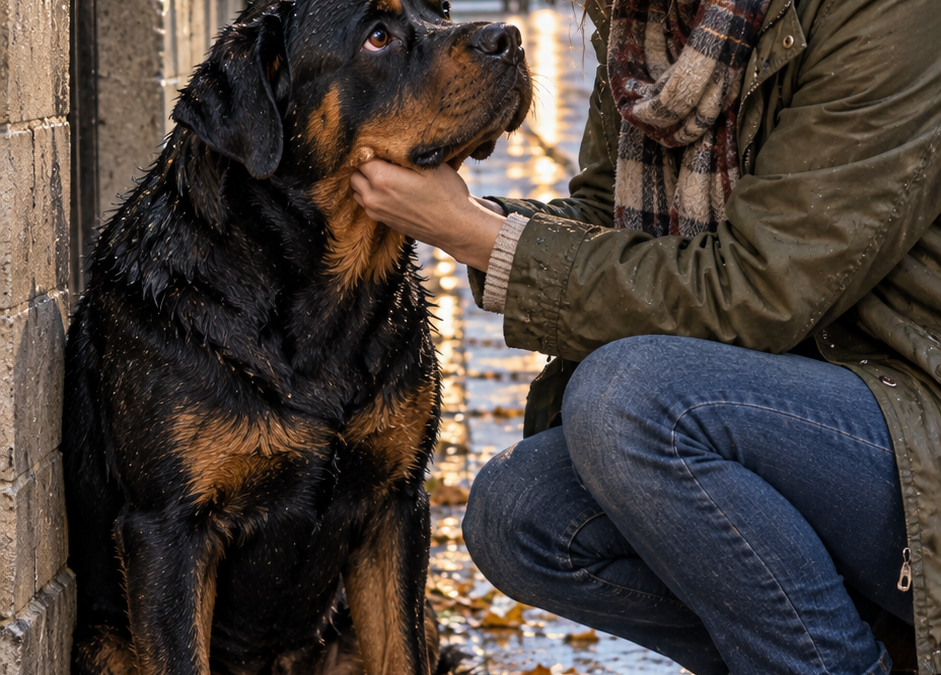
I had just finished an early shift and was walking from the parking lot toward home when I saw him.
He was sitting beside the curb in front of an old apartment building three blocks from our house.
A Rottweiler.
Young, but not a puppy.
Maybe a year and a half.
His coat was soaked from a steady gray rain.
He had no leash.
No collar.
No person calling his name.
He wasn’t pacing.
He wasn’t trying to follow anyone.
He was simply sitting there as if he had been placed in that exact spot and forgotten.
I slowed.
He looked at me.
Even now, I can remember his expression more clearly than I remember what I wore that day.
People who don’t know Rottweilers sometimes see the broad head and muscular body first.
I saw his eyes.
They were scared.
But underneath the fear was something worse.
Expectation.
He was still waiting for someone.
That was obvious.
He had not yet accepted that whoever had left him wasn’t coming back.
I stopped about ten feet away.
“Hey.”
His ears shifted.
He didn’t move.
I looked around.
The street was almost empty.
No one stood near the building entrance.
No one called from a window.
I waited.
Nothing.
“Are you lost?”
He stared at me.
I moved one step closer.
He remained still.
Another step.
His body tensed slightly, but he didn’t retreat.
I crouched several feet away and extended my hand.
“You don’t have to come.”
For almost a minute, neither of us moved.
Then he stood.
Slowly.
He approached like a dog negotiating with his own fear.
One step.
Pause.
Another.
When he reached me, he sniffed my fingers.
Then something happened that I still cannot explain without feeling it in my chest.
He lowered his head into my palm.
Not pushed.
Not demanded affection.
Just placed it there.
Carefully.
As though he was testing whether a human hand could still mean something safe.
I felt something inside me break open.
Or maybe come back together.
Even now, I’m not sure which.
“Okay,” I whispered.
His eyes closed.
“You’re coming with me.”
I took off my scarf, looped it gently through itself as a temporary lead, and walked him home.
Jason was in the kitchen when I opened the door.
He looked past me.
Then at the dog.
Then back at me.
“No.”
I almost laughed.
“Good morning to you too.”
“Emily.”
“He’s been sitting outside in the rain.”
“I can see that.”
“We need to get him checked for a chip.”
“Fine. Then we take him somewhere.”
“Maybe.”
Jason stared.
“Maybe?”
I knelt beside the dog and rubbed his wet neck.
“He might need a place for tonight.”
Jason folded his arms.
“One night.”
“Okay.”
One night became two.
The veterinarian found no microchip.
No collar.
No registration.
We posted online.
Called shelters.
Checked lost-dog listings.
Asked nearby residents.
Nothing.
Nobody claimed him.
I started calling him Rocky because he needed a name and because, somehow, it fit.
Jason rolled his eyes the first time he heard it.
“You named him.”
“I needed to call him something.”
“You don’t name temporary things.”
I smiled.
“We named the coffee machine.”
“That’s different.”
Within a week, Rocky had a bed.
Within two, he had a proper collar.
Within three, Jason stopped asking when we were taking him to a shelter.
I believed that meant acceptance.
Maybe I wanted to believe it.
At first, Rocky followed me everywhere.
Kitchen.
Laundry room.
Bathroom door.
Backyard.
If I sat down, he came close enough that some part of his body touched me.
A paw against my foot.
His shoulder against my knee.
His head across my leg.
At night, he slept beside my side of the bed.
Sometimes I woke and found him staring at me.
The first few times, it unsettled me.
Then I understood.
He was checking.
Still here?
Still safe?
Still mine?
I would reach down and touch him.
“Go back to sleep.”
He would.
Rocky changed the rhythm of my days.
Morning walks replaced scrolling through my phone.
I came home more quickly after work because I knew he was waiting.
I started noticing parks.
Weather.
The exact time the sun went down.
Small things.
Ordinary things.
Things I had stopped noticing in the life Jason and I had built.
And strangely, for a while, Rocky seemed to bring Jason and me closer too.
At first, Jason kept his distance.
Then Rocky began waiting near the front door when Jason came home.
One evening, I saw Jason crouch and scratch behind his ears.
Another time, I walked into the living room and found Jason throwing a rubber ball while Rocky slid across the hardwood floor trying to catch it.
Jason looked embarrassed when he saw me.
“Don’t say anything.”
I smiled.
“I didn’t.”
“You’re smiling.”
“I’m allowed to smile.”
He threw the ball again.
Rocky chased it.
For those first months, I thought everything was good.
Better than good.
I thought our family had become complete.
That’s the word I used.
Family.
Me.
Jason.
Rocky.
Seven months passed.
Seven months in which Rocky stopped flinching when voices rose on television.
Seven months in which he gained weight, learned where we kept his leash, discovered that sprinklers were apparently his mortal enemy, and claimed one corner of the couch despite Jason’s repeated declarations that he would never be allowed on furniture.
Seven months in which I forgot what the house had felt like without him.
Then one evening, Jason came home and said the sentence people always seem to use before changing your life.
“We need to talk.”
He stood near the kitchen counter.
He didn’t take off his jacket.
That was the first thing I noticed.
Jason always took his jacket off the moment he entered.
“Okay.”
Rocky was lying near my chair.
Jason looked at him.
Then at me.
“This isn’t working.”
I frowned.
“What isn’t?”
“The dog.”
For a second, I genuinely didn’t understand.
“What about him?”
Jason exhaled impatiently.
“He takes up too much space.”
I almost smiled because the statement sounded so absurd.
“Physically?”
“I’m serious.”
“So am I. What does that mean?”
“It means everything revolves around him now.”
“No, it doesn’t.”
“Walks. Food. Vet bills. Scheduling around him.”
“I do almost all of that.”
“That’s not the point.”
“Then what is the point?”
Jason looked away.
That mattered later.
At the time, I thought he was frustrated.
Months later, I realized he was avoiding my eyes because he had rehearsed the conversation and didn’t want me interrupting the version of it he needed to deliver.
He said, “I don’t want him here anymore.”
My stomach dropped.
“What?”
“You heard me.”
I stared at him.
Rocky lifted his head at the change in our voices.
“Where exactly do you expect him to go?”
“The shelter.”
I actually laughed.
Not because it was funny.
Because my mind rejected the words.
“You’re joking.”
“No.”
“You want to take Rocky to a shelter?”
“Tomorrow.”
“Jason.”
“I’ve decided.”
The way he said that frightened me more than the decision itself.
Not angry.
Not emotional.
Final.
As if we weren’t having a discussion at all.
As if I were being informed of an arrangement already made.
I stood.
“You don’t get to decide that by yourself.”
“It’s my house too.”
“And Rocky is part of our family.”
“He’s a dog.”
I felt heat rise into my face.
“He was abandoned when I found him.”
“So?”
“So I’m not doing that to him again.”
“You’re being dramatic.”
“Am I?”
I pointed toward Rocky.
“He spent weeks learning that this was home.”
Jason shrugged.
“He’ll adjust.”
Something in me went cold.
“You’ve been playing with him for months.”
“That doesn’t mean I want to organize my life around him forever.”
“You don’t.”
“Emily—”
“I feed him. I walk him. I schedule the vet. I clean up after him. Tell me what exactly he is taking away from you.”
Jason stared at me.
Then he said, “I just don’t want him here.”
I understood then that no practical argument would matter.
There was no issue to solve.
No compromise he wanted.
He had already chosen the outcome.
I lowered my voice.
“If you’re upset about something else, tell me.”
“I’m talking about the dog.”
“No. You’re not.”
His expression hardened.
“Don’t turn this into something it isn’t.”
“Then explain why after seven months you suddenly can’t live with him.”
“I don’t need to justify not wanting an animal in my house.”
“Our house.”
“Fine. Our house.”
Rocky stood and walked toward me.
He pressed his side against my leg.
Jason watched.
Then said the sentence that ended our marriage long before I understood why he had chosen it.
“If you love that dog so much, you can live with him somewhere else.”
The room went silent.
I looked at him.
“What did you say?”
“You heard me.”
I waited for him to take it back.
He didn’t.
“You’re asking me to choose.”
“I’m saying I’m done living with the dog.”
“Jason.”
He looked directly at me now.
“If you choose Rocky, that’s your decision.”
That wording.
Your decision.
I didn’t recognize its importance until months later.
That night, I slept on the living-room couch.
Rocky lay beside me.
I didn’t actually sleep.
I listened to his breathing and stared at the ceiling.
Seven years.
Jason and I had been together seven years.
We had shared apartments.
Family holidays.
Bad jobs.
Good promotions.
Arguments over money.
Trips.
Illness.
Birthdays.
Ordinary Tuesdays.
I kept waiting for morning to make the conversation seem less real.
Maybe Jason would come downstairs embarrassed.
Maybe he’d say he’d been angry.
Maybe there would be some explanation.
Instead, at seven fifteen, he came into the living room dressed for work.
“Have you decided?”
I sat up.
“Don’t do this.”
“The shelter opens at eight.”
My heart began pounding.
“You’re actually going to take him.”
“Yes.”
“You can’t.”
“Emily, I told you yesterday.”
I stood.
“I won’t agree to this.”
Jason picked up Rocky’s leash.
Rocky saw it and immediately stood, tail moving.
He thought he was going for a walk.
That nearly destroyed me.
“Jason, please.”
He clipped on the leash.
I grabbed his wrist.
“Please.”
For the first time, my voice broke.
“He trusts us.”
Jason pulled his arm free.
“He’ll be fine.”
“You don’t know that.”
“It’s a shelter, not an execution.”
“That’s not the point.”
“Then what is?”
“He already lost one home.”
Jason stared at me.
“I can’t watch you do that to him again.”
“Then don’t come.”
That was exactly what I did.
I couldn’t.
I couldn’t stand in a shelter lobby and watch Rocky turn around expecting me to follow.
So I stayed home.
I heard the front door close.
Then silence.
I sat on the floor.
I don’t remember how long.
At some point, I realized I was crying so hard I could barely breathe.
The house felt wrong immediately.
No nails clicking across the floor.
No water bowl.
No body leaning against my knees.
Nothing.
Jason came home that evening.
I barely spoke to him.
The next morning, I drove to the shelter before work.
I had told myself I would stay calm.
I failed the moment I saw Rocky.
He was in a kennel near the end of a row.
Sitting in the back corner.
Head lowered.
The dog I had known at home seemed gone.
“Rocky.”
His head snapped up.
For one second, he stared.
Then he stood so quickly his paws slipped against the floor.
He rushed to the kennel gate.
I knelt.
“Oh, baby.”
Rocky pressed his face against the bars.
Then lifted one paw and placed it against the metal.
No barking.
No jumping.
Just that paw.
And his eyes.
I knew that look.
I had seen it the first morning in the rain.
Waiting.
Only this time, he wasn’t waiting for someone who had abandoned him.
He was waiting for me.
“I came.”
My voice broke.
“I’m here.”
He leaned harder against the gate.
“I promise I’m going to fix this.”
That became my routine.
Every day.
Before work when I could.
After work when I couldn’t.
I sat outside Rocky’s kennel and talked to him.
“I’m looking for apartments.”
His ears lifted.
“I know.”
“I need somewhere that allows large dogs.”
Tail movement.
“That’s apparently harder than it should be.”
He watched.
“But I’m not leaving you here.”
I told him about my workday.
About listings I’d called.
About deposits.
About landlords.
About one apartment that would accept dogs but only up to forty pounds.
Rocky was almost twice that.
“You need to lose some weight,” I joked once.
He looked at me.
I immediately felt guilty.
“No. Don’t you dare. You’re perfect.”
The shelter staff began to know me.
One woman named Melissa pulled me aside after my fourth visit.
“We’re worried about him.”
My stomach tightened.
“What do you mean?”
“He’s barely eating.”
“He eats at home.”
“I know.”
“He loves chicken.”
“We’ve tried.”
“What about toys?”
“He isn’t interested.”
I looked through the kennel window.
Rocky lay facing the hallway.
“He thinks I’m coming back.”
Melissa’s expression softened.
“Yes.”
“I am.”
“I believe you.”
“No. I mean I’m taking him back.”
“Then do it as soon as you can.”
“I’m trying.”
She hesitated.
“He’s extremely bonded to you.”
“I know.”
“Some dogs adapt quickly in shelters. Some don’t.”
I looked at her.
“And Rocky?”
She didn’t need to answer.
He was disappearing in front of me.
I understood that because I was disappearing too.
At home, Jason behaved as if nothing significant had happened.
That may have been the cruelest part.
He watched television.
Made coffee.
Asked whether I needed anything from the grocery store.
Once, he asked, “How was work?”
I stared at him.
“You took my dog away.”
He sighed.
“Emily.”
“And now you’re asking how work was?”
“I don’t want us to spend every day fighting.”
I laughed bitterly.
“Then bring Rocky home.”
“No.”
The answer never changed.
End of week one.
No.
Week two.
No.
By the beginning of the third week, something in me became very quiet.
Grief sometimes looks like panic.
Sometimes it looks like clarity.
I found an apartment.
Small.
Second floor.
Older building.
One bedroom.
No yard.
But large dogs were allowed.
The landlord met Rocky’s breed requirement.
The rent was higher than I wanted.
The neighborhood was farther from work.
None of that mattered.
I signed the lease.
On Friday evening, I returned home.
Jason was sitting at the kitchen table.
I stood in the doorway.
“I can’t live like this.”
He looked up.
“What do you mean?”
“I want Rocky back.”
He shook his head.
“That’s not happening.”
“Then I’m leaving.”
Silence.
Then Jason laughed.
Actually laughed.
Not loudly.
Just one cold, disbelieving sound.
That laugh did more damage than every argument we’d had.
I heard contempt in it.
Not surprise that I would leave.
Contempt that I had finally done exactly what he had expected.
“You’re leaving your husband for a dog.”
“No.”
My voice was calm.
“I’m leaving my husband because he forced me to choose something he knew I couldn’t abandon.”
“Same thing.”
“It isn’t.”
Jason leaned back.
“What are you expecting me to do? Beg?”
“No.”
“Good.”
I stared at him.
Something about his reaction bothered me.
Not enough then to understand.
But enough that part of me noticed.
He wasn’t scared.
He wasn’t angry.
He wasn’t devastated.
He seemed almost relieved.
I thought maybe he had emotionally shut down.
I know better now.
“I signed a lease,” I said.
“When are you going?”
“Tomorrow.”
He nodded.
That was it.
Seven years.
And he nodded.
The next morning, I packed what I could fit in my car.
Clothes.
Documents.
A few kitchen things.
Photographs I couldn’t leave.
My laptop.
Rocky’s empty bed.
Jason watched from the hallway.
No tears.
No argument.
No attempt to stop me.
At one point he said, “Don’t forget your mail.”
That sentence stayed with me too.
It sounded like something you say to a roommate.
I left.
Then I drove directly to the shelter.
Melissa saw me enter carrying a leash.
Her whole face changed.
“Really?”
I nodded.
“He’s coming home.”
She smiled.
“I’ll get him.”
When Rocky appeared at the end of the hallway, he saw me.
Then he saw the leash.
His entire body changed.
He ran.
Melissa almost lost hold of him.
I crouched.
Rocky slammed against me.
I fell backward laughing and crying at the same time.
He climbed halfway into my lap, licking my face.
“I know.”
His tail beat against the floor.
“I know.”
I wrapped my arms around him.
“I’m sorry.”
He pressed closer.
“You’re never going back there.”
He had no idea what apartment we were moving into.
No idea our new place was smaller.
No yard.
No familiar rooms.
He didn’t care.
I was there.
That was home enough.
The first night in the apartment, we slept on the floor because my bed hadn’t arrived yet.
Rocky’s old blanket was spread beside me.
He ignored it.
He put his head across my stomach.
I stared at the ceiling.
I expected to feel devastated.
Instead, I felt something unexpected.
Peace.
For the first time in weeks, I could breathe.
The apartment was quiet.
Boxes everywhere.
Half my belongings still at Jason’s house.
My marriage effectively over.
And yet I felt safer on that floor with Rocky than I had felt in my own home for months.
The next few weeks were difficult.
Separation isn’t romantic just because leaving was the right decision.
There were bills.
Paperwork.
Conversations with lawyers.
Dividing property.
Explaining things to family.
Explaining things to friends.
Some people understood.
Others didn’t.
“You left him over a dog?”
I heard that more than once.
At first, I tried explaining.
“It wasn’t just Rocky.”
But I couldn’t explain what I didn’t yet fully understand.
So sometimes I simply said, “Yes.”
Let them think what they wanted.
Rocky recovered quickly.
Within days, he ate normally.
Within a week, he began playing again.
Within two, he claimed a sunny patch beside my apartment window.
Our life became small but good.
Morning walk.
Work.
Evening walk.
Dinner.
Sometimes friends visited.
Sometimes we went to the park.
I learned how little space happiness actually needs.
Four months passed.
I had started smiling again without noticing.
Jason and I barely communicated except about practical matters.
Then one afternoon, I met an old friend named Rachel for coffee.
We hadn’t seen each other since the separation.
She asked how I was.
“Good.”
“Really?”
I looked out the window.
“Yeah.”
And I meant it.
We talked about work.
Mutual friends.
Normal things.
Then Rachel hesitated.
“Have you heard about Jason?”
My stomach tightened slightly.
“No.”
She looked uncomfortable.
“Maybe I shouldn’t say anything.”
“Then don’t.”
“I just thought you might already know.”
I took a sip of coffee.
“Know what?”
“He’s living with someone.”
I expected that to hurt.
It didn’t.
Not immediately.
I shrugged.
“That’s his business.”
Rachel looked at me carefully.
“They’ve been together for several months.”
My hand stopped.
“Several?”
“That’s what I heard.”
“How many?”
She hesitated.
“At least six. Maybe longer.”
The café seemed to become very quiet.
Six months.
I counted backward.
Rocky had been removed four months earlier.
Jason and I had separated around that time.
Six months meant—
“No.”
Rachel looked worried.
“Emily?”
“They were together before I left.”
She said nothing.
I began replaying dates.
Jason’s late evenings.
The weekend he’d suddenly started going to the gym alone.
The phone he began keeping face down.
His emotional distance.
Things I had noticed but never assembled.
Because if you trust someone, you don’t treat every ordinary change like evidence.
Then I remembered the conversation about Rocky.
Not angry.
Not impulsive.
Planned.
“I need to go.”
I drove home.
Rocky met me at the door.
He knew immediately something was wrong.
Dogs always seem to know before we decide what expression to wear.
He followed me into the living room.
I sat on the floor.
Rocky lay beside me.
And I began remembering.
Jason had never loved Rocky the way I did.
That was true.
But he had not hated him.
He sometimes played with him.
Sometimes pet him.
Sometimes laughed when Rocky did something stupid.
For seven months, Jason tolerated the dog without a serious complaint.
Then suddenly—
Leave.
Tomorrow.
No compromise.
If you love him that much, live somewhere else.
My decision.
That phrase.
Your decision.
I said it aloud.
“He wanted me to leave.”
Rocky’s head lifted.
I looked at him.
“He wanted me to be the one who left.”
Suddenly, everything fit.
If Jason already had someone else, leaving me would have made him the villain.
There would be questions.
Friends.
Family.
Why did you leave Emily?
Was there someone else?
But if I left him?
Different story.
She chose a dog over her husband.
He becomes the abandoned spouse.
The reasonable one.
The victim.
I remembered his laugh when I said I was leaving.
Not shock.
Relief.
I remembered how easily he let me pack.
How he didn’t ask me to stay.
How quickly he accepted the end.
Because the end hadn’t surprised him.
He had designed it.
Rocky wasn’t the reason.
Rocky was the lever.
Jason knew exactly where to apply pressure.
He knew I loved that dog.
He knew Rocky had already been abandoned.
He knew I could never leave him in a shelter indefinitely.
And he knew if he made the conditions impossible enough, I would make the decision Jason was too cowardly to make himself.
For a while, I was furious.
Not because Jason had moved on.
Because he had manipulated me into carrying the responsibility for his exit.
He had built a story in which I destroyed our marriage.
Over a dog.
Meanwhile, he had already been building his next life.
I walked through my apartment that night unable to settle.
Rocky followed.
I remembered every sentence differently.
“The dog takes too much attention.”
Translation: I need a conflict you won’t compromise on.
“I’ve decided.”
Translation: I already know where this is going.
“If you love the dog so much, you can live somewhere else.”
That hadn’t been an insult.
It had been an invitation.
A door he needed me to walk through.
And I had.
I sat beside the window.
Rain had begun outside.
The same cold kind of rain that had fallen the morning I found Rocky.
He lay across my feet.
For a long time, I watched water trace lines down the glass.
Then something shifted.
The anger remained.
But underneath it came another realization.
If Jason had simply said he wanted to leave, would I have let him?
Maybe.
But maybe I would have fought.
Asked for counseling.
Begged for explanations.
Tried to save something already dead.
I had been comfortable in our marriage.
Not happy.
There is a difference.
I hadn’t understood that before.
Routine had disguised emptiness.
I mistook stability for love.
Shared history for closeness.
Familiarity for intimacy.
Jason had done something cruel.
Manipulative.
Cowardly.
But by forcing me out, he had accidentally done the one thing I had been too afraid to do.
He made me build a life that belonged to me.
I looked down.
Rocky was asleep.
His head rested on my foot.
“You know something?”
His eyes opened.
“You ruined everything.”
His ears lifted.
I smiled.
“In the best possible way.”
He stood and placed his chin on my knee.
I stroked his head.
Jason had used Rocky because he knew I loved him.
What he had failed to understand was what Rocky’s love would teach me in return.
Rocky never made me negotiate for affection.
He never made me prove my worth by accepting cruelty.
He never withheld warmth to control me.
When he was afraid, he showed fear.
When he trusted me, he showed trust.
When he loved me, there was no strategy behind it.
People sometimes say dogs love unconditionally.
I’m not sure that’s exactly true.
Dogs need safety.
Care.
Respect.
Consistency.
But what they don’t do is weaponize love the way humans sometimes can.
They don’t sit across from you and design a situation where you will break yourself so they can avoid being honest.
Rocky taught me that love should feel safe enough to be straightforward.
Months later, I learned a little more about the woman Jason was with.
I never met her.
I never contacted her.
I didn’t need to.
For a while, I wondered whether she knew.
Did she know he was married when their relationship began?
Did she know about Rocky?
Did she know he had engineered our separation?
Maybe.
Maybe not.
I eventually realized none of those answers would change my life.
There was a time when I wanted her to discover who Jason really was.
Then I felt ashamed of wanting that.
I didn’t want another woman hurt just so I could feel vindicated.
I hoped she saw him clearly.
That was enough.
A year after I left, my life looked nothing like the one I’d had before.
The apartment had stopped feeling temporary.
Morning light filled the living room.
I bought furniture I liked rather than furniture Jason and I compromised on.
I painted one wall a color he would have hated.
I took a different job with slightly less pay but better hours.
I made new friends.
Reconnected with old ones.
I learned how peaceful weekends could be when I wasn’t quietly measuring another person’s mood.
And Rocky thrived.
He became known in the neighborhood.
Children called his name from across the park.
He learned which café gave him water.
He developed a ridiculous obsession with one red rubber ball.
On Sunday mornings, we walked farther than we needed to.
Sometimes three miles.
Sometimes five.
Rocky always walked as though the world had been created overnight just for him to explore.
Watching him changed me.
Dogs don’t waste much time regretting yesterday once today becomes safe.
I tried to learn that.
One morning, almost exactly a year after I found him, we returned to the street where I had first seen him.
The old apartment building was still there.
Same cracked entrance.
Same curb.
I stopped.
Rocky sniffed the sidewalk.
“Do you remember?”
He looked at me.
“You were right there.”
He pulled toward a tree.
I laughed.
“Clearly this means more to me.”
But I stood there for a moment.
I saw the past layered over the present.
Wet dog.
Gray rain.
My hand extended.
Rocky’s head lowering into my palm.
If I had crossed the street instead—
If I had said I was too busy—
If I had worried what Jason would say—
My entire life would have gone another direction.
I used to think major life changes arrived with announcements.
Job offers.
Wedding proposals.
Divorce papers.
Diagnoses.
But sometimes the hinge is much smaller.
A dog sitting in the rain.
You stop.
You reach out.
Everything after that becomes different.
I bent and rubbed Rocky’s neck.
“You found me at a very inconvenient time.”
His tail wagged.
“I just didn’t know it yet.”
We continued walking.
Later that afternoon, I sat in the park while Rocky ran across the grass.
He came back every few minutes.
Always checked.
Always returned.
I thought about the word home.
For years, I believed home was a house shared with the person you married.
A mortgage.
Furniture.
Photos.
A routine.
Then I learned that a building can contain your entire life and still not feel safe.
Home is different.
Home is where you are allowed to exist without becoming smaller for someone else’s comfort.
Home is where affection isn’t used as leverage.
Home is where you can tell the truth without calculating the consequences.
Home is where nobody threatens what you love simply because hurting it will make you easier to control.
My apartment was smaller than the house Jason and I shared.
I was happier there.
Rocky taught me that space has very little to do with freedom.
Sometimes I still think about Jason.
Not often.
Not with hatred.
Hatred keeps a person tied to you in a different way.
I don’t want that.
I hope he found whatever he believed he was missing.
I hope someday he learned that honesty would have caused less damage than manipulation.
I hope he eventually understood that getting someone else to make the final decision doesn’t erase your responsibility for creating the choice.
Most of all, I stopped needing him to understand anything.
That was freedom too.
I spent months believing I had left my marriage because of a dog.
Then I spent months believing Jason had destroyed our marriage because he wanted another woman.
Eventually, I saw the truth was broader than both.
Rocky didn’t destroy anything.
He exposed something.
Jason didn’t suddenly become the man who manipulated me.
He had simply reached a situation where his character became impossible for me to ignore.
And I wasn’t foolish for not seeing it earlier.
People reveal themselves most clearly when what they want conflicts with what you need.
Jason wanted freedom without blame.
I needed honesty.
He chose deception.
I chose Rocky.
Only one of those decisions still feels right.
One evening, near the anniversary of the day I brought Rocky home from the shelter, I sat on my apartment floor sorting through an old box.
Inside were photographs from my marriage.
Jason and me at the beach.
Christmas.
A friend’s wedding.
Our first apartment.
For years, I thought looking at those pictures would hurt forever.
Instead, I mostly felt distant tenderness for the woman in them.
She didn’t know.
She thought endurance meant maturity.
She thought seven years invested meant leaving would make those years meaningless.
She thought starting over meant failure.
I wanted to tell her something.
Those years weren’t meaningless just because the marriage ended.
A chapter doesn’t have to last forever to have existed.
You can admit something is over without declaring every moment before it false.
Jason and I had good years.
Good memories.
Real laughter.
That did not excuse what he did at the end.
Both things could be true.
Rocky pushed his nose into the box.
“No.”
He grabbed the edge of a photograph.
“Absolutely not.”
I took it from him.
“You don’t get to eat my emotional history.”
His tail moved.
I laughed.
Then I put the photos back.
Closed the box.
Placed it in the closet.
Not destroyed.
Not displayed.
Just finished.
That night, Rocky climbed beside me on the couch.
He was technically too large.
I had technically forbidden it.
Neither of us respected that rule anymore.
I placed my hand on his chest.
His heartbeat was slow and steady.
The first time I found him, his body trembled under my hand.
Now he slept deeply.
Safe enough not to monitor whether I might disappear.
There is something powerful about becoming safety for another living thing.
There is something equally powerful about realizing they became safety for you too.
When Jason forced me to choose, I thought the choice was husband or dog.
It wasn’t.
Not really.
The choice was between abandoning something innocent to preserve a relationship built on someone else’s terms, or accepting the frightening possibility that I could build another life.
Rocky was the reason I had enough courage to choose the second.
He didn’t save me in a dramatic way.
He never pulled me from a burning building.
Never defended me from an attacker.
He simply needed me not to betray him.
And in refusing to betray him, I finally stopped betraying myself.
That may be the most important thing he ever taught me.
Love does require sacrifice sometimes.
But sacrifice is different from self-erasure.
Love asks you to show up.
It should not demand that you abandon your conscience to prove loyalty.
Love can compromise.
Manipulation creates impossible choices and then blames you for choosing.
I know the difference now.
This morning, Rocky and I went to the park early.
The sun was just rising.
There had been rain overnight, so the grass smelled fresh.
Rocky ran ahead.
Then turned.
He always turns.
He waits until he sees me.
Then runs again.
For some reason, that habit still gets me.
I sat on a bench.
Rocky eventually trotted back and placed his head on my knee.
“You’re getting gray.”
His eyebrows had begun to lighten.
He looked offended.
“So am I.”
That seemed to satisfy him.
A woman walked past with a small terrier.
Rocky watched politely.
Then looked at me.
I scratched the side of his face.
Years ago, he sat beside a curb waiting for someone who had left him.
Then later, he sat behind shelter bars waiting for me.
He had been abandoned twice.
The first time by someone I never knew.
The second time because the man I married decided the dog could be used as a weapon in a marriage he no longer wanted.
Rocky survived both.
So did I.
The difference is that survival eventually became something better.
We built a life.
A real one.
Not glamorous.
Not perfect.
But ours.
The apartment is still small.
Rocky still takes up too much of the bed.
My friends still tease me about planning weekends around him.
I still spend too much money on treats.
And every single time I walk through my door, Rocky comes to meet me as though my return is the best thing that happened all day.
Maybe that is why Jason’s manipulation no longer feels like the defining event of my story.
It was only the door.
Rocky and I were the ones who walked through it.
For a long time, I thought Jason had taken my home away.
Then I understood something.
A home cannot be taken from you if it was never really made of walls.
Home is trust.
Home is peace.
Home is being wanted without being controlled.
Home is walking through a door and knowing nobody inside is secretly planning how to make you leave.
Rocky looked at me that morning in the park.
His mouth open.
Tongue hanging out.
Happy.
I smiled.
“Come on. Let’s go home.”
He stood immediately.
We walked back together.
And I knew exactly what that word meant now.
Not Jason’s house.
Not the marriage I had tried to protect.
Not the past.
Home was the life I had chosen after I finally stopped letting someone else decide what I was allowed to love.
Home was freedom.
Home was honesty.
Home was the dog walking beside me.
And for the first time in my life, home was something I had built for myself.








