My Husband Left Our 4-Year-Old Alone for a Cruise—Then He Begged the Police Not to Open One Locked Closet
My Husband Left Our 4-Year-Old Alone for a Cruise—Then He Begged the Police Not to Open One Locked Closet
My husband left our four-year-old alone for three days while he took his family on a Caribbean cruise.
When I came home from deployment, the money was gone, the house was rotting, and Lily was starving.
Then Derek begged the police not to open one locked closet—and suddenly this was no longer just a broken marriage.
My duffel bag hit the floor with a heavy thud that echoed through the silent entryway.
The air inside my Chesapeake home didn’t smell like sweet laundry or fresh coffee.
It smelled of sulfur, rotting meat, and sour milk.
For half a second, my brain tried to reject what my senses were telling me.
I had been awake for almost twenty hours. I had crossed an ocean, cleared military processing, caught a connection through Atlanta, and driven home expecting to surprise my husband and daughter two days earlier than planned.
Maybe the garbage disposal had backed up.
Maybe the refrigerator had failed.
Maybe Derek had taken Lily to his mother’s house and left a few dishes sitting around.
Then I stepped into the kitchen.
Flies hovered over half-eaten takeout containers covered in green mold.
A pizza box sagged open on the floor.
Trash overflowed from the garbage can and spilled across the hardwood.
A carton of milk sat on the counter, swollen from heat.
One of Lily’s pink plastic cups had rolled beneath the table.
My pulse began to hammer.
“Derek?”
Nothing.
“Lily?”
Silence.
Then I saw her.
She was sitting cross-legged on the floor near the pantry.
My four-year-old daughter was clutching an empty, dirty cereal bowl against her chest.
Her clothes were stained.
Her hair was matted into knots.
Her lips looked dry.
And her eyes—those huge brown eyes that normally lit up whenever she heard my voice—looked hollow with exhaustion.
For one terrible second, she simply stared at me.
“Mama?” she whispered.
Her voice cracked.
“Are you really here?”
Something inside me shattered.
I dropped to my knees so quickly that my combat boots slid across the dirty floor.
“It’s me, baby.”
I crawled the last few feet.
“It’s Mama.”
She didn’t immediately hug me.
Her tiny, sticky hands reached up and touched my cheeks.
She pressed one palm against my forehead.
Then my nose.
Then my chin.
It was as if she needed to physically confirm that I wasn’t a dream.
When she finally realized I was real, Lily collapsed against me.
She began to cry without making a sound.
Her whole body shook.
I had seen grown soldiers cry after losing friends.
I had heard explosions close enough to make my teeth hurt.
I had spent nights overseas calculating logistics routes while warning alarms sounded beyond reinforced walls.
None of it had ever hurt me the way my daughter’s silent sobs did.
“I’m here,” I whispered.
I wrapped both arms around her.
“Mama’s here.”
I’m Major Hannah Nolan, United States Army Intelligence.
For six months, I had been deployed overseas supporting an intelligence coordination mission. My life had been schedules, secure communications, cold meals, interrupted sleep, and the constant discipline of never allowing panic to outrun procedure.
I knew how to assess a crisis.
Look.
Think.
Prioritize.
Act.
So I forced myself to do exactly that.
“Lily, look at Mama.”
She pulled back.
Her cheeks were streaked with dirt and tears.
“When did you eat?”
She pointed at the bowl.
“Cereal.”
“Today?”
A tiny shrug.
“Yesterday?”
Another shrug.
My stomach turned.
“Where’s Daddy?”
“On the giant ship with Grandma.”
I stared at her.
“What?”
“The giant ship.”
Her lower lip trembled.
“Grandma said Daddy needed a vacation.”
My fingers went numb.
“Who has been taking care of you?”
Lily looked toward the dark hallway.
“No one.”
I thought I had misheard.
“What about Mrs. Price?”
“Grandma said Mrs. Price would bring crackers through the door.”
She sniffed.
“But nobody came.”
I reached into my field bag.
There were emergency snacks inside that I hadn’t eaten during the flight.
An applesauce pouch.
Crackers.
Two bottles of water.
I wanted to give Lily everything at once.
Training stopped me.
I didn’t know how dehydrated she was or how long she had been eating improperly.
So I gave her two small spoonfuls of applesauce.
Then tiny sips of water.
“Slowly, baby.”
She tried to grab the pouch.
I almost lost control right there.
Instead, I held her hand.
“More in a minute. I promise.”
Then I called 911.
While the dispatcher took my information, I walked through the downstairs rooms with Lily in my arms.
No Derek.
No babysitter.
No note.
No responsible adult.
His car was gone.
The guest room was empty.
The back door was locked.
A security camera above the patio showed a blinking red light, but when I checked the home system on my phone, I discovered the cloud subscription had been canceled eleven days earlier.
That wasn’t an accident.
My heart started pounding harder.
I opened Derek’s social media.
The first photograph answered one question.
There he was.
My husband.
Smiling broadly from the upper deck of a luxury Caribbean cruise ship with a tropical drink raised toward the camera.
Beside him stood his mother, Patricia, wearing white linen and oversized sunglasses.
His sister, Jenna.
Three cousins.
All of them grinning beneath a cloudless blue sky.
The picture had been posted four hours earlier.
The caption said:
Family First! Unwinding in Paradise!
I stared at those two words.
Family first.
My daughter was sitting on a filthy floor drinking water from the cap of my bottle because I was afraid she’d make herself sick gulping too quickly.
And her father was drinking cocktails in the Caribbean.
I opened our banking app.
The balance didn’t make sense.
I refreshed it.
Same number.
I checked the savings account.
Then the emergency reserve.
Then the account I had created for Lily when she was born.
My stomach dropped.
Nineteen thousand dollars was gone.
My combat deployment pay.
Our family emergency reserves.
Lily’s college savings.
All of it.
Transaction after transaction rolled across the screen.
Cruise deposits.
Airline tickets.
Onboard spending.
Bar charges.
Excursions.
Luxury dining packages.
And several enormous payments against Derek’s personal credit cards.
The front door opened behind me.
“Ma’am?”
I spun around.
Two paramedics entered first.
Officer Marcus Bell followed them.
He was tall, broad-shouldered, and somewhere in his forties, with the observant expression of a man who had been a patrol officer long enough to know when the first version of a story wouldn’t be the last.
“I’m Major Hannah Nolan,” I said. “This is my daughter, Lily. She’s four. I returned from deployment less than twenty minutes ago. She’s been left here alone.”
Bell’s eyes moved across the kitchen.
Then toward Lily.
His expression changed.
“For how long?”
“She says three days.”
One paramedic looked sharply toward him.
Bell pulled out a notebook.
“Where’s the father?”
I held up my phone.
“On a cruise.”
The medic lifted Lily onto the couch.
They checked her pulse, temperature, blood sugar and hydration.
Lily gripped my sleeve the entire time.
Then my phone lit up.
DEREK CALLING.
I showed Officer Bell.
He nodded toward the speaker icon.
I answered.
“Hannah?”
Derek’s voice came fast and irritated.
Behind him, I could hear steel drums, heavy bass and people shouting over music.
“Why did my banking app send an alert that you logged in? Why aren’t you in Germany?”
I looked at Lily.
“I came home early, Derek.”
Silence.
“Where is the person taking care of our daughter?”
A brief pause.
“She’s fine.”
“That wasn’t my question.”
“Hannah—”
“Where is she?”
His breathing changed.
“Mom arranged it.”
“Arranged what?”
“Evelyn Price was supposed to keep an eye on her.”
I turned toward Bell.
He was writing every word.
“Evelyn thought you were all on a weekend trip!” I shouted.
My composure finally cracked.
“Lily has been alone in this house for seventy-two hours!”
The music on Derek’s end faded.
I heard a door close.
He had moved somewhere private.
“Don’t blow this out of proportion.”
I actually stopped breathing.
“What did you say?”
“We’ll be back Sunday. You’re home now. Just clean her up, get some groceries, and we’ll deal with this when I get back.”
Just clean her up.
I looked at my daughter.
At her cracked lips.
At the stains on her shirt.
At the empty bowl.
“Officer Bell is standing in my living room, Derek.”
Silence.
“You are being reported for child abandonment.”
His breath hitched.
“What did you just say?”
“You heard me.”
“You brought cops into my house?”
“It’s my house, Derek. I bought it before we married.”
“Hannah, you don’t understand what you’re doing.”
“Oh, I understand exactly what I’m doing. You left our child alone while you spent nineteen thousand dollars of my deployment pay and her savings taking your family on a cruise.”
His voice dropped.
“Listen to me.”
“No.”
“Hannah.”
There was something different in his tone now.
Not arrogance.
Not irritation.
Fear.
Pure fear.
“Hannah, listen to me very carefully.”
Officer Bell stopped writing.
Derek whispered, “Do not let those police search the house.”
Bell looked up.
I felt the hair rise along my arms.
“Give me one good reason why they shouldn’t.”
Another pause.
Then Derek said the sentence that changed everything.
“Stay away from the hallway linen closet.”
Nobody moved.
Slowly, I looked toward the corridor.
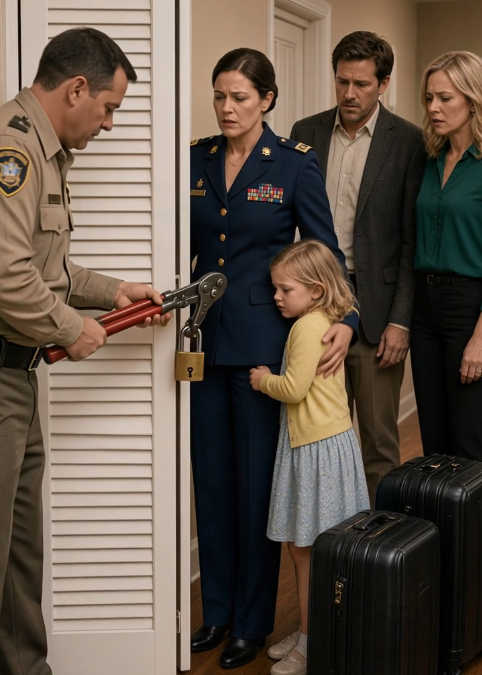
At the far end was a tall oak-framed linen closet built into the wall.
I had used it for towels, sheets and winter blankets before deploying.
Now a heavy-duty steel padlock hung across the brass handles.
It had never been there before.
Officer Bell followed my stare.
“Was that lock there when you left?”
“No.”
Derek heard him.
“Hannah!”
Officer Bell walked toward the hallway.
Derek’s voice exploded through the phone.
“Don’t touch it!”
Bell stopped several feet away.
He looked back at me.
“Do you own this residence?”
“Yes.”
“Is your husband on the deed?”
“No. We married after I bought it.”
“Hannah!” Derek shouted. “Don’t be stupid!”
I stared at the padlock.
“What did you put in my closet?”
“Nothing.”
“Then why are you panicking?”
“I’m not panicking.”
His voice cracked on the final word.
Officer Bell reached toward the equipment secured to his vest.
Derek must have heard the metal shift.
“Do not open that door!”
Lily flinched.
That ended the conversation for me.
I picked up the phone.
“You left our daughter alone.”
My voice had gone completely calm again.
“You stole her savings. And now you’re screaming at police officers from a cruise ship because you’re afraid of a closet in my house.”
I looked at Bell.
“Officer, do what you need to do.”
PART2
Bell didn’t cut the lock immediately.
That detail mattered later.
He stepped back and called his supervisor.
Then another officer photographed the door.
Because Lily’s condition had created a probable child-neglect investigation and because Derek’s reaction suggested the closet could contain evidence or something dangerous, they treated it carefully.
Meanwhile, one of the paramedics told me Lily needed to be examined at the hospital.
Her dehydration wasn’t severe enough for an ambulance emergency, but her blood sugar was low and she needed proper evaluation.
I carried her outside.
As we reached the porch, Derek called again.
I declined it.
He called again.
And again.
Then Patricia called.
I stared at her name.
Officer Bell was standing beside his cruiser.
“Answer it if you want,” he said. “Don’t argue. Just let her talk.”
I put Patricia on speaker.
“Hannah, what in God’s name are you doing?”
No hello.
No question about Lily.
No concern for her granddaughter.
“What am I doing?”
“Derek says you’ve brought police into the house and you’re threatening everybody.”
“Where are you?”
“You know where we are.”
“Say it.”
She hesitated.
“On vacation.”
“Lily has been alone for three days.”
“Don’t be dramatic.”
I looked at Bell.
Even he seemed stunned.
Patricia continued.
“Evelyn was supposed to check on her.”
“Evelyn didn’t know she was responsible for a four-year-old child.”
“Well, that sounds like a misunderstanding.”
“A misunderstanding?”
“You military people always turn everything into a crisis.”
My hands began shaking.
I had spent years learning how to control anger.
Patricia could dismantle that training in seconds.
“What was Lily supposed to eat?”
“There was food.”
“Rotting food.”
“Then order something.”
“She’s four!”
“Hannah, lower your voice.”
I almost laughed.
Then she said, “Derek deserves a break.”
I looked through the open front door at the kitchen.
My daughter had slept there.
Alone.
Probably crying.
Probably waiting for somebody who never came.
“A break from what?”
“From you being gone all the time. From raising Lily while you’re playing soldier.”
The world went very still.
Officer Bell’s jaw tightened.
I said, “Your son abandoned your granddaughter so he could take you on a cruise using money he stole from me.”
“Married people share money.”
“Lily’s college account wasn’t his.”
“She’s four. She doesn’t need college money right now.”
There are moments when a relationship dies so completely that you don’t feel grief.
You feel clarity.
That was mine.
“Do you know what’s inside the linen closet?”
Patricia went silent.
That silence told me more than an answer would have.
“Patricia?”
“I don’t know what you’re talking about.”
“Then why did you stop talking?”
“Hannah, don’t open anything until Derek gets home.”
Officer Bell and I exchanged a look.
“Why?”
“Because it’s his private property.”
“In my house?”
“Just wait.”
“No.”
Her voice hardened.
“If you destroy this family over one mistake, Lily will grow up knowing her mother did it.”
I looked toward the ambulance.
“No, Patricia.”
I disconnected the call.
“Lily is going to grow up knowing her mother came home.”
At the hospital, the pediatrician said words I never expected to hear attached to my daughter.
Acute dehydration.
Caloric deprivation.
Stress response.
Possible neglect trauma.
None of it was life-threatening because I had returned when I did.
That phrase haunted me.
Because I had returned when I did.
I was supposed to remain overseas forty-eight more hours.
A transportation change and an early handoff had allowed me to travel ahead of schedule.
If I had arrived when Derek expected me to, Lily would have spent two additional nights alone.
Maybe three.
I sat beside her hospital bed while she slept with her fist wrapped around my thumb.
At 1:12 that morning, Officer Bell called.
“Major Nolan?”
“Yes.”
“We obtained authorization to open the closet.”
Every muscle in my body tightened.
“And?”
There was a pause.
“You need to speak to federal investigators.”
I stood.
“What did you find?”
“I can’t go into detail on the phone.”
“Officer Bell, that is my house.”
“I know.”
His voice softened.
“But this isn’t only a child-neglect case anymore.”
The next morning, my sister Sarah arrived from Richmond.
The moment she saw Lily, she cried.
Sarah was six years younger than me and normally incapable of entering any room quietly. She talked fast, laughed loudly, and believed every crisis could be improved by food.
That morning she didn’t joke.
She just hugged me.
“I’ve got her,” she said.
“I need to go home.”
“I know.”
“If she wakes up—”
“I’ll tell her Mama is coming back.”
I bent over Lily’s bed.
Her eyes opened.
“You’re leaving?”
Fear flashed across her face so quickly it broke me.
“Just for a little while.”
“No.”
Her fingers closed around my wrist.
“No, Mama.”
I sat beside her immediately.
“Okay.”
I looked at Sarah.
Then I called Bell.
“I can’t come yet.”
He understood.
Two hours later, federal investigators came to me.
The man leading them introduced himself as Special Agent Daniel Vance.
He was in his early fifties, gray at the temples, calm in the way people become calm after spending a career in rooms where panic is useless.
Beside him stood Major Rebecca Sloane.
I knew her.
“Sloane?”
She gave me a grim look.
“Hey, Hannah.”
Sloane and I had gone through advanced intelligence training years earlier. She had moved into a security and counterintelligence liaison role.
Seeing her in that hospital room scared me more than Vance’s badge.
“What is happening?”
Vance closed the door.
“Major Nolan, I’m going to ask several questions. Some of them may feel accusatory. They aren’t. We need a clear timeline.”
“Fine.”
“When did you last personally access the linen closet?”
“The morning I deployed.”
“What was inside?”
“Sheets. Towels. Extra blankets. A vacuum attachment.”
“Was it secured?”
“No.”
“Did you store government materials there?”
“Never.”
“Classified materials?”
“Absolutely not.”
“Government electronics?”
“No.”
He studied me.
“Did you authorize your husband to possess copies of your travel orders?”
“No.”
“Your duty schedule?”
“No.”
“Photographs of restricted workspaces?”
My stomach tightened.
“No.”
Sloane sat beside me.
“Hannah, they found several things.”
Vance opened a folder.
Inside were photographs taken after the closet had been opened.
The first showed black equipment cases stacked behind the towels.
The second showed sealed envelopes.
The third showed several mobile phones.
The fourth showed printed photographs.
My photographs.
Me entering buildings.
Me standing beside colleagues.
Me walking through an airport.
Pictures taken from distances I hadn’t noticed.
Then Vance showed me a photograph of a document.
My deployment itinerary.
Not classified.
But not something Derek should have possessed.
Another sheet contained names and dates.
Another showed bank account information.
Then I saw a name repeated across several pages.
VOLKOV.
“Who is that?”
Vance didn’t answer immediately.
“We believe the name is connected to an ongoing investigation involving illegal procurement, financial fraud and attempts to obtain protected government information.”
I stared at him.
“And that was in my closet?”
“Yes.”
“Why?”
“That’s what we’re determining.”
I looked at Sloane.
“My husband is a sales manager for a construction supplier.”
“That’s his current job,” she said.
“Current?”
Vance folded his hands.
“Approximately fourteen months ago, Derek Nolan began doing private consulting work for an import company.”
“I know. He said it was weekend logistics consulting.”
“The company does not appear to conduct legitimate logistics operations.”
The floor seemed to tilt.
“What are you saying?”
“We’re saying your husband may have been in contact with people under federal investigation.”
I looked toward Lily’s room door.
“No.”
Vance continued carefully.
“We also found financial records suggesting he received money that does not match his reported income.”
“How much?”
“At least eighty-seven thousand dollars that we’ve identified so far.”
I felt sick.
“Where is it?”
“Most of it moved through accounts you didn’t know existed.”
“Then why steal nineteen thousand from us for a cruise?”
“Possibly because those other accounts were being closed. Possibly because he believed he was under scrutiny. Possibly because he wanted to leave the country without using funds tied to the investigation.”
I stared at him.
“Was he running?”
“We don’t know yet.”
I thought about Derek screaming over the phone.
Don’t open the closet.
Not don’t embarrass me.
Not don’t touch my things.
Don’t open the closet.
“Does he know you were investigating him?”
“We don’t believe he knew the extent of it.”
Sloane leaned forward.
“Hannah, there’s something else.”
I knew that tone.
It was the tone used when the next sentence was going to hurt.
“Your security clearance is being temporarily suspended pending review.”
I looked at her.
For the first time since finding Lily, I couldn’t speak.
She immediately raised a hand.
“This isn’t a judgment.”
“It feels like one.”
“I know.”
“I reported everything.”
“I know.”
“I came home and found this.”
“I know.”
“My husband did this.”
“And the review will establish that. But protected information connected to your work was discovered unsecured in your residence during a federal investigation. The Army has procedures.”
I turned toward the window.
For years, I had built my career around one thing.
Trust.
Not popularity.
Not charm.
Trust.
Now, because of Derek, that trust was under examination.
“I didn’t give him anything.”
Sloane’s voice softened.
“I believe you.”
“That doesn’t matter.”
“It matters to me. And eventually it will matter to the board reviewing this.”
Vance closed the folder.
“Major Nolan, right now our priority is evidence preservation and locating everyone involved.”
“Where is Derek?”
“The ship is scheduled to dock in Port Canaveral tomorrow morning.”
My eyes lifted to his.
“Will he be there?”
Vance didn’t smile.
“We intend to find out.”
Derek never made it off the ship as a free man.
Federal agents were waiting when passengers began disembarking.
Patricia later claimed the arrest was unnecessarily humiliating.
She complained that tourists had filmed Derek being escorted away.
She complained that her luggage had been searched.
She complained that the family vacation had been ruined.
She never once publicly mentioned that Lily had spent seventy-two hours alone.
Derek called me from federal custody that afternoon.
I almost didn’t accept the call.
Sloane told me to let my attorney handle everything.
But there was one thing I needed.
I needed to hear whether the man I had married could say our daughter’s name with remorse.
So I answered.
“Hannah.”
His voice sounded smaller.
“What did you tell them?”
I closed my eyes.
Not How is Lily?
Not Is she okay?
“What did I tell them?”
“The agents. They knew things.”
“They searched the closet.”
He exhaled.
“I told you not to let them.”
That was when the last fragile part of my marriage disappeared.
“Lily was hospitalized.”
Silence.
“She’s okay, though, right?”
“That’s what you have to say?”
“I didn’t know Evelyn wasn’t checking on her.”
“You left the country.”
“Mom said it was handled.”
“She’s your daughter.”
“I know.”
“No, Derek. You don’t.”
His voice sharpened.
“You think your uniform makes you perfect?”
There he was.
The Derek I had spent years making excuses for.
“I never said I was perfect.”
“You disappear for six months and expect me to live like some single parent.”
“You agreed to this before we married.”
“Things change.”
“Did things change enough for you to photograph my documents?”
He stopped breathing.
“Did things change enough for you to put information about my assignments in a locked closet?”
“You don’t understand what that was.”
“Then explain it.”
“It wasn’t classified.”
That sentence told me he knew exactly what I meant.
I said nothing.
Derek rushed to fill the silence.
“None of it was classified, Hannah. Volkov said he was doing risk consulting. He wanted general information. Travel trends. Procurement patterns. Public stuff.”
“Then why hide it?”
“Because I knew you’d overreact.”
“Why were there photographs of me?”
“I didn’t take those.”
“Who did?”
“I don’t know.”
“You expect me to believe that?”
“He sent some of them.”
My skin went cold.
“Volkov sent you photographs of your wife being followed, and you kept working with him?”
“It wasn’t like that.”
“What was it like?”
“He paid me.”
Finally.
The truth.
Two words.
He paid me.
“How much?”
“Not as much as they’re saying.”
“How much?”
“I don’t know.”
“You know.”
Silence.
I whispered, “You sold information about me.”
“No.”
“You sold access to my life.”
“It wasn’t access.”
“You gave strangers my schedule.”
“It wasn’t classified!”
“My daughter was sleeping in a house where strangers had information about when I was gone.”
“Hannah—”
“And you left her there alone.”
“I made a mistake.”
“No.”
My voice trembled now.
“A mistake is forgetting an appointment. A mistake is leaving your wallet at a restaurant. You made choices. Every single one required another choice after it.”
He began crying.
I’d heard Derek cry twice in our entire marriage.
Once when his father died.
Once when Lily was born.
“Hannah, please.”
I didn’t answer.
“I can fix this.”
“No.”
“Tell them I never had access to classified information.”
“I already told them the truth.”
“That could help me.”
“I’m not trying to help you.”
“Hannah!”
“I’m trying to help Lily.”
He went quiet.
Then his voice changed.
“You can’t take her away from me.”
I looked through the hospital-room window.
Lily was coloring beside Sarah.
She had drawn a blue house.
A yellow sun.
Two people holding hands.
Just two.
“You already walked away from her.”
I ended the call.
The next few weeks became a blur of interviews.
Child services.
Army investigators.
Federal agents.
Attorneys.
Doctors.
Therapists.
Bank fraud specialists.
Derek’s attorney.
Patricia’s attorney.
My divorce attorney.
Every person wanted a timeline.
When did Derek first become distant?
When did spending change?
When did I notice new electronics?
Had strangers visited the house?
Had he ever asked about my work?
Had he ever asked to use my laptop?
Had he ever pressured me to discuss deployments?
The questions forced me to reconstruct my marriage from fragments I had previously dismissed.
Derek asking casually which days I’d be at Fort Meade.
Derek complaining that my travel schedules changed too often.
Derek wanting to know which defense contractors I worked around.
Derek once joking that government procurement was “where the real money lived.”
At the time, none of it had seemed connected.
Now everything felt contaminated.
But the worst interviews weren’t about espionage.
They were about Lily.
A child psychologist named Dr. Elena Morris met with her twice a week.
Lily had developed a fear of closed doors.
She refused to sleep unless my bedroom door was open.
If I walked into another room without telling her, she panicked.
She began hiding crackers beneath her pillow.
The first time I discovered them, I sat on the floor and cried.
Five individually wrapped crackers.
My daughter had created an emergency food reserve.
At four years old.
Because the adults she trusted had taught her hunger could arrive without warning.
Dr. Morris told me not to take the crackers away immediately.
“Let her know food is available,” she said. “Safety has to become predictable again.”
So every night, before bed, Lily and I checked the kitchen together.
Fruit.
Yogurt.
Bread.
Cereal.
Milk.
Crackers.
I would kneel beside her.
“Is there food for tomorrow?”
“Yes.”
“Is Mama here?”
“Yes.”
“Who is coming back in the morning?”
“You.”
Every night.
The same questions.
The same answers.
Slowly, she stopped hiding food.
Meanwhile, the investigation widened.
Agent Vance met me at a federal office three weeks after Derek’s arrest.
Sloane came with me.
Vance placed a chart on the table.
Derek sat in the middle.
Lines extended from him toward companies, accounts and several individuals.
One name appeared repeatedly.
Mikhail Volkov.
Vance tapped it.
“Volkov wasn’t interested in your husband because Derek had valuable expertise.”
“I figured.”
“He was interested because Derek was married to you.”
That hurt more than I expected.
“Derek knew?”
“Eventually.”
“Eventually?”
“We believe the initial contact was opportunistic. Derek had significant personal debt. Sports betting, credit cards, private loans.”
I stared at him.
“He told me the cards were paid off.”
“They were. Then reopened. He hid the statements.”
Vance continued.
“The early payments were for ordinary commercial information. Public contract notices. Supplier lists. Nothing criminal by itself.”
“Then?”
“Then Volkov began requesting information connected to your schedule.”
My jaw tightened.
“Derek provided travel dates. Names of professional contacts. Photographs of documents you had discarded at home. Nothing we’ve identified so far indicates you mishandled classified information.”
I felt my shoulders drop slightly.
“But?”
“There is always a but, isn’t there?”
“There were attempts to make it appear that money from Volkov’s network was connected to you.”
I looked at him.
“What?”
“One account was opened using identifying information belonging to you.”
“I never opened another account.”
“We know.”
“Then how—”
“Your husband had access to your tax documents, Social Security information and household records.”
My hands curled into fists.
Vance slid over another page.
“They moved thirty-two thousand dollars through an account carrying your name.”
I stared at the document.
The betrayal was almost elegant in its cruelty.
If investigators had discovered the account before uncovering Derek’s operation, it could have looked like I was being paid.
My career could have ended.
Worse, I could have become a suspect.
“He was setting me up.”
Vance was careful.
“We can’t yet prove what Derek understood about the account’s intended purpose.”
“I can.”
“Hannah.”
Sloane touched my arm.
“Facts first.”
She was right.
I hated that she was right.
Vance said, “What we can prove is that Derek provided the identifying information used to create it.”
I looked again at the chart.
“What was in the closet that mattered most?”
Vance hesitated.
“Records.”
“What kind?”
“Payment logs. Contact notes. Copies of communications. Apparently Derek did not trust Volkov.”
I laughed once.
No humor in it.
“So he kept evidence.”
“People engaged in crimes frequently become suspicious of the people they’re committing them with.”
“Why in the linen closet?”
“Because you were overseas, and he believed nobody would search his home.”
I thought about the steel padlock.
“He locked it because of Lily.”
Vance nodded.
“Most likely.”
Another realization followed.
“He left her in the same house as the evidence.”
Nobody answered.
I pressed my palms against my eyes.
For the first time, I wondered whether rage could physically exhaust a person.
Sloane drove me home that afternoon.
Not to the Chesapeake house.
I couldn’t live there.
The government had finished processing the main areas, but every hallway felt wrong.
Every cabinet made me wonder what Derek had touched.
Every room held a version of my life I no longer trusted.
Sarah had found a furnished rental near the water.
Small.
Clean.
Temporary.
Lily liked it because her bedroom had stars painted on the ceiling.
As Sloane parked outside, she said, “You’re allowed to be angry.”
“I know.”
“You’re also allowed to stop functioning for five minutes.”
“I have a four-year-old.”
“You have a sister inside.”
I looked at her.
She nodded toward the house.
“Go sit on the dock.”
I did.
I walked behind the rental, sat at the edge of a narrow wooden dock, and stared across the gray Chesapeake water.
For six months overseas, I had dreamed of home.
I had imagined coffee in my kitchen.
Lily racing down the hallway.
Derek pulling me into his arms.
Normal problems.
Laundry.
Groceries.
Bedtime negotiations.
Instead, home had become evidence.
My marriage had become an investigation.
And my career had become a question mark.
I cried until I couldn’t anymore.
Then I heard small footsteps on the boards.
Lily sat beside me.
She carried two juice boxes.
She handed me one.
“Aunt Sarah says you have sad eyes.”
I laughed despite myself.
“Does she?”
Lily nodded.
“Are you sad because Daddy is in trouble?”
I looked at my daughter.
Children deserve truth.
But they deserve truth in portions they can carry.
“I’m sad because Daddy made some bad choices.”
“Did I make bad choices?”
My heart stopped.
“No.”
She looked down at her shoes.
“Grandma said I had to be a big girl.”
“What do you mean?”
“When Daddy left.”
I waited.
“She said big girls don’t cry.”
I swallowed.
“What else did Grandma say?”
“She said there was cereal.”
“Did she tell you they were leaving?”
Lily nodded.
“Daddy said Mrs. Price would come.”
“Did Mrs. Price come?”
“No.”
“Did Daddy call?”
“One time.”
“What did he say?”
Lily’s face tightened.
“He said stop crying because he couldn’t hear the music.”
I turned away.
The water blurred.
Lily leaned against me.
“Mama?”
“Yes?”
“Can I be little again?”
I pulled her into my lap.
“You can be little for as long as you need.”
That night, I stopped mourning my marriage.
Not because the pain disappeared.
Because something more important replaced it.
Purpose.
I filed for divorce the next morning.
I requested sole physical custody.
Derek’s attorney fought it at first.
He argued that the cruise incident was an isolated lapse in judgment.
Then investigators produced messages.
Derek to Patricia:
Evelyn will probably stop by. Lily has cereal and juice. She’ll be fine.
Patricia:
She’s almost five. Kids used to survive without adults hovering over them.
Derek:
Exactly. Hannah babies her.
Patricia:
Enjoy the trip. Let Captain America deal with bedtime when she gets home.
The judge read the messages twice.
Temporary sole custody was granted before lunch.
Patricia was prohibited from unsupervised contact.
Derek received no visitation while the criminal matters were pending.
The financial investigation was almost as ugly.
The nineteen thousand dollars wasn’t the only money missing.
Derek had taken loans against a jointly insured vehicle.
He had opened two credit cards using household information.
He had transferred money from a tax refund I never knew we’d received.
He had sold jewelry my grandmother left me.
Most of it had gone toward debt.
Some had gone to Patricia.
Some paid for the cruise.
Some could not be traced.
Sarah was sitting beside me when my attorney finished explaining it.
She stared at the spreadsheet.
“Can I say something violent?”
“No.”
“Can I think it?”
“Strongly.”
“Already doing it.”
I laughed.
It was the first real laugh I had managed in weeks.
Then came the Army review.
That frightened me more than the divorce.
I appeared before a security panel with Sloane beside me.
I answered everything.
Yes, I had missed signs in my marriage.
No, Derek had never been authorized to access government systems.
No classified information had been stored in the home.
Yes, some personally held work-related administrative documents had been accessible to my spouse.
Yes, I understood that my household circumstances had created a vulnerability.
No, I had not received money from foreign contacts.
No, I had not knowingly communicated with Volkov.
Yes, I had reported all relevant financial records immediately.
Yes, I would accept whatever retraining or monitoring was required.
The panel chair finally asked, “Major Nolan, do you believe you exercised poor judgment?”
The question hurt.
But I answered honestly.
“In my marriage? Yes.”
The room stayed silent.
“I trusted my husband after evidence existed that I should have asked harder questions about finances. I accepted explanations because I wanted my family to be stable while I served. I regret that.”
I straightened in my chair.
“But I did not compromise my oath. I did not sell information. I did not authorize anyone to exploit my position. And the moment I discovered something wrong, I reported it.”
The chair studied me.
“Thank you, Major.”
My clearance remained suspended while the investigation continued.
But I walked out knowing I had told the truth.
That had to be enough.
The federal case broke open two months later.
Derek decided to cooperate.
Not because he suddenly developed a conscience.
Because Vance’s team had the records from the closet.
They had financial transfers.
Messages.
Travel logs.
Photographs.
Witness testimony.
Derek’s own notes.
He had kept enough evidence to protect himself from Volkov and instead built the case that destroyed him.
Through Derek’s cooperation and evidence seized elsewhere, agents identified additional members of the network.
Companies were raided.
Accounts were frozen.
Two contractors were arrested.
Several people were charged with fraud and illegal procurement offenses.
Vance never gave me operational details I didn’t need to know.
I stopped asking.
I had spent too much of my life around secrets already.
Patricia faced state charges related to Lily’s abandonment and separate financial allegations connected to money Derek had transferred to her.
She insisted she had done nothing wrong.
At one hearing, she cornered me outside the courtroom.
“Hannah.”
I kept walking.
She stepped in front of me.
“Please.”
That word sounded unnatural coming from her.
Sloane was several feet away.
My attorney stopped beside me.
Patricia looked older.
No designer sunglasses.
No cruise clothes.
No superiority.
Just exhaustion.
“I want to see Lily.”
“No.”
“I’m her grandmother.”
“You told her not to cry after leaving her alone.”
“I thought Evelyn was coming.”
“You didn’t confirm.”
“Derek said—”
“You were the adult.”
“So were you!”
There it was.
The old reflex.
Blame me.
“You were gone,” Patricia snapped. “You chose the Army.”
I stared at her.
“And your son chose a cruise.”
Her face twisted.
“I helped raise that child when you were away.”
“And then you abandoned her.”
“I made one mistake.”
“No. You keep calling it a mistake because that sounds smaller than a decision.”
She began crying.
For a moment, I almost felt sorry for her.
Then she said, “You’re destroying our family.”
I shook my head.
“Your family left a four-year-old alone in a house for three days.”
I stepped around her.
“I’m just the person who came home.”
Lily improved gradually.
There was no miraculous morning when the trauma disappeared.
Healing didn’t work that way.
She had good days.
Then bad ones.
She stopped hiding crackers.
Then started again after hearing a cruise commercial on television.
She slept through the night for a week.
Then woke screaming because she’d dreamed I had gone back overseas without saying goodbye.
We built routines.
Every morning, breakfast together.
Every evening, the same bedtime song.
A paper calendar on the refrigerator showing where I would be.
If I left for an appointment, Sarah told her exactly when I would return.
If Sloane visited, Lily made her drink imaginary tea.
Officer Bell visited once too.
He arrived without his uniform.
He brought Lily a stuffed golden retriever.
She named it Biscuit.
Bell stood awkwardly in the doorway while she hugged the toy.
“I thought maybe she could use something good associated with that day.”
I looked at him.
“You saved evidence that helped dismantle a federal network.”
He shook his head.
“I cut a padlock.”
“You listened.”
He glanced toward Lily.
“A lot of people don’t.”
He was right.
Months earlier, Mrs. Evelyn Price had also come to see me.
She cried before I could invite her inside.
“I’m sorry.”
“Evelyn, you didn’t know.”
“I should have checked.”
“What did Patricia tell you?”
“That they were taking Lily out of town Friday night and asked whether I’d keep an eye on the house until Sunday.”
My stomach clenched.
“She never said Lily would be inside?”
“God, no.”
Evelyn covered her mouth.
“She asked me to bring in packages if I saw any. That’s all.”
That explained why Lily expected crackers.
Patricia had apparently told her granddaughter a neighbor would “bring things” without ever actually arranging childcare.
It wasn’t miscommunication.
It was fiction designed to quiet a child long enough for adults to leave.
By the fourth month, my life had become recognizable again.
Different.
But recognizable.
The Chesapeake house was released back to me after investigators finished.
I stood in the hallway the first time I returned.
The closet doors were open.
No padlock.
No black cases.
Nothing inside except empty shelves.
I could still see scratches in the brass handles where Bell’s cutters had removed the lock.
Sarah stood behind me.
“You okay?”
“No.”
“Want to leave?”
I stared at the closet.
“Not yet.”
I walked into Lily’s old room.
Her stuffed animals were still lined along the wall.
A tiny pair of shoes sat near the bed.
There were crayon marks on the baseboard that Derek had once complained about.
I remembered painting that room when I was pregnant.
Derek had held the ladder.
We had argued about whether the walls should be yellow or green.
At the time, I’d believed the biggest decisions in our future would be things like paint colors.
I sat on the floor.
Sarah joined me.
“I think I’m selling it,” I said.
“The house?”
“Yes.”
“You sure?”
I looked toward the hallway.
“This isn’t home anymore.”
Sarah nodded.
“Then sell it.”
The market was strong.
After professional cleaning, repairs and restoration, the property sold for far more than I had originally paid.
My attorney protected the proceeds through the divorce proceedings because I had owned the property before the marriage and records clearly documented my contribution.
Some of the financial damage Derek caused would take longer to resolve.
I accepted that.
Money could be rebuilt.
Lily couldn’t get those three days back.
Neither could I.
Derek eventually entered guilty pleas to several charges as part of a cooperation agreement.
I did not attend.
I didn’t need to see him in handcuffs.
I didn’t need an apology delivered because a prosecutor had negotiated one.
He wrote Lily a letter.
Her therapist and I read it first.
It began:
Daddy made mistakes.
I hated the wording immediately.
Not choices.
Mistakes.
He wrote that he loved her.
That he hoped she would understand someday.
That he missed her.
I placed the letter in a sealed envelope.
“When she’s older,” I told Dr. Morris.
She nodded.
“That’s reasonable.”
I didn’t destroy it.
One day, Lily might want to know what her father said.
When that day came, the decision would belong to her.
Not me.
I had spent enough time around people who believed love meant controlling somebody else’s choices.
I wasn’t going to become one of them.
Five months after the day I came home, Sloane called me.
“Where are you?”
“At the grocery store.”
“Of course you are.”
I laughed.
“What’s wrong?”
“Nothing.”
There was something in her voice.
“Sloane.”
“Your clearance review is complete.”
I stopped beside a display of cereal.
For months I had imagined this call.
Now I couldn’t breathe.
“And?”
“Full restoration.”
My eyes closed.
“Say it again.”
“Your clearance is restored, Hannah.”
I covered my mouth.
Sloane continued.
“The investigation found no evidence that you knowingly compromised protected information or participated in Derek’s activity.”
I leaned against the shopping cart.
People moved around me.
Nobody knew my world had just shifted back into place.
“There’s more,” she said.
“What?”
“Your promotion packet wasn’t killed.”
I opened my eyes.
“I thought it was frozen.”
“It was.”
“Was?”
“Just go home and wait for the official notification.”
“Sloane.”
“Goodbye, Major.”
She hung up.
I stood in the grocery aisle staring at boxes of cereal.
Then I started laughing.
A woman nearby looked at me strangely.
I didn’t care.
I picked up Lily’s favorite brand.
Then another.
Then crackers.
Applesauce.
Milk.
Blueberries.
Everything she loved.
When I reached the checkout, the cart looked absurdly full.
I realized what I had done.
I had filled it because an empty pantry still frightened me too.
Trauma wasn’t only Lily’s.
That night, I placed the groceries away one by one.
Lily sat on the counter swinging her legs.
“That’s a lot of food, Mama.”
“Yeah.”
“Are we having a party?”
I smiled.
“Maybe we are.”
“For what?”
I looked at her.
“For us.”
Six months after I returned from deployment, the warm morning sun rose over the coastal waters of North Carolina’s Outer Banks.
I sat on the wide wooden porch of my new oceanfront cottage, holding a steaming mug of coffee between both hands.
The breeze smelled of salt air, sweet pine and freedom.
Real freedom.
Not the kind printed across vacation brochures.
The kind that comes when fear no longer decides what happens next.
In the front yard, Lily ran through green grass wearing a bright yellow sundress.
Our new golden retriever puppy bounded behind her, tripping over paws he had not yet learned to control.
Lily squealed.
Not a frightened sound.
Not the thin whisper I’d heard in that filthy kitchen.
A full, wild, joyful laugh.
Her cheeks were rosy again.
Her hair shone in the sunlight.
There was no bowl clutched against her chest.
No closed pantry.
No locked door.
The puppy caught the hem of her dress.
Lily spun around.
“Biscuit Junior!”
I laughed.
She had named the real puppy after Officer Bell’s stuffed dog.
Apparently originality was not required when you were four.
The porch door opened.
Sloane stepped outside carrying a plate of blueberry muffins.
Sarah followed with more coffee.
Sarah leaned against the railing.
“She’s looking healthier every single day.”
I watched Lily roll through the grass while the puppy attacked her shoelace.
“She’s strong.”
I smiled.
“She gets it from her mama.”
Sarah snorted.
“She gets the stubborn part from you too.”
“That’s the strong part.”
Sloane sat beside me.
“Definitely related.”
My phone buzzed on the wooden table.
I almost ignored it.
For months, every unexpected call had meant lawyers, investigators, banks or bad news.
But this morning felt different.
I picked up the phone.
An official Department of the Army notification filled the screen.
I read it once.
Then again.
Major Hannah Nolan approved for promotion to Lieutenant Colonel, effective October 1.
I didn’t speak.
Sarah leaned over.
“What?”
I handed her the phone.
Her scream startled the dog.
“Hannah!”
She threw both arms around me.
Sloane started laughing.
“I told you the packet wasn’t dead.”
“You knew?”
“I knew enough to keep my mouth shut.”
“That’s a first.”
My phone buzzed again.
A text from Agent Vance.
Volkov’s network has been entirely dismantled. Your clearance is fully restored with honor. Welcome back, Colonel.
I stared at the message.
Six months earlier, I had returned home believing the worst thing that could happen was discovering my husband had betrayed our marriage.
I had been wrong.
The betrayal reached into my daughter’s safety.
My finances.
My career.
My identity.
Everything I had spent years building.
But Derek had also been wrong about something.
He believed destroying those things would destroy me.
It didn’t.
The Chesapeake house was gone now.
Sold.
The dark hallway.
The closet.
The steel padlock.
The moldy food.
The hidden phones.
The stolen money.
The photographs.
All of it belonged to another life.
Federal investigators had dismantled Volkov’s operation.
The Army had cleared my name.
My divorce was moving toward final judgment.
Derek and his family were facing the consequences of their own decisions.
I didn’t need revenge.
Consequences were enough.
Lily came running toward the porch.
“Mama!”
Her bare feet slapped against the wooden steps.
She held something in both hands.
“Look what I found for you!”
She opened her fingers.
A bright yellow dandelion.
The stem was bent.
Half the seeds were already missing.
To me, it was more beautiful than any medal I’d ever received.
I set my coffee down.
Lily climbed the steps.
I dropped to my knees and opened my arms.
She ran straight into them.
I pulled my daughter tightly against my heart.
“You like it?”
“I love it.”
“It’s yellow.”
“I can see that.”
“Yellow is happy.”
I looked past her toward the ocean.
Six months earlier, she’d asked me whether I was really there.
Back then, she had needed to touch my face to believe I wasn’t a ghost.
Now she didn’t have to ask.
She knew.
I kissed the top of her head.
Behind us, Sarah and Sloane were arguing about whether the puppy had stolen a muffin.
Waves rolled against the shore.
Sunlight spread across the water.
My phone rested forgotten on the table beside the promotion notice.
For years, I had believed strength meant enduring anything.
Deployment.
Distance.
Pressure.
Loneliness.
I had been wrong about that too.
Sometimes strength meant refusing to endure one more thing.
It meant opening the locked door.
Telling the truth.
Walking away.
Starting again.
Lily squeezed my neck.
“You’re not going anywhere today, right?”
I held her tighter.
“Not today, baby.”
She smiled.
“Good.”
Then she wriggled out of my arms and raced back toward the grass, calling for her puppy.
I stayed kneeling on the porch for another moment, holding the little yellow flower she had given me.
The morning I returned from deployment, my daughter had been sitting on a dirty floor holding an empty bowl.
Now she was running toward the ocean with both hands open.
And this time, when I watched her disappear around the corner of the porch, I wasn’t afraid.
Because I knew exactly where she was.
She knew exactly where I was.
And for the first time in a very long time, we were finally home.








