MY HUSBAND FILED FOR DIVORCE WHILE I WAS DEPLOYED. He thought I had nothing—until my commander revealed the truth.
𝗙𝗨𝗟𝗟 𝗦𝗧𝗢𝗥𝗬
Inside, she discovered that Daniel had removed nearly every photograph of her. Her framed promotion certificates were gone. Her uniforms had been stuffed into garbage bags, and the flag presented after her father’s military funeral had been thrown into the garage beneath a pile of broken furniture.
That flag was the only thing she picked up.
She folded it carefully, carried it to her car, and left.
Caroline could have forced Daniel out immediately, but her attorney, Evelyn Brooks, advised patience.
“Let him keep believing he controls the situation,” Evelyn said. “Every day he occupies that house without your consent strengthens our claim for reimbursement.”
Daniel’s confidence grew as the court date approached.
He told mutual friends that Caroline would receive nothing because the Army had never paid her much.
He claimed she had hidden debts.
He said she was unstable from deployment and might be forced into retirement.
Then his attorney requested spousal support.
The filing stated that Daniel had sacrificed his professional ambitions to support Caroline’s military career.
Evelyn placed the document in front of Caroline.
“He wants you to pay him six thousand dollars a month.”
Caroline almost laughed.
Daniel’s consulting company had failed because he rarely arrived before noon and frequently used corporate funds for personal expenses. Caroline had quietly paid employees when Daniel missed payroll. She had also covered the company’s taxes and personally guaranteed one of its loans.
“How much of that can we prove?” she asked.
“All of it.”
Evelyn opened a second folder.
“We have bank records showing that you deposited two hundred and seventy-eight thousand dollars into marital accounts over twelve years. We also have evidence that Daniel transferred a total of ninety-three thousand dollars to Vanessa.”
Caroline’s jaw tightened.
“Ninety-three?”
“Hotels, rent, jewelry, vacations, and a vehicle registered in her name.”
“How long?”
“Based on the records, at least three years.”
Caroline turned toward the window.
Three years.
While she had been visiting wounded soldiers at Walter Reed, Daniel had been buying Vanessa jewelry.
While she was training in Georgia, he had taken Vanessa to Italy.
While Caroline sat beside her dying father in a military hospital, Daniel had transferred sixteen thousand dollars into Vanessa’s account.
Evelyn’s voice softened.
“Caroline, there’s something else. Daniel contacted a journalist.”
“What did he say?”
“That you invented stories about classified missions to inflate your military importance. He’s portraying himself as the neglected husband of a delusional officer.”
Caroline remained silent.
“He thinks your inability to discuss certain assignments means you can’t contradict him publicly,” Evelyn continued. “And he may try the same strategy in court.”
“He doesn’t understand that classified doesn’t mean imaginary.”
“No. But unless the Army authorizes disclosure, we must work with the unclassified portions of your record.”
Caroline nodded.
“That will be enough.”
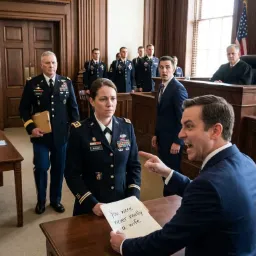
The first divorce hearing took place on a cold Monday morning at the Fairfax County courthouse.
Daniel arrived wearing a tailored navy suit. Vanessa sat behind him, close enough to be seen but far enough away to pretend she was not involved.
Caroline wore her Army service uniform.
The ribbons above her left pocket represented only the awards she was permitted to display publicly. Daniel glanced at them with open contempt.
When the hearing began, his attorney portrayed Caroline as distant and indifferent.
Daniel testified that she had chosen the Army over him repeatedly.
He claimed he had handled their household alone, maintained the property, and postponed his career so she could pursue hers.
“She disappeared for months at a time,” he said. “Sometimes she wouldn’t even tell me where she was going.”
“You understood that your wife’s missions were often classified, correct?” Evelyn asked during cross-examination.
“That’s what she said.”
“You doubt she was deployed?”
“I doubt a lot of things Caroline says.”
“Did you accept her military pay?”
Daniel shifted in his chair.
“We were married. It was household income.”
“Did you use that household income to pay for an apartment occupied by Vanessa Hale?”
His attorney stood immediately.
“Objection.”
The judge overruled it.
Daniel’s face reddened.
But the most damaging moment came when Evelyn asked him to describe Caroline’s military responsibilities.
“She was just a soldier,” Daniel answered.
The courtroom became completely still.
Caroline did not react.
Evelyn stepped closer.
“Just a soldier?”
Daniel shrugged.
“She acts like she was saving the country every day, but she was an administrator. She filled out paperwork. She sat in secure rooms and gave orders to people doing the real work.”
Several uniformed observers in the back row exchanged glances.
Daniel noticed them but misunderstood their expressions.
He smiled.
“My wife had no meaningful assets before our marriage,” he continued. “No important connections. No public reputation. Whatever she achieved was because I kept things running at home.”
That was when the courtroom doors opened.
Colonel Nathaniel Reed entered in full dress uniform, carrying a sealed portfolio.
Behind him walked a military attorney and a representative from the Department of Defense.
Every service member in the gallery stood.
Even the court security officer straightened instinctively.
Daniel stopped smiling.
Colonel Reed approached the witness area and presented his identification to the clerk.
“Your Honor,” the military attorney said, “the Department of Defense has authorized Colonel Reed to provide a limited, unclassified summary of Major Mercer’s service. We also have certified financial and personnel records responsive to the court’s order.”
The judge examined the authorization.
“Proceed.”
Colonel Reed raised his right hand and took the oath.
Then he looked directly at Daniel.
For the first time, Daniel appeared afraid.
PART 3 — The Record He Never Bothered to Read
“State your relationship to Major Mercer,” Evelyn said.
Colonel Reed sat with the calm, controlled posture of a man who had spent decades making decisions under pressure.
“I have been Major Mercer’s commanding officer for six years. For the last four, she has led a specialized personnel recovery unit operating under joint military authority.”
“What does that mean in ordinary language?”
“It means that when American service members disappear in hostile territory, Major Mercer helps bring them home.”
A murmur moved through the courtroom.
Daniel turned toward his attorney.
Colonel Reed continued.
“Major Mercer has completed five combat deployments during her fifteen years of service. She has participated in twenty-seven recovery operations and directly commanded eleven. Her team has recovered forty-three American personnel and more than sixty allied or civilian survivors.”
Evelyn approached the witness stand.
“Was she merely performing administrative work?”
“No.”
“Did she enter dangerous areas?”
“Yes.”
“How dangerous?”
Colonel Reed paused, careful to remain within the limits of his authorization.
“On one operation, Major Mercer’s convoy was struck twice while evacuating wounded personnel. She refused extraction until every surviving soldier had been removed. On another, she crossed exposed ground under fire to reach a downed aircrew. She sustained injuries but continued directing the rescue for six hours.”
Caroline lowered her eyes.
She had never told Daniel about those injuries.
When she returned from that mission with two cracked ribs and a healing wound along her shoulder, she said she had been involved in a training accident.
Daniel had complained that she could not attend his company dinner.
Evelyn lifted a certified document.
“What is Major Mercer’s current position?”
“Operational commander of the unit.”
“And how many people serve under her authority?”
“Directly and indirectly, one hundred and eighty-seven.”
“Is that position normally given to an officer without distinction?”
“No.”
Colonel Reed opened the portfolio.
“Major Mercer’s record includes fifteen years of honorable service, multiple commendations for leadership, a Bronze Star Medal, a Purple Heart, and awards related to joint operations that cannot be fully discussed in open court.”
Daniel stared at Caroline.
She remained motionless.
“There is also another matter,” Colonel Reed said.
The military attorney handed a letter to the judge.
“This morning, the Office of the Secretary of Defense authorized confirmation that Major Mercer has been selected to receive the Distinguished Service Medal for her leadership during a multinational recovery operation last year.”
The judge read the letter before looking toward Caroline.
“Major Mercer, were you aware of this?”
“I knew I had been recommended, Your Honor. I did not know the recommendation had been approved.”
Colonel Reed turned toward her.
“It was approved three weeks ago.”
Caroline’s composure finally cracked.
Not dramatically.
Not with tears or celebration.
She simply inhaled sharply, remembering the people who had not returned from that operation and the wounded soldiers whose names would never appear in the public citation.
Evelyn allowed the silence to settle before asking her final question.
“Colonel, Mr. Mercer testified that his wife was ‘just a soldier’ and that her service contributed little to their marriage. Based on the records you reviewed, is that accurate?”
“No.”
Colonel Reed looked at Daniel.
His voice remained quiet, but every word carried across the courtroom.
“Major Mercer paid the mortgage, covered the household expenses, and used her deployment income to support Mr. Mercer’s business. Yet financial records show that while she was risking her life, he diverted marital money to another woman.”
Daniel’s attorney rose.
“Colonel Reed is not qualified to offer conclusions about the marriage.”
“I am qualified to read bank records,” Reed replied.
The judge instructed him to answer only the question asked.
Colonel Reed nodded.
Then he gave the court the sentence that would later be repeated by nearly every person who witnessed the hearing.
“Mr. Mercer abandoned the woman who protected this country, and he did it while she was protecting men and women under my command.”
Daniel looked toward the gallery.
No one looked back.
The evidence continued.
Military payroll records showed that Caroline had provided most of the marriage’s stable income. Property documents established that she had purchased the Virginia home before marrying Daniel. Bank statements revealed Daniel’s transfers to Vanessa.
Then Evelyn presented the photograph Daniel had sent from Caroline’s kitchen.
“Did you intend this image to cause your wife emotional distress while she was deployed?” Evelyn asked.
“No.”
“Why did you send it?”
“To show her I had moved on.”
“Before the divorce was final?”
Daniel hesitated.
“Yes.”
“And why was Ms. Hale wearing Major Mercer’s clothing?”
“I don’t know.”
Vanessa left the courtroom during the lunch recess.
She did not return.
Later that afternoon, Evelyn produced security footage showing Daniel removing Caroline’s property from the house. Storage records confirmed that he had listed himself as the owner of those belongings and scheduled them for auction.
The judge’s expression grew colder with every document.
By the end of the hearing, Daniel’s claim for temporary spousal support had been denied. He was ordered to vacate Caroline’s house within fourteen days, preserve all marital assets, and return every item he had removed.
The court also froze the business account he had used to transfer money to Vanessa.
Outside the courtroom, reporters waited near the steps.
Daniel moved quickly, shielding his face.
Caroline hoped to leave through a side exit, but Colonel Reed stopped beside her in the marble corridor.
“You handled yourself well,” he said.
“I stood still while everyone else described my life.”
“Sometimes standing still is the hardest part.”
Caroline looked at the sealed portfolio.
“Why did you come personally?”
“Because Private Price asked me to.”
She frowned.
“Owen?”
“He heard about the hearing. So did Torres and the rest of your unit. Price said if the court was going to decide your value, someone should explain how many people are alive because of you.”
Caroline’s eyes filled despite her effort to control them.
Colonel Reed offered her a folded note.
Inside were twenty-seven signatures.
At the bottom, Owen had written:
You never left us behind. We won’t let anyone erase you.
Caroline pressed the note between both hands.
For the first time since receiving the divorce papers, she cried.
Not because Daniel had betrayed her.
Because she finally understood that his version of her life had never been the truth.
PART 4 — The Judgment
The final divorce trial occurred five months later.
By then, Daniel’s carefully constructed story had collapsed.
Vanessa had ended their relationship after learning that the vehicle Daniel gave her had been purchased with money from an account subject to the court’s preservation order.
Daniel’s consulting company entered bankruptcy.
His attorney withdrew after unpaid fees reached twenty-eight thousand dollars.
He arrived at trial with a new lawyer, an inexpensive suit, and none of the arrogance he had displayed during the first hearing.
Caroline entered wearing a dark civilian dress.
Her medal ceremony had taken place two weeks earlier in Washington. Colonel Reed had fastened the Distinguished Service Medal around her neck while recovering soldiers from three different units watched from the front row.
Caroline had invited no reporters.
She had invited the families of the soldiers her team had brought home.
In court, Daniel’s lawyer proposed one final settlement.
Daniel would abandon his demand for support if Caroline allowed him to keep half the equity in the Virginia house.
Evelyn rejected it immediately.
The evidence was clear: the house was Caroline’s separate property. Daniel had contributed little to its value and had caused significant damage before moving out.
The judge also found that Daniel had wasted marital assets by spending money on Vanessa and attempting to conceal transfers during the divorce.
Daniel was ordered to reimburse Caroline for her share of the missing funds.
He was denied spousal support.
He received a limited portion of the remaining joint savings, reduced by the money he had already taken.
Caroline retained the house, her retirement benefits protected by the prenuptial agreement Daniel had once insisted upon, and full ownership of the investment account funded through her grandmother’s inheritance.
Ironically, Daniel had demanded the prenup because he believed his future company would make him wealthy.
He never imagined it would protect Caroline instead.
Before issuing the final judgment, the judge looked over her glasses at Daniel.
“Mr. Mercer, deployment is not abandonment. Military service is not a refusal to participate in marriage. The evidence demonstrates that Major Mercer continued supporting this household even while deployed, whereas you used her absence as an opportunity to misuse property and conceal an affair.”
Daniel stared at the table.
“You repeatedly characterized your wife as insignificant because aspects of her work could not be publicly discussed. Her silence was not proof that she had accomplished nothing. It was proof that she honored her obligations.”
The judge signed the decree.
Their marriage ended with the quiet movement of a pen.
Outside the courtroom, Daniel called Caroline’s name.
She stopped but did not turn immediately.
He approached her alone.
The confidence was gone from his face. He looked smaller now, not because the court had taken anything from him, but because everyone had finally seen what he had tried to hide.
“I didn’t know,” he said.
Caroline faced him.
“You didn’t know what?”
“About the missions. The medal. Any of it.”
“You never asked.”
“You couldn’t tell me.”
“I could have told you more than you think. You just weren’t interested unless my career inconvenienced you.”
Daniel rubbed his hands together.
“I was angry. You were always gone.”
“And while I was gone, I called you from hospital tents. I arranged payments for your employees. I remembered your mother’s birthday. I sent you letters you never answered.”
“I made mistakes.”
“You made decisions.”
He stepped closer.
“Was any of it real to you?”
Caroline studied the man she had once loved.
“Yes,” she said. “That was why it hurt.”
Daniel’s eyes dropped.
“Is there any chance we could—”
“No.”
The answer was neither loud nor cruel.
It was final.
Caroline walked down the courthouse steps, where Colonel Reed and Captain Maya Torres were waiting. Beside them stood Owen Price on a new prosthetic leg, leaning lightly on a cane.
He raised his hand in salute.
Caroline returned it.
Six weeks later, she accepted promotion to lieutenant colonel.
She also made a decision no one expected.
Instead of moving into a larger house or buying an expensive car, she sold the Virginia property. Too many rooms held memories of a woman who had spent years making herself smaller to protect a man’s pride.
With part of the proceeds, Caroline established an emergency fund for military families facing financial abuse during deployment. It provided legal consultations, temporary housing, and secure financial planning for service members whose spouses attempted to exploit their absence.
She named it the Homefront Integrity Fund.
On its first day, the organization received seventeen applications.
One came from a young sergeant stationed overseas whose husband had emptied their daughter’s college account.
Another came from a Navy officer whose wife had forged his signature to sell their home.
Caroline personally called both of them.
“You are not alone,” she told them. “And serving your country does not give anyone permission to steal your future.”
A year after the divorce, Caroline stood on a windswept airfield waiting for another deployment.
Her new unit gathered near the aircraft while families exchanged final hugs. Owen, now medically retired, had come to see them leave.
“You nervous, ma’am?” he asked.
“Always.”
“You never look nervous.”
“That’s because everyone else is watching.”
Owen smiled.
Before boarding, Caroline checked her phone.
There was an email from Daniel.
He had written several times during the past year, but she had never responded. Most messages contained apologies mixed with excuses. This one was shorter.
I saw the article about your foundation. I finally understand what I lost.
Caroline read it once.
Then she deleted it.
Daniel still misunderstood.
He believed he had lost a decorated officer.
A respected commander.
A woman whose name appeared beside medals and national recognition.
But he had lost her long before the court learned any of that.
He had lost her when he mocked the sacrifices he benefited from.
He had lost her when he treated loyalty as weakness.
He had lost her when he decided that because her courage was quiet, it did not exist.
Colonel Reed stood near the aircraft stairs.
“Ready, Lieutenant Colonel Mercer?”
Caroline looked toward the soldiers waiting for her command.
Fifteen years of service had taught her that courage was not the absence of betrayal, fear, or pain.
Courage was knowing exactly what those things cost—and moving forward anyway.
She slipped her phone into her pocket.
“Yes, sir.”
Then she boarded the aircraft without looking back.
Have you finished reading the story and want to read it again?
PART 1 — The Envelope Waiting in the Desert
The divorce papers arrived on the same morning Major Caroline Mercer learned that three of her soldiers might not survive the night.
She was standing inside a reinforced operations center at a remote American base in the Middle East when a communications sergeant approached her desk carrying a thick white envelope.
“Personal delivery, ma’am.”
Caroline recognized her husband’s handwriting immediately.
For fifteen years, she had served in the United States Army. She had led soldiers through burning villages, coordinated rescue operations under enemy fire, and spent countless nights listening to frightened young troops talk about the families waiting for them at home.
But nothing had prepared her for the sentence Daniel had written across the final page of their marriage.
“You were never really a wife.”
The words appeared beneath his signature, added in blue ink as though the legal documents alone had not been cruel enough.
Daniel had filed for divorce eleven days after Caroline began her deployment.
He wanted the house in Virginia.
He wanted their savings.
He wanted the furniture, both vehicles, and nearly everything Caroline had purchased during their twelve-year marriage.
His petition described her as emotionally absent, financially dependent, and obsessed with a military career that had contributed little to their household.
According to Daniel, he had supported her for years.
According to Daniel, she had abandoned him.
According to Daniel, she owned nothing.
Caroline read the papers twice before folding them carefully and placing them back inside the envelope.
“Major?”
Captain Maya Torres stood in the doorway. Her uniform was covered in dust, and a dark stain marked the bandage around her left forearm.
“The evacuation helicopters are fourteen minutes out,” Maya said. “But the road team is reporting movement north of the crash site.”
Caroline slid the envelope beneath a stack of operational maps.
“Then we bring them home before that movement reaches them.”
She did not cry.
There was no time.
Three American soldiers were trapped in the wreckage of an armored vehicle, and the weather was closing rapidly. Caroline took command of the recovery effort herself, coordinating aircraft, medical teams, and ground security while warning alarms echoed through the operations center.
For the next seven hours, she pushed Daniel’s betrayal into a locked compartment of her mind.
By sunset, all three soldiers were alive.
One had lost a leg. Another had suffered severe burns. The youngest, Private First Class Owen Price, had stopped breathing twice during the flight back to base.
Caroline remained beside the medical tent until the surgeons confirmed that he would survive.
Only then did she return to her quarters.
She sat on the edge of her narrow bed, removed the divorce papers, and read Daniel’s handwritten sentence again.
“You were never really a wife.”
This time, she allowed herself to feel it.
She remembered the beginning of their marriage, when Daniel had admired her uniform and told everyone he was proud to be married to a soldier. He had attended promotion ceremonies, posed beside her for photographs, and promised he understood the sacrifices her service required.
But admiration had slowly become resentment.
He complained whenever she trained late.
He called her deployments selfish.
He told friends that the Army had stolen his wife, even though Caroline had covered the mortgage, paid his business debts, and supported him through three failed career changes.
During her previous deployment, Daniel had emptied nearly forty thousand dollars from their joint account. He claimed the money had been used to rescue his consulting company.
Caroline later discovered that much of it had paid for luxury hotels and expensive dinners with a woman named Vanessa Hale.
When confronted, Daniel denied the affair.
Then he accused Caroline of spying on him.
She stayed because she still believed a marriage could be repaired if both people remembered why they had chosen each other.
She had been wrong.
Her secure phone rang shortly after midnight.
It was Colonel Nathaniel Reed, commander of the Joint Recovery Coordination Group and the man who had selected Caroline to lead its most sensitive operational team.
“I heard about the papers,” he said.
Caroline stared at the concrete wall. “News travels quickly.”
“Only because your legal assistance officer contacted headquarters. Your husband is demanding access to military records that don’t belong in a civilian filing.”
Caroline’s expression hardened.
“What records?”
“Deployment compensation, awards, classified assignments—anything he thinks might lead him to money.”
“He won’t find much.”
“That depends on where he looks.”
Caroline understood the warning.
The world Daniel knew was only the visible surface of her life.
He knew she was an Army officer, but he had never cared enough to understand what she actually did. He had skipped her last two promotion ceremonies. He had never read her evaluations, and when she received an invitation to a national military reception, he told her he had better things to do.
Daniel believed she was an ordinary staff officer who spent her deployments filling out reports.
He did not know that Caroline had commanded a specialized recovery unit responsible for locating missing American personnel in some of the most dangerous regions in the world.
He did not know about the villages she had evacuated before an enemy offensive.
He did not know about the intelligence network she had built or the soldiers she had carried out of fire.
And he certainly did not know about the recommendation awaiting final approval in Washington.
“Sir,” Caroline said, “none of that changes what happened to my marriage.”
“No,” Colonel Reed replied. “But it may change what happens when your husband lies under oath.”
Caroline looked down at Daniel’s signature.
“I don’t want revenge.”
“I know.”
“I only want what is legally mine.”
“Then make sure the court hears the truth.”
Two weeks later, Daniel sent her a message.
It contained no apology.
No question about her safety.
No acknowledgment that she was serving in a combat zone.
Instead, he wrote:
Sign the settlement and make this easy. You never cared about having a normal life anyway.
Attached was a photograph of Daniel standing with Vanessa in the kitchen Caroline had renovated using money from an inheritance left by her grandmother.
Vanessa was wearing Caroline’s robe.
Daniel had wanted her to see it.
He wanted her angry enough to make a mistake.
Caroline studied the photograph, saved it to an encrypted evidence folder, and forwarded it to her attorney.
Then she responded with four words.
I will see you in court.
PART 2 — “She Was Just a Soldier”
Caroline returned to Virginia four months later.
No one waited for her at the airport.
Daniel had changed the locks on their house before her plane landed. He had also moved Vanessa into the master bedroom and placed Caroline’s personal belongings in a rented storage unit scheduled for auction after sixty days.
When Caroline arrived at the house in uniform, carrying a single deployment bag, Daniel watched her through the front window but refused to open the door.
“You don’t live here anymore,” he called.
Caroline stood calmly on the porch.
Her hair was pulled into a precise bun, and exhaustion shadowed her gray-green eyes. She had not slept properly in thirty hours, yet her posture remained straight.
“This is still legally my residence.”
“You’ve been served.”
“A divorce petition does not transfer property ownership.”
Vanessa appeared behind him wearing a pale cashmere sweater Caroline recognized as her own.
“Daniel,” she said loudly, “just call the police.”
Caroline did it for them.
When officers arrived, Daniel produced the divorce filing and claimed his wife had abandoned the home voluntarily.
Caroline produced the deed.
Her name was the only one listed.
Daniel’s face changed.
He had apparently forgotten that Caroline had bought the property two years before their wedding with money inherited from her grandparents. Although they had lived there as a married couple, he had never been added to the title.
The officers ordered Daniel to let her inside.
He obeyed, but as Caroline walked past him, he leaned close enough for only her to hear.
“You’re going to regret humiliating me.”
Caroline looked at him without blinking.
“You accomplished that yourself.”
Inside, she discovered that Daniel had removed nearly every photograph of her. Her framed promotion certificates were gone. Her uniforms had been stuffed into garbage bags, and the flag presented after her father’s military funeral had been thrown into the garage beneath a pile of broken furniture.
That flag was the only thing she picked up.
She folded it carefully, carried it to her car, and left.
Caroline could have forced Daniel out immediately, but her attorney, Evelyn Brooks, advised patience.
“Let him keep believing he controls the situation,” Evelyn said. “Every day he occupies that house without your consent strengthens our claim for reimbursement.”
Daniel’s confidence grew as the court date approached.
He told mutual friends that Caroline would receive nothing because the Army had never paid her much.
He claimed she had hidden debts.
He said she was unstable from deployment and might be forced into retirement.
Then his attorney requested spousal support.
The filing stated that Daniel had sacrificed his professional ambitions to support Caroline’s military career.
Evelyn placed the document in front of Caroline.
“He wants you to pay him six thousand dollars a month.”
Caroline almost laughed.
Daniel’s consulting company had failed because he rarely arrived before noon and frequently used corporate funds for personal expenses. Caroline had quietly paid employees when Daniel missed payroll. She had also covered the company’s taxes and personally guaranteed one of its loans.
“How much of that can we prove?” she asked.
“All of it.”
Evelyn opened a second folder.
“We have bank records showing that you deposited two hundred and seventy-eight thousand dollars into marital accounts over twelve years. We also have evidence that Daniel transferred a total of ninety-three thousand dollars to Vanessa.”
Caroline’s jaw tightened.
“Ninety-three?”
“Hotels, rent, jewelry, vacations, and a vehicle registered in her name.”
“How long?”
“Based on the records, at least three years.”
Caroline turned toward the window.
Three years.
While she had been visiting wounded soldiers at Walter Reed, Daniel had been buying Vanessa jewelry.
While she was training in Georgia, he had taken Vanessa to Italy.
While Caroline sat beside her dying father in a military hospital, Daniel had transferred sixteen thousand dollars into Vanessa’s account.
Evelyn’s voice softened.
“Caroline, there’s something else. Daniel contacted a journalist.”
“What did he say?”
“That you invented stories about classified missions to inflate your military importance. He’s portraying himself as the neglected husband of a delusional officer.”
Caroline remained silent.
“He thinks your inability to discuss certain assignments means you can’t contradict him publicly,” Evelyn continued. “And he may try the same strategy in court.”
“He doesn’t understand that classified doesn’t mean imaginary.”
“No. But unless the Army authorizes disclosure, we must work with the unclassified portions of your record.”
Caroline nodded.
“That will be enough.”
The first divorce hearing took place on a cold Monday morning at the Fairfax County courthouse.
Daniel arrived wearing a tailored navy suit. Vanessa sat behind him, close enough to be seen but far enough away to pretend she was not involved.
Caroline wore her Army service uniform.
The ribbons above her left pocket represented only the awards she was permitted to display publicly. Daniel glanced at them with open contempt.
When the hearing began, his attorney portrayed Caroline as distant and indifferent.
Daniel testified that she had chosen the Army over him repeatedly.
He claimed he had handled their household alone, maintained the property, and postponed his career so she could pursue hers.
“She disappeared for months at a time,” he said. “Sometimes she wouldn’t even tell me where she was going.”
“You understood that your wife’s missions were often classified, correct?” Evelyn asked during cross-examination.
“That’s what she said.”
“You doubt she was deployed?”
“I doubt a lot of things Caroline says.”
“Did you accept her military pay?”
Daniel shifted in his chair.
“We were married. It was household income.”
“Did you use that household income to pay for an apartment occupied by Vanessa Hale?”
His attorney stood immediately.
“Objection.”
The judge overruled it.
Daniel’s face reddened.
But the most damaging moment came when Evelyn asked him to describe Caroline’s military responsibilities.
“She was just a soldier,” Daniel answered.
The courtroom became completely still.
Caroline did not react.
Evelyn stepped closer.
“Just a soldier?”
Daniel shrugged.
“She acts like she was saving the country every day, but she was an administrator. She filled out paperwork. She sat in secure rooms and gave orders to people doing the real work.”
Several uniformed observers in the back row exchanged glances.
Daniel noticed them but misunderstood their expressions.
He smiled.
“My wife had no meaningful assets before our marriage,” he continued. “No important connections. No public reputation. Whatever she achieved was because I kept things running at home.”
That was when the courtroom doors opened.
Colonel Nathaniel Reed entered in full dress uniform, carrying a sealed portfolio.
Behind him walked a military attorney and a representative from the Department of Defense.
Every service member in the gallery stood.
Even the court security officer straightened instinctively.
Daniel stopped smiling.
Colonel Reed approached the witness area and presented his identification to the clerk.
“Your Honor,” the military attorney said, “the Department of Defense has authorized Colonel Reed to provide a limited, unclassified summary of Major Mercer’s service. We also have certified financial and personnel records responsive to the court’s order.”
The judge examined the authorization.
“Proceed.”
Colonel Reed raised his right hand and took the oath.
Then he looked directly at Daniel.
For the first time, Daniel appeared afraid.
PART 3 — The Record He Never Bothered to Read
“State your relationship to Major Mercer,” Evelyn said.
Colonel Reed sat with the calm, controlled posture of a man who had spent decades making decisions under pressure.
“I have been Major Mercer’s commanding officer for six years. For the last four, she has led a specialized personnel recovery unit operating under joint military authority.”
“What does that mean in ordinary language?”
“It means that when American service members disappear in hostile territory, Major Mercer helps bring them home.”
A murmur moved through the courtroom.
Daniel turned toward his attorney.
Colonel Reed continued.
“Major Mercer has completed five combat deployments during her fifteen years of service. She has participated in twenty-seven recovery operations and directly commanded eleven. Her team has recovered forty-three American personnel and more than sixty allied or civilian survivors.”
Evelyn approached the witness stand.
“Was she merely performing administrative work?”
“No.”
“Did she enter dangerous areas?”
“Yes.”
“How dangerous?”
Colonel Reed paused, careful to remain within the limits of his authorization.
“On one operation, Major Mercer’s convoy was struck twice while evacuating wounded personnel. She refused extraction until every surviving soldier had been removed. On another, she crossed exposed ground under fire to reach a downed aircrew. She sustained injuries but continued directing the rescue for six hours.”
Caroline lowered her eyes.
She had never told Daniel about those injuries.
When she returned from that mission with two cracked ribs and a healing wound along her shoulder, she said she had been involved in a training accident.
Daniel had complained that she could not attend his company dinner.
Evelyn lifted a certified document.
“What is Major Mercer’s current position?”
“Operational commander of the unit.”
“And how many people serve under her authority?”
“Directly and indirectly, one hundred and eighty-seven.”
“Is that position normally given to an officer without distinction?”
“No.”
Colonel Reed opened the portfolio.
“Major Mercer’s record includes fifteen years of honorable service, multiple commendations for leadership, a Bronze Star Medal, a Purple Heart, and awards related to joint operations that cannot be fully discussed in open court.”
Daniel stared at Caroline.
She remained motionless.
“There is also another matter,” Colonel Reed said.
The military attorney handed a letter to the judge.
“This morning, the Office of the Secretary of Defense authorized confirmation that Major Mercer has been selected to receive the Distinguished Service Medal for her leadership during a multinational recovery operation last year.”
The judge read the letter before looking toward Caroline.
“Major Mercer, were you aware of this?”
“I knew I had been recommended, Your Honor. I did not know the recommendation had been approved.”
Colonel Reed turned toward her.
“It was approved three weeks ago.”
Caroline’s composure finally cracked.
Not dramatically.
Not with tears or celebration.
She simply inhaled sharply, remembering the people who had not returned from that operation and the wounded soldiers whose names would never appear in the public citation.
Evelyn allowed the silence to settle before asking her final question.
“Colonel, Mr. Mercer testified that his wife was ‘just a soldier’ and that her service contributed little to their marriage. Based on the records you reviewed, is that accurate?”
“No.”
Colonel Reed looked at Daniel.
His voice remained quiet, but every word carried across the courtroom.
“Major Mercer paid the mortgage, covered the household expenses, and used her deployment income to support Mr. Mercer’s business. Yet financial records show that while she was risking her life, he diverted marital money to another woman.”
Daniel’s attorney rose.
“Colonel Reed is not qualified to offer conclusions about the marriage.”
“I am qualified to read bank records,” Reed replied.
The judge instructed him to answer only the question asked.
Colonel Reed nodded.
Then he gave the court the sentence that would later be repeated by nearly every person who witnessed the hearing.
“Mr. Mercer abandoned the woman who protected this country, and he did it while she was protecting men and women under my command.”
Daniel looked toward the gallery.
No one looked back.
The evidence continued.
Military payroll records showed that Caroline had provided most of the marriage’s stable income. Property documents established that she had purchased the Virginia home before marrying Daniel. Bank statements revealed Daniel’s transfers to Vanessa.
Then Evelyn presented the photograph Daniel had sent from Caroline’s kitchen.
“Did you intend this image to cause your wife emotional distress while she was deployed?” Evelyn asked.
“No.”
“Why did you send it?”
“To show her I had moved on.”
“Before the divorce was final?”
Daniel hesitated.
“Yes.”
“And why was Ms. Hale wearing Major Mercer’s clothing?”
“I don’t know.”
Vanessa left the courtroom during the lunch recess.
She did not return.
Later that afternoon, Evelyn produced security footage showing Daniel removing Caroline’s property from the house. Storage records confirmed that he had listed himself as the owner of those belongings and scheduled them for auction.
The judge’s expression grew colder with every document.
By the end of the hearing, Daniel’s claim for temporary spousal support had been denied. He was ordered to vacate Caroline’s house within fourteen days, preserve all marital assets, and return every item he had removed.
The court also froze the business account he had used to transfer money to Vanessa.
Outside the courtroom, reporters waited near the steps.
Daniel moved quickly, shielding his face.
Caroline hoped to leave through a side exit, but Colonel Reed stopped beside her in the marble corridor.
“You handled yourself well,” he said.
“I stood still while everyone else described my life.”
“Sometimes standing still is the hardest part.”
Caroline looked at the sealed portfolio.
“Why did you come personally?”
“Because Private Price asked me to.”
She frowned.
“Owen?”
“He heard about the hearing. So did Torres and the rest of your unit. Price said if the court was going to decide your value, someone should explain how many people are alive because of you.”
Caroline’s eyes filled despite her effort to control them.
Colonel Reed offered her a folded note.
Inside were twenty-seven signatures.
At the bottom, Owen had written:
You never left us behind. We won’t let anyone erase you.
Caroline pressed the note between both hands.
For the first time since receiving the divorce papers, she cried.
Not because Daniel had betrayed her.
Because she finally understood that his version of her life had never been the truth.
PART 4 — The Judgment
The final divorce trial occurred five months later.
By then, Daniel’s carefully constructed story had collapsed.
Vanessa had ended their relationship after learning that the vehicle Daniel gave her had been purchased with money from an account subject to the court’s preservation order.
Daniel’s consulting company entered bankruptcy.
His attorney withdrew after unpaid fees reached twenty-eight thousand dollars.
He arrived at trial with a new lawyer, an inexpensive suit, and none of the arrogance he had displayed during the first hearing.
Caroline entered wearing a dark civilian dress.
Her medal ceremony had taken place two weeks earlier in Washington. Colonel Reed had fastened the Distinguished Service Medal around her neck while recovering soldiers from three different units watched from the front row.
Caroline had invited no reporters.
She had invited the families of the soldiers her team had brought home.
In court, Daniel’s lawyer proposed one final settlement.
Daniel would abandon his demand for support if Caroline allowed him to keep half the equity in the Virginia house.
Evelyn rejected it immediately.
The evidence was clear: the house was Caroline’s separate property. Daniel had contributed little to its value and had caused significant damage before moving out.
The judge also found that Daniel had wasted marital assets by spending money on Vanessa and attempting to conceal transfers during the divorce.
Daniel was ordered to reimburse Caroline for her share of the missing funds.
He was denied spousal support.
He received a limited portion of the remaining joint savings, reduced by the money he had already taken.
Caroline retained the house, her retirement benefits protected by the prenuptial agreement Daniel had once insisted upon, and full ownership of the investment account funded through her grandmother’s inheritance.
Ironically, Daniel had demanded the prenup because he believed his future company would make him wealthy.
He never imagined it would protect Caroline instead.
Before issuing the final judgment, the judge looked over her glasses at Daniel.
“Mr. Mercer, deployment is not abandonment. Military service is not a refusal to participate in marriage. The evidence demonstrates that Major Mercer continued supporting this household even while deployed, whereas you used her absence as an opportunity to misuse property and conceal an affair.”
Daniel stared at the table.
“You repeatedly characterized your wife as insignificant because aspects of her work could not be publicly discussed. Her silence was not proof that she had accomplished nothing. It was proof that she honored her obligations.”
The judge signed the decree.
Their marriage ended with the quiet movement of a pen.
Outside the courtroom, Daniel called Caroline’s name.
She stopped but did not turn immediately.
He approached her alone.
The confidence was gone from his face. He looked smaller now, not because the court had taken anything from him, but because everyone had finally seen what he had tried to hide.
“I didn’t know,” he said.
Caroline faced him.
“You didn’t know what?”
“About the missions. The medal. Any of it.”
“You never asked.”
“You couldn’t tell me.”
“I could have told you more than you think. You just weren’t interested unless my career inconvenienced you.”
Daniel rubbed his hands together.
“I was angry. You were always gone.”
“And while I was gone, I called you from hospital tents. I arranged payments for your employees. I remembered your mother’s birthday. I sent you letters you never answered.”
“I made mistakes.”
“You made decisions.”
He stepped closer.
“Was any of it real to you?”
Caroline studied the man she had once loved.
“Yes,” she said. “That was why it hurt.”
Daniel’s eyes dropped.
“Is there any chance we could—”
“No.”
The answer was neither loud nor cruel.
It was final.
Caroline walked down the courthouse steps, where Colonel Reed and Captain Maya Torres were waiting. Beside them stood Owen Price on a new prosthetic leg, leaning lightly on a cane.
He raised his hand in salute.
Caroline returned it.
Six weeks later, she accepted promotion to lieutenant colonel.
She also made a decision no one expected.
Instead of moving into a larger house or buying an expensive car, she sold the Virginia property. Too many rooms held memories of a woman who had spent years making herself smaller to protect a man’s pride.
With part of the proceeds, Caroline established an emergency fund for military families facing financial abuse during deployment. It provided legal consultations, temporary housing, and secure financial planning for service members whose spouses attempted to exploit their absence.
She named it the Homefront Integrity Fund.
On its first day, the organization received seventeen applications.
One came from a young sergeant stationed overseas whose husband had emptied their daughter’s college account.
Another came from a Navy officer whose wife had forged his signature to sell their home.
Caroline personally called both of them.
“You are not alone,” she told them. “And serving your country does not give anyone permission to steal your future.”
A year after the divorce, Caroline stood on a windswept airfield waiting for another deployment.
Her new unit gathered near the aircraft while families exchanged final hugs. Owen, now medically retired, had come to see them leave.
“You nervous, ma’am?” he asked.
“Always.”
“You never look nervous.”
“That’s because everyone else is watching.”
Owen smiled.
Before boarding, Caroline checked her phone.
There was an email from Daniel.
He had written several times during the past year, but she had never responded. Most messages contained apologies mixed with excuses. This one was shorter.
I saw the article about your foundation. I finally understand what I lost.
Caroline read it once.
Then she deleted it.
Daniel still misunderstood.
He believed he had lost a decorated officer.
A respected commander.
A woman whose name appeared beside medals and national recognition.
But he had lost her long before the court learned any of that.
He had lost her when he mocked the sacrifices he benefited from.
He had lost her when he treated loyalty as weakness.
He had lost her when he decided that because her courage was quiet, it did not exist.
Colonel Reed stood near the aircraft stairs.
“Ready, Lieutenant Colonel Mercer?”
Caroline looked toward the soldiers waiting for her command.
Fifteen years of service had taught her that courage was not the absence of betrayal, fear, or pain.
Courage was knowing exactly what those things cost—and moving forward anyway.
She slipped her phone into her pocket.
“Yes, sir.”
Then she boarded the aircraft without looking back.








