𝗙𝗨𝗟𝗟 𝗦𝗧𝗢𝗥𝗬 My Grandfather Found a Water Vein That Saved Our Ranch—Then the HOA Secretly Tapped It
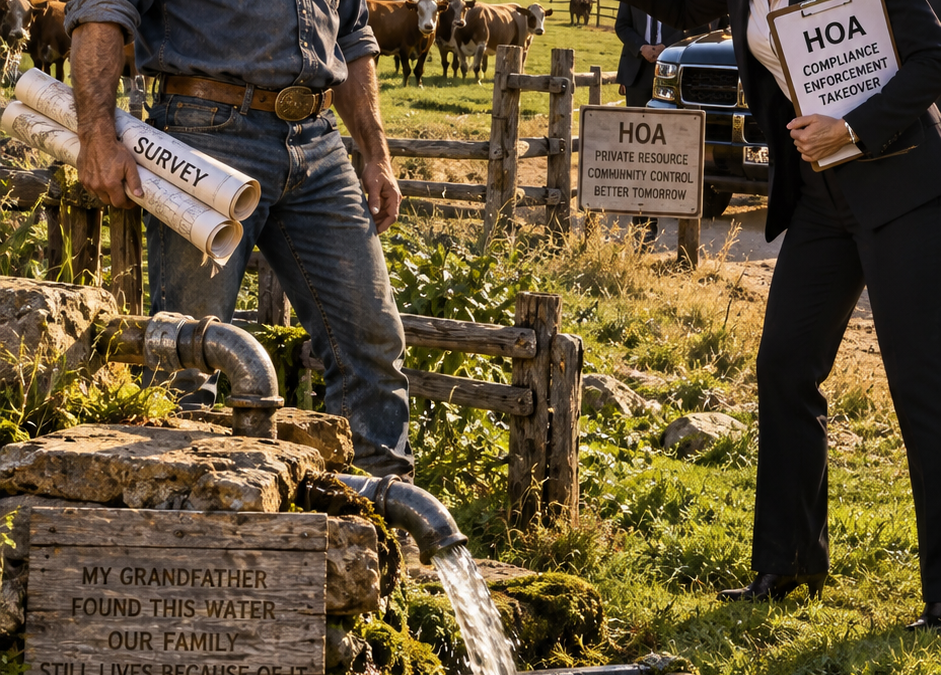
𝗙𝗨𝗟𝗟 𝗦𝗧𝗢𝗥𝗬
The Mercer Ranch covered three hundred acres at the bottom of Granite Ridge.
My family had worked it before the county courthouse had electricity.
Before paved roads.
Before golf carts.
Before people moved into the high desert and decided every living thing should be irrigated into submission.
Grandpa Silas called the source the Granite Vein.
The name stuck.
Technically it was a pressurized artesian aquifer trapped inside a network of fractured granite deep beneath Sector Four.
Grandpa didn’t care what geologists called it.
He cared that it kept cattle alive.
The summer he found it, neighboring ranchers were leaving.
Reservoirs had turned to sludge.
Wells collapsed.
Cattle died standing beside empty troughs.
Silas refused to sell.
Instead, he hired drillers from the southern oil fields.
They told him granite was the wrong place.
He told them where to drill anyway.
Three weeks.
Broken bits.
Burned equipment.
Almost no progress.
Then the drill dropped.
Pressure hit.
Water erupted.
My father used to tell the story every summer when we checked the upper storage tanks.
“Everything we have starts there.”
He always pointed toward the red cliffs.
“Never forget that.”
I didn’t.
The state water deed was dated August 14, 1952.
Five hundred miner’s inches of continuous natural flow.
Senior priority.
Grandpa later built a gravity system using thick steel pipe.
No electric pumps necessary.
Elevation did the work.
Water moved downhill through pressure and patience.
For decades, it was more than enough.
Then Whisper Hollow arrived.
Five hundred luxury homes.
Thirty-six holes of golf.
Artificial lakes.
Entrance fountains.
Private clubhouse.
Decorative streams.
Acres of grass planted in a climate that naturally preferred sagebrush.
The developer advertised Whisper Hollow as a “desert oasis.”
Every time I saw the slogan, I heard my grandfather laughing from the grave.
Oases occur naturally.
Golf courses require accountants and pumps.
Karen Whitmore became HOA president almost immediately.
She was ambitious.
Aggressive.
Certain.
The kind of person who treated disagreement like defective paperwork.
Our problems started with appearances.
My fences were “visually inconsistent.”
My cattle created an “odor impact.”
My equipment generated “agricultural blight.”
My barn became her obsession.
The barn was more than a century old.
Red paint faded.
Boards weathered.
Roof repaired half a dozen times.
Karen wanted it repainted in an HOA-approved neutral color.
I reminded her that I wasn’t in the HOA.
She sent me forty-eight thousand dollars in accumulated fines anyway.
I used the letter to start the stove.
Then she tried buying me out.
Three times.
Each offer looked generous until you compared it with what developers were paying for adjoining parcels.
I declined every one.
After that, things got uglier.
Private security parked near my gate.
Suppliers got questioned.
Inspectors began appearing.
One year, the HOA even installed a barrier across an old county fire road I used for equipment access.
That lasted until my attorney sent them a demand letter.
Karen hated losing.
But she believed the golf resort would eventually make my ranch economically irrelevant.
She was wrong about that too.
Because Whisper Hollow depended on water.
And the high desert never cared what their homes cost.
After Ryan refused to arrest me, Karen spent twenty minutes pacing along the fence calling county officials.
Eventually she reached the water district.
An hour later, a white utility truck arrived.
Arthur Vance climbed out.
Arthur had spent thirty years tracing water lines.
If there was pipe underground anywhere within fifty miles, he probably knew who installed it, what year, and which idiot had hit it with an excavator afterward.
He carried a rugged tablet and a yellow equipment case.
Karen rushed him before he closed the truck door.
“Finally.”
Arthur looked toward me.
“Jack.”
“Arthur.”
Karen pointed at me.
“He shut our water off.”
Arthur frowned.
“Municipal line?”
“He’s diverting it.”
“That’s not what I asked.”
She exhaled impatiently.
“Our main reservoir pressure collapsed when he began turning that valve.”
Arthur looked at the valve.
Then me.
“You mind if I trace it?”
“Go ahead.”
Karen smiled.
That smile lasted seven minutes.
Arthur started with ground-penetrating radar.
He moved along the fence.
Stopped.
Adjusted settings.
Moved back.
Then used an electromagnetic locator.
The device remained quiet near the county line.
He walked east.
Still quiet.
Karen crossed her arms.
“You see?”
Arthur ignored her.
He checked the municipal system map.
Then looked toward the subdivision.
“Our eight-inch main is almost three hundred yards east.”
“So?”
“So Jack isn’t connected to it.”
Karen’s smile vanished.
“That can’t be right.”
Arthur continued scanning.
Then the locator began beeping.
Slowly at first.
Then fast.
He stopped near my valve.
Beep.
Beep.
Beep.
He followed the signal.
Across my pasture.
Along the fence.
Then toward Whisper Hollow.
He stopped in the middle of the gravel road.
The device screamed.
Arthur looked at the screen.
Then at me.
“Jack.”
“Yeah?”
“You have a twelve-inch steel line here.”
“I know.”
“It keeps going.”
I set my coffee down.
“Where?”
He walked toward Whisper Hollow.
The signal followed him.
Karen looked nervous now.
Arthur crossed the road.
Still beeping.
Then he stopped near the HOA boundary.
The buried line continued straight toward the pump station feeding the new golf-course expansion.
Arthur stared at his tablet.
“Karen.”
She didn’t answer.
He looked up.
“When you built the second eighteen holes, where did Apex Utilities connect your irrigation main?”
“Municipal supply.”
“You sure?”
“Of course.”
“Because this line says otherwise.”
Her voice became defensive.
“Apex handled everything.”
Arthur walked back toward my fence.
“Jack, did you authorize any lateral connection?”
“No.”
“Lease?”
“No.”
“Utility easement?”
“No.”
Karen interrupted.
“There must be paperwork.”
Arthur opened the county utility database.
He searched.
Nothing.
He searched the recorder.
Nothing.
He searched encroachment permits.
Nothing.
His expression changed.
“What?”
Karen demanded.
Arthur looked at her.
“You’re not connected to the municipal main.”
Silence.
“What are you talking about?”
“Your irrigation system is connected to Jack’s private line.”
The deputies turned toward Karen.
She laughed.
Too quickly.
“No.”
Arthur held up the tablet.
“Yes.”
“This is absurd.”
“The locator doesn’t care.”
“You’re saying our entire golf course…”
“And the lakes.”
He checked again.
“And the entrance water features.”
Karen looked toward me.
“Are supplied by him?”
Arthur corrected her.
“By his aquifer.”
I picked up my thermos.
Took a slow drink.
Then said:
“Well.”
Ryan glanced at me.
I shrugged.
“I told her it was my valve.”
Karen’s face had gone pale.
Arthur kept tracing.
The buried line ran forty-five feet inside my property for nearly half a mile.
Whoever installed it had stayed on my side long enough to remain hidden behind terrain and fencing, then crossed into Whisper Hollow near their pump station.
Not an accidental boundary error.
Not by a few inches.
Deliberate construction.
Ryan asked the obvious question.
“Mrs. Whitmore, who hired Apex?”
“The HOA.”
“Who owns it?”
She looked away.
I already knew.
“Her brother-in-law.”
Ryan slowly turned toward her.
Karen snapped:
“That has nothing to do with this.”
Arthur looked at the digital records again.
“Actually, it may.”
“No easement?”
Ryan asked.
“None.”
“No permit?”
“None.”
“No recorded water contract?”
“None.”
Arthur looked at Karen.
“You’ve been taking water from a privately controlled artesian source.”
“For how long?”
Ryan asked.
Arthur scrolled.
“The new line went in two years ago.”
I stared toward the subdivision.
Two years.
The same two years Whisper Hollow had expanded its golf course.
The same two years Karen had bragged about reducing municipal water costs through “innovative sustainability.”
Now I understood the innovation.
Steal from the rancher.
Call it green.
Karen recovered enough to start arguing.
“If there is a paperwork defect, we can correct it.”
Ryan looked at her.
“Paperwork defect?”
“It is an underground water table.”
Arthur shook his head.
“No.”
“The valley shares groundwater.”
“No.”
She pointed at me.
“He doesn’t own rain!”
“No one said he did.”
Arthur’s voice hardened.
“But his family does hold senior appropriative rights to this specific artesian source.”
“Those rights are ancient.”
“That is usually what senior means.”
I almost smiled.
Karen turned to me.
“Jack.”
First time all afternoon she’d used my first name.
“We can work something out.”
“You called police twenty minutes ago.”
“We were operating under incorrect information.”
“You called my wrench a weapon.”
“Emotions were high.”
“You accused me of ecoterrorism.”
Ryan looked down.
He had definitely heard that one.
Karen gripped the fence.
“If you shut that line, the course will die.”
I picked up the wrench.
“That seems like something Apex should have considered.”
“Wait.”
“The gasket is replaced.”
“Mercer.”
I fitted the wrench onto the valve wheel.
“We can pay.”
“How much?”
She hesitated.
That told me everything.
This wasn’t negotiation.
She wanted delay.
Tournament sponsors were arriving.
Investors.
Television.
She needed green grass long enough to survive the week.
Then the lawyers could bury me.
I knew her too well.
“No.”
Her eyes widened.
“Think of the homeowners.”
“I do.”
“Five hundred families!”
“They still have municipal drinking water.”
Arthur nodded.
“The fire system is municipal too.”
Karen shot him a murderous look.
I asked:
“What exactly does this illegal line feed?”
Arthur checked.
“Golf irrigation. Decorative lakes. Clubhouse landscaping. Entrance fountains.”
“No residential drinking supply?”
“No.”
“No hydrants?”
“No.”
“No fire reservoirs?”
“No.”
I looked at Karen.
“Then nobody is losing water.”
She practically screamed.
“Our property values depend on those amenities!”
I tightened the wrench.
“So does my orchard.”
Then I turned.
The valve groaned.
Metal scraped metal.
Deep underground, the gate began closing.
Karen grabbed the fence.
“Don’t!”
The wheel turned another quarter.
Sprinklers in the distance slowed.
Another quarter.
They sputtered.
Then stopped.
The entrance waterfall coughed.
A final sheet of water slid down the stone.
Gone.
The golf course fell silent.
I released the wrench.
“There.”
Karen stared at me.
“Your illegal tap is closed.”
“You monster.”
“No.”
I wiped grease from my hands.
“Just a rancher fixing his valve.”
By the next morning, Whisper Hollow looked like someone had unplugged paradise.
The artificial lakes began dropping immediately.
Their shallow margins exposed black mud.
Waterfalls dried.
The newest golf greens yellowed under brutal sun.
Whisper Hollow’s emergency homeowner portal filled with messages.
Karen told everyone I had “unilaterally terminated critical water service.”
She left out the part where that service had been stolen.
Then she made her next mistake.
At ten in the morning, Duke started growling.
My Labrador almost never growled.
I looked through the workshop window.
Black SUV.
Amber lights.
WHISPER HOLLOW SECURITY.
Two guards got out.
One carried bolt cutters.
I walked outside.
The sign on my gate read:
PRIVATE PROPERTY
NO TRESPASSING
I had added another line that morning.
ILLEGAL ENTRY — $10,000 ADMINISTRATIVE FEE
Seemed only fair.
The taller guard was Vance Miller.
He held up a paper.
“Mr. Mercer, we’re authorized to access the utility node.”
“No.”
“HOA emergency directive.”
“No.”
“We have easement-by-necessity rights.”
“No, you don’t.”
He lifted the bolt cutters.
“If you don’t open this gate, we’re cutting the chain.”
I stared at him.
“You’re private security.”
“We are authorized agents.”
“Of an HOA.”
“This is vital infrastructure.”
“For golf.”
He stepped closer.
“You are obstructing emergency utility access.”
I laughed.
Then reached into my pocket and held up my phone.
“Arthur Vance already confirmed yesterday that this is not emergency infrastructure.”
Miller’s jaw tightened.
“We have orders.”
“So did plenty of people who ended up in court.”
He put the bolt cutters on the chain.
That was when another vehicle roared around the bend.
County Tahoe.
Lights flashing.
Sheriff Tom Vance stepped out.
Tom was six-four, broad, gray at the temples, and had very little patience for people pretending to be law enforcement.
He looked at Miller.
Then the bolt cutters.
Then me.
“What in hell are you doing?”
Miller straightened.
“Sheriff, we’re executing an HOA utility directive.”
Tom walked over.
“Show me.”
Miller handed him the paper.
Tom read it.
Then tore it in half.
Miller blinked.
“Sheriff—”
“This is HOA letterhead.”
“It authorizes—”
“It authorizes absolutely nothing.”
Tom pointed toward the county road.
“You are outside Whisper Hollow.”
“We’re protecting vital infrastructure.”
“No.”
Tom stepped closer.
“You’re attempting to cut a lock on private property.”
Miller looked toward me.
“He threatened us.”
Tom looked at me.
“With what?”
I held up my coffee.
Miller said:
“He has a shotgun.”
I nodded toward the porch where it rested unloaded against a chair.
Tom looked back.
“He’s a rancher on his own property.”
Miller tried again.
“Mrs. Whitmore said the county approved emergency entry.”
Tom’s expression darkened.
“No county office approved anything.”
“But—”
“I spent this morning with the recorder.”
He pointed at the gate.
“No easement.”
Then at the ground.
“No utility right-of-way.”
Then toward Whisper Hollow.
“And no court order.”
Miller’s confidence evaporated.
Tom took the bolt cutters from him and dropped them into the dirt.
“If you cross this gate, I’ll book you for trespass.”
Silence.
“If you damage the lock, add criminal mischief.”
Miller swallowed.
“Yes, Sheriff.”
“Leave.”
They left.
Fast.
Tom waited until the SUV disappeared.
Then looked at me.
“You’re going to court tomorrow.”
“Figured.”
He handed me a notice.
“Karen filed emergency relief.”
“Trying to force the valve open?”
“Yes.”
“Good luck.”
“She has three corporate attorneys.”
“I have Grandpa’s water deed.”
Tom smiled.
“Bring it.”
Then he handed me another document.
“What’s this?”
“Notice of illegal utility encroachment.”
I read it.
The unauthorized pipe on my land was now formally documented.
County code allowed civil penalties for unpermitted commercial infrastructure that remained after notice.
“How much?”
“Up to five thousand a day.”
I looked toward Whisper Hollow.
Tom smiled.
“Thought you might appreciate that number.”
The courtroom was packed.
Nearly eighty Whisper Hollow residents filled the gallery.
Karen had told them I was destroying the community.
Some stared at me like I had personally drained their swimming pools with a straw.
Karen sat with three attorneys.
I sat with a wooden crate.
Inside:
1952 survey.
Original water deed.
Modern boundary survey.
County correspondence.
Photographs.
Arthur’s utility report.
Grandpa always said good paperwork was cheaper than good lawyers.
That morning, I hoped he was right.
Judge Evelyn Brooks took the bench at nine.
She had spent decades handling ranch, mineral, and western water disputes.
People feared her because she understood the subjects they hoped to confuse.
Karen’s lead attorney stood.
“Your Honor, Whisper Hollow Estates faces catastrophic economic injury.”
The judge looked unimpressed.
He continued.
“The defendant has terminated a water supply that has continuously served our community for two years.”
“Drinking water?”
“No.”
“Fire suppression?”
“No.”
“What does it serve?”
He hesitated.
“Irrigation and recreational water systems.”
“So golf.”
“Among other amenities.”
“Continue.”
He described yellow grass.
Dry lakes.
Canceled tournaments.
Loss of sponsorship.
Property values.
Then called me malicious.
Judge Brooks looked at me.
“Mr. Mercer?”
I stood.
“Yes, Your Honor.”
“Did you close the valve?”
“Yes.”
“Why?”
“Because it is my valve feeding my water, and I discovered the plaintiff had connected to it without permission.”
A murmur moved through the gallery.
The attorney jumped up.
“We dispute the characterization.”
Judge Brooks looked at him.
“Sit.”
He sat.
She turned back to me.
“Evidence?”
I opened the crate.
First map.
“Certified county survey, 1952.”
Second.
“Current survey completed three months ago.”
Third.
“County water engineer’s tracing report.”
The bailiff delivered them.
Judge Brooks studied the maps.
“Where is the HOA line?”
“Forty-five feet inside my boundary for nearly half a mile.”
The gallery got louder.
Karen’s attorney stood again.
“Our understanding was that Apex Utilities obtained any required rights.”
Judge Brooks looked up.
“Do you have them?”
Silence.
“An easement?”
“No, Your Honor.”
“Encroachment permit?”
“No.”
“Water agreement?”
“No.”
“Then what exactly are we discussing?”
The attorney tried a different angle.
“Implied use.”
“How does clandestine underground construction create implied consent?”
He shifted.
“The defendant did not object for two years.”
“I didn’t know.”
Judge Brooks looked at him.
“That seems important.”
He continued anyway.
“The water source is part of the regional groundwater table.”
Karen suddenly stood.
“Yes!”
Her lawyer grabbed her arm.
She pulled away.
“The water belongs to the valley.”
Judge Brooks slammed the gavel.
“Mrs. Whitmore, sit down.”
Karen sat.
The judge looked at me.
“Do you have proof of water rights?”
I reached into the crate.
The leather folder was cracked at the edges.
Gold state seal still visible inside.
“My grandfather’s original deed.”
The bailiff carried it forward.
Judge Brooks opened it.
Read.
Turned one page.
Then another.
The room went completely quiet.
Finally she looked at Karen’s attorney.
“Document number 4412.”
His face tightened.
Judge Brooks continued.
“Senior appropriative right established August fourteenth, nineteen fifty-two.”
“Yes, Your Honor.”
“Five hundred miner’s inches.”
“Yes.”
“Sector Four artesian granite formation.”
“Yes.”
She looked at me.
“Is this the same source?”
“Yes.”
Arthur’s technical report confirmed it.
Judge Brooks closed the folder.
Then looked at the HOA table.
“Mr. Henderson, your clients do not have a weak claim.”
He waited.
“They have no claim.”
Karen’s face went white.
Judge Brooks continued.
“The defendant’s family established priority decades before Whisper Hollow existed.”
She tapped the deed.
“This source is not municipal infrastructure.”
Another tap.
“It is not HOA infrastructure.”
Another.
“It is privately appropriated water under a senior recorded right.”
Karen whispered something to her lawyer.
He shook his head sharply.
Judge Brooks wasn’t finished.
“You also buried a twelve-inch commercial pipeline on Mr. Mercer’s deeded property.”
The attorney cleared his throat.
“We believed Apex had authorization.”
“Belief is not title.”
“No, Your Honor.”
“Belief is not an easement.”
“No.”
“Belief is not a water contract.”
“No.”
She leaned back.
“You’re asking this court to compel a property owner to provide water through infrastructure you installed illegally to support a private golf course.”
Nobody moved.
“When stated plainly, Mr. Henderson, your position becomes rather difficult.”
I almost smiled.
Then Karen stood again.
“Our homes will lose millions!”
Judge Brooks looked at her.
“That may be true.”
Karen blinked.
“But the cost of your mistake does not convert another person’s property into yours.”
Silence.
The judge denied the emergency order.
Then she turned to the encroachment.
That was where Karen’s day became worse.
The county had established the installation date.
Seven hundred thirty days earlier.
The pipeline had remained illegally on my land the entire time.
Judge Brooks ordered it removed within thirty days.
She also imposed civil encroachment penalties.
Five thousand dollars per day.
Retroactive.
The attorney started calculating before she finished.
His face went gray.
“Your Honor…”
The judge looked at him.
“Yes?”
“That’s over three and a half million dollars.”
“I am capable of multiplication.”
Someone in the gallery gasped.
Karen looked like she’d stopped breathing.
The judge continued.
“If removal is not completed within thirty days, the daily amount increases under the enforcement provision.”
She signed the order.
“And Mr. Mercer retains complete control of his source.”
Gavel.
Done.
I packed Grandpa’s documents carefully.
The courtroom behind me erupted.
Homeowners shouting.
Lawyers talking.
Karen demanding explanations.
I didn’t turn around.
I carried the crate outside.
Sat on the courthouse steps.
And for the first time in three days, breathed normally.
Grandpa Silas had been dead thirty years.
But his signature had just walked into court with me.
And it had held.
Whisper Hollow’s tournament was canceled.
No water.
No golf.
The newest greens turned yellow.
The decorative lakes became cracked mud.
The entrance waterfalls stayed dry.
For once, Whisper Hollow looked like the desert it actually occupied.
Residents were furious.
Not at me for long.
Documents began circulating.
Arthur’s maps.
Court findings.
Apex invoices.
Board minutes.
People discovered Karen’s brother-in-law owned the utility company that had installed the illegal line.
Then they discovered the HOA had paid Apex more than two hundred thousand dollars for the project.
State investigators became interested.
Very interested.
An emergency HOA meeting lasted nearly four hours.
Karen lost her presidency in under four minutes.
Unanimous.
Then her board seat.
Apex Utilities came under investigation for permitting and fraud issues.
Whisper Hollow had to liquidate undeveloped parcels to cover legal exposure.
Residents faced a five-thousand-dollar emergency assessment.
Nobody was happy.
Especially Karen.
Her house went on the market.
I never celebrated that.
Well.
Maybe when I saw the SOLD sign.
A little.
But most homeowners hadn’t known the water was stolen.
They had bought homes believing the systems were legitimate.
I didn’t blame them for trusting paperwork.
I blamed the people who created false paperwork.
Three weeks after the ruling, excavation started.
County-supervised crews arrived at sunrise.
Huge excavators opened my pasture.
The illegal pipe emerged section by section.
Twelve-inch steel.
Half a mile of it.
Every length represented stolen water.
Millions of gallons.
Maybe tens of millions.
I watched from my porch with Duke at my feet.
Arthur walked the trench with inspectors.
Sheriff Tom stopped by twice.
Nobody from Whisper Hollow crossed the fence without permission.
Amazing how quickly boundaries become visible after a judge describes them.
The crew loaded the old pipe onto flatbeds.
When the last section left my land, I felt lighter than expected.
Not because the steel was gone.
Because secrecy was gone.
For two years, something had existed beneath my feet without my knowledge.
A hidden claim.
A hidden theft.
A hidden assumption that my family’s land was available if someone powerful enough needed it.
Now there was a trench.
Open.
Visible.
Honest.
They filled it.
Compacted the soil.
Reseeded the disturbed sections.
Done.
Or so I thought.
Then Gerald Marsh drove up.
Gerald was the new HOA president.
Retired teacher.
Late sixties.
No golf polo.
No security escort.
No threats.
He parked a dusty silver sedan by my gate and waited until I waved him in.
That alone told me we were entering a new era.
He climbed my porch carrying a folder.
“Mr. Mercer.”
“Jack.”
“Jack.”
I pointed at the rocking chair.
“Coffee?”
“Please.”
We sat.
He looked over the pasture.
“It’s beautiful.”
“Karen called it visual blight.”
Gerald smiled.
“Karen is no longer authorized to define beauty for five hundred households.”
“Probably healthy.”
He opened the folder.
“The board has a proposal.”
I looked at him.
“No secret pipes?”
“None.”
“Good beginning.”
“We’ve priced municipal water.”
I waited.
“It is extremely expensive.”
“Water tends to be expensive in a desert.”
“Apparently our previous leadership avoided discovering that.”
I almost laughed.
Gerald slid the document across the table.
“We’d like to lease water from you.”
I didn’t touch it.
“How much?”
“Fifty miner’s inches maximum.”
“Payment?”
“Twenty thousand per month.”
Now I looked.
“That much?”
“Still cheaper than what our golf operation would pay the county.”
He continued.
“Metered.”
“Above-ground control station on the Whisper Hollow side.”
“Fully permitted.”
“County inspected.”
“Aquifer protection trigger.”
“What trigger?”
“If pressure drops five percent below baseline, your automatic shutoff takes priority.”
That got my attention.
Gerald pointed to the clause.
“You control the source.”
I read.
“No perpetual easement.”
“No.”
“No implied future right.”
“Explicitly excluded.”
“No expansion without another written agreement.”
“Correct.”
“HOA pays legal review?”
“Yes.”
“And infrastructure?”
“Yes.”
“And publishes an apology?”
Gerald nodded.
“In the county paper.”
I finally looked at him.
“You wrote this?”
“With counsel.”
“Good counsel?”
“Expensive.”
“Usually related.”
He laughed.
I took another page.
It wasn’t designed to trick me.
No vague shared-resource language.
No buried rights transfer.
No assumption that temporary use created permanent entitlement.
It said plainly:
Mercer owns the water.
Whisper Hollow purchases limited use.
The aquifer comes first.
That mattered more than the money.
“Twenty thousand per month will hurt your budget.”
Gerald nodded.
“So did stealing it.”
Fair.
I closed the folder.
“My lawyer reviews it.”
“Of course.”
“If he approves?”
Gerald waited.
“We have a deal.”
His whole body relaxed.
“Thank you.”
“Don’t thank me yet.”
I pointed toward the pasture.
“The fence stays.”
“Yes.”
“My cattle stay.”
“Yes.”
“The barn stays red.”
Gerald smiled.
“Absolutely.”
“And tell your golfers not to retrieve balls from the bull pasture.”
“That happened?”
“Twice.”
He laughed.
“I’ll issue a memo.”
“Make that one bold.”
We shook hands.
No threats.
No police.
No lawyers standing behind us.
Just two neighbors making an actual agreement.
Funny how simple that becomes when both people understand the word ownership.
The new meter station went in that winter.
On Whisper Hollow’s side.
Exactly where it belonged.
Sand-colored masonry.
Heavy brass meter.
Pressure gauges.
Automatic shutoff.
County seal.
State inspection tag.
For the first time, water crossed my boundary because I had agreed to it.
That changed everything.
The first monthly payment arrived by certified mail.
Twenty thousand dollars.
Natalie at the bank asked whether I wanted to move some of it into an investment account.
I said yes.
Then spent the rest fixing the barn Karen hated.
Deep Mercer red.
Same color Grandpa used in 1958.
New cedar boards where the siding had failed.
Roof reinforced.
Doors rebuilt.
When it was finished, the old barn stood against the golden pasture like it had been waiting seventy years for somebody to remember how proud it once looked.
Gerald drove by.
Slowed down.
Then called.
“Looks good.”
“Careful.”
“What?”
“You’re complimenting visual blight.”
He laughed.
I also repaired fences.
Updated the upper reservoir.
And started a scholarship in Grandpa’s name for local farming families sending children into agricultural engineering or water-resource management.
That felt right.
The Granite Vein had saved our ranch once.
Maybe the money it produced could help somebody else’s child learn how to save another.
One spring evening, Gerald met me at the meter station.
The golf course was green again.
Not obscenely green.
The new board had reduced irrigation demand.
Converted rough areas to native vegetation.
Removed two decorative waterfalls.
Cut lake evaporation losses.
Turns out “sustainability” works better when it means using less water instead of stealing more.
Gerald leaned against the brick enclosure.
“Residents complain about the native grass.”
“Of course.”
“They say it’s brown.”
“It is brown.”
“They want green.”
“Tell them this is what alive looks like here.”
He nodded toward the meter.
“We used forty-two miner’s inches last month.”
“Good.”
“Pressure barely moved.”
“Better.”
Then he looked toward my barn.
“You know, most people thought you would never sell us another gallon.”
“Neither did I.”
“What changed?”
“You asked.”
He smiled.
“That simple?”
“No.”
I looked toward Granite Ridge.
“You also paid.”
That made him laugh.
But the real answer was more complicated.
My grandfather never taught me to hoard water.
He taught me not to surrender control of it.
There is a difference.
Water has value because it is finite.
Using it responsibly can benefit everybody.
Pretending it belongs to whoever digs the sneakiest trench benefits nobody.
Karen wanted ownership without permission.
Gerald wanted access through agreement.
Those are different worlds.
One creates enemies.
The other creates neighbors.
I saw Karen once after she moved.
Hardware store.
Six months later.
I was buying brass fittings.
She stood near the paint counter.
For a moment, neither of us spoke.
Then she said:
“Jack.”
“Karen.”
She looked older.
Not dramatically.
Just tired.
“I heard the golf course has water again.”
“It does.”
“You leased it.”
“Yes.”
“Twenty thousand a month?”
“That’s private.”
She gave a humorless smile.
“So yes.”
I said nothing.
She looked at the fittings in my hand.
“I suppose you think this proves something.”
“What?”
“That you were right.”
“I didn’t need proving.”
Her jaw tightened.
“You destroyed Whisper Hollow financially.”
“No.”
“You knew what would happen when you shut the valve.”
“I knew the golf course would dry.”
“Exactly.”
I put the fittings into my basket.
“You called police and accused me of stealing water.”
Her face changed.
“That was based on what I understood at the time.”
“You sent security with bolt cutters.”
“That was a mistake.”
“You sued me.”
“Our lawyers advised—”
“Your brother-in-law installed a hidden twelve-inch pipe forty-five feet inside my property.”
Silence.
Then she said something surprising.
“I didn’t know the exact route.”
I believed her.
Not because it excused anything.
Because Karen had always been the kind of person who preferred not to ask questions if the answers might create inconvenience.
“Apex told me the rights were handled.”
“You didn’t verify.”
“No.”
“You didn’t want to.”
She looked down.
“No.”
That honesty was new.
“I needed the tournament.”
There it was.
“The second course was over budget. Sponsor commitments were tied to opening. Municipal water rates would’ve destroyed the projections.”
“So you believed what was useful.”
“Yes.”
She looked toward me.
“I thought the ranch would eventually sell.”
I almost smiled.
“You planned around owning something you didn’t own.”
“When you say it like that…”
“It sounds exactly like what happened.”
She sighed.
“I lost my house.”
“I heard.”
“My brother-in-law may lose his company.”
“That’s between him and the state.”
“People hate me.”
“That tends to happen when their emergency assessment arrives.”
Her mouth twitched.
Almost a smile.
Then she asked:
“Do you hate me?”
I thought about it.
“No.”
That surprised her.
“Why?”
“Too much work.”
I picked up my basket.
“What I wanted was my water back.”
She looked at me for a long moment.
“You got it.”
“Yes.”
Then I walked away.
That was the last conversation we ever had.
Years later, the Granite Vein still runs.
Same pressure.
Same cold taste.
Same low vibration through the old iron assembly.
Every morning, I walk past that valve.
Sometimes I put my hand against it.
You can feel the water.
Not dramatically.
Just a faint continuous pulse.
Stone and pressure.
Something moving deep underground that doesn’t care about HOAs, courtrooms, golf tournaments, or property values.
Grandpa found it because he refused to leave.
Everyone told him the mountain was dry.
He drilled anyway.
People laughed.
The drill bits broke.
His savings disappeared.
Then water came out of granite.
I used to think that was the whole lesson.
Persistence.
Now I think he taught me something else.
Finding something valuable is only half the job.
Protecting it is the other half.
The water saved the Mercer Ranch in 1952.
Seventy years later, a pipe hidden beneath my pasture nearly turned that gift into someone else’s entitlement.
Karen thought two years of theft created ownership.
It didn’t.
Whisper Hollow’s lawyers thought five hundred homeowners outweighed one rancher.
They didn’t.
A multimillion-dollar golf resort thought its economic needs mattered more than a deed written before the development existed.
They didn’t.
What mattered was surprisingly simple.
Boundary.
Title.
Permission.
Agreement.
The things people call technicalities when those technicalities stand between them and something they want.
The Granite Vein never belonged to Whisper Hollow.
But today some of its water flows there legally.
Every gallon is measured.
Every gallon is paid for.
Every gallon can be shut off if the aquifer needs protection.
That is the difference between theft and cooperation.
One evening, Gerald and I stood beside the meter station as the sun dropped behind Granite Ridge.
The red cliffs glowed like copper.
Water hissed softly through the brass meter.
Whisper Hollow’s lakes reflected orange light.
My cattle moved across the pasture.
The restored barn stood deep red against the grass.
Gerald looked toward the ridge.
“Hard to believe all this started with a leaking gasket.”
I smiled.
“No.”
“What?”
“It started in 1952.”
“With your grandfather?”
“With a man everybody thought was crazy drilling into granite.”
Gerald nodded.
“Good thing he did.”
I looked toward the old valve.
“Good thing he filed the paperwork afterward.”
He laughed.
That was probably the most important part.
Grandpa’s water saved the ranch.
Grandpa’s signature saved it again.
And whenever I hear that deep, steady flow under my boots, I remember exactly what Karen Whitmore learned too late.
You can build five hundred luxury homes.
You can build golf courses.
Lakes.
Fountains.
Clubhouses.
You can hire lawyers, security guards, engineers, and developers.
You can spend millions trying to turn a desert into paradise.
But if the water beneath that paradise belongs to somebody else, eventually you’re going to have to do something very unfamiliar.
Ask permission.
Have you finished reading the story and want to read it again?
My Grandfather Found a Water Vein That Saved Our Ranch—Then the HOA Secretly Tapped It
The HOA accused me of stealing their water.
Then the county engineer traced the pipe.
It ended at a valve my grandfather had owned since 1952.
My name is Jack Mercer, and the afternoon Karen Whitmore called the sheriff on me, I was standing knee-deep in red clay holding a thirty-six-inch pipe wrench.
That detail mattered to Karen.
Apparently a pipe wrench becomes a weapon when the man holding it refuses to obey an HOA president.
Three county cruisers came tearing down the gravel road beside my ranch, throwing dust high enough to hide the manicured stucco homes of Whisper Hollow Estates.
The lead car stopped hard near my fence.
Before the dust even settled, Karen climbed out.
Pastel-blue golf polo.
White pants.
Designer sunglasses.
Smartphone clutched in one hand.
Rage in every other visible part of her body.
“There he is!”
She pointed at me.
“Arrest him!”
Deputy Ryan Cole stepped out more slowly.
Ryan had worked this county long enough to know the difference between an emergency and a wealthy person using 911 as customer service.
“Afternoon, Jack.”
“Ryan.”
He looked at the wrench.
Then the valve assembly beside me.
Then Karen.
“What happened?”
Karen answered before I could.
“He shut off our water.”
“I’m replacing a gasket.”
“He’s lying!”
Her voice bounced off the granite ridge behind us.
“The lower homes have lost seventy percent of their pressure. Our entrance waterfalls are dry. My pool fountain is sputtering. He is deliberately sabotaging Whisper Hollow because we fined him for that disgusting barn.”
I looked toward Ryan.
“She means the barn built in 1891.”
Karen ignored me.
“He has no authority to touch public utility equipment.”
I rested the wrench against my boot.
“This is my valve.”
“Your valve?”
She laughed.
“The entire valley is under municipal utility authority.”
“No.”
“Our association has a utility easement.”
“Not here.”
“You think because your family arrived before everyone else, you own the water beneath an entire mountain?”
I looked at the rusted iron valve rising from the ground.
“I own this water.”
Karen turned toward Ryan.
“Do you hear that?”
Ryan sighed.
“Mrs. Whitmore, owning a pipe wrench isn’t a crime.”
“He is destroying public infrastructure.”
“He’s standing behind his own fence.”
Karen’s face reddened.
Then Ryan looked at me.
“Jack, is this connected to their system?”
“No.”
“You’re sure?”
“I’ve been working this ranch forty years.”
I pointed uphill toward Granite Ridge.
“This line runs directly from the vein.”
Karen rolled her eyes.
“The vein.”
Like it was some ridiculous family legend.
It wasn’t.
In 1952, during the worst drought anyone in my family had ever seen, my grandfather Silas Mercer spent nearly everything he had drilling into solid granite.
Everyone thought he had lost his mind.
At two hundred eighty feet, the drill hit a pressurized fracture.
Water exploded sixty feet into the air.
Cold.
Clear.
Powerful enough to shake the drilling rig.
That spring saved the ranch.
Grandpa immediately filed senior water rights to the natural artesian flow.
The state recorded them.
The county recorded them.
Every Mercer since then had guarded that paperwork like another family member.
The water fed our cattle.
Our orchard.
Our house.
Our reservoirs.
For more than seventy years, it had never belonged to the town, the county, or any homeowners association.
Yet Karen stood outside my fence insisting I had stolen it from her.
I picked up my wrench.
“I need to finish this repair.”
“Don’t touch that valve!”
She lunged toward the wire.
I fitted the wrench onto the bonnet.
Cold mist hissed through the threads.
Karen screamed.
“My golf course!”
Ryan stared at the valve.
Then toward Whisper Hollow.
Something wasn’t making sense.
Not yet.
But it would.
Because within an hour, the county water engineer would arrive with underground locating equipment.
And Karen Whitmore was about to discover that the water she claimed I was stealing had actually been stolen from my family for two years.
PART2
The Mercer Ranch covered three hundred acres at the bottom of Granite Ridge.
My family had worked it before the county courthouse had electricity.
Before paved roads.
Before golf carts.
Before people moved into the high desert and decided every living thing should be irrigated into submission.
Grandpa Silas called the source the Granite Vein.
The name stuck.
Technically it was a pressurized artesian aquifer trapped inside a network of fractured granite deep beneath Sector Four.
Grandpa didn’t care what geologists called it.
He cared that it kept cattle alive.
The summer he found it, neighboring ranchers were leaving.
Reservoirs had turned to sludge.
Wells collapsed.
Cattle died standing beside empty troughs.
Silas refused to sell.
Instead, he hired drillers from the southern oil fields.
They told him granite was the wrong place.
He told them where to drill anyway.
Three weeks.
Broken bits.
Burned equipment.
Almost no progress.
Then the drill dropped.
Pressure hit.
Water erupted.
My father used to tell the story every summer when we checked the upper storage tanks.
“Everything we have starts there.”
He always pointed toward the red cliffs.
“Never forget that.”
I didn’t.
The state water deed was dated August 14, 1952.
Five hundred miner’s inches of continuous natural flow.
Senior priority.
Grandpa later built a gravity system using thick steel pipe.
No electric pumps necessary.
Elevation did the work.
Water moved downhill through pressure and patience.
For decades, it was more than enough.
Then Whisper Hollow arrived.
Five hundred luxury homes.
Thirty-six holes of golf.
Artificial lakes.
Entrance fountains.
Private clubhouse.
Decorative streams.
Acres of grass planted in a climate that naturally preferred sagebrush.
The developer advertised Whisper Hollow as a “desert oasis.”
Every time I saw the slogan, I heard my grandfather laughing from the grave.
Oases occur naturally.
Golf courses require accountants and pumps.
Karen Whitmore became HOA president almost immediately.
She was ambitious.
Aggressive.
Certain.
The kind of person who treated disagreement like defective paperwork.
Our problems started with appearances.
My fences were “visually inconsistent.”
My cattle created an “odor impact.”
My equipment generated “agricultural blight.”
My barn became her obsession.
The barn was more than a century old.
Red paint faded.
Boards weathered.
Roof repaired half a dozen times.
Karen wanted it repainted in an HOA-approved neutral color.
I reminded her that I wasn’t in the HOA.
She sent me forty-eight thousand dollars in accumulated fines anyway.
I used the letter to start the stove.
Then she tried buying me out.
Three times.
Each offer looked generous until you compared it with what developers were paying for adjoining parcels.
I declined every one.
After that, things got uglier.
Private security parked near my gate.
Suppliers got questioned.
Inspectors began appearing.
One year, the HOA even installed a barrier across an old county fire road I used for equipment access.
That lasted until my attorney sent them a demand letter.
Karen hated losing.
But she believed the golf resort would eventually make my ranch economically irrelevant.
She was wrong about that too.
Because Whisper Hollow depended on water.
And the high desert never cared what their homes cost.
After Ryan refused to arrest me, Karen spent twenty minutes pacing along the fence calling county officials.
Eventually she reached the water district.
An hour later, a white utility truck arrived.
Arthur Vance climbed out.
Arthur had spent thirty years tracing water lines.
If there was pipe underground anywhere within fifty miles, he probably knew who installed it, what year, and which idiot had hit it with an excavator afterward.
He carried a rugged tablet and a yellow equipment case.
Karen rushed him before he closed the truck door.
“Finally.”
Arthur looked toward me.
“Jack.”
“Arthur.”
Karen pointed at me.
“He shut our water off.”
Arthur frowned.
“Municipal line?”
“He’s diverting it.”
“That’s not what I asked.”
She exhaled impatiently.
“Our main reservoir pressure collapsed when he began turning that valve.”
Arthur looked at the valve.
Then me.
“You mind if I trace it?”
“Go ahead.”
Karen smiled.
That smile lasted seven minutes.
Arthur started with ground-penetrating radar.
He moved along the fence.
Stopped.
Adjusted settings.
Moved back.
Then used an electromagnetic locator.
The device remained quiet near the county line.
He walked east.
Still quiet.
Karen crossed her arms.
“You see?”
Arthur ignored her.
He checked the municipal system map.
Then looked toward the subdivision.
“Our eight-inch main is almost three hundred yards east.”
“So?”
“So Jack isn’t connected to it.”
Karen’s smile vanished.
“That can’t be right.”
Arthur continued scanning.
Then the locator began beeping.
Slowly at first.
Then fast.
He stopped near my valve.
Beep.
Beep.
Beep.
He followed the signal.
Across my pasture.
Along the fence.
Then toward Whisper Hollow.
He stopped in the middle of the gravel road.
The device screamed.
Arthur looked at the screen.
Then at me.
“Jack.”
“Yeah?”
“You have a twelve-inch steel line here.”
“I know.”
“It keeps going.”
I set my coffee down.
“Where?”
He walked toward Whisper Hollow.
The signal followed him.
Karen looked nervous now.
Arthur crossed the road.
Still beeping.
Then he stopped near the HOA boundary.
The buried line continued straight toward the pump station feeding the new golf-course expansion.
Arthur stared at his tablet.
“Karen.”
She didn’t answer.
He looked up.
“When you built the second eighteen holes, where did Apex Utilities connect your irrigation main?”
“Municipal supply.”
“You sure?”
“Of course.”
“Because this line says otherwise.”
Her voice became defensive.
“Apex handled everything.”
Arthur walked back toward my fence.
“Jack, did you authorize any lateral connection?”
“No.”
“Lease?”
“No.”
“Utility easement?”
“No.”
Karen interrupted.
“There must be paperwork.”
Arthur opened the county utility database.
He searched.
Nothing.
He searched the recorder.
Nothing.
He searched encroachment permits.
Nothing.
His expression changed.
“What?”
Karen demanded.
Arthur looked at her.
“You’re not connected to the municipal main.”
Silence.
“What are you talking about?”
“Your irrigation system is connected to Jack’s private line.”
The deputies turned toward Karen.
She laughed.
Too quickly.
“No.”
Arthur held up the tablet.
“Yes.”
“This is absurd.”
“The locator doesn’t care.”
“You’re saying our entire golf course…”
“And the lakes.”
He checked again.
“And the entrance water features.”
Karen looked toward me.
“Are supplied by him?”
Arthur corrected her.
“By his aquifer.”
I picked up my thermos.
Took a slow drink.
Then said:
“Well.”
Ryan glanced at me.
I shrugged.
“I told her it was my valve.”
Karen’s face had gone pale.
Arthur kept tracing.
The buried line ran forty-five feet inside my property for nearly half a mile.
Whoever installed it had stayed on my side long enough to remain hidden behind terrain and fencing, then crossed into Whisper Hollow near their pump station.
Not an accidental boundary error.
Not by a few inches.
Deliberate construction.
Ryan asked the obvious question.
“Mrs. Whitmore, who hired Apex?”
“The HOA.”
“Who owns it?”
She looked away.
I already knew.
“Her brother-in-law.”
Ryan slowly turned toward her.
Karen snapped:
“That has nothing to do with this.”
Arthur looked at the digital records again.
“Actually, it may.”
“No easement?”
Ryan asked.
“None.”
“No permit?”
“None.”
“No recorded water contract?”
“None.”
Arthur looked at Karen.
“You’ve been taking water from a privately controlled artesian source.”
“For how long?”
Ryan asked.
Arthur scrolled.
“The new line went in two years ago.”
I stared toward the subdivision.
Two years.
The same two years Whisper Hollow had expanded its golf course.
The same two years Karen had bragged about reducing municipal water costs through “innovative sustainability.”
Now I understood the innovation.
Steal from the rancher.
Call it green.
Karen recovered enough to start arguing.
“If there is a paperwork defect, we can correct it.”
Ryan looked at her.
“Paperwork defect?”
“It is an underground water table.”
Arthur shook his head.
“No.”
“The valley shares groundwater.”
“No.”
She pointed at me.
“He doesn’t own rain!”
“No one said he did.”
Arthur’s voice hardened.
“But his family does hold senior appropriative rights to this specific artesian source.”
“Those rights are ancient.”
“That is usually what senior means.”
I almost smiled.
Karen turned to me.
“Jack.”
First time all afternoon she’d used my first name.
“We can work something out.”
“You called police twenty minutes ago.”
“We were operating under incorrect information.”
“You called my wrench a weapon.”
“Emotions were high.”
“You accused me of ecoterrorism.”
Ryan looked down.
He had definitely heard that one.
Karen gripped the fence.
“If you shut that line, the course will die.”
I picked up the wrench.
“That seems like something Apex should have considered.”
“Wait.”
“The gasket is replaced.”
“Mercer.”
I fitted the wrench onto the valve wheel.
“We can pay.”
“How much?”
She hesitated.
That told me everything.
This wasn’t negotiation.
She wanted delay.
Tournament sponsors were arriving.
Investors.
Television.
She needed green grass long enough to survive the week.
Then the lawyers could bury me.
I knew her too well.
“No.”
Her eyes widened.
“Think of the homeowners.”
“I do.”
“Five hundred families!”
“They still have municipal drinking water.”
Arthur nodded.
“The fire system is municipal too.”
Karen shot him a murderous look.
I asked:
“What exactly does this illegal line feed?”
Arthur checked.
“Golf irrigation. Decorative lakes. Clubhouse landscaping. Entrance fountains.”
“No residential drinking supply?”
“No.”
“No hydrants?”
“No.”
“No fire reservoirs?”
“No.”
I looked at Karen.
“Then nobody is losing water.”
She practically screamed.
“Our property values depend on those amenities!”
I tightened the wrench.
“So does my orchard.”
Then I turned.
The valve groaned.
Metal scraped metal.
Deep underground, the gate began closing.
Karen grabbed the fence.
“Don’t!”
The wheel turned another quarter.
Sprinklers in the distance slowed.
Another quarter.
They sputtered.
Then stopped.
The entrance waterfall coughed.
A final sheet of water slid down the stone.
Gone.
The golf course fell silent.
I released the wrench.
“There.”
Karen stared at me.
“Your illegal tap is closed.”
“You monster.”
“No.”
I wiped grease from my hands.
“Just a rancher fixing his valve.”
By the next morning, Whisper Hollow looked like someone had unplugged paradise.
The artificial lakes began dropping immediately.
Their shallow margins exposed black mud.
Waterfalls dried.
The newest golf greens yellowed under brutal sun.
Whisper Hollow’s emergency homeowner portal filled with messages.
Karen told everyone I had “unilaterally terminated critical water service.”
She left out the part where that service had been stolen.
Then she made her next mistake.
At ten in the morning, Duke started growling.
My Labrador almost never growled.
I looked through the workshop window.
Black SUV.
Amber lights.
WHISPER HOLLOW SECURITY.
Two guards got out.
One carried bolt cutters.
I walked outside.
The sign on my gate read:
PRIVATE PROPERTY
NO TRESPASSING
I had added another line that morning.
ILLEGAL ENTRY — $10,000 ADMINISTRATIVE FEE
Seemed only fair.
The taller guard was Vance Miller.
He held up a paper.
“Mr. Mercer, we’re authorized to access the utility node.”
“No.”
“HOA emergency directive.”
“No.”
“We have easement-by-necessity rights.”
“No, you don’t.”
He lifted the bolt cutters.
“If you don’t open this gate, we’re cutting the chain.”
I stared at him.
“You’re private security.”
“We are authorized agents.”
“Of an HOA.”
“This is vital infrastructure.”
“For golf.”
He stepped closer.
“You are obstructing emergency utility access.”
I laughed.
Then reached into my pocket and held up my phone.
“Arthur Vance already confirmed yesterday that this is not emergency infrastructure.”
Miller’s jaw tightened.
“We have orders.”
“So did plenty of people who ended up in court.”
He put the bolt cutters on the chain.
That was when another vehicle roared around the bend.
County Tahoe.
Lights flashing.
Sheriff Tom Vance stepped out.
Tom was six-four, broad, gray at the temples, and had very little patience for people pretending to be law enforcement.
He looked at Miller.
Then the bolt cutters.
Then me.
“What in hell are you doing?”
Miller straightened.
“Sheriff, we’re executing an HOA utility directive.”
Tom walked over.
“Show me.”
Miller handed him the paper.
Tom read it.
Then tore it in half.
Miller blinked.
“Sheriff—”
“This is HOA letterhead.”
“It authorizes—”
“It authorizes absolutely nothing.”
Tom pointed toward the county road.
“You are outside Whisper Hollow.”
“We’re protecting vital infrastructure.”
“No.”
Tom stepped closer.
“You’re attempting to cut a lock on private property.”
Miller looked toward me.
“He threatened us.”
Tom looked at me.
“With what?”
I held up my coffee.
Miller said:
“He has a shotgun.”
I nodded toward the porch where it rested unloaded against a chair.
Tom looked back.
“He’s a rancher on his own property.”
Miller tried again.
“Mrs. Whitmore said the county approved emergency entry.”
Tom’s expression darkened.
“No county office approved anything.”
“But—”
“I spent this morning with the recorder.”
He pointed at the gate.
“No easement.”
Then at the ground.
“No utility right-of-way.”
Then toward Whisper Hollow.
“And no court order.”
Miller’s confidence evaporated.
Tom took the bolt cutters from him and dropped them into the dirt.
“If you cross this gate, I’ll book you for trespass.”
Silence.
“If you damage the lock, add criminal mischief.”
Miller swallowed.
“Yes, Sheriff.”
“Leave.”
They left.
Fast.
Tom waited until the SUV disappeared.
Then looked at me.
“You’re going to court tomorrow.”
“Figured.”
He handed me a notice.
“Karen filed emergency relief.”
“Trying to force the valve open?”
“Yes.”
“Good luck.”
“She has three corporate attorneys.”
“I have Grandpa’s water deed.”
Tom smiled.
“Bring it.”
Then he handed me another document.
“What’s this?”
“Notice of illegal utility encroachment.”
I read it.
The unauthorized pipe on my land was now formally documented.
County code allowed civil penalties for unpermitted commercial infrastructure that remained after notice.
“How much?”
“Up to five thousand a day.”
I looked toward Whisper Hollow.
Tom smiled.
“Thought you might appreciate that number.”
The courtroom was packed.
Nearly eighty Whisper Hollow residents filled the gallery.
Karen had told them I was destroying the community.
Some stared at me like I had personally drained their swimming pools with a straw.
Karen sat with three attorneys.
I sat with a wooden crate.
Inside:
1952 survey.
Original water deed.
Modern boundary survey.
County correspondence.
Photographs.
Arthur’s utility report.
Grandpa always said good paperwork was cheaper than good lawyers.
That morning, I hoped he was right.
Judge Evelyn Brooks took the bench at nine.
She had spent decades handling ranch, mineral, and western water disputes.
People feared her because she understood the subjects they hoped to confuse.
Karen’s lead attorney stood.
“Your Honor, Whisper Hollow Estates faces catastrophic economic injury.”
The judge looked unimpressed.
He continued.
“The defendant has terminated a water supply that has continuously served our community for two years.”
“Drinking water?”
“No.”
“Fire suppression?”
“No.”
“What does it serve?”
He hesitated.
“Irrigation and recreational water systems.”
“So golf.”
“Among other amenities.”
“Continue.”
He described yellow grass.
Dry lakes.
Canceled tournaments.
Loss of sponsorship.
Property values.
Then called me malicious.
Judge Brooks looked at me.
“Mr. Mercer?”
I stood.
“Yes, Your Honor.”
“Did you close the valve?”
“Yes.”
“Why?”
“Because it is my valve feeding my water, and I discovered the plaintiff had connected to it without permission.”
A murmur moved through the gallery.
The attorney jumped up.
“We dispute the characterization.”
Judge Brooks looked at him.
“Sit.”
He sat.
She turned back to me.
“Evidence?”
I opened the crate.
First map.
“Certified county survey, 1952.”
Second.
“Current survey completed three months ago.”
Third.
“County water engineer’s tracing report.”
The bailiff delivered them.
Judge Brooks studied the maps.
“Where is the HOA line?”
“Forty-five feet inside my boundary for nearly half a mile.”
The gallery got louder.
Karen’s attorney stood again.
“Our understanding was that Apex Utilities obtained any required rights.”
Judge Brooks looked up.
“Do you have them?”
Silence.
“An easement?”
“No, Your Honor.”
“Encroachment permit?”
“No.”
“Water agreement?”
“No.”
“Then what exactly are we discussing?”
The attorney tried a different angle.
“Implied use.”
“How does clandestine underground construction create implied consent?”
He shifted.
“The defendant did not object for two years.”
“I didn’t know.”
Judge Brooks looked at him.
“That seems important.”
He continued anyway.
“The water source is part of the regional groundwater table.”
Karen suddenly stood.
“Yes!”
Her lawyer grabbed her arm.
She pulled away.
“The water belongs to the valley.”
Judge Brooks slammed the gavel.
“Mrs. Whitmore, sit down.”
Karen sat.
The judge looked at me.
“Do you have proof of water rights?”
I reached into the crate.
The leather folder was cracked at the edges.
Gold state seal still visible inside.
“My grandfather’s original deed.”
The bailiff carried it forward.
Judge Brooks opened it.
Read.
Turned one page.
Then another.
The room went completely quiet.
Finally she looked at Karen’s attorney.
“Document number 4412.”
His face tightened.
Judge Brooks continued.
“Senior appropriative right established August fourteenth, nineteen fifty-two.”
“Yes, Your Honor.”
“Five hundred miner’s inches.”
“Yes.”
“Sector Four artesian granite formation.”
“Yes.”
She looked at me.
“Is this the same source?”
“Yes.”
Arthur’s technical report confirmed it.
Judge Brooks closed the folder.
Then looked at the HOA table.
“Mr. Henderson, your clients do not have a weak claim.”
He waited.
“They have no claim.”
Karen’s face went white.
Judge Brooks continued.
“The defendant’s family established priority decades before Whisper Hollow existed.”
She tapped the deed.
“This source is not municipal infrastructure.”
Another tap.
“It is not HOA infrastructure.”
Another.
“It is privately appropriated water under a senior recorded right.”
Karen whispered something to her lawyer.
He shook his head sharply.
Judge Brooks wasn’t finished.
“You also buried a twelve-inch commercial pipeline on Mr. Mercer’s deeded property.”
The attorney cleared his throat.
“We believed Apex had authorization.”
“Belief is not title.”
“No, Your Honor.”
“Belief is not an easement.”
“No.”
“Belief is not a water contract.”
“No.”
She leaned back.
“You’re asking this court to compel a property owner to provide water through infrastructure you installed illegally to support a private golf course.”
Nobody moved.
“When stated plainly, Mr. Henderson, your position becomes rather difficult.”
I almost smiled.
Then Karen stood again.
“Our homes will lose millions!”
Judge Brooks looked at her.
“That may be true.”
Karen blinked.
“But the cost of your mistake does not convert another person’s property into yours.”
Silence.
The judge denied the emergency order.
Then she turned to the encroachment.
That was where Karen’s day became worse.
The county had established the installation date.
Seven hundred thirty days earlier.
The pipeline had remained illegally on my land the entire time.
Judge Brooks ordered it removed within thirty days.
She also imposed civil encroachment penalties.
Five thousand dollars per day.
Retroactive.
The attorney started calculating before she finished.
His face went gray.
“Your Honor…”
The judge looked at him.
“Yes?”
“That’s over three and a half million dollars.”
“I am capable of multiplication.”
Someone in the gallery gasped.
Karen looked like she’d stopped breathing.
The judge continued.
“If removal is not completed within thirty days, the daily amount increases under the enforcement provision.”
She signed the order.
“And Mr. Mercer retains complete control of his source.”
Gavel.
Done.
I packed Grandpa’s documents carefully.
The courtroom behind me erupted.
Homeowners shouting.
Lawyers talking.
Karen demanding explanations.
I didn’t turn around.
I carried the crate outside.
Sat on the courthouse steps.
And for the first time in three days, breathed normally.
Grandpa Silas had been dead thirty years.
But his signature had just walked into court with me.
And it had held.
Whisper Hollow’s tournament was canceled.
No water.
No golf.
The newest greens turned yellow.
The decorative lakes became cracked mud.
The entrance waterfalls stayed dry.
For once, Whisper Hollow looked like the desert it actually occupied.
Residents were furious.
Not at me for long.
Documents began circulating.
Arthur’s maps.
Court findings.
Apex invoices.
Board minutes.
People discovered Karen’s brother-in-law owned the utility company that had installed the illegal line.
Then they discovered the HOA had paid Apex more than two hundred thousand dollars for the project.
State investigators became interested.
Very interested.
An emergency HOA meeting lasted nearly four hours.
Karen lost her presidency in under four minutes.
Unanimous.
Then her board seat.
Apex Utilities came under investigation for permitting and fraud issues.
Whisper Hollow had to liquidate undeveloped parcels to cover legal exposure.
Residents faced a five-thousand-dollar emergency assessment.
Nobody was happy.
Especially Karen.
Her house went on the market.
I never celebrated that.
Well.
Maybe when I saw the SOLD sign.
A little.
But most homeowners hadn’t known the water was stolen.
They had bought homes believing the systems were legitimate.
I didn’t blame them for trusting paperwork.
I blamed the people who created false paperwork.
Three weeks after the ruling, excavation started.
County-supervised crews arrived at sunrise.
Huge excavators opened my pasture.
The illegal pipe emerged section by section.
Twelve-inch steel.
Half a mile of it.
Every length represented stolen water.
Millions of gallons.
Maybe tens of millions.
I watched from my porch with Duke at my feet.
Arthur walked the trench with inspectors.
Sheriff Tom stopped by twice.
Nobody from Whisper Hollow crossed the fence without permission.
Amazing how quickly boundaries become visible after a judge describes them.
The crew loaded the old pipe onto flatbeds.
When the last section left my land, I felt lighter than expected.
Not because the steel was gone.
Because secrecy was gone.
For two years, something had existed beneath my feet without my knowledge.
A hidden claim.
A hidden theft.
A hidden assumption that my family’s land was available if someone powerful enough needed it.
Now there was a trench.
Open.
Visible.
Honest.
They filled it.
Compacted the soil.
Reseeded the disturbed sections.
Done.
Or so I thought.
Then Gerald Marsh drove up.
Gerald was the new HOA president.
Retired teacher.
Late sixties.
No golf polo.
No security escort.
No threats.
He parked a dusty silver sedan by my gate and waited until I waved him in.
That alone told me we were entering a new era.
He climbed my porch carrying a folder.
“Mr. Mercer.”
“Jack.”
“Jack.”
I pointed at the rocking chair.
“Coffee?”
“Please.”
We sat.
He looked over the pasture.
“It’s beautiful.”
“Karen called it visual blight.”
Gerald smiled.
“Karen is no longer authorized to define beauty for five hundred households.”
“Probably healthy.”
He opened the folder.
“The board has a proposal.”
I looked at him.
“No secret pipes?”
“None.”
“Good beginning.”
“We’ve priced municipal water.”
I waited.
“It is extremely expensive.”
“Water tends to be expensive in a desert.”
“Apparently our previous leadership avoided discovering that.”
I almost laughed.
Gerald slid the document across the table.
“We’d like to lease water from you.”
I didn’t touch it.
“How much?”
“Fifty miner’s inches maximum.”
“Payment?”
“Twenty thousand per month.”
Now I looked.
“That much?”
“Still cheaper than what our golf operation would pay the county.”
He continued.
“Metered.”
“Above-ground control station on the Whisper Hollow side.”
“Fully permitted.”
“County inspected.”
“Aquifer protection trigger.”
“What trigger?”
“If pressure drops five percent below baseline, your automatic shutoff takes priority.”
That got my attention.
Gerald pointed to the clause.
“You control the source.”
I read.
“No perpetual easement.”
“No.”
“No implied future right.”
“Explicitly excluded.”
“No expansion without another written agreement.”
“Correct.”
“HOA pays legal review?”
“Yes.”
“And infrastructure?”
“Yes.”
“And publishes an apology?”
Gerald nodded.
“In the county paper.”
I finally looked at him.
“You wrote this?”
“With counsel.”
“Good counsel?”
“Expensive.”
“Usually related.”
He laughed.
I took another page.
It wasn’t designed to trick me.
No vague shared-resource language.
No buried rights transfer.
No assumption that temporary use created permanent entitlement.
It said plainly:
Mercer owns the water.
Whisper Hollow purchases limited use.
The aquifer comes first.
That mattered more than the money.
“Twenty thousand per month will hurt your budget.”
Gerald nodded.
“So did stealing it.”
Fair.
I closed the folder.
“My lawyer reviews it.”
“Of course.”
“If he approves?”
Gerald waited.
“We have a deal.”
His whole body relaxed.
“Thank you.”
“Don’t thank me yet.”
I pointed toward the pasture.
“The fence stays.”
“Yes.”
“My cattle stay.”
“Yes.”
“The barn stays red.”
Gerald smiled.
“Absolutely.”
“And tell your golfers not to retrieve balls from the bull pasture.”
“That happened?”
“Twice.”
He laughed.
“I’ll issue a memo.”
“Make that one bold.”
We shook hands.
No threats.
No police.
No lawyers standing behind us.
Just two neighbors making an actual agreement.
Funny how simple that becomes when both people understand the word ownership.
The new meter station went in that winter.
On Whisper Hollow’s side.
Exactly where it belonged.
Sand-colored masonry.
Heavy brass meter.
Pressure gauges.
Automatic shutoff.
County seal.
State inspection tag.
For the first time, water crossed my boundary because I had agreed to it.
That changed everything.
The first monthly payment arrived by certified mail.
Twenty thousand dollars.
Natalie at the bank asked whether I wanted to move some of it into an investment account.
I said yes.
Then spent the rest fixing the barn Karen hated.
Deep Mercer red.
Same color Grandpa used in 1958.
New cedar boards where the siding had failed.
Roof reinforced.
Doors rebuilt.
When it was finished, the old barn stood against the golden pasture like it had been waiting seventy years for somebody to remember how proud it once looked.
Gerald drove by.
Slowed down.
Then called.
“Looks good.”
“Careful.”
“What?”
“You’re complimenting visual blight.”
He laughed.
I also repaired fences.
Updated the upper reservoir.
And started a scholarship in Grandpa’s name for local farming families sending children into agricultural engineering or water-resource management.
That felt right.
The Granite Vein had saved our ranch once.
Maybe the money it produced could help somebody else’s child learn how to save another.
One spring evening, Gerald met me at the meter station.
The golf course was green again.
Not obscenely green.
The new board had reduced irrigation demand.
Converted rough areas to native vegetation.
Removed two decorative waterfalls.
Cut lake evaporation losses.
Turns out “sustainability” works better when it means using less water instead of stealing more.
Gerald leaned against the brick enclosure.
“Residents complain about the native grass.”
“Of course.”
“They say it’s brown.”
“It is brown.”
“They want green.”
“Tell them this is what alive looks like here.”
He nodded toward the meter.
“We used forty-two miner’s inches last month.”
“Good.”
“Pressure barely moved.”
“Better.”
Then he looked toward my barn.
“You know, most people thought you would never sell us another gallon.”
“Neither did I.”
“What changed?”
“You asked.”
He smiled.
“That simple?”
“No.”
I looked toward Granite Ridge.
“You also paid.”
That made him laugh.
But the real answer was more complicated.
My grandfather never taught me to hoard water.
He taught me not to surrender control of it.
There is a difference.
Water has value because it is finite.
Using it responsibly can benefit everybody.
Pretending it belongs to whoever digs the sneakiest trench benefits nobody.
Karen wanted ownership without permission.
Gerald wanted access through agreement.
Those are different worlds.
One creates enemies.
The other creates neighbors.
I saw Karen once after she moved.
Hardware store.
Six months later.
I was buying brass fittings.
She stood near the paint counter.
For a moment, neither of us spoke.
Then she said:
“Jack.”
“Karen.”
She looked older.
Not dramatically.
Just tired.
“I heard the golf course has water again.”
“It does.”
“You leased it.”
“Yes.”
“Twenty thousand a month?”
“That’s private.”
She gave a humorless smile.
“So yes.”
I said nothing.
She looked at the fittings in my hand.
“I suppose you think this proves something.”
“What?”
“That you were right.”
“I didn’t need proving.”
Her jaw tightened.
“You destroyed Whisper Hollow financially.”
“No.”
“You knew what would happen when you shut the valve.”
“I knew the golf course would dry.”
“Exactly.”
I put the fittings into my basket.
“You called police and accused me of stealing water.”
Her face changed.
“That was based on what I understood at the time.”
“You sent security with bolt cutters.”
“That was a mistake.”
“You sued me.”
“Our lawyers advised—”
“Your brother-in-law installed a hidden twelve-inch pipe forty-five feet inside my property.”
Silence.
Then she said something surprising.
“I didn’t know the exact route.”
I believed her.
Not because it excused anything.
Because Karen had always been the kind of person who preferred not to ask questions if the answers might create inconvenience.
“Apex told me the rights were handled.”
“You didn’t verify.”
“No.”
“You didn’t want to.”
She looked down.
“No.”
That honesty was new.
“I needed the tournament.”
There it was.
“The second course was over budget. Sponsor commitments were tied to opening. Municipal water rates would’ve destroyed the projections.”
“So you believed what was useful.”
“Yes.”
She looked toward me.
“I thought the ranch would eventually sell.”
I almost smiled.
“You planned around owning something you didn’t own.”
“When you say it like that…”
“It sounds exactly like what happened.”
She sighed.
“I lost my house.”
“I heard.”
“My brother-in-law may lose his company.”
“That’s between him and the state.”
“People hate me.”
“That tends to happen when their emergency assessment arrives.”
Her mouth twitched.
Almost a smile.
Then she asked:
“Do you hate me?”
I thought about it.
“No.”
That surprised her.
“Why?”
“Too much work.”
I picked up my basket.
“What I wanted was my water back.”
She looked at me for a long moment.
“You got it.”
“Yes.”
Then I walked away.
That was the last conversation we ever had.
Years later, the Granite Vein still runs.
Same pressure.
Same cold taste.
Same low vibration through the old iron assembly.
Every morning, I walk past that valve.
Sometimes I put my hand against it.
You can feel the water.
Not dramatically.
Just a faint continuous pulse.
Stone and pressure.
Something moving deep underground that doesn’t care about HOAs, courtrooms, golf tournaments, or property values.
Grandpa found it because he refused to leave.
Everyone told him the mountain was dry.
He drilled anyway.
People laughed.
The drill bits broke.
His savings disappeared.
Then water came out of granite.
I used to think that was the whole lesson.
Persistence.
Now I think he taught me something else.
Finding something valuable is only half the job.
Protecting it is the other half.
The water saved the Mercer Ranch in 1952.
Seventy years later, a pipe hidden beneath my pasture nearly turned that gift into someone else’s entitlement.
Karen thought two years of theft created ownership.
It didn’t.
Whisper Hollow’s lawyers thought five hundred homeowners outweighed one rancher.
They didn’t.
A multimillion-dollar golf resort thought its economic needs mattered more than a deed written before the development existed.
They didn’t.
What mattered was surprisingly simple.
Boundary.
Title.
Permission.
Agreement.
The things people call technicalities when those technicalities stand between them and something they want.
The Granite Vein never belonged to Whisper Hollow.
But today some of its water flows there legally.
Every gallon is measured.
Every gallon is paid for.
Every gallon can be shut off if the aquifer needs protection.
That is the difference between theft and cooperation.
One evening, Gerald and I stood beside the meter station as the sun dropped behind Granite Ridge.
The red cliffs glowed like copper.
Water hissed softly through the brass meter.
Whisper Hollow’s lakes reflected orange light.
My cattle moved across the pasture.
The restored barn stood deep red against the grass.
Gerald looked toward the ridge.
“Hard to believe all this started with a leaking gasket.”
I smiled.
“No.”
“What?”
“It started in 1952.”
“With your grandfather?”
“With a man everybody thought was crazy drilling into granite.”
Gerald nodded.
“Good thing he did.”
I looked toward the old valve.
“Good thing he filed the paperwork afterward.”
He laughed.
That was probably the most important part.
Grandpa’s water saved the ranch.
Grandpa’s signature saved it again.
And whenever I hear that deep, steady flow under my boots, I remember exactly what Karen Whitmore learned too late.
You can build five hundred luxury homes.
You can build golf courses.
Lakes.
Fountains.
Clubhouses.
You can hire lawyers, security guards, engineers, and developers.
You can spend millions trying to turn a desert into paradise.
But if the water beneath that paradise belongs to somebody else, eventually you’re going to have to do something very unfamiliar.
Ask permission.








