𝗣𝗔𝗥𝗧 𝟮 My Father Thought One Cruel Joke Would Keep Me in My Place
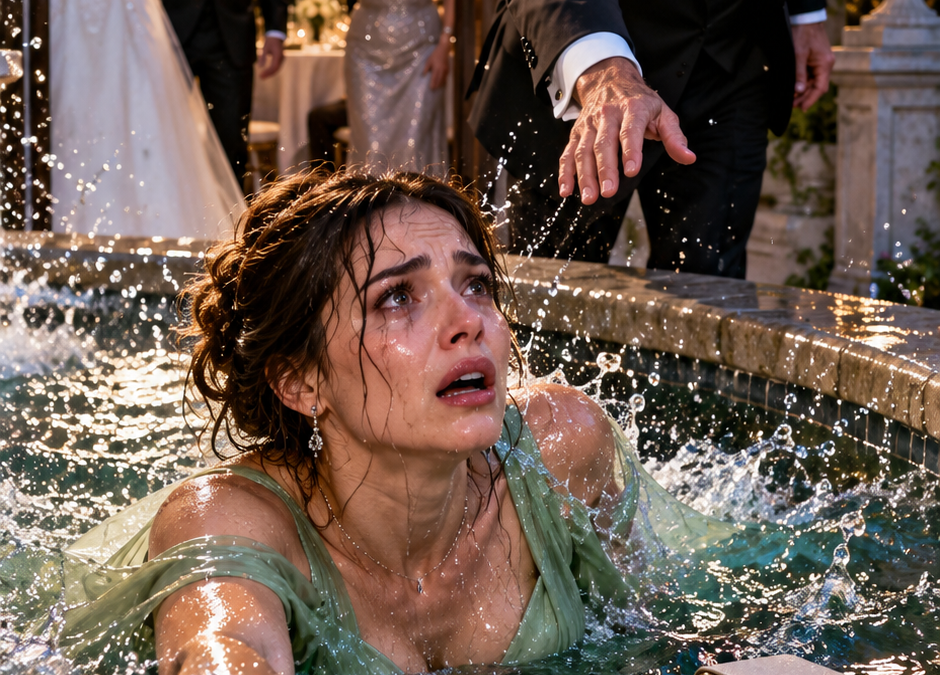
𝗣𝗔𝗥𝗧 𝟮
The last few claps died.
For once, no one laughed.
I turned and walked into the hotel lobby, dripping water across the polished marble floor.
A young waiter froze with a tray of champagne.
I passed him without apology.
In the restroom, I locked the door behind me and looked at myself in the mirror.
At first, I barely recognized the woman staring back.
Not because of the black mascara under my eyes.
Not because of the pale green dress clinging to my body.
Not because my hair hung wet around my face.
It was my eyes.
For years, I had trained myself to look away first.
At family dinners, I looked down when my father began another joke.
At Christmas, I smiled when Allison received sentimental gifts and I received something practical with a receipt still tucked inside.
At charity galas, I pretended not to notice when my mother introduced Allison as “our beautiful daughter” and me as “our oldest.”
I had become skilled at disappearing while standing in plain sight.
But the woman in the mirror was no longer disappearing.
I bent, gathered the ruined contents of my clutch, and found my phone. The screen flickered weakly, water trapped beneath the glass, but it still worked.
Barely.
My fingers shook as I opened a hidden conversation.
Daniel.
For three years, his name had sat in my phone under a simple initial: D.
Not because I was ashamed of him.
At least, that was what I told myself.
I typed two words.
Come now.
The message struggled for a moment.
Then it went through.
No explanation.
Daniel would understand.
He always did.
I set the phone on the counter and pressed both palms to the cool marble. My pulse began to slow.
The ballroom music floated faintly through the lobby walls. Glasses clinked. Laughter rose and fell. Somewhere outside, my father’s voice returned to its cheerful volume.
Of course it did.
In his version of the evening, nothing serious had happened.
A family joke.
A little embarrassment.
Something Meredith would eventually be expected to laugh about.
I had spent most of my life being told hurt only counted when the person causing it agreed it should.
Tonight, I was finished negotiating.
I peeled off the soaked chiffon dress and left it in a cold, heavy heap near the sink. From my emergency garment bag, I removed the black cocktail dress I had packed without admitting to myself why. It was sharp, simple, unforgiving. Sleeveless. Clean-lined. Not mourning black.
Decision black.
I dried my hair as best I could under the hand dryer, pinned it back, and painted my lips a deep red I usually reserved for court appearances and days when I needed to remember I had a spine.
I was touching up the corner of my mouth when someone knocked softly.
“Meredith?”
My mother.
I closed my eyes.
“Come in.”
Evelyn Harper entered carefully. She was still immaculate in silver silk, though concern had disturbed her composure. She held a cream shawl in both hands.
For several seconds, we only looked at each other.
Then she noticed the ruined green dress on the floor.
“Oh, sweetheart.”
I almost laughed.
Sweetheart sounded strange coming from her now.
“I brought your wrap,” she said.
I did not take it.
“What happened out there wasn’t meant to—”
“Mom.”
She stopped.
I met her gaze in the mirror.
“Don’t explain what Dad meant.”
“I wasn’t going to.”
“Yes, you were.”
She looked down.
That small movement hurt more than an argument would have.
Because she knew.
Maybe she had always known.
“I should have stopped him,” she said quietly.
I turned around.
“Yes.”
No accusation.
No shouting.
Just truth.
Her fingers tightened around the shawl.
“I’ve spent years trying to keep peace in this family.”
“You kept quiet.”
“That isn’t always the same thing.”
“In our family, it was.”
She looked as though she wanted to object.
Then she seemed to decide I had earned the sentence.
Outside, someone laughed loudly.
My mother flinched.
“I don’t understand your father anymore.”
“I do.”
She looked up.
“He needs a room to agree with him.”
“That isn’t fair.”
“Maybe not,” I said. “But it’s true.”
She sat slowly on the upholstered bench near the wall.
“What are you going to do?”
“Leave.”
Relief crossed her face too quickly.
I saw it.
“So that’s what you came in here for.”
“No.”
“You wanted to make sure I wouldn’t cause a scene.”
“Meredith.”
She looked genuinely wounded.
Some part of me softened, but only slightly.
“I am not going to ruin Allison’s wedding.”
“I know.”
“Do you?”
“Yes.”
Her voice became gentler.
“I know you’ve spent half your life making sure Allison never had to pay for the way your father treated you.”
That surprised me.
I had never heard my mother acknowledge it so plainly.
“I noticed more than you think,” she said.
“Noticing isn’t the same as helping.”
“I know.”
There was no defense in her voice this time.
For years, I had imagined confronting my mother. In those imaginary conversations, she always had excuses, and I always had devastating answers. Reality was quieter.
There was no victory in seeing your mother ashamed.
Only sadness.
My phone vibrated.
The screen showed one new message.
Ten minutes. Side entrance.
My heartbeat changed.
Not faster.
Steadier.
Daniel was coming.
My mother noticed.
“Is someone meeting you?”
“Yes.”
“Who?”
I hesitated.
There were still choices available to me.
I could leave without revealing anything. I could protect the life I had built. Daniel had never asked to be displayed as evidence that I was lovable. In fact, that was one reason I had kept our marriage secret from my family.
Our life belonged to us.
Not to my father’s judgment.
Not to Allison’s comparisons.
Not to the gossip that surrounded the Harper name.
But something had shifted when I hit the water.
I was tired of lying when people asked if I was seeing anyone.
Tired of hiding my wedding ring on a chain beneath my clothes at family gatherings.
Tired of making Daniel wait in hotel rooms during holidays because I was not ready for the chaos his existence would create.
Most of all, I was tired of pretending secrecy had protected our marriage when, lately, it had begun to diminish it.
“My husband,” I said.
My mother blinked.
The silence that followed was almost comical.
“Your what?”
“My husband.”
She stared at me.
“You’re married?”
“Yes.”
“How long?”
“Three years.”
Her mouth opened.
Closed.
“Three years?”
“Yes.”
“To whom?”
“Daniel Reyes.”
The name did nothing at first.
Then her expression changed.
Not because Daniel was famous in the celebrity sense. He wasn’t.
But in the circles my parents valued, Daniel Reyes was known. He was a corporate attorney who had built one of the most respected boutique legal practices in the city. He sat on nonprofit boards, taught one evening seminar each semester, and had a reputation for solving complicated problems without needing anyone to notice he had solved them.
Most of the guests at Allison’s wedding would know his name.
My mother certainly did.
“Daniel Reyes from Reyes & Cole?”
“Yes.”
She stood.
“You married Daniel Reyes?”
“That is generally what I’ve been saying.”
“But how?”
“We went to law school together.”
“I know that.”
“We reconnected six years ago.”
“And you never told us?”
“No.”
“Why?”
That question contained more pain than I expected.
I could have answered cruelly.
Because I didn’t trust you.
It was true.
But it was not the entire truth.
“I wanted one part of my life that wasn’t measured against Allison.”
My mother’s face fell.
“I didn’t want Dad asking how much Daniel earned or whether his family was important enough. I didn’t want him joking about whether Daniel had settled for me. I didn’t want every dinner turned into an evaluation.”
“I wouldn’t have allowed that.”
I looked at her.
We both knew she would have.
Maybe reluctantly.
Maybe with discomfort.
But she would have.
She lowered her eyes again.
“Allison knows?”
“No.”
“Your brother?”
“No.”
“No one?”
“Aunt Beatrice.”
My mother looked almost offended.
“Beatrice?”
“She was our witness.”
For the first time all evening, something close to humor crossed her face.
“Of course she was.”
Aunt Beatrice, my mother’s older sister, had spent six decades ignoring polite society whenever polite society became inconvenient. She was the only Harper relative I trusted completely.
My mother sat again.
“I don’t know whether to be hurt or impressed.”
“You can be both.”
“I suppose I am.”
A quieter question followed.
“Are you happy?”
The tension left my shoulders.
“Yes.”
That answer required no thought.
“Yes. Very.”
Her eyes became wet.
I was not prepared for that.
“I wish I had known.”
“I wish I had felt able to tell you.”
She nodded slowly.
“That’s different, isn’t it?”
“Yes.”
Another knock came at the door.
We both stiffened.
“Meredith?”
Allison.
My mother wiped quickly beneath one eye.
“I’ll let her in.”
My sister entered in a cloud of ivory silk and perfume, her veil removed, her hair pinned with tiny pearls. Her expression was anxious rather than angry.
“Oh, thank God.”
She hurried toward me.
“Are you okay?”
“I’ll survive.”
“Dad is impossible.”
I watched her carefully.
That was unexpected.
“I told him he went too far,” she said.
“You did?”
“Yes.” Allison looked irritated. “He said everyone thought it was funny.”
I said nothing.
Her expression shifted.
“What?”
“Nothing.”
“No, that’s your something face.”
I almost smiled.
Growing up, Allison had always been able to read my expressions better than anyone.
Maybe that made everything harder.
“I don’t want to fight with you tonight,” I said.
“Neither do I.”
“You should go back to your reception.”
“Not until I know you’re okay.”
I studied her.
Allison was ten years younger and had benefited from our father’s favoritism for as long as I could remember. But benefiting from something was not the same as creating it.
That distinction had taken me years to understand.
“I’m leaving soon.”
She frowned.
“Please don’t.”
“I think that’s best.”
“But people will notice.”
The words slipped out naturally.
Allison heard them at the same moment I did.
Her face flushed.
“I didn’t mean—”
“Yes, you did.”
“No, I meant—”
“You meant that if I leave, people will talk.”
She looked miserable.
“This is the problem,” I said.
“I know.”
“No. I don’t think you do.”
Allison leaned against the counter, careful of her train.
“Then tell me.”
I hesitated.
For years, I had resented Allison because it was easier than resenting my parents. Allison was visible. Allison got the praise. Allison received the first choices, the sentimental gifts, the compliments, the gentle tone.
But sometimes I remembered a six-year-old Allison slipping into my bedroom after one of Dad’s jokes and offering me half a chocolate bar because she did not know how else to comfort me.
People were rarely only one thing.
“I spent most of my childhood being told you were prettier, sweeter, easier, more lovable.”
Allison’s eyes widened.
“I never asked him to say that.”
“I know.”
“Then why do you look at me like I’m responsible?”
I looked away.
Because she had finally asked the question I had avoided.
“I don’t know.”
Her voice softened.
“I used to think you hated me.”
“I never hated you.”
“You avoided me.”
“Yes.”
“That’s what it felt like.”
The orchestra outside shifted into a slower song.
Allison looked down at her hands.
“Do you know why I asked you to be maid of honor?”
I stared at her.
“You didn’t. Tessa is your maid of honor.”
“I asked you first.”
“What?”
“You never answered my email.”
“I never got an email.”
Allison looked up.
“I sent it in January.”
“I didn’t receive it.”
“I thought you ignored me.”
We stared at each other.
“What address?” I asked.
“Your old Harper Foundation account.”
“That account was deactivated last year.”
“Oh.”
Something fragile passed between us.
Not reconciliation.
Not yet.
But possibility.
“I thought you didn’t want to stand beside me,” Allison whispered.
I remembered January.
Daniel had asked why I wasn’t involved in the wedding party.
I had shrugged.
“Allison has her people.”
I had said it as though it did not matter.
It had mattered.
Of course it had.
“I would have said yes,” I said.
Allison’s eyes filled.
“Really?”
“Yes.”
The room became quiet again.
Then my phone buzzed.
Daniel.
I’m here.
I inhaled.
Allison noticed.
“Who’s here?”
My mother moved quickly.
“Perhaps we should—”
I lifted one hand.
“No.”
There would never be a perfect moment.
I had waited three years for one.
Perfect moments, I was beginning to realize, were often just excuses fear used to buy more time.
“There’s something you don’t know about me,” I said.
Allison’s concern returned.
“What?”
I reached beneath the neckline of my dress and pulled out the thin silver chain.
A ring hung from it.
Simple platinum.
No diamond.
Daniel had once asked if I wanted something larger. I had told him I preferred the band because circles needed no decoration to explain themselves.
Allison stared.
“What is that?”
“My wedding ring.”
Silence.
My mother watched us carefully.
Allison looked from the ring to me.
“You’re married?”
“Yes.”
“How long?”
“Three years.”
She sat down abruptly.
“You’ve been married for three years?”
“Yes.”
“To who?”
“Daniel Reyes.”
Allison stared.
Then, unexpectedly, she laughed.
Not mockingly.
It was a stunned, breathless sound.
“Daniel Reyes?”
“Yes.”
“The Daniel Reyes?”
“He would hate being called that.”
“Oh my God.” She put one hand over her mouth. “Meredith.”
“I know.”
“No, I don’t think you do. I’ve sat through three Christmas dinners where Dad made jokes about your dating life.”
“Yes.”
“And you were married?”
“Yes.”
“You could have ended those jokes at any time.”
I looked at my sister.
“I shouldn’t have needed a husband to make them unacceptable.”
Her amusement vanished.
“No,” she said softly. “You shouldn’t have.”
I slid the ring onto my finger.
It felt heavier than usual.
Not because it had changed.
Because I was finally allowing it to be seen.
Allison looked toward the door.
“Is he here?”
“Yes.”
“Now?”
“Yes.”
“Oh.”
The bride looked suddenly nervous.
“What?” I asked.
“All four hundred guests are out there.”
“I know.”
“Dad is out there.”
“I know.”
“And Daniel Reyes is about to walk into the lobby?”
“Yes.”
Allison rubbed her forehead.
“This is the most Meredith thing you have ever done.”
“What does that mean?”
“Quietly having an entire life nobody knows about and then revealing it while wearing red lipstick.”
For the first time that evening, I laughed.
A real laugh.
My mother joined softly.
Even Allison smiled.
For thirty seconds, we were simply mother and daughters in a restroom, not symbols in the Harper family mythology.
Then the door opened again.
Aunt Beatrice entered without knocking.
She wore midnight-blue velvet and carried a champagne flute.
“I assume we’re finally telling everybody.”
Allison turned.
“You knew?”
Beatrice took a sip.
“I signed the certificate.”
“Aunt Bea!”
“I keep confidences.”
“You kept this for three years?”
“Yes.”
“You didn’t accidentally mention it once?”
“No.”
“You accidentally told Grandma about my nose piercing within six hours.”
“That wasn’t confidential,” Beatrice said. “It was visible.”
Despite herself, Allison laughed.
Beatrice turned to me.
“Daniel’s in the lobby.”
My stomach tightened.
“Alone?”
“Currently being greeted by at least six attorneys and one retired judge.”
Allison stood.
“Oh no.”
Beatrice raised an eyebrow.
“What?”
“Nothing.”
Allison looked at me.
“What are you going to do?”
That was the question.
I had imagined grand entrances before. Not because I wanted one, but because fantasies sometimes fill the spaces where courage has not yet arrived.
I had pictured taking Daniel’s hand and walking directly to my father.
I had imagined the room falling silent.
I had imagined everyone realizing, all at once, that the pathetic spinster had never been pathetic or alone.
But standing there now, something about that fantasy felt empty.
Daniel was not ammunition.
My marriage was not evidence.
And I did not want the most important relationship in my life introduced as a response to the ugliest moment of the evening.
“I think I’m going to leave with my husband,” I said.
Allison blinked.
“That’s it?”
“That’s it.”
“What about Dad?”
“He’ll learn eventually that not everything is about him.”
Beatrice smiled into her champagne.
My mother looked thoughtful.
After a moment, Allison nodded.
Then she surprised me.
“Can I meet him first?”
I considered that.
“Yes.”
We walked into the lobby together.
Me in black.
Allison in ivory.
My mother in silver.
Aunt Beatrice trailing behind like a satisfied conspirator.
Daniel stood beneath the chandelier, speaking with Judge Weston. He wore a charcoal suit with no tie, and his dark hair was slightly disordered, which told me he had driven quickly.
Then he saw me.
The entire room disappeared from his face.
He excused himself immediately and crossed the lobby.
Not dramatically.
Not hurriedly.
Just directly.
His eyes moved over me from head to toe.
“You’re okay?”
“Yes.”
“You said come now.”
“I know.”
“I assumed something happened.”
“Something did.”
He looked toward the ballroom doors, then back at me. I could see every question he was choosing not to ask in front of everyone.
Then his gaze dropped to my hand.
To the wedding band I was wearing openly for the first time at a family event.
His expression changed.
Very slightly.
But I saw it.
“So,” he said.
“So.”
A small smile touched his mouth.
“That’s new.”
“It shouldn’t be.”
“No,” he said. “It shouldn’t.”
He took my hand.
Allison stepped forward awkwardly.
“Hi.”
Daniel looked at her.
I took a breath.
“Daniel, this is my sister Allison.”
His expression warmed.
“The bride.”
“Yes,” Allison said. “And apparently your sister-in-law.”
“Apparently.”
She laughed.
“I’m sorry. I’m trying to understand how I’ve had a brother-in-law for three years.”
Daniel glanced at me.
“I’ve also been trying to understand that.”
There was no bitterness in his tone.
That somehow made me feel worse.
Allison extended her hand.
Daniel looked at it, then gently ignored it and opened his arms.
Only after checking her expression first.
Allison smiled and hugged him.
“Congratulations,” Daniel said.
“Thank you.”
When they separated, Allison studied him.
“I feel like I should apologize for my entire family.”
Daniel’s smile faded slightly.
“You’re only responsible for yourself.”
That sentence landed somewhere deep.
Allison felt it too.
“I’m learning that,” she said.
The ballroom doors opened.
A small group of guests drifted into the lobby.
One of them spotted Daniel.
“Reyes!”
Another waved.
Within seconds, several people approached. Daniel greeted them politely. I noticed Allison watching.
Not Daniel.
Me.
She watched how naturally his hand rested at my back. How he leaned slightly toward me when I spoke. How we communicated in glances because three years of marriage had given us a language no ballroom could understand.
There was something almost tender in Allison’s expression.
Then another voice cut through the lobby.
“Well, well.”
I froze.
My father stood in the ballroom doorway.
Robert Harper’s smile had returned.
But this one was different.
Calculated.
He recognized Daniel immediately.
“Daniel Reyes.”
Daniel turned.
“Mr. Harper.”
My father approached.
“What brings you here?”
Daniel looked at me.
The answer was obvious, but he let me decide whether to say it.
That small courtesy gave me more strength than any dramatic declaration could have.
I stepped beside him.
“He’s here for me.”
My father laughed lightly.
“Meredith, don’t tell me you called counsel because you fell into a fountain.”
Several nearby guests became suddenly interested in their drinks.
I shook my head.
“No.”
I took Daniel’s hand.
“I called my husband.”
My father’s face emptied.
It was astonishing how quiet a crowded lobby could become.
He looked at our joined hands.
Then at the ring on my finger.
Then back at Daniel.
“Your what?”
“My husband.”
Daniel’s thumb moved gently across my knuckles.
My father laughed once.
No one joined him.
“This is some kind of joke.”
“No.”
“How long?”
“Three years.”
He stared at me.
Then something appeared in his face that I had not expected.
Not anger.
Hurt.
Real hurt.
“You married without telling us?”
The old reflex rose instantly.
Apologize.
Explain.
Make him comfortable.
I did none of those things.
“Yes.”
He looked at my mother.
“You knew?”
“Ten minutes ago,” she said.
“Allison?”
“About fifteen.”
“Beatrice?”
Aunt Beatrice lifted her champagne.
“Three years.”
My father closed his eyes briefly.
When he opened them, he looked older.
“You let your aunt attend your wedding but not your parents?”
“There were six people there.”
“That doesn’t answer me.”
“No,” I said. “It doesn’t.”
He looked around the lobby.
I saw the moment he realized people were listening.
His posture straightened automatically.
The performance was returning.
So I spoke before it could.
“Dad, I’m leaving.”
“We’re talking about this.”
“Not tonight.”
“You can’t drop something like this and walk away.”
“I can.”
“This affects the family.”
I looked at Daniel.
Then back at my father.
“My marriage isn’t a family asset.”
His jaw tightened.
Daniel remained silent.
I was grateful for that.
This was mine.
My father lowered his voice.
“Why didn’t you tell me?”
There it was.
Not us.
Me.
I thought about the fountain.
The laughter.
Thirty-two years of jokes.
But I also thought about childhood mornings when my father made pancakes shaped like animals. The afternoon he taught me to ride a bicycle. The way he had once driven four hours through a snowstorm to bring me home from college when I had pneumonia.
People were rarely only one thing.
That was the tragedy of families.
Love did not automatically erase harm.
And harm did not erase every memory of love.
“Because I didn’t know how to let you into my life without letting you define it,” I said.
He stared at me.
The lobby had become painfully quiet.
“I didn’t trust you to meet Daniel without evaluating him. And I didn’t trust you to see me happy without turning it into a joke.”
My father looked toward the ballroom.
Maybe he remembered the microphone.
Maybe he remembered the fountain.
I did not know.
When he looked back, the certainty had gone from his face.
“You think that little of me?”
“I think you taught me to expect it.”
He flinched.
I almost took the words back.
Almost.
Instead, I squeezed Daniel’s hand.
Allison stepped beside our mother.
No one spoke.
Finally, my father said, “We can discuss this tomorrow.”
I nodded.
“If we can actually discuss it.”
“What is that supposed to mean?”
“It means I won’t attend another conversation where the goal is proving I’m too sensitive.”
He opened his mouth.
Then stopped.
Perhaps because, for once, there was no audience laughing with him.
I turned to Allison.
“Your wedding is beautiful.”
Her eyes filled.
“Don’t go.”
“I need to.”
She nodded.
Then she hugged me.
Not delicately.
Not carefully.
For a few seconds, we were sisters again.
“I want to talk,” she whispered.
“So do I.”
“When?”
“Tomorrow.”
“Promise?”
“Yes.”
When we separated, Allison looked at Daniel.
“Take care of her.”
I nearly objected.
Daniel beat me to it.
“She takes care of herself pretty well.”
Allison smiled.
“Right.”
Daniel added, “But I’ll drive.”
That earned a quiet laugh from me.
We left through the side entrance.
Outside, the night was cool. City lights reflected on wet pavement from an earlier rain. Daniel’s car waited at the curb.
He opened the passenger door.
I stopped.
“What?” he asked.
I looked back at the hotel.
Behind those glowing windows, my father was probably already trying to regain control of the story. By morning, maybe he would call it a misunderstanding. Maybe he would say I had embarrassed him. Maybe he would suggest my marriage had been hidden because I enjoyed drama.
For the first time in my life, I felt no urgency to correct the story immediately.
“You don’t have to be fine,” Daniel said.
Tears stung unexpectedly.
“I know.”
“You also don’t have to explain tonight.”
“I know.”
“And you don’t owe me an apology for calling me.”
I looked at him.
“I was going to apologize.”
“I know.”
I laughed through the tears.
He touched my cheek.
“What happened?”
So I told him.
Not dramatically.
Not all at once.
I told him about the microphone.
The laughter.
The terrace.
The fountain.
The applause.
Daniel’s expression hardened briefly, but he did not interrupt.
When I finished, he was silent.
Then he asked something I had not expected.
“Why did you text me?”
I frowned.
“Because I needed you.”
“No.” His voice remained gentle. “Why tonight?”
I looked toward the hotel entrance.
Because that was the real question.
I had needed him before.
At Christmas.
At birthdays.
After family dinners when I drove home furious and pretended I was not.
But tonight I had finally called.
“I think,” I said slowly, “I got tired of protecting the secret more than I was protecting us.”
Daniel looked at me for a long moment.
Then nodded.
“Okay.”
I studied him.
“Are you angry?”
“No.”
“Were you?”
“Yes.”
The honesty stung.
“When?”
“For about a year.”
I looked down.
“Why didn’t you tell me?”
“I did.”
“When?”
“Last Thanksgiving.”
I remembered.
We had been washing dishes in our apartment. Daniel had asked how long we planned to keep living two versions of our life.
I had kissed him and said, “We’ll figure it out.”
Then I had changed the subject.
“I didn’t understand,” I whispered.
“I know.”
“That isn’t better.”
“No.”
He was not accusing me.
That made it easier to listen.
Daniel leaned against the car.
“I agreed to privacy, Meredith. I didn’t agree to becoming invisible.”
My eyes closed briefly.
“I know that now.”
“I never needed your father’s approval.”
“I know.”
“I didn’t need your family to admire me.”
“I know.”
“I just wanted to be your husband everywhere.”
A tear slid down my cheek.
“I was afraid.”
“I know.”
“What if telling them ruined it?”
Daniel gave me a sad smile.
“What if hiding it did?”
That question followed us home.
We did not resolve everything that night.
We ordered soup from the twenty-four-hour deli near our apartment. I showered until the smell of fountain water left my skin. Daniel hung the black dress over a chair. We sat in bed eating bread from paper bags while the city hummed beyond the windows.
At two in the morning, I finally said, “I’m sorry.”
Daniel looked over.
“For what?”
“For making our marriage smaller so my family couldn’t touch it.”
He set down his spoon.
“It wasn’t small.”
“You know what I mean.”
“Yes.”
He took my hand.
“I don’t want you to tell people because you’re embarrassed by secrecy.”
“Then why?”
“Because you’re proud of your life.”
I looked around our apartment.
The chipped ceramic bowl Daniel had made during an unsuccessful pottery class. The framed photograph from our hiking trip in Peru. The blanket we argued about every night because he stole it. The crooked bookshelf we kept meaning to replace. The window herb garden that somehow survived despite both of us forgetting to water it.
Our life was not glamorous.
It was not curated.
It was mine.
It was ours.
And I was proud.
My phone buzzed on the nightstand.
A message from Allison.
I found something you need to see.
I stared at the screen.
Another message arrived.
It’s about the email I sent in January.
Then a third.
It wasn’t sent to your old account by mistake. Dad forwarded it there after I gave it to him to send with the wedding documents.
I sat upright.
Daniel looked at me.
“What?”
I handed him the phone.
Allison’s fourth message appeared.
Meredith, I think Dad made sure you never saw it.
Suddenly, the unanswered invitation was no longer a misunderstanding.
It was a choice someone had made for us.
For a long moment, I could not speak.
I had spent years telling myself that distance between Allison and me had formed naturally. We were different ages. Different personalities. Different daughters in the same house.
But what if some of that distance had been maintained?
Encouraged?
Protected by the very man who benefited from keeping us separate?
Daniel read the messages twice.
“Do you want to call her?”
I shook my head.
Then nodded.
Then shook my head again.
“I don’t know.”
“That’s allowed.”
I looked at the phone as another message appeared.
I’m sorry. I didn’t know. I swear I didn’t know.
My chest hurt.
Not with anger alone.
With grief.
Because there was another version of that wedding hidden inside the truth. One where Allison asked me to stand beside her. One where I said yes. One where I wore whatever dress she chose and held her bouquet while she said her vows. One where I still might have left early, still might have kept Daniel secret, still might have struggled under the weight of my father’s cruelty.
But at least my sister and I would have been standing side by side.
My father had taken even that possibility and redirected it to an email account he knew I would never see.
Daniel placed his hand over mine.
“What do you need?”
I gave a tired laugh.
“I used to hate that question.”
“Why?”
“Because I never knew the answer.”
“And now?”
I looked at Allison’s messages.
“I need the truth.”
At nine the next morning, Allison came to our apartment.
She arrived without makeup, wearing jeans and an oversized sweater, her wedding hair still half-pinned and exhausted. She stood in the hallway holding a folder against her chest as if it contained something fragile.
When I opened the door, she looked at me and burst into tears.
“I’m sorry,” she said.
Not the graceful, polite kind of crying people do in public.
Ugly crying.
Little-sister crying.
The kind I had not seen since she was fourteen and our father forgot her school performance because a donor dinner ran late.
I stepped aside.
“Come in.”
Daniel made coffee and then disappeared into his office, giving us privacy without making Allison feel unwelcome.
She sat at our kitchen table and opened the folder.
“I couldn’t sleep,” she said. “After you left, I kept thinking about the email. I knew I sent it. I remembered writing it. I remembered attaching the dress information and telling Dad to forward it to you because he said he was already sending you hotel details.”
My stomach tightened.
“Why did he have to send it?”
“Because he insisted on managing the family block at the hotel. He said you were always difficult about logistics.”
Of course he had.
Allison pulled out printed pages.
“I checked my sent folder. I sent the email to Dad. Not to you. I asked him to forward it.”
She slid the first page across the table.
There it was.
Dad, please forward this to Meredith with the rest of the wedding packet. I want her to be my maid of honor. I know things are awkward sometimes, but she’s my sister. I want her beside me.
The words blurred.
I covered my mouth.
Allison started crying again.
“I meant it.”
I nodded because I could not speak.
She slid another page across.
“This is what he forwarded.”
The second email was shorter.
Cold.
Practical.
Meredith, attached are hotel details for Allison’s wedding weekend. Ceremony begins at four. Reception to follow.
No mention of maid of honor.
No forwarded message from Allison.
No invitation.
No chance.
“He deleted that part,” Allison whispered. “Then he sent it to your old Harper Foundation account.”
I looked up.
“You knew the account was dead?”
“I didn’t. But Dad did. He’s the one who told HR to deactivate it after you left the board committee.”
A numbness spread through me.
Daniel appeared quietly in the doorway, as if some shift in the room had called him.
I looked at him.
“He knew.”
Daniel’s face changed.
Not with surprise.
With anger.
Controlled, silent anger.
Allison wiped her face.
“I confronted him this morning.”
“What did he say?”
“At first, he denied it. Then he said he must have made a mistake. Then I asked why he removed the maid-of-honor paragraph.”
I waited.
Allison’s voice broke.
“He said he was protecting my wedding from your attitude.”
I closed my eyes.
There it was.
Not a mistake.
A philosophy.
My father had decided that my presence beside my sister would ruin the aesthetic before I ever stepped into the ballroom.
“He said,” Allison continued, “that if I put you in the wedding party, you would make everything tense. That you would resent the attention. That you would find some way to turn the day into a referendum on your childhood.”
A small, bitter laugh escaped me.
“He managed that by himself.”
Allison looked shattered.
“I believed you ignored me.”
“I believed you chose Tessa.”
“I did choose Tessa,” she said. “After you didn’t answer. But I cried when I asked her. Bradley thought I was overwhelmed by planning, but I was crying because I thought my sister didn’t want to stand with me.”
I reached across the table.
Allison grabbed my hand.
For years, I had seen her as the beneficiary of my humiliation.
Now I saw something else.
A girl who had also been managed.
Maybe more gently.
Maybe more comfortably.
But still managed.
“What do we do?” she asked.
I looked at the printed emails.
The old me would have asked what would cause the least conflict.
The woman in the mirror from the night before had no interest in that question.
“We tell the truth,” I said.
Allison nodded.
“To Dad?”
“To everyone who needs to know it.”
By noon, my mother knew.
By one, Aunt Beatrice knew and had already used language that would have scandalized the hotel staff.
By three, Bradley knew, and to his credit, he did not try to minimize anything. He sat beside Allison on our sofa, holding her hand, his face pale with anger.
At four, my father began calling.
First me.
Then Allison.
Then my mother.
Then Daniel, which was the first truly stupid choice he made that day.
Daniel looked at the unknown number, then at me.
“Do you want me to answer?”
“No.”
The call went to voicemail.
A minute later, a message appeared.
This has gone far enough. Meredith needs to stop weaponizing a family misunderstanding. Call me.
Daniel stared at the screen.
Then he smiled without humor.
“I see where you learned the word dramatic.”
Despite everything, Allison laughed.
That evening, we agreed to meet at my parents’ house.
Not because my father deserved the setting.
Because my mother asked for it.
And because Allison said, “I want him to look at both of us when he explains.”
Daniel drove.
This time, he did not wait outside.
When my father opened the door and saw all of us standing there—me, Daniel, Allison, Bradley, my mother behind him in the foyer, and Aunt Beatrice already sitting in the living room like a judge who had arrived early—his face tightened.
“This is ridiculous,” he said.
“No,” Allison replied. “This is overdue.”
We gathered in the living room beneath the family portraits.
There was Allison at sixteen, glowing in a white dress before a charity debutante event.
There was my brother, Graham, shaking hands with a governor.
There was me at twenty-five, standing slightly apart from the family, wearing a navy suit and the expression of someone already preparing to be criticized for it.
My father refused to sit.
“This family does not conduct tribunals.”
Aunt Beatrice lifted one eyebrow.
“Then stop behaving like a defendant.”
My mother said, “Robert.”
He looked at her.
She did not look away.
That surprised him.
Good.
Allison placed the printed emails on the coffee table.
“Why did you do it?”
“I already explained.”
“No,” she said. “You insulted Meredith and called it an explanation.”
He turned to me.
“I made a judgment call.”
“About my relationship with my sister?”
“About Allison’s wedding.”
Allison’s voice sharpened.
“My wedding. Mine. Not yours.”
His face hardened.
“You were under a lot of stress. I made a decision that protected the day.”
“You lied to both of us.”
“I filtered unnecessary conflict.”
I almost laughed.
That was my father’s genius.
He never used ugly words for ugly things.
Lying became filtering.
Humiliation became humor.
Control became protection.
“Say it plainly,” I said.
He looked at me.
“You don’t get to cross-examine me in my own house.”
Daniel shifted slightly beside me.
Not forward.
Not threatening.
Just present.
My father noticed.
“Daniel, surely you understand family discretion.”
Daniel’s voice was calm.
“I understand documentation.”
The room went still.
My father blinked.
“What?”
Daniel looked at the printed emails.
“I understand that Allison sent you a message containing a direct request that Meredith serve as maid of honor. I understand that you removed that request, sent a stripped version to an inactive email address, and allowed both daughters to believe the other had created the distance. I understand that last night, after engineering part of that distance, you mocked Meredith publicly for arriving alone, then pushed her into a fountain in front of guests.”
My father’s face reddened.
“That is an absurd characterization.”
“It is a chronological summary,” Daniel said.
I looked at my husband.
For three years, I had kept him away from my family because I feared what their cruelty would do to our marriage.
Now he stood beside me, not rescuing me, not speaking over me, but naming facts with such precision that my father had nowhere to hide.
My mother sat down slowly.
Allison’s grip tightened around Bradley’s hand.
My father pointed at Daniel.
“You don’t know this family.”
Daniel’s expression did not change.
“I know my wife.”
The sentence was simple.
It shook something loose in me.
My wife.
Not Meredith the problem.
Not Meredith the spinster.
Not Meredith the difficult oldest daughter.
His wife.
A person with a life beyond that room.
My father turned back to me.
“So this is what you wanted? To bring in your attorney husband and humiliate me?”
“No,” I said.
My voice was quieter than I expected.
“I wanted my father to stop humiliating me.”
He looked away.
For the first time, I saw the shape of his fear.
Not guilt.
Not yet.
Fear.
Because the old arrangement had depended on everyone accepting his version of events. If he said it was a joke, it was a joke. If he said I was dramatic, I was dramatic. If he said he was protecting Allison, then control became love.
But now there were too many witnesses.
Too many records.
Too many people no longer willing to laugh.
Allison stood.
“You made me think she ignored me.”
My father rubbed his forehead.
“I thought you would get over it.”
“I didn’t.”
“You had Tessa.”
“I wanted my sister.”
He flinched then.
Finally.
Not enough.
But visibly.
My mother spoke next.
“Robert, did you know the account was inactive?”
He did not answer.
“Robert.”
He exhaled sharply.
“I suspected.”
A sound left Allison, small and wounded.
My mother closed her eyes.
Aunt Beatrice whispered, “Coward.”
My father snapped, “Stay out of this, Beatrice.”
“No,” she said. “I don’t think I will.”
I looked at him.
“Why?”
His shoulders dropped slightly.
For a second, he looked like an old man in an expensive suit, surrounded by consequences he had been certain would never arrive.
“Because the two of you together always made things harder.”
Allison stared.
“What does that mean?”
He looked between us.
“When you were children, Meredith challenged everything. Allison cried when people argued. The house was chaos when you two were close. When you were apart, things were calmer.”
I could barely comprehend what I was hearing.
“So you kept us apart because it was easier for you?”
“I kept peace.”
My mother’s voice shook.
“No. You kept control.”
He looked at her as if she had slapped him.
Maybe she had.
Not with her hand.
With the first honest sentence I had heard from her in years.
The room went silent.
I thought anger would carry me then.
Instead, grief did.
“You taught me my sister didn’t need me,” I said. “You taught her I didn’t want her. You made both of us lonelier because our closeness inconvenienced you.”
My father opened his mouth.
Nothing came out.
I stepped closer, not because I wanted to intimidate him, but because I needed him to hear me without performance between us.
“Last night, when you pushed me into that fountain, people applauded because you taught them I was someone they were allowed to laugh at.”
His face tightened.
“I didn’t mean for you to fall.”
“But you meant to move me.”
He looked down.
I continued.
“That is what you have done my whole life. Moved me out of the frame. Away from Allison. Away from the version of the family you wanted people to admire. Away from anything that made you uncomfortable.”
My voice almost broke, but I held it.
“I am done being moved.”
No one spoke.
My father’s eyes shone, but I did not know whether the tears were remorse, shame, or anger at being cornered.
“I made mistakes,” he said finally.
The old me would have accepted that because it sounded close enough to an apology.
I was not the old me.
“That is not an apology.”
His jaw tightened.
Daniel remained still.
Allison looked at me with something like awe and sadness.
My mother folded her hands in her lap.
My father swallowed.
“I am sorry.”
I waited.
He looked at Allison first.
“I am sorry I interfered with your wedding plans.”
Allison’s face hardened.
“Try again.”
He looked startled.
She shook her head.
“You didn’t interfere with wedding plans. You lied to me about my sister.”
The words seemed to strike him.
He nodded once.
“I am sorry I lied to you about Meredith.”
Then he looked at me.
“And I am sorry I humiliated you last night.”
I held his gaze.
“And?”
His brow furrowed.
I said nothing.
He looked toward the floor.
“I am sorry I pushed you.”
The room held still.
It was the first time anyone in my family had named the action plainly.
Not a joke.
Not an accident.
Not drama.
He pushed me.
I nodded once.
“I hear you.”
Relief flickered across his face.
Too soon.
“I am not ready to forgive you.”
The relief vanished.
I continued.
“I don’t know when I will be. I don’t know what our relationship looks like now. But it will never again look like it did.”
My father’s voice lowered.
“You would cut off your own family?”
“There it is,” Aunt Beatrice muttered.
I ignored her.
“No,” I said. “I am telling my family the terms on which I remain.”
He stared at me.
“No jokes about my marriage. No comments about my dating history. No rewriting what happened. No calling me dramatic because I refuse to make you comfortable. No using Allison and me against each other.”
Allison stepped beside me.
“And no speaking for me.”
My mother stood too.
“And no expecting me to smooth over what you break.”
My father looked at the three of us.
Maybe that was the true punishment.
Not public embarrassment.
Not Daniel’s presence.
Not the printed emails.
The sight of the women in his family no longer standing separately.
For years, he had controlled rooms by isolating us within them.
That ended there.
He sat down heavily.
“I don’t know how to fix this.”
For once, he sounded honest.
“You don’t fix it tonight,” I said.
“Then what do I do?”
“You start by not asking the people you hurt to make you feel better.”
His eyes lowered.
We left soon after.
There was no dramatic final line. No thunderclap. No perfect victory.
Real endings rarely announce themselves.
Sometimes they look like a woman walking out of her parents’ house with her husband beside her, her sister’s arm linked through hers, and her mother standing in the doorway with one hand over her mouth because she finally understands what silence has cost.
In the weeks that followed, my father tried.
Badly, at first.
He sent long messages explaining his intentions. I did not answer those.
Then he sent shorter messages naming what he had done. I read those.
Allison and I met for lunch two days after the confrontation. We cried over soup and compared memories like detectives examining a crime scene neither of us had understood while living inside it.
She told me about school plays she thought I skipped because I did not care.
I told her about invitations I never received.
She told me she used to wait for me after family dinners, hoping I would come to her room.
I told her I used to sit in my car outside the house, trying to gather the energy to go back inside.
There was no way to recover every lost year.
But there was a way to stop losing more.
My mother began therapy before my father did. Aunt Beatrice called that “the first intelligent thing anyone has done in this family since Meredith eloped.”
Daniel and I did not become magically perfect because I had finally worn my ring in public. We had hard conversations. I had to learn how many times my fear had asked him to be patient when patience was costing him. He had to admit how often he had hidden his hurt because he thought protecting me meant needing less.
But we were honest.
That changed everything.
Three months after Allison’s wedding, she and Bradley hosted a small dinner in their new apartment.
No chandeliers.
No orchestra.
No microphone.
Just eight people around a table too small for the serving dishes.
I wore my wedding ring on my hand.
Daniel sat beside me.
Allison burned the bread and laughed so hard she cried. Bradley ordered emergency pizza. My mother brought flowers. Aunt Beatrice brought champagne and announced she trusted none of us with the cork.
My father was not there.
He had been invited for dessert only, at Allison’s request, with rules stated clearly in advance.
When he arrived, he paused in the doorway like a man entering a country whose laws he had not yet learned.
He greeted Daniel respectfully.
He hugged Allison gently.
Then he came to me.
For a moment, neither of us spoke.
Finally, he said, “Meredith.”
Just my name.
No joke.
No performance.
No audience.
“Dad,” I said.
He looked at my ring, then back at my face.
“I’m glad you’re happy.”
The sentence was imperfect.
Late.
Small.
But it did not contain a blade.
So I accepted it for what it was.
“Thank you.”
He nodded and stepped back.
That was all.
For now, it was enough.
Later that night, Daniel and I walked home beneath streetlights, our hands linked between us.
“Are you okay?” he asked.
I thought about the ballroom. The microphone. The fountain. The applause. The restroom mirror. Allison’s email. My father sitting in the living room with the truth finally surrounding him.
Then I thought about Daniel’s hand in mine.
My sister’s laugh across a small dinner table.
My mother saying no when my father tried to interrupt her.
My own voice, steady and clear, telling him I was done being moved.
“I’m not the same,” I said.
Daniel smiled slightly.
“No.”
I looked up at him.
“Is that good?”
He stopped walking and turned toward me.
“It’s honest.”
I laughed softly.
“That sounds like something I would say.”
“I learned from my wife.”
My wife.
This time, the words did not feel like a secret.
They felt like a door standing open.
For most of my life, my father had treated me like a punchline that existed to make other people more comfortable.
At my sister’s wedding, he thought he had delivered his best joke.
He did not understand that when I climbed out of that fountain, I was not just leaving the water.
I was leaving the role he had written for me.
And when the secret I had protected for three years walked through those ballroom doors, it did not save me.
It reminded me that I had already built a life beyond his reach.
All I had to do was stop hiding it.








