𝗙𝗨𝗟𝗟 𝗦𝗧𝗢𝗥𝗬 My Family Sent Me Into the Freezing Garage Before They Discovered What My Husband Had Left Behind
𝗣𝗔𝗥𝗧 𝟮
My mother entered carrying a folded tablecloth.
“Because your sister and Julian are our guests, and we’re trying to have a peaceful holiday.”
She placed the tablecloth on the counter.
“Put your boxes neatly against the garage wall. Don’t block the middle. Julian needs to park there.”
Julian grinned.
“I appreciate it.”
I looked from one face to another.
My father had already returned to his newspaper.
My mother was studying the Thanksgiving tablecloth as though its wrinkles were the most pressing problem in the house.
Harper looked annoyed.
Julian seemed delighted by the prospect of moving into the largest bedroom upstairs.
None of them appeared troubled by the thought of a pregnant widow spending the night in an unheated garage.
They thought I was helpless.
They thought the exhaustion and grief of the previous seven months had reduced me to someone who could be ordered around without resistance.
And because they believed David had been an ordinary government consultant and I handled administrative paperwork for the Department of Defense, they had never considered that our lives might be considerably different from what they imagined.
For almost twelve years, I had served in the United States Army.
I was Lieutenant Colonel Claire Bennett.
David had been a colonel.
Much of our work involved assignments we couldn’t discuss with our families. Our relatives knew we worked for the government, but secrecy had become so deeply ingrained in our marriage that we eventually stopped correcting their assumptions.
David preferred it that way.
He hated being treated differently because of his rank.
He wanted our home to be a place where he could repair a leaking faucet, argue about whose turn it was to buy groceries, and spend an entire Sunday watching old movies without anyone addressing him as sir.
I wanted that too.
Our secrecy had protected our work.
Unfortunately, it had also allowed my family to invent an entire version of our lives.
They thought David earned a modest salary in an office.
They thought I performed paperwork that could be abandoned whenever they needed me.
They believed Julian’s investment business made him the most important person in any room.
And now they were standing in the kitchen of a house my husband had paid for, deciding that I was the least important person inside it.
I glanced at the clock.
5:19 a.m.
Less than twelve hours earlier, my emergency leave had officially ended.
I had opened a sealed packet from David’s personal effects the previous night, following instructions I had received through official channels.
I had already confirmed my transportation.
An authorized military team was coming to collect me that morning for medical assessment and temporary reassignment.
My family knew none of it.
I could have told them.
I could have explained my rank, my orders, and the reason I had been awake most of the night.
But I was tired of trying to convince people that I deserved basic consideration.
So when Harper asked again whether I intended to move my belongings, I gave her the answer she wanted.
“Okay.”
She blinked.
“What?”
“I’ll move.”
Relief spread across her face.
My mother immediately began discussing where Julian could set up his laptop.
My father muttered something about finally having a peaceful morning.
Julian tossed his keys into the air and caught them.
“Thanks, Claire. I knew you’d understand.”
I picked up the cardboard box I had packed the previous evening.
Then I walked into the garage.
The cold struck me immediately.
My socks offered almost no protection against the concrete floor. The air smelled faintly of motor oil, cardboard, and the sawdust David had left behind after building a set of storage shelves.
His tools still hung above the workbench.
I recognized the blue-handled screwdriver he always accused me of stealing.
I recognized the battered measuring tape he’d carried from one house to another throughout our marriage.
There was even a small wooden birdhouse sitting unfinished on the shelf.
He had started building it after we learned I was pregnant.
“I’m practicing,” he’d told me.
“For what?”
“For making things our kid will immediately destroy.”
I had laughed so hard that he threatened to build the entire nursery out of reinforced concrete.
Now I stood in that freezing garage, staring at the birdhouse, and felt the familiar ache rise through my chest.
I set down the box.
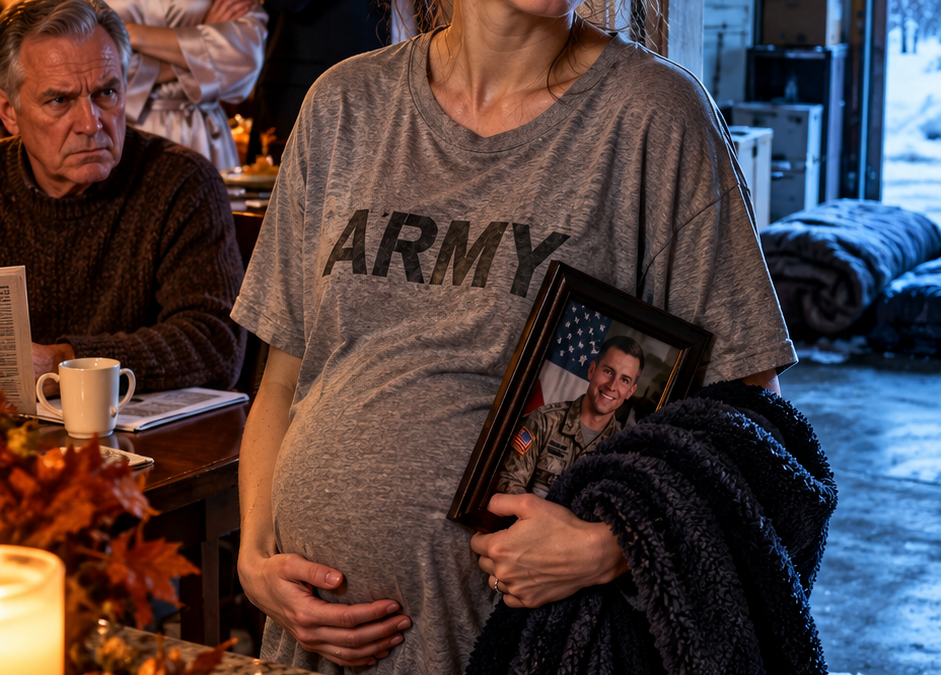
Inside were three maternity sweaters, a pair of boots, my medical folder, a framed photograph of David, and a wooden box containing letters he’d written during deployments.
I had packed those things because I was leaving.
Not because my family had ordered me out of my bedroom.
I placed a hand over my stomach.
Our baby shifted.
“Your daddy would be furious,” I whispered.
The movement came again.
I almost smiled.
Then I heard an engine outside.
Julian stepped into the garage, keys dangling from his hand.
“Looks like you won’t have to move the rest of your stuff right now,” he said.
I didn’t answer.
He glanced toward the driveway.
“What the hell?”
A second engine sounded.
Then a third.
Three dark government vehicles turned into our driveway, tires grinding over the frost.
Two black SUVs stopped near the house, followed by a transport van.
Julian walked outside.
“Hey! You can’t park there!”
The driver’s door of the first SUV opened.
A uniformed soldier stepped out.
He was broad-shouldered, composed, and completely uninterested in Julian’s complaints.
He walked directly toward me.
At the garage entrance, he stopped, brought his feet together, and snapped to attention.
Then he raised a sharp salute.
“Lieutenant Colonel Bennett. Sergeant Morales, ma’am. Your transportation is ready.”
Behind me, something struck the concrete.
Julian had dropped his Audi keys.
For one extraordinary second, nobody spoke.
Then I straightened my shoulders.
Muscle memory took over.
I raised my hand and returned the salute.
“Sergeant.”
“Ma’am.”
He lowered his arm.
“Captain Ellis asked me to confirm you’re ready for movement.”
I looked past him toward the vehicles.
Everything was exactly as I expected.
No dramatic armored convoy.
No spectacle.
Just professional service members carrying out authorized transportation orders.
“Give me ten minutes,” I said.
“Yes, ma’am.”
He stepped back.
I turned toward the house.
My mother stood frozen in the doorway.
Harper had stopped beside her, clutching the edges of her robe.
My father appeared behind them, his newspaper hanging uselessly from one hand.
Julian stared at me.
“Lieutenant Colonel?”
His voice sounded strangely small.
I bent to pick up my box.
My father finally spoke.
“What is this?”
“I have to report.”
“Report where?”
“I can’t discuss that.”
Harper stepped forward.
“You’re in the Army?”
“Yes.”
“But you told us you worked for the Department of Defense.”
“I do.”
“That’s not what you said.”
“It was all I was permitted to say.”
My father gave a short, disbelieving laugh.
“This is ridiculous.”
I looked at him.
“Dad.”
One word.
Not angry.
Not loud.
Just tired.
He stopped talking.
Sergeant Morales stepped forward.
“May I take that box, ma’am?”
“I’ve got it.”
He looked at me for a moment and nodded.
I needed to carry it myself.
After everything that had happened, the weight of that cardboard box felt like something solid I could still control.
I walked past Julian and returned to the kitchen.
My coffee was still sitting on the counter.
A thin crescent of cream had dried around the rim.
Less than half an hour earlier, I’d been standing in this exact spot while my family discussed where I should sleep as though I were an inconvenient guest in someone else’s home.
Now nobody seemed certain where to stand.
My mother reached toward me.
“Claire.”
I moved past her.
“I need to pack.”
“I can help.”
“I already packed last night.”
Harper’s face changed.
“You knew they were coming?”
“Yes.”
“And you still let us—”
She stopped.
I waited.
Still let us what?
Order me into a freezing garage?
Complain about my grief?
Treat my husband’s home like a vacation property where the wealthiest guest deserved the best bedroom?
Harper looked away.
I carried the box toward the stairs.
Behind me, my father spoke.
“Why didn’t you tell us?”
I stopped on the landing.
“About what?”
“Any of this.”
I looked down at him.
For the first time that morning, he seemed uncertain.
“You never asked.”
“That isn’t fair.”
“No,” I said quietly. “It isn’t.”
Then I continued upstairs.
Our bedroom looked almost exactly as it had the morning before David’s funeral.
The black dress I’d worn still hung over the chair.
His side of the bed remained untouched.
His watch sat on the nightstand beside our wedding photograph.
When the Army returned his personal effects two months earlier, I had received that watch along with his wedding ring, a folding knife, three foreign coins, a battered notebook that had been cleared for release, and the sealed packet I’d opened the previous night.
I picked up the watch.
Its leather strap was worn where it had rested against his wrist.
I could still picture him fastening it every morning.
Sometimes he would stand behind me while I brushed my hair, wrap one arm around my waist, and rest his chin on my shoulder.
“One day,” he used to say, “we’re going to have a Thanksgiving where neither of us has to answer a phone call.”
I’d laugh.
“That’s ambitious.”
“Then I’ll retire.”
“You’ve been threatening to retire for years.”
“This time I mean it.”
I had believed we would eventually get that Thanksgiving.
A long weekend.
A kitchen filled with food.
David standing at the stove pretending to understand my mother’s stuffing recipe.
Our child running through the living room while he complained that somebody had stolen his television remote.
Ordinary things.
The future we’d spent years trying to reach.
Instead, seven months earlier, David had disappeared during a classified overseas mission.
The first notification had been carefully worded.
His status was under review.
There were details they couldn’t disclose.
I was instructed to remain available for further briefings.
I was also an officer, which made every conversation more complicated.
I understood the language.
I knew why certain information couldn’t be released.
I knew that operational security didn’t stop mattering simply because someone was grieving.
But none of that knowledge helped me sleep.
For months, I lived between professional understanding and personal terror.
I attended briefings where David’s name appeared on documents I wasn’t permitted to keep.
I signed forms.
I answered questions.
I endured long periods of silence.
And every time my phone rang, I felt a moment of desperate hope before remembering that hope itself had become exhausting.
Eventually, after a prolonged review, David was officially declared killed in the line of duty.
His funeral was authorized.
We buried an empty casket.
I had known that would happen.
I had prepared myself as well as anyone could.
But nothing prepared me for watching the flag being folded while knowing there was no body inside the coffin.
Nothing prepared me for receiving that flag.
And nothing prepared me for returning home to find that the people who were supposed to comfort me had already decided I was grieving too much.
I put David’s watch in my handbag.
My suitcase waited beneath the window.
I had packed it after opening his sealed packet at 11:47 the previous night.
The packet contained administrative instructions concerning my return to duty and the transfer of certain outstanding personal matters connected to David’s service.
I couldn’t discuss the details.
But the instructions meant I had known before going to bed that military transportation would arrive the following morning.
That knowledge had been the only reason I hadn’t completely fallen apart when Harper called.
I closed the suitcase.
Someone knocked on the bedroom door.
“Claire?”
Harper.
I hesitated.
“Come in.”
She entered slowly.
She’d changed into jeans, boots, and a cream sweater. Her hair was tied back, and without the silk robe and perfect makeup, she looked more like the older sister I remembered from childhood.
The girl who used to sneak into my room during thunderstorms.
The girl who held my hand when I was frightened.
The girl who once promised nobody would ever hurt me while she was around.
I wondered when we’d become strangers.
Harper looked around the bedroom.
“Julian didn’t know this was David’s house.”
“He did.”
Her eyes snapped toward me.
“What?”
“I told him yesterday when he asked whether the guest Wi-Fi could be upgraded.”
“What did he say?”
“He said ownership was complicated after someone died.”
Harper stared at the floor.
“That sounds like him.”
There was something in her voice that made me look more carefully.
Not surprise.
Not even embarrassment.
Weariness.
“Are you okay?” I asked.
She gave a faint laugh.
“You’re asking me that?”
“Yes.”
Her mouth trembled.
For a moment, I thought she might cry.
Then she straightened.
“I don’t know.”
It was the first honest answer she’d given me in months.
I sat on the edge of the bed.
Harper leaned against the dresser.
“Was David really a consultant?”
“No.”
“What did he do?”
“I can’t tell you.”
“Even now?”
“Especially now.”
She looked at me for a long moment.
“And you?”
“Same answer.”
Silence settled between us.
Then she spoke so quietly I almost missed it.
“I thought you were embarrassed.”
I frowned.
“About what?”
“Not having some glamorous career.”
I stared at her.
Then an incredulous laugh escaped me.
“Harper, I have a career.”
“I know that now.”
“You knew I worked for the government.”
“Yes, but you never talked about it, and Julian always said—”
She stopped.
“Julian always said what?”
She rubbed her forehead.
“That people who don’t talk about their accomplishments usually don’t have any.”
I looked toward the window.
Three government vehicles sat in our driveway.
A uniformed soldier waited beside the garage.
Downstairs, Julian was apparently demanding to know who had authorized anyone to block his car.
“Your husband sounds exhausting,” I said.
Harper gave a tired smile.
“He is.”
I looked back at her.
“Then why do you keep letting him speak for you?”
She lowered her eyes.
“Because sometimes it’s easier than arguing.”
I knew that answer too well.
Before I could respond, Sergeant Morales appeared in the hallway.
“Ma’am? Captain Ellis is on the secure line.”
I stood immediately.
He handed me the phone.
“Bennett.”
A familiar voice answered.
“Claire.”
Captain Natalie Ellis had served as my operations officer for three years before transferring to personnel recovery.
She was one of the few people who knew both David and me well enough to understand how difficult the previous seven months had been.
“You holding up?” she asked.
“Yes.”
She paused.
Natalie knew when I was lying.
She was also kind enough not to make me admit it.
“We’ve had a change.”
My hand tightened around the phone.
“What kind?”
“Nothing dangerous. Medical and administrative.”
I exhaled.
“Go ahead.”
“Given your pregnancy and the continuing status review, command isn’t sending you directly back to your previous billet.”
“Then where?”
“Walter Reed first. Obstetric assessment. After that, Fort Belvoir. Temporary assignment.”
“For how long?”
“Undetermined.”
I closed my eyes.
Undetermined.
I had spent seven months learning to hate that word.
Natalie continued.
“There’s also a legal briefing.”
My eyes opened.
“About David?”
“Yes.”
I looked toward the window.
Harper had quietly stepped into the hallway, giving me privacy.
“What changed?”
“I can’t discuss it on this line.”
“You just said it was secure.”
“It is.”
“Then tell me.”
Another pause.
“Claire, something was recovered.”
My heartbeat seemed to stop.
“What?”
“We’ll talk when you arrive.”
“Natalie.”
“I know.”
Her voice softened.
“I know.”
I stared at David’s empty side of the bed.
“Personal effects?”
“Possibly more than that.”
My hand tightened around the phone.
“When?”
“Forty-eight hours ago.”
“Where?”
“Not on the phone.”
“Does it change his status?”
“I don’t know.”
That answer frightened me more than either yes or no.
I handed the phone back to Morales.
For several seconds, I couldn’t move.
“Ma’am?”
“I’m fine.”
He didn’t insult me by pretending to believe it.
“I’ll take your suitcase.”
This time, I let him.
Downstairs, Julian was standing in the foyer arguing with a uniformed woman.
“I’m simply asking who authorized three vehicles to block my driveway.”
The woman turned toward me.
“There she is.”
She stepped past him.
“Lieutenant Colonel Bennett. Captain Lee. Transportation coordinator.”
We shook hands.
“Thank you, Captain.”
Julian looked between us.
“Claire, is all of this really necessary?”
Captain Lee raised one eyebrow.
I answered before she could.
“It’s transportation.”
“With three vehicles?”
“One is medical support.”
His gaze dropped toward my stomach.
For the first time that morning, he seemed to remember I was pregnant.
“Oh.”
My mother emerged from the dining room holding my coat.
“You forgot this.”
“I was coming back for it.”
“I know.”
She held it open.
I considered taking it from her.
Then I turned and let her help me into it.
Her hands rested briefly on my shoulders.
When she spoke, her voice was so quiet that nobody else could hear.
“I should have said something.”
I fastened the first button.
“Yes.”
“I didn’t know—”
“This isn’t about what you didn’t know, Mom.”
She looked at me.
“You didn’t need to know my rank to know I shouldn’t sleep in a freezing garage.”
Her eyes filled with tears.
“You didn’t need to know David was an officer. You didn’t need to know anything classified.”
“I know.”
I finished buttoning my coat.
“I’m sorry,” she whispered.
I nodded once.
“I heard you.”
It wasn’t forgiveness.
But it wasn’t rejection either.
For that morning, it was all I could give her.
My father stood near the front door.
“You’re leaving on Thanksgiving?”
“I’m reporting for duty.”
“You just buried your husband.”
“I know.”
He glanced toward Captain Lee.
“I don’t understand how they can expect that.”
“They’re not sending me into a war zone, Dad.”
“You don’t know that.”
“I do.”
He looked at my stomach.
“You’re pregnant.”
“Yes.”
“And they can just call you away?”
“I’m still an officer.”
His expression changed.
For the first time, he seemed to understand that I had responsibilities that existed entirely outside his approval.
“What rank did you say?”
“I didn’t. Sergeant Morales did.”
“Lieutenant Colonel.”
“Yes.”
His eyes widened.
“Is that high?”
Harper made an involuntary sound that might have been a laugh.
Even I almost smiled.
“Yes, Dad.”
He rubbed his forehead.
“How long have you been one?”
“Three years.”
“And David?”
I looked at him.
“Colonel.”
Julian stopped pretending not to listen.
My father sat heavily on the small bench beside the door.
“Colonel?”
“Yes.”
“You two were officers this whole time?”
“Twelve years for me. Longer for David.”
My mother lowered herself into a chair.
“How did we not know?”
I looked from one to the other.
There were so many answers.
Because whenever I said I couldn’t discuss my work, they assumed it wasn’t important.
Because David had never been interested in impressing anyone.
Because Julian talked so loudly about his accomplishments that everyone else became an audience.
Because secrecy had become a habit, and my family had mistaken that silence for a lack of ambition.
But I didn’t have the strength to explain any of it.
“We wanted home to be separate.”
My father looked down.
Captain Lee checked her watch discreetly.
I understood.
“I have to go.”
My mother stepped forward.
“Will you call?”
“When I can.”
“Where are you going?”
“Maryland first.”
“How long will you be gone?”
“I don’t know.”
Harper approached me.
“Claire.”
I turned.
She wrapped her arms around me.
Carefully, mindful of my stomach.
The embrace surprised both of us.
For several seconds, neither of us spoke.
Then she whispered, “I’m sorry about the garage.”
My throat tightened.
“I know.”
“No. I don’t think you do.”
She pulled back.
“I heard Dad talking about it last night. Mom didn’t want an argument. Julian wanted the office upstairs, but then he decided your bedroom had the better desk.”
She wiped her eyes.
“I told myself it didn’t matter because you barely slept anyway.”
I looked at her.
“I made your pain convenient for me,” she whispered.
That sentence hurt because it was true.
But at least she had finally said it.
I squeezed her hand.
“We’ll talk later.”
She nodded.
Julian stood near the staircase, watching us.
He appeared to be waiting for his turn to receive an explanation.
I gave him none.
Outside, dawn had begun turning the sky gray.
Frost glittered across David’s lawn.
I walked slowly toward the SUV.
Our house looked exactly as it always had.
Brick chimney.
White shutters.
A narrow front porch.
The porch light David had installed slightly crooked because he’d refused to read the instructions.
I remembered standing behind him while he worked, laughing because he’d spent twenty minutes insisting he could fix it without taking it down.
“You’re a colonel,” I had teased him. “Surely you can follow a diagram.”
He’d turned around with a screwdriver in his hand.
“That’s why God invented lieutenants.”
I’d laughed.
He had laughed too.
For seven months, I’d been unable to decide whether our house felt like a refuge or a museum.
Every room held a memory.
Some comforted me.
Others made it impossible to breathe.
Now, standing on the driveway, I realized I didn’t need to decide what the house meant forever.
I only needed to decide what happened next.
I turned back toward my family.
“Mom.”
“Yes?”
“The house is in a trust.”
Everyone went quiet.
“The estate attorney will contact me about the longer-term arrangements. For now, you’re welcome to stay through Sunday as planned.”
Julian frowned.
“Arrangements?”
Harper looked at him.
“Julian.”
“What? I’m asking.”
“The house belongs to Claire,” she said.
I corrected her gently.
“It belongs to the trust David established. I’m the primary beneficiary.”
My father stood straighter.
“Why would David put his own house in a trust?”
“For reasons that are private.”
I had a general understanding of the estate arrangements, but I still needed to review them with our attorney before making any permanent decisions.
“Please lock up when you leave,” I said.
My mother nodded.
“We will.”
I climbed into the SUV.
Captain Lee closed the door.
Harper lifted one hand.
I lifted mine in return.
Then we drove away.
I watched the house disappear through the rear window.
I had lived through classified deployments, dangerous assignments, and months of uncertainty following David’s disappearance.
Yet one of the hardest things I’d ever done was leave that driveway without turning back to make sure my family was comfortable.
This time, they could manage without me.
Walter Reed smelled faintly of antiseptic, coffee, and cinnamon.
Someone had decorated the nurses’ station with paper turkeys.
One wore a hand-drawn camouflage helmet.
I smiled despite myself.
A nurse escorted me to an examination room.
After months of complicated military briefings and devastating personal news, the familiarity of an ordinary medical appointment was unexpectedly reassuring.
My obstetrician, Major Priya Shah, examined me carefully.
My blood pressure was slightly elevated.
My baby was active.
The heartbeat was strong.
Dr. Shah studied me over her glasses.
“When did you last sleep?”
“Define sleep.”
“That answer gets you no points, Colonel.”
“About three hours.”
“And when did you last eat?”
I hesitated.
“Coffee.”
She raised an eyebrow.
“Coffee isn’t food.”
“So I’ve heard.”
She handed me a packet of crackers.
“Start.”
I obeyed.
There was something deeply comforting about being ordered to eat crackers by someone who had no interest in my family’s drama.
Dr. Shah completed the examination and reviewed my chart.
“Everything looks reassuring today,” she said. “But you need proper meals, rest, and follow-up care.”
“I know.”
“Knowing and doing are different things.”
I gave her a tired smile.
“You sound like my husband.”
She looked up.
For a moment, I regretted mentioning him.
Then she said gently, “He sounds like he cared about you.”
I looked at my stomach.
“He did.”
The baby shifted beneath my hand.
I felt tears gathering again.
David had been so excited when we learned I was pregnant.
We had spent years discussing children, always postponing the decision until the next assignment ended or the next transfer was complete.
Then, shortly before his final deployment, we decided there would never be a perfect time.
I still remembered the morning I told him.
He had been standing in the kitchen, drinking coffee while reading something on his tablet.
I placed the positive pregnancy test beside his cup.
He stared at it.
Then at me.
Then back at the test.
“Claire?”
I nodded.
He stood so quickly that his chair scraped against the floor.
“Are you serious?”
I laughed.
“Very.”
He wrapped his arms around me and held me so tightly that I had to remind him I still needed to breathe.
Then he dropped to his knees and pressed his forehead against my stomach.
“Hey, little one,” he whispered. “I’m your dad.”
I hadn’t known it was possible to feel so happy.
He had promised to be home for the birth.
I’d promised to keep the baby from inheriting his terrible sense of humor.
We had laughed.
We had made plans.
And then, only weeks later, he was gone.
At Walter Reed, listening to our child’s heartbeat, I felt the familiar pain of knowing David would never hear it.
But there was relief too.
After everything that had happened, our baby was safe.
I thanked Dr. Shah and followed Captain Lee outside.
By midmorning, we were on our way to Fort Belvoir.
Holiday traffic moved in the opposite direction.
Families traveled toward grandparents’ houses, airports, grocery stores, and dining rooms filled with food.
I watched the cars pass and wondered how many people were heading home to someone who had been waiting for them.
At 10:16, we entered a low administrative building I knew well.
Natalie Ellis waited inside.
The moment the door closed behind us, she hugged me.
Not Lieutenant Colonel Bennett.
Not ma’am.
Claire.
I held on longer than I intended.
When she stepped back, her eyes were wet.
“The funeral?”
“Yesterday.”
“I’m sorry I couldn’t be there.”
“You had orders.”
“So did half the people who loved him.”
She handed me a bottle of water.
“Come on.”
We walked down a quiet hallway and entered a conference room.
Three people waited inside.
A JAG officer I recognized.
A civilian analyst I didn’t.
And Major General Thomas Rourke.
David’s former commanding officer.
I stopped in the doorway.
Rourke stood.
“Claire.”
“Sir.”
“No ranks today.”
I gave him a sad smile.
“That would be a first.”
He smiled faintly.
“David would’ve said the same thing.”
I sat.
On the table was a sealed gray evidence container.
My eyes fixed on it.
Natalie took the chair beside me.
Rourke folded his hands.
“Two days ago, a partner force completed a site inspection connected to David’s final operation.”
I felt my stomach tighten.
“They recovered material believed to have belonged to him.”
The analyst slid a document across the table.
It was a chain-of-custody summary.
Coordinates were redacted.
Names were redacted.
Several operational details were withheld.
But the list of recovered items was visible.
Wallet fragment.
Field notebook.
Encrypted storage device.
Personal correspondence.
Wedding photograph.
I stopped reading.
“Photograph?”
Natalie opened the gray container.
Inside, sealed in transparent evidence packaging, was a picture I recognized instantly.
David and me at Lake Anna.
Six years earlier.
I was sitting on the edge of a dock with my jeans rolled to my knees, laughing at something outside the frame.
David had taken the photograph during one of the rare weekends when neither of us had been called back to duty.
Later, he’d folded a copy and tucked it inside the hidden sleeve of his field wallet.
He carried it everywhere.
I reached toward the package.
My fingers stopped just short of the plastic.
“He had this?”
“Yes,” Rourke said.
I stared at the photograph.
There was my younger face.
There was the sunlight on the lake.
There was a woman who had no idea how much happiness she was living through.
I touched the edge of the plastic.
For months, David had existed in my life as paperwork, memories, and carefully worded military briefings.
Now something that had rested against his body was sitting in front of me.
He had carried my photograph.
Even at the end.
I pressed my lips together, trying not to cry.
Natalie placed a tissue beside my hand.
I couldn’t thank her.
My eyes moved toward the second item.
A small black notebook.
Not the notebook returned with his earlier personal effects.
Another one.
Rourke leaned forward.
“The recovered material does not currently alter David’s official status.”
I looked up.
“Currently?”
“We’re being exact.”
I hated exactness when it entered a room wearing uncertainty.
“What else was recovered?”
The analyst glanced toward Rourke.
He nodded.
“A storage device.”
“David’s?”
“We believe so.”
“Decoded?”
“Partially.”
I tightened my grip on the water bottle.
“And?”
Natalie reached into a folder.
“We found a personal file mixed with the operational material.”
She slid a sheet of paper toward me.
At the top was a date.
Nine months before David’s final mission.
Underneath, in his handwriting, were three words.
FOR CLAIRE ONLY.
My vision blurred.
“What is it?”
“We don’t know completely,” Natalie said. “The file is damaged.”
“There’s text?”
“Fragments.”
I began reading.
If this reaches you, I need you to know I made one decision without telling you.
My heart pounded.
Most of the next paragraph was corrupted.
Only scattered phrases remained.
…not because I doubted you…
…the house…
…when the time was right…
Then one complete sentence.
I asked Harper to help me.
I stared at it.
Harper.
My sister.
The sister who had told me to sleep in a freezing garage.
The sister who had spent the morning looking down on the career she thought I didn’t have.
The sister who supposedly knew nothing about David’s affairs.
Rourke spoke gently.
“Claire, do you know what that means?”
“No.”
But even as I said it, a memory returned.
A summer barbecue.
Nearly a year earlier.
David and Harper standing near the back fence.
Harper was crying.
David had handed her an envelope.
When I approached, they changed the subject.
I had forgotten the incident completely.
Until now.
I looked down at the damaged message.
I asked Harper to help me.
For the first time that morning, I wasn’t thinking about what my family had failed to understand about me.
I was wondering what my sister had known about my husband.
And why she had never told me.
I read the sentence again.
“May I have a copy of this?”
The JAG officer looked toward Rourke.
“We can provide the cleared personal portions. The underlying file will remain under review.”
I nodded.
“And David’s status?”
Rourke’s expression softened.
“Nothing we’ve recovered establishes a reason to change the determination at this time.”
I looked at the photograph again.
Part of me had been terrified of hearing that David’s death was no longer certain.
For seven months, I’d lived between grief and hope, never knowing which emotion I would wake up with.
I couldn’t survive another cycle of waiting for an answer that might never come.
But Rourke didn’t offer false hope.
He told me what was known, what remained uncertain, and what the recovery team was still examining.
I appreciated him for that.
“What about Harper?” I asked.
Natalie studied me.
“Do you think she knows something?”
“I don’t know.”
I thought about the envelope at the barbecue.
Harper’s tears.
David’s unusually serious expression.
And the way they’d both changed the subject when I approached.
“I need to speak to her.”
Rourke nodded.
“Do it as his wife, Claire. Not as an investigator.”
I looked at him.
“Is that an order, sir?”
“No.”
He gave me a sad smile.
“It’s advice from someone who knew your husband.”
I lowered my eyes.
David had always told me that my greatest professional strength could become my greatest personal weakness.
I was excellent at asking questions.
Not always as good at accepting answers I couldn’t verify.
I folded the cleared pages carefully.
Then I asked Natalie whether I could use a private room.
She walked me down the hallway and left me alone with a telephone.
For nearly a minute, I sat staring at Harper’s name on the screen.
Then I called.
She answered on the third ring.
“Claire?”
“Are you alone?”
A pause.
“Yes. Why?”
“I need to ask you something about David.”
Her breathing changed.
“What about him?”
“Do you remember the barbecue last summer? When you were talking near the back fence?”
She went silent.
“Harper?”
“Yes.”
“David gave you an envelope.”
Another long silence.
“How do you know about that?”
“I saw you.”
“Claire—”
“What was inside?”
She began crying.
Not loudly.
Just a small, broken sound that made me grip the telephone more tightly.
“Harper, I need you to tell me the truth.”
She took a shaky breath.
“He asked me to help him with something.”
“What?”
“The house.”
I closed my eyes.
“What about the house?”
“He wanted to make sure you and the baby would be protected if anything happened to him.”
I looked toward the conference room.
David’s photograph was still sitting on the table.
“He established a trust.”
“I know.”
“You knew?”
“Yes.”
Harper began crying harder.
“Claire, he was worried about you.”
My throat tightened.
“Why?”
“Because you always take care of everyone else.”
I couldn’t answer.
“He said if something ever happened to him, you would try to keep everything together. You’d handle the paperwork, the funeral arrangements, the military people, Mom and Dad, all of it. And you wouldn’t tell anyone when you needed help.”
Tears began sliding down my face.
That sounded exactly like David.
“What did he ask you to do?”
“He asked me to help coordinate some personal and family information with the estate attorney. He wanted someone outside the military who could assist you if he couldn’t.”
“Why didn’t he tell me?”
“He wanted to finish everything first. Then he was going to explain it.”
I thought about the damaged message.
I made one decision without telling you.
David had never liked keeping personal secrets from me.
Our professional lives contained enough things we couldn’t discuss.
At home, we tried to be completely honest.
But estate planning had always been something we intended to finish later.
Perhaps he’d finally decided later had become too dangerous.
“Why were you crying that day?” I asked.
Harper hesitated.
“Because Julian and I were having problems.”
“What kind of problems?”
“Financial problems.”
I sat straighter.
“What does that have to do with David?”
“Julian had made some investments that weren’t going well. He kept telling me everything was fine, but I found out he’d borrowed money I didn’t know about.”
I remembered how confidently Julian had walked into our kitchen that morning.
The expensive watch.
The Audi.
The constant references to investors and business opportunities.
“Did David lend him money?”
“No.”
“Did Julian ask?”
Harper didn’t answer immediately.
“Yes.”
I closed my eyes.
“And?”
“David refused.”
Of course he had.
David could be extraordinarily generous.
But he hated financial dishonesty.
He would give someone the shirt off his back if they genuinely needed it, but he wouldn’t support an arrangement he believed might hurt the people involved.
“Julian was angry,” Harper continued. “He thought David was judging him.”
“Was he?”
“Probably.”
Despite everything, a small laugh escaped me.
Harper laughed too.
Then she became serious.
“David told me I needed to understand my own finances. He said I shouldn’t sign anything I didn’t understand, and I shouldn’t let Julian convince me that asking questions meant I didn’t trust him.”
I stared at the wall.
David had spent years protecting people quietly.
He never announced it.
He never expected applause.
Sometimes I discovered he’d helped someone only after the problem had been resolved.
“What was in the envelope?” I asked.
“Information from the estate attorney. David wanted me to understand that the house was protected for you and the baby. He asked whether I’d be willing to help if you needed someone to coordinate with the attorney or manage practical things while you were away.”
“And you agreed?”
“Yes.”
I thought about the morning’s events.
My sister had known David wanted his house to remain a safe place for me.
She had known about the trust.
She had known he was worried about what might happen if I had to manage everything alone.
And she’d still stood in our kitchen and ordered me into the garage.
“Harper.”
“I know.”
“How could you?”
She began crying again.
“I don’t have an excuse.”
I swallowed.
“Did Julian know about the trust?”
“He knew David had arranged things. He didn’t have any authority over the house.”
“Then why did you let him act like he did?”
She was quiet for a long time.
“Because I’ve spent years making excuses for him.”
I stared at the floor.
Harper continued.
“Every time he embarrasses me, I pretend it doesn’t matter. Every time he talks down to someone, I tell myself he’s just stressed. When he complained about your bedroom, I knew I should have said no.”
Her voice broke.
“But I didn’t want another argument.”
I wiped my cheeks.
“So you let him hurt me instead.”
“Yes.”
There was no attempt to shift responsibility.
No explanation about how difficult Julian could be.
No demand that I understand.
Just one terrible, honest word.
I looked down at David’s cleared message.
“Do you know what he wrote about you?”
“What?”
“He wrote that he’d asked you to help him.”
Harper began sobbing.
I let her cry.
For once, I wasn’t going to rush to comfort someone whose decisions had hurt me.
When she could finally speak, she whispered, “I let him down.”
I looked toward the window.
Beyond the administrative building, the morning sky was bright and clear.
“You let me down too.”
“I know.”
“I can’t fix your marriage, Harper. And I can’t keep pretending nothing happened because you apologized.”
“I’m not asking you to.”
I took a breath.
“I need you to make sure Mom and Dad understand that nobody is to move my belongings. The estate attorney will handle anything involving the house.”
“I will.”
“And Julian needs to stop treating David’s home like something he’s entitled to.”
“I’ll tell him.”
“No. You need to decide whether you’re willing to stand by that when he argues.”
Harper was silent.
Then she said, “You’re right.”
I thought about the sister who had once promised to protect me during thunderstorms.
I still loved her.
But I finally understood that love couldn’t substitute for accountability.
“We’ll talk again,” I said. “After I’ve had some time.”
“I love you, Claire.”
My throat tightened.
“I love you too.”
Then I ended the call.
I sat alone for several minutes.
David’s decision to involve Harper hadn’t been some elaborate secret that changed everything I knew about our marriage.
He had wanted to protect me.
He had recognized that my tendency to carry every burden alone might become dangerous if he was no longer there.
And he’d asked someone he believed I could trust to help.
The cruelty of that Thanksgiving morning hurt even more now.
But I refused to let Harper’s failure destroy the meaning of David’s intention.
Natalie found me a few minutes later.
“Everything okay?”
I gave her a tired smile.
“Not yet.”
She sat beside me.
“Anything you need?”
I looked at her.
“Could you help me contact the estate attorney?”
“Of course.”
“And after that, I’d like to ask about my temporary assignment.”
She smiled.
“Already thinking about work?”
“About the future.”
Her expression softened.
“That sounds better.”
Over the following days, I began putting my life back into order.
Not all at once.
And certainly not without crying.
The medical staff helped coordinate my prenatal care. My temporary assignment gave me a predictable schedule and enough stability to address the practical matters surrounding David’s death.
I spoke with the estate attorney and confirmed the arrangements David had established.
The house would remain under the trust’s administration in accordance with its terms. I was its primary beneficiary, and no member of my family had been given permission to treat it as their property.
Through the attorney, I arranged for the house to be secured after my family’s scheduled departure.
I also made it clear that any future visits would require my agreement.
Julian was furious.
Harper told me he accused her of embarrassing him and claimed the entire situation had been exaggerated.
Apparently, he believed the arrival of military transportation had been intended to humiliate him.
I didn’t respond.
The vehicles had come because I had orders.
The fact that Julian happened to witness something he didn’t understand was neither my responsibility nor my concern.
My father called two days after Thanksgiving.
I almost let the call go to voicemail.
Then I answered.
“Claire?”
“Hi, Dad.”
He cleared his throat.
“Your mother says you’re doing all right.”
“I’m receiving good medical care.”
“That’s good.”
There was a long silence.
Then he spoke again.
“I’ve been thinking about what I said.”
I sat down beside the window.
“Which part?”
He exhaled.
“All of it.”
For once, he didn’t sound angry.
He sounded ashamed.
“I shouldn’t have spoken to you that way. Your husband had just been buried, and I was worried about keeping everyone happy for Thanksgiving.”
I closed my eyes.
“You decided everyone else’s happiness mattered more than mine.”
“Yes.”
“And my baby’s safety.”
Another silence.
“Yes.”
I looked down at my stomach.
“I need you to understand something, Dad. You didn’t hurt me because you didn’t know I was a lieutenant colonel. You hurt me because you thought you could.”
His voice cracked.
“I know.”
“David loved that house. He built so much of it with his own hands. And I came home from his funeral to find you discussing my bedroom like it was yours to give away.”
“I was wrong.”
I wiped my eyes.
“I know you were.”
He began crying.
My father rarely cried.
Growing up, I’d believed he was incapable of it.
Hearing him struggle to speak should have made me feel better.
Instead, I felt profoundly tired.
I wasn’t ready to comfort him.
“I’m going to need time,” I said.
“Whatever you need.”
“And when I come home, I don’t want to hear anyone tell me how long I’m allowed to grieve.”
“You won’t.”
I hoped he meant it.
But I no longer confused a promise with proof that things had changed.
My mother called later that evening.
She didn’t ask me to forgive anyone.
She didn’t explain why she had stood silently beside the sugar bowl while my father told me I was ruining Thanksgiving.
She simply apologized.
Then she asked about the baby.
For several minutes, we talked about my latest examination.
It was the first conversation we’d had in months that didn’t revolve around what someone else needed from me.
When I hung up, I felt sad.
But I also felt relieved.
There was a possibility that my relationship with my parents could improve.
There was no guarantee.
I didn’t have to decide immediately.
Harper contacted the estate attorney as she’d promised and helped ensure the house was secured after the holiday weekend.
She also began separating her financial affairs from Julian’s and seeking independent advice about the debts she’d discovered.
I didn’t know whether their marriage would survive.
That was her decision.
But for the first time in years, she seemed willing to make it herself.
As for me, I returned to our house several weeks later with approved leave.
I went alone.
When I unlocked the front door, the rooms were quiet.
No television.
No conversations about investments.
No one complaining that my grief made them uncomfortable.
Just the soft hum of the refrigerator and the familiar smell of the furniture polish David always claimed was unnecessary.
I walked slowly through the kitchen.
His crooked porch light was still there.
His tools remained above the garage workbench.
And the unfinished birdhouse waited on the shelf exactly where he’d left it.
I carried it inside and set it on the dining room table.
For a long time, I simply looked at it.
Then I retrieved his watch from my handbag.
I placed it beside the birdhouse.
Our child’s father would never finish that little wooden project.
He would never teach our baby to ride a bicycle.
He would never complain about assembling a crib or insist he knew a faster way to install a car seat.
I couldn’t change any of that.
But I could make sure our child knew who David had been.
Not merely his rank.
Not the classified details of his service.
The man who loved terrible coffee, built crooked porch lights, refused to follow instructions, and carried a photograph of his wife everywhere he went.
I rested my hand on my stomach.
“Your daddy loved you before he ever met you,” I whispered.
The baby moved.
I smiled through my tears.
Then I picked up the birdhouse and began examining the pieces.
I didn’t finish it that afternoon.
I wasn’t ready.
Instead, I found David’s pencil marks on the wood and carefully returned everything to the workbench.
I would finish it when our child was old enough to help.
Perhaps we’d make it crooked.
Perhaps we’d hang it beside the porch light.
And perhaps, one Thanksgiving, we’d sit in the kitchen and laugh about the man who believed every problem could be solved with a screwdriver and enough determination.
I had no intention of pretending the previous months hadn’t happened.
David was gone.
My family’s cruelty had changed our relationships.
My military career would continue in a different form while I prepared to become a mother.
And there were days when the future still frightened me so badly that I could barely breathe.
But I no longer believed I had to face every difficult moment alone.
David had tried to make sure of that.
He’d left me a protected home, practical arrangements for an uncertain future, and people who genuinely cared whether I was safe.
He hadn’t been able to guarantee that everyone he trusted would honor his intentions.
No one could.
But his final efforts reminded me of something I’d nearly forgotten during those terrible months.
I was still allowed to build a life.
I was still allowed to protect myself.
And I was still allowed to expect the people who claimed to love me to treat me with basic human kindness.
On Thanksgiving morning, my family had sent me into a freezing garage because they believed I had nowhere else to go.
They had no idea that transportation was already waiting to take me somewhere safe.
But the most important thing I carried out of that house wasn’t my rank, my orders, or even the trust my husband had established.
It was the certainty that I didn’t have to become powerless simply because I was grieving.
I could miss David every day for the rest of my life.
I could cry whenever I needed to.
I could raise our child, continue serving, and rebuild relationships only when the people involved demonstrated that they deserved a place in our lives.
And one day, when my baby asked about the father who never came home, I would tell the truth.
David was a soldier.
He was a husband.
He was a man who loved us deeply.
And even when he knew he might not return, he had done everything he could to make sure we would always have a home.








