𝗙𝗨𝗟𝗟 𝗦𝗧𝗢𝗥𝗬 My Daughter Begged Me Not to Tell Grandma What She Whispered After I Pulled Her From the Freezer
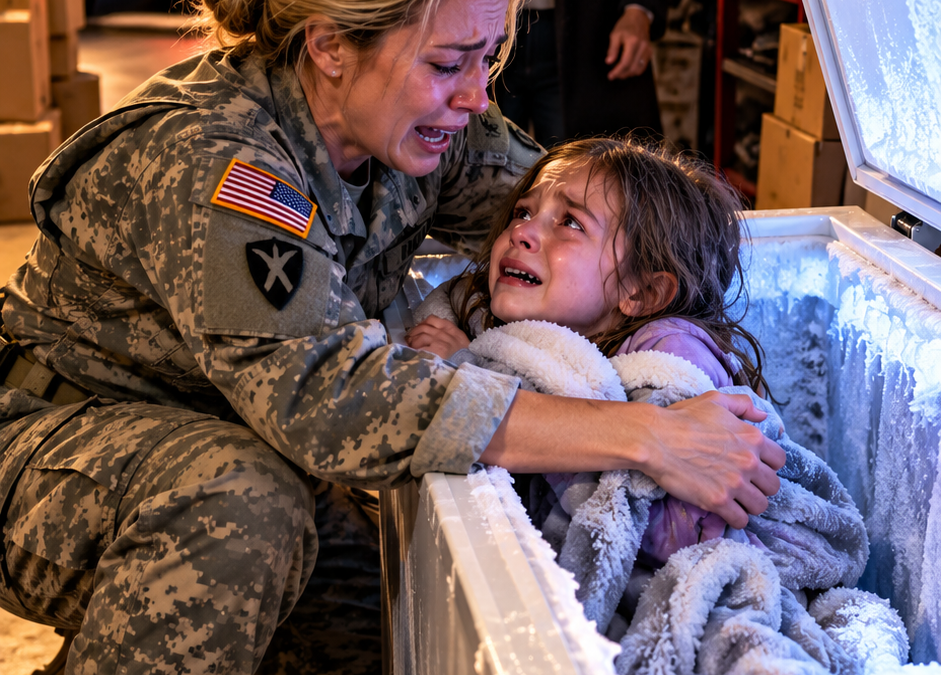
𝗙𝗨𝗟𝗟 𝗦𝗧𝗢𝗥𝗬
“I wanted to call you.”
My heart seemed to stop.
“That’s why she put you in there?”
Lily nodded.
“She said I had to learn.”
I looked over my shoulder at the freezer.
For the first time, I noticed the scratches along the inside edge of the lid.
They were small, uneven marks.
Not the kind a tool would leave.
They were close together, just where a frightened child might have clawed at the lid while trying to escape.
I turned back to Lily.
“Sweetheart, has Grandma ever done this before?”
She buried her face against my chest.
I felt her nod.
The garage seemed to tilt around me.
“How many times?”
“I don’t know.”
“More than once?”
Another nod.
“She says the cold helps me think.”
I closed my eyes.
There were moments in combat when I had felt fear so intensely that the entire world seemed to narrow to a single point.
This was different.
This was my daughter.
She had been suffering somewhere I had believed she was safe, and I hadn’t known.
I wanted to scream.
I wanted to find Evelyn.
I wanted answers that no explanation could possibly make acceptable.
But Lily was still trembling in my arms.
She needed me to be her mother, not a woman consumed by rage.
I reached for my phone and called 911.
As I gave the dispatcher the address, I pulled Lily closer and described her condition.
“My seven-year-old daughter was trapped inside a chest freezer. She’s conscious, but she’s extremely cold, and her lips are blue.”
The dispatcher asked whether she was breathing normally.
I answered her questions while rubbing Lily’s back gently through my coat.
Then she told me to move Lily into the warmer part of the house and follow her instructions while emergency responders made their way to us.
I carried my daughter toward the connecting door.
Lily immediately panicked.
“No! Mommy, no!”
“What is it?”
“Don’t go inside.”
“Why?”
“Grandma might come back.”
I stopped.
“Sweetheart, Grandma isn’t going to take you away from me.”
She stared at the garage entrance.
Then she whispered something that made my blood run cold.
“Grandma said Daddy told her it was okay.”
I looked at my daughter.
“What did Daddy say was okay?”
“Quiet time.”
I had heard that phrase before.
Evelyn had mentioned it during one of our custody exchanges.
She said Lily had become emotional since the divorce and needed more structure.
Taylor had agreed that a predictable routine would help her.
At the time, I thought they meant sitting quietly in her room or reading a book until she calmed down.
Now I was holding my freezing child beside the place where Evelyn apparently conducted her version of quiet time.
I glanced around the garage.
A tiny red light glowed above the storage shelves.
The security camera.
Taylor had installed it two years earlier.
If it was still recording, there might be evidence of what had happened tonight.
Perhaps even evidence of the previous incidents Lily had described.
I told the dispatcher about the camera.
Then headlights swept across the driveway.
Lily went rigid.
“No.”
Her arms tightened around my neck.
“Mommy, please.”
I looked toward the entrance.
A car door slammed.
Footsteps approached.
“Don’t let her take me.”
I stood, positioning myself between my daughter and the driveway.
The footsteps stopped at the edge of the garage.
For one long second, nobody moved.
Then Evelyn Bennett stepped into view.
She carried two grocery bags.
When she saw me, one slipped from her hand.
A carton of milk struck the concrete and rolled toward the workbench.
“Sarah?”
I had known Evelyn for more than a decade.
I recognized every expression she wore when she was disappointed, offended, or preparing to tell me how badly I was raising my daughter.
But the expression on her face that night was different.
Her eyes moved from me to Lily.
And something changed.
She looked frightened.
Not surprised that Lily was hurt.
Frightened that Lily was out of the freezer.
“Why is she out here?” Evelyn asked.
I stared at her.
My daughter whimpered against my shoulder.
That was the moment I understood how thoroughly Evelyn had taught Lily to fear her.
“Stay where you are,” I said.
Evelyn swallowed.
“Sarah, listen to me.”
“I’ve called an ambulance.”
She closed her eyes.
For a brief moment, her entire posture seemed to collapse.
“I wasn’t going to leave her there.”
I looked at her in disbelief.
“That is not a sentence you should ever need to say about a seven-year-old child.”
Evelyn lowered her gaze.
“I know.”
I expected her to argue.
I expected her to accuse Lily of exaggerating or tell me that I was overreacting.
Instead, she sat down on a wooden stool near the garage entrance.
“She was upset,” she said quietly.
I said nothing.
“She kept asking for you.”
Lily buried her face deeper into my shoulder.
“I thought she needed to calm down.”
“You put her in a freezer to calm down?”
Evelyn shook her head.
“No. It wasn’t supposed to—”
She stopped.
Perhaps she finally heard how monstrous the explanation sounded.
“She’s seven years old,” I said.
“I know how old she is.”
“Then explain why my daughter was screaming for help inside that thing.”
Evelyn looked toward the freezer.
Her mouth opened, but no words came out.
I had spent years arguing with this woman over nearly everything.
Now, for the first time, she seemed unable to construct a defense.
Sirens sounded in the distance.
“Sarah, please.”
“Don’t come any closer.”
She looked at Lily.
“Sweetheart, Grandma didn’t mean—”
“Don’t talk to her.”
My voice came out sharper than I intended.
Lily flinched.
I immediately lowered it.
“It’s okay, baby. I’m right here.”
Evelyn stared at me.
For a moment, I thought she might stand and approach us anyway.
Instead, she lowered her head.
When the emergency vehicles arrived, I had never been so relieved to see flashing lights.
Two paramedics entered the garage, followed by police officers.
I told them what had happened.
One paramedic gently examined Lily while the other prepared blankets and asked me questions.
How long had she been inside?
Was she conscious when I found her?
Had she been exposed to the cold before?
I couldn’t answer the first question.
I didn’t know.
I hadn’t been there.
Every unanswered question felt like an accusation.
One of the medics looked at me.
“You found her. Right now, that’s what matters.”
I nodded, but the words didn’t reach the part of me that needed them.
As they prepared to transport Lily, I pointed toward the camera above the shelves.
“That may have recorded everything.”
An officer followed my finger.
“We’ll make sure the footage is preserved.”
Evelyn remained seated on the stool.
She didn’t try to follow us.
As the paramedics carried Lily toward the ambulance, my daughter reached for my hand.
“Mommy?”
“I’m here.”
“Am I in trouble?”
I stopped walking.
For a moment, I could barely speak.
“No, sweetheart.”
“Grandma said—”
“Listen to me, Lily.”
I leaned close enough that she could see my face clearly.
“You are not in trouble. You didn’t do anything wrong. Nothing you did could ever make it okay for someone to put you in there.”
She looked at me uncertainly.
“But I cried.”
“You’re allowed to cry.”
“And I wouldn’t stop asking for you.”
“You’re always allowed to ask for me.”
Her eyes filled with tears.
“Even when Daddy says I’m supposed to stay at his house?”
I swallowed.
“Even then.”
She held my hand throughout the ride to the hospital.
Outside the ambulance windows, Colorado passed in flashes of streetlights and darkness.
I had never felt so helpless.
At the hospital, doctors examined Lily and began treating her for cold exposure.
I stood beside her bed, answering questions while she watched me through frightened eyes.
Eventually, a physician explained that she was cold, exhausted, and badly frightened, but she had been found before the exposure caused more serious consequences.
I wanted to feel relieved.
Instead, I kept thinking about what might have happened if I had waited until Friday to collect those boxes.
What if I hadn’t heard her?
What if the garage door had been closed?
What if I had decided I was too tired to drive across town?
I couldn’t stop imagining all the ways that night could have ended differently.
Lily was given warm blankets and something to drink.
When she finally stopped shivering, she asked to watch cartoons.
I turned on the television.
A show about talking dogs filled the room with cheerful music that seemed almost insulting under the circumstances.
At 11:43 p.m., my phone rang.
Taylor.
I stared at his name.
Lily noticed.
“Daddy?”
“Yes, sweetheart.”
“Are you going to answer?”
“I think I should.”
She nodded.
I stepped into the hallway, leaving the door open so she could still see me.
“What happened?” Taylor demanded before I could speak.
“Where are you?”
“Pueblo. I had a work emergency. Mom called and said the police were at the house.”
I closed my eyes.
“Lily was inside the garage freezer.”
Silence.
“What?”
“I found her inside it.”
“No.”
“Yes, Taylor.”
“No, Sarah. That doesn’t make sense.”
“Your mother admitted putting her there.”
His breathing changed.
“Is Lily okay?”
“She’s being examined.”
“I’m coming.”
“Taylor, there’s something else.”
“What?”
“Lily says this has happened before.”
He stopped speaking.
“She says your mother puts her in the freezer when she’s bad.”
“That’s impossible.”
“She showed me where she scratched the lid trying to get out.”
“Sarah—”
“She also says Evelyn told her you approved it.”
His response came immediately.
“I did not.”
I leaned against the wall.
“Then why would Lily believe that?”
“I don’t know.”
“She said you told Grandma she could give her quiet time.”
“I never told my mother to put our daughter in a freezer.”
For a moment, I wanted to believe him.
Despite our divorce, I had never believed Taylor capable of deliberately hurting Lily.
But there was a terrible distance between loving a child and protecting one.
And somewhere inside that distance, my daughter had been trapped.
“Come to the hospital,” I said.
“Of course.”
“Don’t call your mother first.”
“I won’t.”
He arrived forty-five minutes later.
His shirt was untucked, his hair disheveled, and he still wore the work boots he had apparently driven in from Pueblo.
When he saw Lily asleep through the hospital-room window, he stopped.
He didn’t go inside.
“Why are you standing here?” I asked.
His eyes never left her.
“Because I don’t know if seeing me will upset her.”
That answer surprised me.
He rubbed his face with both hands.
“Mom told me Lily had been having tantrums.”
I stared at him.
“When?”
“For the last month or so.”
“What kind of tantrums?”
“Crying after school. Refusing dinner. Asking for you.”
“And you believed her?”
“I thought Lily was struggling with the divorce.”
I folded my arms.
“What did Evelyn tell you she was doing about it?”
“Quiet time.”
The phrase made me physically sick.
“What did you think that meant?”
“Her room. Reading. Sitting somewhere until she calmed down.”
“You didn’t ask?”
He looked at me.
“No.”
One word.
No excuse.
No attempt to blame me.
For years, Taylor had defended his mother during our arguments.
He insisted she meant well.
He said she was simply old-fashioned.
He accused me of treating every disagreement like a military operation.
Now he stood in a hospital hallway, looking at our sleeping child, and finally admitted that he hadn’t asked the questions that mattered.
“I should have,” he whispered.
“Yes,” I said. “You should have.”
He nodded.
And for once, neither of us tried to win the argument.
At one in the morning, a police officer came to speak with us.
The garage camera was still functioning.
That was the good news.
The complication was that its recording system operated through an account registered to Taylor.
He immediately provided access.
“Take everything,” he told the officer.
The officer reviewed his notes.
“There appear to be several weeks of recordings available.”
Taylor frowned.
“That can’t be right.”
“Why?”
“I changed the plan after Sarah moved out. I reduced the storage to three days.”
I looked at him.
“You did?”
“We were cutting expenses.”
That sounded exactly like Taylor.
The man once canceled a movie subscription in the middle of a free trial because he objected to the principle of automatic billing.
The officer checked his information.
“According to the account history, someone upgraded the storage twelve days ago.”
Taylor stared at him.
“Who?”
“We’re looking into that.”
I watched my ex-husband’s face.
For the first time since our divorce, we were standing on the same side of a question.
And neither of us liked where it was leading.
By morning, Lily had been cleared for discharge.
Before we left, a hospital social worker named Monica Ruiz came to speak with us.
She wore a soft gray cardigan and carried a folder against her chest.
But what I noticed most was the way she spoke to Lily.
She didn’t talk over her.
She didn’t ask Taylor or me to answer questions that belonged to our daughter.
She pulled up a chair and sat where Lily could see her.
“Where would you feel comfortable staying tonight?”
Lily looked at me.
“With Mommy.”
“Okay.”
Then she glanced toward Taylor.
His face tightened, but he smiled.
“That sounds good, peanut.”
Lily studied him.
“Are you mad?”
“No.”
“You look sad.”
“I am sad.”
“Because I picked Mommy?”
He crouched several feet away from her bed.
“No, sweetheart. I’m sad because something happened to you, and I didn’t understand what was going on.”
She considered that.
Then she held out her hand.
Taylor looked at me.
I nodded.
He moved closer and gently took her fingers.
“I thought you said Grandma could do quiet time,” Lily whispered.
“I said Grandma could help you calm down.”
“That’s what she said.”
His eyes filled with tears.
“I didn’t know what she meant.”
Lily frowned.
“Why didn’t you ask?”
He bowed his head.
“I should have.”
I looked away.
Because that question belonged to me, too.
Why hadn’t I noticed that Lily had become quieter during the weeks before our divorce?
Why hadn’t I asked more questions when she started saying she didn’t like being alone with Grandma?
Why had I assumed her sudden reluctance to talk about school was simply another consequence of the changes happening in our family?
I had been trained to recognize problems before they became emergencies.
Yet my daughter had been living through something terrible, and I hadn’t recognized it.
On the way to my townhouse, Lily fell asleep in the back seat.
I carried her inside and placed her in my bed.
Then I sat at the kitchen table until sunrise.
I couldn’t bring myself to sleep.
Every time I closed my eyes, I saw the freezer.
At 7:18 a.m., Monica called.
“Sarah, there’s something you should know.”
I gripped my coffee mug.
“What is it?”
“The security account. Investigators have confirmed that Evelyn paid for the storage upgrade.”
I stared toward the bedroom.
“Evelyn?”
“Yes.”
“Why would she deliberately preserve recordings of herself?”
“That’s one of the questions investigators are trying to answer.”
After the call ended, I sat motionless.
I had assumed the camera would reveal what Evelyn had wanted hidden.
But what if she had deliberately ensured the recordings would remain?
What if there was something else happening inside that house?
At nine, Taylor arrived with a suitcase containing Lily’s clothes, her favorite stuffed rabbit, and a few books.
He left everything on the porch.
Then he knocked and waited for me to invite him inside.
It was such a small gesture.
But after years of feeling that everyone in Taylor’s family had the right to walk into my life without permission, I noticed it.
I made coffee.
We sat across from each other at the kitchen table.
“I remembered something,” he said.
“What?”
“Mom called me about two weeks ago and asked whether the cameras were still working.”
“Why?”
“She said she’d heard someone outside at night.”
“And you told her?”
“That I’d reduced the recording plan.”
I felt the pieces shifting.
“Then she upgraded it herself.”
He nodded slowly.
“Apparently.”
“Why?”
Neither of us had an answer.
Taylor reached into his jacket.
“There’s something else.”
He placed an envelope on the table.
My name was written across the front in Evelyn’s unmistakable handwriting.
“Where did you get that?”
“Mom’s attorney delivered it to mine this morning.”
I stared at the envelope.
“Have you read it?”
“No. It’s addressed to you.”
I opened it.
Inside were three pages.
Two handwritten.
One printed.
The first sentence made me stop.
Sarah,
There is no explanation that makes what I did acceptable, but there is something you need to know about why I made sure the cameras kept recording.
I looked up.
Taylor had gone very still.
I continued reading.
Evelyn wrote that nearly a year earlier, she had begun noticing changes in herself.
Small things at first.
Forgotten appointments.
Misplaced keys.
Conversations she couldn’t remember having.
She sometimes repeated the same question several times in an afternoon.
She had begun forgetting ordinary routines that had once been automatic.
At first, she blamed stress.
Then age.
Eventually, she realized she was sometimes remembering events differently from the people around her.
She had hidden the problem from everyone.
Three weeks earlier, she had visited a neurologist.
The printed document was an appointment summary.
Additional testing recommended.
Cognitive impairment suspected.
Nothing in the document established a definitive diagnosis.
But Evelyn had written another sentence beneath it.
I became afraid that I was doing things I later remembered differently. I upgraded the cameras because I no longer trusted my own memory.
My hands began to tremble.
Taylor noticed.
“What does it say?”
I handed him the pages.
He read them in silence.
When he reached the appointment summary, he covered his mouth.
For a long moment, neither of us spoke.
Then I picked up the final page.
I have asked the investigators to review everything. Do not protect me from the truth. But please understand this: if Lily says something happened, believe Lily before you believe my memory of it.
I read those words several times.
The woman who had once corrected every decision I made about raising my daughter was now admitting that she could no longer trust her own recollection.
But the letter didn’t erase what she had done.
Lily had been locked inside a freezer.
She had screamed until her voice was hoarse.
She had clawed at the lid.
Whatever Evelyn was experiencing, my daughter had paid the price.
Taylor lowered the letter.
“There’s another camera.”
I looked up.
“What?”
“The upstairs hallway.”
“So?”
“It points toward the landing outside Lily’s room.”
He paused.
Then something changed in his expression.
“Two months ago, Lily told me Mom kept coming upstairs at night and asking what day it was.”
My stomach tightened.
“What did you say?”
“I told her Grandma was probably tired.”
He looked down at the letter.
“Sarah, what if this started long before the freezer?”
I understood immediately.
Investigators had been examining the garage footage to establish what Evelyn had done.
But the other recordings might show how long she had been behaving strangely.
They might show the warning signs both Taylor and I had missed.
And somewhere in those recordings might be the answer to a question that suddenly seemed more important than anything else.
How long had Lily been trying to tell us something was wrong?
I stood up.
“We need to tell the investigators about that camera.”
Taylor nodded.
“I’ll call them.”
“Not just the camera. Everything Lily told you. Every strange thing your mother did that you dismissed.”
He looked down.
“There’s probably more than I want to admit.”
“Then start remembering.”
He didn’t argue.
Over the next several days, our lives became a series of appointments, interviews, and difficult conversations.
Investigators collected the available recordings.
Lily met with a trained child-interview specialist.
A temporary custody arrangement kept her with me while the circumstances were reviewed.
Evelyn was not permitted to have contact with her.
I had expected those measures to make Lily feel immediately safe.
They didn’t.
The first night after we brought her home, she refused to sleep in her own room.
I found her sitting on my bed with her knees tucked under her chin, clutching the stuffed rabbit Taylor had brought over.
“What’s wrong, sweetheart?”
She looked toward the bedroom door.
“Can you leave the light on?”
“Of course.”
“And the door open?”
“Absolutely.”
She hesitated.
“What if Grandma comes?”
I sat beside her.
“Grandma isn’t coming here.”
“Are you sure?”
“Yes.”
She stared down at the rabbit.
“She told me you wouldn’t believe me.”
The words struck me harder than I expected.
“Why would she tell you that?”
“She said grown-ups have important things to do.”
I felt my throat tighten.
“She said if I told you, you would get mad because I was making trouble.”
I gently took her hand.
“Lily, look at me.”
She raised her eyes.
“There is nothing more important to me than keeping you safe.”
“But you have Army things.”
“Sometimes I do.”
“And meetings.”
“Yes.”
“And Daddy said you were always busy.”
I looked at her.
Taylor and I had said things about each other during the divorce that we should never have allowed our daughter to hear.
I had thought we were protecting Lily by keeping most of our disagreements behind closed doors.
Apparently, more had reached her than I realized.
“I have responsibilities at work,” I told her. “But those responsibilities don’t make you less important. You can always tell me when something frightens you.”
She leaned against me.
“Even if Grandma says it’s a secret?”
“Especially then.”
That night, Lily slept with her hand wrapped around mine.
I barely slept at all.
The following morning, I called Taylor.
“We need to change how we talk to her.”
He sounded exhausted.
“I know.”
“No more telling her she’s fine when she says something is wrong. No more assuming she’s exaggerating.”
“Sarah, I understand.”
“Do you?”
He was quiet.
Then he said, “I’m starting to.”
I wanted to tell him that understanding wasn’t enough.
I wanted to list every warning he had ignored and every time he had defended Evelyn instead of listening to me.
But the look on Lily’s face when she asked whether her father was angry was still fresh in my mind.
Our daughter needed at least one thing to remain certain.
Both her parents loved her.
And if Taylor was willing to change his behavior, I wasn’t going to make Lily responsible for our bitterness.
Three days after the rescue, an investigator called.
The recordings were being reviewed.
He couldn’t discuss every detail while the investigation was ongoing, but he wanted to confirm several dates and ask whether Lily had mentioned anything unusual during the previous month.
I told him about her reluctance to stay with Evelyn.
Then I remembered something else.
During one of our final weeks together, before the divorce was finalized, Lily had started asking whether she could come to work with me after school.
I had assumed she wanted to spend more time with me because she knew I would soon be moving out.
One afternoon, she had asked whether seven-year-olds were allowed to stay alone at home.
I remembered laughing gently and telling her she was much too young.
Then she had asked whether being alone was still bad if a grown-up told you to do it.
At the time, I had thought she was asking about a school rule.
Now the memory made me feel physically sick.
I told the investigator.
He asked me to write down everything I remembered without discussing my recollections with Lily or trying to question her further.
When I ended the call, I sat alone in the kitchen.
The house was quiet.
Lily was drawing in the living room.
I could hear the soft scrape of colored pencils against paper.
I wanted desperately to go to her and ask exactly what had happened every time she stayed with Evelyn.
But the interviewer had explained why repeated questions could make things harder for a frightened child.
Lily had already been made to feel that she had to provide the right answers to adults.
I wasn’t going to do that to her again.
Instead, I went into the living room and sat beside her.
“What are you drawing?”
She held up the paper.
It showed a yellow house with a bright red roof.
Two stick figures stood in the yard.
One was tall.
One was small.
“That’s us,” she said.
I smiled.
“Where are we?”
“At our new house.”
I looked more closely.
There was no garage.
No freezer.
Only a tree, a swing, and a very large sun.
“That’s a beautiful house.”
She nodded seriously.
“It has no scary places.”
I pulled her into my arms.
“I like that kind of house.”
For the first time since the rescue, she laughed.
It was a small sound.
But I held on to it.
Taylor came by that afternoon.
He had asked whether he could bring Lily’s remaining school supplies and a few belongings.
I agreed.
When he arrived, she ran to him.
“Daddy!”
He dropped to one knee and opened his arms.
She hugged him tightly.
I watched his face as he held her.
He looked like a man who had been given something precious he no longer knew how to deserve.
“Hey, peanut.”
“Did you bring my purple markers?”
“All twelve.”
“And my dinosaur pajamas?”
“Those too.”
She smiled.
Then she became serious.
“Is Grandma mad at me?”
Taylor’s expression changed.
“No, sweetheart.”
“Are you sure?”
He looked toward me, then back at Lily.
“Grandma is dealing with some things right now. But nothing that happened was your fault.”
Lily considered that.
“Can she put me in quiet time again?”
“No.”
His voice was firm.
“Never again.”
She watched him for several seconds.
Then she asked, “Promise?”
He swallowed.
“I promise.”
I knew he meant it.
But I also knew that promises meant very little unless the adults responsible for making them were prepared to change their behavior.
After Lily returned to her drawing, Taylor and I stepped onto the porch.
He looked exhausted.
“I keep remembering things.”
“Like what?”
“Mom forgetting where she parked. Asking me what time Lily got out of school when she’d already picked her up hundreds of times.”
He rubbed his forehead.
“Last month, she called me because she couldn’t remember how to turn off the oven.”
I stared at him.
“You didn’t tell me that.”
“I thought she was tired.”
“Taylor.”
“I know.”
He looked down.
“I know.”
For the first time, I saw how deeply his habit of minimizing problems had shaped our marriage.
Whenever his mother behaved badly, he found a harmless explanation.
Whenever I complained, he called it a misunderstanding.
When Lily showed signs of distress, he assumed it was the divorce.
He had spent years believing that if he could find a reasonable explanation for something uncomfortable, he wouldn’t have to confront it.
Now our daughter was living with the consequences.
“I’m not going to defend what happened,” he said.
I folded my arms.
“Good.”
“But Mom needs medical help.”
“Yes.”
“And Lily needs to be safe.”
“Yes.”
He looked at me.
“I don’t know how to hold both of those things at once.”
I understood that more than I wanted to admit.
Evelyn had spent years making me feel unwelcome in my own family.
I had resented her criticism, her interference, and the way Taylor seemed incapable of challenging her.
But she was also a woman who had apparently been frightened by changes in her memory and had tried desperately to conceal them.
I could feel compassion for that fear.
I could even understand why losing her independence might have terrified her.
What I couldn’t accept was the idea that her fear should take precedence over Lily’s safety.
“You don’t have to choose between getting your mother help and protecting our daughter,” I told him.
“Then what do I do?”
“Start by telling the truth. Even when it’s uncomfortable.”
He nodded slowly.
It was the same lesson I had tried to teach him throughout our marriage.
I wished he had understood it sooner.
A week after the rescue, investigators arranged to meet with us.
Monica was present.
So was an officer who had been reviewing the recordings.
We sat in a small conference room while he explained what they had established so far.
The garage camera had captured Evelyn leading Lily toward the freezer on the night I found her.
The footage showed Lily resisting.
It showed Evelyn lifting the lid.
And it showed her placing my daughter inside.
The officer paused before continuing.
The recording also captured Lily trying to escape.
Her cries had been audible.
Her attempts to push against the lid had been visible through the slight movements of the freezer.
Then the camera showed Evelyn leaving the garage.
I stared at the table.
I had already known those things.
I had held Lily after pulling her out.
I had heard her describe what happened.
But knowing there was a recording made the reality feel somehow even more terrible.
There had been a moment when another adult could have stopped.
She could have opened the lid.
She could have let my daughter out.
Instead, she had walked away.
“How long?” I asked.
The officer looked at me.
“How long was she inside?”
He gave me the time established by the recording.
Long enough that I understood how fortunate we had been to find her conscious.
I pressed my hands together beneath the table.
Taylor leaned forward.
“Was this the first time?”
The investigator hesitated.
“No.”
I felt the room go silent.
Several earlier incidents had been identified in the available footage.
Not every recording showed the freezer.
Some showed Evelyn directing Lily into the garage after what appeared to be ordinary disagreements.
Others showed Lily emerging frightened and crying.
In two recordings, investigators had documented Evelyn placing her in the freezer.
My daughter had not been confused.
She had not exaggerated.
She had been telling the truth.
“How many times altogether?” I asked.
“We haven’t established that yet.”
I nodded.
My hands were trembling.
Taylor stared at the officer.
“She told me Lily was having tantrums.”
The officer didn’t respond.
He didn’t need to.
Taylor lowered his face into his hands.
For several moments, he sat without moving.
Then he whispered, “She was trying to tell me.”
I looked at him.
“Yes.”
His shoulders shook.
I had never seen Taylor cry that way.
Not when his father died.
Not during our divorce.
Not even in the hospital hallway after Lily was rescued.
But there, surrounded by evidence of what our daughter had endured, he finally seemed to understand that his good intentions hadn’t protected her.
The investigator continued.
The upstairs hallway camera had captured unusual incidents involving Evelyn.
On several nights, she appeared outside Lily’s bedroom looking confused.
Sometimes she opened the door, asked Lily a question, left, and returned a short time later to ask the same thing again.
On one occasion, Lily came out of her bedroom and gently guided Evelyn back downstairs.
I stared at the investigator.
“Lily helped her?”
He nodded.
According to the recording, Evelyn appeared disoriented.
Lily had taken her hand and led her toward the living room.
The officer described another recording in which Evelyn stood on the upstairs landing for several minutes, apparently unsure why she had gone there.
Lily approached her.
They spoke briefly.
Then Lily returned to her bedroom.
I remembered the child I had seen drawing a house without scary places.
She had been trying to navigate a situation no seven-year-old should have been responsible for.
The investigators could not determine Evelyn’s medical condition from the recordings.
They also couldn’t establish that her suspected impairment explained every abusive act.
Those questions would require separate medical and legal evaluations.
But one thing was now clear.
The warning signs had been visible long before the night I returned for my boxes.
And Lily had noticed them.
After the meeting, I walked outside.
The Colorado sky was painfully blue.
I stood beside my car, trying to control my breathing.
Taylor came out several minutes later.
He stopped a few feet away.
“Sarah.”
I couldn’t look at him.
“She tried to help your mother.”
“I know.”
“She was seven years old, Taylor.”
His voice broke.
“I know.”
“She was frightened, and instead of anyone helping her, she was trying to take care of Evelyn.”
He stood silently.
“How many times did she come to you?”
He looked down.
“I don’t know.”
“How many times did you tell her Grandma was just tired?”
He didn’t answer.
I turned toward him.
“I am not asking because I want to hurt you. I’m asking because Lily spent months learning that when something frightened her, the adults around her would explain it away.”
Tears ran down his face.
“You’re right.”
I had spent eleven years waiting for Taylor to acknowledge that my concerns about his mother were legitimate.
When he finally did, it brought me no satisfaction.
I only wished our daughter hadn’t been the person who forced us to confront the truth.
That evening, Lily found me sitting on the floor beside my bed.
She was wearing her dinosaur pajamas.
“Mommy?”
I quickly wiped my eyes.
“Hey, sweetheart.”
“Why are you crying?”
I considered pretending I wasn’t.
Then I remembered everything we had learned.
“I’m sad about what happened to you.”
She climbed into my lap.
“Because of the freezer?”
“Yes.”
She looked thoughtful.
“It was really cold.”
“I know.”
“I thought nobody could hear me.”
My chest tightened.
I wrapped my arms around her.
“I heard you.”
“But before that, nobody did.”
I closed my eyes.
There it was.
The truth I had been trying to avoid.
She had called for help before.
Maybe not always with screams.
Sometimes with questions.
Sometimes with silence.
Sometimes by asking to come to work with me or refusing to stay with Grandma.
I had heard the words without understanding what she was trying to tell me.
“I’m sorry, Lily.”
She leaned back.
“Why?”
“Because I wish I’d understood sooner that something was wrong.”
She touched my cheek.
“You’re here now.”
I couldn’t answer.
I simply held her.
Over the following weeks, Lily began working with a child therapist who specialized in trauma.
Her progress wasn’t simple.
There were good days when she laughed at cartoons, argued about vegetables, and complained about homework like any other seven-year-old.
Then there were nights when she woke screaming.
Sometimes she dreamed that she was trapped in the freezer again.
Other times she was afraid that Evelyn would come into her room.
She stopped wanting to wear the pink hoodie she had been wearing that night.
She became anxious when she heard certain appliances humming.
Once, while we were grocery shopping, she froze in front of a row of commercial freezers.
I saw the color drain from her face.
She grabbed my hand.
“Mommy, can we go?”
I abandoned the shopping cart.
We walked outside together.
I knelt beside her in the parking lot.
“You’re safe.”
She nodded, but her breathing was still fast.
“That one sounded like Grandma’s.”
I looked back through the store windows.
The freezer hadn’t been dangerous.
But Lily’s fear was real.
And I was beginning to understand that bringing her home had been only the beginning.
Her recovery would take more than changing where she slept.
It would take time, patience, and the steady proof that the adults in her life were finally listening.
Taylor began attending parenting sessions and cooperating with the custody review.
He also arranged for Evelyn to receive additional medical evaluations.
Through our attorneys, I learned that her doctors were investigating the memory problems she had described.
There was still no definitive explanation for all her behavior.
I didn’t want one invented simply to make the situation easier to understand.
A medical condition might explain confusion, impaired judgment, or unusual changes in behavior.
It couldn’t undo Lily’s fear.
And it didn’t remove the need for accountability.
For a while, Taylor struggled with that distinction.
One afternoon, he called after meeting with his mother’s attorney.
“She’s frightened,” he told me.
I was sitting in my office.
“Of course she is.”
“She keeps asking whether Lily hates her.”
I closed my eyes.
“That’s not Lily’s responsibility.”
“I know.”
“She doesn’t need to reassure Evelyn.”
“I know, Sarah.”
His voice sounded exhausted.
“Sometimes Mom remembers what happened. Other times she tells me she thought Lily was somewhere else entirely.”
I looked out my office window.
The parade ground stretched beneath the afternoon sun.
I had dealt with people who desperately wanted an explanation for their mistakes.
Sometimes explanations were useful.
Sometimes they were attempts to avoid responsibility.
In Evelyn’s case, I didn’t yet know where one ended and the other began.
“Taylor, whatever her doctors discover, Lily has to come first.”
“She will.”
“And don’t ask Lily to talk to your mother because you feel guilty.”
There was a pause.
“I wasn’t going to.”
“Good.”
We ended the call without arguing.
That was progress.
A month after the rescue, the custody review resulted in Lily continuing to live primarily with me while Taylor’s parenting time was arranged around her safety and emotional needs.
Evelyn was not allowed unsupervised contact with her.
Taylor agreed to those conditions.
I could tell it hurt him.
But I also saw him making choices he would once have avoided.
He stopped defending his mother’s actions.
He stopped dismissing Lily’s discomfort.
When she said she didn’t want to discuss Grandma, he respected that.
And when she asked difficult questions, he answered them honestly in language she could understand.
One afternoon, Lily returned from spending time with him and announced that they had baked cookies.
“Did you have fun?” I asked.
She nodded.
“Daddy burned the first batch.”
I laughed.
“That sounds like Daddy.”
She smiled.
“Then he said we could order pizza.”
I watched her unpack her little backpack.
For the first time since the rescue, she seemed comfortable talking about a visit without checking my expression.
I realized how much I had feared losing that ordinary happiness.
I wanted her to love her father.
I wanted her to trust him again.
But I also wanted him to understand that her trust was something he would have to earn through his actions.
The legal proceedings involving Evelyn continued separately.
The recordings, Lily’s statements, the hospital documentation, and Evelyn’s own admissions formed part of the investigation.
Her medical evaluations were considered, but they did not erase the evidence of what had happened.
I attended the hearings I needed to attend.
I answered questions.
I provided documentation.
And every time I saw photographs of that garage, I felt the same sick sensation in my stomach.
Eventually, Evelyn accepted responsibility in the legal process for the documented incidents involving Lily.
The resulting restrictions ensured that she would not be left alone with my daughter, while her medical care and living arrangements were addressed separately.
I didn’t celebrate.
There was no satisfaction in watching the grandmother of my child confront the consequences of hurting her.
I had spent too many years working around families affected by trauma to believe that suffering automatically became meaningful when someone was punished.
What mattered to me was that Lily was safe.
And that the adults responsible for what happened could no longer pretend it hadn’t happened.
Evelyn sent another letter several weeks later.
This one was addressed to Lily.
I didn’t give it to her immediately.
I discussed it with her therapist first.
The letter was short.
Evelyn said she was sorry.
She acknowledged that Lily had been frightened and hurt.
She wrote that Lily had done nothing wrong and that no child should ever be made to feel afraid of asking for her mother.
There were no excuses.
No requests for forgiveness.
No insistence that she had meant well.
For the first time since I had known her, Evelyn seemed to understand that the most important part of an apology was not whether the person offering it felt better afterward.
It was whether the person who had been hurt was allowed to feel whatever they felt.
When Lily eventually chose to hear the letter, she sat beside me on the couch.
I read it aloud.
She listened quietly.
Then she asked, “Do I have to write back?”
“No.”
“Do I have to forgive her?”
“No, sweetheart.”
She thought about that.
Then she took the letter and folded it carefully.
“Can I keep it in my drawer?”
“Of course.”
She walked into her bedroom.
When she came back, she climbed onto the couch and asked whether we could watch a movie.
I turned on her favorite cartoon.
We didn’t talk about Evelyn again that evening.
And that was okay.
For once, Lily was allowed to decide what she wanted to do with a difficult feeling.
As the months passed, our lives gradually settled into a new routine.
I remained in my townhouse near Fort Carson.
It wasn’t the beautiful home Taylor and I had bought together.
The kitchen was smaller.
The backyard was little more than a patch of grass enclosed by a wooden fence.
There were no mountain views from the living room.
But Lily loved it.
She decorated her bedroom with glow-in-the-dark stars.
We planted flowers beside the front steps.
Taylor helped assemble a small swing in the yard after Lily asked whether we could make our house look more like the one in her drawing.
One Saturday morning, I found her standing beside the swing with a piece of paper in her hand.
“Mommy, look.”
It was another drawing.
A yellow house.
A red roof.
A tree.
Two people in the yard.
But this time, there was a third figure standing beside the fence.
“Who’s that?” I asked.
“Daddy.”
I looked at her.
“Is he coming over?”
She shrugged.
“Maybe sometimes.”
I smiled.
“Maybe sometimes.”
She pointed toward the sky in the drawing.
“And that’s the biggest sun ever.”
“It certainly is.”
She looked up at me.
“Because nobody’s scared.”
I pressed my lips together.
Then I pulled her into a hug.
I knew her fears hadn’t disappeared.
She still had difficult nights.
She still attended therapy.
Some days, an ordinary sound or unexpected change could bring back memories she struggled to explain.
But she was learning that fear didn’t have to remain a secret.
She was learning that she could ask questions without being punished.
And Taylor and I were learning that being good parents required more than loving her.
We had to listen.
We had to pay attention.
We had to be willing to recognize problems even when doing so threatened the explanations we preferred to believe.
One evening, several months after the rescue, Lily and I were making dinner when she suddenly asked a question.
“Mommy, why did you come that night?”
I stopped cutting vegetables.
“What do you mean?”
“The night you found me.”
I set the knife down.
“I was picking up my boxes.”
“But Daddy told you Friday.”
“Yes.”
“Why did you come Thursday?”
I looked at her.
I had asked myself that question a hundred times.
I had considered every possible explanation.
Maybe I had been impatient to finish collecting my things.
Maybe I had sensed that something was wrong.
Maybe it had been nothing more than a decision that happened to save my daughter’s life.
I didn’t know.
“I just decided to come early, sweetheart.”
She considered that.
“Good.”
I smiled faintly.
“Very good.”
She returned to stirring the sauce.
For several minutes, we worked in comfortable silence.
Then she said, “I thought you weren’t coming.”
My hands stopped moving.
She kept looking at the pot.
“When I was inside, I kept yelling for you. But I thought maybe you couldn’t hear me because you lived somewhere else now.”
I turned off the stove.
“Lily.”
She looked up.
I knelt beside her.
“Listen to me. Your daddy and I don’t live together anymore. That will never change how much I love you.”
“I know.”
“And even when I’m not standing right beside you, you can tell me when something is wrong.”
She nodded.
Then she wrapped both arms around my neck.
“I know now.”
I held her for a long time.
I thought about the night I had driven down Aspen Ridge Lane expecting nothing more than a few boxes.
I thought about the open garage door.
The muffled screams.
The freezer lid that resisted when I tried to lift it.
The unbearable cold of Lily’s small body against my chest.
And the whispered confession that had changed everything I thought I knew about my family.
My divorce had felt like the greatest failure of my life.
For weeks, I had mourned the house, the marriage, and the future I had imagined for my daughter.
But that night taught me something I would never forget.
A house isn’t a home simply because a family lives inside it.
And a child isn’t safe simply because the adults responsible for her insist that they love her.
Safety is something we build through our actions.
Through attention.
Through honesty.
Through the willingness to believe a frightened child even when the truth is uncomfortable.
I couldn’t change what happened to Lily.
I couldn’t give her back the nights she had spent afraid.
I couldn’t erase the memory of that freezer or guarantee that she would never have another nightmare.
But I could give her something she hadn’t had when she was trapped inside it.
A voice that would be heard.
A home where she could ask for help.
And a mother who would never again mistake silence for proof that everything was fine.
That evening, after dinner, Lily asked me to sit beside her while she fell asleep.
I tucked her stuffed rabbit beneath the blanket.
She looked toward the bedroom door.
“Can you leave it open?”
“Of course.”
“And the hallway light?”
“Absolutely.”
I kissed her forehead.
“Good night, sweetheart.”
She caught my hand before I could stand.
“Mommy?”
“Yes, baby?”
“I’m glad you heard me.”
For a moment, I couldn’t speak.
Then I leaned down and kissed her again.
“So am I.”
She closed her eyes.
I stayed beside her until her breathing became slow and steady.
Outside, the Colorado night settled quietly over our little house.
There were no sirens.
No footsteps approaching the garage.
No frightened voice calling for help.
Only the soft sound of my daughter sleeping peacefully beneath her blankets.
And for the first time since that terrible Thursday night, I allowed myself to believe that we were finally beginning to come home.








