𝗙𝗨𝗟𝗟 𝗦𝗧𝗢𝗥𝗬 My Dad Said the Stray Dog Could Stay One Night—Thirteen Years Later, We Took Him to the Ocean to Say Goodbye
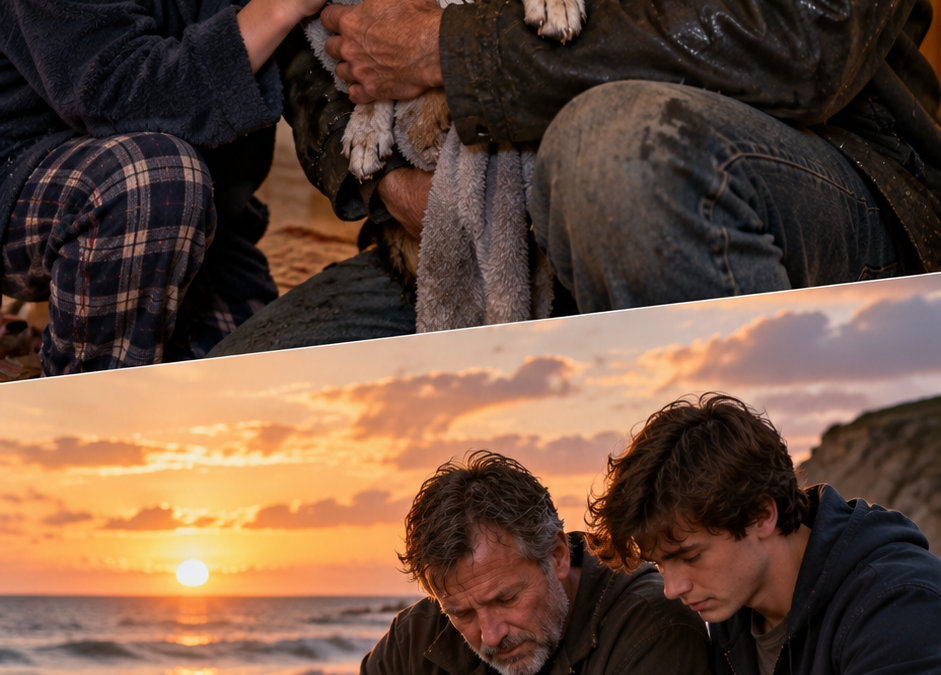
𝗣𝗔𝗥𝗧 𝟮
The dog slowly lowered his body onto the towel.
I crouched.
Dad immediately said, “Don’t touch him.”
I froze.
“Why?”
“Because we don’t know him.”
I extended my fingers but kept several feet between us.
The dog’s eyes stayed fixed on me.
“He looks sad.”
Dad rubbed his face.
“You’re supposed to be asleep.”
“Can he sleep here?”
“One night.”
I looked up.
“One night?”
“Until morning.”
My father pointed toward me.
“Then we call around. Find the owner. Shelter if we have to.”
I smiled.
“Okay.”
“Don’t smile like that.”
“Like what?”
“Like you already won.”
I hadn’t.
Not yet.
Dad found an old blanket.
He gave the dog some water.
Then he placed a little food in a bowl.
The dog did not touch it while we watched.
Dad pulled out a chair.
“Come on.”
We moved to the doorway.
The dog waited.
Then he approached the food.
Carefully.
Every few bites, he looked at us.
My father’s face changed while he watched.
I noticed it even then.
Pity was part of it.
But there was something else.
Recognition, maybe.
The dog looked like he expected everything temporary to disappear.
My father understood that feeling.
So did I.
“Does he have a name?” I asked.
“No.”
“What should we call him?”
“We don’t call him anything.”
“We have to.”
“For one night?”
“Yes.”
Dad looked at the ceiling.
I studied the dog.
“Bruno.”
“Why Bruno?”
“I don’t know.”
My father shook his head.
“Fine.”
“Hi, Bruno.”
The dog stopped eating.
He looked at me.
His tail moved.
Barely.
I gasped.
“He likes it.”
“He moved his tail one inch.”
“He likes it.”
Dad smiled.
A tiny smile.
I remember that because I had not seen many of them since Mom left.
That night Bruno was supposed to sleep in the kitchen.
Dad built him a bed out of blankets.
He turned off the light.
We went upstairs.
Ten minutes later, I heard something outside my bedroom.
I opened the door.
Bruno stood there.
“How did you get up here?”
He looked at me.
I glanced toward my father’s closed bedroom.
Then back at Bruno.
“You’re going to get me in trouble.”
His tail moved.
“Fine.”
I opened the door wider.
Bruno walked inside.
He circled twice near the foot of my bed and lay down.
I climbed under the blanket.
For several minutes, I watched him.
The storm continued outside.
Bruno lifted his head whenever thunder rolled.
“It’s okay.”
I whispered it because I wanted him to believe me.
Maybe I needed to hear it too.
“It’s okay.”
I fell asleep.
In the morning, my father found him there.
He stood in the doorway.
I woke to see him staring.
“I told you kitchen.”
“He came up.”
“Dogs don’t understand stairs by magic.”
“He figured it out.”
Dad looked at Bruno.
Bruno looked back.
Dad sighed.
“Breakfast.”
That was Day One.
The only day Bruno was officially ours temporarily.
Dad spent the morning calling shelters and veterinary clinics.
No one had reported him missing.
We drove around the area where Dad found him.
No signs.
No posters.
Dad took him to a veterinarian to check for a microchip.
Nothing.
“Another day,” Dad said.
The next day became several.
Several became a week.
Every evening I asked the same question.
“Is Bruno staying?”
Dad gave increasingly weaker answers.
“We’re still checking.”
Then:
“We’ll see.”
Then:
“Stop asking.”
By the end of the second week, Bruno had a collar.
By the end of the month, he had a dog bed in the kitchen that he never used because he slept in my room.
My father never formally announced that Bruno belonged to us.
There was no family meeting.
No decision.
One morning Dad simply bought a large bag of dog food instead of the small temporary one.
That was it.
Bruno stayed.
At first, he trusted me more than Dad.
I was smaller.
Quieter.
Less threatening.
He followed me room to room.
If I did homework at the table, Bruno slept beneath my chair.
If I watched television, he pressed against my leg.
If I went upstairs, he followed.
If I went to the bathroom and closed the door, he waited outside.
Dad joked that I had a furry bodyguard.
But Bruno watched Dad too.
Carefully.
My father had a deep voice.
Whenever he spoke loudly, Bruno flinched.
If Dad lifted an object quickly, Bruno sometimes ducked.
That told us things about his past nobody could confirm.
So Dad changed.
That may have been Bruno’s first great rescue.
My father had never been cruel.
But he was tired and impatient.
After Mom left, frustration followed him everywhere.
Cabinet stuck?
He slammed it.
Tool broke?
He cursed.
Bill too high?
He raised his voice.
Bruno reacted to every sharp sound.
Dad noticed.
Slowly, he stopped.
He began speaking more quietly.
Moving more deliberately.
When he came home from work, Bruno initially hid behind the sofa.
Dad never forced him out.
He would sit in his chair.
Take off his boots.
Then say, “Hey, Bruno.”
Nothing.
“Long day.”
Eventually Bruno’s nose appeared from behind the couch.
Dad would talk.
Not to me.
To Bruno.
“Machine broke again.”
Bruno watched.
“Boss says we lost half the afternoon.”
Another inch forward.
“Guy has never touched a machine in his life, but he knows exactly how long repairs should take.”
Bruno eventually came out.
He would sit several feet away.
Then closer.
After a few weeks, he started meeting Dad at the door.
The first time that happened, my father stood completely still.
Bruno’s tail wagged.
Dad looked at me.
“Well.”
I smiled.
“He likes you.”
Dad crouched.
“Come here.”
Bruno approached.
Dad scratched behind his ear.
That night my father talked more during dinner than he had in months.
Something was happening to our house.
We were becoming people again.
Bruno’s first ride in Dad’s car happened by accident.
Dad was leaving early on a Saturday to fix something at the warehouse.
He opened the driver’s door.
Bruno followed him into the garage.
“Back inside.”
Bruno ignored him.
Dad opened the house door.
“Go.”
Bruno sat.
“Elias.”
I appeared.
“What?”
“Get your dog.”
“He’s your dog too.”
Dad gave me a look.
“Bruno.”
I called him.
Nothing.
Then Dad opened the passenger door to grab something from the seat.
Bruno jumped in.
He sat upright.
Perfectly comfortable.
Dad stared.
Bruno stared back.
I laughed.
“You have a passenger.”
“I do not.”
Bruno’s tail wagged.
Dad looked at the clock.
Then sighed.
“Fine.”
He drove away with Bruno beside him.
That became their ritual.
Whenever possible, Bruno rode with Dad.
Trips to the hardware store.
Quick errands.
Saturday work.
Grocery runs where weather allowed him to come along.
Dad rested one hand on Bruno’s back.
Bruno watched the world through the windshield.
When I think about childhood, I picture that scene more than any birthday or holiday.
My father.
Steering wheel.
Bruno in the passenger seat.
One hand connecting them.
It became proof that Dad was not alone.
Neither was I.
At school, things were more difficult.
Children ask cruel questions because they do not yet understand how deeply answers can hurt.
“Where’s your mom?”
“Why doesn’t she come to school events?”
“Did she leave because of you?”
Most weren’t trying to destroy me.
But when you’re young, intent doesn’t matter much.
The words still land.
When I was eleven, three boys started making jokes.
One afternoon, one of them said, “Even your mom didn’t want you.”
I hit him.
I got suspended for two days.
Dad was furious when he picked me up.
“What were you thinking?”
I stared out the window.
“You can’t hit people because they say something you don’t like.”
I said nothing.
“Elias.”
Nothing.
“Talk to me.”
“Leave me alone.”
Dad stopped talking.
When we got home, I went straight to my room.
Bruno followed.
I shut the door.
Sat on the floor.
And cried.
Not quiet crying.
The kind that hurts your chest.
Bruno came over.
He pressed his body against mine.
I wrapped my arms around him.
“I hate her.”
Bruno stayed still.
“I hate Mom.”
His head rested on my shoulder.
“I hate her for leaving.”
I cried harder.
“I hate that everyone knows.”
Bruno did not offer advice.
He didn’t tell me hatred was wrong.
He didn’t explain adult relationships.
He stayed.
Later that evening, Dad opened the door.
He saw me on the floor with Bruno.
He sat beside us.
For several minutes, no one spoke.
Then Dad said, “It wasn’t your fault.”
I stared at Bruno.
“Why did she leave?”
Dad inhaled.
“I don’t know how to answer that in a way that makes sense.”
“Did she not love me?”
“No.”
He answered quickly.
“Never believe that.”
“Then why?”
Dad looked down.
“Sometimes people love you and still aren’t able to be what you need.”
That answer was imperfect.
But honest.
Bruno shifted between us.
Dad placed one hand on his back.
Then another on my shoulder.
We stayed there.
After that day, my father started trying harder to be home.
Not because he stopped needing money.
He couldn’t.
But he changed shifts when possible.
Dropped some extra work.
He began treating time as something valuable, not something available only after every bill had been paid.
I believe Bruno caused that too.
Dogs measure life differently.
They don’t care how productive you were.
They notice whether you came home.
Bruno always celebrated Dad.
Even if Dad had been gone ten hours or ten minutes, Bruno greeted him like survival itself depended on that return.
That kind of welcome changes a person.
My father began laughing again.
Real laughter.
He played with Bruno in the yard.
He bought him absurd toys he claimed were “on sale.”
He cooked extra chicken.
He became the sort of man who said he didn’t want the dog on furniture and then fell asleep with Bruno’s head in his lap.
I grew up.
Bruno remained beside us.
He saw first dates.
Arguments.
Exam failures.
Graduation.
My first job.
The day I got my driver’s license.
The first time I came home after drinking at a party and tried unsuccessfully to hide it from Dad.
Bruno betrayed me by following me around sniffing suspiciously.
“You smell like a brewery,” Dad said.
“I had one drink.”
Bruno sneezed.
Dad pointed at him.
“Even he doesn’t believe you.”
Bruno became part of every family story.
Sometimes I forgot there had been a time without him.
Then he began getting old.
At first, the signs were small.
Gray around the muzzle.
Longer naps.
Less interest in chasing squirrels.
A pause before climbing stairs.
Dad pretended not to notice.
“He’s lazy.”
“He’s twelve.”
“He’s always been lazy.”
Then Bruno stopped jumping into the passenger seat.
He would stand beside the car and wait.
Dad began lifting him.
The first time I saw it, something tightened in my stomach.
Bruno had always seemed permanent.
That is the arrogance of loving animals while you are young.
They are there every day, so you begin to assume every day will continue.
It doesn’t.
His arthritis worsened.
We gave medication.
Bought ramps.
Moved his bed downstairs.
He developed heart problems.
Then kidney issues.
Veterinary appointments became more frequent.
The doctor was kind.
That almost made it harder.
If she had been cold, we could have argued.
Instead, she told us the truth gently.
“We’re managing his comfort now.”
Dad stared at the floor.
“Not fixing him?”
The veterinarian paused.
“No.”
Dad nodded.
Bruno lay between us.
His head on Dad’s shoe.
I watched my father’s face.
The man who had survived abandonment, exhaustion, debt, loneliness, and raising a child mostly alone looked terrified.
Not of death.
Of failing Bruno.
“How do I know when?”
The veterinarian understood.
“When the difficult days become most of the days.”
Dad swallowed.
“How do I know he’s ready?”
“You may not.”
That answer hurt.
“Your job isn’t to wait for him to tell you clearly. Your job is to know him.”
Dad stared at Bruno.
“I know him.”
“Yes.”
“Better than anyone.”
“I believe you.”
For weeks afterward, Dad kept a notebook.
Good day.
Bad day.
Ate well.
Didn’t eat.
Walked to mailbox.
Too tired.
Slept comfortably.
Restless.
I hated that notebook.
It made Bruno’s decline measurable.
Then one morning, Bruno could not stand.
Dad called me.
His voice sounded wrong.
“Come home.”
I left immediately.
By the time I arrived, Bruno had managed to get up with help.
He lay on the living room rug.
Dad sat beside him.
The notebook was open.
More bad days than good.
Dad said, “He always liked the ocean.”
I looked at him.
“What?”
“Remember when we took him when you were twelve?”
I did.
Bruno had spent hours running through shallow water, barking at waves as though they were personally insulting him.
Dad looked at Bruno.
“I want to take him again.”
I understood.
“When?”
“Today.”
That became the drive.
The one I was living now.
The coast appeared beyond the windshield.
My father slowed.
Bruno breathed behind us.
We parked near a quiet section of beach.
It was late afternoon.
Few people were there.
Dad opened the back door.
“Hey, buddy.”
Bruno’s eyes opened.
Dad slid one arm beneath his chest and another beneath his back legs.
He lifted him.
Bruno had once been heavy enough that Dad complained every time he had to pick him up.
Now he seemed frighteningly light.
Dad held him against his chest.
I carried the blanket.
We walked across the sand.
The sky had turned orange near the horizon.
Waves rolled gently toward shore.
Dad stopped near the water.
He lowered himself carefully.
I spread the blanket.
But Dad kept Bruno in his arms.
Bruno opened his eyes wider.
His nose moved.
Salt air.
Water.
Memory.
“Remember this?” I whispered.
His ears shifted.
Dad said, “He remembers.”
We sat.
The waves approached.
Retreated.
Approached.
Bruno watched.
For several minutes, he seemed more awake than he had all week.
He looked toward the sea.
Then at me.
Then at my father.
Dad ran one hand over his head.
“You’ve been a good boy.”
His voice broke.
Bruno looked at him.
Then slowly lifted his muzzle.
He licked Dad’s hand.
Once.
That was all.
My father bowed his head.
I watched his shoulders shake.
Dad almost never cried in front of me.
That night he didn’t hide it.
He held Bruno close.
“Okay.”
His voice was barely audible.
“I know.”
I placed my hand on Bruno’s back.
His breathing slowed.
The sun disappeared.
The sky deepened from orange to purple.
We stayed.
No clock.
No schedule.
No one needed anything from us.
For once, Dad was not working.
I was not worrying.
Bruno was not waiting at the door.
We were together.
Exactly as we had been meant to be.
As darkness arrived, Bruno’s breathing changed.
Longer pauses.
Dad felt it.
“So this is it.”
I could not answer.
He pulled Bruno closer.
I rested my hand between Bruno’s shoulders.
“Hey, Bruno.”
His eyes were closed.
“Remember when you stole my sandwich when I was nine?”
Dad laughed through tears.
“He didn’t steal it.”
“He absolutely did.”
“You left it on the floor.”
“That is not permission.”
Bruno breathed.
I continued talking.
I told him stories from his own life.
Maybe for him.
Maybe for us.
The first storm.
The first ride.
The time he chased a squirrel into Dad’s vegetable garden and destroyed half the tomatoes.
The night he stayed beside me when I had a fever.
The way he waited outside school.
The beach.
The car.
The foot of my bed.
Thirteen years.
Bruno released one final soft breath.
Then nothing.
I waited.
My hand remained on his back.
Dad didn’t move.
“Dad?”
He knew.
We both knew.
Bruno had gone to sleep.
No struggle.
No fear.
No panic.
His body simply stopped working while the two people who loved him most held him near the ocean.
Dad kept his arms around him.
Minutes passed.
Then longer.
The beach became dark.
Stars appeared between clouds.
The moon cast pale light across the water.
Neither of us said we should leave.
The sea did not hurry us.
Eventually Dad whispered, “Thirteen years.”
“Yeah.”
“One day.”
I looked at him.
He smiled weakly.
“I said one day.”
“You were a terrible liar.”
“I believed it.”
“No, you didn’t.”
Dad looked at Bruno.
“No.”
He shook his head.
“Maybe I didn’t.”
We remained there until the cold forced us up.
Dad wrapped Bruno in the old blanket.
He carried him back to the car.
Then laid him carefully across the back seat.
I got into the passenger side.
Dad sat behind the wheel.
Neither of us started the car.
We looked at the seat beside me.
Bruno’s seat.
Dad touched the passenger headrest.
“I hate that seat.”
I looked at him.
“What?”
“It’s wrong.”
He stared at it.
“Empty.”
I moved to the back.
Dad looked surprised.
“What are you doing?”
“That’s his seat.”
I sat beside Bruno instead.
Dad nodded.
Then started the engine.
The ride home was quiet.
I watched Bruno beneath the blanket.
My mind filled with memories.
Rain.
Homework.
School.
Dad laughing.
Bruno growing gray.
Every mile felt like moving farther from a life that had ended.
When we reached home, Dad parked in the garage.
He switched off the engine.
Again, we didn’t move.
Finally he said, “I thought I saved him.”
I looked at him.
“That night.”
Dad rubbed his hands over his face.
“I saw this little thing standing in the rain. Thought, ‘Poor dog. Somebody needs to help him.’”
He laughed once.
“Arrogant.”
“What do you mean?”
Dad turned toward me.
“He saved us.”
My eyes filled.
Dad continued.
“I didn’t know what to do after your mother left.”
“I know.”
“No, you don’t.”
His voice shook.
“I was scared all the time.”
I listened.
“Scared I couldn’t pay for the house. Scared I was failing you. Scared you’d grow up hating me because I was never there.”
“Dad.”
“I thought if I just worked enough, maybe everything would hold together.”
He looked toward the back seat.
“Then Bruno came.”
I smiled through tears.
“He made you come home.”
“Yeah.”
Dad nodded.
“He made me sit down.”
He laughed softly.
“Made me talk to somebody.”
“You talked to him more than you talked to me.”
“He listened better.”
I pushed his shoulder.
Dad smiled.
Then the smile collapsed.
“I’m going to miss him.”
“Me too.”
I leaned my head against Dad’s shoulder.
For a few minutes, we sat like that.
Two adults grieving the dog who had once taught them how to be a family.
The next morning felt wrong.
No claws on the floor.
No collar tags.
No breathing from the corner.
Dad made coffee.
I sat at the kitchen table.
Neither of us had slept much.
The old food bowl was still by the wall.
Dad stared at it.
Then poured coffee.
He sat.
Long silence.
Then he said, “I think we should save another one.”
I looked up.
“What?”
“Not replace Bruno.”
“Okay.”
“Never that.”
“I know.”
Dad held the mug between both hands.
“But there’s an empty bed.”
I waited.
“Empty bowls.”
He looked toward the hallway.
“And that stupid passenger seat.”
I almost laughed.
Dad’s eyes filled.
“Bruno got thirteen years because somebody stopped in the rain.”
I nodded.
“Maybe there’s another dog waiting for somebody to stop.”
Something opened inside me.
Not happiness.
Not yet.
Possibility.
“Okay.”
Dad looked at me.
“Okay?”
“Let’s go.”
We visited the shelter that afternoon.
Part of me felt guilty.
Too soon.
As though walking among other dogs meant betraying Bruno.
Dad must have felt it too.
He stopped at the entrance.
“We can leave.”
I looked at him.
“Do you want to?”
“No.”
“Then we go in.”
The kennel corridor was loud.
Dogs barked.
Paws scratched metal doors.
Volunteers moved between rooms.
Dad walked slowly.
He stopped at every kennel.
Older dogs.
Young dogs.
Large.
Small.
Friendly.
Terrified.
None of them was Bruno.
That was the point.
We were not looking for Bruno.
Then I saw one near the end.
Small.
Thin.
Curled in the back corner.
He trembled.
Something about his eyes stopped me.
I crouched.
The dog watched.
Dad stood behind me.
“He looks familiar.”
“Yeah.”
Not physically.
Emotionally.
The same lost expression.
The same uncertainty Bruno carried that first night.
I extended my hand near the kennel.
The dog stayed still.
I waited.
Eventually he stood.
One step.
Stop.
Another.
Then he came close enough to sniff my fingers.
I did not move.
He licked my hand.
Dad made a sound behind me.
I turned.
He was crying.
“He has the same eyes,” Dad said.
I looked back at the dog.
“Yeah.”
Not Bruno’s color.
Not Bruno’s face.
Not Bruno’s body.
But the same question.
Am I safe here?
We learned his story.
Stray.
No owner.
Fearful.
Underweight.
Healthy enough to recover.
“Name?” Dad asked.
The shelter worker said, “We call him Oliver.”
Dad glanced at me.
“Olivier.”
“You’re making it French?”
“He looks sophisticated.”
The dog was trembling in a kennel.
“He looks terrified.”
“Same thing.”
I laughed.
That mattered.
We adopted him.
Not because he resembled Bruno.
Because Bruno had taught us what could happen when fear was given time.
On the drive home, Olivier sat in the back seat beside me.
His body shook.
I kept one hand against his back.
Dad drove.
For several miles, nobody spoke.
At a traffic light, Olivier stood.
He climbed awkwardly between the seats.
Then placed his front paws on the passenger seat.
Dad glanced over.
“No.”
Olivier climbed fully onto it.
He sat.
Looked at Dad.
Then at me.
Then back at Dad.
His tail moved.
Once.
Dad stopped breathing for a second.
I smiled.
“He likes the seat.”
Dad placed his hand on Olivier’s back.
“Yeah.”
His voice broke.
“I guess he does.”
We drove home.
Weeks passed.
Olivier slowly opened.
At first, he hid from sudden sounds.
Dad never rushed him.
We had learned that from Bruno.
Food came at the same time every day.
Walks were predictable.
Hands moved slowly.
Doors did not slam.
Fear was allowed.
Nobody punished it.
Eventually Olivier discovered the yard.
Then toys.
Then sunlight.
Then the foot of my bed.
The first night I found him sleeping there, I sat on the edge of the mattress and cried quietly.
Not because he was Bruno.
Because he wasn’t.
That realization finally freed me.
Love does not require repetition.
Olivier could be himself.
He did not need to inherit Bruno’s personality.
Only the space Bruno had taught us how to make.
Dad changed too.
He talked to Olivier during drives.
Not exactly like Bruno.
But enough.
“Long day.”
Olivier watched him.
“Traffic was terrible.”
Tail movement.
“Elias still doesn’t know how to park.”
I protested from the back seat.
Olivier looked at me.
“Don’t listen to him.”
Dad laughed.
The house became noisy again.
A different noise.
A new rhythm.
Bruno’s absence remained.
Some mornings Dad still looked automatically toward the old bed.
Sometimes I heard myself call “Bruno” before correcting the name.
Grief did not disappear because Olivier arrived.
It simply stopped being the only thing in the room.
That difference mattered.
One evening, Dad and I sat on the porch.
Olivier lay at our feet.
The sky was orange.
It reminded me of the beach.
“Dad?”
“Yeah?”
“When you found Bruno…”
He looked at me.
“You said one day.”
“I remember.”
“What if you hadn’t brought him home?”
Dad stared toward the road.
A long silence.
“I don’t know.”
“Really?”
“I know what probably would’ve happened to him.”
I waited.
“But us?”
His expression changed.
“I don’t know who I would’ve become.”
That surprised me.
Dad continued.
“I was angry.”
“At Mom?”
“At everything.”
He looked at his hands.
“Mostly myself.”
“Why?”
“Because I thought if I’d been better, she would’ve stayed.”
I had never heard him say that.
“You thought that?”
“Of course.”
He laughed bitterly.
“You weren’t the only one asking why.”
Olivier lifted his head.
Dad scratched his ear.
“Bruno made me stop thinking every bad thing was proof I’d failed.”
“How?”
Dad smiled.
“Dogs don’t care about your theories.”
I laughed.
“He needed food. Walks. Company. You needed breakfast. School. Somebody to come home.”
Dad looked at me.
“He made life practical again.”
I understood.
Grief can become enormous because it lives in thought.
Animals pull you back into ordinary needs.
Feed me.
Walk with me.
Sit here.
Open the door.
Come home.
Love me now.
Bruno had given Dad things to do when feelings were too complicated to understand.
He had done the same for me.
I looked at Olivier.
“So Bruno saved us.”
Dad nodded.
“Yeah.”
“And now we saved Olivier.”
Dad smiled.
“Maybe.”
Then he shook his head.
“Give him time.”
I looked at him.
“He might save us too.”
Years later, that sentence is still with me.
I understand now that rescuing an animal is rarely one-directional.
You provide food.
Shelter.
Medicine.
Safety.
But they change the architecture of your life.
They force routines into lonely mornings.
They create reasons to return home.
They witness grief without asking you to explain it.
They occupy physical space that sadness once claimed.
Bruno did that for us.
Olivier continued it.
Not as replacement.
As inheritance.
The inheritance was not Bruno’s bed.
Not the passenger seat.
Not the old blanket.
It was what Bruno had taught us about love.
Love stays.
Then love leaves.
And somehow love remains.
That lesson became clearer as I got older.
For years, I believed endings canceled what came before.
Mom left, so the family was broken.
Bruno died, so the happiness ended.
But that is not how love works.
My mother’s departure hurt, but it didn’t erase Dad.
It didn’t erase me.
Bruno’s death hurt, but it didn’t erase thirteen years.
Nothing could.
Those years had changed who we were.
Every time Dad moved gently around Olivier because he remembered how Bruno once flinched, Bruno was still shaping the world.
Every time I sat beside a frightened dog instead of forcing contact, Bruno was there.
Every time Dad decided to come home instead of taking extra work, Bruno’s lesson continued.
Love became behavior.
Memory became action.
That was Bruno’s real legacy.
Months after Olivier came home, Dad framed a photograph from our final trip to the ocean.
I hadn’t known he had taken it.
The picture showed Bruno in Dad’s arms.
The sunset behind them.
My hand resting on Bruno’s back.
None of us looking at the camera.
Dad placed it in the living room.
Next to it, he eventually placed another photograph.
Olivier sitting in the passenger seat on his first day.
I stared at both.
Dad noticed.
“Too much?”
“No.”
“It’s not weird?”
“No.”
I smiled.
“It’s right.”
One picture did not replace the other.
They belonged together.
Beginning.
Ending.
Beginning again.
Years later, I returned to that beach alone.
Dad was older.
Olivier was older too.
I walked to the same part of the sand where Bruno had taken his last breath.
The ocean looked exactly the same.
That bothered me at first.
How could something so important happen here and leave no mark?
Then I understood.
The sea didn’t need to remember.
I did.
I sat.
Listened to the waves.
I could almost see Dad holding Bruno.
The old dog lifting his head.
One final lick on Dad’s hand.
I had spent years thinking that gesture meant goodbye.
Now I think Bruno was saying something else.
I’m okay.
You’re okay.
Keep going.
Not because dogs understand death philosophically.
But because love often communicates what language cannot.
Bruno had arrived in our lives during a storm.
He left beside calm water.
There was something fitting about that.
When he came, our house was frightened.
Uncertain.
Holding its breath.
When he left, Dad and I were together.
Able to cry.
Able to speak.
Able to love again without believing new love betrayed old love.
That transformation took thirteen years.
One day, Dad called me while I was at work.
“Olivier stole my sandwich.”
I laughed.
“You left it where he could reach.”
“That is not permission.”
I stopped.
Dad stopped too.
Then we both began laughing.
It was the exact argument we had once had about Bruno.
Not identical.
Connected.
Dad finally said, “He learned from the best.”
Maybe he did.
Today, Olivier still rides beside my father.
Dad is retired now.
There is no warehouse shift.
No second job.
No rush.
Some mornings, the two of them drive simply because they can.
Coffee for Dad.
Window cracked for Olivier.
One hand on the wheel.
One hand resting on the dog beside him.
When I see them leave, I sometimes see two scenes at once.
Bruno.
Olivier.
Past.
Present.
The same gesture carrying different love.
I no longer find that sad.
It feels like continuity.
There is a difference between replacement and continuation.
A replacement asks you to forget what came before.
Continuation carries it forward.
Olivier is not Bruno.
He never will be.
That is why loving him matters.
He received his own life.
His own habits.
His own ridiculous fears.
His own favorite places.
Bruno taught us to make room.
Olivier filled that room differently.
I think about my seven-year-old self often.
That boy standing in the kitchen while rain hammered the roof.
Looking at a trembling dog wrapped in a towel.
Asking, “Can we keep him?”
I wish I could speak to him.
I would tell him:
Yes.
You keep him.
But not forever.
Nothing stays forever.
That is not the tragedy you think it is.
You get thirteen years.
You get a dog beside your bed.
A friend outside school.
A witness to your worst days.
A reason your father comes home.
A thousand car rides.
Arguments.
Laughter.
Gray fur.
Medication.
A final beach.
You get enough love to break your heart when it leaves.
And that heartbreak will be worth it.
Every bit.
I would tell him not to fear the final day so much that he misses the ordinary ones.
The ordinary ones are the story.
Bruno eating under the table.
Waiting at the door.
Snoring during television.
Stealing food.
Getting sand in the car.
Following me upstairs.
Resting under Dad’s hand.
Those things seemed small when they happened.
Now they are enormous.
Life is mostly built from moments we do not recognize as important until they become memory.
Bruno taught me that too.
My father once said he found Bruno beside the highway because he happened to be driving home late.
For years, I thought of it as luck.
Now I think about choices.
Dad could have kept driving.
He was tired.
It was raining.
He had a child waiting.
He was working two jobs.
Stopping created inconvenience.
He stopped anyway.
That one decision changed thirteen years.
Perhaps more.
Because Bruno changed Dad.
Dad changed me.
Together we changed Olivier’s life.
The effects continue.
That is how kindness works.
You rarely see its full distance.
Dad thought he was moving a wet dog out of traffic.
He was rebuilding a family.
He simply didn’t know it yet.
I once asked him why he stopped that night.
He said, “Because he looked lost.”
I laughed.
“That’s all?”
Dad shrugged.
“I knew the feeling.”
That may be the most honest thing he ever said.
Bruno and my father recognized something in each other before either knew what they could become.
Both abandoned in different ways.
Both exhausted.
Both still waiting.
Then they found companionship.
I was the child who received the result.
A father becoming present again.
A dog who loved me without asking why my mother had left.
A house becoming warm.
I owe much of the man I became to a stray dog my father intended to keep for twenty-four hours.
There is one memory I return to more than all the others.
Not Bruno’s death.
Not the shelter.
Not even the storm.
It is an ordinary morning.
I might have been fourteen.
Dad was leaving for work.
I stood at the doorway eating toast.
Bruno jumped into the passenger seat.
Dad got behind the wheel.
He started the car.
Then, before pulling away, he looked at me.
“You good?”
“Yeah.”
“School?”
“Yeah.”
“Homework?”
“Mostly.”
Dad narrowed his eyes.
“Mostly?”
“I’ll finish.”
He shook his head.
Bruno looked between us.
Dad placed his hand on Bruno’s back.
Then smiled at me.
“See you tonight.”
“Okay.”
He drove away.
At the time, it meant nothing.
Today, it means everything.
See you tonight.
The promise of return.
The promise my mother could not keep.
The promise Dad learned to keep.
Every day.
Bruno had helped teach him.
That is why the empty passenger seat hurt so much after Bruno died.
It wasn’t merely a seat.
It represented return.
Routine.
Family.
When Olivier climbed into it, he did not erase Bruno.
He restored the promise.
Someone was going with Dad.
Someone was coming home.
The rhythm continued.
That was enough.
One evening not long ago, Dad and I sat outside while Olivier slept near the steps.
Dad’s hair is almost completely white now.
He moves slower.
I notice it.
I hate noticing it.
He looked toward the dog.
“Remember the beach?”
“Every day.”
“I thought Bruno would be scared.”
“So did I.”
“He wasn’t.”
“No.”
Dad smiled.
“He looked tired.”
“He was.”
“Peaceful, though.”
I nodded.
Long silence.
Then Dad said, “When my time comes, take me there.”
I looked at him.
“Don’t say that.”
“I’m serious.”
“Dad.”
He laughed.
“Not tomorrow.”
“Good.”
“But someday.”
I looked toward the sunset.
“What do you want me to do?”
“Sit.”
“That’s it?”
“Sit.”
He looked at me.
“No speeches.”
“You know I’ll give a speech.”
“I know.”
“Long one.”
“Probably.”
Olivier lifted his head.
Dad scratched his neck.
“Maybe bring him too, if he’s still around.”
I swallowed.
“Okay.”
Dad leaned back.
“You know Bruno gave us a good ending.”
I thought about that.
“Yeah.”
“Not everybody gets one.”
No.
Not everybody does.
But Bruno did.
More importantly, he had a good life before the ending.
That matters more.
Thirteen years after one rainy night.
Thirteen years after Dad said, “One day.”
Thirteen years after a frightened dog entered our kitchen.
Bruno left this world beside the ocean, held by the same man who once picked him up beside a highway and the same boy whose bed he had guarded through childhood.
He left loved.
He left known.
He left having changed everything.
And the morning after our worst goodbye, my father made coffee and chose hope again.
That may be the bravest thing he ever taught me.
Not stopping for Bruno in the rain.
Not working two jobs.
Not raising me alone.
Choosing to love again after knowing exactly how much losing love hurts.
Olivier was not a denial of grief.
He was proof grief had not killed our ability to care.
That is why, when people ask me whether adopting another dog after Bruno felt too soon, I tell them no.
Bruno had spent thirteen years teaching us what love was for.
It would have been a strange tribute to close the door afterward.
So we opened it.
Another frightened dog walked through.
Another tail moved.
Another bed became occupied.
Another passenger seat found a companion.
Bruno’s story did not continue because Olivier became him.
It continued because Bruno had taught us what to do when we saw someone alone.
Stop.
Make room.
Bring them home.
My name is Elias.
My father once told me a stray dog could stay with us for one day.
That day lasted thirteen years.
It lasted through childhood.
Through grief.
Through school.
Through loneliness.
Through growing up.
Through thousands of mornings when Bruno sat beside my father in the car.
It lasted until a quiet evening at the edge of the sea, when Bruno licked my father’s hand once and finally allowed himself to rest.
And somehow, even then, the day did not truly end.
It became memory.
Then courage.
Then a trip to a shelter.
Then Olivier.
Then another trembling dog learning that a house could become home.
That is what Bruno left us.
Not the idea that love always wins by preventing loss.
Sometimes love cannot prevent anything.
Bodies age.
Animals die.
People leave.
Time takes what it takes.
Love wins differently.
It wins by making the years matter.
It wins by changing the people left behind.
It wins when grief becomes compassion instead of bitterness.
It wins when an empty seat becomes a reason to save another life.
It wins when a father who has lost enough still opens his heart again.
It wins when a frightened dog climbs into a car and gives one small wag of his tail.
And every morning, when my father starts the engine and Olivier settles into the passenger seat beside him, Dad still drives the same way he always has.
One hand on the wheel.
One hand resting gently on the dog next to him.
They leave together.
Quietly.
And for a second, if the light catches the windshield just right, I can almost see Bruno there too.
Not because he was replaced.
Because he was loved enough to remain.
Somewhere in the memory of rain.
In the smell of an old blanket.
In the sound of claws on a hallway floor.
In the sea.
In my father’s gentler voice.
In the way I now stop when I see an animal afraid.
In every new life we choose not to pass by.
Bruno came to us for one day.
He gave us thirteen years.
And what he taught us will last far longer than either.
Have you finished reading the story and want to read it again?
My Dad Said the Stray Dog Could Stay One Night—Thirteen Years Later, We Took Him to the Ocean to Say Goodbye
Thirteen years after my father carried a terrified stray dog into our house and promised me he would stay for only one night, we were driving that same dog toward the ocean because neither of us was ready to say goodbye anywhere else.
Bruno had spent his life sitting beside my father in the passenger seat, sleeping at the foot of my bed, and quietly holding together a family that had almost collapsed when my mother left, but now he was stretched across the back seat, too weak to lift his head when I whispered his name.
I thought the hardest part would be watching Bruno take his last breath, but what my father did the next morning showed me that some goodbyes are not endings at all—they are the place where love decides what it will become next.
My name is Elias.
I was twenty years old the day we took Bruno to the sea for the last time, but when I looked into the back seat that afternoon, I saw thirteen years of my life lying under an old gray blanket.
Bruno’s muzzle, once dark brown, had turned almost completely white.
His breathing was slow.
His ribs rose gently beneath the blanket and fell again.
He no longer raised his head when we stopped at traffic lights.
He no longer pressed his nose against the window when we passed the bakery where my father sometimes bought him plain bread.
He no longer became excited when I said his name.
But he was still breathing.
That mattered.
Each breath felt borrowed.
Each one seemed to say that he had stayed as long as he possibly could.
My father drove with both hands on the wheel.
That alone felt wrong.
For most of my childhood, one of those hands had belonged to Bruno.
Every morning before work, Bruno would climb into the passenger seat as though the car had been designed around him.
Dad would drive with his left hand and rest his right hand on Bruno’s shoulder or back.
They rarely needed words.
The two of them could spend an hour in the car together in complete silence and somehow seem to be having a conversation.
Now the passenger seat was empty.
I sat there instead.
Neither of us mentioned it.
Outside, the road stretched toward the coast.
The sky was pale blue above us, but clouds gathered far over the water.
I looked at my father’s face.
He had always looked older than other fathers when I was young.
He worked too hard.
Slept too little.
Worried about money.
Worried about me.
Then Bruno came, and over the years something softened in him.
That day, though, the lines around his eyes seemed deeper.
His jaw remained tight.
I knew if I spoke about what was going to happen, he might lose control.
So I watched the road.
Bruno breathed behind us.
And I thought about the night our family began again.
I was seven when my mother left.
For years afterward, I told people she “went away.”
Children use softer words for things they cannot explain.
She did not die.
That would have been easier to explain at school.
She simply decided she could not stay.
The adults around me used phrases like “things weren’t working” and “sometimes grown-ups change.”
None of those words meant anything to a seven-year-old.
All I understood was that my mother had been there, and then she wasn’t.
Her coffee cup disappeared from beside my father’s.
Her shoes were gone from the hallway.
Her perfume stopped lingering in the bathroom.
Her side of the closet became empty.
At first, I expected her to come back.
For months, every car pulling into the street made me look through the window.
Every knock at the door made my stomach jump.
I would imagine her standing there.
Maybe she would say she had made a mistake.
Maybe she would hug me.
Maybe the world would become normal again.
It never happened.
My father handled her departure the only way he knew how.
He worked.
Then he worked more.
He already had one full-time job at a warehouse.
After my mother left, he picked up evening maintenance work at an office building because one income was barely enough to cover the house, food, bills, and everything else.
Some mornings he left before I was fully awake.
Some nights he came home after I was already in bed.
Our neighbor, Mrs. Bell, watched me after school.
Sometimes I ate dinner at her house.
Other times Dad left food in the refrigerator with instructions written on a piece of paper.
Heat for two minutes.
Don’t forget vegetables.
Homework first.
Lock the door.
Call me if anything happens.
I knew he loved me.
I never questioned that.
But love can still feel lonely when the person loving you is always exhausted.
Our house changed.
Before Mom left, it had been noisy.
Arguments sometimes.
Laughter sometimes.
Music.
Cooking.
People moving from room to room.
Afterward, the house became a place where Dad and I recovered between shifts and school.
We were two people surviving beside each other.
I learned not to complain.
Dad learned not to ask questions he feared he did not have time to answer.
Then came the rain.
I remember that night more clearly than I remember entire years of childhood.
A storm had been moving through since afternoon.
Rain hammered the roof and ran in thick lines down my bedroom window.
I woke sometime after eleven because I heard the back door open.
Then my father’s voice.
“Easy.”
I sat up.
He was speaking softly.
My father almost never spoke softly to himself.
I climbed out of bed.
Another sound came from downstairs.
A scrape.
Then a whimper.
I moved toward the hallway.
“Dad?”
He didn’t answer immediately.
I went down the stairs.
The kitchen light was on.
My father stood near the sink wearing his work jacket.
Water dripped from his hair.
Mud covered the bottom of his pants.
And in his arms was a small dog.
The animal was soaked so completely that his fur clung to his body.
He was skinny.
His eyes were huge.
One ear bent sideways.
He trembled violently.
I stopped halfway into the kitchen.
“What is that?”
Dad looked at me.
“A problem.”
The dog looked at me too.
“Is he ours?”
“No.”
That answer came too quickly.
I walked closer.
The dog pressed against Dad’s chest.
“Where did you get him?”
“Highway.”
“You found him?”
“Almost hit him.”
My father placed the dog carefully onto an old towel on the kitchen floor.
The animal immediately crouched.
Dad stepped back.
“I saw him near the shoulder.”
He took off his jacket.
“I stopped. Thought he’d run.”
The dog watched every movement.
“He didn’t?”
“No.”
“What did he do?”
“Nothing.”
Dad’s expression shifted.
“He just stood there in the rain.”
I understood years later why that bothered my father.
At seven, I only knew the dog looked frightened.
“Can we keep him?”
Dad sighed.
“Elias.”
“Please.”
“We don’t know who owns him.”
“He doesn’t have a collar.”
“That doesn’t mean anything.”
“He likes you.”
“He’s terrified of me.”
The dog slowly lowered his body onto the towel.
I crouched.
Dad immediately said, “Don’t touch him.”
I froze.
“Why?”
“Because we don’t know him.”
I extended my fingers but kept several feet between us.
The dog’s eyes stayed fixed on me.
“He looks sad.”
Dad rubbed his face.
“You’re supposed to be asleep.”
“Can he sleep here?”
“One night.”
I looked up.
“One night?”
“Until morning.”
My father pointed toward me.
“Then we call around. Find the owner. Shelter if we have to.”
I smiled.
“Okay.”
“Don’t smile like that.”
“Like what?”
“Like you already won.”
I hadn’t.
Not yet.
Dad found an old blanket.
He gave the dog some water.
Then he placed a little food in a bowl.
The dog did not touch it while we watched.
Dad pulled out a chair.
“Come on.”
We moved to the doorway.
The dog waited.
Then he approached the food.
Carefully.
Every few bites, he looked at us.
My father’s face changed while he watched.
I noticed it even then.
Pity was part of it.
But there was something else.
Recognition, maybe.
The dog looked like he expected everything temporary to disappear.
My father understood that feeling.
So did I.
“Does he have a name?” I asked.
“No.”
“What should we call him?”
“We don’t call him anything.”
“We have to.”
“For one night?”
“Yes.”
Dad looked at the ceiling.
I studied the dog.
“Bruno.”
“Why Bruno?”
“I don’t know.”
My father shook his head.
“Fine.”
“Hi, Bruno.”
The dog stopped eating.
He looked at me.
His tail moved.
Barely.
I gasped.
“He likes it.”
“He moved his tail one inch.”
“He likes it.”
Dad smiled.
A tiny smile.
I remember that because I had not seen many of them since Mom left.
That night Bruno was supposed to sleep in the kitchen.
Dad built him a bed out of blankets.
He turned off the light.
We went upstairs.
Ten minutes later, I heard something outside my bedroom.
I opened the door.
Bruno stood there.
“How did you get up here?”
He looked at me.
I glanced toward my father’s closed bedroom.
Then back at Bruno.
“You’re going to get me in trouble.”
His tail moved.
“Fine.”
I opened the door wider.
Bruno walked inside.
He circled twice near the foot of my bed and lay down.
I climbed under the blanket.
For several minutes, I watched him.
The storm continued outside.
Bruno lifted his head whenever thunder rolled.
“It’s okay.”
I whispered it because I wanted him to believe me.
Maybe I needed to hear it too.
“It’s okay.”
I fell asleep.
In the morning, my father found him there.
He stood in the doorway.
I woke to see him staring.
“I told you kitchen.”
“He came up.”
“Dogs don’t understand stairs by magic.”
“He figured it out.”
Dad looked at Bruno.
Bruno looked back.
Dad sighed.
“Breakfast.”
That was Day One.
The only day Bruno was officially ours temporarily.
Dad spent the morning calling shelters and veterinary clinics.
No one had reported him missing.
We drove around the area where Dad found him.
No signs.
No posters.
Dad took him to a veterinarian to check for a microchip.
Nothing.
“Another day,” Dad said.
The next day became several.
Several became a week.
Every evening I asked the same question.
“Is Bruno staying?”
Dad gave increasingly weaker answers.
“We’re still checking.”
Then:
“We’ll see.”
Then:
“Stop asking.”
By the end of the second week, Bruno had a collar.
By the end of the month, he had a dog bed in the kitchen that he never used because he slept in my room.
My father never formally announced that Bruno belonged to us.
There was no family meeting.
No decision.
One morning Dad simply bought a large bag of dog food instead of the small temporary one.
That was it.
Bruno stayed.
At first, he trusted me more than Dad.
I was smaller.
Quieter.
Less threatening.
He followed me room to room.
If I did homework at the table, Bruno slept beneath my chair.
If I watched television, he pressed against my leg.
If I went upstairs, he followed.
If I went to the bathroom and closed the door, he waited outside.
Dad joked that I had a furry bodyguard.
But Bruno watched Dad too.
Carefully.
My father had a deep voice.
Whenever he spoke loudly, Bruno flinched.
If Dad lifted an object quickly, Bruno sometimes ducked.
That told us things about his past nobody could confirm.
So Dad changed.
That may have been Bruno’s first great rescue.
My father had never been cruel.
But he was tired and impatient.
After Mom left, frustration followed him everywhere.
Cabinet stuck?
He slammed it.
Tool broke?
He cursed.
Bill too high?
He raised his voice.
Bruno reacted to every sharp sound.
Dad noticed.
Slowly, he stopped.
He began speaking more quietly.
Moving more deliberately.
When he came home from work, Bruno initially hid behind the sofa.
Dad never forced him out.
He would sit in his chair.
Take off his boots.
Then say, “Hey, Bruno.”
Nothing.
“Long day.”
Eventually Bruno’s nose appeared from behind the couch.
Dad would talk.
Not to me.
To Bruno.
“Machine broke again.”
Bruno watched.
“Boss says we lost half the afternoon.”
Another inch forward.
“Guy has never touched a machine in his life, but he knows exactly how long repairs should take.”
Bruno eventually came out.
He would sit several feet away.
Then closer.
After a few weeks, he started meeting Dad at the door.
The first time that happened, my father stood completely still.
Bruno’s tail wagged.
Dad looked at me.
“Well.”
I smiled.
“He likes you.”
Dad crouched.
“Come here.”
Bruno approached.
Dad scratched behind his ear.
That night my father talked more during dinner than he had in months.
Something was happening to our house.
We were becoming people again.
Bruno’s first ride in Dad’s car happened by accident.
Dad was leaving early on a Saturday to fix something at the warehouse.
He opened the driver’s door.
Bruno followed him into the garage.
“Back inside.”
Bruno ignored him.
Dad opened the house door.
“Go.”
Bruno sat.
“Elias.”
I appeared.
“What?”
“Get your dog.”
“He’s your dog too.”
Dad gave me a look.
“Bruno.”
I called him.
Nothing.
Then Dad opened the passenger door to grab something from the seat.
Bruno jumped in.
He sat upright.
Perfectly comfortable.
Dad stared.
Bruno stared back.
I laughed.
“You have a passenger.”
“I do not.”
Bruno’s tail wagged.
Dad looked at the clock.
Then sighed.
“Fine.”
He drove away with Bruno beside him.
That became their ritual.
Whenever possible, Bruno rode with Dad.
Trips to the hardware store.
Quick errands.
Saturday work.
Grocery runs where weather allowed him to come along.
Dad rested one hand on Bruno’s back.
Bruno watched the world through the windshield.
When I think about childhood, I picture that scene more than any birthday or holiday.
My father.
Steering wheel.
Bruno in the passenger seat.
One hand connecting them.
It became proof that Dad was not alone.
Neither was I.
At school, things were more difficult.
Children ask cruel questions because they do not yet understand how deeply answers can hurt.
“Where’s your mom?”
“Why doesn’t she come to school events?”
“Did she leave because of you?”
Most weren’t trying to destroy me.
But when you’re young, intent doesn’t matter much.
The words still land.
When I was eleven, three boys started making jokes.
One afternoon, one of them said, “Even your mom didn’t want you.”
I hit him.
I got suspended for two days.
Dad was furious when he picked me up.
“What were you thinking?”
I stared out the window.
“You can’t hit people because they say something you don’t like.”
I said nothing.
“Elias.”
Nothing.
“Talk to me.”
“Leave me alone.”
Dad stopped talking.
When we got home, I went straight to my room.
Bruno followed.
I shut the door.
Sat on the floor.
And cried.
Not quiet crying.
The kind that hurts your chest.
Bruno came over.
He pressed his body against mine.
I wrapped my arms around him.
“I hate her.”
Bruno stayed still.
“I hate Mom.”
His head rested on my shoulder.
“I hate her for leaving.”
I cried harder.
“I hate that everyone knows.”
Bruno did not offer advice.
He didn’t tell me hatred was wrong.
He didn’t explain adult relationships.
He stayed.
Later that evening, Dad opened the door.
He saw me on the floor with Bruno.
He sat beside us.
For several minutes, no one spoke.
Then Dad said, “It wasn’t your fault.”
I stared at Bruno.
“Why did she leave?”
Dad inhaled.
“I don’t know how to answer that in a way that makes sense.”
“Did she not love me?”
“No.”
He answered quickly.
“Never believe that.”
“Then why?”
Dad looked down.
“Sometimes people love you and still aren’t able to be what you need.”
That answer was imperfect.
But honest.
Bruno shifted between us.
Dad placed one hand on his back.
Then another on my shoulder.
We stayed there.
After that day, my father started trying harder to be home.
Not because he stopped needing money.
He couldn’t.
But he changed shifts when possible.
Dropped some extra work.
He began treating time as something valuable, not something available only after every bill had been paid.
I believe Bruno caused that too.
Dogs measure life differently.
They don’t care how productive you were.
They notice whether you came home.
Bruno always celebrated Dad.
Even if Dad had been gone ten hours or ten minutes, Bruno greeted him like survival itself depended on that return.
That kind of welcome changes a person.
My father began laughing again.
Real laughter.
He played with Bruno in the yard.
He bought him absurd toys he claimed were “on sale.”
He cooked extra chicken.
He became the sort of man who said he didn’t want the dog on furniture and then fell asleep with Bruno’s head in his lap.
I grew up.
Bruno remained beside us.
He saw first dates.
Arguments.
Exam failures.
Graduation.
My first job.
The day I got my driver’s license.
The first time I came home after drinking at a party and tried unsuccessfully to hide it from Dad.
Bruno betrayed me by following me around sniffing suspiciously.
“You smell like a brewery,” Dad said.
“I had one drink.”
Bruno sneezed.
Dad pointed at him.
“Even he doesn’t believe you.”
Bruno became part of every family story.
Sometimes I forgot there had been a time without him.
Then he began getting old.
At first, the signs were small.
Gray around the muzzle.
Longer naps.
Less interest in chasing squirrels.
A pause before climbing stairs.
Dad pretended not to notice.
“He’s lazy.”
“He’s twelve.”
“He’s always been lazy.”
Then Bruno stopped jumping into the passenger seat.
He would stand beside the car and wait.
Dad began lifting him.
The first time I saw it, something tightened in my stomach.
Bruno had always seemed permanent.
That is the arrogance of loving animals while you are young.
They are there every day, so you begin to assume every day will continue.
It doesn’t.
His arthritis worsened.
We gave medication.
Bought ramps.
Moved his bed downstairs.
He developed heart problems.
Then kidney issues.
Veterinary appointments became more frequent.
The doctor was kind.
That almost made it harder.
If she had been cold, we could have argued.
Instead, she told us the truth gently.
“We’re managing his comfort now.”
Dad stared at the floor.
“Not fixing him?”
The veterinarian paused.
“No.”
Dad nodded.
Bruno lay between us.
His head on Dad’s shoe.
I watched my father’s face.
The man who had survived abandonment, exhaustion, debt, loneliness, and raising a child mostly alone looked terrified.
Not of death.
Of failing Bruno.
“How do I know when?”
The veterinarian understood.
“When the difficult days become most of the days.”
Dad swallowed.
“How do I know he’s ready?”
“You may not.”
That answer hurt.
“Your job isn’t to wait for him to tell you clearly. Your job is to know him.”
Dad stared at Bruno.
“I know him.”
“Yes.”
“Better than anyone.”
“I believe you.”
For weeks afterward, Dad kept a notebook.
Good day.
Bad day.
Ate well.
Didn’t eat.
Walked to mailbox.
Too tired.
Slept comfortably.
Restless.
I hated that notebook.
It made Bruno’s decline measurable.
Then one morning, Bruno could not stand.
Dad called me.
His voice sounded wrong.
“Come home.”
I left immediately.
By the time I arrived, Bruno had managed to get up with help.
He lay on the living room rug.
Dad sat beside him.
The notebook was open.
More bad days than good.
Dad said, “He always liked the ocean.”
I looked at him.
“What?”
“Remember when we took him when you were twelve?”
I did.
Bruno had spent hours running through shallow water, barking at waves as though they were personally insulting him.
Dad looked at Bruno.
“I want to take him again.”
I understood.
“When?”
“Today.”
That became the drive.
The one I was living now.
The coast appeared beyond the windshield.
My father slowed.
Bruno breathed behind us.
We parked near a quiet section of beach.
It was late afternoon.
Few people were there.
Dad opened the back door.
“Hey, buddy.”
Bruno’s eyes opened.
Dad slid one arm beneath his chest and another beneath his back legs.
He lifted him.
Bruno had once been heavy enough that Dad complained every time he had to pick him up.
Now he seemed frighteningly light.
Dad held him against his chest.
I carried the blanket.
We walked across the sand.
The sky had turned orange near the horizon.
Waves rolled gently toward shore.
Dad stopped near the water.
He lowered himself carefully.
I spread the blanket.
But Dad kept Bruno in his arms.
Bruno opened his eyes wider.
His nose moved.
Salt air.
Water.
Memory.
“Remember this?” I whispered.
His ears shifted.
Dad said, “He remembers.”
We sat.
The waves approached.
Retreated.
Approached.
Bruno watched.
For several minutes, he seemed more awake than he had all week.
He looked toward the sea.
Then at me.
Then at my father.
Dad ran one hand over his head.
“You’ve been a good boy.”
His voice broke.
Bruno looked at him.
Then slowly lifted his muzzle.
He licked Dad’s hand.
Once.
That was all.
My father bowed his head.
I watched his shoulders shake.
Dad almost never cried in front of me.
That night he didn’t hide it.
He held Bruno close.
“Okay.”
His voice was barely audible.
“I know.”
I placed my hand on Bruno’s back.
His breathing slowed.
The sun disappeared.
The sky deepened from orange to purple.
We stayed.
No clock.
No schedule.
No one needed anything from us.
For once, Dad was not working.
I was not worrying.
Bruno was not waiting at the door.
We were together.
Exactly as we had been meant to be.
As darkness arrived, Bruno’s breathing changed.
Longer pauses.
Dad felt it.
“So this is it.”
I could not answer.
He pulled Bruno closer.
I rested my hand between Bruno’s shoulders.
“Hey, Bruno.”
His eyes were closed.
“Remember when you stole my sandwich when I was nine?”
Dad laughed through tears.
“He didn’t steal it.”
“He absolutely did.”
“You left it on the floor.”
“That is not permission.”
Bruno breathed.
I continued talking.
I told him stories from his own life.
Maybe for him.
Maybe for us.
The first storm.
The first ride.
The time he chased a squirrel into Dad’s vegetable garden and destroyed half the tomatoes.
The night he stayed beside me when I had a fever.
The way he waited outside school.
The beach.
The car.
The foot of my bed.
Thirteen years.
Bruno released one final soft breath.
Then nothing.
I waited.
My hand remained on his back.
Dad didn’t move.
“Dad?”
He knew.
We both knew.
Bruno had gone to sleep.
No struggle.
No fear.
No panic.
His body simply stopped working while the two people who loved him most held him near the ocean.
Dad kept his arms around him.
Minutes passed.
Then longer.
The beach became dark.
Stars appeared between clouds.
The moon cast pale light across the water.
Neither of us said we should leave.
The sea did not hurry us.
Eventually Dad whispered, “Thirteen years.”
“Yeah.”
“One day.”
I looked at him.
He smiled weakly.
“I said one day.”
“You were a terrible liar.”
“I believed it.”
“No, you didn’t.”
Dad looked at Bruno.
“No.”
He shook his head.
“Maybe I didn’t.”
We remained there until the cold forced us up.
Dad wrapped Bruno in the old blanket.
He carried him back to the car.
Then laid him carefully across the back seat.
I got into the passenger side.
Dad sat behind the wheel.
Neither of us started the car.
We looked at the seat beside me.
Bruno’s seat.
Dad touched the passenger headrest.
“I hate that seat.”
I looked at him.
“What?”
“It’s wrong.”
He stared at it.
“Empty.”
I moved to the back.
Dad looked surprised.
“What are you doing?”
“That’s his seat.”
I sat beside Bruno instead.
Dad nodded.
Then started the engine.
The ride home was quiet.
I watched Bruno beneath the blanket.
My mind filled with memories.
Rain.
Homework.
School.
Dad laughing.
Bruno growing gray.
Every mile felt like moving farther from a life that had ended.
When we reached home, Dad parked in the garage.
He switched off the engine.
Again, we didn’t move.
Finally he said, “I thought I saved him.”
I looked at him.
“That night.”
Dad rubbed his hands over his face.
“I saw this little thing standing in the rain. Thought, ‘Poor dog. Somebody needs to help him.’”
He laughed once.
“Arrogant.”
“What do you mean?”
Dad turned toward me.
“He saved us.”
My eyes filled.
Dad continued.
“I didn’t know what to do after your mother left.”
“I know.”
“No, you don’t.”
His voice shook.
“I was scared all the time.”
I listened.
“Scared I couldn’t pay for the house. Scared I was failing you. Scared you’d grow up hating me because I was never there.”
“Dad.”
“I thought if I just worked enough, maybe everything would hold together.”
He looked toward the back seat.
“Then Bruno came.”
I smiled through tears.
“He made you come home.”
“Yeah.”
Dad nodded.
“He made me sit down.”
He laughed softly.
“Made me talk to somebody.”
“You talked to him more than you talked to me.”
“He listened better.”
I pushed his shoulder.
Dad smiled.
Then the smile collapsed.
“I’m going to miss him.”
“Me too.”
I leaned my head against Dad’s shoulder.
For a few minutes, we sat like that.
Two adults grieving the dog who had once taught them how to be a family.
The next morning felt wrong.
No claws on the floor.
No collar tags.
No breathing from the corner.
Dad made coffee.
I sat at the kitchen table.
Neither of us had slept much.
The old food bowl was still by the wall.
Dad stared at it.
Then poured coffee.
He sat.
Long silence.
Then he said, “I think we should save another one.”
I looked up.
“What?”
“Not replace Bruno.”
“Okay.”
“Never that.”
“I know.”
Dad held the mug between both hands.
“But there’s an empty bed.”
I waited.
“Empty bowls.”
He looked toward the hallway.
“And that stupid passenger seat.”
I almost laughed.
Dad’s eyes filled.
“Bruno got thirteen years because somebody stopped in the rain.”
I nodded.
“Maybe there’s another dog waiting for somebody to stop.”
Something opened inside me.
Not happiness.
Not yet.
Possibility.
“Okay.”
Dad looked at me.
“Okay?”
“Let’s go.”
We visited the shelter that afternoon.
Part of me felt guilty.
Too soon.
As though walking among other dogs meant betraying Bruno.
Dad must have felt it too.
He stopped at the entrance.
“We can leave.”
I looked at him.
“Do you want to?”
“No.”
“Then we go in.”
The kennel corridor was loud.
Dogs barked.
Paws scratched metal doors.
Volunteers moved between rooms.
Dad walked slowly.
He stopped at every kennel.
Older dogs.
Young dogs.
Large.
Small.
Friendly.
Terrified.
None of them was Bruno.
That was the point.
We were not looking for Bruno.
Then I saw one near the end.
Small.
Thin.
Curled in the back corner.
He trembled.
Something about his eyes stopped me.
I crouched.
The dog watched.
Dad stood behind me.
“He looks familiar.”
“Yeah.”
Not physically.
Emotionally.
The same lost expression.
The same uncertainty Bruno carried that first night.
I extended my hand near the kennel.
The dog stayed still.
I waited.
Eventually he stood.
One step.
Stop.
Another.
Then he came close enough to sniff my fingers.
I did not move.
He licked my hand.
Dad made a sound behind me.
I turned.
He was crying.
“He has the same eyes,” Dad said.
I looked back at the dog.
“Yeah.”
Not Bruno’s color.
Not Bruno’s face.
Not Bruno’s body.
But the same question.
Am I safe here?
We learned his story.
Stray.
No owner.
Fearful.
Underweight.
Healthy enough to recover.
“Name?” Dad asked.
The shelter worker said, “We call him Oliver.”
Dad glanced at me.
“Olivier.”
“You’re making it French?”
“He looks sophisticated.”
The dog was trembling in a kennel.
“He looks terrified.”
“Same thing.”
I laughed.
That mattered.
We adopted him.
Not because he resembled Bruno.
Because Bruno had taught us what could happen when fear was given time.
On the drive home, Olivier sat in the back seat beside me.
His body shook.
I kept one hand against his back.
Dad drove.
For several miles, nobody spoke.
At a traffic light, Olivier stood.
He climbed awkwardly between the seats.
Then placed his front paws on the passenger seat.
Dad glanced over.
“No.”
Olivier climbed fully onto it.
He sat.
Looked at Dad.
Then at me.
Then back at Dad.
His tail moved.
Once.
Dad stopped breathing for a second.
I smiled.
“He likes the seat.”
Dad placed his hand on Olivier’s back.
“Yeah.”
His voice broke.
“I guess he does.”
We drove home.
Weeks passed.
Olivier slowly opened.
At first, he hid from sudden sounds.
Dad never rushed him.
We had learned that from Bruno.
Food came at the same time every day.
Walks were predictable.
Hands moved slowly.
Doors did not slam.
Fear was allowed.
Nobody punished it.
Eventually Olivier discovered the yard.
Then toys.
Then sunlight.
Then the foot of my bed.
The first night I found him sleeping there, I sat on the edge of the mattress and cried quietly.
Not because he was Bruno.
Because he wasn’t.
That realization finally freed me.
Love does not require repetition.
Olivier could be himself.
He did not need to inherit Bruno’s personality.
Only the space Bruno had taught us how to make.
Dad changed too.
He talked to Olivier during drives.
Not exactly like Bruno.
But enough.
“Long day.”
Olivier watched him.
“Traffic was terrible.”
Tail movement.
“Elias still doesn’t know how to park.”
I protested from the back seat.
Olivier looked at me.
“Don’t listen to him.”
Dad laughed.
The house became noisy again.
A different noise.
A new rhythm.
Bruno’s absence remained.
Some mornings Dad still looked automatically toward the old bed.
Sometimes I heard myself call “Bruno” before correcting the name.
Grief did not disappear because Olivier arrived.
It simply stopped being the only thing in the room.
That difference mattered.
One evening, Dad and I sat on the porch.
Olivier lay at our feet.
The sky was orange.
It reminded me of the beach.
“Dad?”
“Yeah?”
“When you found Bruno…”
He looked at me.
“You said one day.”
“I remember.”
“What if you hadn’t brought him home?”
Dad stared toward the road.
A long silence.
“I don’t know.”
“Really?”
“I know what probably would’ve happened to him.”
I waited.
“But us?”
His expression changed.
“I don’t know who I would’ve become.”
That surprised me.
Dad continued.
“I was angry.”
“At Mom?”
“At everything.”
He looked at his hands.
“Mostly myself.”
“Why?”
“Because I thought if I’d been better, she would’ve stayed.”
I had never heard him say that.
“You thought that?”
“Of course.”
He laughed bitterly.
“You weren’t the only one asking why.”
Olivier lifted his head.
Dad scratched his ear.
“Bruno made me stop thinking every bad thing was proof I’d failed.”
“How?”
Dad smiled.
“Dogs don’t care about your theories.”
I laughed.
“He needed food. Walks. Company. You needed breakfast. School. Somebody to come home.”
Dad looked at me.
“He made life practical again.”
I understood.
Grief can become enormous because it lives in thought.
Animals pull you back into ordinary needs.
Feed me.
Walk with me.
Sit here.
Open the door.
Come home.
Love me now.
Bruno had given Dad things to do when feelings were too complicated to understand.
He had done the same for me.
I looked at Olivier.
“So Bruno saved us.”
Dad nodded.
“Yeah.”
“And now we saved Olivier.”
Dad smiled.
“Maybe.”
Then he shook his head.
“Give him time.”
I looked at him.
“He might save us too.”
Years later, that sentence is still with me.
I understand now that rescuing an animal is rarely one-directional.
You provide food.
Shelter.
Medicine.
Safety.
But they change the architecture of your life.
They force routines into lonely mornings.
They create reasons to return home.
They witness grief without asking you to explain it.
They occupy physical space that sadness once claimed.
Bruno did that for us.
Olivier continued it.
Not as replacement.
As inheritance.
The inheritance was not Bruno’s bed.
Not the passenger seat.
Not the old blanket.
It was what Bruno had taught us about love.
Love stays.
Then love leaves.
And somehow love remains.
That lesson became clearer as I got older.
For years, I believed endings canceled what came before.
Mom left, so the family was broken.
Bruno died, so the happiness ended.
But that is not how love works.
My mother’s departure hurt, but it didn’t erase Dad.
It didn’t erase me.
Bruno’s death hurt, but it didn’t erase thirteen years.
Nothing could.
Those years had changed who we were.
Every time Dad moved gently around Olivier because he remembered how Bruno once flinched, Bruno was still shaping the world.
Every time I sat beside a frightened dog instead of forcing contact, Bruno was there.
Every time Dad decided to come home instead of taking extra work, Bruno’s lesson continued.
Love became behavior.
Memory became action.
That was Bruno’s real legacy.
Months after Olivier came home, Dad framed a photograph from our final trip to the ocean.
I hadn’t known he had taken it.
The picture showed Bruno in Dad’s arms.
The sunset behind them.
My hand resting on Bruno’s back.
None of us looking at the camera.
Dad placed it in the living room.
Next to it, he eventually placed another photograph.
Olivier sitting in the passenger seat on his first day.
I stared at both.
Dad noticed.
“Too much?”
“No.”
“It’s not weird?”
“No.”
I smiled.
“It’s right.”
One picture did not replace the other.
They belonged together.
Beginning.
Ending.
Beginning again.
Years later, I returned to that beach alone.
Dad was older.
Olivier was older too.
I walked to the same part of the sand where Bruno had taken his last breath.
The ocean looked exactly the same.
That bothered me at first.
How could something so important happen here and leave no mark?
Then I understood.
The sea didn’t need to remember.
I did.
I sat.
Listened to the waves.
I could almost see Dad holding Bruno.
The old dog lifting his head.
One final lick on Dad’s hand.
I had spent years thinking that gesture meant goodbye.
Now I think Bruno was saying something else.
I’m okay.
You’re okay.
Keep going.
Not because dogs understand death philosophically.
But because love often communicates what language cannot.
Bruno had arrived in our lives during a storm.
He left beside calm water.
There was something fitting about that.
When he came, our house was frightened.
Uncertain.
Holding its breath.
When he left, Dad and I were together.
Able to cry.
Able to speak.
Able to love again without believing new love betrayed old love.
That transformation took thirteen years.
One day, Dad called me while I was at work.
“Olivier stole my sandwich.”
I laughed.
“You left it where he could reach.”
“That is not permission.”
I stopped.
Dad stopped too.
Then we both began laughing.
It was the exact argument we had once had about Bruno.
Not identical.
Connected.
Dad finally said, “He learned from the best.”
Maybe he did.
Today, Olivier still rides beside my father.
Dad is retired now.
There is no warehouse shift.
No second job.
No rush.
Some mornings, the two of them drive simply because they can.
Coffee for Dad.
Window cracked for Olivier.
One hand on the wheel.
One hand resting on the dog beside him.
When I see them leave, I sometimes see two scenes at once.
Bruno.
Olivier.
Past.
Present.
The same gesture carrying different love.
I no longer find that sad.
It feels like continuity.
There is a difference between replacement and continuation.
A replacement asks you to forget what came before.
Continuation carries it forward.
Olivier is not Bruno.
He never will be.
That is why loving him matters.
He received his own life.
His own habits.
His own ridiculous fears.
His own favorite places.
Bruno taught us to make room.
Olivier filled that room differently.
I think about my seven-year-old self often.
That boy standing in the kitchen while rain hammered the roof.
Looking at a trembling dog wrapped in a towel.
Asking, “Can we keep him?”
I wish I could speak to him.
I would tell him:
Yes.
You keep him.
But not forever.
Nothing stays forever.
That is not the tragedy you think it is.
You get thirteen years.
You get a dog beside your bed.
A friend outside school.
A witness to your worst days.
A reason your father comes home.
A thousand car rides.
Arguments.
Laughter.
Gray fur.
Medication.
A final beach.
You get enough love to break your heart when it leaves.
And that heartbreak will be worth it.
Every bit.
I would tell him not to fear the final day so much that he misses the ordinary ones.
The ordinary ones are the story.
Bruno eating under the table.
Waiting at the door.
Snoring during television.
Stealing food.
Getting sand in the car.
Following me upstairs.
Resting under Dad’s hand.
Those things seemed small when they happened.
Now they are enormous.
Life is mostly built from moments we do not recognize as important until they become memory.
Bruno taught me that too.
My father once said he found Bruno beside the highway because he happened to be driving home late.
For years, I thought of it as luck.
Now I think about choices.
Dad could have kept driving.
He was tired.
It was raining.
He had a child waiting.
He was working two jobs.
Stopping created inconvenience.
He stopped anyway.
That one decision changed thirteen years.
Perhaps more.
Because Bruno changed Dad.
Dad changed me.
Together we changed Olivier’s life.
The effects continue.
That is how kindness works.
You rarely see its full distance.
Dad thought he was moving a wet dog out of traffic.
He was rebuilding a family.
He simply didn’t know it yet.
I once asked him why he stopped that night.
He said, “Because he looked lost.”
I laughed.
“That’s all?”
Dad shrugged.
“I knew the feeling.”
That may be the most honest thing he ever said.
Bruno and my father recognized something in each other before either knew what they could become.
Both abandoned in different ways.
Both exhausted.
Both still waiting.
Then they found companionship.
I was the child who received the result.
A father becoming present again.
A dog who loved me without asking why my mother had left.
A house becoming warm.
I owe much of the man I became to a stray dog my father intended to keep for twenty-four hours.
There is one memory I return to more than all the others.
Not Bruno’s death.
Not the shelter.
Not even the storm.
It is an ordinary morning.
I might have been fourteen.
Dad was leaving for work.
I stood at the doorway eating toast.
Bruno jumped into the passenger seat.
Dad got behind the wheel.
He started the car.
Then, before pulling away, he looked at me.
“You good?”
“Yeah.”
“School?”
“Yeah.”
“Homework?”
“Mostly.”
Dad narrowed his eyes.
“Mostly?”
“I’ll finish.”
He shook his head.
Bruno looked between us.
Dad placed his hand on Bruno’s back.
Then smiled at me.
“See you tonight.”
“Okay.”
He drove away.
At the time, it meant nothing.
Today, it means everything.
See you tonight.
The promise of return.
The promise my mother could not keep.
The promise Dad learned to keep.
Every day.
Bruno had helped teach him.
That is why the empty passenger seat hurt so much after Bruno died.
It wasn’t merely a seat.
It represented return.
Routine.
Family.
When Olivier climbed into it, he did not erase Bruno.
He restored the promise.
Someone was going with Dad.
Someone was coming home.
The rhythm continued.
That was enough.
One evening not long ago, Dad and I sat outside while Olivier slept near the steps.
Dad’s hair is almost completely white now.
He moves slower.
I notice it.
I hate noticing it.
He looked toward the dog.
“Remember the beach?”
“Every day.”
“I thought Bruno would be scared.”
“So did I.”
“He wasn’t.”
“No.”
Dad smiled.
“He looked tired.”
“He was.”
“Peaceful, though.”
I nodded.
Long silence.
Then Dad said, “When my time comes, take me there.”
I looked at him.
“Don’t say that.”
“I’m serious.”
“Dad.”
He laughed.
“Not tomorrow.”
“Good.”
“But someday.”
I looked toward the sunset.
“What do you want me to do?”
“Sit.”
“That’s it?”
“Sit.”
He looked at me.
“No speeches.”
“You know I’ll give a speech.”
“I know.”
“Long one.”
“Probably.”
Olivier lifted his head.
Dad scratched his neck.
“Maybe bring him too, if he’s still around.”
I swallowed.
“Okay.”
Dad leaned back.
“You know Bruno gave us a good ending.”
I thought about that.
“Yeah.”
“Not everybody gets one.”
No.
Not everybody does.
But Bruno did.
More importantly, he had a good life before the ending.
That matters more.
Thirteen years after one rainy night.
Thirteen years after Dad said, “One day.”
Thirteen years after a frightened dog entered our kitchen.
Bruno left this world beside the ocean, held by the same man who once picked him up beside a highway and the same boy whose bed he had guarded through childhood.
He left loved.
He left known.
He left having changed everything.
And the morning after our worst goodbye, my father made coffee and chose hope again.
That may be the bravest thing he ever taught me.
Not stopping for Bruno in the rain.
Not working two jobs.
Not raising me alone.
Choosing to love again after knowing exactly how much losing love hurts.
Olivier was not a denial of grief.
He was proof grief had not killed our ability to care.
That is why, when people ask me whether adopting another dog after Bruno felt too soon, I tell them no.
Bruno had spent thirteen years teaching us what love was for.
It would have been a strange tribute to close the door afterward.
So we opened it.
Another frightened dog walked through.
Another tail moved.
Another bed became occupied.
Another passenger seat found a companion.
Bruno’s story did not continue because Olivier became him.
It continued because Bruno had taught us what to do when we saw someone alone.
Stop.
Make room.
Bring them home.
My name is Elias.
My father once told me a stray dog could stay with us for one day.
That day lasted thirteen years.
It lasted through childhood.
Through grief.
Through school.
Through loneliness.
Through growing up.
Through thousands of mornings when Bruno sat beside my father in the car.
It lasted until a quiet evening at the edge of the sea, when Bruno licked my father’s hand once and finally allowed himself to rest.
And somehow, even then, the day did not truly end.
It became memory.
Then courage.
Then a trip to a shelter.
Then Olivier.
Then another trembling dog learning that a house could become home.
That is what Bruno left us.
Not the idea that love always wins by preventing loss.
Sometimes love cannot prevent anything.
Bodies age.
Animals die.
People leave.
Time takes what it takes.
Love wins differently.
It wins by making the years matter.
It wins by changing the people left behind.
It wins when grief becomes compassion instead of bitterness.
It wins when an empty seat becomes a reason to save another life.
It wins when a father who has lost enough still opens his heart again.
It wins when a frightened dog climbs into a car and gives one small wag of his tail.
And every morning, when my father starts the engine and Olivier settles into the passenger seat beside him, Dad still drives the same way he always has.
One hand on the wheel.
One hand resting gently on the dog next to him.
They leave together.
Quietly.
And for a second, if the light catches the windshield just right, I can almost see Bruno there too.
Not because he was replaced.
Because he was loved enough to remain.
Somewhere in the memory of rain.
In the smell of an old blanket.
In the sound of claws on a hallway floor.
In the sea.
In my father’s gentler voice.
In the way I now stop when I see an animal afraid.
In every new life we choose not to pass by.
Bruno came to us for one day.
He gave us thirteen years.
And what he taught us will last far longer than either.








