𝗙𝗨𝗟𝗟 𝗦𝗧𝗢𝗥𝗬 My Credentials Lay at the Officer’s Feet When the Garage Gates Began to Open
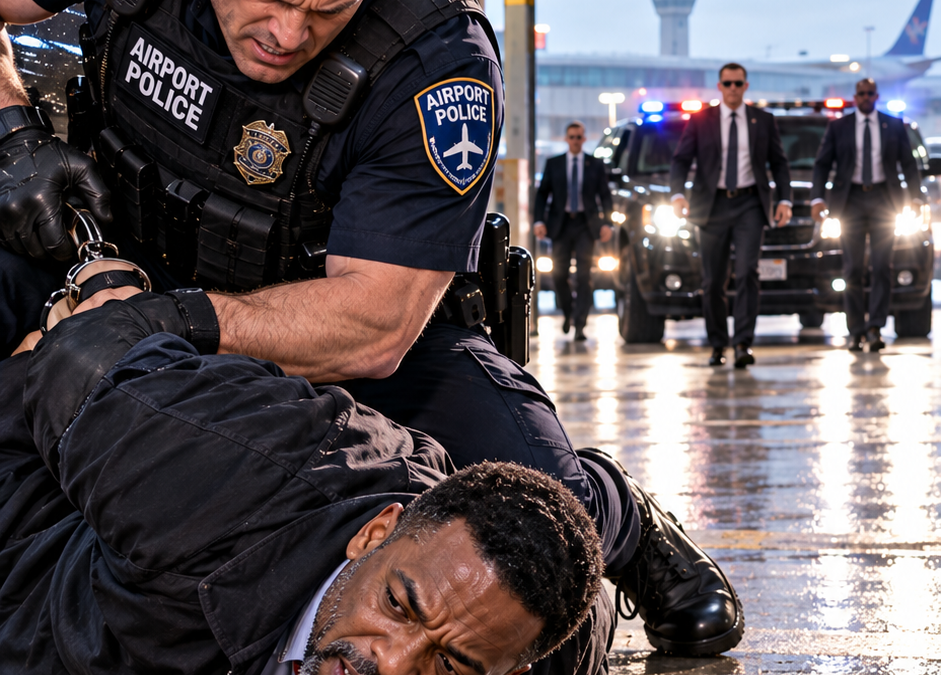
𝗙𝗨𝗟𝗟 𝗦𝗧𝗢𝗥𝗬
He was heavily built, with close-cropped brown hair, a square jaw, and pale blue eyes that rarely seemed to soften.
Years earlier, he’d experienced an incident involving a suspect who escaped through a terminal during what had initially appeared to be an ordinary encounter.
According to the subsequent review, that experience had influenced his approach to uncertain situations.
He had become particularly sensitive to anything that resembled a concealed weapon or an attempt to evade police attention.
I didn’t know his history when he approached me.
All I saw was a uniformed officer changing direction and walking quickly toward my vehicle.
His body camera was recording.
“Sir! Step away from the SUV!”
I turned toward him.
I wasn’t surprised that he’d noticed my equipment.
Armed federal personnel operating near airports can attract attention when local coordination isn’t immediately apparent to every officer working the area.
There are straightforward procedures for resolving that kind of encounter.
I intended to follow them.
I moved away from the open driver’s door and kept both hands visible.
“Of course, Officer.”
His eyes moved toward the front of my coat.
“Keep your hands where I can see them.”
“They’re visible.”
“Don’t reach toward that jacket again.”
“I won’t.”
He continued advancing.
“What are you carrying?”
I kept my voice calm.
“I’m a federal law enforcement officer. My credentials are inside my left breast pocket. My weapon is secured in a retention holster.”
His expression hardened.
“Don’t tell me what to check.”
“I’m not asking you to let me reach for anything. Your partner can retrieve the credentials while I keep my hands visible.”
He looked irritated.
“You’ve got a concealed weapon in an airport garage, and you’re going to stand there telling me how to do my job?”
“No, Officer. I’m offering a safe way to verify my authorization.”
I had spent enough years around armed encounters to recognize the importance of avoiding unnecessary movement.
I had no intention of reaching toward either my weapon or my identification while Mason was already concerned about what I might be carrying.
All I wanted was for him to keep his distance, control the encounter, and use the information I was offering.
Instead, he moved closer.
Another airport police officer appeared from a neighboring parking row.
He was younger, with short black hair and the alert expression of somebody still accustomed to asking questions before deciding he knew the answer.
His name was Eli Parker.
He was twenty-nine and had three years of airport patrol experience.
He immediately looked at my hands.
Then at my coat.
Then at the restricted parking permit displayed in the Suburban’s windshield.
“What’s going on?” he asked.
Mason gestured toward me.
“Armed subject. Possible unauthorized weapon.”
I kept my palms visible.
“Officer, my credentials are in my breast pocket. I’ve offered to let you retrieve them.”
Parker looked at me.
Then at Mason.
“Have we checked identification?”
“Not yet,” Mason snapped.
Parker took a step forward.
“I can retrieve it.”
Mason raised one hand sharply.
“Hold your position.”
Parker stopped.
For a moment, the three of us stood beneath the fluorescent lights with the situation balanced at a point where it could still have ended quietly.
My hands were empty.
My weapon remained locked in its holster.
My identification was accessible.
My vehicle carried the proper authorization.
And there were two officers present, which made a controlled verification entirely practical.
I thought we would resolve the issue within a minute or two.
Then Mason stepped directly into my personal space.
“Turn around.”
I looked at him.
“Officer, I’m cooperating. My identification—”
“I gave you an instruction.”
I felt my pulse increase.
Not because I was preparing to resist.
Because I could see him abandoning the simplest way to establish what was happening.
I turned carefully.
“All right.”
He moved closer to the driver’s door.
Then he grabbed it and pulled it fully open.
The sudden movement made the vehicle shake.
A woman walking through the neighboring row stopped beside a concrete pillar.
She was dragging a suitcase and carrying a business bag.
I later learned her name was Teresa Walsh, a fifty-four-year-old accountant traveling through Denver on business.
She looked toward us, clearly startled.
Several parking spaces away, a rideshare driver named Carlos Mendoza lowered his window.
He’d been waiting for a passenger when he noticed Mason approaching me.
Now he reached for his phone.
I saw the movement from the corner of my eye.
I didn’t want anybody interfering.
A civilian stepping into the encounter could easily make an already tense situation more dangerous.
But I was grateful that somebody was documenting what was happening.
Mason caught my upper arm.
His grip was hard.
“Move!”
I followed the direction of the pressure rather than resisting it.
He pulled me sharply away from the open driver’s doorway.
Then he turned me toward the side of the Suburban.
My chest struck the vehicle’s body panel.
The impact knocked the breath out of me.
Before I could adjust my footing, he twisted one arm behind my back.
Pain shot through my shoulder.
I clenched my jaw.
“I’m not resisting.”
“Then stop talking.”
“My hands are visible. My weapon is secured.”
He pressed me harder against the vehicle.
I stared at the dark reflection in the tinted window.
I could see part of his face behind me.
His shoulders were tight.
His attention seemed fixed on controlling my body rather than processing the information I was providing.
Years of tactical training told me exactly what could happen if I reacted the wrong way.
If I turned suddenly, he might interpret it as an attempt to attack.
If I pulled my arm forward to relieve the pressure, he might decide I was resisting.
If I reached toward my credentials, he might believe I was reaching for another weapon.
My safest option was to remain as still as possible.
“Officer,” I said, carefully controlling my breathing, “you can retrieve the credential without me moving.”
“Quiet.”
Parker stepped closer.
I saw his face reflected in the Suburban’s window.
He looked concerned.
My weapon was still secured inside its holster.
Mason found it beneath my coat.
He worked the locking mechanism and removed the handgun.
Then he stepped backward with the weapon controlled away from my body.
I didn’t move.
“That’s my issued duty weapon,” I said.
Mason gave a short, humorless laugh.
“That’s what they all say.”
Parker studied the empty holster.
It wasn’t a cheap accessory or an improvised way to conceal a firearm.
It was professional equipment designed to retain the weapon securely until deliberately released.
I could almost see him assembling the details.
The holster.
The permit.
My controlled movements.
My willingness to let him retrieve identification.
None of those details independently proved who I was.
But together, they should have made immediate verification the obvious next step.
Instead, Mason placed the recovered handgun on the hood of his cruiser and turned back toward me.
His hand moved toward his handcuffs.
For the first time, I felt genuine alarm.
I wasn’t afraid of being handcuffed.
I’d spent too many years working around law enforcement to regard handcuffs themselves as an unbearable humiliation.
I was afraid of what this delay could do to the operation.
My secure phone was inside my coat.
The convoy was approaching.
A protected federal witness was about to enter the same parking level where Mason had just created a highly visible disturbance.
If the convoy arrived while officers were still treating me as an unidentified armed suspect, the situation could become dangerous for everyone.
I needed to prevent that.
But I couldn’t explain the operational details in front of nearby travelers.
I couldn’t announce that a protected witness was about to arrive.
I couldn’t identify the vehicles involved.
And I couldn’t simply reach for my secure phone without risking another physical confrontation.
So I tried again.
“Officer, please have your partner open my credential wallet.”
Mason tightened his grip.
“Stop giving instructions.”
“I’m trying to help you resolve this safely.”
“Give me one more instruction, and I’ll treat that attitude as resistance.”
I closed my mouth.
There are moments when the safest available decision is not to win an argument.
It’s to remain alive long enough for somebody else to recognize that the argument never needed to happen.
Parker moved toward my coat.
“Let me check his identification.”
Mason stopped him.
“Help me secure him first.”
I shifted slightly under the pressure of Mason’s hold.
The movement allowed the credential wallet inside my breast pocket to slide several inches outward.
It fell to the concrete near Parker’s boots.
He immediately crouched and picked it up.
Relief moved through me.
Finally.
The answer was literally in his hands.
Parker began opening the leather cover.
Then Mason reached across and knocked his hand downward.
“Not yet.”
Parker froze.
The wallet remained closed.
For a moment, he looked as surprised as I felt.
“He’s secured,” Parker said. “We can verify him.”
“Secure the scene first.”
Parker lowered the credential wallet beside the front tire.
I stared at it.
It was only a few feet away.
Inside was my photograph, my federal identification number, and the badge that would confirm my status as a federal air marshal.
Mason didn’t need to trust my word.
He didn’t need to trust my demeanor.
He didn’t even need to trust the professional equipment he’d removed from my body.
He only needed to examine the identification I’d offered from the beginning and verify it through the proper channel.
But he seemed determined to postpone that step until after he’d established complete physical control.
I began to understand that the obstacle wasn’t simply uncertainty about my identity.
Mason had made a decision about me.
And every new detail was being interpreted through that decision.
My calmness meant I was calculating.
My willingness to cooperate meant I might be trained.
My locked retention holster confirmed that I knew how to handle a weapon.
My federal-looking vehicle permit became another reason to suspect I might have access to something I wasn’t entitled to use.
Even my request for verification seemed to irritate him.
I couldn’t prove what assumptions had led him there.
But I could see the consequences.
My secure phone vibrated inside my coat.
A short, distinctive pattern.
I knew exactly what it meant.
The convoy was nearing its arrival window.
I glanced toward the digital clock above the parking level entrance.
Parker noticed.
“What are you looking at?”
I turned my eyes toward him.
“I’m expecting an official contact.”
Mason pressed his forearm harder across my upper back.
“You’re not contacting anybody.”
I didn’t argue.
Parker glanced toward the clock.
Then toward my vehicle.
Then he stepped away and used his shoulder radio.
“Dispatch, I need a registration check on a black Chevrolet Suburban in East Parking. Also requesting supervisory assistance.”
Mason looked irritated.
“We don’t need a supervisor for this.”
Parker kept his tone professional.
“I’d like one on scene.”
He read the license plate into the radio.
Then he waited.
The response took longer than an ordinary registration inquiry.
I knew why.
My vehicle wasn’t registered like a private passenger car.
Its official designation required additional verification through a designated federal coordination contact.
But Mason had not yet examined that information.
Parker looked at the mobile terminal inside the cruiser.
The display returned a restricted administrative classification.
He read it carefully.
Then he looked toward me.
“Grant—I mean, Mason. This vehicle has federal access authorization.”
Mason glanced toward the screen.
“Doesn’t mean he’s authorized to use it.”
“No. But dispatch is directing us to a federal coordination contact.”
“Then make the call.”
Parker reached for his radio again.
I felt a brief surge of hope.
Perhaps we could still resolve the encounter before the convoy reached us.
But my secure phone vibrated again.
The timing was becoming uncomfortably close.
I looked toward the garage entrance.
Mason noticed.
“What are you waiting for?”
I kept my voice low.
“An official movement that’s already been scheduled.”
“What movement?”
“I can’t discuss protected operational details in a public parking garage. My credentials and your dispatch center can establish my authorization.”
He stared at me.
“You expect me to believe that?”
“I expect you to verify it.”
He tightened his jaw.
Then he looked away.
I stopped trying to convince him.
Parker had requested a supervisor.
Dispatch had identified the vehicle’s restricted status.
The credential wallet was on the ground.
There wasn’t much more I could safely do.
Behind us, Teresa Walsh moved farther behind the concrete support column.
She had stopped pretending she was simply waiting for somebody.
She was watching the encounter carefully.
Carlos Mendoza remained inside his rideshare vehicle with his phone raised.
Two additional travelers paused near the elevator lobby.
I could hear fragments of their conversation.
“What’s going on?”
“Is he under arrest?”
“Did he have a gun?”
Those questions were understandable.
From their perspective, an armed man in a suit was being restrained by airport police beside a black SUV.
They didn’t know why I was there.
They didn’t know what Mason had been told.
And they certainly didn’t know a protected witness was approaching the garage.
I didn’t want them to find out.
My greatest concern wasn’t that somebody might recognize me.
It was that the disturbance would attract attention to a transfer that had been deliberately planned to avoid unnecessary exposure.
Another airport employee stopped near the pedestrian walkway.
Her name was Marissa Lane.
She was thirty-three and worked in airline operations, coordinating restricted vehicle movements.
I learned afterward that she’d immediately recognized the access permit on my windshield.
It wasn’t the type issued to ordinary travelers, rental cars, or rideshare drivers.
She knew it required a higher level of authorization.
Rather than enter the confrontation, she quietly alerted another airport employee that the vehicle appeared to have special access credentials.
Meanwhile, Parker’s request for supervisory assistance had reached Sergeant Laura Hayes.
She was forty-six and had spent seventeen years working in airport policing.
She had handled everything from bomb threats and diplomatic arrivals to medical emergencies and dangerous encounters involving armed travelers.
She understood the importance of scene security.
She also understood that controlling a situation wasn’t the same as understanding it.
When she received the radio report about an armed man being detained beside a restricted access lane, with identification still unverified, she immediately headed toward our level.
She instructed the officers to keep the encounter stable until she arrived.
She also directed them to preserve anything they’d removed and avoid unnecessary searches while the identity check was pending.
I didn’t hear all of her instructions.
But I noticed Parker listening closely to his shoulder radio.
Then he looked toward Mason.
“Sergeant Hayes is coming.”
Mason said nothing.
He walked toward the cruiser and adjusted the position of my recovered handgun on the hood.
Then he turned back toward me.
I watched him through the Suburban’s reflection.
His hand moved toward his handcuffs again.
My phone vibrated for the third time.
I looked toward the entrance.
Parker followed my gaze.
At the far end of the garage, a barrier arm began rising.
Three identical black SUVs passed through the controlled entrance.
They maintained nearly equal distances from one another.
Their headlights swept across the concrete walls as they turned toward our parking level.
I felt my stomach tighten.
The convoy had arrived.
And I was still being restrained against my own vehicle.
For several seconds, I watched the headlights approach.
I had coordinated enough protective movements to recognize the formation immediately.
The lead vehicle.
The protected vehicle behind it.
The rear security vehicle.
Every driver maintaining spacing.
Every turn controlled.
Every movement timed to reduce unnecessary exposure.
They were doing exactly what they were supposed to do.
I was the one person who wasn’t where I was supposed to be.
Not because I’d missed an instruction.
Not because I’d arrived late.
Because an airport police officer had dragged me away from the designated handoff position and refused to open my credentials.
I took a slow breath.
There was still a chance to prevent a serious complication.
“Officer Mason.”
He looked at me.
“What now?”
“I need you to listen carefully.”
His expression hardened.
“I’m done listening to your instructions.”
“Three official vehicles are approaching this area. Please keep the lane clear and let your supervisor verify my identity.”
He turned toward the headlights.
Then back at me.
“Are those people with you?”
“I can’t discuss the operation here.”
That was the wrong answer.
Or perhaps there was no answer he would have accepted.
Mason straightened.
He seemed to interpret the convoy’s arrival as further evidence that something suspicious was happening.
My phone vibrated for the fourth time.
I stared at the approaching vehicles.
Whatever opportunity we’d had to resolve the mistake quietly was disappearing.
The lead SUV slowed approximately fifteen feet from Mason’s cruiser.
The second and third vehicles positioned themselves at protective angles behind it.
Their doors opened within seconds.
Several men and women in dark suits stepped onto the concrete.
They didn’t rush.
They didn’t shout.
They moved with the deliberate coordination of people who knew exactly what each person was responsible for doing.
Two agents established positions near the protected vehicle.
Another moved toward the rear, monitoring the elevator lobby and the growing number of civilian observers.
And at the center of the formation stood Deputy U.S. Marshal Rebecca Sloan.
Rebecca was forty-five, tall and athletic, with straight chestnut hair and the composed expression of somebody accustomed to making difficult decisions while everyone else was still trying to understand what was happening.
She had fifteen years of experience in federal fugitive and witness security operations.
We’d worked together before.
She knew my assignment.
She knew where I was supposed to be.
And the moment she stepped out of the lead SUV, she saw me pressed against my own vehicle with my coat displaced and my holster empty.
Her expression changed.
Not dramatically.
There was no theatrical surprise.
Just the immediate recognition that something was very wrong.
“Nathan?”
I looked toward her.
“Rebecca.”
She scanned the scene.
Mason.
Parker.
The cruiser.
My handgun.
The credential wallet on the concrete.
The civilians filming from nearby.
Then she looked toward the protected convoy.
Her priorities were obvious.
Whatever had happened to me, the witness still needed to reach the aircraft safely.
She wasn’t about to let a confrontation between federal personnel and airport police compromise the mission.
Mason, however, seemed to be developing a different interpretation.
He stepped toward the cruiser and picked up my handgun.
He kept the muzzle pointed downward.
But the moment he moved with the weapon, every federal agent in the immediate area became visibly more alert.
I felt the danger sharpen.
An airport police officer was holding my issued handgun.
Several federal agents had just arrived during a sensitive protective operation.
And the civilians nearby were filming the entire scene.
There was no reason for anybody to draw another weapon.
But confusion itself could become dangerous if somebody made a sudden, poorly understood movement.
Parker recognized it, too.
He stepped slightly away from Mason.
His hands remained visible near his vest.
His body camera continued recording.
Rebecca raised one hand in a controlled, unmistakable gesture.
“Officer, keep the weapon pointed down. Nobody here wants this situation to escalate.”
Mason glanced at the agents.
“Who are you people?”
Rebecca displayed her federal identification.
“Deputy U.S. Marshal Rebecca Sloan. We’re conducting an authorized federal movement.”
Mason gestured toward me.
“This man was carrying a concealed firearm in a restricted airport area.”
Rebecca looked directly at him.
“His identity has been verified by our operation.”
“It hasn’t been verified by me.”
I closed my eyes briefly.
That was the problem in one sentence.
Mason had been offered a safe way to establish my identity from the beginning.
He had refused.
Now he was using that absence of verification to justify continuing the same encounter he’d prevented anyone from resolving.
Rebecca didn’t argue.
“Where are his credentials?”
Parker looked toward the front tire of my Suburban.
“Right there.”
Mason turned toward him.
“You haven’t verified those.”
“No,” Parker answered. “Because you stopped me.”
The words landed heavily.
For the first time, I saw real uncertainty move across Mason’s face.
Before he could respond, another police vehicle entered our level from the opposite ramp.
Sergeant Laura Hayes stepped out.
She immediately surveyed the scene.
The federal convoy.
Rebecca’s exposed credentials.
The specialized access permit on my Suburban.
My empty holster.
Mason holding a handgun near the center of the encounter.
Then she looked toward Parker.
“Have we established the subject’s identity?”
Parker shook his head.
“Not through our system yet. His credential wallet is beside the front tire. I attempted to examine it earlier.”
Hayes turned toward Mason.
“Why wasn’t that completed?”
Mason’s jaw tightened.
“I was controlling an armed subject.”
Hayes looked at me.
Then at the weapon in Mason’s hand.
“And now?”
He didn’t answer.
She extended one hand.
“Place the recovered firearm on the cruiser hood. Slowly.”
For a moment, he seemed reluctant.
Then he complied.
An airport police officer secured the weapon while Hayes turned toward Rebecca.
Rebecca briefly explained my role without disclosing the protected witness’s identity.
I was the federal air marshal assigned to receive the convoy and coordinate the aviation security portion of the transfer.
Our team had been expected at that exact location.
The restricted vehicle permit was legitimate.
The weapon was authorized.
And the delay was now affecting a sensitive federal operation.
Hayes listened.
Then she looked at my credential wallet.
It was still lying near the tire.
The object I’d repeatedly asked the officers to examine had remained within reach throughout the most aggressive portion of the encounter.
Rebecca moved toward it.
She crouched, picked it up, and opened the leather cover.
My photograph appeared beside my federal identification number and the badge of the Federal Air Marshal Service.
She checked the credential.
Then she turned it outward so the airport officers could see it.
“This is Federal Air Marshal Nathan Cole.”
Another member of the federal team confirmed my identity through the secure operational roster.
Rebecca continued.
“He is assigned to this movement. His vehicle and firearm are authorized. Your officers have prevented him from performing the aviation security handoff.”
Mason stared at the identification.
For several seconds, nobody spoke.
I could almost see the details rearranging themselves in his mind.
The restricted permit.
The federal vehicle classification.
The professional retention holster.
The secure communications device.
My refusal to reach toward my weapon.
My repeated offers to have another officer retrieve my identification.
The arrival of the federal convoy.
Every fact he’d treated as suspicious now formed a straightforward explanation.
He had been offered that explanation from the beginning.
He just hadn’t wanted to examine it.
Hayes looked directly at him.
“Officer Trent, step away from Mr. Cole.”
His grip loosened.
For the first time since he’d approached me, I was able to stand normally.
My shoulder ached.
My wrist was red where he’d been restraining my arm.
I straightened my jacket and took one careful breath.
Rebecca approached me.
“Are you injured?”
“My left shoulder. Nothing that needs immediate attention.”
She glanced toward the protected vehicle.
“We need to move.”
“I know.”
She looked at my phone.
“Can you complete the handoff?”
I considered the question.
My shoulder hurt.
My equipment had been handled by officers unfamiliar with the operation.
My secure phone had been ringing unanswered.
And the parking level now contained several civilians filming a scene that should never have attracted this much attention.
I wasn’t going to pretend the original plan could continue unchanged.
“Use the alternate handoff,” I told her. “Daniel can assume direct responsibility. I’ll confirm the aviation details and clear the restricted route.”
Rebecca nodded immediately.
Federal Air Marshal Daniel Reeves stepped forward.
He was forty-one, lean and broad-chested, with closely cropped brown hair and twelve years of aviation security experience.
He was accustomed to taking over incomplete assignments without turning the handoff into a prolonged discussion about who was responsible for the disruption.
He took my place within the transportation plan.
Rebecca adjusted the protective formation.
The agents tightened their positions around the convoy.
One moved toward the elevator lobby, redirecting curious travelers away from the protected vehicle without revealing why that particular SUV mattered.
Another coordinated access through the restricted route.
I retrieved my secure communications device under the supervision of the federal team.
Then I confirmed the necessary information.
The receiving team was ready.
The alternate air marshal assignment was active.
The protected movement could proceed.
Only when every element had been verified did I authorize the next stage.
The convoy began moving.
The protected vehicle remained shielded from unnecessary attention.
Daniel assumed direct responsibility for the witness.
Within minutes, the team had cleared the garage and continued toward the controlled airport access point.
I stood beside my Suburban and watched the vehicles disappear.
Only then did I allow myself to acknowledge how close we’d come to a serious operational failure.
If Mason had reacted aggressively to the arriving agents, the encounter could have turned into an armed confrontation.
If the witness’s vehicle had become identifiable to the crowd, the entire movement might have required emergency changes.
If the delay had continued, the protected passenger could have missed the carefully arranged departure window.
Instead, the team had completed the transfer safely.
That was what mattered most.
But I knew the incident itself wasn’t finished.
Hayes approached me after the convoy cleared the garage.
“Mr. Cole, I need to document what happened.”
I nodded.
“So do I.”
She looked toward my shoulder.
“Medical assistance is available.”
“I’ll get examined.”
She hesitated.
“I’m sorry this happened.”
I studied her.
“I appreciate that. But I want the records preserved before anybody starts deciding what the official explanation should be.”
She nodded.
“Already in progress.”
She directed airport security to preserve footage from the garage’s fixed cameras.
One covered the parking row where Mason had approached me.
Another overlooked the restricted entrance ramp.
A third captured the elevator corridor and the area where civilians had gathered.
Parker’s body camera had remained active throughout the encounter.
Mason’s camera had recorded his approach, the physical restraint, the removal of my handgun, and his repeated refusal to examine the credential wallet.
The vehicle access records established that my Suburban had entered through the proper authorization system.
Dispatch records documented Parker’s request for a registration check and supervisory assistance.
There were civilian recordings, too.
Carlos Mendoza had remained inside his rideshare vehicle throughout the confrontation.
He had recorded much of it without placing himself or anybody else in danger.
Teresa Walsh had watched from behind a concrete pillar.
She provided her contact information and described seeing Mason pull me against my SUV while my hands remained visible.
Marissa Lane, the airline operations coordinator, explained that she’d recognized my windshield permit as a restricted access authorization rather than an ordinary parking credential.
Each piece of evidence would help establish what happened.
No single recording captured every angle.
No witness had seen everything.
But together, they could reconstruct the encounter without depending solely on anybody’s recollection.
I found that reassuring.
Because I had spent enough time in security work to understand how easily a frightening moment could become a different story after the fact.
A person remembers the threat.
Another remembers the noise.
Somebody else remembers only the moment a weapon appeared.
And when careers, reputations, or disciplinary consequences are involved, people sometimes become remarkably confident about details they didn’t actually witness.
I wanted the evidence preserved before explanations had time to reshape it.
An airport paramedic named Alicia Grant arrived a short time later.
She was thirty-seven, with dark braided hair and the practical, steady manner of somebody accustomed to assessing injuries while everyone around her tried to explain why they weren’t injured.
“Where does it hurt?”
“My left shoulder. Wrist’s a little tender.”
She examined my arm.
“Any numbness?”
“Not now.”
“Can you raise it?”
I tried.
A sharp ache moved through the upper part of my shoulder.
I stopped.
Alicia frowned.
“That isn’t nothing.”
“I didn’t say it was nothing.”
“You said it didn’t need immediate attention.”
“Those are different things.”
She gave me a look.
“You’re one of those patients.”
I almost smiled.
“What kind?”
“The ones who think being calm means they’re medically qualified to assess themselves.”
I let her continue the examination.
She documented bruising, soft-tissue tenderness, and restricted movement.
Nothing suggested an immediately life-threatening injury.
But she recommended follow-up care and reduced lifting until the shoulder improved.
I agreed.
Then I finally looked at my personal phone.
There were missed calls.
Several messages.
And a name on the screen that made my stomach tighten.
Denise.
My wife had called repeatedly.
There were messages from Marcus, too.
I opened the most recent one.
“Dad, there’s a video online. Please call us.”
For the first time that afternoon, I felt genuine fear unrelated to the airport operation.
Not because I thought I was in danger.
Because I realized my family had seen something frightening and had no idea how it ended.
I called Denise immediately.
She answered before the second ring.
“Nathan?”
Her voice was tight.
I closed my eyes.
“Baby, I’m okay.”
She made a sound I will never forget.
It was half a sob and half a breath she’d apparently been holding for far too long.
“Where are you?”
“Still at the airport.”
“Are you hurt?”
“My shoulder’s bruised. Nothing serious.”
“Don’t do that.”
I stopped.
“Do what?”
“Don’t give me the version you use when you’re trying to keep me calm.”
I leaned against the side of the Suburban.
For a moment, I didn’t know what to say.
Then I heard Marcus in the background.
“Is that Dad?”
Denise put the phone on speaker.
“Dad?”
“I’m here, son.”
“We saw a video.”
“I know.”
“Some officer had you against the truck. He was holding a gun.”
I looked toward Mason.
He was standing beside his cruiser under another supervisor’s observation.
His face was pale.
“The situation has been resolved.”
Marcus didn’t answer immediately.
Then he asked, “Were you scared?”
The question caught me off guard.
I’d spent my entire adult life trying to prevent my family from worrying about the details of my work.
I wanted Marcus to believe his father knew how to handle difficult situations.
I wanted Denise to sleep peacefully when I was away.
And I had developed the habit of speaking about frightening things as though they were ordinary inconveniences.
But my son had just watched a video of me being physically restrained by an armed officer.
He deserved something better than another polished reassurance.
“Yes,” I said quietly. “For a little while, I was.”
Denise began crying again.
I felt my throat tighten.
“I’m coming home as soon as they finish documenting everything.”
“Please.”
“I promise.”
I stayed on the phone until she was breathing normally.
Then I spoke to Marcus privately for a few minutes.
He was studying engineering, not law enforcement.
He understood systems, procedures, and the consequences of small errors inside complicated machinery.
But he couldn’t understand why an officer had refused to look at credentials that were already available.
I told him I was asking myself the same question.
When I finally ended the call, I sat inside the Suburban for several minutes.
The vehicle was silent.
My shoulder ached.
My tie had come loose.
There were faint marks on my wrist.
I stared at the steering wheel.
I’d spent years protecting people whose names I could never mention at home.
I’d accepted that operational secrecy was part of the job.
But until that afternoon, I’d never fully appreciated how cruel that silence could feel to the people waiting for me.
Denise had watched an incomplete video.
She’d recognized my vehicle and my coat.
She’d called both my phones.
And while I was still involved in the official response, she’d been left reading strangers’ speculation about whether I was under arrest, injured, or worse.
I had been frightened during the encounter.
She had been frightened without knowing whether the encounter had ended.
I wasn’t sure which experience I would rather have spared her.
Three days later, the formal review began.
The meeting took place in a windowless conference room away from passenger traffic and the normal noise of airport operations.
Captain Samuel Ortega led the review.
He was fifty-two, broad-shouldered, with graying black hair and twenty-six years in law enforcement.
His reputation rested on careful incident reconstruction.
He wasn’t interested in making Mason a public villain.
He also wasn’t interested in protecting him simply because he wore an airport police uniform.
His responsibility was to determine what had happened, what policies applied, and where the encounter had stopped being a reasonable safety investigation.
I respected that approach.
I had no desire to see the review become a competition between agencies.
The federal team had completed its mission.
The airport police had a legitimate responsibility to investigate potential threats.
The question was whether Mason had exercised that responsibility appropriately after the situation began providing information that contradicted his original concern.
Ortega reviewed every available recording.
Parker’s body camera provided the clearest chronological sequence.
It showed me standing beside the open driver’s door.
It showed my hands moving into view.
It recorded my explanation that my credentials were in my breast pocket.
It captured Parker offering to retrieve them.
Then it showed Mason stopping him.
The garage footage documented Mason pulling me away from my vehicle and pressing me against the side panel.
His body camera recorded the removal of my handgun from its locked retention holster.
Parker’s camera showed my credential wallet falling to the ground.
Then Mason preventing Parker from opening it.
The dispatch records established when Parker requested the vehicle check and supervisory assistance.
The registration return clearly directed officers toward federal verification.
By then, Mason had already removed my weapon, separated me from the vehicle, and established a position of physical control.
Ortega asked him why he hadn’t permitted the credential check.
Mason explained that he was concerned about an armed subject who appeared unusually calm.
He believed I might have been attempting to manipulate the encounter.
He said my repeated requests to check my identification seemed calculated.
He also believed the restricted vehicle classification could have indicated unauthorized use of a government vehicle.
I listened without interrupting.
I understood how officers could become cautious around somebody whose behavior didn’t match their expectations.
But caution wasn’t a substitute for verification.
And calmness wasn’t evidence of guilt.
Ortega returned to the video.
He stopped it at the moment Parker picked up my credential wallet.
Then he asked Mason a simple question.
“What specific threat prevented Officer Parker from examining the identification at this point?”
Mason stared at the screen.
I was already restrained.
My weapon had been removed.
Parker was standing beside him.
The credential wallet was in police control.
There were functioning radios.
A supervisor had been requested.
And the vehicle record was directing them toward an official federal contact.
For several seconds, Mason didn’t answer.
Then he said he wanted to maintain complete control of the scene.
Ortega nodded.
“Control of what?”
The question stayed with me long after the meeting ended.
It captured the entire problem.
An officer’s duty to control a dangerous situation doesn’t include refusing information that could establish whether the danger exists.
The more secure the scene became, the easier verification should have been.
Instead, Mason seemed to treat each opportunity to verify my identity as a challenge to the judgment he’d already made.
Parker’s account was different.
He explained that he’d initially accepted Mason’s concern about an armed individual near a restricted area.
He didn’t consider the presence of a firearm irrelevant.
But he’d noticed several details that suggested the encounter might involve authorized personnel.
The restricted permit.
The professional retention holster.
My controlled cooperation.
My repeated offers to let an officer retrieve my credentials.
And the absence of any attempt to reach for my weapon or escape.
He’d tried to slow the encounter.
He’d requested registration verification.
He’d called for a supervisor.
But he also admitted that he should have challenged the situation more firmly once my weapon had been secured.
I appreciated that honesty.
It wasn’t easy for a younger officer to question the decisions of a more experienced partner.
It was even harder when the older officer was already visibly committed to a particular course of action.
But Parker understood that recognizing a mistake wasn’t enough.
There were moments when an officer needed to interrupt the momentum of another person’s bad decision.
Sergeant Hayes made that point during the policy review.
She argued that officers needed clearer guidance on safely verifying claimed law enforcement credentials during armed encounters.
They also needed explicit support from supervisors when they identified unnecessary escalation by another officer.
A professional disagreement in the middle of an encounter didn’t automatically undermine safety.
Sometimes it was the only thing preventing a dangerous mistake from becoming irreversible.
Ortega agreed.
The investigation’s findings were careful.
They didn’t conclude that Mason had been wrong simply for noticing a possible concealed firearm.
His initial concern was understandable in an airport environment.
But the findings distinguished that initial concern from his subsequent conduct.
Once I’d complied with his commands, my weapon had been secured, and additional officers were available, he had multiple opportunities to verify my identity.
He’d ignored them.
He’d continued escalating physical control despite the absence of threatening movement.
And he’d interpreted my calm cooperation as support for an assumption that the available evidence increasingly contradicted.
The department imposed administrative discipline.
Mason was temporarily removed from public-facing assignments while the review was completed.
He was required to undergo additional training in armed-contact assessment, credential verification, bias awareness, and supervisory escalation procedures.
Returning to normal patrol would require passing a separate field evaluation conducted by instructors outside his immediate chain of command.
He wasn’t arrested.
He wasn’t publicly dragged away in handcuffs.
And I didn’t ask anybody to destroy his career.
I wanted the record to describe his decisions accurately enough that another officer could study the encounter and recognize the mistake before making it.
Some people found that position difficult to understand.
A few colleagues told me I was being too generous.
Others believed I should demand the most severe disciplinary outcome available.
But I kept returning to the same question.
What would actually make the next encounter safer?
An officer who lost his career without understanding the decisions that brought him to that point wouldn’t help anybody.
An officer who remained in the field without correcting those decisions could hurt somebody else.
I wanted meaningful accountability.
And I wanted the department to change the procedures that had allowed the encounter to escalate unnecessarily.
Parker received formal recognition for maintaining his body camera, requesting supervisory assistance, preserving the location of my credentials, and attempting to reduce unnecessary escalation.
He seemed uncomfortable accepting praise.
When we spoke afterward, he told me he still thought he should have stepped in sooner.
I nodded.
“Then remember that feeling the next time you see something going wrong.”
He looked at me.
“You don’t blame me?”
“I think you recognized the problem before anybody else on your side of the scene. I also think you know you had another opportunity to intervene.”
He nodded slowly.
“Yes, sir.”
“That’s where learning begins.”
Several weeks later, Denver Airport Police introduced revised procedures for encounters involving armed individuals who claimed current law enforcement status inside controlled transportation areas.
The new guidance emphasized earlier supervisory notification when identity couldn’t be confirmed immediately.
It clarified how officers could maintain weapon awareness while using secure credential verification channels.
It also strengthened instructions concerning body-camera preservation and restricted vehicle records.
Parker became involved in a small training group demonstrating how officers could maintain scene security without turning uncertainty into criminal suspicion.
Hayes helped develop scenarios based on the garage encounter.
The training didn’t publicly identify me.
It didn’t need to.
The important information wasn’t my name.
It was the sequence of decisions.
An officer observed a possible firearm.
The person involved complied.
Identification was offered.
Another officer attempted to verify it.
Verification was prevented.
The scene became more physically aggressive even as the immediate danger had been reduced.
Then an authorized federal movement arrived, exposing the consequences of the delay.
Every one of those steps offered something future officers could learn.
Meanwhile, my shoulder slowly healed.
The bruising faded.
The stiffness in my wrist disappeared after several weeks of treatment and reduced lifting.
I returned to federal assignments.
But something had changed in the way I prepared for work.
I checked my credential wallet more frequently.
I confirmed my equipment twice before leaving home.
And whenever an assignment involved coordination with local authorities, I paid even closer attention to how quickly identifying information could be verified without compromising operational security.
Denise noticed.
One morning, she found me checking my credentials at the kitchen counter.
“That’s the third time.”
I looked up.
“What?”
“You’ve checked that wallet three times.”
I smiled.
“Occupational habit.”
She didn’t smile back.
“Nathan.”
I stopped.
She stepped closer.
“Are you still thinking about the airport?”
I looked down at the badge.
Then I closed the wallet.
“Sometimes.”
She touched my hand.
“You don’t have to pretend it didn’t affect you.”
I felt something tighten in my chest.
I’d been trying to protect her from my work for so long that I’d forgotten she also wanted to be allowed inside the difficult parts of my life.
“I’m not pretending.”
She raised an eyebrow.
I sighed.
“All right. Maybe a little.”
She wrapped her arms around me.
I held her for a long time.
There was no dramatic conversation.
No sudden revelation.
Just the quiet understanding that I didn’t need to manage my wife’s feelings as carefully as I managed an operation.
She had spent twenty-three years loving a man whose profession required calmness under pressure.
She also deserved to know that calmness sometimes came at a cost.
That evening, Marcus joined us for dinner.
He’d been unusually quiet about the incident since watching the video.
Finally, while we were clearing the dishes, he asked whether he could talk to me.
We sat at the kitchen table.
He looked uncomfortable.
“Dad, I’ve been thinking about that video.”
I nodded.
“Me too.”
“You didn’t look scared.”
I stared at him.
He continued.
“You didn’t fight. You didn’t raise your voice. You barely moved.”
“That was deliberate.”
“I know.”
He looked down.
“But it didn’t mean you felt safe.”
I felt a strange mixture of pride and sadness.
“No.”
He swallowed.
“For a while, I thought maybe you weren’t frightened because you knew you could prove who you were.”
I considered his words.
Then I reached into my jacket and placed my credential wallet on the table.
“This helped establish my identity eventually.”
Marcus looked at it.
“But?”
“But imagine somebody else in the same situation.”
I leaned forward.
“An ordinary traveler. A private citizen who lawfully carries a firearm. Somebody who doesn’t have a federal credential or an official vehicle classification.”
He nodded slowly.
“What if that person follows every instruction, keeps his hands visible, and still encounters an officer who refuses to consider information that contradicts his first impression?”
Marcus looked toward the wallet.
“He might not have anybody coming to confirm who he is.”
“Exactly.”
I sat back.
“The badge wasn’t the reason I deserved reasonable treatment. It was only the thing that eventually forced everybody to reconsider what was happening.”
He stared at me for a long time.
Then he nodded.
I could see he understood.
Months later, I returned to the same parking level at Denver International Airport.
This time, I was there for a joint training exercise involving federal security personnel and airport police.
The concrete pillars looked exactly as they had on the afternoon Mason approached me.
The same overhead lights illuminated the restricted lane.
The same fixed cameras watched the entrances.
For a moment, I stood beside a black training vehicle and looked toward the place where my credential wallet had landed.
I could almost hear the sound of it striking the concrete.
I could almost feel Mason’s forearm pressing across my upper back.
Then I looked around.
Parker was standing among the instructors.
He was explaining the revised verification procedures to a group of officers from several airport units.
Hayes was nearby, observing the exercise.
Mason was present, too.
He had completed his required retraining and was participating under supervision.
He looked quieter than I remembered.
When our eyes met, he gave me a small nod.
I returned it.
We didn’t need a public confrontation.
I didn’t need him to deliver an apology in front of the entire room.
Whatever regret he felt was his responsibility to address through his conduct.
What mattered to me was what the officers were learning.
They practiced maintaining appropriate distance during uncertain armed encounters.
They rehearsed controlled methods for retrieving identification without requiring the subject to make potentially dangerous movements.
They learned how restricted vehicle records and secure verification channels could clarify situations before physical detention progressed beyond what safety actually required.
And they practiced something that had been missing during my encounter.
Listening when another officer identified information that didn’t fit the original assumption.
I watched Parker guide two trainees through a scenario involving a person who claimed federal law enforcement status.
The trainee maintained appropriate safety precautions.
Then he requested the credential.
His partner retrieved it.
They verified it through the designated channel.
The encounter ended without anybody being pressed against a vehicle.
Without a weapon being unnecessarily handled.
Without a crowd gathering.
Without a sensitive operation being delayed.
It was almost boring.
I smiled.
Boring was exactly what I wanted.
Hayes joined me near the edge of the training area.
“What do you think?”
I watched the trainees reset for another exercise.
“It’s better.”
She nodded.
“We still have work to do.”
“We always will.”
She glanced toward the restricted entrance.
“Did your witness get where they needed to go?”
I looked at her.
“Safely.”
She smiled faintly.
“Good.”
For a moment, we stood quietly beneath the fluorescent lights.
Then I thought about Denise waiting for me at home.
Marcus at the kitchen table.
The incomplete video that had frightened them both.
The witnesses who had preserved the encounter.
Parker’s willingness to question another officer.
Rebecca’s controlled arrival.
And the credential wallet that had been lying on the concrete while Mason insisted he couldn’t verify who I was.
I had returned to work.
My shoulder had healed.
The protected witness had reached the flight safely.
And the airport police department had made changes intended to prevent another encounter from following the same path.
None of that meant the incident had become harmless.
I still remembered the pressure against my shoulder.
The sound of my weapon being removed.
The growing anxiety each time my secure phone vibrated.
And the terrible realization that I couldn’t reach for the very identification that might end the encounter because the officer refusing to examine it was already interpreting my cooperation as suspicious.
But when I looked around the garage that morning, I saw something different.
Officers were asking questions.
They were verifying information.
They were learning when to pause instead of escalating.
Mason stood among them, required to confront the decisions he’d made.
Parker was helping teach the procedures he’d wished his partner had followed.
And the same location where an avoidable confrontation had endangered a protected operation had become a place where people were practicing how to prevent the next one.
As the exercise ended, I walked toward the exit.
My credential wallet rested securely inside my breast pocket.
I touched it once.
Not because I doubted it was there.
Because I finally understood something I’d spent years believing I already knew.
A badge can establish authority.
It can confirm a professional responsibility.
It can grant access to places most people never enter.
But it cannot be the reason somebody deserves patience, dignity, or lawful treatment.
Those things belong to people long before anyone asks their name.
I stepped into the afternoon sunlight and headed toward my vehicle.
For once, I had no urgent assignment waiting.
No secure phone vibrating.
No protected convoy approaching.
Just a quiet drive home to my wife and son.
I started the engine, called Denise, and told her I would be there for dinner.
This time, I made sure I meant it.








