𝗣𝗔𝗥𝗧 𝟮 “Move, lady.”Those were the first words Corporal Tyler Mercer ever said to me.
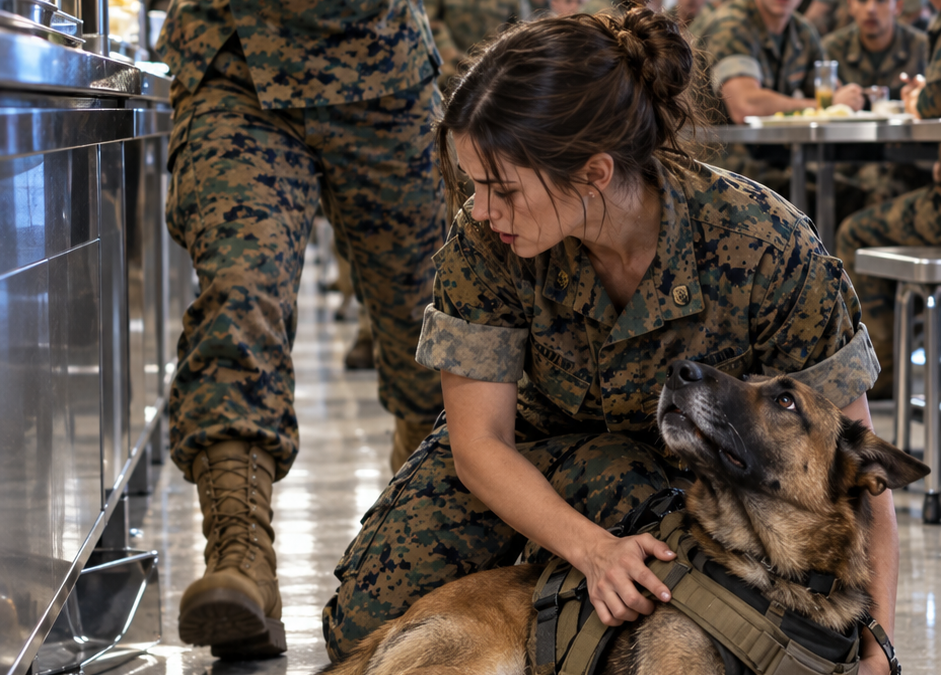
𝗣𝗔𝗥𝗧 𝟮
The question was what witnessing would require from them.
Two young Marines near the condiment station took half a step forward.
Mercer glanced at them.
They stopped.
He noticed.
And he enjoyed it.
That told me more about him than anything else he had said.
He looked at my jacket.
It was old, olive drab, and faded around the elbows.
There were repair stitches along one sleeve from a winter I preferred not to remember.
No name tape.
No unit patch.
No rank.
I had removed every piece of insignia years earlier.
Mercer mistook the absence for emptiness.
“You civilians put on old military jackets and think that makes you important,” he said.
I looked down at the worn sleeve.
For an instant, I was no longer standing in a California mess hall.
I smelled smoke on a foreign road.
I heard rotor blades.
I heard a radio screaming names over explosions.
I saw twelve folded flags.
Then Bruno pressed the side of his head against my hand.
The room came back.
“Don’t confuse quiet with weakness,” I said.
Mercer’s grin widened.
“Was that supposed to scare me?”
“No.”
I tightened my fingers around Bruno’s harness.
“It was advice.”
Footsteps sounded behind him.
A man entered the mess hall carrying a folded newspaper in one hand and a paper coffee cup in the other.
Sergeant Major Raymond Hayes.
He had more gray hair than the last time I had seen him.
The lines around his eyes had deepened.
But his walk had not changed.
Neither had the way he scanned a room before fully entering it.
His eyes moved across the fallen trays.
The broken glass.
The people standing motionless.
Then Bruno.
Then me.
The coffee cup fell from his hand.
It struck the floor and rolled beneath a table.
Coffee spread across the tile.
No one looked at it.
Everyone was watching Hayes.
His face had gone still.
Mercer turned toward him.
“Sergeant Major, perfect timing.”
Hayes did not answer.
Mercer pointed toward me.
“This civilian brought an animal inside and caused a disturbance.”
The lie arrived so naturally that I almost admired how little effort it cost him.
Hayes looked at Bruno.
His gaze stopped on the trembling front paw.
Then he looked at me.
Recognition moved between us.
Twenty-three years of it.
Sand.
Mud.
Promotions.
Funerals.
Bad coffee.
A transport aircraft at two in the morning.
A promise neither of us had ever discussed afterward.
I shook my head once.
Not yet.
Hayes understood immediately.
He had served with me too long not to.
His back straightened.
“What happened here?”
Mercer answered quickly.
“She blocked the serving area and refused to move.”
A woman behind the counter removed her disposable gloves.
“That isn’t what happened.”
Mercer turned.
“Excuse me?”
She stepped out from behind the serving station.
“My name is Denise Alvarez. I’ve worked in this kitchen for nine years.”
Her voice shook slightly.
She kept going.
“You pushed past her.”
Mercer’s expression hardened.
The three Marines behind him looked elsewhere.
One became deeply interested in the menu board.
Another stared at his boots.
The youngest kept looking at Bruno.
Hayes walked toward me.
“Can he stand?”
“I don’t know.”
My voice sounded calm.
Too calm.
Hayes knew that tone.
He had once told me it frightened him more than yelling because it meant I had moved past emotion and into decisions.
He turned to the kitchen manager.
“Call the base veterinary clinic.”
Mercer frowned.
“For a dog?”
Hayes faced him.
“For a Marine veteran.”
A murmur moved through the room.
People looked at Bruno differently.
Then at me.
Mercer crossed his arms.
“You’re making this bigger than it is.”
Hayes held his eyes.
“No, Corporal.”
His voice became very quiet.
“You did that yourself.”
The veterinary team arrived twenty minutes later.
Those twenty minutes felt longer than some nights overseas.
Dr. Hannah Cole entered with a technician and a collapsible transport stretcher.
She knelt several feet from Bruno and held out one hand.
“Hello, handsome.”
Bruno looked at me.
“It’s okay.”
He sniffed her fingers.
Dr. Cole slowly examined his shoulder and remaining front leg.
When she reached the joint, his breathing changed.
She noticed immediately.
“So did I.
“He has pain here,” she said. “I want imaging before I say anything more.”
“Can he walk?”
“I don’t want him trying.”
The technician opened the stretcher.
When they began lifting Bruno, he struggled.
“I’m here,” I told him.
His body relaxed.
We carried him through the mess hall.
No one spoke.
Near the exit, a young Marine stood and saluted.
Another followed.
Then another.
Within seconds, an aisle of Marines stood at attention as Bruno passed between them.
I did not know what to feel.
Pride seemed wrong.
Gratitude felt incomplete.
All I could think was that ten minutes earlier, most of them had watched without moving.
Mercer stood beside the serving line.
His arms were no longer crossed.
At the veterinary clinic, Bruno disappeared through a pair of swinging doors.
I sat beneath fluorescent lights with my shoulder pressed carefully against the wall.
Hayes remained standing.
He had always hated waiting.
Time had silvered his hair and put lines across his face, but apparently it had not taught him how to sit still.
“You need somebody to examine that shoulder,” he said.
“My shoulder can wait.”
“You said that in Helmand.”
“I was younger.”
“You were stubborn.”
I looked at him.
“What changed?”
“Your knees.”
Despite everything, I almost smiled.
He sat beside me.
For several moments, neither of us spoke.
A Labrador whimpered somewhere behind a closed door.
The phone rang at reception.
California sunshine poured through the front windows as if this were an ordinary day.
“Why didn’t you tell him?” Hayes asked.
“Tell him what?”
“You know what.”
I watched the door Bruno had disappeared through.
“My history wasn’t the emergency.”
“He treated you like you were disposable.”
“That’s not why I stayed quiet.”
“Then why?”
I turned toward him.
“Because everyone in that room needed a chance to tell the truth before they knew who I was.”
Hayes understood.
Rank could manufacture courage.
Recognition could suddenly improve a person’s morals.
Neither told you what they would do when they believed no one important was watching.
Denise had spoken before knowing anything about me.
The others had not.
Mercer had made his choices while believing I had no power.
That mattered.
Hayes rubbed both hands across his face.
“You still turn everything into a field assessment.”
“People reveal themselves under pressure.”
“You taught me that.”
“I also taught you not to drop coffee.”
“That lesson never took.”
The clinic door opened.
Mercer entered with Captain Andrew Collins, Staff Sergeant Leah Brooks from military police, and the three younger Marines from the dining hall.
Mercer looked irritated.
Collins looked like someone who had already developed a headache.
Brooks carried a tablet.
“Ma’am,” Collins said, “Captain Andrew Collins. Corporal Mercer’s company commander.”
I stood.
“Elena Ward.”
Mercer stared at me as if the name should mean something.
It did not.
Not yet.
Collins shook my hand.
“I understand there was an incident.”
“There was.”
“Corporal Mercer says your dog created a safety hazard.”
Hayes stepped forward.
“That isn’t what the witnesses reported.”
Collins looked at him.
“I’m gathering every account, Sergeant Major.”
“Then gather them accurately.”
Mercer exhaled sharply.
“This has gotten ridiculous.”
Brooks turned toward him.
“You were instructed not to discuss the incident until interviews were completed.”
“I’m only saying what happened.”
“You already gave your statement.”
Mercer looked at me.
“She stepped in front of me.”
“No,” I said. “I was standing still.”
“You moved.”
“I turned after you spoke.”
“You blocked me.”
“Bruno was beside my left leg.”
Mercer pointed toward the examination room.
“That thing took up half the aisle.”
Hayes moved.
Captain Collins put a hand against his chest.
“Sergeant Major.”
Hayes stopped.
Every muscle in his jaw tightened.
Mercer noticed and misunderstood the restraint as protection.
“That’s exactly my point,” he said. “Everyone’s emotional over an animal.”
Brooks studied him.
“Do you understand what a service dog is?”
“I understand perfectly.”
“Explain it.”
Mercer hesitated.
“A dog somebody brings everywhere.”
Brooks waited.
Silence exposed him more effectively than an argument.
Captain Collins turned to the three younger Marines.
“Who was closest?”
The first one, Private First Class Nolan Reed, raised his hand halfway.
“I was, sir.”
“What did you see?”
Reed looked at Mercer.
Mercer looked back.
Reed lowered his hand.
“I saw the woman near the counter.”
“That wasn’t my question.”
“I didn’t see everything.”
“You were standing directly behind Corporal Mercer,” Brooks said.
“I was looking at the food.”
Hayes gave a humorless laugh.
“It must have been fascinating.”
Collins looked at the second Marine.
“Lance Corporal Shaw?”
“I heard the trays fall, sir.”
“What happened before that?”
“I’m not sure.”
Then Collins turned to the youngest.
His name tape read PARKER.
“Private Parker?”
Parker looked at Mercer.
Then at me.
Finally, he looked toward the closed doors behind which Bruno was being examined.
“He told her to move,” Parker said.
Mercer’s face changed.
“Parker.”
Brooks lifted one hand.
“Do not address the witness.”
Parker swallowed.
“She started moving the dog closer to the counter.”
“Did Corporal Mercer wait?” Collins asked.
“No, sir.”
“What happened?”
“He pushed through anyway.”
Mercer stepped forward.
“That’s a lie.”
Brooks placed herself between them.
“Remain where you are.”
Parker’s voice shook now.
“His shoulder hit her. Then his boot hit the dog’s front leg.”
Mercer stared at him.
“You’re finished.”
Captain Collins turned so sharply his chair scraped.
“Corporal.”
Mercer realized what he had said.
“I meant he misunderstood.”
“That is not what you said.”
Parker went pale, but he continued.
“Corporal Mercer laughed afterward.”
The waiting room became completely silent.
A receptionist stopped typing.
Hayes turned toward the window.
I watched Mercer.
The confidence from the mess hall was gone.
He looked cornered.
People who feel cornered tend to make one of two choices.
They accept responsibility.
Or they attack whoever appears weakest.
Mercer chose the second.
“She shouldn’t even have been on base.”
Captain Collins looked at me.
“Were you authorized to enter the facility?”
I reached into my jacket.
Mercer smiled.
He thought he had found an exit.
I handed Brooks my identification.
She looked at it.
Her posture changed almost imperceptibly.
Collins noticed.
“What?”
She passed him the card.
He read it.
Then read it again.
His eyes rose.
Mercer looked between us.
“What?”
Collins returned the identification with both hands.
“Your access is valid, ma’am.”
Mercer frowned.
“That’s it?”
“That is enough for that question,” I said.
He looked irritated.
“What aren’t you telling us?”
Hayes drew breath.
I stopped him with one glance.
Brooks returned to her tablet.
“Why were you at the mess hall?”
“I had a meeting at headquarters.”
“With whom?”
“Major General Thomas Whitaker.”
Mercer laughed.
No one else did.
“You expect us to believe that?”
Captain Collins closed his eyes.
“Corporal, stop talking.”
“Why?”
“Because every sentence is making your situation worse.”
Before Mercer could answer, Dr. Cole stepped through the doors.
Everything else disappeared from my mind.
She had the expression doctors and veterinarians use when they know the person waiting is studying every muscle in their face.
“There’s no fracture,” she said.
I exhaled.
“But there is significant inflammation around the joint.”
“How bad?”
“Bruno’s remaining front leg carries more load than normal because of the previous amputation. Trauma to that joint matters more for him than it would for a four-legged dog.”
“Will he recover?”
“He should.”
The pause hurt.
“What aren’t you saying?”
“I don’t want him bearing weight for several days. After that, we reassess.”
Several days sounded temporary.
For Bruno, it threatened everything.
He had one front leg.
His independence depended on it.
So did mine more than most people in that room understood.
“We’ll keep him today for observation,” Dr. Cole said.
“I’m staying.”
“You can sit with him once we stabilize the joint.”
Hayes touched my good shoulder.
“He’ll be all right.”
I looked at him.
“You can’t promise that.”
“No.”
His hand dropped.
“But I can promise you won’t do this alone.”
Behind us, Mercer muttered something.
Brooks heard.
“What did you say?”
He lifted his chin.
“I said this is an embarrassing waste of resources.”
Captain Collins stared at him.
“A service dog has been injured. A civilian was struck against a metal counter. Witnesses dispute your statement.”
“One witness.”
“Denise Alvarez gave a signed statement.”
For the first time, Mercer looked uncertain.
Then Brooks said, “And the mess hall has security cameras.”
His face emptied.
Hayes looked at her.
“You have the footage?”
“It’s being preserved.”
Mercer immediately said, “The camera angle won’t show everything.”
Nobody had mentioned an angle.
Brooks stopped typing.
“That’s interesting.”
“I’m speaking generally.”
“You said you had not noticed the cameras.”
“I didn’t.”
“Yet your first concern is the viewing angle.”
Mercer looked toward the exit.
Brooks quietly shifted into his path.
No one raised a voice.
No one needed to.
The lie had finally become heavier than the truth.
I sat with Bruno while the footage was reviewed.
The treatment room had cheerful blue walls and painted paw prints along the baseboards.
He rested on a padded mat.
His joint was wrapped.
An IV line disappeared beneath a small bandage.
When I entered, his eyes opened.
His tail struck the mat once.
“Don’t get sentimental,” I whispered. “You still owe me breakfast.”
His tail moved again.
I sat beside him and placed my hand on his neck.
The pain in my shoulder had become a steady pulse.
I ignored it.
Dr. Cole did not.
“You need medical attention.”
“I need five minutes.”
“You said that fifteen minutes ago.”
“Then I need five more.”
She crouched on the opposite side of Bruno.
“Veterans are terrible patients.”
“You say that like it’s new information.”
“Hayes told me you served together.”
“He served under my command.”
Her eyebrows rose.
“How far under?”
“Far enough that he still hates paperwork.”
“That does not narrow it down.”
I looked at Bruno.
Dr. Cole became quieter.
“He also said Bruno saved you.”
“He did.”
“How?”
I could have avoided the question.
Years earlier, I would have.
But sitting there beside Bruno, I no longer saw much value in pretending strength meant silence.
“After I retired, I stopped sleeping.”
She waited.
“I could stand in front of hundreds of Marines. I could brief generals. I could visit families after their sons or daughters died.”
I looked at Bruno’s resting face.
“But I couldn’t walk into a grocery store if it was crowded.”
Dr. Cole said nothing.
“If somebody dropped a glass behind me, I stopped hearing the store. I heard somewhere else.”
Bruno’s breathing remained slow beneath my hand.
“I avoided crowds. Then traffic. Then restaurants. Then people.”
“You knew what was happening?”
“I knew every statistic.”
“That’s not what I asked.”
I looked at her.
“Yes. I knew.”
“Knowing doesn’t mean you know how to accept help.”
“No.”
Bruno had come from a veterans’ service program in Oceanside.
He had already lost his leg after being hit by a vehicle when he was young.
The trainer had described him as resilient.
I had called him stubborn.
We understood each other immediately.
“He notices my breathing before I do,” I said. “He interrupts panic before I recognize it. He creates space in crowds. He wakes me from nightmares.”
Dr. Cole glanced toward the hallway.
“So the mess hall was difficult before Mercer touched either of you.”
“It was crowded.”
“Why go?”
“General Whitaker asked me there.”
“For the meeting?”
“Yes.”
“What kind of meeting?”
I stroked Bruno’s neck.
“He wants to expand transition and mental-health support for retiring Marines.”
“And he asked you to advise him.”
“He asked me to listen first.”
Understanding settled across her face.
“You could have announced who you were.”
“That would have changed everything.”
“Sometimes that is useful.”
“Yes.”
I looked toward the closed door.
“But today it would have hidden the problem.”
A knock sounded.
Hayes entered with Captain Collins and Brooks.
I knew from their faces that the video had answered every remaining factual question.
Brooks stood near the wall.
“We reviewed three camera angles.”
I waited.
“They confirm the witness statements. You began moving Bruno after Mercer spoke. Corporal Mercer continued forward. His shoulder made contact with you.”
“And Bruno?”
“The second angle shows Mercer’s boot contacting Bruno’s leg.”
My hand stopped moving through his fur.
“Deliberately?”
Brooks paused.
“We cannot determine intention from the recording.”
I appreciated that answer.
Truth did not require exaggeration.
She continued.
“The footage does show he had room and time to stop. It also captured his comments afterward.”
Collins stepped closer.
“I’m sorry this happened under my command.”
“This did not happen because you failed to apologize.”
He nodded.
“No, ma’am.”
“What happened after I fell?”
He understood the question.
“Most people watched.”
“Yes.”
“Ms. Alvarez spoke.”
“Yes.”
“Private Parker eventually gave an accurate statement.”
“Eventually.”
He heard the emphasis.
“You think the silence matters as much as Mercer.”
“I think Mercer behaved that way because he expected silence.”
Hayes folded his arms.
“That kind of arrogance doesn’t appear overnight.”
I looked at Collins.
“Find out how many times people complained before today.”
Brooks opened another document on her tablet.
“We already found two.”
Collins turned.
“What complaints?”
“One civilian employee reported that Mercer repeatedly mocked her accent.”
“Denise?”
Brooks nodded.
“The second complaint came from a junior Marine who reported being publicly humiliated by him during meal service.”
Collins looked stunned.
“Why wasn’t I told?”
“The first was categorized as an interpersonal misunderstanding. The second was withdrawn.”
“Who reviewed them?”
Brooks hesitated.
“Staff Sergeant Nolan.”
Collins looked away.
The problem had just become bigger.
Mercer had not discovered cruelty during lunch.
Lunch had merely given his cruelty a larger audience.
“Where is he?”
“In a conference room,” Brooks said. “Removed from duty pending the investigation.”
“Does he know who I am?”
Hayes answered.
“No. He keeps asking.”
“Good.”
Collins looked at me.
“Why?”
“I want to hear what he believes before my résumé enters the room.”
Brooks nodded.
“Would you participate in another interview?”
“Yes.”
Hayes immediately said, “Elena.”
“I’m fine.”
“You’re injured.”
“My shoulder met a counter.”
“And Bruno is sedated.”
“I’m still capable of answering questions.”
Dr. Cole crossed her arms.
“After someone examines your shoulder.”
I looked at Hayes.
He smiled.
“Doctor outranks retired Marines inside her clinic.”
“Everybody enjoys power eventually.”
The base medical center found a deep bruise and a mild shoulder strain.
No fracture.
They put my arm in a sling I hated instantly.
Hayes drove me to the administrative building afterward.
Without Bruno beside my left leg, every hallway felt wider than it should.
Every noise felt sharper.
“You’re counting exits,” Hayes said.
“I always count exits.”
“You’re counting them faster.”
I looked out the window.
“Yes.”
“Postpone the interview.”
“No.”
“You don’t have to prove anything.”
“This isn’t about proving something.”
“Then what?”
I turned toward him.
“If Mercer apologizes after he learns my rank, then he isn’t apologizing to me.”
Hayes nodded.
“He’s apologizing to power.”
“Exactly.”
Mercer sat at the far end of the conference table when I entered.
Captain Collins sat to one side.
Brooks and a legal representative sat nearby.
A camera recorded everything.
Hayes and I took the opposite seats.
Mercer noticed my sling.
For an instant, I thought I saw guilt.
Then defensiveness covered it.
“I already told you what happened.”
Brooks touched her tablet.
“You are being given an opportunity to clarify your statement.”
Mercer looked at me.
“Why is she here?”
“Ms. Ward is the complainant.”
“I thought this was supposed to be impartial.”
“It is.”
“She has the Sergeant Major coaching her.”
Hayes leaned back.
“Elena Ward has never needed coaching from me.”
Mercer caught the familiarity.
“You know her.”
“Yes.”
“How?”
Brooks intervened.
“That is not relevant.”
Mercer stared at me.
“You set me up.”
I almost admired the speed with which he made himself the victim.
“I went to lunch with my service dog.”
“You knew the Sergeant Major.”
“That did not move your feet.”
“You wanted a confrontation.”
“I asked you to repeat what you said.”
“Exactly.”
“Yes.”
I leaned forward.
“Because I wanted people to remember it.”
Mercer turned toward Collins.
“She’s twisting everything.”
Brooks rotated her tablet.
“Let’s examine that.”
The footage began.
There I was beside the counter.
Bruno stood close against my left leg.
Mercer entered frame.
His voice came through the recording.
“Move, lady.”
The video showed me turning and beginning to guide Bruno closer.
Mercer kept moving.
His shoulder hit me.
My body struck the counter.
Bruno twisted.
The trays fell.
Then Bruno’s cry filled the conference room.
Mercer looked away.
The recording continued.
“Seriously?”
Then:
“He was in my path.”
“So what?”
“Move your animal and let people eat.”
Brooks stopped the video.
“What part was twisted?”
Mercer stared at the table.
“It happened quickly.”
“Your comments did not.”
“I was frustrated.”
“With whom?”
“The line wasn’t moving.”
Brooks checked her notes.
“You waited eleven seconds.”
He looked up.
“What?”
“From the time you arrived until physical contact. Eleven seconds.”
“That footage doesn’t show what she said before.”
“I said nothing,” I replied.
“You looked at me.”
Hayes leaned forward.
“She looked at you?”
Mercer heard how ridiculous it sounded.
“She had an attitude.”
I asked, “What does a silent attitude look like?”
His eyes hardened.
“Like somebody who thinks she owns the place.”
“I was ordering lunch.”
“You were wearing that jacket.”
I looked at my sleeve.
“What did my jacket tell you?”
“That you wanted attention.”
“It has no insignia.”
“Exactly.”
The room went still.
He had said more than he intended.
Collins frowned.
“What does ‘exactly’ mean?”
Mercer shifted.
“Nothing.”
“You emphasized it,” Brooks said.
He exhaled.
“People wear old military clothing and expect special treatment.”
“What special treatment did Ms. Ward request?” Collins asked.
“She brought a dog inside.”
“A permitted service animal,” Brooks said.
“She expected everyone to accommodate her.”
I studied him.
“Was walking around us an accommodation?”
“You could have moved faster.”
“Bruno has three legs.”
“That isn’t my fault.”
“No.”
I held his gaze.
“What happened afterward was your choice.”
Mercer shoved his chair backward.
“I’m done being lectured by some random civilian.”
The chair legs scraped against the floor.
Hayes became completely still.
Captain Collins looked at me.
Brooks looked at me.
They were waiting.
The moment had come.
Not because Mercer deserved humiliation.
Because the truth now had context.
Before I could speak, the conference-room door opened.
Every Marine in the room stood.
Major General Thomas Whitaker entered with his aide.
I rose more slowly because of the sling.
Mercer snapped to attention.
Whitaker saw my shoulder.
Then he looked toward the empty space where Bruno should have been.
His face changed immediately.
“Elena, where is Bruno?”
“At the veterinary clinic.”
“What happened?”
Brooks answered.
“There was an incident at the mess hall, sir.”
Whitaker looked at Mercer.
“This corporal?”
“Yes, sir.”
He turned back to me.
“Was Bruno injured?”
“His remaining front joint was aggravated.”
Whitaker’s jaw tightened.
“He can’t bear weight today.”
Mercer’s face had changed.
Confusion had replaced anger.
Whitaker stepped closer.
“I waited forty minutes at headquarters.”
“I’m sorry.”
He stared at me.
“You were injured and you’re apologizing for being late?”
“Old habit.”
He looked at Hayes.
“You let her apologize?”
Hayes shook his head.
“I’ve been trying to stop her for twenty-three years, sir.”
Mercer’s eyes moved between us.
The arithmetic was beginning.
Whitaker noticed Brooks’s paused video.
“May I see it?”
Brooks looked at me.
I nodded.
The recording played again.
Mercer watched it more closely than anyone.
Perhaps some part of him hoped the past would change under greater authority.
It did not.
Bruno cried out through the speakers.
The insults followed.
When the video ended, Whitaker said nothing.
His silence felt heavier than shouting.
Mercer swallowed.
“Sir, I didn’t know who she was.”
There it was.
The sentence that explained everything.
Whitaker turned slowly toward him.
Captain Collins closed his eyes.
Brooks stopped typing.
I leaned forward.
“Why should that matter?”
Mercer looked at me.
“I mean I didn’t understand the situation.”
“You saw Bruno’s harness.”
“I thought it might be fake.”
“Why?”
“I’ve seen stories about people pretending.”
“What about me made you think I was pretending?”
He said nothing.
Whitaker spoke quietly.
“Answer the question, Corporal.”
Mercer’s breathing changed.
“She didn’t look like somebody who belonged there.”
Ugly honesty.
But honesty.
“What does belonging look like?” I asked.
“Current identification.”
“I had it.”
“You didn’t show it.”
“You never asked.”
“You were wearing an unmarked jacket.”
I touched the empty sleeve.
“So the missing patches bothered you.”
He stared down.
Whitaker understood why they were gone.
Hayes did too.
After retirement, I had removed every visible indication of rank.
People behaved differently around authority.
Doors opened.
Voices softened.
Arguments disappeared.
I had spent most of my adult life watching people straighten their backs the moment they learned who I was.
I wanted to know who they were when they believed I was nobody.
That day, I had learned more than I wanted.
Whitaker looked at Mercer.
“Do you recognize the name Elena Ward?”
“No, sir.”
“Did you study Marine Corps leadership cases during professional military education?”
“Yes, sir.”
“The Sangin evacuation?”
A flicker crossed Mercer’s face.
“Yes, sir.”
“Who coordinated the withdrawal corridor after communications failed?”
Mercer said nothing.
“Who held the eastern route while the last convoy came through?”
“I don’t remember, sir.”
Whitaker looked at me.
I hated where this was going.
This was exactly what I had tried to avoid.
Hayes saw it.
“Sir, perhaps Elena should decide what is relevant.”
Whitaker nodded immediately.
“You’re right.”
Then he looked at me.
“Your story.”
“No.”
My eyes went to the empty space beside my chair.
“Today is Bruno’s story.”
Mercer looked lost.
I took a breath.
“I served twenty-eight years in the United States Marine Corps.”
His face changed.
“I entered as a second lieutenant.”
My fingers rested against the edge of the table.
“I retired as a colonel.”
Mercer’s lips parted.
Hayes watched him without pleasure.
“I commanded Marines in California, North Carolina, Iraq, and Afghanistan.”
Mercer stared at my jacket as if the missing insignia had suddenly become louder than visible rank.
“I coordinated the Sangin evacuation General Whitaker mentioned.”
His complexion faded.
“No way.”
The words escaped before discipline stopped them.
I met his eyes.
“Twelve Marines did not come home from that operation.”
Silence.
“I visited every family.”
Mercer’s shoulders lowered.
“Sergeant Major Hayes served under my command. He was wounded during the last convoy.”
Mercer looked at Hayes.
Hayes touched the table.
“She carried my radio after I couldn’t.”
“That isn’t relevant,” I said.
“It is to me.”
Whitaker turned toward Mercer.
“Colonel Ward also helped develop transition procedures now used by thousands of Marines leaving active service.”
“General.”
He stopped.
I looked directly at Mercer.
“My record does not make what you did wrong.”
His eyes dropped.
“It was already wrong.”
“Yes.”
“If you had known my rank, would you have treated me differently?”
He did not answer.
“You would have moved around Bruno.”
Silence.
“You would have apologized after I fell.”
His hands tightened together.
“You might have been the first person to offer help.”
His breathing became shallow.
“But if you did those things only because I was Colonel Ward, what would that say?”
Mercer finally raised his eyes.
“What do you want from me?”
It was the first honest question he had asked all day.
“I wanted you to tell the truth.”
“I made a mistake.”
“You made several.”
“I was in a hurry.”
“Then you lied.”
“I panicked.”
“You threatened Parker after he contradicted you.”
“I didn’t mean it like that.”
“Intent does not erase impact.”
He pressed both palms against the table.
“Are you trying to end my career?”
“No.”
That answer surprised him.
It surprised Hayes too.
Mercer stared at me.
“Then why are we still doing this?”
“Because losing a career does not automatically teach a person how to deserve another chance.”
Whitaker leaned back.
Mercer’s defensiveness returned.
“So you want to make an example out of me.”
“You already made yourself one.”
His jaw tightened.
“What happens next is not my decision.”
“They’ll listen to you.”
“Yes.”
“So it is.”
“No, Corporal.”
I kept my voice low.
“It means I have to be more careful with that influence than you were with yours.”
Brooks paused the recording.
“The formal review will consider physical conduct, false statements, witness intimidation, and prior complaints.”
Mercer looked at Collins.
“Prior complaints?”
Collins did not protect him.
“Two have surfaced.”
Mercer’s face hardened again.
“Denise complains about everyone.”
“She reported repeated comments about her accent,” Brooks said.
“She misunderstood jokes.”
Collins asked, “And the junior Marine?”
Mercer hesitated.
“He was weak.”
The room went quiet.
Mercer realized another piece of truth had escaped.
I studied him.
“Was he weak, or isolated?”
“He couldn’t handle correction.”
“Did you correct him privately?”
“No.”
“Why?”
“He needed to learn.”
“What did public humiliation teach him?”
Mercer looked toward the window.
“Everybody gets embarrassed.”
“That is not leadership.”
“I never said I was perfect.”
“Perfection is not the standard.”
He turned back.
“What is?”
I thought of every young Marine ever placed under my authority.
Every one of them somebody’s son or daughter.
Every one of them watching what leaders permitted.
“Responsibility.”
For once, Mercer had no answer.
Captain Collins broke the silence.
“Corporal Mercer will remain removed from duty pending proceedings.”
Whitaker nodded.
“Protect every witness from retaliation.”
“Yes, sir.”
“Review how the earlier complaints were handled.”
“Yes, sir.”
Then Whitaker looked at me.
“Will you still meet with the transition committee?”
“Not today.”
“Of course.”
“I’ll reschedule when Bruno can walk.”
Mercer looked up.
“That meeting was real?”
Hayes gave him a tired look.
“Everything she told you was real.”
Mercer stared at me.
“Why were you eating alone?”
There was something almost childlike in the disbelief.
I looked toward the empty space beside my chair.
“I wasn’t alone.”
He followed my gaze.
“Bruno was with me.”
That was the moment his face finally broke.
Not when he learned I had been a colonel.
Not when a major general entered.
Not when the camera proved he had lied.
When he understood that the dog he had dismissed as an inconvenience was the companion I had considered company.
Mercer covered his mouth.
No one rescued him from the silence.
Some consequences need room.
Bruno stayed overnight.
I remained at the veterinary clinic until Dr. Cole threatened to assign me a kennel.
Hayes drove me to a small hotel near Oceanside.
The room was quiet.
Too quiet.
Bruno’s travel bowl was still in my bag.
His folded blanket lay beside it.
At two in the morning, I woke reaching toward the side of the bed.
Nothing.
My heart accelerated instantly.
The air conditioner hummed.
A car moved outside.
Then somewhere down the hallway, a glass struck something hard.
The sound brought the mess hall back in a single violent rush.
Trays falling.
Bruno crying out.
Mercer laughing.
I put both feet on the carpet.
“Five things,” I whispered.
Bruno usually reminded me before I had to think about it.
Now I had to do it alone.
A lamp.
Blue chair.
White curtains.
My boots.
Bruno’s folded harness cover.
Four things I could touch.
Blanket.
Mattress.
Jacket.
Nightstand.
Three things I could hear.
Air conditioner.
Traffic.
My breathing.
The panic passed slowly.
When it did, I sat in the dark and admitted what I had been avoiding all evening.
I was terrified.
Not of Mercer.
Not of the investigation.
Not of my shoulder.
I was terrified Bruno might never work again.
People often misunderstood what service dogs meant to veterans like me.
They imagined loyalty.
Companionship.
Comfort.
All true.
But Bruno also gave me independence.
He created distance in crowds before I had to ask.
He recognized the beginning of a panic response before my conscious mind caught up.
He woke me when dreams dragged me somewhere I no longer wanted to live.
Without him, I could still function.
That was the phrase people used.
Function.
But there is a vast difference between functioning and living freely.
At seven in the morning, Dr. Cole called.
“He stood.”
I closed my eyes.
“How long?”
“Several seconds.”
“Did he bear weight?”
“Briefly.”
“Pain?”
“Cautious. The medication is helping.”
“When can I see him?”
“I expected that before hello.”
“Hello, Doctor.”
She laughed.
“Eight o’clock.”
I arrived at seven forty-five.
Bruno heard my voice through the treatment-room door.
One bark echoed down the hallway.
That one sound gave me back the morning.
Dr. Cole brought him out using a padded support cart.
His rear legs touched the floor while the support carried some of the weight from his chest.
His front joint remained wrapped.
He pulled toward me.
“Easy.”
He ignored me.
Some habits survived training.
I knelt and pressed my forehead against his.
“You scared me.”
He licked my chin.
Dr. Cole suddenly became very interested in her clipboard.
“How long?” I asked.
“Two weeks restricted movement.”
“And then?”
“We reassess.”
“Can he work again?”
“Possibly.”
I hated the uncertainty.
But real recovery rarely arrives with guarantees.
Hayes entered carrying two coffees.
Both had lids.
I looked at him.
“You learned.”
“I adapt under pressure.”
He handed one to me.
“How’s our Marine?”
Dr. Cole looked up.
“You meant Ms. Ward yesterday.”
Hayes smiled.
“I mean Bruno.”
I shook my head.
“He stood.”
Relief changed Hayes’s whole face.
“Of course he did.”
He crouched.
Bruno rested his chin against Hayes’s knee.
The receptionist appeared at the doorway.
“Colonel Ward?”
“Yes?”
“There are people asking to see you.”
“How many?”
She looked unsure.
“About thirty.”
Hayes glanced at me.
“I didn’t invite anybody.”
We stepped into the lobby.
Denise Alvarez stood at the front.
Private Parker was beside her.
Behind them were Marines from the mess hall.
Some carried cards.
One had a new blanket.
Another held a pet-store bag.
Nobody approached until I nodded.
Denise stepped forward.
“How is he?”
“He stood this morning.”
A collective breath moved through the room.
“Thank God.”
Parker kept looking at Bruno.
“I should have spoken sooner.”
I studied him.
He looked as if he had barely slept.
“You spoke when it became difficult.”
“I waited.”
“Yes.”
His face dropped.
I did not lie to make him feel better.
Then I said, “Courage doesn’t always arrive on time.”
He looked at me.
“But it arrived.”
He nodded.
“I won’t wait next time.”
“That promise matters more.”
One by one, people introduced themselves.
Several apologized for remaining silent.
I listened.
I did not tell them everything was fine.
It wasn’t.
An apology is a beginning.
It is not completed work.
A young corporal named Maya Lewis stepped forward.
“I saw everything,” she said. “I kept thinking somebody senior would do something.”
“What did you learn?”
She swallowed.
“Everybody was waiting for everybody.”
“Yes.”
“I don’t want to be that person again.”
“Then don’t be.”
Denise handed me an envelope.
“The kitchen staff collected something for Bruno.”
I tried to return it.
“His care is covered.”
“Then give it to the service-dog program.”
I looked at the handwritten names covering the envelope.
“Agreed.”
Captain Collins arrived later.
He carried nothing.
I appreciated that.
“May we talk?”
We stepped outside.
California sunlight covered the walkway.
Training aircraft sounded somewhere beyond the buildings.
“Mercer has been formally suspended pending proceedings.”
I nodded.
“Staff Sergeant Nolan has been removed from supervisory responsibilities while we review the previous complaints.”
“What happens to Denise’s complaint?”
“Reopened.”
“The junior Marine?”
“We contacted him.”
“Did he want contact?”
Collins paused.
“That’s a fair question.”
“It should have been the first one.”
“You’re right.”
He made a note.
“The command is arranging independent support.”
“Good.”
He looked through the clinic window.
“They’re ashamed.”
“Some should be.”
“Does shame help?”
“Only if it becomes action.”
Collins nodded.
“Mercer asked to speak with you.”
“No.”
He looked surprised.
“Not yet.”
“Why?”
“His first apologies belong to Parker and Denise.”
“And Bruno?”
“Bruno cannot judge sincerity.”
“What about you?”
“I can wait.”
Three days later, Bruno came home.
He wore a support brace and moved carefully.
Every successful step made it easier for me to breathe.
The mess hall staff invited us back.
I almost declined.
Bruno made the decision before I did.
When we reached the entrance, the automatic doors opened.
Noise rolled toward us.
Trays.
Silverware.
Voices.
Bruno stopped.
His body stiffened.
So did mine.
I put my hand on his harness.
“We can leave.”
He looked up.
Then he took one step forward.
I followed.
The mess hall gradually became quiet.
But this silence was different.
Nobody rushed toward us.
Nobody stared with suspicion.
Nobody tried to turn Bruno into a spectacle.
Denise waited behind the counter.
“Welcome back.”
Bruno’s tail moved.
I took chicken, rice, and green beans.
Denise placed a sealed dog treat beside my tray.
“Regulations,” she said. “Outside.”
“Obviously.”
I carried my tray toward an empty table.
Parker stood nearby.
“Colonel Ward?”
“Elena is fine.”
He looked deeply uncomfortable with that.
“May I sit with you?”
I glanced at Bruno.
“He decides.”
Parker crouched several feet away and offered one hand.
Bruno studied him.
Then leaned forward to sniff.
His tail moved once.
“Permission granted.”
Parker sat.
Maya joined us a few minutes later.
Then two more Marines.
At first, nobody discussed Mercer.
They asked about Bruno.
How service dogs were trained.
Why he had only three legs.
How I had met him.
Eventually Parker looked down at his lunch.
“Why didn’t you tell us who you were?”
“I wanted to eat.”
“That’s all?”
“That should have been enough.”
He nodded slowly.
Maya looked at my jacket.
“Why did you remove the rank patches?”
“Because people listen differently when they see authority.”
“Isn’t that the point of rank?”
“Sometimes.”
I broke a dinner roll.
“But leaders also need to know what happens when authority leaves the room.”
Parker looked around the dining hall.
“I think everybody knows now.”
“Knowing lasts an afternoon.”
I met his eyes.
“Practice has to last longer.”
Two weeks after the incident, Bruno returned to Dr. Cole.
She removed the brace and carefully tested the joint.
He stood without trembling.
“Walk him toward the door.”
I held the harness loosely.
Bruno crossed the room.
His gait would always be uneven.
Three legs demanded constant adjustment.
But every step carried his weight.
Dr. Cole smiled.
“He can begin limited work.”
The breath I had been holding for two weeks finally left.
“How limited?”
“Short outings. Quiet places.”
I looked at Bruno.
“He hates quiet places.”
“That sounds like his handler.”
Hayes and General Whitaker waited outside.
Whitaker carried a folder.
“The transition proposal,” he said.
“You worked on it without me?”
“We used your previous recommendations.”
“Dangerous.”
“We survived.”
I opened it.
The revised program included service-animal education.
Bystander responsibility.
Transition counseling.
Independent reporting channels.
Denise Alvarez had been asked to join a civilian advisory panel.
Parker had volunteered for a junior-leadership working group.
The changes would not fix everything.
But they were real.
“What are you calling this?” I asked.
Whitaker looked at Bruno.
“The Steady Ground Initiative.”
I read it again.
“Too sentimental.”
Hayes smiled.
“You love it.”
“I tolerate it.”
Bruno leaned against my leg.
Whitaker closed the folder.
“Mercer’s hearing concluded yesterday.”
I waited.
“He accepted responsibility for physical contact, a false statement, and witness intimidation.”
“That’s more than he accepted before.”
“He’ll lose rank.”
I looked toward the clinic entrance.
“What else?”
“Corrective training and supervised service with a veterans’ support organization.”
“Was that imposed?”
“Part of the recommendation.”
“Then be careful.”
Whitaker nodded.
“I knew you would say that.”
“Do not place him around vulnerable veterans until professionals decide he is ready. Service should not become a punishment inflicted on the people receiving it.”
“Agreed.”
“And Denise decides whether she accepts his apology.”
“Agreed.”
Hayes studied me.
“You’re still protecting him.”
“No.”
I looked at Bruno.
“I’m protecting everyone around him.”
Another week passed before Mercer asked again to meet me.
By then, he had apologized to Parker.
Parker did not forgive him.
Mercer accepted that.
He apologized to Denise.
She told him she needed time.
He accepted that too.
Those two facts mattered enough for me to agree.
We met at a veterans’ community center in Oceanside.
Folding chairs.
Bulletin boards.
An ancient coffee machine.
Bruno rested beside me.
Mercer arrived in civilian clothes.
Without the uniform, he looked younger.
He stopped several feet away.
“Colonel Ward.”
“Elena.”
His eyes went toward Hayes, who stood near the doorway.
I had asked him to come.
Trust did not require carelessness.
Mercer sat across from me.
For a few seconds, he only looked at Bruno.
“How is he?”
“Recovering.”
“I’m glad.”
Bruno remained still.
Mercer folded his hands.
“I apologized to Parker.”
“I heard.”
“He didn’t accept it.”
“He wasn’t obligated.”
“I know.”
“Do you?”
Mercer met my eyes.
“I’m starting to.”
He took a breath.
“Ms. Alvarez didn’t forgive me either.”
“She said she needed time.”
“I understand.”
The coffee machine clicked behind us.
Mercer looked toward the sound, then back.
“I keep hearing that recording.”
“So do I.”
“Especially the sound Bruno made.”
I said nothing.
“I told myself I hadn’t noticed him. Then they played the footage.”
“You looked at his harness.”
“I know.”
“Why did you lie?”
His face tightened.
“Because the truth made me look weak.”
“Responsibility would have required more strength.”
“I understand that now.”
“Understanding while consequences are happening is easy.”
He absorbed it.
“What do I do, then?”
“You practice afterward.”
“How?”
“You stop treating humiliation like leadership.”
He nodded.
“You intervene when somebody without influence is mistreated.”
Another nod.
“You accept that people you harmed may never trust you again.”
His jaw tightened.
“I deserve that.”
“This isn’t about what you deserve.”
He looked confused.
“It is about what they need in order to feel safe.”
Mercer looked down at Bruno.
“Can I apologize to him?”
“You may speak to him.”
He moved from his chair to one knee.
He stayed several feet away.
He did not reach forward.
Bruno watched him carefully.
“I frightened you,” Mercer said.
His voice was quiet.
“I hurt your leg, and afterward I acted like you didn’t matter.”
His voice shook.
“You mattered before I knew anything about her.”
Bruno’s ears moved slightly.
“I’m sorry.”
Silence.
Bruno did not approach.
Mercer waited.
Then he stood and returned to his chair.
For once, he did not demand a different response.
“That might be all you get,” I said.
“I know.”
He rose.
At the doorway, he stopped.
“Why didn’t you destroy me?”
Hayes stiffened.
I answered before he could.
“Because accountability should protect people, reveal truth, and demand change.”
Mercer waited.
“Revenge would have made you the center of the story again.”
His eyes lowered.
He left without another word.
Months later, the Steady Ground Initiative opened at Camp Pendleton.
The first session was held inside the same mess hall.
Denise spoke about civilian employees who stayed silent because they feared losing work.
Parker talked about delayed courage.
Dr. Cole explained service-dog access and how to behave around working animals.
I stood near the same stainless-steel counter where my shoulder had struck months before.
Bruno stood beside me.
His joint had healed.
He would never move like a four-legged dog.
He never seemed particularly interested in that fact.
General Whitaker introduced me using only my name.
We had agreed on it.
Some people in the room knew my record.
Others did not.
I preferred it that way.
“Leadership is easiest when everybody knows your rank,” I said.
The room quieted.
“Character appears when you believe nobody important is watching.”
Bruno settled beside my boot.
I looked toward the serving line.
The broken glass had been replaced long ago.
The trays were stacked.
Nothing visible remained from the day he was hurt.
That did not mean nothing remained.
“Most failures do not begin with one dramatic decision,” I continued. “They begin with smaller permissions.”
A cruel joke goes unanswered.
A complaint becomes a misunderstanding.
A junior Marine withdraws a report.
A civilian employee learns silence protects her paycheck.
Then somebody begins believing no one will object.
“Courage works the same way.”
I looked toward Denise.
“One person speaks.”
Then Parker.
“Another confirms the truth even after being afraid.”
Brooks stood near the rear wall.
“Someone examines evidence instead of protecting reputation.”
Captain Collins nodded.
“A commander accepts that accountability also belongs above the person who was caught.”
I looked across the room.
“And eventually a community changes what it permits.”
After the session, Marines lined up to meet Bruno.
They approached one at a time.
Every person asked permission before touching him.
Bruno accepted the attention with shameless enthusiasm.
Denise handed me coffee.
It had a secure lid.
“Hayes insisted.”
“He learns slowly.”
“He said the same thing about you.”
“That sounds like him.”
Across the room, Parker was arranging chairs.
He noticed a nervous young private standing alone.
Without hesitation, Parker waved him over.
The gesture lasted maybe three seconds.
I watched anyway.
Real change rarely looks impressive from a distance.
Most of it lives inside ordinary choices.
Hayes joined me.
“You were right.”
“That doesn’t narrow much down.”
He smiled.
“About letting them reveal themselves.”
I looked around.
“Some disappointed me.”
“Some didn’t.”
“No.”
Bruno leaned against my leg.
Hayes glanced at my jacket.
“Do you regret taking the patches off?”
I touched the empty sleeve.
“No.”
“Going to put them back?”
“No.”
“I knew that.”
The mess hall doors opened.
A woman entered wearing a faded Army sweatshirt.
A service dog walked beside her.
She stopped just inside.
Every uniformed face in the room turned.
Her shoulders tightened.
I knew that reaction.
For one second, the old silence threatened to return.
Then Parker stepped away from the chairs.
“Ma’am, the accessible tables are over here.”
Maya moved a chair out of the way.
Denise brought a bowl of water for the dog.
Nobody asked the woman’s rank.
Nobody demanded her history.
Nobody asked what she had done to deserve accommodation.
Nobody required proof that she mattered.
She sat beside the window.
Her dog settled at her feet.
Slowly, her shoulders relaxed.
Hayes looked at me.
“That’s your ending.”
I watched Parker return to his chairs.
Denise go back behind the counter.
The woman reach down and touch her dog.
Bruno rested his head beneath my hand.
“No,” I said.
His metal tag touched the floor with one soft click.
Months earlier, the same sound had followed his body hitting tile while a room full of people decided whether what they had seen required anything from them.
This time, nobody looked away.
I stroked Bruno behind the ears.
“That’s their beginning.”








