𝗙𝗨𝗟𝗟 𝗦𝗧𝗢𝗥𝗬 Marissa Held the Keys While the Siren Was Already Screaming
𝗙𝗨𝗟𝗟 𝗦𝗧𝗢𝗥𝗬
We moved around the corner where the wind was weaker. The roll-up bay door sat six inches above the concrete because its bottom seal had folded underneath months earlier. I dropped to one knee, reached beneath it, and found the emergency release rope hanging inside.
It took two tries with numb fingers.
The mechanism snapped loose.
I lifted the door three feet.
“Go!”
Everyone crawled under.
I went last and pulled it down behind me.
The sudden quiet was almost worse.
Rain hammered the metal roof. The fluorescent lights were dead, so I set my flashlight on a workbench facing upward. The beam spread across concrete block walls, lawn equipment, bags of ice melt, and an old steel desk.
No windows.
Better than the parking lot.
The little girl was crying without making much sound. Her mother crouched beside her and whispered into her wet hair. Mr. Harland sat on an overturned bucket, both hands wrapped around his cane, his chest rising and falling hard.
I checked my phone.
One bar.
The warning showed the storm moving northeast directly across our side of the county.
I called 911, gave the dispatcher our location, the number of people with me, and told her the clubhouse had remained locked during the warning.
She did not comment on that.
She just said, “Stay where you are. Do not go back outside.”
So we stayed.
Ten minutes later, something heavy struck the building with a deep metallic bang. Dust sifted from a ceiling joint. One of the boys grabbed his mother’s sleeve.
I kept the flashlight steady.
“Building’s still solid,” I said.
My voice sounded calmer than my hands felt.
When the worst of the wind finally moved off, the sirens kept going for a few more minutes. Then came a different sound outside.
Diesel engine.
Air brakes.
I raised the bay door carefully.
A red fire department utility truck was stopped on the service lane, headlights cutting through the gray rain. A broad-shouldered man in turnout pants stepped out and came toward us.
“Everybody okay?”
“Seven of us,” I said. “No injuries.”
He counted faces himself before accepting it.
Only then did he look uphill toward the clubhouse.
Part of the covered entrance had peeled loose. Debris was scattered across the parking lot. A section of awning hung at an angle, dripping rain in heavy sheets.
“Why weren’t you sheltering up there?” he asked.
I wiped rainwater from my forehead.
“We tried.”
He looked at me. “Tried?”
“The HOA president locked us out.”
His expression changed by maybe half an inch.
That was enough.
“During the warning?”
I nodded.
He glanced toward the clubhouse again.
“Show me.”
The fire chief’s name was Russell Boon.
He did not hurry uphill, but nobody had to tell him the difference between moving slowly and wasting time. He walked with his radio in one hand, scanning the damaged trees, the loose awning, and the clubhouse roofline before we reached the entrance.
Marissa saw us coming through the glass.
This time, the door opened before we touched it.
“Chief,” she said, stepping into the doorway.
Her red pantsuit looked almost untouched except for a few dark rain spots along one shoulder.
“We had a controlled access situation.”
Boon stopped under the damaged awning. Water dripped from the edge beside him.
“Were residents denied entry during the tornado warning?”
Marissa’s eyes moved to me.
“The facility was closed, and Mr. Dorsey became confrontational.”
“That wasn’t my question.”
She folded her arms.
“The clubhouse is not an approved public shelter.”
Boon looked through the open doorway.
“Does it have an interior restroom corridor?”
Marissa hesitated. “Yes.”
“Masonry construction?”
“Yes.”
“Emergency lighting?”
Another pause. “Yes.”
He glanced toward the parking lot where one of his firefighters was checking the torn awning.
“And you sent residents back outside.”
“I enforced board policy.”
I felt my wet shirt sticking between my shoulder blades.
Ten minutes earlier, I would have argued every word.
Now, I stayed quiet.
Boon was not asking me to prove anything. He was looking at the building and listening to her choices.
Marissa pointed at me.
“He broke into the maintenance facility.”
“I used the emergency release on the equipment bay,” I said. “Seven people sheltered there until your crew arrived.”
“That area is restricted.”
Boon turned toward me.
“Anybody hurt?”
“No.”
“Any equipment damaged?”
“No.”
He looked back at Marissa.
“Then we’ll deal with access questions after I know these buildings are safe.”
Her posture changed. Not much. Her shoulders squared, and the keys in her hand disappeared behind her hip.
Boon noticed.
“Are those the clubhouse master keys?”
“They’re HOA property.”
“I asked what they are.”
She stared at him.
“Yes.”
He held out his hand.
Marissa did not move.
Rain ticked against the glass doors behind her.
“Why?” she asked.
“Because I need access to every room while my crew checks this structure, and I’m not waiting for somebody to decide which doors I’m allowed to open.”
For the first time that afternoon, she did not have an answer ready.
She placed the key ring in his palm.
The metal made a small, clean sound.
Boon handed it immediately to a firefighter beside him.
“Check the interior rooms, mechanical spaces, and rear exits.”
The firefighter disappeared inside.
Marissa looked at me as if I had arranged the whole thing.
I had not.
That mattered.
I had gotten seven people out of the wind because standing at her locked door had stopped being useful. Chief Boon taking the keys was simply what came next.
Then his radio cracked.
A crew farther north had found power lines down across Cedar Ridge Drive. The main entrance was blocked.
Boon answered, then looked toward the service lane behind the clubhouse.
“That maintenance road connect to County 18?”
“Eventually,” I said. “There’s a drainage crossing about half a mile down.”
“Passable?”
I pictured the creek, the concrete culvert, and the amount of rain we had just taken.
“I don’t know anymore.”
Boon nodded once.
“Then we find out before anyone needs it.”
Marissa stepped forward.
“That road is HOA service access only.”
Boon looked at the keys now hanging from his firefighter’s hand, then back at her.
“Right now, ma’am, I’m less interested in who controls the road than whether it can get an ambulance through.”
I turned toward my truck.
The tornado had moved on, but the storm had left us with a different problem.
And this one was not going to be solved by a locked door.
I took the lead because I knew where the service road got ugly.
Boon followed in the fire department utility truck with one firefighter beside him. Marissa came behind them in her white SUV after insisting she needed to supervise HOA property.
The rain had weakened to a steady hiss, but runoff poured across the road in brown sheets. Broken cedar branches snapped under my tires.
About a quarter mile past the maintenance building, I stopped at the first drainage dip. Water covered the pavement six inches deep and moved fast enough to carry leaves sideways.
I stepped out, rain cold against my neck, and tested the shoulder with the heel of my boot.
Solid gravel.
Boon came up beside me.
“Ambulance?” he asked.
“Slow, maybe. But this isn’t the crossing I’m worried about.”
We continued another thousand feet.
Then I saw orange plastic through the trees.
I hit the brakes.
The old concrete culvert crossing had been narrowed by two decorative stone columns and a black steel gate installed across the service road. I had not been back this far since spring. Fresh mulch surrounded the columns. A keypad box stood on the driver’s side.
Beyond the gate, the road continued toward County 18.
Boon climbed out and stared at it.
“When did that go in?”
“Not when I was working back here.”
Marissa’s SUV stopped behind us. She stepped onto the wet gravel and immediately pointed toward the gate.
“That access was upgraded for security.”
Boon walked to the keypad.
“Open it.”
Marissa did not move.
“Only authorized vendors use this route.”
“The main entrance is blocked by power lines.”
“County crews will clear it.”
Boon’s face stayed flat.
“And until then, this may be our emergency access.”
Marissa folded her arms.
“The gate protects HOA assets.”
I looked past it. Water boiled through the culvert below, carrying sticks and foam downstream. On our side, the road was already collecting runoff because leaves and storm debris had packed against the new stonework.
“Chief,” I said, “look at the ditch.”
He followed my finger.
The original drainage channel had been partly filled to widen the landscaped entrance around the gate. Water that should have moved along the ditch was spilling over the road instead.
Boon crouched near the edge, then stood.
“Who installed this?”
Marissa shifted her eyes toward me.
“It was approved.”
“That wasn’t what I asked.”
She reached into her purse, took out a small remote, and pressed it.
Nothing happened.
She pressed it again.
The gate stayed closed.
“Power’s out,” I said.
“There’s a manual release.”
I walked to the motor housing and found the access panel padlocked.
Marissa lifted her chin.
“The contractor has that key.”
Boon looked back toward the neighborhood.
His radio crackled with a request for a possible medical response on Juniper Court. An elderly resident was having trouble breathing. The main entrance was still inaccessible.
Boon answered immediately, then turned to me.
“How far to County 18 from the other side?”
“Maybe eight-tenths of a mile.”
“Can your truck make it if the crossing holds?”
Before I could answer, Marissa stepped between us and the gate, not touching either of us, but making her position clear.
“You cannot drive through restricted HOA infrastructure without authorization.”
I looked at the water creeping higher across my boots.
Twenty minutes earlier, I had wasted time arguing with her at another locked entrance.
I was not doing it twice.
I walked back to my truck, opened the toolbox, and pulled out a tow strap and a long-handled shovel.
Boon watched me.
“What are you doing?”
“Not touching the gate.”
I pointed toward the clogged drainage channel beside it.
“I’m giving the water somewhere else to go before it takes the road with it.”
I drove the shovel into the wet mulch.
The first cut released a narrow stream.
The second made it wider.
Boon grabbed another shovel from his truck.
Behind us, Marissa stood beside her locked gate while the water began choosing a new path. The channel we cut through the mulch started as a trickle and turned into a muddy stream. Within seconds, water rushed away from the pavement and dropped into the old ditch below the gate columns.
I widened the cut while Boon cleared branches farther downhill. My jeans were soaked from the knees down, and wet clay packed around my boots until every step felt heavy.
Then Boon’s radio snapped alive again.
“Chief, Medic Four is staging at County 18. They can’t reach Juniper from the north entrance.”
Boon raised his radio.
“Stand by.”
He looked through the steel gate toward the road beyond it, then at the padlocked motor housing.
“We need this open now.”
Marissa stepped closer.
“I already told you the contractor controls the manual release.”
“Call him in this weather.”
Boon stared at her for a second.
“Yes, in this weather.”
She pulled out her phone and walked back toward her SUV.
I kept digging.
That was when my shovel struck something hard beneath the mulch.
Not stone.
Plastic.
I scraped mud away and found a black corrugated drainage pipe, maybe eight inches across, crushed nearly flat beneath the decorative fill. I followed its line with my eyes.
It ran directly under one of the new gate columns.
Chief Boon came over.
I pointed. “That used to carry runoff under this shoulder.”
He crouched, pressed two fingers against the collapsed pipe, then looked at the water still spreading along the road.
“They built over it.”
“Looks that way.”
Marissa returned, phone lowered at her side.
“The contractor isn’t answering.”
Boon stood.
“Then your security improvement has blocked an emergency route and compromised drainage during a storm.”
“That is your interpretation.”
Her voice stayed controlled, but her fingers tightened around the phone.
Before Boon could answer, a low cracking sound came from beneath the nearest stone column.
We all turned.
Mud pushed out around its base.
The column shifted less than an inch, but the gate frame moved with it.
Boon immediately raised one hand.
“Everybody back.”
We stepped away.
No collapse came.
The gate simply sat there crooked now, one side lower than the other.
I looked toward the culvert. The crossing itself was still intact, but the landscaped shoulder around the gate was beginning to wash out.
My original idea of testing the road with my truck was finished.
Even if we got the gate open, I was not taking a vehicle across until someone checked the undermined edge.
That cost us our fastest route.
Boon made the same calculation.
“We need another way to Juniper.”
I pictured Cedar Ridge in my head.
Streets.
Fences.
Drainage.
Easements.
Backyards.
Then I remembered the old gravel farm lane behind my property. It predated the subdivision and connected to County 18 through a utility easement. Narrow, rough, but no gate.
“There is one,” I said.
Boon looked at me.
“Vehicle access?”
“For my pickup, yes. Maybe your utility truck. An ambulance would be tight.”
“Can we get the patient out that way instead?”
I nodded. “If we can reach Juniper from inside the neighborhood.”
Boon keyed his radio and changed the plan.
Medic Four would meet us at the county end of my lane. His firefighter would go to Juniper with oxygen and a medical kit. I would guide them through.
Marissa stepped forward.
“You’re routing emergency traffic across private property.”
“Mine,” I said. “I’m giving permission.”
Her mouth opened, then closed.
For the first time all day, she had no lock between us and a solution.
I threw the shovel into my truck bed and climbed behind the wheel. Boon’s utility truck pulled in behind me. In the mirror, the black gate stood crooked between its stone columns while muddy water carved around the base.
Marissa remained beside it, red suit bright against the gray storm, watching us drive away on a route she had never thought to control.
My property sat on the southwest edge of Cedar Ridge, where the subdivision pavement ended against eight acres of pasture my father had refused to sell. When the development went in, the old farm lane still ran behind my equipment shed: two muddy tire tracks between oak trees and a barbed-wire fence.
I swung my pickup through the open cattle gate, jumped out, and dragged a fallen branch clear while Boon waited behind me.
The air smelled like wet leaves, diesel exhaust, and fresh-cut wood.
“How far?” he called.
“Three-quarters of a mile to County 18.”
I climbed back in and kept moving.
The lane dropped toward a shallow creek, crossed on an old concrete slab, then climbed through the back pasture. Water ran over the slab maybe three inches deep.
I stopped before it.
Boon walked forward, crouched at the edge, and watched the current.
“Your call,” he said.
I stepped into the water with a shovel handle and checked the downstream edge.
“Solid concrete. No visible washout. One vehicle at a time.”
I crossed first in low gear.
Boon followed.
Ten minutes later, we reached County 18, where the ambulance waited with its lights flashing against the gray afternoon.
The ambulance could not safely make the narrow creek crossing.
So Boon changed the plan again.
His firefighter rode back with me carrying oxygen and a medical bag while the medic crew prepared to receive the patient at the county road.
We entered Cedar Ridge through my pasture, crossed my backyard, and used a gravel utility strip that opened onto Juniper Court.
Nobody stopped us because there was nothing to unlock.
At the house, the patient was conscious but struggling for breath. The firefighter stabilized him while Boon’s second crew brought a wheeled transport chair from the utility truck. We moved him carefully back along the same route.
At the creek, four of us carried the chair across on foot while Boon kept the vehicles off the slab.
The ambulance crew took over on the far side.
When the rear doors closed, I finally noticed my hands shaking.
Not fear exactly.
Adrenaline with nowhere left to go.
Boon stood beside me watching the ambulance pull onto County 18.
“That lane probably saved us forty minutes,” he said.
I wiped mud from my palm onto my jeans.
“It was just an old farm road.”
“Today it was emergency access.”
His radio chirped. He listened, then looked back toward Cedar Ridge.
County crews still had the main entrance closed. More calls were coming in for storm damage, but nothing immediately life-threatening.
“We’re keeping your lane available until the entrance clears,” he said.
“Fine by me.”
Then another department vehicle rolled up from the county side. A battalion officer stepped out carrying a tablet and spoke quietly with Boon.
I caught only pieces.
Clubhouse locked.
Occupancy.
Blocked secondary route.
Drainage failure.
Boon glanced at me.
“Caleb, I need you back at the clubhouse.”
“Why?”
“Because this stopped being about one locked door.”
When we returned, Marissa was standing beneath the damaged awning with two HOA board members. Her red pantsuit was streaked with mud at the cuffs now. Behind her, down the hill, the crooked service gate was visible, one stone column leaning noticeably toward the ditch.
Boon walked straight to the firefighter holding the clubhouse master ring. He took it, removed the red HOA tag, and handed the entire ring to the battalion officer.
Marissa stepped forward.
“Those keys belong to the association.”
Boon faced her.
“Not while we’re operating an emergency scene.”
“You cannot seize HOA property indefinitely.”
“I don’t need indefinitely.”
He pointed toward the clubhouse, then toward the service road.
“I need uninterrupted access until every emergency route and common building is cleared.”
Marissa looked at me as if I had somehow engineered the moment.
I had not.
My truck was still dripping mud from a road my family had kept open for forty years.
Her new gate was sitting crooked in its own washout.
Boon had her keys, and for the first time since the siren started, Cedar Ridge was functioning without asking her permission.
He did not give Marissa time to turn the keys into another argument.
He assigned one firefighter to the clubhouse entrance, another to the damaged service gate, then asked me to walk the property with him while the battalion officer checked the common areas.
Rain had weakened to a cold mist, but runoff still hissed through gutters and poured brown across the lower parking lot. Marissa followed twenty feet behind us, her heels clicking against wet concrete.
“This inspection is unnecessary,” she said.
Boon kept walking.
“This isn’t an inspection. I’m identifying access points while my crews are still operating.”
We reached the service road.
One side of the gate had dropped nearly six inches where the soil beneath the stone column had washed away. Beyond it, the narrow pavement curved behind the clubhouse and connected with Juniper Court.
I stared at the road longer than Boon did.
I had used that route years earlier when the clubhouse was still being built. Back then, there had been no decorative gate, no electronic lock. Just an open emergency lane wide enough for a fire engine.
“That wasn’t always gated,” I said.
Marissa stopped.
“The association upgraded security.”
Boon looked at the concrete base, then at the keypad housing hanging crooked beside it.
“When?”
“Last year.”
“Who approved restricting this access?”
Her jaw tightened.
“The board approved the improvement.”
Boon crouched near the curb. A strip of red reflective material was half buried beneath mud. He pulled it free with two fingers, wiped it against his glove, and exposed part of an old fire lane marker that had been covered when landscaping stones were installed.
Marissa saw it at the same moment I did.
She stepped closer.
“That doesn’t prove anything.”
“I didn’t say it did,” Boon replied.
His radio cracked before she could continue. A crew at the main entrance reported that a fallen utility pole would keep the road blocked for several more hours.
Boon stood and looked toward my pasture.
“Then your farm lane stays active.”
Marissa turned to me.
“Absolutely not. The HOA cannot authorize residents to cross private agricultural property.”
I looked at her.
“You’re right.”
For half a second, she seemed surprised.
“You can’t authorize it,” I said. “I can.”
I pulled my phone from my pocket and called my neighbor on County 18.
Within fifteen minutes, he arrived with his compact tractor and a box blade. We widened two muddy turns, cleared another fallen limb, and laid crushed limestone from a pile beside my equipment shed across the softest section.
I burned through material I had bought for my own driveway and watched one rear tire carve a rut through pasture grass I had spent years maintaining.
It hurt.
But the road held.
Boon began routing fire department utility vehicles through it, then arranged for residents with urgent medical needs to be escorted out in four-wheel-drive vehicles.
Marissa stood beside the clubhouse as people passed through my gate.
She could no longer control the route because the route did not belong to her.
Near dusk, Boon called me over.
The battalion officer stood beside him with the HOA key ring sealed inside a clear property pouch.
“We found three exterior access points controlled by this ring,” Boon said. “Clubhouse, equipment enclosure, service gate. During an active tornado warning, two were locked against emergency use.”
Marissa crossed her arms.
“They were locked for security.”
Boon’s expression did not change.
“And while we’re operating here, my crews need access without waiting on that security system.”
He handed the pouch to Graham, one of the board members, not Marissa.
“The association can decide who holds these after the emergency access review. Until then, keep them available to responders.”
Graham closed his hand around the pouch.
Marissa stared at it, but he did not pass it over.
The wind pushed cold rain beneath the brim of my hat. I watched another fire department truck roll through the opening in my fence.
Marissa had locked us out to prove she controlled Cedar Ridge.
By nightfall, every safe route through the neighborhood was running through land she had never controlled at all.
By sunrise, the storm had moved east, but Cedar Ridge looked like it had been dragged through a river.
Pine branches covered sidewalks. Shingles clung to wet lawns. The clubhouse parking lot was streaked with mud. I had been awake most of the night, running residents through my pasture road, checking culverts, and spreading another load of limestone where tires had chewed the ground soft.
My boots were soaked through. The navy shirt under my jacket smelled like rain, diesel, and damp earth.
I was closing my tractor shed when Marissa’s SUV rolled up beside my gate.
She stepped out in the same red pantsuit, wrinkled now at the knees and darkened along one cuff.
She did not come onto my property.
“You made your point,” she said.
I rested one hand on the gatepost.
“I was getting people out.”
“You turned my neighborhood into a spectacle.”
“Your neighborhood?”
Her eyes narrowed.
“You know what I mean.”
I did.
That was the problem.
For years, I had treated Marissa’s need for control like bad weather. Something irritating that eventually passed. The tornado had shown me what happened when everybody kept adapting around it.
She looked toward the rutted pasture behind me.
“The board will reimburse reasonable road damage if you stop routing association traffic through here.”
I shook my head.
“No.”
“Then what exactly do you want?”
“A route that works when mine is closed.”
She gave a short laugh.
“The service gate was damaged by the storm.”
“The gate should never have been controlling that lane in the first place.”
Her expression changed.
Not fear.
Calculation.
“Be careful, Caleb.”
She returned to her SUV and left.
Two hours later, Chief Boon came back with a fire marshal and the city’s emergency access coordinator. I met them at the clubhouse service road. Marissa arrived with two board members, but this time nobody waited for her permission.
The fire marshal measured the lane, checked the turning radius, photographed the buried fire lane marker, and examined the electronic gate hardware.
I stayed out of his way.
I did not need to win an argument anymore.
I needed to help restore what should have been there before the storm.
Boon walked the curve with me and pointed toward an ornamental island planted with dwarf spruce.
“That narrows the approach.”
I remembered when the island had been installed. I had even hauled mulch for the landscaping crew as a favor.
That one landed hard.
I had helped make the emergency lane worse without ever asking what the lane was for.
“Take it out,” I said.
Marissa snapped her head toward me.
“You don’t own that island.”
“No,” I said. “But I own the skid steer you’ll need if the board decides it wants this fixed before the next storm.”
One of the board members, a gray-haired man named Graham, stared at the damaged gate, then at the muddy tire tracks disappearing toward my farm.
“How fast?”
“Today, if you want.”
Marissa stepped between us.
“Nobody is authorizing demolition.”
Graham stood beside the other board member with the clear property pouch tucked under one arm, the HOA key ring still visible through the plastic.
Marissa looked at it.
“Once the review is finished, those come back to me.”
Graham glanced toward the damaged gate, then toward the fire marshal measuring the lane.
“We’ll decide that after we know what emergency access actually requires.”
Marissa opened her mouth, but Graham had already turned to the other board member.
“Call the landscaper. Cancel the replacement gate.”
For the first time since the sirens had started the previous afternoon, Marissa had no command ready.
By noon, my skid steer was pushing the ornamental island apart while residents carried broken branches away from the curb. I worked slowly, peeling back wet soil until the original width of the lane emerged beneath it.
Marissa stood under the clubhouse awning, watching the space she had controlled become a road again.
When the last spruce came free, I found another strip of faded red paint along the curb.
Boon saw it and nodded once.
I killed the engine in the sudden quiet.
The restored lane looked almost ordinary.
That was the reversal Marissa had never expected.
I was no longer trying to get my key back.
I was helping build a neighborhood that would never need her key again.
Three days after the tornado, I drove past the clubhouse and almost missed the place where the gate had been.
The leaning stone column was gone. So was the keypad. Fresh gravel filled the shoulder. The ornamental island had been stripped back, and the service lane ran clean and wide from Juniper Court to the rear access road.
Chief Boon stood near the curb with the fire marshal while a fire engine eased through the turn at walking speed. Its tires cleared both sides without touching the grass.
I parked beside my skid steer and watched the engine complete the loop.
Boon looked over at me and raised one thumb.
That was enough.
Marissa arrived a few minutes later.
Her red pantsuit was pressed again. Her ponytail was tight. Her posture was straight. But she stopped when she saw the engine moving through the lane without anyone opening anything for it.
Graham and the other board member were already beside the clubhouse entrance. The fire marshal finished his walkthrough and spoke quietly with Boon.
Graham had the HOA key ring in his hand.
“Clubhouse stays accessible during severe weather activation,” he said. “Emergency access stays unobstructed. No electronic gate goes back on that lane.”
Marissa held out her hand.
“Give me the keys.”
Graham did not move.
The silence lasted maybe two seconds.
It felt longer.
“They’re common property keys.”
“They’ll stay in the secured emergency box and with the designated facilities officer.”
Her hand dropped.
Nobody applauded.
Nobody needed to.
Boon walked toward his truck while the fire engine made one final pass through the restored lane. Before he climbed in, he stopped beside me.
“Your pasture route bought us time when we didn’t have any.”
I looked at the dried mud packed into the tread of my boots.
“Cost me half a driveway pile and a fair stretch of decent grass.”
“Worth it?”
I looked toward the clubhouse.
A maintenance crew was bolting a weatherproof emergency access box onto the wall. Graham placed a duplicate key set inside, closed the lid, and tested the latch.
Then I looked toward the service lane, open now, clear now, useful now.
“Worth it,” I said.
The next Saturday, I repaired the farm lane.
A few Cedar Ridge residents showed up without being asked. One brought gravel. Another brought a landscape rake. The man whose medical emergency had sent us across the pasture came by with his daughter. He was pale and moving slowly, but he was standing.
He shook my hand with both of his and did not say much.
Neither did I.
Some things get smaller when you explain them.
By afternoon, we had filled the worst ruts and reset the cattle gate. I kept the farm lane exactly what it had always been: private land, working ground, and an emergency option if everything else failed.
The difference was that Cedar Ridge no longer depended on it.
Marissa passed once in her SUV.
She slowed near the gate but never stopped. I saw her through the windshield, looking toward the clubhouse, where the service lane now stood open behind her.
I gave her a small nod.
She drove on.
A month later, another line of thunderstorms rolled across the county. Nothing severe came of it, but when the weather alert sounded on my phone, I walked onto the porch and looked toward Cedar Ridge.
The clubhouse lights were on.
The emergency lane was clear.
No chain.
No keypad.
No one standing at a locked door, waiting for permission.
I could smell rain coming over the pasture, cool and metallic against the warm evening air. Behind me, my old farm road disappeared between the oaks toward County 18. Ahead of me, the neighborhood finally had its own way out.
Marissa had believed the keys were what gave her authority.
Losing control of them proved something simpler.
In an emergency, a key is only useful until people build a system that no longer needs the person holding it.
𝗧𝗛𝗘 𝗘𝗡𝗗
Marissa Held the Keys While the Siren Was Already Screaming
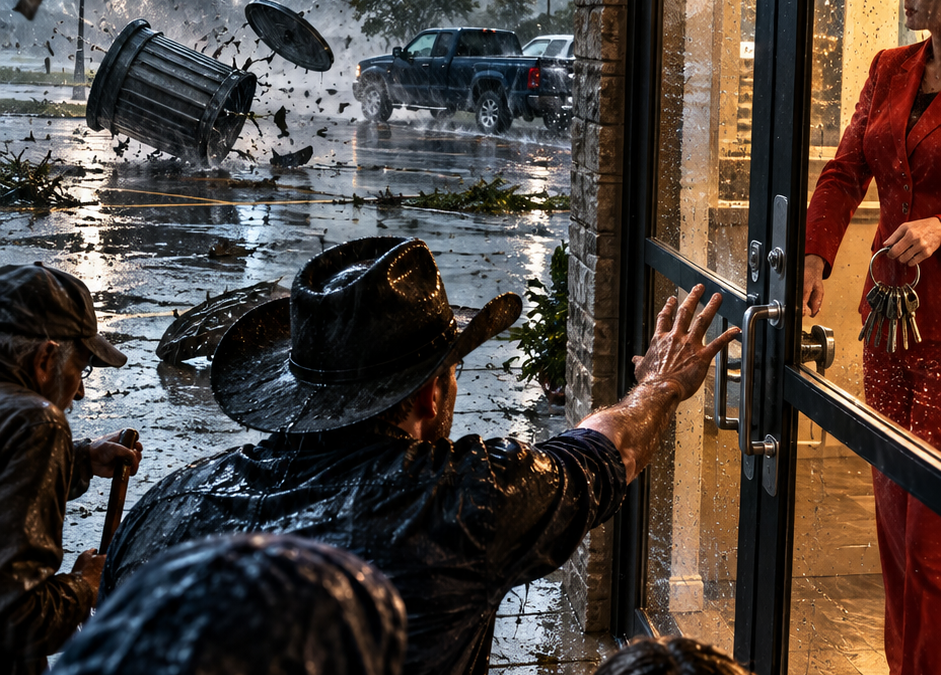
The first trash can hit the clubhouse parking lot hard enough to tear its lid off. The tornado siren was screaming over Cedar Ridge, six people were behind me, and two of them were children. On the other side of the locked glass door, Marissa Keen stood dry, safe, and holding the keys like the storm still needed her permission.
My name is Caleb Dorsey, and until that afternoon, I thought the worst thing an HOA president could do was make people miserable over rules that did not matter.
Wrong paint colors.
Trash cans left out too late.
Holiday lights still hanging on January third.
A pickup parked too close to a curb.
That was the kind of nonsense I had seen from Marissa Keen for years. She had a gift for making small things feel official. She could turn a flowerpot into a violation, a porch chair into a board agenda item, and a resident’s ordinary mistake into a certified letter with a deadline.
But I had never believed her need for control could become dangerous.
Not really.
Then the tornado siren went off.
The sky had already turned wrong by then. Anyone who has lived through enough spring storms knows the color I mean. Green-gray clouds pressed low over the neighborhood. The air smelled like wet asphalt, broken leaves, and electricity. Rain came sideways in violent sheets, slamming against cars and gutters, turning the clubhouse parking lot into a black mirror.
I had been driving back from checking a drainage crossing behind my property when the warning alert hit my phone.
Tornado warning.
Seek shelter immediately.
Cedar Ridge did not have a public storm shelter. Most homes had interior closets or bathrooms, but I was already near the clubhouse, and so were several other residents who had been caught outside when the weather turned. The clubhouse was one of the strongest common buildings in the neighborhood: masonry construction, interior restrooms, storage rooms, a central hallway, and fewer windows than most houses. It was not perfect. But compared with standing in an open parking lot under a tornado warning, it was safety.
So I ran for the door.
By the time I reached it, six people had gathered behind me.
Mrs. Alvarez was there with her two children, a little boy and a girl both soaked through and crying in that silent, stunned way children do when they are too scared to make full sounds. Mr. Harland, who lived two streets over, leaned heavily on his cane, breathing through his mouth. Three other residents crowded beneath the covered entrance while wind shoved rain under the awning.
The first trash can flew across the lot and hit the pavement so hard its lid tore off.
The little girl screamed.
I grabbed the clubhouse handle.
Locked.
I yanked it again, harder.
Still locked.
Inside, ten feet away in the dry lobby, Marissa Keen stood in a red pantsuit, a ring of master keys hanging from her right hand.
She saw us.
There was no mistake about that.
Emergency lights glowed faintly behind her, making her look almost staged: perfectly visible, perfectly dry, perfectly still while the storm tore at everything outside.
“Marissa!” I shouted through the glass. “Open the door!”
She stepped closer, but she kept the glass between us.
“The clubhouse is closed.”
For one second, I thought I had misheard her.
“There’s a tornado warning.”
“This building is not a designated public storm shelter.”
Another gust slammed rain against the glass. Somewhere behind us, a patio chair scraped across the concrete. Mrs. Alvarez pulled both children tight against her legs. Mr. Harland shifted his cane and nearly lost his balance.
I pulled the handle again.
Locked.
“Nobody is asking you to open a public shelter,” I said. “You’ve got residents standing outside in eighty-mile-an-hour wind.”
Marissa’s mouth tightened.
“Unauthorized occupancy creates liability.”
Liability.
That was the word she chose while children stood behind me in a tornado warning.
Water ran off the brim of my cowboy hat and down my jaw. My navy shirt was soaked across the shoulders. Behind her, I could see a dry lobby, heavy interior walls, restrooms, a storage corridor. Behind me was an open parking lot filling with debris.
“Unlock it,” I said.
She lifted the key ring slightly, almost without realizing it.
Then she said, “No.”
I hit the glass once with the flat of my palm.
“There are kids out here.”
“You need to move away from the doors.”
That was when I made my first mistake.
I kept arguing.
Maybe ninety seconds.
Maybe two minutes.
In normal life, two minutes is nothing. Under a tornado siren, two minutes feels expensive. Every second has weight. Every sentence costs something.
I pointed toward Mr. Harland. I pointed toward the children. I told her we could stay away from the windows, that we only needed an interior corridor until the warning passed, that the clubhouse was better than the parking lot.
Marissa answered with rules.
Insurance.
Board policy.
Authorized access.
Facility status.
Every phrase sounded clean and official and completely useless against the wind.
Then the power flickered.
The parking lot lights went black, came back, and somewhere behind us a transformer flashed blue through the rain.
The sound of the wind changed.
Not louder exactly.
Lower.
That was worse.
I turned around.
Beyond the rain, branches bent hard toward the east. My pickup sat forty yards away, a dark blue Ford with two steel toolboxes behind the cab. Past it, behind the clubhouse, I could just make out the service lane running downhill toward the maintenance building.
Concrete block.
Low roof.
No big windows.
I knew that building because I had repaired a drain line there the previous spring after the HOA maintenance contractor quit and the board asked residents for temporary help.
The clubhouse handle was still cold in my hand.
I looked through the glass one last time.
Marissa was already stepping backward.
Then she turned the deadbolt beneath the handle.
A small metallic click.
That sound ended it.
I stopped asking.
“Everybody with me,” I said.
Mrs. Alvarez looked at the locked door, then at me.
“Where?”
I pointed through the rain toward my truck.
“Somewhere we don’t need her keys.”
I took Mr. Harland by the elbow and started across the parking lot as another gust drove the rain almost horizontal.
Behind us, the clubhouse doors stayed locked.
We made it to my truck in twenty seconds.
It felt like five minutes.
I opened both passenger doors and got Mrs. Alvarez and her children inside first, then helped Mr. Harland into the back seat. The other three residents crowded under the left side of the truck while I pulled a yellow rain jacket and a heavy flashlight from the toolbox.
“Maintenance building!” I shouted. “Stay close!”
The service lane was maybe three hundred feet downhill, but the wind kept shoving us sideways. Rain stung my face like thrown gravel. Halfway there, a pine limb dropped across the pavement behind us with a crack I felt through my boots.
Nobody needed convincing after that.
The maintenance building had a steel exterior door with a mechanical latch, not an electronic access system. I knew because I had replaced that latch myself.
I tried the handle.
Locked.
For one second, Marissa’s key ring flashed through my mind.
Then I remembered the old equipment bay around the east side.
“Keep against the wall!”
We moved around the corner where the wind was weaker. The roll-up bay door sat six inches above the concrete because its bottom seal had folded underneath months earlier. I dropped to one knee, reached beneath it, and found the emergency release rope hanging inside.
It took two tries with numb fingers.
The mechanism snapped loose.
I lifted the door three feet.
“Go!”
Everyone crawled under.
I went last and pulled it down behind me.
The sudden quiet was almost worse.
Rain hammered the metal roof. The fluorescent lights were dead, so I set my flashlight on a workbench facing upward. The beam spread across concrete block walls, lawn equipment, bags of ice melt, and an old steel desk.
No windows.
Better than the parking lot.
The little girl was crying without making much sound. Her mother crouched beside her and whispered into her wet hair. Mr. Harland sat on an overturned bucket, both hands wrapped around his cane, his chest rising and falling hard.
I checked my phone.
One bar.
The warning showed the storm moving northeast directly across our side of the county.
I called 911, gave the dispatcher our location, the number of people with me, and told her the clubhouse had remained locked during the warning.
She did not comment on that.
She just said, “Stay where you are. Do not go back outside.”
So we stayed.
Ten minutes later, something heavy struck the building with a deep metallic bang. Dust sifted from a ceiling joint. One of the boys grabbed his mother’s sleeve.
I kept the flashlight steady.
“Building’s still solid,” I said.
My voice sounded calmer than my hands felt.
When the worst of the wind finally moved off, the sirens kept going for a few more minutes. Then came a different sound outside.
Diesel engine.
Air brakes.
I raised the bay door carefully.
A red fire department utility truck was stopped on the service lane, headlights cutting through the gray rain. A broad-shouldered man in turnout pants stepped out and came toward us.
“Everybody okay?”
“Seven of us,” I said. “No injuries.”
He counted faces himself before accepting it.
Only then did he look uphill toward the clubhouse.
Part of the covered entrance had peeled loose. Debris was scattered across the parking lot. A section of awning hung at an angle, dripping rain in heavy sheets.
“Why weren’t you sheltering up there?” he asked.
I wiped rainwater from my forehead.
“We tried.”
He looked at me. “Tried?”
“The HOA president locked us out.”
His expression changed by maybe half an inch.
That was enough.
“During the warning?”
I nodded.
He glanced toward the clubhouse again.
“Show me.”
The fire chief’s name was Russell Boon.
He did not hurry uphill, but nobody had to tell him the difference between moving slowly and wasting time. He walked with his radio in one hand, scanning the damaged trees, the loose awning, and the clubhouse roofline before we reached the entrance.
Marissa saw us coming through the glass.
This time, the door opened before we touched it.
“Chief,” she said, stepping into the doorway.
Her red pantsuit looked almost untouched except for a few dark rain spots along one shoulder.
“We had a controlled access situation.”
Boon stopped under the damaged awning. Water dripped from the edge beside him.
“Were residents denied entry during the tornado warning?”
Marissa’s eyes moved to me.
“The facility was closed, and Mr. Dorsey became confrontational.”
“That wasn’t my question.”
She folded her arms.
“The clubhouse is not an approved public shelter.”
Boon looked through the open doorway.
“Does it have an interior restroom corridor?”
Marissa hesitated. “Yes.”
“Masonry construction?”
“Yes.”
“Emergency lighting?”
Another pause. “Yes.”
He glanced toward the parking lot where one of his firefighters was checking the torn awning.
“And you sent residents back outside.”
“I enforced board policy.”
I felt my wet shirt sticking between my shoulder blades.
Ten minutes earlier, I would have argued every word.
Now, I stayed quiet.
Boon was not asking me to prove anything. He was looking at the building and listening to her choices.
Marissa pointed at me.
“He broke into the maintenance facility.”
“I used the emergency release on the equipment bay,” I said. “Seven people sheltered there until your crew arrived.”
“That area is restricted.”
Boon turned toward me.
“Anybody hurt?”
“No.”
“Any equipment damaged?”
“No.”
He looked back at Marissa.
“Then we’ll deal with access questions after I know these buildings are safe.”
Her posture changed. Not much. Her shoulders squared, and the keys in her hand disappeared behind her hip.
Boon noticed.
“Are those the clubhouse master keys?”
“They’re HOA property.”
“I asked what they are.”
She stared at him.
“Yes.”
He held out his hand.
Marissa did not move.
Rain ticked against the glass doors behind her.
“Why?” she asked.
“Because I need access to every room while my crew checks this structure, and I’m not waiting for somebody to decide which doors I’m allowed to open.”
For the first time that afternoon, she did not have an answer ready.
She placed the key ring in his palm.
The metal made a small, clean sound.
Boon handed it immediately to a firefighter beside him.
“Check the interior rooms, mechanical spaces, and rear exits.”
The firefighter disappeared inside.
Marissa looked at me as if I had arranged the whole thing.
I had not.
That mattered.
I had gotten seven people out of the wind because standing at her locked door had stopped being useful. Chief Boon taking the keys was simply what came next.
Then his radio cracked.
A crew farther north had found power lines down across Cedar Ridge Drive. The main entrance was blocked.
Boon answered, then looked toward the service lane behind the clubhouse.
“That maintenance road connect to County 18?”
“Eventually,” I said. “There’s a drainage crossing about half a mile down.”
“Passable?”
I pictured the creek, the concrete culvert, and the amount of rain we had just taken.
“I don’t know anymore.”
Boon nodded once.
“Then we find out before anyone needs it.”
Marissa stepped forward.
“That road is HOA service access only.”
Boon looked at the keys now hanging from his firefighter’s hand, then back at her.
“Right now, ma’am, I’m less interested in who controls the road than whether it can get an ambulance through.”
I turned toward my truck.
The tornado had moved on, but the storm had left us with a different problem.
And this one was not going to be solved by a locked door.
I took the lead because I knew where the service road got ugly.
Boon followed in the fire department utility truck with one firefighter beside him. Marissa came behind them in her white SUV after insisting she needed to supervise HOA property.
The rain had weakened to a steady hiss, but runoff poured across the road in brown sheets. Broken cedar branches snapped under my tires.
About a quarter mile past the maintenance building, I stopped at the first drainage dip. Water covered the pavement six inches deep and moved fast enough to carry leaves sideways.
I stepped out, rain cold against my neck, and tested the shoulder with the heel of my boot.
Solid gravel.
Boon came up beside me.
“Ambulance?” he asked.
“Slow, maybe. But this isn’t the crossing I’m worried about.”
We continued another thousand feet.
Then I saw orange plastic through the trees.
I hit the brakes.
The old concrete culvert crossing had been narrowed by two decorative stone columns and a black steel gate installed across the service road. I had not been back this far since spring. Fresh mulch surrounded the columns. A keypad box stood on the driver’s side.
Beyond the gate, the road continued toward County 18.
Boon climbed out and stared at it.
“When did that go in?”
“Not when I was working back here.”
Marissa’s SUV stopped behind us. She stepped onto the wet gravel and immediately pointed toward the gate.
“That access was upgraded for security.”
Boon walked to the keypad.
“Open it.”
Marissa did not move.
“Only authorized vendors use this route.”
“The main entrance is blocked by power lines.”
“County crews will clear it.”
Boon’s face stayed flat.
“And until then, this may be our emergency access.”
Marissa folded her arms.
“The gate protects HOA assets.”
I looked past it. Water boiled through the culvert below, carrying sticks and foam downstream. On our side, the road was already collecting runoff because leaves and storm debris had packed against the new stonework.
“Chief,” I said, “look at the ditch.”
He followed my finger.
The original drainage channel had been partly filled to widen the landscaped entrance around the gate. Water that should have moved along the ditch was spilling over the road instead.
Boon crouched near the edge, then stood.
“Who installed this?”
Marissa shifted her eyes toward me.
“It was approved.”
“That wasn’t what I asked.”
She reached into her purse, took out a small remote, and pressed it.
Nothing happened.
She pressed it again.
The gate stayed closed.
“Power’s out,” I said.
“There’s a manual release.”
I walked to the motor housing and found the access panel padlocked.
Marissa lifted her chin.
“The contractor has that key.”
Boon looked back toward the neighborhood.
His radio crackled with a request for a possible medical response on Juniper Court. An elderly resident was having trouble breathing. The main entrance was still inaccessible.
Boon answered immediately, then turned to me.
“How far to County 18 from the other side?”
“Maybe eight-tenths of a mile.”
“Can your truck make it if the crossing holds?”
Before I could answer, Marissa stepped between us and the gate, not touching either of us, but making her position clear.
“You cannot drive through restricted HOA infrastructure without authorization.”
I looked at the water creeping higher across my boots.
Twenty minutes earlier, I had wasted time arguing with her at another locked entrance.
I was not doing it twice.
I walked back to my truck, opened the toolbox, and pulled out a tow strap and a long-handled shovel.
Boon watched me.
“What are you doing?”
“Not touching the gate.”
I pointed toward the clogged drainage channel beside it.
“I’m giving the water somewhere else to go before it takes the road with it.”
I drove the shovel into the wet mulch.
The first cut released a narrow stream.
The second made it wider.
Boon grabbed another shovel from his truck.
Behind us, Marissa stood beside her locked gate while the water began choosing a new path. The channel we cut through the mulch started as a trickle and turned into a muddy stream. Within seconds, water rushed away from the pavement and dropped into the old ditch below the gate columns.
I widened the cut while Boon cleared branches farther downhill. My jeans were soaked from the knees down, and wet clay packed around my boots until every step felt heavy.
Then Boon’s radio snapped alive again.
“Chief, Medic Four is staging at County 18. They can’t reach Juniper from the north entrance.”
Boon raised his radio.
“Stand by.”
He looked through the steel gate toward the road beyond it, then at the padlocked motor housing.
“We need this open now.”
Marissa stepped closer.
“I already told you the contractor controls the manual release.”
“Call him in this weather.”
Boon stared at her for a second.
“Yes, in this weather.”
She pulled out her phone and walked back toward her SUV.
I kept digging.
That was when my shovel struck something hard beneath the mulch.
Not stone.
Plastic.
I scraped mud away and found a black corrugated drainage pipe, maybe eight inches across, crushed nearly flat beneath the decorative fill. I followed its line with my eyes.
It ran directly under one of the new gate columns.
Chief Boon came over.
I pointed. “That used to carry runoff under this shoulder.”
He crouched, pressed two fingers against the collapsed pipe, then looked at the water still spreading along the road.
“They built over it.”
“Looks that way.”
Marissa returned, phone lowered at her side.
“The contractor isn’t answering.”
Boon stood.
“Then your security improvement has blocked an emergency route and compromised drainage during a storm.”
“That is your interpretation.”
Her voice stayed controlled, but her fingers tightened around the phone.
Before Boon could answer, a low cracking sound came from beneath the nearest stone column.
We all turned.
Mud pushed out around its base.
The column shifted less than an inch, but the gate frame moved with it.
Boon immediately raised one hand.
“Everybody back.”
We stepped away.
No collapse came.
The gate simply sat there crooked now, one side lower than the other.
I looked toward the culvert. The crossing itself was still intact, but the landscaped shoulder around the gate was beginning to wash out.
My original idea of testing the road with my truck was finished.
Even if we got the gate open, I was not taking a vehicle across until someone checked the undermined edge.
That cost us our fastest route.
Boon made the same calculation.
“We need another way to Juniper.”
I pictured Cedar Ridge in my head.
Streets.
Fences.
Drainage.
Easements.
Backyards.
Then I remembered the old gravel farm lane behind my property. It predated the subdivision and connected to County 18 through a utility easement. Narrow, rough, but no gate.
“There is one,” I said.
Boon looked at me.
“Vehicle access?”
“For my pickup, yes. Maybe your utility truck. An ambulance would be tight.”
“Can we get the patient out that way instead?”
I nodded. “If we can reach Juniper from inside the neighborhood.”
Boon keyed his radio and changed the plan.
Medic Four would meet us at the county end of my lane. His firefighter would go to Juniper with oxygen and a medical kit. I would guide them through.
Marissa stepped forward.
“You’re routing emergency traffic across private property.”
“Mine,” I said. “I’m giving permission.”
Her mouth opened, then closed.
For the first time all day, she had no lock between us and a solution.
I threw the shovel into my truck bed and climbed behind the wheel. Boon’s utility truck pulled in behind me. In the mirror, the black gate stood crooked between its stone columns while muddy water carved around the base.
Marissa remained beside it, red suit bright against the gray storm, watching us drive away on a route she had never thought to control.
My property sat on the southwest edge of Cedar Ridge, where the subdivision pavement ended against eight acres of pasture my father had refused to sell. When the development went in, the old farm lane still ran behind my equipment shed: two muddy tire tracks between oak trees and a barbed-wire fence.
I swung my pickup through the open cattle gate, jumped out, and dragged a fallen branch clear while Boon waited behind me.
The air smelled like wet leaves, diesel exhaust, and fresh-cut wood.
“How far?” he called.
“Three-quarters of a mile to County 18.”
I climbed back in and kept moving.
The lane dropped toward a shallow creek, crossed on an old concrete slab, then climbed through the back pasture. Water ran over the slab maybe three inches deep.
I stopped before it.
Boon walked forward, crouched at the edge, and watched the current.
“Your call,” he said.
I stepped into the water with a shovel handle and checked the downstream edge.
“Solid concrete. No visible washout. One vehicle at a time.”
I crossed first in low gear.
Boon followed.
Ten minutes later, we reached County 18, where the ambulance waited with its lights flashing against the gray afternoon.
The ambulance could not safely make the narrow creek crossing.
So Boon changed the plan again.
His firefighter rode back with me carrying oxygen and a medical bag while the medic crew prepared to receive the patient at the county road.
We entered Cedar Ridge through my pasture, crossed my backyard, and used a gravel utility strip that opened onto Juniper Court.
Nobody stopped us because there was nothing to unlock.
At the house, the patient was conscious but struggling for breath. The firefighter stabilized him while Boon’s second crew brought a wheeled transport chair from the utility truck. We moved him carefully back along the same route.
At the creek, four of us carried the chair across on foot while Boon kept the vehicles off the slab.
The ambulance crew took over on the far side.
When the rear doors closed, I finally noticed my hands shaking.
Not fear exactly.
Adrenaline with nowhere left to go.
Boon stood beside me watching the ambulance pull onto County 18.
“That lane probably saved us forty minutes,” he said.
I wiped mud from my palm onto my jeans.
“It was just an old farm road.”
“Today it was emergency access.”
His radio chirped. He listened, then looked back toward Cedar Ridge.
County crews still had the main entrance closed. More calls were coming in for storm damage, but nothing immediately life-threatening.
“We’re keeping your lane available until the entrance clears,” he said.
“Fine by me.”
Then another department vehicle rolled up from the county side. A battalion officer stepped out carrying a tablet and spoke quietly with Boon.
I caught only pieces.
Clubhouse locked.
Occupancy.
Blocked secondary route.
Drainage failure.
Boon glanced at me.
“Caleb, I need you back at the clubhouse.”
“Why?”
“Because this stopped being about one locked door.”
When we returned, Marissa was standing beneath the damaged awning with two HOA board members. Her red pantsuit was streaked with mud at the cuffs now. Behind her, down the hill, the crooked service gate was visible, one stone column leaning noticeably toward the ditch.
Boon walked straight to the firefighter holding the clubhouse master ring. He took it, removed the red HOA tag, and handed the entire ring to the battalion officer.
Marissa stepped forward.
“Those keys belong to the association.”
Boon faced her.
“Not while we’re operating an emergency scene.”
“You cannot seize HOA property indefinitely.”
“I don’t need indefinitely.”
He pointed toward the clubhouse, then toward the service road.
“I need uninterrupted access until every emergency route and common building is cleared.”
Marissa looked at me as if I had somehow engineered the moment.
I had not.
My truck was still dripping mud from a road my family had kept open for forty years.
Her new gate was sitting crooked in its own washout.
Boon had her keys, and for the first time since the siren started, Cedar Ridge was functioning without asking her permission.
He did not give Marissa time to turn the keys into another argument.
He assigned one firefighter to the clubhouse entrance, another to the damaged service gate, then asked me to walk the property with him while the battalion officer checked the common areas.
Rain had weakened to a cold mist, but runoff still hissed through gutters and poured brown across the lower parking lot. Marissa followed twenty feet behind us, her heels clicking against wet concrete.
“This inspection is unnecessary,” she said.
Boon kept walking.
“This isn’t an inspection. I’m identifying access points while my crews are still operating.”
We reached the service road.
One side of the gate had dropped nearly six inches where the soil beneath the stone column had washed away. Beyond it, the narrow pavement curved behind the clubhouse and connected with Juniper Court.
I stared at the road longer than Boon did.
I had used that route years earlier when the clubhouse was still being built. Back then, there had been no decorative gate, no electronic lock. Just an open emergency lane wide enough for a fire engine.
“That wasn’t always gated,” I said.
Marissa stopped.
“The association upgraded security.”
Boon looked at the concrete base, then at the keypad housing hanging crooked beside it.
“When?”
“Last year.”
“Who approved restricting this access?”
Her jaw tightened.
“The board approved the improvement.”
Boon crouched near the curb. A strip of red reflective material was half buried beneath mud. He pulled it free with two fingers, wiped it against his glove, and exposed part of an old fire lane marker that had been covered when landscaping stones were installed.
Marissa saw it at the same moment I did.
She stepped closer.
“That doesn’t prove anything.”
“I didn’t say it did,” Boon replied.
His radio cracked before she could continue. A crew at the main entrance reported that a fallen utility pole would keep the road blocked for several more hours.
Boon stood and looked toward my pasture.
“Then your farm lane stays active.”
Marissa turned to me.
“Absolutely not. The HOA cannot authorize residents to cross private agricultural property.”
I looked at her.
“You’re right.”
For half a second, she seemed surprised.
“You can’t authorize it,” I said. “I can.”
I pulled my phone from my pocket and called my neighbor on County 18.
Within fifteen minutes, he arrived with his compact tractor and a box blade. We widened two muddy turns, cleared another fallen limb, and laid crushed limestone from a pile beside my equipment shed across the softest section.
I burned through material I had bought for my own driveway and watched one rear tire carve a rut through pasture grass I had spent years maintaining.
It hurt.
But the road held.
Boon began routing fire department utility vehicles through it, then arranged for residents with urgent medical needs to be escorted out in four-wheel-drive vehicles.
Marissa stood beside the clubhouse as people passed through my gate.
She could no longer control the route because the route did not belong to her.
Near dusk, Boon called me over.
The battalion officer stood beside him with the HOA key ring sealed inside a clear property pouch.
“We found three exterior access points controlled by this ring,” Boon said. “Clubhouse, equipment enclosure, service gate. During an active tornado warning, two were locked against emergency use.”
Marissa crossed her arms.
“They were locked for security.”
Boon’s expression did not change.
“And while we’re operating here, my crews need access without waiting on that security system.”
He handed the pouch to Graham, one of the board members, not Marissa.
“The association can decide who holds these after the emergency access review. Until then, keep them available to responders.”
Graham closed his hand around the pouch.
Marissa stared at it, but he did not pass it over.
The wind pushed cold rain beneath the brim of my hat. I watched another fire department truck roll through the opening in my fence.
Marissa had locked us out to prove she controlled Cedar Ridge.
By nightfall, every safe route through the neighborhood was running through land she had never controlled at all.
By sunrise, the storm had moved east, but Cedar Ridge looked like it had been dragged through a river.
Pine branches covered sidewalks. Shingles clung to wet lawns. The clubhouse parking lot was streaked with mud. I had been awake most of the night, running residents through my pasture road, checking culverts, and spreading another load of limestone where tires had chewed the ground soft.
My boots were soaked through. The navy shirt under my jacket smelled like rain, diesel, and damp earth.
I was closing my tractor shed when Marissa’s SUV rolled up beside my gate.
She stepped out in the same red pantsuit, wrinkled now at the knees and darkened along one cuff.
She did not come onto my property.
“You made your point,” she said.
I rested one hand on the gatepost.
“I was getting people out.”
“You turned my neighborhood into a spectacle.”
“Your neighborhood?”
Her eyes narrowed.
“You know what I mean.”
I did.
That was the problem.
For years, I had treated Marissa’s need for control like bad weather. Something irritating that eventually passed. The tornado had shown me what happened when everybody kept adapting around it.
She looked toward the rutted pasture behind me.
“The board will reimburse reasonable road damage if you stop routing association traffic through here.”
I shook my head.
“No.”
“Then what exactly do you want?”
“A route that works when mine is closed.”
She gave a short laugh.
“The service gate was damaged by the storm.”
“The gate should never have been controlling that lane in the first place.”
Her expression changed.
Not fear.
Calculation.
“Be careful, Caleb.”
She returned to her SUV and left.
Two hours later, Chief Boon came back with a fire marshal and the city’s emergency access coordinator. I met them at the clubhouse service road. Marissa arrived with two board members, but this time nobody waited for her permission.
The fire marshal measured the lane, checked the turning radius, photographed the buried fire lane marker, and examined the electronic gate hardware.
I stayed out of his way.
I did not need to win an argument anymore.
I needed to help restore what should have been there before the storm.
Boon walked the curve with me and pointed toward an ornamental island planted with dwarf spruce.
“That narrows the approach.”
I remembered when the island had been installed. I had even hauled mulch for the landscaping crew as a favor.
That one landed hard.
I had helped make the emergency lane worse without ever asking what the lane was for.
“Take it out,” I said.
Marissa snapped her head toward me.
“You don’t own that island.”
“No,” I said. “But I own the skid steer you’ll need if the board decides it wants this fixed before the next storm.”
One of the board members, a gray-haired man named Graham, stared at the damaged gate, then at the muddy tire tracks disappearing toward my farm.
“How fast?”
“Today, if you want.”
Marissa stepped between us.
“Nobody is authorizing demolition.”
Graham stood beside the other board member with the clear property pouch tucked under one arm, the HOA key ring still visible through the plastic.
Marissa looked at it.
“Once the review is finished, those come back to me.”
Graham glanced toward the damaged gate, then toward the fire marshal measuring the lane.
“We’ll decide that after we know what emergency access actually requires.”
Marissa opened her mouth, but Graham had already turned to the other board member.
“Call the landscaper. Cancel the replacement gate.”
For the first time since the sirens had started the previous afternoon, Marissa had no command ready.
By noon, my skid steer was pushing the ornamental island apart while residents carried broken branches away from the curb. I worked slowly, peeling back wet soil until the original width of the lane emerged beneath it.
Marissa stood under the clubhouse awning, watching the space she had controlled become a road again.
When the last spruce came free, I found another strip of faded red paint along the curb.
Boon saw it and nodded once.
I killed the engine in the sudden quiet.
The restored lane looked almost ordinary.
That was the reversal Marissa had never expected.
I was no longer trying to get my key back.
I was helping build a neighborhood that would never need her key again.
Three days after the tornado, I drove past the clubhouse and almost missed the place where the gate had been.
The leaning stone column was gone. So was the keypad. Fresh gravel filled the shoulder. The ornamental island had been stripped back, and the service lane ran clean and wide from Juniper Court to the rear access road.
Chief Boon stood near the curb with the fire marshal while a fire engine eased through the turn at walking speed. Its tires cleared both sides without touching the grass.
I parked beside my skid steer and watched the engine complete the loop.
Boon looked over at me and raised one thumb.
That was enough.
Marissa arrived a few minutes later.
Her red pantsuit was pressed again. Her ponytail was tight. Her posture was straight. But she stopped when she saw the engine moving through the lane without anyone opening anything for it.
Graham and the other board member were already beside the clubhouse entrance. The fire marshal finished his walkthrough and spoke quietly with Boon.
Graham had the HOA key ring in his hand.
“Clubhouse stays accessible during severe weather activation,” he said. “Emergency access stays unobstructed. No electronic gate goes back on that lane.”
Marissa held out her hand.
“Give me the keys.”
Graham did not move.
The silence lasted maybe two seconds.
It felt longer.
“They’re common property keys.”
“They’ll stay in the secured emergency box and with the designated facilities officer.”
Her hand dropped.
Nobody applauded.
Nobody needed to.
Boon walked toward his truck while the fire engine made one final pass through the restored lane. Before he climbed in, he stopped beside me.
“Your pasture route bought us time when we didn’t have any.”
I looked at the dried mud packed into the tread of my boots.
“Cost me half a driveway pile and a fair stretch of decent grass.”
“Worth it?”
I looked toward the clubhouse.
A maintenance crew was bolting a weatherproof emergency access box onto the wall. Graham placed a duplicate key set inside, closed the lid, and tested the latch.
Then I looked toward the service lane, open now, clear now, useful now.
“Worth it,” I said.
The next Saturday, I repaired the farm lane.
A few Cedar Ridge residents showed up without being asked. One brought gravel. Another brought a landscape rake. The man whose medical emergency had sent us across the pasture came by with his daughter. He was pale and moving slowly, but he was standing.
He shook my hand with both of his and did not say much.
Neither did I.
Some things get smaller when you explain them.
By afternoon, we had filled the worst ruts and reset the cattle gate. I kept the farm lane exactly what it had always been: private land, working ground, and an emergency option if everything else failed.
The difference was that Cedar Ridge no longer depended on it.
Marissa passed once in her SUV.
She slowed near the gate but never stopped. I saw her through the windshield, looking toward the clubhouse, where the service lane now stood open behind her.
I gave her a small nod.
She drove on.
A month later, another line of thunderstorms rolled across the county. Nothing severe came of it, but when the weather alert sounded on my phone, I walked onto the porch and looked toward Cedar Ridge.
The clubhouse lights were on.
The emergency lane was clear.
No chain.
No keypad.
No one standing at a locked door, waiting for permission.
I could smell rain coming over the pasture, cool and metallic against the warm evening air. Behind me, my old farm road disappeared between the oaks toward County 18. Ahead of me, the neighborhood finally had its own way out.
Marissa had believed the keys were what gave her authority.
Losing control of them proved something simpler.
In an emergency, a key is only useful until people build a system that no longer needs the person holding it.








