Major Sterling Thought One Blow Would Keep Me Quiet
𝗙𝗨𝗟𝗟 𝗦𝗧𝗢𝗥𝗬
Then I found the personnel records for three soldiers listed as absent without leave.
Each had raised concerns shortly before disappearing. Two had asked questions about deductions from their pay. The third had attempted to report abuse. Their paperwork said they had walked away from the Army, yet none had contacted the people who had been waiting to hear from them.
I had wanted to investigate those cases openly. My supervisors had agreed that we needed more than an order to turn over files. Records could be altered. Witnesses could be warned. If the three men were alive, speed mattered. If they weren’t, I wanted to know who had last seen them.
A small team continued that work while I came onto the base under cover. I was supposed to observe, document, and leave before anyone learned who I was. We had a secure line and a signal for the team to move if the situation demanded it.
In the back of the MP car, my wrists pressed against the cuffs each time we crossed a rough patch of road. I thought of Leo, left in the room with Sterling. I thought of Brenda being ordered out of the kitchen she had served for two decades. I had exposed myself, and they would bear some of the cost until I returned.
“Corporal,” I said through the partition, “please verify my identification when we arrive.”
Miller kept his eyes on the road. “The major said it was fake.”
“He hasn’t seen it.”
Santino turned slightly in the passenger seat. I could see only part of his face.
“We’re taking you to the provost marshal,” he said.
“That’s where I asked to go.”
Neither of them answered.
At the office, Miller opened the rear door and helped me out. I was unsteady for a second. The blow to my head had left the ground feeling less certain than it should have.
Inside, a desk sergeant looked up from his paperwork.
“What happened to her?”
“Major Sterling ordered her detained,” Miller said. “Assault and impersonation.”
The sergeant studied my face. “Did she get medical attention?”
“Not yet.”
“I’ve asked them to check my credentials,” I said.
The sergeant turned to Miller. “Have you?”
“The major said they were false.”
“That isn’t what I asked.”
Miller’s silence told him enough.
The sergeant came around the desk. He spoke to me more carefully than Miller had.
“Where are they?”
“Right breast pocket. I can take them out when the cuffs are off, or you can retrieve them in front of these two corporals.”
He looked at the cut above my eye and then at the insignia still caught between my fingers.
“Miller. Remove the cuffs.”
“Sergeant, the major ordered—”
“I’ll speak to Major Sterling. Remove them.”
Miller found his keys. His hands shook as he unlocked my wrists. The pressure eased, leaving two red bands on my skin. I took out my credential case and passed it to the sergeant.
He checked the photograph, read the identification, and went to the desk phone. After he verified it through the secure number, he returned the case to me and stood straight.
“Colonel. I’m sorry.”
I wanted to sit down. Instead, I asked for a secure line and medical support. The sergeant gave me both. While he made the medical call, I contacted the team waiting beyond the base.
“This is Vance,” I said. “My cover is compromised. Sterling assaulted me in the mess hall, and MPs brought me to the provost marshal’s office. I need the response team here.”
The duty officer asked whether I was safe.
“For now. Leo Miller and the other witnesses are still in the hall.”
“We’re moving.”
“Has the team checked the area north of the base?”
There was a pause. I heard another voice in the background, too faint to make out.
“They’re at the old ammunition bunkers,” the duty officer said. “We’ll relay what they find.”
I closed my eyes for one breath. I had spent days studying service roads and old maps, looking for a place connected to the missing soldiers’ last known assignments. The bunkers were one possibility. At that moment, I still didn’t know whether the team would find anything there.
“Preserve everything,” I said. “And have legal personnel review the orders before anyone approaches General Thorne.”
The duty officer understood why I had named him. Brigadier General Silas Thorne commanded Camp Vora. His signature appeared on the records marking the three soldiers AWOL. That alone did not prove he knew what had happened to them. It meant he needed to answer questions, and it meant our team had to be prepared before asking.
I hung up. Corporal Miller stood near the door, his face drained of color. Santino looked at my injured forehead and then down at his boots.
“I was wrong,” Santino said quietly.
“You were given conflicting accounts,” I told him. “Then you chose not to check the one thing that could settle them.”
Miller opened his mouth, but I raised a hand. I had little time to spend on their apologies.
“From this point on, write down exactly what each person told you. Include what you saw in the hall. Do it while you remember.”
“Yes, ma’am,” Miller said.
The desk sergeant handed me a clean towel. I wet it at a sink and carefully wiped my face. When I pulled it away from my forehead, fresh blood marked the cloth. The room tilted faintly, and I braced one hand against the sink.
A medic arrived and checked my eyes. She wanted me taken for a full evaluation. I promised I would go as soon as Sterling was away from the witnesses. She disliked that answer, and she made me repeat her warning about a possible concussion before she let me leave.
On the drive back, Miller kept the siren off. The mess hall came into view, its steps crowded with soldiers carrying buckets and mops. Some of them stopped working as our car approached.
I entered with the two MPs behind me.
Sterling stood near the center aisle, directing the cleanup. Leo was helping gather chairs. Hayes stood beside him. Brenda was still behind the counter; apparently Sterling had not yet persuaded her to leave.
“Get every bit of it,” Sterling told a soldier kneeling beside the table. “I don’t want to see a stain.”
He heard the doors and turned.
When he saw me free of the cuffs, he looked first at the MPs.
“Why is she here?”
I walked to the table where he had struck me. Someone had taken away the tray, but a smear of gravy remained along one leg.
“My credentials were verified,” I said.
“That office answers to this command.”
“Identity verification doesn’t.”
His eyes flicked from my face to Miller’s. Corporal Miller stood at attention, unable to meet his gaze. Sterling understood that the explanation he had given them had collapsed.
“You’ve created a misunderstanding,” he said.
“I asked you to examine my ID.”
“You challenged me in front of my troops.”
“I asked you to leave Private Miller alone.”
“That private needed discipline.”
Leo held a chair in both hands. His knuckles had gone white. I wanted to get him out of the hall, but Sterling was still watching everyone, measuring who might speak.
I took out my phone and called the duty officer on the number I had used before. With the line open, I confirmed where I was and that Sterling was present. The officer told me the response team had arrived at the base perimeter. I ended the call.
Sterling watched me pocket the phone.
“What have you done?” he asked.
“Asked for help.”
A low thrum grew outside. Soldiers near the windows looked toward the parade ground as a helicopter approached. Sterling heard it too. His gaze shifted to the doors, then back to me.
“You brought people here because of an argument in a cafeteria?”
“I brought people here because of the complaints your soldiers have been afraid to make. What happened today gave us witnesses.”
For the first time since I had met him, Sterling seemed unsure whom to threaten. He looked at Leo, then at Hayes, and found them both watching him.
The doors opened. Members of the response team entered with legal personnel and a medic. Their lead officer approached Sterling and informed him that he was being relieved of his duties while the allegations were investigated. He told Sterling to keep his hands visible.
Sterling began to protest. Then a voice came from the hallway leading toward the administrative offices.
“Thomas.”
Brigadier General Silas Thorne stepped into the mess hall.
I had been told he was away at a conference. He wore a crisp uniform and moved with the unhurried confidence of a man accustomed to having people clear a path. Sterling’s expression changed at the sight of him. Relief came first.
“Sir,” Sterling said. “I’ve been trying to handle this.”
Thorne stopped beside him and looked at the team, then at my forehead.
“Colonel Vance,” he said. “I would have expected a call before you brought an operation onto my base.”
“I expected you to be in Washington.”
“My schedule changed.”
He offered no further explanation. The room had gone quiet again, though the silence felt different now. Soldiers were watching to see whether the people who had entered with me would hold their ground.
Thorne glanced at the cleaned floor. “I understand there was an altercation.”
“Major Sterling slammed my face into a tray,” I said. “He then accused me of assault and had me detained without checking my credentials.”
“I’ll review the incident. You can send me your report.”
“He’ll remain away from the witnesses while we do.”
Thorne’s gaze settled on Sterling. “Thomas, wait outside.”
Sterling didn’t move. “Sir, she’s trying to take control of the whole base.”
“I heard her,” Thorne said.
For an instant, I thought he might allow Sterling to be escorted out and keep the rest of our conversation private. Then he turned back to me.
“You have exceeded the scope of any inspection I authorized.”
“You didn’t authorize it.”
A muscle moved in his jaw.
I kept my voice level. “We’re also reviewing the records of three soldiers listed as AWOL. They made complaints before they disappeared. You signed the paperwork.”
Thorne folded his hands behind his back. “They deserted. Their records will show it.”
“That’s what I intend to check.”
“You’re doing it by staging a confrontation with a major in a mess hall?”
“Leo Miller dropped his canteen. Sterling’s actions were his own.”
Thorne took a step nearer. “You’ve seen one disciplinary incident and decided you understand a command you’ve known for a few weeks.”
I thought of the letters from parents. I thought of the deductions in pay records and the soldiers who went silent when Sterling entered a room. Most of all, I thought of Leo’s face when he had been asked to deny what he saw.
“I’ve seen enough to keep investigating,” I said.
A message vibrated against my palm. I glanced at the screen. The team north of the base had found disturbed ground near the bunkers. They were securing the area and waiting for the investigators who could examine it properly.
I showed Thorne the location on the map.
His eyes stayed on it for a fraction too long.
“People are at the old bunkers,” I said. “If the missing soldiers were taken there, we’ll find out.”
Sterling’s breathing changed. He looked at Thorne, whose face remained composed.
“You sent a team into a restricted area?” Thorne asked.
“Yes.”
“On whose authority?”
I told him. The legal officer beside the response team had the supporting documents and stepped forward to show them. Thorne barely glanced at the pages.
He looked at me again. “You have no idea what operates through this base.”
“Then explain it.”
His voice dropped. “There are logistics arrangements you aren’t cleared to understand.”
“Those arrangements don’t explain three missing soldiers.”
Thorne held my gaze. “Walk away, Colonel. Let the proper offices handle this before you damage your career over assumptions.”
I had heard a version of that warning from senior officers before. It usually came when they wanted time to learn what an investigator knew. I wasn’t certain yet what the team at the bunkers had found, and I wouldn’t pretend to be. I was certain Thorne wanted me to stop asking.
“No,” I said.
He turned sharply toward Hayes.
“Sergeant. Escort Colonel Vance to the provost marshal’s office. She will remain there while I contact her superiors.”
Hayes looked at me. Then he looked at Leo, who still held the chair in front of him.
When Hayes had lowered his eyes earlier, I had been angry with him. On the drive to the provost marshal’s office, I had wondered how long Sterling had spent teaching him to stay quiet. Now Sterling and Thorne were both watching him. The decision he had avoided at lunch had returned in a room full of witnesses.
Hayes set his radio on the nearest table.
“No, sir,” he said.
Thorne’s expression hardened. “Think carefully.”
“I have.” Hayes turned toward the legal officer. “I saw Major Sterling put his hand on Colonel Vance’s neck and force her face into the tray. He ordered the room to say she attacked him. I heard it.”
Sterling took a step toward him. “Hayes.”
Hayes stood his ground. “I should have said something then.”
The lead officer directed Sterling to remain where he was. Sterling’s hand moved toward his holster. It went no farther. He saw the team watching him and slowly lifted both hands away from his belt.
Thorne did not raise his voice. “Sergeant, you will regret this.”
Hayes swallowed. “Maybe. But I can say what I saw.”
The legal officer asked Thorne to come with him. Thorne refused at first, insisting on making a call. After a brief exchange, he was informed that the investigation covered the records he had signed and the activities at the bunkers. He would be taken from the hall while those matters were examined.
Sterling began talking over them. He said Thorne had approved everything. He said there were accounts I didn’t know about and men above Thorne who expected the logistics pipeline to continue. Each claim brought more questions, and the investigators recorded his words.
I stood beside the table, one hand against its edge. My head hurt badly enough that the floor seemed to shift when I turned. I watched the team escort both men out.
Leo put down the chair.
“Are they coming back?” he asked.
“They won’t be coming back here today,” I said. “There are people ready to hear what happened. You can tell them at your own pace.”
He looked toward the doors long after they had closed. “I told him I didn’t see.”
“I heard you.”
“I saw everything.”
“I know.”
His mouth tightened. “I was scared he’d take my pay. My mom needs it.”
I pulled out a chair, and he sat. Up close, he looked exhausted.
“You can tell the investigators about that too,” I said. “What he threatened. What you were afraid would happen.”
“I thought you were going to get hurt because of me.”
“Sterling made that choice, Leo. You didn’t.”
He nodded, though I could see he would need more than one conversation to believe it.
Brenda came from behind the counter carrying a damp cloth and a paper cup of water. She handed them to me and looked at the dried blood near my eyebrow.
“You need a doctor.”
“The medic agrees with you.”
“She sounds sensible.”
Brenda’s hands had stopped shaking. She glanced at the serving counter. “He said I was fired.”
“I heard him. I’ll make sure that’s in my report.”
She gave me a tired smile. “I was mostly worried he’d do something worse to them after the MPs took you.”
“So was I.”
I sat for a moment while the medic examined me again. Around us, legal personnel began taking names and arranging private interviews away from the hall. No one was asked to speak in front of Sterling. Soldiers who had stared at their plates earlier began approaching one at a time.
Hayes waited until Leo had gone with an interviewer before he came over.
“I knew it was wrong,” he said. “I watched him do it.”
“Yes.”
He looked relieved that I had not tried to spare him that fact. “I told myself I could help the kids if I stayed. Every time I kept quiet, it got easier to do it again.”
I thought of his hand on the radio, of the chair scraping when Sterling pushed me down.
“You spoke today,” I said. “Now tell the investigators about the other times.”
“I will.”
That afternoon, I was taken to the medical clinic. The doctor confirmed a concussion and closed the cut above my eyebrow. For the next several hours, my work consisted mostly of sitting still while other people did the part I had come to Camp Vora to help begin.
Investigators secured the administrative records. The team at the old ammunition bunkers found the remains of three people in shallow graves. Their identities were confirmed later. They were the soldiers listed as AWOL.
I had carried their names through months of paperwork. Hearing that confirmation was different from reading it. Each had a family that had spent that time wondering why he hadn’t come home or called. The people assigned to notify them went in person. I could do nothing to make that visit easier, and I would not describe the discovery as a victory.
The inquiry into the money took longer. Investigators followed pay deductions, payments recruits had been pressured to make, and records connected to the logistics operation Sterling had mentioned. Witnesses who had once refused to put their names to complaints spoke after they were interviewed away from the command that had frightened them. Some remembered dates. Others could only describe what had happened and who had been present. All of it was examined.
Thorne and Sterling were removed from their commands. The cases against them proceeded through the military justice system, along with the investigation into the deaths and the money taken from soldiers. I gave my statement, supplied the notes I had kept during my assignment, and testified to what Sterling had done in the mess hall. The people who had watched it testified too.
For a long time, I remembered the sound of Leo’s canteen more vividly than the blow to my head. It was an ordinary noise. In another mess hall, a private would have picked it up, perhaps embarrassed himself for a second, and gone back to lunch. At Camp Vora, that sound told everyone to be afraid.
Several weeks after my first visit, I returned while the investigations were still underway. My forehead had healed enough that only a narrow mark remained. Camp Vora was quieter when I entered the mess hall, but people were eating and talking. A fork fell somewhere behind me. Its owner picked it up without looking at the doors.
Brenda was at the counter. She saw me and came around to ask how my head was. Hayes stopped by on his way out with a stack of paperwork beneath his arm. He looked tired, though he no longer avoided my eyes.
Leo was sitting with two other soldiers. When he spotted me, he rose, then seemed uncertain whether he was supposed to salute. I waved him back down and joined him for a moment.
“How’s your mother?” I asked.
“She’s doing okay.” He held up a letter he had been reading. “I told her some of what happened.”
“That must have been hard.”
“She already knew something was wrong.” He folded the letter carefully. “I told the investigators I saw Sterling hit you.”
“I know. Thank you.”
He looked at the thin mark near my eyebrow. “I wish I’d said it that day.”
I remembered him standing beneath Sterling’s shadow, trying to protect the pay his mother depended on. I remembered wanting someone in the room to speak and understanding why nobody had.
“You said it when you could,” I told him.
He considered that, then nodded.
I still had the silver eagle in my pocket. I took it out and held it for a moment. Its edges had left a faint impression in my palm the day I tried to make Sterling look at it. I had believed showing him my rank would end the confrontation. Instead, what changed Camp Vora was slower and harder: Brenda calling for help, a desk sergeant checking my ID, Hayes giving his statement, Leo finding the words to give his.
I put the eagle away and left them to their lunch.
As I reached the doors, I heard another canteen fall. It rolled a short distance across the floor. Someone called to its owner, and a few soldiers laughed. Then the room filled again with the sound of people talking.
𝗧𝗛𝗘 𝗘𝗡𝗗
Major Sterling Thought One Blow Would Keep Me Quiet
The canteen hit the floor, and every soldier in the mess hall stopped talking. Major Sterling reached for the private who had dropped it. I stepped between them before I remembered that I was supposed to be invisible.
Private Leo Miller was nineteen. I knew that because I had read his file the night before. I knew he sent most of his pay home to help his mother with her medical bills, that he called her every Sunday when the phone lines were free, and that he had arrived at Camp Vora six weeks earlier believing the Army would give him a way to support her.
None of that should have mattered when his canteen slipped from his hand.
It mattered at Camp Vora.
The canteen struck the concrete floor, bounced twice, and rolled beneath a table. Leo bent to retrieve it. Around him, forks paused halfway to mouths. Nobody laughed at his clumsiness. Nobody offered to help.
They watched the doors.
Major Thomas Sterling had just entered the mess hall.
He stopped when he heard the noise. For a moment he stood beneath the fluorescent lights, scanning the room while Leo stayed crouched beside the table. Sterling was broad through the shoulders, always immaculate, and careful about where he stood when he spoke to soldiers. He liked an audience. In the three weeks I had been on the base, I had watched him turn a late formation, an untucked shirt, and a question about missing pay into public humiliations.
He crossed the room toward Leo.
“Private.”
Leo stood so quickly he struck the edge of the table with his shoulder.
“Yes, sir.”
“What was that?”
“My canteen, sir. I dropped it.”
“I can see that. I asked what it was.”
Leo’s lips parted. He glanced down at the canteen beneath the table, trying to find an answer that would satisfy a man who had already decided there wasn’t one.
“I’m sorry, sir.”
Sterling stepped close enough that Leo had to tilt his head back.
“You think this place is a joke?”
“No, sir.”
“Then why are you throwing equipment around my mess hall?”
Leo’s hands were shaking. I could see him trying to hold them still against the seams of his pants.
Across the room, Sergeant Hayes lowered his eyes to his tray.
I had spent three weeks watching Hayes do that. He had ten years in uniform, knew the rules as well as anyone on the base, and had learned to survive Sterling by looking away at precisely the right moment. Each time, he appeared to hate himself for it.
Sterling reached toward Leo’s collar.
I stood.
“He dropped it, sir,” I said. “It was an accident.”
Sterling’s hand stopped inches from Leo.
Until that moment, I had kept my head down. My faded fatigues carried no visible rank, and my transfer paperwork identified me as a soldier awaiting assignment processing. I ate where I was told, worked where I was sent, and listened. Most people at Camp Vora had stopped noticing me.
Sterling turned to face me.
“What did you say?”
“There’s no need to escalate this, Major.”
The room seemed to contract around us. Leo stared at me. Behind the serving counter, Brenda, the civilian cook, set down a ladle without making a sound.
Sterling took a step closer. I smelled coffee and tobacco on his breath.
“You’re new,” he said.
“Yes, sir.”
“Then I’ll explain something about this base. When I’m speaking to one of my soldiers, you keep your mouth shut.”
I could have apologized. I could have sat down and kept collecting evidence the way I had been instructed to do. Leo might have escaped with a punishment that ended when lunch was over.
But Sterling still stood between him and the door, and Leo looked as though he could barely breathe.
“He made a mistake,” I said.
Sterling put his hand on the back of my neck.
I felt the pressure before I understood how hard he meant to push. My knees struck the bench. The edge of my tray flashed up at me, and then my face hit its metal divider with a crack that rang through the hall.
Pain spread across my forehead and down into my jaw. My vision went white for an instant. Gravy spilled over the table and onto the floor. Something warm ran past my eyebrow.
Sterling kept my head down.
“You don’t correct me,” he said, loud enough for the whole room. “You don’t interfere with discipline. And you don’t make a fool of me in front of my men.”
My cheek rested against mashed potatoes. The metal tray pressed into my brow where I had struck it. I listened for someone to move.
A chair scraped. Then it stopped.
Hayes, I thought.
Sterling leaned nearer. “Are we clear?”
I didn’t answer. I was afraid my voice would shake if I tried.
He held me there another few seconds, long enough to make sure everyone saw. Then he released me and stepped back.
“Get out.”
I gripped the edge of the table and stood. My forehead throbbed. Food clung to my face and uniform. I pulled a napkin from the dispenser and pressed it carefully against the cut above my eyebrow.
Leo was crying without making a sound. He looked at the floor as if this had happened because he had dropped a canteen.
I wanted to tell him that Sterling had been waiting for an excuse. If it hadn’t been Leo, it would have been someone else.
Instead, I looked at Sterling.
“You need to stand down, Major.”
A few soldiers shifted in their seats. Sterling stared at me, apparently unable to believe I was still speaking.
“Get out,” he repeated.
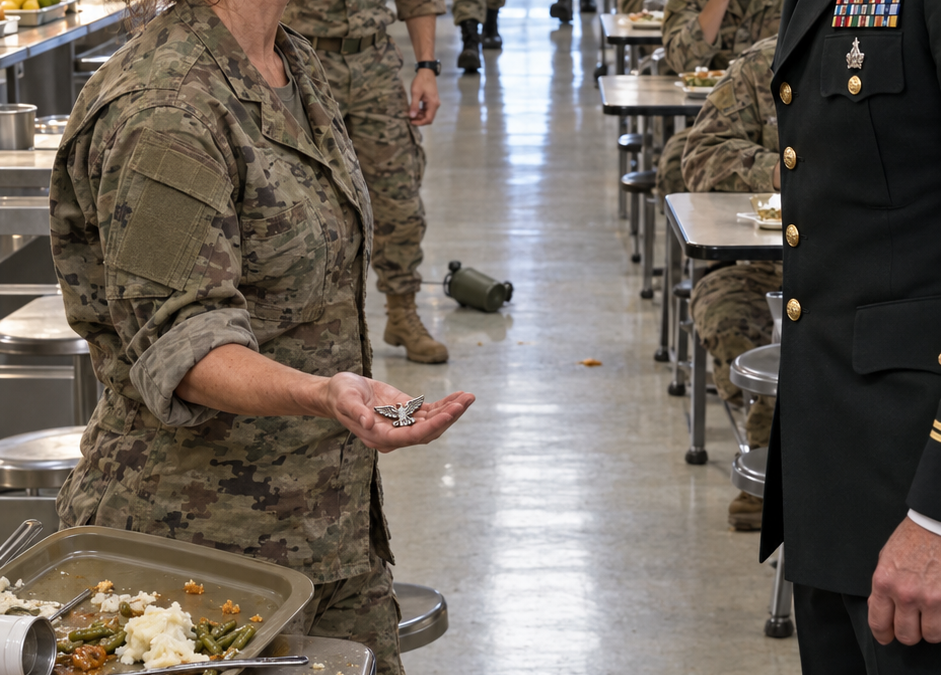
I reached into my breast pocket and took out the silver eagle I had carried there each morning. It lay small and cool in my palm.
“My name is Colonel Elena Vance,” I said. “I’m with the Department of Defense Office of Inspector General.”
Sterling looked at the insignia. Then he looked at my face, streaked with blood and gravy. His expression changed so quickly I nearly missed it: surprise, uncertainty, and finally anger.
“You bought that somewhere,” he said.
“My identification is in this pocket.”
“Stolen valor.” He gave a short laugh, relieved to have found an explanation he liked. “You picked the wrong base for that.”
I had expected him to check my credentials. Even then, with my head pounding, I thought there was a chance he would take one look at the ID and realize what he had done.
Instead, he turned toward Hayes.
“Call the MPs. Tell them we have an impostor who assaulted an officer.”
No one in the mess hall spoke.
Sterling faced the room. “You all saw her come at me.”
He waited.
A soldier at the next table fixed his eyes on his tray. Someone farther back lowered a fork with trembling fingers. Leo glanced at me, then looked away.
I had been sent to Camp Vora because soldiers were afraid to make complaints. Reports had reached our office through families, anonymous letters, and one call that ended when the caller heard footsteps. The allegations described hazing, money taken from recruits, and punishments meant to frighten anyone who considered speaking up.
Standing in that mess hall, I understood how difficult a truthful statement would be to get from any of them. Sterling had just hurt me in front of the entire room, and he was asking them to deny what they had seen. They knew he would be there tomorrow. They had no reason yet to believe I would.
“Private Miller,” Sterling said.
Leo straightened.
“Did she assault me?”
Leo’s eyes filled again. “Sir, I—”
“Answer the question.”
“I didn’t see,” Leo whispered.
Sterling nodded, satisfied, and looked toward the other tables. “Anyone?”
Silence.
Hayes stood near the aisle with his radio in his hand. His jaw was set, but he made no move to use it.
“Sergeant,” I said, “when the MPs arrive, tell them who I say I am. Ask them to verify my credentials.”
Sterling stepped between us. “You will not give orders to my men.”
From behind the serving counter came a small metallic click.
Sterling turned. Brenda stood beside the silent alarm button mounted under the counter. She had worked in that kitchen for twenty years. I had seen her slip extra food onto the trays of soldiers who looked hungry and ask after the families of people whose names Sterling never bothered to learn.
Her hand shook as she drew it back.
“You’re fired,” Sterling told her.
Brenda held his gaze. “I called the MPs.”
“That was your last day here.”
“Then it was my last day.”
The double doors opened before he could answer.
Two military police corporals entered. The one in front announced himself and asked everyone to remain where they were. I watched his eyes take in the spilled tray, the blood on my face, Sterling’s posture, and the stillness of the room.
Sterling reached him first.
“This woman is impersonating a colonel,” he said. “She assaulted me. Put her in a holding cell.”
The corporal looked at me.
“I’m Colonel Elena Vance,” I said. “My identification is in my right breast pocket. You can verify it through the provost marshal’s office.”
Sterling pointed to the eagle in my hand. “That pin means nothing. Cuff her.”
The corporal hesitated. His name tape read MILLER. The younger MP beside him was Santino. Neither man knew what had happened before Brenda pressed the alarm. They could have asked. They could have examined the ID I had offered.
Sterling saw the hesitation and moved closer to Corporal Miller.
“That is an order.”
Miller took out his handcuffs. “Ma’am, turn around, please.”
I held his gaze for a moment. His face was tight with fear.
Then I turned.
The cuffs closed around my wrists. Leo made a broken sound behind me, and I looked over my shoulder.
“Sergeant Hayes,” I said, “stay with Private Miller.”
Hayes raised his head. For the first time since Sterling had entered the hall, he met my eyes.
Sterling laughed. “You won’t be telling anyone what to do from a cell.”
The MPs led me past the tables. Nobody looked up. Brenda stood behind the counter with both hands flat against the steel surface. As I passed, she gave me the smallest nod.
Outside, the midday light made the pain in my head sharpen. Corporal Miller guided me into the back of the patrol car. The door shut, leaving me alone behind the partition.
My reflection in the window was difficult to recognize. One side of my forehead was swelling. Blood had dried near my eyebrow, and gravy stained my collar.
I smiled despite the pain.
I had spent months trying to find proof of what happened when Sterling believed nobody could challenge him. Now I had watched him do it myself. The harder part would be making sure the soldiers who had seen it were safe enough to tell the truth.
The car pulled away from the mess hall.
For three months before I arrived at Camp Vora, I had studied the base from a distance. The first complaint described a recruit forced to pay for equipment he had never damaged. Another described money collected from young soldiers under threat of disciplinary action. Parents wrote that their children sounded frightened on the phone and refused to explain why.
Then I found the personnel records for three soldiers listed as absent without leave.
Each had raised concerns shortly before disappearing. Two had asked questions about deductions from their pay. The third had attempted to report abuse. Their paperwork said they had walked away from the Army, yet none had contacted the people who had been waiting to hear from them.
I had wanted to investigate those cases openly. My supervisors had agreed that we needed more than an order to turn over files. Records could be altered. Witnesses could be warned. If the three men were alive, speed mattered. If they weren’t, I wanted to know who had last seen them.
A small team continued that work while I came onto the base under cover. I was supposed to observe, document, and leave before anyone learned who I was. We had a secure line and a signal for the team to move if the situation demanded it.
In the back of the MP car, my wrists pressed against the cuffs each time we crossed a rough patch of road. I thought of Leo, left in the room with Sterling. I thought of Brenda being ordered out of the kitchen she had served for two decades. I had exposed myself, and they would bear some of the cost until I returned.
“Corporal,” I said through the partition, “please verify my identification when we arrive.”
Miller kept his eyes on the road. “The major said it was fake.”
“He hasn’t seen it.”
Santino turned slightly in the passenger seat. I could see only part of his face.
“We’re taking you to the provost marshal,” he said.
“That’s where I asked to go.”
Neither of them answered.
At the office, Miller opened the rear door and helped me out. I was unsteady for a second. The blow to my head had left the ground feeling less certain than it should have.
Inside, a desk sergeant looked up from his paperwork.
“What happened to her?”
“Major Sterling ordered her detained,” Miller said. “Assault and impersonation.”
The sergeant studied my face. “Did she get medical attention?”
“Not yet.”
“I’ve asked them to check my credentials,” I said.
The sergeant turned to Miller. “Have you?”
“The major said they were false.”
“That isn’t what I asked.”
Miller’s silence told him enough.
The sergeant came around the desk. He spoke to me more carefully than Miller had.
“Where are they?”
“Right breast pocket. I can take them out when the cuffs are off, or you can retrieve them in front of these two corporals.”
He looked at the cut above my eye and then at the insignia still caught between my fingers.
“Miller. Remove the cuffs.”
“Sergeant, the major ordered—”
“I’ll speak to Major Sterling. Remove them.”
Miller found his keys. His hands shook as he unlocked my wrists. The pressure eased, leaving two red bands on my skin. I took out my credential case and passed it to the sergeant.
He checked the photograph, read the identification, and went to the desk phone. After he verified it through the secure number, he returned the case to me and stood straight.
“Colonel. I’m sorry.”
I wanted to sit down. Instead, I asked for a secure line and medical support. The sergeant gave me both. While he made the medical call, I contacted the team waiting beyond the base.
“This is Vance,” I said. “My cover is compromised. Sterling assaulted me in the mess hall, and MPs brought me to the provost marshal’s office. I need the response team here.”
The duty officer asked whether I was safe.
“For now. Leo Miller and the other witnesses are still in the hall.”
“We’re moving.”
“Has the team checked the area north of the base?”
There was a pause. I heard another voice in the background, too faint to make out.
“They’re at the old ammunition bunkers,” the duty officer said. “We’ll relay what they find.”
I closed my eyes for one breath. I had spent days studying service roads and old maps, looking for a place connected to the missing soldiers’ last known assignments. The bunkers were one possibility. At that moment, I still didn’t know whether the team would find anything there.
“Preserve everything,” I said. “And have legal personnel review the orders before anyone approaches General Thorne.”
The duty officer understood why I had named him. Brigadier General Silas Thorne commanded Camp Vora. His signature appeared on the records marking the three soldiers AWOL. That alone did not prove he knew what had happened to them. It meant he needed to answer questions, and it meant our team had to be prepared before asking.
I hung up. Corporal Miller stood near the door, his face drained of color. Santino looked at my injured forehead and then down at his boots.
“I was wrong,” Santino said quietly.
“You were given conflicting accounts,” I told him. “Then you chose not to check the one thing that could settle them.”
Miller opened his mouth, but I raised a hand. I had little time to spend on their apologies.
“From this point on, write down exactly what each person told you. Include what you saw in the hall. Do it while you remember.”
“Yes, ma’am,” Miller said.
The desk sergeant handed me a clean towel. I wet it at a sink and carefully wiped my face. When I pulled it away from my forehead, fresh blood marked the cloth. The room tilted faintly, and I braced one hand against the sink.
A medic arrived and checked my eyes. She wanted me taken for a full evaluation. I promised I would go as soon as Sterling was away from the witnesses. She disliked that answer, and she made me repeat her warning about a possible concussion before she let me leave.
On the drive back, Miller kept the siren off. The mess hall came into view, its steps crowded with soldiers carrying buckets and mops. Some of them stopped working as our car approached.
I entered with the two MPs behind me.
Sterling stood near the center aisle, directing the cleanup. Leo was helping gather chairs. Hayes stood beside him. Brenda was still behind the counter; apparently Sterling had not yet persuaded her to leave.
“Get every bit of it,” Sterling told a soldier kneeling beside the table. “I don’t want to see a stain.”
He heard the doors and turned.
When he saw me free of the cuffs, he looked first at the MPs.
“Why is she here?”
I walked to the table where he had struck me. Someone had taken away the tray, but a smear of gravy remained along one leg.
“My credentials were verified,” I said.
“That office answers to this command.”
“Identity verification doesn’t.”
His eyes flicked from my face to Miller’s. Corporal Miller stood at attention, unable to meet his gaze. Sterling understood that the explanation he had given them had collapsed.
“You’ve created a misunderstanding,” he said.
“I asked you to examine my ID.”
“You challenged me in front of my troops.”
“I asked you to leave Private Miller alone.”
“That private needed discipline.”
Leo held a chair in both hands. His knuckles had gone white. I wanted to get him out of the hall, but Sterling was still watching everyone, measuring who might speak.
I took out my phone and called the duty officer on the number I had used before. With the line open, I confirmed where I was and that Sterling was present. The officer told me the response team had arrived at the base perimeter. I ended the call.
Sterling watched me pocket the phone.
“What have you done?” he asked.
“Asked for help.”
A low thrum grew outside. Soldiers near the windows looked toward the parade ground as a helicopter approached. Sterling heard it too. His gaze shifted to the doors, then back to me.
“You brought people here because of an argument in a cafeteria?”
“I brought people here because of the complaints your soldiers have been afraid to make. What happened today gave us witnesses.”
For the first time since I had met him, Sterling seemed unsure whom to threaten. He looked at Leo, then at Hayes, and found them both watching him.
The doors opened. Members of the response team entered with legal personnel and a medic. Their lead officer approached Sterling and informed him that he was being relieved of his duties while the allegations were investigated. He told Sterling to keep his hands visible.
Sterling began to protest. Then a voice came from the hallway leading toward the administrative offices.
“Thomas.”
Brigadier General Silas Thorne stepped into the mess hall.
I had been told he was away at a conference. He wore a crisp uniform and moved with the unhurried confidence of a man accustomed to having people clear a path. Sterling’s expression changed at the sight of him. Relief came first.
“Sir,” Sterling said. “I’ve been trying to handle this.”
Thorne stopped beside him and looked at the team, then at my forehead.
“Colonel Vance,” he said. “I would have expected a call before you brought an operation onto my base.”
“I expected you to be in Washington.”
“My schedule changed.”
He offered no further explanation. The room had gone quiet again, though the silence felt different now. Soldiers were watching to see whether the people who had entered with me would hold their ground.
Thorne glanced at the cleaned floor. “I understand there was an altercation.”
“Major Sterling slammed my face into a tray,” I said. “He then accused me of assault and had me detained without checking my credentials.”
“I’ll review the incident. You can send me your report.”
“He’ll remain away from the witnesses while we do.”
Thorne’s gaze settled on Sterling. “Thomas, wait outside.”
Sterling didn’t move. “Sir, she’s trying to take control of the whole base.”
“I heard her,” Thorne said.
For an instant, I thought he might allow Sterling to be escorted out and keep the rest of our conversation private. Then he turned back to me.
“You have exceeded the scope of any inspection I authorized.”
“You didn’t authorize it.”
A muscle moved in his jaw.
I kept my voice level. “We’re also reviewing the records of three soldiers listed as AWOL. They made complaints before they disappeared. You signed the paperwork.”
Thorne folded his hands behind his back. “They deserted. Their records will show it.”
“That’s what I intend to check.”
“You’re doing it by staging a confrontation with a major in a mess hall?”
“Leo Miller dropped his canteen. Sterling’s actions were his own.”
Thorne took a step nearer. “You’ve seen one disciplinary incident and decided you understand a command you’ve known for a few weeks.”
I thought of the letters from parents. I thought of the deductions in pay records and the soldiers who went silent when Sterling entered a room. Most of all, I thought of Leo’s face when he had been asked to deny what he saw.
“I’ve seen enough to keep investigating,” I said.
A message vibrated against my palm. I glanced at the screen. The team north of the base had found disturbed ground near the bunkers. They were securing the area and waiting for the investigators who could examine it properly.
I showed Thorne the location on the map.
His eyes stayed on it for a fraction too long.
“People are at the old bunkers,” I said. “If the missing soldiers were taken there, we’ll find out.”
Sterling’s breathing changed. He looked at Thorne, whose face remained composed.
“You sent a team into a restricted area?” Thorne asked.
“Yes.”
“On whose authority?”
I told him. The legal officer beside the response team had the supporting documents and stepped forward to show them. Thorne barely glanced at the pages.
He looked at me again. “You have no idea what operates through this base.”
“Then explain it.”
His voice dropped. “There are logistics arrangements you aren’t cleared to understand.”
“Those arrangements don’t explain three missing soldiers.”
Thorne held my gaze. “Walk away, Colonel. Let the proper offices handle this before you damage your career over assumptions.”
I had heard a version of that warning from senior officers before. It usually came when they wanted time to learn what an investigator knew. I wasn’t certain yet what the team at the bunkers had found, and I wouldn’t pretend to be. I was certain Thorne wanted me to stop asking.
“No,” I said.
He turned sharply toward Hayes.
“Sergeant. Escort Colonel Vance to the provost marshal’s office. She will remain there while I contact her superiors.”
Hayes looked at me. Then he looked at Leo, who still held the chair in front of him.
When Hayes had lowered his eyes earlier, I had been angry with him. On the drive to the provost marshal’s office, I had wondered how long Sterling had spent teaching him to stay quiet. Now Sterling and Thorne were both watching him. The decision he had avoided at lunch had returned in a room full of witnesses.
Hayes set his radio on the nearest table.
“No, sir,” he said.
Thorne’s expression hardened. “Think carefully.”
“I have.” Hayes turned toward the legal officer. “I saw Major Sterling put his hand on Colonel Vance’s neck and force her face into the tray. He ordered the room to say she attacked him. I heard it.”
Sterling took a step toward him. “Hayes.”
Hayes stood his ground. “I should have said something then.”
The lead officer directed Sterling to remain where he was. Sterling’s hand moved toward his holster. It went no farther. He saw the team watching him and slowly lifted both hands away from his belt.
Thorne did not raise his voice. “Sergeant, you will regret this.”
Hayes swallowed. “Maybe. But I can say what I saw.”
The legal officer asked Thorne to come with him. Thorne refused at first, insisting on making a call. After a brief exchange, he was informed that the investigation covered the records he had signed and the activities at the bunkers. He would be taken from the hall while those matters were examined.
Sterling began talking over them. He said Thorne had approved everything. He said there were accounts I didn’t know about and men above Thorne who expected the logistics pipeline to continue. Each claim brought more questions, and the investigators recorded his words.
I stood beside the table, one hand against its edge. My head hurt badly enough that the floor seemed to shift when I turned. I watched the team escort both men out.
Leo put down the chair.
“Are they coming back?” he asked.
“They won’t be coming back here today,” I said. “There are people ready to hear what happened. You can tell them at your own pace.”
He looked toward the doors long after they had closed. “I told him I didn’t see.”
“I heard you.”
“I saw everything.”
“I know.”
His mouth tightened. “I was scared he’d take my pay. My mom needs it.”
I pulled out a chair, and he sat. Up close, he looked exhausted.
“You can tell the investigators about that too,” I said. “What he threatened. What you were afraid would happen.”
“I thought you were going to get hurt because of me.”
“Sterling made that choice, Leo. You didn’t.”
He nodded, though I could see he would need more than one conversation to believe it.
Brenda came from behind the counter carrying a damp cloth and a paper cup of water. She handed them to me and looked at the dried blood near my eyebrow.
“You need a doctor.”
“The medic agrees with you.”
“She sounds sensible.”
Brenda’s hands had stopped shaking. She glanced at the serving counter. “He said I was fired.”
“I heard him. I’ll make sure that’s in my report.”
She gave me a tired smile. “I was mostly worried he’d do something worse to them after the MPs took you.”
“So was I.”
I sat for a moment while the medic examined me again. Around us, legal personnel began taking names and arranging private interviews away from the hall. No one was asked to speak in front of Sterling. Soldiers who had stared at their plates earlier began approaching one at a time.
Hayes waited until Leo had gone with an interviewer before he came over.
“I knew it was wrong,” he said. “I watched him do it.”
“Yes.”
He looked relieved that I had not tried to spare him that fact. “I told myself I could help the kids if I stayed. Every time I kept quiet, it got easier to do it again.”
I thought of his hand on the radio, of the chair scraping when Sterling pushed me down.
“You spoke today,” I said. “Now tell the investigators about the other times.”
“I will.”
That afternoon, I was taken to the medical clinic. The doctor confirmed a concussion and closed the cut above my eyebrow. For the next several hours, my work consisted mostly of sitting still while other people did the part I had come to Camp Vora to help begin.
Investigators secured the administrative records. The team at the old ammunition bunkers found the remains of three people in shallow graves. Their identities were confirmed later. They were the soldiers listed as AWOL.
I had carried their names through months of paperwork. Hearing that confirmation was different from reading it. Each had a family that had spent that time wondering why he hadn’t come home or called. The people assigned to notify them went in person. I could do nothing to make that visit easier, and I would not describe the discovery as a victory.
The inquiry into the money took longer. Investigators followed pay deductions, payments recruits had been pressured to make, and records connected to the logistics operation Sterling had mentioned. Witnesses who had once refused to put their names to complaints spoke after they were interviewed away from the command that had frightened them. Some remembered dates. Others could only describe what had happened and who had been present. All of it was examined.
Thorne and Sterling were removed from their commands. The cases against them proceeded through the military justice system, along with the investigation into the deaths and the money taken from soldiers. I gave my statement, supplied the notes I had kept during my assignment, and testified to what Sterling had done in the mess hall. The people who had watched it testified too.
For a long time, I remembered the sound of Leo’s canteen more vividly than the blow to my head. It was an ordinary noise. In another mess hall, a private would have picked it up, perhaps embarrassed himself for a second, and gone back to lunch. At Camp Vora, that sound told everyone to be afraid.
Several weeks after my first visit, I returned while the investigations were still underway. My forehead had healed enough that only a narrow mark remained. Camp Vora was quieter when I entered the mess hall, but people were eating and talking. A fork fell somewhere behind me. Its owner picked it up without looking at the doors.
Brenda was at the counter. She saw me and came around to ask how my head was. Hayes stopped by on his way out with a stack of paperwork beneath his arm. He looked tired, though he no longer avoided my eyes.
Leo was sitting with two other soldiers. When he spotted me, he rose, then seemed uncertain whether he was supposed to salute. I waved him back down and joined him for a moment.
“How’s your mother?” I asked.
“She’s doing okay.” He held up a letter he had been reading. “I told her some of what happened.”
“That must have been hard.”
“She already knew something was wrong.” He folded the letter carefully. “I told the investigators I saw Sterling hit you.”
“I know. Thank you.”
He looked at the thin mark near my eyebrow. “I wish I’d said it that day.”
I remembered him standing beneath Sterling’s shadow, trying to protect the pay his mother depended on. I remembered wanting someone in the room to speak and understanding why nobody had.
“You said it when you could,” I told him.
He considered that, then nodded.
I still had the silver eagle in my pocket. I took it out and held it for a moment. Its edges had left a faint impression in my palm the day I tried to make Sterling look at it. I had believed showing him my rank would end the confrontation. Instead, what changed Camp Vora was slower and harder: Brenda calling for help, a desk sergeant checking my ID, Hayes giving his statement, Leo finding the words to give his.
I put the eagle away and left them to their lunch.
As I reached the doors, I heard another canteen fall. It rolled a short distance across the floor. Someone called to its owner, and a few soldiers laughed. Then the room filled again with the sound of people talking.








