𝗙𝗨𝗟𝗟 𝗦𝗧𝗢𝗥𝗬 Linda Sent an Excavator Into My Pasture Before the County Map Exposed What She Had Really Done
𝗙𝗨𝗟𝗟 𝗦𝗧𝗢𝗥𝗬
Two neighbors had appeared near the road by then. One was Tom Willis, who lived across from my north fence and had retired from the county road department. He was already filming from behind his mailbox. The other was Melissa Grant, who walked her dog past my pasture every morning and knew my horses by name.
Linda stepped closer.
“Your pasture is blocking runoff from Cedar Ridge,” she said. “Three yards flooded during the last storm. This ditch is necessary.”
“That doesn’t answer whether you have permission to be on my land.”
“We have a permit.”
“You have a permit for something. I’m asking whether it’s for this property.”
For the first time, the foreman looked uncomfortable.
He walked over and asked Linda for the paperwork.
She hesitated.
He held out his hand.
“Let me see it.”
“Why?”
“Because if we’re on the wrong parcel, I need to know that before my equipment goes another foot.”
That was the first sensible sentence I had heard all morning.
Linda reluctantly handed him the permit.
He studied it, then looked at me.
“What’s your parcel number?”
I told him.
His eyes went back to the page.
Linda reached for the paper. “That’s irrelevant.”
The foreman did not give it back.
Instead, he stared toward the stakes his crew had driven through my pasture. Then at the permit. Then back at Linda.
“Ma’am,” he said quietly, “I think we need to stop.”
Linda’s face hardened.
“No. You were hired to finish today.”
The excavator bucket hit the ground again.
Then somewhere beneath the torn grass came a sharp metallic crack.
Every horse in the pasture bolted.
The operator froze.
I ran toward the trench.
A black pipe was sticking through the fresh dirt, split open beneath the excavator bucket. Water began bubbling around it, darkening the soil and filling the bottom of the trench.
The foreman swore under his breath.
Linda looked at me as if I had buried that pipe there years earlier just to inconvenience her that morning.
I pointed my phone directly at the broken line.
“Nobody touches anything else.”
Linda folded her arms. “This project is permitted.”
“Good,” I said. “Then the county shouldn’t have any problem coming out here and confirming exactly what they permitted.”
For the first time since she stepped out of that SUV, Linda stopped arguing.
Not because she agreed.
Because the look on her face told me she knew something about that permit I did not.
She recovered faster than I expected.
Within thirty seconds, she was telling the crew the broken pipe was probably abandoned and ordering them to keep digging around it.
The foreman did not move.
“I’m not putting another bucket in the ground until we know what that is.”
“It’s an old irrigation line,” Linda snapped.
I looked at her. “You didn’t know there was a pipe here five minutes ago.”
Tom Willis had crossed the road now, phone still recording. Melissa followed him and stopped outside the damaged fence.
“Is that your livestock water line?” Tom asked.
I crouched beside the trench. Water was steadily filling the bottom now.
“It feeds the trough by the south paddock.”
As if on cue, one of my mares kicked the empty trough in the distance.
The foreman rubbed both hands over his face.
“Okay,” he said. “We’re done until somebody from the county comes out.”
Linda stepped directly between him and the excavator.
“You have a contract with Cedar Ridge, and you told us access was cleared.”
“It is,” she said.
“No,” I said. “It isn’t.”
Linda turned toward me. Her voice dropped.
“You’ve been warned about drainage before.”
That caught my attention.
“Warned by whom?”
“The HOA.”
“I’m not in your HOA.”
“Your property impacts HOA property.”
“That doesn’t make my property yours.”
Melissa quietly said, “She’s right, Linda.”
Linda spun around. “This isn’t a community discussion.”
It became one almost immediately.
Two more neighbors walked over after seeing the excavator. Then a pickup stopped along the road. Within minutes, half a dozen people were standing near my fence, watching water collect in a trench that had not existed an hour earlier.
Linda pulled out her phone.
She made one call, then another.
Twenty minutes later, a second Cedar Ridge board member arrived. His name was Richard Hale.
Unlike Linda, Richard did not come in angry. He came in nervous.
He walked straight to the trench, looked at the damaged pipe, then asked for the permit.
Linda said, “I have it handled.”
“Let me see it.”
“Richard.”
“Linda, let me see the permit.”
That silence got everyone’s attention.
Finally, she handed it over.
Richard read the first page.
Then the second.
His face changed.
“What?” Tom called from the fence.
Linda grabbed for the papers. “Nothing.”
Richard did not let go immediately.
“Did the county approve the final route?”
“Yes,” Linda said.
“That’s not what I asked.”
The foreman stepped closer. “That’s what I’m trying to figure out too.”
Linda shoved the permit back into her folder.
“The engineer approved the project.”
Richard lowered his voice, but I was close enough to hear him.
“The engineer approved the drainage work behind lots forty-one through forty-six.”
My pasture sat west of Cedar Ridge.
Those lots were east of it.
I looked at Richard.
“Say that again.”
Linda interrupted immediately.
“Parcel boundaries were adjusted during planning.”
“Then show me the adjustment,” I said.
She did not.
Instead, she pointed at the trench.
“We’re dealing with an emergency. If we wait for another storm, homeowners could suffer thousands of dollars in damage.”
I understood the strategy then.
She was not trying to prove she had the right property.
She was trying to make stopping her sound irresponsible.
The foreman was not buying it anymore.
He ordered his crew to load their tools.
Linda exploded.
“If you leave, Cedar Ridge will hold your company responsible for breach of contract.”
He looked at the broken pipe.
“Lady, I’m more worried about who’s responsible for that.”
Then my phone rang.
It was the county public works office. I had left a message less than half an hour earlier.
A woman asked for the permit number.
I read it from the photograph I had taken while Linda was arguing.
There was a pause.
Keyboard clicks.
Another pause.
“Sir,” she finally said, “where exactly are they digging?”
I gave her my address.
She asked me to repeat it.
When I did, her voice became noticeably more careful.
“Do not allow additional excavation if you can safely prevent it.”
Linda was watching me now.
“Why?” I asked.
The woman hesitated.
“Because the address you just gave me does not match the property listed on this permit.”
Nobody spoke.
Even Linda heard that.
Then the woman added the sentence that changed the entire morning.
“Our county engineer is on his way.”
Linda heard every word.
But instead of backing down, she walked toward me and held out her hand.
“Give me your phone.”
For a second, I thought I had misunderstood her.
“What?”
“You contacted the county about an HOA project without authorization. I need to know what you told them.”
Tom actually laughed from the fence.
I did not.
“You entered my pasture, cut my fence, broke my water line, and started digging a drainage ditch across my land. I don’t need your authorization to call anybody.”
Richard stepped between us before Linda could answer.
“Everybody needs to calm down.”
Then the excavator operator shouted, “Hey, we’ve got water moving.”
The trench had filled faster than any of us realized. Water from the broken line was running downhill through the fresh excavation, turning loose soil into brown slurry. It was heading directly toward the gap where the crew had removed my fence.
My horses were still trapped on the far side.
I ran toward the barn.
“Tom, help me close that gap.”
He followed immediately. We dragged two temporary livestock panels from beside the barn and carried them toward the damaged section. Melissa came through the gate and helped us wire one panel to the remaining fence post.
Linda stood twenty feet away making another phone call.
She was not helping.
She was telling someone I had interfered with emergency infrastructure work.
Then a dark pickup pulled up behind the contractor’s trucks.
The driver introduced himself as Daniel Price, another HOA board member.
Linda rushed toward him before he even closed the door.
“The property owner has stopped construction.”
Daniel looked past her at the trench.
“Why is his field flooding?”
“The contractor hit an unmarked line,” Linda said.
“It wasn’t unmarked,” I said. “There was a utility marker beside the fence until your crew pulled it out.”
The foreman turned sharply.
“What marker?”
I pointed toward a pile of removed stakes and fencing.
Tom walked over and picked something from the grass.
A faded blue marker.
The foreman’s jaw tightened.
“That wasn’t there when we started.”
One of his workers raised a hand.
“It was.”
Everyone looked at him.
The worker swallowed.
“I asked about it this morning. She said it was old.”
He pointed at Linda.
The entire mood changed.
Linda’s face went pale, then hard.
“That is not what I said.”
“Yes, ma’am. It is.”
Daniel looked at Richard.
Richard looked at the permit folder.
Then Daniel asked the question Linda clearly did not want anyone asking.
“Who gave the contractor the property map?”
Linda did not answer.
The foreman did.
“HOA president emailed it to our office.”
He pulled out his tablet.
A few taps later, he turned the screen toward us.
There was an aerial map with a thick red line running across my pasture. At the bottom was a note:
Approved drainage easement.
I stared at it.
“I never signed an easement.”
Richard moved closer. “Can you open the original attachment?”
The foreman did.
Daniel leaned over his shoulder.
Then he frowned.
“The parcel number on this map isn’t his.”
Linda reached for the tablet.
The foreman pulled it away.
“No.”
That one word hit harder than shouting.
Linda had lost control of her own contractor.
A vehicle appeared at the end of the road.
White county truck.
Official seal on the door.
Linda immediately straightened her jacket and walked toward the road.
“Let me handle this.”
But the county engineer did not stop beside her.
He drove through the open gate, parked beside the trench, and stepped out carrying a survey map.
He looked at the excavation.
Then at my house.
Then down at his map.
His expression changed almost instantly.
“Who authorized this route?”
Linda raised her folder.
“I did. Under county permit twenty-four dash seven seventy-one.”
The engineer stared at her.
Then he looked across my pasture toward Cedar Ridge.
“No,” he said.
Linda froze.
He unfolded the survey map across the hood of his truck.
“Permit 24-771 doesn’t authorize work here.”
He placed one finger on the map.
“The approved project is over there.”
His finger landed nearly six hundred feet away, on the other side of the subdivision.
For three full seconds, nobody moved.
Then Linda pointed at the engineer’s map.
“That can’t be right.”
The county engineer, Mark Ellison, did not argue.
He simply rotated the survey toward her.
“This is the application your association submitted.”
Linda opened her blue folder and slapped her copy beside it.
“Then why does mine show the drainage line crossing this pasture?”
Mark studied her page.
His eyebrows tightened.
“Where did you get this?”
“From our project file.”
“That’s not what I asked.”
Richard stepped closer.
“Mark, is that an official county map?”
Mark put both documents side by side.
Same permit number.
Same project name.
Same approval date.
Different route.
On the county copy, the proposed drainage ditch ran behind Cedar Ridge lots forty-one through forty-six and emptied into an existing stormwater channel.
On Linda’s copy, the red line had been shifted west, straight across my pasture.
Tom lowered his phone for the first time all morning.
“Somebody changed it.”
Linda immediately shook her head.
“No. There must have been a revision.”
Mark looked at her.
“Revisions come through my office.”
He pulled out his phone, checked something, then said, “No revision.”
The foreman walked over with his tablet.
“This is the file we received from Cedar Ridge.”
Mark compared it to Linda’s paper.
Same altered route.
Daniel muttered, “Oh God.”
Linda heard him.
“Stop acting like anyone committed a crime. We had flooding. We adjusted the solution.”
Mark’s head came up.
“You adjusted an engineered drainage plan?”
“We corrected the route.”
“After approval?”
“It was necessary.”
“And did you submit that change?”
Linda said nothing.
The silence answered for her.
Then Melissa called from near the fence.
“There’s something else.”
She was standing beside the pile of materials the crew had removed that morning. In her hand was a small metal sign covered in dirt.
PRIVATE PROPERTY. NO EASEMENT ACCESS.
I had installed it two years earlier after surveyors marked the pasture boundary.
Melissa turned it over.
Fresh scratches crossed the back where someone had pulled it from the post.
Tom’s camera swung toward Linda.
One of the workers spoke again.
“She told us to take that down.”
Linda snapped around.
“You need to stop making accusations.”
“I’m telling them what happened.”
The foreman looked furious now.
“You told my crew this land belonged to the association.”
“I said the HOA had access rights.”
“You said you owned the drainage corridor.”
Richard stared at Linda.
“Did you?”
She ignored him.
Instead, she turned toward Mark.
“This is becoming ridiculous. Can we finish the work and sort out the paperwork afterward?”
Mark’s answer came immediately.
“No.”
He walked to his truck and pulled out a roll of bright orange tape.
“This site is shut down.”
Linda followed him.
“You don’t have to do that.”
“I absolutely do.”
He tied the tape across the excavated section, then photographed the trench, the damaged pipe, the removed fence, and the contractor stakes.
When he reached the blue utility marker Tom had found, he stopped.
“Who removed this?”
The worker raised his hand halfway.
“I did, but I was told it was abandoned.”
“By whom?”
Nobody needed him to point.
Linda stepped backward.
Then a silver sedan stopped on the road.
An elderly man got out carrying a folder. I recognized him as Mr. Alvarez, who owned lot forty-four inside Cedar Ridge.
He walked directly toward Mark.
“I heard there was a problem with the drainage project.”
Linda tried to intercept him.
“Frank, this is being handled.”
He walked around her.
“No, Linda. I think he needs to see these.”
He opened his folder.
Inside were photographs taken after the last major storm.
They showed water behind lots forty-one through forty-six.
But they showed something else too.
A drainage channel already existed there.
And in one photograph, Linda was standing beside it while a landscaping crew filled it with soil.
Mark stared at the picture.
“When was this taken?”
Mr. Alvarez looked at Linda.
“Three months ago.”
Then he said quietly, “The flooding started after the HOA ordered that channel filled.”
Mark took the photograph and held it beside the county drainage map.
“Where was this channel?”
Mr. Alvarez pointed across Cedar Ridge, behind my fence.
“It ran behind six houses and connected to the culvert near Willow Lane.”
Mark looked at Linda.
“That’s the same corridor your permit was designed to restore.”
Linda crossed her arms.
“It wasn’t functioning properly.”
Mr. Alvarez shook his head.
“It functioned for twelve years.”
“You complained about standing water,” Linda said.
“I complained after you filled it.”
That landed hard.
Daniel asked, “Why was it filled?”
Mr. Alvarez answered before Linda could.
“Because she wanted a landscaped walking path.”
Linda turned on him.
“The board approved that project.”
Richard suddenly looked confused.
“No. We approved landscaping near the retention area. Nobody voted to fill a drainage channel.”
Linda opened her mouth.
Mark cut her off.
“I need photographs of the work.”
“I have more,” Mr. Alvarez said.
He handed me the folder while he searched his phone.
There were printed pictures from different dates. The first showed the old drainage channel, shallow but clear. The second showed landscaping trucks unloading soil. The third showed the channel almost completely buried. Then came photographs after heavy rain.
Water pooling against fences.
Mulch floating through yards.
One basement window with sandbags stacked beneath it.
Melissa looked from the photographs to Linda.
“So the HOA caused the drainage problem.”
Mark answered carefully. “I’m not making that determination yet.”
Then he pointed at the pasture.
“But excavating over here would not restore the approved drainage corridor.”
The foreman’s phone rang.
He answered, listened for ten seconds, then walked away from Linda.
When he returned, his expression was grim.
“My office pulled the email chain.”
Linda stiffened.
“What email chain?”
“The one sending us the construction map.”
He turned the tablet toward Mark.
The first attachment was dated six weeks earlier.
It matched the county plan.
The second had been sent eleven days later from Linda’s HOA email.
The subject line read:
Updated Route — Use This Version.
Mark opened it.
There was the red line across my pasture.
Below the attachment was a message:
County is aware of field adjustment. Proceed under existing permit.
Nobody said anything.
Linda finally spoke.
“That doesn’t mean what you’re implying.”
Mark looked up.
“It means the contractor was told the county knew about a change I never received.”
“I spoke to someone.”
“Who?”
“I don’t remember.”
“What department?”
“It was weeks ago.”
Mark took out a notebook.
“Then we’ll check the call records.”
Linda’s confidence cracked slightly.
Everyone saw it.
Richard stepped away from her and called someone on his phone. Daniel walked toward Mr. Alvarez. The neighbors began talking quietly among themselves. Linda suddenly looked less like the person in charge and more like the only person nobody wanted to stand beside.
Then the foreman noticed something else in the email.
“Wait.”
He zoomed in on the attachment.
At the bottom of the altered map was a signature block.
Property access verified.
Underneath it was my name.
My stomach tightened.
“I never signed that.”
Mark took the tablet.
The signature looked like mine from a distance.
But it was not mine.
Even my last name was misspelled by one letter.
Tom leaned over.
“That’s supposed to be your signature, apparently.”
Linda stepped forward.
“That document came from management.”
Richard ended his phone call.
“No, it didn’t.”
Everyone turned toward him.
His face had gone pale.
“I just spoke to the management company. They have no copy of that form.”
Linda stared at him.
Richard continued, “They also said they warned you in writing that this pasture was outside Cedar Ridge.”
Mark slowly closed his notebook.
A new vehicle turned onto the road.
County seal.
Different department.
Mark looked at it, then at Linda.
“That’ll be code enforcement.”
Linda took one step toward her SUV.
Mark’s voice stopped her.
“Miss Carver, don’t leave yet.”
She turned.
“Why?”
He looked at the altered map on the tablet.
“Because now I need to know who created this document.”
Linda did not make it to her SUV.
The code enforcement truck stopped behind it, blocking the driveway. A woman in a county jacket stepped out and introduced herself as Rachel Monroe.
She took one look at the trench and asked Mark, “How bad?”
“Wrong parcel. Unapproved route. Damaged utility. Possible altered access document.”
Rachel stopped writing.
“Possible what?”
Mark handed her the contractor’s tablet.
Linda immediately stepped forward.
“Before everyone starts using words like altered, I’d like an attorney present.”
Rachel looked at her.
“You’re free to call one. Right now, I’m documenting an active violation.”
Linda pulled out her phone.
Then we heard sirens.
Not loud at first. Just close enough to make everyone turn toward the road.
A sheriff’s cruiser appeared around the bend.
Linda stared at Mark.
“You called the police.”
“I didn’t.”
The foreman raised his hand.
“My office did.”
Linda’s expression changed completely.
The foreman explained that his company had reported suspected fraudulent authorization after finding my name on a property access form I said I had never signed.
The deputy parked beside the county truck. His name was Deputy Harris.
He did not come in aggressively. He asked everyone to stay where they were, requested identification, then started separating people.
Linda hated that immediately.
“I’m HOA president. I can explain the entire situation.”
“I’ll speak with you,” Harris said, “after I speak with the property owner.”
That might have been the first time all morning someone told Linda she was not going first.
I showed him my driver’s license, property records on my phone, and the video I had recorded from the moment the excavator was running.
Then Tom approached.
“I recorded before he did.”
Harris looked at him.
“How much before?”
“About eight minutes.”
Tom opened his video.
The footage showed the crew removing my fence. Then Linda walked into frame. Her voice was clear.
“Take the sign down. The easement supersedes his private property notice.”
A worker asked, “Are we definitely cleared to enter?”
Linda answered without hesitation.
“Yes. County approved and owner acknowledged.”
Harris replayed that part.
Then again.
Linda was twenty feet away, speaking rapidly into her phone. Rachel photographed the removed sign. Mark photographed the blue utility marker. The foreman forwarded the entire email chain to both of them.
Then Harris asked me, “Did you acknowledge access in any form?”
“No.”
“Email?”
“No.”
“Phone?”
“No.”
“Verbal permission?”
“I didn’t even know this project existed until an excavator woke my horses.”
He nodded and wrote it down.
Then Richard approached holding his phone.
“I have something else.”
Linda immediately shouted, “Richard, don’t.”
Everyone looked at her.
That was a mistake.
Harris turned toward Richard.
“What do you have?”
Richard opened an HOA board email from two months earlier.
It was from the management company to Linda, Richard, Daniel, and the other directors. The subject line read:
Property Boundary Concern.
Richard read one sentence aloud.
“Parcel 18-442, the western pasture, is privately owned and is not subject to Cedar Ridge HOA covenants or recorded drainage easements.”
The date was five weeks before Linda sent the altered construction map.
Harris looked toward her.
“Miss Carver, I need to speak with you now.”
Linda ended her phone call.
“My attorney advised me not to answer questions.”
“That’s your right.”
For the first time, she smiled.
It lasted about two seconds.
Rachel walked over from the trench carrying a plastic evidence sleeve.
Inside was a torn piece of paper she had found half buried in the mud. It had apparently fallen from Linda’s blue folder. Across the top were the words:
Original Route Review.
Handwritten beside the approved drainage line was a note:
Too expensive. Shift west through pasture.
Below it were two initials.
L.C.
Linda stared at the paper.
Nobody had to ask whose initials they were.
Then Deputy Harris looked at Mark.
“Is shifting west cheaper?”
Mark nodded slowly.
“By a lot.”
Harris closed his notebook.
Linda finally stopped talking.
She stayed silent until Harris asked the contractor to shut down the excavator completely and provide copies of the site paperwork.
Then she found her voice again.
“You cannot seize HOA records.”
“I’m not seizing anything,” Harris said. “The contractor is voluntarily providing copies of documents they received.”
“They’re confidential.”
The foreman looked at her.
“You sent them to us.”
That ended that argument.
Rachel began measuring the trench while Mark marked the actual parcel boundary with orange flags.
Every new flag made the mistake look worse.
The ditch was not a few feet over the line.
It was entirely on my land.
According to Mark’s measurements, the planned route would have crossed almost four hundred feet of pasture before reaching the creek.
Then one of the workers called him over.
“There’s another stake here.”
It was buried near the far end of the proposed route.
A red ribbon was tied around the top.
The foreman checked his tablet.
“That’s our outlet marker.”
I looked toward the creek.
“If you’d finished, where would the water have gone?”
Mark walked downhill, following the proposed line.
We followed him.
At the bottom of the pasture, he stopped near the creek bank.
His expression tightened.
“Right here.”
Rachel looked over his shoulder.
“That’s not stabilized.”
“No.”
“What does that mean?” I asked.
Mark pointed at the steep bank.
“It means concentrated stormwater would have discharged onto an unprotected slope.”
The foreman stared at Linda.
“You told us there was an approved outlet structure.”
Linda said nothing.
Mark continued walking. Then he noticed fresh pink survey ribbon tied to a tree.
“This isn’t county marking.”
The worker raised his hand again.
“She put those up.”
Linda snapped, “I showed you the intended corridor.”
Harris turned. “You personally marked the route?”
“I identified the general area.”
The worker shook his head.
“You walked the whole thing with us last Friday.”
That got my attention.
Last Friday, I had been away overnight helping my brother repair a trailer. Linda had apparently walked contractors across my pasture while I was not home.
Tom looked at me.
“I saw her SUV here Friday morning. I thought she was talking to somebody at the fence.”
The foreman opened another file.
“We have site photos.”
He scrolled through them.
There was Linda standing beside my barn.
Linda pointing toward the creek.
Linda beside the private property sign that she later ordered removed.
Then one photograph stopped everyone.
She was holding a clipboard.
On it was a printed county map.
The original county map.
The one showing the approved route six hundred feet away.
Richard stared at the screen.
“So you had the correct plan with you.”
Linda’s face went rigid.
“That doesn’t prove anything.”
“It proves you knew where the approved route was,” Daniel said.
She turned on him.
“You don’t understand the cost difference.”
There it was.
Not a denial.
A justification.
Mark asked quietly, “What cost difference?”
Daniel answered.
“The original route required removing part of the new walking path.”
Mr. Alvarez laughed once without humor.
“The path she built over the old drainage channel.”
Richard rubbed both hands over his face.
Linda suddenly pointed at me.
“His pasture was the practical solution. Nobody uses this section for anything except horses.”
I felt something in me change.
All morning, I had stayed calm because I wanted facts. Now I understood the facts.
She had not made a mapping mistake.
She had looked at my land and decided it was cheaper to damage than the HOA’s landscaping.
Deputy Harris stepped between us.
“Ms. Carver, do not approach him.”
Then Rachel’s phone rang.
She listened, asked one question, and looked directly at Linda.
When she hung up, she turned to Mark.
“County records found the electronic permit submission.”
Mark waited.
Rachel held up her phone.
“The map attached when the permit was approved is the original route.”
Linda’s shoulders dropped.
Rachel continued, “The altered pasture map was created twelve days later.”
Harris asked, “Can they tell who uploaded it?”
Rachel nodded.
“Not uploaded.”
She looked at Linda.
“It was never sent to the county at all.”
That sentence changed everything.
Until then, Linda had kept one escape route open.
A misunderstanding.
A revision.
A county employee who supposedly knew about the change.
Rachel had just closed it.
“The county never received this map?” Deputy Harris asked.
“Correct.”
Mark held out his hand for the tablet. Rachel showed him the electronic record on her phone while he compared timestamps.
“The permit was approved May fourteenth,” he said. “Original route only.”
The foreman pointed to his email.
“We received the pasture route May twenty-sixth.”
Richard looked at Linda.
“And you told the contractor the county was aware.”
Linda finally answered.
“I believed they were.”
Mark’s voice stayed calm.
“Based on what?”
She looked around at all of us.
Nobody helped her.
Then Daniel’s phone buzzed.
He read the message and went completely still.
“What now?” Richard asked.
Daniel turned the screen toward him.
“The management company found Linda’s reimbursement request.”
Linda moved immediately.
“That has nothing to do with this.”
Daniel kept reading.
“It was an invoice for preliminary drainage work.”
Attached to it was a cost comparison between restoring the approved channel and cutting a new route through my pasture.
The approved route required removing landscaping, rebuilding part of the walking path, and installing proper drainage structures.
Estimated cost: $47,800.
The pasture route: $16,400.
At the bottom was a handwritten note.
Save 31K if western owner doesn’t object.
Tom stared at me.
“But you never knew.”
“No,” I said.
Richard looked sick.
Daniel scrolled farther.
“There’s an email attached.”
He read silently, then looked at Linda.
“You wrote, ‘Owner unlikely to challenge temporary drainage access.’”
The pasture suddenly felt very quiet.
Even the horses had settled.
I looked at Linda.
“So that’s what this was.”
She did not answer.
“You thought you could dig it before I could stop you.”
“It was supposed to take one day.”
There it was.
The closest thing to an admission we had heard.
Harris wrote something down.
Linda realized what she had said.
“I mean, the contractor scheduled one day.”
Mark folded the county map.
“No legitimate drainage project gets moved onto another parcel because it’s cheaper.”
Rachel handed Linda a printed notice from her truck.
“This is a stop-work order covering all drainage construction associated with this permit pending investigation.”
Linda stared at it.
“All construction?”
“All of it.”
“What about the flooding?”
Mark pointed toward Cedar Ridge.
“The association will need to restore the approved drainage corridor or submit a new engineered plan.”
Mr. Alvarez stepped forward.
“So the walking path?”
Mark looked at him.
“If it’s obstructing permitted drainage, that will be part of the inspection.”
For the first time, Linda looked genuinely frightened.
Not angry.
Frightened.
That walking path had been her signature HOA project—new benches, decorative lights, fresh landscaping, and now the county was looking directly at it.
Then Harris walked over to me.
“Do you want to make a formal property damage report?”
Linda looked up sharply.
I looked at my torn fence, the flooded trench, the broken water line, the excavation scar running through grass my horses had grazed that morning.
“Yes,” I said.
Linda whispered something under her breath.
Harris asked her to repeat it.
She did not.
Then the contractor’s foreman stepped forward.
“Our company will provide every email, map, photograph, and work order we received.”
Richard nodded.
“So will the board.”
Linda turned toward him.
“You don’t speak for the board.”
Richard met her eyes.
“Actually, there’s an emergency meeting tonight.”
She stared at him.
He continued, “Four directors have already requested it.”
Daniel added quietly, “The first agenda item is removing you as president.”
And for the first time since she drove into my pasture, Linda had no order left that anyone was willing to follow.
By sunset, the excavator was gone.
The ditch was not.
It cut across my pasture like a fresh scar, surrounded by orange county tape and temporary livestock panels. The contractor repaired the broken water line before leaving, and my horses finally drank again just after five.
Linda left without speaking to me.
She did not attend the emergency HOA meeting that night.
Richard called me the next morning.
“The board removed her as president.”
I leaned against the same fence post where I had set my coffee the day before.
“Unanimous?”
“Five to zero. Linda didn’t appear.”
He paused.
“There’s more.”
The board had voted to cooperate with the county, preserve every drainage-related email, and pay to restore my pasture without asking me to waive any claims.
“I want everything in writing,” I said.
“You’ll have it today.”
For once, Cedar Ridge kept its word.
Three days later, Mark returned with a survey crew.
They documented the entire excavation, confirmed again that no recorded HOA drainage easement crossed my parcel, and marked the approved route behind lots forty-one through forty-six.
Then the county inspected the walking path.
That inspection lasted almost four hours.
A week later, crews began tearing up part of it.
Mr. Alvarez stood beside me watching an excavator remove the same decorative landscaping that had covered the old drainage channel.
“Funny,” he said. “They could have done this the first time.”
“Would have been cheaper.”
He laughed once.
“Not for Linda’s ego.”
I did not answer.
By then, I did not need to.
The facts had done enough talking.
The contractor restored my fence, filled the unauthorized ditch, compacted the soil, and reseeded the damaged section. They replaced two posts their equipment had cracked. They repaired the water line properly. The HOA paid the bill, not me.
As for the altered access form, Deputy Harris never gave me dramatic updates. He only said the documents had been forwarded for review and that I might be contacted again.
That was fine.
I was not interested in turning the pasture into a courtroom.
I wanted my land back.
About a month later, Cedar Ridge held an open community meeting about the drainage project. Richard invited me.
I almost did not go.
Then Tom said, “You should see this.”
So I did.
The room was packed. Mr. Alvarez brought his photographs. Melissa sat near the front. Even the contractor’s foreman attended.
Richard stood at the podium and displayed two maps on a screen.
The first was the county-approved drainage route.
The second was the altered route across my pasture.
He did not make a speech about Linda.
He did not have to.
He simply explained that the HOA would restore the original drainage corridor and establish a new rule requiring two board members and the management company to verify property access before contractors entered any land outside common areas.
Then something unexpected happened.
A woman from lot forty-three stood up.
She looked directly at me.
“I’m sorry we didn’t ask questions sooner.”
Another homeowner nodded.
Then another.
These were people whose flooded yards had made Linda’s project sound urgent. Now they understood that urgency had been used to justify taking a shortcut through somebody else’s property.
I stood there for a moment, feeling more tired than angry.
Because that was the thing about what Linda had done.
She had not only trespassed on my land.
She had used her own neighbors’ fear to do it.
Two months after the morning the excavator arrived, heavy rain hit.
I woke before sunrise and walked outside expecting trouble.
Water ran through the restored Cedar Ridge channel exactly where the county plan showed it should. No flooded yards. No water across my pasture. No emergency. Just drainage working the way it had before someone decided landscaping mattered more than boundaries.
I walked down to the repaired fence.
The grass over the old trench was coming back.
One of my mares followed me and stopped where the excavator had broken the pipe. She lowered her head and started grazing like the land had finally become ordinary again.
Across the road, Cedar Ridge looked quiet.
Inside my barn office, taped to the wall, was a copy of the county map Mark had given me.
Not because I needed reminding where my property ended.
I knew that.
My father had known it.
The survey knew it.
The fence knew it.
The horses knew it.
I kept the map there because sometimes people with titles, folders, contractors, and urgent voices will try to make you feel unreasonable for defending a boundary they already know exists.
Linda had counted on speed.
She had counted on confusion.
She had counted on the contractor finishing before I could slow the morning down enough for truth to catch up.
But truth did catch up.
It came in phone records, county maps, neighbor videos, email chains, altered documents, witness statements, and one broken water line she had dismissed until the whole pasture was watching it flood.
In the end, Linda did not lose because I shouted louder.
She lost because she left a trail.
And sometimes the most expensive mistake a person can make is assuming someone else’s boundary does not matter simply because they think nobody will stop them.
𝗧𝗛𝗘 𝗘𝗡𝗗
Linda Sent an Excavator Into My Pasture Before the County Map Exposed What She Had Really Done
The first warning came from a man in an orange vest standing thirty yards inside my pasture, telling me my horses had ten minutes to move before his excavator started digging. The second warning was the white SUV rolling through the fence gap they had already cut, with an HOA sign on the door and Linda Carver stepping out like she owned every blade of grass beneath her shoes. The third warning was the permit in her hand—because the moment I saw how tightly she held it, I knew there was something on that paper she did not want me to read.
“You’ve got ten minutes to move those horses,” the foreman shouted, “or they’re going to have to learn how to jump an excavator.”
That was the first thing anyone said to me that morning.
Not good morning.
Not sorry about your fence.
Not we may have made a mistake.
Just ten minutes.
I was standing on my back porch with a coffee mug in my hand, wearing the same work boots I had left beside the door the night before. The sun had barely cleared the top of the cottonwoods near Miller Creek, and the pasture still had that cool early light on it, the kind that makes everything look calmer than it really is.
Then I saw the yellow excavator.
It was parked thirty yards inside my property.
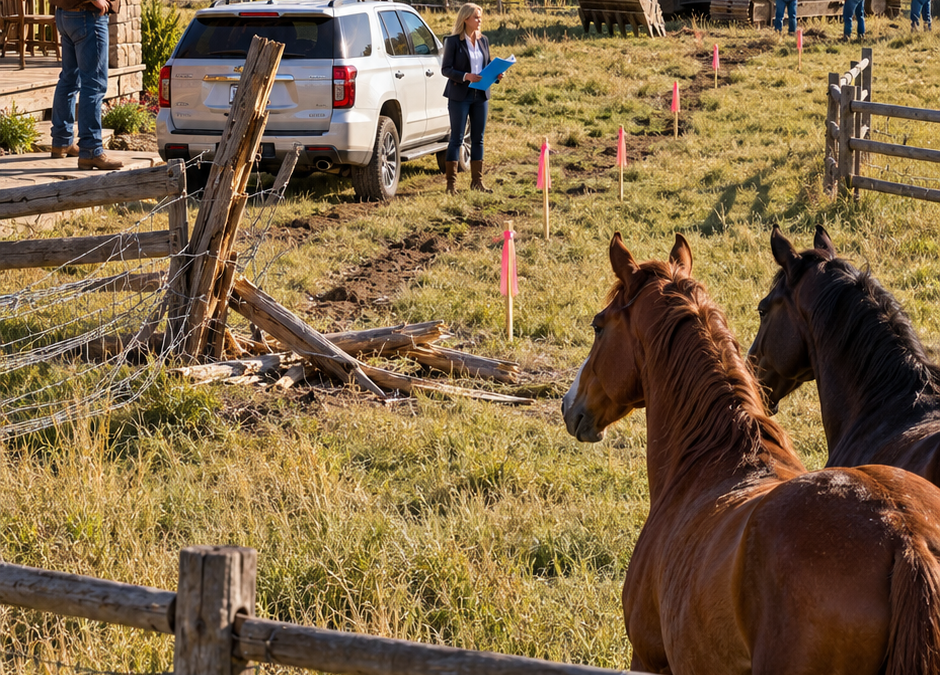
Behind it, four workers had already pulled up a section of fencing and driven wooden stakes through my grass in a crooked line toward the creek. My two mares were pressed against the far fence, heads high, ears sharp, nervous and snorting because the machine had turned their quiet morning into noise, diesel, and fear.
For a moment, I could not make sense of what I was seeing.
A person’s mind resists certain things at first. It tries to make them smaller. Reasonable. Accidental. Maybe the crew was lost. Maybe they had the wrong gate. Maybe someone from the county had authorized work nearby and the address had been mixed up.
Then I saw the white SUV.
It rolled through the opening they had cut in my fence like it had every right to be there. Dust trailed behind the tires. A magnetic sign on the door read Cedar Ridge Homeowners Association.
And then Linda Carver stepped out.
Linda had been HOA president for three years, despite one important fact she always seemed determined to forget: my pasture was not part of Cedar Ridge.
I lived across the road from the subdivision, not inside it. My land had been in private hands long before Cedar Ridge had gates, streetlights, landscaping committees, or residents arguing about mailbox color. My property was not subject to their covenants. My pasture was not HOA common area. My horses did not graze under the authority of Linda Carver.
But you would never have known that from the way she walked toward me.
She carried a blue folder under one arm, held close to her ribs like a weapon she planned to use carefully. Her sunglasses were pushed up on her head. Her hair was perfect. Her expression had the smooth confidence of a woman who believed everyone else’s boundaries existed only until she found a reason to step over them.
“What exactly are you doing?” I called.
The foreman killed the excavator engine.
For one brief second, the pasture went quiet except for my horses breathing hard against the far fence.
Before the foreman could answer, Linda did.
“Emergency drainage correction,” she said.
She said it like the phrase should end the discussion.
I set my coffee mug on the fence post.
“You cut my fence.”
“We’ve notified affected property owners.”
“You didn’t notify me.”
“We sent notice.”
“Where?”
She hesitated.
It was small, barely half a second, but I saw it.
Then she pointed vaguely toward my house.
That was the moment my irritation became suspicion.
I walked through the gap they had cut in my fence and stopped between the excavator and the trench line they had marked through my grass.
“Everybody stops until I see what authorizes you to dig here.”
Linda opened the folder immediately.
Too quickly.
Like she had practiced that part.
“I have county approval.”
She pulled out a photocopied permit and held it toward me without letting go.
That also told me something.
People with clean documents hand them to you. People with questionable documents show them to you just long enough to create the impression of proof.
I leaned closer and read the heading.
Storm Water Drainage Improvement.
There was a permit number. An engineer’s stamp. A project name. A parcel reference buried halfway down the page.
Linda tapped the stamp with one manicured finger.
“Approved.”
“Then give me the permit.”
“I just showed it to you.”
“Give it to me.”
Her smile tightened. “You’re being difficult.”
“No. I’m being a landowner whose fence has been cut.”
Behind us, the excavator started again.
I turned sharply.
“Shut that machine off.”
The operator looked toward the foreman.
Linda raised her voice. “Continue working.”
The bucket dropped.
It tore through the grass and came up carrying a load of dark soil.
That was the moment this stopped being a neighborhood disagreement.
I pulled out my phone and started recording.
“State your name,” I said.
Linda’s expression changed.
“You know my name.”
“Then you won’t mind saying it on camera while your contractor excavates my property.”
Two neighbors had appeared near the road by then. One was Tom Willis, who lived across from my north fence and had retired from the county road department. He was already filming from behind his mailbox. The other was Melissa Grant, who walked her dog past my pasture every morning and knew my horses by name.
Linda stepped closer.
“Your pasture is blocking runoff from Cedar Ridge,” she said. “Three yards flooded during the last storm. This ditch is necessary.”
“That doesn’t answer whether you have permission to be on my land.”
“We have a permit.”
“You have a permit for something. I’m asking whether it’s for this property.”
For the first time, the foreman looked uncomfortable.
He walked over and asked Linda for the paperwork.
She hesitated.
He held out his hand.
“Let me see it.”
“Why?”
“Because if we’re on the wrong parcel, I need to know that before my equipment goes another foot.”
That was the first sensible sentence I had heard all morning.
Linda reluctantly handed him the permit.
He studied it, then looked at me.
“What’s your parcel number?”
I told him.
His eyes went back to the page.
Linda reached for the paper. “That’s irrelevant.”
The foreman did not give it back.
Instead, he stared toward the stakes his crew had driven through my pasture. Then at the permit. Then back at Linda.
“Ma’am,” he said quietly, “I think we need to stop.”
Linda’s face hardened.
“No. You were hired to finish today.”
The excavator bucket hit the ground again.
Then somewhere beneath the torn grass came a sharp metallic crack.
Every horse in the pasture bolted.
The operator froze.
I ran toward the trench.
A black pipe was sticking through the fresh dirt, split open beneath the excavator bucket. Water began bubbling around it, darkening the soil and filling the bottom of the trench.
The foreman swore under his breath.
Linda looked at me as if I had buried that pipe there years earlier just to inconvenience her that morning.
I pointed my phone directly at the broken line.
“Nobody touches anything else.”
Linda folded her arms. “This project is permitted.”
“Good,” I said. “Then the county shouldn’t have any problem coming out here and confirming exactly what they permitted.”
For the first time since she stepped out of that SUV, Linda stopped arguing.
Not because she agreed.
Because the look on her face told me she knew something about that permit I did not.
She recovered faster than I expected.
Within thirty seconds, she was telling the crew the broken pipe was probably abandoned and ordering them to keep digging around it.
The foreman did not move.
“I’m not putting another bucket in the ground until we know what that is.”
“It’s an old irrigation line,” Linda snapped.
I looked at her. “You didn’t know there was a pipe here five minutes ago.”
Tom Willis had crossed the road now, phone still recording. Melissa followed him and stopped outside the damaged fence.
“Is that your livestock water line?” Tom asked.
I crouched beside the trench. Water was steadily filling the bottom now.
“It feeds the trough by the south paddock.”
As if on cue, one of my mares kicked the empty trough in the distance.
The foreman rubbed both hands over his face.
“Okay,” he said. “We’re done until somebody from the county comes out.”
Linda stepped directly between him and the excavator.
“You have a contract with Cedar Ridge, and you told us access was cleared.”
“It is,” she said.
“No,” I said. “It isn’t.”
Linda turned toward me. Her voice dropped.
“You’ve been warned about drainage before.”
That caught my attention.
“Warned by whom?”
“The HOA.”
“I’m not in your HOA.”
“Your property impacts HOA property.”
“That doesn’t make my property yours.”
Melissa quietly said, “She’s right, Linda.”
Linda spun around. “This isn’t a community discussion.”
It became one almost immediately.
Two more neighbors walked over after seeing the excavator. Then a pickup stopped along the road. Within minutes, half a dozen people were standing near my fence, watching water collect in a trench that had not existed an hour earlier.
Linda pulled out her phone.
She made one call, then another.
Twenty minutes later, a second Cedar Ridge board member arrived. His name was Richard Hale.
Unlike Linda, Richard did not come in angry. He came in nervous.
He walked straight to the trench, looked at the damaged pipe, then asked for the permit.
Linda said, “I have it handled.”
“Let me see it.”
“Richard.”
“Linda, let me see the permit.”
That silence got everyone’s attention.
Finally, she handed it over.
Richard read the first page.
Then the second.
His face changed.
“What?” Tom called from the fence.
Linda grabbed for the papers. “Nothing.”
Richard did not let go immediately.
“Did the county approve the final route?”
“Yes,” Linda said.
“That’s not what I asked.”
The foreman stepped closer. “That’s what I’m trying to figure out too.”
Linda shoved the permit back into her folder.
“The engineer approved the project.”
Richard lowered his voice, but I was close enough to hear him.
“The engineer approved the drainage work behind lots forty-one through forty-six.”
My pasture sat west of Cedar Ridge.
Those lots were east of it.
I looked at Richard.
“Say that again.”
Linda interrupted immediately.
“Parcel boundaries were adjusted during planning.”
“Then show me the adjustment,” I said.
She did not.
Instead, she pointed at the trench.
“We’re dealing with an emergency. If we wait for another storm, homeowners could suffer thousands of dollars in damage.”
I understood the strategy then.
She was not trying to prove she had the right property.
She was trying to make stopping her sound irresponsible.
The foreman was not buying it anymore.
He ordered his crew to load their tools.
Linda exploded.
“If you leave, Cedar Ridge will hold your company responsible for breach of contract.”
He looked at the broken pipe.
“Lady, I’m more worried about who’s responsible for that.”
Then my phone rang.
It was the county public works office. I had left a message less than half an hour earlier.
A woman asked for the permit number.
I read it from the photograph I had taken while Linda was arguing.
There was a pause.
Keyboard clicks.
Another pause.
“Sir,” she finally said, “where exactly are they digging?”
I gave her my address.
She asked me to repeat it.
When I did, her voice became noticeably more careful.
“Do not allow additional excavation if you can safely prevent it.”
Linda was watching me now.
“Why?” I asked.
The woman hesitated.
“Because the address you just gave me does not match the property listed on this permit.”
Nobody spoke.
Even Linda heard that.
Then the woman added the sentence that changed the entire morning.
“Our county engineer is on his way.”
Linda heard every word.
But instead of backing down, she walked toward me and held out her hand.
“Give me your phone.”
For a second, I thought I had misunderstood her.
“What?”
“You contacted the county about an HOA project without authorization. I need to know what you told them.”
Tom actually laughed from the fence.
I did not.
“You entered my pasture, cut my fence, broke my water line, and started digging a drainage ditch across my land. I don’t need your authorization to call anybody.”
Richard stepped between us before Linda could answer.
“Everybody needs to calm down.”
Then the excavator operator shouted, “Hey, we’ve got water moving.”
The trench had filled faster than any of us realized. Water from the broken line was running downhill through the fresh excavation, turning loose soil into brown slurry. It was heading directly toward the gap where the crew had removed my fence.
My horses were still trapped on the far side.
I ran toward the barn.
“Tom, help me close that gap.”
He followed immediately. We dragged two temporary livestock panels from beside the barn and carried them toward the damaged section. Melissa came through the gate and helped us wire one panel to the remaining fence post.
Linda stood twenty feet away making another phone call.
She was not helping.
She was telling someone I had interfered with emergency infrastructure work.
Then a dark pickup pulled up behind the contractor’s trucks.
The driver introduced himself as Daniel Price, another HOA board member.
Linda rushed toward him before he even closed the door.
“The property owner has stopped construction.”
Daniel looked past her at the trench.
“Why is his field flooding?”
“The contractor hit an unmarked line,” Linda said.
“It wasn’t unmarked,” I said. “There was a utility marker beside the fence until your crew pulled it out.”
The foreman turned sharply.
“What marker?”
I pointed toward a pile of removed stakes and fencing.
Tom walked over and picked something from the grass.
A faded blue marker.
The foreman’s jaw tightened.
“That wasn’t there when we started.”
One of his workers raised a hand.
“It was.”
Everyone looked at him.
The worker swallowed.
“I asked about it this morning. She said it was old.”
He pointed at Linda.
The entire mood changed.
Linda’s face went pale, then hard.
“That is not what I said.”
“Yes, ma’am. It is.”
Daniel looked at Richard.
Richard looked at the permit folder.
Then Daniel asked the question Linda clearly did not want anyone asking.
“Who gave the contractor the property map?”
Linda did not answer.
The foreman did.
“HOA president emailed it to our office.”
He pulled out his tablet.
A few taps later, he turned the screen toward us.
There was an aerial map with a thick red line running across my pasture. At the bottom was a note:
Approved drainage easement.
I stared at it.
“I never signed an easement.”
Richard moved closer. “Can you open the original attachment?”
The foreman did.
Daniel leaned over his shoulder.
Then he frowned.
“The parcel number on this map isn’t his.”
Linda reached for the tablet.
The foreman pulled it away.
“No.”
That one word hit harder than shouting.
Linda had lost control of her own contractor.
A vehicle appeared at the end of the road.
White county truck.
Official seal on the door.
Linda immediately straightened her jacket and walked toward the road.
“Let me handle this.”
But the county engineer did not stop beside her.
He drove through the open gate, parked beside the trench, and stepped out carrying a survey map.
He looked at the excavation.
Then at my house.
Then down at his map.
His expression changed almost instantly.
“Who authorized this route?”
Linda raised her folder.
“I did. Under county permit twenty-four dash seven seventy-one.”
The engineer stared at her.
Then he looked across my pasture toward Cedar Ridge.
“No,” he said.
Linda froze.
He unfolded the survey map across the hood of his truck.
“Permit 24-771 doesn’t authorize work here.”
He placed one finger on the map.
“The approved project is over there.”
His finger landed nearly six hundred feet away, on the other side of the subdivision.
For three full seconds, nobody moved.
Then Linda pointed at the engineer’s map.
“That can’t be right.”
The county engineer, Mark Ellison, did not argue.
He simply rotated the survey toward her.
“This is the application your association submitted.”
Linda opened her blue folder and slapped her copy beside it.
“Then why does mine show the drainage line crossing this pasture?”
Mark studied her page.
His eyebrows tightened.
“Where did you get this?”
“From our project file.”
“That’s not what I asked.”
Richard stepped closer.
“Mark, is that an official county map?”
Mark put both documents side by side.
Same permit number.
Same project name.
Same approval date.
Different route.
On the county copy, the proposed drainage ditch ran behind Cedar Ridge lots forty-one through forty-six and emptied into an existing stormwater channel.
On Linda’s copy, the red line had been shifted west, straight across my pasture.
Tom lowered his phone for the first time all morning.
“Somebody changed it.”
Linda immediately shook her head.
“No. There must have been a revision.”
Mark looked at her.
“Revisions come through my office.”
He pulled out his phone, checked something, then said, “No revision.”
The foreman walked over with his tablet.
“This is the file we received from Cedar Ridge.”
Mark compared it to Linda’s paper.
Same altered route.
Daniel muttered, “Oh God.”
Linda heard him.
“Stop acting like anyone committed a crime. We had flooding. We adjusted the solution.”
Mark’s head came up.
“You adjusted an engineered drainage plan?”
“We corrected the route.”
“After approval?”
“It was necessary.”
“And did you submit that change?”
Linda said nothing.
The silence answered for her.
Then Melissa called from near the fence.
“There’s something else.”
She was standing beside the pile of materials the crew had removed that morning. In her hand was a small metal sign covered in dirt.
PRIVATE PROPERTY. NO EASEMENT ACCESS.
I had installed it two years earlier after surveyors marked the pasture boundary.
Melissa turned it over.
Fresh scratches crossed the back where someone had pulled it from the post.
Tom’s camera swung toward Linda.
One of the workers spoke again.
“She told us to take that down.”
Linda snapped around.
“You need to stop making accusations.”
“I’m telling them what happened.”
The foreman looked furious now.
“You told my crew this land belonged to the association.”
“I said the HOA had access rights.”
“You said you owned the drainage corridor.”
Richard stared at Linda.
“Did you?”
She ignored him.
Instead, she turned toward Mark.
“This is becoming ridiculous. Can we finish the work and sort out the paperwork afterward?”
Mark’s answer came immediately.
“No.”
He walked to his truck and pulled out a roll of bright orange tape.
“This site is shut down.”
Linda followed him.
“You don’t have to do that.”
“I absolutely do.”
He tied the tape across the excavated section, then photographed the trench, the damaged pipe, the removed fence, and the contractor stakes.
When he reached the blue utility marker Tom had found, he stopped.
“Who removed this?”
The worker raised his hand halfway.
“I did, but I was told it was abandoned.”
“By whom?”
Nobody needed him to point.
Linda stepped backward.
Then a silver sedan stopped on the road.
An elderly man got out carrying a folder. I recognized him as Mr. Alvarez, who owned lot forty-four inside Cedar Ridge.
He walked directly toward Mark.
“I heard there was a problem with the drainage project.”
Linda tried to intercept him.
“Frank, this is being handled.”
He walked around her.
“No, Linda. I think he needs to see these.”
He opened his folder.
Inside were photographs taken after the last major storm.
They showed water behind lots forty-one through forty-six.
But they showed something else too.
A drainage channel already existed there.
And in one photograph, Linda was standing beside it while a landscaping crew filled it with soil.
Mark stared at the picture.
“When was this taken?”
Mr. Alvarez looked at Linda.
“Three months ago.”
Then he said quietly, “The flooding started after the HOA ordered that channel filled.”
Mark took the photograph and held it beside the county drainage map.
“Where was this channel?”
Mr. Alvarez pointed across Cedar Ridge, behind my fence.
“It ran behind six houses and connected to the culvert near Willow Lane.”
Mark looked at Linda.
“That’s the same corridor your permit was designed to restore.”
Linda crossed her arms.
“It wasn’t functioning properly.”
Mr. Alvarez shook his head.
“It functioned for twelve years.”
“You complained about standing water,” Linda said.
“I complained after you filled it.”
That landed hard.
Daniel asked, “Why was it filled?”
Mr. Alvarez answered before Linda could.
“Because she wanted a landscaped walking path.”
Linda turned on him.
“The board approved that project.”
Richard suddenly looked confused.
“No. We approved landscaping near the retention area. Nobody voted to fill a drainage channel.”
Linda opened her mouth.
Mark cut her off.
“I need photographs of the work.”
“I have more,” Mr. Alvarez said.
He handed me the folder while he searched his phone.
There were printed pictures from different dates. The first showed the old drainage channel, shallow but clear. The second showed landscaping trucks unloading soil. The third showed the channel almost completely buried. Then came photographs after heavy rain.
Water pooling against fences.
Mulch floating through yards.
One basement window with sandbags stacked beneath it.
Melissa looked from the photographs to Linda.
“So the HOA caused the drainage problem.”
Mark answered carefully. “I’m not making that determination yet.”
Then he pointed at the pasture.
“But excavating over here would not restore the approved drainage corridor.”
The foreman’s phone rang.
He answered, listened for ten seconds, then walked away from Linda.
When he returned, his expression was grim.
“My office pulled the email chain.”
Linda stiffened.
“What email chain?”
“The one sending us the construction map.”
He turned the tablet toward Mark.
The first attachment was dated six weeks earlier.
It matched the county plan.
The second had been sent eleven days later from Linda’s HOA email.
The subject line read:
Updated Route — Use This Version.
Mark opened it.
There was the red line across my pasture.
Below the attachment was a message:
County is aware of field adjustment. Proceed under existing permit.
Nobody said anything.
Linda finally spoke.
“That doesn’t mean what you’re implying.”
Mark looked up.
“It means the contractor was told the county knew about a change I never received.”
“I spoke to someone.”
“Who?”
“I don’t remember.”
“What department?”
“It was weeks ago.”
Mark took out a notebook.
“Then we’ll check the call records.”
Linda’s confidence cracked slightly.
Everyone saw it.
Richard stepped away from her and called someone on his phone. Daniel walked toward Mr. Alvarez. The neighbors began talking quietly among themselves. Linda suddenly looked less like the person in charge and more like the only person nobody wanted to stand beside.
Then the foreman noticed something else in the email.
“Wait.”
He zoomed in on the attachment.
At the bottom of the altered map was a signature block.
Property access verified.
Underneath it was my name.
My stomach tightened.
“I never signed that.”
Mark took the tablet.
The signature looked like mine from a distance.
But it was not mine.
Even my last name was misspelled by one letter.
Tom leaned over.
“That’s supposed to be your signature, apparently.”
Linda stepped forward.
“That document came from management.”
Richard ended his phone call.
“No, it didn’t.”
Everyone turned toward him.
His face had gone pale.
“I just spoke to the management company. They have no copy of that form.”
Linda stared at him.
Richard continued, “They also said they warned you in writing that this pasture was outside Cedar Ridge.”
Mark slowly closed his notebook.
A new vehicle turned onto the road.
County seal.
Different department.
Mark looked at it, then at Linda.
“That’ll be code enforcement.”
Linda took one step toward her SUV.
Mark’s voice stopped her.
“Miss Carver, don’t leave yet.”
She turned.
“Why?”
He looked at the altered map on the tablet.
“Because now I need to know who created this document.”
Linda did not make it to her SUV.
The code enforcement truck stopped behind it, blocking the driveway. A woman in a county jacket stepped out and introduced herself as Rachel Monroe.
She took one look at the trench and asked Mark, “How bad?”
“Wrong parcel. Unapproved route. Damaged utility. Possible altered access document.”
Rachel stopped writing.
“Possible what?”
Mark handed her the contractor’s tablet.
Linda immediately stepped forward.
“Before everyone starts using words like altered, I’d like an attorney present.”
Rachel looked at her.
“You’re free to call one. Right now, I’m documenting an active violation.”
Linda pulled out her phone.
Then we heard sirens.
Not loud at first. Just close enough to make everyone turn toward the road.
A sheriff’s cruiser appeared around the bend.
Linda stared at Mark.
“You called the police.”
“I didn’t.”
The foreman raised his hand.
“My office did.”
Linda’s expression changed completely.
The foreman explained that his company had reported suspected fraudulent authorization after finding my name on a property access form I said I had never signed.
The deputy parked beside the county truck. His name was Deputy Harris.
He did not come in aggressively. He asked everyone to stay where they were, requested identification, then started separating people.
Linda hated that immediately.
“I’m HOA president. I can explain the entire situation.”
“I’ll speak with you,” Harris said, “after I speak with the property owner.”
That might have been the first time all morning someone told Linda she was not going first.
I showed him my driver’s license, property records on my phone, and the video I had recorded from the moment the excavator was running.
Then Tom approached.
“I recorded before he did.”
Harris looked at him.
“How much before?”
“About eight minutes.”
Tom opened his video.
The footage showed the crew removing my fence. Then Linda walked into frame. Her voice was clear.
“Take the sign down. The easement supersedes his private property notice.”
A worker asked, “Are we definitely cleared to enter?”
Linda answered without hesitation.
“Yes. County approved and owner acknowledged.”
Harris replayed that part.
Then again.
Linda was twenty feet away, speaking rapidly into her phone. Rachel photographed the removed sign. Mark photographed the blue utility marker. The foreman forwarded the entire email chain to both of them.
Then Harris asked me, “Did you acknowledge access in any form?”
“No.”
“Email?”
“No.”
“Phone?”
“No.”
“Verbal permission?”
“I didn’t even know this project existed until an excavator woke my horses.”
He nodded and wrote it down.
Then Richard approached holding his phone.
“I have something else.”
Linda immediately shouted, “Richard, don’t.”
Everyone looked at her.
That was a mistake.
Harris turned toward Richard.
“What do you have?”
Richard opened an HOA board email from two months earlier.
It was from the management company to Linda, Richard, Daniel, and the other directors. The subject line read:
Property Boundary Concern.
Richard read one sentence aloud.
“Parcel 18-442, the western pasture, is privately owned and is not subject to Cedar Ridge HOA covenants or recorded drainage easements.”
The date was five weeks before Linda sent the altered construction map.
Harris looked toward her.
“Miss Carver, I need to speak with you now.”
Linda ended her phone call.
“My attorney advised me not to answer questions.”
“That’s your right.”
For the first time, she smiled.
It lasted about two seconds.
Rachel walked over from the trench carrying a plastic evidence sleeve.
Inside was a torn piece of paper she had found half buried in the mud. It had apparently fallen from Linda’s blue folder. Across the top were the words:
Original Route Review.
Handwritten beside the approved drainage line was a note:
Too expensive. Shift west through pasture.
Below it were two initials.
L.C.
Linda stared at the paper.
Nobody had to ask whose initials they were.
Then Deputy Harris looked at Mark.
“Is shifting west cheaper?”
Mark nodded slowly.
“By a lot.”
Harris closed his notebook.
Linda finally stopped talking.
She stayed silent until Harris asked the contractor to shut down the excavator completely and provide copies of the site paperwork.
Then she found her voice again.
“You cannot seize HOA records.”
“I’m not seizing anything,” Harris said. “The contractor is voluntarily providing copies of documents they received.”
“They’re confidential.”
The foreman looked at her.
“You sent them to us.”
That ended that argument.
Rachel began measuring the trench while Mark marked the actual parcel boundary with orange flags.
Every new flag made the mistake look worse.
The ditch was not a few feet over the line.
It was entirely on my land.
According to Mark’s measurements, the planned route would have crossed almost four hundred feet of pasture before reaching the creek.
Then one of the workers called him over.
“There’s another stake here.”
It was buried near the far end of the proposed route.
A red ribbon was tied around the top.
The foreman checked his tablet.
“That’s our outlet marker.”
I looked toward the creek.
“If you’d finished, where would the water have gone?”
Mark walked downhill, following the proposed line.
We followed him.
At the bottom of the pasture, he stopped near the creek bank.
His expression tightened.
“Right here.”
Rachel looked over his shoulder.
“That’s not stabilized.”
“No.”
“What does that mean?” I asked.
Mark pointed at the steep bank.
“It means concentrated stormwater would have discharged onto an unprotected slope.”
The foreman stared at Linda.
“You told us there was an approved outlet structure.”
Linda said nothing.
Mark continued walking. Then he noticed fresh pink survey ribbon tied to a tree.
“This isn’t county marking.”
The worker raised his hand again.
“She put those up.”
Linda snapped, “I showed you the intended corridor.”
Harris turned. “You personally marked the route?”
“I identified the general area.”
The worker shook his head.
“You walked the whole thing with us last Friday.”
That got my attention.
Last Friday, I had been away overnight helping my brother repair a trailer. Linda had apparently walked contractors across my pasture while I was not home.
Tom looked at me.
“I saw her SUV here Friday morning. I thought she was talking to somebody at the fence.”
The foreman opened another file.
“We have site photos.”
He scrolled through them.
There was Linda standing beside my barn.
Linda pointing toward the creek.
Linda beside the private property sign that she later ordered removed.
Then one photograph stopped everyone.
She was holding a clipboard.
On it was a printed county map.
The original county map.
The one showing the approved route six hundred feet away.
Richard stared at the screen.
“So you had the correct plan with you.”
Linda’s face went rigid.
“That doesn’t prove anything.”
“It proves you knew where the approved route was,” Daniel said.
She turned on him.
“You don’t understand the cost difference.”
There it was.
Not a denial.
A justification.
Mark asked quietly, “What cost difference?”
Daniel answered.
“The original route required removing part of the new walking path.”
Mr. Alvarez laughed once without humor.
“The path she built over the old drainage channel.”
Richard rubbed both hands over his face.
Linda suddenly pointed at me.
“His pasture was the practical solution. Nobody uses this section for anything except horses.”
I felt something in me change.
All morning, I had stayed calm because I wanted facts. Now I understood the facts.
She had not made a mapping mistake.
She had looked at my land and decided it was cheaper to damage than the HOA’s landscaping.
Deputy Harris stepped between us.
“Ms. Carver, do not approach him.”
Then Rachel’s phone rang.
She listened, asked one question, and looked directly at Linda.
When she hung up, she turned to Mark.
“County records found the electronic permit submission.”
Mark waited.
Rachel held up her phone.
“The map attached when the permit was approved is the original route.”
Linda’s shoulders dropped.
Rachel continued, “The altered pasture map was created twelve days later.”
Harris asked, “Can they tell who uploaded it?”
Rachel nodded.
“Not uploaded.”
She looked at Linda.
“It was never sent to the county at all.”
That sentence changed everything.
Until then, Linda had kept one escape route open.
A misunderstanding.
A revision.
A county employee who supposedly knew about the change.
Rachel had just closed it.
“The county never received this map?” Deputy Harris asked.
“Correct.”
Mark held out his hand for the tablet. Rachel showed him the electronic record on her phone while he compared timestamps.
“The permit was approved May fourteenth,” he said. “Original route only.”
The foreman pointed to his email.
“We received the pasture route May twenty-sixth.”
Richard looked at Linda.
“And you told the contractor the county was aware.”
Linda finally answered.
“I believed they were.”
Mark’s voice stayed calm.
“Based on what?”
She looked around at all of us.
Nobody helped her.
Then Daniel’s phone buzzed.
He read the message and went completely still.
“What now?” Richard asked.
Daniel turned the screen toward him.
“The management company found Linda’s reimbursement request.”
Linda moved immediately.
“That has nothing to do with this.”
Daniel kept reading.
“It was an invoice for preliminary drainage work.”
Attached to it was a cost comparison between restoring the approved channel and cutting a new route through my pasture.
The approved route required removing landscaping, rebuilding part of the walking path, and installing proper drainage structures.
Estimated cost: $47,800.
The pasture route: $16,400.
At the bottom was a handwritten note.
Save 31K if western owner doesn’t object.
Tom stared at me.
“But you never knew.”
“No,” I said.
Richard looked sick.
Daniel scrolled farther.
“There’s an email attached.”
He read silently, then looked at Linda.
“You wrote, ‘Owner unlikely to challenge temporary drainage access.’”
The pasture suddenly felt very quiet.
Even the horses had settled.
I looked at Linda.
“So that’s what this was.”
She did not answer.
“You thought you could dig it before I could stop you.”
“It was supposed to take one day.”
There it was.
The closest thing to an admission we had heard.
Harris wrote something down.
Linda realized what she had said.
“I mean, the contractor scheduled one day.”
Mark folded the county map.
“No legitimate drainage project gets moved onto another parcel because it’s cheaper.”
Rachel handed Linda a printed notice from her truck.
“This is a stop-work order covering all drainage construction associated with this permit pending investigation.”
Linda stared at it.
“All construction?”
“All of it.”
“What about the flooding?”
Mark pointed toward Cedar Ridge.
“The association will need to restore the approved drainage corridor or submit a new engineered plan.”
Mr. Alvarez stepped forward.
“So the walking path?”
Mark looked at him.
“If it’s obstructing permitted drainage, that will be part of the inspection.”
For the first time, Linda looked genuinely frightened.
Not angry.
Frightened.
That walking path had been her signature HOA project—new benches, decorative lights, fresh landscaping, and now the county was looking directly at it.
Then Harris walked over to me.
“Do you want to make a formal property damage report?”
Linda looked up sharply.
I looked at my torn fence, the flooded trench, the broken water line, the excavation scar running through grass my horses had grazed that morning.
“Yes,” I said.
Linda whispered something under her breath.
Harris asked her to repeat it.
She did not.
Then the contractor’s foreman stepped forward.
“Our company will provide every email, map, photograph, and work order we received.”
Richard nodded.
“So will the board.”
Linda turned toward him.
“You don’t speak for the board.”
Richard met her eyes.
“Actually, there’s an emergency meeting tonight.”
She stared at him.
He continued, “Four directors have already requested it.”
Daniel added quietly, “The first agenda item is removing you as president.”
And for the first time since she drove into my pasture, Linda had no order left that anyone was willing to follow.
By sunset, the excavator was gone.
The ditch was not.
It cut across my pasture like a fresh scar, surrounded by orange county tape and temporary livestock panels. The contractor repaired the broken water line before leaving, and my horses finally drank again just after five.
Linda left without speaking to me.
She did not attend the emergency HOA meeting that night.
Richard called me the next morning.
“The board removed her as president.”
I leaned against the same fence post where I had set my coffee the day before.
“Unanimous?”
“Five to zero. Linda didn’t appear.”
He paused.
“There’s more.”
The board had voted to cooperate with the county, preserve every drainage-related email, and pay to restore my pasture without asking me to waive any claims.
“I want everything in writing,” I said.
“You’ll have it today.”
For once, Cedar Ridge kept its word.
Three days later, Mark returned with a survey crew.
They documented the entire excavation, confirmed again that no recorded HOA drainage easement crossed my parcel, and marked the approved route behind lots forty-one through forty-six.
Then the county inspected the walking path.
That inspection lasted almost four hours.
A week later, crews began tearing up part of it.
Mr. Alvarez stood beside me watching an excavator remove the same decorative landscaping that had covered the old drainage channel.
“Funny,” he said. “They could have done this the first time.”
“Would have been cheaper.”
He laughed once.
“Not for Linda’s ego.”
I did not answer.
By then, I did not need to.
The facts had done enough talking.
The contractor restored my fence, filled the unauthorized ditch, compacted the soil, and reseeded the damaged section. They replaced two posts their equipment had cracked. They repaired the water line properly. The HOA paid the bill, not me.
As for the altered access form, Deputy Harris never gave me dramatic updates. He only said the documents had been forwarded for review and that I might be contacted again.
That was fine.
I was not interested in turning the pasture into a courtroom.
I wanted my land back.
About a month later, Cedar Ridge held an open community meeting about the drainage project. Richard invited me.
I almost did not go.
Then Tom said, “You should see this.”
So I did.
The room was packed. Mr. Alvarez brought his photographs. Melissa sat near the front. Even the contractor’s foreman attended.
Richard stood at the podium and displayed two maps on a screen.
The first was the county-approved drainage route.
The second was the altered route across my pasture.
He did not make a speech about Linda.
He did not have to.
He simply explained that the HOA would restore the original drainage corridor and establish a new rule requiring two board members and the management company to verify property access before contractors entered any land outside common areas.
Then something unexpected happened.
A woman from lot forty-three stood up.
She looked directly at me.
“I’m sorry we didn’t ask questions sooner.”
Another homeowner nodded.
Then another.
These were people whose flooded yards had made Linda’s project sound urgent. Now they understood that urgency had been used to justify taking a shortcut through somebody else’s property.
I stood there for a moment, feeling more tired than angry.
Because that was the thing about what Linda had done.
She had not only trespassed on my land.
She had used her own neighbors’ fear to do it.
Two months after the morning the excavator arrived, heavy rain hit.
I woke before sunrise and walked outside expecting trouble.
Water ran through the restored Cedar Ridge channel exactly where the county plan showed it should. No flooded yards. No water across my pasture. No emergency. Just drainage working the way it had before someone decided landscaping mattered more than boundaries.
I walked down to the repaired fence.
The grass over the old trench was coming back.
One of my mares followed me and stopped where the excavator had broken the pipe. She lowered her head and started grazing like the land had finally become ordinary again.
Across the road, Cedar Ridge looked quiet.
Inside my barn office, taped to the wall, was a copy of the county map Mark had given me.
Not because I needed reminding where my property ended.
I knew that.
My father had known it.
The survey knew it.
The fence knew it.
The horses knew it.
I kept the map there because sometimes people with titles, folders, contractors, and urgent voices will try to make you feel unreasonable for defending a boundary they already know exists.
Linda had counted on speed.
She had counted on confusion.
She had counted on the contractor finishing before I could slow the morning down enough for truth to catch up.
But truth did catch up.
It came in phone records, county maps, neighbor videos, email chains, altered documents, witness statements, and one broken water line she had dismissed until the whole pasture was watching it flood.
In the end, Linda did not lose because I shouted louder.
She lost because she left a trail.
And sometimes the most expensive mistake a person can make is assuming someone else’s boundary does not matter simply because they think nobody will stop them.








