𝗙𝗨𝗟𝗟 𝗦𝗧𝗢𝗥𝗬 Linda Parked Across My Garage Like My Deed Was Just Another HOA Rule She Could Rewrite
𝗙𝗨𝗟𝗟 𝗦𝗧𝗢𝗥𝗬
She lifted her phone. “I’m calling the board.”
“You do that.”
I walked back toward the garage.
Behind me, she said, “Mark, I’m serious. If you interfere with an authorized HOA operation, there will be consequences.”
I turned around. “There will be consequences either way.”
Then I went inside.
My wife, Rachel, was standing in the kitchen doorway by then, still in her robe, hair pulled into a loose knot. She had heard enough to know something was wrong.
“Why is Linda’s car in our driveway?” she asked.
“Because apparently our driveway has been promoted to community infrastructure.”
Rachel closed her eyes. “Please tell me you’re not going to fight with her in the street.”
“No.”
That surprised her.
“No?”
“I’m calling the proper authorities.”
Her face shifted with relief, then concern. “Do you think they’ll do anything?”
“I’m going to make sure they have every reason to.”
That was one thing my father taught me better than anger.
Documentation.
He spent thirty years as a building inspector, and he used to say, “Never argue with someone who survives on confusion. Make a record and let them argue with that.”
So I started with photographs.
Wide shots showing Linda’s SUV blocking the garage.
Close shots showing the driveway lines.
A photo of the license plate.
A photo of the HOA notice.
A short video from the garage showing that my truck could not exit.
Then I pulled my property file from the office cabinet. The deed. The site plan. The driveway boundary survey from when we bought the house. Everything showed the same thing: the garage and driveway were part of my private lot, not HOA common area, not shared access, not overflow parking, not anything Linda could “temporarily designate” because she wanted to.
I called the non-emergency line first.
I explained calmly that a vehicle was illegally blocking access to my private garage, that the owner refused to move it, and that the obstruction was preventing me from leaving my property.
The dispatcher asked whether there was a dispute.
“Yes,” I said. “The HOA president is claiming she has authority to use my driveway. I have property records proving otherwise.”
The dispatcher asked whether anyone was threatening anyone.
“No.”
“Is the vehicle occupied?”
“No.”
“Is it blocking the only vehicle exit?”
“Yes.”
She said an officer would be sent when available.
Then I called the city parking enforcement office.
Then I called Jake Rourke.
Jake was the city’s contracted recovery coordinator for complicated vehicle removals. I knew him because years earlier, a construction truck had blocked our alley during a drainage project, and Jake had been the one who handled the removal after the driver disappeared. He was calm, procedural, and allergic to nonsense.
When he answered, I said, “Jake, I have an HOA president’s SUV blocking my garage, and she refuses to move it.”
There was a pause.
Then he said, “That sentence got worse with every word.”
“I have photos, property records, and the HOA notice she gave me.”
“Send everything.”
I did.
While I waited, Linda remained outside, pacing near her SUV and making calls.
I could hear fragments through the open garage.
“He’s being unreasonable.”
“No, he has not been authorized to interfere.”
“The board directive is clear.”
“He’s threatening to escalate.”
That one almost made me laugh.
Threatening to escalate.
Her SUV was blocking my only way out, and somehow my phone call was the escalation.
A police officer arrived forty minutes later.
Officer Grant Wallace was young but not inexperienced. He had the composed expression of someone who had learned to listen before deciding who was wasting his time.
Linda approached him before he reached my driveway.
“Officer, I’m Linda Marsh, president of the Willow Creek HOA. We have an uncooperative homeowner interfering with approved community parking operations.”
Officer Wallace looked at the SUV.
Then he looked at my open garage.
Then he looked back at Linda.
“Is that your vehicle?”
“Yes.”
“Is that his garage?”
Linda hesitated. “The driveway area has been temporarily designated—”
“Ma’am,” he said, “is that his garage?”
Her mouth tightened. “Yes, but—”
He turned to me. “Sir, you called?”
“Yes. My name is Mark Ellison. That vehicle is blocking my garage. I asked Ms. Marsh to move it. She refused. Here are the property records, photos, and the notice she gave me.”
I handed him the folder.
He reviewed the HOA notice first. I could tell exactly when he reached the phrase private-facing access areas because one eyebrow moved slightly.
Then he looked at the deed and site plan.
“Do you have any document showing the HOA has a right to block this driveway?” he asked Linda.
She lifted her folder again. “The board issued a temporary directive.”
“That’s not what I asked.”
“It is association policy.”
“Does it contain homeowner authorization?”
“The board has authority to regulate parking.”
“On private driveways?”
Linda’s voice sharpened. “The HOA regulates the community.”
Officer Wallace looked at her for a long moment.
“Regulating parking is not the same as taking control of a homeowner’s driveway.”
For the first time that morning, Linda’s confidence flickered.
Only briefly.
Then she recovered.
“I am not moving my vehicle until the board’s authority is recognized.”
Officer Wallace nodded slowly, as if she had just confirmed something important.
“Then we’ll proceed with removal.”
Linda blinked. “Excuse me?”
“If you refuse to move a vehicle blocking private access, it can be removed.”
“You cannot tow my SUV.”
He looked at the driveway angle, the narrow street, and the decorative HOA planters Linda herself had approved along the curb months earlier. A standard tow truck would have struggled to get the right angle without damaging the vehicle or the stone entry posts beside my driveway.
“I’m not the recovery operator,” he said. “But the obstruction will be handled.”
Linda stepped closer. “Officer, do you understand who I am?”
That was when Rachel, standing beside me, muttered, “Here we go.”
Officer Wallace’s expression cooled by about ten degrees.
“Yes, ma’am,” he said. “You’re the registered owner of the vehicle blocking this garage.”
Linda started calling people again.
I did not.
At that point, I had done what I needed to do. I had made the record. I had provided proof. I had stayed calm. The process was now larger than Linda’s voice.
Less than an hour after I first found her SUV, the recovery crew arrived.
Not with the usual tow setup.
With two trucks, three technicians, and Jake Rourke stepping out in a reflective vest, holding a clipboard and looking like a man who had already had enough of everyone.
Linda marched toward him.
“Are you in charge?”
Jake looked at her SUV, then at the garage, then down at his paperwork.
“I’m coordinating the recovery.”
“This is my vehicle.”
“Correct.”
“You do not have permission to touch it.”
Jake pointed toward my garage. “Ownership isn’t the issue. Location is.”
Linda stared at him.
He continued, “Your vehicle is obstructing private access. You were asked to move it. You refused. Enforcement authorized removal.”
“This is an HOA matter.”
“No,” Jake said. “This is a vehicle blocking a private garage.”
Linda turned toward Officer Wallace. “Tell him to stop.”
Officer Wallace did not move.
Jake walked the driveway perimeter, checked the angle, measured clearance, and spoke quietly with his crew. One of the technicians looked at the planters, the narrow curb, and the way Linda had wedged the SUV across the driveway.
“Standard tow could damage it,” he said.
Jake nodded. “That’s what I figured.”
Linda crossed her arms. “Good. Then it stays.”
Jake looked up at her.
“No, ma’am. It leaves differently.”
She frowned. “What does that mean?”
Jake did not answer right away.
Instead, he made a call.
I heard only his side.
“Confirmed obstruction. Private garage access. Standard extraction risk due to angle and fixed structures. Yes. We’ll need aerial lift clearance. Municipal drop site. Correct.”
Linda laughed once. “Aerial what?”
Jake ended the call and looked at me. “You may want to move back inside or stand behind the marked line once we set it.”
“What’s happening?” Rachel asked.
Jake glanced at the SUV. “Her vehicle is leaving without using the driveway.”
Twenty minutes later, the sound appeared before the machine did.
A deep, heavy beating over the neighborhood.
People came out of houses one by one. Doors opened. Curtains moved. A kid on a bicycle stopped in the middle of the sidewalk and stared upward. Even Linda stopped talking.
The helicopter came over the rooftops like something out of a disaster movie.
It was a heavy-lift recovery helicopter used by the city contractor for difficult removals, usually from construction zones, flood areas, or inaccessible lots. I had seen one on the news once after a landslide. I never imagined I would see one hovering over my driveway because an HOA president refused to move her SUV.
Linda’s face went completely blank.
Then she said, “No.”
Jake’s crew had already attached the lift rig under the guidance of the operator and recovery team. The whole process was careful, slow, and controlled. No one rushed. No one grandstanded. The absurdity of the situation did not change the professionalism of the removal.
Linda screamed anyway.
“You don’t have permission!”
Jake did not raise his voice. “Removal is authorized.”
“That’s my car!”
“Yes, ma’am.”
“You can’t fly my car away!”
Jake looked at the paperwork on his clipboard.
“Apparently we can.”
The helicopter stabilized over the driveway.
The cables tightened.
For one strange second, Linda’s SUV seemed to become lighter than its own arrogance.
Then it lifted.
Smoothly.
Cleanly.
Up from the pavement and away from my garage.
The entire neighborhood watched in stunned silence as Linda Marsh’s white SUV rose above Hawthorne Ridge, dangling beneath a helicopter like the most expensive lesson in property rights anyone on our street had ever seen.
Linda stood on the curb screaming into her phone.
“No, they’re lifting it right now!”
Pause.
“I don’t care what the board says. Stop them!”
Pause.
“Call someone!”
Nobody stopped it.
Nobody could.
The helicopter carried the SUV over the line of rooftops, turned toward the main road, and disappeared toward the municipal district.
For the first time all morning, my driveway was clear.
I stood there with my keys still in my hand.
Rachel looked at the empty space where the SUV had been.
Then she looked at me.
“Well,” she said, “that’s one way to enforce a boundary.”
I finally opened the garage fully, climbed into my truck, and backed out without touching a thing.
Linda stood on the curb, no longer shouting.
She watched me drive past with a face that had lost all its polish.
But I knew the story was not over.
Because Jake had told me the destination.
The SUV was being delivered to municipal property near City Hall.
Not the impound lot yet. Not immediately. The city’s impound entrance was under repair that morning, and the designated temporary holding area for aerial recoveries was a secured lawn section behind the municipal building—an open, visible space used for staging oversized removals.
Unfortunately for Linda, that area sat directly outside the mayor’s office windows.
By the time I finished my supplier meeting and drove to City Hall with my documentation, the scene had already drawn a crowd.
Linda’s SUV sat on the municipal lawn like an exhibit.
It was not damaged. The recovery crew had done its job perfectly. The vehicle rested safely on all four tires. A few city employees stood nearby, staring at it with the careful silence of people trying not to laugh at something they would later describe as “unusual.”
Mayor Thomas Bell came outside in a gray suit with no tie, looking like a man whose day had just been interrupted by a question no briefing packet could have prepared him for.
He looked at the SUV.
Then at Jake.
Then at Officer Wallace.
Then at me.
Finally, he asked, “Why is there a white SUV on the municipal lawn?”
Nobody answered immediately.
Not because there was no answer.
Because every honest answer sounded insane.
Linda arrived five minutes later in a rideshare, stepping out so fast she almost stumbled. Her face was flushed. Her hair, perfect that morning, had started to lose its shape. She marched toward the mayor like she expected him to rescue her from a world that had suddenly stopped obeying.
“Mayor Bell,” she said, breathless. “This is outrageous. My vehicle was taken from a lawful HOA-designated parking location.”
The mayor turned slowly toward her.
“Lawful according to whom?”
“The HOA board.”
I stepped forward. “Not according to the property records.”
Linda glared at me. “You have caused enough trouble.”
“No,” I said. “I documented the trouble you caused.”
Jake came over carrying the recovery packet.
“Mayor, here are the removal documents,” he said. “Vehicle was blocking private garage access. Owner refused to move. Standard tow presented damage risk due to angle and fixed structures. Aerial removal authorized under obstruction protocol.”
The mayor looked at the paperwork, then at Officer Wallace.
“Was there a dispute over the property?”
Officer Wallace nodded. “The vehicle owner claimed HOA authority to use the driveway. The homeowner provided deed and site documentation showing the driveway is private property.”
Linda inserted herself again. “The HOA has broad authority over community parking.”
The mayor looked at me. “Do you have the records?”
“Yes.”
I handed him the folder.
He reviewed the deed, the site plan, the photographs, and Linda’s HOA notice. The longer he read, the quieter Linda became.
That was the thing about paperwork.
It did not shout.
It did not insult.
It did not defend itself emotionally.
It simply sat there, being true.
The mayor held up the HOA notice.
“What is a private-facing access area?” he asked.
Linda’s mouth opened.
No sound came out.
He looked at the notice again. “Because this appears to be an attempt to rename someone’s driveway without their consent.”
“That is not what—”
“Is his driveway HOA common property?”
“No, but—”
“Is there an easement allowing the HOA to block his garage?”
Linda hesitated. “Not specifically.”
“Is there any written permission from Mr. Ellison allowing you to park there?”
She looked at me with pure resentment.
“No.”
Mayor Bell lowered the paper.
“Then this is not complicated.”
Linda’s face tightened. “The city cannot interfere with internal HOA governance.”
“I’m not trying to,” he said. “But the HOA cannot use internal governance to occupy someone else’s property.”
Her voice rose. “I was coordinating a community need.”
“You blocked a private garage.”
“For a temporary period.”
“Without consent.”
“We had a directive.”
He tapped the paper once. “A directive you signed does not give you rights over land you do not own.”
That sentence ended the argument.
Not because Linda agreed.
Because everyone heard it clearly enough that continuing made her look worse.
The mayor turned to Jake. “What happens now?”
Jake said, “Vehicle can be released once fees are processed and the owner signs acknowledgment of removal basis.”
Linda spun toward him. “Fees?”
Jake nodded. “Recovery fees.”
“You flew my SUV across town!”
“Yes, ma’am. That costs more than a tow.”
For the first time that day, I saw Linda fully understand the financial shape of what she had done.
Not just the embarrassment.
Not just the mayor.
Not just the crowd.
The bill.
The recovery bill. The administrative fees. The documentation. The HOA board questions waiting behind all of it. The unavoidable fact that her stunt had produced records outside her control.
Linda’s lips pressed into a thin line.
She looked at Mayor Bell as if hoping for mercy.
He gave her none.
“Ms. Marsh,” he said, “the city cannot solve your HOA dispute for you. But I will be very clear about this. You cannot use someone else’s private property as your personal parking space, and you cannot block a resident’s only garage access because your board invents a phrase for his driveway.”
Linda said nothing.
That silence was the first sensible thing she had done all day.
She eventually signed the acknowledgment.
I watched from a distance while Jake explained the release process. Linda listened without interrupting. Her shoulders had dropped. Her voice, when she finally spoke, was lower. Gone was the woman who had stood in my driveway that morning telling me I would learn to cooperate.
City Hall had taught a different lesson.
By late afternoon, Linda was back inside her SUV.
The same vehicle that had floated over Hawthorne Ridge like a warning.
She drove away slowly, not looking at me.
I went home before sunset.
For the first time all day, the neighborhood looked normal again. Kids were riding bikes near the corner. A dog barked behind a fence. Someone watered flowers. The driveway was empty, clean, and mine.
I pulled my truck into the garage and sat there for a moment after turning off the engine.
Rachel came out through the side door.
“You okay?” she asked.
I nodded.
“Just tired.”
She leaned against the truck. “Do you think she’ll try something else?”
“Not with the driveway.”
That turned out to be true.
Linda never blocked my garage again.
The HOA sent a careful email the next week clarifying that “temporary parking directives” did not apply to privately deeded driveways without owner consent. The language was bland, but the meaning was obvious. Someone had spoken to an attorney. Someone had looked at the city paperwork. Someone had realized Linda’s clever little phrase had almost turned into a much larger legal problem.
Neighbors stopped me for days.
Some laughed. Some wanted details. Some admitted Linda had pressured them too—one over a guest car, another over a contractor van, another over a moving truck parked in front of the wrong house for less than an hour.
That was how it always worked with her.
She pushed people one by one, making each person feel alone in the argument. But once her SUV flew over the neighborhood, solitude became impossible. Everyone had seen the same thing. Everyone understood the same lesson.
Linda’s authority had limits.
Visible ones.
A month later, the board removed her from direct parking enforcement duties. The official explanation was “procedural restructuring.” That was HOA language for: she went too far, and now lawyers are nervous.
I didn’t need more than that.
People asked me if I felt guilty about the helicopter.
I didn’t.
I didn’t call a helicopter to humiliate her. I called the authorities because she blocked my garage and refused to move. Every step after that came from her own refusal, her own paperwork, her own assumption that being HOA president gave her access to property she did not own.
She could have moved the SUV in thirty seconds.
She chose not to.
That is the part people like Linda never want included in the story.
They want the consequence to sound excessive, unreasonable, dramatic. They want everyone to begin at the moment the helicopter appears, not at the moment they were politely told to stop. But consequences rarely appear from nowhere. They arrive at the end of ignored warnings.
That morning, I warned her.
The officer warned her.
Jake explained it.
The paperwork was clear.
She kept saying no until no was no longer useful.
Now, whenever I open my garage, I still think about that white SUV hanging above the rooftops. Not because it was funny, though part of it was. Not because it was dramatic, though the whole neighborhood will probably talk about it for years.
I think about it because it proved something simple.
A driveway does not stop being private because an HOA wants convenience.
A notice does not become law because someone prints it on letterhead.
And a person who knows their rights does not have to scream to defend them.
Sometimes the strongest answer is a deed, a photograph, a calm phone call, and the patience to let the paperwork speak louder than the bully on your curb.
Linda started that morning believing she could control my driveway.
She ended it at City Hall, signing forms beside the SUV she had refused to move.
And when I parked my truck inside my own garage that night, the space felt quieter than usual.
Not because nothing had happened there.
Because something had been settled.
My driveway was not an HOA experiment.
It was not a private-facing access area.
It was mine.
And Linda Marsh never forgot it again.
𝗧𝗛𝗘 𝗘𝗡𝗗
Linda Parked Across My Garage Like My Deed Was Just Another HOA Rule She Could Rewrite
I woke up thinking the worst part of my morning would be cold coffee and a late start. Then I opened my front door and found Linda’s white SUV blocking my garage like she had planted a flag on my driveway. She thought an HOA notice could turn my private property into her temporary parking space, but by sundown she was explaining herself in front of the mayor.
The first thing I noticed was how quiet the house felt.
That should have warned me.
Most mornings on Hawthorne Ridge started the same way. The coffee maker clicked on at 6:15. My old truck sat in the garage waiting for me. The sun hit the kitchen window just after seven, and by then I was usually halfway through toast, checking messages, and making a mental list of everything I needed to handle before noon.
That morning, I had a supplier meeting across town.
Nothing dramatic. Nothing emotional. Nothing that should have involved police, city officials, an HOA president, a recovery crew, and a helicopter lifting a luxury SUV over the neighborhood.
I only knew I was running ten minutes behind.
I grabbed my keys from the ceramic bowl near the door, took one sip of coffee too hot to enjoy, and pressed the garage opener.
The motor hummed.
The garage door rolled up.
Then I stopped.
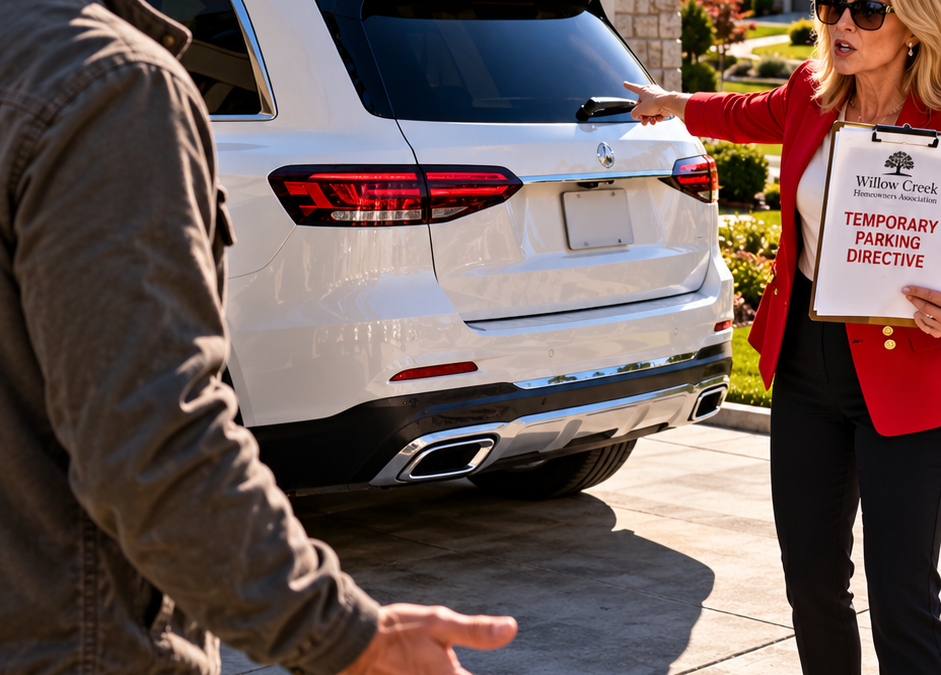
A white SUV was parked directly across the garage entrance, close enough that I could not have squeezed a bicycle past it, much less my truck. It sat at an angle, nose toward the curb, rear bumper cutting across the width of my driveway like whoever parked it had wanted to make sure there was no mistake.
I stood there holding my keys, staring through the open garage.
For one second, my brain tried to make it reasonable.
Maybe someone broke down.
Maybe there was an emergency.
Maybe a neighbor had left it there for five minutes and was already coming back.
Then I saw Linda Marsh standing near the front bumper with her phone in one hand and a folder tucked under her arm.
That ended every generous explanation.
Linda was the president of the Willow Creek HOA, a title she wore with the kind of satisfaction most people reserve for actual elected office. She lived two streets over in one of the larger houses near the clubhouse, drove that spotless white SUV everywhere, and spoke to residents as if every conversation were a disciplinary meeting waiting to happen.
I had dealt with her before.
A year earlier, she tried to fine me for leaving my trash bins visible from the street at 7:04 p.m. when the rules said they had to be removed by seven. Another time, she sent me a warning because my porch light was “too warm in tone” and created what she called “a nonuniform evening appearance.” When I asked where the lighting color requirement was written, she said, “Some standards are understood.”
That was Linda.
When the rules helped her, she quoted them.
When they didn’t exist, she implied them.
I stepped out of the garage and walked down the driveway.
“Linda,” I said, keeping my voice as even as I could. “Move your SUV.”
She didn’t apologize. She didn’t look surprised. She didn’t even pretend it was a mistake.
Instead, she smiled.
“Good morning, Mark.”
There are smiles that greet you.
Linda’s smile always inspected you.
“You’re blocking my garage,” I said.
“I’m aware.”
That answer was so casual that I actually paused.
“You’re aware?”
“Yes. The HOA has updated temporary parking rules for today’s neighborhood coordination work.”
I looked from her face to the SUV and back again. “My driveway is not neighborhood parking.”
She opened the folder and removed a printed notice.
“It is temporarily designated for approved association use.”
She handed it to me like she was serving court papers.
I took the page and read the top line.
Willow Creek Homeowners Association Temporary Parking Directive.
I read it once.
Then again.
The notice claimed that due to “community access optimization,” certain driveway aprons and “underused private-facing access areas” could be temporarily used by HOA officers, vendors, or authorized residents during neighborhood activities.
Private-facing access areas.
That was how they had decided to describe my driveway.
Not my property. Not my garage access. Not land attached to my deed.
A private-facing access area.
I looked at the bottom of the page. Linda’s signature was there. So was the name of one board member. There was no attorney review. No city permit. No property owner authorization. No easement. No emergency order. Nothing that gave her the right to block my garage.
“Where is my authorization?” I asked.
Linda’s expression did not change. “This is an HOA directive.”
“That is not what I asked.”
“It was approved by the board.”
“The board doesn’t own my driveway.”
She tucked the folder under her arm. “You’ll learn to cooperate.”
That sentence changed the morning.
Up until then, I was irritated. Late. Annoyed. Ready to argue just enough to get my driveway cleared.
But when she said that, I understood the SUV was not just badly parked. It was a message. Linda had not blocked me by accident. She had chosen my driveway because she wanted to prove that an HOA notice with her signature could override my deed, my schedule, and my right to leave my own house.
I took one breath.
“Linda, you have ten minutes to move the SUV.”
She laughed.
Not loudly. Worse than that. Softly, like I had said something childish.
“You are not touching my vehicle,” she said.
“I didn’t say I was.”
She lifted her phone. “I’m calling the board.”
“You do that.”
I walked back toward the garage.
Behind me, she said, “Mark, I’m serious. If you interfere with an authorized HOA operation, there will be consequences.”
I turned around. “There will be consequences either way.”
Then I went inside.
My wife, Rachel, was standing in the kitchen doorway by then, still in her robe, hair pulled into a loose knot. She had heard enough to know something was wrong.
“Why is Linda’s car in our driveway?” she asked.
“Because apparently our driveway has been promoted to community infrastructure.”
Rachel closed her eyes. “Please tell me you’re not going to fight with her in the street.”
“No.”
That surprised her.
“No?”
“I’m calling the proper authorities.”
Her face shifted with relief, then concern. “Do you think they’ll do anything?”
“I’m going to make sure they have every reason to.”
That was one thing my father taught me better than anger.
Documentation.
He spent thirty years as a building inspector, and he used to say, “Never argue with someone who survives on confusion. Make a record and let them argue with that.”
So I started with photographs.
Wide shots showing Linda’s SUV blocking the garage.
Close shots showing the driveway lines.
A photo of the license plate.
A photo of the HOA notice.
A short video from the garage showing that my truck could not exit.
Then I pulled my property file from the office cabinet. The deed. The site plan. The driveway boundary survey from when we bought the house. Everything showed the same thing: the garage and driveway were part of my private lot, not HOA common area, not shared access, not overflow parking, not anything Linda could “temporarily designate” because she wanted to.
I called the non-emergency line first.
I explained calmly that a vehicle was illegally blocking access to my private garage, that the owner refused to move it, and that the obstruction was preventing me from leaving my property.
The dispatcher asked whether there was a dispute.
“Yes,” I said. “The HOA president is claiming she has authority to use my driveway. I have property records proving otherwise.”
The dispatcher asked whether anyone was threatening anyone.
“No.”
“Is the vehicle occupied?”
“No.”
“Is it blocking the only vehicle exit?”
“Yes.”
She said an officer would be sent when available.
Then I called the city parking enforcement office.
Then I called Jake Rourke.
Jake was the city’s contracted recovery coordinator for complicated vehicle removals. I knew him because years earlier, a construction truck had blocked our alley during a drainage project, and Jake had been the one who handled the removal after the driver disappeared. He was calm, procedural, and allergic to nonsense.
When he answered, I said, “Jake, I have an HOA president’s SUV blocking my garage, and she refuses to move it.”
There was a pause.
Then he said, “That sentence got worse with every word.”
“I have photos, property records, and the HOA notice she gave me.”
“Send everything.”
I did.
While I waited, Linda remained outside, pacing near her SUV and making calls.
I could hear fragments through the open garage.
“He’s being unreasonable.”
“No, he has not been authorized to interfere.”
“The board directive is clear.”
“He’s threatening to escalate.”
That one almost made me laugh.
Threatening to escalate.
Her SUV was blocking my only way out, and somehow my phone call was the escalation.
A police officer arrived forty minutes later.
Officer Grant Wallace was young but not inexperienced. He had the composed expression of someone who had learned to listen before deciding who was wasting his time.
Linda approached him before he reached my driveway.
“Officer, I’m Linda Marsh, president of the Willow Creek HOA. We have an uncooperative homeowner interfering with approved community parking operations.”
Officer Wallace looked at the SUV.
Then he looked at my open garage.
Then he looked back at Linda.
“Is that your vehicle?”
“Yes.”
“Is that his garage?”
Linda hesitated. “The driveway area has been temporarily designated—”
“Ma’am,” he said, “is that his garage?”
Her mouth tightened. “Yes, but—”
He turned to me. “Sir, you called?”
“Yes. My name is Mark Ellison. That vehicle is blocking my garage. I asked Ms. Marsh to move it. She refused. Here are the property records, photos, and the notice she gave me.”
I handed him the folder.
He reviewed the HOA notice first. I could tell exactly when he reached the phrase private-facing access areas because one eyebrow moved slightly.
Then he looked at the deed and site plan.
“Do you have any document showing the HOA has a right to block this driveway?” he asked Linda.
She lifted her folder again. “The board issued a temporary directive.”
“That’s not what I asked.”
“It is association policy.”
“Does it contain homeowner authorization?”
“The board has authority to regulate parking.”
“On private driveways?”
Linda’s voice sharpened. “The HOA regulates the community.”
Officer Wallace looked at her for a long moment.
“Regulating parking is not the same as taking control of a homeowner’s driveway.”
For the first time that morning, Linda’s confidence flickered.
Only briefly.
Then she recovered.
“I am not moving my vehicle until the board’s authority is recognized.”
Officer Wallace nodded slowly, as if she had just confirmed something important.
“Then we’ll proceed with removal.”
Linda blinked. “Excuse me?”
“If you refuse to move a vehicle blocking private access, it can be removed.”
“You cannot tow my SUV.”
He looked at the driveway angle, the narrow street, and the decorative HOA planters Linda herself had approved along the curb months earlier. A standard tow truck would have struggled to get the right angle without damaging the vehicle or the stone entry posts beside my driveway.
“I’m not the recovery operator,” he said. “But the obstruction will be handled.”
Linda stepped closer. “Officer, do you understand who I am?”
That was when Rachel, standing beside me, muttered, “Here we go.”
Officer Wallace’s expression cooled by about ten degrees.
“Yes, ma’am,” he said. “You’re the registered owner of the vehicle blocking this garage.”
Linda started calling people again.
I did not.
At that point, I had done what I needed to do. I had made the record. I had provided proof. I had stayed calm. The process was now larger than Linda’s voice.
Less than an hour after I first found her SUV, the recovery crew arrived.
Not with the usual tow setup.
With two trucks, three technicians, and Jake Rourke stepping out in a reflective vest, holding a clipboard and looking like a man who had already had enough of everyone.
Linda marched toward him.
“Are you in charge?”
Jake looked at her SUV, then at the garage, then down at his paperwork.
“I’m coordinating the recovery.”
“This is my vehicle.”
“Correct.”
“You do not have permission to touch it.”
Jake pointed toward my garage. “Ownership isn’t the issue. Location is.”
Linda stared at him.
He continued, “Your vehicle is obstructing private access. You were asked to move it. You refused. Enforcement authorized removal.”
“This is an HOA matter.”
“No,” Jake said. “This is a vehicle blocking a private garage.”
Linda turned toward Officer Wallace. “Tell him to stop.”
Officer Wallace did not move.
Jake walked the driveway perimeter, checked the angle, measured clearance, and spoke quietly with his crew. One of the technicians looked at the planters, the narrow curb, and the way Linda had wedged the SUV across the driveway.
“Standard tow could damage it,” he said.
Jake nodded. “That’s what I figured.”
Linda crossed her arms. “Good. Then it stays.”
Jake looked up at her.
“No, ma’am. It leaves differently.”
She frowned. “What does that mean?”
Jake did not answer right away.
Instead, he made a call.
I heard only his side.
“Confirmed obstruction. Private garage access. Standard extraction risk due to angle and fixed structures. Yes. We’ll need aerial lift clearance. Municipal drop site. Correct.”
Linda laughed once. “Aerial what?”
Jake ended the call and looked at me. “You may want to move back inside or stand behind the marked line once we set it.”
“What’s happening?” Rachel asked.
Jake glanced at the SUV. “Her vehicle is leaving without using the driveway.”
Twenty minutes later, the sound appeared before the machine did.
A deep, heavy beating over the neighborhood.
People came out of houses one by one. Doors opened. Curtains moved. A kid on a bicycle stopped in the middle of the sidewalk and stared upward. Even Linda stopped talking.
The helicopter came over the rooftops like something out of a disaster movie.
It was a heavy-lift recovery helicopter used by the city contractor for difficult removals, usually from construction zones, flood areas, or inaccessible lots. I had seen one on the news once after a landslide. I never imagined I would see one hovering over my driveway because an HOA president refused to move her SUV.
Linda’s face went completely blank.
Then she said, “No.”
Jake’s crew had already attached the lift rig under the guidance of the operator and recovery team. The whole process was careful, slow, and controlled. No one rushed. No one grandstanded. The absurdity of the situation did not change the professionalism of the removal.
Linda screamed anyway.
“You don’t have permission!”
Jake did not raise his voice. “Removal is authorized.”
“That’s my car!”
“Yes, ma’am.”
“You can’t fly my car away!”
Jake looked at the paperwork on his clipboard.
“Apparently we can.”
The helicopter stabilized over the driveway.
The cables tightened.
For one strange second, Linda’s SUV seemed to become lighter than its own arrogance.
Then it lifted.
Smoothly.
Cleanly.
Up from the pavement and away from my garage.
The entire neighborhood watched in stunned silence as Linda Marsh’s white SUV rose above Hawthorne Ridge, dangling beneath a helicopter like the most expensive lesson in property rights anyone on our street had ever seen.
Linda stood on the curb screaming into her phone.
“No, they’re lifting it right now!”
Pause.
“I don’t care what the board says. Stop them!”
Pause.
“Call someone!”
Nobody stopped it.
Nobody could.
The helicopter carried the SUV over the line of rooftops, turned toward the main road, and disappeared toward the municipal district.
For the first time all morning, my driveway was clear.
I stood there with my keys still in my hand.
Rachel looked at the empty space where the SUV had been.
Then she looked at me.
“Well,” she said, “that’s one way to enforce a boundary.”
I finally opened the garage fully, climbed into my truck, and backed out without touching a thing.
Linda stood on the curb, no longer shouting.
She watched me drive past with a face that had lost all its polish.
But I knew the story was not over.
Because Jake had told me the destination.
The SUV was being delivered to municipal property near City Hall.
Not the impound lot yet. Not immediately. The city’s impound entrance was under repair that morning, and the designated temporary holding area for aerial recoveries was a secured lawn section behind the municipal building—an open, visible space used for staging oversized removals.
Unfortunately for Linda, that area sat directly outside the mayor’s office windows.
By the time I finished my supplier meeting and drove to City Hall with my documentation, the scene had already drawn a crowd.
Linda’s SUV sat on the municipal lawn like an exhibit.
It was not damaged. The recovery crew had done its job perfectly. The vehicle rested safely on all four tires. A few city employees stood nearby, staring at it with the careful silence of people trying not to laugh at something they would later describe as “unusual.”
Mayor Thomas Bell came outside in a gray suit with no tie, looking like a man whose day had just been interrupted by a question no briefing packet could have prepared him for.
He looked at the SUV.
Then at Jake.
Then at Officer Wallace.
Then at me.
Finally, he asked, “Why is there a white SUV on the municipal lawn?”
Nobody answered immediately.
Not because there was no answer.
Because every honest answer sounded insane.
Linda arrived five minutes later in a rideshare, stepping out so fast she almost stumbled. Her face was flushed. Her hair, perfect that morning, had started to lose its shape. She marched toward the mayor like she expected him to rescue her from a world that had suddenly stopped obeying.
“Mayor Bell,” she said, breathless. “This is outrageous. My vehicle was taken from a lawful HOA-designated parking location.”
The mayor turned slowly toward her.
“Lawful according to whom?”
“The HOA board.”
I stepped forward. “Not according to the property records.”
Linda glared at me. “You have caused enough trouble.”
“No,” I said. “I documented the trouble you caused.”
Jake came over carrying the recovery packet.
“Mayor, here are the removal documents,” he said. “Vehicle was blocking private garage access. Owner refused to move. Standard tow presented damage risk due to angle and fixed structures. Aerial removal authorized under obstruction protocol.”
The mayor looked at the paperwork, then at Officer Wallace.
“Was there a dispute over the property?”
Officer Wallace nodded. “The vehicle owner claimed HOA authority to use the driveway. The homeowner provided deed and site documentation showing the driveway is private property.”
Linda inserted herself again. “The HOA has broad authority over community parking.”
The mayor looked at me. “Do you have the records?”
“Yes.”
I handed him the folder.
He reviewed the deed, the site plan, the photographs, and Linda’s HOA notice. The longer he read, the quieter Linda became.
That was the thing about paperwork.
It did not shout.
It did not insult.
It did not defend itself emotionally.
It simply sat there, being true.
The mayor held up the HOA notice.
“What is a private-facing access area?” he asked.
Linda’s mouth opened.
No sound came out.
He looked at the notice again. “Because this appears to be an attempt to rename someone’s driveway without their consent.”
“That is not what—”
“Is his driveway HOA common property?”
“No, but—”
“Is there an easement allowing the HOA to block his garage?”
Linda hesitated. “Not specifically.”
“Is there any written permission from Mr. Ellison allowing you to park there?”
She looked at me with pure resentment.
“No.”
Mayor Bell lowered the paper.
“Then this is not complicated.”
Linda’s face tightened. “The city cannot interfere with internal HOA governance.”
“I’m not trying to,” he said. “But the HOA cannot use internal governance to occupy someone else’s property.”
Her voice rose. “I was coordinating a community need.”
“You blocked a private garage.”
“For a temporary period.”
“Without consent.”
“We had a directive.”
He tapped the paper once. “A directive you signed does not give you rights over land you do not own.”
That sentence ended the argument.
Not because Linda agreed.
Because everyone heard it clearly enough that continuing made her look worse.
The mayor turned to Jake. “What happens now?”
Jake said, “Vehicle can be released once fees are processed and the owner signs acknowledgment of removal basis.”
Linda spun toward him. “Fees?”
Jake nodded. “Recovery fees.”
“You flew my SUV across town!”
“Yes, ma’am. That costs more than a tow.”
For the first time that day, I saw Linda fully understand the financial shape of what she had done.
Not just the embarrassment.
Not just the mayor.
Not just the crowd.
The bill.
The recovery bill. The administrative fees. The documentation. The HOA board questions waiting behind all of it. The unavoidable fact that her stunt had produced records outside her control.
Linda’s lips pressed into a thin line.
She looked at Mayor Bell as if hoping for mercy.
He gave her none.
“Ms. Marsh,” he said, “the city cannot solve your HOA dispute for you. But I will be very clear about this. You cannot use someone else’s private property as your personal parking space, and you cannot block a resident’s only garage access because your board invents a phrase for his driveway.”
Linda said nothing.
That silence was the first sensible thing she had done all day.
She eventually signed the acknowledgment.
I watched from a distance while Jake explained the release process. Linda listened without interrupting. Her shoulders had dropped. Her voice, when she finally spoke, was lower. Gone was the woman who had stood in my driveway that morning telling me I would learn to cooperate.
City Hall had taught a different lesson.
By late afternoon, Linda was back inside her SUV.
The same vehicle that had floated over Hawthorne Ridge like a warning.
She drove away slowly, not looking at me.
I went home before sunset.
For the first time all day, the neighborhood looked normal again. Kids were riding bikes near the corner. A dog barked behind a fence. Someone watered flowers. The driveway was empty, clean, and mine.
I pulled my truck into the garage and sat there for a moment after turning off the engine.
Rachel came out through the side door.
“You okay?” she asked.
I nodded.
“Just tired.”
She leaned against the truck. “Do you think she’ll try something else?”
“Not with the driveway.”
That turned out to be true.
Linda never blocked my garage again.
The HOA sent a careful email the next week clarifying that “temporary parking directives” did not apply to privately deeded driveways without owner consent. The language was bland, but the meaning was obvious. Someone had spoken to an attorney. Someone had looked at the city paperwork. Someone had realized Linda’s clever little phrase had almost turned into a much larger legal problem.
Neighbors stopped me for days.
Some laughed. Some wanted details. Some admitted Linda had pressured them too—one over a guest car, another over a contractor van, another over a moving truck parked in front of the wrong house for less than an hour.
That was how it always worked with her.
She pushed people one by one, making each person feel alone in the argument. But once her SUV flew over the neighborhood, solitude became impossible. Everyone had seen the same thing. Everyone understood the same lesson.
Linda’s authority had limits.
Visible ones.
A month later, the board removed her from direct parking enforcement duties. The official explanation was “procedural restructuring.” That was HOA language for: she went too far, and now lawyers are nervous.
I didn’t need more than that.
People asked me if I felt guilty about the helicopter.
I didn’t.
I didn’t call a helicopter to humiliate her. I called the authorities because she blocked my garage and refused to move. Every step after that came from her own refusal, her own paperwork, her own assumption that being HOA president gave her access to property she did not own.
She could have moved the SUV in thirty seconds.
She chose not to.
That is the part people like Linda never want included in the story.
They want the consequence to sound excessive, unreasonable, dramatic. They want everyone to begin at the moment the helicopter appears, not at the moment they were politely told to stop. But consequences rarely appear from nowhere. They arrive at the end of ignored warnings.
That morning, I warned her.
The officer warned her.
Jake explained it.
The paperwork was clear.
She kept saying no until no was no longer useful.
Now, whenever I open my garage, I still think about that white SUV hanging above the rooftops. Not because it was funny, though part of it was. Not because it was dramatic, though the whole neighborhood will probably talk about it for years.
I think about it because it proved something simple.
A driveway does not stop being private because an HOA wants convenience.
A notice does not become law because someone prints it on letterhead.
And a person who knows their rights does not have to scream to defend them.
Sometimes the strongest answer is a deed, a photograph, a calm phone call, and the patience to let the paperwork speak louder than the bully on your curb.
Linda started that morning believing she could control my driveway.
She ended it at City Hall, signing forms beside the SUV she had refused to move.
And when I parked my truck inside my own garage that night, the space felt quieter than usual.
Not because nothing had happened there.
Because something had been settled.
My driveway was not an HOA experiment.
It was not a private-facing access area.
It was mine.
And Linda Marsh never forgot it again.








