𝗙𝗨𝗟𝗟 𝗦𝗧𝗢𝗥𝗬 Linda Left Sixty Prize Cattle in My Pasture and Expected Me to Keep Quiet
𝗣𝗔𝗥𝗧 𝟮
I sent Linda a message that evening. I listed the number of animals, the time they had arrived, and the care we had begun providing. I told her again that I had not authorized delivery and asked for a date and time for removal.
She replied the next afternoon: They are safe where they are. Please continue proper care.
I read it twice.
She had not offered a plan. She had given me an instruction.
I saved the message.
Over the following days, the north pasture became the center of every decision on the ranch. The grass I had set aside for my own cattle was being eaten by Linda’s herd. We had to bring in additional feed sooner than planned. Tom and his crew checked the water twice a day, walked the fence, and watched for any animal that lagged behind the others.
At night, I found myself listening for them.
I resented that. I resented seeing the feed invoices on my desk and knowing I had no idea when they would stop. Most of all, I resented the way Linda’s decision had made the animals dependent on me. I could be furious with her and still have to get up before daylight to make certain they were all right.
Tom saw it wearing on me.
“You don’t have to come out every morning,” he told me one day as we filled a trough.
“I want to know what’s happening.”
“I’ll tell you.”
“I know you will.”
He set down the hose and studied me. “This is bigger than the feed bill, isn’t it?”
I looked across the pasture. One of the cattle lifted its head, an ear tag swinging as it turned.
“If something happens to one of them, she’ll say it was my fault,” I said. “If I spend money keeping them healthy, she’ll say that was my choice. She put them here and drove away.”
Tom had no answer for that. He picked up the hose again.
A week after the delivery, an envelope arrived from the HOA.
I opened it at the kitchen table. Inside was a bill addressed to me. Linda claimed I was responsible for the cost of feeding and maintaining the herd while it remained on my land.
For a moment, I thought I must have read it wrong. I looked at the itemized charges, then at the letter attached to them. Linda’s name appeared at the bottom.
She had bought the cattle, brought them through my gate, left them in my pasture, and was now billing me for their care.
I called Tom and read him the letter.
He was quiet for so long that I checked whether the call had dropped.
“Do not pay that,” he said.
“I wasn’t planning to.”
“And keep the envelope.”
“I’m keeping everything.”
I sent Linda a written refusal. I stated that her organization had placed the herd on my ranch without my permission, that I had demanded its removal, and that I would not pay charges arising from her decision. I asked her once more to arrange collection.
She did not answer me.
Her attorney did.
His letter arrived a few days later. It demanded that I return all sixty cattle to the HOA. It described the herd as HOA property and warned me against withholding it.
I called the number at the top of the page. When the attorney answered, I asked him why his client had abandoned her property on my land.
“The animals were placed there temporarily,” he said.
“Against my wishes.”
“That is not how my client describes the arrangement.”
“Then she left something out.”
He paused. “The purchase documents establish ownership. We expect the herd to be returned.”
“Send trucks and arrange a time with me,” I said. “You’ve had that option since the morning they arrived.”
“Our position is that you are holding property that belongs to the association.”
After the call, I sat at my desk with his letter in front of me. The word property appeared several times. None of the pages mentioned the day Linda had stepped out of her truck and told me I would care for the herd. None mentioned the workers leaving it behind. None mentioned her message instructing me to continue.
Her attorney had made one point very clearly, though: the HOA claimed to own the cattle.
I called Daniel.
Daniel had handled matters for the ranch before. He had a habit of letting people finish speaking, even when they were angry, and asking the question they had skipped. I told him everything from the sound that woke me to the attorney’s demand.
When I finished, he said, “What documents came with the herd?”
“Identification records. Tom’s been going through them.”
“Bring all of it. The bills, too. Every message. I want to see what Linda signed, what you signed, and what was delivered.”
“I didn’t sign anything for this delivery.”
“Then we’ll establish that as carefully as everything else.”
The next morning, Tom and I spread the records across the long table in the ranch office. Ear tag numbers covered pages of his notebook. My phone held photographs of every animal. We had feed receipts, delivery dates, crew hours, Linda’s messages, the HOA bill, and her attorney’s letter.
Tom had started matching the ear tags to the paperwork.
He moved with the patience he used when separating cattle. A number on an ear tag led to an entry in a record. An entry led to another document. He checked names, dates, and descriptions, then had me verify each match.
By noon, he had accounted for the entire herd.
“Sixty,” he said, laying down his pen. “Every one of them.”
I looked at the sheets covering the table. “Can we prove where they came from?”
“I think so.”
He showed me the livestock seller listed in the documents. Daniel contacted the seller using the business details on the paperwork. When the seller confirmed that the HOA corporation had purchased the herd, Daniel asked for the records identifying the animals in that sale.
The purchase records matched all sixty.
I felt a rush of relief when Daniel told me, followed almost immediately by confusion. Linda’s attorney had already claimed the HOA owned them. What had we gained by proving it?
Daniel understood my face before I asked.
“We need a complete timeline,” he said. “We need to know who bought them, who delivered them, and what terms applied when they were left here. Your records establish which animals we’re talking about.”
“So we agree with her attorney that the HOA bought them.”
“We agree with what the purchase records show.”
He placed the letter beside Tom’s list of ear tags.
“What I’m interested in,” Daniel said, “is what Linda expected to happen after delivery.”
Tom continued sorting through the documents. Near the bottom of a folder that had come with the herd, he found a boarding agreement.
At first, I barely recognized it. Linda had raised the possibility of temporary space on my ranch before, and Tom had kept papers connected with the inquiry. We had never agreed that she could arrive with sixty cattle whenever it suited her. When the trucks came, I had not been expecting a delivery at all.
But Linda had signed the agreement before the animals arrived.
Tom slid it across the table to Daniel. I watched him read it, turn to the next page, and go back.
“What?” I asked.
He pointed to a date. The agreement set a deadline for the owner to retrieve the herd. Then he pointed to a clause describing the financial consequences if the owner failed to do so.
We read it again together.
Linda had given her attorney records proving the HOA bought the cattle. In the same trail of paperwork, she had left an agreement governing what happened when those cattle stayed on my ranch past the deadline. That deadline had come and gone. She had not sent trucks to collect the herd. She had sent me a bill instead.
“Why didn’t I see this sooner?” I asked.
“Because you were trying to get sixty cattle cared for,” Tom said.
He was right, but I was still angry with myself. I had spent every morning counting animals and every evening wondering whether Linda would make another accusation. Meanwhile, a signed agreement had been sitting in a folder.
Daniel did not celebrate. He read the agreement a third time and made copies of everything.
“This matters,” he said. “We’ll put it alongside the delivery records and what Linda wrote afterward.”
For the next few days, we built the timeline. The seller’s purchase records showed the HOA had bought the herd. The identification documents tied each animal in my pasture to that purchase. The delivery date established when Linda had brought them to the ranch. Her signature appeared on the boarding agreement made before the delivery. The retrieval deadline was written plainly. My messages showed I had repeatedly demanded that the animals be moved, while Linda’s replies showed she knew they remained in my care.
The feed invoices and crew logs showed what that care had cost.
At the end of the week, Daniel called Linda’s attorney. I was with him in his office, though I could hear only Daniel’s side of the conversation.
“Yes, we have the purchase documents,” he said. “We also have the signed boarding agreement.”
He listened.
“The deadline in that agreement passed.”
Another pause.
“My client asked for removal from the first day. Your client chose to leave the herd there.”
By the time he hung up, his expression had changed very little.
“What did he say?” I asked.
“He says the HOA is entitled to its cattle.”
“Is that all?”
“He says they’ll let the court decide.”
A lawsuit followed.
I had known the dispute might reach court from the moment the attorney’s letter arrived. Seeing my name on the filed papers still made my stomach drop. The HOA demanded all sixty cattle. Its claim centered on the purchase: it had paid for the herd, so the herd belonged to it, and I had no right to keep it on my ranch.
The papers described what the HOA wanted. They gave almost no space to how the cattle had arrived or why they were still there.
Daniel filed our response. We did not dispute the original purchase. We set out what had happened afterward, using Linda’s signed agreement and the records we had kept from the first morning.
Through all of it, the cattle remained in the north pasture.
People imagine a lawsuit as a series of sharp conversations in an office. Most days, mine began with a fence line and a head count. One morning, I found a trough running slowly and helped Tom clear it. Another afternoon, rain turned the path beside the barn into deep mud, and we worked there until dark to make sure the animals still had access to feed.
The work gave me something solid to do. It also made the unfairness harder to ignore.
Each animal had needs that could not wait for a lawyer’s letter. Linda had been able to drive away because she knew I understood that. When I pictured her smiling at me beside the truck, I realized she had counted on my responsibility from the beginning.
Tom was careful with the herd. He learned which animals moved first when he called them and which tended to hang back. He caught a minor problem with one animal early enough for the veterinarian to check it before it became serious. Every time he recorded a treatment or a feed delivery, he added it to the file.
One evening, I found him at the ranch office after everyone else had gone home. The desk lamp was on, and he was comparing two columns of numbers.
“You can finish that tomorrow,” I said.
“I’m nearly done.”
I stood beside him. “You’ve put more hours into their records than Linda spent on this ranch.”
Tom looked up. “She thought bringing sixty cattle here meant they were your problem.”
“They are my problem.”
“They’re under our care,” he said. “That’s why these records matter.”
He went back to the page. I stayed and helped him check the last entries.
On the morning of the hearing, I counted the cattle before I changed clothes. All sixty were there, moving slowly through the pasture as the sun reached the grass. Tom met me at the gate.
“I’ve got them,” he said.
“I know.”
“Go tell the judge what happened.”
It sounded simple when he said it. Driving to court, I felt the weight of every bill, every message, and every day Linda had left the herd behind.
Linda sat beside her attorney when I entered the courtroom. She looked up, then turned back to the papers in front of her. I remembered her walking around me to get into her truck while the workers continued unloading. In court, she was still asking someone else to deal with the choice she had made.
Her attorney presented the purchase records first. He explained that the HOA corporation had paid for the cattle and that the documents identified the herd in my pasture. He laid out the records with confidence. I had seen them often enough by then to recognize several of the numbers before he read them aloud.
Then he said I had refused to return the HOA’s property.
I gripped the edge of my chair.
Daniel touched my arm once, telling me to wait.
When it was his turn, he stood and agreed that the records established the original purchase.
Linda’s attorney looked surprised. For a moment, Linda did too.
Daniel asked the court to look at the rest of the documents. He went through the delivery date, Linda’s messages, my demands that she retrieve the herd, and the care records we had kept. Then he presented the boarding agreement.
The judge took time reading it.
From where I sat, I could see him turn back to the first page. He checked the date and looked at the signature at the bottom. Then he asked Daniel when the cattle were supposed to have been collected.
Daniel gave him the agreed deadline and pointed to the delivery record.
The judge looked at Linda’s attorney. “Were they collected by that date?”
“No,” the attorney said.
The judge asked about the financial consequences set out in the agreement. Linda’s attorney argued that the purchase documents still proved ownership. Daniel answered that nobody was disputing who had made the original purchase. The question before the court was whether the HOA could ignore what Linda had signed, leave the herd in my care beyond the deadline, and then demand that it be handed over as though none of those terms existed.
I watched the judge go back through the papers. He looked at Linda’s signature again. Then he read one of her messages instructing me to continue caring for the cattle after I had asked her to remove them.
I had saved that message because it made me angry. Hearing it read in court, I was grateful I had kept it.
Linda’s attorney spoke again. He returned to the sale records and the HOA’s demand. Daniel returned to the agreement and the dates. Neither raised his voice. The hearing was quieter than I had imagined, which somehow made every answer feel more consequential.
When the judge asked me about the first morning, I described it as clearly as I could. I told him about waking to the cattle in the north pasture, seeing the three trucks beside my barn, and asking Linda who had given her permission. I told him I had demanded removal while her employees were still there. I told him the trucks had gone the next morning and the cattle had stayed.
“Why did you care for them?” he asked.
I looked at Linda, then back at him.
“Because they were in my pasture,” I said. “They needed water and feed. I wasn’t going to let an animal suffer to make a point to the person who left it there.”
The judge nodded and made a note.
By the time the hearing ended, I was exhausted. I had spent weeks preparing to prove something I had witnessed with my own eyes: Linda had left the cattle and the work to me. Now the court had the records, the photographs, her messages, and her signature.
The judge rejected the HOA’s demand to take all sixty cattle back without regard to the signed agreement. The purchase records established that the HOA had bought them, but those records did not erase the terms Linda had accepted or what the parties had documented after the herd arrived. Under the court’s ruling in our dispute, the herd remained on my ranch.
I listened closely as the decision was given. I had wanted an answer for so long that, when it finally came, I felt too tired to react.
Outside the courtroom, Daniel gathered the papers into his case.
“Are you all right?” he asked.
“I think so.”
“You heard the ruling?”
“Yes.” I looked toward the doors Linda had just passed through. “I’m thinking about the morning she left.”
Daniel waited.
“She looked at those cattle and saw something she could set down on my property,” I said. “I looked at them and knew somebody had to take care of them.”
When I got back to the ranch, Tom was in the north pasture. He raised a hand as I drove up. I parked beside the gate and walked over.
“Well?” he asked.
“The herd stays.”
He let out a long breath and looked behind him at the cattle. One was standing near the trough we had repaired. The others were scattered across the grass, the same way they had been the morning I found them, though now I could identify every one.
Tom opened his notebook. “Then I’d better finish today’s count.”
“I’ll help.”
We walked the fence together and counted all sixty. When we reached the last animal, Tom closed the notebook. The cattle had water, feed, and room to move. The court had answered Linda’s demand. For the first time since her trucks appeared beside my barn, I knew what would happen next.
We went back to work.
𝗧𝗛𝗘 𝗘𝗡𝗗
Linda Left Sixty Prize Cattle in My Pasture and Expected Me to Keep Quiet
The first thing I heard that morning was a sound that did not belong on my ranch. Before I reached the north pasture, I could see trucks parked beside my barn and cattle spreading across grass I had already committed to my own herd. Then Linda stepped out of the largest truck and spoke as though everything had been settled without me.
I had owned the ranch long enough to recognize the sound of cattle moving through the north pasture. From my bedroom, I could usually tell whether they were being pushed along the fence or settling in to graze.
That morning, the ground seemed to be moving.
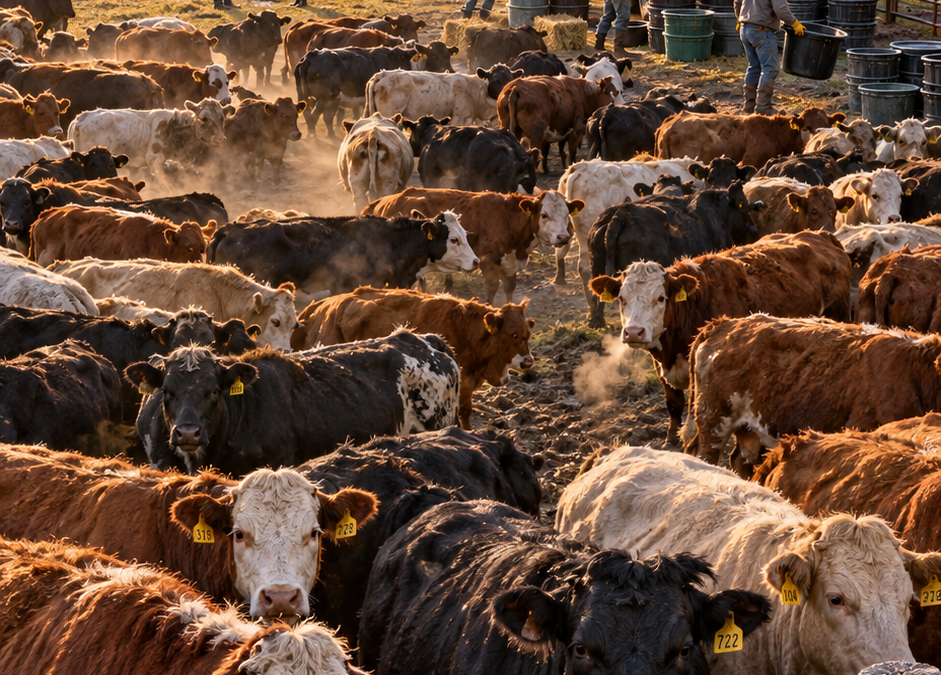
I pulled on my boots and went out to the porch. Dawn had barely reached the far end of the property. The animals stood in dark clusters across the grass, their breath visible in the cool air. At first I thought a neighboring fence might have gone down and a herd had wandered through. Then I started counting.
I reached forty before I lost my place.
I counted again from the gate. There were nearly sixty.
They were broad, healthy animals with glossy coats and the kind of calm handling that comes from a great deal of work. Several wore ear tags I could see from the fence. Even without getting close, I could tell they had not come from the neighboring ranch.
Three trucks were parked beside my cattle barn. Men in work clothes were carrying equipment from the beds and setting it inside.
I got into my pickup.
The road to the north pasture took less than five minutes. During the drive, I kept looking for a broken fence or a trailer stopped at the wrong gate. Every fence I passed was standing. By the time I reached the barn, one of the men was unloading a stack of feed tubs.
“Put that back,” I said through the open window.
He stopped and looked toward the largest truck.
Its passenger door opened. Linda climbed down.
I knew Linda as the woman who spoke for the homeowners association that had been expanding along the eastern edge of my property. Whenever the HOA wanted something from me, Linda seemed to be the person sent to explain why it should be convenient.
That morning, she was dressed for an office, not a pasture. She picked her way around a patch of mud and came toward my truck with a smile.
“Good morning,” she said.
I got out. “Whose cattle are those?”
“They’re ours.”
“How did they get into my pasture?”
“We had them brought over early. They’re staying here temporarily.”
I looked past her at the cattle. “Who gave you permission?”
Linda’s smile held. “We needed somewhere to keep them.”
“That doesn’t answer me.”
She glanced toward the barn, where her employees were watching us. “It’s only for a short time. Your ranch is set up for livestock. You already have the pasture and the facilities.”
I could feel the anger rising, but I kept my voice level. “My facilities are set up for my livestock.”
“Of course. And you know how to take care of them.”
I waited for her to finish, certain I had misunderstood what she was suggesting.
“You can handle their care while they’re here,” she said. “We’ll sort out the rest.”
“No. You need to load them and take them back.”
Linda gave a small laugh. “You’re making this harder than it has to be.”
Behind her, an employee carried another tub toward my barn.
“Put it on the truck,” I told him.
He stopped again.
Linda turned. “Finish unloading.”
The man looked from her to me. I stepped between him and the barn doors.
“This is my property,” I said. “You are not using this building. And those cattle need to leave.”
For the first time, Linda’s expression tightened. She took out her phone, checked something on the screen, and put it away.
“They won’t be here long,” she said.
“Then you have time to get them out today.”
She walked around me toward her truck. One of the workers called after her, asking what to do with the tubs. Linda told him to leave the equipment and get back to work.
I followed her far enough that she had to look at me before opening the door.
“I am telling you directly,” I said. “I did not agree to board this herd.”
“I heard you.”
She climbed into the truck. A few minutes later, she drove away.
The workers stayed until midday. They tried twice more to put equipment in the barn. I kept the doors closed and made them leave everything outside. They avoided my questions about where the cattle had come from and when transport was returning. One man said he only had instructions to deliver the animals. Another said I would have to speak to Linda.
By afternoon, I had called her six times. She answered once.
“When are the trucks coming back?” I asked.
“I’m working on it.”
“That herd cannot stay here.”
“It needs to tonight.”
“Then send me the name of whoever owns it and the plan for moving it.”
Linda ended the call without answering.
I stood by the pasture fence after sunset and watched the cattle. They were settling in, some grazing, some lying down. Whatever Linda had done, the animals had no part in it. They needed water, feed, and someone to notice if one got sick or hurt. I could not leave them without care simply because I had never agreed to provide it.
At six the next morning, the trucks were gone. So were the workers. The feed tubs had been left beside the barn, but not enough feed to carry a herd of that size for long.
All sixty cattle were still in my north pasture.
I called my ranch manager, Tom Harris.
Tom had been with me for years. He knew every gate that dragged against the ground, every trough that needed watching in summer, and every animal we owned. When I told him what had happened, he said he would be there in twenty minutes.
He arrived in twelve.
For a while he said nothing. We stood together by the fence as the cattle moved slowly through the grass.
“Those aren’t strays,” he said at last.
“I know.”
“How many?”
“About sixty.”
Tom counted them himself. Then he went through the gate with a notebook and began examining them one by one. He read ear tags aloud while I wrote down the numbers. We photographed each animal from both sides and recorded any distinguishing marks. Tom checked their condition, their water, and the fencing. We did not mix them with my cattle.
We spent hours on work Linda’s people should have done before leaving.
Several animals had more than basic identification. Tom showed me the records that had come with the herd, papers one of the workers had placed inside a plastic sleeve with the equipment. The entries listed breeding information and individual animals in detail.
“These are valuable cattle,” Tom said.
“I gathered that.”
“No. I mean seriously valuable.”
He turned a page toward me and pointed out one breeding program, then another. He knew enough to recognize the names. I knew enough to understand that anyone who had paid for those animals would normally be careful about where they were sent.
“Why would she leave them here?” I asked.
Tom looked out across the pasture. “I don’t know.”
That answer troubled me more than a guess would have.
We checked the fences again. I called the veterinarian who handled my herd and explained that sixty unfamiliar cattle had been left on the property. I ordered feed. Tom made room in our daily schedule for checking the animals, and I told him to keep a record of every hour his crew spent on them.
He gave me a look.
“You think she’ll refuse to pay,” he said.
“She already thinks I volunteered.”
I sent Linda a message that evening. I listed the number of animals, the time they had arrived, and the care we had begun providing. I told her again that I had not authorized delivery and asked for a date and time for removal.
She replied the next afternoon: They are safe where they are. Please continue proper care.
I read it twice.
She had not offered a plan. She had given me an instruction.
I saved the message.
Over the following days, the north pasture became the center of every decision on the ranch. The grass I had set aside for my own cattle was being eaten by Linda’s herd. We had to bring in additional feed sooner than planned. Tom and his crew checked the water twice a day, walked the fence, and watched for any animal that lagged behind the others.
At night, I found myself listening for them.
I resented that. I resented seeing the feed invoices on my desk and knowing I had no idea when they would stop. Most of all, I resented the way Linda’s decision had made the animals dependent on me. I could be furious with her and still have to get up before daylight to make certain they were all right.
Tom saw it wearing on me.
“You don’t have to come out every morning,” he told me one day as we filled a trough.
“I want to know what’s happening.”
“I’ll tell you.”
“I know you will.”
He set down the hose and studied me. “This is bigger than the feed bill, isn’t it?”
I looked across the pasture. One of the cattle lifted its head, an ear tag swinging as it turned.
“If something happens to one of them, she’ll say it was my fault,” I said. “If I spend money keeping them healthy, she’ll say that was my choice. She put them here and drove away.”
Tom had no answer for that. He picked up the hose again.
A week after the delivery, an envelope arrived from the HOA.
I opened it at the kitchen table. Inside was a bill addressed to me. Linda claimed I was responsible for the cost of feeding and maintaining the herd while it remained on my land.
For a moment, I thought I must have read it wrong. I looked at the itemized charges, then at the letter attached to them. Linda’s name appeared at the bottom.
She had bought the cattle, brought them through my gate, left them in my pasture, and was now billing me for their care.
I called Tom and read him the letter.
He was quiet for so long that I checked whether the call had dropped.
“Do not pay that,” he said.
“I wasn’t planning to.”
“And keep the envelope.”
“I’m keeping everything.”
I sent Linda a written refusal. I stated that her organization had placed the herd on my ranch without my permission, that I had demanded its removal, and that I would not pay charges arising from her decision. I asked her once more to arrange collection.
She did not answer me.
Her attorney did.
His letter arrived a few days later. It demanded that I return all sixty cattle to the HOA. It described the herd as HOA property and warned me against withholding it.
I called the number at the top of the page. When the attorney answered, I asked him why his client had abandoned her property on my land.
“The animals were placed there temporarily,” he said.
“Against my wishes.”
“That is not how my client describes the arrangement.”
“Then she left something out.”
He paused. “The purchase documents establish ownership. We expect the herd to be returned.”
“Send trucks and arrange a time with me,” I said. “You’ve had that option since the morning they arrived.”
“Our position is that you are holding property that belongs to the association.”
After the call, I sat at my desk with his letter in front of me. The word property appeared several times. None of the pages mentioned the day Linda had stepped out of her truck and told me I would care for the herd. None mentioned the workers leaving it behind. None mentioned her message instructing me to continue.
Her attorney had made one point very clearly, though: the HOA claimed to own the cattle.
I called Daniel.
Daniel had handled matters for the ranch before. He had a habit of letting people finish speaking, even when they were angry, and asking the question they had skipped. I told him everything from the sound that woke me to the attorney’s demand.
When I finished, he said, “What documents came with the herd?”
“Identification records. Tom’s been going through them.”
“Bring all of it. The bills, too. Every message. I want to see what Linda signed, what you signed, and what was delivered.”
“I didn’t sign anything for this delivery.”
“Then we’ll establish that as carefully as everything else.”
The next morning, Tom and I spread the records across the long table in the ranch office. Ear tag numbers covered pages of his notebook. My phone held photographs of every animal. We had feed receipts, delivery dates, crew hours, Linda’s messages, the HOA bill, and her attorney’s letter.
Tom had started matching the ear tags to the paperwork.
He moved with the patience he used when separating cattle. A number on an ear tag led to an entry in a record. An entry led to another document. He checked names, dates, and descriptions, then had me verify each match.
By noon, he had accounted for the entire herd.
“Sixty,” he said, laying down his pen. “Every one of them.”
I looked at the sheets covering the table. “Can we prove where they came from?”
“I think so.”
He showed me the livestock seller listed in the documents. Daniel contacted the seller using the business details on the paperwork. When the seller confirmed that the HOA corporation had purchased the herd, Daniel asked for the records identifying the animals in that sale.
The purchase records matched all sixty.
I felt a rush of relief when Daniel told me, followed almost immediately by confusion. Linda’s attorney had already claimed the HOA owned them. What had we gained by proving it?
Daniel understood my face before I asked.
“We need a complete timeline,” he said. “We need to know who bought them, who delivered them, and what terms applied when they were left here. Your records establish which animals we’re talking about.”
“So we agree with her attorney that the HOA bought them.”
“We agree with what the purchase records show.”
He placed the letter beside Tom’s list of ear tags.
“What I’m interested in,” Daniel said, “is what Linda expected to happen after delivery.”
Tom continued sorting through the documents. Near the bottom of a folder that had come with the herd, he found a boarding agreement.
At first, I barely recognized it. Linda had raised the possibility of temporary space on my ranch before, and Tom had kept papers connected with the inquiry. We had never agreed that she could arrive with sixty cattle whenever it suited her. When the trucks came, I had not been expecting a delivery at all.
But Linda had signed the agreement before the animals arrived.
Tom slid it across the table to Daniel. I watched him read it, turn to the next page, and go back.
“What?” I asked.
He pointed to a date. The agreement set a deadline for the owner to retrieve the herd. Then he pointed to a clause describing the financial consequences if the owner failed to do so.
We read it again together.
Linda had given her attorney records proving the HOA bought the cattle. In the same trail of paperwork, she had left an agreement governing what happened when those cattle stayed on my ranch past the deadline. That deadline had come and gone. She had not sent trucks to collect the herd. She had sent me a bill instead.
“Why didn’t I see this sooner?” I asked.
“Because you were trying to get sixty cattle cared for,” Tom said.
He was right, but I was still angry with myself. I had spent every morning counting animals and every evening wondering whether Linda would make another accusation. Meanwhile, a signed agreement had been sitting in a folder.
Daniel did not celebrate. He read the agreement a third time and made copies of everything.
“This matters,” he said. “We’ll put it alongside the delivery records and what Linda wrote afterward.”
For the next few days, we built the timeline. The seller’s purchase records showed the HOA had bought the herd. The identification documents tied each animal in my pasture to that purchase. The delivery date established when Linda had brought them to the ranch. Her signature appeared on the boarding agreement made before the delivery. The retrieval deadline was written plainly. My messages showed I had repeatedly demanded that the animals be moved, while Linda’s replies showed she knew they remained in my care.
The feed invoices and crew logs showed what that care had cost.
At the end of the week, Daniel called Linda’s attorney. I was with him in his office, though I could hear only Daniel’s side of the conversation.
“Yes, we have the purchase documents,” he said. “We also have the signed boarding agreement.”
He listened.
“The deadline in that agreement passed.”
Another pause.
“My client asked for removal from the first day. Your client chose to leave the herd there.”
By the time he hung up, his expression had changed very little.
“What did he say?” I asked.
“He says the HOA is entitled to its cattle.”
“Is that all?”
“He says they’ll let the court decide.”
A lawsuit followed.
I had known the dispute might reach court from the moment the attorney’s letter arrived. Seeing my name on the filed papers still made my stomach drop. The HOA demanded all sixty cattle. Its claim centered on the purchase: it had paid for the herd, so the herd belonged to it, and I had no right to keep it on my ranch.
The papers described what the HOA wanted. They gave almost no space to how the cattle had arrived or why they were still there.
Daniel filed our response. We did not dispute the original purchase. We set out what had happened afterward, using Linda’s signed agreement and the records we had kept from the first morning.
Through all of it, the cattle remained in the north pasture.
People imagine a lawsuit as a series of sharp conversations in an office. Most days, mine began with a fence line and a head count. One morning, I found a trough running slowly and helped Tom clear it. Another afternoon, rain turned the path beside the barn into deep mud, and we worked there until dark to make sure the animals still had access to feed.
The work gave me something solid to do. It also made the unfairness harder to ignore.
Each animal had needs that could not wait for a lawyer’s letter. Linda had been able to drive away because she knew I understood that. When I pictured her smiling at me beside the truck, I realized she had counted on my responsibility from the beginning.
Tom was careful with the herd. He learned which animals moved first when he called them and which tended to hang back. He caught a minor problem with one animal early enough for the veterinarian to check it before it became serious. Every time he recorded a treatment or a feed delivery, he added it to the file.
One evening, I found him at the ranch office after everyone else had gone home. The desk lamp was on, and he was comparing two columns of numbers.
“You can finish that tomorrow,” I said.
“I’m nearly done.”
I stood beside him. “You’ve put more hours into their records than Linda spent on this ranch.”
Tom looked up. “She thought bringing sixty cattle here meant they were your problem.”
“They are my problem.”
“They’re under our care,” he said. “That’s why these records matter.”
He went back to the page. I stayed and helped him check the last entries.
On the morning of the hearing, I counted the cattle before I changed clothes. All sixty were there, moving slowly through the pasture as the sun reached the grass. Tom met me at the gate.
“I’ve got them,” he said.
“I know.”
“Go tell the judge what happened.”
It sounded simple when he said it. Driving to court, I felt the weight of every bill, every message, and every day Linda had left the herd behind.
Linda sat beside her attorney when I entered the courtroom. She looked up, then turned back to the papers in front of her. I remembered her walking around me to get into her truck while the workers continued unloading. In court, she was still asking someone else to deal with the choice she had made.
Her attorney presented the purchase records first. He explained that the HOA corporation had paid for the cattle and that the documents identified the herd in my pasture. He laid out the records with confidence. I had seen them often enough by then to recognize several of the numbers before he read them aloud.
Then he said I had refused to return the HOA’s property.
I gripped the edge of my chair.
Daniel touched my arm once, telling me to wait.
When it was his turn, he stood and agreed that the records established the original purchase.
Linda’s attorney looked surprised. For a moment, Linda did too.
Daniel asked the court to look at the rest of the documents. He went through the delivery date, Linda’s messages, my demands that she retrieve the herd, and the care records we had kept. Then he presented the boarding agreement.
The judge took time reading it.
From where I sat, I could see him turn back to the first page. He checked the date and looked at the signature at the bottom. Then he asked Daniel when the cattle were supposed to have been collected.
Daniel gave him the agreed deadline and pointed to the delivery record.
The judge looked at Linda’s attorney. “Were they collected by that date?”
“No,” the attorney said.
The judge asked about the financial consequences set out in the agreement. Linda’s attorney argued that the purchase documents still proved ownership. Daniel answered that nobody was disputing who had made the original purchase. The question before the court was whether the HOA could ignore what Linda had signed, leave the herd in my care beyond the deadline, and then demand that it be handed over as though none of those terms existed.
I watched the judge go back through the papers. He looked at Linda’s signature again. Then he read one of her messages instructing me to continue caring for the cattle after I had asked her to remove them.
I had saved that message because it made me angry. Hearing it read in court, I was grateful I had kept it.
Linda’s attorney spoke again. He returned to the sale records and the HOA’s demand. Daniel returned to the agreement and the dates. Neither raised his voice. The hearing was quieter than I had imagined, which somehow made every answer feel more consequential.
When the judge asked me about the first morning, I described it as clearly as I could. I told him about waking to the cattle in the north pasture, seeing the three trucks beside my barn, and asking Linda who had given her permission. I told him I had demanded removal while her employees were still there. I told him the trucks had gone the next morning and the cattle had stayed.
“Why did you care for them?” he asked.
I looked at Linda, then back at him.
“Because they were in my pasture,” I said. “They needed water and feed. I wasn’t going to let an animal suffer to make a point to the person who left it there.”
The judge nodded and made a note.
By the time the hearing ended, I was exhausted. I had spent weeks preparing to prove something I had witnessed with my own eyes: Linda had left the cattle and the work to me. Now the court had the records, the photographs, her messages, and her signature.
The judge rejected the HOA’s demand to take all sixty cattle back without regard to the signed agreement. The purchase records established that the HOA had bought them, but those records did not erase the terms Linda had accepted or what the parties had documented after the herd arrived. Under the court’s ruling in our dispute, the herd remained on my ranch.
I listened closely as the decision was given. I had wanted an answer for so long that, when it finally came, I felt too tired to react.
Outside the courtroom, Daniel gathered the papers into his case.
“Are you all right?” he asked.
“I think so.”
“You heard the ruling?”
“Yes.” I looked toward the doors Linda had just passed through. “I’m thinking about the morning she left.”
Daniel waited.
“She looked at those cattle and saw something she could set down on my property,” I said. “I looked at them and knew somebody had to take care of them.”
When I got back to the ranch, Tom was in the north pasture. He raised a hand as I drove up. I parked beside the gate and walked over.
“Well?” he asked.
“The herd stays.”
He let out a long breath and looked behind him at the cattle. One was standing near the trough we had repaired. The others were scattered across the grass, the same way they had been the morning I found them, though now I could identify every one.
Tom opened his notebook. “Then I’d better finish today’s count.”
“I’ll help.”
We walked the fence together and counted all sixty. When we reached the last animal, Tom closed the notebook. The cattle had water, feed, and room to move. The court had answered Linda’s demand. For the first time since her trucks appeared beside my barn, I knew what would happen next.
We went back to work.








