𝗙𝗨𝗟𝗟 𝗦𝗧𝗢𝗥𝗬 Linda Called My Old Drain an Eyesore Before the Hill Showed Her What It Had Been Holding Back
𝗙𝗨𝗟𝗟 𝗦𝗧𝗢𝗥𝗬
The sound of the jackhammer tore through my yard.
Chunks of concrete came loose one after another.
The channel that had protected my property for years disappeared into a wheelbarrow while Linda stood nearby, satisfied, as if she were watching the neighborhood become more beautiful by force.
By evening, it was gone.
In its place was a rough strip of exposed soil running along the rear slope. The workers spread decorative gravel over part of it, raked the surface, and planted a few ornamental grasses near the edge.
Linda looked pleased.
“There,” she said. “Much better.”
I crouched near the disturbed ground and pressed my hand into the soil.
It was already damp.
That bothered me.
It had not rained that day. No sprinklers were running. The old channel had carried slow subsurface seepage away even in dry weather, something I had never fully appreciated until it was gone.
“Water is already collecting here,” I said.
Linda barely glanced down. “Fresh soil settles.”
“This is runoff.”
“It hasn’t rained.”
“Exactly.”
She gave me one of those smiles that made every warning feel like an insult to her authority.
“Jake, sometimes homeowners get attached to outdated features. Give it time.”
I stood up.
“I hope you’re right.”
She lifted her chin. “I am.”
Two days later, the storm came.
The weather service had warned about it all afternoon. A strong system moved in from the west, pushing heavy clouds over the mountains. By sunset, the sky had gone the color of bruised steel. Wind shook the oak branches behind the property. The air smelled like wet dust before a single drop fell.
I stood by the back windows and watched the hill.
The missing drain ran through my mind like a bad memory.
My wife, Emily, came up beside me.
“You’re worried,” she said.
“Yes.”
“Because of the drain?”
“Because water doesn’t care what Linda approved.”
The rain started at 8:17 p.m.
I remember the time because I looked at my phone.
At first, it was steady but normal. Water streaked down the windows. The pool surface danced under the drops. The patio darkened.
Then the storm intensified.
Rain hammered the roof so hard it sounded like gravel being poured overhead. Water rushed down the slope behind the house in sheets. I grabbed a flashlight, stepped under the covered patio, and pointed the beam toward the place where the channel used to be.
My stomach dropped.
Water was not being redirected anymore.
It was spreading.
A muddy current poured directly through the disturbed soil and across the back of the yard. The ornamental grasses Linda’s crew had planted were already flattened. Gravel shifted and rolled. Muddy water crawled toward the patio like something alive.
Emily opened the sliding door behind me.
“Jake?”
“Stay inside.”
The water reached the patio fifteen minutes later.
By nine, mud was pushing against the lower step.
By ten, the pool deck was surrounded by brown water.
I called the HOA emergency number. No answer. I left a message. Then another.
At 10:46, I sent Linda a video.
The message was simple.
“This is the result of removing the drainage channel. Water is now entering the patio and pool area.”
She did not respond.
By midnight, I stopped trying to keep up with towels near the back door and focused on documenting everything. I filmed the runoff path. I filmed the water pouring from the slope where the channel had been removed. I filmed the mud collecting around the pool deck.
I could do nothing else.
There is a specific kind of helplessness that comes from watching damage happen slowly. If a tree falls through your roof, the disaster is instant. Violent, but clear. This was different. This was water making decisions one inch at a time, and every inch proved what I had already told them.
By morning, my backyard looked like it had been dragged downhill.
Mud covered the patio. The planters were knocked sideways. Decorative gravel had washed into the pool. The lawn was torn into channels. The lower shrubs were half-buried. Standing water pooled where the concrete drain had once collected runoff and carried it away.
I called Linda again.
This time, she answered.
“What is it, Jake?”
Her voice was clipped, irritated, like my flooded yard had inconvenienced her morning.
“You need to come see what happened.”
“There was a storm.”
“You removed the drainage channel two days ago.”
“We removed an unsightly structure.”
“You removed the thing that kept the storm out of my backyard.”
She exhaled. “I’ll stop by.”
She arrived an hour later wearing boots too clean for the situation and a rain jacket that still had the fold lines in it. Two board members came with her, along with the same landscaping supervisor who had overseen the removal.
Linda stepped through the side gate and stopped.
For a moment, she said nothing.
That alone told me the damage was worse than she expected.
The backyard was not messy.
It was wrecked.
Mud coated the patio in thick layers. The pool water had turned brown-green with debris. The soil along the slope had collapsed into uneven ridges. Water still trickled through the exact line where the old drain used to run, now spreading freely instead of being captured.
I pointed to the scar in the ground.
“That was the drainage path.”
Linda recovered quickly.
“This is a storm-related issue.”
“Yes,” I said. “Stormwater is exactly what the drain controlled.”
“You can’t prove the channel would have prevented all this.”
“I recorded the water path.”
The landscaping supervisor shifted his weight.
Linda noticed and snapped, “We are not assigning blame in the middle of a cleanup.”
“I’m not asking you to assign blame. I’m showing you cause and effect.”
She looked toward the mud-covered patio. “The HOA will review the matter.”
That was her standard phrase when she wanted to delay reality.
Then I saw the first crack.
Not in her argument.
In the concrete.
A thin dark line ran along the pool deck near the deep end, just beyond the coping. At first, I thought it was mud. Then I stepped closer.
It wasn’t mud.
It was a crack.
Then I saw another.
And another.
“Stop,” I said.
Linda frowned. “What now?”
I held up my hand and moved toward the pool.
The concrete around the deck had begun to lift slightly near one corner. Not much. Maybe an inch. But enough that the surface no longer sat flat.
Emily came outside behind me and covered her mouth.
“Jake,” she whispered.
The ground made a sound then.
A low, deep groan.
Not loud, but heavy.
The kind of sound you feel in your legs before your ears fully understand it.
Everyone froze.
Water and mud began pushing upward through one of the cracks near the pool deck. The concrete shifted with a grinding pop. The corner of the deck lifted. The pool coping separated from the surrounding slab.
Linda took a step back.
“What is happening?” she asked.
Nobody answered.
The pool moved.
Not like something floating. Not dramatically at first. It tilted—just enough to make my mind reject what my eyes were seeing. The structure had been pushed unevenly by water pressure and unstable soil beneath it. Mud bubbled up around one side. A section of the deck buckled upward. The pool shell rose out of alignment like the earth beneath it had exhaled.
Emily said, “Oh my God.”
The landscaping supervisor muttered something I could not hear.
Linda stood completely still, staring at the pool as if it had personally betrayed her.
For years, that pool had sat stable in the backyard because the hillside water was controlled. Now, with nowhere to go, water had saturated the soil around and beneath it. Pressure built. Mud shifted. The structure moved.
The swimming pool had literally risen unevenly from the ground.
That was when Linda finally understood.
Not fully, maybe. Not honestly. But enough.
She looked toward the missing drain line.
Then toward the cracked deck.
Then toward me.
Her face had gone pale.
I pulled out my phone again.
“You’re seeing this?” I said into the video. “This is two days after the HOA removed the drainage channel. The pool deck is cracking, water is pushing up through the slab, and the pool structure has shifted.”
Linda turned toward me sharply. “Do not record me.”
“I’m recording my property.”
“This is inappropriate.”
“No, Linda. Removing the drain was inappropriate.”
The board members said nothing.
That silence told me they were beginning to understand the size of the problem.
Within an hour, I had called an independent drainage engineer and a structural pool specialist. I did not wait for HOA approval. I did not ask Linda who she preferred. I wanted professionals who answered to facts, not neighborhood politics.
The drainage engineer, a man named Robert Keene, came the next morning.
He was in his sixties, quiet, with mud-stained boots and the tired patience of someone who had spent a career watching people disrespect water. He walked the slope slowly. He studied the removed channel area. He looked at old photos I had taken before the removal, then at the videos from the storm.
Finally, he stood near the pool and said, “Who authorized removing that channel?”
“The HOA.”
He looked toward the hill.
“Without replacement drainage?”
“Yes.”
He shook his head once.
That was not good.
The pool specialist arrived later that day and was even more direct.
“You have hydrostatic pressure and soil movement,” he said. “The pool shell has shifted. The deck failure is not cosmetic.”
Linda came by while both professionals were there.
She had traded her polished confidence for a defensive tightness.
Robert Keene explained the water flow in plain terms. The old channel had intercepted runoff from the rear slope and moved it laterally away from the yard. Removing it allowed water to concentrate in the disturbed soil zone, saturating the pool area and destabilizing the surrounding ground.
Linda tried to interrupt.
“But the storm was unusually strong.”
Robert looked at her. “Strong storms are exactly why drainage systems exist.”
She did not have an answer for that.
The written reports came in four days later.
They were devastating.
The drainage report stated that the removed channel had been a functional runoff-control feature and that removing it without an engineered replacement had materially contributed to the flooding and soil saturation. The structural report connected the excess water and shifting soil to the cracked deck and displaced pool structure.
I made copies of everything.
Photos.
Videos.
The HOA notice.
My written objection.
The footage of the workers breaking the channel apart.
The storm videos.
The reports.
The estimates.
Then I prepared a timeline.
I did not make it emotional.
I did not need to.
Day one: HOA removed the drain over homeowner objection.
Day three: major storm.
Day four: flooding, mud intrusion, deck cracking, pool displacement.
Day six: independent drainage inspection.
Day seven: structural inspection.
Day nine: reports confirmed drainage removal contributed to damage.
The evidence was cleaner than any speech I could give.
The HOA board called an emergency meeting the following week.
For the first time since I had lived in Maple Ridge, the room was full.
People had heard rumors. They knew my backyard had flooded. Some had seen photos. A few had heard the pool had risen from the ground and assumed that had to be exaggeration.
It was not.
Linda sat at the front table with the other board members, but she did not look comfortable. She kept shuffling papers and whispering to the property manager. Her authority, which usually filled the room before she said a word, seemed smaller now.
I waited until resident comments opened.
Then I stood.
“My name is Jake Miller,” I said. “I live on Lot 42, upper hillside row. Nine years ago, when I bought my home, the backyard had an old drainage channel along the rear slope. It was not decorative. It was functional. It carried stormwater away from the patio, pool area, and foundation.”
Linda stared down at her papers.
I continued.
“On May 14, the HOA removed that channel over my objection. I warned President Parker on video that removing it without replacement drainage would create runoff problems. Two days later, a storm hit. Water entered the backyard through the exact area where the channel had been removed.”
I placed the first photo on the document camera.
The screen behind the board showed my yard before the removal.
Then the channel.
Then the workers breaking it apart.
Then the mud-covered patio.
Then the cracked pool deck.
Then the displaced pool structure surrounded by brown water.
A sound moved through the room.
Not a gasp exactly.
More like the collective loss of every easy excuse.
I handed the board the professional reports.
“These are independent findings from a drainage engineer and a structural pool specialist. I am not asking this board to take my word over Linda’s. I am asking you to look at the timeline, the videos, the reports, and the damage.”
One board member, a man named Alan Brooks, leaned into his microphone.
“Mrs. Parker, was a drainage engineer consulted before removal?”
Linda’s mouth tightened.
“The project was reviewed as part of hillside beautification.”
“That is not what I asked.”
She glanced toward the property manager. “Not specifically, no.”
Another board member asked, “Was the homeowner’s objection documented?”
I said, “I have the video.”
Linda closed her eyes for half a second.
That was the moment I knew the meeting had shifted.
For weeks, maybe months, the board had treated Linda’s confidence as competence. Now the evidence was forcing them to separate the two.
The property manager reviewed the reports silently, then whispered to the board attorney.
The attorney’s expression changed.
That expression did more than anything else to sober the room.
Because lawyers do not look concerned over ordinary landscaping disagreements. They look concerned when someone has created exposure.
Linda tried one final defense.
“The channel was old, unattractive, and not consistent with current visual standards,” she said.
I turned toward her.
“So was it ugly, or was it unimportant?”
She stared at me.
“Because you can’t have it both ways. If it was important enough for the HOA to remove from my property, then it was important enough to understand before you destroyed it.”
The room went silent.
I had not shouted.
That mattered.
My anger was there, but I kept it in its place. I had learned something from watching the water ruin my yard: force without direction only creates more damage. Evidence needed a channel too.
The board voted that night to suspend all hillside modification projects pending engineering review.
Then they voted to authorize immediate installation of emergency drainage at my property.
Linda did not vote.
She sat motionless while the decision passed.
The repairs took weeks.
First came the temporary diversion barriers, then excavation. Professionals reopened the flow path and installed a modern subsurface drainage system with catch basins, reinforced pipe, gravel bedding, and proper outflow routing. It was not as visually simple as Linda’s ornamental grasses, but it worked.
The pool repairs were harder.
Sections of deck had to be demolished. The soil had to be stabilized. The pool shell had to be assessed, lifted, corrected, and reinforced. The landscaping had to be rebuilt almost from scratch. Mud was removed by the truckload. Damaged plants were replaced. The patio had to be pressure-washed so many times I thought the concrete might start asking for mercy.
Throughout the process, I documented everything.
Not because I enjoyed it.
Because I had learned exactly how quickly people in authority will rewrite a story if you leave them enough blank space.
Linda avoided me after the meeting.
When we crossed paths once near the clubhouse, she looked away. That was fine. I did not need an apology from her to know what had happened. The reports said it. The photos said it. The repaired drainage system said it every time rainwater flowed safely away from the yard.
Eventually, the HOA sent a formal letter acknowledging that the drainage removal had been performed without adequate technical review and that the association would participate in remediation costs under the guidance of its insurer and counsel.
It was not written in human language.
No sentence said, “We should have listened.”
No sentence said, “Linda was wrong.”
No sentence said, “We nearly destroyed part of your home because someone thought ugly meant useless.”
But I could read between the lines.
The board had learned enough to protect itself.
That was still better than pretending nothing happened.
By late summer, the backyard looked almost normal again.
Almost.
The patio was clean. The new drainage system was buried, hidden beneath stone and soil, but I knew exactly where it ran. The pool had been stabilized. The deck was repaired. Fresh landscaping softened the slope. When the evening light came over the ridge, you could almost forget the mud, the cracks, the rumble from beneath the concrete.
Almost.
The first time it rained after the repairs, I stood at the back window with a cup of coffee and watched.
Emily came beside me.
“You trust it?” she asked.
“I trust the engineer more than I trusted the HOA.”
She smiled faintly.
Rainwater came down the slope, reached the new catch basin, disappeared underground, and moved away from the pool exactly the way it should.
No spreading mud.
No standing water.
No pressure building beneath the deck.
Just water doing what water does when people respect it enough to give it a path.
I thought about my father then.
He would have hated the whole mess. He would have hated Linda’s arrogance, the board’s carelessness, the way a functional thing had been dismissed because it didn’t look pretty enough. But he would have approved of the documentation. He would have approved of the reports. He would have approved of making the evidence so clear that nobody could bury the truth under meeting language.
A few months later, the HOA changed its procedures.
No drainage, grading, retaining wall, or hillside landscaping modification could be approved without professional review. No work could be performed on a homeowner’s lot without written authorization or legal confirmation of HOA responsibility. Board members had to receive technical documentation before voting on projects affecting runoff.
It was the kind of policy that should have existed before my yard became the lesson.
But at least it existed after.
Linda eventually stepped down from the architectural committee.
The announcement said she wanted to “focus on other community priorities.”
I knew what that meant.
It meant she no longer got to decide what was ugly enough to destroy.
Sometimes people ask me whether I regret not fighting harder that first day, whether I should have stood in front of the workers or physically stopped them from breaking the channel apart.
I understand the question.
I asked myself the same thing while watching mud swallow my patio.
But I also know the truth. If I had grabbed tools, blocked workers, or lost my temper, Linda would have made me the story. She would have turned the whole thing into homeowner aggression, board interference, and refusal to cooperate.
Instead, I recorded.
I warned.
I documented.
And when the storm came, the truth had nowhere to hide.
That is how I won.
Not by being louder than the HOA.
Not by humiliating Linda.
Not by turning the meeting into a shouting match.
I won because the evidence formed a straight line from their decision to the damage they tried to deny. The old drain existed. The HOA removed it. The rain came. The water followed the missing path. The yard flooded. The pool shifted. The professionals confirmed why.
That line was stronger than Linda’s confidence.
Today, if you stand in my backyard, you won’t see much evidence of what happened. The new system is mostly underground. The grass has grown back. The patio is usable again. The pool sits level. The hillside looks peaceful in that deceptive way hillsides do when the weather is clear.
But I know what is beneath it.
I know where the water goes.
I know why the drain matters.
And I know that sometimes the ugliest-looking part of a property is the thing quietly saving everything beautiful around it.
Linda looked at my old drainage channel and saw an eyesore.
I looked at it and saw protection.
The storm decided which one of us understood the land.
𝗧𝗛𝗘 𝗘𝗡𝗗
Linda Called My Old Drain an Eyesore Before the Hill Showed Her What It Had Been Holding Back
The old drainage channel behind my house had never asked for attention, never caused trouble, and never failed me once. Then the HOA decided it was ugly enough to remove. Two nights later, I stood in the rain watching my backyard come apart around the swimming pool, knowing every warning I had given them was now buried under mud.
My name is Jake Miller, and for years, my hillside home was the kind of place people slowed down to admire.
Not because it was the biggest house in the neighborhood. It wasn’t. Not because it looked like something from a magazine. It didn’t. It was simply solid, quiet, and settled into the slope in a way that made it feel older than the subdivision around it.
The house sat near the upper edge of Maple Ridge, a planned HOA community built across a long hillside where every property depended on something most residents rarely thought about: water control.
When it rained, water came down from the mountains fast.
It rushed through tree lines, down retaining walls, across yards, under fences, and toward anything lower than itself. People who lived on flat streets could forget about drainage until their gutters clogged. On a hillside, you could not afford that luxury. Water always found a path. If you blocked the path, it made a new one.
My father had taught me that before I ever bought the house.
He had worked construction most of his life, mostly foundations, retaining walls, and hillside drainage systems. When I first walked the property with him, he didn’t start by looking at the kitchen, the master bedroom, or the view. He walked straight into the backyard, stood near the old concrete channel running along the rear slope, and stared at it for a long time.
“That’s why this place is still here,” he said.
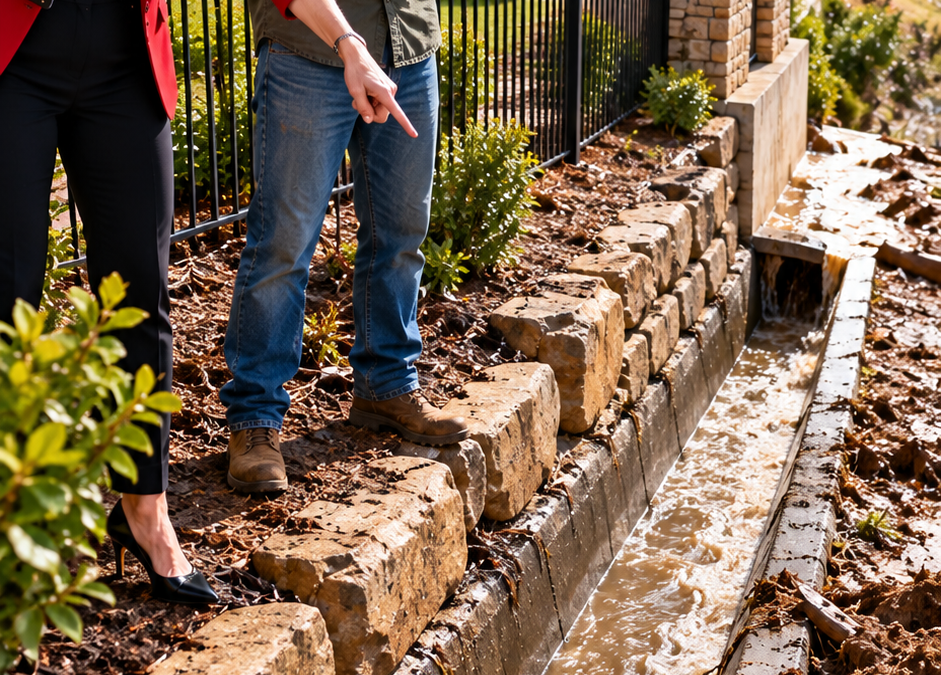
I looked at the narrow drainage run beside the back fence. It wasn’t pretty. It was old concrete, stained from years of runoff, with a metal grate in one section and a shallow stone-lined channel leading toward the side easement. Ivy had grown near the edges. Moss had darkened the shaded corners. It looked like something most people would ignore.
“What do you mean?” I asked.
He pointed up toward the hill behind the house.
“All that water comes down somewhere. This thing catches it before it starts looking for your foundation.”
So I kept it.
Over the years, I cleared leaves from it, checked for cracks, kept the grate open, and made sure water moved through it the way it was supposed to. It did not match the polished look of Maple Ridge’s newer landscaping. It did not photograph well for HOA newsletters. But every winter, when rain swept down from the ridgeline, that old drain did its job without complaint.
For nine years, I had no serious problems with the HOA.
I paid my dues. I trimmed my trees. I submitted requests when I changed exterior lighting or replaced a section of fence. I attended maybe three meetings in nine years, mostly because I preferred to stay out of neighborhood politics.
That changed when Linda Parker became HOA president.
Linda had a way of turning preference into policy.
She was polished, forceful, and very good at saying the words “community standards” as if they carried the weight of state law. She liked clean lines, fresh mulch, matching paint, and anything that made Maple Ridge look less like a neighborhood and more like a sales brochure.
At first, I thought she was just strict.
Then I watched her fine an elderly couple because their side gate was “weathered beyond acceptable visual harmony.” I watched her pressure a family into removing a children’s play structure because it was visible from the walking trail. I watched her argue for replacing mature shrubs near the clubhouse because they looked “too natural.”
That was Linda’s real problem.
She hated anything that looked like it had existed before she approved it.
My drainage channel was exactly that.
The first notice came in early spring.
It described the channel as an “unsightly hardscape element” and requested that I “beautify or remove” it to align with updated landscaping expectations along the hillside lots.
I laughed when I read it.
Then I stopped laughing.
I sent a written response explaining that the drainage system was functional, pre-existing, and necessary for runoff control. I included photos from previous storms showing water moving through it. I attached a copy of the old property inspection report that identified the channel as part of the site drainage.
Two weeks passed.
Then Linda showed up in person.
It was a warm afternoon, bright enough that the whole backyard looked harmless. The pool was still. The patio furniture was dry. The slope behind the house sat quiet beneath a line of shrubs and oak trees. If you didn’t know better, you might think water had never threatened that yard in its life.
Linda came through the side gate with three workers behind her.
I was standing near the patio, cleaning the pool skimmer basket, when I heard voices.
“Excuse me,” I called out. “What are you doing?”
Linda turned like she had expected me to be difficult but was prepared to enjoy it.
“Good afternoon, Jake,” she said. “We’re here to address the drainage channel.”
The workers carried demolition tools.
One had a jackhammer.
Another had a wheelbarrow.
The third was marking the ground near the concrete channel with orange spray paint.
I set the skimmer basket down slowly.
“No,” I said. “You’re not.”
Linda smiled. “The board approved the removal.”
“The board doesn’t own this backyard.”
“The channel affects the visual continuity of the hillside corridor.”
“It affects water runoff.”
She lifted a folder from under her arm. “We’ve already reviewed this.”
“With who?”
“With the landscaping committee.”
I looked at the workers. “Did anyone here review drainage plans?”
Nobody answered.
Linda’s smile thinned. “Jake, the structure is old, unattractive, and inconsistent with the neighborhood aesthetic.”
“It’s a drainage system.”
“It’s an eyesore.”
“It keeps water out of my yard.”
She sighed like I was intentionally missing the point.
“Modern landscaping can handle runoff without exposed concrete channels.”
“Who designed the replacement drainage?”
“We’re not replacing it. We’re removing the unattractive element.”
For a moment, I just stared at her.
Then I pulled out my phone and started recording.
Linda noticed immediately.
“That isn’t necessary.”
“It is absolutely necessary.”
Her face hardened. “The HOA has approved this change.”
“And I’m telling you on camera that removing this drain is dangerous. Water comes down that slope during storms. This channel carries it away from the patio, the pool area, and the foundation. If you remove it without an engineered replacement, you’re creating a runoff problem.”
Linda folded her arms.
“The next rain will prove you’re being dramatic.”
Those words stayed in my mind longer than anything else she said.
The next rain will prove you’re being dramatic.
I recorded the workers as they began breaking apart the old concrete channel. I recorded Linda standing beside them, supervising. I recorded myself telling them to stop. I recorded the date, the time, the location, and the fact that I did not consent to the removal.
The sound of the jackhammer tore through my yard.
Chunks of concrete came loose one after another.
The channel that had protected my property for years disappeared into a wheelbarrow while Linda stood nearby, satisfied, as if she were watching the neighborhood become more beautiful by force.
By evening, it was gone.
In its place was a rough strip of exposed soil running along the rear slope. The workers spread decorative gravel over part of it, raked the surface, and planted a few ornamental grasses near the edge.
Linda looked pleased.
“There,” she said. “Much better.”
I crouched near the disturbed ground and pressed my hand into the soil.
It was already damp.
That bothered me.
It had not rained that day. No sprinklers were running. The old channel had carried slow subsurface seepage away even in dry weather, something I had never fully appreciated until it was gone.
“Water is already collecting here,” I said.
Linda barely glanced down. “Fresh soil settles.”
“This is runoff.”
“It hasn’t rained.”
“Exactly.”
She gave me one of those smiles that made every warning feel like an insult to her authority.
“Jake, sometimes homeowners get attached to outdated features. Give it time.”
I stood up.
“I hope you’re right.”
She lifted her chin. “I am.”
Two days later, the storm came.
The weather service had warned about it all afternoon. A strong system moved in from the west, pushing heavy clouds over the mountains. By sunset, the sky had gone the color of bruised steel. Wind shook the oak branches behind the property. The air smelled like wet dust before a single drop fell.
I stood by the back windows and watched the hill.
The missing drain ran through my mind like a bad memory.
My wife, Emily, came up beside me.
“You’re worried,” she said.
“Yes.”
“Because of the drain?”
“Because water doesn’t care what Linda approved.”
The rain started at 8:17 p.m.
I remember the time because I looked at my phone.
At first, it was steady but normal. Water streaked down the windows. The pool surface danced under the drops. The patio darkened.
Then the storm intensified.
Rain hammered the roof so hard it sounded like gravel being poured overhead. Water rushed down the slope behind the house in sheets. I grabbed a flashlight, stepped under the covered patio, and pointed the beam toward the place where the channel used to be.
My stomach dropped.
Water was not being redirected anymore.
It was spreading.
A muddy current poured directly through the disturbed soil and across the back of the yard. The ornamental grasses Linda’s crew had planted were already flattened. Gravel shifted and rolled. Muddy water crawled toward the patio like something alive.
Emily opened the sliding door behind me.
“Jake?”
“Stay inside.”
The water reached the patio fifteen minutes later.
By nine, mud was pushing against the lower step.
By ten, the pool deck was surrounded by brown water.
I called the HOA emergency number. No answer. I left a message. Then another.
At 10:46, I sent Linda a video.
The message was simple.
“This is the result of removing the drainage channel. Water is now entering the patio and pool area.”
She did not respond.
By midnight, I stopped trying to keep up with towels near the back door and focused on documenting everything. I filmed the runoff path. I filmed the water pouring from the slope where the channel had been removed. I filmed the mud collecting around the pool deck.
I could do nothing else.
There is a specific kind of helplessness that comes from watching damage happen slowly. If a tree falls through your roof, the disaster is instant. Violent, but clear. This was different. This was water making decisions one inch at a time, and every inch proved what I had already told them.
By morning, my backyard looked like it had been dragged downhill.
Mud covered the patio. The planters were knocked sideways. Decorative gravel had washed into the pool. The lawn was torn into channels. The lower shrubs were half-buried. Standing water pooled where the concrete drain had once collected runoff and carried it away.
I called Linda again.
This time, she answered.
“What is it, Jake?”
Her voice was clipped, irritated, like my flooded yard had inconvenienced her morning.
“You need to come see what happened.”
“There was a storm.”
“You removed the drainage channel two days ago.”
“We removed an unsightly structure.”
“You removed the thing that kept the storm out of my backyard.”
She exhaled. “I’ll stop by.”
She arrived an hour later wearing boots too clean for the situation and a rain jacket that still had the fold lines in it. Two board members came with her, along with the same landscaping supervisor who had overseen the removal.
Linda stepped through the side gate and stopped.
For a moment, she said nothing.
That alone told me the damage was worse than she expected.
The backyard was not messy.
It was wrecked.
Mud coated the patio in thick layers. The pool water had turned brown-green with debris. The soil along the slope had collapsed into uneven ridges. Water still trickled through the exact line where the old drain used to run, now spreading freely instead of being captured.
I pointed to the scar in the ground.
“That was the drainage path.”
Linda recovered quickly.
“This is a storm-related issue.”
“Yes,” I said. “Stormwater is exactly what the drain controlled.”
“You can’t prove the channel would have prevented all this.”
“I recorded the water path.”
The landscaping supervisor shifted his weight.
Linda noticed and snapped, “We are not assigning blame in the middle of a cleanup.”
“I’m not asking you to assign blame. I’m showing you cause and effect.”
She looked toward the mud-covered patio. “The HOA will review the matter.”
That was her standard phrase when she wanted to delay reality.
Then I saw the first crack.
Not in her argument.
In the concrete.
A thin dark line ran along the pool deck near the deep end, just beyond the coping. At first, I thought it was mud. Then I stepped closer.
It wasn’t mud.
It was a crack.
Then I saw another.
And another.
“Stop,” I said.
Linda frowned. “What now?”
I held up my hand and moved toward the pool.
The concrete around the deck had begun to lift slightly near one corner. Not much. Maybe an inch. But enough that the surface no longer sat flat.
Emily came outside behind me and covered her mouth.
“Jake,” she whispered.
The ground made a sound then.
A low, deep groan.
Not loud, but heavy.
The kind of sound you feel in your legs before your ears fully understand it.
Everyone froze.
Water and mud began pushing upward through one of the cracks near the pool deck. The concrete shifted with a grinding pop. The corner of the deck lifted. The pool coping separated from the surrounding slab.
Linda took a step back.
“What is happening?” she asked.
Nobody answered.
The pool moved.
Not like something floating. Not dramatically at first. It tilted—just enough to make my mind reject what my eyes were seeing. The structure had been pushed unevenly by water pressure and unstable soil beneath it. Mud bubbled up around one side. A section of the deck buckled upward. The pool shell rose out of alignment like the earth beneath it had exhaled.
Emily said, “Oh my God.”
The landscaping supervisor muttered something I could not hear.
Linda stood completely still, staring at the pool as if it had personally betrayed her.
For years, that pool had sat stable in the backyard because the hillside water was controlled. Now, with nowhere to go, water had saturated the soil around and beneath it. Pressure built. Mud shifted. The structure moved.
The swimming pool had literally risen unevenly from the ground.
That was when Linda finally understood.
Not fully, maybe. Not honestly. But enough.
She looked toward the missing drain line.
Then toward the cracked deck.
Then toward me.
Her face had gone pale.
I pulled out my phone again.
“You’re seeing this?” I said into the video. “This is two days after the HOA removed the drainage channel. The pool deck is cracking, water is pushing up through the slab, and the pool structure has shifted.”
Linda turned toward me sharply. “Do not record me.”
“I’m recording my property.”
“This is inappropriate.”
“No, Linda. Removing the drain was inappropriate.”
The board members said nothing.
That silence told me they were beginning to understand the size of the problem.
Within an hour, I had called an independent drainage engineer and a structural pool specialist. I did not wait for HOA approval. I did not ask Linda who she preferred. I wanted professionals who answered to facts, not neighborhood politics.
The drainage engineer, a man named Robert Keene, came the next morning.
He was in his sixties, quiet, with mud-stained boots and the tired patience of someone who had spent a career watching people disrespect water. He walked the slope slowly. He studied the removed channel area. He looked at old photos I had taken before the removal, then at the videos from the storm.
Finally, he stood near the pool and said, “Who authorized removing that channel?”
“The HOA.”
He looked toward the hill.
“Without replacement drainage?”
“Yes.”
He shook his head once.
That was not good.
The pool specialist arrived later that day and was even more direct.
“You have hydrostatic pressure and soil movement,” he said. “The pool shell has shifted. The deck failure is not cosmetic.”
Linda came by while both professionals were there.
She had traded her polished confidence for a defensive tightness.
Robert Keene explained the water flow in plain terms. The old channel had intercepted runoff from the rear slope and moved it laterally away from the yard. Removing it allowed water to concentrate in the disturbed soil zone, saturating the pool area and destabilizing the surrounding ground.
Linda tried to interrupt.
“But the storm was unusually strong.”
Robert looked at her. “Strong storms are exactly why drainage systems exist.”
She did not have an answer for that.
The written reports came in four days later.
They were devastating.
The drainage report stated that the removed channel had been a functional runoff-control feature and that removing it without an engineered replacement had materially contributed to the flooding and soil saturation. The structural report connected the excess water and shifting soil to the cracked deck and displaced pool structure.
I made copies of everything.
Photos.
Videos.
The HOA notice.
My written objection.
The footage of the workers breaking the channel apart.
The storm videos.
The reports.
The estimates.
Then I prepared a timeline.
I did not make it emotional.
I did not need to.
Day one: HOA removed the drain over homeowner objection.
Day three: major storm.
Day four: flooding, mud intrusion, deck cracking, pool displacement.
Day six: independent drainage inspection.
Day seven: structural inspection.
Day nine: reports confirmed drainage removal contributed to damage.
The evidence was cleaner than any speech I could give.
The HOA board called an emergency meeting the following week.
For the first time since I had lived in Maple Ridge, the room was full.
People had heard rumors. They knew my backyard had flooded. Some had seen photos. A few had heard the pool had risen from the ground and assumed that had to be exaggeration.
It was not.
Linda sat at the front table with the other board members, but she did not look comfortable. She kept shuffling papers and whispering to the property manager. Her authority, which usually filled the room before she said a word, seemed smaller now.
I waited until resident comments opened.
Then I stood.
“My name is Jake Miller,” I said. “I live on Lot 42, upper hillside row. Nine years ago, when I bought my home, the backyard had an old drainage channel along the rear slope. It was not decorative. It was functional. It carried stormwater away from the patio, pool area, and foundation.”
Linda stared down at her papers.
I continued.
“On May 14, the HOA removed that channel over my objection. I warned President Parker on video that removing it without replacement drainage would create runoff problems. Two days later, a storm hit. Water entered the backyard through the exact area where the channel had been removed.”
I placed the first photo on the document camera.
The screen behind the board showed my yard before the removal.
Then the channel.
Then the workers breaking it apart.
Then the mud-covered patio.
Then the cracked pool deck.
Then the displaced pool structure surrounded by brown water.
A sound moved through the room.
Not a gasp exactly.
More like the collective loss of every easy excuse.
I handed the board the professional reports.
“These are independent findings from a drainage engineer and a structural pool specialist. I am not asking this board to take my word over Linda’s. I am asking you to look at the timeline, the videos, the reports, and the damage.”
One board member, a man named Alan Brooks, leaned into his microphone.
“Mrs. Parker, was a drainage engineer consulted before removal?”
Linda’s mouth tightened.
“The project was reviewed as part of hillside beautification.”
“That is not what I asked.”
She glanced toward the property manager. “Not specifically, no.”
Another board member asked, “Was the homeowner’s objection documented?”
I said, “I have the video.”
Linda closed her eyes for half a second.
That was the moment I knew the meeting had shifted.
For weeks, maybe months, the board had treated Linda’s confidence as competence. Now the evidence was forcing them to separate the two.
The property manager reviewed the reports silently, then whispered to the board attorney.
The attorney’s expression changed.
That expression did more than anything else to sober the room.
Because lawyers do not look concerned over ordinary landscaping disagreements. They look concerned when someone has created exposure.
Linda tried one final defense.
“The channel was old, unattractive, and not consistent with current visual standards,” she said.
I turned toward her.
“So was it ugly, or was it unimportant?”
She stared at me.
“Because you can’t have it both ways. If it was important enough for the HOA to remove from my property, then it was important enough to understand before you destroyed it.”
The room went silent.
I had not shouted.
That mattered.
My anger was there, but I kept it in its place. I had learned something from watching the water ruin my yard: force without direction only creates more damage. Evidence needed a channel too.
The board voted that night to suspend all hillside modification projects pending engineering review.
Then they voted to authorize immediate installation of emergency drainage at my property.
Linda did not vote.
She sat motionless while the decision passed.
The repairs took weeks.
First came the temporary diversion barriers, then excavation. Professionals reopened the flow path and installed a modern subsurface drainage system with catch basins, reinforced pipe, gravel bedding, and proper outflow routing. It was not as visually simple as Linda’s ornamental grasses, but it worked.
The pool repairs were harder.
Sections of deck had to be demolished. The soil had to be stabilized. The pool shell had to be assessed, lifted, corrected, and reinforced. The landscaping had to be rebuilt almost from scratch. Mud was removed by the truckload. Damaged plants were replaced. The patio had to be pressure-washed so many times I thought the concrete might start asking for mercy.
Throughout the process, I documented everything.
Not because I enjoyed it.
Because I had learned exactly how quickly people in authority will rewrite a story if you leave them enough blank space.
Linda avoided me after the meeting.
When we crossed paths once near the clubhouse, she looked away. That was fine. I did not need an apology from her to know what had happened. The reports said it. The photos said it. The repaired drainage system said it every time rainwater flowed safely away from the yard.
Eventually, the HOA sent a formal letter acknowledging that the drainage removal had been performed without adequate technical review and that the association would participate in remediation costs under the guidance of its insurer and counsel.
It was not written in human language.
No sentence said, “We should have listened.”
No sentence said, “Linda was wrong.”
No sentence said, “We nearly destroyed part of your home because someone thought ugly meant useless.”
But I could read between the lines.
The board had learned enough to protect itself.
That was still better than pretending nothing happened.
By late summer, the backyard looked almost normal again.
Almost.
The patio was clean. The new drainage system was buried, hidden beneath stone and soil, but I knew exactly where it ran. The pool had been stabilized. The deck was repaired. Fresh landscaping softened the slope. When the evening light came over the ridge, you could almost forget the mud, the cracks, the rumble from beneath the concrete.
Almost.
The first time it rained after the repairs, I stood at the back window with a cup of coffee and watched.
Emily came beside me.
“You trust it?” she asked.
“I trust the engineer more than I trusted the HOA.”
She smiled faintly.
Rainwater came down the slope, reached the new catch basin, disappeared underground, and moved away from the pool exactly the way it should.
No spreading mud.
No standing water.
No pressure building beneath the deck.
Just water doing what water does when people respect it enough to give it a path.
I thought about my father then.
He would have hated the whole mess. He would have hated Linda’s arrogance, the board’s carelessness, the way a functional thing had been dismissed because it didn’t look pretty enough. But he would have approved of the documentation. He would have approved of the reports. He would have approved of making the evidence so clear that nobody could bury the truth under meeting language.
A few months later, the HOA changed its procedures.
No drainage, grading, retaining wall, or hillside landscaping modification could be approved without professional review. No work could be performed on a homeowner’s lot without written authorization or legal confirmation of HOA responsibility. Board members had to receive technical documentation before voting on projects affecting runoff.
It was the kind of policy that should have existed before my yard became the lesson.
But at least it existed after.
Linda eventually stepped down from the architectural committee.
The announcement said she wanted to “focus on other community priorities.”
I knew what that meant.
It meant she no longer got to decide what was ugly enough to destroy.
Sometimes people ask me whether I regret not fighting harder that first day, whether I should have stood in front of the workers or physically stopped them from breaking the channel apart.
I understand the question.
I asked myself the same thing while watching mud swallow my patio.
But I also know the truth. If I had grabbed tools, blocked workers, or lost my temper, Linda would have made me the story. She would have turned the whole thing into homeowner aggression, board interference, and refusal to cooperate.
Instead, I recorded.
I warned.
I documented.
And when the storm came, the truth had nowhere to hide.
That is how I won.
Not by being louder than the HOA.
Not by humiliating Linda.
Not by turning the meeting into a shouting match.
I won because the evidence formed a straight line from their decision to the damage they tried to deny. The old drain existed. The HOA removed it. The rain came. The water followed the missing path. The yard flooded. The pool shifted. The professionals confirmed why.
That line was stronger than Linda’s confidence.
Today, if you stand in my backyard, you won’t see much evidence of what happened. The new system is mostly underground. The grass has grown back. The patio is usable again. The pool sits level. The hillside looks peaceful in that deceptive way hillsides do when the weather is clear.
But I know what is beneath it.
I know where the water goes.
I know why the drain matters.
And I know that sometimes the ugliest-looking part of a property is the thing quietly saving everything beautiful around it.
Linda looked at my old drainage channel and saw an eyesore.
I looked at it and saw protection.
The storm decided which one of us understood the land.








