𝗙𝗨𝗟𝗟 𝗦𝗧𝗢𝗥𝗬 Karen’s Victory Smile Disappeared the Moment the County Clerk Opened the Wrong File
𝗙𝗨𝗟𝗟 𝗦𝗧𝗢𝗥𝗬
Karen raised hers immediately.
I looked over.
She did not look at the auctioneer.
She looked at me.
I raised my bid.
She raised hers.
The room changed almost at once. People shifted in their chairs. A man in the back stopped whispering. Someone let out a low sound that was almost a laugh. Everyone could tell this was not a normal auction anymore.
It became a contest.
I kept my face still.
Karen kept smiling.
The numbers climbed.
Ten thousand above opening.
Twenty-five.
Forty.
Seventy.
Each bid tightened something in my chest. I had planned for competition, but not this kind. Karen was not bidding like someone calculating development costs. She was bidding like someone spending other people’s money to prove a point.
I leaned toward my limit.
Then past comfort.
Then to the edge of what I could still justify.
The auctioneer looked at me. “Do I have another bid?”
I raised my card one final time.
My mouth was dry.
That number stretched me farther than I wanted, but I could still make it work if I delayed the workshop, took on two more commercial grading jobs, and handled more of the build myself.
Karen did not hesitate.
She raised her card and outbid me by a large amount.
Not a little.
Not a careful increment.
A statement.
The room reacted immediately.
A few people murmured. Someone behind me whispered, “Damn.”
The auctioneer looked at me.
I stared at the table in front of him.
I could have bid again.
I wanted to.
For one wild second, anger told me to raise my card and make Karen bleed for it.
But anger is expensive when it controls the pen.
I knew my limit.
So I lowered my card.
The auctioneer called Karen’s number once.
Twice.
Sold.
The gavel came down.
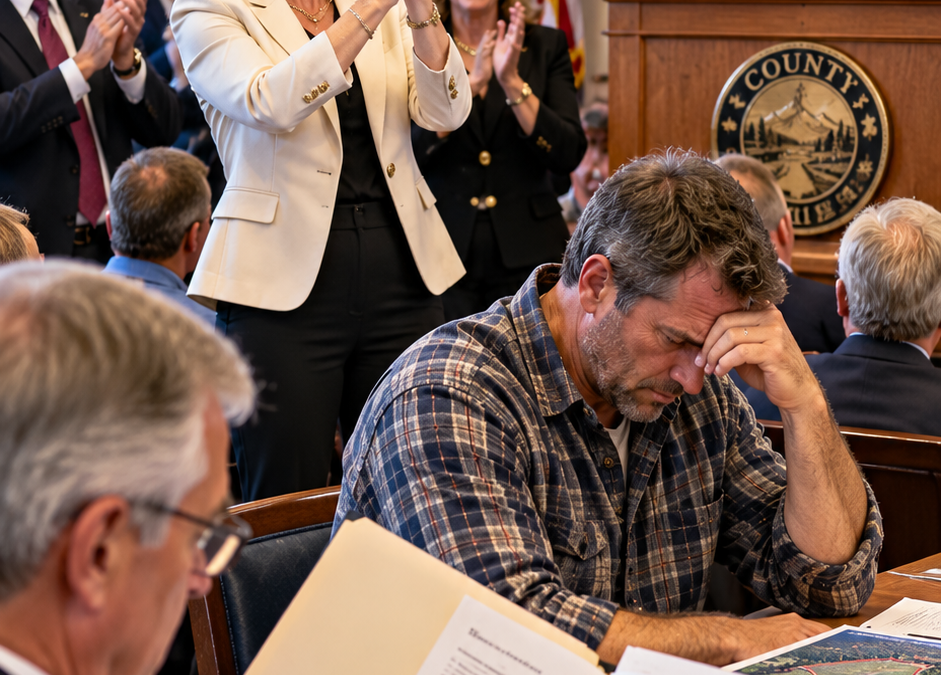
The HOA board members applauded.
Actually applauded.
Not polite clapping. Not subdued acknowledgment. They broke into open, smug applause like Karen had just rescued the neighborhood from disaster.
Karen turned toward me.
Her smile was bright and victorious.
I nodded once.
Then I stood, gathered my folder, and walked out.
I did not argue.
I did not congratulate her.
I did not let her see how badly I wanted to turn around and say something I would regret.
Outside, the mountain air felt colder than it had that morning.
I sat in my truck for a long time with both hands on the steering wheel.
The land was gone.
Not because Karen wanted to build something meaningful.
Not because she had a plan better than mine.
Because she could use the HOA’s money and pride to take it off the table.
That was the part that burned.
I had wanted that hill for a home.
Karen wanted it as a trophy.
By lunchtime, people were already talking. Cedar Hollow residents posted online about how the HOA had “protected the viewshed.” Douglas sent a community email praising Karen’s “decisive leadership.” He said the board had secured a key parcel to preserve neighborhood value and prevent “incompatible use.”
Incompatible use.
That meant me.
A man planning a house and workshop on land zoned for exactly that.
By evening, I had read the email three times, each time feeling the same anger return with sharper edges.
Then I did what my father always told me to do when anger got too loud.
I opened the records.
My father had been a county assessor for twenty-eight years. He believed public records were where people’s confidence went to be tested. “Before you fight a man,” he used to say, “find out what he signed.”
So I started with the parcel Karen had won.
Then I widened the search.
The HOA had recently borrowed money for several community assets. I knew that from public meeting notes and recorded financing documents. Cedar Hollow had renovated its clubhouse, expanded the pool area, upgraded landscaping, and purchased a maintenance lot near the back entrance. They liked calling those things investments. I liked calling them obligations.
I searched by the HOA’s legal name.
Cedar Hollow Community Association.
Then related entities.
Then property records.
Then tax status.
Most of it was ordinary.
Deeds. Maintenance liens. Easements. Notices. Board filings. Contractor payments.
Then I saw the clubhouse parcel.
At first, I almost skipped it.
The clubhouse was the crown jewel of Cedar Hollow. A stone building with big windows, a fitness room, meeting space, a pool deck, and a ridiculous bronze sign near the entrance that said The Lodge at Cedar Hollow. Karen had hosted every annual meeting there since becoming president. She treated it like city hall, a throne room, and a country club all at once.
The tax record showed a balance.
A large one.
I leaned closer to the screen.
It was not just one missed payment.
There were penalties.
Interest.
Several overdue obligations attached to the clubhouse property.
I refreshed the page because I thought I had misread it.
The numbers did not change.
The HOA that had just outbid me at auction had a serious unpaid tax problem on its clubhouse.
I did not smile.
Not yet.
Because public records can be incomplete, delayed, or easy to misunderstand if you want them to say something too badly.
The next morning, I went to the county clerk’s office.
The woman at the counter was named Mrs. Latham. She had gray hair, square glasses, and the steady patience of someone who had explained the same form to angry people for thirty years.
I gave her the parcel number and asked to verify the tax balance and notices.
She typed, clicked, frowned slightly, then printed a record.
“This is current as of yesterday,” she said.
I read it in silence.
The overdue balance was real.
So were the penalties.
So were the notices.
“Has the owner been notified?” I asked.
She gave me a careful look. “The record indicates notices were issued according to procedure.”
“To Cedar Hollow Community Association?”
“Yes.”
“Any pending correction? Appeal? Payment plan?”
She checked again. “I don’t see one recorded here.”
I felt the ground shift under the entire situation.
Not dramatically.
Not like an explosion.
More like a door opening somewhere far away.
I folded the printout and slipped it into my folder.
“Thank you,” I said.
Mrs. Latham nodded. “People usually don’t check until it’s already a problem.”
“That seems to be a theme.”
Before leaving, I asked one more question.
“If taxes remain unpaid, what happens?”
She did not give legal advice. Clerks never do, and good ones tell you that quickly. But she explained the process in general terms. Notices. Deadlines. Potential tax lien procedures. Collection remedies allowed by state law. Time periods. Owner responsibilities.
I listened carefully.
I did not ask how to hurt the HOA.
I asked what the county did when people did not pay what they owed.
There is a difference.
That afternoon, I drove to the clubhouse.
I parked across the street, stepped out, and looked at the building Karen had used as the center of her little kingdom.
The lawn was freshly cut. The flower beds were perfect. Two flags moved lazily near the entrance. Through the windows, I could see clean tables arranged inside for some upcoming board event.
Then I saw the notice.
It had been posted near the entrance, partly shielded by a decorative planter.
Most residents probably walked past without reading it.
I did not.
The language was formal, dry, and dangerous. It referenced unresolved tax obligations and warned that failure to address them could lead to further legal collection action.
I took a photograph.
Then another from farther back, showing the building and the notice together.
A woman leaving the fitness room looked at me suspiciously.
I got back in my truck and left without saying a word.
For the next week, Karen celebrated.
The HOA newsletter praised the auction purchase.
Douglas wrote that Cedar Hollow had “secured long-term protection of the mountain overlook.”
Karen gave a statement at the board meeting about preserving property values and preventing outside interests from compromising neighborhood character. Residents clapped. Someone suggested naming a walking trail after her. Another person thanked her for “standing up to opportunists.”
I knew they meant me.
I sat at home that night and watched the meeting recording online with the tax documents open beside me.
Karen stood behind the clubhouse podium, confident and polished.
“We acted decisively,” she said. “When important property becomes available near our community, we cannot simply hope the right thing happens. We have to lead.”
I paused the video there.
We have to lead.
Behind her, through the clubhouse windows, I could see the dark reflection of the room.
I wondered if anyone on that board had checked the tax account before spending more HOA money.
I wondered if they understood that protecting an overlook meant very little if they could not protect the building they were standing in.
I did nothing.
That was the hardest part.
People assume doing nothing is easy. It is not. Not when you are angry. Not when you have evidence. Not when every instinct wants to walk into the next meeting, drop the records on the table, and watch Karen’s face change.
But that would have made it about me.
I did not want it to be about revenge.
I wanted it to be about records.
So I waited.
The county moved at its own pace.
First came updated notices.
Then formal demand.
Then deadline language.
I knew because I checked the records every morning and sometimes in the afternoon too. I did not contact the HOA. I did not contact residents. I did not post anything online. I did not threaten Karen. I did not interfere.
I simply watched the public process unfold.
A few days after the formal notices went out, the tone inside Cedar Hollow changed.
The first sign was an HOA email marked urgent.
It announced a special board meeting regarding “financial administration and asset protection.”
That phrase told me more than they probably wanted it to.
Then a resident I knew from the hardware store called me.
His name was Allan. He lived near the clubhouse and occasionally hired my company for drainage work.
“Jack,” he said, voice low, “did you know the HOA has a tax problem?”
“I saw the public records.”
There was a long pause.
“You saw them when?”
“After the auction.”
“You didn’t say anything.”
“It wasn’t my board.”
He let out a breath. “People are upset.”
“They should ask their board why.”
“They’re saying the amount is bigger than expected.”
“It usually is once penalties start talking.”
Allan was quiet for a moment.
Then he said, “Karen keeps saying it’s temporary.”
“She may be right.”
“You think so?”
“I think either they pay it or they don’t. The county doesn’t care how confident she sounds.”
At the emergency meeting, Karen tried to control the room.
I watched that recording too.
She stood at the same podium where she had celebrated outbidding me, but this time her hands gripped both sides of it.
“The clubhouse is not in danger,” she said. “This is an administrative issue created by timing, accounting transitions, and county processing delays.”
A man in the front row interrupted. “Then why is there a final notice on the door?”
The room stirred.
Karen looked toward the HOA attorney, Philip Harlan.
Harlan adjusted his glasses and stood slowly.
“Let’s be precise,” he said. “The association has outstanding tax obligations connected to the clubhouse parcel. Some notices were received previously. The amounts have increased due to penalties and interest. Ignoring the matter would be unwise.”
That was lawyer language for: this is worse than Karen wants to admit.
Another resident asked, “How did this happen when we had money to buy the overlook parcel?”
The room got loud after that.
Karen raised her voice.
“The overlook parcel was a strategic acquisition approved by the board.”
A woman shouted, “But we didn’t pay taxes on what we already own?”
Douglas tried to calm everyone down, but his face had gone pale. Board members shuffled papers. Harlan spoke in careful sentences. Karen kept saying the issue would be handled.
But numbers do not care about tone.
The balance was read aloud.
The room went silent.
Then everyone started talking at once.
I almost felt sorry for them.
Almost.
Because most residents had not known. They had trusted the board. They had paid dues, attended pool parties, walked into that clubhouse for yoga classes and wine tastings, and assumed the people managing the money knew where the obligations were buried.
But Karen knew how to perform certainty, and certainty had become a substitute for competence.
That is a dangerous trade.
Over the next several days, Cedar Hollow tried to raise money quickly.
Special assessment discussions began. Reserve transfers were proposed. Someone suggested delaying landscaping contracts. Someone else wanted to unwind the land auction purchase, which was impossible by then without consequences. There were arguments about whether the board had authority to move funds. Accusations flew over missed notices, accounting changes, and whether Karen had pushed too hard to buy the overlook property while ignoring older debts.
Meanwhile, the county deadline kept approaching.
I met with my attorney during that period, not because I wanted to attack the HOA, but because I wanted to understand what could happen next.
Marissa Cole had handled property disputes for half the county. She was direct, precise, and had very little patience for emotional theories unsupported by documents.
I laid out the auction, the HOA purchase, the clubhouse taxes, and the notices.
She reviewed the records and said, “They overextended.”
“That’s what it looks like.”
“Did you have anything to do with the tax issue?”
“No.”
“Did you contact the county to trigger enforcement?”
“No. I verified records.”
“Good.”
“I’m not trying to sabotage them.”
She looked at me over the top of her glasses. “Jack, unpaid taxes are not sabotage. They are unpaid taxes.”
That sentence steadied me.
Because a part of me did feel guilty.
Not responsible, exactly. But involved. Like by finding the records, I had become part of the disaster.
Marissa must have seen it on my face.
“You lost an auction,” she said. “You reviewed public records. The HOA’s obligations existed before you looked at them. Their deadlines existed before you knew the dates. Their choices created their exposure.”
“I know.”
“Then stay clean. Do not contact board members. Do not threaten anyone. Do not interfere with the process. If there is a public sale or lien opportunity and you want to participate, we discuss it first and follow every rule.”
“I don’t want to do anything illegal.”
“Then don’t improvise.”
That was good advice.
So I didn’t.
I stayed clean.
I watched the process.
Karen did not.
Or maybe she tried and failed.
The next meeting was worse.
By then, residents had seen the posted notices themselves. Someone had printed the tax record and passed it around. Another resident demanded to know why the board had approved an expensive land purchase while the clubhouse account remained unresolved.
Karen insisted the two matters were separate.
Technically, maybe they were.
Practically, nobody believed her.
A man named Victor stood and said, “You clapped when you outbid Jack Miller. You all clapped. You acted like you had unlimited money. Now you’re telling us we may need an emergency assessment to protect the clubhouse?”
Karen’s face tightened. “The board acted to protect the neighborhood.”
Victor shot back, “From what? A man building a house?”
That line spread through the room.
I heard it later from Allan, then saw it in the meeting notes.
A man building a house.
The phrase stripped the board’s victory down to what it had really been.
Not protection.
Control.
Karen had wanted to stop me because I was outside her authority. The board had applauded because they enjoyed the feeling of defeating someone who would not answer to them.
Now the bill for that feeling had come due.
The final enforcement notice was posted two weeks after the auction.
This one had no softness left in it.
The county gave a limited period to resolve the outstanding taxes and associated charges. If the balance was not addressed, the county could pursue remedies available under state law.
I drove by once and saw the notice from the road.
I did not stop.
There was nothing for me to photograph anymore.
The paper was there.
The debt was there.
The clock was there.
Karen demanded another emergency meeting.
This time, the room was packed.
Residents stood along the walls. Some held copies of financial statements. Others had printed emails from months earlier where the board had assured everyone that Cedar Hollow was financially strong.
Karen looked smaller behind the podium.
Not humble.
Just cornered.
She began with familiar language: temporary issue, accounting irregularity, aggressive county schedule, commitment to resolution.
Then Harlan stood.
He did not let her soften it.
“The deadline is real,” he said. “The balance must be resolved. If it is not, the county has authority to proceed under applicable tax collection procedures. I strongly advise against assuming more time will be granted.”
A resident asked, “Can we sell the overlook parcel?”
Harlan replied, “Not quickly enough without complications.”
Another asked, “Can we borrow against reserves?”
Douglas said, “Our borrowing capacity is constrained.”
That was another way of saying the HOA had already borrowed too much.
Karen snapped, “We are exploring all options.”
Victor stood again.
“You explored buying land to keep Jack from owning it. Did you explore paying the tax bill first?”
Nobody applauded.
Nobody needed to.
The question did enough.
Karen’s eyes glistened, but she did not cry. She was too angry for that.
“This board acted in good faith,” she said.
Maybe she believed it.
That was possible.
People can do reckless things under the banner of good faith. They can dress pride as duty and call control protection. They can convince themselves they are defending a community when they are really defending their own authority.
But belief does not pay taxes.
The HOA tried.
I will give them that much.
They scrambled for funds. They debated special assessments. They negotiated. They contacted lenders. They reviewed reserves. They explored emergency dues. They considered selling minor assets.
But the deadlines had teeth, and the amounts were larger than many residents had been led to expect. Penalties had grown. Obligations had stacked. The new land purchase had drained flexibility at precisely the wrong time.
By the time they understood the size of the hole, they were already standing in it.
The county proceeded.
Not dramatically.
Government rarely moves like a movie.
There was no midnight seizure, no sheriff kicking open the clubhouse doors, no crowd gathering outside while Karen screamed. There were notices, filings, deadlines, recorded actions, and legal steps taken in the dull, relentless language of procedure.
But dull language can still ruin people.
The clubhouse became the center of the legal collection process.
The place Karen had used to celebrate control became the asset everyone now discussed in terms of lien priority, unpaid obligations, statutory remedy, and loss exposure.
I did not attend those meetings.
I heard enough.
Residents were furious. Some blamed Karen. Some blamed Douglas. Some blamed the management company. Some blamed prior boards. A few tried blaming me, which would have been funny if it had not been so dishonest.
I had not created the tax balance.
I had not voted to ignore notices.
I had not borrowed against community assets.
I had not outbid myself at auction for a parcel the HOA did not need.
All I had done was lose publicly, go home quietly, and read records they should have read first.
Months later, the final outcome became clear.
Cedar Hollow did not collapse. Neighborhoods rarely do. But the clubhouse was no longer the untouchable symbol of success it had been before. The tax issue forced legal and financial consequences the board could not spin away. Whether through sale, settlement, lien resolution, restructuring, or other county-approved remedy, the clubhouse became the price of the board’s financial mistake.
Karen resigned before the annual meeting.
Her resignation email was short.
She cited health, stress, and the need to spend time with family.
She did not mention me.
She did not mention the auction.
She did not mention the applause.
Douglas followed two weeks later.
A temporary board took over, and the first thing they did was hire an outside accountant to review every major obligation tied to HOA property. That should have happened long before anyone raised a paddle at the county auction.
One afternoon, I ran into Allan at the hardware store.
He found me in the fastener aisle, holding two boxes of galvanized bolts.
“You heard?” he asked.
“About Karen?”
“About all of it.”
“I heard enough.”
He shook his head. “People are still arguing. Some say the board meant well.”
“Meaning well is not a financial control.”
He gave a tired laugh. “No. It is not.”
Then he looked at me more seriously.
“You know, some residents thought you were waiting to pounce.”
“I wasn’t.”
“I know that now.”
I nodded.
He picked up a box of screws, put it back, then said, “For what it’s worth, a lot of people are starting to understand that the land auction was more about ego than protection.”
That mattered more than I expected.
Not because I needed vindication from Cedar Hollow.
I did not.
But because truth has weight, and it is exhausting carrying it alone while others clap for a lie.
A year after the auction, I drove past the overlook parcel.
The HOA still owned it, at least on paper. Nothing had been built there. No walking trail. No preserve. No community garden. No scenic platform. Just grass, wind, and a temporary sign leaning slightly near the edge of the road.
Protected Open Space.
That was what the sign said.
I pulled over for a moment and looked at the ridge.
It was still beautiful.
Painfully beautiful.
For a second, the old disappointment came back.
I could still see the house I had imagined. The porch. The workshop. The line of pines. The evening light turning the mountains blue.
Then I let the image go.
Not every loss needs to be avenged.
Some losses simply reveal people.
Karen had revealed herself at the auction, smiling while other people applauded my defeat.
The board had revealed itself by spending money to control land while neglecting obligations on property they already owned.
The county records had revealed what confidence tried to hide.
And I had learned something too.
I had learned that walking away is not the same thing as surrender.
That silence is not the same thing as weakness.
That public records do not shout, but they endure.
A few months later, I bought a different piece of land.
It was smaller, farther out, and harder to reach in winter. But it had a creek at the bottom, a stand of old fir trees near the north edge, and a western view no HOA could claim to be protecting from me.
Ellis came out to walk it.
He stood near the future build site, hands on his hips, and nodded toward the mountains.
“This one’s better,” he said.
I looked around.
The land was rougher. Less convenient. More work.
But it was mine.
“It might be,” I said.
I built slower than planned.
First the driveway. Then the well. Then the foundation. The workshop came before the house because I needed somewhere to store tools and because I am exactly the kind of man who will sleep in a camper if it means the equipment stays dry.
Some evenings, after the crew left and the light started fading, I stood where the porch would be and thought about the auction room.
Karen’s raised card.
The applause.
The gavel.
My own hands letting the folder close.
At the time, I had thought that moment was the end of something.
It wasn’t.
It was the beginning of a different lesson.
Karen won the property.
She won the applause.
She won the moment.
But she did not win the truth hidden in the records.
That truth had been waiting in county files, in tax ledgers, in notices nobody wanted to read, in obligations that did not disappear because the board had a different priority that month.
The HOA thought beating me at auction meant they had won the whole fight.
But I had never needed to fight them over that land.
Their own paperwork was enough.
By the time Cedar Hollow understood that, the celebration was long over.
The clubhouse lights still came on some nights, though under different rules and different management. The new board became quieter. More careful. Less theatrical. They sent fewer triumphant emails. They asked more questions in meetings. They learned, at least for a while, that money committed in pride still has to be paid back in reality.
As for Karen, I saw her only once after she resigned.
It was at a county office, of all places.
She stood near the clerk’s counter holding a folder, looking smaller without the board members around her. For a moment, she did not see me. Then she turned, and our eyes met.
Neither of us spoke.
What was there to say?
She had outbid me.
I had walked away.
The county records had done the rest.
After a few seconds, she looked down first.
I stepped to another counter and handled my permit paperwork for the new property.
When I left, she was still waiting.
That image stayed with me longer than her victory smile.
Not because I enjoyed seeing her diminished.
Because it reminded me how temporary power looks when it is built on assumption.
Karen had believed control meant having the last word in a room.
She had believed winning meant making other people clap.
She had believed property was something the HOA could dominate if it moved fast enough and sounded official enough.
But land has records.
Buildings have obligations.
Taxes have deadlines.
And pride, no matter how polished, does not erase a balance due.
I never got the first property.
I never built the house I imagined on that mountain overlook.
But I also never had to wonder who Karen really was or what kind of board Cedar Hollow had trusted with its money. They showed everyone.
All I had to do was read what they forgot to hide.
In the end, the property Karen took from me sat empty, the clubhouse became a financial wound the HOA could not ignore, and the applause from that auction room turned into a memory nobody on the board wanted repeated.
Karen thought she had won because she could outbid me.
She forgot that money spent in public still leaves records behind.
And sometimes the most expensive mistake is not the thing you buy.
It is the thing you failed to pay for before you started celebrating.
𝗧𝗛𝗘 𝗘𝗡𝗗
Karen’s Victory Smile Disappeared the Moment the County Clerk Opened the Wrong File
Karen thought she had beaten me the second the auctioneer’s gavel came down.
The HOA board applauded like they had just protected the entire neighborhood from me.
But the property she bought was never the only record worth looking at.
My name is Jack Miller, and for months I had been looking for one particular kind of land.
Not a subdivision lot. Not a polished parcel with fresh curbs, ornamental trees, and a mailbox already approved by some committee. I wanted quiet land. Real land. Something high enough to see the mountain ridge at sunset, far enough from the HOA streets to breathe, and open enough to build something that belonged to me before anyone else had an opinion about it.
I had spent too many years in places where every decision required permission.
Paint color. Fence height. Shed placement. Driveway material. Tree removal. Porch lights. I had listened to people who had never fixed a fence tell me what “rural charm” should look like. I had watched homeowners move into mountain country and complain about coyotes, tractors, dust, and the smell of cut hay.
So when I found the county auction listing, I felt something I had not felt in a long time.
Possibility.
The property sat on a rise beyond the east edge of Cedar Hollow Estates, the HOA where Karen Whitmore served as president. It was not huge, but it was perfect for what I wanted. A quiet piece of land overlooking the mountains. Enough slope for drainage. Enough trees for privacy. A flat bench near the top where I could build a modest house and a workshop. Below it, a gravel service track connected to an old county access road.
I walked it twice before the auction.
The first time, I went alone.
The grass was knee-high and pale from late summer heat. Wind moved through it in long silver waves. From the upper corner, I could see the mountains layered blue and gray in the distance, with clouds dragging shadows across the ridges. I stood there for nearly an hour, imagining a small house facing west, a porch deep enough for a chair and a coffee cup, a workshop tucked behind a screen of pines.
The second time, I brought a contractor friend named Ellis.
He walked the build site, checked the grade, looked at drainage, and finally said, “If you can get this at the auction price, you’d be crazy not to.”
That was all I needed.
I did my research. I checked the parcel boundaries. I reviewed the auction terms. I confirmed utilities, access, zoning, and taxes. I knew exactly how high I could bid without endangering the rest of the plan.
That number mattered.
I was not rich. I had savings, yes, but savings earned slowly through years of careful work. I owned a small excavation business, and most of what I had came from early mornings, late invoices, diesel bills, busted equipment, and jobs where people remembered your mistake longer than your effort.
I could stretch.
But I could not be reckless.
The morning of the auction, I arrived early at the county administration building with my paperwork in a folder and a cashier’s check clipped inside.
The room was already half full.
Investors sat in the back, talking quietly. A few local farmers leaned against the wall. Two real estate agents whispered over printed sheets. The county auctioneer stood near the front, sorting documents with a bored expression.
Then Karen walked in.
She did not come alone.
Three HOA board members came with her, all dressed like they were attending a hearing instead of a land auction. Karen wore a cream blazer, dark slacks, and the sharp smile she used whenever she wanted everyone to know she had already decided the outcome.
I looked away.
I had dealt with Karen before.
Everyone near Cedar Hollow had.
She was not just strict. Strict people can be fair. Karen was territorial. She believed the HOA’s interests expanded wherever her eyes landed. If the neighborhood could see a hill, she thought the board should influence it. If residents walked near a field, she thought the HOA had a right to manage it. If land bordered the subdivision, she treated it like unfinished business.
The parcel I wanted sat just outside the HOA boundary.
That was why she was there.
She saw me near the front and smiled.
“Jack,” she said. “I didn’t know you were interested in county land.”
I held my folder at my side. “Now you do.”
Her smile sharpened. “This parcel affects the entire community.”
“It’s outside your community.”
“It overlooks us.”
“That isn’t the same thing.”
One of the board members, a man named Douglas, gave a soft laugh like I had said something quaint.
Karen tilted her head. “We’ll see what the county thinks.”
“The county thinks it’s for sale,” I said. “That’s why we’re here.”
For a second, her smile slipped.
Then the auctioneer called everyone to order.
The first few parcels came and went quickly. Tax-delinquent lots. Narrow strips. One small commercial parcel near the highway. I barely listened. My eyes stayed on the packet in front of the auctioneer.
Then he announced the parcel number I had memorized.
My heart started beating harder.
The opening bid was exactly what the listing had said it would be.
I raised my card.
“Opening bid recognized,” the auctioneer said.
Karen raised hers immediately.
I looked over.
She did not look at the auctioneer.
She looked at me.
I raised my bid.
She raised hers.
The room changed almost at once. People shifted in their chairs. A man in the back stopped whispering. Someone let out a low sound that was almost a laugh. Everyone could tell this was not a normal auction anymore.
It became a contest.
I kept my face still.
Karen kept smiling.
The numbers climbed.
Ten thousand above opening.
Twenty-five.
Forty.
Seventy.
Each bid tightened something in my chest. I had planned for competition, but not this kind. Karen was not bidding like someone calculating development costs. She was bidding like someone spending other people’s money to prove a point.
I leaned toward my limit.
Then past comfort.
Then to the edge of what I could still justify.
The auctioneer looked at me. “Do I have another bid?”
I raised my card one final time.
My mouth was dry.
That number stretched me farther than I wanted, but I could still make it work if I delayed the workshop, took on two more commercial grading jobs, and handled more of the build myself.
Karen did not hesitate.
She raised her card and outbid me by a large amount.
Not a little.
Not a careful increment.
A statement.
The room reacted immediately.
A few people murmured. Someone behind me whispered, “Damn.”
The auctioneer looked at me.
I stared at the table in front of him.
I could have bid again.
I wanted to.
For one wild second, anger told me to raise my card and make Karen bleed for it.
But anger is expensive when it controls the pen.
I knew my limit.
So I lowered my card.
The auctioneer called Karen’s number once.
Twice.
Sold.
The gavel came down.
The HOA board members applauded.
Actually applauded.
Not polite clapping. Not subdued acknowledgment. They broke into open, smug applause like Karen had just rescued the neighborhood from disaster.
Karen turned toward me.
Her smile was bright and victorious.
I nodded once.
Then I stood, gathered my folder, and walked out.
I did not argue.
I did not congratulate her.
I did not let her see how badly I wanted to turn around and say something I would regret.
Outside, the mountain air felt colder than it had that morning.
I sat in my truck for a long time with both hands on the steering wheel.
The land was gone.
Not because Karen wanted to build something meaningful.
Not because she had a plan better than mine.
Because she could use the HOA’s money and pride to take it off the table.
That was the part that burned.
I had wanted that hill for a home.
Karen wanted it as a trophy.
By lunchtime, people were already talking. Cedar Hollow residents posted online about how the HOA had “protected the viewshed.” Douglas sent a community email praising Karen’s “decisive leadership.” He said the board had secured a key parcel to preserve neighborhood value and prevent “incompatible use.”
Incompatible use.
That meant me.
A man planning a house and workshop on land zoned for exactly that.
By evening, I had read the email three times, each time feeling the same anger return with sharper edges.
Then I did what my father always told me to do when anger got too loud.
I opened the records.
My father had been a county assessor for twenty-eight years. He believed public records were where people’s confidence went to be tested. “Before you fight a man,” he used to say, “find out what he signed.”
So I started with the parcel Karen had won.
Then I widened the search.
The HOA had recently borrowed money for several community assets. I knew that from public meeting notes and recorded financing documents. Cedar Hollow had renovated its clubhouse, expanded the pool area, upgraded landscaping, and purchased a maintenance lot near the back entrance. They liked calling those things investments. I liked calling them obligations.
I searched by the HOA’s legal name.
Cedar Hollow Community Association.
Then related entities.
Then property records.
Then tax status.
Most of it was ordinary.
Deeds. Maintenance liens. Easements. Notices. Board filings. Contractor payments.
Then I saw the clubhouse parcel.
At first, I almost skipped it.
The clubhouse was the crown jewel of Cedar Hollow. A stone building with big windows, a fitness room, meeting space, a pool deck, and a ridiculous bronze sign near the entrance that said The Lodge at Cedar Hollow. Karen had hosted every annual meeting there since becoming president. She treated it like city hall, a throne room, and a country club all at once.
The tax record showed a balance.
A large one.
I leaned closer to the screen.
It was not just one missed payment.
There were penalties.
Interest.
Several overdue obligations attached to the clubhouse property.
I refreshed the page because I thought I had misread it.
The numbers did not change.
The HOA that had just outbid me at auction had a serious unpaid tax problem on its clubhouse.
I did not smile.
Not yet.
Because public records can be incomplete, delayed, or easy to misunderstand if you want them to say something too badly.
The next morning, I went to the county clerk’s office.
The woman at the counter was named Mrs. Latham. She had gray hair, square glasses, and the steady patience of someone who had explained the same form to angry people for thirty years.
I gave her the parcel number and asked to verify the tax balance and notices.
She typed, clicked, frowned slightly, then printed a record.
“This is current as of yesterday,” she said.
I read it in silence.
The overdue balance was real.
So were the penalties.
So were the notices.
“Has the owner been notified?” I asked.
She gave me a careful look. “The record indicates notices were issued according to procedure.”
“To Cedar Hollow Community Association?”
“Yes.”
“Any pending correction? Appeal? Payment plan?”
She checked again. “I don’t see one recorded here.”
I felt the ground shift under the entire situation.
Not dramatically.
Not like an explosion.
More like a door opening somewhere far away.
I folded the printout and slipped it into my folder.
“Thank you,” I said.
Mrs. Latham nodded. “People usually don’t check until it’s already a problem.”
“That seems to be a theme.”
Before leaving, I asked one more question.
“If taxes remain unpaid, what happens?”
She did not give legal advice. Clerks never do, and good ones tell you that quickly. But she explained the process in general terms. Notices. Deadlines. Potential tax lien procedures. Collection remedies allowed by state law. Time periods. Owner responsibilities.
I listened carefully.
I did not ask how to hurt the HOA.
I asked what the county did when people did not pay what they owed.
There is a difference.
That afternoon, I drove to the clubhouse.
I parked across the street, stepped out, and looked at the building Karen had used as the center of her little kingdom.
The lawn was freshly cut. The flower beds were perfect. Two flags moved lazily near the entrance. Through the windows, I could see clean tables arranged inside for some upcoming board event.
Then I saw the notice.
It had been posted near the entrance, partly shielded by a decorative planter.
Most residents probably walked past without reading it.
I did not.
The language was formal, dry, and dangerous. It referenced unresolved tax obligations and warned that failure to address them could lead to further legal collection action.
I took a photograph.
Then another from farther back, showing the building and the notice together.
A woman leaving the fitness room looked at me suspiciously.
I got back in my truck and left without saying a word.
For the next week, Karen celebrated.
The HOA newsletter praised the auction purchase.
Douglas wrote that Cedar Hollow had “secured long-term protection of the mountain overlook.”
Karen gave a statement at the board meeting about preserving property values and preventing outside interests from compromising neighborhood character. Residents clapped. Someone suggested naming a walking trail after her. Another person thanked her for “standing up to opportunists.”
I knew they meant me.
I sat at home that night and watched the meeting recording online with the tax documents open beside me.
Karen stood behind the clubhouse podium, confident and polished.
“We acted decisively,” she said. “When important property becomes available near our community, we cannot simply hope the right thing happens. We have to lead.”
I paused the video there.
We have to lead.
Behind her, through the clubhouse windows, I could see the dark reflection of the room.
I wondered if anyone on that board had checked the tax account before spending more HOA money.
I wondered if they understood that protecting an overlook meant very little if they could not protect the building they were standing in.
I did nothing.
That was the hardest part.
People assume doing nothing is easy. It is not. Not when you are angry. Not when you have evidence. Not when every instinct wants to walk into the next meeting, drop the records on the table, and watch Karen’s face change.
But that would have made it about me.
I did not want it to be about revenge.
I wanted it to be about records.
So I waited.
The county moved at its own pace.
First came updated notices.
Then formal demand.
Then deadline language.
I knew because I checked the records every morning and sometimes in the afternoon too. I did not contact the HOA. I did not contact residents. I did not post anything online. I did not threaten Karen. I did not interfere.
I simply watched the public process unfold.
A few days after the formal notices went out, the tone inside Cedar Hollow changed.
The first sign was an HOA email marked urgent.
It announced a special board meeting regarding “financial administration and asset protection.”
That phrase told me more than they probably wanted it to.
Then a resident I knew from the hardware store called me.
His name was Allan. He lived near the clubhouse and occasionally hired my company for drainage work.
“Jack,” he said, voice low, “did you know the HOA has a tax problem?”
“I saw the public records.”
There was a long pause.
“You saw them when?”
“After the auction.”
“You didn’t say anything.”
“It wasn’t my board.”
He let out a breath. “People are upset.”
“They should ask their board why.”
“They’re saying the amount is bigger than expected.”
“It usually is once penalties start talking.”
Allan was quiet for a moment.
Then he said, “Karen keeps saying it’s temporary.”
“She may be right.”
“You think so?”
“I think either they pay it or they don’t. The county doesn’t care how confident she sounds.”
At the emergency meeting, Karen tried to control the room.
I watched that recording too.
She stood at the same podium where she had celebrated outbidding me, but this time her hands gripped both sides of it.
“The clubhouse is not in danger,” she said. “This is an administrative issue created by timing, accounting transitions, and county processing delays.”
A man in the front row interrupted. “Then why is there a final notice on the door?”
The room stirred.
Karen looked toward the HOA attorney, Philip Harlan.
Harlan adjusted his glasses and stood slowly.
“Let’s be precise,” he said. “The association has outstanding tax obligations connected to the clubhouse parcel. Some notices were received previously. The amounts have increased due to penalties and interest. Ignoring the matter would be unwise.”
That was lawyer language for: this is worse than Karen wants to admit.
Another resident asked, “How did this happen when we had money to buy the overlook parcel?”
The room got loud after that.
Karen raised her voice.
“The overlook parcel was a strategic acquisition approved by the board.”
A woman shouted, “But we didn’t pay taxes on what we already own?”
Douglas tried to calm everyone down, but his face had gone pale. Board members shuffled papers. Harlan spoke in careful sentences. Karen kept saying the issue would be handled.
But numbers do not care about tone.
The balance was read aloud.
The room went silent.
Then everyone started talking at once.
I almost felt sorry for them.
Almost.
Because most residents had not known. They had trusted the board. They had paid dues, attended pool parties, walked into that clubhouse for yoga classes and wine tastings, and assumed the people managing the money knew where the obligations were buried.
But Karen knew how to perform certainty, and certainty had become a substitute for competence.
That is a dangerous trade.
Over the next several days, Cedar Hollow tried to raise money quickly.
Special assessment discussions began. Reserve transfers were proposed. Someone suggested delaying landscaping contracts. Someone else wanted to unwind the land auction purchase, which was impossible by then without consequences. There were arguments about whether the board had authority to move funds. Accusations flew over missed notices, accounting changes, and whether Karen had pushed too hard to buy the overlook property while ignoring older debts.
Meanwhile, the county deadline kept approaching.
I met with my attorney during that period, not because I wanted to attack the HOA, but because I wanted to understand what could happen next.
Marissa Cole had handled property disputes for half the county. She was direct, precise, and had very little patience for emotional theories unsupported by documents.
I laid out the auction, the HOA purchase, the clubhouse taxes, and the notices.
She reviewed the records and said, “They overextended.”
“That’s what it looks like.”
“Did you have anything to do with the tax issue?”
“No.”
“Did you contact the county to trigger enforcement?”
“No. I verified records.”
“Good.”
“I’m not trying to sabotage them.”
She looked at me over the top of her glasses. “Jack, unpaid taxes are not sabotage. They are unpaid taxes.”
That sentence steadied me.
Because a part of me did feel guilty.
Not responsible, exactly. But involved. Like by finding the records, I had become part of the disaster.
Marissa must have seen it on my face.
“You lost an auction,” she said. “You reviewed public records. The HOA’s obligations existed before you looked at them. Their deadlines existed before you knew the dates. Their choices created their exposure.”
“I know.”
“Then stay clean. Do not contact board members. Do not threaten anyone. Do not interfere with the process. If there is a public sale or lien opportunity and you want to participate, we discuss it first and follow every rule.”
“I don’t want to do anything illegal.”
“Then don’t improvise.”
That was good advice.
So I didn’t.
I stayed clean.
I watched the process.
Karen did not.
Or maybe she tried and failed.
The next meeting was worse.
By then, residents had seen the posted notices themselves. Someone had printed the tax record and passed it around. Another resident demanded to know why the board had approved an expensive land purchase while the clubhouse account remained unresolved.
Karen insisted the two matters were separate.
Technically, maybe they were.
Practically, nobody believed her.
A man named Victor stood and said, “You clapped when you outbid Jack Miller. You all clapped. You acted like you had unlimited money. Now you’re telling us we may need an emergency assessment to protect the clubhouse?”
Karen’s face tightened. “The board acted to protect the neighborhood.”
Victor shot back, “From what? A man building a house?”
That line spread through the room.
I heard it later from Allan, then saw it in the meeting notes.
A man building a house.
The phrase stripped the board’s victory down to what it had really been.
Not protection.
Control.
Karen had wanted to stop me because I was outside her authority. The board had applauded because they enjoyed the feeling of defeating someone who would not answer to them.
Now the bill for that feeling had come due.
The final enforcement notice was posted two weeks after the auction.
This one had no softness left in it.
The county gave a limited period to resolve the outstanding taxes and associated charges. If the balance was not addressed, the county could pursue remedies available under state law.
I drove by once and saw the notice from the road.
I did not stop.
There was nothing for me to photograph anymore.
The paper was there.
The debt was there.
The clock was there.
Karen demanded another emergency meeting.
This time, the room was packed.
Residents stood along the walls. Some held copies of financial statements. Others had printed emails from months earlier where the board had assured everyone that Cedar Hollow was financially strong.
Karen looked smaller behind the podium.
Not humble.
Just cornered.
She began with familiar language: temporary issue, accounting irregularity, aggressive county schedule, commitment to resolution.
Then Harlan stood.
He did not let her soften it.
“The deadline is real,” he said. “The balance must be resolved. If it is not, the county has authority to proceed under applicable tax collection procedures. I strongly advise against assuming more time will be granted.”
A resident asked, “Can we sell the overlook parcel?”
Harlan replied, “Not quickly enough without complications.”
Another asked, “Can we borrow against reserves?”
Douglas said, “Our borrowing capacity is constrained.”
That was another way of saying the HOA had already borrowed too much.
Karen snapped, “We are exploring all options.”
Victor stood again.
“You explored buying land to keep Jack from owning it. Did you explore paying the tax bill first?”
Nobody applauded.
Nobody needed to.
The question did enough.
Karen’s eyes glistened, but she did not cry. She was too angry for that.
“This board acted in good faith,” she said.
Maybe she believed it.
That was possible.
People can do reckless things under the banner of good faith. They can dress pride as duty and call control protection. They can convince themselves they are defending a community when they are really defending their own authority.
But belief does not pay taxes.
The HOA tried.
I will give them that much.
They scrambled for funds. They debated special assessments. They negotiated. They contacted lenders. They reviewed reserves. They explored emergency dues. They considered selling minor assets.
But the deadlines had teeth, and the amounts were larger than many residents had been led to expect. Penalties had grown. Obligations had stacked. The new land purchase had drained flexibility at precisely the wrong time.
By the time they understood the size of the hole, they were already standing in it.
The county proceeded.
Not dramatically.
Government rarely moves like a movie.
There was no midnight seizure, no sheriff kicking open the clubhouse doors, no crowd gathering outside while Karen screamed. There were notices, filings, deadlines, recorded actions, and legal steps taken in the dull, relentless language of procedure.
But dull language can still ruin people.
The clubhouse became the center of the legal collection process.
The place Karen had used to celebrate control became the asset everyone now discussed in terms of lien priority, unpaid obligations, statutory remedy, and loss exposure.
I did not attend those meetings.
I heard enough.
Residents were furious. Some blamed Karen. Some blamed Douglas. Some blamed the management company. Some blamed prior boards. A few tried blaming me, which would have been funny if it had not been so dishonest.
I had not created the tax balance.
I had not voted to ignore notices.
I had not borrowed against community assets.
I had not outbid myself at auction for a parcel the HOA did not need.
All I had done was lose publicly, go home quietly, and read records they should have read first.
Months later, the final outcome became clear.
Cedar Hollow did not collapse. Neighborhoods rarely do. But the clubhouse was no longer the untouchable symbol of success it had been before. The tax issue forced legal and financial consequences the board could not spin away. Whether through sale, settlement, lien resolution, restructuring, or other county-approved remedy, the clubhouse became the price of the board’s financial mistake.
Karen resigned before the annual meeting.
Her resignation email was short.
She cited health, stress, and the need to spend time with family.
She did not mention me.
She did not mention the auction.
She did not mention the applause.
Douglas followed two weeks later.
A temporary board took over, and the first thing they did was hire an outside accountant to review every major obligation tied to HOA property. That should have happened long before anyone raised a paddle at the county auction.
One afternoon, I ran into Allan at the hardware store.
He found me in the fastener aisle, holding two boxes of galvanized bolts.
“You heard?” he asked.
“About Karen?”
“About all of it.”
“I heard enough.”
He shook his head. “People are still arguing. Some say the board meant well.”
“Meaning well is not a financial control.”
He gave a tired laugh. “No. It is not.”
Then he looked at me more seriously.
“You know, some residents thought you were waiting to pounce.”
“I wasn’t.”
“I know that now.”
I nodded.
He picked up a box of screws, put it back, then said, “For what it’s worth, a lot of people are starting to understand that the land auction was more about ego than protection.”
That mattered more than I expected.
Not because I needed vindication from Cedar Hollow.
I did not.
But because truth has weight, and it is exhausting carrying it alone while others clap for a lie.
A year after the auction, I drove past the overlook parcel.
The HOA still owned it, at least on paper. Nothing had been built there. No walking trail. No preserve. No community garden. No scenic platform. Just grass, wind, and a temporary sign leaning slightly near the edge of the road.
Protected Open Space.
That was what the sign said.
I pulled over for a moment and looked at the ridge.
It was still beautiful.
Painfully beautiful.
For a second, the old disappointment came back.
I could still see the house I had imagined. The porch. The workshop. The line of pines. The evening light turning the mountains blue.
Then I let the image go.
Not every loss needs to be avenged.
Some losses simply reveal people.
Karen had revealed herself at the auction, smiling while other people applauded my defeat.
The board had revealed itself by spending money to control land while neglecting obligations on property they already owned.
The county records had revealed what confidence tried to hide.
And I had learned something too.
I had learned that walking away is not the same thing as surrender.
That silence is not the same thing as weakness.
That public records do not shout, but they endure.
A few months later, I bought a different piece of land.
It was smaller, farther out, and harder to reach in winter. But it had a creek at the bottom, a stand of old fir trees near the north edge, and a western view no HOA could claim to be protecting from me.
Ellis came out to walk it.
He stood near the future build site, hands on his hips, and nodded toward the mountains.
“This one’s better,” he said.
I looked around.
The land was rougher. Less convenient. More work.
But it was mine.
“It might be,” I said.
I built slower than planned.
First the driveway. Then the well. Then the foundation. The workshop came before the house because I needed somewhere to store tools and because I am exactly the kind of man who will sleep in a camper if it means the equipment stays dry.
Some evenings, after the crew left and the light started fading, I stood where the porch would be and thought about the auction room.
Karen’s raised card.
The applause.
The gavel.
My own hands letting the folder close.
At the time, I had thought that moment was the end of something.
It wasn’t.
It was the beginning of a different lesson.
Karen won the property.
She won the applause.
She won the moment.
But she did not win the truth hidden in the records.
That truth had been waiting in county files, in tax ledgers, in notices nobody wanted to read, in obligations that did not disappear because the board had a different priority that month.
The HOA thought beating me at auction meant they had won the whole fight.
But I had never needed to fight them over that land.
Their own paperwork was enough.
By the time Cedar Hollow understood that, the celebration was long over.
The clubhouse lights still came on some nights, though under different rules and different management. The new board became quieter. More careful. Less theatrical. They sent fewer triumphant emails. They asked more questions in meetings. They learned, at least for a while, that money committed in pride still has to be paid back in reality.
As for Karen, I saw her only once after she resigned.
It was at a county office, of all places.
She stood near the clerk’s counter holding a folder, looking smaller without the board members around her. For a moment, she did not see me. Then she turned, and our eyes met.
Neither of us spoke.
What was there to say?
She had outbid me.
I had walked away.
The county records had done the rest.
After a few seconds, she looked down first.
I stepped to another counter and handled my permit paperwork for the new property.
When I left, she was still waiting.
That image stayed with me longer than her victory smile.
Not because I enjoyed seeing her diminished.
Because it reminded me how temporary power looks when it is built on assumption.
Karen had believed control meant having the last word in a room.
She had believed winning meant making other people clap.
She had believed property was something the HOA could dominate if it moved fast enough and sounded official enough.
But land has records.
Buildings have obligations.
Taxes have deadlines.
And pride, no matter how polished, does not erase a balance due.
I never got the first property.
I never built the house I imagined on that mountain overlook.
But I also never had to wonder who Karen really was or what kind of board Cedar Hollow had trusted with its money. They showed everyone.
All I had to do was read what they forgot to hide.
In the end, the property Karen took from me sat empty, the clubhouse became a financial wound the HOA could not ignore, and the applause from that auction room turned into a memory nobody on the board wanted repeated.
Karen thought she had won because she could outbid me.
She forgot that money spent in public still leaves records behind.
And sometimes the most expensive mistake is not the thing you buy.
It is the thing you failed to pay for before you started celebrating.








