𝗙𝗨𝗟𝗟 𝗦𝗧𝗢𝗥𝗬 Karen’s Husband Thought My Fence Was the Only Thing Standing in His Way.
𝗙𝗨𝗟𝗟 𝗦𝗧𝗢𝗥𝗬
“The HOA recognizes nothing on my side of that fence.”
She lifted her clipboard.
“The board has authority over construction impacts affecting community development.”
“Inside the community.”
“The project affects the community.”
“My fence does not belong to your board.”
Grant muttered something under his breath, then turned toward two workers standing near a utility trailer.
“Get the cutters.”
The operator stepped back.
I said, “Don’t.”
One worker froze. The other looked at Grant.
Grant pointed at the H-brace. “That section. Take it down enough for the crane to swing in.”
I walked closer, stopping just outside arm’s reach.
“Grant, I am telling you clearly, on camera, that you do not have permission to cut, remove, damage, open, dismantle, or cross that fence.”
Karen rolled her eyes.
“You’re being dramatic.”
I took out my phone and started recording.
“No,” I said. “I’m being precise.”
Grant’s jaw flexed.
He did not like precision.
“Film all you want,” he said. “We’ll fix your fence.”
Then he made the mistake.
He gave the operator a hand signal.
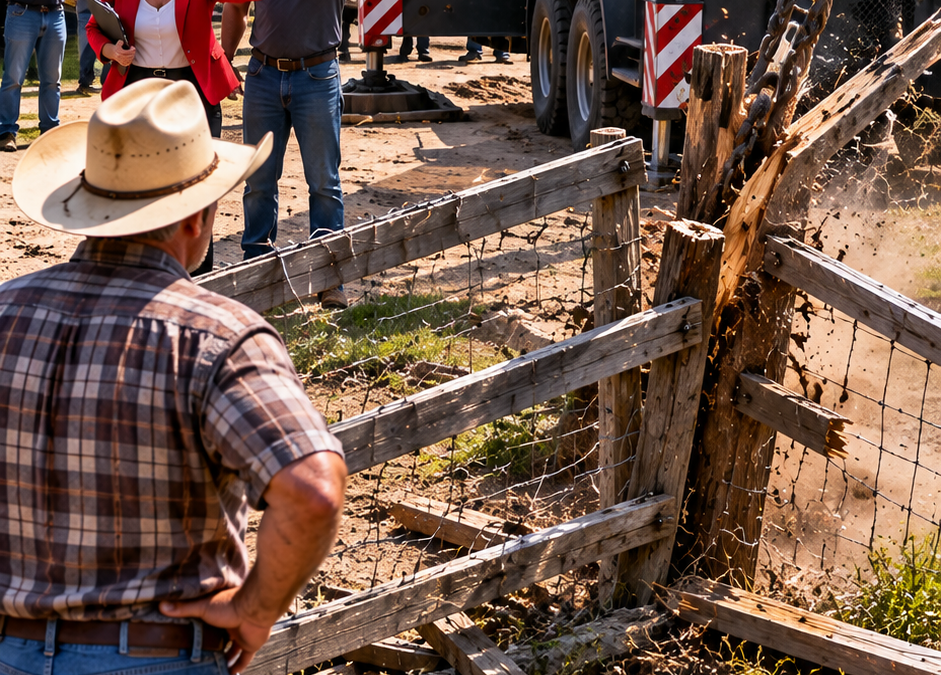
The crane lurched forward slowly, not enough to fully enter, but enough for its front assembly and heavy tire line to press toward the fence while one of Grant’s workers used bolt cutters near the lower wire. Another worker began prying at staples from a post. Someone shouted. The operator hesitated. Grant waved him on.
The first wire snapped.
It recoiled across the gravel road with a sharp metallic crack.
A post split under pressure.
Then the crane pushed into the section, and the brace assembly gave way with a sound I felt in my teeth.
Wood burst outward. Wire twisted. Staples popped. Dust jumped from the ground. One cedar post snapped near its base and skidded across the gravel.
Karen clapped once.
Actually clapped.
“There,” she said. “Now we can move.”
I looked at her.
Then at Grant.
Then at the broken fence lying across my road.
I wanted to yell. I wanted to grab him by the shirt and drag him to the splintered post and make him understand exactly what he had done. I wanted to say things my father would have understood but my wife would not have wanted repeated in court.
Instead, I stopped talking.
I kept recording.
That silence bothered them more than shouting would have.
Grant watched me for a second, then frowned.
“What?”
I said nothing.
I moved along the broken fence and began taking photographs.
Every post.
Every wire.
Every staple.
Every tire track where the crane had crossed the boundary.
Every worker standing on my property.
Every piece of equipment.
Every vehicle plate.
Every face I could clearly record from a lawful distance.
Karen followed me for several steps.
“Wade, this is unnecessary.”
I photographed the broken H-brace.
“You’re acting like we destroyed a building.”
I photographed the cut wire.
“Grant already said he’ll replace it.”
I photographed the crane’s position on my ranch road.
“The project cannot afford delays.”
I looked at her then.
“That is the first true thing you’ve said all morning.”
She blinked.
Grant came over, irritation rising now that his shortcut had not produced surrender.
“Look, man, I told you. We’ll replace the fence later.”
“Replacing it is not the point.”
“It is literally the point. It’s a fence.”
I lowered my phone just enough to look him directly in the face.
“No. It is a boundary.”
He scoffed. “Same thing.”
“That sentence is going to cost you.”
For the first time, his expression shifted.
Only slightly.
But enough.
Karen stepped in quickly. “Are you threatening us?”
“No. I’m documenting you.”
A few residents had gone quiet by then. One of them, an older woman standing near the subdivision road, looked at the broken fence with clear discomfort. The crane operator had stopped moving completely. His hands were off the controls. He looked like a man who had realized he was trapped between a paying contractor and a property owner with a recording phone.
Grant noticed the delay and shouted toward him.
“Keep going.”
The operator shook his head.
“I’m not moving another inch until this gets cleared.”
Grant stormed toward him. “I’m clearing it.”
“No,” the operator said. “You’re arguing with the landowner.”
Karen took out her phone.
“I’m calling the sheriff.”
“Good,” I said without looking up from my photos.
She seemed to hate that answer.
She expected fear. Or hesitation. Or that quick flash people get when they know they are in trouble. Instead, I welcomed it, because the one thing better than documentation was documentation with deputies present.
While Karen called, I walked the line again.
The fence damage was worse than it looked at first. The H-brace was gone. The tension in the nearby wire had been released, pulling several adjacent posts out of alignment. One lower strand had twisted under the crane tire. A gatepost farther down had shifted because the bracing system had taken the force unevenly. The gravel edge of my ranch road was crushed where the crane had tried to angle in. A drainage swale near the corner was caved by the equipment’s weight.
Grant had not opened a gap.
He had damaged a boundary system.
That difference mattered.
Fifteen minutes later, Deputy Allen Rusk arrived in a county SUV.
He stepped out slowly, taking in the scene before anyone spoke. That was his habit. He had responded to ranch calls before—loose cattle, damaged gates, hunters crossing property lines. He knew better than to accept the loudest version first.
Karen rushed toward him.
“Deputy, thank goodness. Mr. Harlan is obstructing a legitimate construction project.”
Grant stood behind her with his arms folded.
“We had temporary access approval,” Karen continued. “He is escalating a minor fence issue and preventing work from continuing.”
Deputy Rusk looked past her at the broken posts, twisted wire, and crane sitting half-angled toward my ranch road.
Then he looked at me.
“Wade?”
I held up my phone.
“I have video from before they cut the fence.”
Karen said quickly, “No one cut anything maliciously.”
Rusk held up one hand.
“I’m going to ask questions one at a time.”
That shut everyone down.
He walked over to the damaged fence, crouched near the broken post, then stood and looked at Grant.
“Who owns this fence?”
The question was simple.
Too simple for Karen’s folder.
Too simple for Grant’s arrogance.
Karen started to answer.
“The fence sits adjacent to the community construction area—”
“That is not what I asked,” Rusk said.
Grant shifted his weight.
Rusk asked again, slower.
“Who owns this fence?”
I said, “I do.”
Karen said, “The boundary is disputed.”
I almost laughed.
It was always disputed after they broke something.
Rusk looked at her. “Was it disputed before the crane arrived?”
Karen hesitated.
Grant jumped in. “We needed access. The road is too narrow. I told him we’d replace it.”
Rusk turned to him. “Did you have permission to remove or damage the fence?”
Grant’s mouth opened.
Closed.
Karen answered for him. “The HOA has authority over construction logistics affecting approved neighborhood improvements.”
Rusk stared at her for a moment.
“Ma’am, does the HOA own this fence?”
“We believe there are community access considerations.”
“Does the HOA own the land on the other side of this fence?”
Karen’s face tightened. “That is what needs to be clarified.”
I reached into my truck and pulled out the laminated copy of my survey I kept behind the seat.
“It’s clarified,” I said.
I handed it to Rusk.
He unfolded it across the hood of his SUV. I pointed to the recorded boundary, the fence line, the ranch road, and the section where the crane had tried to pass.
“The fence follows the surveyed property line. The ranch road is inside my parcel. Their legal access road is here.”
Rusk studied the document.
Karen tried again.
“That survey may not reflect construction easements.”
“Show me the easement,” I said.
She glared.
Rusk looked up. “Do you have one?”
Karen held up her folder, but less confidently now.
“We have HOA construction approvals.”
“Do you have an easement or written permission from Mr. Harlan?”
Silence.
Grant muttered, “This is ridiculous.”
Rusk turned to him.
“What part?”
Grant removed his sunglasses, revealing eyes red with frustration.
“We’re talking about one section of fence. He’s acting like we burned his barn down.”
“No,” I said. “I’m acting like you destroyed private property to move equipment across land you don’t own.”
Grant pointed at me. “And I said I’d fix it.”
Rusk stepped between our lines of sight.
“Enough.”
For a moment, nobody spoke.
The crane idled behind us, heavy and expensive, burning fuel while everyone stared at the broken boundary.
Rusk took statements. Mine first. Then Grant’s. Then Karen’s. Then the crane operator’s, which did more damage than anything I could have said.
The operator was blunt.
“I asked if they had permission,” he told Rusk. “Mr. Whitmore said he had project authorization. The landowner objected before the fence was damaged. I stopped once it was clear there was a property dispute.”
Grant’s face turned red.
Karen looked furious.
Rusk wrote it down.
Before leaving, he told everyone that no further crossing should occur without documentation proving legal access or written permission from me. The crane was not to proceed across my property. The damaged fence and trespass issue would be documented for civil follow-up, and any further damage could create additional problems.
Grant exploded.
“You’re telling me this crane has to sit here?”
Rusk looked at him.
“I’m telling you not to drive it across private property without permission.”
“That thing is costing money every hour.”
“That sounds like something to discuss with whoever planned the route.”
A resident nearby coughed into his hand, badly hiding a laugh.
Karen snapped her head toward him.
I said nothing.
I did not need to.
The deputy left after giving me an incident number.
The crane stayed.
And that was when the real cost began.
By noon, the construction site was stalled. The steel delivery scheduled for that afternoon had nowhere to go. The crane operator refused to move across my land. The legal road remained too narrow. Grant got on the phone with someone and started pacing. Karen stood near her SUV, whispering fiercely into hers.
I went back to work.
That seemed to bother them more than anything.
I checked troughs. I moved cattle from the south pasture. I repaired a latch on the barn. Every so often, I saw Grant standing near the crane, staring at my road like a starving man looking through a bakery window.
He thought pressure would make me fold.
He did not know me.
That night, I opened my property files.
My wife, Nora, sat across from me at the kitchen table while I spread out the survey, old fence receipts, photographs from construction, past maintenance invoices, and the deputy’s incident number.
She watched me arrange them.
“You’re going after them,” she said.
“I’m going to make them pay for what they broke.”
“That is not the same thing.”
I looked at her.
She gave me the kind of look only a spouse can give—a look that says she understands both the facts and the anger underneath them.
I sighed.
“I know.”
“Do you?”
I leaned back in the chair.
For a while, the only sound was the ceiling fan turning above us.
“I keep hearing Dad,” I said.
Nora’s expression softened.
“He built that stretch, didn’t he?”
“With me. Summer of 1999. Hottest week I can remember.”
“And Grant called it just a fence.”
I nodded.
“That’s what I can’t get out of my head.”
Nora reached across the table and placed her hand over mine.
“Then make the record clean. Not angry. Clean.”
She was right.
Anger was useful for about five minutes. After that, it made mistakes.
So I worked clean.
I pulled out the recorded survey showing the fence on my property line. I found receipts for the original fence materials and later repairs. I printed photographs from before the damage, including one from a pasture inspection earlier that spring that showed the H-brace intact. I saved the video of Grant ordering the cut. I backed up the photos of the crane, the workers, and the broken fence. I wrote a timeline from memory before anyone else’s version could contaminate the facts.
The next morning, I hired an independent surveyor.
His name was Daniel Price, and he had surveyed half the farms in the county. He arrived with equipment, flags, and the dry patience of a man who had listened to too many boundary arguments from people who thought confidence was evidence.
He examined the recorded plat, located the monuments, measured the fence line, marked the ranch road, and confirmed the relationship between the damaged section and my parcel.
Grant watched from the subdivision side with a sour expression.
Karen stood beside him, arms folded.
Daniel did not care.
He measured what existed.
Facts do not need applause.
By late morning, he gave me the preliminary result.
“The fence is on your line,” he said. “The road is inside your property. Their proposed crane route crosses your land.”
“Any access easement?”
“Not in the records I reviewed.”
“Put it in writing.”
“I will.”
When the written survey confirmation arrived two days later, the whole project stopped pretending.
The crane could not use my ranch road.
The construction site could not receive its planned lift.
The narrow legal access road remained a problem.
And the expensive machine Grant had hired became an expensive monument to poor judgment.
I later learned the crane was costing them by the hour—standby fees, operator time, schedule penalties, delivery delays, subcontractor rescheduling, and equipment coordination charges. Whether the crane itself was worth eighty thousand dollars or the job cost that much in crane-related expenses, I did not care. What mattered was that Grant had tried to save time by breaking my fence and ended up buying delay instead.
By the third day, his tone changed.
He called me directly.
I let it go to voicemail.
“Wade,” he said, voice tight but controlled. “This has gone far enough. We need to resolve this. I’m willing to replace the fence section and cover reasonable costs. Call me back.”
Reasonable costs.
I saved the message.
I did not call back.
My attorney, Elaine Porter, called him instead.
Elaine had represented ranchers long enough to know the difference between damage repair and full restoration. She also knew how to make men like Grant regret the word “reasonable.”
She sent a letter to Grant, Karen, the HOA, the property owner behind the construction project, and the contractor responsible for the crane logistics. The letter identified trespass, property damage, unauthorized access attempt, boundary interference, equipment encroachment, and restoration obligations. It included photographs, the deputy incident number, the survey confirmation, and my demand that no one enter or cross my property without written permission.
It also made clear that replacing “a few boards,” as Grant had phrased it, would not solve the damage.
The fence tension system had been compromised.
The H-brace needed full reconstruction.
Adjacent posts had shifted.
Wire had to be restrung beyond the visibly broken section.
The gravel road edge had to be repaired.
The drainage swale needed restoration.
Temporary livestock containment had been required.
Survey and legal costs had been incurred because they disputed a boundary they never had the right to cross.
Grant did not like that.
Karen liked it even less.
A meeting was scheduled with county officials the following week.
Not at my request alone. The construction project now had enough complications that the county wanted everyone in one room before the situation got worse.
The meeting took place in a county conference room with beige walls, fluorescent lights, and a long table that made everyone look like they were about to negotiate a treaty over land neither side wanted to admit was muddy.
I attended with Elaine.
Karen came with Grant, the HOA attorney, and Mark Ellison, one of the board members who had the exhausted expression of a man realizing too late that Karen’s confidence had legal invoices attached to it. The crane company sent a representative. The construction site owner came too, visibly irritated and trying not to look directly at Grant.
County officials sat at the far end.
The first half hour was exactly what I expected.
Their attorney tried to soften everything.
He called the fence damage “a minor obstruction removal.”
Elaine corrected him immediately.
“It was not an obstruction. It was a private boundary fence on Mr. Harlan’s recorded property line.”
He tried “temporary access modification.”
Elaine said, “Unauthorized destruction.”
He tried “a misunderstanding regarding construction logistics.”
Elaine said, “The landowner expressly denied permission on video before the fence was damaged.”
The county official asked to see the video.
We played it.
There was my voice, clear and steady: You do not have permission to cut, remove, damage, open, dismantle, or cross that fence.
There was Grant saying, Get the cutters.
There was Karen saying, It’s just a fence.
There was the wire snapping.
The room changed after that.
Video does not care how people describe themselves later.
Grant stared at the table.
Karen stared at the wall.
The attorney stopped using the word minor.
Then we presented the survey.
Daniel Price’s written confirmation showed the fence marking the boundary, the ranch road inside my property, and the crane route crossing private land with no recorded easement. The county records matched. Their internal project map did not.
That map, when finally produced, was embarrassing. It showed a dotted “temporary access route” across the area near my fence, labeled as if someone had decided availability based on convenience rather than rights.
Elaine tapped it with one finger.
“Who authorized this route?”
The contractor looked at Grant.
Grant looked at Karen.
Karen looked at the HOA attorney.
The HOA attorney looked like he wanted to be anywhere else.
Mark Ellison finally said, “The route was discussed during the project planning meeting.”
Elaine asked, “Was Mr. Harlan present?”
“No.”
“Was written permission obtained?”
“No.”
“Was an easement verified?”
Mark’s voice got quieter.
“No.”
“Was the county survey checked?”
He paused.
“Apparently not properly.”
Grant muttered, “We were told access would be handled.”
Elaine turned to him.
“You handled it by breaking the fence.”
His face reddened.
The county official asked for the restoration estimate.
I slid the packet across the table.
Grant picked it up first.
I watched his expression change as he read.
He had expected a few hundred dollars. Maybe a couple thousand if I was being difficult.
The estimate was far higher.
Complete H-brace reconstruction. Replacement cedar posts and steel reinforcement. Full wire tension reset across the affected run. Labor. Equipment. Gravel road edge repair. Drainage restoration. Temporary livestock containment reimbursement. Survey costs. Documentation costs. Legal fees tied directly to the trespass and damage. Follow-up inspection.
The total pushed into six figures once penalties, professional costs, and associated restoration expenses were calculated.
Grant dropped the packet on the table.
“That is insane.”
Elaine did not blink.
“No. What was insane was destroying a boundary fence after the owner refused permission, then attempting to drive a heavy crane over private ranch land.”
Karen leaned forward.
“You cannot seriously expect the HOA to pay this.”
I looked at her.
“The HOA was standing there celebrating when my fence broke.”
Her eyes flashed. “I did not celebrate.”
Elaine clicked something on her laptop.
A still image appeared on the conference screen.
Karen, smiling.
Hands together.
Mid-clap.
Beside the broken fence.
No one spoke.
Karen sat back.
The silence that followed was almost beautiful.
Their attorney asked for a break.
During the break, I stepped into the hallway and leaned against the wall near a bulletin board covered in county notices. Elaine stood beside me, flipping through her notes.
“You’re doing fine,” she said.
“I want to tell him what my father would have said.”
“That would feel good for ten seconds and cost us leverage.”
“I know.”
She glanced at me.
“Do you?”
I laughed quietly despite myself.
“Everybody keeps asking me that.”
“Because you look like a man trying very hard not to become a problem.”
“I am.”
“Good. Keep doing that.”
The meeting resumed twenty minutes later.
Their tone had changed.
Grant no longer argued that it was just a fence. Karen no longer pretended the HOA map settled the issue. Their attorney shifted toward resolving costs, project access, and documentation.
The crane company made it clear they would not move equipment across my land under any disputed permission. The county confirmed that the proper route would need to be used, even if it required smaller equipment, temporary road modifications inside Ridgeview, or rescheduling.
Grant looked physically pained.
His shortcut had failed.
Worse, it had trapped him in the kind of delay he had been trying to avoid.
By the end of the meeting, they agreed in principle to pay for complete restoration, not patchwork repair. Final numbers still had to be reviewed, but the framework was set. The fence would be restored properly. The damaged road edge and swale would be repaired. Survey and inspection costs would be reimbursed. No construction traffic would enter my ranch without written permission. The crane would reach the site using the proper route, even if that meant dismantling part of their own temporary access setup and paying for alternate equipment.
Karen signed the preliminary agreement with a hand so stiff I thought she might tear the paper.
Grant signed after her.
He did not look at me.
That was wise.
The restoration work began the following week.
I hired the fencing contractor, not them.
That was one of my conditions.
If my boundary was being rebuilt, it would be rebuilt by people I trusted, to ranch standards, not subdivision standards. The new H-brace was stronger than the old one. The posts were set deeper. The wire was restrung properly across the whole affected run. The gravel road edge was repaired and compacted. The drainage swale was reshaped. A new steel-reinforced brace point was added near the corner because the old design had been good, but the new one needed to be better.
Every invoice went through Elaine.
Every payment was documented.
Every inspection was photographed.
Grant drove by once during the work. He slowed near the subdivision road, looked at the crew rebuilding what he had broken, then kept driving.
Karen did not come at all.
I preferred that.
The crane eventually reached its destination.
Not through my fence.
Not across my road.
Not by pretending my boundary was an inconvenience.
They had to bring in smaller support equipment, reinforce part of their legal access road, remove a section of decorative stonework near the subdivision entrance, and coordinate a slower, uglier, more expensive movement through property they actually had authority to use.
It took days longer.
I watched from my pasture once, arms resting on the top rail of a temporary gate, while the crane crawled through Ridgeview’s proper route. Workers guided it carefully past landscaping Karen had once described as essential to the neighborhood’s image. A few shrubs had been removed. A retaining edge had been reinforced. The whole operation looked inconvenient, costly, and entirely legal.
That was all I had ever asked.
Use your own land.
Break your own decorative stone.
Disturb your own project schedule.
Leave my fence alone.
When the final restoration was finished, I walked the new fence line with the contractor.
The afternoon sun was low, turning the wire bright in places. The posts stood solid. The braces were tight. The ranch road edge looked clean again. The swale drained correctly after a test run with water from the truck tank.
The fence looked better than it had before.
That did not erase the violation.
But it helped.
That evening, Nora walked down with me.
She ran one hand over the new cedar post and smiled faintly.
“Your father would approve.”
“He would complain about one of the brace angles first.”
“Yes,” she said. “Then he would approve.”
I laughed.
We stood there together for a while, watching cattle move slowly in the pasture beyond the fence. The air smelled like dust, cedar, and cut grass. From the subdivision side came faint construction noise, but it no longer felt like it was pressing against us. The line had been reestablished. Not just physically. Legally. Publicly. Expensively.
Nora slipped her hand into mine.
“Do you feel better?”
I thought about it.
“I feel clearer.”
“That’s not what I asked.”
“I know.”
She squeezed my hand.
The truth was, I did feel better, but not because Grant paid or Karen was embarrassed. I felt better because the ranch had answered a question that should never have been asked.
Where does your authority end?
Right there.
At the fence.
A month later, I received the final signed settlement paperwork. Payment had cleared. Restoration was complete. The county file reflected the boundary confirmation. The HOA’s attorney sent written acknowledgment that Ridgeview Estates had no right of access across my ranch road and no authority to modify, remove, or damage my fence or any other boundary structure.
I placed that letter in the property file.
Then I made copies.
One for Elaine.
One for the ranch office.
One for the fireproof cabinet where I kept documents my father had taught me never to throw away.
The folder was thicker now.
That seemed to be the pattern with land. Every generation inherited not only property, but proof. Deeds. Surveys. Receipts. Photos. Letters. Incident reports. Agreements written because someone before you learned that spoken respect can disappear the moment convenience demands it.
I added one more note to the file in my own handwriting.
Fence damaged by Grant Whitmore for unauthorized crane access. Permission denied before damage. Restoration paid in full. Boundary reaffirmed.
Then I closed the folder.
I did not see Karen for several weeks.
When I finally did, it was at the feed store. She was standing near the counter, talking to someone from Ridgeview, when I walked in for salt blocks and mineral supplement. Her conversation stopped when she saw me.
For a second, neither of us spoke.
Then she looked away.
That was the closest thing to an apology I expected from Karen Whitmore.
I bought my supplies and left.
Grant I saw only once after that, driving past the ranch in his white truck. He did not slow down. He did not wave. He did not look toward the fence.
Good.
Some lessons are expensive enough that silence becomes the only proof they landed.
The following spring, after a long rain, I walked the fence line alone.
The pasture was green, the air cool, and the posts darkened by moisture. Water moved through the restored swale exactly as it should. The cattle stood beyond the rise, heads down, grazing under a sky the color of pewter. I stopped at the rebuilt H-brace and rested my hand on the top rail.
It was solid.
I thought of my father again.
I thought of him standing there in 1999, shirt soaked through, gloves torn at the fingers, telling me the line would matter someday. I thought of how many times I had repeated his rule without fully understanding the weight behind it.
Nobody touched the fence without permission.
As a boy, I heard ownership in that sentence.
As a man, I heard responsibility.
Because the fence was not only about keeping people out. It was about knowing what you were obligated to protect. The cattle behind it. The road beside it. The soil beneath it. The memory of the hands that built it. The legal boundary that kept peace possible when manners failed.
Karen thought it was just a fence.
Grant thought it was a five-minute obstacle.
They both believed urgency made them special.
They learned otherwise.
Their shortcut became delay.
Their confidence became evidence.
Their little act of destruction became a six-figure lesson in property lines, restoration, and the cost of assuming a rancher would rather avoid conflict than defend his land.
I did not win because I shouted.
I did not win because I threatened.
I won because I knew where the line was, had the records to prove it, and stayed calm long enough for their mistake to become undeniable.
That fence still stands today.
Stronger than before.
The crane got where it was going by the route it should have used from the beginning.
Ridgeview finished its construction project without touching my land again.
And every time I drive past that rebuilt section, I remember Karen’s laugh, Grant’s smile, the sound of that first wire snapping across the gravel.
Then I remember what came after.
The photographs.
The deputy’s question.
The survey.
The county meeting.
The restoration estimate.
The signed acknowledgment.
The final payment.
The line rebuilt exactly where it belonged.
On my ranch, boundaries are not decorations.
They are not obstacles.
They are not flexible because someone is in a hurry.
And if a man ever forgets that and points an eighty-thousand-dollar crane at my fence again, he will learn the same lesson Grant Whitmore learned.
The fence may look quiet.
But the truth behind it is expensive.
𝗧𝗛𝗘 𝗘𝗡𝗗
Karen’s Husband Thought My Fence Was the Only Thing Standing in His Way.
At first, I thought the crane was only turning around. Then Karen’s husband pointed at my fence like it was trash that needed clearing. By the time the first post snapped, I already knew the most expensive damage that day would not be the wood.
My name is Wade Harlan, and my ranch had one simple rule.
Nobody touched my fence without permission.
That was not a suggestion. It was not a neighborly preference. It was not one of those decorative rural sayings people paint on signs and hang in feed stores. On my land, that rule existed because fences meant something. They held cattle where cattle belonged. They marked property lines that had been surveyed, recorded, fought over, repaired, and respected for generations. They kept strangers from wandering into pasture, contractors from cutting corners, and careless people from pretending open ground meant free ground.
My father taught me that before I was old enough to drive a tractor.
“Fence is not just wire and posts,” he told me once, kneeling beside a broken stretch after a storm had dropped a cottonwood branch across it. “Fence is a promise. You keep your animals in, you keep other people out, and you show the world exactly where your responsibility starts.”
I had never forgotten that.
My ranch sat along the western edge of Ridgeview Estates, a subdivision that had grown where an old pecan orchard used to be. The neighborhood had wide roads, stone signs, decorative ponds, and an HOA that believed beauty was something you could enforce with fines. Their houses backed up toward my land in several places, though my ranch remained outside their covenants, outside their dues, and outside their authority.
That last part bothered Karen Whitmore more than anything.
Karen was the HOA president. She had the kind of confidence people mistake for competence until real paperwork enters the room. She liked arriving with folders, maps, board letters, and that tight smile of hers—the smile that said she had already decided the outcome before the conversation began.
Her husband, Grant Whitmore, was worse in a quieter way.
Karen liked rules because she wanted control.
Grant liked shortcuts because he believed consequences were for people without money, equipment, or connections.
He was a contractor by trade, though from what I had seen, he spent more time talking over crews than working with them. He drove a lifted white pickup with polished wheels and a company logo on the doors. He wore sunglasses even under cloud cover and liked standing with both hands on his hips, staring at other people’s work as if his approval changed the quality of it.
I had dealt with him twice before.
The first time, one of his subcontractors parked a dump trailer partly across my access lane. Grant told me it would “only be there a couple hours.” I told him it would be moved in ten minutes or towed. It moved in seven.
The second time, his crew stacked pallets of stone too close to my fence line while building a patio for one of the Ridgeview houses. I told him to move them. He said the placement was temporary. I said trespass often was. He moved them, but not before muttering that I was difficult.
Difficult.
That was what people called you when you treated your own property like it belonged to you.
So when I heard diesel engines that morning and saw a crane being unloaded near the narrow legal access road behind Ridgeview, I knew trouble had finally found a louder machine.
It was a clear morning in late August, already hot enough that dust hung in the air before noon. I had been checking a water trough near the south pasture when the sound rolled across the ranch—deep engine noise, hydraulic whining, metal ramps clanging. It did not sound like ordinary construction equipment. It sounded heavier, slower, more deliberate.
I climbed into my truck and drove toward the east fence line.
From the rise above the old gravel road, I could see everything.
A large crane sat on a lowboy trailer near the subdivision access point. Not a tower crane, but a heavy mobile crane with outriggers, a long boom folded down, and enough weight in its body to tear up soft ground if the operator misjudged it. Two escort trucks idled nearby. A crew in hard hats stood around looking toward the construction site beyond Ridgeview’s last row of houses.
The site was visible from where I parked.
A new custom home was going up on a lot that backed toward my ranch. The house was enormous—three stories, steel beams, stone columns, glass walls, and a roofline complicated enough to require equipment bigger than the narrow subdivision lane could handle. I had heard the project belonged to one of Karen’s board allies, a man who wanted a private guest wing, an outdoor kitchen, and some decorative structure heavy enough to require crane placement.
Their problem was obvious.
The legal access road was too narrow.
The road curved between two retaining walls, then pinched near a drainage ditch. A smaller lift could probably get through. The crane could not. Not without risking damage to Ridgeview’s own curbs, walls, landscaping, and underground utilities.
My side of the fence, however, had a wide gravel ranch road running parallel to the pasture.
It was built for tractors, hay trailers, and cattle trucks.
It was also mine.
That was the route Grant Whitmore was staring at when I arrived.
I parked under a live oak and did not get out immediately. I wanted to see what they would do when they thought no one was watching.
Grant stood beside the crane operator, pointing across my fence toward my ranch road. Karen was there too, of course. She stood near her SUV with a clipboard pressed against her chest, looking pleased with herself. Two HOA board members hovered behind her. A few residents had wandered out to watch the spectacle.
Grant spoke to the operator, then pointed again.
The operator shook his head.
Grant pointed harder.
I could not hear the words yet, but I knew body language well enough. Grant was explaining that the crane needed to go through my fence.
Not around it.
Not through the legal road.
Through my fence.
I stepped out of the truck and began walking down the slope.
Nobody noticed me at first.
The crew was focused on unloading chains, checking equipment, and deciding how to turn an impossible route into someone else’s problem. Karen noticed me when I was about twenty yards away. Her smile changed instantly. It became brighter, tighter, more official.
“Wade,” she called. “Good. We were just about to come speak with you.”
“No,” I said. “You were about to cut my fence.”
Grant turned, sunglasses hiding his eyes.
“Morning,” he said, like we were meeting at a hardware store. “We’ve got a little access issue.”
“You have a legal access road.”
He laughed once. “Not for this equipment.”
“That sounds like a planning issue.”
“It’s a five-minute fix,” he said, pointing at the fence. “We take down one section, roll through, put it back after the crane is done.”
I looked at him.
Then I looked at Karen.
Then I looked at the fence.
It was a five-strand barbed-wire fence with cedar posts, steel braces at the corner, and a wide H-brace assembly near the ranch road. It was not ornamental. It was part of a working boundary system. Behind it, my cattle had grazed for years. It followed the recorded line exactly, built after a survey my father had paid for when Ridgeview was still a developer’s dream on paper.
“You are not taking down anything,” I said.
Karen stepped forward.
“Wade, let’s be reasonable.”
That sentence almost always meant the unreasonable thing had already been planned.
“The crane needs access to an approved construction site,” she said. “The community has deadlines tied to this project.”
“The community should have measured its access road before hiring an eighty-thousand-dollar crane.”
Grant smiled. “It’s not an eighty-thousand-dollar crane.”
“How much is it?”
He hesitated.
Karen cut in. “The cost of the equipment is irrelevant.”
“It won’t be when it’s sitting here unable to move.”
Grant’s smile disappeared.
“Look,” he said, voice hardening. “We’re not asking to buy your land. We just need to pass through. I’ll replace the fence after.”
“You will not touch the fence before.”
“It’s just a fence.”
Karen actually laughed when he said it.
A small laugh. Dismissive. Careless.
Just a fence.
I felt something cold settle behind my ribs.
That fence had been stretched by my father and me over three brutal days in July heat. He had been sixty-three then, old enough for his knees to hurt but too stubborn to let me hire help. We set corner posts with a tractor auger that jammed on limestone every ten feet. We tightened wire until our hands blistered through gloves. We lined the fence to the survey markers because he wanted Ridgeview’s future residents to know exactly where the ranch began.
“This line will matter someday,” he said.
I had thought he was being dramatic.
Now Karen Whitmore was standing beside it, laughing.
I looked at Grant.
“You cut that fence, and you will regret it.”
He grinned again, but there was irritation under it.
“Wade, the crane will be through in five minutes.”
“No.”
Karen glanced toward the operator. “Grant, we’re already behind.”
The operator, a heavyset man with gray in his beard, looked uncomfortable. “I don’t have authorization to cross private property.”
Grant snapped, “You have authorization from me.”
The operator looked at my fence, then at me.
“I need landowner permission.”
“You have project authorization,” Grant said.
“That is not the same thing.”
For a second, I thought common sense might stop it.
Then Karen spoke.
“The HOA recognizes this passage as a temporary construction access point.”
I turned to her slowly.
“The HOA recognizes nothing on my side of that fence.”
She lifted her clipboard.
“The board has authority over construction impacts affecting community development.”
“Inside the community.”
“The project affects the community.”
“My fence does not belong to your board.”
Grant muttered something under his breath, then turned toward two workers standing near a utility trailer.
“Get the cutters.”
The operator stepped back.
I said, “Don’t.”
One worker froze. The other looked at Grant.
Grant pointed at the H-brace. “That section. Take it down enough for the crane to swing in.”
I walked closer, stopping just outside arm’s reach.
“Grant, I am telling you clearly, on camera, that you do not have permission to cut, remove, damage, open, dismantle, or cross that fence.”
Karen rolled her eyes.
“You’re being dramatic.”
I took out my phone and started recording.
“No,” I said. “I’m being precise.”
Grant’s jaw flexed.
He did not like precision.
“Film all you want,” he said. “We’ll fix your fence.”
Then he made the mistake.
He gave the operator a hand signal.
The crane lurched forward slowly, not enough to fully enter, but enough for its front assembly and heavy tire line to press toward the fence while one of Grant’s workers used bolt cutters near the lower wire. Another worker began prying at staples from a post. Someone shouted. The operator hesitated. Grant waved him on.
The first wire snapped.
It recoiled across the gravel road with a sharp metallic crack.
A post split under pressure.
Then the crane pushed into the section, and the brace assembly gave way with a sound I felt in my teeth.
Wood burst outward. Wire twisted. Staples popped. Dust jumped from the ground. One cedar post snapped near its base and skidded across the gravel.
Karen clapped once.
Actually clapped.
“There,” she said. “Now we can move.”
I looked at her.
Then at Grant.
Then at the broken fence lying across my road.
I wanted to yell. I wanted to grab him by the shirt and drag him to the splintered post and make him understand exactly what he had done. I wanted to say things my father would have understood but my wife would not have wanted repeated in court.
Instead, I stopped talking.
I kept recording.
That silence bothered them more than shouting would have.
Grant watched me for a second, then frowned.
“What?”
I said nothing.
I moved along the broken fence and began taking photographs.
Every post.
Every wire.
Every staple.
Every tire track where the crane had crossed the boundary.
Every worker standing on my property.
Every piece of equipment.
Every vehicle plate.
Every face I could clearly record from a lawful distance.
Karen followed me for several steps.
“Wade, this is unnecessary.”
I photographed the broken H-brace.
“You’re acting like we destroyed a building.”
I photographed the cut wire.
“Grant already said he’ll replace it.”
I photographed the crane’s position on my ranch road.
“The project cannot afford delays.”
I looked at her then.
“That is the first true thing you’ve said all morning.”
She blinked.
Grant came over, irritation rising now that his shortcut had not produced surrender.
“Look, man, I told you. We’ll replace the fence later.”
“Replacing it is not the point.”
“It is literally the point. It’s a fence.”
I lowered my phone just enough to look him directly in the face.
“No. It is a boundary.”
He scoffed. “Same thing.”
“That sentence is going to cost you.”
For the first time, his expression shifted.
Only slightly.
But enough.
Karen stepped in quickly. “Are you threatening us?”
“No. I’m documenting you.”
A few residents had gone quiet by then. One of them, an older woman standing near the subdivision road, looked at the broken fence with clear discomfort. The crane operator had stopped moving completely. His hands were off the controls. He looked like a man who had realized he was trapped between a paying contractor and a property owner with a recording phone.
Grant noticed the delay and shouted toward him.
“Keep going.”
The operator shook his head.
“I’m not moving another inch until this gets cleared.”
Grant stormed toward him. “I’m clearing it.”
“No,” the operator said. “You’re arguing with the landowner.”
Karen took out her phone.
“I’m calling the sheriff.”
“Good,” I said without looking up from my photos.
She seemed to hate that answer.
She expected fear. Or hesitation. Or that quick flash people get when they know they are in trouble. Instead, I welcomed it, because the one thing better than documentation was documentation with deputies present.
While Karen called, I walked the line again.
The fence damage was worse than it looked at first. The H-brace was gone. The tension in the nearby wire had been released, pulling several adjacent posts out of alignment. One lower strand had twisted under the crane tire. A gatepost farther down had shifted because the bracing system had taken the force unevenly. The gravel edge of my ranch road was crushed where the crane had tried to angle in. A drainage swale near the corner was caved by the equipment’s weight.
Grant had not opened a gap.
He had damaged a boundary system.
That difference mattered.
Fifteen minutes later, Deputy Allen Rusk arrived in a county SUV.
He stepped out slowly, taking in the scene before anyone spoke. That was his habit. He had responded to ranch calls before—loose cattle, damaged gates, hunters crossing property lines. He knew better than to accept the loudest version first.
Karen rushed toward him.
“Deputy, thank goodness. Mr. Harlan is obstructing a legitimate construction project.”
Grant stood behind her with his arms folded.
“We had temporary access approval,” Karen continued. “He is escalating a minor fence issue and preventing work from continuing.”
Deputy Rusk looked past her at the broken posts, twisted wire, and crane sitting half-angled toward my ranch road.
Then he looked at me.
“Wade?”
I held up my phone.
“I have video from before they cut the fence.”
Karen said quickly, “No one cut anything maliciously.”
Rusk held up one hand.
“I’m going to ask questions one at a time.”
That shut everyone down.
He walked over to the damaged fence, crouched near the broken post, then stood and looked at Grant.
“Who owns this fence?”
The question was simple.
Too simple for Karen’s folder.
Too simple for Grant’s arrogance.
Karen started to answer.
“The fence sits adjacent to the community construction area—”
“That is not what I asked,” Rusk said.
Grant shifted his weight.
Rusk asked again, slower.
“Who owns this fence?”
I said, “I do.”
Karen said, “The boundary is disputed.”
I almost laughed.
It was always disputed after they broke something.
Rusk looked at her. “Was it disputed before the crane arrived?”
Karen hesitated.
Grant jumped in. “We needed access. The road is too narrow. I told him we’d replace it.”
Rusk turned to him. “Did you have permission to remove or damage the fence?”
Grant’s mouth opened.
Closed.
Karen answered for him. “The HOA has authority over construction logistics affecting approved neighborhood improvements.”
Rusk stared at her for a moment.
“Ma’am, does the HOA own this fence?”
“We believe there are community access considerations.”
“Does the HOA own the land on the other side of this fence?”
Karen’s face tightened. “That is what needs to be clarified.”
I reached into my truck and pulled out the laminated copy of my survey I kept behind the seat.
“It’s clarified,” I said.
I handed it to Rusk.
He unfolded it across the hood of his SUV. I pointed to the recorded boundary, the fence line, the ranch road, and the section where the crane had tried to pass.
“The fence follows the surveyed property line. The ranch road is inside my parcel. Their legal access road is here.”
Rusk studied the document.
Karen tried again.
“That survey may not reflect construction easements.”
“Show me the easement,” I said.
She glared.
Rusk looked up. “Do you have one?”
Karen held up her folder, but less confidently now.
“We have HOA construction approvals.”
“Do you have an easement or written permission from Mr. Harlan?”
Silence.
Grant muttered, “This is ridiculous.”
Rusk turned to him.
“What part?”
Grant removed his sunglasses, revealing eyes red with frustration.
“We’re talking about one section of fence. He’s acting like we burned his barn down.”
“No,” I said. “I’m acting like you destroyed private property to move equipment across land you don’t own.”
Grant pointed at me. “And I said I’d fix it.”
Rusk stepped between our lines of sight.
“Enough.”
For a moment, nobody spoke.
The crane idled behind us, heavy and expensive, burning fuel while everyone stared at the broken boundary.
Rusk took statements. Mine first. Then Grant’s. Then Karen’s. Then the crane operator’s, which did more damage than anything I could have said.
The operator was blunt.
“I asked if they had permission,” he told Rusk. “Mr. Whitmore said he had project authorization. The landowner objected before the fence was damaged. I stopped once it was clear there was a property dispute.”
Grant’s face turned red.
Karen looked furious.
Rusk wrote it down.
Before leaving, he told everyone that no further crossing should occur without documentation proving legal access or written permission from me. The crane was not to proceed across my property. The damaged fence and trespass issue would be documented for civil follow-up, and any further damage could create additional problems.
Grant exploded.
“You’re telling me this crane has to sit here?”
Rusk looked at him.
“I’m telling you not to drive it across private property without permission.”
“That thing is costing money every hour.”
“That sounds like something to discuss with whoever planned the route.”
A resident nearby coughed into his hand, badly hiding a laugh.
Karen snapped her head toward him.
I said nothing.
I did not need to.
The deputy left after giving me an incident number.
The crane stayed.
And that was when the real cost began.
By noon, the construction site was stalled. The steel delivery scheduled for that afternoon had nowhere to go. The crane operator refused to move across my land. The legal road remained too narrow. Grant got on the phone with someone and started pacing. Karen stood near her SUV, whispering fiercely into hers.
I went back to work.
That seemed to bother them more than anything.
I checked troughs. I moved cattle from the south pasture. I repaired a latch on the barn. Every so often, I saw Grant standing near the crane, staring at my road like a starving man looking through a bakery window.
He thought pressure would make me fold.
He did not know me.
That night, I opened my property files.
My wife, Nora, sat across from me at the kitchen table while I spread out the survey, old fence receipts, photographs from construction, past maintenance invoices, and the deputy’s incident number.
She watched me arrange them.
“You’re going after them,” she said.
“I’m going to make them pay for what they broke.”
“That is not the same thing.”
I looked at her.
She gave me the kind of look only a spouse can give—a look that says she understands both the facts and the anger underneath them.
I sighed.
“I know.”
“Do you?”
I leaned back in the chair.
For a while, the only sound was the ceiling fan turning above us.
“I keep hearing Dad,” I said.
Nora’s expression softened.
“He built that stretch, didn’t he?”
“With me. Summer of 1999. Hottest week I can remember.”
“And Grant called it just a fence.”
I nodded.
“That’s what I can’t get out of my head.”
Nora reached across the table and placed her hand over mine.
“Then make the record clean. Not angry. Clean.”
She was right.
Anger was useful for about five minutes. After that, it made mistakes.
So I worked clean.
I pulled out the recorded survey showing the fence on my property line. I found receipts for the original fence materials and later repairs. I printed photographs from before the damage, including one from a pasture inspection earlier that spring that showed the H-brace intact. I saved the video of Grant ordering the cut. I backed up the photos of the crane, the workers, and the broken fence. I wrote a timeline from memory before anyone else’s version could contaminate the facts.
The next morning, I hired an independent surveyor.
His name was Daniel Price, and he had surveyed half the farms in the county. He arrived with equipment, flags, and the dry patience of a man who had listened to too many boundary arguments from people who thought confidence was evidence.
He examined the recorded plat, located the monuments, measured the fence line, marked the ranch road, and confirmed the relationship between the damaged section and my parcel.
Grant watched from the subdivision side with a sour expression.
Karen stood beside him, arms folded.
Daniel did not care.
He measured what existed.
Facts do not need applause.
By late morning, he gave me the preliminary result.
“The fence is on your line,” he said. “The road is inside your property. Their proposed crane route crosses your land.”
“Any access easement?”
“Not in the records I reviewed.”
“Put it in writing.”
“I will.”
When the written survey confirmation arrived two days later, the whole project stopped pretending.
The crane could not use my ranch road.
The construction site could not receive its planned lift.
The narrow legal access road remained a problem.
And the expensive machine Grant had hired became an expensive monument to poor judgment.
I later learned the crane was costing them by the hour—standby fees, operator time, schedule penalties, delivery delays, subcontractor rescheduling, and equipment coordination charges. Whether the crane itself was worth eighty thousand dollars or the job cost that much in crane-related expenses, I did not care. What mattered was that Grant had tried to save time by breaking my fence and ended up buying delay instead.
By the third day, his tone changed.
He called me directly.
I let it go to voicemail.
“Wade,” he said, voice tight but controlled. “This has gone far enough. We need to resolve this. I’m willing to replace the fence section and cover reasonable costs. Call me back.”
Reasonable costs.
I saved the message.
I did not call back.
My attorney, Elaine Porter, called him instead.
Elaine had represented ranchers long enough to know the difference between damage repair and full restoration. She also knew how to make men like Grant regret the word “reasonable.”
She sent a letter to Grant, Karen, the HOA, the property owner behind the construction project, and the contractor responsible for the crane logistics. The letter identified trespass, property damage, unauthorized access attempt, boundary interference, equipment encroachment, and restoration obligations. It included photographs, the deputy incident number, the survey confirmation, and my demand that no one enter or cross my property without written permission.
It also made clear that replacing “a few boards,” as Grant had phrased it, would not solve the damage.
The fence tension system had been compromised.
The H-brace needed full reconstruction.
Adjacent posts had shifted.
Wire had to be restrung beyond the visibly broken section.
The gravel road edge had to be repaired.
The drainage swale needed restoration.
Temporary livestock containment had been required.
Survey and legal costs had been incurred because they disputed a boundary they never had the right to cross.
Grant did not like that.
Karen liked it even less.
A meeting was scheduled with county officials the following week.
Not at my request alone. The construction project now had enough complications that the county wanted everyone in one room before the situation got worse.
The meeting took place in a county conference room with beige walls, fluorescent lights, and a long table that made everyone look like they were about to negotiate a treaty over land neither side wanted to admit was muddy.
I attended with Elaine.
Karen came with Grant, the HOA attorney, and Mark Ellison, one of the board members who had the exhausted expression of a man realizing too late that Karen’s confidence had legal invoices attached to it. The crane company sent a representative. The construction site owner came too, visibly irritated and trying not to look directly at Grant.
County officials sat at the far end.
The first half hour was exactly what I expected.
Their attorney tried to soften everything.
He called the fence damage “a minor obstruction removal.”
Elaine corrected him immediately.
“It was not an obstruction. It was a private boundary fence on Mr. Harlan’s recorded property line.”
He tried “temporary access modification.”
Elaine said, “Unauthorized destruction.”
He tried “a misunderstanding regarding construction logistics.”
Elaine said, “The landowner expressly denied permission on video before the fence was damaged.”
The county official asked to see the video.
We played it.
There was my voice, clear and steady: You do not have permission to cut, remove, damage, open, dismantle, or cross that fence.
There was Grant saying, Get the cutters.
There was Karen saying, It’s just a fence.
There was the wire snapping.
The room changed after that.
Video does not care how people describe themselves later.
Grant stared at the table.
Karen stared at the wall.
The attorney stopped using the word minor.
Then we presented the survey.
Daniel Price’s written confirmation showed the fence marking the boundary, the ranch road inside my property, and the crane route crossing private land with no recorded easement. The county records matched. Their internal project map did not.
That map, when finally produced, was embarrassing. It showed a dotted “temporary access route” across the area near my fence, labeled as if someone had decided availability based on convenience rather than rights.
Elaine tapped it with one finger.
“Who authorized this route?”
The contractor looked at Grant.
Grant looked at Karen.
Karen looked at the HOA attorney.
The HOA attorney looked like he wanted to be anywhere else.
Mark Ellison finally said, “The route was discussed during the project planning meeting.”
Elaine asked, “Was Mr. Harlan present?”
“No.”
“Was written permission obtained?”
“No.”
“Was an easement verified?”
Mark’s voice got quieter.
“No.”
“Was the county survey checked?”
He paused.
“Apparently not properly.”
Grant muttered, “We were told access would be handled.”
Elaine turned to him.
“You handled it by breaking the fence.”
His face reddened.
The county official asked for the restoration estimate.
I slid the packet across the table.
Grant picked it up first.
I watched his expression change as he read.
He had expected a few hundred dollars. Maybe a couple thousand if I was being difficult.
The estimate was far higher.
Complete H-brace reconstruction. Replacement cedar posts and steel reinforcement. Full wire tension reset across the affected run. Labor. Equipment. Gravel road edge repair. Drainage restoration. Temporary livestock containment reimbursement. Survey costs. Documentation costs. Legal fees tied directly to the trespass and damage. Follow-up inspection.
The total pushed into six figures once penalties, professional costs, and associated restoration expenses were calculated.
Grant dropped the packet on the table.
“That is insane.”
Elaine did not blink.
“No. What was insane was destroying a boundary fence after the owner refused permission, then attempting to drive a heavy crane over private ranch land.”
Karen leaned forward.
“You cannot seriously expect the HOA to pay this.”
I looked at her.
“The HOA was standing there celebrating when my fence broke.”
Her eyes flashed. “I did not celebrate.”
Elaine clicked something on her laptop.
A still image appeared on the conference screen.
Karen, smiling.
Hands together.
Mid-clap.
Beside the broken fence.
No one spoke.
Karen sat back.
The silence that followed was almost beautiful.
Their attorney asked for a break.
During the break, I stepped into the hallway and leaned against the wall near a bulletin board covered in county notices. Elaine stood beside me, flipping through her notes.
“You’re doing fine,” she said.
“I want to tell him what my father would have said.”
“That would feel good for ten seconds and cost us leverage.”
“I know.”
She glanced at me.
“Do you?”
I laughed quietly despite myself.
“Everybody keeps asking me that.”
“Because you look like a man trying very hard not to become a problem.”
“I am.”
“Good. Keep doing that.”
The meeting resumed twenty minutes later.
Their tone had changed.
Grant no longer argued that it was just a fence. Karen no longer pretended the HOA map settled the issue. Their attorney shifted toward resolving costs, project access, and documentation.
The crane company made it clear they would not move equipment across my land under any disputed permission. The county confirmed that the proper route would need to be used, even if it required smaller equipment, temporary road modifications inside Ridgeview, or rescheduling.
Grant looked physically pained.
His shortcut had failed.
Worse, it had trapped him in the kind of delay he had been trying to avoid.
By the end of the meeting, they agreed in principle to pay for complete restoration, not patchwork repair. Final numbers still had to be reviewed, but the framework was set. The fence would be restored properly. The damaged road edge and swale would be repaired. Survey and inspection costs would be reimbursed. No construction traffic would enter my ranch without written permission. The crane would reach the site using the proper route, even if that meant dismantling part of their own temporary access setup and paying for alternate equipment.
Karen signed the preliminary agreement with a hand so stiff I thought she might tear the paper.
Grant signed after her.
He did not look at me.
That was wise.
The restoration work began the following week.
I hired the fencing contractor, not them.
That was one of my conditions.
If my boundary was being rebuilt, it would be rebuilt by people I trusted, to ranch standards, not subdivision standards. The new H-brace was stronger than the old one. The posts were set deeper. The wire was restrung properly across the whole affected run. The gravel road edge was repaired and compacted. The drainage swale was reshaped. A new steel-reinforced brace point was added near the corner because the old design had been good, but the new one needed to be better.
Every invoice went through Elaine.
Every payment was documented.
Every inspection was photographed.
Grant drove by once during the work. He slowed near the subdivision road, looked at the crew rebuilding what he had broken, then kept driving.
Karen did not come at all.
I preferred that.
The crane eventually reached its destination.
Not through my fence.
Not across my road.
Not by pretending my boundary was an inconvenience.
They had to bring in smaller support equipment, reinforce part of their legal access road, remove a section of decorative stonework near the subdivision entrance, and coordinate a slower, uglier, more expensive movement through property they actually had authority to use.
It took days longer.
I watched from my pasture once, arms resting on the top rail of a temporary gate, while the crane crawled through Ridgeview’s proper route. Workers guided it carefully past landscaping Karen had once described as essential to the neighborhood’s image. A few shrubs had been removed. A retaining edge had been reinforced. The whole operation looked inconvenient, costly, and entirely legal.
That was all I had ever asked.
Use your own land.
Break your own decorative stone.
Disturb your own project schedule.
Leave my fence alone.
When the final restoration was finished, I walked the new fence line with the contractor.
The afternoon sun was low, turning the wire bright in places. The posts stood solid. The braces were tight. The ranch road edge looked clean again. The swale drained correctly after a test run with water from the truck tank.
The fence looked better than it had before.
That did not erase the violation.
But it helped.
That evening, Nora walked down with me.
She ran one hand over the new cedar post and smiled faintly.
“Your father would approve.”
“He would complain about one of the brace angles first.”
“Yes,” she said. “Then he would approve.”
I laughed.
We stood there together for a while, watching cattle move slowly in the pasture beyond the fence. The air smelled like dust, cedar, and cut grass. From the subdivision side came faint construction noise, but it no longer felt like it was pressing against us. The line had been reestablished. Not just physically. Legally. Publicly. Expensively.
Nora slipped her hand into mine.
“Do you feel better?”
I thought about it.
“I feel clearer.”
“That’s not what I asked.”
“I know.”
She squeezed my hand.
The truth was, I did feel better, but not because Grant paid or Karen was embarrassed. I felt better because the ranch had answered a question that should never have been asked.
Where does your authority end?
Right there.
At the fence.
A month later, I received the final signed settlement paperwork. Payment had cleared. Restoration was complete. The county file reflected the boundary confirmation. The HOA’s attorney sent written acknowledgment that Ridgeview Estates had no right of access across my ranch road and no authority to modify, remove, or damage my fence or any other boundary structure.
I placed that letter in the property file.
Then I made copies.
One for Elaine.
One for the ranch office.
One for the fireproof cabinet where I kept documents my father had taught me never to throw away.
The folder was thicker now.
That seemed to be the pattern with land. Every generation inherited not only property, but proof. Deeds. Surveys. Receipts. Photos. Letters. Incident reports. Agreements written because someone before you learned that spoken respect can disappear the moment convenience demands it.
I added one more note to the file in my own handwriting.
Fence damaged by Grant Whitmore for unauthorized crane access. Permission denied before damage. Restoration paid in full. Boundary reaffirmed.
Then I closed the folder.
I did not see Karen for several weeks.
When I finally did, it was at the feed store. She was standing near the counter, talking to someone from Ridgeview, when I walked in for salt blocks and mineral supplement. Her conversation stopped when she saw me.
For a second, neither of us spoke.
Then she looked away.
That was the closest thing to an apology I expected from Karen Whitmore.
I bought my supplies and left.
Grant I saw only once after that, driving past the ranch in his white truck. He did not slow down. He did not wave. He did not look toward the fence.
Good.
Some lessons are expensive enough that silence becomes the only proof they landed.
The following spring, after a long rain, I walked the fence line alone.
The pasture was green, the air cool, and the posts darkened by moisture. Water moved through the restored swale exactly as it should. The cattle stood beyond the rise, heads down, grazing under a sky the color of pewter. I stopped at the rebuilt H-brace and rested my hand on the top rail.
It was solid.
I thought of my father again.
I thought of him standing there in 1999, shirt soaked through, gloves torn at the fingers, telling me the line would matter someday. I thought of how many times I had repeated his rule without fully understanding the weight behind it.
Nobody touched the fence without permission.
As a boy, I heard ownership in that sentence.
As a man, I heard responsibility.
Because the fence was not only about keeping people out. It was about knowing what you were obligated to protect. The cattle behind it. The road beside it. The soil beneath it. The memory of the hands that built it. The legal boundary that kept peace possible when manners failed.
Karen thought it was just a fence.
Grant thought it was a five-minute obstacle.
They both believed urgency made them special.
They learned otherwise.
Their shortcut became delay.
Their confidence became evidence.
Their little act of destruction became a six-figure lesson in property lines, restoration, and the cost of assuming a rancher would rather avoid conflict than defend his land.
I did not win because I shouted.
I did not win because I threatened.
I won because I knew where the line was, had the records to prove it, and stayed calm long enough for their mistake to become undeniable.
That fence still stands today.
Stronger than before.
The crane got where it was going by the route it should have used from the beginning.
Ridgeview finished its construction project without touching my land again.
And every time I drive past that rebuilt section, I remember Karen’s laugh, Grant’s smile, the sound of that first wire snapping across the gravel.
Then I remember what came after.
The photographs.
The deputy’s question.
The survey.
The county meeting.
The restoration estimate.
The signed acknowledgment.
The final payment.
The line rebuilt exactly where it belonged.
On my ranch, boundaries are not decorations.
They are not obstacles.
They are not flexible because someone is in a hurry.
And if a man ever forgets that and points an eighty-thousand-dollar crane at my fence again, he will learn the same lesson Grant Whitmore learned.
The fence may look quiet.
But the truth behind it is expensive.








