𝗣𝗔𝗥𝗧 𝟮 Karen Told the Sheriff My Parents Were Dead — Then Their Moving Truck Stopped in Her Driveway
𝗣𝗔𝗥𝗧 𝟮
The belief that once she had decided what reality was, everyone else’s responsibility was simply to catch up.
By June, she had begun referring to my parents in the past tense during board meetings.
She was subtle.
That was why nobody stopped her.
She’d call number 12 “the situation over at the Walker property.”
At one meeting she said the situation had “resolved itself.”
Someone corrected her.
“The Walkers are in Texas. Ray had surgery.”
Karen smiled.
“Of course. Absolutely.”
Then the next month she used almost the same language again.
What most people did not know was that Karen had wanted something from my father’s house long before he went to Houston.
In the fall of 2024, she remodeled her kitchen.
She came to number 12 and asked my father whether he would sell her his leaded-glass cabinet doors.
She also wanted the Stanley chest.
She said the chest would make a beautiful bar cabinet.
My father refused.
Karen came back with an offer.
He refused again.
That second refusal was less polite.
My mother told me later exactly what he’d said.
“Those doors leave this house when I do.”
Karen did not argue.
She smiled.
She sent them a fruit basket that Christmas.
Then, while my father was learning to walk again in Houston, Karen opened what the HOA records called an “abandonment determination.”
Uncut grass.
Uncollected mail.
No observed occupancy.
Never mind the forwarding address.
Never mind the April email.
Never mind that she personally knew where the owners were.
Violation notices began accumulating at fifty dollars per day.
Ninety-six days.
$4,800 in fines.
Notices addressed to a man in rehabilitation a thousand miles away.
Then, on August 12, Karen signed a work order for Ridgeline Hauling and Salvage.
Her signature.
No second board member.
No owner authorization.
The crew entered number 12.
They emptied the workshop.
Then they removed four kitchen cabinet doors.
Not all ten.
Four.
By lunch, they were gone.
I knew none of this.
I found out in October because an HOA lien notice finally reached me in Denver.
$18,600 against my parents’ house.
I stood in my kitchen reading the breakdown.
Fines.
Administrative expenses.
Legal costs.
Then one line at the bottom.
CONTENTS DISPOSAL / LANDFILL.
I read it four times.
Then booked a flight to North Carolina.
Somewhere over Kansas, one fact kept coming back.
My mother had given the HOA her forwarding address.
Karen had replied personally.
You cannot honestly declare a house abandoned when you know exactly where the owners are.
Not unless you need the house to be abandoned.
I reached Cedar Hollow late.
The workshop told me what happened before the house did.
My father had installed the roll-up door himself in the 1990s.
The track had always been slightly wrong.
The door rattled in a specific rhythm when you raised it.
I pulled the handle.
The door made the same sound it had made my entire childhood.
Then it opened onto almost nothing.
Bare concrete.
Empty pegboard.
Screw hooks gone.
Tools gone.
On the workbench was a rectangle of clean wood surrounded by nine months of dust.
The shape of the Stanley chest.
Sharp on all four sides.
Whoever had removed it had lifted it straight up.
I stood there so long that my rental car began chiming because I had left the door open.
The kitchen was worse.
Four upper cabinets had been stripped to bare frames.
The hinges had not even been unscrewed properly.
Someone had pried them.
Wood was splintered around several screw holes.
Six cabinet doors remained.
Four specific doors were gone.
That was when I understood this had never been a routine cleanout.
Someone had walked through my mother’s kitchen and selected what they wanted.
I sat on the front steps and called Houston.
My mother answered.
I could hear hospital announcements in the background.
“Travis.”
“Hey, Mom.”
“Your father walked to the window today.”
Her voice changed immediately.
Brightened.
“Twice. The therapist says that’s a week ahead.”
In the background my father complained about something.
My mother laughed.
Then she asked the question I had been hoping she would not ask.
“Everything okay at the house?”
I looked through the window at the pry marks where my father’s doors had been.
“The furnace sounds a little rough.”
“Oh.”
“I’ll get somebody to look at it.”
She trusted me.
In thirty years I had never given my mother a reason not to.
That was the first lie I told in the whole thing.
I want to say that plainly.
I did not tell her somebody had torn apart her kitchen.
Not while she was holding my father upright in a hospital hallway.
I work as a commercial insurance adjuster.
For fifteen years, I have walked into properties after fires, floods, collapses, thefts, storms—the worst day of somebody else’s life—and documented what remained.
So I went to work.
Wide shot.
Medium shot.
Detail.
Scale reference.
Timestamp.
Cabinet frames.
Pry marks.
Workshop.
Pegboard.
Dust outline.
Eighty-one photographs.
I did not know whether any of them would matter.
I just knew doing something with my hands felt better than standing there.
The next morning, I went to the HOA office.
It occupied a converted garage beside the clubhouse.
Karen sat behind the counter drinking coffee.
She wore an oatmeal-colored cardigan.
When she saw me, she smiled.
“Travis. I’m so glad you came in person.”
She already had a folder on the counter.
Number 12 was written on the tab.
That detail stayed with me.
She had pulled my parents’ file before she knew I was in North Carolina.
“Sit down,” she said.
“I know this is difficult. Nobody wants to inherit a mess.”
Inherit.
She had decided my parents were dead before asking why I was there.
She turned the folder toward me and began walking me through it.
“Uncut grass. Mail accumulation. No observed occupancy. Ninety-six days of unresolved notices.”
Her fingertip moved down the page.
“The association has obligations. This wasn’t punitive. It was abatement.”
“Abatement.”
“Correct. The property had become an eyesore and potential hazard.”
She smiled sympathetically.
“I may be able to work with you on some fines. The removal costs aren’t negotiable. Do you want to pay today or arrange installments?”
She still had not asked whether my father had recovered.
So I removed two documents from my bag.
The first was the recorded deed.
Raymond and Diane Walker.
Joint tenants with right of survivorship.
The second was my recorded power of attorney.
I placed both documents on the counter.
“My parents are alive.”
Karen looked down.
“Neither one transferred this property. Neither one abandoned it. And I’m legally authorized to act for both of them.”
Karen did something impressive.
She did not visibly react.
But her language changed.
Before the documents appeared, she had said “your parents’ estate.”
Afterward, she called it “your parents’ file.”
She never used the word estate again.
That is what people look like when they discover the story they have been telling contains a hole.
They begin repairing it while they speak.
The HOA’s attorney, Curtis Sloan, reviewed everything later that day.
He was in his sixties and sounded exhausted by everyone involved.
After looking at the deed and power of attorney, he advised the board to suspend enforcement pending review.
The fines froze at $4,800.
For about an hour, I felt relief.
Then I asked Karen the question that actually mattered.
“Where is my father’s property?”
She pulled out a sheet.
Fast.
Too fast.
Ridgeline Hauling and Salvage.
August 12.
Weight: 6,800 pounds.
Destination:
TRANSFER STATION / LANDFILL.
She slid it across the counter.
“It’s gone, Travis.”
I looked at her.
“The tool chest?”
“Everything removed under the order.”
“My father’s cabinet doors?”
“Disposed.”
She softened her voice.
“It was considered garbage. I’m sorry.”
Her apology was comfortable.
Almost casual.
The kind of apology you make because rain ruined someone’s picnic.
Nine days later, Karen put the lien back before the board.
She added the cleanout invoice.
$18,600.
The vote passed four to two.
I was in the back of the room.
Peggy Sutton, the vice president, voted against enforcement.
She kept her hand raised a fraction longer than necessary while looking at Karen.
I noticed.
I did not yet know why.
On the drive home, one number kept bothering me.
6,800 pounds.
My father’s workshop contained hand tools, a wooden chest, a workbench, and miscellaneous equipment.
Four cabinet doors had been removed.
Six thousand eight hundred pounds did not make sense.
Three houses away lived Gus Anderson.
Eighty-one years old.
He had lived on Cedar Hollow Lane since my parents arrived.
Gus watched the neighborhood the way some men watch sports.
His daughter had installed a doorbell camera two years earlier.
Gus barely understood it.
But the camera faced the street.
I knocked.
“Gus, can that thing show recordings from August?”
He stared at the camera.
“My daughter does all that.”
“Can we call her?”
He did not ask why.
That told me something.
His daughter, Suzanne, pulled the footage remotely.
August 12.
At 11:06 a.m., a Ridgeline Hauling truck moved past Gus’s mailbox.
It was riding low.
It had just left number 12.
The county landfill was twenty minutes away.
To reach the highway, the truck needed to turn right at the end of Cedar Hollow Lane.
It turned left.
Away from the highway.
Deeper into the neighborhood.
I asked Suzanne to play it again.
Left.
The truck never went toward the landfill.
I watched four times.
Then sat on Gus’s porch because my legs suddenly felt unreliable.
Karen’s disposal manifest was not describing what had happened.
It was describing what she wanted everyone to believe had happened.
The camera lost the truck near the final bend.
So I walked.
Past that point, Cedar Hollow Lane did not branch.
Four hundred feet later it ended in a cul-de-sac.
Four houses.
One was number 20.
Karen Hollister.
That gave me direction.
It did not give me proof.
I could not enter her house.
I could not accuse her based on where a truck turned.
I’ve watched insurance fraud cases collapse because someone knew exactly what happened but obtained the evidence illegally.
I was not going to make that mistake.
What I could legally read was the HOA newsletter.
Karen wrote it every month.
The September issue was still posted online.
Page four contained a feature called NEIGHBOR SPOTLIGHT.
That month’s neighbor was Karen.
The topic was her newly remodeled kitchen.
Three photographs.
In the second image, behind Karen’s kitchen island, four decorative leaded-glass cabinet doors had been mounted along the wall.
My father’s doors.
I knew them instantly.
The diamond pattern.
The wood grain.
And the third door from the left.
The center pane sitting a quarter inch proud of the frame.
There was no second set.
My father had made them by hand.
I sat in the rental car staring at the photograph.
Then something even colder occurred to me.
Karen had published them.
She had not hidden the doors.
She photographed them.
Wrote an article.
Mailed that photograph to 212 homes.
Including number 12.
She could only do that if she had become completely convinced my parents would never return to recognize what she had taken.
I called Houston that night.
My mother put me on speaker.
“Forty feet today,” she said.
“What?”
“Your father. Forty feet down the hallway and forty back.”
My father said something profane about his walker.
I laughed because she laughed.
“That’s great, Dad.”
My mother asked, “Did you fix that furnace?”
“It’s handled.”
Another lie.
I sat in the dark kitchen afterward.
Four empty cabinet frames above me.
And I made myself a promise.
Those doors would be back on that wall before my father walked through the front door.
The next morning I showed Curtis Sloan the newsletter.
He stared at the photograph.
“Those are your parents’ doors.”
“Yes.”
“And that’s Karen’s kitchen.”
“Yes.”
“So now what?”
He sighed.
“Now you have almost nothing.”
I thought I’d misheard.
“What?”
“A photograph proves she possesses the doors. It does not prove theft.”
“She signed the work order.”
“She authorized a cleanout. The board will argue the abandonment determination gave her authority.”
“She said the property went to a landfill.”
“Yes.”
He tapped the photo.
“But if Karen says the hauling crew offered her salvage from a load already designated for disposal, and she accepted it, possession alone doesn’t prove she stole it.”
I hated him for about thirty seconds.
Then understood he was right.
“You need the missing paper,” Sloan said.
“What missing paper?”
“The paper showing how property went from the truck to her house.”
That paper, if it existed, belonged to Ridgeline.
Before I could pursue it, Karen made another move.
When I returned to number 12, an envelope was taped to the storm door.
HOA letterhead.
Signed by Karen.
Effective immediately, I was prohibited from entering the clubhouse, HOA office, pool building, and all association common areas due to what she called a “hostile pattern of contact.”
Every association file I might want to inspect was inside those buildings.
She wasn’t angry.
She was closing doors.
One at a time.
I hired Colleen Reese.
She practiced property law from a second-floor office in downtown Greensboro.
Her window air conditioner ran even though it was October.
I showed her eighty-one photographs and every document.
She listened without taking notes.
That made me nervous until I realized she remembered almost everything word for word.
When I finished, she said, “You’re right.”
I waited.
“That’s good.”
“No.”
She leaned back.
“Being right is going to be the least useful thing you own for a while.”
She sent Ridgeline a formal demand for the full August 12 job file.
Four days later, they refused.
Politely.
Their client was Cedar Hollow Estates HOA.
Job files and routing documentation could be provided only to the client, through subpoena, or to the authorizing signatory.
The authorizing signatory was Karen.
I read the letter twice.
“So the person who can voluntarily release evidence against Karen is Karen.”
“Correct.”
“Subpoena it.”
“We need litigation underway, then a hearing.”
“How long?”
“Four to six months.”
My parents’ lien enforcement hearing was December 16.
We did not have four months.
If the lien was validated, the HOA could begin foreclosure proceedings against the house.
My father was walking forty feet twice a day.
My mother still believed I was dealing with a furnace.
I attended the next board meeting by telephone because Karen had banned me from the building.
I had six minutes.
I laid out everything.
The deed.
The power of attorney.
My mother’s April forwarding email.
Karen’s reply.
The newsletter photo showing my father’s cabinet doors in Karen’s house.
And Karen’s signature authorizing the cleanout.
Silence followed.
Through a speakerphone, I could hear papers moving.
Then Karen spoke.
“May I distribute something?”
More papers.
A long silence.
Colleen received a copy the following morning.
She placed it on her desk.
VOLUNTARY STATEMENT OF ABANDONMENT.
Dated May 22.
It supposedly authorized the HOA to enter number 12, secure it, remove personal property, and dispose of contents without further notice.
At the bottom was my mother’s signature.
Diane E. Walker.
The long loop in the W.
The E that never fully closed.
It looked real.
Very real.
And it was notarized.
Suddenly everything Karen had done appeared authorized.
Not merely excused.
Authorized in advance by my mother.
The cleanout became a service.
The property became abandoned.
The stolen doors became discarded contents.
Curtis Sloan withdrew his recommendation to suspend enforcement.
Peggy Sutton stopped answering my calls.
That night, around ten, I called Houston.
I had avoided telling my mother about the cabinets.
I could not avoid this.
“Mom, I need to read you something.”
I read the affidavit.
There was silence.
Then:
“I didn’t sign that.”
“You’re sure?”
“Travis, I don’t—”
She stopped.
I heard her breathe.
“Honey, I’ve signed so many things this year.”
My stomach dropped.
“Discharge papers. Therapy forms. Pharmacy paperwork. Insurance. Every day somebody puts something in front of me.”
Her voice became smaller.
“What if I did sign it? What if I signed something and don’t remember?”
Then my mother started apologizing.
“I’m sorry.”
“Mom.”
“I’m so sorry.”
“Stop.”
“What if I—”
“Mom, stop apologizing.”
She apologized four times in ninety seconds for something she had not done.
And I need to admit the ugliest thing I did throughout all of this.
For about four seconds, I doubted her.
May had been terrible.
My father had suffered a setback.
They had changed rehabilitation facilities.
My mother had barely slept.
She had been signing documents constantly.
For four seconds, I wondered whether she had unknowingly signed away their house contents.
Then shame hit me.
I knew my mother’s handwriting.
I had forty years of birthday cards proving it.
The signature looked like hers.
But I stopped studying the signature.
I looked beneath it.
The notary block.
A notary does not merely confirm that a signature resembles someone’s handwriting.
The notary certifies that the named person personally appeared and acknowledged the signature.
The affidavit stated:
Diane E. Walker personally appeared before the notary in Guilford County, North Carolina, on May 22.
My mother had not set foot in North Carolina since March 3.
I called Colleen at 11:00 p.m.
She answered immediately.
“Stop fighting Karen about authority,” I said.
“What?”
“She has paper for everything. So stop fighting the story on her paper.”
I paced through my parents’ kitchen.
“The affidavit has a notary log. The landfill manifest has a transfer-station scale ticket. The hauling job has a routing record.”
I looked toward the empty cabinets.
“Karen wrote the story. She didn’t write the receipts.”
Colleen was silent.
Then:
“That’s the right instinct.”
She paused.
“And it’s probably the last chance we get.”
Karen had just increased the lien request again by adding legal costs.
Twenty-two days remained.
The first outside record came from the Guilford County Transfer Station.
Every truck entering and leaving was weighed.
Date.
Hauler.
Truck number.
Inbound weight.
Outbound weight.
Public record.
Nine dollars.
We requested August 12.
Six days later, Colleen called me.
“Come in.”
She placed two documents side by side.
Karen’s manifest:
6,800 pounds disposed.
County transfer-station record:
2,140 pounds delivered by Ridgeline.
Difference:
4,660 pounds.
Nearly two-thirds of the supposed landfill load had never reached the landfill.
“That’s not a clerical discrepancy,” Colleen said.
“No.”
“That’s a document describing an event that didn’t happen.”
Next came the notary log.
The notary who supposedly witnessed my mother’s signature worked for the management company servicing Cedar Hollow Estates.
Her office was eleven feet from Karen’s.
The log showed Diane Walker.
May 22.
Identity verified.
Fortunately, my mother had another habit.
She never missed my father’s therapy appointments.
Houston Methodist had records.
At 9:15 a.m. on May 22, Diane Walker signed into occupational therapy in Houston.
More than a thousand miles from Guilford County.
I stared at that timestamp.
Three days earlier, my mother had apologized to me because she feared she had forgotten signing something.
Now there it was.
9:15 a.m.
Houston.
The affidavit was impossible.
Colleen tapped the page.
“That document just changed from Karen’s best defense to evidence of a crime.”
Then she smiled without humor.
“Now Ridgeline will talk.”
The subpoena went out Monday.
Ridgeline responded Wednesday.
That almost never happens.
Their compliance officer, Naen Puit, called personally.
Colleen put her on speaker.
“I’ve been waiting for someone to ask about this job since August,” Naen said.
“What do you mean?” I asked.
“Our crews follow redirect policy. If a landfill load makes a stop somewhere else—donation, resale, private delivery—nothing comes off the truck without signed authorization.”
“Was there a redirect authorization on August 12?”
Paper moved on her end.
“Yes.”
My chest tightened.
“Where?”
“Second stop was twenty Cedar Hollow Lane.”
Karen’s house.
The scan arrived an hour later.
I opened it in my parents’ kitchen.
Ridgeline Hauling and Salvage.
Job number.
Crew of three.
August 12.
Stop One:
12 Cedar Hollow Lane.
Stop Two, handwritten:
20 Cedar Hollow Lane — Deliver to Garage.
Authorizing party:
Karen Hollister.
Her handwriting.
Her address.
Her signature.
She had not accepted discarded items casually.
She had redirected the truck.
And Ridgeline’s insurance policy required photographic documentation.
Twelve timestamped photos were attached.
Men carrying property down Karen’s driveway.
The Stanley tool chest.
My father’s hand tools.
Wrapped cabinet doors.
In one photograph, the moving blanket had slipped.
You could see the diamond-patterned leaded glass.
The driver, Wes Tolman, also gave a statement.
Karen met the crew at number 20.
She directed which items went into her garage.
She told the crew the homeowners had died and their family had released the contents.
Colleen read the statement.
Then she wrote one number on her legal pad.
$58,000.
An appraiser’s estimated value for the antique tool chest, tools, and custom cabinet doors.
She circled it.
“This isn’t an HOA fine dispute anymore, Travis.”
“What is it?”
“Felony-level property theft supported by falsified records.”
She closed the file.
“Next I take this to the district attorney.”
Karen did not know any of this had been found.
And during that same week, she made the worst decision she could have made.
She went to law enforcement first.
On Monday, Karen filed a criminal complaint against me.
Forgery of a power of attorney.
Attempted fraud against the estate of a deceased homeowner.
She had physically held my recorded power of attorney in October.
She had read it across her counter.
Yet she signed a sworn statement claiming it was fake.
Her written narrative contained one sentence that eventually became almost impossible for her to explain:
Ray Walker died in March. There is no father.
Deputy Lawrence Boyd received the case.
He did exactly what a reasonable deputy should do when two parties accuse each other of document fraud.
He scheduled an in-person verification.
December 15.
8:40 a.m.
At number 20 Cedar Hollow Lane.
The address where disputed property was believed to be located.
All parties present.
Identification confirmed.
Ownership verified.
Karen loved the idea.
She emailed Boyd thanking him for his diligence.
She wrote that she welcomed having the situation resolved in front of witnesses.
I think she believed she had scheduled my arrest.
Then, on December 13, my father’s cardiologist cleared him to travel.
Nine months after surgery.
Nine months after the stroke.
Nine months after my mother had left North Carolina believing they would be home by fall.
They were finally coming home.
I booked a twenty-six-foot rental truck.
They had accumulated more than I expected.
A hospital-style bed.
My mother’s recliner.
Boxes of clothes.
Medical supplies.
Four boxes of sheet music.
A walker my father despised.
Everything two people collect when six days away becomes nine months.
Then I called my mother.
“Mom, when you get back Monday, we’re not going directly home.”
“Why?”
“We need to stop somewhere first.”
“Where?”
I gave her the address.
She was quiet.
Then she understood.
“Her house?”
“Yes.”
December 15 was trash day.
That is why there were so many witnesses.
Nothing dramatic.
Just timing.
Cedar Hollow residents rolled their bins to the curb Monday mornings.
At 8:40, maybe eighteen people were outside.
Deputy Boyd arrived at 8:30.
Colleen and I parked nearby at 8:35.
Karen stepped into her yard holding her phone.
Then the truck appeared.
It passed number 12.
Stopped at number 20.
And Karen began shouting.
Now we were back where this story started.
“That man is dead,” she told Deputy Boyd.
“Whoever is in that truck is a liar.”
Then the passenger door opened.
My mother climbed down.
Five foot two.
Good winter coat.
Purse over her arm.
Perfectly composed.
She stepped onto Karen Hollister’s driveway.
Karen’s face changed.
It was almost mechanical.
Like a machine encountering a number it was not programmed to process.
“Mrs. Walker.”
My mother looked at her.
Karen recovered fast.
“Diane, I don’t know what Travis has told you—”
Then the rear driver’s-side door opened.
I walked around to help with the ramp.
My father appeared.
He was thinner.
His shoulders had narrowed.
He held the rail with one hand and his cane with the other.
For nine months he had fought for every extra foot.
Ten feet.
Twenty.
Forty.
Back again.
Now Raymond Walker slowly walked down the ramp onto the driveway of the woman who had just told a sheriff’s deputy he was dead.
Nobody on Cedar Hollow Lane moved.
Not one trash bin rolled.
My father didn’t look at Karen first.
He looked at Boyd.
“Officer.”
Boyd nodded.
My father pointed toward the house.
“I built the doors in her kitchen.”
That was when Karen lost control.
“That’s not—”
Her voice jumped in pitch.
“That’s not him.”
Gus Anderson spoke from his mailbox.
“That’s Ray.”
Karen turned.
“This is staged.”
Nobody answered.
“They staged this.”
She looked at Boyd.
“Larry, you don’t know what he’s doing. I want that truck off my property.”
“Ma’am,” Boyd said, “I need you to stop talking.”
She didn’t.
I actually think she believed she could still win.
For eleven years, certainty had worked for her.
When challenged, she spoke louder.
When questioned, she produced a document.
When somebody resisted, she changed a rule.
So she reset.
“Fine.”
She raised both hands.
“Fine. Yes, there are things from that house inside mine.”
Boyd watched her.
“The hauling crew was taking them to the dump. They offered me salvage. Items that were already being discarded.”
She looked around at the neighbors.
“That’s not theft. You can’t steal garbage.”
Curtis Sloan had predicted almost those exact words months earlier.
It was her best defense.
Colleen waited until Karen finished.
Then she opened her folder.
“Deputy Boyd.”
She handed him a document.
“This is Ridgeline Hauling’s redirect authorization.”
Boyd read.
“Stop two,” Colleen said, “twenty Cedar Hollow Lane. Delivered to garage.”
Karen interrupted.
“The crew must have filled that out.”
Colleen handed him the next page.
“County transfer-station scale record.”
Boyd looked between the documents.
“Same truck, same day. Two thousand one hundred forty pounds delivered. Mrs. Hollister’s disposal manifest claims sixty-eight hundred.”
Karen shook her head.
“Scales make mistakes.”
Colleen handed him another packet.
“Ridgeline crew photo log.”
Twelve images.
Timestamped.
Property being unloaded into Karen’s garage.
Image four showed the Stanley chest.
Image nine showed one of the leaded-glass doors.
Karen’s voice became smaller.
“I’ve never seen those photographs.”
Colleen reached for one final document.
She moved more slowly this time.
“And this is the affidavit Mrs. Hollister presented to the HOA bearing Diane Walker’s signature.”
My mother stared at the page.
Colleen continued.
“It states Mrs. Walker personally appeared in Guilford County on May 22.”
She placed another record beneath it.
“At 9:15 that morning, Diane Walker was signed into occupational therapy in Houston.”
Silence.
Karen had been talking continuously for almost four minutes.
Now she said nothing.
That silence changed the entire morning.
Boyd gathered the papers.
Then turned toward my father.
“Mr. Walker, can you identify the property believed to be inside?”
My father nodded toward Karen’s house.
“Open the third cabinet door from the left.”
Boyd looked confused.
“Sir?”
“Open it.”
My father rested both hands on his cane.
“Then let it close.”
“That’s how you’ll identify it?”
“Just listen.”
Karen’s husband, Dale, had come to the doorway.
He looked like a man who had realized the disaster he was watching had started inside his own house.
Boyd asked for access.
Dale opened the garage.
The Stanley chest sat four feet from his vehicle under a moving blanket.
There was no argument left about that.
Boyd and another officer went through the house.
The front door remained open.
Eighteen people stood in the December cold.
Then, from inside the house, we heard it.
A cabinet door closing.
A small, flat knock.
Wrong.
Slightly proud.
Exactly the sound that door had made since 1998.
My mother’s hand rose to her mouth.
My father looked toward the house.
His face barely moved.
But I knew him.
I saw what that sound did to him.
Somebody had taken a piece of his life.
Put it on another person’s wall.
And even there, it still sounded like his hand.
Deputy Boyd came outside.
Everything after that moved quickly.
Karen was detained on her own driveway.
She kept repeating the word “salvage.”
Peggy Sutton already had her phone out.
“I’m calling an emergency board meeting.”
Two movers had driven the truck from Houston.
They knew almost none of this.
They stood near the ramp watching with the stunned expressions of men who thought they had accepted a normal moving job.
One finally approached me.
“Sir?”
“Yeah?”
“Where do you want the furniture?”
I looked toward Karen’s garage.
Then toward the truck.
“My parents’ house.”
He nodded.
“Okay.”
And those two men began carrying my father’s property back.
The Stanley chest.
Boxes of tools.
Cabinet doors.
One piece at a time.
Down Karen’s driveway.
Up the moving ramp.
Karen watched from beside the patrol vehicle.
I did not say anything to her.
I did not need to.
The lien hearing was the following morning.
It lasted eleven minutes.
Colleen submitted the redirect authorization.
Transfer-station scale ticket.
Notary record.
Houston therapy record.
Ridgeline photographs.
The $18,600 lien was voided completely.
The $4,800 in fines disappeared.
The abandonment determination was reversed.
The cleanout authorization was invalidated.
Every HOA action Karen had signed against number 12 collapsed on the record.
My mother sat beside my father.
When we reached the courthouse parking lot afterward, she looked at me and said:
“Nine months of this and they couldn’t wait five more minutes to find out whether we were alive.”
I did not know how to answer.
The district attorney filed charges in January.
Felony larceny involving approximately $58,000 in redirected property.
Obtaining property by false pretenses.
Charges connected to falsified documentation.
The false abandonment affidavit.
The disposal records.
And the false law-enforcement complaint in which Karen had sworn my father was dead.
That last one was especially difficult for her to explain.
Because she had personally held the power of attorney naming him as a living principal two months earlier.
Dale Hollister was never charged.
He genuinely did not know.
A week after Christmas, he came to number 12 alone.
He stood on the porch.
Tried to speak.
Stopped.
Tried again.
Couldn’t finish.
My mother invited him inside.
Then she made him coffee.
That was the most Diane Walker thing that happened all year.
Karen pleaded guilty in April.
Fourteen months of active custody.
Five years’ probation.
Restitution.
Another $22,000 toward repairing the damage her crew had caused to the kitchen cabinets.
She was permanently barred from serving on the board of a community association in North Carolina.
The notary involved in the false affidavit lost her commission.
Ridgeline changed its procedures.
A redirected load now required authorization from the actual property owner, not merely the company or association that ordered the pickup.
Naen Puit sent Colleen a copy of the revised form.
No message.
None was necessary.
Cedar Hollow held new elections.
Peggy Sutton became board president.
The first new rule required two signatures for vendor work orders.
No president would ever again send a crew into a house alone.
The association eventually settled with my parents over the unauthorized abatement and damage.
That meant 212 households shared part of the financial cost.
Some people thought that was unfair.
I didn’t.
Karen had been able to do what she did because people spent years deciding opposing her was more uncomfortable than stopping her.
Someone corrected her when she first started talking about my parents as if they were gone.
Then everyone let the subject move on.
Certainty can become power when enough people get tired of saying no.
We returned the Stanley chest to the workshop on December 18.
My father could not carry it anymore.
That hurt him.
He did not say so.
He did not have to.
Gus Anderson came down from number six.
Gus and I lifted the chest between us.
My father stood in the doorway with his cane.
“You’re tilting it.”
“We’re not.”
“You are.”
“Gus?”
Gus grunted.
“He’s always like this?”
“Thirty-eight years.”
My father pointed.
“Move your end left.”
We moved it.
The dust outline was still visible on the bench.
Nine months of sawdust had settled everywhere except where the chest used to sit.
Gus and I lowered it.
It fit inside its own outline perfectly.
Like a key sliding into a lock.
My father put one hand on the lid.
He did not open it.
He just stood there.
The cabinet doors took longer.
The frames had been damaged badly enough that a professional shop had to rebuild several mounting points.
In March, a young cabinetmaker from Battleground came to reinstall them.
My father sat in a kitchen chair throughout the job.
He corrected measurements.
Questioned screws.
Criticized shims.
The young man took it well.
When he reached the third door from the left, he noticed the problem.
“Mr. Walker?”
“What?”
“This pane sits proud.”
“I know.”
“I can fix it while I’ve got it down.”
“No.”
“It’d take ten minutes.”
My father pointed at the door.
“Leave it.”
The cabinetmaker smiled.
“Sentimental?”
“No.”
Dad leaned back.
“That’s how you know it’s mine.”
The young man left it exactly as it was.
That week, my mother had her piano tuned.
The tuner told her it was nearly a full year overdue.
She said she knew.
That evening she sat down and played for forty minutes.
Badly.
She had not practiced in months.
My father sat in his chair with his eyes closed.
He never complained.
Eventually, I told my mother about the four seconds.
The four seconds when I had looked at the forged abandonment affidavit and wondered if exhaustion had made her sign it without remembering.
I expected her to be hurt.
Instead she laughed.
Not politely.
She laughed until she had tears in her eyes.
“Travis.”
“I’m serious.”
“Oh, honey.”
She wiped her face.
“If I’d signed away your father’s cabinets, you would have found me floating in the river before breakfast.”
From the living room my father shouted:
“I heard that.”
Mom yelled back:
“Good.”
That was the last time we talked about Karen for a long while.
I flew home to Denver in April.
Life returned to the boring things you do not appreciate until someone takes boring away.
Work.
Grocery stores.
Bills.
Coffee.
Phone calls about nothing important.
Then, a few weeks later, my phone buzzed on a Tuesday afternoon.
A message from Mom.
No words.
Just a photograph.
The kitchen.
Morning sunlight coming through the leaded glass.
The third cabinet door from the left was half open.
Diamond-shaped patches of light fell across the counter.
I stared at that picture for a long time.
Nine months earlier, my father had entered an operating room expecting to be home in six days.
While he was learning to walk again, another person decided his absence meant she could rewrite his life.
She called his house abandoned.
Called his belongings garbage.
Called his son a criminal.
Then finally called him dead.
She signed those claims.
Notarized them.
Filed them.
Repeated them to police.
Karen Hollister believed paper could make anything true if she produced enough of it.
In the end, paper was exactly what destroyed her story.
A forwarding email.
A power of attorney.
A truck weight.
A therapy sign-in sheet.
A redirect authorization.
Twelve photographs.
A sworn complaint with one sentence she could never take back.
Ray Walker died in March. There is no father.
But there was.
He came home.
He walked down her driveway on a cane.
He identified his own work by the sound it made when it closed.
And now, sitting at my desk hundreds of miles away, I looked at the photograph my mother had sent and knew something Karen never could have understood.
Homes aren’t made valuable by deeds, boards, liens, or the signatures people put at the bottoms of forms.
They’re made by the small imperfections somebody leaves behind.
A tool chest fitting into its old dust outline.
A piano played badly after a year of silence.
Two initials written into decades of memory.
And one handmade cabinet door that never closed quite right.
My mother’s photograph did not have sound.
It didn’t need it.
I knew exactly what that door sounded like when it closed.
Have you finished reading the story and want to read it again?
Karen Told the Sheriff My Parents Were Dead — Then Their Moving Truck Stopped in Her Driveway
Karen had spent nine months convincing everyone my parents were never coming home.
Then a twenty-six-foot moving truck stopped in front of her house.
When the passenger door opened, every lie she had written down began collapsing at once.
At 8:40 on a cold Monday morning, the truck rolled slowly down Cedar Hollow Lane while nearly every person standing at the curb assumed it was headed for number 12.
My parents’ house.
It wasn’t.
The truck passed their driveway without even touching the brakes.
For a moment, nobody seemed to understand.
Then the air brakes hissed in front of number 20.
Karen Hollister’s house.
The twenty-six-foot rental truck stopped directly beside her driveway, and the loading ramp began to lower.
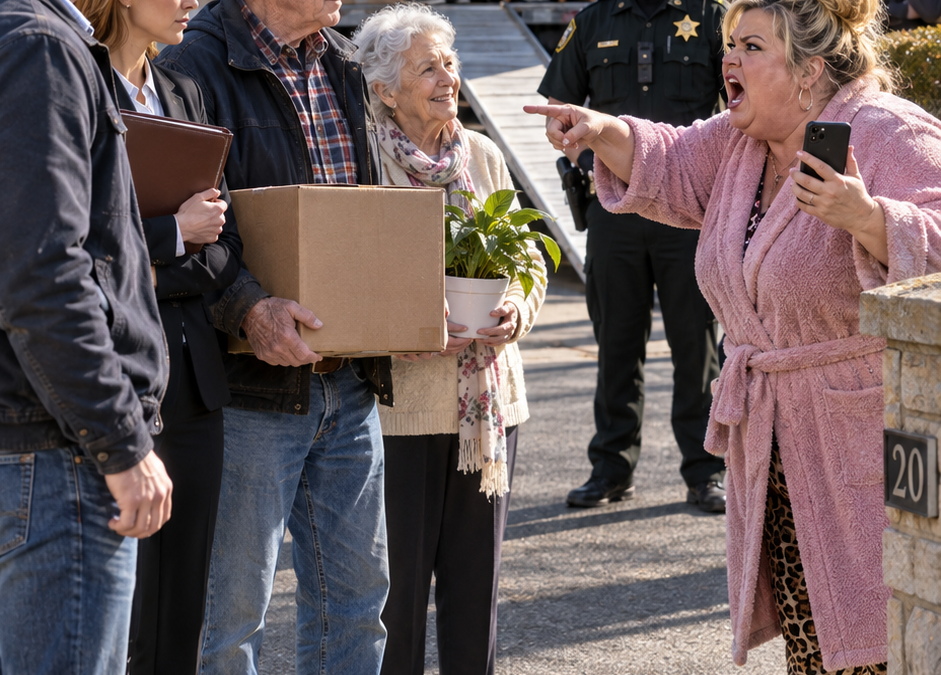
Karen came out before the ramp had reached the pavement.
She was wearing a robe over her clothes and clutching her phone.
She pointed at me.
Then she looked at the sheriff’s deputy standing in her yard.
“Get him off my property.”
Deputy Lawrence Boyd did not move.
Karen’s voice got louder.
“He doesn’t own anything on this street.”
I said nothing.
For nine months, Karen had controlled every conversation by speaking first and speaking with absolute certainty.
That morning, I was finally willing to let her.
She stepped closer.
“You’re not on the deed, Travis. You’re not on the board. You’re a visitor with a phone.”
There were neighbors standing beside trash cans all along the street.
Eighteen people, maybe more.
Gus Anderson was at his mailbox three houses down.
Peggy Sutton stood near the curb in a winter coat.
My attorney, Colleen Reese, was beside me with a folder under her arm.
Karen had an audience.
That usually made her stronger.
She turned toward Deputy Boyd.
“That man is dead.”
Nobody spoke.
She pointed toward the truck.
“Whoever is inside that vehicle is lying. I want them arrested.”
She had just repeated the central claim in her sworn criminal complaint in front of a law-enforcement officer.
My father, Raymond Walker, was dead.
My mother had abandoned the house.
I was an out-of-state son forging documents to interfere with property that no longer belonged to me or to them.
That was the story Karen had built.
She had fines supporting it.
Affidavits supporting it.
A landfill manifest supporting it.
A police complaint supporting it.
Almost every document carried her signature.
Deputy Boyd looked down at the folder beneath his arm.
Then back at Karen.
“Ma’am, your complaint states both homeowners are deceased.”
“Correct.”
“Mr. Walker says he’s acting under a valid power of attorney for living owners.”
“The power of attorney is fraudulent.”
“Understood.”
Boyd looked toward the truck.
“Is the party asserting ownership available to identify themselves?”
Karen crossed her arms.
“Whoever he hired to play this game doesn’t change the law.”
Behind me, the passenger door opened.
But to understand why what happened next destroyed her so completely, you have to understand how far she had gone to make sure my parents never walked back onto Cedar Hollow Lane.
Nine months earlier, on March 4, my father entered an operating room in Houston for a valve replacement.
The surgery itself was supposed to be routine as heart surgery can ever be called routine.
Six days in the hospital.
A few weeks of recovery.
Then home to North Carolina.
That was the plan.
On the third day after surgery, he had a stroke.
Six days became three weeks.
Three weeks became inpatient rehabilitation.
Rehabilitation became another facility near the Katy Freeway.
And suddenly my mother, Diane, was living in Houston beside him.
She was sixty-nine years old.
She slept in a recliner most nights because she refused to leave him alone.
I offered to fly her back to North Carolina at least a dozen times.
“Just for a week,” I would tell her. “I’ll stay with Dad.”
She always gave me the same answer.
“He wakes up scared sometimes.”
Then she’d lower her voice.
“He needs to see somebody he knows.”
So she stayed.
My parents’ house at number 12 Cedar Hollow Lane sat empty.
But it was not abandoned.
That distinction would eventually matter more than almost anything else.
On March 20, my mother signed a durable power of attorney naming me.
It was recorded with the Guilford County Register of Deeds four days later.
At the time, nobody considered it dramatic.
It was housekeeping.
If my parents needed a bill paid, a contractor called, insurance paperwork handled, or something signed back home, I could do it.
I lived in Denver.
I put my copy in a drawer and barely thought about it again.
The house itself had been part of my family since 1988.
My father had spent thirty-eight years making it his.
He was a cabinetmaker.
Not the kind who ordered boxes from a catalog and installed them.
He built things.
Measured.
Cut.
Fitted.
Sanded.
Started over when something did not feel right under his hand.
The kitchen was his pride.
On my parents’ tenth anniversary, he made my mother a set of upper cabinet doors with leaded glass panels.
Each diamond-shaped pane had been cut and assembled by hand.
One door—the third from the left—was imperfect.
The middle pane sat about a quarter inch proud of the frame.
When the door closed, it made a small, flat knocking sound.
For thirty years people had told my father to fix it.
He always refused.
“That’s how you know a man made it,” he’d say, “and not a factory.”
Behind the house was a detached workshop.
On the main bench sat a Stanley tool chest from the 1940s.
It had belonged to my grandfather.
My father had learned with those tools.
Then built his own career with them.
The chest had been on that bench for as long as I could remember.
On April 9, my mother emailed the Cedar Hollow Estates HOA.
She gave them her Houston forwarding address.
She explained that Ray was recovering after surgery.
She wrote that they expected to return by fall.
She asked the office to hold association mail rather than allow it to accumulate at number 12.
Karen Hollister personally replied.
One sentence.
Received. Take care of Ray.
That email would become one of the most important pieces of paper in the entire case.
Because Karen knew where my parents were.
She knew why they were gone.
She knew my father’s name.
And she knew they intended to return.
Karen had been president of the Cedar Hollow Estates HOA for eleven years.
The neighborhood had 212 homes and four other board members.
But the bylaws contained one old provision nobody had ever bothered changing.
The president could authorize vendor work orders alone.
No second signature.
No board vote.
Karen’s pen.
Karen’s decision.
I had met her only twice while growing up.
She had been pleasant.
Warm, even.
The kind of person who remembered birthdays, names, children’s colleges.
But Karen possessed one quality I did not understand until much later.
Certainty.
Not confidence.
Certainty.
The belief that once she had decided what reality was, everyone else’s responsibility was simply to catch up.
By June, she had begun referring to my parents in the past tense during board meetings.
She was subtle.
That was why nobody stopped her.
She’d call number 12 “the situation over at the Walker property.”
At one meeting she said the situation had “resolved itself.”
Someone corrected her.
“The Walkers are in Texas. Ray had surgery.”
Karen smiled.
“Of course. Absolutely.”
Then the next month she used almost the same language again.
What most people did not know was that Karen had wanted something from my father’s house long before he went to Houston.
In the fall of 2024, she remodeled her kitchen.
She came to number 12 and asked my father whether he would sell her his leaded-glass cabinet doors.
She also wanted the Stanley chest.
She said the chest would make a beautiful bar cabinet.
My father refused.
Karen came back with an offer.
He refused again.
That second refusal was less polite.
My mother told me later exactly what he’d said.
“Those doors leave this house when I do.”
Karen did not argue.
She smiled.
She sent them a fruit basket that Christmas.
Then, while my father was learning to walk again in Houston, Karen opened what the HOA records called an “abandonment determination.”
Uncut grass.
Uncollected mail.
No observed occupancy.
Never mind the forwarding address.
Never mind the April email.
Never mind that she personally knew where the owners were.
Violation notices began accumulating at fifty dollars per day.
Ninety-six days.
$4,800 in fines.
Notices addressed to a man in rehabilitation a thousand miles away.
Then, on August 12, Karen signed a work order for Ridgeline Hauling and Salvage.
Her signature.
No second board member.
No owner authorization.
The crew entered number 12.
They emptied the workshop.
Then they removed four kitchen cabinet doors.
Not all ten.
Four.
By lunch, they were gone.
I knew none of this.
I found out in October because an HOA lien notice finally reached me in Denver.
$18,600 against my parents’ house.
I stood in my kitchen reading the breakdown.
Fines.
Administrative expenses.
Legal costs.
Then one line at the bottom.
CONTENTS DISPOSAL / LANDFILL.
I read it four times.
Then booked a flight to North Carolina.
Somewhere over Kansas, one fact kept coming back.
My mother had given the HOA her forwarding address.
Karen had replied personally.
You cannot honestly declare a house abandoned when you know exactly where the owners are.
Not unless you need the house to be abandoned.
I reached Cedar Hollow late.
The workshop told me what happened before the house did.
My father had installed the roll-up door himself in the 1990s.
The track had always been slightly wrong.
The door rattled in a specific rhythm when you raised it.
I pulled the handle.
The door made the same sound it had made my entire childhood.
Then it opened onto almost nothing.
Bare concrete.
Empty pegboard.
Screw hooks gone.
Tools gone.
On the workbench was a rectangle of clean wood surrounded by nine months of dust.
The shape of the Stanley chest.
Sharp on all four sides.
Whoever had removed it had lifted it straight up.
I stood there so long that my rental car began chiming because I had left the door open.
The kitchen was worse.
Four upper cabinets had been stripped to bare frames.
The hinges had not even been unscrewed properly.
Someone had pried them.
Wood was splintered around several screw holes.
Six cabinet doors remained.
Four specific doors were gone.
That was when I understood this had never been a routine cleanout.
Someone had walked through my mother’s kitchen and selected what they wanted.
I sat on the front steps and called Houston.
My mother answered.
I could hear hospital announcements in the background.
“Travis.”
“Hey, Mom.”
“Your father walked to the window today.”
Her voice changed immediately.
Brightened.
“Twice. The therapist says that’s a week ahead.”
In the background my father complained about something.
My mother laughed.
Then she asked the question I had been hoping she would not ask.
“Everything okay at the house?”
I looked through the window at the pry marks where my father’s doors had been.
“The furnace sounds a little rough.”
“Oh.”
“I’ll get somebody to look at it.”
She trusted me.
In thirty years I had never given my mother a reason not to.
That was the first lie I told in the whole thing.
I want to say that plainly.
I did not tell her somebody had torn apart her kitchen.
Not while she was holding my father upright in a hospital hallway.
I work as a commercial insurance adjuster.
For fifteen years, I have walked into properties after fires, floods, collapses, thefts, storms—the worst day of somebody else’s life—and documented what remained.
So I went to work.
Wide shot.
Medium shot.
Detail.
Scale reference.
Timestamp.
Cabinet frames.
Pry marks.
Workshop.
Pegboard.
Dust outline.
Eighty-one photographs.
I did not know whether any of them would matter.
I just knew doing something with my hands felt better than standing there.
The next morning, I went to the HOA office.
It occupied a converted garage beside the clubhouse.
Karen sat behind the counter drinking coffee.
She wore an oatmeal-colored cardigan.
When she saw me, she smiled.
“Travis. I’m so glad you came in person.”
She already had a folder on the counter.
Number 12 was written on the tab.
That detail stayed with me.
She had pulled my parents’ file before she knew I was in North Carolina.
“Sit down,” she said.
“I know this is difficult. Nobody wants to inherit a mess.”
Inherit.
She had decided my parents were dead before asking why I was there.
She turned the folder toward me and began walking me through it.
“Uncut grass. Mail accumulation. No observed occupancy. Ninety-six days of unresolved notices.”
Her fingertip moved down the page.
“The association has obligations. This wasn’t punitive. It was abatement.”
“Abatement.”
“Correct. The property had become an eyesore and potential hazard.”
She smiled sympathetically.
“I may be able to work with you on some fines. The removal costs aren’t negotiable. Do you want to pay today or arrange installments?”
She still had not asked whether my father had recovered.
So I removed two documents from my bag.
The first was the recorded deed.
Raymond and Diane Walker.
Joint tenants with right of survivorship.
The second was my recorded power of attorney.
I placed both documents on the counter.
“My parents are alive.”
Karen looked down.
“Neither one transferred this property. Neither one abandoned it. And I’m legally authorized to act for both of them.”
Karen did something impressive.
She did not visibly react.
But her language changed.
Before the documents appeared, she had said “your parents’ estate.”
Afterward, she called it “your parents’ file.”
She never used the word estate again.
That is what people look like when they discover the story they have been telling contains a hole.
They begin repairing it while they speak.
The HOA’s attorney, Curtis Sloan, reviewed everything later that day.
He was in his sixties and sounded exhausted by everyone involved.
After looking at the deed and power of attorney, he advised the board to suspend enforcement pending review.
The fines froze at $4,800.
For about an hour, I felt relief.
Then I asked Karen the question that actually mattered.
“Where is my father’s property?”
She pulled out a sheet.
Fast.
Too fast.
Ridgeline Hauling and Salvage.
August 12.
Weight: 6,800 pounds.
Destination:
TRANSFER STATION / LANDFILL.
She slid it across the counter.
“It’s gone, Travis.”
I looked at her.
“The tool chest?”
“Everything removed under the order.”
“My father’s cabinet doors?”
“Disposed.”
She softened her voice.
“It was considered garbage. I’m sorry.”
Her apology was comfortable.
Almost casual.
The kind of apology you make because rain ruined someone’s picnic.
Nine days later, Karen put the lien back before the board.
She added the cleanout invoice.
$18,600.
The vote passed four to two.
I was in the back of the room.
Peggy Sutton, the vice president, voted against enforcement.
She kept her hand raised a fraction longer than necessary while looking at Karen.
I noticed.
I did not yet know why.
On the drive home, one number kept bothering me.
6,800 pounds.
My father’s workshop contained hand tools, a wooden chest, a workbench, and miscellaneous equipment.
Four cabinet doors had been removed.
Six thousand eight hundred pounds did not make sense.
Three houses away lived Gus Anderson.
Eighty-one years old.
He had lived on Cedar Hollow Lane since my parents arrived.
Gus watched the neighborhood the way some men watch sports.
His daughter had installed a doorbell camera two years earlier.
Gus barely understood it.
But the camera faced the street.
I knocked.
“Gus, can that thing show recordings from August?”
He stared at the camera.
“My daughter does all that.”
“Can we call her?”
He did not ask why.
That told me something.
His daughter, Suzanne, pulled the footage remotely.
August 12.
At 11:06 a.m., a Ridgeline Hauling truck moved past Gus’s mailbox.
It was riding low.
It had just left number 12.
The county landfill was twenty minutes away.
To reach the highway, the truck needed to turn right at the end of Cedar Hollow Lane.
It turned left.
Away from the highway.
Deeper into the neighborhood.
I asked Suzanne to play it again.
Left.
The truck never went toward the landfill.
I watched four times.
Then sat on Gus’s porch because my legs suddenly felt unreliable.
Karen’s disposal manifest was not describing what had happened.
It was describing what she wanted everyone to believe had happened.
The camera lost the truck near the final bend.
So I walked.
Past that point, Cedar Hollow Lane did not branch.
Four hundred feet later it ended in a cul-de-sac.
Four houses.
One was number 20.
Karen Hollister.
That gave me direction.
It did not give me proof.
I could not enter her house.
I could not accuse her based on where a truck turned.
I’ve watched insurance fraud cases collapse because someone knew exactly what happened but obtained the evidence illegally.
I was not going to make that mistake.
What I could legally read was the HOA newsletter.
Karen wrote it every month.
The September issue was still posted online.
Page four contained a feature called NEIGHBOR SPOTLIGHT.
That month’s neighbor was Karen.
The topic was her newly remodeled kitchen.
Three photographs.
In the second image, behind Karen’s kitchen island, four decorative leaded-glass cabinet doors had been mounted along the wall.
My father’s doors.
I knew them instantly.
The diamond pattern.
The wood grain.
And the third door from the left.
The center pane sitting a quarter inch proud of the frame.
There was no second set.
My father had made them by hand.
I sat in the rental car staring at the photograph.
Then something even colder occurred to me.
Karen had published them.
She had not hidden the doors.
She photographed them.
Wrote an article.
Mailed that photograph to 212 homes.
Including number 12.
She could only do that if she had become completely convinced my parents would never return to recognize what she had taken.
I called Houston that night.
My mother put me on speaker.
“Forty feet today,” she said.
“What?”
“Your father. Forty feet down the hallway and forty back.”
My father said something profane about his walker.
I laughed because she laughed.
“That’s great, Dad.”
My mother asked, “Did you fix that furnace?”
“It’s handled.”
Another lie.
I sat in the dark kitchen afterward.
Four empty cabinet frames above me.
And I made myself a promise.
Those doors would be back on that wall before my father walked through the front door.
The next morning I showed Curtis Sloan the newsletter.
He stared at the photograph.
“Those are your parents’ doors.”
“Yes.”
“And that’s Karen’s kitchen.”
“Yes.”
“So now what?”
He sighed.
“Now you have almost nothing.”
I thought I’d misheard.
“What?”
“A photograph proves she possesses the doors. It does not prove theft.”
“She signed the work order.”
“She authorized a cleanout. The board will argue the abandonment determination gave her authority.”
“She said the property went to a landfill.”
“Yes.”
He tapped the photo.
“But if Karen says the hauling crew offered her salvage from a load already designated for disposal, and she accepted it, possession alone doesn’t prove she stole it.”
I hated him for about thirty seconds.
Then understood he was right.
“You need the missing paper,” Sloan said.
“What missing paper?”
“The paper showing how property went from the truck to her house.”
That paper, if it existed, belonged to Ridgeline.
Before I could pursue it, Karen made another move.
When I returned to number 12, an envelope was taped to the storm door.
HOA letterhead.
Signed by Karen.
Effective immediately, I was prohibited from entering the clubhouse, HOA office, pool building, and all association common areas due to what she called a “hostile pattern of contact.”
Every association file I might want to inspect was inside those buildings.
She wasn’t angry.
She was closing doors.
One at a time.
I hired Colleen Reese.
She practiced property law from a second-floor office in downtown Greensboro.
Her window air conditioner ran even though it was October.
I showed her eighty-one photographs and every document.
She listened without taking notes.
That made me nervous until I realized she remembered almost everything word for word.
When I finished, she said, “You’re right.”
I waited.
“That’s good.”
“No.”
She leaned back.
“Being right is going to be the least useful thing you own for a while.”
She sent Ridgeline a formal demand for the full August 12 job file.
Four days later, they refused.
Politely.
Their client was Cedar Hollow Estates HOA.
Job files and routing documentation could be provided only to the client, through subpoena, or to the authorizing signatory.
The authorizing signatory was Karen.
I read the letter twice.
“So the person who can voluntarily release evidence against Karen is Karen.”
“Correct.”
“Subpoena it.”
“We need litigation underway, then a hearing.”
“How long?”
“Four to six months.”
My parents’ lien enforcement hearing was December 16.
We did not have four months.
If the lien was validated, the HOA could begin foreclosure proceedings against the house.
My father was walking forty feet twice a day.
My mother still believed I was dealing with a furnace.
I attended the next board meeting by telephone because Karen had banned me from the building.
I had six minutes.
I laid out everything.
The deed.
The power of attorney.
My mother’s April forwarding email.
Karen’s reply.
The newsletter photo showing my father’s cabinet doors in Karen’s house.
And Karen’s signature authorizing the cleanout.
Silence followed.
Through a speakerphone, I could hear papers moving.
Then Karen spoke.
“May I distribute something?”
More papers.
A long silence.
Colleen received a copy the following morning.
She placed it on her desk.
VOLUNTARY STATEMENT OF ABANDONMENT.
Dated May 22.
It supposedly authorized the HOA to enter number 12, secure it, remove personal property, and dispose of contents without further notice.
At the bottom was my mother’s signature.
Diane E. Walker.
The long loop in the W.
The E that never fully closed.
It looked real.
Very real.
And it was notarized.
Suddenly everything Karen had done appeared authorized.
Not merely excused.
Authorized in advance by my mother.
The cleanout became a service.
The property became abandoned.
The stolen doors became discarded contents.
Curtis Sloan withdrew his recommendation to suspend enforcement.
Peggy Sutton stopped answering my calls.
That night, around ten, I called Houston.
I had avoided telling my mother about the cabinets.
I could not avoid this.
“Mom, I need to read you something.”
I read the affidavit.
There was silence.
Then:
“I didn’t sign that.”
“You’re sure?”
“Travis, I don’t—”
She stopped.
I heard her breathe.
“Honey, I’ve signed so many things this year.”
My stomach dropped.
“Discharge papers. Therapy forms. Pharmacy paperwork. Insurance. Every day somebody puts something in front of me.”
Her voice became smaller.
“What if I did sign it? What if I signed something and don’t remember?”
Then my mother started apologizing.
“I’m sorry.”
“Mom.”
“I’m so sorry.”
“Stop.”
“What if I—”
“Mom, stop apologizing.”
She apologized four times in ninety seconds for something she had not done.
And I need to admit the ugliest thing I did throughout all of this.
For about four seconds, I doubted her.
May had been terrible.
My father had suffered a setback.
They had changed rehabilitation facilities.
My mother had barely slept.
She had been signing documents constantly.
For four seconds, I wondered whether she had unknowingly signed away their house contents.
Then shame hit me.
I knew my mother’s handwriting.
I had forty years of birthday cards proving it.
The signature looked like hers.
But I stopped studying the signature.
I looked beneath it.
The notary block.
A notary does not merely confirm that a signature resembles someone’s handwriting.
The notary certifies that the named person personally appeared and acknowledged the signature.
The affidavit stated:
Diane E. Walker personally appeared before the notary in Guilford County, North Carolina, on May 22.
My mother had not set foot in North Carolina since March 3.
I called Colleen at 11:00 p.m.
She answered immediately.
“Stop fighting Karen about authority,” I said.
“What?”
“She has paper for everything. So stop fighting the story on her paper.”
I paced through my parents’ kitchen.
“The affidavit has a notary log. The landfill manifest has a transfer-station scale ticket. The hauling job has a routing record.”
I looked toward the empty cabinets.
“Karen wrote the story. She didn’t write the receipts.”
Colleen was silent.
Then:
“That’s the right instinct.”
She paused.
“And it’s probably the last chance we get.”
Karen had just increased the lien request again by adding legal costs.
Twenty-two days remained.
The first outside record came from the Guilford County Transfer Station.
Every truck entering and leaving was weighed.
Date.
Hauler.
Truck number.
Inbound weight.
Outbound weight.
Public record.
Nine dollars.
We requested August 12.
Six days later, Colleen called me.
“Come in.”
She placed two documents side by side.
Karen’s manifest:
6,800 pounds disposed.
County transfer-station record:
2,140 pounds delivered by Ridgeline.
Difference:
4,660 pounds.
Nearly two-thirds of the supposed landfill load had never reached the landfill.
“That’s not a clerical discrepancy,” Colleen said.
“No.”
“That’s a document describing an event that didn’t happen.”
Next came the notary log.
The notary who supposedly witnessed my mother’s signature worked for the management company servicing Cedar Hollow Estates.
Her office was eleven feet from Karen’s.
The log showed Diane Walker.
May 22.
Identity verified.
Fortunately, my mother had another habit.
She never missed my father’s therapy appointments.
Houston Methodist had records.
At 9:15 a.m. on May 22, Diane Walker signed into occupational therapy in Houston.
More than a thousand miles from Guilford County.
I stared at that timestamp.
Three days earlier, my mother had apologized to me because she feared she had forgotten signing something.
Now there it was.
9:15 a.m.
Houston.
The affidavit was impossible.
Colleen tapped the page.
“That document just changed from Karen’s best defense to evidence of a crime.”
Then she smiled without humor.
“Now Ridgeline will talk.”
The subpoena went out Monday.
Ridgeline responded Wednesday.
That almost never happens.
Their compliance officer, Naen Puit, called personally.
Colleen put her on speaker.
“I’ve been waiting for someone to ask about this job since August,” Naen said.
“What do you mean?” I asked.
“Our crews follow redirect policy. If a landfill load makes a stop somewhere else—donation, resale, private delivery—nothing comes off the truck without signed authorization.”
“Was there a redirect authorization on August 12?”
Paper moved on her end.
“Yes.”
My chest tightened.
“Where?”
“Second stop was twenty Cedar Hollow Lane.”
Karen’s house.
The scan arrived an hour later.
I opened it in my parents’ kitchen.
Ridgeline Hauling and Salvage.
Job number.
Crew of three.
August 12.
Stop One:
12 Cedar Hollow Lane.
Stop Two, handwritten:
20 Cedar Hollow Lane — Deliver to Garage.
Authorizing party:
Karen Hollister.
Her handwriting.
Her address.
Her signature.
She had not accepted discarded items casually.
She had redirected the truck.
And Ridgeline’s insurance policy required photographic documentation.
Twelve timestamped photos were attached.
Men carrying property down Karen’s driveway.
The Stanley tool chest.
My father’s hand tools.
Wrapped cabinet doors.
In one photograph, the moving blanket had slipped.
You could see the diamond-patterned leaded glass.
The driver, Wes Tolman, also gave a statement.
Karen met the crew at number 20.
She directed which items went into her garage.
She told the crew the homeowners had died and their family had released the contents.
Colleen read the statement.
Then she wrote one number on her legal pad.
$58,000.
An appraiser’s estimated value for the antique tool chest, tools, and custom cabinet doors.
She circled it.
“This isn’t an HOA fine dispute anymore, Travis.”
“What is it?”
“Felony-level property theft supported by falsified records.”
She closed the file.
“Next I take this to the district attorney.”
Karen did not know any of this had been found.
And during that same week, she made the worst decision she could have made.
She went to law enforcement first.
On Monday, Karen filed a criminal complaint against me.
Forgery of a power of attorney.
Attempted fraud against the estate of a deceased homeowner.
She had physically held my recorded power of attorney in October.
She had read it across her counter.
Yet she signed a sworn statement claiming it was fake.
Her written narrative contained one sentence that eventually became almost impossible for her to explain:
Ray Walker died in March. There is no father.
Deputy Lawrence Boyd received the case.
He did exactly what a reasonable deputy should do when two parties accuse each other of document fraud.
He scheduled an in-person verification.
December 15.
8:40 a.m.
At number 20 Cedar Hollow Lane.
The address where disputed property was believed to be located.
All parties present.
Identification confirmed.
Ownership verified.
Karen loved the idea.
She emailed Boyd thanking him for his diligence.
She wrote that she welcomed having the situation resolved in front of witnesses.
I think she believed she had scheduled my arrest.
Then, on December 13, my father’s cardiologist cleared him to travel.
Nine months after surgery.
Nine months after the stroke.
Nine months after my mother had left North Carolina believing they would be home by fall.
They were finally coming home.
I booked a twenty-six-foot rental truck.
They had accumulated more than I expected.
A hospital-style bed.
My mother’s recliner.
Boxes of clothes.
Medical supplies.
Four boxes of sheet music.
A walker my father despised.
Everything two people collect when six days away becomes nine months.
Then I called my mother.
“Mom, when you get back Monday, we’re not going directly home.”
“Why?”
“We need to stop somewhere first.”
“Where?”
I gave her the address.
She was quiet.
Then she understood.
“Her house?”
“Yes.”
December 15 was trash day.
That is why there were so many witnesses.
Nothing dramatic.
Just timing.
Cedar Hollow residents rolled their bins to the curb Monday mornings.
At 8:40, maybe eighteen people were outside.
Deputy Boyd arrived at 8:30.
Colleen and I parked nearby at 8:35.
Karen stepped into her yard holding her phone.
Then the truck appeared.
It passed number 12.
Stopped at number 20.
And Karen began shouting.
Now we were back where this story started.
“That man is dead,” she told Deputy Boyd.
“Whoever is in that truck is a liar.”
Then the passenger door opened.
My mother climbed down.
Five foot two.
Good winter coat.
Purse over her arm.
Perfectly composed.
She stepped onto Karen Hollister’s driveway.
Karen’s face changed.
It was almost mechanical.
Like a machine encountering a number it was not programmed to process.
“Mrs. Walker.”
My mother looked at her.
Karen recovered fast.
“Diane, I don’t know what Travis has told you—”
Then the rear driver’s-side door opened.
I walked around to help with the ramp.
My father appeared.
He was thinner.
His shoulders had narrowed.
He held the rail with one hand and his cane with the other.
For nine months he had fought for every extra foot.
Ten feet.
Twenty.
Forty.
Back again.
Now Raymond Walker slowly walked down the ramp onto the driveway of the woman who had just told a sheriff’s deputy he was dead.
Nobody on Cedar Hollow Lane moved.
Not one trash bin rolled.
My father didn’t look at Karen first.
He looked at Boyd.
“Officer.”
Boyd nodded.
My father pointed toward the house.
“I built the doors in her kitchen.”
That was when Karen lost control.
“That’s not—”
Her voice jumped in pitch.
“That’s not him.”
Gus Anderson spoke from his mailbox.
“That’s Ray.”
Karen turned.
“This is staged.”
Nobody answered.
“They staged this.”
She looked at Boyd.
“Larry, you don’t know what he’s doing. I want that truck off my property.”
“Ma’am,” Boyd said, “I need you to stop talking.”
She didn’t.
I actually think she believed she could still win.
For eleven years, certainty had worked for her.
When challenged, she spoke louder.
When questioned, she produced a document.
When somebody resisted, she changed a rule.
So she reset.
“Fine.”
She raised both hands.
“Fine. Yes, there are things from that house inside mine.”
Boyd watched her.
“The hauling crew was taking them to the dump. They offered me salvage. Items that were already being discarded.”
She looked around at the neighbors.
“That’s not theft. You can’t steal garbage.”
Curtis Sloan had predicted almost those exact words months earlier.
It was her best defense.
Colleen waited until Karen finished.
Then she opened her folder.
“Deputy Boyd.”
She handed him a document.
“This is Ridgeline Hauling’s redirect authorization.”
Boyd read.
“Stop two,” Colleen said, “twenty Cedar Hollow Lane. Delivered to garage.”
Karen interrupted.
“The crew must have filled that out.”
Colleen handed him the next page.
“County transfer-station scale record.”
Boyd looked between the documents.
“Same truck, same day. Two thousand one hundred forty pounds delivered. Mrs. Hollister’s disposal manifest claims sixty-eight hundred.”
Karen shook her head.
“Scales make mistakes.”
Colleen handed him another packet.
“Ridgeline crew photo log.”
Twelve images.
Timestamped.
Property being unloaded into Karen’s garage.
Image four showed the Stanley chest.
Image nine showed one of the leaded-glass doors.
Karen’s voice became smaller.
“I’ve never seen those photographs.”
Colleen reached for one final document.
She moved more slowly this time.
“And this is the affidavit Mrs. Hollister presented to the HOA bearing Diane Walker’s signature.”
My mother stared at the page.
Colleen continued.
“It states Mrs. Walker personally appeared in Guilford County on May 22.”
She placed another record beneath it.
“At 9:15 that morning, Diane Walker was signed into occupational therapy in Houston.”
Silence.
Karen had been talking continuously for almost four minutes.
Now she said nothing.
That silence changed the entire morning.
Boyd gathered the papers.
Then turned toward my father.
“Mr. Walker, can you identify the property believed to be inside?”
My father nodded toward Karen’s house.
“Open the third cabinet door from the left.”
Boyd looked confused.
“Sir?”
“Open it.”
My father rested both hands on his cane.
“Then let it close.”
“That’s how you’ll identify it?”
“Just listen.”
Karen’s husband, Dale, had come to the doorway.
He looked like a man who had realized the disaster he was watching had started inside his own house.
Boyd asked for access.
Dale opened the garage.
The Stanley chest sat four feet from his vehicle under a moving blanket.
There was no argument left about that.
Boyd and another officer went through the house.
The front door remained open.
Eighteen people stood in the December cold.
Then, from inside the house, we heard it.
A cabinet door closing.
A small, flat knock.
Wrong.
Slightly proud.
Exactly the sound that door had made since 1998.
My mother’s hand rose to her mouth.
My father looked toward the house.
His face barely moved.
But I knew him.
I saw what that sound did to him.
Somebody had taken a piece of his life.
Put it on another person’s wall.
And even there, it still sounded like his hand.
Deputy Boyd came outside.
Everything after that moved quickly.
Karen was detained on her own driveway.
She kept repeating the word “salvage.”
Peggy Sutton already had her phone out.
“I’m calling an emergency board meeting.”
Two movers had driven the truck from Houston.
They knew almost none of this.
They stood near the ramp watching with the stunned expressions of men who thought they had accepted a normal moving job.
One finally approached me.
“Sir?”
“Yeah?”
“Where do you want the furniture?”
I looked toward Karen’s garage.
Then toward the truck.
“My parents’ house.”
He nodded.
“Okay.”
And those two men began carrying my father’s property back.
The Stanley chest.
Boxes of tools.
Cabinet doors.
One piece at a time.
Down Karen’s driveway.
Up the moving ramp.
Karen watched from beside the patrol vehicle.
I did not say anything to her.
I did not need to.
The lien hearing was the following morning.
It lasted eleven minutes.
Colleen submitted the redirect authorization.
Transfer-station scale ticket.
Notary record.
Houston therapy record.
Ridgeline photographs.
The $18,600 lien was voided completely.
The $4,800 in fines disappeared.
The abandonment determination was reversed.
The cleanout authorization was invalidated.
Every HOA action Karen had signed against number 12 collapsed on the record.
My mother sat beside my father.
When we reached the courthouse parking lot afterward, she looked at me and said:
“Nine months of this and they couldn’t wait five more minutes to find out whether we were alive.”
I did not know how to answer.
The district attorney filed charges in January.
Felony larceny involving approximately $58,000 in redirected property.
Obtaining property by false pretenses.
Charges connected to falsified documentation.
The false abandonment affidavit.
The disposal records.
And the false law-enforcement complaint in which Karen had sworn my father was dead.
That last one was especially difficult for her to explain.
Because she had personally held the power of attorney naming him as a living principal two months earlier.
Dale Hollister was never charged.
He genuinely did not know.
A week after Christmas, he came to number 12 alone.
He stood on the porch.
Tried to speak.
Stopped.
Tried again.
Couldn’t finish.
My mother invited him inside.
Then she made him coffee.
That was the most Diane Walker thing that happened all year.
Karen pleaded guilty in April.
Fourteen months of active custody.
Five years’ probation.
Restitution.
Another $22,000 toward repairing the damage her crew had caused to the kitchen cabinets.
She was permanently barred from serving on the board of a community association in North Carolina.
The notary involved in the false affidavit lost her commission.
Ridgeline changed its procedures.
A redirected load now required authorization from the actual property owner, not merely the company or association that ordered the pickup.
Naen Puit sent Colleen a copy of the revised form.
No message.
None was necessary.
Cedar Hollow held new elections.
Peggy Sutton became board president.
The first new rule required two signatures for vendor work orders.
No president would ever again send a crew into a house alone.
The association eventually settled with my parents over the unauthorized abatement and damage.
That meant 212 households shared part of the financial cost.
Some people thought that was unfair.
I didn’t.
Karen had been able to do what she did because people spent years deciding opposing her was more uncomfortable than stopping her.
Someone corrected her when she first started talking about my parents as if they were gone.
Then everyone let the subject move on.
Certainty can become power when enough people get tired of saying no.
We returned the Stanley chest to the workshop on December 18.
My father could not carry it anymore.
That hurt him.
He did not say so.
He did not have to.
Gus Anderson came down from number six.
Gus and I lifted the chest between us.
My father stood in the doorway with his cane.
“You’re tilting it.”
“We’re not.”
“You are.”
“Gus?”
Gus grunted.
“He’s always like this?”
“Thirty-eight years.”
My father pointed.
“Move your end left.”
We moved it.
The dust outline was still visible on the bench.
Nine months of sawdust had settled everywhere except where the chest used to sit.
Gus and I lowered it.
It fit inside its own outline perfectly.
Like a key sliding into a lock.
My father put one hand on the lid.
He did not open it.
He just stood there.
The cabinet doors took longer.
The frames had been damaged badly enough that a professional shop had to rebuild several mounting points.
In March, a young cabinetmaker from Battleground came to reinstall them.
My father sat in a kitchen chair throughout the job.
He corrected measurements.
Questioned screws.
Criticized shims.
The young man took it well.
When he reached the third door from the left, he noticed the problem.
“Mr. Walker?”
“What?”
“This pane sits proud.”
“I know.”
“I can fix it while I’ve got it down.”
“No.”
“It’d take ten minutes.”
My father pointed at the door.
“Leave it.”
The cabinetmaker smiled.
“Sentimental?”
“No.”
Dad leaned back.
“That’s how you know it’s mine.”
The young man left it exactly as it was.
That week, my mother had her piano tuned.
The tuner told her it was nearly a full year overdue.
She said she knew.
That evening she sat down and played for forty minutes.
Badly.
She had not practiced in months.
My father sat in his chair with his eyes closed.
He never complained.
Eventually, I told my mother about the four seconds.
The four seconds when I had looked at the forged abandonment affidavit and wondered if exhaustion had made her sign it without remembering.
I expected her to be hurt.
Instead she laughed.
Not politely.
She laughed until she had tears in her eyes.
“Travis.”
“I’m serious.”
“Oh, honey.”
She wiped her face.
“If I’d signed away your father’s cabinets, you would have found me floating in the river before breakfast.”
From the living room my father shouted:
“I heard that.”
Mom yelled back:
“Good.”
That was the last time we talked about Karen for a long while.
I flew home to Denver in April.
Life returned to the boring things you do not appreciate until someone takes boring away.
Work.
Grocery stores.
Bills.
Coffee.
Phone calls about nothing important.
Then, a few weeks later, my phone buzzed on a Tuesday afternoon.
A message from Mom.
No words.
Just a photograph.
The kitchen.
Morning sunlight coming through the leaded glass.
The third cabinet door from the left was half open.
Diamond-shaped patches of light fell across the counter.
I stared at that picture for a long time.
Nine months earlier, my father had entered an operating room expecting to be home in six days.
While he was learning to walk again, another person decided his absence meant she could rewrite his life.
She called his house abandoned.
Called his belongings garbage.
Called his son a criminal.
Then finally called him dead.
She signed those claims.
Notarized them.
Filed them.
Repeated them to police.
Karen Hollister believed paper could make anything true if she produced enough of it.
In the end, paper was exactly what destroyed her story.
A forwarding email.
A power of attorney.
A truck weight.
A therapy sign-in sheet.
A redirect authorization.
Twelve photographs.
A sworn complaint with one sentence she could never take back.
Ray Walker died in March. There is no father.
But there was.
He came home.
He walked down her driveway on a cane.
He identified his own work by the sound it made when it closed.
And now, sitting at my desk hundreds of miles away, I looked at the photograph my mother had sent and knew something Karen never could have understood.
Homes aren’t made valuable by deeds, boards, liens, or the signatures people put at the bottoms of forms.
They’re made by the small imperfections somebody leaves behind.
A tool chest fitting into its old dust outline.
A piano played badly after a year of silence.
Two initials written into decades of memory.
And one handmade cabinet door that never closed quite right.
My mother’s photograph did not have sound.
It didn’t need it.
I knew exactly what that door sounded like when it closed.








