𝗙𝗨𝗟𝗟 𝗦𝗧𝗢𝗥𝗬 Karen Thought Wet Concrete Could Rewrite the Line on My Deed
𝗙𝗨𝗟𝗟 𝗦𝗧𝗢𝗥𝗬
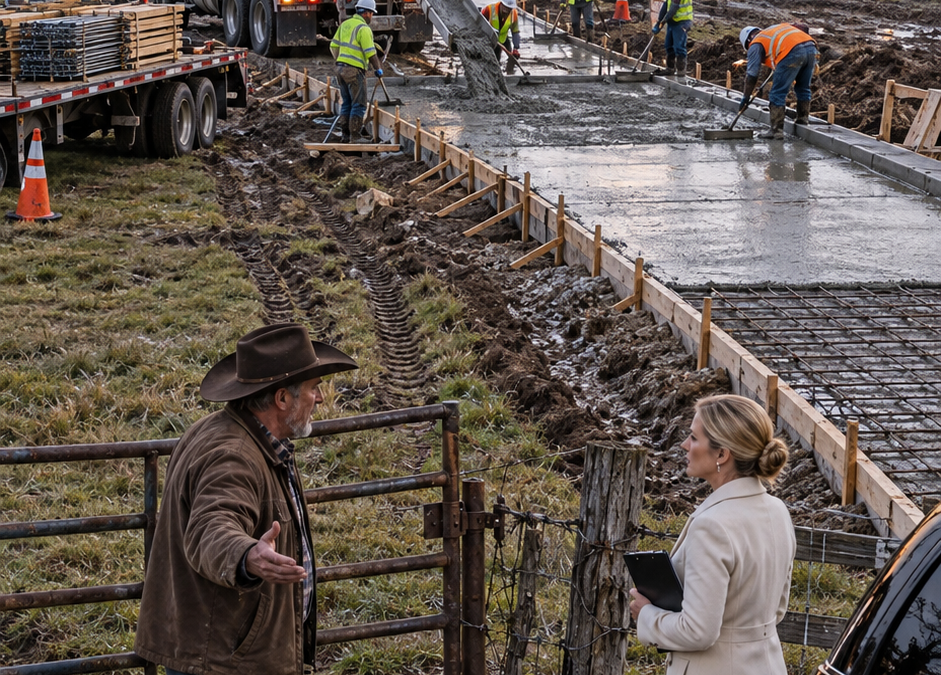
She walked over slowly, more irritated than concerned.
I pointed to the recorded boundary line.
“This is my parcel. This is the HOA boundary. This is where your so-called access road sits.”
She stared at the paper.
For the first time that morning, her face changed.
Only slightly.
But I saw it.
The boundary line ran directly through the middle of the concrete they had just poured.
Not near it.
Not beside it.
Through it.
Part of the slab and curb were fully inside my property. The rest crossed an area the HOA had no recorded right to occupy. They had not poured on some vague edge. They had driven a project hundreds of feet beyond their authority because their map said what they wanted and my deed said what was true.
Karen looked from the survey to the concrete.
“This can’t be right.”
“It is right.”
“Our map shows the access corridor.”
“Your map is wrong.”
“The board reviewed this.”
“Then the board reviewed the wrong document.”
She swallowed, then recovered enough to lift her chin.
“We relied on professional planning.”
“You relied on a drawing that doesn’t transfer ownership.”
“Jack, we have already spent thousands of dollars.”
“You should have spent some of it on a survey.”
The project foreman approached cautiously.
“Ma’am?”
Karen did not look at him.
He shifted his weight.
“Do you want us to pause?”
There it was.
The moment.
Karen had a chance to stop. The damage was already serious, but wet concrete could still be addressed before it became worse. The crew was waiting. The foreman had heard enough to understand there was a problem. Even he knew the smart thing was to pause until someone verified the boundary.
Karen looked at the survey again.
Then at me.
Then at the wet concrete.
Her pride made the decision.
“Finish the pour,” she said.
The foreman hesitated.
“Are you sure?”
“Yes.”
I stared at her.
“Karen.”
She met my eyes.
“The HOA has approved construction.”
“You are choosing to continue after seeing my deed.”
“I am choosing not to let you obstruct a lawful project.”
“This is not lawful.”
“That is your opinion.”
“No,” I said. “That is the line on the survey.”
She turned away.
“Finish it.”
The foreman looked uneasy, but he obeyed.
The second mixer began unloading.
I stood there and recorded everything.
Every truck.
Every worker.
Every section of form.
Every word I could capture.
Karen stood with her arms folded, pretending she had regained control. But I could see tension in the way she held her shoulders. She knew now. Maybe she would never admit it, but she knew. The paper had shaken her. The concrete was no longer a confident project. It was evidence.
By sunset, nearly one hundred feet of my property had been covered by fresh concrete.
The crew finished smoothing the surface. The raised curb wall ran along the edge like a spine. The access road looked clean, expensive, and illegal. Karen stayed until the end. When the final truck pulled away, she stood beside the new concrete and smiled like she had won a race.
“Now,” she said, “we can all move forward.”
I looked at the slab.
“Yes,” I said. “We can.”
She did not understand what I meant.
That night, I called the county building department.
I gave them my parcel number, the HOA project location, the contractor name from the truck, and a summary of what had happened. I sent photographs, video, and a scan of my survey. The woman who answered transferred me to an inspector named Paul Renshaw, who listened without interrupting.
“They poured today?” he asked.
“Yes.”
“On an active permit?”
“I don’t know.”
“Did you grant permission?”
“No.”
“Did they show a recorded easement?”
“No.”
“Send me everything.”
“I already did.”
He paused.
“I’m opening it now.”
I sat at my kitchen table with my phone in my hand, staring at the dark window while he reviewed the files.
I could still smell concrete on my jacket.
After a few minutes, he said, “The parcel line shown on your survey places the work area inside your property.”
“That’s what I told them.”
“I’ll verify with county records in the morning.”
“Can they keep working?”
“If there is no valid permit for construction on your land and no authorization, they have a serious problem.”
“They plan to cure it overnight.”
“They can plan whatever they want. I’ll be out there first thing.”
I barely slept.
Every time I closed my eyes, I saw Karen’s face when she said, “Too late.” I saw the concrete sliding into the forms. I saw the foreman asking whether to pause. I saw Karen choosing pride over the boundary line.
By sunrise, I was already outside.
The slab had hardened enough to hold its shape. Dew sat on the smooth surface. The raised curb wall looked almost elegant in the morning light, which made it more infuriating. It looked like it belonged somewhere. It did not.
Inspector Renshaw arrived at eight-thirty in a county truck.
He was a compact man in his fifties with gray hair, sharp eyes, and the tired expression of someone who had seen too many people confuse paperwork with permission. He carried a tablet, a measuring wheel, and a folder.
Karen arrived ten minutes later.
Of course she did.
Two board members came with her, along with the contractor foreman. Karen looked confident again, though not as effortlessly as before. She had changed into a navy blazer and brought her HOA map in a plastic sleeve.
Renshaw introduced himself, then asked for the project permit.
The contractor handed him a packet.
Renshaw reviewed it.
“This permit application references HOA common access improvements.”
“Yes,” Karen said quickly. “That’s correct.”
Renshaw looked at the slab.
“On common land?”
“Yes.”
“No,” I said.
He turned to me.
I handed him my survey and deed.
Renshaw compared the documents on the hood of his truck. He checked the permit packet. Then he pulled up the county parcel map on his tablet. He walked the boundary. He measured. He checked again.
Nobody spoke much.
Karen tried once.
“The HOA has historically planned this corridor.”
Renshaw did not look up.
“Historical planning is not property authorization.”
That shut her down for almost a full minute.
After twenty minutes, he walked back to the concrete and placed a stop-work notice on a temporary post beside it.
Karen stared.
“What are you doing?”
“I’m issuing a stop-work order.”
Her face flushed.
“You can’t.”
“I can.”
“This project was approved.”
“Not for construction on this parcel.”
Karen snatched at the notice before the adhesive had fully settled.
Renshaw’s voice sharpened.
“Do not remove that.”
She froze with one hand on the paper.
“This is impossible,” she said.
“No,” he replied. “It is very possible. The construction appears to extend onto private property without documented permission. Work stops until legal authority and proper permitting are resolved.”
Karen’s voice rose.
“The HOA has already poured the concrete.”
“That does not legalize it.”
“We have emergency access needs.”
“Then document them through the proper process.”
“The neighborhood has spent thousands of dollars.”
“That is not a building code defense.”
She ripped the notice halfway from the post.
Renshaw stepped closer.
“Ms. Whitmore, if you remove that notice, I will document it as interference with a county order.”
Her hand dropped.
The paper hung crookedly, torn at one corner.
The board members behind her looked nervous now.
The foreman looked like a man mentally distancing himself from the person who had told him to continue.
Renshaw took photographs, including one of the damaged notice.
“Who authorized the pour after the property owner objected?”
Karen’s mouth tightened.
“The board authorized the project.”
“That is not what I asked.”
No answer.
He looked at the foreman.
“Did the owner object before completion?”
The foreman glanced at Karen.
Then he looked at Renshaw.
“Yes.”
Karen spun toward him.
“He was interfering.”
The foreman lowered his eyes.
“He showed a survey.”
Renshaw typed something into his tablet.
Karen’s face went hard.
The inspector turned to me.
“Mr. Morrison, no one is to continue work here. I recommend you speak with counsel before taking action involving removal.”
“I already have counsel.”
“Good.”
Karen stepped in front of the concrete curb as if her body could protect the project.
“Nobody is touching this.”
I looked at her.
“It’s on my land.”
“It is HOA infrastructure now.”
“It is illegal concrete on private property.”
“You cannot destroy HOA property.”
I almost laughed.
She had brought trucks onto my land, poured concrete after being told to stop, watched the county issue a stop-work order, and still believed ownership could be created by expense.
“Karen,” I said, “you built it where you had no right to build it.”
Her voice dropped into something colder.
“You try removing it, and we will sue you.”
“My attorney will enjoy reading that.”
That afternoon, I met with Martin Hale, my lawyer.
He reviewed the deed, survey, photographs, video, inspector’s notes, permit packet, stop-work order, and the footage of Karen telling the crew to continue after seeing my survey.
Martin rarely smiled in professional settings.
He smiled then.
Not warmly.
Strategically.
“They made this easy.”
“It doesn’t feel easy.”
“No. But evidence-wise, they made it easy.”
“Can I remove it?”
“Not recklessly. We will give formal notice, reference the county order, demand removal at their expense, and reserve your right to mitigate damage to your property if they fail to act.”
“How long?”
“We give them a short deadline. They already poured after objection.”
“What if they refuse?”
“Then we seek court relief, or if legally appropriate, you remove the encroachment and pursue damages. I want the notice clean.”
Clean.
That word mattered in every property fight I had ever been dragged into.
Karen loved chaos. She thrived on urgency, emotion, pressure, and performance. The way to beat her was not to match it. The way to beat her was to become boringly precise.
So Martin sent the notice.
The HOA had constructed a concrete access road and curb wall on my private property without authorization. The owner had objected before completion. The HOA continued. The county issued a stop-work order. The HOA must remove the encroachment, restore the property, and pay all associated costs.
Deadline: forty-eight hours.
Karen responded through the HOA attorney.
They denied wrongdoing.
They claimed historical access rights.
They claimed emergency necessity.
They claimed the concrete improvement benefited the community.
They claimed removal would cause unnecessary expense.
They claimed my objection was unreasonable.
They did not attach a deed, easement, lease, license, or written permission.
Martin read their letter and said, “Good.”
“Good?”
“They still don’t have the document.”
The HOA did nothing.
No removal crew.
No restoration plan.
No permit correction.
No apology.
Instead, Karen sent an email to residents accusing me of obstructing critical safety infrastructure and threatening neighborhood access. She described the concrete as an “approved emergency route improvement” and said the HOA would “defend community property against destruction.”
Community property.
I stood in my kitchen reading those words until I felt the old cold anger return.
Then I called Martin.
“They’re not removing it.”
“No,” he said. “They’re daring you to.”
“Then let’s make sure I do it correctly.”
The next morning, I arrived with my own demolition crew.
I did not sneak.
I did not rush in before sunrise the way Karen had.
The crew came at nine o’clock with marked trucks, equipment, safety cones, protective barriers, and documentation. Martin was there. Inspector Renshaw had been notified. The county had confirmed the stop-work order remained active and that the HOA had not produced authorization for the encroachment. A restoration contractor was on standby to repair the ground after removal.
Everything was documented.
Everything Karen had failed to do, I did twice.
The demolition foreman walked the concrete line with me.
“You want all of this removed?”
“All concrete inside my boundary.”
He checked the survey markers.
“This section here?”
“Yes.”
“And the curb?”
“Yes.”
He nodded.
“We’ll cut first, then break. Cleaner that way.”
Before he could start, Karen came running from the direction of the HOA road.
She must have been watching.
She crossed the grass in a tan coat, phone in hand, hair pulled back, face flushed with panic and fury. Two neighbors followed at a distance. Then more appeared near the street.
“What do you think you’re doing?” she shouted.
I turned.
“Removing illegal concrete from my property.”
“You cannot touch HOA property.”
I pointed to the survey markers.
“It is on my property.”
“The HOA paid for that.”
“You paid to trespass.”
She held up her phone.
“I am calling the sheriff.”
“Good.”
That surprised her.
I turned to the demolition crew.
“Wait until the deputies arrive.”
Martin nodded approval.
Karen seemed disappointed. She had expected me to look guilty or worried. I was neither. I wanted deputies there. I wanted witnesses. I wanted one more official record.
Within fifteen minutes, two sheriff’s deputies pulled up.
Karen ran to them before they had fully stepped out of the cruiser.
“He is destroying HOA property,” she said. “I want him arrested.”
The lead deputy, a tall man named Reeves, held up one hand.
“Slow down.”
“He brought demolition equipment.”
“I can see that.”
“This is an HOA access road.”
Deputy Reeves looked at me.
“Mr. Morrison?”
“Yes.”
“Can you explain?”
I handed him the binder.
Deed.
Survey.
County parcel map.
Stop-work order.
Attorney notice.
HOA response.
Photographs.
Video stills.
Deputy Reeves studied the deed for nearly a minute. Then he looked at the survey, then the concrete, then the county notice still posted near the slab.
His partner walked the site with Martin and the demolition foreman.
Karen kept talking.
“The board approved this. The neighborhood needs this access. He has been hostile from the beginning. He is trying to damage the HOA.”
Deputy Reeves looked at her.
“Who authorized construction on his property?”
Karen’s mouth closed.
For the first time that morning, she had nothing ready.
“The HOA approved the project,” she said finally.
“That’s not what I asked.”
She gripped her phone.
“The road is shown on our map.”
“Do you have an easement?”
“It is a historical corridor.”
“Do you have a recorded easement?”
Her eyes flicked toward the concrete.
“The legal issues are being reviewed.”
“That sounds like no.”
She snapped, “Deputy, this is a civil matter.”
He looked at the stop-work order.
“It became more than a simple civil disagreement when construction continued after objection and a county order was issued.”
Her face went pale.
He handed the binder back to me.
“At this point, based on what I’m seeing, we are not arresting Mr. Morrison for removing an unauthorized encroachment from his own property. We’ll document the situation.”
Karen stared at him.
“You’re allowing him to destroy HOA infrastructure?”
Deputy Reeves said, “HOA rules do not override property ownership.”
The words were plain.
They landed hard.
Neighbors had gathered now.
Some stood on the HOA side road. Some recorded with their phones. A few whispered. I recognized several of them from past meetings, people who had likely received Karen’s email and arrived expecting to see me exposed as unreasonable.
Instead, they watched deputies review my deed.
They watched Karen fail to produce a legal right.
They watched the county stop-work notice flap in the breeze beside the concrete.
The demolition foreman approached me.
“Ready?”
I looked at Deputy Reeves.
He nodded once.
I looked at Karen.
She looked almost desperate now.
“Jack, don’t do this.”
I thought about the first truck waking me.
The wet concrete.
The boundary line.
The foreman asking whether to pause.
Karen saying, “Finish the pour.”
I said, “Start.”
The saw cut came first.
A high, grinding scream filled the morning as the blade bit into the concrete along the property line. Dust rose in a pale cloud. The crew worked carefully, cutting sections so the removal would not damage more ground than necessary. Karen stood behind the deputies, phone clutched in her hand, watching the road she thought she had stolen become a construction mistake in reverse.
Then came the jackhammer.
The first strike cracked the curb wall.
The sound echoed off the houses.
The second strike spread the crack across the smooth face.
The third broke loose a chunk the size of a suitcase.
Karen flinched.
The crew kept going.
Piece by piece, the illegal concrete began to fail. What had looked permanent the day before turned fragile under steel and pressure. The curb shattered. The slab fractured. Sections lifted and broke apart. Workers loaded chunks into a dump trailer. The road Karen had rushed to pour was reduced to debris under the eyes of the same neighbors she had tried to turn against me.
She kept muttering.
“This is illegal.”
No one answered.
The deputies remained until the first major section was removed. Inspector Renshaw arrived midway through the demolition and documented the process. He spoke with Deputy Reeves, reviewed the site, and confirmed again that the HOA had not produced authorization.
Karen tried one last time with him.
“Inspector, this is destruction of approved work.”
Renshaw looked at her.
“Ms. Whitmore, this work was not approved for this parcel.”
“It was already built.”
“That was the violation.”
She had no answer for that.
By noon, half the encroaching section was gone.
By late afternoon, the rest was broken, loaded, and hauled away. The restoration contractor began removing disturbed base material and preparing the ground for repair. The property looked rough, but every broken piece of concrete leaving in that dump trailer felt like a correction.
Not revenge.
Correction.
There is a difference.
Revenge wants suffering.
Correction wants the line restored.
A week later, the HOA paid the first invoice.
Not voluntarily at first. Karen fought the amount. She said my demolition crew charged too much. She claimed I should have waited longer. She claimed the HOA could have removed it more cheaply. She objected to the restoration charges, attorney fees, inspection costs, and survey updates.
Martin responded with a letter that included one sentence I still remember.
The HOA had the opportunity to avoid all demolition costs when Mr. Morrison objected before completion and Ms. Whitmore directed the crew to proceed.
After that, the argument became less energetic.
The final settlement required the HOA to reimburse demolition, removal, restoration, legal expenses, survey costs, and related damages. It also required written acknowledgment that no access road, curb, wall, or structure could be built on my property without a recorded agreement signed by me. The county required corrected permit files. The contractor revised its internal approval procedures. Ridge Hollow Estates had to notify residents that the so-called access corridor did not exist as HOA property.
Karen hated that letter most of all.
I know because she tried to soften the wording three times.
Martin refused.
The board eventually overruled her.
A month after the concrete was removed, the ground looked almost normal again. The grass had been reseeded. The fence line was repaired. The gate was reinforced. Survey markers stood bright and permanent where no one could pretend not to see them.
I installed a camera facing the old construction approach.
I also installed a sign.
PRIVATE PROPERTY. NO HOA ACCESS. RECORDED BOUNDARY ENFORCED.
It was not elegant.
It was necessary.
Karen resigned from the access committee two weeks later.
Not from the board entirely. People like Karen rarely surrender all at once. But something had changed. Neighbors had watched her claim authority she could not prove. They had watched deputies refuse to arrest me. They had watched concrete she called community property leave my land in broken pieces.
Her words carried less weight after that.
At the next HOA meeting, residents asked who approved construction without verifying ownership. They asked why legal review had not been completed before the pour. They asked why the contractor was told to continue after I produced a survey. They asked whether HOA funds had been wasted because Karen wanted to move faster than the law allowed.
For once, Karen had no clean speech ready.
She said the board had acted in good faith.
A man in the back asked, “Is that what we call pouring concrete after the landowner says stop?”
The room went quiet.
Karen did not answer.
I was not there, but three different neighbors told me about it afterward.
One of them, Mrs. Keller, stopped by the fence a few days later while I was checking the repaired ground.
“They’re finally asking questions,” she said.
“Good.”
“I think people thought you were just being difficult.”
“I know.”
“They don’t think that now.”
I looked toward the clean boundary line.
“I was never trying to be difficult. I was trying to keep what’s mine.”
She nodded.
“That seems clearer after the jackhammer.”
For the first time in weeks, I laughed.
The truth was, I did not enjoy any of it.
Not the fight. Not the deputies. Not the invoices. Not the tension with neighbors. Not the mornings spent talking to attorneys instead of working my land. Not the sight of construction trucks at my gate or broken concrete piled in a trailer.
People imagine property disputes as satisfying once you win.
They are not.
They leave you more guarded.
They make you check locks twice. They make you photograph corners. They make you hear engines differently. They teach you that some people will look at land they do not own and see only opportunity.
But they also teach you the value of records.
A deed is not dramatic. A survey does not shout. A county map does not pound its fist on a table. But when someone stands in front of wet concrete and says “too late,” those quiet documents become stronger than any performance.
That was what Karen never understood.
She thought the pour mattered because it made her plan physical.
I knew the deed mattered because it made her plan illegal.
One evening, long after the repairs were finished, I stood near the gate at sunset.
The land was quiet again. No mixers. No saws. No jackhammer. No deputies. No neighbors recording from the road. The repaired strip was still visible if you knew where to look, but grass was coming in. The boundary markers caught the last light. The gate hung straight.
I walked to the place where the concrete wall had cracked first.
There was no concrete left.
Only soil.
I thought about Karen’s voice that morning.
“We already poured it. Too late.”
She had said it like a verdict.
It was not.
It was only evidence.
Evidence of trespass. Evidence of arrogance. Evidence of an HOA board that believed its own vote could reach beyond its own land.
The court filings, county orders, deputy reports, demolition invoices, and settlement all said the same thing in different languages.
Private property does not become public access because someone pours concrete on it before breakfast.
Karen learned that the expensive way.
The HOA learned it in front of the whole neighborhood.
And I learned something too.
When someone rushes to build on your land, they are hoping speed will do what permission cannot.
Do not panic.
Do not swing first.
Do not let their urgency become your confusion.
Get the deed.
Mark the line.
Call the county.
Document everything.
Then make them answer the only question that matters.
Show me where you got the right.
Karen never could.
That is why the wall came down.
That is why the road disappeared.
And that is why, every morning now, when I open my gate and look across my own land, there is nothing standing there that I did not allow.
𝗧𝗛𝗘 𝗘𝗡𝗗
Karen Thought Wet Concrete Could Rewrite the Line on My Deed
The first truck woke me before sunrise.
By the time I reached my gate, concrete was already sliding across my land like someone had decided ownership was negotiable if they moved fast enough.
Then Karen looked me in the eye and said, “We already poured it. Too late.”
My name is Jack Morrison, and until that morning, I believed there were certain lines people would not cross simply because the records were too clear.
I was wrong.
The sound came first.
Not birds. Not wind. Not the old branches tapping against the roof the way they did when storms rolled over the ridge. This was heavier. Mechanical. A deep grinding sound that crawled through the walls before I was fully awake.
I opened my eyes in the gray light before dawn and listened.
Engines.
More than one.
Then came the sharp backup alarm of a truck reversing somewhere near my front gate.
For a few seconds, I lay still, trying to understand what my half-asleep mind had already begun warning me about. My property sat at the edge of Ridge Hollow Estates, close enough that the HOA board liked to pretend my land was part of their “community view,” but separate enough that their covenants had no legal reach over me. My gate opened onto a private gravel drive my father had maintained for thirty years before I inherited the place. Beyond that gate sat pasture, oak trees, a drainage ditch, and the old service lane that ran along the front corner of my parcel.
No one had permission to work there.
No one had called me.
No county notice had arrived.
No contractor had scheduled anything.
The backup alarm sounded again.
I got dressed in less than a minute, pulled on boots, grabbed my jacket, and went outside.
The morning air was cold enough to sting. Low fog hung in the pasture, and the sky had that dull silver color that comes before the sun has made any promises. As I walked toward the gate, the engine noise grew louder. Then I saw the first concrete mixer through the trees.
It was parked directly outside my gate.
A second mixer sat behind it.
A flatbed truck loaded with forms and rebar was angled near the shoulder. Several men in reflective vests moved across the ground with shovels, rakes, and levels. Fresh tire tracks cut through the damp grass. Orange cones had been placed along my fence line as if someone had the authority to turn my property into a construction zone while I slept.
Then I saw the concrete.
Wet gray material was already being poured across the front edge of my land.
A crew had formed a long strip that ran from the HOA side road toward the corner of my property. It was not a little patch. It was not a repair. It was the beginning of an access road, complete with a raised concrete curb or low wall along one side, designed to guide vehicles from Ridge Hollow Estates directly across my frontage.
Across my land.
I stood there for a moment, unable to speak.
Not because I was confused.
Because I understood too quickly.
This was not a mistake made by workers who missed a marker. This was not a contractor turning too wide. This was planned. The forms were set. The trucks were scheduled. The crew had arrived before sunrise because someone wanted concrete on the ground before I could object.
Then I saw Karen.
She stood behind the workers near a black SUV, wearing a cream-colored coat and holding a clipboard against her chest. Her posture was calm. Too calm. She watched the concrete pour with the satisfied expression of a woman who believed speed could turn trespass into accomplishment.
I walked straight toward her.
“Stop this right now.”
A few workers turned.
Karen did not.
She looked at the wet concrete first, then at me.
“Good morning, Jack.”
“Tell them to stop.”
Her mouth curved into a small smile.
“The pour has already started.”
“I can see that.”
“Then you understand we can’t just interrupt it.”
I stepped closer, keeping my voice controlled only because the workers were watching and I did not want Karen to have anything she could later describe as threatening.
“This is my property.”
Karen sighed as if I had arrived late to a meeting and missed the obvious part.
“The HOA board approved this access improvement.”
“I don’t care what the board approved. They don’t own this land.”
She lifted the clipboard.
“The road alignment is shown on the HOA access map.”
“An HOA map is not a deed.”
“It has been part of the neighborhood plan for years.”
“No one asked me for permission.”
She gave me that thin, practiced smile again.
“We already poured it. Too late.”
The words hit harder than the engines.
Too late.
She said it as if concrete cured faster than property law. As if wet cement could erase a legal boundary. As if the moment her contractor dumped the first load, my rights had been buried under it.
That was the moment I knew this was going to get ugly.
I turned toward the crew.
“Stop pouring.”
One of the workers hesitated and looked toward a man in a hard hat near the mixer chute. The man looked at Karen.
Karen raised her voice.
“Continue.”
The chute shifted, and more concrete spilled into the forms.
I looked back at her.
“You’re making this worse.”
“No, Jack. You are. This project improves neighborhood safety and traffic flow. You’ve been told before that this road was necessary.”
“I was told the HOA wanted it. That’s different.”
“The board voted.”
“The board cannot vote my land away.”
Her expression hardened.
“You always make everything personal.”
“You brought concrete trucks to my gate before sunrise.”
“Because you refuse to cooperate.”
“I refuse to donate my land to an HOA I don’t belong to.”
Karen opened the clipboard and pulled out a printed map. She unfolded it with crisp, dramatic movements and held it toward me.
“Here,” she said. “This is the access corridor.”
I looked at the paper.
It was a colored HOA planning map, the kind printed for board packets and homeowner presentations. It showed proposed walking paths, drainage improvements, clubhouse expansion, and a route labeled “Emergency and Maintenance Access.” The thick line ran exactly where the concrete was being poured.
Across my frontage.
There was no survey stamp. No county recording number. No easement reference. No owner signature. No legal description. Nothing that could turn a wish into a right.
I looked up.
“Show me the recorded easement.”
Karen blinked once.
“This map has been used by the HOA for years.”
“That wasn’t my question.”
“It identifies the access corridor.”
“Show me the deed, easement, license, written agreement, condemnation order, anything giving the HOA authority to build on my land.”
Her jaw tightened.
“The board approved the project.”
“You already said that.”
“And our contractor is acting under HOA authorization.”
“The HOA cannot authorize trespass.”
She turned away from me and waved toward the workers.
“Keep going.”
The crew continued.
Something inside me went quiet.
Anger can be loud at first. It wants to come out through your hands, your voice, your movement. But when someone keeps violating your property while you are standing there telling them to stop, anger becomes something colder. It becomes calculation.
I walked back to the house.
Karen called after me.
“Where are you going?”
“To get the document you should have checked before you poured.”
Inside, I opened the fireproof cabinet in my office and pulled out the folder I had used too many times since Ridge Hollow started pushing against my boundary. Original deed. Property survey. County parcel map. Prior correspondence. A letter from my attorney from the last time Karen tried to claim a strip of my land as “shared access.”
I carried the folder back outside.
The second concrete truck was already positioning.
The wet strip had grown longer. The raised curb line was taking shape, smooth and gray, cutting across the grass like an insult made permanent. The smell of wet concrete hung in the cold air. Workers moved fast, too fast, finishing edges and checking levels.
Karen stood near the SUV, pretending not to watch me approach.
I unfolded the survey across the hood of my truck.
“Come here.”
She did not move.
“Karen.”
She walked over slowly, more irritated than concerned.
I pointed to the recorded boundary line.
“This is my parcel. This is the HOA boundary. This is where your so-called access road sits.”
She stared at the paper.
For the first time that morning, her face changed.
Only slightly.
But I saw it.
The boundary line ran directly through the middle of the concrete they had just poured.
Not near it.
Not beside it.
Through it.
Part of the slab and curb were fully inside my property. The rest crossed an area the HOA had no recorded right to occupy. They had not poured on some vague edge. They had driven a project hundreds of feet beyond their authority because their map said what they wanted and my deed said what was true.
Karen looked from the survey to the concrete.
“This can’t be right.”
“It is right.”
“Our map shows the access corridor.”
“Your map is wrong.”
“The board reviewed this.”
“Then the board reviewed the wrong document.”
She swallowed, then recovered enough to lift her chin.
“We relied on professional planning.”
“You relied on a drawing that doesn’t transfer ownership.”
“Jack, we have already spent thousands of dollars.”
“You should have spent some of it on a survey.”
The project foreman approached cautiously.
“Ma’am?”
Karen did not look at him.
He shifted his weight.
“Do you want us to pause?”
There it was.
The moment.
Karen had a chance to stop. The damage was already serious, but wet concrete could still be addressed before it became worse. The crew was waiting. The foreman had heard enough to understand there was a problem. Even he knew the smart thing was to pause until someone verified the boundary.
Karen looked at the survey again.
Then at me.
Then at the wet concrete.
Her pride made the decision.
“Finish the pour,” she said.
The foreman hesitated.
“Are you sure?”
“Yes.”
I stared at her.
“Karen.”
She met my eyes.
“The HOA has approved construction.”
“You are choosing to continue after seeing my deed.”
“I am choosing not to let you obstruct a lawful project.”
“This is not lawful.”
“That is your opinion.”
“No,” I said. “That is the line on the survey.”
She turned away.
“Finish it.”
The foreman looked uneasy, but he obeyed.
The second mixer began unloading.
I stood there and recorded everything.
Every truck.
Every worker.
Every section of form.
Every word I could capture.
Karen stood with her arms folded, pretending she had regained control. But I could see tension in the way she held her shoulders. She knew now. Maybe she would never admit it, but she knew. The paper had shaken her. The concrete was no longer a confident project. It was evidence.
By sunset, nearly one hundred feet of my property had been covered by fresh concrete.
The crew finished smoothing the surface. The raised curb wall ran along the edge like a spine. The access road looked clean, expensive, and illegal. Karen stayed until the end. When the final truck pulled away, she stood beside the new concrete and smiled like she had won a race.
“Now,” she said, “we can all move forward.”
I looked at the slab.
“Yes,” I said. “We can.”
She did not understand what I meant.
That night, I called the county building department.
I gave them my parcel number, the HOA project location, the contractor name from the truck, and a summary of what had happened. I sent photographs, video, and a scan of my survey. The woman who answered transferred me to an inspector named Paul Renshaw, who listened without interrupting.
“They poured today?” he asked.
“Yes.”
“On an active permit?”
“I don’t know.”
“Did you grant permission?”
“No.”
“Did they show a recorded easement?”
“No.”
“Send me everything.”
“I already did.”
He paused.
“I’m opening it now.”
I sat at my kitchen table with my phone in my hand, staring at the dark window while he reviewed the files.
I could still smell concrete on my jacket.
After a few minutes, he said, “The parcel line shown on your survey places the work area inside your property.”
“That’s what I told them.”
“I’ll verify with county records in the morning.”
“Can they keep working?”
“If there is no valid permit for construction on your land and no authorization, they have a serious problem.”
“They plan to cure it overnight.”
“They can plan whatever they want. I’ll be out there first thing.”
I barely slept.
Every time I closed my eyes, I saw Karen’s face when she said, “Too late.” I saw the concrete sliding into the forms. I saw the foreman asking whether to pause. I saw Karen choosing pride over the boundary line.
By sunrise, I was already outside.
The slab had hardened enough to hold its shape. Dew sat on the smooth surface. The raised curb wall looked almost elegant in the morning light, which made it more infuriating. It looked like it belonged somewhere. It did not.
Inspector Renshaw arrived at eight-thirty in a county truck.
He was a compact man in his fifties with gray hair, sharp eyes, and the tired expression of someone who had seen too many people confuse paperwork with permission. He carried a tablet, a measuring wheel, and a folder.
Karen arrived ten minutes later.
Of course she did.
Two board members came with her, along with the contractor foreman. Karen looked confident again, though not as effortlessly as before. She had changed into a navy blazer and brought her HOA map in a plastic sleeve.
Renshaw introduced himself, then asked for the project permit.
The contractor handed him a packet.
Renshaw reviewed it.
“This permit application references HOA common access improvements.”
“Yes,” Karen said quickly. “That’s correct.”
Renshaw looked at the slab.
“On common land?”
“Yes.”
“No,” I said.
He turned to me.
I handed him my survey and deed.
Renshaw compared the documents on the hood of his truck. He checked the permit packet. Then he pulled up the county parcel map on his tablet. He walked the boundary. He measured. He checked again.
Nobody spoke much.
Karen tried once.
“The HOA has historically planned this corridor.”
Renshaw did not look up.
“Historical planning is not property authorization.”
That shut her down for almost a full minute.
After twenty minutes, he walked back to the concrete and placed a stop-work notice on a temporary post beside it.
Karen stared.
“What are you doing?”
“I’m issuing a stop-work order.”
Her face flushed.
“You can’t.”
“I can.”
“This project was approved.”
“Not for construction on this parcel.”
Karen snatched at the notice before the adhesive had fully settled.
Renshaw’s voice sharpened.
“Do not remove that.”
She froze with one hand on the paper.
“This is impossible,” she said.
“No,” he replied. “It is very possible. The construction appears to extend onto private property without documented permission. Work stops until legal authority and proper permitting are resolved.”
Karen’s voice rose.
“The HOA has already poured the concrete.”
“That does not legalize it.”
“We have emergency access needs.”
“Then document them through the proper process.”
“The neighborhood has spent thousands of dollars.”
“That is not a building code defense.”
She ripped the notice halfway from the post.
Renshaw stepped closer.
“Ms. Whitmore, if you remove that notice, I will document it as interference with a county order.”
Her hand dropped.
The paper hung crookedly, torn at one corner.
The board members behind her looked nervous now.
The foreman looked like a man mentally distancing himself from the person who had told him to continue.
Renshaw took photographs, including one of the damaged notice.
“Who authorized the pour after the property owner objected?”
Karen’s mouth tightened.
“The board authorized the project.”
“That is not what I asked.”
No answer.
He looked at the foreman.
“Did the owner object before completion?”
The foreman glanced at Karen.
Then he looked at Renshaw.
“Yes.”
Karen spun toward him.
“He was interfering.”
The foreman lowered his eyes.
“He showed a survey.”
Renshaw typed something into his tablet.
Karen’s face went hard.
The inspector turned to me.
“Mr. Morrison, no one is to continue work here. I recommend you speak with counsel before taking action involving removal.”
“I already have counsel.”
“Good.”
Karen stepped in front of the concrete curb as if her body could protect the project.
“Nobody is touching this.”
I looked at her.
“It’s on my land.”
“It is HOA infrastructure now.”
“It is illegal concrete on private property.”
“You cannot destroy HOA property.”
I almost laughed.
She had brought trucks onto my land, poured concrete after being told to stop, watched the county issue a stop-work order, and still believed ownership could be created by expense.
“Karen,” I said, “you built it where you had no right to build it.”
Her voice dropped into something colder.
“You try removing it, and we will sue you.”
“My attorney will enjoy reading that.”
That afternoon, I met with Martin Hale, my lawyer.
He reviewed the deed, survey, photographs, video, inspector’s notes, permit packet, stop-work order, and the footage of Karen telling the crew to continue after seeing my survey.
Martin rarely smiled in professional settings.
He smiled then.
Not warmly.
Strategically.
“They made this easy.”
“It doesn’t feel easy.”
“No. But evidence-wise, they made it easy.”
“Can I remove it?”
“Not recklessly. We will give formal notice, reference the county order, demand removal at their expense, and reserve your right to mitigate damage to your property if they fail to act.”
“How long?”
“We give them a short deadline. They already poured after objection.”
“What if they refuse?”
“Then we seek court relief, or if legally appropriate, you remove the encroachment and pursue damages. I want the notice clean.”
Clean.
That word mattered in every property fight I had ever been dragged into.
Karen loved chaos. She thrived on urgency, emotion, pressure, and performance. The way to beat her was not to match it. The way to beat her was to become boringly precise.
So Martin sent the notice.
The HOA had constructed a concrete access road and curb wall on my private property without authorization. The owner had objected before completion. The HOA continued. The county issued a stop-work order. The HOA must remove the encroachment, restore the property, and pay all associated costs.
Deadline: forty-eight hours.
Karen responded through the HOA attorney.
They denied wrongdoing.
They claimed historical access rights.
They claimed emergency necessity.
They claimed the concrete improvement benefited the community.
They claimed removal would cause unnecessary expense.
They claimed my objection was unreasonable.
They did not attach a deed, easement, lease, license, or written permission.
Martin read their letter and said, “Good.”
“Good?”
“They still don’t have the document.”
The HOA did nothing.
No removal crew.
No restoration plan.
No permit correction.
No apology.
Instead, Karen sent an email to residents accusing me of obstructing critical safety infrastructure and threatening neighborhood access. She described the concrete as an “approved emergency route improvement” and said the HOA would “defend community property against destruction.”
Community property.
I stood in my kitchen reading those words until I felt the old cold anger return.
Then I called Martin.
“They’re not removing it.”
“No,” he said. “They’re daring you to.”
“Then let’s make sure I do it correctly.”
The next morning, I arrived with my own demolition crew.
I did not sneak.
I did not rush in before sunrise the way Karen had.
The crew came at nine o’clock with marked trucks, equipment, safety cones, protective barriers, and documentation. Martin was there. Inspector Renshaw had been notified. The county had confirmed the stop-work order remained active and that the HOA had not produced authorization for the encroachment. A restoration contractor was on standby to repair the ground after removal.
Everything was documented.
Everything Karen had failed to do, I did twice.
The demolition foreman walked the concrete line with me.
“You want all of this removed?”
“All concrete inside my boundary.”
He checked the survey markers.
“This section here?”
“Yes.”
“And the curb?”
“Yes.”
He nodded.
“We’ll cut first, then break. Cleaner that way.”
Before he could start, Karen came running from the direction of the HOA road.
She must have been watching.
She crossed the grass in a tan coat, phone in hand, hair pulled back, face flushed with panic and fury. Two neighbors followed at a distance. Then more appeared near the street.
“What do you think you’re doing?” she shouted.
I turned.
“Removing illegal concrete from my property.”
“You cannot touch HOA property.”
I pointed to the survey markers.
“It is on my property.”
“The HOA paid for that.”
“You paid to trespass.”
She held up her phone.
“I am calling the sheriff.”
“Good.”
That surprised her.
I turned to the demolition crew.
“Wait until the deputies arrive.”
Martin nodded approval.
Karen seemed disappointed. She had expected me to look guilty or worried. I was neither. I wanted deputies there. I wanted witnesses. I wanted one more official record.
Within fifteen minutes, two sheriff’s deputies pulled up.
Karen ran to them before they had fully stepped out of the cruiser.
“He is destroying HOA property,” she said. “I want him arrested.”
The lead deputy, a tall man named Reeves, held up one hand.
“Slow down.”
“He brought demolition equipment.”
“I can see that.”
“This is an HOA access road.”
Deputy Reeves looked at me.
“Mr. Morrison?”
“Yes.”
“Can you explain?”
I handed him the binder.
Deed.
Survey.
County parcel map.
Stop-work order.
Attorney notice.
HOA response.
Photographs.
Video stills.
Deputy Reeves studied the deed for nearly a minute. Then he looked at the survey, then the concrete, then the county notice still posted near the slab.
His partner walked the site with Martin and the demolition foreman.
Karen kept talking.
“The board approved this. The neighborhood needs this access. He has been hostile from the beginning. He is trying to damage the HOA.”
Deputy Reeves looked at her.
“Who authorized construction on his property?”
Karen’s mouth closed.
For the first time that morning, she had nothing ready.
“The HOA approved the project,” she said finally.
“That’s not what I asked.”
She gripped her phone.
“The road is shown on our map.”
“Do you have an easement?”
“It is a historical corridor.”
“Do you have a recorded easement?”
Her eyes flicked toward the concrete.
“The legal issues are being reviewed.”
“That sounds like no.”
She snapped, “Deputy, this is a civil matter.”
He looked at the stop-work order.
“It became more than a simple civil disagreement when construction continued after objection and a county order was issued.”
Her face went pale.
He handed the binder back to me.
“At this point, based on what I’m seeing, we are not arresting Mr. Morrison for removing an unauthorized encroachment from his own property. We’ll document the situation.”
Karen stared at him.
“You’re allowing him to destroy HOA infrastructure?”
Deputy Reeves said, “HOA rules do not override property ownership.”
The words were plain.
They landed hard.
Neighbors had gathered now.
Some stood on the HOA side road. Some recorded with their phones. A few whispered. I recognized several of them from past meetings, people who had likely received Karen’s email and arrived expecting to see me exposed as unreasonable.
Instead, they watched deputies review my deed.
They watched Karen fail to produce a legal right.
They watched the county stop-work notice flap in the breeze beside the concrete.
The demolition foreman approached me.
“Ready?”
I looked at Deputy Reeves.
He nodded once.
I looked at Karen.
She looked almost desperate now.
“Jack, don’t do this.”
I thought about the first truck waking me.
The wet concrete.
The boundary line.
The foreman asking whether to pause.
Karen saying, “Finish the pour.”
I said, “Start.”
The saw cut came first.
A high, grinding scream filled the morning as the blade bit into the concrete along the property line. Dust rose in a pale cloud. The crew worked carefully, cutting sections so the removal would not damage more ground than necessary. Karen stood behind the deputies, phone clutched in her hand, watching the road she thought she had stolen become a construction mistake in reverse.
Then came the jackhammer.
The first strike cracked the curb wall.
The sound echoed off the houses.
The second strike spread the crack across the smooth face.
The third broke loose a chunk the size of a suitcase.
Karen flinched.
The crew kept going.
Piece by piece, the illegal concrete began to fail. What had looked permanent the day before turned fragile under steel and pressure. The curb shattered. The slab fractured. Sections lifted and broke apart. Workers loaded chunks into a dump trailer. The road Karen had rushed to pour was reduced to debris under the eyes of the same neighbors she had tried to turn against me.
She kept muttering.
“This is illegal.”
No one answered.
The deputies remained until the first major section was removed. Inspector Renshaw arrived midway through the demolition and documented the process. He spoke with Deputy Reeves, reviewed the site, and confirmed again that the HOA had not produced authorization.
Karen tried one last time with him.
“Inspector, this is destruction of approved work.”
Renshaw looked at her.
“Ms. Whitmore, this work was not approved for this parcel.”
“It was already built.”
“That was the violation.”
She had no answer for that.
By noon, half the encroaching section was gone.
By late afternoon, the rest was broken, loaded, and hauled away. The restoration contractor began removing disturbed base material and preparing the ground for repair. The property looked rough, but every broken piece of concrete leaving in that dump trailer felt like a correction.
Not revenge.
Correction.
There is a difference.
Revenge wants suffering.
Correction wants the line restored.
A week later, the HOA paid the first invoice.
Not voluntarily at first. Karen fought the amount. She said my demolition crew charged too much. She claimed I should have waited longer. She claimed the HOA could have removed it more cheaply. She objected to the restoration charges, attorney fees, inspection costs, and survey updates.
Martin responded with a letter that included one sentence I still remember.
The HOA had the opportunity to avoid all demolition costs when Mr. Morrison objected before completion and Ms. Whitmore directed the crew to proceed.
After that, the argument became less energetic.
The final settlement required the HOA to reimburse demolition, removal, restoration, legal expenses, survey costs, and related damages. It also required written acknowledgment that no access road, curb, wall, or structure could be built on my property without a recorded agreement signed by me. The county required corrected permit files. The contractor revised its internal approval procedures. Ridge Hollow Estates had to notify residents that the so-called access corridor did not exist as HOA property.
Karen hated that letter most of all.
I know because she tried to soften the wording three times.
Martin refused.
The board eventually overruled her.
A month after the concrete was removed, the ground looked almost normal again. The grass had been reseeded. The fence line was repaired. The gate was reinforced. Survey markers stood bright and permanent where no one could pretend not to see them.
I installed a camera facing the old construction approach.
I also installed a sign.
PRIVATE PROPERTY. NO HOA ACCESS. RECORDED BOUNDARY ENFORCED.
It was not elegant.
It was necessary.
Karen resigned from the access committee two weeks later.
Not from the board entirely. People like Karen rarely surrender all at once. But something had changed. Neighbors had watched her claim authority she could not prove. They had watched deputies refuse to arrest me. They had watched concrete she called community property leave my land in broken pieces.
Her words carried less weight after that.
At the next HOA meeting, residents asked who approved construction without verifying ownership. They asked why legal review had not been completed before the pour. They asked why the contractor was told to continue after I produced a survey. They asked whether HOA funds had been wasted because Karen wanted to move faster than the law allowed.
For once, Karen had no clean speech ready.
She said the board had acted in good faith.
A man in the back asked, “Is that what we call pouring concrete after the landowner says stop?”
The room went quiet.
Karen did not answer.
I was not there, but three different neighbors told me about it afterward.
One of them, Mrs. Keller, stopped by the fence a few days later while I was checking the repaired ground.
“They’re finally asking questions,” she said.
“Good.”
“I think people thought you were just being difficult.”
“I know.”
“They don’t think that now.”
I looked toward the clean boundary line.
“I was never trying to be difficult. I was trying to keep what’s mine.”
She nodded.
“That seems clearer after the jackhammer.”
For the first time in weeks, I laughed.
The truth was, I did not enjoy any of it.
Not the fight. Not the deputies. Not the invoices. Not the tension with neighbors. Not the mornings spent talking to attorneys instead of working my land. Not the sight of construction trucks at my gate or broken concrete piled in a trailer.
People imagine property disputes as satisfying once you win.
They are not.
They leave you more guarded.
They make you check locks twice. They make you photograph corners. They make you hear engines differently. They teach you that some people will look at land they do not own and see only opportunity.
But they also teach you the value of records.
A deed is not dramatic. A survey does not shout. A county map does not pound its fist on a table. But when someone stands in front of wet concrete and says “too late,” those quiet documents become stronger than any performance.
That was what Karen never understood.
She thought the pour mattered because it made her plan physical.
I knew the deed mattered because it made her plan illegal.
One evening, long after the repairs were finished, I stood near the gate at sunset.
The land was quiet again. No mixers. No saws. No jackhammer. No deputies. No neighbors recording from the road. The repaired strip was still visible if you knew where to look, but grass was coming in. The boundary markers caught the last light. The gate hung straight.
I walked to the place where the concrete wall had cracked first.
There was no concrete left.
Only soil.
I thought about Karen’s voice that morning.
“We already poured it. Too late.”
She had said it like a verdict.
It was not.
It was only evidence.
Evidence of trespass. Evidence of arrogance. Evidence of an HOA board that believed its own vote could reach beyond its own land.
The court filings, county orders, deputy reports, demolition invoices, and settlement all said the same thing in different languages.
Private property does not become public access because someone pours concrete on it before breakfast.
Karen learned that the expensive way.
The HOA learned it in front of the whole neighborhood.
And I learned something too.
When someone rushes to build on your land, they are hoping speed will do what permission cannot.
Do not panic.
Do not swing first.
Do not let their urgency become your confusion.
Get the deed.
Mark the line.
Call the county.
Document everything.
Then make them answer the only question that matters.
Show me where you got the right.
Karen never could.
That is why the wall came down.
That is why the road disappeared.
And that is why, every morning now, when I open my gate and look across my own land, there is nothing standing there that I did not allow.








