𝗙𝗨𝗟𝗟 𝗦𝗧𝗢𝗥𝗬 Karen Thought My Driveway Was the One Place She Could Force Me to Surrender
𝗙𝗨𝗟𝗟 𝗦𝗧𝗢𝗥𝗬
That did not help her argument.
I folded one hand around the edge of the door. “Then I’m even less comfortable.”
Karen’s face changed then. The polite mask slipped just enough to show the resentment underneath.
“You know,” she said, “this community works best when people cooperate.”
“This isn’t community cooperation. This is you asking to use my private property.”
“I am asking for a reasonable accommodation.”
“For your RV.”
“For my family.”
I looked at the vehicle again. The driver’s window was down, and a man I assumed was Karen’s brother-in-law sat inside, staring straight ahead like he wanted no part of this. I couldn’t blame him.
“Karen,” I said carefully, “I’m not trying to be difficult. I’m telling you no.”
Her lips pressed into a thin line.
“This is extremely disappointing.”
“I’m sorry you feel that way.”
She stepped back from the door. “This isn’t over.”
I almost asked what that meant, but I already knew.
With Karen, every disagreement became a campaign.
She marched down my walkway, climbed into the passenger seat of the RV, and slammed the door hard enough that I heard the sound from inside my house after I closed my own.
I stood in the entryway for a moment, listening to the RV engine rumble away from the curb.
Then I locked the door.
At the time, I thought that would be the end of it.
That was my first mistake.
The next morning, I opened my email while drinking coffee and found a message from the HOA.
Subject line: Community Cooperation Concern.
I stared at it for a few seconds before opening it because even the phrase irritated me.
The email was from Douglas Brant, the HOA board president. It said the board had received a complaint regarding my “failure to engage in neighborly accommodation during a temporary parking hardship.” It reminded me that Cedar Ridge Estates encouraged residents to “maintain a spirit of cooperation and goodwill” and asked me to “reconsider any unnecessary refusal that might create community tension.”
I read the email twice.
Then I leaned back in my chair and laughed, but there was no humor in it.
Karen had taken less than twelve hours to turn a denied driveway request into an HOA issue.
I typed a response slowly because I knew exactly how people like Douglas worked. They fed on emotional replies. They loved turning irritation into evidence.
I wrote:
Douglas, my driveway is private property. I did not authorize Karen Whitmore or her family to park an RV on it. I do not consent to any use of my driveway by her vehicle, her guests, or any third party. Please confirm the HOA is not claiming authority to compel use of privately owned driveways for RV storage.
Then I sent it.
Twenty minutes later, my phone buzzed.
Karen.
I let it go unanswered.
A text came through immediately after.
You embarrassed me in front of my family.
I saved it.
Another followed.
All I asked for was basic decency.
I saved that too.
By ten in the morning, there were four messages.
By noon, there were seven.
Some were angry. Some were dramatic. Some were weirdly formal, like she was trying to create a record that made her sound calm.
Your refusal is unreasonable.
The RV would not interfere with your home.
The HOA can get involved if you force the issue.
You should think carefully before creating problems for yourself.
That last one made me pause.
Not because I was scared.
Because I recognized the shape of a threat when someone tried to dress it up as advice.
I screenshotted everything, saved the email chain into a folder, and backed the files up to cloud storage. I also downloaded the footage from my front porch camera showing Karen’s visit the night before.
Something in my gut told me I would need it later.
By the afternoon, Douglas finally responded to my email. His tone had changed slightly.
He claimed the HOA was not “formally compelling” me to allow driveway use, but he encouraged me to “resolve the matter amicably” because “extended neighbor disputes can affect community harmony.”
Community harmony.
That phrase again.
In Cedar Ridge, “community harmony” usually meant one person wanted something and expected everyone else to stop having rights until they got it.
I replied with one sentence:
There is nothing to resolve; I do not consent to any RV parking on my property.
Then I went back to work.
For the next two days, Karen escalated in the way entitled people do when they realize force is the only tool they trust.
She sent more texts.
She left a voicemail saying she was “deeply hurt” by my selfishness.
She emailed the HOA again and copied me this time, accusing me of creating “a hostile environment.”
She even stopped me near the mailboxes and said loudly enough for two neighbors to hear, “Some people don’t belong in communities if they can’t act like neighbors.”
I looked at her and said, “Some people confuse neighbors with storage facilities.”
One of the neighbors coughed into his hand to hide a laugh.
Karen went red.
After that, the messages stopped for one whole day.
I should have found that suspicious.
Instead, I enjoyed the peace.
On Friday afternoon, I was in my office reviewing a contract when a deep engine sound vibrated through the front wall of my house.
At first, I thought it was a delivery truck.
Then the sound got louder.
Slower.
Closer.
I stood and walked to the window.
The RV was back.
It rolled down the street like a ship that had drifted into the wrong harbor, enormous and gleaming, with Karen sitting behind the wheel this time. She pulled past my mailbox, braked hard, then angled the RV across the entrance to my driveway.
Not in the driveway.
Across it.
Blocking it completely.
I stood there for a second, watching through the blinds, feeling that quiet click inside me when surprise becomes certainty.
She had decided to make the problem physical.
I grabbed my phone, opened the camera app, and started recording before I walked outside.
My porch camera was already active. So was the driveway camera mounted over the garage. After a package theft two years earlier, I had installed a full system with audio. At the time, my friends had teased me for being paranoid.
That day, paranoia looked like preparation.
Karen rolled down the driver’s window before I reached the sidewalk.
“You need to move,” I said.
She looked down at me from the high cab. “No. You need to stop being ridiculous.”
“You are blocking my driveway.”
“I’m not parked on your driveway.”
“You’re blocking access to it.”
She shrugged. “Temporarily.”
“Move the RV.”
“I told you we needed somewhere to put it.”
“And I told you my property was not available.”
Her mouth twisted. “The HOA is tired of your attitude.”
“The HOA does not own my driveway.”
“You keep saying that like it matters.”
I stared at her.
That sentence stayed with me.
You keep saying that like it matters.
There it was. The whole truth of Karen in seven words.
Private property mattered when it belonged to her. Rules mattered when she could weaponize them. Boundaries mattered when she drew them. But my rights were inconvenient, so she treated them like opinions.
I held up my phone. “I’m recording this.”
“Good,” she snapped. “Record how unreasonable you’re being.”
“You need to move the RV now.”
“I’m going to park it where I should have parked it two days ago.”
“No, you’re not.”
“You can’t stop me.”
“I can call the police.”
That made her laugh. “Go ahead. I’ll tell them you created the situation.”
“How?”
“By refusing to cooperate.”
I lowered my voice. “Karen, listen carefully. You do not have permission to enter my driveway. You do not have permission to park on my property. If you drive that RV onto my property, you are trespassing.”
She pointed toward my house through the windshield. “The HOA can make your life miserable.”
“Do whatever you think you need to do.”
For a moment, neither of us moved.
I could hear the RV engine rumbling, the low hiss of its brakes, a dog barking somewhere down the street. Curtains shifted in the house across from mine. Someone was watching.
Karen’s jaw clenched.
Then she suddenly threw the RV into gear.
The engine growled.
I stepped back instinctively, thinking she was finally going to pull away.
Instead, the front wheels turned toward my driveway.
At first, my brain refused to accept what my eyes were seeing.
She was not leaving.
She was turning in.
The RV lurched forward, too sharply, too fast for a vehicle that size in such a tight space. Its front bumper cleared the curb but missed the driveway angle. The right side swung wide. The rear end clipped the stone mailbox post with a grinding crack, but Karen didn’t stop.
“Karen!” I shouted.
She kept going.
The RV climbed onto the driveway, tilted slightly, then jerked as she overcorrected. The engine roared again. The entire side of the vehicle shuddered.
Then it went straight toward my porch.
Everything after that happened too fast and too slowly at the same time.
The massive white front of the RV filled my vision.
The passenger-side mirror snapped against one of the porch posts.
The front corner hit the brick column with a sound like thunder.
Then the whole house seemed to explode.
Wood splintered. Brick shattered. Glass cracked somewhere above me. A section of porch railing burst outward. Dust and insulation filled the air. The impact shook the ground under my feet and punched a deep, sickening vibration through my chest.
For a second, I could not move.
I just stood there with my phone in my hand, staring at the RV embedded in the corner of my house.
My porch was crushed.
The front column was gone.
Part of the exterior wall had folded inward.
Pieces of brick lay scattered across the flower bed like broken teeth.
A window hung crooked from its frame.
I remember hearing a smoke alarm start chirping inside.
I remember smelling hot rubber and dust.
I remember thinking, absurdly, that my dinner table sat on the other side of that wall.
Karen climbed out of the RV.
Not stumbling.
Not crying.
Not apologizing.
She climbed down from the driver’s seat, looked at the damage, then looked at me with pure fury.
“Look what you made me do,” she said.
That sentence snapped me back into my body.
“What I made you do?”
“You were standing there distracting me!”
“You drove into my house.”
“You blocked me!”
“I was standing on my own lawn.”
She lifted her phone.
For one impossible second, I thought she was calling an ambulance or her insurance company.
Instead, she called the police.
Her voice changed the moment the dispatcher answered.
“Yes, I need officers here immediately,” she said, breathless now, performing panic. “My neighbor caused an accident. He was harassing me while I was trying to park. He blocked me, and now there’s property damage.”
I stared at her in disbelief.
She had crashed into my house and then called the police on me.
A strange calm settled over me then.
Not peace.
Something colder.
I stopped arguing. I stopped reacting. I checked that the video on my phone was still recording, then stepped farther back and took slow footage of the RV, the driveway, the broken porch, and Karen still talking into her phone.
Neighbors had started coming outside. Mr. Alvarez from across the street stood in his driveway with both hands on top of his head. A woman from the corner house kept saying, “Oh my God,” over and over. Someone asked if I was hurt.
“I’m okay,” I said, though I wasn’t sure yet.
My hands were shaking.
But my voice worked.
The police arrived within minutes.
Two officers stepped out of the cruiser: a tall male officer named Daniels and a female officer named Reeves. Their expressions shifted as soon as they saw the RV half-buried in the front of my house.
Karen rushed toward them before they even reached the sidewalk.
“Thank God you’re here,” she said. “He caused this.”
Officer Reeves held up one hand. “Ma’am, slow down.”
Karen pointed at me. “He refused to let me park even though the HOA authorized temporary use. He came outside yelling, and he stood in the way. I had to maneuver around him, and he created an unsafe situation.”
Officer Daniels looked past her at the RV.
Then at me.
Then at the corner of my house.
He did not look impressed with her version.
“Sir,” he said to me, “are you injured?”
“I don’t think so.”
“Anyone inside?”
“No. I was home alone, but I was outside when she drove into it.”
Karen spun around. “That is not what happened.”
I looked at the officers. “I have cameras.”
Karen stopped talking.
It was subtle, but everyone saw it.
Officer Reeves looked at me. “Cameras?”
“Front porch, driveway, and I recorded part of the conversation on my phone.”
Karen recovered quickly. “He edits things. He’s been planning this.”
Officer Daniels turned to her slowly. “Planning for you to drive an RV into his house?”
Her mouth opened, then closed.
I almost laughed, but the damage behind her kept that from happening.
The officers separated us. Officer Reeves took Karen near the curb. Officer Daniels came to me.
I showed him my phone first.
The recording captured Karen blocking the driveway, refusing to move, threatening that the HOA could make my life miserable, and then turning the RV toward my property after I clearly told her she did not have permission.
Officer Daniels watched without interrupting.
When the crash happened on the screen, his jaw tightened.
“Do you have the fixed-camera footage too?” he asked.
“Yes.”
I took him inside through the back door because the front entrance was unsafe. The impact had cracked drywall in the hallway and knocked a framed photo off the wall. Dust hung in the air. A section of trim near the front room had split. I could hear the house making small settling sounds that made my stomach turn.
My computer was still awake in my office.
I pulled up the security system and found the driveway camera first.
There it was in high definition.
The RV blocking the driveway.
Karen arguing through the window.
Me standing on the lawn with my phone.
The clear angle showing there was no obstruction in front of her vehicle except the normal geometry of my driveway and the fact that she was trying to force a thirty-six-foot RV where it did not belong.
Then the turn.
The acceleration.
The impact.
Officer Daniels watched the entire clip once.
Then he asked me to play it again.
He called Officer Reeves inside before the second viewing.
She stood beside him in silence as the footage played.
When the RV hit the house, she whispered, “Jesus.”
Neither officer said anything for several seconds after the video ended.
Then Officer Reeves looked at me. “Can you export that?”
“Yes.”
“Please do.”
We returned outside.
Karen was pacing near the curb, speaking angrily into her phone. I heard her say “HOA authorization” twice before she saw the officers coming and ended the call.
Officer Reeves approached her.
“Mrs. Whitmore,” she said, “why did you drive toward the house?”
Karen straightened. “I didn’t drive toward the house. I was attempting to park.”
“The video shows you were told not to enter the driveway.”
“He was being unreasonable.”
“That does not answer my question.”
Karen’s eyes darted toward me. “He startled me.”
“You were already turning before he moved.”
“I panicked.”
“Earlier you said he blocked you.”
“He did.”
“The footage does not show that.”
Karen’s face flushed darker. “You’re taking his side.”
Officer Daniels said, “We are documenting what the evidence shows.”
That sentence changed the entire scene.
The officers began photographing everything: the RV position, tire tracks, broken masonry, porch supports, damaged windows, the driveway angle, the mailbox post, and the debris field. Officer Reeves took statements from neighbors who had witnessed the RV return and heard parts of the argument. Mr. Alvarez told her he had seen Karen turn into the driveway after I told her not to. The woman from the corner said she heard me yell for Karen to stop before the impact.
Karen kept insisting the HOA had approved temporary parking.
Officer Daniels finally said, “Ma’am, HOA permission does not give you legal authority to enter someone else’s private property.”
“But they said—”
“Even if they said it, they cannot override property law.”
Karen looked like the concept had personally betrayed her.
A building inspector arrived later that evening, called by the fire department after the police requested a safety check. He examined the porch and front wall, then told me I could not use the front entrance until it was stabilized. The impact had damaged part of the exterior framing, crushed electrical conduit near the front room, and shifted a window header. It was worse than it looked, and it looked terrible.
My insurance company opened a claim that night.
I barely slept.
Every time the house creaked, I woke up thinking the front wall was moving.
The next morning, I walked around the damage in daylight.
It was somehow worse.
The porch roof sagged where the support column had been destroyed. Brick veneer had peeled away from the corner. The front window was spiderwebbed. The flower bed was buried under splinters, insulation, glass, and pieces of RV plastic. One of the porch steps had cracked clean in half.
My house looked like it had been attacked by someone who wanted to prove a point and had missed only because the wall stopped her.
At nine, I called a property attorney named Marissa Cole. I had used her once before for a contract issue, and I remembered her as calm, precise, and allergic to nonsense.
By noon, I was sitting in her office with printed copies of every HOA email, every text from Karen, photographs of the damage, the police report number, and a flash drive containing all camera footage.
Marissa reviewed the timeline without much expression.
That was one thing I liked about her. She did not gasp or perform outrage. She looked for leverage.
When she reached Karen’s text saying You should think carefully before creating problems for yourself, Marissa tapped the paper with one finger.
“This helps,” she said.
“So does the video?”
“The video does more than help.”
She watched the footage on her laptop, first from my phone, then from the driveway camera, then from the porch camera that caught the impact from a second angle.
When the RV hit the house, she paused the video and sat back.
“She created a very large problem for herself,” Marissa said.
“How large?”
“That depends on the final damage assessment, the police classification, insurance subrogation, and whether the HOA had any role beyond emails and pressure.”
I told her Karen kept claiming HOA authorization.
Marissa’s expression sharpened.
“Do you have anything from the HOA saying she could use your driveway?”
“Not directly. They pressured me to reconsider.”
“Good. Send me the entire chain.”
“I already did.”
She nodded once. “Then we will preserve evidence, notify her insurer, notify your insurer, send a demand letter, and put the HOA on notice not to destroy communications regarding this incident.”
“Can the HOA be responsible?”
“Maybe. Maybe not. But if they encouraged her, authorized her, or helped create the false belief that she could use your property, they need to be very careful from this point forward.”
That was the first time since the crash that I felt something other than anger.
I felt steadier.
Not safe exactly.
But no longer alone inside the mess Karen had made.
The HOA scheduled an emergency board meeting four days later.
I received notice through Marissa, not directly from them. That mattered. The tone changed as soon as an attorney was involved. Gone were the phrases about harmony and cooperation. Suddenly, everyone discovered words like “alleged,” “pending review,” and “without admission.”
Marissa advised me to attend but not speak unless necessary.
“Let the evidence do the talking,” she said.
The meeting was held in the clubhouse at seven in the evening.
The same clubhouse where Karen had once hosted a seminar on “neighborly communication.”
I arrived with Marissa at my side and a folder in my hands. Karen was already there, seated near the front with her husband beside her. She refused to look at me.
Douglas Brant sat at the head table with the other board members. He looked older than he had in his email photo, or maybe just less confident. Harlan, the HOA’s attorney, sat beside him with a legal pad and the weary posture of a man who had spent the afternoon learning bad facts.
The room was full.
Neighbors whispered in rows of folding chairs. Some looked curious. Some looked uncomfortable. A few looked at me with sympathy. Others avoided my eyes, probably because they had repeated Karen’s version too quickly and were now unsure how much of it was still safe to believe.
Douglas cleared his throat.
“We are here,” he began, “to discuss the incident that occurred on Maple Hollow Drive involving property damage and an RV.”
Marissa leaned toward me and murmured, “Incident. Nice.”
I kept my face still.
Douglas continued. “There has been misinformation circulating, and the board wants to proceed responsibly.”
That was rich, considering they had helped circulate the first version.
Karen suddenly stood.
“I want to say something.”
Harlan turned toward her quickly. “Karen, I would advise—”
“I have a right to defend myself,” she snapped.
The room went quiet.
Karen faced the board but spoke loudly enough for everyone.
“I was put in an impossible situation. I asked for help. I was denied basic neighborly courtesy. I was trying to resolve a parking issue that the HOA should have managed, and he escalated everything.”
She pointed at me without looking directly at my face.
My pulse kicked once, hard.
Marissa placed one hand lightly on the folder in front of me. A silent reminder.
Wait.
Karen kept going.
“He came outside aggressively. He recorded me without permission. He distracted me while I was attempting to park, and the accident happened because he created a hostile environment.”
A few people shifted in their seats.
Douglas looked at Harlan.
Harlan looked like he wanted the floor to open.
Marissa stood.
Her voice was calm.
“My client has provided the board with the complete security footage from multiple angles, the police report reference, the written communications preceding the crash, and preservation notice regarding all HOA communications. Before this meeting continues with unsupported accusations, I suggest the board review the recording.”
Karen turned pale.
Douglas hesitated. “We don’t necessarily need to—”
Harlan interrupted him. “Play the video.”
Four words.
No warmth.
No debate.
The clubhouse had a wall-mounted screen used for community presentations. A board member connected a laptop. The video began with the driveway camera angle.
There was Karen’s RV, blocking my driveway.
There was my voice telling her she could not use my property.
There was Karen threatening that the HOA could make my life miserable.
Someone in the room muttered, “Oh no.”
The video continued.
Karen put the RV in gear.
Turned toward the driveway.
Ignored my warning.
Clipped the mailbox post.
Overcorrected.
Drove straight into the house.
The sound of the crash filled the clubhouse speakers.
No one moved.
Then the video switched to the porch camera.
Different angle.
Same truth.
Then my phone recording played, capturing Karen saying, “You keep saying that like it matters,” when I told her it was private property.
That sentence did more damage in the room than any argument I could have made.
When the video ended, the silence was absolute.
Karen sank back into her chair.
Douglas rubbed both hands over his face.
One board member whispered, “She said he blocked her.”
Marissa said nothing.
She did not have to.
The evidence had entered the room and taken every chair.
Harlan finally spoke.
“The association does not condone unauthorized entry onto private property,” he said. “Nor does it authorize any resident to park on another owner’s driveway without express permission.”
That was the HOA distancing itself from Karen in real time.
Karen turned toward him. “But Douglas told me we could pressure him.”
Douglas’s head snapped up. “I did not tell you to drive into his house.”
“I was trying to park!”
“You were told no,” someone in the back said.
Karen spun around. “Stay out of it.”
That only made things worse.
For the next twenty minutes, the board moved through damage control with visible panic. They voted to suspend Karen from committee duties pending investigation. They agreed to provide Marissa with requested communications. They announced that residents had no authority to use another owner’s driveway, yard, or access without written consent. They also confirmed that all prior HOA messages about “neighborly accommodation” were not enforcement directives.
Translation: please do not sue us for what we strongly implied two days before the crash.
After the meeting, Karen approached me in the parking lot.
Her husband tried to stop her, but she pulled away.
“You ruined my reputation,” she said.
I stared at her.
Behind her, Marissa stopped walking.
“No,” I said. “You drove an RV into my house.”
Karen’s eyes filled with angry tears. “You could have just let me park there.”
“And you could have accepted no.”
She looked at me like she still could not understand how the story had turned against her.
That was what struck me most.
Even after the police.
Even after the video.
Even after the meeting.
Some part of Karen still believed my refusal was the original sin and everything after it was merely consequence.
Marissa stepped forward. “Mrs. Whitmore, do not contact my client directly again.”
Karen looked at her, then at me.
For once, she walked away without another word.
The repairs took weeks.
The estimate was enormous.
My porch had to be partially demolished and rebuilt. The exterior wall required structural repair. Wiring had to be replaced. The window and frame were removed. Masonry had to be matched and reset. The flower bed was scraped out and rebuilt after they removed debris from the soil.
Insurance became its own exhausting language.
Adjusters came and went. Contractors measured. Engineers inspected. Karen’s insurance company tried to ask whether I had contributed to the accident by “refusing reasonable temporary accommodation.” Marissa sent them the footage and a letter that was polite enough to be admissible and sharp enough to draw blood.
They stopped asking that question.
The police investigation moved separately. I was not told every detail, but I knew Karen received citations related to property damage and unsafe operation. Whether the prosecutor pursued anything beyond that was not under my control. What mattered to me was the civil side: repairing my house, recovering damages, and making sure Karen could not rewrite the record.
The legal demand went out three weeks after the crash.
It included repair costs, temporary safety measures, inspection fees, landscaping damage, legal fees, and other documented losses. By then, the total had climbed far higher than I expected when I first saw the broken porch. Damage spreads through a house in quiet ways. A cracked wall becomes electrical inspection. Electrical inspection becomes code upgrades. A smashed column becomes roof support analysis. A destroyed porch becomes permits, delays, and specialized labor.
Karen had not just hit wood and brick.
She had hit systems.
She had hit time.
She had hit the sense of safety I used to feel when I turned into my own driveway.
For weeks, I parked on the street because the repair crew needed access. Every morning, I walked past orange cones and stacked lumber where my front porch used to be. Every evening, I came home to dust, tarps, and the smell of sawed wood.
Neighbors stopped by with food, apologies, and gossip.
Mr. Alvarez brought tamales and told me he had given a written witness statement.
The woman from the corner, whose name I finally learned was Denise, brought banana bread and admitted Karen had told several people I had “lunged at the RV.”
“I should have known better,” Denise said, looking ashamed. “Karen always makes herself the victim.”
I appreciated the apology more than the bread, though the bread was excellent.
Douglas sent one formal email through the HOA attorney expressing regret for the “unfortunate circumstances.” Marissa advised me not to respond.
Karen herself stayed quiet.
At first, anyway.
Then one night, about a month after the crash, I found an envelope tucked under my front door.
No stamp.
No return address.
Inside was a handwritten note from Karen.
It was not an apology.
It was three pages of justification.
She wrote that she had been under stress. That her sister’s visit had been important. That the HOA rules created pressure. That I had been cold and inflexible. That she never meant for things to happen “the way they did.” She said the community had turned against her and that I should understand how humiliating that felt.
The only sentence that came close to responsibility was:
I regret that your house was damaged during the misunderstanding.
I read that line three times.
During the misunderstanding.
As if my house had simply misunderstood the RV.
I scanned the letter and sent it to Marissa.
Her reply came ten minutes later.
Do not respond. Preserve the original.
So I did.
The settlement process took longer than I wanted and less time than Karen probably hoped. The video made denial expensive. Witnesses supported my account. The HOA’s own emergency meeting minutes confirmed they had disavowed her authority. Her insurer eventually agreed to cover the main property damage, and Karen remained personally exposed for portions not covered.
I did not celebrate that.
I know some people expect a dramatic satisfaction from watching someone face consequences. Maybe I would have felt that if the damage had been smaller, if the violation had been merely irritating instead of violent.
But standing in front of your own broken home changes the flavor of justice.
It becomes less about victory and more about restoration.
I wanted the wall fixed.
I wanted the porch safe.
I wanted my property record clean.
I wanted Karen’s lie buried under so much evidence it could never climb back out.
That was enough.
The repairs finished in early summer.
The new porch looked better than the old one, though I hated admitting that at first. The contractor matched the brick so closely most people could not tell where the damage had been. The new columns were stronger. The railing was cleaner. I replaced the broken window with a larger one that let more light into the front room. I replanted the flower bed with lavender, boxwood, and white salvia because I wanted something calm there.
The first evening after the crew left for good, I sat on the rebuilt porch with a cup of coffee and watched the sun drop behind the roofs across the street.
For the first time in weeks, there were no cones.
No caution tape.
No plywood sheets.
No workers calling measurements to each other.
Just my driveway.
My porch.
My house.
Whole again.
Mr. Alvarez walked by and lifted a hand. “Looks good.”
“Thanks.”
“Better than before.”
I looked at the clean railing, the fresh brick, the new steps.
“Yeah,” I said. “It does.”
He paused at the edge of my yard. “You doing okay?”
I thought about giving the automatic answer.
Fine.
All good.
Moving on.
But I had spent too much time pretending the crash was only property damage.
“It still bothers me,” I admitted.
He nodded. “It would bother anyone.”
“She really thought she had the right.”
“That’s what scared me most,” he said.
I looked at him.
He glanced down the street toward Karen’s house. “Accidents happen. Bad driving happens. But that wasn’t just bad driving. She believed your no didn’t count.”
I sat with that after he left.
Because he was right.
The crash had been loud and destructive, but the real danger had arrived earlier, quietly, inside Karen’s assumption that my boundary was negotiable because she wanted it to be.
The RV only made that assumption visible.
A few weeks later, the HOA amended its community guidance. The new policy stated clearly that no resident, guest, board member, or committee representative could pressure another homeowner to provide parking, storage, access, utility use, or any private property accommodation without written consent. It also stated that HOA courtesy expectations did not override property ownership.
I printed the policy and put it in my folder with everything else.
Not because I trusted them.
Because I had learned the value of records.
Karen put her house up for sale before the end of the year.
The listing photos were beautiful.
Bright kitchen. Updated floors. Spacious backyard. Quiet community.
No mention of the RV.
No mention of the emergency board meeting.
No mention of the fact that half the neighborhood still slowed down when passing my house because they remembered the day her entitlement hit brick.
I saw her once before she moved.
I was bringing my trash bins back from the curb. She was standing beside a moving truck, arms crossed, watching two men carry boxes from her garage. For a moment, we were the only two people on the street.
She looked at my repaired porch.
Then at me.
I expected anger. Maybe another accusation. Maybe one last attempt to make herself the injured party.
Instead, she looked tired.
“You really saved every message,” she said.
It wasn’t a question.
“Yes.”
“And the cameras.”
“Yes.”
She gave a small, bitter laugh. “Of course you did.”
I held the handle of the trash bin and said nothing.
She looked away first.
A week later, she was gone.
The neighborhood grew quieter after that. Not perfect. HOAs never become perfect. There were still emails about mulch color and mailbox paint. Douglas still used too many words to say very little. Someone still complained when kids left bikes near the clubhouse.
But something had shifted.
People became more careful with the phrase “community.” They stopped using it quite so easily as a weapon. The board became less eager to send pressure emails over private disputes. And when someone asked to borrow space, equipment, or access, they asked like a person requesting a favor instead of a committee issuing a verdict.
As for me, I kept the cameras.
I kept the folder.
I kept the repaired porch clean and the lavender trimmed.
And every time I pulled into my driveway, I felt the same quiet certainty I had tried to explain to Karen from the beginning.
A driveway is not just empty pavement.
It is part of a home.
It is where you come back after long days. Where your groceries come in. Where your friends park when they visit. Where your kids learn to ride bikes, where your dog waits by the gate, where rainwater runs in familiar lines after a storm. It is ordinary, yes, but ordinary does not mean public.
Karen never understood that.
She thought refusing her RV was an insult.
Then she thought blocking my driveway was leverage.
Then she thought driving onto my property would force the answer she wanted.
And when all of that failed, she thought calling the police first would turn her into the victim.
But the cameras saw what she forgot.
Evidence does not care who sounds more offended.
Evidence does not care who chairs a committee.
Evidence does not care how loudly someone says they had permission when every frame shows they did not.
In the end, Karen did more than crash into my house.
She crashed into the one thing she could not intimidate, pressure, charm, or rewrite.
The truth.
And the truth was simple.
I told her no.
She drove forward anyway.
Everything after that was damage she made herself.
𝗧𝗛𝗘 𝗘𝗡𝗗
Karen Thought My Driveway Was the One Place She Could Force Me to Surrender
I should have known Karen would not accept one polite answer.
People like her never hear the word no as a boundary.
They hear it as a challenge.
The whole thing started with a knock on my front door just after seven on a Tuesday evening.
I remember the exact time because I had just taken a pan of chicken out of the oven, and my kitchen still smelled like garlic, rosemary, and the kind of normal evening I had been looking forward to all day. I worked from home, and after nine hours of calls, invoices, and people who thought “urgent” meant “I forgot to plan,” I wanted nothing more complicated than dinner, a hot shower, and maybe an hour of silence before bed.
Then the doorbell rang.
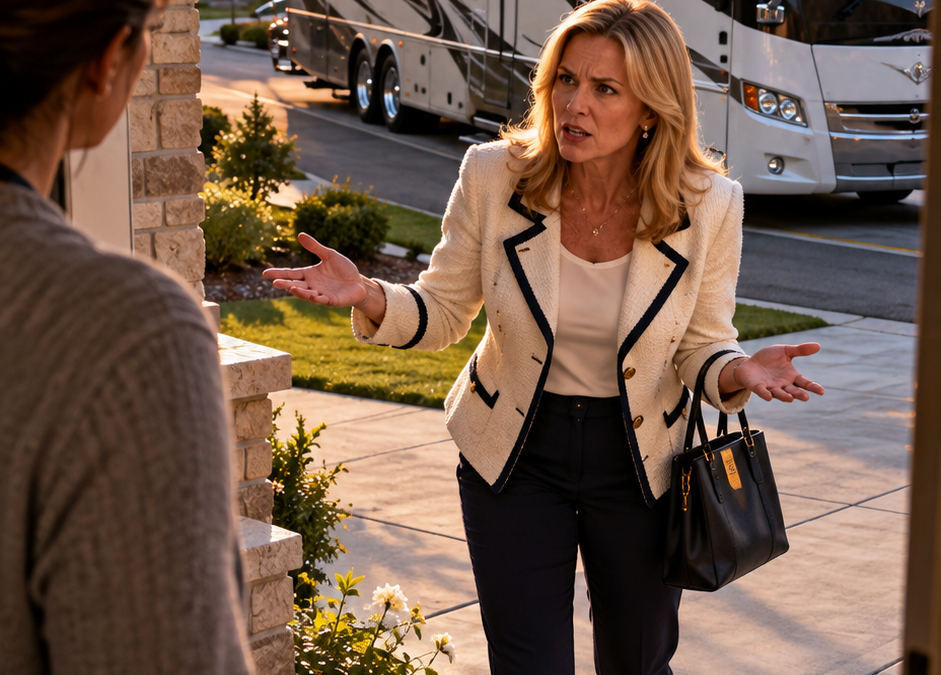
When I opened the door, Karen Whitmore was standing on my porch with the strained smile she used whenever she wanted something but planned to phrase it like a favor to me.
Karen lived three houses down in Cedar Ridge Estates, the HOA neighborhood I had moved into four years earlier. She was one of those people who treated the community rules like scripture when they helped her and like suggestions when they did not. She chaired the “Neighborhood Harmony Committee,” which was a ridiculous name for a group that mostly sent emails about trash cans, mailbox colors, and whether somebody’s patio lights looked too “commercial.”
Behind her, parked at the curb, was an RV so large it looked like it had lost a fight with a tour bus and won.
It was white with black trim, tall enough to block half the sunset, and long enough that its rear end sat dangerously close to my neighbor’s mailbox. Even from my doorway, I could hear it idling with a low diesel rumble that made the windows hum.
Karen clasped her hands in front of her.
“Hi,” she said brightly. “I need to ask a small favor.”
I looked past her at the RV.
Small was already out of the question.
“What’s going on?” I asked.
She turned and glanced at the vehicle as if she had forgotten it was there. “My sister and her husband came in early for the weekend, and they brought the RV. The HOA doesn’t allow RV parking on the street overnight.”
“I know.”
“So I need to park it in your driveway.”
I waited for the rest of the sentence.
There wasn’t one.
She said it like she was informing me of a delivery window.
“My driveway?” I asked.
“Yes. Yours is wide enough, and you don’t park on the right side.”
That was true. My driveway had been built by the previous owner, who had owned a small boat. It was wider than most in the neighborhood and curved gently beside the garage before reaching the side gate. I used the left side for my truck. The right side stayed open because I liked being able to back out without turning a normal morning into geometry.
But open space on private property is not an invitation.
“I’m sorry,” I said. “That won’t work.”
Karen blinked. “Why not?”
“Because my driveway isn’t available.”
Her smile stayed in place, but the warmth dropped out of it.
“I only need it for a few nights.”
“I understand, but the answer is no.”
She laughed once, as if I had made a joke in poor taste. “You don’t even use that part.”
“I still own it.”
Her eyes narrowed. “We’re neighbors. Neighbors are supposed to help each other.”
“I do help my neighbors,” I said. “But letting someone park a thirty-foot RV beside my house is not something I’m comfortable with.”
“It’s thirty-six feet,” she said automatically.
That did not help her argument.
I folded one hand around the edge of the door. “Then I’m even less comfortable.”
Karen’s face changed then. The polite mask slipped just enough to show the resentment underneath.
“You know,” she said, “this community works best when people cooperate.”
“This isn’t community cooperation. This is you asking to use my private property.”
“I am asking for a reasonable accommodation.”
“For your RV.”
“For my family.”
I looked at the vehicle again. The driver’s window was down, and a man I assumed was Karen’s brother-in-law sat inside, staring straight ahead like he wanted no part of this. I couldn’t blame him.
“Karen,” I said carefully, “I’m not trying to be difficult. I’m telling you no.”
Her lips pressed into a thin line.
“This is extremely disappointing.”
“I’m sorry you feel that way.”
She stepped back from the door. “This isn’t over.”
I almost asked what that meant, but I already knew.
With Karen, every disagreement became a campaign.
She marched down my walkway, climbed into the passenger seat of the RV, and slammed the door hard enough that I heard the sound from inside my house after I closed my own.
I stood in the entryway for a moment, listening to the RV engine rumble away from the curb.
Then I locked the door.
At the time, I thought that would be the end of it.
That was my first mistake.
The next morning, I opened my email while drinking coffee and found a message from the HOA.
Subject line: Community Cooperation Concern.
I stared at it for a few seconds before opening it because even the phrase irritated me.
The email was from Douglas Brant, the HOA board president. It said the board had received a complaint regarding my “failure to engage in neighborly accommodation during a temporary parking hardship.” It reminded me that Cedar Ridge Estates encouraged residents to “maintain a spirit of cooperation and goodwill” and asked me to “reconsider any unnecessary refusal that might create community tension.”
I read the email twice.
Then I leaned back in my chair and laughed, but there was no humor in it.
Karen had taken less than twelve hours to turn a denied driveway request into an HOA issue.
I typed a response slowly because I knew exactly how people like Douglas worked. They fed on emotional replies. They loved turning irritation into evidence.
I wrote:
Douglas, my driveway is private property. I did not authorize Karen Whitmore or her family to park an RV on it. I do not consent to any use of my driveway by her vehicle, her guests, or any third party. Please confirm the HOA is not claiming authority to compel use of privately owned driveways for RV storage.
Then I sent it.
Twenty minutes later, my phone buzzed.
Karen.
I let it go unanswered.
A text came through immediately after.
You embarrassed me in front of my family.
I saved it.
Another followed.
All I asked for was basic decency.
I saved that too.
By ten in the morning, there were four messages.
By noon, there were seven.
Some were angry. Some were dramatic. Some were weirdly formal, like she was trying to create a record that made her sound calm.
Your refusal is unreasonable.
The RV would not interfere with your home.
The HOA can get involved if you force the issue.
You should think carefully before creating problems for yourself.
That last one made me pause.
Not because I was scared.
Because I recognized the shape of a threat when someone tried to dress it up as advice.
I screenshotted everything, saved the email chain into a folder, and backed the files up to cloud storage. I also downloaded the footage from my front porch camera showing Karen’s visit the night before.
Something in my gut told me I would need it later.
By the afternoon, Douglas finally responded to my email. His tone had changed slightly.
He claimed the HOA was not “formally compelling” me to allow driveway use, but he encouraged me to “resolve the matter amicably” because “extended neighbor disputes can affect community harmony.”
Community harmony.
That phrase again.
In Cedar Ridge, “community harmony” usually meant one person wanted something and expected everyone else to stop having rights until they got it.
I replied with one sentence:
There is nothing to resolve; I do not consent to any RV parking on my property.
Then I went back to work.
For the next two days, Karen escalated in the way entitled people do when they realize force is the only tool they trust.
She sent more texts.
She left a voicemail saying she was “deeply hurt” by my selfishness.
She emailed the HOA again and copied me this time, accusing me of creating “a hostile environment.”
She even stopped me near the mailboxes and said loudly enough for two neighbors to hear, “Some people don’t belong in communities if they can’t act like neighbors.”
I looked at her and said, “Some people confuse neighbors with storage facilities.”
One of the neighbors coughed into his hand to hide a laugh.
Karen went red.
After that, the messages stopped for one whole day.
I should have found that suspicious.
Instead, I enjoyed the peace.
On Friday afternoon, I was in my office reviewing a contract when a deep engine sound vibrated through the front wall of my house.
At first, I thought it was a delivery truck.
Then the sound got louder.
Slower.
Closer.
I stood and walked to the window.
The RV was back.
It rolled down the street like a ship that had drifted into the wrong harbor, enormous and gleaming, with Karen sitting behind the wheel this time. She pulled past my mailbox, braked hard, then angled the RV across the entrance to my driveway.
Not in the driveway.
Across it.
Blocking it completely.
I stood there for a second, watching through the blinds, feeling that quiet click inside me when surprise becomes certainty.
She had decided to make the problem physical.
I grabbed my phone, opened the camera app, and started recording before I walked outside.
My porch camera was already active. So was the driveway camera mounted over the garage. After a package theft two years earlier, I had installed a full system with audio. At the time, my friends had teased me for being paranoid.
That day, paranoia looked like preparation.
Karen rolled down the driver’s window before I reached the sidewalk.
“You need to move,” I said.
She looked down at me from the high cab. “No. You need to stop being ridiculous.”
“You are blocking my driveway.”
“I’m not parked on your driveway.”
“You’re blocking access to it.”
She shrugged. “Temporarily.”
“Move the RV.”
“I told you we needed somewhere to put it.”
“And I told you my property was not available.”
Her mouth twisted. “The HOA is tired of your attitude.”
“The HOA does not own my driveway.”
“You keep saying that like it matters.”
I stared at her.
That sentence stayed with me.
You keep saying that like it matters.
There it was. The whole truth of Karen in seven words.
Private property mattered when it belonged to her. Rules mattered when she could weaponize them. Boundaries mattered when she drew them. But my rights were inconvenient, so she treated them like opinions.
I held up my phone. “I’m recording this.”
“Good,” she snapped. “Record how unreasonable you’re being.”
“You need to move the RV now.”
“I’m going to park it where I should have parked it two days ago.”
“No, you’re not.”
“You can’t stop me.”
“I can call the police.”
That made her laugh. “Go ahead. I’ll tell them you created the situation.”
“How?”
“By refusing to cooperate.”
I lowered my voice. “Karen, listen carefully. You do not have permission to enter my driveway. You do not have permission to park on my property. If you drive that RV onto my property, you are trespassing.”
She pointed toward my house through the windshield. “The HOA can make your life miserable.”
“Do whatever you think you need to do.”
For a moment, neither of us moved.
I could hear the RV engine rumbling, the low hiss of its brakes, a dog barking somewhere down the street. Curtains shifted in the house across from mine. Someone was watching.
Karen’s jaw clenched.
Then she suddenly threw the RV into gear.
The engine growled.
I stepped back instinctively, thinking she was finally going to pull away.
Instead, the front wheels turned toward my driveway.
At first, my brain refused to accept what my eyes were seeing.
She was not leaving.
She was turning in.
The RV lurched forward, too sharply, too fast for a vehicle that size in such a tight space. Its front bumper cleared the curb but missed the driveway angle. The right side swung wide. The rear end clipped the stone mailbox post with a grinding crack, but Karen didn’t stop.
“Karen!” I shouted.
She kept going.
The RV climbed onto the driveway, tilted slightly, then jerked as she overcorrected. The engine roared again. The entire side of the vehicle shuddered.
Then it went straight toward my porch.
Everything after that happened too fast and too slowly at the same time.
The massive white front of the RV filled my vision.
The passenger-side mirror snapped against one of the porch posts.
The front corner hit the brick column with a sound like thunder.
Then the whole house seemed to explode.
Wood splintered. Brick shattered. Glass cracked somewhere above me. A section of porch railing burst outward. Dust and insulation filled the air. The impact shook the ground under my feet and punched a deep, sickening vibration through my chest.
For a second, I could not move.
I just stood there with my phone in my hand, staring at the RV embedded in the corner of my house.
My porch was crushed.
The front column was gone.
Part of the exterior wall had folded inward.
Pieces of brick lay scattered across the flower bed like broken teeth.
A window hung crooked from its frame.
I remember hearing a smoke alarm start chirping inside.
I remember smelling hot rubber and dust.
I remember thinking, absurdly, that my dinner table sat on the other side of that wall.
Karen climbed out of the RV.
Not stumbling.
Not crying.
Not apologizing.
She climbed down from the driver’s seat, looked at the damage, then looked at me with pure fury.
“Look what you made me do,” she said.
That sentence snapped me back into my body.
“What I made you do?”
“You were standing there distracting me!”
“You drove into my house.”
“You blocked me!”
“I was standing on my own lawn.”
She lifted her phone.
For one impossible second, I thought she was calling an ambulance or her insurance company.
Instead, she called the police.
Her voice changed the moment the dispatcher answered.
“Yes, I need officers here immediately,” she said, breathless now, performing panic. “My neighbor caused an accident. He was harassing me while I was trying to park. He blocked me, and now there’s property damage.”
I stared at her in disbelief.
She had crashed into my house and then called the police on me.
A strange calm settled over me then.
Not peace.
Something colder.
I stopped arguing. I stopped reacting. I checked that the video on my phone was still recording, then stepped farther back and took slow footage of the RV, the driveway, the broken porch, and Karen still talking into her phone.
Neighbors had started coming outside. Mr. Alvarez from across the street stood in his driveway with both hands on top of his head. A woman from the corner house kept saying, “Oh my God,” over and over. Someone asked if I was hurt.
“I’m okay,” I said, though I wasn’t sure yet.
My hands were shaking.
But my voice worked.
The police arrived within minutes.
Two officers stepped out of the cruiser: a tall male officer named Daniels and a female officer named Reeves. Their expressions shifted as soon as they saw the RV half-buried in the front of my house.
Karen rushed toward them before they even reached the sidewalk.
“Thank God you’re here,” she said. “He caused this.”
Officer Reeves held up one hand. “Ma’am, slow down.”
Karen pointed at me. “He refused to let me park even though the HOA authorized temporary use. He came outside yelling, and he stood in the way. I had to maneuver around him, and he created an unsafe situation.”
Officer Daniels looked past her at the RV.
Then at me.
Then at the corner of my house.
He did not look impressed with her version.
“Sir,” he said to me, “are you injured?”
“I don’t think so.”
“Anyone inside?”
“No. I was home alone, but I was outside when she drove into it.”
Karen spun around. “That is not what happened.”
I looked at the officers. “I have cameras.”
Karen stopped talking.
It was subtle, but everyone saw it.
Officer Reeves looked at me. “Cameras?”
“Front porch, driveway, and I recorded part of the conversation on my phone.”
Karen recovered quickly. “He edits things. He’s been planning this.”
Officer Daniels turned to her slowly. “Planning for you to drive an RV into his house?”
Her mouth opened, then closed.
I almost laughed, but the damage behind her kept that from happening.
The officers separated us. Officer Reeves took Karen near the curb. Officer Daniels came to me.
I showed him my phone first.
The recording captured Karen blocking the driveway, refusing to move, threatening that the HOA could make my life miserable, and then turning the RV toward my property after I clearly told her she did not have permission.
Officer Daniels watched without interrupting.
When the crash happened on the screen, his jaw tightened.
“Do you have the fixed-camera footage too?” he asked.
“Yes.”
I took him inside through the back door because the front entrance was unsafe. The impact had cracked drywall in the hallway and knocked a framed photo off the wall. Dust hung in the air. A section of trim near the front room had split. I could hear the house making small settling sounds that made my stomach turn.
My computer was still awake in my office.
I pulled up the security system and found the driveway camera first.
There it was in high definition.
The RV blocking the driveway.
Karen arguing through the window.
Me standing on the lawn with my phone.
The clear angle showing there was no obstruction in front of her vehicle except the normal geometry of my driveway and the fact that she was trying to force a thirty-six-foot RV where it did not belong.
Then the turn.
The acceleration.
The impact.
Officer Daniels watched the entire clip once.
Then he asked me to play it again.
He called Officer Reeves inside before the second viewing.
She stood beside him in silence as the footage played.
When the RV hit the house, she whispered, “Jesus.”
Neither officer said anything for several seconds after the video ended.
Then Officer Reeves looked at me. “Can you export that?”
“Yes.”
“Please do.”
We returned outside.
Karen was pacing near the curb, speaking angrily into her phone. I heard her say “HOA authorization” twice before she saw the officers coming and ended the call.
Officer Reeves approached her.
“Mrs. Whitmore,” she said, “why did you drive toward the house?”
Karen straightened. “I didn’t drive toward the house. I was attempting to park.”
“The video shows you were told not to enter the driveway.”
“He was being unreasonable.”
“That does not answer my question.”
Karen’s eyes darted toward me. “He startled me.”
“You were already turning before he moved.”
“I panicked.”
“Earlier you said he blocked you.”
“He did.”
“The footage does not show that.”
Karen’s face flushed darker. “You’re taking his side.”
Officer Daniels said, “We are documenting what the evidence shows.”
That sentence changed the entire scene.
The officers began photographing everything: the RV position, tire tracks, broken masonry, porch supports, damaged windows, the driveway angle, the mailbox post, and the debris field. Officer Reeves took statements from neighbors who had witnessed the RV return and heard parts of the argument. Mr. Alvarez told her he had seen Karen turn into the driveway after I told her not to. The woman from the corner said she heard me yell for Karen to stop before the impact.
Karen kept insisting the HOA had approved temporary parking.
Officer Daniels finally said, “Ma’am, HOA permission does not give you legal authority to enter someone else’s private property.”
“But they said—”
“Even if they said it, they cannot override property law.”
Karen looked like the concept had personally betrayed her.
A building inspector arrived later that evening, called by the fire department after the police requested a safety check. He examined the porch and front wall, then told me I could not use the front entrance until it was stabilized. The impact had damaged part of the exterior framing, crushed electrical conduit near the front room, and shifted a window header. It was worse than it looked, and it looked terrible.
My insurance company opened a claim that night.
I barely slept.
Every time the house creaked, I woke up thinking the front wall was moving.
The next morning, I walked around the damage in daylight.
It was somehow worse.
The porch roof sagged where the support column had been destroyed. Brick veneer had peeled away from the corner. The front window was spiderwebbed. The flower bed was buried under splinters, insulation, glass, and pieces of RV plastic. One of the porch steps had cracked clean in half.
My house looked like it had been attacked by someone who wanted to prove a point and had missed only because the wall stopped her.
At nine, I called a property attorney named Marissa Cole. I had used her once before for a contract issue, and I remembered her as calm, precise, and allergic to nonsense.
By noon, I was sitting in her office with printed copies of every HOA email, every text from Karen, photographs of the damage, the police report number, and a flash drive containing all camera footage.
Marissa reviewed the timeline without much expression.
That was one thing I liked about her. She did not gasp or perform outrage. She looked for leverage.
When she reached Karen’s text saying You should think carefully before creating problems for yourself, Marissa tapped the paper with one finger.
“This helps,” she said.
“So does the video?”
“The video does more than help.”
She watched the footage on her laptop, first from my phone, then from the driveway camera, then from the porch camera that caught the impact from a second angle.
When the RV hit the house, she paused the video and sat back.
“She created a very large problem for herself,” Marissa said.
“How large?”
“That depends on the final damage assessment, the police classification, insurance subrogation, and whether the HOA had any role beyond emails and pressure.”
I told her Karen kept claiming HOA authorization.
Marissa’s expression sharpened.
“Do you have anything from the HOA saying she could use your driveway?”
“Not directly. They pressured me to reconsider.”
“Good. Send me the entire chain.”
“I already did.”
She nodded once. “Then we will preserve evidence, notify her insurer, notify your insurer, send a demand letter, and put the HOA on notice not to destroy communications regarding this incident.”
“Can the HOA be responsible?”
“Maybe. Maybe not. But if they encouraged her, authorized her, or helped create the false belief that she could use your property, they need to be very careful from this point forward.”
That was the first time since the crash that I felt something other than anger.
I felt steadier.
Not safe exactly.
But no longer alone inside the mess Karen had made.
The HOA scheduled an emergency board meeting four days later.
I received notice through Marissa, not directly from them. That mattered. The tone changed as soon as an attorney was involved. Gone were the phrases about harmony and cooperation. Suddenly, everyone discovered words like “alleged,” “pending review,” and “without admission.”
Marissa advised me to attend but not speak unless necessary.
“Let the evidence do the talking,” she said.
The meeting was held in the clubhouse at seven in the evening.
The same clubhouse where Karen had once hosted a seminar on “neighborly communication.”
I arrived with Marissa at my side and a folder in my hands. Karen was already there, seated near the front with her husband beside her. She refused to look at me.
Douglas Brant sat at the head table with the other board members. He looked older than he had in his email photo, or maybe just less confident. Harlan, the HOA’s attorney, sat beside him with a legal pad and the weary posture of a man who had spent the afternoon learning bad facts.
The room was full.
Neighbors whispered in rows of folding chairs. Some looked curious. Some looked uncomfortable. A few looked at me with sympathy. Others avoided my eyes, probably because they had repeated Karen’s version too quickly and were now unsure how much of it was still safe to believe.
Douglas cleared his throat.
“We are here,” he began, “to discuss the incident that occurred on Maple Hollow Drive involving property damage and an RV.”
Marissa leaned toward me and murmured, “Incident. Nice.”
I kept my face still.
Douglas continued. “There has been misinformation circulating, and the board wants to proceed responsibly.”
That was rich, considering they had helped circulate the first version.
Karen suddenly stood.
“I want to say something.”
Harlan turned toward her quickly. “Karen, I would advise—”
“I have a right to defend myself,” she snapped.
The room went quiet.
Karen faced the board but spoke loudly enough for everyone.
“I was put in an impossible situation. I asked for help. I was denied basic neighborly courtesy. I was trying to resolve a parking issue that the HOA should have managed, and he escalated everything.”
She pointed at me without looking directly at my face.
My pulse kicked once, hard.
Marissa placed one hand lightly on the folder in front of me. A silent reminder.
Wait.
Karen kept going.
“He came outside aggressively. He recorded me without permission. He distracted me while I was attempting to park, and the accident happened because he created a hostile environment.”
A few people shifted in their seats.
Douglas looked at Harlan.
Harlan looked like he wanted the floor to open.
Marissa stood.
Her voice was calm.
“My client has provided the board with the complete security footage from multiple angles, the police report reference, the written communications preceding the crash, and preservation notice regarding all HOA communications. Before this meeting continues with unsupported accusations, I suggest the board review the recording.”
Karen turned pale.
Douglas hesitated. “We don’t necessarily need to—”
Harlan interrupted him. “Play the video.”
Four words.
No warmth.
No debate.
The clubhouse had a wall-mounted screen used for community presentations. A board member connected a laptop. The video began with the driveway camera angle.
There was Karen’s RV, blocking my driveway.
There was my voice telling her she could not use my property.
There was Karen threatening that the HOA could make my life miserable.
Someone in the room muttered, “Oh no.”
The video continued.
Karen put the RV in gear.
Turned toward the driveway.
Ignored my warning.
Clipped the mailbox post.
Overcorrected.
Drove straight into the house.
The sound of the crash filled the clubhouse speakers.
No one moved.
Then the video switched to the porch camera.
Different angle.
Same truth.
Then my phone recording played, capturing Karen saying, “You keep saying that like it matters,” when I told her it was private property.
That sentence did more damage in the room than any argument I could have made.
When the video ended, the silence was absolute.
Karen sank back into her chair.
Douglas rubbed both hands over his face.
One board member whispered, “She said he blocked her.”
Marissa said nothing.
She did not have to.
The evidence had entered the room and taken every chair.
Harlan finally spoke.
“The association does not condone unauthorized entry onto private property,” he said. “Nor does it authorize any resident to park on another owner’s driveway without express permission.”
That was the HOA distancing itself from Karen in real time.
Karen turned toward him. “But Douglas told me we could pressure him.”
Douglas’s head snapped up. “I did not tell you to drive into his house.”
“I was trying to park!”
“You were told no,” someone in the back said.
Karen spun around. “Stay out of it.”
That only made things worse.
For the next twenty minutes, the board moved through damage control with visible panic. They voted to suspend Karen from committee duties pending investigation. They agreed to provide Marissa with requested communications. They announced that residents had no authority to use another owner’s driveway, yard, or access without written consent. They also confirmed that all prior HOA messages about “neighborly accommodation” were not enforcement directives.
Translation: please do not sue us for what we strongly implied two days before the crash.
After the meeting, Karen approached me in the parking lot.
Her husband tried to stop her, but she pulled away.
“You ruined my reputation,” she said.
I stared at her.
Behind her, Marissa stopped walking.
“No,” I said. “You drove an RV into my house.”
Karen’s eyes filled with angry tears. “You could have just let me park there.”
“And you could have accepted no.”
She looked at me like she still could not understand how the story had turned against her.
That was what struck me most.
Even after the police.
Even after the video.
Even after the meeting.
Some part of Karen still believed my refusal was the original sin and everything after it was merely consequence.
Marissa stepped forward. “Mrs. Whitmore, do not contact my client directly again.”
Karen looked at her, then at me.
For once, she walked away without another word.
The repairs took weeks.
The estimate was enormous.
My porch had to be partially demolished and rebuilt. The exterior wall required structural repair. Wiring had to be replaced. The window and frame were removed. Masonry had to be matched and reset. The flower bed was scraped out and rebuilt after they removed debris from the soil.
Insurance became its own exhausting language.
Adjusters came and went. Contractors measured. Engineers inspected. Karen’s insurance company tried to ask whether I had contributed to the accident by “refusing reasonable temporary accommodation.” Marissa sent them the footage and a letter that was polite enough to be admissible and sharp enough to draw blood.
They stopped asking that question.
The police investigation moved separately. I was not told every detail, but I knew Karen received citations related to property damage and unsafe operation. Whether the prosecutor pursued anything beyond that was not under my control. What mattered to me was the civil side: repairing my house, recovering damages, and making sure Karen could not rewrite the record.
The legal demand went out three weeks after the crash.
It included repair costs, temporary safety measures, inspection fees, landscaping damage, legal fees, and other documented losses. By then, the total had climbed far higher than I expected when I first saw the broken porch. Damage spreads through a house in quiet ways. A cracked wall becomes electrical inspection. Electrical inspection becomes code upgrades. A smashed column becomes roof support analysis. A destroyed porch becomes permits, delays, and specialized labor.
Karen had not just hit wood and brick.
She had hit systems.
She had hit time.
She had hit the sense of safety I used to feel when I turned into my own driveway.
For weeks, I parked on the street because the repair crew needed access. Every morning, I walked past orange cones and stacked lumber where my front porch used to be. Every evening, I came home to dust, tarps, and the smell of sawed wood.
Neighbors stopped by with food, apologies, and gossip.
Mr. Alvarez brought tamales and told me he had given a written witness statement.
The woman from the corner, whose name I finally learned was Denise, brought banana bread and admitted Karen had told several people I had “lunged at the RV.”
“I should have known better,” Denise said, looking ashamed. “Karen always makes herself the victim.”
I appreciated the apology more than the bread, though the bread was excellent.
Douglas sent one formal email through the HOA attorney expressing regret for the “unfortunate circumstances.” Marissa advised me not to respond.
Karen herself stayed quiet.
At first, anyway.
Then one night, about a month after the crash, I found an envelope tucked under my front door.
No stamp.
No return address.
Inside was a handwritten note from Karen.
It was not an apology.
It was three pages of justification.
She wrote that she had been under stress. That her sister’s visit had been important. That the HOA rules created pressure. That I had been cold and inflexible. That she never meant for things to happen “the way they did.” She said the community had turned against her and that I should understand how humiliating that felt.
The only sentence that came close to responsibility was:
I regret that your house was damaged during the misunderstanding.
I read that line three times.
During the misunderstanding.
As if my house had simply misunderstood the RV.
I scanned the letter and sent it to Marissa.
Her reply came ten minutes later.
Do not respond. Preserve the original.
So I did.
The settlement process took longer than I wanted and less time than Karen probably hoped. The video made denial expensive. Witnesses supported my account. The HOA’s own emergency meeting minutes confirmed they had disavowed her authority. Her insurer eventually agreed to cover the main property damage, and Karen remained personally exposed for portions not covered.
I did not celebrate that.
I know some people expect a dramatic satisfaction from watching someone face consequences. Maybe I would have felt that if the damage had been smaller, if the violation had been merely irritating instead of violent.
But standing in front of your own broken home changes the flavor of justice.
It becomes less about victory and more about restoration.
I wanted the wall fixed.
I wanted the porch safe.
I wanted my property record clean.
I wanted Karen’s lie buried under so much evidence it could never climb back out.
That was enough.
The repairs finished in early summer.
The new porch looked better than the old one, though I hated admitting that at first. The contractor matched the brick so closely most people could not tell where the damage had been. The new columns were stronger. The railing was cleaner. I replaced the broken window with a larger one that let more light into the front room. I replanted the flower bed with lavender, boxwood, and white salvia because I wanted something calm there.
The first evening after the crew left for good, I sat on the rebuilt porch with a cup of coffee and watched the sun drop behind the roofs across the street.
For the first time in weeks, there were no cones.
No caution tape.
No plywood sheets.
No workers calling measurements to each other.
Just my driveway.
My porch.
My house.
Whole again.
Mr. Alvarez walked by and lifted a hand. “Looks good.”
“Thanks.”
“Better than before.”
I looked at the clean railing, the fresh brick, the new steps.
“Yeah,” I said. “It does.”
He paused at the edge of my yard. “You doing okay?”
I thought about giving the automatic answer.
Fine.
All good.
Moving on.
But I had spent too much time pretending the crash was only property damage.
“It still bothers me,” I admitted.
He nodded. “It would bother anyone.”
“She really thought she had the right.”
“That’s what scared me most,” he said.
I looked at him.
He glanced down the street toward Karen’s house. “Accidents happen. Bad driving happens. But that wasn’t just bad driving. She believed your no didn’t count.”
I sat with that after he left.
Because he was right.
The crash had been loud and destructive, but the real danger had arrived earlier, quietly, inside Karen’s assumption that my boundary was negotiable because she wanted it to be.
The RV only made that assumption visible.
A few weeks later, the HOA amended its community guidance. The new policy stated clearly that no resident, guest, board member, or committee representative could pressure another homeowner to provide parking, storage, access, utility use, or any private property accommodation without written consent. It also stated that HOA courtesy expectations did not override property ownership.
I printed the policy and put it in my folder with everything else.
Not because I trusted them.
Because I had learned the value of records.
Karen put her house up for sale before the end of the year.
The listing photos were beautiful.
Bright kitchen. Updated floors. Spacious backyard. Quiet community.
No mention of the RV.
No mention of the emergency board meeting.
No mention of the fact that half the neighborhood still slowed down when passing my house because they remembered the day her entitlement hit brick.
I saw her once before she moved.
I was bringing my trash bins back from the curb. She was standing beside a moving truck, arms crossed, watching two men carry boxes from her garage. For a moment, we were the only two people on the street.
She looked at my repaired porch.
Then at me.
I expected anger. Maybe another accusation. Maybe one last attempt to make herself the injured party.
Instead, she looked tired.
“You really saved every message,” she said.
It wasn’t a question.
“Yes.”
“And the cameras.”
“Yes.”
She gave a small, bitter laugh. “Of course you did.”
I held the handle of the trash bin and said nothing.
She looked away first.
A week later, she was gone.
The neighborhood grew quieter after that. Not perfect. HOAs never become perfect. There were still emails about mulch color and mailbox paint. Douglas still used too many words to say very little. Someone still complained when kids left bikes near the clubhouse.
But something had shifted.
People became more careful with the phrase “community.” They stopped using it quite so easily as a weapon. The board became less eager to send pressure emails over private disputes. And when someone asked to borrow space, equipment, or access, they asked like a person requesting a favor instead of a committee issuing a verdict.
As for me, I kept the cameras.
I kept the folder.
I kept the repaired porch clean and the lavender trimmed.
And every time I pulled into my driveway, I felt the same quiet certainty I had tried to explain to Karen from the beginning.
A driveway is not just empty pavement.
It is part of a home.
It is where you come back after long days. Where your groceries come in. Where your friends park when they visit. Where your kids learn to ride bikes, where your dog waits by the gate, where rainwater runs in familiar lines after a storm. It is ordinary, yes, but ordinary does not mean public.
Karen never understood that.
She thought refusing her RV was an insult.
Then she thought blocking my driveway was leverage.
Then she thought driving onto my property would force the answer she wanted.
And when all of that failed, she thought calling the police first would turn her into the victim.
But the cameras saw what she forgot.
Evidence does not care who sounds more offended.
Evidence does not care who chairs a committee.
Evidence does not care how loudly someone says they had permission when every frame shows they did not.
In the end, Karen did more than crash into my house.
She crashed into the one thing she could not intimidate, pressure, charm, or rewrite.
The truth.
And the truth was simple.
I told her no.
She drove forward anyway.
Everything after that was damage she made herself.








