𝗙𝗨𝗟𝗟 𝗦𝗧𝗢𝗥𝗬 Karen Smiled at My Warning Like the Quarry Was Just Another Empty Lot
𝗙𝗨𝗟𝗟 𝗦𝗧𝗢𝗥𝗬
She laughed like I had made a dry joke.
I had not.
The real conflict started in late spring, a few weeks before Briar Ridge’s annual Founders’ Gala.
If you’ve never lived near a wealthy HOA, let me tell you something useful: they can turn any gathering into an event of almost military scale. The Founders’ Gala wasn’t just a party. It was apparently an institution. Catered food. Valet drop-off. White tents. Decorative lighting. Live music. Sponsors. Formal invitations. A silent auction. A champagne wall. Enough posturing to power a small city.
For reasons still unclear to me, that year Karen decided the existing event parking wasn’t good enough.
The clubhouse lot held maybe seventy cars if people parked responsibly. There was overflow access near the pool lot and along the inner boulevard if traffic volunteers coordinated it correctly. They had made it work before. Inconveniently, perhaps, but safely.
Karen didn’t want inconvenient.
Karen wanted hundreds of spaces.
She arrived at my quarry office on a Thursday afternoon with two board members trailing behind her and a rolled site plan tucked under her arm. I had just finished reviewing a blasting sequence with my foreman, Luis Ortega, when my receptionist buzzed me.
“She’s here again,” she said in a tone that told me she did not need to specify who “she” was.
I stepped outside to meet them in the yard.
Karen wore cream slacks and a blue blouse that somehow looked ironed by magic. The two board members behind her—one nervous man in a golf shirt and a woman in oversized sunglasses—looked less certain than she did.
“Mr. Mercer,” Karen said warmly, as if we were meeting for lunch instead of another attempted land grab. “I’m so glad I caught you.”
“That depends on why you’re here.”
She ignored the tone and unrolled the site plan across the hood of my truck.
“We’re finalizing logistics for the Founders’ Gala,” she said. “Attendance is expected to be much higher this year. We need additional parking, and your east quarry shelf is the ideal solution.”
For a second, I thought I had heard her wrong.
“My what?”
She pointed directly at the restricted upper bench inside the safety perimeter, a wide gravel shelf adjacent to one of the controlled blast areas. “This section. It’s level enough, close enough, and currently unused for anything visible. We only need it for one evening.”
I looked from the paper to her face.
“You want to park HOA guest vehicles inside my restricted quarry zone?”
She gave a light laugh. “When you say it that way, it sounds dramatic.”
“It sounds accurate.”
Her smile held. “We already made arrangements for traffic flow.”
That sentence landed harder than anything else she said, because it meant she had moved beyond asking and into planning.
I straightened the site plan and tapped the exact zone she was indicating.
“This area is part of an active operation,” I said. “It is privately owned, marked restricted, and not available for event use. There are barriers on every approach for a reason.”
Karen glanced toward the ridge as if the barriers were a minor aesthetic flaw.
“It’s just sitting there,” she said.
“It’s not sitting there. It’s part of the quarry.”
“For one night.”
“No.”
The nervous man behind her cleared his throat. “Karen, maybe we should—”
She cut him off with a glance, then turned back to me.
“Our community has supported local businesses generously,” she said. “I’m sure you don’t want to be remembered as the person who sabotaged the neighborhood’s signature event over a temporary parking issue.”
That was how she did things. She took a no, dressed it up as selfishness, then offered you the chance to fix her version of your character.
I pointed past her shoulder toward the far edge of the eastern shelf. Bright red markers lined the route. Steel barriers blocked vehicle entry. Warning signs were posted every few yards.
“You see those?” I asked.
“Yes.”
“That means keep out.”
“Surely there’s some flexibility.”
“No.”
Her expression cooled.
I opened the property map hanging on the inside wall of the yard office and brought it outside. Then I laid it across the truck hood beside her event plan.
“This line is my property boundary,” I said. “This zone is restricted. This access road is quarry only. You cannot park there. You cannot direct anyone there. You cannot treat it like overflow space.”
She glanced at the map, then back at me.
“We already made arrangements,” she repeated.
I leaned in slightly so there would be no room for confusion.
“Then unmake them.”
The woman in sunglasses shifted uncomfortably. The golf-shirt board member looked like he wanted to disappear.
Karen rolled up her plan with deliberate calm.
“I think you’re being unnecessarily rigid, Mr. Mercer.”
“And I think you need to keep every vehicle out of that area.”
For the first time, the friendliness dropped completely from her face.
“You know,” she said, “land that’s basically unused invites practical solutions.”
“Private property isn’t available just because you want it.”
She turned and walked back to her SUV without another word.
Luis, who had watched the whole exchange from the shop door, came over after they left.
“She’s going to do something stupid,” he said.
“I know.”
“You want me to add more barriers?”
“Yes. And call the gate crew. I want the east access checked again.”
We reinforced what was already there, not because the existing barriers were unclear, but because I had spent enough years dealing with entitled people to know clarity only helps the ones who want to understand.
The next morning, I saw the first car from the upper ridge.
I was driving in just after sunrise when something metallic flashed against the gravel shelf in the restricted zone. Then another glint. Then another.
I stopped the truck, got out, and climbed the overlook path.
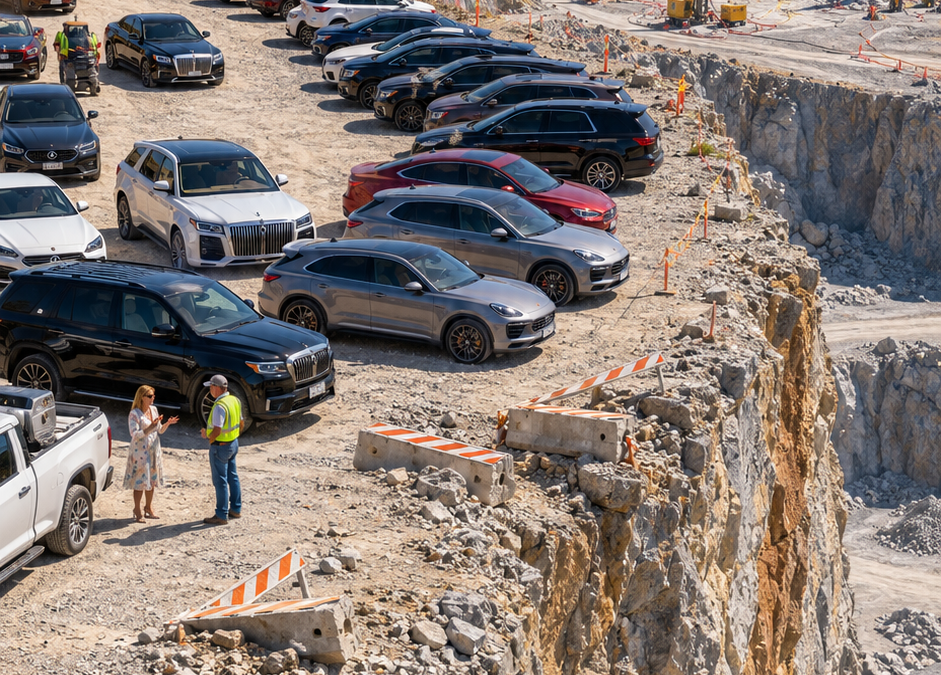
Luxury SUVs. Sedans. Two imported sport coupes. A black Range Rover. A silver Mercedes. A white Escalade. A line of vehicles packed into the restricted shelf as if it were a hotel overflow lot.
For several seconds, I just stared.
It wasn’t confusion that hit me first.
It was disbelief at the scale of the arrogance.
She had done it.
After every warning, after the map, after the barriers, after the direct no, Karen had gone ahead and used my quarry as her private event parking lot.
I called Luis immediately.
“Get to the east shelf,” I said. “Now.”
Then I called my operations manager, Travis Boone, and told him to halt any non-essential movement near that zone until we assessed the situation.
The Founders’ Gala was scheduled to begin that evening, but clearly some early-arrival logistics had already started. Traffic attendants in Briar Ridge polos were waving cars toward the area through a gap that somebody had forced open near the eastern service entrance. Temporary cones stood where my warning markers had been shifted aside.
By the time I reached the shelf road, Karen was already there in a pale sunhat, giving instructions like she had always owned the place.
I walked straight toward her.
“What did I tell you yesterday?”
She turned, saw my face, and sighed theatrically. “Oh, not this again.”
“Move every vehicle out of here.”
She folded her arms. “You are being ridiculous.”
“You are inside a restricted quarry blast zone.”
“It’s daytime.”
“That has nothing to do with it.”
She gave a short, dismissive laugh. “You’re trying to ruin the event because you enjoy flexing control.”
Behind her, a volunteer in a name badge froze mid-step, clearly wishing he were anywhere else.
I kept my voice level. “Karen, listen carefully. These vehicles cannot remain here. This is private operational property. They need to be removed immediately.”
She shook her head like she was dealing with a difficult child.
“The guests have arrived. Vendors are in motion. We are not evacuating a parking area because you’ve decided to make a point.”
“That ‘parking area’ has a scheduled controlled blast.”
For the first time, she blinked.
Then she frowned. “Excuse me?”
“A controlled blast,” I repeated. “Scheduled long before your event. Permitted, documented, and part of today’s operation.”
She stared at me as if I were inventing it to scare her.
“That’s absurd.”
“No, Karen. What’s absurd is you using a restricted quarry shelf after I told you not to.”
“You can postpone it.”
I almost laughed, because only someone like Karen could say that with a straight face. As if you could pause industrial operations, contractor schedules, safety sequencing, crew timing, and permit windows because a luxury HOA wanted prettier parking.
“No,” I said. “I cannot.”
“You expect me to believe you’d blow up rock with people here?”
“I expect you to understand why people are not supposed to be here.”
Her face tightened. “You should have informed us.”
“I did better than that. I warned you to stay out.”
She looked around, suddenly aware that several volunteers and drivers were listening now.
“What time?” she asked.
“Nine-thirty.”
It was a little after eight.
For one brief moment, I thought good sense might finally reach her.
Then she said, “There’s still time for the event to proceed if you delay the blast.”
“No.”
“You can’t be serious.”
“I’m serious enough that I’m telling you again: move every vehicle out now.”
She stepped closer, lowering her voice.
“If you sabotage this event, the board will hold you responsible.”
I looked at her long enough to let the stupidity of that sentence sit between us.
Then I turned away and called Travis.
“Start the formal clearance protocol,” I said. “And document everything.”
From that point on, the morning stopped feeling like a neighborhood argument and turned back into what it had always been beneath Karen’s performance: a safety operation.
My crew moved exactly the way trained crews move when the stakes become real. We checked the perimeter. We re-established the access restrictions. We documented the forced entry point and the displaced barriers. We notified the county operations contact that unauthorized civilian vehicles had entered a restricted blast-adjacent shelf. We began the standard warning sequence with an added layer of written documentation.
Karen followed me for part of it, still insisting I was escalating unnecessarily.
“You’re being hostile,” she said as I reviewed the clearance checklist with Luis.
“No,” I replied. “I’m being responsible.”
“You could resolve this with one phone call.”
“I already did. Yesterday. When I told you no.”
By eight-thirty, the mood had shifted.
It had to.
Even the people who knew nothing about quarry operations could tell this was no longer a bluff. My crew wasn’t arguing. They were working. Warning horns were checked. Radios crackled. Safety officers moved between points. The casual posture disappeared from everyone except Karen, and even hers began to crack at the edges.
Some of the drivers started asking questions.
A man in loafers beside a Lexus said, “Wait, there’s really going to be a blast?”
A volunteer answered weakly, “I’m sure they’re just trying to pressure us.”
I walked over.
“No,” I said. “I’m trying to get your car out of a restricted zone before it becomes part of a damage report.”
That got his attention.
“What do you mean damage report?”
“It means you need to move your car.”
Word spread fast after that.
A few owners sprinted for their vehicles and backed out in a hurry, gravel spitting beneath their tires. Others couldn’t get through because Karen’s improvised parking pattern had blocked multiple lanes. People started talking over one another. One woman in heels accused an HOA volunteer of misleading guests. Two men argued over who had been told where to park. Somebody kept asking where the valet supervisor was, as if that title had any power in my quarry.
Karen stood near the barrier line, holding her phone so tightly I thought it might snap.
“This is unbelievable,” she muttered.
“No,” I said. “It’s exactly what I warned you about.”
She shot me a look full of anger and disbelief, but underneath it I finally saw the first trace of fear.
That fear grew when the final clearance warning went out.
There is a particular quiet that settles over an active site right before a controlled blast. Machines move away. Voices shorten. The air itself seems to brace. Everyone who belongs there understands the rhythm.
Karen did not belong there.
That was the moment it became visible on her face.
She looked out across the shelf toward the remaining vehicles—some abandoned because owners had been shuttled elsewhere, some boxed in by the chaos she created, some still sitting exactly where her “arrangements” had placed them. For the first time, she understood she was not in an HOA meeting, not in a rules debate, not in one of those boardroom performances where she could talk louder and confuse the issue until people gave up.
She was standing next to a real operation with real force behind it.
And force does not care about titles.
We had already cleared every person from the restricted zone. That mattered to me most. Vehicles can be replaced. People cannot.
Karen remained behind the secondary barrier with me, the county safety contact, and my crew leads. She was no longer talking much. Her voice, when it came, had lost its polish.
“Can’t you stop it?” she asked one last time.
I looked at her.
“I told you what this place was.”
At nine-thirty, the blast sequence initiated.
The warning sounded. The quarry wall held still for one suspended beat. Then the charges went.
The earth answered in a rolling concussion that tore through the valley like thunder under stone. The wall erupted into a violent bloom of dust, shattered rock, and force. A gray-brown cloud surged outward and upward, swallowing the shelf in a churning curtain. Loose debris cascaded across the zone. Fine particulate rolled over the ground in thick waves.
Karen gasped.
She didn’t scream. She just stared.
Every person behind the barrier stared.
There are moments when arrogance collapses so completely that words no longer rush in to protect it. This was one of them.
The dust hung heavy for what felt like forever.
No one said anything.
No one needed to.
When the cloud finally began to thin, shapes emerged where smooth rows of luxury vehicles had been less than a minute earlier. Bent metal. Half-buried frames. Crushed roofs. Glass gone. Stone and rubble piled across hoods, trunks, and windshields. What had looked like a polished overflow lot now looked like the aftermath of a disaster zone.
Karen turned toward me slowly.
The expression on her face was almost childlike in its refusal to accept consequence.
“You did this,” she said.
It took real effort not to let my anger take over.
“No,” I said. “You did.”
She opened her mouth, closed it, then looked back toward the buried cars.
Behind us, phones started ringing.
First hers. Then one of the board members’. Then two volunteers’. Then what felt like every device in the area at once.
Insurance carriers. Spouses. Board members. Guests asking where their vehicles were. Vendors asking whether the event was still happening. People demanding explanations before they even knew what questions to ask.
Karen answered one call, then another, each one making her face worse.
“Yes, there was an incident,” she said sharply.
No, no one was injured.
No, the blast was not unexpected.
Yes, the vehicles were in the zone.
No, I did not authorize—
She stopped speaking right there because she had almost said the one sentence that would destroy her faster than anything else: I did not authorize it.
But she had authorized it.
And soon enough, everyone would know.
By noon, the rest of the HOA board had arrived.
They did not come calmly. They came in pieces—fast-driving SUVs, frantic phone calls, expensive shoes crunching over quarry gravel, expressions ranging from outrage to panic. They expected, I think, to find a misunderstanding they could turn into a negotiation.
Instead, they found recovery protocol, county documentation, photographs, security logs, and a very visible field of ruined vehicles sitting squarely inside my restricted property.
One board member, a man named Philip Dawson, strode toward me with the false confidence of someone who had not yet heard the full story.
“This is an outrageous failure of communication,” he declared.
I handed him a copy of the property map.
“No,” I said. “This is an outrageous failure of obedience.”
He glanced at the map.
I handed him another document—my blast schedule notification.
Then another—my property boundary plat.
Then a written incident summary documenting Karen’s request, my refusal, the restricted-zone warning, and the unauthorized entry.
Every paper told the same story.
Karen tried to interrupt. “The land appeared unused—”
“It is not unused,” I said.
“It was vacant during the event setup—”
“Vacant does not mean available.”
She turned to the others. “He never explained that vehicles would be at risk.”
I stared at her in disbelief. “I told you to keep every vehicle out.”
One of the newer board members, a woman with a trembling voice, asked, “Karen, did he give you permission or not?”
Silence.
That silence mattered more than all her earlier speeches.
The county representative arrived shortly after and reviewed the records on-site. He compared my boundary documents with the official files and confirmed what had never been in dispute to begin with: the blasted shelf, the access route, and the restricted zone were all within my private operational property, not HOA common space, not easement land, not shared-use overflow.
Karen’s face changed when she heard it said aloud in front of the whole board.
It was one thing to ignore me.
It was another to hear the government records remove every possible escape route from her version of the story.
Still, the HOA tried to wriggle.
One board member muttered that the shelf had looked harmless. Another said it had seemed “practically vacant.” Someone else suggested the boundaries were not intuitive from the neighborhood side.
I answered each one the same way.
“Private property records do not disappear because your event needs more parking.”
That line followed them the rest of the day.
Recovery crews began their work under formal documentation. Each vehicle had to be identified, photographed, assessed, and reported. Tow operations were coordinated. Owners were contacted. Damage estimates started coming in, and they were brutal. Crushed body panels. Structural deformation. shattered glass systems. Suspension failure. Total-loss declarations. The kind of numbers that make insurance adjusters go quiet on the phone.
Every trail led back to the same decision.
Karen had authorized the use of my restricted quarry shelf without permission.
The board spent the next several days living inside that fact.
Lawyers became involved almost immediately. Insurance representatives asked the right question within minutes of reviewing the site photos: who directed the vehicles into a clearly restricted industrial zone? Once that question entered the room, everything else became paperwork built around an answer nobody wanted.
Karen tried blaming me publicly for not halting the blast.
That failed.
She tried suggesting I should have coordinated with the HOA.
That failed too.
She implied the signage should have been even stronger.
I brought out photographs showing barriers, warning markers, posted restrictions, and the forced-open access point.
She insisted the land had looked harmless.
The county report used the phrase active private quarry operation three separate times.
By the end of the week, her confidence was gone.
I saw her once more in person during a meeting held at the county office, where statements were being reviewed. The woman who had once smiled at my warnings like they were obstacles for lesser people now looked drawn, brittle, and exhausted. Beside her sat two attorneys, a stack of insurance forms, and the remains of a board trying to decide whether saving her was worth sinking with her.
It wasn’t.
That was the part people always misunderstand about entitlement. They think it survives by strength. Most of the time, it survives by momentum. By habit. By people allowing it to move forward because resisting it seems tiresome, awkward, or socially expensive.
But once the damage becomes undeniable, the loyal crowd gets very small.
Days later, the HOA formally canceled the Founders’ Gala.
The announcement they sent residents was carefully worded, of course. “Unexpected site complications.” “Safety-related logistical issues.” “Event restructuring.” Language designed to soften stupidity into misfortune.
No one believed it.
By then, the story had outrun the spin.
Residents knew cars had been buried in the quarry. Guests knew their vehicles had been towed out from under rubble. Insurance companies knew the parking decision had been unauthorized. The board knew Karen had ignored a direct warning. And Karen knew something worse than all of that.
She knew the paper trail was clean, and none of it favored her.
I went back to work.
That may sound cold, but work was always the clearest place for me. Stone doesn’t gossip. Equipment doesn’t posture. Processes don’t care about anyone’s ego. The quarry resumed normal operation because that is what it had always done before Briar Ridge and what it would keep doing long after Karen’s authority was just a bad memory in neighborhood minutes.
I did make changes.
Not because my barriers had failed in any reasonable sense, but because I had learned a painful truth: some people can look directly at danger and still decide it doesn’t apply to them if the inconvenience feels large enough.
So I installed stronger steel barriers at the eastern approach. I upgraded the gate system. I added larger warning signs with explicit language: ACTIVE QUARRY PROPERTY. NO PUBLIC ACCESS. RESTRICTED BLAST ZONE. UNAUTHORIZED VEHICLES SUBJECT TO REMOVAL AND DAMAGE RISK. TRESPASSING WILL BE DOCUMENTED.
The signs were impossible to misunderstand.
Luis looked them over after installation and said, “Think it’ll help?”
“With reasonable people?” I asked.
He snorted. “Fair point.”
A month later, I heard that Karen had resigned as HOA president.
The official reason was “personal circumstances.”
Of course it was.
The unofficial reason sat in insurance files, county reports, board minutes, and a long row of repair estimates she could not talk her way out of. She had started that week planning a glamorous neighborhood celebration. She ended it surrounded by lawyers, adjusters, angry residents, and documents proving she had mistaken private industrial land for an empty patch she could borrow.
I didn’t celebrate her downfall.
That might surprise some people, but I didn’t need revenge. I needed boundaries respected. I needed facts to remain facts. I needed my property treated like what it was, not what an HOA president wanted it to become for one decorative evening.
Still, I would be lying if I said I felt nothing when I heard she was gone.
What I felt was relief.
Relief that no one had been killed.
Relief that my workers had followed every procedure exactly.
Relief that every warning had been documented.
Relief that truth, in the end, had more weight than performance.
A few weeks after the resignation, one of the more reasonable Briar Ridge residents stopped by the office. He introduced himself as Martin Hale, a retired contractor who had moved into the neighborhood the year before.
“I just wanted to say something,” he told me.
“All right.”
He glanced out toward the ridge line. “A lot of us knew Karen could be difficult. I don’t think most people understood how far she’d go if nobody stopped her.”
I nodded.
“She kept saying the quarry was wasted space,” he added. “Like it offended her that something nearby existed for work instead of aesthetics.”
That line stayed with me long after he left.
Maybe that was the real issue all along.
To Karen, my quarry wasn’t a business, a responsibility, a hazardous site, or a piece of property with legal boundaries. It was a blank area on the edge of her polished world, and blank areas invite reinvention in the minds of people who assume every landscape is just waiting for them to improve it.
But not everything empty is available.
Not everything quiet is harmless.
And not every boundary is there for negotiation.
Sometimes a fence is a fence. A warning is a warning. A no is a no.
By autumn, the dust from that day had long settled. The crushed vehicles were gone. The reports were filed. The lawyers had moved on to whatever they do with disasters once the human drama cools into billing hours. The HOA put up some revised internal policies about event approvals and off-site coordination. My crew joked about it more than once, but even they knew how close the story had come to being worse.
I still walk the upper ridge some mornings before the loaders start.
From there, I can see the neighborhood below—its curved roads, trimmed hedges, and rooftops catching the morning sun. Beyond that, I can see the eastern shelf where Karen tried to build herself a luxury parking lot out of someone else’s restricted ground.
It looks ordinary now.
Just stone, gravel, barriers, and the clean geometry of work.
That feels right.
Because the quarry never changed.
It was never an empty place to borrow. It was never event overflow. It was never waiting for HOA permission to become useful.
It was exactly what I told her it was from the beginning.
Karen just had to learn the hard way that private property comes with boundaries, and some boundaries are made of more than lines on a map.
Some are backed by law.
Some are backed by force.
And some, if you ignore them long enough, will bury every expensive illusion you parked on top of them.








