𝗙𝗨𝗟𝗟 𝗦𝗧𝗢𝗥𝗬 Karen Pointed at My Propane Tank Like It Was a Crime Scene Waiting to Happen
𝗙𝗨𝗟𝗟 𝗦𝗧𝗢𝗥𝗬
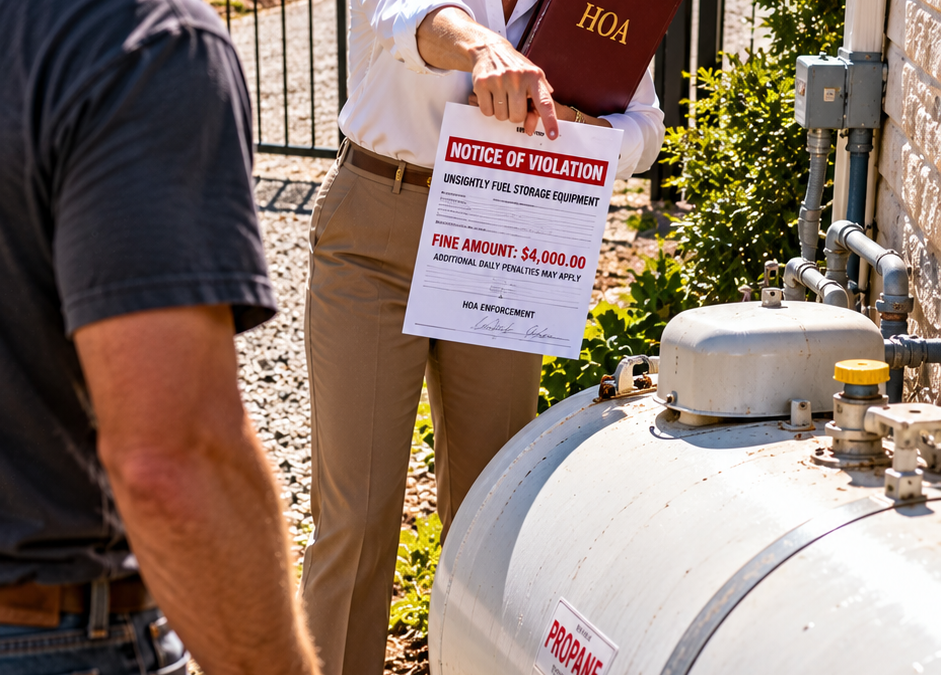
There were words like unsightly, nonconforming, visual nuisance, community harmony, and immediate corrective action. There were threats of daily fines, suspension of community privileges, legal enforcement, and assessment liens if I failed to remove or conceal the tank by the deadline.
What I did not see was a code citation.
No fire code section.
No county ordinance.
No reference to the recorded HOA provision banning propane tanks.
No inspection report.
No licensed evaluator.
Just Karen’s signature at the bottom, large and dramatic, as though handwriting could replace authority.
I folded the notice once and held it at my side.
“I’m not moving anything based on this.”
Her expression hardened.
“You have until Friday.”
“Today is Tuesday.”
“Then I suggest you act quickly.”
I looked past her toward the open gate.
“You need to leave.”
“I am here in my official capacity.”
“You are trespassing in an unofficially dramatic way.”
Her eyes narrowed behind the sunglasses.
“You always make these matters more difficult than they need to be.”
“No, Karen. I ask what rule you’re enforcing. That’s what makes it difficult for you.”
For a moment, she said nothing.
The tank sat behind me in the sun, pale and quiet, doing exactly what it had been installed to do. It did not hiss. It did not leak. It did not glow. It did not threaten the neighborhood. But Karen looked at it as if it were an act of rebellion.
She snapped the folder shut.
“Friday,” she said. “After that, the fines increase.”
Then she turned and walked back through my gate like she had just finished an inspection.
I watched her leave.
I did not shout after her.
I did not argue.
I did not threaten legal action.
I stood there holding the violation notice while the tank hummed silently beside me, and I felt the first edge of a familiar anger rising in my chest.
It was not the fine that bothered me most.
It was the certainty.
Karen had not asked whether the tank was legal. She had not asked who installed it. She had not asked whether it was part of an approved system, whether it met required clearances, whether it served essential equipment, or whether the HOA’s own documents said anything about propane at all.
She had seen something she disliked and treated her dislike as law.
I had lived around that kind of authority long enough to know how dangerous it could become if nobody forced it to explain itself.
I walked into the house and placed the notice on the kitchen table.
My wife, Laura, was pouring coffee when she saw my face.
“What happened?”
“Karen happened.”
She looked at the paper.
“Oh no.”
“She wants the propane tank removed by Friday.”
Laura stared at me.
“The propane tank? The one that runs our heat?”
“And the stove. And the generator.”
“On what basis?”
“Appearance standards.”
Her eyebrows lifted.
“That’s not a safety issue.”
“Exactly.”
Laura picked up the notice and read it slowly. She was calmer than I was in most disputes, but I could see irritation building in her expression.
“She can’t seriously expect us to disconnect fuel to the house in three days.”
“She seriously expects people to panic when she prints things in bold.”
Laura set the notice down.
“What are you going to do?”
“Call the propane company first.”
Not the HOA.
Not Karen.
Not the board.
The propane company.
When someone attacks a technical installation, you start with the people who understand the equipment.
The company that installed our system was Oak Valley Propane. They had handled the tank pad, lines, regulator, permits, pressure test, appliance connections, and inspection records. Their technician, Mike Alvarez, had been the one who walked me through the system after installation, explaining shutoffs, service access, emergency procedures, and the routine things homeowners should know.
I called their office and asked for him.
He returned my call twenty minutes later.
“Hey, Jack. Everything all right with the system?”
“The system seems fine. The HOA president just gave me a four-thousand-dollar violation notice and ordered me to remove the tank by Friday.”
There was a short silence.
Then Mike laughed.
Not politely.
Fully.
“She did what?”
“She says it violates appearance standards.”
“The tank we installed last year?”
“Yes.”
“On the pad approved in the installation file?”
“Yes.”
“With the clearance we documented?”
“Yes.”
“With the service access we told you not to obstruct?”
“That would be the one.”
He laughed again, then caught himself.
“All right. Don’t move anything until we verify exactly what the HOA is claiming.”
“That was my plan.”
“Send me a copy of the notice.”
I did.
He called back ten minutes later, and his voice had changed. Still calm, but more serious.
“Jack, this notice doesn’t cite any fuel code.”
“I noticed.”
“It doesn’t cite a county safety violation either.”
“I noticed that too.”
“It’s written like an aesthetic enforcement letter, but it demands alteration of an active fuel installation.”
“That seems like a problem.”
“It can be. If someone unqualified tells a homeowner to disconnect, move, hide, enclose, or modify a propane tank without proper review, that can create safety issues. Tanks need clearances. Venting matters. Access matters. Regulators matter. You can’t just shove a fence panel around one because a board doesn’t like looking at it.”
“Can you come inspect it?”
“I’ll be there tomorrow.”
“Karen gave me until Friday.”
“Karen can wait for someone who knows what propane is.”
That was the first time I smiled all morning.
The next day, Karen returned.
This time, she brought witnesses.
Two HOA board members followed her up the driveway but stopped outside my gate like they were afraid the gravel itself might be legally disputed. One was Leonard Voss, a retired accountant who had served as treasurer for years and always looked like he wanted the smallest possible version of every conflict. The other was Diane Mercer, chair of the architectural committee, who had once sent a neighbor a violation letter because her front door wreath was “seasonally premature.”
Karen stood at the gate with the burgundy folder.
I stood on my side.
The gate stayed closed.
“Good morning,” I said.
Karen ignored that.
“We are here to confirm noncompliance.”
“No. You are outside my gate.”
Her eyes flicked to the chain.
“You are obstructing an HOA inspection.”
“You are not authorized to inspect my fuel system.”
“We are not inspecting the fuel system. We are inspecting the visual violation.”
Diane leaned slightly to look past me at the tank.
Leonard avoided eye contact.
Karen held up another paper.
“Because you refused to cooperate yesterday, an additional fine has been assessed.”
I laughed once.
I did not mean to.
It just came out.
Karen’s expression sharpened.
“You find this amusing?”
“I find it revealing.”
“You have now been fined for the original violation and failure to cooperate with enforcement.”
“Let me ask this clearly,” I said. “Which rule bans propane tanks?”
Karen opened the folder.
That made me feel better. Not because I thought she had the rule, but because I wanted Leonard and Diane to watch her look for it.
She flipped through tabbed pages for nearly a minute.
The sound of paper turning became its own kind of confession.
Diane glanced at Leonard.
Leonard adjusted his glasses.
Karen finally stopped on a page.
“It is covered under community appearance standards.”
“Read the propane section.”
Her lips pressed together.
“The rule does not need to list every possible eyesore.”
“Read the section.”
She stared at me.
I opened my own folder.
I had prepared it the night before: deed, property survey, propane installation paperwork, HOA declaration, architectural rules, correspondence, permit records, and the exact appearance standards section Karen loved citing when she could not find something more specific.
I pulled out the governing document and held it up.
“The appearance section discusses landscaping, exterior paint colors, visible trash containers, driveway maintenance, temporary storage, and holiday decorations. It does not ban propane tanks.”
Diane shifted her weight.
Karen said, “The board has authority to interpret community standards.”
“Interpretation is not invention.”
Leonard cleared his throat.
“Karen, maybe we should review the language before—”
She turned on him.
“We have reviewed it.”
“No,” I said. “You have relied on it. That is different.”
Karen pointed toward the tank.
“It is visible from the street.”
“Barely.”
“It is visible.”
“Visible does not mean prohibited.”
“It disrupts the character of the neighborhood.”
“It powers essential systems in my house.”
“You should have installed it underground.”
“That would have required different permits, different cost, and different site conditions. It was not required.”
“Other homeowners manage to comply.”
“Comply with what?”
Again, no answer.
Then Mike’s truck pulled into the driveway behind Karen’s SUV.
The Oak Valley Propane logo was printed on the side in blue letters. Mike stepped out wearing work boots, a company shirt, and the expression of a man who already knew he had walked into nonsense.
He nodded to me.
“Morning, Jack.”
“Morning, Mike.”
Karen looked him up and down.
“And who are you?”
“Mike Alvarez. Licensed propane technician. Oak Valley Propane.”
Her posture changed.
Not much, but enough.
Mike walked to the gate and looked at her.
“Are you the person who issued the removal notice?”
Karen lifted her chin.
“I am the HOA president.”
“That wasn’t what I asked.”
Diane’s eyebrows rose slightly.
Karen said, “The HOA issued a violation notice concerning the tank’s visibility.”
Mike looked at me.
“May I access the installation?”
“Yes.”
I opened the gate and let him through, then closed it behind him before Karen could move.
She did not like that.
“We need to observe,” she said.
“You can observe from there.”
“This is an HOA matter.”
“This is a fuel system,” Mike said. “Please remain outside the work area.”
The words please remain outside sounded polite.
They were not optional.
Mike inspected the tank carefully. He checked the pad, supports, valve assembly, regulator, line routing, protection from vehicle impact, clearance from ignition sources, distance from openings, service access, condition of fittings, and documentation tag. He took photographs. He compared the installation to the paperwork I handed him. He crouched near the line, stood, made a note, and checked the gauge.
Karen kept trying to speak.
Mike kept ignoring her.
After several minutes, he turned toward me.
“The installation meets the applicable requirements I’m responsible for verifying. I see no basis for removal from a propane safety standpoint.”
I nodded.
“Thank you.”
Karen’s voice cut in.
“I want to see your license and paperwork.”
Mike turned slowly.
“I can provide credentials to the property owner and the appropriate authority.”
“I am the HOA authority.”
“You are not the fuel safety authority.”
Her face went red.
“We have the right to enforce standards.”
Mike looked at the violation notice in my hand.
“Are you ordering him to alter a fuel installation without a qualified inspection?”
Karen’s mouth opened.
No sound came out.
Mike continued, calm and precise.
“Because if the HOA instructs a homeowner to move, disconnect, enclose, obstruct, or otherwise modify a propane tank improperly, you may create a safety hazard. You may block required access. You may interfere with ventilation. You may violate clearance requirements. So I’m asking plainly: are you ordering him to alter this installation without a qualified safety determination?”
Leonard stared at Karen.
Diane looked at the ground.
Karen finally said, “We are ordering him to correct an appearance violation.”
“That does not answer the safety issue,” Mike said.
“The HOA is not responsible for his fuel system.”
“But you’re telling him to remove it.”
Karen snapped the folder closed.
“The board will be reviewing propane policies for the entire subdivision.”
That was new.
“The entire subdivision?” I asked.
“Yes,” she said, regaining some of her edge. “This situation has revealed a broader compliance issue. Every homeowner with nonconforming equipment will be reviewed.”
Mike looked at me.
I looked at Karen.
That was the moment I realized this was not only about my tank.
Karen had arrived angry, but prepared. The fine was not improvised. The language looked templated. The threat about suspending community services had been printed in advance. And now, with Mike standing there, she had shifted instantly from one tank to an entire enforcement campaign.
She was not correcting a violation.
She was building a program.
And I had a very bad feeling she had been doing it without a real rule.
Karen left five minutes later, taking Leonard and Diane with her.
Leonard looked back once before getting into his car. His expression was not hostile. It was worried.
That worried me more.
After Mike finished, he handed me copies of his inspection notes.
“Keep these,” he said.
“I will.”
“She’s going after other people.”
“That’s what it sounded like.”
“Can she force them to disconnect?”
He looked toward the street.
“She can scare them into doing it. That’s not the same thing.”
I knew exactly what he meant.
By dinner, I had called three neighbors.
By bedtime, I had heard from nine.
By the next afternoon, I had a stack of violation letters spread across my dining table that made Karen’s campaign look much larger than she had admitted.
Some homeowners had propane tanks like mine. One couple used propane for heat because their house sat at the edge of the subdivision where natural gas lines had never been extended. An older widow named Mrs. Keller had a small aboveground tank for her backup generator because she needed powered medical equipment during outages. A young family had a tank for their stove and water heater.
But the letters did not stop at propane.
One man had been fined for a visible water filtration unit near his garage even though it had been approved by a previous board. Another family had been cited for a standby generator installed after a storm left the neighborhood without power for three days. A retired firefighter had received a notice about a code-compliant exterior vent cap because Karen claimed it was “visually inconsistent with community finishes.”
The language was always the same.
Unsightly equipment.
Community appearance.
Daily penalties.
Failure to cooperate.
Possible suspension of community services.
And in several cases, the homeowners had already complied out of fear.
Mrs. Keller had turned off her generator system until she could “get clarity.” The young family had canceled a propane delivery. Another resident had built a decorative enclosure around equipment without consulting the installer, then learned later it might block required service access.
That made my anger sharpen into something heavier.
Karen’s letters were not just annoying people.
They were pushing homeowners to alter essential systems.
I called Laura into the dining room and showed her the stack.
Her face darkened.
“She sent all of these?”
“Yes.”
“Do the rules support any of them?”
“I’m checking.”
For the next three nights, I became a student of our HOA’s governing documents.
I read the declaration. The bylaws. The architectural guidelines. Meeting minutes. Policy amendments. Enforcement procedures. Fine schedule. Common area rules. Utility easement language. I requested records from the management company. I asked neighbors to send me every notice they had received. I built a spreadsheet with dates, alleged violations, rule citations, fine amounts, response deadlines, and whether each homeowner had requested review.
A pattern emerged quickly.
Karen’s enforcement letters cited broad appearance authority but almost never a specific approved rule banning the equipment in question. When homeowners challenged the fines, the HOA delayed hearings or marked the fine as “pending review” while still including it in unpaid balance summaries. In some letters, the HOA threatened to suspend community services over unpaid fines even when those fines were actively disputed.
That was not just aggressive.
It was sloppy.
Maybe worse.
Then I found the strangest thing.
In the minutes from a board meeting six months earlier, Karen had announced that the HOA would be “reviewing policies related to visible private utility equipment.” The minutes stated that the board would conduct research, consult experts, and draft proposed guidelines for homeowner review.
But there was no later approval.
No adopted propane policy.
No recorded amendment.
No membership vote.
No published final guideline.
Nothing.
Karen had spoken as if the policy already existed, but the records showed only a proposed review that had never been completed.
Her propane rule was nowhere in the approved documents.
I sat back from the table and stared at the page.
Laura, sitting across from me with a cup of tea, saw my expression.
“What did you find?”
“There is no propane rule.”
“She made it up?”
“She may have converted a policy review into enforcement.”
“That sounds like made it up.”
I looked at the stack of letters again.
“She fined people with it.”
Laura’s voice went quiet.
“Jack, Mrs. Keller turned off her generator.”
“I know.”
“She needs that generator.”
“I know.”
That was the point where the issue stopped being a fight over my tank and became something else.
I called Martin Hale, an attorney who had handled an easement issue for me years earlier. I sent him Karen’s notice, my installation documents, the HOA appearance standards, board minutes, and copies of the other violation letters homeowners had shared with permission.
He called me back the next morning.
“This is messy,” he said.
“How messy?”
“The HOA can regulate certain exterior appearances if the governing documents allow it, but they cannot safely or lawfully improvise technical requirements for fuel systems. They also need to follow their own enforcement procedures. These notices look vulnerable.”
“Can they keep assessing fines while disputes are pending?”
“That depends on the documents, but threatening suspension of services over contested fines is risky if the process hasn’t been completed properly.”
“What do I do?”
“First, do not move the tank. Second, request the official enforcement records. Third, request the policy authority for the propane rule. Fourth, get an independent inspection if possible. A fire marshal’s review would carry weight.”
“I already have the propane company inspection.”
“Good. Get the county involved before Karen turns this into a neighborhood-wide safety problem.”
So I did.
I went to the county office with a binder thick enough to make Karen’s burgundy folder look like a greeting card.
The clerk directed me to the local fire prevention office. I explained the situation carefully: professionally installed propane tank, HOA removal demand, no safety citation, risk of homeowners altering fuel equipment under pressure, and multiple notices affecting essential systems.
The fire marshal agreed to inspect.
His name was Robert Gaines.
He arrived two days later in a county vehicle with a calm face and a direct manner. Karen arrived too, of course. So did Leonard, Diane, Mike from Oak Valley Propane, my attorney, and several neighbors who had received similar letters.
The gathering at my gate looked almost ridiculous.
All because of a tank that had been sitting safely beside my house for a year.
Fire Marshal Gaines began by setting the tone.
“I am here to review the installation for applicable safety concerns. This is not an HOA hearing. No one is to interfere with the inspection.”
Karen opened her mouth.
Gaines looked at her.
“Please step back.”
She closed it.
That alone made the morning worthwhile.
Gaines inspected the tank more formally than Mike had. He checked location, clearance, valves, regulator, protective placement, signage, line route, service access, proximity to structures, and whether anything created an immediate hazard. He reviewed the installation paperwork. He compared it with county records and Oak Valley’s documentation.
Karen stood with her arms crossed, watching as if she expected the tank to confess.
It did not.
After nearly thirty minutes, Gaines finished his notes.
“Do I need to remove it?” I asked.
“No.”
Karen’s head snapped toward him.
Gaines continued, “I am not issuing an order for removal. Based on what I have reviewed today, I do not see an immediate safety violation requiring removal of this propane tank.”
Karen stepped forward.
“But the HOA has appearance standards.”
Gaines looked at her.
“Appearance standards are not fire safety orders.”
“It is visible from community areas.”
“That is not my determination.”
“Are you saying the HOA cannot regulate it?”
“I am saying my office is not ordering removal, and any alteration to fuel equipment should comply with applicable safety requirements and be performed by qualified personnel.”
Mike nodded.
Gaines turned to the small group of homeowners.
“If any of you received instructions to move, enclose, disconnect, or alter fuel-related equipment, do not do so without consulting a qualified professional and the appropriate authority. Improper modifications can create hazards.”
Mrs. Keller looked shaken.
“I turned off my generator because I was afraid of being fined.”
Gaines turned to her.
“Have your installer inspect it before making further changes.”
Karen said quickly, “The HOA never told anyone to create a hazard.”
I looked at her.
“You told people to remove equipment without verifying the rules.”
“That is not what happened.”
I held up the letters.
“It is exactly what happened.”
The neighbors began talking all at once.
Leonard looked at the ground again.
Diane’s face had gone pale.
Fire Marshal Gaines did not accuse Karen of anything beyond his authority. He did not need to. His conclusion was enough: no removal order, safety requirements must be followed, unqualified demands to alter essential systems could be dangerous.
Karen’s violation letter had lost the one thing she wanted people to assume it had.
Legitimacy.
Within days, everything began moving.
Not because Karen suddenly became reasonable.
Because the homeowners did.
People who had been afraid separately became angry together.
Mrs. Keller demanded an emergency board meeting. The retired firefighter requested a full review of equipment-related enforcement notices. Paul Henderson, who had been fined for his generator housing, asked for a list of all disputed fines. Laura helped organize the documents into categories. My attorney sent a formal letter challenging my fine and demanding suspension of the enforcement campaign pending review.
The HOA resisted at first.
Karen insisted that the board had authority.
The management company claimed the notices were consistent with community standards.
The board said homeowners should comply first and appeal afterward.
That last phrase lit the fuse.
Comply first.
Appeal afterward.
People understood what that meant now. It meant turn off the generator first, then ask whether the order was valid. Move the tank first, then ask whether the rule existed. Pay the fine first, then hope the same people who issued it might return your money. Risk your heating, backup power, and safety first, then politely request fairness later.
The room was packed the night of the emergency meeting.
The clubhouse had never felt so small. Folding chairs lined the walls. People stood in the back. The air smelled like coffee, perfume, wet coats, and anger held under pressure.
Karen sat at the front table with Leonard, Diane, two other board members, and the HOA’s attorney.
Her burgundy folder was there too.
For once, it did not look powerful.
It looked like evidence.
The meeting began with Karen reading a prepared statement.
“The board recognizes that recent enforcement actions have generated concern among certain homeowners. We remain committed to preserving the appearance, safety, and value of our community.”
A man near the back muttered, “Here we go.”
Karen continued.
“However, misinformation has circulated regarding the board’s authority and the purpose of these notices.”
I stood before she could go further.
The HOA attorney leaned toward his microphone.
“Homeowner comments will occur after the president’s statement.”
I looked at him.
“Will the president’s statement identify the approved rule banning propane tanks?”
The room went silent.
Karen’s eyes locked on mine.
The attorney said, “Please sit down until open comment.”
I sat.
But the question stayed in the air like smoke.
Karen resumed, less smoothly now.
“The board initiated a review of visible private utility equipment due to community concerns.”
Mrs. Keller raised her hand.
Karen ignored it.
“This review included propane tanks, generators, filtration systems, and related exterior components. Enforcement notices were sent where equipment appeared inconsistent with community appearance standards.”
Paul Henderson spoke from the second row.
“Was the policy ever approved?”
Karen said, “The board has existing authority.”
“That isn’t what he asked,” someone else said.
Leonard shifted in his chair.
Karen looked toward the attorney.
He took over.
“At this stage, the board is reviewing the scope and implementation of the equipment enforcement initiative.”
Initiative.
That was the new word.
Not rule.
Not policy.
Initiative.
I wrote it down.
When open comment began, homeowners lined up.
Mrs. Keller went first.
She was seventy-three, small, and usually soft-spoken. That night, her voice trembled, but she did not back down.
“I received a notice saying my generator tank was unsightly and subject to daily fines. I turned off the system because I was afraid. I rely on that generator during outages for medical equipment. Nobody from the HOA asked whether it was safe to shut down. Nobody inspected it. Nobody gave me a code citation. I want to know who authorized that letter.”
Karen looked down at her notes.
The attorney answered.
“The notice was part of a broader enforcement review.”
Mrs. Keller said, “That is not an answer.”
The room murmured.
Paul Henderson went next.
“My generator was installed after the storm two years ago. The prior board approved it. I have the approval letter. Karen’s notice called it nonconforming. When I appealed, the fine stayed on my account as pending. Then I received a service suspension warning over unpaid fines. How can you threaten suspension over a fine that hasn’t been reviewed?”
The attorney said, “Account notices are generated through management procedures.”
Paul looked at the board.
“So nobody checked those either?”
Diane flinched.
Then the retired firefighter stood.
He placed a stack of papers on the table.
“I spent thirty years responding to residential emergencies. You do not tell people to enclose fuel tanks, block equipment, move lines, or shut off generators because something looks bad from the street. If this board wants a policy, consult professionals first. What happened here was reckless.”
Karen’s face tightened.
Then it was my turn.
I walked to the microphone holding my binder.
“My name is Jack Morrison,” I said. “My propane tank was professionally installed, documented, and inspected. Karen came through my gate and ordered me to remove it. When I asked which safety official had declared it illegal, she said the HOA did not need permission.”
Karen’s eyes flashed.
I continued.
“The governing documents do not ban propane tanks. The appearance standards she cited address landscaping, exterior paint, visible trash containers, and similar items. The board minutes show a policy review was proposed, but I found no approved propane policy, no adopted private utility equipment rule, and no completed review.”
I held up the notice.
“Yet fines were issued. Daily penalties were threatened. Service suspensions were threatened. Homeowners changed or stopped using essential equipment because they were afraid of letters that may not have been based on any approved rule.”
I looked at the board.
“This is not about whether the neighborhood should have standards. Standards must exist in the documents before they are enforced. And if those standards affect fuel systems, generators, or equipment tied to safety, they need professional review before someone gets hurt.”
The room stayed quiet after I sat down.
Not because people disagreed.
Because the truth had become too plain to decorate.
Leonard finally leaned into his microphone.
“I move that all enforcement actions related to visible private utility equipment, including propane tanks and generators, be suspended pending full review of governing authority, safety implications, and homeowner appeals.”
Karen turned toward him sharply.
“Leonard.”
He did not look at her.
“I also move that disputed fines under this enforcement initiative be frozen and removed from service suspension calculations until properly reviewed.”
Diane swallowed.
“I second.”
Karen looked betrayed.
The attorney whispered to her.
The board voted.
Karen voted no.
Leonard voted yes.
Diane voted yes.
The other two members hesitated, then voted yes.
The motion passed.
For the first time since Karen had walked through my gate, I felt the pressure in my chest loosen.
Not disappear.
Loosen.
The enforcement campaign was suspended.
The fines were frozen.
A review committee would examine the records, policy history, safety issues, and homeowner complaints. The board would produce the enforcement file, meeting minutes, management company communications, and rule authority supporting any future action.
Karen sat silently at the back of the room after the meeting ended.
She had started the night at the front table, folder open, voice controlled, authority intact. By the end, homeowners were gathered around Leonard and Diane asking how to submit documents, how to challenge fines, how to restore suspended equipment, how to verify whether a notice was real.
Karen had become almost irrelevant to the process she had started.
That may have been the most painful part for her.
Not that people were angry.
That they no longer needed her permission to question her.
Two weeks later, the review committee issued preliminary findings.
The propane rule did not exist.
The board had discussed developing a policy, but no final rule had been adopted. No safety professionals had been consulted before the enforcement notices went out. The management company had used a template created from Karen’s instructions and applied it broadly to multiple types of equipment. Several fines had been assessed without specific citations to approved governing language. Some disputed fines had been included in balance notices before appeals were heard.
The findings were dry.
The impact was not.
Homeowners demanded corrections.
The board rescinded the propane-related fines. It removed disputed equipment fines from account balances pending individual review. It sent letters advising homeowners not to alter fuel, electrical, generator, or safety-related equipment without qualified professional guidance. It scheduled a proper policy drafting process with fire safety input, installer consultation, legal review, and homeowner comment.
Karen did not resign immediately.
People like Karen rarely walk away the first time their authority is questioned. They wait to see whether fear returns.
It did not.
At the next monthly meeting, Mrs. Keller stood and asked whether the HOA would reimburse her for the generator inspection she had needed after shutting down the system. Paul asked whether the board would apologize for threatening suspension over contested fines. The retired firefighter asked whether future enforcement letters would be required to cite exact rule provisions.
Each question was calm.
Each question was documented.
Each question made the room a little harder for Karen to control.
By the end of that meeting, Karen announced she would be “stepping back from enforcement responsibilities” while the review continued.
It was not an apology.
It was not accountability.
It was retreat disguised as process.
I accepted it for what it was.
My propane tank stayed exactly where it belonged.
No fence was built too close around it. No unsafe enclosure blocked access. No contractor disconnected lines because Karen wanted a cleaner view. The tank continued doing what it had always done: quietly powering the systems my home depended on.
Winter came early that year.
The first hard freeze arrived in November, sharp and mean, coating the grass in silver and turning every breath white. That night, the wind knocked a branch across a line somewhere east of town. Power flickered across the subdivision. Some homes lost electricity for three hours.
Our generator started within seconds.
The house stayed warm.
The stove worked.
The water heater ran.
Laura stood beside me in the kitchen while snow dusted the windows.
“Still an eyesore?” she asked.
I looked toward the side yard, where the propane tank sat in the dark, invisible behind the shrubs but very much present.
“Apparently a useful one.”
She smiled.
The next morning, Mrs. Keller called.
Her generator had worked too.
She sounded close to tears when she told me.
“I almost left it off,” she said. “If you hadn’t pushed back, I think I would have.”
I did not know what to say at first.
Then I said the truth.
“I’m glad you didn’t.”
After we hung up, I stood at the window for a long time.
That was when the whole thing settled into me.
This had never been about a tank.
Not really.
It was about the way fear travels through a community when someone learns how to print it on letterhead. It was about people receiving notices and assuming the person who sent them must have checked. It was about homeowners altering safe equipment because challenging a fine felt more frightening than obeying it. It was about the gap between authority and accuracy.
Karen had counted on that gap.
She had lived in it.
She had used it.
But the gap closed the moment people started asking simple questions.
Which rule?
Whose authority?
What record?
What inspection?
What safety review?
What vote?
The questions were not dramatic.
They were stronger than drama.
Months later, the HOA adopted a real equipment policy.
It was nothing like Karen’s campaign. It allowed propane tanks, generators, filtration units, and similar essential systems when installed legally and maintained safely. It required reasonable screening where practical, but prohibited screening that violated safety clearance or service access requirements. It required exact rule citations in enforcement letters. It barred fines from being treated as final while a timely appeal was pending. It required technical consultation before any notice involving fuel, electrical, or life-safety systems.
It was not perfect.
No HOA document ever is.
But it was real.
Approved.
Reviewed.
Written down.
That was all I had asked for from the beginning.
Not special treatment.
Not immunity.
Just proof.
Karen stopped coming to my gate.
For a while, I still saw her at meetings, sitting stiffly in the second row while Leonard, now acting president, worked through agenda items with less drama and more evidence. Diane became quieter too, though to her credit, she supported most of the reforms once the facts were unavoidable.
The burgundy folder disappeared.
I do not know whether Karen threw it away or simply stopped carrying it where people could see.
I like to think it sits in a closet somewhere, stuffed with old notices that no longer frighten anyone.
One spring morning, nearly a year after the first fine, I walked outside to check the tank again.
Routine check.
Gauge level.
Valve cover.
Pad condition.
Clearance.
Nothing dramatic.
The shrubs around it had filled in, trimmed carefully so they softened the view without blocking access. The service path remained clear. The inspection tag was current. The system was safe.
The same tank Karen had pointed at like a crime scene was still there, doing its job.
I rested one hand on the lid and looked toward the road.
A neighbor walked by with his dog and lifted a hand.
“Morning, Jack.”
“Morning.”
No complaint.
No threat.
No folder.
Just an ordinary morning in a neighborhood that had finally learned the difference between a rule and a rumor.
I thought about that first day again, Karen storming through my gate, voice sharp, finger pointed, certain that bold print and confidence would be enough. I thought about Mike asking whether she was ordering alterations to a fuel installation without qualified inspection. I thought about Fire Marshal Gaines telling everyone that appearance standards were not safety orders. I thought about Mrs. Keller’s generator coming on in the storm.
That was the part I carried with me.
Not that I beat Karen.
Not that my fine was rescinded.
Not that the tank stayed.
The part that mattered was smaller and larger at the same time: people started checking.
They checked their letters.
They checked the rules.
They checked the minutes.
They checked whether a fine was final, whether a policy existed, whether a demand was safe, whether a person with a folder actually had the authority she claimed.
That changed the neighborhood more than any propane tank ever could.
Karen had taught everyone to fear notices.
The tank taught everyone to read them.
And in the end, that was enough.
My propane system stayed exactly where it belonged, safely installed on my property, powering my home through cold mornings, heavy storms, and every outage that followed.
The HOA learned that a violation letter does not make something illegal.
I learned something too.
Sometimes protecting one corner of your own property forces an entire community to remember that accountability begins with a simple question.
Show me the rule.
𝗧𝗛𝗘 𝗘𝗡𝗗
Karen Pointed at My Propane Tank Like It Was a Crime Scene Waiting to Happen
Karen stormed through my gate with a burgundy folder in her hand and fear dressed up as authority in her voice.
She pointed at my propane tank like I had hidden something dangerous in plain sight.
By the time she left, I knew the tank was not the real problem; the problem was how many people in the neighborhood had already learned to obey paperwork without asking whether it was true.
I was halfway through checking the propane gauge when I heard the gate latch slam behind me.
That sound mattered.
Not because the gate was expensive or ornamental. It was just a steel farm-style gate at the side of my driveway, painted black, with a simple chain and latch that kept people from wandering onto the back portion of my property. But there is a difference between hearing a gate open and hearing someone force themselves through it like they own the ground on the other side.
I turned with one hand still resting on the tank lid.
Karen Whitmore was marching across my gravel drive.
Of course it was Karen.
In our subdivision, people rarely said “the HOA president” anymore. They just said Karen, the way people talk about weather they are tired of surviving. She wore tan slacks, a white blouse, and sunglasses that made her face look colder than it already was. Tucked under her arm was a burgundy folder thick enough to make any homeowner nervous.
I had seen that folder before.
It appeared at violation hearings, driveway arguments, mailbox disputes, landscaping complaints, and one unforgettable meeting where she spent forty minutes explaining why a family’s basketball hoop represented “architectural decline.” To Karen, a folder was not storage. It was theater.
She stopped ten feet from me and pointed at the propane tank.
“Remove that tank immediately.”
No greeting. No question. No acknowledgment that she had just walked through a private gate without permission.
I looked at the tank, then back at her.
It was a standard residential propane tank sitting on a prepared pad beside the utility side of my house, screened from the front road by shrubs and visible only if someone came through the gate or stood at a very particular angle near the side easement. It powered my heating system, kitchen range, fireplace, backup generator, and water heater. It had been installed by a licensed propane company. It had inspection tags, clearance documentation, and a service record cleaner than Karen’s tone.
I wiped my hands on a rag.
“Are you sure you know what you’re looking at?”
Her mouth tightened.
“I know exactly what I’m looking at.”
“Then you know it’s a propane tank.”
“I know it is an unacceptable eyesore.”
That was when I knew the conversation was going to be absurd.
“It powers my house,” I said. “And it was professionally installed.”
Karen opened the burgundy folder with sharp, practiced movements. She pulled out a printed notice and held it toward me as if she were serving a warrant.
“You are in violation of community appearance standards.”
I did not take the paper right away.
“Karen, you came through a closed gate.”
“This is an enforcement matter.”
“This is my property.”
“Your property is still subject to HOA rules.”
“Not every inch of it is subject to whatever you decide this morning.”
She thrust the notice closer.
“Take it.”
I took it.
The first line read: NOTICE OF VIOLATION — UNSIGHTLY FUEL STORAGE EQUIPMENT.
Below that, in bold type, was a fine for several thousand dollars.
I read the amount twice, because the number was so ridiculous my brain refused it the first time.
“You’re fining me four thousand dollars for a propane tank?”
“That is the initial enforcement amount,” she said. “Additional daily penalties will accrue if the tank remains.”
“If the tank remains,” I repeated.
“Yes.”
“The tank that powers my house.”
“The tank that violates HOA standards.”
“Which safety official declared it illegal?”
Karen’s smile came slowly.
It was the kind of smile people use when they believe they have moved the conversation away from facts and into power.
“The HOA does not need permission from safety officials to enforce its own rules.”
That sentence told me more than she meant it to.
I looked again at the notice.
There were words like unsightly, nonconforming, visual nuisance, community harmony, and immediate corrective action. There were threats of daily fines, suspension of community privileges, legal enforcement, and assessment liens if I failed to remove or conceal the tank by the deadline.
What I did not see was a code citation.
No fire code section.
No county ordinance.
No reference to the recorded HOA provision banning propane tanks.
No inspection report.
No licensed evaluator.
Just Karen’s signature at the bottom, large and dramatic, as though handwriting could replace authority.
I folded the notice once and held it at my side.
“I’m not moving anything based on this.”
Her expression hardened.
“You have until Friday.”
“Today is Tuesday.”
“Then I suggest you act quickly.”
I looked past her toward the open gate.
“You need to leave.”
“I am here in my official capacity.”
“You are trespassing in an unofficially dramatic way.”
Her eyes narrowed behind the sunglasses.
“You always make these matters more difficult than they need to be.”
“No, Karen. I ask what rule you’re enforcing. That’s what makes it difficult for you.”
For a moment, she said nothing.
The tank sat behind me in the sun, pale and quiet, doing exactly what it had been installed to do. It did not hiss. It did not leak. It did not glow. It did not threaten the neighborhood. But Karen looked at it as if it were an act of rebellion.
She snapped the folder shut.
“Friday,” she said. “After that, the fines increase.”
Then she turned and walked back through my gate like she had just finished an inspection.
I watched her leave.
I did not shout after her.
I did not argue.
I did not threaten legal action.
I stood there holding the violation notice while the tank hummed silently beside me, and I felt the first edge of a familiar anger rising in my chest.
It was not the fine that bothered me most.
It was the certainty.
Karen had not asked whether the tank was legal. She had not asked who installed it. She had not asked whether it was part of an approved system, whether it met required clearances, whether it served essential equipment, or whether the HOA’s own documents said anything about propane at all.
She had seen something she disliked and treated her dislike as law.
I had lived around that kind of authority long enough to know how dangerous it could become if nobody forced it to explain itself.
I walked into the house and placed the notice on the kitchen table.
My wife, Laura, was pouring coffee when she saw my face.
“What happened?”
“Karen happened.”
She looked at the paper.
“Oh no.”
“She wants the propane tank removed by Friday.”
Laura stared at me.
“The propane tank? The one that runs our heat?”
“And the stove. And the generator.”
“On what basis?”
“Appearance standards.”
Her eyebrows lifted.
“That’s not a safety issue.”
“Exactly.”
Laura picked up the notice and read it slowly. She was calmer than I was in most disputes, but I could see irritation building in her expression.
“She can’t seriously expect us to disconnect fuel to the house in three days.”
“She seriously expects people to panic when she prints things in bold.”
Laura set the notice down.
“What are you going to do?”
“Call the propane company first.”
Not the HOA.
Not Karen.
Not the board.
The propane company.
When someone attacks a technical installation, you start with the people who understand the equipment.
The company that installed our system was Oak Valley Propane. They had handled the tank pad, lines, regulator, permits, pressure test, appliance connections, and inspection records. Their technician, Mike Alvarez, had been the one who walked me through the system after installation, explaining shutoffs, service access, emergency procedures, and the routine things homeowners should know.
I called their office and asked for him.
He returned my call twenty minutes later.
“Hey, Jack. Everything all right with the system?”
“The system seems fine. The HOA president just gave me a four-thousand-dollar violation notice and ordered me to remove the tank by Friday.”
There was a short silence.
Then Mike laughed.
Not politely.
Fully.
“She did what?”
“She says it violates appearance standards.”
“The tank we installed last year?”
“Yes.”
“On the pad approved in the installation file?”
“Yes.”
“With the clearance we documented?”
“Yes.”
“With the service access we told you not to obstruct?”
“That would be the one.”
He laughed again, then caught himself.
“All right. Don’t move anything until we verify exactly what the HOA is claiming.”
“That was my plan.”
“Send me a copy of the notice.”
I did.
He called back ten minutes later, and his voice had changed. Still calm, but more serious.
“Jack, this notice doesn’t cite any fuel code.”
“I noticed.”
“It doesn’t cite a county safety violation either.”
“I noticed that too.”
“It’s written like an aesthetic enforcement letter, but it demands alteration of an active fuel installation.”
“That seems like a problem.”
“It can be. If someone unqualified tells a homeowner to disconnect, move, hide, enclose, or modify a propane tank without proper review, that can create safety issues. Tanks need clearances. Venting matters. Access matters. Regulators matter. You can’t just shove a fence panel around one because a board doesn’t like looking at it.”
“Can you come inspect it?”
“I’ll be there tomorrow.”
“Karen gave me until Friday.”
“Karen can wait for someone who knows what propane is.”
That was the first time I smiled all morning.
The next day, Karen returned.
This time, she brought witnesses.
Two HOA board members followed her up the driveway but stopped outside my gate like they were afraid the gravel itself might be legally disputed. One was Leonard Voss, a retired accountant who had served as treasurer for years and always looked like he wanted the smallest possible version of every conflict. The other was Diane Mercer, chair of the architectural committee, who had once sent a neighbor a violation letter because her front door wreath was “seasonally premature.”
Karen stood at the gate with the burgundy folder.
I stood on my side.
The gate stayed closed.
“Good morning,” I said.
Karen ignored that.
“We are here to confirm noncompliance.”
“No. You are outside my gate.”
Her eyes flicked to the chain.
“You are obstructing an HOA inspection.”
“You are not authorized to inspect my fuel system.”
“We are not inspecting the fuel system. We are inspecting the visual violation.”
Diane leaned slightly to look past me at the tank.
Leonard avoided eye contact.
Karen held up another paper.
“Because you refused to cooperate yesterday, an additional fine has been assessed.”
I laughed once.
I did not mean to.
It just came out.
Karen’s expression sharpened.
“You find this amusing?”
“I find it revealing.”
“You have now been fined for the original violation and failure to cooperate with enforcement.”
“Let me ask this clearly,” I said. “Which rule bans propane tanks?”
Karen opened the folder.
That made me feel better. Not because I thought she had the rule, but because I wanted Leonard and Diane to watch her look for it.
She flipped through tabbed pages for nearly a minute.
The sound of paper turning became its own kind of confession.
Diane glanced at Leonard.
Leonard adjusted his glasses.
Karen finally stopped on a page.
“It is covered under community appearance standards.”
“Read the propane section.”
Her lips pressed together.
“The rule does not need to list every possible eyesore.”
“Read the section.”
She stared at me.
I opened my own folder.
I had prepared it the night before: deed, property survey, propane installation paperwork, HOA declaration, architectural rules, correspondence, permit records, and the exact appearance standards section Karen loved citing when she could not find something more specific.
I pulled out the governing document and held it up.
“The appearance section discusses landscaping, exterior paint colors, visible trash containers, driveway maintenance, temporary storage, and holiday decorations. It does not ban propane tanks.”
Diane shifted her weight.
Karen said, “The board has authority to interpret community standards.”
“Interpretation is not invention.”
Leonard cleared his throat.
“Karen, maybe we should review the language before—”
She turned on him.
“We have reviewed it.”
“No,” I said. “You have relied on it. That is different.”
Karen pointed toward the tank.
“It is visible from the street.”
“Barely.”
“It is visible.”
“Visible does not mean prohibited.”
“It disrupts the character of the neighborhood.”
“It powers essential systems in my house.”
“You should have installed it underground.”
“That would have required different permits, different cost, and different site conditions. It was not required.”
“Other homeowners manage to comply.”
“Comply with what?”
Again, no answer.
Then Mike’s truck pulled into the driveway behind Karen’s SUV.
The Oak Valley Propane logo was printed on the side in blue letters. Mike stepped out wearing work boots, a company shirt, and the expression of a man who already knew he had walked into nonsense.
He nodded to me.
“Morning, Jack.”
“Morning, Mike.”
Karen looked him up and down.
“And who are you?”
“Mike Alvarez. Licensed propane technician. Oak Valley Propane.”
Her posture changed.
Not much, but enough.
Mike walked to the gate and looked at her.
“Are you the person who issued the removal notice?”
Karen lifted her chin.
“I am the HOA president.”
“That wasn’t what I asked.”
Diane’s eyebrows rose slightly.
Karen said, “The HOA issued a violation notice concerning the tank’s visibility.”
Mike looked at me.
“May I access the installation?”
“Yes.”
I opened the gate and let him through, then closed it behind him before Karen could move.
She did not like that.
“We need to observe,” she said.
“You can observe from there.”
“This is an HOA matter.”
“This is a fuel system,” Mike said. “Please remain outside the work area.”
The words please remain outside sounded polite.
They were not optional.
Mike inspected the tank carefully. He checked the pad, supports, valve assembly, regulator, line routing, protection from vehicle impact, clearance from ignition sources, distance from openings, service access, condition of fittings, and documentation tag. He took photographs. He compared the installation to the paperwork I handed him. He crouched near the line, stood, made a note, and checked the gauge.
Karen kept trying to speak.
Mike kept ignoring her.
After several minutes, he turned toward me.
“The installation meets the applicable requirements I’m responsible for verifying. I see no basis for removal from a propane safety standpoint.”
I nodded.
“Thank you.”
Karen’s voice cut in.
“I want to see your license and paperwork.”
Mike turned slowly.
“I can provide credentials to the property owner and the appropriate authority.”
“I am the HOA authority.”
“You are not the fuel safety authority.”
Her face went red.
“We have the right to enforce standards.”
Mike looked at the violation notice in my hand.
“Are you ordering him to alter a fuel installation without a qualified inspection?”
Karen’s mouth opened.
No sound came out.
Mike continued, calm and precise.
“Because if the HOA instructs a homeowner to move, disconnect, enclose, obstruct, or otherwise modify a propane tank improperly, you may create a safety hazard. You may block required access. You may interfere with ventilation. You may violate clearance requirements. So I’m asking plainly: are you ordering him to alter this installation without a qualified safety determination?”
Leonard stared at Karen.
Diane looked at the ground.
Karen finally said, “We are ordering him to correct an appearance violation.”
“That does not answer the safety issue,” Mike said.
“The HOA is not responsible for his fuel system.”
“But you’re telling him to remove it.”
Karen snapped the folder closed.
“The board will be reviewing propane policies for the entire subdivision.”
That was new.
“The entire subdivision?” I asked.
“Yes,” she said, regaining some of her edge. “This situation has revealed a broader compliance issue. Every homeowner with nonconforming equipment will be reviewed.”
Mike looked at me.
I looked at Karen.
That was the moment I realized this was not only about my tank.
Karen had arrived angry, but prepared. The fine was not improvised. The language looked templated. The threat about suspending community services had been printed in advance. And now, with Mike standing there, she had shifted instantly from one tank to an entire enforcement campaign.
She was not correcting a violation.
She was building a program.
And I had a very bad feeling she had been doing it without a real rule.
Karen left five minutes later, taking Leonard and Diane with her.
Leonard looked back once before getting into his car. His expression was not hostile. It was worried.
That worried me more.
After Mike finished, he handed me copies of his inspection notes.
“Keep these,” he said.
“I will.”
“She’s going after other people.”
“That’s what it sounded like.”
“Can she force them to disconnect?”
He looked toward the street.
“She can scare them into doing it. That’s not the same thing.”
I knew exactly what he meant.
By dinner, I had called three neighbors.
By bedtime, I had heard from nine.
By the next afternoon, I had a stack of violation letters spread across my dining table that made Karen’s campaign look much larger than she had admitted.
Some homeowners had propane tanks like mine. One couple used propane for heat because their house sat at the edge of the subdivision where natural gas lines had never been extended. An older widow named Mrs. Keller had a small aboveground tank for her backup generator because she needed powered medical equipment during outages. A young family had a tank for their stove and water heater.
But the letters did not stop at propane.
One man had been fined for a visible water filtration unit near his garage even though it had been approved by a previous board. Another family had been cited for a standby generator installed after a storm left the neighborhood without power for three days. A retired firefighter had received a notice about a code-compliant exterior vent cap because Karen claimed it was “visually inconsistent with community finishes.”
The language was always the same.
Unsightly equipment.
Community appearance.
Daily penalties.
Failure to cooperate.
Possible suspension of community services.
And in several cases, the homeowners had already complied out of fear.
Mrs. Keller had turned off her generator system until she could “get clarity.” The young family had canceled a propane delivery. Another resident had built a decorative enclosure around equipment without consulting the installer, then learned later it might block required service access.
That made my anger sharpen into something heavier.
Karen’s letters were not just annoying people.
They were pushing homeowners to alter essential systems.
I called Laura into the dining room and showed her the stack.
Her face darkened.
“She sent all of these?”
“Yes.”
“Do the rules support any of them?”
“I’m checking.”
For the next three nights, I became a student of our HOA’s governing documents.
I read the declaration. The bylaws. The architectural guidelines. Meeting minutes. Policy amendments. Enforcement procedures. Fine schedule. Common area rules. Utility easement language. I requested records from the management company. I asked neighbors to send me every notice they had received. I built a spreadsheet with dates, alleged violations, rule citations, fine amounts, response deadlines, and whether each homeowner had requested review.
A pattern emerged quickly.
Karen’s enforcement letters cited broad appearance authority but almost never a specific approved rule banning the equipment in question. When homeowners challenged the fines, the HOA delayed hearings or marked the fine as “pending review” while still including it in unpaid balance summaries. In some letters, the HOA threatened to suspend community services over unpaid fines even when those fines were actively disputed.
That was not just aggressive.
It was sloppy.
Maybe worse.
Then I found the strangest thing.
In the minutes from a board meeting six months earlier, Karen had announced that the HOA would be “reviewing policies related to visible private utility equipment.” The minutes stated that the board would conduct research, consult experts, and draft proposed guidelines for homeowner review.
But there was no later approval.
No adopted propane policy.
No recorded amendment.
No membership vote.
No published final guideline.
Nothing.
Karen had spoken as if the policy already existed, but the records showed only a proposed review that had never been completed.
Her propane rule was nowhere in the approved documents.
I sat back from the table and stared at the page.
Laura, sitting across from me with a cup of tea, saw my expression.
“What did you find?”
“There is no propane rule.”
“She made it up?”
“She may have converted a policy review into enforcement.”
“That sounds like made it up.”
I looked at the stack of letters again.
“She fined people with it.”
Laura’s voice went quiet.
“Jack, Mrs. Keller turned off her generator.”
“I know.”
“She needs that generator.”
“I know.”
That was the point where the issue stopped being a fight over my tank and became something else.
I called Martin Hale, an attorney who had handled an easement issue for me years earlier. I sent him Karen’s notice, my installation documents, the HOA appearance standards, board minutes, and copies of the other violation letters homeowners had shared with permission.
He called me back the next morning.
“This is messy,” he said.
“How messy?”
“The HOA can regulate certain exterior appearances if the governing documents allow it, but they cannot safely or lawfully improvise technical requirements for fuel systems. They also need to follow their own enforcement procedures. These notices look vulnerable.”
“Can they keep assessing fines while disputes are pending?”
“That depends on the documents, but threatening suspension of services over contested fines is risky if the process hasn’t been completed properly.”
“What do I do?”
“First, do not move the tank. Second, request the official enforcement records. Third, request the policy authority for the propane rule. Fourth, get an independent inspection if possible. A fire marshal’s review would carry weight.”
“I already have the propane company inspection.”
“Good. Get the county involved before Karen turns this into a neighborhood-wide safety problem.”
So I did.
I went to the county office with a binder thick enough to make Karen’s burgundy folder look like a greeting card.
The clerk directed me to the local fire prevention office. I explained the situation carefully: professionally installed propane tank, HOA removal demand, no safety citation, risk of homeowners altering fuel equipment under pressure, and multiple notices affecting essential systems.
The fire marshal agreed to inspect.
His name was Robert Gaines.
He arrived two days later in a county vehicle with a calm face and a direct manner. Karen arrived too, of course. So did Leonard, Diane, Mike from Oak Valley Propane, my attorney, and several neighbors who had received similar letters.
The gathering at my gate looked almost ridiculous.
All because of a tank that had been sitting safely beside my house for a year.
Fire Marshal Gaines began by setting the tone.
“I am here to review the installation for applicable safety concerns. This is not an HOA hearing. No one is to interfere with the inspection.”
Karen opened her mouth.
Gaines looked at her.
“Please step back.”
She closed it.
That alone made the morning worthwhile.
Gaines inspected the tank more formally than Mike had. He checked location, clearance, valves, regulator, protective placement, signage, line route, service access, proximity to structures, and whether anything created an immediate hazard. He reviewed the installation paperwork. He compared it with county records and Oak Valley’s documentation.
Karen stood with her arms crossed, watching as if she expected the tank to confess.
It did not.
After nearly thirty minutes, Gaines finished his notes.
“Do I need to remove it?” I asked.
“No.”
Karen’s head snapped toward him.
Gaines continued, “I am not issuing an order for removal. Based on what I have reviewed today, I do not see an immediate safety violation requiring removal of this propane tank.”
Karen stepped forward.
“But the HOA has appearance standards.”
Gaines looked at her.
“Appearance standards are not fire safety orders.”
“It is visible from community areas.”
“That is not my determination.”
“Are you saying the HOA cannot regulate it?”
“I am saying my office is not ordering removal, and any alteration to fuel equipment should comply with applicable safety requirements and be performed by qualified personnel.”
Mike nodded.
Gaines turned to the small group of homeowners.
“If any of you received instructions to move, enclose, disconnect, or alter fuel-related equipment, do not do so without consulting a qualified professional and the appropriate authority. Improper modifications can create hazards.”
Mrs. Keller looked shaken.
“I turned off my generator because I was afraid of being fined.”
Gaines turned to her.
“Have your installer inspect it before making further changes.”
Karen said quickly, “The HOA never told anyone to create a hazard.”
I looked at her.
“You told people to remove equipment without verifying the rules.”
“That is not what happened.”
I held up the letters.
“It is exactly what happened.”
The neighbors began talking all at once.
Leonard looked at the ground again.
Diane’s face had gone pale.
Fire Marshal Gaines did not accuse Karen of anything beyond his authority. He did not need to. His conclusion was enough: no removal order, safety requirements must be followed, unqualified demands to alter essential systems could be dangerous.
Karen’s violation letter had lost the one thing she wanted people to assume it had.
Legitimacy.
Within days, everything began moving.
Not because Karen suddenly became reasonable.
Because the homeowners did.
People who had been afraid separately became angry together.
Mrs. Keller demanded an emergency board meeting. The retired firefighter requested a full review of equipment-related enforcement notices. Paul Henderson, who had been fined for his generator housing, asked for a list of all disputed fines. Laura helped organize the documents into categories. My attorney sent a formal letter challenging my fine and demanding suspension of the enforcement campaign pending review.
The HOA resisted at first.
Karen insisted that the board had authority.
The management company claimed the notices were consistent with community standards.
The board said homeowners should comply first and appeal afterward.
That last phrase lit the fuse.
Comply first.
Appeal afterward.
People understood what that meant now. It meant turn off the generator first, then ask whether the order was valid. Move the tank first, then ask whether the rule existed. Pay the fine first, then hope the same people who issued it might return your money. Risk your heating, backup power, and safety first, then politely request fairness later.
The room was packed the night of the emergency meeting.
The clubhouse had never felt so small. Folding chairs lined the walls. People stood in the back. The air smelled like coffee, perfume, wet coats, and anger held under pressure.
Karen sat at the front table with Leonard, Diane, two other board members, and the HOA’s attorney.
Her burgundy folder was there too.
For once, it did not look powerful.
It looked like evidence.
The meeting began with Karen reading a prepared statement.
“The board recognizes that recent enforcement actions have generated concern among certain homeowners. We remain committed to preserving the appearance, safety, and value of our community.”
A man near the back muttered, “Here we go.”
Karen continued.
“However, misinformation has circulated regarding the board’s authority and the purpose of these notices.”
I stood before she could go further.
The HOA attorney leaned toward his microphone.
“Homeowner comments will occur after the president’s statement.”
I looked at him.
“Will the president’s statement identify the approved rule banning propane tanks?”
The room went silent.
Karen’s eyes locked on mine.
The attorney said, “Please sit down until open comment.”
I sat.
But the question stayed in the air like smoke.
Karen resumed, less smoothly now.
“The board initiated a review of visible private utility equipment due to community concerns.”
Mrs. Keller raised her hand.
Karen ignored it.
“This review included propane tanks, generators, filtration systems, and related exterior components. Enforcement notices were sent where equipment appeared inconsistent with community appearance standards.”
Paul Henderson spoke from the second row.
“Was the policy ever approved?”
Karen said, “The board has existing authority.”
“That isn’t what he asked,” someone else said.
Leonard shifted in his chair.
Karen looked toward the attorney.
He took over.
“At this stage, the board is reviewing the scope and implementation of the equipment enforcement initiative.”
Initiative.
That was the new word.
Not rule.
Not policy.
Initiative.
I wrote it down.
When open comment began, homeowners lined up.
Mrs. Keller went first.
She was seventy-three, small, and usually soft-spoken. That night, her voice trembled, but she did not back down.
“I received a notice saying my generator tank was unsightly and subject to daily fines. I turned off the system because I was afraid. I rely on that generator during outages for medical equipment. Nobody from the HOA asked whether it was safe to shut down. Nobody inspected it. Nobody gave me a code citation. I want to know who authorized that letter.”
Karen looked down at her notes.
The attorney answered.
“The notice was part of a broader enforcement review.”
Mrs. Keller said, “That is not an answer.”
The room murmured.
Paul Henderson went next.
“My generator was installed after the storm two years ago. The prior board approved it. I have the approval letter. Karen’s notice called it nonconforming. When I appealed, the fine stayed on my account as pending. Then I received a service suspension warning over unpaid fines. How can you threaten suspension over a fine that hasn’t been reviewed?”
The attorney said, “Account notices are generated through management procedures.”
Paul looked at the board.
“So nobody checked those either?”
Diane flinched.
Then the retired firefighter stood.
He placed a stack of papers on the table.
“I spent thirty years responding to residential emergencies. You do not tell people to enclose fuel tanks, block equipment, move lines, or shut off generators because something looks bad from the street. If this board wants a policy, consult professionals first. What happened here was reckless.”
Karen’s face tightened.
Then it was my turn.
I walked to the microphone holding my binder.
“My name is Jack Morrison,” I said. “My propane tank was professionally installed, documented, and inspected. Karen came through my gate and ordered me to remove it. When I asked which safety official had declared it illegal, she said the HOA did not need permission.”
Karen’s eyes flashed.
I continued.
“The governing documents do not ban propane tanks. The appearance standards she cited address landscaping, exterior paint, visible trash containers, and similar items. The board minutes show a policy review was proposed, but I found no approved propane policy, no adopted private utility equipment rule, and no completed review.”
I held up the notice.
“Yet fines were issued. Daily penalties were threatened. Service suspensions were threatened. Homeowners changed or stopped using essential equipment because they were afraid of letters that may not have been based on any approved rule.”
I looked at the board.
“This is not about whether the neighborhood should have standards. Standards must exist in the documents before they are enforced. And if those standards affect fuel systems, generators, or equipment tied to safety, they need professional review before someone gets hurt.”
The room stayed quiet after I sat down.
Not because people disagreed.
Because the truth had become too plain to decorate.
Leonard finally leaned into his microphone.
“I move that all enforcement actions related to visible private utility equipment, including propane tanks and generators, be suspended pending full review of governing authority, safety implications, and homeowner appeals.”
Karen turned toward him sharply.
“Leonard.”
He did not look at her.
“I also move that disputed fines under this enforcement initiative be frozen and removed from service suspension calculations until properly reviewed.”
Diane swallowed.
“I second.”
Karen looked betrayed.
The attorney whispered to her.
The board voted.
Karen voted no.
Leonard voted yes.
Diane voted yes.
The other two members hesitated, then voted yes.
The motion passed.
For the first time since Karen had walked through my gate, I felt the pressure in my chest loosen.
Not disappear.
Loosen.
The enforcement campaign was suspended.
The fines were frozen.
A review committee would examine the records, policy history, safety issues, and homeowner complaints. The board would produce the enforcement file, meeting minutes, management company communications, and rule authority supporting any future action.
Karen sat silently at the back of the room after the meeting ended.
She had started the night at the front table, folder open, voice controlled, authority intact. By the end, homeowners were gathered around Leonard and Diane asking how to submit documents, how to challenge fines, how to restore suspended equipment, how to verify whether a notice was real.
Karen had become almost irrelevant to the process she had started.
That may have been the most painful part for her.
Not that people were angry.
That they no longer needed her permission to question her.
Two weeks later, the review committee issued preliminary findings.
The propane rule did not exist.
The board had discussed developing a policy, but no final rule had been adopted. No safety professionals had been consulted before the enforcement notices went out. The management company had used a template created from Karen’s instructions and applied it broadly to multiple types of equipment. Several fines had been assessed without specific citations to approved governing language. Some disputed fines had been included in balance notices before appeals were heard.
The findings were dry.
The impact was not.
Homeowners demanded corrections.
The board rescinded the propane-related fines. It removed disputed equipment fines from account balances pending individual review. It sent letters advising homeowners not to alter fuel, electrical, generator, or safety-related equipment without qualified professional guidance. It scheduled a proper policy drafting process with fire safety input, installer consultation, legal review, and homeowner comment.
Karen did not resign immediately.
People like Karen rarely walk away the first time their authority is questioned. They wait to see whether fear returns.
It did not.
At the next monthly meeting, Mrs. Keller stood and asked whether the HOA would reimburse her for the generator inspection she had needed after shutting down the system. Paul asked whether the board would apologize for threatening suspension over contested fines. The retired firefighter asked whether future enforcement letters would be required to cite exact rule provisions.
Each question was calm.
Each question was documented.
Each question made the room a little harder for Karen to control.
By the end of that meeting, Karen announced she would be “stepping back from enforcement responsibilities” while the review continued.
It was not an apology.
It was not accountability.
It was retreat disguised as process.
I accepted it for what it was.
My propane tank stayed exactly where it belonged.
No fence was built too close around it. No unsafe enclosure blocked access. No contractor disconnected lines because Karen wanted a cleaner view. The tank continued doing what it had always done: quietly powering the systems my home depended on.
Winter came early that year.
The first hard freeze arrived in November, sharp and mean, coating the grass in silver and turning every breath white. That night, the wind knocked a branch across a line somewhere east of town. Power flickered across the subdivision. Some homes lost electricity for three hours.
Our generator started within seconds.
The house stayed warm.
The stove worked.
The water heater ran.
Laura stood beside me in the kitchen while snow dusted the windows.
“Still an eyesore?” she asked.
I looked toward the side yard, where the propane tank sat in the dark, invisible behind the shrubs but very much present.
“Apparently a useful one.”
She smiled.
The next morning, Mrs. Keller called.
Her generator had worked too.
She sounded close to tears when she told me.
“I almost left it off,” she said. “If you hadn’t pushed back, I think I would have.”
I did not know what to say at first.
Then I said the truth.
“I’m glad you didn’t.”
After we hung up, I stood at the window for a long time.
That was when the whole thing settled into me.
This had never been about a tank.
Not really.
It was about the way fear travels through a community when someone learns how to print it on letterhead. It was about people receiving notices and assuming the person who sent them must have checked. It was about homeowners altering safe equipment because challenging a fine felt more frightening than obeying it. It was about the gap between authority and accuracy.
Karen had counted on that gap.
She had lived in it.
She had used it.
But the gap closed the moment people started asking simple questions.
Which rule?
Whose authority?
What record?
What inspection?
What safety review?
What vote?
The questions were not dramatic.
They were stronger than drama.
Months later, the HOA adopted a real equipment policy.
It was nothing like Karen’s campaign. It allowed propane tanks, generators, filtration units, and similar essential systems when installed legally and maintained safely. It required reasonable screening where practical, but prohibited screening that violated safety clearance or service access requirements. It required exact rule citations in enforcement letters. It barred fines from being treated as final while a timely appeal was pending. It required technical consultation before any notice involving fuel, electrical, or life-safety systems.
It was not perfect.
No HOA document ever is.
But it was real.
Approved.
Reviewed.
Written down.
That was all I had asked for from the beginning.
Not special treatment.
Not immunity.
Just proof.
Karen stopped coming to my gate.
For a while, I still saw her at meetings, sitting stiffly in the second row while Leonard, now acting president, worked through agenda items with less drama and more evidence. Diane became quieter too, though to her credit, she supported most of the reforms once the facts were unavoidable.
The burgundy folder disappeared.
I do not know whether Karen threw it away or simply stopped carrying it where people could see.
I like to think it sits in a closet somewhere, stuffed with old notices that no longer frighten anyone.
One spring morning, nearly a year after the first fine, I walked outside to check the tank again.
Routine check.
Gauge level.
Valve cover.
Pad condition.
Clearance.
Nothing dramatic.
The shrubs around it had filled in, trimmed carefully so they softened the view without blocking access. The service path remained clear. The inspection tag was current. The system was safe.
The same tank Karen had pointed at like a crime scene was still there, doing its job.
I rested one hand on the lid and looked toward the road.
A neighbor walked by with his dog and lifted a hand.
“Morning, Jack.”
“Morning.”
No complaint.
No threat.
No folder.
Just an ordinary morning in a neighborhood that had finally learned the difference between a rule and a rumor.
I thought about that first day again, Karen storming through my gate, voice sharp, finger pointed, certain that bold print and confidence would be enough. I thought about Mike asking whether she was ordering alterations to a fuel installation without qualified inspection. I thought about Fire Marshal Gaines telling everyone that appearance standards were not safety orders. I thought about Mrs. Keller’s generator coming on in the storm.
That was the part I carried with me.
Not that I beat Karen.
Not that my fine was rescinded.
Not that the tank stayed.
The part that mattered was smaller and larger at the same time: people started checking.
They checked their letters.
They checked the rules.
They checked the minutes.
They checked whether a fine was final, whether a policy existed, whether a demand was safe, whether a person with a folder actually had the authority she claimed.
That changed the neighborhood more than any propane tank ever could.
Karen had taught everyone to fear notices.
The tank taught everyone to read them.
And in the end, that was enough.
My propane system stayed exactly where it belonged, safely installed on my property, powering my home through cold mornings, heavy storms, and every outage that followed.
The HOA learned that a violation letter does not make something illegal.
I learned something too.
Sometimes protecting one corner of your own property forces an entire community to remember that accountability begins with a simple question.
Show me the rule.








