𝗣𝗔𝗥𝗧 𝟮 Karen Parked on My Farm 23 Times — Then Her SUV Left My Field the Hard Way
𝗣𝗔𝗥𝗧 𝟮
The first time happened in late April.
Saturday morning.
I was repairing fencing on the north side when I noticed a white SUV near the county road.
Pearl paint.
Clean enough to reflect clouds.
The type of vehicle that looked personally offended by mud.
I walked toward it.
A woman was climbing out.
Mid-forties.
Expensive sunglasses.
Pressed jacket.
Carrying a canvas market bag.
“Morning.”
She glanced at me.
“Morning.”
“This is private property.”
She looked genuinely surprised.
Not guilty.
Surprised.
“I’m just going to the market.”
“You can’t park here.”
“I’ll be an hour.”
“That isn’t the issue.”
She looked around.
“There’s plenty of room.”
Forty acres.
Worked soil.
Irrigation lines.
Planted sections.
Fence posts.
Then she looked at me as though I had failed to appreciate the obvious.
“It’s just a field.”
I remember those words.
Just a field.
“Nobody’s using it.”
“I am.”
She gave me a patient little smile.
Then turned.
Walked toward the market.
I stood there beside her SUV.
One tire rested dangerously close to a planted row.
The engine ticked as it cooled.
I considered moving it myself.
Then decided against it.
People make mistakes.
Sometimes they misunderstand boundaries.
I finished the fence.
Pulled the notebook from my back pocket.
Wrote:
April 27.
9:08 a.m.
White SUV.
Plate number.
Southeast field.
My father taught me that.
Write it down.
He used to say:
“The things you write down, you can prove. The things you remember, you can only argue about.”
Karen returned an hour and twenty minutes later.
Got in.
Drove away.
No wave.
No apology.
I assumed that was the end.
The following Saturday, she returned.
Same corner.
Same SUV.
I reached her before she got far from the vehicle.
“Ma’am.”
She kept walking.
“We talked last week.”
“I know.”
“This is still private property.”
“I’ll just be a minute.”
She waved one hand.
Like I was a crossing guard who had become overenthusiastic about his authority.
Forty minutes later, she returned.
Smiled politely.
Drove away.
Week three, I installed signs.
NO TRESPASSING.
PRIVATE PROPERTY.
Heavy metal.
County-standard size.
One visible from each direction.
I set both posts in concrete.
Saturday morning, Karen parked directly beside one.
When I walked down, I found a sticky note pressed against the sign.
Neat handwriting.
NOT BLOCKING ANYTHING 🙂
Smiley face included.
I peeled the note off.
Put it into my notebook.
That was when this stopped being a parking mistake.
I used her license plate and publicly available county information to identify the registered owner.
Karen Prescott.
Address six miles east.
New development.
Large houses.
Small lots.
Decorative ponds.
Everything matching except the garage doors.
That evening, I wrote a formal trespass notice.
Three paragraphs.
My name.
Parcel number.
Property description.
Dates of prior incidents.
Vehicle plate.
Clear statement that she did not have permission to enter or park.
Clear statement that future unauthorized entry would be treated as trespass.
I had it notarized Monday.
Mailed it certified Tuesday.
Return receipt requested.
Thursday, Karen signed for it.
Her signature came back on the green card.
I put the card behind the sticky note.
Saturday morning, the white SUV returned.
Same place.
I stood on my porch watching for maybe thirty seconds.
Then called the county sheriff’s non-emergency line.
Deputy Marsh was the one who arrived.
He was younger than I expected.
Calm.
Friendly.
The expression of a man hoping the problem in front of him could be solved with two conversations and no paperwork.
I gave him the notebook.
Trespass notice.
Return receipt.
Photographs.
He walked over to Karen.
I remained at the fence.
I could hear pieces.
“I’ve been parking here for weeks.”
“This is private property.”
“I’m not blocking anything.”
“The owner has asked you not to.”
“It’s just for the market.”
Karen’s tone was warm.
Reasonable.
Almost amused.
A person listening from a distance might have assumed she and the deputy were discussing a harmless misunderstanding.
Marsh eventually returned to me.
“I spoke with her.”
“And?”
“She understands you don’t want her parking here.”
“Did you issue a written warning?”
He hesitated.
“It’s basically a civil property matter.”
“She signed a certified trespass notice four days ago.”
“I understand.”
“And came back anyway.”
“I understand.”
“I want a report.”
Marsh looked toward the market.
Then toward me.
Finally nodded.
He wrote a short incident report.
Not much.
But it had:
Date.
Case number.
Deputy signature.
That was enough for my folder.
Karen remained in her SUV until Marsh’s cruiser disappeared.
Then she opened the door.
Got out.
Locked the vehicle.
And walked toward the farmers market.
She had waited for law enforcement to leave before continuing the trespass they had just warned her about.
I watched her go.
Then went inside.
Made coffee.
Wrote everything down.
The next Saturday, Karen escalated.
She brought a folding chair.
Set it up ten feet from her SUV.
Inside my property.
Opened a magazine.
When I approached, she raised her phone.
“I’m recording.”
“So am I.”
“If you come near me or my vehicle, I’ll file harassment charges.”
“You are sitting on my farm.”
“This is a public-access area.”
“No.”
“My attorney says—”
“This is private land.”
“If you intimidate me, I will call police.”
I stopped.
Looked at her.
A folding chair.
Magazine.
Phone.
Inside my property.
And somehow, in Karen’s version of events, I was harassing her.
I turned around.
Went back to the farmhouse.
Set up my own camera.
Recorded twenty minutes.
SUV.
Chair.
Signs.
Property line.
Karen reading.
When she left, I wrote the incident into the notebook.
That evening, my phone rang from an unfamiliar number.
Male voice.
“My wife tells me you’ve been aggressively confronting her.”
“Who is this?”
“You know who.”
I actually did not.
Then:
“We know people in this county.”
That clarified things.
“You should back off.”
I looked at the time.
Wrote it down while he was talking.
“I’m documenting this call.”
Pause.
“I’d suggest you stop harassing my wife.”
“She is repeatedly trespassing on private farmland.”
“It isn’t hurting you.”
“That doesn’t matter.”
“You’re making a mistake.”
“Have a good evening.”
I ended the call.
Wrote the number into the log.
Time.
Date.
Summary.
Six weeks in, I had:
Signs.
Formal notice.
Signed delivery receipt.
Sheriff report.
Photos.
Video.
Phone threats.
None of it changed Karen’s behavior.
So I spoke to my neighbors.
Ray Kowalski owns the farm north of mine.
Forty acres.
Twenty-two years.
We are not close in a social sense.
We do not go out for dinner.
But when a storm damages his west fence, I help.
When my irrigation pump freezes, Ray has parts.
Farm neighbors have their own language.
I described Karen’s vehicle.
He nodded before I finished.
“White SUV?”
“Yes.”
“Pearl paint?”
“Yes.”
“Cracked mud flap on the right rear?”
I stared.
“You know her?”
“Parked against my east fence twice last summer.”
“What did you do?”
“Asked her to move.”
“And?”
“She eventually did.”
“You didn’t report it?”
Ray shrugged.
“Wasn’t worth the trouble.”
I looked at him.
“I think she counts on that.”
He chewed the inside of his cheek.
“You need a witness, come get me.”
Dale Pritchard farmed three-quarters of a mile south.
Same story.
He had seen her.
Did not engage.
Too much hassle.
That week, I drove to the county recorder.
Requested a certified copy of my deed.
The southeastern boundary was exactly where I knew.
My land extended fifteen feet inward from the public road shoulder.
Karen was not parking in a right-of-way.
She was not confused by some fuzzy edge.
She was well inside my parcel.
I hired a licensed surveyor.
Three hundred eighty dollars.
He marked the boundary with bright steel stakes.
Orange tops.
Visible from the road.
Signed survey report.
Official letterhead.
I added both to the folder.
Then I paid for an hour with a property-rights attorney.
He reviewed everything.
“You’ve done this properly.”
“That’s what I needed to know.”
“You own the land.”
“Yes.”
“You’ve given formal notice.”
“Yes.”
“She signed.”
“Yes.”
“Then have the vehicle towed.”
“Legally?”
“From your property, yes, assuming local towing rules are followed.”
The next Saturday, I arranged it.
Hendricks County Towing.
Bud drove the truck.
Quiet man.
Toothpick.
Asked almost no questions.
He reviewed my authorization.
Survey.
Deed.
Karen arrived at 9:15.
Parked.
Walked away.
At 9:47, Bud connected the SUV and removed it.
When Karen returned around 11:30, the corner was empty.
Bud had left his business card where her tire had been.
I watched from the porch.
She found the card.
Read it.
Stared at the field.
Then called someone.
It cost four hundred dollars to retrieve the SUV.
I learned that because Bud called to confirm release.
I wrote it in the folder.
Surely, I thought, four hundred dollars would accomplish what courtesy had not.
Four days later, the county mailed me a noise complaint.
My farm equipment was allegedly operating excessively during early hours.
Complainant:
Karen Prescott.
I had run the same diesel tractor during legal hours for fourteen years.
No complaints.
Now one appeared four days after the tow.
I put it in the folder.
Retaliation leaves dates.
Saturday arrived.
Karen returned.
Same white SUV.
Same field.
She had paid four hundred dollars and apparently decided the towing fee was simply the price of parking.
Week seven.
Incident fourteen.
By week eight, things became uglier.
Two vehicles arrived.
Karen’s SUV.
Dark green sedan.
Her husband.
They drove over the orange survey stakes.
One was flattened into the ground.
Another bent.
I walked down carrying my phone.
Karen’s husband stepped between me and the cars.
I recognized the voice immediately.
“We know people.”
He was taller than me.
Broad.
Standing in that particular square posture some men use when they think body mass settles property law.
“You’ve been harassing my wife.”
I said nothing.
Photographed him.
Photographed Karen’s tire beside the damaged stake.
Photographed the sedan.
Photographed the flattened marker.
Photographed the tire tracks cutting through the crop edge.
“Touch her car,” he said, “and we’ll have you charged with assault.”
“I am recording damage to my property.”
He stepped closer.
I stepped backward.
Kept filming.
“Please step away.”
Something about the camera convinced him.
He stopped.
I had already called Bud.
He arrived twelve minutes later.
Karen had learned a new tactic.
She stood against the back of her SUV.
Hands physically touching the vehicle.
Bud inspected the scene.
Then looked at me.
“Can’t safely hook it while she’s touching it.”
“I know.”
Karen smiled.
First genuine smile I had seen from her.
Bud opened his tow log.
I said:
“Write that you were unable to remove the vehicle because the owner intentionally remained in physical contact with it.”
He did.
I photographed the entry.
Bud left.
Karen watched him go.
Then walked toward the market.
That afternoon, I called the sheriff again.
Different deputy.
Older.
Tired before he got out.
I showed him the survey stakes.
Crop damage.
Repeated trespass.
A local contractor had estimated:
$340 to replace survey markers.
$860 in crop-edge damage and soil restoration.
$1,200 total.
The deputy wrote.
Then sighed.
“You’re probably looking at small claims.”
“I know.”
He noticed the folder.
“You’ve been documenting everything?”
“Every incident.”
He nodded.
“Keep doing that.”
After he left, I stood in the field.
Eleven weeks.
Signs failed.
Certified notice failed.
Sheriff failed.
Tow failed.
Survey failed.
Another sheriff report.
Attorney advice.
Nothing.
Karen had discovered a simple truth.
Most systems require the victim to keep spending time and money.
The trespasser only needs enough stubbornness to return.
Every wall I put in front of her was made from paper.
That night, I went into the barn.
Not angry.
Anger had burned itself out weeks earlier.
What remained was something quieter.
I found a napkin on the workbench.
A pencil.
And started sketching.
I am not going to explain how I constructed what eventually came out of that barn.
It is enough to say I understood farm timber, heavy machinery, leverage, and the difference between an idea that looks impressive on paper and one that should never be attempted casually.
What I built was absurd.
Deliberately absurd.
A giant trebuchet.
Not because that was the first solution.
Because it was what remained after I had spent eleven weeks trying every ordinary solution I could find.
While I was working in the barn, Karen filed a harassment petition against me.
The papers arrived three weeks later.
Her claim described me as repeatedly confronting and intimidating her in a “public access area adjacent to his property.”
Adjacent.
That word was doing serious work.
She requested an order preventing me from approaching her while she was “parked near the road.”
In other words, Karen wanted judicial protection allowing her to continue parking on my land.
I put the petition in the folder.
During the weeks before the hearing, she parked two more times.
Incidents twenty-one and twenty-two.
Photographs.
Dates.
Times.
The magistrate’s courtroom was small.
Wood paneling.
Plain benches.
Karen brought her husband and two friends.
Character witnesses.
She announced that before anyone asked.
The magistrate was a woman in her sixties.
Reading glasses hanging from a beaded chain.
Expression of someone who had heard every possible version of neighborhood madness.
She reviewed Karen’s petition.
Then:
“Mr. Harlan?”
I opened the folder.
Certified deed.
Survey.
Trespass notice.
Karen’s signature.
Sheriff report.
Tow documentation.
Property-damage report.
Photographs.
I placed each item down.
Slowly.
The magistrate studied them.
Karen’s husband shifted.
One of her friends stopped smiling.
Finally, the magistrate looked toward Karen.
“Were you aware the area was privately owned?”
“It looks like empty land.”
“That isn’t my question.”
Karen’s face tightened.
“I didn’t see any—”
“You signed this.”
The magistrate held up the return receipt.
“A certified notice advising you that the land was private and instructing you not to park there.”
Silence.
Karen began:
“It’s unreasonable for one person to control that much unused—”
“Case dismissed.”
Karen stood so fast her chair scraped.
“This is not over.”
The magistrate looked toward her.
“Ma’am.”
“I’ll go to zoning. His equipment runs at five in the morning.”
Her husband touched her arm.
“This is not over,” she said to me.
I returned the documents to the folder.
Walked out.
In the parking lot, Karen was already on her phone.
I drove home.
Saturday morning, she returned with three cars.
That was incident twenty-three.
SUV.
Green sedan.
Silver minivan.
They brought folding tables.
Cooler.
Bluetooth speaker.
They spread out in my southeast field like they were tailgating before a football game.
That was the moment I understood the magistrate’s dismissal had not embarrassed Karen.
It had emboldened her.
She interpreted every consequence she survived as proof consequences were fake.
I watched from my kitchen window.
Then looked toward the barn.
The doors were closed.
Inside sat the strangest piece of farm equipment I had ever made.
I had tested it carefully with inert farm loads.
I had also spent those weeks verifying exactly where my private property ended and the county shoulder began.
Ray and Dale agreed to come the following Saturday.
I invited Claire, a freelance reporter who covered rural land and county issues.
I told her only:
“There might be a property-rights story.”
She asked whether she should bring a camera.
“Yes.”
The final Saturday arrived.
9:47 a.m.
Karen’s SUV came down the road.
Same speed.
Same corner.
The motion had become ritual.
She turned onto my field like someone pulling into her own driveway.
Got out.
Coffee.
Market bag.
She ignored the trespassing signs.
Then noticed Ray.
Then Dale.
Then Claire.
Finally, she looked toward the open barn.
Her coffee lowered slightly.
The trebuchet stood outside.
Large.
Ridiculous.
Impossible to mistake.
I walked toward her.
“Karen.”
“What is that?”
“Step away from your vehicle.”
Her eyes moved between me and the machine.
“Are you insane?”
“Your vehicle is trespassing for the twenty-third documented time.”
“This is harassment.”
“Step away from the vehicle.”
She did.
Not because she suddenly respected me.
Because she did not understand what was happening.
For once, uncertainty beat entitlement.
I walked back.
Activated the machine.
And seconds later, the white SUV was no longer sitting on my field.
The rest you already know.
Karen screamed.
Called police.
Deputy Marsh arrived.
And I handed him the folder.
He read:
Incident One.
Incident Two.
Signs.
Sticky note.
Certified notice.
Her signature.
Sheriff warning.
Tow.
Noise complaint.
Survey.
Destroyed stakes.
Property damage.
Second sheriff report.
Magistrate dismissal.
Then the full log.
Twenty-three pages.
One for each incident.
Photograph.
Date.
Time.
Location.
Plate.
Distance inside my property.
Marsh turned pages slowly.
Karen tried interrupting.
“Officer, my vehicle was airborne.”
“I understand.”
“He could have killed somebody.”
“No one was in the vehicle.”
“That doesn’t matter.”
“It matters.”
“He destroyed it.”
Marsh continued reading.
Then:
“Mr. Harlan, where did the vehicle land?”
“Public shoulder.”
“You confirm?”
He walked toward it.
Checked the survey references in my folder against the markers.
Walked back.
Karen was calling her attorney.
We heard her explanation.
At first fast.
Angry.
Certain.
Then she went quiet.
Someone on the other end spoke for a long time.
Her shoulders lowered.
When the call ended, her face was different.
Not defeated.
Not yet.
But informed.
That was new.
Deputy Marsh closed the folder.
“Ma’am.”
Karen looked up.
“This property owner has documented repeated trespass beginning with formal written notice that you personally signed.”
She started to object.
He held up one hand.
“There are twenty-three incidents here.”
“The car—”
“The vehicle was removed from confirmed private property.”
He paused.
“I’m not making an arrest today.”
Karen stared.
“You’re letting him get away with this?”
“I’m telling you what I’m doing.”
Then Marsh looked at me.
“I strongly suggest no one repeat anything remotely like this.”
“Understood.”
He looked back at the machine.
“Very strongly.”
Ray started clapping.
Slow.
Deliberate.
Claire lowered her camera long enough to smile.
Dale walked toward me.
Held out his hand.
I shook it.
We said nothing.
Monday morning, the county attorney’s office called.
I expected trouble.
Instead, a woman asked me to confirm basic details.
She had reviewed Marsh’s report.
The documented history.
Trespass notice.
Survey.
Prior court dismissal.
Then she said:
“The office is not pursuing criminal charges against you arising from this incident.”
I sat down.
She continued.
“Our review recognizes the landowner’s established right to remove an unauthorized vehicle from private property, though obviously the method here is extraordinary.”
“That’s fair.”
“The vehicle was unoccupied.”
“Yes.”
“And it came to rest in the public right-of-way.”
“Yes.”
“Then you are not the prosecution priority in this matter.”
I thanked her.
Recorded the disposition in my folder.
Made coffee.
Sat quietly.
The adrenaline I had been carrying for eleven weeks finally had somewhere to go.
Karen was not finished.
The following week, she filed a civil action herself.
No lawyer.
She wanted $3,400.
Undercarriage damage.
Two cracked rims.
Mounting damage.
The filing had handwritten corrections.
The hearing occurred three weeks later.
Same magistrate.
Same courtroom.
This time Karen arrived alone.
No husband.
No friends.
No witnesses.
I carried the same folder.
The magistrate recognized us.
“This is the same property dispute?”
“Yes, ma’am.”
She read Karen’s claim.
Reviewed the earlier harassment dismissal.
Reviewed the trespass record.
Then set the pages down.
“Dismissed with prejudice.”
Karen’s face tightened.
“Filing costs assessed to plaintiff.”
Then the magistrate added:
“Ms. Prescott, I strongly recommend you let this matter end.”
Karen did not answer.
She collected her papers.
Left.
No final threat.
No “this isn’t over.”
Just the door closing.
I drove home past the farmers market.
Something had changed.
The market association had leased an actual parking field beside the old feed store.
Hand-painted signs directed traffic.
A teenager sat behind a folding table collecting three dollars per car.
Three dollars.
That was all proper parking cost.
All along.
Thirty cars were lined neatly inside the rented area.
Nobody parked on my farm.
Claire’s story had run two weeks earlier.
The headline mentioned a rural landowner, repeated trespass, and an unusual property-rights dispute.
The market board apparently did not want a sequel.
Karen never returned.
Ray called the following week.
“Got a vehicle at my south fence.”
“Same one?”
“No.”
“What happened?”
“Asked him to move.”
“And?”
“He said he would next time.”
“That sounds familiar.”
“I’m writing the letter.”
“Good.”
“Needs notarizing?”
“I would.”
He paused.
“Still have that machine?”
I looked through the barn window.
“Still standing.”
“Good.”
He hung up.
Two weeks later, Karen’s husband called me from a new number.
I recognized him immediately.
I said:
“This call is being recorded. Today is—”
He hung up.
I added the call log to the folder.
October brought one last piece.
My small-claims case.
I had filed for the damage Karen’s repeated driving caused.
Survey stakes:
$340.
Crop-edge soil and yield damage:
$860.
Total:
$1,200.
Karen did not appear.
Default judgment.
Full amount.
The check arrived several weeks later.
I deposited it.
Used it to offset the survey cost, consultation, repairs, and towing-related expenses.
After eleven weeks of absurdity, the final math left me roughly even.
I considered that a victory.
In November, I replaced the damaged survey stakes.
Deeper this time.
Bright reflective tape.
Visible from both directions.
Then I worked the damaged corner.
Broke the compacted soil.
Turned it.
Let winter do the rest.
Spring came.
I planted sweet corn.
Six rows.
Right where Karen had parked.
The same dirt she had called “just a field.”
The same strip where her tires had pressed the ground hard enough to stop anything from growing properly.
The corn emerged in straight green lines.
By early summer, it was knee high.
Then waist high.
Then tall enough that from the county road you could no longer see the place where her SUV used to sit.
I left the trebuchet standing.
For a while, I thought about dismantling it.
It was ridiculous.
A reminder of a dispute that had consumed nearly three months of my life.
But it was tucked far enough inside the farm that it did not interfere with anything.
So I left it.
The wood weathered.
The metal dulled.
It became part of the landscape.
Nobody parks there now.
Every Saturday when the market opens, I take coffee to the fence.
Cars pass.
Turn into the official lot.
Three dollars.
People park.
Shop.
Leave.
Simple.
Sometimes someone recognizes me from Claire’s article.
They slow down.
Look toward the barn.
Look toward the corn.
I pretend not to notice.
Ray still jokes about the whole thing.
“You should charge admission.”
“No.”
“Photos?”
“No.”
“Trebuchet rides?”
“Absolutely not.”
He laughs.
Then usually asks about rainfall or seed.
Farm conversations return to normal quickly.
That is what I wanted.
Normal.
Not revenge.
Not fame.
Not being the farmer people pointed at because he threw an SUV.
I wanted my southeast field back.
The strange thing is that if Karen had listened on the first Saturday, none of this would have happened.
I said:
“This is private property.”
That was all.
Five words.
She could have answered:
“Sorry.”
Moved.
Paid nothing.
Lost nothing.
Instead, she looked at forty acres and decided quantity canceled ownership.
She saw empty space.
Not someone’s property.
That distinction is common.
People think land is unused because they cannot see someone actively standing on every square foot.
But farmland is not a parking lot waiting for cars.
Soil compacts.
Crops get damaged.
Access gets blocked.
Irrigation lines get crushed.
Fences matter.
Boundaries matter.
My father understood that better than anyone.
He used to walk this property every Sunday morning.
Sometimes we went together.
He would stop at corner posts.
Shake them.
Check wire tension.
Look for erosion.
When I was young, I thought he was obsessive.
Then one day he told me:
“A boundary you don’t maintain becomes a boundary somebody else decides.”
I did not understand then.
I do now.
Karen had not taken acres.
She took one corner.
A place big enough for a vehicle.
That was how it started.
But every week she returned, the argument became larger.
First:
Can I park here?
Then:
Can you stop me?
Then:
Will the sheriff stop me?
Then:
Can you tow me?
Then:
Can I block the tow?
Then:
Can I accuse you of harassment for objecting?
Every unanswered act rewrote the boundary in her mind.
By week eleven, she was not testing whether she could park.
She believed she had earned the right to.
That may be the most dangerous form of entitlement.
The kind that mistakes tolerated wrongdoing for permission.
I tolerated the first mistake.
Then I documented everything after.
That folder remains on the shelf above my father’s old farm records.
It is thick.
Probably thicker than it needs to be.
Inside:
Sticky note.
Certified return receipt.
Trespass notice.
Sheriff reports.
Survey.
Photographs.
Tow receipt.
Noise complaint.
Damage estimate.
Harassment petition.
Dismissal.
Twenty-three incident sheets.
County attorney disposition.
Civil dismissal.
Small-claims judgment.
Every page tells the same story in smaller pieces.
One person kept saying no.
The other person kept pretending not to hear it.
My father would have approved of the folder.
He would not have approved of the trebuchet.
At least that is what I tell myself.
Ray disagrees.
“You know your dad.”
“I did.”
“He once moved a broken combine with two tractors, a logging chain, and what I’m pretty sure was pure spite.”
“That was different.”
“How?”
“It was his combine.”
Ray grinned.
“Your field.”
Fair enough.
Still, I do not romanticize what happened.
There were easier outcomes.
Better ones.
Karen could have stopped.
The deputy could have taken the first trespass report more seriously.
The market could have arranged proper overflow parking earlier.
The tow might have ended it.
The magistrate dismissal should have ended it.
There were twenty-two separate opportunities before incident twenty-three.
That is why the final morning felt less like escalation and more like the end of a long equation.
People who heard only the last part thought I lost my mind.
Farmer builds giant catapult and launches woman’s SUV.
That headline makes me sound unhinged.
If you begin at Saturday number one, the story feels different.
Not sensible.
Still absurd.
But understandable.
Context matters.
The machine itself was only the loudest sentence in an eleven-week conversation.
The quieter sentences were better.
PRIVATE PROPERTY.
PLEASE MOVE.
NO TRESPASSING.
FORMAL NOTICE.
SIGNED RECEIPT.
SHERIFF REPORT.
BOUNDARY SURVEY.
TOW AUTHORIZATION.
COURT DISMISSAL.
Those should have been enough.
They were not.
After the final court case ended, I saw Karen once.
Maybe two months later.
Grocery store in town.
Different parking lot.
She was pushing a cart.
I was carrying feed supplements.
We saw each other from opposite ends of an aisle.
She froze.
So did I.
For a second, I thought she might say something.
She did not.
Neither did I.
She turned her cart.
Went the other direction.
That was fine.
There are people you need closure from.
Karen was not one of them.
Closure was corn growing in the southeast corner.
Closure was a Saturday market operating without anyone using my field.
Closure was Ray calling to ask whether he should notarize a trespass letter instead of simply accepting someone on his land.
Closure was the sheriff driving past without turning in.
Closure was not checking my porch every Saturday morning for a white SUV.
That first quiet Saturday felt strange.
I woke early.
Made coffee.
Walked outside.
Around nine, market traffic increased.
Sedans.
Minivans.
Pickup trucks.
Karen’s SUV never appeared.
I stood there longer than necessary.
Waiting for something I no longer wanted to happen.
Then eventually understood:
She was not coming.
I went back to work.
Farm life does not care about symbolic moments for long.
A pump needed servicing.
Fence needed tightening.
Weather report suggested rain.
The ground demanded attention.
That helped.
Months later, the southeast corn was nearly ready.
I walked those six rows one evening.
Ran my hand across the leaves.
The soil underneath had recovered.
Soft enough again.
Living.
The survey posts stood bright at the roadside.
Behind them, public shoulder.
Beyond that, county pavement.
Clear.
Private here.
Public there.
No argument.
The trebuchet stood thirty feet behind me.
Silent.
Finished.
I wondered whether I should finally dismantle it.
Then Ray’s truck slowed on the road.
He rolled down his window.
“Taking it apart?”
“Thinking about it.”
“Don’t.”
“Why?”
He looked toward the farmers market.
Then back at the machine.
“Signage.”
I laughed.
He drove on.
Maybe he was right.
The old NO TRESPASSING signs are still there.
So are the survey posts.
Those should be enough.
But behind them stands one additional reminder that this particular farmer eventually runs out of paperwork.
Nobody has tested the theory.
I am grateful for that.
The farmers market added more parking the following season.
Five dollars now instead of three.
Inflation.
Still cheaper than a tow.
Much cheaper than what Karen spent.
When people ask me whether I regret what happened, the answer is complicated.
I regret that it reached that point.
I regret the time.
The money.
The sheriff calls.
The court hearings.
The damage to my soil.
I regret eleven Saturdays spent watching someone challenge a boundary that never needed to be challenged.
But I do not regret protecting the farm.
Forty acres may look large from the road.
To me, every piece has a history.
My father’s hands are in these fence lines.
His decisions are in the drainage.
His mistakes are buried under newer repairs.
The southeast corner may have looked empty to Karen.
It was not empty to me.
It never was.
The first Saturday, she said:
“It’s just a field.”
The last spring after everything ended, I stood in that same corner surrounded by six rows of corn.
Wind moved through the leaves.
The plants made that dry whisper corn makes once it gets tall.
I looked toward the road.
Cars passed.
Nobody turned in.
Then I looked back toward the machine in the grass.
For eleven weeks, Karen had believed patience meant permission.
That silence meant surrender.
That every system she ignored would eventually tire before she did.
She was almost right.
The system did get tired.
So did I.
But the land remained mine.
That was the one fact she never managed to wear down.
And in the end, every court paper, survey marker, deputy report, and absurd piece of farm-built machinery said the same thing my father had taught me years ago:
A boundary only works if somebody is willing to keep it.
Have you finished reading the story and want to read it again?
Karen Parked on My Farm 23 Times — Then Her SUV Left My Field the Hard Way
She parked on my farm twenty-three times after I told her to stop.
She ignored signs, certified notices, deputies, surveys, and even a tow truck.
By the final Saturday, I had stopped asking her to move.
The arm dropped.
Her white SUV rose.
For one impossible second, more than two tons of polished metal, leather seats, grocery bags, and eleven weeks of entitlement seemed to hang above my southeast field as if gravity itself had paused to reconsider the situation.
Then the vehicle cleared my fence.
Not by much.
But enough.
It came down on the grassy shoulder beside the county road with a violent thump that sent dust rolling over the ditch.
Behind me, Ray Kowalski made a sound somewhere between a cough and a laugh.
Dale Pritchard just stared.
Claire, the freelance reporter I had invited, never lowered her camera.
And Karen Prescott screamed.
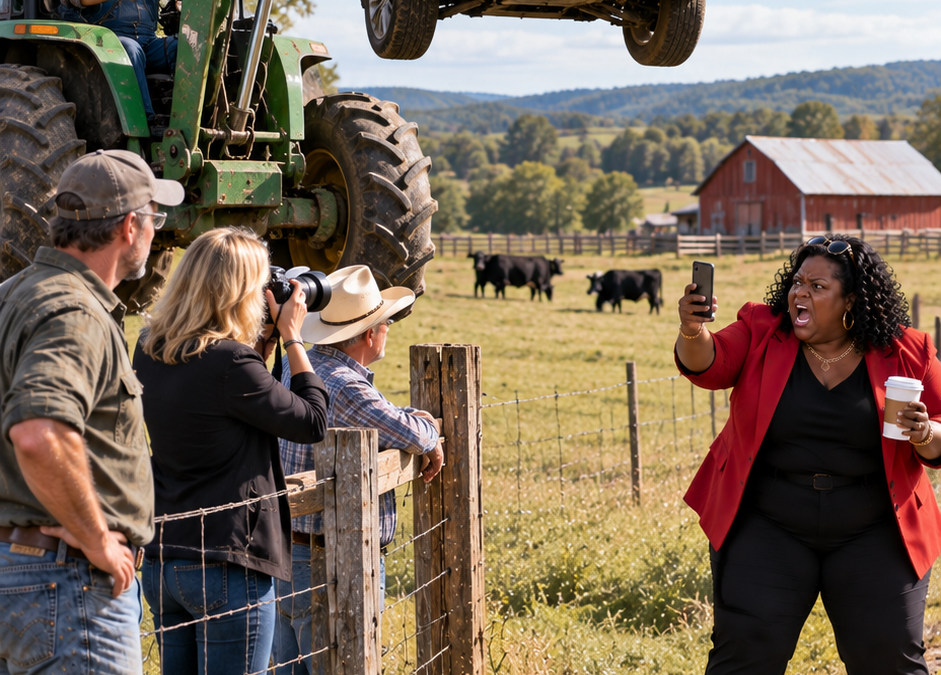
“That’s my car!”
She started running before the dust had settled.
Her phone was raised in one hand.
Somehow, she still held her coffee in the other.
“You destroyed my car!”
I walked toward the fence carrying a thick manila folder.
“You’re going to prison!”
She was already dialing.
“I’m calling 911 right now!”
I stopped inside my property line.
Karen reached the SUV.
It was sitting entirely beyond my fence now, on the public shoulder.
Crooked.
Dirty.
Very much no longer parked in my field.
She turned toward me.
“You can’t do this!”
For eleven weeks, she had said some version of that sentence every Saturday.
You can’t tell me where to park.
You can’t tow me.
You can’t photograph me.
You can’t harass me.
You can’t touch my car.
You can’t do anything to me.
That morning was the first time the words sounded less like a warning and more like something she was trying to convince herself of.
I opened the folder.
“Your vehicle was parked on private property without permission for the twenty-third documented time.”
“You launched it!”
“I removed it.”
“With a medieval weapon!”
“It is now sitting on the public road shoulder.”
I pointed.
“Parking is legal there.”
She stared at me.
Then at the vehicle.
Then back at me.
“I measured the property boundary twice.”
Her mouth opened.
Closed.
Opened again.
Then she turned back to the phone and began giving dispatch a version of events so dramatic that I barely recognized the morning I had just lived through.
I waited.
Fourteen years on a farm teaches patience.
You learn to wait for rain.
Wait for soil temperatures.
Wait for equipment parts.
Wait for animals to calm down.
Wait for people to finish proving exactly who they are.
Twelve minutes later, a sheriff’s cruiser turned off the county road.
Deputy Marsh.
I recognized him immediately.
He had already been to my farm twice.
Both visits involved the same white SUV.
He parked behind Karen’s vehicle.
Got out.
Looked at her.
Looked at me.
Then slowly looked past me toward the large wooden machine sitting near my barn.
He stared for several seconds.
Then looked back at me.
“Mr. Harlan.”
“Deputy.”
He rubbed his jaw.
“Walk me through what happened.”
I held out the folder.
“It’s all there.”
Karen stepped forward.
“Officer, he fired my SUV through the air!”
Deputy Marsh accepted the folder.
“Ma’am, I’ll get your statement.”
“This is felony destruction of property.”
“In a moment.”
“He built a catapult!”
Marsh opened the folder.
Ray leaned against my fence post.
He had been watching the dispute develop since the third week.
Now he worked a piece of hay between his teeth while Deputy Marsh began reading.
I want to make something clear before I tell you how a reasonably quiet farmer ended up standing beside something that looked like it belonged outside a castle.
I am not dramatic.
I do not enjoy conflict.
I did not spend my childhood dreaming about throwing luxury SUVs across property lines.
My father bought these forty acres in 1979.
Forty thousand dollars cash.
Everything he had.
And more than he probably should have risked.
The soil here is clay.
Heavy.
Stubborn.
When dry, it cracks.
When wet, it grabs your boots and refuses to let go.
My father spent thirty years making this farm productive.
I spent another fourteen learning that inheriting land and deserving land are not the same thing.
You earn that second part.
Year after year.
Fence after fence.
Harvest after harvest.
The southeast corner sits closest to the county road.
Half a mile farther down that same road is an old feed store.
Every Saturday between April and October, its parking lot becomes a farmers market.
Vegetables.
Honey.
Soap.
Bread.
Crafts.
People drive out from subdivisions to spend two hours enjoying what they call the country.
I have nothing against the market.
Some of those people stop at my roadside stand.
Business is business.
What I did not expect was that one woman would decide my southeast field was overflow parking.
The first time happened in late April.
Saturday morning.
I was repairing fencing on the north side when I noticed a white SUV near the county road.
Pearl paint.
Clean enough to reflect clouds.
The type of vehicle that looked personally offended by mud.
I walked toward it.
A woman was climbing out.
Mid-forties.
Expensive sunglasses.
Pressed jacket.
Carrying a canvas market bag.
“Morning.”
She glanced at me.
“Morning.”
“This is private property.”
She looked genuinely surprised.
Not guilty.
Surprised.
“I’m just going to the market.”
“You can’t park here.”
“I’ll be an hour.”
“That isn’t the issue.”
She looked around.
“There’s plenty of room.”
Forty acres.
Worked soil.
Irrigation lines.
Planted sections.
Fence posts.
Then she looked at me as though I had failed to appreciate the obvious.
“It’s just a field.”
I remember those words.
Just a field.
“Nobody’s using it.”
“I am.”
She gave me a patient little smile.
Then turned.
Walked toward the market.
I stood there beside her SUV.
One tire rested dangerously close to a planted row.
The engine ticked as it cooled.
I considered moving it myself.
Then decided against it.
People make mistakes.
Sometimes they misunderstand boundaries.
I finished the fence.
Pulled the notebook from my back pocket.
Wrote:
April 27.
9:08 a.m.
White SUV.
Plate number.
Southeast field.
My father taught me that.
Write it down.
He used to say:
“The things you write down, you can prove. The things you remember, you can only argue about.”
Karen returned an hour and twenty minutes later.
Got in.
Drove away.
No wave.
No apology.
I assumed that was the end.
The following Saturday, she returned.
Same corner.
Same SUV.
I reached her before she got far from the vehicle.
“Ma’am.”
She kept walking.
“We talked last week.”
“I know.”
“This is still private property.”
“I’ll just be a minute.”
She waved one hand.
Like I was a crossing guard who had become overenthusiastic about his authority.
Forty minutes later, she returned.
Smiled politely.
Drove away.
Week three, I installed signs.
NO TRESPASSING.
PRIVATE PROPERTY.
Heavy metal.
County-standard size.
One visible from each direction.
I set both posts in concrete.
Saturday morning, Karen parked directly beside one.
When I walked down, I found a sticky note pressed against the sign.
Neat handwriting.
NOT BLOCKING ANYTHING 🙂
Smiley face included.
I peeled the note off.
Put it into my notebook.
That was when this stopped being a parking mistake.
I used her license plate and publicly available county information to identify the registered owner.
Karen Prescott.
Address six miles east.
New development.
Large houses.
Small lots.
Decorative ponds.
Everything matching except the garage doors.
That evening, I wrote a formal trespass notice.
Three paragraphs.
My name.
Parcel number.
Property description.
Dates of prior incidents.
Vehicle plate.
Clear statement that she did not have permission to enter or park.
Clear statement that future unauthorized entry would be treated as trespass.
I had it notarized Monday.
Mailed it certified Tuesday.
Return receipt requested.
Thursday, Karen signed for it.
Her signature came back on the green card.
I put the card behind the sticky note.
Saturday morning, the white SUV returned.
Same place.
I stood on my porch watching for maybe thirty seconds.
Then called the county sheriff’s non-emergency line.
Deputy Marsh was the one who arrived.
He was younger than I expected.
Calm.
Friendly.
The expression of a man hoping the problem in front of him could be solved with two conversations and no paperwork.
I gave him the notebook.
Trespass notice.
Return receipt.
Photographs.
He walked over to Karen.
I remained at the fence.
I could hear pieces.
“I’ve been parking here for weeks.”
“This is private property.”
“I’m not blocking anything.”
“The owner has asked you not to.”
“It’s just for the market.”
Karen’s tone was warm.
Reasonable.
Almost amused.
A person listening from a distance might have assumed she and the deputy were discussing a harmless misunderstanding.
Marsh eventually returned to me.
“I spoke with her.”
“And?”
“She understands you don’t want her parking here.”
“Did you issue a written warning?”
He hesitated.
“It’s basically a civil property matter.”
“She signed a certified trespass notice four days ago.”
“I understand.”
“And came back anyway.”
“I understand.”
“I want a report.”
Marsh looked toward the market.
Then toward me.
Finally nodded.
He wrote a short incident report.
Not much.
But it had:
Date.
Case number.
Deputy signature.
That was enough for my folder.
Karen remained in her SUV until Marsh’s cruiser disappeared.
Then she opened the door.
Got out.
Locked the vehicle.
And walked toward the farmers market.
She had waited for law enforcement to leave before continuing the trespass they had just warned her about.
I watched her go.
Then went inside.
Made coffee.
Wrote everything down.
The next Saturday, Karen escalated.
She brought a folding chair.
Set it up ten feet from her SUV.
Inside my property.
Opened a magazine.
When I approached, she raised her phone.
“I’m recording.”
“So am I.”
“If you come near me or my vehicle, I’ll file harassment charges.”
“You are sitting on my farm.”
“This is a public-access area.”
“No.”
“My attorney says—”
“This is private land.”
“If you intimidate me, I will call police.”
I stopped.
Looked at her.
A folding chair.
Magazine.
Phone.
Inside my property.
And somehow, in Karen’s version of events, I was harassing her.
I turned around.
Went back to the farmhouse.
Set up my own camera.
Recorded twenty minutes.
SUV.
Chair.
Signs.
Property line.
Karen reading.
When she left, I wrote the incident into the notebook.
That evening, my phone rang from an unfamiliar number.
Male voice.
“My wife tells me you’ve been aggressively confronting her.”
“Who is this?”
“You know who.”
I actually did not.
Then:
“We know people in this county.”
That clarified things.
“You should back off.”
I looked at the time.
Wrote it down while he was talking.
“I’m documenting this call.”
Pause.
“I’d suggest you stop harassing my wife.”
“She is repeatedly trespassing on private farmland.”
“It isn’t hurting you.”
“That doesn’t matter.”
“You’re making a mistake.”
“Have a good evening.”
I ended the call.
Wrote the number into the log.
Time.
Date.
Summary.
Six weeks in, I had:
Signs.
Formal notice.
Signed delivery receipt.
Sheriff report.
Photos.
Video.
Phone threats.
None of it changed Karen’s behavior.
So I spoke to my neighbors.
Ray Kowalski owns the farm north of mine.
Forty acres.
Twenty-two years.
We are not close in a social sense.
We do not go out for dinner.
But when a storm damages his west fence, I help.
When my irrigation pump freezes, Ray has parts.
Farm neighbors have their own language.
I described Karen’s vehicle.
He nodded before I finished.
“White SUV?”
“Yes.”
“Pearl paint?”
“Yes.”
“Cracked mud flap on the right rear?”
I stared.
“You know her?”
“Parked against my east fence twice last summer.”
“What did you do?”
“Asked her to move.”
“And?”
“She eventually did.”
“You didn’t report it?”
Ray shrugged.
“Wasn’t worth the trouble.”
I looked at him.
“I think she counts on that.”
He chewed the inside of his cheek.
“You need a witness, come get me.”
Dale Pritchard farmed three-quarters of a mile south.
Same story.
He had seen her.
Did not engage.
Too much hassle.
That week, I drove to the county recorder.
Requested a certified copy of my deed.
The southeastern boundary was exactly where I knew.
My land extended fifteen feet inward from the public road shoulder.
Karen was not parking in a right-of-way.
She was not confused by some fuzzy edge.
She was well inside my parcel.
I hired a licensed surveyor.
Three hundred eighty dollars.
He marked the boundary with bright steel stakes.
Orange tops.
Visible from the road.
Signed survey report.
Official letterhead.
I added both to the folder.
Then I paid for an hour with a property-rights attorney.
He reviewed everything.
“You’ve done this properly.”
“That’s what I needed to know.”
“You own the land.”
“Yes.”
“You’ve given formal notice.”
“Yes.”
“She signed.”
“Yes.”
“Then have the vehicle towed.”
“Legally?”
“From your property, yes, assuming local towing rules are followed.”
The next Saturday, I arranged it.
Hendricks County Towing.
Bud drove the truck.
Quiet man.
Toothpick.
Asked almost no questions.
He reviewed my authorization.
Survey.
Deed.
Karen arrived at 9:15.
Parked.
Walked away.
At 9:47, Bud connected the SUV and removed it.
When Karen returned around 11:30, the corner was empty.
Bud had left his business card where her tire had been.
I watched from the porch.
She found the card.
Read it.
Stared at the field.
Then called someone.
It cost four hundred dollars to retrieve the SUV.
I learned that because Bud called to confirm release.
I wrote it in the folder.
Surely, I thought, four hundred dollars would accomplish what courtesy had not.
Four days later, the county mailed me a noise complaint.
My farm equipment was allegedly operating excessively during early hours.
Complainant:
Karen Prescott.
I had run the same diesel tractor during legal hours for fourteen years.
No complaints.
Now one appeared four days after the tow.
I put it in the folder.
Retaliation leaves dates.
Saturday arrived.
Karen returned.
Same white SUV.
Same field.
She had paid four hundred dollars and apparently decided the towing fee was simply the price of parking.
Week seven.
Incident fourteen.
By week eight, things became uglier.
Two vehicles arrived.
Karen’s SUV.
Dark green sedan.
Her husband.
They drove over the orange survey stakes.
One was flattened into the ground.
Another bent.
I walked down carrying my phone.
Karen’s husband stepped between me and the cars.
I recognized the voice immediately.
“We know people.”
He was taller than me.
Broad.
Standing in that particular square posture some men use when they think body mass settles property law.
“You’ve been harassing my wife.”
I said nothing.
Photographed him.
Photographed Karen’s tire beside the damaged stake.
Photographed the sedan.
Photographed the flattened marker.
Photographed the tire tracks cutting through the crop edge.
“Touch her car,” he said, “and we’ll have you charged with assault.”
“I am recording damage to my property.”
He stepped closer.
I stepped backward.
Kept filming.
“Please step away.”
Something about the camera convinced him.
He stopped.
I had already called Bud.
He arrived twelve minutes later.
Karen had learned a new tactic.
She stood against the back of her SUV.
Hands physically touching the vehicle.
Bud inspected the scene.
Then looked at me.
“Can’t safely hook it while she’s touching it.”
“I know.”
Karen smiled.
First genuine smile I had seen from her.
Bud opened his tow log.
I said:
“Write that you were unable to remove the vehicle because the owner intentionally remained in physical contact with it.”
He did.
I photographed the entry.
Bud left.
Karen watched him go.
Then walked toward the market.
That afternoon, I called the sheriff again.
Different deputy.
Older.
Tired before he got out.
I showed him the survey stakes.
Crop damage.
Repeated trespass.
A local contractor had estimated:
$340 to replace survey markers.
$860 in crop-edge damage and soil restoration.
$1,200 total.
The deputy wrote.
Then sighed.
“You’re probably looking at small claims.”
“I know.”
He noticed the folder.
“You’ve been documenting everything?”
“Every incident.”
He nodded.
“Keep doing that.”
After he left, I stood in the field.
Eleven weeks.
Signs failed.
Certified notice failed.
Sheriff failed.
Tow failed.
Survey failed.
Another sheriff report.
Attorney advice.
Nothing.
Karen had discovered a simple truth.
Most systems require the victim to keep spending time and money.
The trespasser only needs enough stubbornness to return.
Every wall I put in front of her was made from paper.
That night, I went into the barn.
Not angry.
Anger had burned itself out weeks earlier.
What remained was something quieter.
I found a napkin on the workbench.
A pencil.
And started sketching.
I am not going to explain how I constructed what eventually came out of that barn.
It is enough to say I understood farm timber, heavy machinery, leverage, and the difference between an idea that looks impressive on paper and one that should never be attempted casually.
What I built was absurd.
Deliberately absurd.
A giant trebuchet.
Not because that was the first solution.
Because it was what remained after I had spent eleven weeks trying every ordinary solution I could find.
While I was working in the barn, Karen filed a harassment petition against me.
The papers arrived three weeks later.
Her claim described me as repeatedly confronting and intimidating her in a “public access area adjacent to his property.”
Adjacent.
That word was doing serious work.
She requested an order preventing me from approaching her while she was “parked near the road.”
In other words, Karen wanted judicial protection allowing her to continue parking on my land.
I put the petition in the folder.
During the weeks before the hearing, she parked two more times.
Incidents twenty-one and twenty-two.
Photographs.
Dates.
Times.
The magistrate’s courtroom was small.
Wood paneling.
Plain benches.
Karen brought her husband and two friends.
Character witnesses.
She announced that before anyone asked.
The magistrate was a woman in her sixties.
Reading glasses hanging from a beaded chain.
Expression of someone who had heard every possible version of neighborhood madness.
She reviewed Karen’s petition.
Then:
“Mr. Harlan?”
I opened the folder.
Certified deed.
Survey.
Trespass notice.
Karen’s signature.
Sheriff report.
Tow documentation.
Property-damage report.
Photographs.
I placed each item down.
Slowly.
The magistrate studied them.
Karen’s husband shifted.
One of her friends stopped smiling.
Finally, the magistrate looked toward Karen.
“Were you aware the area was privately owned?”
“It looks like empty land.”
“That isn’t my question.”
Karen’s face tightened.
“I didn’t see any—”
“You signed this.”
The magistrate held up the return receipt.
“A certified notice advising you that the land was private and instructing you not to park there.”
Silence.
Karen began:
“It’s unreasonable for one person to control that much unused—”
“Case dismissed.”
Karen stood so fast her chair scraped.
“This is not over.”
The magistrate looked toward her.
“Ma’am.”
“I’ll go to zoning. His equipment runs at five in the morning.”
Her husband touched her arm.
“This is not over,” she said to me.
I returned the documents to the folder.
Walked out.
In the parking lot, Karen was already on her phone.
I drove home.
Saturday morning, she returned with three cars.
That was incident twenty-three.
SUV.
Green sedan.
Silver minivan.
They brought folding tables.
Cooler.
Bluetooth speaker.
They spread out in my southeast field like they were tailgating before a football game.
That was the moment I understood the magistrate’s dismissal had not embarrassed Karen.
It had emboldened her.
She interpreted every consequence she survived as proof consequences were fake.
I watched from my kitchen window.
Then looked toward the barn.
The doors were closed.
Inside sat the strangest piece of farm equipment I had ever made.
I had tested it carefully with inert farm loads.
I had also spent those weeks verifying exactly where my private property ended and the county shoulder began.
Ray and Dale agreed to come the following Saturday.
I invited Claire, a freelance reporter who covered rural land and county issues.
I told her only:
“There might be a property-rights story.”
She asked whether she should bring a camera.
“Yes.”
The final Saturday arrived.
9:47 a.m.
Karen’s SUV came down the road.
Same speed.
Same corner.
The motion had become ritual.
She turned onto my field like someone pulling into her own driveway.
Got out.
Coffee.
Market bag.
She ignored the trespassing signs.
Then noticed Ray.
Then Dale.
Then Claire.
Finally, she looked toward the open barn.
Her coffee lowered slightly.
The trebuchet stood outside.
Large.
Ridiculous.
Impossible to mistake.
I walked toward her.
“Karen.”
“What is that?”
“Step away from your vehicle.”
Her eyes moved between me and the machine.
“Are you insane?”
“Your vehicle is trespassing for the twenty-third documented time.”
“This is harassment.”
“Step away from the vehicle.”
She did.
Not because she suddenly respected me.
Because she did not understand what was happening.
For once, uncertainty beat entitlement.
I walked back.
Activated the machine.
And seconds later, the white SUV was no longer sitting on my field.
The rest you already know.
Karen screamed.
Called police.
Deputy Marsh arrived.
And I handed him the folder.
He read:
Incident One.
Incident Two.
Signs.
Sticky note.
Certified notice.
Her signature.
Sheriff warning.
Tow.
Noise complaint.
Survey.
Destroyed stakes.
Property damage.
Second sheriff report.
Magistrate dismissal.
Then the full log.
Twenty-three pages.
One for each incident.
Photograph.
Date.
Time.
Location.
Plate.
Distance inside my property.
Marsh turned pages slowly.
Karen tried interrupting.
“Officer, my vehicle was airborne.”
“I understand.”
“He could have killed somebody.”
“No one was in the vehicle.”
“That doesn’t matter.”
“It matters.”
“He destroyed it.”
Marsh continued reading.
Then:
“Mr. Harlan, where did the vehicle land?”
“Public shoulder.”
“You confirm?”
He walked toward it.
Checked the survey references in my folder against the markers.
Walked back.
Karen was calling her attorney.
We heard her explanation.
At first fast.
Angry.
Certain.
Then she went quiet.
Someone on the other end spoke for a long time.
Her shoulders lowered.
When the call ended, her face was different.
Not defeated.
Not yet.
But informed.
That was new.
Deputy Marsh closed the folder.
“Ma’am.”
Karen looked up.
“This property owner has documented repeated trespass beginning with formal written notice that you personally signed.”
She started to object.
He held up one hand.
“There are twenty-three incidents here.”
“The car—”
“The vehicle was removed from confirmed private property.”
He paused.
“I’m not making an arrest today.”
Karen stared.
“You’re letting him get away with this?”
“I’m telling you what I’m doing.”
Then Marsh looked at me.
“I strongly suggest no one repeat anything remotely like this.”
“Understood.”
He looked back at the machine.
“Very strongly.”
Ray started clapping.
Slow.
Deliberate.
Claire lowered her camera long enough to smile.
Dale walked toward me.
Held out his hand.
I shook it.
We said nothing.
Monday morning, the county attorney’s office called.
I expected trouble.
Instead, a woman asked me to confirm basic details.
She had reviewed Marsh’s report.
The documented history.
Trespass notice.
Survey.
Prior court dismissal.
Then she said:
“The office is not pursuing criminal charges against you arising from this incident.”
I sat down.
She continued.
“Our review recognizes the landowner’s established right to remove an unauthorized vehicle from private property, though obviously the method here is extraordinary.”
“That’s fair.”
“The vehicle was unoccupied.”
“Yes.”
“And it came to rest in the public right-of-way.”
“Yes.”
“Then you are not the prosecution priority in this matter.”
I thanked her.
Recorded the disposition in my folder.
Made coffee.
Sat quietly.
The adrenaline I had been carrying for eleven weeks finally had somewhere to go.
Karen was not finished.
The following week, she filed a civil action herself.
No lawyer.
She wanted $3,400.
Undercarriage damage.
Two cracked rims.
Mounting damage.
The filing had handwritten corrections.
The hearing occurred three weeks later.
Same magistrate.
Same courtroom.
This time Karen arrived alone.
No husband.
No friends.
No witnesses.
I carried the same folder.
The magistrate recognized us.
“This is the same property dispute?”
“Yes, ma’am.”
She read Karen’s claim.
Reviewed the earlier harassment dismissal.
Reviewed the trespass record.
Then set the pages down.
“Dismissed with prejudice.”
Karen’s face tightened.
“Filing costs assessed to plaintiff.”
Then the magistrate added:
“Ms. Prescott, I strongly recommend you let this matter end.”
Karen did not answer.
She collected her papers.
Left.
No final threat.
No “this isn’t over.”
Just the door closing.
I drove home past the farmers market.
Something had changed.
The market association had leased an actual parking field beside the old feed store.
Hand-painted signs directed traffic.
A teenager sat behind a folding table collecting three dollars per car.
Three dollars.
That was all proper parking cost.
All along.
Thirty cars were lined neatly inside the rented area.
Nobody parked on my farm.
Claire’s story had run two weeks earlier.
The headline mentioned a rural landowner, repeated trespass, and an unusual property-rights dispute.
The market board apparently did not want a sequel.
Karen never returned.
Ray called the following week.
“Got a vehicle at my south fence.”
“Same one?”
“No.”
“What happened?”
“Asked him to move.”
“And?”
“He said he would next time.”
“That sounds familiar.”
“I’m writing the letter.”
“Good.”
“Needs notarizing?”
“I would.”
He paused.
“Still have that machine?”
I looked through the barn window.
“Still standing.”
“Good.”
He hung up.
Two weeks later, Karen’s husband called me from a new number.
I recognized him immediately.
I said:
“This call is being recorded. Today is—”
He hung up.
I added the call log to the folder.
October brought one last piece.
My small-claims case.
I had filed for the damage Karen’s repeated driving caused.
Survey stakes:
$340.
Crop-edge soil and yield damage:
$860.
Total:
$1,200.
Karen did not appear.
Default judgment.
Full amount.
The check arrived several weeks later.
I deposited it.
Used it to offset the survey cost, consultation, repairs, and towing-related expenses.
After eleven weeks of absurdity, the final math left me roughly even.
I considered that a victory.
In November, I replaced the damaged survey stakes.
Deeper this time.
Bright reflective tape.
Visible from both directions.
Then I worked the damaged corner.
Broke the compacted soil.
Turned it.
Let winter do the rest.
Spring came.
I planted sweet corn.
Six rows.
Right where Karen had parked.
The same dirt she had called “just a field.”
The same strip where her tires had pressed the ground hard enough to stop anything from growing properly.
The corn emerged in straight green lines.
By early summer, it was knee high.
Then waist high.
Then tall enough that from the county road you could no longer see the place where her SUV used to sit.
I left the trebuchet standing.
For a while, I thought about dismantling it.
It was ridiculous.
A reminder of a dispute that had consumed nearly three months of my life.
But it was tucked far enough inside the farm that it did not interfere with anything.
So I left it.
The wood weathered.
The metal dulled.
It became part of the landscape.
Nobody parks there now.
Every Saturday when the market opens, I take coffee to the fence.
Cars pass.
Turn into the official lot.
Three dollars.
People park.
Shop.
Leave.
Simple.
Sometimes someone recognizes me from Claire’s article.
They slow down.
Look toward the barn.
Look toward the corn.
I pretend not to notice.
Ray still jokes about the whole thing.
“You should charge admission.”
“No.”
“Photos?”
“No.”
“Trebuchet rides?”
“Absolutely not.”
He laughs.
Then usually asks about rainfall or seed.
Farm conversations return to normal quickly.
That is what I wanted.
Normal.
Not revenge.
Not fame.
Not being the farmer people pointed at because he threw an SUV.
I wanted my southeast field back.
The strange thing is that if Karen had listened on the first Saturday, none of this would have happened.
I said:
“This is private property.”
That was all.
Five words.
She could have answered:
“Sorry.”
Moved.
Paid nothing.
Lost nothing.
Instead, she looked at forty acres and decided quantity canceled ownership.
She saw empty space.
Not someone’s property.
That distinction is common.
People think land is unused because they cannot see someone actively standing on every square foot.
But farmland is not a parking lot waiting for cars.
Soil compacts.
Crops get damaged.
Access gets blocked.
Irrigation lines get crushed.
Fences matter.
Boundaries matter.
My father understood that better than anyone.
He used to walk this property every Sunday morning.
Sometimes we went together.
He would stop at corner posts.
Shake them.
Check wire tension.
Look for erosion.
When I was young, I thought he was obsessive.
Then one day he told me:
“A boundary you don’t maintain becomes a boundary somebody else decides.”
I did not understand then.
I do now.
Karen had not taken acres.
She took one corner.
A place big enough for a vehicle.
That was how it started.
But every week she returned, the argument became larger.
First:
Can I park here?
Then:
Can you stop me?
Then:
Will the sheriff stop me?
Then:
Can you tow me?
Then:
Can I block the tow?
Then:
Can I accuse you of harassment for objecting?
Every unanswered act rewrote the boundary in her mind.
By week eleven, she was not testing whether she could park.
She believed she had earned the right to.
That may be the most dangerous form of entitlement.
The kind that mistakes tolerated wrongdoing for permission.
I tolerated the first mistake.
Then I documented everything after.
That folder remains on the shelf above my father’s old farm records.
It is thick.
Probably thicker than it needs to be.
Inside:
Sticky note.
Certified return receipt.
Trespass notice.
Sheriff reports.
Survey.
Photographs.
Tow receipt.
Noise complaint.
Damage estimate.
Harassment petition.
Dismissal.
Twenty-three incident sheets.
County attorney disposition.
Civil dismissal.
Small-claims judgment.
Every page tells the same story in smaller pieces.
One person kept saying no.
The other person kept pretending not to hear it.
My father would have approved of the folder.
He would not have approved of the trebuchet.
At least that is what I tell myself.
Ray disagrees.
“You know your dad.”
“I did.”
“He once moved a broken combine with two tractors, a logging chain, and what I’m pretty sure was pure spite.”
“That was different.”
“How?”
“It was his combine.”
Ray grinned.
“Your field.”
Fair enough.
Still, I do not romanticize what happened.
There were easier outcomes.
Better ones.
Karen could have stopped.
The deputy could have taken the first trespass report more seriously.
The market could have arranged proper overflow parking earlier.
The tow might have ended it.
The magistrate dismissal should have ended it.
There were twenty-two separate opportunities before incident twenty-three.
That is why the final morning felt less like escalation and more like the end of a long equation.
People who heard only the last part thought I lost my mind.
Farmer builds giant catapult and launches woman’s SUV.
That headline makes me sound unhinged.
If you begin at Saturday number one, the story feels different.
Not sensible.
Still absurd.
But understandable.
Context matters.
The machine itself was only the loudest sentence in an eleven-week conversation.
The quieter sentences were better.
PRIVATE PROPERTY.
PLEASE MOVE.
NO TRESPASSING.
FORMAL NOTICE.
SIGNED RECEIPT.
SHERIFF REPORT.
BOUNDARY SURVEY.
TOW AUTHORIZATION.
COURT DISMISSAL.
Those should have been enough.
They were not.
After the final court case ended, I saw Karen once.
Maybe two months later.
Grocery store in town.
Different parking lot.
She was pushing a cart.
I was carrying feed supplements.
We saw each other from opposite ends of an aisle.
She froze.
So did I.
For a second, I thought she might say something.
She did not.
Neither did I.
She turned her cart.
Went the other direction.
That was fine.
There are people you need closure from.
Karen was not one of them.
Closure was corn growing in the southeast corner.
Closure was a Saturday market operating without anyone using my field.
Closure was Ray calling to ask whether he should notarize a trespass letter instead of simply accepting someone on his land.
Closure was the sheriff driving past without turning in.
Closure was not checking my porch every Saturday morning for a white SUV.
That first quiet Saturday felt strange.
I woke early.
Made coffee.
Walked outside.
Around nine, market traffic increased.
Sedans.
Minivans.
Pickup trucks.
Karen’s SUV never appeared.
I stood there longer than necessary.
Waiting for something I no longer wanted to happen.
Then eventually understood:
She was not coming.
I went back to work.
Farm life does not care about symbolic moments for long.
A pump needed servicing.
Fence needed tightening.
Weather report suggested rain.
The ground demanded attention.
That helped.
Months later, the southeast corn was nearly ready.
I walked those six rows one evening.
Ran my hand across the leaves.
The soil underneath had recovered.
Soft enough again.
Living.
The survey posts stood bright at the roadside.
Behind them, public shoulder.
Beyond that, county pavement.
Clear.
Private here.
Public there.
No argument.
The trebuchet stood thirty feet behind me.
Silent.
Finished.
I wondered whether I should finally dismantle it.
Then Ray’s truck slowed on the road.
He rolled down his window.
“Taking it apart?”
“Thinking about it.”
“Don’t.”
“Why?”
He looked toward the farmers market.
Then back at the machine.
“Signage.”
I laughed.
He drove on.
Maybe he was right.
The old NO TRESPASSING signs are still there.
So are the survey posts.
Those should be enough.
But behind them stands one additional reminder that this particular farmer eventually runs out of paperwork.
Nobody has tested the theory.
I am grateful for that.
The farmers market added more parking the following season.
Five dollars now instead of three.
Inflation.
Still cheaper than a tow.
Much cheaper than what Karen spent.
When people ask me whether I regret what happened, the answer is complicated.
I regret that it reached that point.
I regret the time.
The money.
The sheriff calls.
The court hearings.
The damage to my soil.
I regret eleven Saturdays spent watching someone challenge a boundary that never needed to be challenged.
But I do not regret protecting the farm.
Forty acres may look large from the road.
To me, every piece has a history.
My father’s hands are in these fence lines.
His decisions are in the drainage.
His mistakes are buried under newer repairs.
The southeast corner may have looked empty to Karen.
It was not empty to me.
It never was.
The first Saturday, she said:
“It’s just a field.”
The last spring after everything ended, I stood in that same corner surrounded by six rows of corn.
Wind moved through the leaves.
The plants made that dry whisper corn makes once it gets tall.
I looked toward the road.
Cars passed.
Nobody turned in.
Then I looked back toward the machine in the grass.
For eleven weeks, Karen had believed patience meant permission.
That silence meant surrender.
That every system she ignored would eventually tire before she did.
She was almost right.
The system did get tired.
So did I.
But the land remained mine.
That was the one fact she never managed to wear down.
And in the end, every court paper, survey marker, deputy report, and absurd piece of farm-built machinery said the same thing my father had taught me years ago:
A boundary only works if somebody is willing to keep it.








