𝗙𝗨𝗟𝗟 𝗦𝗧𝗢𝗥𝗬 Karen Called Police Over My Driveway — Then She Was Summoned to MY Command Office
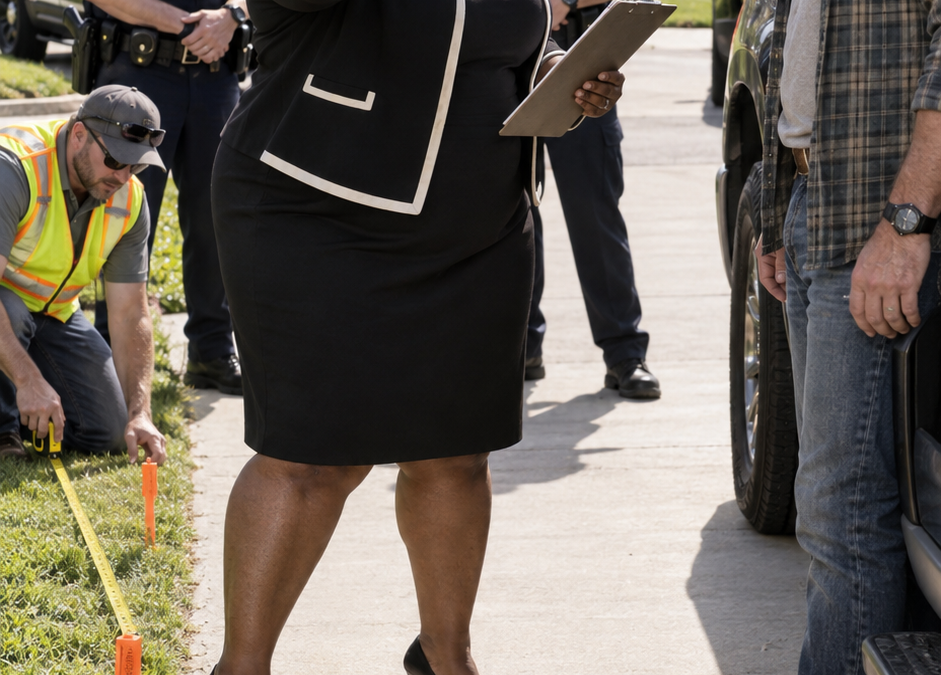
𝗙𝗨𝗟𝗟 𝗦𝗧𝗢𝗥𝗬
The secretary wrote something down.
The officer handed me a card.
“If you have documentation concerning the boundary, contact us through the number here.”
“Thank you.”
Karen had already turned away.
Back to her surveyor.
She didn’t say goodbye.
As far as she was concerned, the matter had been handled.
I watched the cruisers leave.
Then stood alone in my driveway.
Six orange stakes.
One orange-bordered notice.
One supposedly official survey reference.
HC201907.
I photographed that number one more time.
Reference.
Date.
Signature.
All visible.
The kind of photograph you could print as an exhibit without needing someone to explain what it showed.
Karen had called the police on a man whose name appeared on federal orders that could make half the people she knew stand at attention.
But I wasn’t going to tell her that.
Not while she was still comfortable.
Not while she was still creating evidence.
I went inside.
Set my phone on the kitchen counter.
Opened the county recorder’s online portal.
Typed:
HC201907.
Search.
Zero results.
I checked the formatting.
Tried again.
Nothing.
Searched the parcel.
No such document.
Searched HOA easements.
Nothing.
The county recording system contained every deed, recorded survey, easement, lien, covenant, and boundary instrument associated with our development.
If HC201907 legally existed, it should have been there.
It wasn’t.
I sat back.
The police complaint referenced a document that did not exist.
Karen’s notice referenced the same document.
The survey stakes were supposedly based on it.
She had used it in front of law enforcement.
That was no longer just HOA arrogance.
That was something else.
And Karen had no idea I had already checked.
The subdivision had ninety-six homes.
I knew because I had read the incorporation documents after I moved in.
Twelve years old.
The HOA apparently started normally.
Dues.
Common landscaping.
Neighborhood disputes handled by conversation.
Then Karen Trumbull became president.
Eight years before I arrived.
I could never find evidence of a truly competitive election during those eight years.
Karen controlled nominations.
Existing board members approved replacements.
Four seats around her.
All occupied by people she had personally selected.
Monthly dues were $340.
I paid mine.
Always on time.
What happened to the money was less obvious.
The previous fiscal report showed approximately $41,000 in fine revenue.
A lot for ninety-six houses.
But the expense side did not show corresponding neighborhood improvements.
That caught my attention.
So did Karen’s enforcement process.
Once I started looking, I saw the pattern.
Karen used a private “surveyor.”
His invoices called the company Certified Land Services.
Later, I learned his credentials were not active with the state licensing board.
He would show up.
Drive orange stakes into someone’s yard.
Measure.
Take photographs.
Then issue a report with a reference number designed to resemble a county recording number.
Karen would use that report to support whichever pressure point worked best.
Police complaint.
City complaint.
HOA fine.
Lien threat.
Sometimes all four.
Most homeowners never checked.
Why would they?
They saw orange stakes.
A surveyor.
A document number.
Police.
Official letters.
They assumed the system had already decided the issue.
At least two families had paid Karen’s HOA before me.
One paid $1,800.
Another $2,200.
Neither had checked whether the “survey documents” Karen cited were actually recorded.
Then there were Robert and Eleanor Henderson.
Seventy-two and seventy.
They had owned their home twenty-two years.
Longer than the HOA existed.
Eleanor grew flowers along the front walkway.
Robert had placed a small border of decorative stones around the bed.
Six inches high.
Nothing structural.
Karen cited them for unauthorized hardscape.
The fine ran for fourteen months.
$2,800.
They could not afford a property lawyer.
Their son told them a legal fight might cost more than simply paying Karen.
So they waited.
Stopped adding anything to the garden.
Eleanor stopped planting the flowers she liked because she didn’t want to give Karen another reason to inspect the yard.
Imagine living somewhere twenty-two years and suddenly walking through your front garden as if you’re trespassing in somebody else’s property.
Robert told me once:
“We don’t want trouble.”
I told him:
“You already have trouble. You just didn’t cause it.”
I moved into the subdivision fourteen months before Karen staged the police visit.
For my first two months, nothing happened.
I paid dues.
Kept the lawn trimmed.
Introduced myself to the neighbors.
Stayed quiet.
That is my preference.
Then Karen noticed my truck.
Full-size government pickup.
Federal plates.
Installation decals.
Assigned to me.
Authorized for residential parking.
Three weeks after I moved in, I found a handwritten note in my mailbox.
Karen’s personal stationery.
She described the truck as a “large commercial-appearing vehicle with nonstandard plate designation” potentially violating aesthetic standards.
I pulled the bylaws.
Section Four, Paragraph Three.
Personally assigned vehicles were explicitly permitted in private driveways.
No size restriction.
I wrote back.
Cited the section.
Thanked her for her concern.
Karen never replied.
For two months, nothing.
I thought the issue was dead.
I misunderstood her.
Karen’s silence was not acceptance.
It was research.
The truck angle failed.
So she searched for another.
The driveway gave her more room.
Property lines.
Surveys.
Reference numbers.
Police reports.
Complicated enough that an ordinary homeowner might surrender before checking.
Five days after the cruisers appeared, certified mail arrived.
HOA letterhead.
Karen’s name.
Three pages.
Unauthorized driveway expansion into common easement.
$1,200 initial fine.
Daily penalty:
$150.
Thirty-day projection:
$5,700.
Sixty days:
$10,200.
Ninety:
$14,700.
And there it was again.
HC201907.
The nonexistent survey.
I kept everything.
Envelope.
Certified-mail sticker.
Notice.
Accrual table.
Signature block.
Board secretary’s countersignature.
Photographs.
Two days later, Karen came to my front door.
The board secretary stood behind her in the same position she had taken on the driveway.
Pen ready.
Karen handed me another document.
“Ten days.”
“No good morning?”
She ignored that.
“Ten days to engage a licensed contractor and begin removal of the encroaching section of driveway.”
I looked at the attached contractor referral sheet.
“If not, we file the lien.”
She looked directly into my eyes.
“This is not a negotiation.”
I read the first page.
Then looked at her.
“I’ll review these documents and respond through the appropriate channels.”
She paused.
That phrase bothered her.
“There’s nothing to review.”
“I understand your position.”
“The survey is clear.”
“I heard you.”
“Ten days.”
I nodded.
Karen stood there another moment.
Waiting for anger.
Or surrender.
She got neither.
The board secretary’s pen hovered.
Nothing to write.
Karen turned.
They walked away.
I closed the door.
That evening, I submitted a formal county records request.
Three things.
Original subdivision plat.
My lot deed with certified boundary dimensions.
Complete recorded easement search.
Public documents.
Anyone could request them.
Most homeowners never think to.
That was Karen’s business model.
Make the challenge look harder and more expensive than paying her.
Two days later, the city zoning department mailed me a notice.
Complaint alleging unpermitted hardscape.
Filed by:
Karen Trumbull.
Now she had opened a second front.
HOA enforcement.
City zoning.
Both referencing the same alleged encroachment.
I added the zoning letter to the file.
Then called a colleague at my installation.
His work involved property matters, land-use issues, and legal coordination affecting installation personnel.
I read him the reference number.
“Say that again.”
“HC201907.”
“County survey?”
“Supposedly.”
“You checked?”
“Nothing.”
“Get the certified plat.”
“Already requested.”
“Good.”
Three days later, the county records arrived.
I spread them across the kitchen table.
The original subdivision plat predated the HOA by four years.
County seal.
Licensed surveyor.
Every lot line recorded.
I found my parcel.
Then my driveway.
The legal boundary sat 4.2 feet beyond the edge Karen’s surveyor had staked.
Not four inches.
Four-point-two feet.
The orange stakes were completely inside my property.
No common easement.
No HOA ownership.
No disputed strip.
Nothing.
I checked the deed.
Same.
Then the easement search.
Nothing touching my driveway.
I searched HC201907 again.
Nothing.
Karen’s entire case rested on a document that had never existed.
She had cited it to police.
City zoning.
Certified mail.
Potential lien enforcement.
Her private surveyor had cited it.
Every piece of pressure rested on the same fabricated foundation.
Then I pulled the HOA’s own founding survey.
No easement.
No common land claim.
Karen’s own organization contradicted her.
Two official surveys.
Zero support.
One fake number.
While I was still sitting at the table, Marcia knocked.
She lived two houses away.
Sixty-three.
Recently widowed.
I’d noticed her watching through the window when the cruisers were outside.
She came through the side door instead of the front.
That told me something.
People who feel safe in their neighborhoods use front doors.
Marcia sat at my table.
“She did this to me.”
“What?”
“The stakes.”
Three years earlier.
Police complaint.
Encroachment allegation.
Fine.
Lien threat.
Ten-day remediation notice.
Different document number.
Same format.
Her son had spoken with a lawyer.
The lawyer explained that challenging it could cost more than paying.
So Marcia paid Karen’s HOA $2,200.
She had kept every document.
She pushed a folder toward me.
Fine notice.
Lien warning.
Payment confirmation.
Photographs.
Survey reference:
HC201714.
I searched it.
Zero.
Marcia stared at the screen.
Then whispered:
“She knew.”
“What?”
“She knew nobody would check.”
Two days later, the Garcias called.
Same sequence.
Orange stakes.
Complaint.
Fine.
Lien threat.
They paid $1,800.
Their reference number also did not exist.
Now I had three cases.
Mine.
Marcia.
Garcias.
$4,000 already extracted from two households.
And the Hendersons still facing $2,800.
This was no clerical mistake.
It was a method.
I built a packet.
Certified plat.
HOA founding survey.
County statement confirming no HC201907.
Marcia’s documents.
Garcia documents.
My notice.
Photographs.
Certified-mail receipts.
Then I forwarded it to installation counsel for formal review.
The response came the next day.
Precise.
Measured.
Enough to end my own case immediately.
But that was the problem.
I could win for myself.
File the certified plat.
Invalidate the lien.
Karen would move to somebody else.
Marcia’s $2,200 would stay gone.
The Garcias’ $1,800 would stay gone.
The Hendersons would keep avoiding their own garden.
Quiet victory would protect me.
It would not stop her.
I needed a setting Karen could not control.
Not her clubhouse.
Not a board she selected.
Not a meeting where she could declare an issue closed by four votes.
I needed real records.
Real authority.
And a room where Karen would not know what she had walked into until the door was already closed behind her.
Before I could set that in motion, Karen escalated again.
I was at work when my security system alerted.
10:47 a.m.
Driveway motion.
I opened the camera feed.
Contractor pickup.
Skid steer.
Concrete-breaking equipment.
Two men in orange vests.
Karen on the sidewalk.
Her original stakes were still in place.
The workers were using them as their demolition line.
I called Marcia.
“Can you go outside?”
“What happened?”
“There’s a demolition crew at my house.”
“What?”
“Ask the foreman what authority they’re operating under.”
Three minutes later, she called back.
Work order.
Signed by Karen.
Removal of unauthorized hardscape encroaching on HOA common easement.
Reference:
HC201907.
No city permit.
No court order.
No homeowner authorization.
Karen had sent machinery to break apart my driveway using a document she had invented.
I left the installation.
No drama.
No speeding.
I parked normally.
Started recording before getting out.
Karen was six feet into my driveway.
Pointing at the concrete.
I walked to the crew leader.
“Do not touch my property.”
He turned.
“You have no permit, no court order, and no permission from the owner.”
Karen stepped toward my phone.
She spoke directly into the camera.
“The HOA authorizes this.”
I said nothing.
“I have full authority as HOA president.”
Still recording.
“This is HOA land, and I am acting within my legal mandate.”
Clear.
Deliberate.
Timestamped.
She believed the recording helped her.
I let her finish.
Then asked the crew leader to step aside.
“The work order references HC201907.”
He looked down at the sheet.
“Yes.”
“That document does not exist in county records.”
He looked at me.
“I have a certified plat showing this driveway sits 4.2 feet inside my recorded boundary.”
I held the document where he could see it.
“There is no common easement.”
I pointed toward the skid steer.
“If you break this concrete without a court order or city permit, your company could be liable for destruction of private property.”
I kept my tone neutral.
“I’m not threatening you. I’m telling you what the record shows.”
The foreman stared at the work order.
Then called someone.
I heard pieces.
“No permit.”
“Reference number not matching.”
“Owner has certified plat.”
He returned.
Looked at Karen.
“We can’t proceed.”
Her jaw tightened.
“You have a signed HOA work order.”
“We need a valid permit or proof of easement.”
“You have the survey.”
“We need something recorded.”
“I’ll have it to you by Friday.”
She wouldn’t.
She couldn’t.
The crew loaded the skid steer.
Drove away.
Karen stayed on the sidewalk.
Clipboard against her chest.
Watching.
When the trailer disappeared, she looked at me.
For the first time, I saw uncertainty.
Not fear.
Calculation.
She thought she had solved me.
Now she was recalculating.
She left.
I stood beside the orange stakes.
Karen had just put herself on video claiming full legal authority to demolish private property under a nonexistent survey.
That removed the last reason I had to wait.
I went inside.
Saved the video in multiple places.
Then made a phone call.
Four days later, every mailbox received a half-sheet notice.
COMMUNITY STANDARDS ENFORCEMENT UPDATE
Special HOA meeting.
Thursday.
7:00 p.m.
Karen wanted an audience.
She got one.
Forty residents attended.
Marcia sat near the front.
Garcias together.
The Hendersons’ daughter came in place of her parents.
I sat in the back.
Folder closed on my lap.
Karen began exactly at seven.
Projector.
Screen.
First slide.
HC201907.
Full size.
Bright.
Official-looking.
She called it:
“The official HOA survey establishing the common easement boundary in the Callaway section.”
Official.
I had my phone recording from my shirt pocket.
Karen walked through the entire case.
Survey.
Stakes.
Fine.
Demolition.
Lien authority.
Then announced a formal lien of $14,700 against my property.
Accumulated penalties.
Attorney fees.
Estimated demolition costs.
She thanked the board.
Four to zero.
Then moved directly to the Hendersons.
$2,800.
Fourteen months.
Thirty days to pay before foreclosure referral.
The Henderson daughter stared at the table.
Karen delivered the threat like someone reading grocery prices.
Then open comment began.
Marcia stood.
Three years earlier, she explained, Karen had used the same process.
Same survey format.
Different number.
$2,200 settlement.
She now believed the survey had never been legally recorded.
“I want that addressed in the minutes.”
Karen looked at her.
“That matter was resolved by agreement.”
“The document wasn’t real.”
“That issue is closed.”
Karen looked beyond her.
“Other comments?”
Two people raised concerns about fine escalation.
Karen dismissed both.
Then:
“Colonel—”
She stopped herself.
At that point she did not know my rank.
“Mr. Callaway, you requested time.”
I stood.
“I have reviewed HC201907.”
Karen waited.
“I have specific concerns regarding its county filing status.”
A few heads turned.
“I will address those concerns through the appropriate channels.”
Pause.
“That is all.”
I sat.
Karen gave me a soft, almost pitying smile.
“You are entitled to do that.”
Then:
“The lien process will continue regardless.”
Meeting adjourned at 8:43.
Karen looked pleased.
As people left, I heard her tell someone:
“They always fold eventually.”
Marcia stopped beside me.
“You didn’t use the documents.”
“Not tonight.”
She studied me.
Then nodded.
I stayed another minute.
The projector remained on.
HC201907 glowing six feet tall.
The fake survey Karen had just presented as official evidence before forty witnesses.
I stopped the recording.
Checked the file.
Perfect.
The next time Karen saw me would be different.
Her summons arrived Friday morning.
Official courier.
Federal envelope.
Installation seal.
Signed by my commanding general’s office and installation legal authority.
She was directed to appear Monday at 0900.
Command building.
Room 114.
Formal administrative proceeding concerning conduct affecting a member of installation command staff.
It was not an invitation.
Karen called her HOA attorney.
He told her federal administrative proceedings were outside his practice area.
Monday morning, she came through the installation gate with her board secretary.
No attorney.
Clipboard.
The sentry processed her.
An escort took her through the command building.
Unit crest above the entrance.
Uniformed personnel.
Installation seal.
Framed citations.
Room 114 sat at the end of the corridor.
I was already inside.
At the head of the table.
Uniform on.
Colonel insignia at my collar.
The Judge Advocate officer sat to my left.
Across from him sat a representative from the county recorder’s office.
Sealed folder in front of her.
Four empty chairs on Karen’s side.
Water pitcher.
Nobody drinking.
The door opened.
Karen entered.
Stopped.
Her eyes went first to the room.
Seal.
Uniforms.
Legal officer.
Then me.
The man from the driveway.
The man she’d threatened with police.
The man she had called noncompliant.
The man she’d told:
This is not a negotiation.
Sitting at the head of the table in uniform.
I watched the realization reach her face.
Not all at once.
Piece by piece.
She sat.
Placed the clipboard on the table.
Never touched it again.
Her secretary sat beside her.
Uncapped her pen.
Looked around.
Then quietly capped it.
The JAG officer began.
“For the record, Colonel Callaway is a member of this installation’s command staff.”
Karen looked at me.
I held her gaze.
The JAG continued.
“This proceeding concerns documented conduct by the Creekside Ridge Homeowners Association and associated persons resulting in police deployment, attempted interference with private property, false boundary claims, and the attempted use of fabricated property documentation affecting a federal officer.”
Karen straightened.
The recorder representative opened her folder.
Placed one document in front of Karen.
Certified subdivision plat.
“The first record,” the JAG said, “is the original county-filed subdivision plat.”
He pointed.
“Colonel Callaway’s driveway lies 4.2 feet inside his recorded lot boundary.”
Karen looked down.
“No HOA easement.”
Next document.
Certified county search statement.
“The second record confirms that document HC201907 does not exist.”
Silence.
Karen looked at the page.
The JAG continued.
“It has never been recorded by the county.”
Her secretary stopped writing.
“It does not exist in city records.”
Karen’s hands flattened on the table.
“It does not appear in the HOA’s original recorded survey.”
Another document slid forward.
“And your own association’s founding documents show no common easement over this driveway.”
Karen opened her mouth.
“The HOA has authority—”
“You will have an opportunity to respond.”
The JAG did not raise his voice.
Her sentence ended.
Next came the 911 transcript.
Karen’s statement to police:
The encroachment is clearly within the recorded HOA easement.
The JAG looked at her.
“There was no recorded easement.”
Then he opened his laptop.
Pressed play.
Karen’s voice filled the room.
My driveway.
My phone recording.
“I have full authority as HOA president.”
Karen watched.
“This is HOA land and I am acting within my legal mandate.”
Her secretary made a small sound.
The video ended.
Next:
HOA meeting recording.
Projector screen.
HC201907.
Karen’s voice:
“The official HOA survey.”
Forty homeowners visible.
“You publicly presented the document as an official survey.”
Karen shifted.
“I was acting in the best interests of the community.”
“You will have time to respond.”
Next came Marcia’s documents.
HC201714.
County search:
Zero.
Garcia paperwork.
Another fake reference.
Zero.
Two families.
$4,000.
The JAG looked across the table.
“This is not an isolated clerical mistake.”
He tapped the files.
“It is a repeated method.”
Karen’s authority seemed to leave her physically.
Not dramatically.
She just became smaller in the chair.
For eight years, her confidence had depended on nobody checking the foundation.
Now the foundation was spread across a federal conference table.
The county representative folded her hands.
I spoke for the first time.
“The county attorney has received the evidence.”
Karen looked at me.
“Submitting fabricated documents in a county lien process is not an internal HOA disagreement.”
I kept my voice calm.
“That matter belongs to them now.”
Pause.
“What remains within my authority is installation access.”
Her eyes moved briefly toward the door.
“Effective immediately, you will not be issued installation credentials or permitted access to this facility or associated controlled housing areas except where legally required and specifically authorized.”
I slid another sheet forward.
“The lien against my property will be withdrawn no later than Thursday.”
Karen’s face tightened.
“The Henderson lien will also be withdrawn.”
She looked up sharply.
“That property has nothing to do with—”
“It was supported through the same enforcement method now under county review.”
Silence.
“If either lien remains active after Thursday, the county attorney will be notified immediately.”
I leaned back.
“Questions?”
Karen looked at the certified plat.
Then the statement showing HC201907 had never existed.
Then my recording transcript.
She had no questions.
Her board secretary stood first.
Gathered her notepad.
Pen.
Walked toward the door.
She never looked at Karen.
Karen stood.
The clipboard remained on the table.
She left without it.
Forty-eight hours later, both liens were withdrawn.
I checked the county portal Wednesday night.
My property:
Released.
Henderson property:
Released.
Same timestamp.
Filed by the HOA attorney.
Not Karen.
The city zoning complaint disappeared that week.
Administrative closure.
Two sentences.
No violation.
I placed that letter in the file.
Then stopped caring about my driveway case.
Because it was over.
The county attorney sent Karen notice of investigation three days after the command-office meeting.
Her private surveyor received separate notice from the state licensing authority.
Those matters no longer belonged to me.
I provided evidence.
Then stepped away.
The HOA began unraveling on its own.
All four board members resigned before the emergency membership meeting.
The two who had looked down when Karen thanked them publicly resigned first.
The others followed.
Marcia.
The Garcias.
The Henderson family.
Four more homeowners.
They organized a proper meeting.
Forty-one residents attended.
First real election anyone could remember in eight years.
Open nominations.
Secret ballot.
Five seats.
Five homeowners not selected by Karen.
The Hendersons’ daughter won one.
Her parents’ $2,800 in fines were erased during the new board’s first week.
Not suspended.
Not negotiated.
Removed.
Marcia began civil recovery efforts for her $2,200 payment.
The Garcias hired a lawyer on contingency.
Then the new board voted to audit the HOA finances.
The $41,000 in fine revenue suddenly became very interesting.
I had no desire to supervise that.
They had accountants for that.
Attorneys.
Auditors.
Real authority.
I attended the new board’s first meeting.
Same clubhouse.
Same chairs.
Same fluorescent lights.
Different people.
Marcia introduced me.
Just my name.
No rank.
No speech about what had happened.
I thanked the room.
Then told them:
“You don’t need me running this association.”
A few people laughed.
“You needed someone to push back once.”
I looked around.
“Now you know you can.”
That was all.
I left before adjournment.
The morning I remember most came one week after the liens disappeared.
Tuesday.
Before sunrise.
I woke before the alarm.
Habit.
Made coffee.
No messages.
No certified-mail notifications.
No city complaints.
No HOA letters.
At six, I walked outside.
The driveway looked exactly as it had the day I moved in.
Same concrete.
Same width.
Same edge.
Still sitting 4.2 feet inside my legal property line.
The orange stakes were gone.
I had pulled them the morning after Karen received her summons.
One at a time.
Photographed each removal.
Kept the images.
The garage door was clean.
No violation notice.
No fake reference number.
My government pickup sat exactly where it had always sat.
Federal plate.
Installation markings.
The truck that started Karen’s obsession.
I had never moved it.
Never intended to.
I stood with my coffee looking at the driveway.
It is strange how ordinary property can look after somebody spends months trying to convince you it belongs to them.
Concrete.
Nothing more.
But for a few weeks, every time I turned onto my street, I wondered what would be waiting.
Police.
Stakes.
Notices.
Heavy equipment.
Now there was nothing.
Then I looked two houses down.
Robert Henderson was crouched beside Eleanor’s garden.
Placing decorative stones along the front edge.
Same kind Karen had fined them $2,800 for.
Eleanor stood behind him with one hand on his shoulder.
She looked up.
Saw me.
Raised her hand.
I raised mine.
I did not walk over.
They weren’t putting those stones back for me.
They were doing it because it was their house.
Their garden.
Their front walk.
Their twenty-two years of memories.
And nobody was standing over them with a clipboard anymore.
That was the point.
Karen had believed authority came from looking official.
Orange stakes.
Reference numbers.
Police cruisers.
Surveyors.
Board votes.
Certified mail.
Projected fines.
Liens.
Contractors.
For years, that was enough because most people did not have the time, money, or confidence to ask one very basic question.
Is any of this real?
HC201907 looked real.
Until someone searched for it.
Her survey looked real.
Until someone pulled the plat.
Her easement looked real.
Until county records showed none existed.
Her lien threats looked powerful.
Until somebody compared them with the documents supporting them.
Her authority lasted exactly as long as people believed it did.
The driveway had never moved.
The property line had never changed.
The county record had been sitting there for years.
Four-point-two feet.
Fixed.
Recorded.
Unimpressed by Karen.
I finished my coffee.
Went inside.
I had to be at work by 0700.
When I came home that evening, the driveway was still there.
It was there the next morning.
And the morning after that.
No stakes.
No cruisers.
No clipboard.
Just concrete exactly where the county survey had always said it belonged.
Karen had called the police because she thought she owned four feet of my driveway.
In the end, those four feet cost her the board she’d controlled for eight years, exposed the fake records she had used against other families, and brought her into the one room where a confident voice and an official-looking piece of paper meant absolutely nothing without proof.
She had summoned police to my house.
Then she got summoned to my command office.
The difference was that when she walked into mine, every document on the table was real.
Have you finished reading the story and want to read it again?
Karen Called Police Over My Driveway — Then She Was Summoned to MY Command Office
Karen called the police over four feet of my driveway.
She thought the orange stakes, a fake survey number, and two cruisers would make me fold.
Then she walked into my command building and found me sitting at the head of the table in a colonel’s uniform.
I turned onto my street that afternoon and saw the police cruisers before I saw anything else.
Two of them.
Parked nose to tail across the mouth of my driveway.
No emergency lights.
Engines running.
For a second, I wondered whether something had happened inside my house.
Then I saw Karen.
She was standing in the middle of my driveway with a clipboard pressed flat against her chest.
Not on the sidewalk.
Not on the curb.
On my property.
Six bright orange survey stakes had been driven into the ground along the right edge of the concrete.
A man in a reflective vest crouched beside one of them with a measuring tape stretched across my driveway.
Karen had brought the HOA board secretary with her too.
The secretary stood two feet behind Karen.
Notepad open.
Pen ready.
A witness.
An audience.
A record.
I slowed my truck.
One of the officers stepped toward me and raised his hand.
“Sir, we received a complaint regarding a possible encroachment onto an HOA common easement.”
He sounded professional.
Neutral.
“We’re just here to document.”
That was when Karen finally looked at me.
She gave me a tiny nod.
Not a greeting.
More like acknowledgment that I had arrived in time to watch myself lose.
I put the truck in park.
Karen stepped toward me before the officer could say anything else.
“You’ve been in violation for three years.”
Her voice was flat.
Bored.
Like she had already had this conversation many times with many people.
“If you refuse to acknowledge the encroachment today, we’ll file for forced removal and bill you for the contractor.”
I looked at the orange stakes.
Then the surveyor.
Then the officer.
Karen turned slightly toward him.
“And if he continues obstructing the process, we’ll come back with more than a complaint.”
I still said nothing.
She pointed toward the stakes.
“Those mark the legal property line.”
Then toward the narrow strip of concrete on the other side.
“Everything beyond them is HOA common property.”
I looked at the six orange flags.
Someone had placed them carefully.
Two feet apart.
Straight line.
Bright enough to be visible from across the street.
They looked official.
That was the point.
Then I saw the notice taped to my garage door.
Centered perfectly.
HOA VIOLATION NOTICE.
Bold letters.
Dense legal-looking language underneath.
Near the bottom:
REFERENCE DOCUMENT HC201907.
Karen’s signature block.
I took out my phone.
First photograph:
The orange stakes.
Close enough to show exactly where each stake sat relative to the driveway edge.
Second:
The man with the measuring tape.
Third:
The two officers.
Fourth:
The notice on the garage.
Wide shot.
Then close.
Reference number.
Date.
Karen’s signature.
Clean frame.
Then I turned the camera toward Karen.
She watched me photograph her.
No protest.
No concern.
She thought I was documenting my own defeat.
I’d seen that expression before.
The expression people wear when they confuse restraint with weakness.
To anyone watching from a window, the scene looked obvious.
Two police cruisers.
Survey stakes.
A professional-looking man measuring my driveway.
HOA president with documentation.
Board secretary taking notes.
Me standing alone.
Karen had planned that.
She wanted neighbors to see.
She wanted the notice visible.
She wanted the officers present.
This was not merely enforcement.
It was theater.
The message wasn’t just for me.
It was for everyone else.
This is what happens when you make Karen come to your house.
There is a kind of anger that makes people shout.
Mine doesn’t.
Mine gets quieter.
It starts recording dates.
Reference numbers.
Names.
Exact words.
I looked at the officer.
“I understand.”
Then at Karen.
“I’ll look into it.”
That surprised her.
Only slightly.
Her board secretary glanced at her.
Something passed between them.
Not quite a smile.
Close.
The secretary wrote something down.
The officer handed me a card.
“If you have documentation concerning the boundary, contact us through the number here.”
“Thank you.”
Karen had already turned away.
Back to her surveyor.
She didn’t say goodbye.
As far as she was concerned, the matter had been handled.
I watched the cruisers leave.
Then stood alone in my driveway.
Six orange stakes.
One orange-bordered notice.
One supposedly official survey reference.
HC201907.
I photographed that number one more time.
Reference.
Date.
Signature.
All visible.
The kind of photograph you could print as an exhibit without needing someone to explain what it showed.
Karen had called the police on a man whose name appeared on federal orders that could make half the people she knew stand at attention.
But I wasn’t going to tell her that.
Not while she was still comfortable.
Not while she was still creating evidence.
I went inside.
Set my phone on the kitchen counter.
Opened the county recorder’s online portal.
Typed:
HC201907.
Search.
Zero results.
I checked the formatting.
Tried again.
Nothing.
Searched the parcel.
No such document.
Searched HOA easements.
Nothing.
The county recording system contained every deed, recorded survey, easement, lien, covenant, and boundary instrument associated with our development.
If HC201907 legally existed, it should have been there.
It wasn’t.
I sat back.
The police complaint referenced a document that did not exist.
Karen’s notice referenced the same document.
The survey stakes were supposedly based on it.
She had used it in front of law enforcement.
That was no longer just HOA arrogance.
That was something else.
And Karen had no idea I had already checked.
The subdivision had ninety-six homes.
I knew because I had read the incorporation documents after I moved in.
Twelve years old.
The HOA apparently started normally.
Dues.
Common landscaping.
Neighborhood disputes handled by conversation.
Then Karen Trumbull became president.
Eight years before I arrived.
I could never find evidence of a truly competitive election during those eight years.
Karen controlled nominations.
Existing board members approved replacements.
Four seats around her.
All occupied by people she had personally selected.
Monthly dues were $340.
I paid mine.
Always on time.
What happened to the money was less obvious.
The previous fiscal report showed approximately $41,000 in fine revenue.
A lot for ninety-six houses.
But the expense side did not show corresponding neighborhood improvements.
That caught my attention.
So did Karen’s enforcement process.
Once I started looking, I saw the pattern.
Karen used a private “surveyor.”
His invoices called the company Certified Land Services.
Later, I learned his credentials were not active with the state licensing board.
He would show up.
Drive orange stakes into someone’s yard.
Measure.
Take photographs.
Then issue a report with a reference number designed to resemble a county recording number.
Karen would use that report to support whichever pressure point worked best.
Police complaint.
City complaint.
HOA fine.
Lien threat.
Sometimes all four.
Most homeowners never checked.
Why would they?
They saw orange stakes.
A surveyor.
A document number.
Police.
Official letters.
They assumed the system had already decided the issue.
At least two families had paid Karen’s HOA before me.
One paid $1,800.
Another $2,200.
Neither had checked whether the “survey documents” Karen cited were actually recorded.
Then there were Robert and Eleanor Henderson.
Seventy-two and seventy.
They had owned their home twenty-two years.
Longer than the HOA existed.
Eleanor grew flowers along the front walkway.
Robert had placed a small border of decorative stones around the bed.
Six inches high.
Nothing structural.
Karen cited them for unauthorized hardscape.
The fine ran for fourteen months.
$2,800.
They could not afford a property lawyer.
Their son told them a legal fight might cost more than simply paying Karen.
So they waited.
Stopped adding anything to the garden.
Eleanor stopped planting the flowers she liked because she didn’t want to give Karen another reason to inspect the yard.
Imagine living somewhere twenty-two years and suddenly walking through your front garden as if you’re trespassing in somebody else’s property.
Robert told me once:
“We don’t want trouble.”
I told him:
“You already have trouble. You just didn’t cause it.”
I moved into the subdivision fourteen months before Karen staged the police visit.
For my first two months, nothing happened.
I paid dues.
Kept the lawn trimmed.
Introduced myself to the neighbors.
Stayed quiet.
That is my preference.
Then Karen noticed my truck.
Full-size government pickup.
Federal plates.
Installation decals.
Assigned to me.
Authorized for residential parking.
Three weeks after I moved in, I found a handwritten note in my mailbox.
Karen’s personal stationery.
She described the truck as a “large commercial-appearing vehicle with nonstandard plate designation” potentially violating aesthetic standards.
I pulled the bylaws.
Section Four, Paragraph Three.
Personally assigned vehicles were explicitly permitted in private driveways.
No size restriction.
I wrote back.
Cited the section.
Thanked her for her concern.
Karen never replied.
For two months, nothing.
I thought the issue was dead.
I misunderstood her.
Karen’s silence was not acceptance.
It was research.
The truck angle failed.
So she searched for another.
The driveway gave her more room.
Property lines.
Surveys.
Reference numbers.
Police reports.
Complicated enough that an ordinary homeowner might surrender before checking.
Five days after the cruisers appeared, certified mail arrived.
HOA letterhead.
Karen’s name.
Three pages.
Unauthorized driveway expansion into common easement.
$1,200 initial fine.
Daily penalty:
$150.
Thirty-day projection:
$5,700.
Sixty days:
$10,200.
Ninety:
$14,700.
And there it was again.
HC201907.
The nonexistent survey.
I kept everything.
Envelope.
Certified-mail sticker.
Notice.
Accrual table.
Signature block.
Board secretary’s countersignature.
Photographs.
Two days later, Karen came to my front door.
The board secretary stood behind her in the same position she had taken on the driveway.
Pen ready.
Karen handed me another document.
“Ten days.”
“No good morning?”
She ignored that.
“Ten days to engage a licensed contractor and begin removal of the encroaching section of driveway.”
I looked at the attached contractor referral sheet.
“If not, we file the lien.”
She looked directly into my eyes.
“This is not a negotiation.”
I read the first page.
Then looked at her.
“I’ll review these documents and respond through the appropriate channels.”
She paused.
That phrase bothered her.
“There’s nothing to review.”
“I understand your position.”
“The survey is clear.”
“I heard you.”
“Ten days.”
I nodded.
Karen stood there another moment.
Waiting for anger.
Or surrender.
She got neither.
The board secretary’s pen hovered.
Nothing to write.
Karen turned.
They walked away.
I closed the door.
That evening, I submitted a formal county records request.
Three things.
Original subdivision plat.
My lot deed with certified boundary dimensions.
Complete recorded easement search.
Public documents.
Anyone could request them.
Most homeowners never think to.
That was Karen’s business model.
Make the challenge look harder and more expensive than paying her.
Two days later, the city zoning department mailed me a notice.
Complaint alleging unpermitted hardscape.
Filed by:
Karen Trumbull.
Now she had opened a second front.
HOA enforcement.
City zoning.
Both referencing the same alleged encroachment.
I added the zoning letter to the file.
Then called a colleague at my installation.
His work involved property matters, land-use issues, and legal coordination affecting installation personnel.
I read him the reference number.
“Say that again.”
“HC201907.”
“County survey?”
“Supposedly.”
“You checked?”
“Nothing.”
“Get the certified plat.”
“Already requested.”
“Good.”
Three days later, the county records arrived.
I spread them across the kitchen table.
The original subdivision plat predated the HOA by four years.
County seal.
Licensed surveyor.
Every lot line recorded.
I found my parcel.
Then my driveway.
The legal boundary sat 4.2 feet beyond the edge Karen’s surveyor had staked.
Not four inches.
Four-point-two feet.
The orange stakes were completely inside my property.
No common easement.
No HOA ownership.
No disputed strip.
Nothing.
I checked the deed.
Same.
Then the easement search.
Nothing touching my driveway.
I searched HC201907 again.
Nothing.
Karen’s entire case rested on a document that had never existed.
She had cited it to police.
City zoning.
Certified mail.
Potential lien enforcement.
Her private surveyor had cited it.
Every piece of pressure rested on the same fabricated foundation.
Then I pulled the HOA’s own founding survey.
No easement.
No common land claim.
Karen’s own organization contradicted her.
Two official surveys.
Zero support.
One fake number.
While I was still sitting at the table, Marcia knocked.
She lived two houses away.
Sixty-three.
Recently widowed.
I’d noticed her watching through the window when the cruisers were outside.
She came through the side door instead of the front.
That told me something.
People who feel safe in their neighborhoods use front doors.
Marcia sat at my table.
“She did this to me.”
“What?”
“The stakes.”
Three years earlier.
Police complaint.
Encroachment allegation.
Fine.
Lien threat.
Ten-day remediation notice.
Different document number.
Same format.
Her son had spoken with a lawyer.
The lawyer explained that challenging it could cost more than paying.
So Marcia paid Karen’s HOA $2,200.
She had kept every document.
She pushed a folder toward me.
Fine notice.
Lien warning.
Payment confirmation.
Photographs.
Survey reference:
HC201714.
I searched it.
Zero.
Marcia stared at the screen.
Then whispered:
“She knew.”
“What?”
“She knew nobody would check.”
Two days later, the Garcias called.
Same sequence.
Orange stakes.
Complaint.
Fine.
Lien threat.
They paid $1,800.
Their reference number also did not exist.
Now I had three cases.
Mine.
Marcia.
Garcias.
$4,000 already extracted from two households.
And the Hendersons still facing $2,800.
This was no clerical mistake.
It was a method.
I built a packet.
Certified plat.
HOA founding survey.
County statement confirming no HC201907.
Marcia’s documents.
Garcia documents.
My notice.
Photographs.
Certified-mail receipts.
Then I forwarded it to installation counsel for formal review.
The response came the next day.
Precise.
Measured.
Enough to end my own case immediately.
But that was the problem.
I could win for myself.
File the certified plat.
Invalidate the lien.
Karen would move to somebody else.
Marcia’s $2,200 would stay gone.
The Garcias’ $1,800 would stay gone.
The Hendersons would keep avoiding their own garden.
Quiet victory would protect me.
It would not stop her.
I needed a setting Karen could not control.
Not her clubhouse.
Not a board she selected.
Not a meeting where she could declare an issue closed by four votes.
I needed real records.
Real authority.
And a room where Karen would not know what she had walked into until the door was already closed behind her.
Before I could set that in motion, Karen escalated again.
I was at work when my security system alerted.
10:47 a.m.
Driveway motion.
I opened the camera feed.
Contractor pickup.
Skid steer.
Concrete-breaking equipment.
Two men in orange vests.
Karen on the sidewalk.
Her original stakes were still in place.
The workers were using them as their demolition line.
I called Marcia.
“Can you go outside?”
“What happened?”
“There’s a demolition crew at my house.”
“What?”
“Ask the foreman what authority they’re operating under.”
Three minutes later, she called back.
Work order.
Signed by Karen.
Removal of unauthorized hardscape encroaching on HOA common easement.
Reference:
HC201907.
No city permit.
No court order.
No homeowner authorization.
Karen had sent machinery to break apart my driveway using a document she had invented.
I left the installation.
No drama.
No speeding.
I parked normally.
Started recording before getting out.
Karen was six feet into my driveway.
Pointing at the concrete.
I walked to the crew leader.
“Do not touch my property.”
He turned.
“You have no permit, no court order, and no permission from the owner.”
Karen stepped toward my phone.
She spoke directly into the camera.
“The HOA authorizes this.”
I said nothing.
“I have full authority as HOA president.”
Still recording.
“This is HOA land, and I am acting within my legal mandate.”
Clear.
Deliberate.
Timestamped.
She believed the recording helped her.
I let her finish.
Then asked the crew leader to step aside.
“The work order references HC201907.”
He looked down at the sheet.
“Yes.”
“That document does not exist in county records.”
He looked at me.
“I have a certified plat showing this driveway sits 4.2 feet inside my recorded boundary.”
I held the document where he could see it.
“There is no common easement.”
I pointed toward the skid steer.
“If you break this concrete without a court order or city permit, your company could be liable for destruction of private property.”
I kept my tone neutral.
“I’m not threatening you. I’m telling you what the record shows.”
The foreman stared at the work order.
Then called someone.
I heard pieces.
“No permit.”
“Reference number not matching.”
“Owner has certified plat.”
He returned.
Looked at Karen.
“We can’t proceed.”
Her jaw tightened.
“You have a signed HOA work order.”
“We need a valid permit or proof of easement.”
“You have the survey.”
“We need something recorded.”
“I’ll have it to you by Friday.”
She wouldn’t.
She couldn’t.
The crew loaded the skid steer.
Drove away.
Karen stayed on the sidewalk.
Clipboard against her chest.
Watching.
When the trailer disappeared, she looked at me.
For the first time, I saw uncertainty.
Not fear.
Calculation.
She thought she had solved me.
Now she was recalculating.
She left.
I stood beside the orange stakes.
Karen had just put herself on video claiming full legal authority to demolish private property under a nonexistent survey.
That removed the last reason I had to wait.
I went inside.
Saved the video in multiple places.
Then made a phone call.
Four days later, every mailbox received a half-sheet notice.
COMMUNITY STANDARDS ENFORCEMENT UPDATE
Special HOA meeting.
Thursday.
7:00 p.m.
Karen wanted an audience.
She got one.
Forty residents attended.
Marcia sat near the front.
Garcias together.
The Hendersons’ daughter came in place of her parents.
I sat in the back.
Folder closed on my lap.
Karen began exactly at seven.
Projector.
Screen.
First slide.
HC201907.
Full size.
Bright.
Official-looking.
She called it:
“The official HOA survey establishing the common easement boundary in the Callaway section.”
Official.
I had my phone recording from my shirt pocket.
Karen walked through the entire case.
Survey.
Stakes.
Fine.
Demolition.
Lien authority.
Then announced a formal lien of $14,700 against my property.
Accumulated penalties.
Attorney fees.
Estimated demolition costs.
She thanked the board.
Four to zero.
Then moved directly to the Hendersons.
$2,800.
Fourteen months.
Thirty days to pay before foreclosure referral.
The Henderson daughter stared at the table.
Karen delivered the threat like someone reading grocery prices.
Then open comment began.
Marcia stood.
Three years earlier, she explained, Karen had used the same process.
Same survey format.
Different number.
$2,200 settlement.
She now believed the survey had never been legally recorded.
“I want that addressed in the minutes.”
Karen looked at her.
“That matter was resolved by agreement.”
“The document wasn’t real.”
“That issue is closed.”
Karen looked beyond her.
“Other comments?”
Two people raised concerns about fine escalation.
Karen dismissed both.
Then:
“Colonel—”
She stopped herself.
At that point she did not know my rank.
“Mr. Callaway, you requested time.”
I stood.
“I have reviewed HC201907.”
Karen waited.
“I have specific concerns regarding its county filing status.”
A few heads turned.
“I will address those concerns through the appropriate channels.”
Pause.
“That is all.”
I sat.
Karen gave me a soft, almost pitying smile.
“You are entitled to do that.”
Then:
“The lien process will continue regardless.”
Meeting adjourned at 8:43.
Karen looked pleased.
As people left, I heard her tell someone:
“They always fold eventually.”
Marcia stopped beside me.
“You didn’t use the documents.”
“Not tonight.”
She studied me.
Then nodded.
I stayed another minute.
The projector remained on.
HC201907 glowing six feet tall.
The fake survey Karen had just presented as official evidence before forty witnesses.
I stopped the recording.
Checked the file.
Perfect.
The next time Karen saw me would be different.
Her summons arrived Friday morning.
Official courier.
Federal envelope.
Installation seal.
Signed by my commanding general’s office and installation legal authority.
She was directed to appear Monday at 0900.
Command building.
Room 114.
Formal administrative proceeding concerning conduct affecting a member of installation command staff.
It was not an invitation.
Karen called her HOA attorney.
He told her federal administrative proceedings were outside his practice area.
Monday morning, she came through the installation gate with her board secretary.
No attorney.
Clipboard.
The sentry processed her.
An escort took her through the command building.
Unit crest above the entrance.
Uniformed personnel.
Installation seal.
Framed citations.
Room 114 sat at the end of the corridor.
I was already inside.
At the head of the table.
Uniform on.
Colonel insignia at my collar.
The Judge Advocate officer sat to my left.
Across from him sat a representative from the county recorder’s office.
Sealed folder in front of her.
Four empty chairs on Karen’s side.
Water pitcher.
Nobody drinking.
The door opened.
Karen entered.
Stopped.
Her eyes went first to the room.
Seal.
Uniforms.
Legal officer.
Then me.
The man from the driveway.
The man she’d threatened with police.
The man she had called noncompliant.
The man she’d told:
This is not a negotiation.
Sitting at the head of the table in uniform.
I watched the realization reach her face.
Not all at once.
Piece by piece.
She sat.
Placed the clipboard on the table.
Never touched it again.
Her secretary sat beside her.
Uncapped her pen.
Looked around.
Then quietly capped it.
The JAG officer began.
“For the record, Colonel Callaway is a member of this installation’s command staff.”
Karen looked at me.
I held her gaze.
The JAG continued.
“This proceeding concerns documented conduct by the Creekside Ridge Homeowners Association and associated persons resulting in police deployment, attempted interference with private property, false boundary claims, and the attempted use of fabricated property documentation affecting a federal officer.”
Karen straightened.
The recorder representative opened her folder.
Placed one document in front of Karen.
Certified subdivision plat.
“The first record,” the JAG said, “is the original county-filed subdivision plat.”
He pointed.
“Colonel Callaway’s driveway lies 4.2 feet inside his recorded lot boundary.”
Karen looked down.
“No HOA easement.”
Next document.
Certified county search statement.
“The second record confirms that document HC201907 does not exist.”
Silence.
Karen looked at the page.
The JAG continued.
“It has never been recorded by the county.”
Her secretary stopped writing.
“It does not exist in city records.”
Karen’s hands flattened on the table.
“It does not appear in the HOA’s original recorded survey.”
Another document slid forward.
“And your own association’s founding documents show no common easement over this driveway.”
Karen opened her mouth.
“The HOA has authority—”
“You will have an opportunity to respond.”
The JAG did not raise his voice.
Her sentence ended.
Next came the 911 transcript.
Karen’s statement to police:
The encroachment is clearly within the recorded HOA easement.
The JAG looked at her.
“There was no recorded easement.”
Then he opened his laptop.
Pressed play.
Karen’s voice filled the room.
My driveway.
My phone recording.
“I have full authority as HOA president.”
Karen watched.
“This is HOA land and I am acting within my legal mandate.”
Her secretary made a small sound.
The video ended.
Next:
HOA meeting recording.
Projector screen.
HC201907.
Karen’s voice:
“The official HOA survey.”
Forty homeowners visible.
“You publicly presented the document as an official survey.”
Karen shifted.
“I was acting in the best interests of the community.”
“You will have time to respond.”
Next came Marcia’s documents.
HC201714.
County search:
Zero.
Garcia paperwork.
Another fake reference.
Zero.
Two families.
$4,000.
The JAG looked across the table.
“This is not an isolated clerical mistake.”
He tapped the files.
“It is a repeated method.”
Karen’s authority seemed to leave her physically.
Not dramatically.
She just became smaller in the chair.
For eight years, her confidence had depended on nobody checking the foundation.
Now the foundation was spread across a federal conference table.
The county representative folded her hands.
I spoke for the first time.
“The county attorney has received the evidence.”
Karen looked at me.
“Submitting fabricated documents in a county lien process is not an internal HOA disagreement.”
I kept my voice calm.
“That matter belongs to them now.”
Pause.
“What remains within my authority is installation access.”
Her eyes moved briefly toward the door.
“Effective immediately, you will not be issued installation credentials or permitted access to this facility or associated controlled housing areas except where legally required and specifically authorized.”
I slid another sheet forward.
“The lien against my property will be withdrawn no later than Thursday.”
Karen’s face tightened.
“The Henderson lien will also be withdrawn.”
She looked up sharply.
“That property has nothing to do with—”
“It was supported through the same enforcement method now under county review.”
Silence.
“If either lien remains active after Thursday, the county attorney will be notified immediately.”
I leaned back.
“Questions?”
Karen looked at the certified plat.
Then the statement showing HC201907 had never existed.
Then my recording transcript.
She had no questions.
Her board secretary stood first.
Gathered her notepad.
Pen.
Walked toward the door.
She never looked at Karen.
Karen stood.
The clipboard remained on the table.
She left without it.
Forty-eight hours later, both liens were withdrawn.
I checked the county portal Wednesday night.
My property:
Released.
Henderson property:
Released.
Same timestamp.
Filed by the HOA attorney.
Not Karen.
The city zoning complaint disappeared that week.
Administrative closure.
Two sentences.
No violation.
I placed that letter in the file.
Then stopped caring about my driveway case.
Because it was over.
The county attorney sent Karen notice of investigation three days after the command-office meeting.
Her private surveyor received separate notice from the state licensing authority.
Those matters no longer belonged to me.
I provided evidence.
Then stepped away.
The HOA began unraveling on its own.
All four board members resigned before the emergency membership meeting.
The two who had looked down when Karen thanked them publicly resigned first.
The others followed.
Marcia.
The Garcias.
The Henderson family.
Four more homeowners.
They organized a proper meeting.
Forty-one residents attended.
First real election anyone could remember in eight years.
Open nominations.
Secret ballot.
Five seats.
Five homeowners not selected by Karen.
The Hendersons’ daughter won one.
Her parents’ $2,800 in fines were erased during the new board’s first week.
Not suspended.
Not negotiated.
Removed.
Marcia began civil recovery efforts for her $2,200 payment.
The Garcias hired a lawyer on contingency.
Then the new board voted to audit the HOA finances.
The $41,000 in fine revenue suddenly became very interesting.
I had no desire to supervise that.
They had accountants for that.
Attorneys.
Auditors.
Real authority.
I attended the new board’s first meeting.
Same clubhouse.
Same chairs.
Same fluorescent lights.
Different people.
Marcia introduced me.
Just my name.
No rank.
No speech about what had happened.
I thanked the room.
Then told them:
“You don’t need me running this association.”
A few people laughed.
“You needed someone to push back once.”
I looked around.
“Now you know you can.”
That was all.
I left before adjournment.
The morning I remember most came one week after the liens disappeared.
Tuesday.
Before sunrise.
I woke before the alarm.
Habit.
Made coffee.
No messages.
No certified-mail notifications.
No city complaints.
No HOA letters.
At six, I walked outside.
The driveway looked exactly as it had the day I moved in.
Same concrete.
Same width.
Same edge.
Still sitting 4.2 feet inside my legal property line.
The orange stakes were gone.
I had pulled them the morning after Karen received her summons.
One at a time.
Photographed each removal.
Kept the images.
The garage door was clean.
No violation notice.
No fake reference number.
My government pickup sat exactly where it had always sat.
Federal plate.
Installation markings.
The truck that started Karen’s obsession.
I had never moved it.
Never intended to.
I stood with my coffee looking at the driveway.
It is strange how ordinary property can look after somebody spends months trying to convince you it belongs to them.
Concrete.
Nothing more.
But for a few weeks, every time I turned onto my street, I wondered what would be waiting.
Police.
Stakes.
Notices.
Heavy equipment.
Now there was nothing.
Then I looked two houses down.
Robert Henderson was crouched beside Eleanor’s garden.
Placing decorative stones along the front edge.
Same kind Karen had fined them $2,800 for.
Eleanor stood behind him with one hand on his shoulder.
She looked up.
Saw me.
Raised her hand.
I raised mine.
I did not walk over.
They weren’t putting those stones back for me.
They were doing it because it was their house.
Their garden.
Their front walk.
Their twenty-two years of memories.
And nobody was standing over them with a clipboard anymore.
That was the point.
Karen had believed authority came from looking official.
Orange stakes.
Reference numbers.
Police cruisers.
Surveyors.
Board votes.
Certified mail.
Projected fines.
Liens.
Contractors.
For years, that was enough because most people did not have the time, money, or confidence to ask one very basic question.
Is any of this real?
HC201907 looked real.
Until someone searched for it.
Her survey looked real.
Until someone pulled the plat.
Her easement looked real.
Until county records showed none existed.
Her lien threats looked powerful.
Until somebody compared them with the documents supporting them.
Her authority lasted exactly as long as people believed it did.
The driveway had never moved.
The property line had never changed.
The county record had been sitting there for years.
Four-point-two feet.
Fixed.
Recorded.
Unimpressed by Karen.
I finished my coffee.
Went inside.
I had to be at work by 0700.
When I came home that evening, the driveway was still there.
It was there the next morning.
And the morning after that.
No stakes.
No cruisers.
No clipboard.
Just concrete exactly where the county survey had always said it belonged.
Karen had called the police because she thought she owned four feet of my driveway.
In the end, those four feet cost her the board she’d controlled for eight years, exposed the fake records she had used against other families, and brought her into the one room where a confident voice and an official-looking piece of paper meant absolutely nothing without proof.
She had summoned police to my house.
Then she got summoned to my command office.
The difference was that when she walked into mine, every document on the table was real.








