𝗙𝗨𝗟𝗟 𝗦𝗧𝗢𝗥𝗬 Karen Called My Family’s Bridge a Community Road, but She Wouldn’t Show Me Who Had Given It Away
𝗙𝗨𝗟𝗟 𝗦𝗧𝗢𝗥𝗬
My family had preserved it for forty-two years. The paper showed its age along the folds, but the description of the parcel was clear. It described the land around the crossing and the bridge itself. I traced the lines with my finger, following the creek and the road just as my father had shown me when I was old enough to ask where our property ended.
There was no grant of community access in the deed. There was no reference giving the HOA control of the bridge.
I knew Karen might have another document I had not seen. I was prepared to read it. What I would not do was accept her notice in place of it.
The HOA’s attorney arrived two days later.
He came in a dark sedan and parked by the barn. He carried a folder almost as thick as Karen’s, though he did not open it immediately. He introduced himself, looked toward the bridge, and said he understood there was a dispute about access.
“I want to see the recorded easement your client says she has,” I told him.
He nodded. “Let me review what I brought.”
We stood at the back of his car while he opened the folder. He found Karen’s community map, a copy of the notice she had sent, and several pages describing the subdivision. He searched farther down. I watched him turn one sheet over, then another.
“Karen referred to an old access agreement,” I said.
“Yes.”
“Do you have it?”
“I’m checking the materials I was given.”
He returned to the map. I brought out my deed and laid it beside his papers so we could compare them.
The difference was visible before either of us spoke. The HOA map placed a boundary along one side of the creek. The property description in my deed followed the recorded line on the other side and included the bridge. The map also failed to mark the bridge as HOA property, despite Karen’s claim that the association controlled it.
The attorney bent closer.
“Is this the original?” he asked.
“Yes.”
“How long has your family had it?”
“Forty-two years.”
He read the description and looked up toward the crossing. Then he looked back at the map.
“Karen gave me the impression the bridge was within the community boundary,” he said.
“It isn’t.”
“I need to verify the survey.”
“I’d welcome that.”
He read the deed again. I could see him looking for a reference to an easement. I had done the same thing the night before, though with considerably less hope of finding one.
“Can you identify a recorded agreement granting the HOA access?” I asked.
“I can’t identify one from what I have here.”
For the first time since Karen’s visit, someone representing the HOA had answered the question I had been asking.
The attorney did not concede the whole dispute. He said the association needed to review its records and that longstanding use might matter. I told him people had crossed the bridge over the years, but Karen had gone further: she had announced it as community access and invited the entire subdivision to use it.
“My family paid to keep it standing,” I said. “We paid for lumber, steel, repairs, and inspections. Karen has never called to ask whether it was safe for this traffic, much less offered to help maintain it.”
He glanced toward the bridge as another car approached. It slowed for us, crossed, and continued along the road.
“I see why you’re concerned,” he said.
“I need the HOA to stop telling people it controls something it hasn’t proved it controls.”
He took copies of the relevant pages with my permission and said he would contact me after checking the county records.
Karen called that evening.
“What did you tell our attorney?” she demanded.
“The same thing I told you.”
“He says you have an old deed.”
“My family has the deed to the land.”
“That doesn’t settle how the bridge has been used.”
“I’m willing to look at any recorded right you can show me.”
“You know people need that route.”
I sat at the kitchen table and looked through the window toward the barn. “Needing a route doesn’t tell me who granted access.”
Karen went quiet for a moment. Then she said, “We’re having the property lines checked.”
“That’s fine.”
“I hope you’ll accept the result.”
“So do I.”
After the call, I contacted a county surveyor. I wanted the recorded boundary checked against the ground by someone who could put the question to rest. Karen had a map, I had a deed, and the attorney had seen that they did not line up. The bridge itself had not moved. We needed an accurate answer about where it stood.
On the day of the survey, Karen arrived with the attorney. I met them near the crossing. The surveyor brought official maps, the recorded property information, and his equipment. He walked the area, checked the boundary against the physical features, and took his time with the points nearest the bridge.
While he worked, cars from the subdivision still crossed. One driver slowed to look at our small group and then continued. I could feel Karen watching each vehicle as if its presence supported her claim.
The attorney watched the surveyor instead.
I stayed back. I had spent years looking at that stretch of land. I knew where my father said the line ran and where the deed said it ran. Yet I found myself holding my breath when the surveyor made his final checks. Karen had come onto my ranch speaking with certainty. I wanted the answer recorded clearly enough that she could not turn it into another argument about what the HOA believed.
The surveyor called us over.
He showed us the recorded boundary and where he had verified it on the ground. Then he indicated the bridge.
“It sits entirely within this parcel,” he said, pointing to my property on the official map.
Karen stepped closer. “Our map puts it inside the access area.”
“Your map doesn’t match the recorded survey,” he replied.
“Could it be using a different boundary reference?”
He showed her the line again. “This is the recorded property boundary I checked against the site.”
The attorney asked two questions about the bridge’s position and took notes. Karen said nothing while the surveyor answered. She stared at the maps, then at the crossing, as though she expected one of them to change.
I looked at the bridge too. Traffic had worn a faint track into the approach over the past weeks. The boards still looked sound. The land under both ends belonged to my parcel, just as the deed described.
The surveyor packed up his equipment. His findings had answered where the bridge stood. The attorney turned to Karen.
“Where did the association’s claimed access right come from?” he asked.
She lifted her folder slightly. “From the community records.”
“Which recorded document?”
“I’ll have to ask the board.”
He glanced at the map she was holding. “This doesn’t show a transfer or an easement.”
“People have used the bridge for years.”
I spoke before the attorney could answer. “I’ve seen people use it. I have never agreed that the HOA can declare it a road for the whole subdivision.”
Karen faced me. “You can’t pretend the neighborhood hasn’t depended on it.”
“I’m asking you to show how that use became the right you announced.”
The wind moved through the trees beside the creek. A loose sheet in Karen’s folder lifted, and she pressed it down. The attorney waited for an answer. She did not give him one.
I thought the survey would be enough to stop the traffic while the HOA checked its records. Karen thought otherwise. The next morning, more residents crossed.
I called her and asked again that she correct the notice she had sent them. She told me she would wait for her attorney’s review. When I said I would be at the bridge telling drivers it was private, she said I was blocking community access.
Later that day, the sheriff arrived.
Karen met him near the approach and immediately began explaining that residents relied on the bridge. I stood by my truck and let her finish. I had not closed the crossing or put anything across the road. I had been speaking to drivers and telling them the HOA’s claim was disputed. Karen described that as interference.
The sheriff asked to hear my side.
I gave him the deed and the surveyor’s findings. I explained that my family had owned and maintained the bridge for forty-two years. I told him Karen had announced it as community access without showing a recorded agreement, and that the HOA’s own attorney was still looking for one.
Karen held out her map. “This shows the community route.”
The sheriff examined it, then looked at the deed.
“These boundaries aren’t the same,” he said.
“The HOA’s map shows the planned access,” Karen replied.
“Do you have a recorded document granting it?”
“Our attorney is reviewing the older records.”
“Then you need to let him review them.”
Karen’s expression sharpened. “He’s telling residents they can’t use the bridge.”
“I’ve told them it’s on private land,” I said.
The sheriff looked from Karen to me. “I’m not going to settle a private property dispute by declaring this bridge public at the roadside. The recorded documents matter. If the association claims an access right, its attorney needs to identify it.”
Karen tried once more to explain how many households could use the route. The sheriff listened and repeated that convenience did not give him an order to recognize the bridge as public access.
He handed the deed back to me.
“Keep copies of what you have,” he said.
“I will.”
Karen returned to her SUV. She drove over the bridge on her way out without looking at me.
That night, I walked down to the creek after the traffic had stopped. The bridge was quiet except for water below it and an occasional creak as the air cooled. I ran my hand along the railing, feeling the places where old wood met newer repairs.
When my father and I had replaced part of the deck years earlier, we had worked through a long, hot afternoon. I had wanted to finish quickly. He had made me lift one board back out because it did not sit flush.
“People will cross this after we’re gone,” he said. “Do it right.”
I had been young enough to think he was being severe over one board. Now I understood that he had been thinking beyond the day’s work. We maintained the bridge for whoever came after us, and we kept the deeds for the same reason.
I went back to the house and placed the original document in its case.
The HOA attorney contacted the county records office. He checked the original deed against the county’s copy and followed the relevant chain of title. The deed was exactly where I had told him it would be. The records he found did not show an HOA ownership transfer for the bridge. They did not show the community easement Karen had claimed.
When he called me, he was direct.
“We’ve reviewed the recorded documents,” he said. “I haven’t found support for the association’s claim that it controls the bridge.”
“Has Karen seen that?”
“She will.”
“What about the notice to residents?”
“I’m taking the findings to the board.”
I thanked him and hung up. Relief came slowly. He had said what I had been asking the HOA to verify from the beginning, but Karen had already shown me how easily a map and a confident announcement could fill a road with cars. I needed the board to correct its claim as clearly as Karen had made it.
The wait lasted several days.
Traffic began to thin. I did not know whether the attorney had told Karen to stop describing the bridge as community access or whether residents had heard about the survey. A few cars still came through. When I spoke to their drivers, I kept it simple: the bridge was on my private parcel, and the HOA was reviewing its earlier notice.
One woman lowered her window and looked genuinely surprised.
“We were told this was HOA property,” she said.
“That’s what I’m asking them to correct.”
She looked back toward the crossing. “I’m sorry. I didn’t know.”
“I know.”
She turned around carefully and drove back across. I watched until she reached the far side. I had wanted the traffic to stop, but I had never wanted neighbors to feel tricked into an argument at my gate. Karen had put them there as surely as she had put me there.
Finally, the HOA board reviewed the deed, the survey, and the attorney’s findings. Their map had used the wrong boundary lines. They had treated a route people sometimes took as though it appeared in the property records as a community right. The bridge stood on my parcel, and their attorney could not identify a recorded easement supporting Karen’s announcement.
The HOA withdrew its claim over the bridge.
It also corrected the community map.
I read the written correction at my kitchen table. It was brief. It did not mention the repair bills my family had paid or the weeks of cars crossing before the board checked its paperwork. It did what I needed it to do: it stopped identifying my bridge as community property.
I took the letter down to the bridge with me the next morning. A few old signs stood near the approach, one of them so weathered it no longer gave a driver much useful information. I removed it and put up a clear private property notice where someone coming from the subdivision could see it before crossing.
Then I stood back and checked the sight line from the road.
The bridge looked the same. The boards, the rails, and the creek beneath it had been there through the entire dispute. What had changed was the message people received before they reached it.
For the first time in weeks, I worked near the barn without hearing a steady line of unfamiliar tires. A ranch truck crossed in the afternoon, slowed as it should, and carried on toward our fields. Later, I walked down to inspect the deck. I found ordinary wear and made a note of what we would need to repair next.
I would pay for that work, as my family always had. I understood exactly why we did it.
That evening, I put the deed case away. Before closing the cabinet, I checked that the oldest document was still properly sleeved. Forty-two years earlier, my family had saved it because it described what belonged to us. During the weeks Karen claimed the bridge, that care gave the surveyor and the county records office a clear history to check.
Karen had brought a map that showed the route her HOA wanted. I had brought the deed that described the land under it. Once everyone looked at the recorded boundary, the board corrected its map, withdrew its claim, and the cars stopped coming.
The next morning, I crossed the bridge on my way to the ranch. I slowed where my father had taught me to slow, felt the familiar rise of the deck beneath my tires, and drove on to the work waiting in the fields.
𝗧𝗛𝗘 𝗘𝗡𝗗
Karen Called My Family’s Bridge a Community Road, but She Wouldn’t Show Me Who Had Given It Away
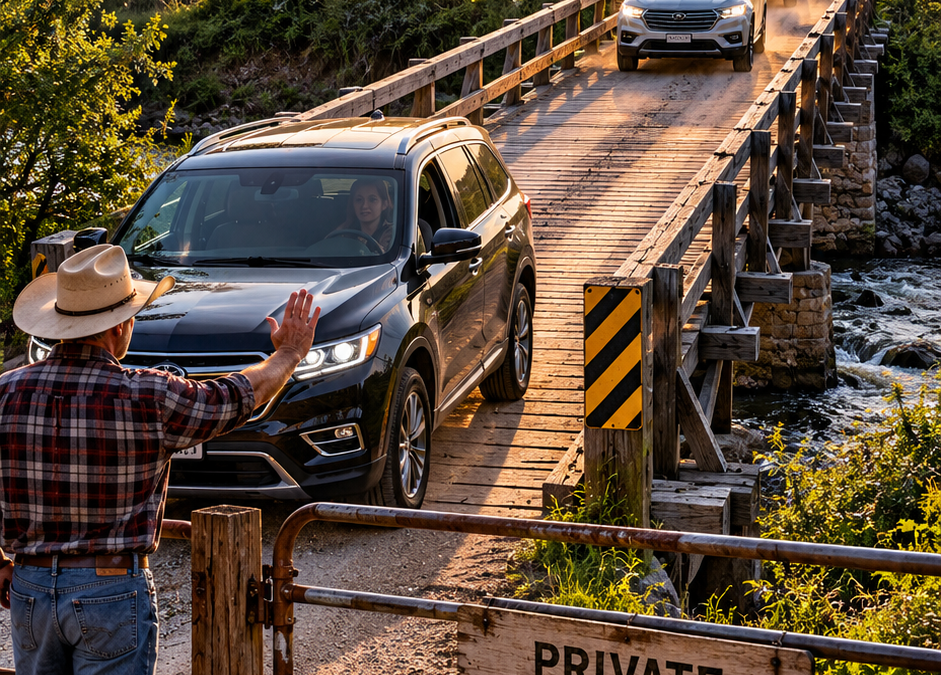
The first car crossed our bridge before sunrise, its tires rattling over boards my father had helped me replace. By breakfast, three more had passed, all headed toward the subdivision instead of the ranch the bridge had served for decades. I stood at the gate with a question Karen had refused to answer the day before: who had given those drivers the right to be there?
The bridge was the only direct way into the main part of our ranch. My family had crossed it with feed trucks, tractors, cattle trailers, and pickup loads of fencing supplies. I had learned to drive on that road. When I was young, my father made me stop before the bridge, look along both sides, and cross slowly enough to feel how the deck held under the tires.
“You take care of the way in,” he used to say, “or one day you won’t have one.”
He meant repairs. He meant checking the boards after heavy rain and watching for movement where the bridge met the bank. He meant paying attention before a small problem became a dangerous one. For forty-two years, my family had done exactly that.
The bridge did not look grand. It was a working ranch bridge: strong, narrow, and built for people who knew to slow down before crossing. The road beyond it led past our lower field toward the barn and the house. A turn farther up connected with land near the HOA subdivision, which was why some residents found the route convenient. Convenience, as far as I knew, had never made it theirs.
I heard the fourth car while I was still standing by the gate.
It came toward me from the bridge at a speed I did not like. I raised a hand. The driver slowed, rolled down his window, and looked annoyed before I had spoken.
“Is there a problem?” he asked.
“This is a private ranch road.”
“Karen said we can use it.”
“Karen from the HOA?”
“Yes. She said the bridge is community access now.”
He looked past me, toward the road ahead, as if I were standing between him and a place he was already late to reach.
“Did she tell you who owns the bridge?” I asked.
“She said the HOA has an agreement.”
“Ask her to show it to you.”
He pulled his window back up. I stepped aside rather than hold him there. He drove on, leaving dust suspended over the road between my gate and the house.
Karen had made her announcement the previous afternoon.
I had been working near the barn when her SUV came up the drive. She got out carrying a thick folder against her chest and walked toward me without greeting me. There was a confidence in her stride that I had come to recognize. Whenever Karen wanted something, she arrived as though the discussion had already taken place and I had simply failed to hear the result.
“We need to talk about the bridge,” she said.
I set down the wrench in my hand. “What about it?”
“The HOA is formalizing access for the neighborhood.”
I looked toward the bridge. “Access across whose property?”
“It serves the whole community.”
“It serves my ranch.”
“It serves more people than it did forty years ago,” she said. “You know the subdivision has grown.”
I did know. Houses stood on land that had once been open beyond our property line. The HOA had widened roads within its own development and put up signs naming trails and common areas. None of that had moved the bridge.
Karen opened her folder and showed me a page covered in colored lines.
“Our community access map includes this route,” she said.
I studied the page. One line came toward the ranch from the subdivision and crossed a shaded area near the creek. It was difficult to tell from the drawing exactly where Karen believed the property boundary lay.
“Where did this map come from?”
“The HOA.”
“I can see that. Where’s the recorded agreement you mentioned?”
She held the folder closer to her body. “The association has the paperwork.”
“Then show me the agreement.”
“I’m showing you the access route.”
I handed the map back. “You’re showing me a line somebody drew.”
Karen sighed. “The bridge is necessary for the neighborhood.”
“That still doesn’t tell me who gave you permission to use it.”
She shifted her weight. Behind her, I could see the old bridge between the trees. From where we stood, it looked barely wide enough for the traffic she was proposing. I thought of the cost of repairs, of the inspections we had arranged over the years, of every invoice my family had paid.
Karen followed my glance. “People have been crossing it for years.”
“Some have,” I said. “That doesn’t mean the HOA owns it.”
“We’re not going to debate every driver who has used the road.”
“I’m asking about the right you say the association has. You came here to tell me about it.”
Her face tightened. “I have a board meeting. You’ll receive the formal notice.”
She closed the folder and went back to her SUV.
I watched her drive away, unsettled but not yet expecting a stream of cars at dawn. I thought she might send a letter. I thought I would have time to review whatever document she believed supported her claim.
Instead, she told the residents the bridge was theirs to use.
By midmorning, I had counted eight vehicles. Two turned around after reaching my gate. Others drove through toward the connecting road. Their drivers looked at me with the easy confidence of people who had been told an authority figure had settled the matter for them.
I was angry with Karen, but I did not blame each driver for believing what the HOA president had announced. I worried about the bridge under their tires.
The crossing had been built for the ranch’s needs. My family had maintained it with that use in mind. More traffic meant more wear, more risk, and questions no one from the HOA had bothered to discuss with me. If a driver damaged a railing or met one of our trucks where the road narrowed, Karen’s map would do little to help.
I called her.
“People are driving across my bridge,” I said when she answered.
“Good morning to you, too.”
“Did you tell residents to use it?”
“I told them about the community access route.”
“I asked you yesterday for the recorded agreement.”
“And I told you we have documentation.”
“Send it to me.”
There was a pause. “Our attorney will be in touch.”
“Until then, tell people to stop crossing.”
“I can’t close a route the community depends on because you suddenly object to sharing it.”
“I’m objecting to you claiming authority over my property without showing me where that authority came from.”
Karen’s voice hardened. “You’ve made your position clear.”
The call ended.
I stood beside the gate with my phone in my hand. I could hear water moving beneath the bridge. My father had once taught me to listen after a storm because the sound changed when branches caught under the supports. The water sounded ordinary that morning. Nothing else did.
Over the next few days, the cars kept coming. I wrote down the times and, when I could, photographed the traffic from my side of the road. I did not want a fight with the residents. I wanted the HOA to show me the right it claimed or correct what it had told them.
Karen sent a notice instead. It described the bridge as part of a longstanding community route and referred to an old access agreement. I read the notice twice. It did not identify where that agreement had been recorded. It did not give a document number or include a copy.
I went into the farmhouse and took out our deed.
My family had preserved it for forty-two years. The paper showed its age along the folds, but the description of the parcel was clear. It described the land around the crossing and the bridge itself. I traced the lines with my finger, following the creek and the road just as my father had shown me when I was old enough to ask where our property ended.
There was no grant of community access in the deed. There was no reference giving the HOA control of the bridge.
I knew Karen might have another document I had not seen. I was prepared to read it. What I would not do was accept her notice in place of it.
The HOA’s attorney arrived two days later.
He came in a dark sedan and parked by the barn. He carried a folder almost as thick as Karen’s, though he did not open it immediately. He introduced himself, looked toward the bridge, and said he understood there was a dispute about access.
“I want to see the recorded easement your client says she has,” I told him.
He nodded. “Let me review what I brought.”
We stood at the back of his car while he opened the folder. He found Karen’s community map, a copy of the notice she had sent, and several pages describing the subdivision. He searched farther down. I watched him turn one sheet over, then another.
“Karen referred to an old access agreement,” I said.
“Yes.”
“Do you have it?”
“I’m checking the materials I was given.”
He returned to the map. I brought out my deed and laid it beside his papers so we could compare them.
The difference was visible before either of us spoke. The HOA map placed a boundary along one side of the creek. The property description in my deed followed the recorded line on the other side and included the bridge. The map also failed to mark the bridge as HOA property, despite Karen’s claim that the association controlled it.
The attorney bent closer.
“Is this the original?” he asked.
“Yes.”
“How long has your family had it?”
“Forty-two years.”
He read the description and looked up toward the crossing. Then he looked back at the map.
“Karen gave me the impression the bridge was within the community boundary,” he said.
“It isn’t.”
“I need to verify the survey.”
“I’d welcome that.”
He read the deed again. I could see him looking for a reference to an easement. I had done the same thing the night before, though with considerably less hope of finding one.
“Can you identify a recorded agreement granting the HOA access?” I asked.
“I can’t identify one from what I have here.”
For the first time since Karen’s visit, someone representing the HOA had answered the question I had been asking.
The attorney did not concede the whole dispute. He said the association needed to review its records and that longstanding use might matter. I told him people had crossed the bridge over the years, but Karen had gone further: she had announced it as community access and invited the entire subdivision to use it.
“My family paid to keep it standing,” I said. “We paid for lumber, steel, repairs, and inspections. Karen has never called to ask whether it was safe for this traffic, much less offered to help maintain it.”
He glanced toward the bridge as another car approached. It slowed for us, crossed, and continued along the road.
“I see why you’re concerned,” he said.
“I need the HOA to stop telling people it controls something it hasn’t proved it controls.”
He took copies of the relevant pages with my permission and said he would contact me after checking the county records.
Karen called that evening.
“What did you tell our attorney?” she demanded.
“The same thing I told you.”
“He says you have an old deed.”
“My family has the deed to the land.”
“That doesn’t settle how the bridge has been used.”
“I’m willing to look at any recorded right you can show me.”
“You know people need that route.”
I sat at the kitchen table and looked through the window toward the barn. “Needing a route doesn’t tell me who granted access.”
Karen went quiet for a moment. Then she said, “We’re having the property lines checked.”
“That’s fine.”
“I hope you’ll accept the result.”
“So do I.”
After the call, I contacted a county surveyor. I wanted the recorded boundary checked against the ground by someone who could put the question to rest. Karen had a map, I had a deed, and the attorney had seen that they did not line up. The bridge itself had not moved. We needed an accurate answer about where it stood.
On the day of the survey, Karen arrived with the attorney. I met them near the crossing. The surveyor brought official maps, the recorded property information, and his equipment. He walked the area, checked the boundary against the physical features, and took his time with the points nearest the bridge.
While he worked, cars from the subdivision still crossed. One driver slowed to look at our small group and then continued. I could feel Karen watching each vehicle as if its presence supported her claim.
The attorney watched the surveyor instead.
I stayed back. I had spent years looking at that stretch of land. I knew where my father said the line ran and where the deed said it ran. Yet I found myself holding my breath when the surveyor made his final checks. Karen had come onto my ranch speaking with certainty. I wanted the answer recorded clearly enough that she could not turn it into another argument about what the HOA believed.
The surveyor called us over.
He showed us the recorded boundary and where he had verified it on the ground. Then he indicated the bridge.
“It sits entirely within this parcel,” he said, pointing to my property on the official map.
Karen stepped closer. “Our map puts it inside the access area.”
“Your map doesn’t match the recorded survey,” he replied.
“Could it be using a different boundary reference?”
He showed her the line again. “This is the recorded property boundary I checked against the site.”
The attorney asked two questions about the bridge’s position and took notes. Karen said nothing while the surveyor answered. She stared at the maps, then at the crossing, as though she expected one of them to change.
I looked at the bridge too. Traffic had worn a faint track into the approach over the past weeks. The boards still looked sound. The land under both ends belonged to my parcel, just as the deed described.
The surveyor packed up his equipment. His findings had answered where the bridge stood. The attorney turned to Karen.
“Where did the association’s claimed access right come from?” he asked.
She lifted her folder slightly. “From the community records.”
“Which recorded document?”
“I’ll have to ask the board.”
He glanced at the map she was holding. “This doesn’t show a transfer or an easement.”
“People have used the bridge for years.”
I spoke before the attorney could answer. “I’ve seen people use it. I have never agreed that the HOA can declare it a road for the whole subdivision.”
Karen faced me. “You can’t pretend the neighborhood hasn’t depended on it.”
“I’m asking you to show how that use became the right you announced.”
The wind moved through the trees beside the creek. A loose sheet in Karen’s folder lifted, and she pressed it down. The attorney waited for an answer. She did not give him one.
I thought the survey would be enough to stop the traffic while the HOA checked its records. Karen thought otherwise. The next morning, more residents crossed.
I called her and asked again that she correct the notice she had sent them. She told me she would wait for her attorney’s review. When I said I would be at the bridge telling drivers it was private, she said I was blocking community access.
Later that day, the sheriff arrived.
Karen met him near the approach and immediately began explaining that residents relied on the bridge. I stood by my truck and let her finish. I had not closed the crossing or put anything across the road. I had been speaking to drivers and telling them the HOA’s claim was disputed. Karen described that as interference.
The sheriff asked to hear my side.
I gave him the deed and the surveyor’s findings. I explained that my family had owned and maintained the bridge for forty-two years. I told him Karen had announced it as community access without showing a recorded agreement, and that the HOA’s own attorney was still looking for one.
Karen held out her map. “This shows the community route.”
The sheriff examined it, then looked at the deed.
“These boundaries aren’t the same,” he said.
“The HOA’s map shows the planned access,” Karen replied.
“Do you have a recorded document granting it?”
“Our attorney is reviewing the older records.”
“Then you need to let him review them.”
Karen’s expression sharpened. “He’s telling residents they can’t use the bridge.”
“I’ve told them it’s on private land,” I said.
The sheriff looked from Karen to me. “I’m not going to settle a private property dispute by declaring this bridge public at the roadside. The recorded documents matter. If the association claims an access right, its attorney needs to identify it.”
Karen tried once more to explain how many households could use the route. The sheriff listened and repeated that convenience did not give him an order to recognize the bridge as public access.
He handed the deed back to me.
“Keep copies of what you have,” he said.
“I will.”
Karen returned to her SUV. She drove over the bridge on her way out without looking at me.
That night, I walked down to the creek after the traffic had stopped. The bridge was quiet except for water below it and an occasional creak as the air cooled. I ran my hand along the railing, feeling the places where old wood met newer repairs.
When my father and I had replaced part of the deck years earlier, we had worked through a long, hot afternoon. I had wanted to finish quickly. He had made me lift one board back out because it did not sit flush.
“People will cross this after we’re gone,” he said. “Do it right.”
I had been young enough to think he was being severe over one board. Now I understood that he had been thinking beyond the day’s work. We maintained the bridge for whoever came after us, and we kept the deeds for the same reason.
I went back to the house and placed the original document in its case.
The HOA attorney contacted the county records office. He checked the original deed against the county’s copy and followed the relevant chain of title. The deed was exactly where I had told him it would be. The records he found did not show an HOA ownership transfer for the bridge. They did not show the community easement Karen had claimed.
When he called me, he was direct.
“We’ve reviewed the recorded documents,” he said. “I haven’t found support for the association’s claim that it controls the bridge.”
“Has Karen seen that?”
“She will.”
“What about the notice to residents?”
“I’m taking the findings to the board.”
I thanked him and hung up. Relief came slowly. He had said what I had been asking the HOA to verify from the beginning, but Karen had already shown me how easily a map and a confident announcement could fill a road with cars. I needed the board to correct its claim as clearly as Karen had made it.
The wait lasted several days.
Traffic began to thin. I did not know whether the attorney had told Karen to stop describing the bridge as community access or whether residents had heard about the survey. A few cars still came through. When I spoke to their drivers, I kept it simple: the bridge was on my private parcel, and the HOA was reviewing its earlier notice.
One woman lowered her window and looked genuinely surprised.
“We were told this was HOA property,” she said.
“That’s what I’m asking them to correct.”
She looked back toward the crossing. “I’m sorry. I didn’t know.”
“I know.”
She turned around carefully and drove back across. I watched until she reached the far side. I had wanted the traffic to stop, but I had never wanted neighbors to feel tricked into an argument at my gate. Karen had put them there as surely as she had put me there.
Finally, the HOA board reviewed the deed, the survey, and the attorney’s findings. Their map had used the wrong boundary lines. They had treated a route people sometimes took as though it appeared in the property records as a community right. The bridge stood on my parcel, and their attorney could not identify a recorded easement supporting Karen’s announcement.
The HOA withdrew its claim over the bridge.
It also corrected the community map.
I read the written correction at my kitchen table. It was brief. It did not mention the repair bills my family had paid or the weeks of cars crossing before the board checked its paperwork. It did what I needed it to do: it stopped identifying my bridge as community property.
I took the letter down to the bridge with me the next morning. A few old signs stood near the approach, one of them so weathered it no longer gave a driver much useful information. I removed it and put up a clear private property notice where someone coming from the subdivision could see it before crossing.
Then I stood back and checked the sight line from the road.
The bridge looked the same. The boards, the rails, and the creek beneath it had been there through the entire dispute. What had changed was the message people received before they reached it.
For the first time in weeks, I worked near the barn without hearing a steady line of unfamiliar tires. A ranch truck crossed in the afternoon, slowed as it should, and carried on toward our fields. Later, I walked down to inspect the deck. I found ordinary wear and made a note of what we would need to repair next.
I would pay for that work, as my family always had. I understood exactly why we did it.
That evening, I put the deed case away. Before closing the cabinet, I checked that the oldest document was still properly sleeved. Forty-two years earlier, my family had saved it because it described what belonged to us. During the weeks Karen claimed the bridge, that care gave the surveyor and the county records office a clear history to check.
Karen had brought a map that showed the route her HOA wanted. I had brought the deed that described the land under it. Once everyone looked at the recorded boundary, the board corrected its map, withdrew its claim, and the cars stopped coming.
The next morning, I crossed the bridge on my way to the ranch. I slowed where my father had taught me to slow, felt the familiar rise of the deck beneath my tires, and drove on to the work waiting in the fields.








