𝗙𝗨𝗟𝗟 𝗦𝗧𝗢𝗥𝗬 Karen Brought Six Police Cars to My Family’s Farm, and I Started a Timer
𝗣𝗔𝗥𝗧 𝟮 My phone was still running in my pocket. I could feel it against my leg. I had started the timer because Karen had arrived expecting panic. I needed something small to do while I kept my voice steady. But as I watched her search through the folder, I began to understand how much she had counted on the sight of six police cars doing her work for her.
My father had taught me to keep calm when equipment failed. Stop, look at what you know, then deal with the part in front of you. I tried to hear his voice over the anger building in my chest.
The part in front of me was a question about ownership.
“My family kept the deeds,” I told the officers. “The original is inside.”
The lead officer looked at me. “Can you bring them out?”
“Yes.”
Karen crossed her arms. “We have already established the farm is in the expansion zone.”
“You’ve established that it’s shaded on your map,” I said.
I went into the farmhouse.
The kitchen still smelled of coffee. My mug was on the table where I had left it, the surface of the coffee dark and still. Through the window above the sink, I could see the police vehicles lined up along the drive. For a moment I stood there with my hand on the back of a chair, trying to understand how an ordinary morning had become this.
Then I went to the cabinet where I kept the document case.
It was thick leather, worn smooth along the corners. My father had used it, and his father before him. Inside, the papers were arranged in sleeves so the oldest would not have to be handled more than necessary. There was the 1926 deed, the later transfers, and the descriptions that tied each generation’s ownership to the same ground.
I had taken the case out many times. I had needed it for ordinary things: a boundary question, a bank appointment, a conversation with an attorney. I had never carried it outside to explain to police why I was entitled to remain in my own home.
I closed the case and walked back through the front door.
Karen’s face changed when she saw what I was carrying. The color left it so quickly that I wondered whether she knew exactly what was inside.
The lead officer cleared a space on the hood of his SUV. I set the case down and opened it.
“This is the original deed,” I said, removing the oldest document from its sleeve.
The paper had aged, but the property description was clear. I pointed out the land, then showed him the later transfers in order. Names changed as the farm passed through my family. The property description stayed with it.
The officer leaned closer. He checked the document, then looked toward the fields.
“This is the farm?” he asked.
“Yes.”
“And these show the later transfers?”
“Every one we have. You can check the county records as well.”
I laid them out beside the original deed. My hands were steadier than I felt. A hundred years of ownership stretched across the hood of a police SUV in the morning sun.
For a moment, I could see my grandfather at the kitchen table, telling me to wash my hands before he would let me near the old paper. I remembered my father going through the same case after a storm had damaged a fence, making sure the repair followed the right line. They were both gone, but I could hear how they would have explained each page.
The officer examined the documents without rushing. Karen stood on the other side of the SUV, clutching her folder.
“Where is the HOA’s ownership document?” he asked her.
“The HOA inherited the farm through community records.”
“Who transferred it?”
“The community expansion process covers—”
“Who signed the transfer?” he asked.
Karen looked down at the papers in her folder. She pulled one partway out, read its heading, and pushed it back.
“There are several records,” she said.
“Do any of them show this owner transferring the farm to the HOA?”
“Our attorney said the vote gave us control.”
The officer set one of my documents down carefully. “I’m asking what you have with you.”
Karen’s eyes moved toward the other patrol cars. I followed her glance. The officers were no longer standing as though they expected to secure the barn. One had stepped back toward his vehicle. Another was reading the property description over the lead officer’s shoulder.
Karen saw it too.
“You’re letting him delay this,” she said to the officer. “The board has already voted. He needs to be removed so we can take control of the property.”
I had known that was what she wanted. Hearing her say it in front of my house was something else. She was speaking about removing me from the land where I had grown up, the land my family had kept through hard seasons and better ones, as if I were an obstacle left in the way of a project.
The lead officer straightened.
“A board vote isn’t a property deed,” he said.
Karen took a step toward him. “I didn’t say it was a deed.”
“You’re asking my officers to remove a man from property his documents identify as his.”
“The HOA has authority.”
“Show me where it comes from.”
She opened her mouth, then closed it.
I pulled out my phone. Twenty-three minutes had passed since the police arrived. I had been so focused on the documents that I had nearly forgotten the timer.
Karen noticed me checking it.
“You think this is funny?” she asked.
“No.”
“Then put your phone away.”
I slipped it back into my pocket. “I’m waiting for you to answer his question.”
She turned away from me.
The officer gathered the papers he had been given and stepped toward his SUV. He told Karen he was going to call his department attorney. She began speaking before he finished, insisting that the HOA’s legal department had reviewed everything. He said he would verify it himself.
That was when the waiting became difficult.
The officers remained on my driveway. No one approached the barn, but their cars were still there, and the leather case was still open on the hood of the SUV. I stood beside the documents, keeping a hand near the old deed whenever a breeze lifted a corner of its sleeve.
Across the yard, my work waited. Feed had to be put out. A gate near the south field needed attention. By midmorning the temperature would rise, and the ground I had planned to work would be drier than I wanted. Those concerns felt strangely close and distant at once. They were the ordinary demands of a farm. I wanted to get back to them.
One of the younger officers came over.
“Do you want to sit down?” he asked.
“I’m all right.”
He looked toward the barn. “We were told there was an order involving this property.”
“There isn’t one in that folder,” I said.
“I can see why you’d be upset.”
I looked at the line of police cars. “I was still making coffee when you came through the gate.”
He glanced down. “I’m sorry.”
I believed he meant it. I also wanted him to understand what the morning had felt like from my porch. I had watched six vehicles come up the drive while Karen walked in behind them, ready to point at parts of my farm and tell strangers they belonged to her association.
“What were you told would happen?” I asked.
“That we’d be here while a property order was carried out.”
“And if I’d been too frightened to bring out the deeds?”
He did not answer. After a moment, he went back to the other officers.
I could not stop thinking about that question. Karen had shown them highlighted pages and called them an order. She had arrived with enough police cars to make a person doubt his own right to say no. My family’s records were in the house because we had kept them safe for a century. What would she have said if I had not been able to find them that morning?
The lead officer remained on the phone near his SUV. He walked a short distance away, listened, and looked back at the papers on the hood. Once, he asked Karen to repeat the name of the document she had presented. She told him. He read its heading aloud into the phone.
Karen tried to speak to him again, but he raised a hand and continued the call.
While we waited, I looked past the vehicles to the barn. Its oldest beams had been there longer than anyone now standing in the driveway. My grandfather had repaired one of the doors after a winter storm. My father had replaced sections of the roof. I had spent enough mornings inside it to know which boards creaked before my foot touched them.
Karen had pointed at that barn first. Perhaps she had thought it looked like the easiest part of the farm to claim: a building on a map, a structure her board could label for future use. She had seen a shaded area. I saw years of work done by people whose names were on the papers beside me.
The officer ended his call and returned.
Karen stepped forward at once. “Did you speak to counsel?”
“I did.”
“Our attorney assured us this was legal.”
The officer placed his phone in his pocket. “Your attorney’s assurance isn’t an order for my department.”
He spoke evenly, but his words carried across the driveway.
“There is no seizure order for this farm,” he continued. “There is no condemnation notice and no court authorization for us to remove the owner or take control of the property. The document you gave me concerns a different address.”
Karen shook her head. “That address is connected to the development.”
“It is not this parcel.”
“The boundary map—”
“A development map does not authorize police to take someone’s farm.”
He turned to the officers and directed them to step away from the property. Two moved immediately toward their cars. Another returned the papers he had been holding to the lead officer.
Relief passed through me so suddenly that I had to brace a hand against the SUV. Then Karen opened her folder again.
“I have the development plan,” she said.
The officer faced her. “You showed me the map.”
“This is the full version. It includes the expansion timetable and the board’s approval.”
She unfolded more pages, laying them out beside my family’s deeds. Colored blocks covered land around the subdivision. Lines crossed roads and fields. A section of my farm appeared within a proposed planning area.
I felt the anger return. She had just been told the police had no authority to seize the farm, yet she was still trying to make the map do the work of a deed.
The officer looked at the pages.
“Where is the recorded transfer of his land?” he asked.
Karen put her finger on a shaded section.
“That identifies where you want to develop,” he said. “I’m asking who transferred the farm.”
She moved to another page. “The board approved this.”
“I understand the board approved its plan. Where is the recorded transfer?”
“There are community records.”
“Do you have a deed?”
Karen said nothing.
“Do you have another valid transfer of this farm to the HOA?”
Her fingers tightened around the edge of the paper.
“Do you have an order authorizing my officers to seize it?”
“No,” she said quietly.
The officer folded the map and handed it back. “Then the police will not enforce your claim.”
Karen looked at him for a long moment. She had arrived issuing instructions loud enough for everyone to hear. Now she gathered her papers without another argument. She slid the highlighted document into the folder, shut it, and walked toward her SUV.
I watched her pass the barn. She did not look at it again.
The lead officer helped me return the deeds to their sleeves. He handled the 1926 document with care, holding it at the edges while I opened the case.
“I’m sorry for the disruption,” he said.
I wanted to ask him how a document with the wrong address had brought six cars through my gate. He had checked it when he arrived. He had made the call. At that moment, I was too tired to turn the morning into another argument.
“You did check,” I said.
“Yes.”
He glanced toward the house. “Keep these somewhere safe.”
“They’ve been safe for a hundred years.”
One corner of his mouth moved, though he did not quite smile. He closed the case and handed it to me.
The cars began to leave. Each one turned slowly on the gravel, careful of the gateposts. I stood in the same place where I had met Karen when she got out of the truck. The first car went down the lane, then the second. Dust lifted behind them and drifted toward the fields.
Karen’s SUV left before the final patrol car. I watched it pass through the gate my father had repaired so many times. She had offered no apology. I did not call after her. The officer’s questions had been answered, and every answer was now on the record of that morning.
When the last police car disappeared down the road, I took out my phone.
The stopwatch read 38 minutes and 17 seconds.
I pressed Stop.
The number stayed on the screen while the farm grew quiet again. I could hear the animals in the barn. A breeze moved through the grass near the house. Somewhere beyond the fields, a vehicle passed on the road without turning into my gate.
I stood there longer than I needed to.
Then I carried the document case inside, set it on the kitchen table, and finally drank the coffee I had made before sunrise. It had gone cold.
At the barn, the day’s work was waiting. I fed the animals, checked the gate near the south field, and went through the tasks I had planned. My hands knew what to do, but my mind kept returning to Karen’s voice.
“He needs to be removed.”
I could still see the exact place where she had stood when she said it.
By late afternoon, the tire tracks were fading in the gravel. I went into the farmhouse and called my attorney.
I told him about the six cars, the wrong address, Karen’s map, and the phone call to the department attorney. Then I told him about the original deed spread across the hood of a police SUV.
He asked me to send copies of everything Karen had shown me if I had them. I had no copies of her folder, but I described its heading and the subdivision address the officer had read aloud. He asked for the farm’s deed history and my notes about the encounter.
“Write down the timeline while it’s fresh,” he said.
“I remember every minute.”
“Write it down anyway.”
I sat at the kitchen table that evening and did as he asked. I wrote when the cars arrived, what Karen had said, which documents she had presented, and how the lead officer had answered her. At the top of the page I wrote the time shown on my phone.
38 minutes, 17 seconds.
It was a small number beside a hundred years. Still, I wanted it recorded. Those were the minutes Karen had spent trying to turn my family’s farm into something the HOA could take by showing police a map.
The next morning, my attorney took the deed history and supporting documents to the county records office. The county already had the recorded chain of ownership; our filing placed the current dispute and our response alongside the documents that mattered. He also demanded that the HOA withdraw its claim against the farm.
Over the following days, he handled the exchange with their attorney. I continued working. The fields needed me whether or not Karen understood what a deed was.
When my attorney called to say the HOA had withdrawn its claim, I was standing near the barn. I leaned against the doorframe and let him finish telling me what had been filed.
“So it’s over?” I asked.
“The HOA has withdrawn the claim it brought against your farm,” he said.
I looked toward the road. The gate was closed, and no cars were coming.
“Thank you,” I said.
After the call, I walked inside the barn. Morning light came through the gaps between the old boards. I rested my hand on one of the beams my grandfather had repaired and thought of him writing 1926 above his workbench so the date would remain visible.
Karen had brought six police cars because she expected me to surrender the place before anyone looked closely at her papers. The officers had looked. Her address led to a subdivision property three miles away. Her map showed what the HOA hoped to do. Neither showed that my family had given up the farm.
I opened the barn doors and went back to work. The deed case was safe in the house, the county records still traced the land to my family, and the fields beyond the gate were ours to tend.
𝗧𝗛𝗘 𝗘𝗡𝗗
Karen Brought Six Police Cars to My Family’s Farm, and I Started a Timer
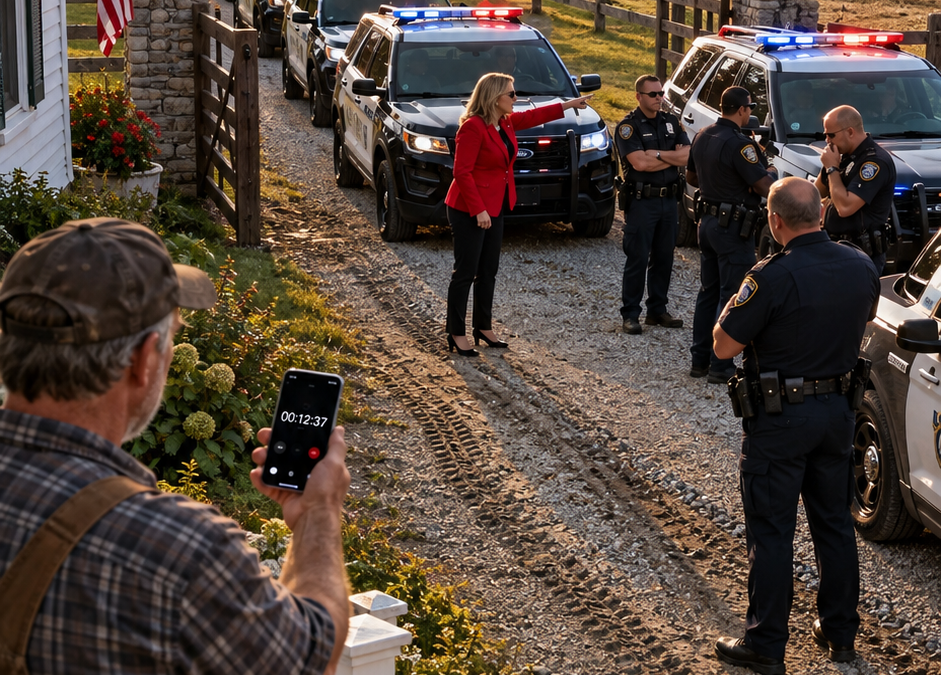
The first police car came through my front gate just after sunrise, followed by five more. Karen stepped out behind them and pointed at my barn as if a hundred years of my family’s work could be erased with one sentence. When she announced that the HOA controlled my farm, I reached for my phone.
I pressed Start on the stopwatch.
Karen stared at me. “What are you doing?”
“Timing how long this mistake takes to disappear.”
She gave a short, irritated laugh. Then she looked over her shoulder at the officers, waiting for them to laugh with her.
None did.
Six patrol cars filled the gravel drive between the house and the barn. Their tires had left fresh tracks across ground my family had maintained for generations. The officers stood near their vehicles, some looking at Karen, others looking out toward the fields. One had his hand resting on his belt. Another kept glancing at the farmhouse as if he expected someone else to come out and explain why they were there.
I wished someone could.
Until ten minutes earlier, the morning had been ordinary. I had checked the weather, put coffee on, and walked outside to see whether the ground had dried enough for the work I had planned. The barn doors were open. A few animals were calling to be fed. The fields beyond them were quiet.
Then I heard tires on the gravel.
My family had owned this farm since 1926. That year was written on the first deed and on a small board my grandfather had kept above his workbench. As a boy, I had asked him why he needed the board when he already knew the date.
“Because one day somebody else will need to know it,” he told me.
I had thought he meant my children.
Standing in my driveway, looking at Karen and six police cars, I wondered whether he had imagined a morning like this.
Karen was president of the homeowners association whose subdivision lay several miles away. I had met her before. The HOA had expanded over the years, replacing open ground with houses and paved roads. Its board talked about future projects whenever land near the subdivision came up for sale. My farm was close enough to interest them and far enough away that their rules had never applied to it.
Karen apparently believed those two facts could be changed by a vote.
“This farm is under HOA control now,” she said again, louder this time. She pointed toward the barn. “We need access to the property.”
I looked at the lead officer. He was standing a few steps behind her, watching my face. He did not move toward the barn.
“Is that why you brought the police?” I asked Karen.
“We voted on the community expansion zone. Your farm is included.”
“Who voted?”
“The board.”
“Which recorded document transferred my land to the HOA?”
“Our legal department has it.”
She said it with the confidence of a person who expected everyone to stop asking questions once an attorney was mentioned.
The officer stepped forward.
“Ma’am,” he said to Karen, “let me see the order you told us about.”
Karen turned toward him, surprised by his tone. She opened a folder and pulled out several pages with yellow highlighting. The officer took them and read the first page. I watched his eyes move down the text, then return to the top.
“What is this address?” he asked.
“Our expansion property.”
“I’m asking what property this document concerns.”
Karen came closer and pointed at a highlighted paragraph. “It explains the board’s authority.”
The officer looked past her at my house. He read the address printed on the page again.
“This is a subdivision address,” he said.
“Yes. That’s where the HOA is based.”
“It’s three miles from here.”
“It’s part of the same expansion.”
He held the paper at his side. “Where is this farm’s legal parcel number?”
For the first time since she had arrived, Karen hesitated.
She recovered quickly. “That’s a clerical issue. The map shows the area we mean.”
The officer studied her. The other officers had gone still enough that I could hear one of my animals moving inside the barn.
I had lived on the farm my whole life. I knew the difference between a mistake on a form and a mistake about who owned the land beneath my feet. Karen had brought six police cars through my gate on the strength of a document that named a property three miles away.
She reached into her folder again and produced a larger sheet. Unfolded, it showed roads, colored sections, and a shaded area around the edge of the development.
“There,” she said, laying a finger on it. “The farm falls within the proposed boundary.”
I could see part of my property outlined on the map. I could also see the words identifying it as a development plan. It was a picture of what the HOA wanted, with no signature from anyone in my family and no recorded transfer of the farm.
“Proposed by whom?” I asked.
“Our board and our planning team.”
“That answers who drew the map. It doesn’t answer who gave you my land.”
Karen lowered her hand. “You’re trying to turn this into an argument.”
“You drove police cars onto my farm.”
“We came to carry out the board’s decision.”
The lead officer spoke before I could. “I need to know what authority you’re asking us to enforce.”
“I just showed you.”
“You showed me a document with the wrong property address and a development map.”
Karen looked at the other officers, as though one of them might step in. No one did.
She turned back to me. “The HOA has protected the area around this farm for years. The roads, the drainage, the surrounding property values—our community has invested in all of it.”
I had heard versions of that argument before. Every time the HOA wanted to discuss my land, Karen began with the subdivision’s investments, as if work done somewhere else gave its board a claim to whatever it could see from the road.
“My family has worked this farm for a hundred years,” I said. “Show me the recorded deed transferring it to you.”
Her mouth tightened. “You don’t understand how community records work.”
“Then show the officer.”
The lead officer kept the papers in his hand and waited.
Karen said nothing.
My phone was still running in my pocket. I could feel it against my leg. I had started the timer because Karen had arrived expecting panic. I needed something small to do while I kept my voice steady. But as I watched her search through the folder, I began to understand how much she had counted on the sight of six police cars doing her work for her.
My father had taught me to keep calm when equipment failed. Stop, look at what you know, then deal with the part in front of you. I tried to hear his voice over the anger building in my chest.
The part in front of me was a question about ownership.
“My family kept the deeds,” I told the officers. “The original is inside.”
The lead officer looked at me. “Can you bring them out?”
“Yes.”
Karen crossed her arms. “We have already established the farm is in the expansion zone.”
“You’ve established that it’s shaded on your map,” I said.
I went into the farmhouse.
The kitchen still smelled of coffee. My mug was on the table where I had left it, the surface of the coffee dark and still. Through the window above the sink, I could see the police vehicles lined up along the drive. For a moment I stood there with my hand on the back of a chair, trying to understand how an ordinary morning had become this.
Then I went to the cabinet where I kept the document case.
It was thick leather, worn smooth along the corners. My father had used it, and his father before him. Inside, the papers were arranged in sleeves so the oldest would not have to be handled more than necessary. There was the 1926 deed, the later transfers, and the descriptions that tied each generation’s ownership to the same ground.
I had taken the case out many times. I had needed it for ordinary things: a boundary question, a bank appointment, a conversation with an attorney. I had never carried it outside to explain to police why I was entitled to remain in my own home.
I closed the case and walked back through the front door.
Karen’s face changed when she saw what I was carrying. The color left it so quickly that I wondered whether she knew exactly what was inside.
The lead officer cleared a space on the hood of his SUV. I set the case down and opened it.
“This is the original deed,” I said, removing the oldest document from its sleeve.
The paper had aged, but the property description was clear. I pointed out the land, then showed him the later transfers in order. Names changed as the farm passed through my family. The property description stayed with it.
The officer leaned closer. He checked the document, then looked toward the fields.
“This is the farm?” he asked.
“Yes.”
“And these show the later transfers?”
“Every one we have. You can check the county records as well.”
I laid them out beside the original deed. My hands were steadier than I felt. A hundred years of ownership stretched across the hood of a police SUV in the morning sun.
For a moment, I could see my grandfather at the kitchen table, telling me to wash my hands before he would let me near the old paper. I remembered my father going through the same case after a storm had damaged a fence, making sure the repair followed the right line. They were both gone, but I could hear how they would have explained each page.
The officer examined the documents without rushing. Karen stood on the other side of the SUV, clutching her folder.
“Where is the HOA’s ownership document?” he asked her.
“The HOA inherited the farm through community records.”
“Who transferred it?”
“The community expansion process covers—”
“Who signed the transfer?” he asked.
Karen looked down at the papers in her folder. She pulled one partway out, read its heading, and pushed it back.
“There are several records,” she said.
“Do any of them show this owner transferring the farm to the HOA?”
“Our attorney said the vote gave us control.”
The officer set one of my documents down carefully. “I’m asking what you have with you.”
Karen’s eyes moved toward the other patrol cars. I followed her glance. The officers were no longer standing as though they expected to secure the barn. One had stepped back toward his vehicle. Another was reading the property description over the lead officer’s shoulder.
Karen saw it too.
“You’re letting him delay this,” she said to the officer. “The board has already voted. He needs to be removed so we can take control of the property.”
I had known that was what she wanted. Hearing her say it in front of my house was something else. She was speaking about removing me from the land where I had grown up, the land my family had kept through hard seasons and better ones, as if I were an obstacle left in the way of a project.
The lead officer straightened.
“A board vote isn’t a property deed,” he said.
Karen took a step toward him. “I didn’t say it was a deed.”
“You’re asking my officers to remove a man from property his documents identify as his.”
“The HOA has authority.”
“Show me where it comes from.”
She opened her mouth, then closed it.
I pulled out my phone. Twenty-three minutes had passed since the police arrived. I had been so focused on the documents that I had nearly forgotten the timer.
Karen noticed me checking it.
“You think this is funny?” she asked.
“No.”
“Then put your phone away.”
I slipped it back into my pocket. “I’m waiting for you to answer his question.”
She turned away from me.
The officer gathered the papers he had been given and stepped toward his SUV. He told Karen he was going to call his department attorney. She began speaking before he finished, insisting that the HOA’s legal department had reviewed everything. He said he would verify it himself.
That was when the waiting became difficult.
The officers remained on my driveway. No one approached the barn, but their cars were still there, and the leather case was still open on the hood of the SUV. I stood beside the documents, keeping a hand near the old deed whenever a breeze lifted a corner of its sleeve.
Across the yard, my work waited. Feed had to be put out. A gate near the south field needed attention. By midmorning the temperature would rise, and the ground I had planned to work would be drier than I wanted. Those concerns felt strangely close and distant at once. They were the ordinary demands of a farm. I wanted to get back to them.
One of the younger officers came over.
“Do you want to sit down?” he asked.
“I’m all right.”
He looked toward the barn. “We were told there was an order involving this property.”
“There isn’t one in that folder,” I said.
“I can see why you’d be upset.”
I looked at the line of police cars. “I was still making coffee when you came through the gate.”
He glanced down. “I’m sorry.”
I believed he meant it. I also wanted him to understand what the morning had felt like from my porch. I had watched six vehicles come up the drive while Karen walked in behind them, ready to point at parts of my farm and tell strangers they belonged to her association.
“What were you told would happen?” I asked.
“That we’d be here while a property order was carried out.”
“And if I’d been too frightened to bring out the deeds?”
He did not answer. After a moment, he went back to the other officers.
I could not stop thinking about that question. Karen had shown them highlighted pages and called them an order. She had arrived with enough police cars to make a person doubt his own right to say no. My family’s records were in the house because we had kept them safe for a century. What would she have said if I had not been able to find them that morning?
The lead officer remained on the phone near his SUV. He walked a short distance away, listened, and looked back at the papers on the hood. Once, he asked Karen to repeat the name of the document she had presented. She told him. He read its heading aloud into the phone.
Karen tried to speak to him again, but he raised a hand and continued the call.
While we waited, I looked past the vehicles to the barn. Its oldest beams had been there longer than anyone now standing in the driveway. My grandfather had repaired one of the doors after a winter storm. My father had replaced sections of the roof. I had spent enough mornings inside it to know which boards creaked before my foot touched them.
Karen had pointed at that barn first. Perhaps she had thought it looked like the easiest part of the farm to claim: a building on a map, a structure her board could label for future use. She had seen a shaded area. I saw years of work done by people whose names were on the papers beside me.
The officer ended his call and returned.
Karen stepped forward at once. “Did you speak to counsel?”
“I did.”
“Our attorney assured us this was legal.”
The officer placed his phone in his pocket. “Your attorney’s assurance isn’t an order for my department.”
He spoke evenly, but his words carried across the driveway.
“There is no seizure order for this farm,” he continued. “There is no condemnation notice and no court authorization for us to remove the owner or take control of the property. The document you gave me concerns a different address.”
Karen shook her head. “That address is connected to the development.”
“It is not this parcel.”
“The boundary map—”
“A development map does not authorize police to take someone’s farm.”
He turned to the officers and directed them to step away from the property. Two moved immediately toward their cars. Another returned the papers he had been holding to the lead officer.
Relief passed through me so suddenly that I had to brace a hand against the SUV. Then Karen opened her folder again.
“I have the development plan,” she said.
The officer faced her. “You showed me the map.”
“This is the full version. It includes the expansion timetable and the board’s approval.”
She unfolded more pages, laying them out beside my family’s deeds. Colored blocks covered land around the subdivision. Lines crossed roads and fields. A section of my farm appeared within a proposed planning area.
I felt the anger return. She had just been told the police had no authority to seize the farm, yet she was still trying to make the map do the work of a deed.
The officer looked at the pages.
“Where is the recorded transfer of his land?” he asked.
Karen put her finger on a shaded section.
“That identifies where you want to develop,” he said. “I’m asking who transferred the farm.”
She moved to another page. “The board approved this.”
“I understand the board approved its plan. Where is the recorded transfer?”
“There are community records.”
“Do you have a deed?”
Karen said nothing.
“Do you have another valid transfer of this farm to the HOA?”
Her fingers tightened around the edge of the paper.
“Do you have an order authorizing my officers to seize it?”
“No,” she said quietly.
The officer folded the map and handed it back. “Then the police will not enforce your claim.”
Karen looked at him for a long moment. She had arrived issuing instructions loud enough for everyone to hear. Now she gathered her papers without another argument. She slid the highlighted document into the folder, shut it, and walked toward her SUV.
I watched her pass the barn. She did not look at it again.
The lead officer helped me return the deeds to their sleeves. He handled the 1926 document with care, holding it at the edges while I opened the case.
“I’m sorry for the disruption,” he said.
I wanted to ask him how a document with the wrong address had brought six cars through my gate. He had checked it when he arrived. He had made the call. At that moment, I was too tired to turn the morning into another argument.
“You did check,” I said.
“Yes.”
He glanced toward the house. “Keep these somewhere safe.”
“They’ve been safe for a hundred years.”
One corner of his mouth moved, though he did not quite smile. He closed the case and handed it to me.
The cars began to leave. Each one turned slowly on the gravel, careful of the gateposts. I stood in the same place where I had met Karen when she got out of the truck. The first car went down the lane, then the second. Dust lifted behind them and drifted toward the fields.
Karen’s SUV left before the final patrol car. I watched it pass through the gate my father had repaired so many times. She had offered no apology. I did not call after her. The officer’s questions had been answered, and every answer was now on the record of that morning.
When the last police car disappeared down the road, I took out my phone.
The stopwatch read 38 minutes and 17 seconds.
I pressed Stop.
The number stayed on the screen while the farm grew quiet again. I could hear the animals in the barn. A breeze moved through the grass near the house. Somewhere beyond the fields, a vehicle passed on the road without turning into my gate.
I stood there longer than I needed to.
Then I carried the document case inside, set it on the kitchen table, and finally drank the coffee I had made before sunrise. It had gone cold.
At the barn, the day’s work was waiting. I fed the animals, checked the gate near the south field, and went through the tasks I had planned. My hands knew what to do, but my mind kept returning to Karen’s voice.
“He needs to be removed.”
I could still see the exact place where she had stood when she said it.
By late afternoon, the tire tracks were fading in the gravel. I went into the farmhouse and called my attorney.
I told him about the six cars, the wrong address, Karen’s map, and the phone call to the department attorney. Then I told him about the original deed spread across the hood of a police SUV.
He asked me to send copies of everything Karen had shown me if I had them. I had no copies of her folder, but I described its heading and the subdivision address the officer had read aloud. He asked for the farm’s deed history and my notes about the encounter.
“Write down the timeline while it’s fresh,” he said.
“I remember every minute.”
“Write it down anyway.”
I sat at the kitchen table that evening and did as he asked. I wrote when the cars arrived, what Karen had said, which documents she had presented, and how the lead officer had answered her. At the top of the page I wrote the time shown on my phone.
38 minutes, 17 seconds.
It was a small number beside a hundred years. Still, I wanted it recorded. Those were the minutes Karen had spent trying to turn my family’s farm into something the HOA could take by showing police a map.
The next morning, my attorney took the deed history and supporting documents to the county records office. The county already had the recorded chain of ownership; our filing placed the current dispute and our response alongside the documents that mattered. He also demanded that the HOA withdraw its claim against the farm.
Over the following days, he handled the exchange with their attorney. I continued working. The fields needed me whether or not Karen understood what a deed was.
When my attorney called to say the HOA had withdrawn its claim, I was standing near the barn. I leaned against the doorframe and let him finish telling me what had been filed.
“So it’s over?” I asked.
“The HOA has withdrawn the claim it brought against your farm,” he said.
I looked toward the road. The gate was closed, and no cars were coming.
“Thank you,” I said.
After the call, I walked inside the barn. Morning light came through the gaps between the old boards. I rested my hand on one of the beams my grandfather had repaired and thought of him writing 1926 above his workbench so the date would remain visible.
Karen had brought six police cars because she expected me to surrender the place before anyone looked closely at her papers. The officers had looked. Her address led to a subdivision property three miles away. Her map showed what the HOA hoped to do. Neither showed that my family had given up the farm.
I opened the barn doors and went back to work. The deed case was safe in the house, the county records still traced the land to my family, and the fields beyond the gate were ours to tend.








