𝗙𝗨𝗟𝗟 𝗦𝗧𝗢𝗥𝗬 I Went to the Shelter to Find One Dog for My Grieving Mother—But Two Refused to Leave Each Other
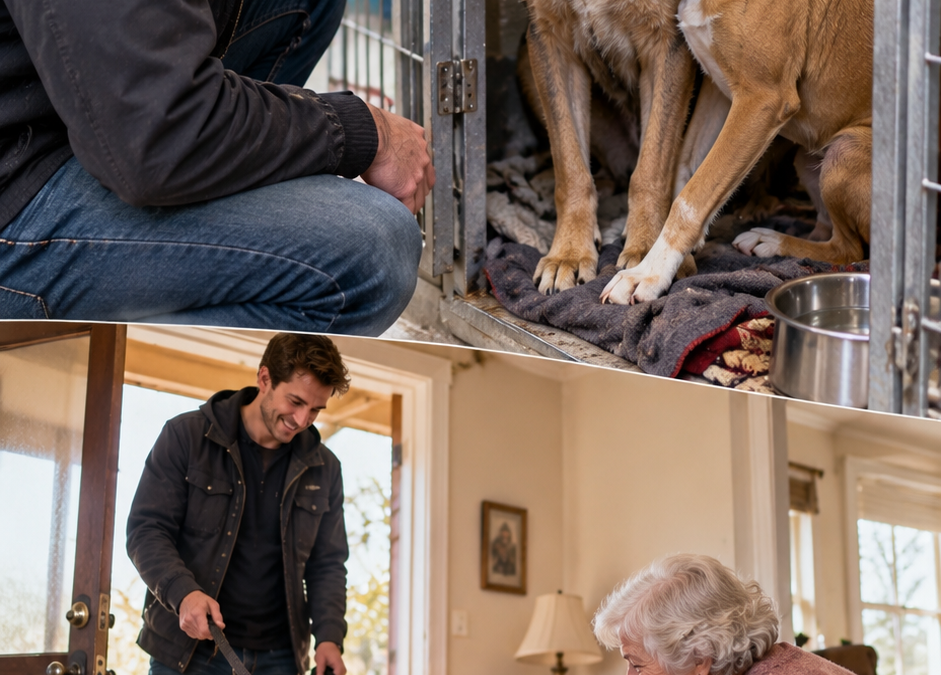
𝗣𝗔𝗥𝗧 𝟮
That was true.
If Mom said no, I would take responsibility.
I had already decided that.
Rachel seemed satisfied enough to continue.
“We have a few dogs you should meet.”
The first was a sweet older beagle.
Friendly.
Gentle.
Probably perfect.
The second was a small terrier mix who climbed directly into my lap.
The third was a quiet spaniel.
I liked all of them.
But nothing felt right.
I was about to leave when I noticed a kennel near the end of the corridor.
Two dogs were inside.
One was Luna.
She was medium-sized, young but not a puppy, with soft brown-and-white fur and large dark eyes.
The other was Bruno.
He was older.
Much older.
His muzzle was almost completely gray.
His back legs looked stiff.
He was lying on a thick blanket.
Luna lay beside him.
Not near him.
Against him.
Her head rested across his front leg.
“Those two?”
Rachel’s expression changed.
“They’re bonded.”
“What happened?”
“They came in together.”
“Same owner?”
“We think so.”
“What do you mean, you think?”
“They were found together after being abandoned.”
I looked through the bars.
Luna watched me.
Bruno barely lifted his head.
“How old?”
“Luna, maybe four. Bruno, around eleven or twelve.”
“Health?”
“Luna’s good.”
Rachel paused.
“Bruno has arthritis, dental issues, and some age-related problems.”
I crouched.
Luna stood.
She approached the kennel door.
Then stopped halfway.
Looked back at Bruno.
Bruno had lifted his head.
Luna immediately returned to him.
That one movement told me everything.
“She won’t leave him?”
“Not willingly.”
Rachel leaned against the wall.
“When we take Luna out for an exam, Bruno becomes anxious. When Bruno goes to the vet room, Luna cries.”
“So you adopt them together.”
“We’re trying.”
The word trying mattered.
“How long have they been here?”
“Almost four months.”
I looked at her.
“Four months?”
“People want Luna.”
“But not Bruno.”
Rachel nodded.
“Several families asked if they could adopt her alone.”
“What did you say?”
“No.”
I turned back toward the dogs.
Luna was watching me again.
Bruno had lowered his head.
“He’d be hard to place.”
“Yes.”
“Because he’s old.”
“Yes.”
“And expensive.”
“Possibly.”
I knew what she wasn’t saying.
Luna might be young enough to find a home easily.
Bruno might spend whatever time he had left in a shelter.
Unless they stayed together.
I sat on the floor outside the kennel.
Luna eventually came closer.
I put my fingers near the bars.
She sniffed them.
Then looked at Bruno.
“You really love him, don’t you?”
Her tail moved once.
Bruno opened his eyes.
I stayed for almost an hour.
Rachel eventually opened the kennel so I could sit with them.
Luna approached first.
She sniffed my shoes.
Then my knees.
Bruno did not move.
I didn’t force him.
After several minutes, Luna returned to Bruno and lay beside him.
I sat nearby.
Eventually Bruno’s eyes moved toward me.
I held out one hand.
He sniffed from a distance.
That was all.
But something in me had already changed.
I had entered the shelter looking for one dog.
Now I couldn’t stop thinking about two.
On the drive home, I argued with myself.
This was absurd.
My mother needed companionship, not responsibility for a senior dog with medical problems and a younger dog attached to him.
Two dogs meant twice the food.
More veterinary bills.
More work.
And I had not even asked her.
By the time I reached my apartment, I had convinced myself to forget them.
That lasted until evening.
I kept seeing Luna turn back toward Bruno.
Kept seeing how quickly she abandoned the open kennel door when she realized he wasn’t following.
I called Rachel.
“It’s me.”
“I know.”
“How?”
“You stared at those two for an hour. I expected this call.”
I sighed.
“What would adopting both involve?”
She explained.
Applications.
Home check.
Medical plans.
A meeting with my mother.
That last part ruined my surprise.
“I wanted to bring them to her.”
Rachel was firm.
“No.”
I knew she was right.
“Can I bring her here without telling her why?”
“You can try.”
The next afternoon, I picked up my mother.
“Where are we going?”
“Out.”
“That’s suspicious.”
“You need to leave the house.”
“I leave the house.”
“Grocery shopping doesn’t count.”
She gave me the look mothers perfect over decades.
But she got in the car.
When we pulled into the rescue center, she stared at the sign.
“No.”
“Just come inside.”
“You are not giving me a dog.”
“I’m not giving you anything.”
“You have exactly the face you had when you were twelve and broke the kitchen window.”
“I did not break that window.”
“Your baseball did.”
“Technical distinction.”
She almost smiled.
That was encouraging.
Rachel met us inside.
My mother immediately knew she had been ambushed.
“You planned this.”
“I planned a visit.”
“A visit to dogs.”
“Yes.”
“I don’t need a dog.”
“Okay.”
“You’re not listening.”
“I am.”
“I’m serious.”
“So am I.”
She looked away.
“I can’t replace your father with an animal.”
“I know.”
That stopped her.
My voice softened.
“I would never ask you to.”
The anger left her face.
“I just thought maybe…”
I struggled.
“Maybe the house doesn’t have to be completely silent.”
For a moment, I thought she might cry.
Instead, she said, “Show me.”
Rachel led us through the shelter.
My mother smiled at some dogs.
Touched a few through the kennel doors.
Then we reached Luna and Bruno.
Everything changed.
Luna stood.
My mother stopped.
Bruno remained lying down.
“Who are they?”
Rachel explained.
My mother listened.
When she heard they had been abandoned together, her expression tightened.
When Rachel explained that Luna refused to leave Bruno, Mom looked through the bars for a long time.
“They won’t separate them?”
“No.”
“Good.”
I looked at her.
She pretended not to notice.
We entered the meeting room.
Rachel brought Luna first, then Bruno.
Luna stayed beside him.
My mother sat in a chair.
She did not call them.
That surprised me.
She simply watched.
Luna slowly approached.
Smelled her shoes.
Then returned to Bruno.
Mom asked, “Can I touch him?”
“If he comes close enough.”
Bruno eventually stood.
His back legs trembled slightly.
He took several slow steps.
My mother’s eyes filled.
“Poor old man.”
He stopped near her.
She held out her hand.
Bruno sniffed it.
Then Luna moved between them and placed her head on my mother’s knee.
Mom inhaled sharply.
I looked away.
When we left an hour later, she said nothing.
In the car, I asked, “What do you think?”
“About what?”
I laughed.
“The dogs.”
She stared through the window.
“Luna is beautiful.”
“And Bruno?”
“He’s tired.”
“Yeah.”
“He loves her.”
“I think so.”
“She loves him more.”
“Definitely.”
We drove another mile.
Then she said quietly, “It would be cruel to separate them.”
“I agree.”
She looked at me.
“You already filled out an application, didn’t you?”
“Part of one.”
She shook her head.
“You were always impossible.”
“Is that a yes?”
“I didn’t say that.”
But she was smiling.
The adoption took time.
The shelter inspected my mother’s home.
We discussed Bruno’s health.
Mom spoke with the veterinarian.
She asked intelligent questions.
What food would he need?
How much exercise?
What medications?
What signs of pain should she watch for?
The woman who insisted she did not want a dog was suddenly taking notes about orthopedic bedding.
I said nothing.
Two weeks later, approval came.
For both.
I offered to bring Mom with me on adoption day.
She surprised me.
“No.”
“No?”
“You bring them.”
I frowned.
“Why?”
She looked embarrassed.
“I want to wait here.”
Then she added, “I want them to arrive home.”
Home.
That word told me everything.
I drove to the shelter alone.
Luna recognized me.
Her tail went wild.
Bruno stood slowly.
Rachel handed me their paperwork.
Medication.
Food.
Leashes.
Luna’s blanket.
Bruno’s orthopedic mat.
“They’ve been together every minute they’ve been here,” she said.
“They’ll stay that way.”
“I know.”
She crouched and kissed Luna.
Then Bruno.
“Be good.”
Luna licked her face.
Bruno leaned against her leg.
Rachel wiped her eyes.
“Get them out of here before I change my mind.”
The ride to my mother’s house was quiet.
Luna watched through the window.
Bruno lay on the back seat.
At one point, Luna rested her chin against his shoulder.
I looked through the mirror.
“You two have no idea, do you?”
Bruno’s eyes met mine.
“Maybe you do.”
When I pulled into Mom’s driveway, the front door opened immediately.
She had been waiting.
I got out.
Luna jumped down first.
Bruno needed help.
I supported his back legs.
Then we walked toward the house.
My mother stood in the doorway, one hand still holding the handle.
She looked at Luna.
Then Bruno.
Then Luna again.
Her eyes filled with tears.
Not the same tears I had seen after my father was gone.
These were different.
They looked almost like relief.
I stopped at the bottom step.
For one second, nobody moved.
Then Mom opened the door wider.
Luna entered first.
She walked slowly toward my mother.
Sat at her feet.
And placed her head against her shoes.
My mother’s mouth trembled.
Bruno followed.
Slow.
Careful.
He stopped beside Luna.
Looked up at my mother.
There was dignity in that old dog’s face.
And exhaustion.
And something that looked very much like hope.
Mom bent down.
She touched Luna’s head.
Then Bruno’s neck.
Then she lowered herself completely onto the floor.
She put one arm around each dog.
And started crying.
I stood in the hallway with my hands in my pockets.
I didn’t speak.
Nothing I could have said would improve the moment.
It belonged to them.
Eventually Mom looked at me.
“I didn’t know you were really bringing both.”
“I couldn’t separate them.”
She wiped her face.
“They belong together.”
“Exactly.”
She smiled.
It was the first real smile I had seen since my father was gone.
“Neither could I.”
That night, Mom made a bed in the living room near the fireplace.
Technically, she made two.
Luna ignored hers and curled beside Bruno.
Mom laughed.
“Well, that was money wasted.”
Bruno lowered himself carefully onto the orthopedic mattress.
Luna immediately placed her head across his front paw.
Exactly as she had in the shelter.
Mom sat in my father’s old chair.
For a moment, I worried that would hurt.
Instead, she pulled a blanket over her knees.
Luna lifted her head.
Mom spoke softly.
“You’re okay.”
Luna settled.
I sat on the sofa.
The fire made small sounds.
Bruno breathed heavily.
Luna sighed.
The house was not silent.
That alone felt miraculous.
After a while, Mom said, “You know, when your father was gone, I thought that was it.”
I looked at her.
“What do you mean?”
“I thought nothing new would happen here.”
Her hand rested on the chair.
“I thought the house would just… wait.”
“For what?”
“I don’t know.”
She looked toward Luna.
“Maybe for me to get old.”
“Mom.”
“I’m serious.”
She smiled sadly.
“I thought life had already happened.”
I didn’t answer.
She watched Bruno sleep.
“But now…”
Luna shifted.
Bruno’s paw moved.
Mom smiled.
“Now the house is breathing again.”
That sentence stayed with me.
The house is breathing again.
The following weeks changed everything.
Mom developed routines.
Bruno needed medication every morning.
She gave it hidden in soft food.
She bought nonslip runners because his back legs struggled on the polished floors.
She placed water bowls in two rooms so he would not have to walk far.
Luna received a ridiculous number of toys.
Mom insisted she bought only three.
I counted eleven.
“You spoiled her.”
“She had nothing.”
“She has four beds.”
“Different rooms.”
“You live in a small house.”
“That is irrelevant.”
Luna discovered the garden.
The first time Mom opened the back door, Luna stepped outside cautiously.
She smelled every plant.
Every fence post.
Every patch of grass.
Then suddenly she ran.
A wide circle around the yard.
Then another.
Mom stood on the porch laughing.
I had not heard that laugh in months.
Luna ran toward Bruno.
He stood near the door.
Too stiff to join.
She slowed immediately.
Walked beside him.
They explored together at Bruno’s pace.
I watched from the kitchen.
That was their relationship.
Luna had energy enough to run anywhere.
But if Bruno could not follow, she slowed down.
Bruno gave her security.
Luna gave him movement.
They balanced each other.
Mom began walking again too.
Short distances at first.
Bruno could not go far, so they walked slowly around the block.
Luna would have preferred longer walks, but she adjusted.
Sometimes I joined them.
My mother in the middle.
Luna on one side.
Bruno on the other.
Neighbors stopped to talk.
People who had barely seen Mom since my father was gone suddenly saw her every morning.
She learned names again.
Spoke to people.
One neighbor started leaving dog treats by the fence.
Another brought an old ramp for Bruno.
The world slowly reentered my mother’s life.
Or perhaps she reentered it.
I visited more often.
Not because I was worried.
Because I wanted to be there.
That was new.
Before Luna and Bruno, visiting Mom sometimes felt heavy.
I loved her.
Of course I did.
But grief occupied every room.
There was always something we were avoiding.
After the dogs arrived, we had ordinary things to discuss.
“Luna dug up the flowers.”
“Bruno stole toast.”
“Luna barked at a squirrel.”
“Bruno refused his medication until I wrapped it in cheese.”
Normal problems.
Wonderful problems.
One afternoon I arrived and found Mom asleep in the chair.
Luna was curled beside her feet.
Bruno lay near the fireplace.
The television was off.
For the first time, Mom did not need artificial noise.
The room already felt full.
I stood there longer than necessary.
Luna opened one eye.
I put a finger to my lips.
She closed it again.
Months passed.
Bruno’s health improved slightly with proper treatment.
He would never become young again.
That was not the goal.
The goal was comfort.
He gained strength.
Moved more easily.
His coat improved.
He began wagging when Mom entered the room.
Luna changed too.
At the shelter, she constantly monitored Bruno.
At Mom’s house, she slowly relaxed.
She still slept beside him.
Still checked when he stood.
But she started doing things simply for herself.
Chasing leaves.
Rolling in the grass.
Carrying a stuffed toy room to room.
One afternoon she brought a ball to Mom.
Mom threw it.
Luna raced after it.
Returned.
Mom threw again.
After ten minutes, she was laughing so hard she had tears in her eyes.
I stood by the doorway.
“You okay?”
She wiped her face.
“I forgot.”
“Forgot what?”
“What it feels like to laugh without feeling guilty afterward.”
That hurt.
I sat beside her.
“You don’t have to feel guilty.”
“I know that here.”
She touched her head.
“But grief doesn’t always live here.”
She touched her chest.
Luna returned with the ball.
Mom threw it.
“Apparently therapy is demanding another session.”
I laughed.
Bruno watched from his bed.
His tail moved.
The first holiday season without my father had been something we both dreaded.
I expected Mom to retreat.
Instead, she decorated.
Not extravagantly.
But she put lights around the window.
Hung the ornaments.
Luna stole one plastic decoration and carried it under the table.
Bruno slept through most of the process.
Mom found an old photograph of my father holding Charlie, our childhood dog.
She placed it on the mantel.
Then added a photograph of Luna and Bruno beside it.
I looked at her.
“You okay?”
She nodded.
“I think so.”
She studied the photographs.
“Love doesn’t replace love.”
I waited.
“It adds to it.”
I thought that was the healthiest thing she had said in months.
One evening, she told me what I had already suspected.
“You thought you were adopting them for me.”
“Yes.”
“You were wrong.”
“I’m starting to realize that.”
“I thought I was saving them.”
She looked down.
Luna lay with her head against Bruno’s leg.
“They saved me.”
Mom’s voice became quiet.
“I had so much grief and nowhere to put it.”
I listened.
“People would ask how I was and I would say fine because anything else required too much explanation.”
She stroked Luna’s ear.
“But she never asks.”
Luna looked up.
Mom smiled.
“She just sits.”
“And Bruno?”
“He understands silence.”
That made me smile.
“He’s an expert.”
Mom nodded.
“They taught me the house wasn’t empty.”
She took a breath.
“They taught me I wasn’t empty.”
That night, I drove home thinking about rescue.
The word suggests a clear direction.
One person rescues another.
One animal is saved by one human.
But nothing about Luna and Bruno had moved in one direction.
The shelter saved them from abandonment.
They saved each other during whatever came before.
I helped bring them to my mother.
My mother gave them a home.
They gave her a reason to wake up and participate in life.
Everyone gave something.
Everyone received something.
That felt more truthful.
About six months after the adoption, Bruno had a bad week.
He struggled to stand one morning.
Mom called me frightened.
I drove over.
We took him to the veterinarian.
Luna came too because leaving her behind made her panic.
The vet examined Bruno.
Arthritis flare.
Painful, but manageable.
Medication adjustment.
Rest.
Nothing catastrophic.
Mom still cried in the parking lot.
“I’m not ready.”
I put my arm around her.
“I know.”
“He’s old.”
“I know.”
“I knew that when we adopted him.”
“I know.”
“That doesn’t help.”
“No.”
Luna pressed against Bruno in the back seat.
Mom looked at them.
“Why do we love things we know we’re going to lose?”
I had no perfect answer.
Finally, I said, “Because losing them later is still better than never having them.”
She closed her eyes.
Then nodded.
Bruno recovered.
Slowly.
We celebrated the first time he walked into the garden on his own.
Mom cooked him chicken.
I told her this was excessive.
She ignored me.
Luna stole half the chicken.
Bruno looked betrayed.
For several minutes, Mom laughed like a woman ten years younger.
Those moments mattered more after the scare.
We stopped assuming ordinary days were guaranteed.
A sunny afternoon became something to notice.
Bruno sleeping comfortably became good news.
Luna lying upside down on the sofa became a photograph.
Mom started filling her phone with pictures.
One day she sent me seventeen photographs of Bruno sleeping in almost identical positions.
I called.
“Mom.”
“What?”
“These are the same picture.”
“They are not.”
“He moved two inches.”
“Exactly.”
I gave up.
A year after they arrived, we marked the anniversary.
Mom bought two dog-safe treats.
I brought dinner.
We sat in the garden.
Luna ran after a ball.
Bruno slept in the sun.
Mom looked around.
“A year.”
“Feels longer.”
“In a good way?”
“Yes.”
She nodded.
“Me too.”
Then she said something that surprised me.
“I’m grateful you didn’t bring home only Luna.”
I looked at Bruno.
“I couldn’t.”
“I know.”
“She wouldn’t have come without him emotionally anyway.”
Mom was quiet.
Then she said, “Maybe I needed both.”
“How?”
“Luna reminded me life still moves.”
She watched the younger dog running.
“And Bruno reminded me that moving slowly is still moving.”
I smiled.
“That’s annoyingly wise.”
“I’m your mother.”
“Unfortunately.”
She threw a napkin at me.
For the first time in a long time, the future stopped feeling like something our family had to endure.
Mom began planning again.
She planted vegetables.
Invited an old friend for coffee.
Joined a local walking group, though she always chose the shorter route because of Bruno.
She started baking again.
The house smelled like bread.
Luna waited in the kitchen hoping something would fall.
Bruno understood that patience near the table was usually rewarded.
There were still difficult days.
Grief does not vanish because dogs arrive.
Sometimes Mom cried.
Sometimes an anniversary hurt.
Sometimes a song on the radio made her leave the room.
Luna usually followed.
Bruno sometimes did, if his legs allowed it.
They did not cure grief.
They gave her company inside it.
That difference mattered.
Healing is not forgetting.
It is learning to carry memory without being crushed by it.
My mother learned that slowly.
So did I.
I had been so focused on her grief that I ignored my own.
My father was gone from my life too.
I missed him.
I missed calling him for advice.
Missed arguments about stupid things.
Missed the way he laughed at his own jokes before finishing them.
When I visited Mom, Luna sometimes sat beside me.
One evening I found myself talking to her.
“Dad would have liked you.”
Luna tilted her head.
“He would pretend not to.”
Her tail moved.
“But within a week you’d be sleeping in his chair.”
Bruno looked up from the floor.
“And you’d probably get his food.”
I sat there smiling and crying at the same time.
Mom saw from the kitchen.
She did not interrupt.
Later, she placed a cup of coffee beside me.
“We’re both allowed to miss him.”
“I know.”
“Maybe we should stop pretending only one of us is grieving.”
That changed our relationship.
We started talking honestly.
Not constantly.
Not dramatically.
But honestly.
The dogs often lay between us.
Luna became an expert at placing her head on whoever became emotional first.
Bruno simply remained nearby.
One gave comfort actively.
The other gave presence.
Both worked.
Over time, the house changed physically too.
Dog beds appeared everywhere.
Toys under furniture.
Leashes by the door.
A basket of towels for muddy paws.
Medication organizers.
Treat jars.
The perfect order Mom maintained after my father was gone disappeared.
I was glad.
Life is messy.
The mess meant something was happening.
One summer afternoon I stood at the doorway and looked inside.
Mom was in the kitchen talking to Luna.
Bruno was sleeping directly in the middle of the hallway where everyone had to step around him.
The radio played.
A window was open.
The curtains moved.
There was sunlight on the floor.
The house was breathing.
Exactly as Mom had said.
One evening, she asked me whether I regretted it.
“Regret what?”
“Bringing two dogs instead of one.”
I looked at Luna.
Then Bruno.
Then the veterinary bills stacked on the counter.
“Financially?”
She laughed.
“Seriously.”
“No.”
“Never?”
“Not once.”
She smiled.
“Good.”
“Do you?”
She looked offended.
“How dare you.”
I laughed.
She reached down and stroked Bruno.
“I thought you brought them because you were worried about me.”
“I was.”
“You were right.”
“I know.”
“But I also think they came because they needed me.”
“Probably.”
She shook her head.
“No.”
“What?”
“Not probably.”
She looked at both dogs.
“We needed each other.”
That was true.
Years from now, when I remember Luna and Bruno, I know I will remember the doorway first.
My mother standing there.
Her hand on the handle.
Two dogs facing her.
That first moment when nobody knew exactly what came next.
Luna walking inside.
Bruno following.
Mom lowering herself to the floor.
Three wounded hearts recognizing something in one another.
People talk about animals knowing where they belong.
I used to think that was sentimental nonsense.
Then I saw Luna look at my mother.
Something changed in both of them.
Maybe dogs don’t understand the concept of adoption.
Maybe they don’t understand grief the way we do.
But they understand safety.
Tone.
Touch.
Presence.
They know when somebody makes room.
My mother opened the door.
Not only the physical one.
She made room in a life she had believed was finished changing.
That saved all three of them in different ways.
Bruno eventually became slower.
We knew that would happen.
His walks shortened.
Then became mostly time in the garden.
Luna adjusted every time.
She stopped running far ahead.
If Bruno lay in the sun, she lay near him.
If he struggled to rise, she waited.
Their bond never weakened.
Watching them taught me something about loyalty.
Loyalty isn’t always dramatic.
Sometimes it is simply matching your pace to someone who can no longer move as quickly as you can.
One afternoon I watched Luna race toward the far fence.
Halfway there, she stopped.
Looked back.
Bruno had taken only three steps from the porch.
Luna turned around.
Ran back.
Then walked beside him.
I thought about how many humans could learn from that.
We are often impatient with people who slow us down.
Age.
Illness.
Grief.
Fear.
We want them to catch up.
Luna never asked Bruno to catch up.
She returned.
That may have been the purest expression of love in the entire story.
Not the adoption.
Not the dramatic doorway.
That simple choice.
I can go faster.
But I will walk with you.
My mother did the same for Bruno.
Bruno did the same emotionally for Luna.
And in many ways, Luna and Bruno did it for Mom.
They didn’t drag her out of grief.
They stayed beside her until she was ready to move.
That was why it worked.
Today, Luna and Bruno live exactly where they belong.
There is a corner in the living room that officially belongs to them.
In reality, most of the house belongs to them.
Mom claims otherwise.
Nobody believes her.
Luna still sleeps near Bruno whenever she can.
Bruno still watches her with the patient expression of an old dog who has seen enough chaos to appreciate peace.
Mom wakes each morning with something to do.
Food bowls.
Medication.
Garden door.
Walks.
Brushes.
Vet appointments.
Those tasks may sound small.
They gave structure to days that once felt endless.
More importantly, they gave affection somewhere to go.
Love does poorly when trapped.
My mother had enormous love with no place to put it after my father was gone.
Luna and Bruno did not replace him.
They gave that love movement again.
I understand that now.
And they returned it.
Completely.
No conditions.
No complicated language.
Just presence.
I entered that shelter believing I was choosing a dog for my mother.
I was arrogant enough to think I understood what she needed.
Then two dogs refused to let me simplify their story.
Luna would not leave Bruno.
Bruno could not promise years.
My mother could not promise she would never grieve again.
None of them arrived perfect.
That was exactly why they fit.
A young dog carrying fear.
An old dog carrying pain.
A woman carrying loss.
Somehow, together, they made something whole.
Not because any of their wounds disappeared.
Because they stopped carrying them alone.
My name isn’t important to this story.
I am simply the son who walked into a rescue center one morning convinced I needed to find one dog.
Instead, I found Luna.
Then I found Bruno.
And because Luna refused to imagine a life without him, I brought both of them to a house that had forgotten how to feel alive.
I thought I was rescuing my mother from loneliness.
I thought I was rescuing two abandoned dogs from a shelter.
Now I know rescue was happening in every direction.
My mother gave Luna and Bruno a home.
Luna gave my mother laughter.
Bruno gave her quiet companionship.
Luna gave Bruno a reason to keep moving.
Bruno gave Luna the security she needed to become fearless.
And all three of them gave me something I had not realized I needed.
They gave me my mother back.
Not the woman she had been before loss.
You do not go backward.
They gave me the woman she became afterward.
Softer.
Stronger.
More willing to say when she was sad.
More willing to laugh when she was happy.
More willing to accept that loving again does not betray the people we have already loved.
Whenever I visit now, I no longer knock and brace myself for silence.
Before I reach the door, I usually hear Luna.
Sometimes Bruno gives one low bark.
Then my mother calls from inside.
The door opens.
The house smells like coffee or bread.
Luna rushes toward me.
Bruno takes his time.
Mom smiles.
And every single time, I remember that first night.
Luna lying beside Bruno near the fireplace.
My mother sitting in the chair.
Her voice quiet as she said the house was breathing again.
She was right.
The house breathes.
It breathes through Luna racing into the garden.
Through Bruno’s slow footsteps.
Through my mother’s laughter.
Through muddy paw prints.
Through water bowls.
Through the sound of medication bottles in the morning.
Through conversations that no longer stop whenever my father’s name comes up.
It breathes because love returned.
Not the same love.
Love never returns in the same shape.
It found another form.
That is what I misunderstood when I first went to the shelter.
I thought I was looking for something to fill an empty place.
But love does not fill old places.
It creates new ones.
Luna and Bruno did not take my father’s place.
They made their own.
And in doing so, they helped my mother understand that her heart had room for both grief and joy.
For memory and new beginnings.
For what was gone and what had arrived.
One evening, long after sunset, I stood outside her house before leaving.
Through the window, I could see my mother in her chair.
Bruno lay near her feet.
Luna was curled beside him, her head resting on his leg exactly the way it had at the shelter.
Mom reached down and touched both of them.
She said something I couldn’t hear.
Luna’s tail moved.
My mother smiled.
I stayed outside for another few seconds.
Then I understood something I had been trying to put into words for more than a year.
Home is not simply the place where you live.
It is the place where you are allowed to be tired.
Where someone slows down for you.
Where your old wounds do not make you unwanted.
Where nobody asks you to abandon the one you love in order to be chosen.
Luna found that.
Bruno found that.
My mother found it again.
And maybe I did too.
I went to a rescue center searching for one companion.
Instead, I brought home two dogs who refused to leave each other behind.
They walked through my mother’s front door together.
And from that day forward, none of us had to face the quiet alone again.
Have you finished reading the story and want to read it again?
I Went to the Shelter to Find One Dog for My Grieving Mother—But Two Refused to Leave Each Other
I walked into the rescue center looking for one gentle dog who might make my mother’s silent house feel alive again, and I was certain that was the only decision I had come to make.
Then I found Luna pressed against an aging dog named Bruno, refusing to move even when the kennel door opened, and I realized choosing one of them meant breaking something neither had survived alone.
I thought I was bringing my mother a companion—but when I finally opened her front door with both dogs beside me, I discovered I had misunderstood completely who needed rescuing.
After my father was gone, my mother’s house became unbearably quiet.
It wasn’t the peaceful kind of quiet.
There is a silence that feels restful, the kind that comes after a long day when the lights are low and everyone you love is safe.
This wasn’t that.
This silence felt abandoned.
I noticed it the first time I visited her alone.
Before, there had always been sound in that house.
My father moving around the kitchen.
The television playing too loudly.
Cabinet doors closing.
Coffee being made.
Conversations drifting from one room to another.
My mother complaining that he had left his shoes where somebody would trip over them.
Ordinary marriage sounds.
Ordinary life.
After he was gone, the house seemed to hold its breath.
My mother kept everything neat.
Too neat.
His chair remained where it had always been.
The blanket over the back did not move.
The clock in the hallway seemed louder than I remembered.
When I visited, my mother smiled.
She asked about work.
Made coffee.
Asked whether I was eating properly.
She did all the things mothers do when they would rather discuss anything except themselves.
But I noticed changes.
She stopped opening the curtains in the dining room.
She rarely went into the garden.
Meals became smaller.
Sometimes when I called, the television was on in the background even though she wasn’t watching.
She needed noise.
Any noise.
One evening I found her sitting in the living room with no lights on.
“Mom?”
She startled.
“I didn’t hear you come in.”
“You okay?”
“Of course.”
It was the answer she always gave.
I sat beside her.
For a long time, neither of us spoke.
Then she looked toward my father’s empty chair.
“I keep thinking I hear him.”
I swallowed.
She laughed softly, embarrassed.
“Stupid, isn’t it?”
“No.”
“I’ll be washing dishes and think I hear his key in the door.”
She looked down.
“Sometimes I turn around.”
I didn’t know what to say.
There are kinds of pain that language only makes smaller.
So I sat with her.
Later that night, driving home, I made a decision.
My mother needed something living in that house.
Not as a replacement.
Nothing could replace a person.
But she needed a heartbeat that did not belong to grief.
I thought about a dog.
She had loved dogs when I was young.
We had one when I was a child, an old mixed-breed named Charlie who followed my mother everywhere.
After Charlie died, my parents never adopted another.
Life became busy.
Then years passed.
Now the house felt too empty.
I spent several days researching local shelters.
One Saturday morning, I drove to a rescue center outside town.
I told myself I was only looking.
That is the lie people tell before adopting animals.
The shelter smelled like disinfectant, kibble, and damp blankets.
Dogs barked as I walked through the main corridor.
Some jumped against kennel doors.
Some wagged.
Some watched quietly.
A volunteer named Rachel asked what I was looking for.
“Calm.”
“That helps.”
“Older might be okay.”
“That helps even more.”
“My mother lives alone.”
Rachel nodded.
“So not a dog that needs five miles of running every morning.”
“Definitely not.”
“Small?”
“Doesn’t have to be.”
“Any other pets?”
“No.”
She studied me.
“You’re adopting for your mother?”
“I’m trying to.”
“Does she know?”
“No.”
Rachel raised one eyebrow.
“I know.”
“Surprise pets are usually a bad idea.”
“I’m not going to force anything on her.”
That was true.
If Mom said no, I would take responsibility.
I had already decided that.
Rachel seemed satisfied enough to continue.
“We have a few dogs you should meet.”
The first was a sweet older beagle.
Friendly.
Gentle.
Probably perfect.
The second was a small terrier mix who climbed directly into my lap.
The third was a quiet spaniel.
I liked all of them.
But nothing felt right.
I was about to leave when I noticed a kennel near the end of the corridor.
Two dogs were inside.
One was Luna.
She was medium-sized, young but not a puppy, with soft brown-and-white fur and large dark eyes.
The other was Bruno.
He was older.
Much older.
His muzzle was almost completely gray.
His back legs looked stiff.
He was lying on a thick blanket.
Luna lay beside him.
Not near him.
Against him.
Her head rested across his front leg.
“Those two?”
Rachel’s expression changed.
“They’re bonded.”
“What happened?”
“They came in together.”
“Same owner?”
“We think so.”
“What do you mean, you think?”
“They were found together after being abandoned.”
I looked through the bars.
Luna watched me.
Bruno barely lifted his head.
“How old?”
“Luna, maybe four. Bruno, around eleven or twelve.”
“Health?”
“Luna’s good.”
Rachel paused.
“Bruno has arthritis, dental issues, and some age-related problems.”
I crouched.
Luna stood.
She approached the kennel door.
Then stopped halfway.
Looked back at Bruno.
Bruno had lifted his head.
Luna immediately returned to him.
That one movement told me everything.
“She won’t leave him?”
“Not willingly.”
Rachel leaned against the wall.
“When we take Luna out for an exam, Bruno becomes anxious. When Bruno goes to the vet room, Luna cries.”
“So you adopt them together.”
“We’re trying.”
The word trying mattered.
“How long have they been here?”
“Almost four months.”
I looked at her.
“Four months?”
“People want Luna.”
“But not Bruno.”
Rachel nodded.
“Several families asked if they could adopt her alone.”
“What did you say?”
“No.”
I turned back toward the dogs.
Luna was watching me again.
Bruno had lowered his head.
“He’d be hard to place.”
“Yes.”
“Because he’s old.”
“Yes.”
“And expensive.”
“Possibly.”
I knew what she wasn’t saying.
Luna might be young enough to find a home easily.
Bruno might spend whatever time he had left in a shelter.
Unless they stayed together.
I sat on the floor outside the kennel.
Luna eventually came closer.
I put my fingers near the bars.
She sniffed them.
Then looked at Bruno.
“You really love him, don’t you?”
Her tail moved once.
Bruno opened his eyes.
I stayed for almost an hour.
Rachel eventually opened the kennel so I could sit with them.
Luna approached first.
She sniffed my shoes.
Then my knees.
Bruno did not move.
I didn’t force him.
After several minutes, Luna returned to Bruno and lay beside him.
I sat nearby.
Eventually Bruno’s eyes moved toward me.
I held out one hand.
He sniffed from a distance.
That was all.
But something in me had already changed.
I had entered the shelter looking for one dog.
Now I couldn’t stop thinking about two.
On the drive home, I argued with myself.
This was absurd.
My mother needed companionship, not responsibility for a senior dog with medical problems and a younger dog attached to him.
Two dogs meant twice the food.
More veterinary bills.
More work.
And I had not even asked her.
By the time I reached my apartment, I had convinced myself to forget them.
That lasted until evening.
I kept seeing Luna turn back toward Bruno.
Kept seeing how quickly she abandoned the open kennel door when she realized he wasn’t following.
I called Rachel.
“It’s me.”
“I know.”
“How?”
“You stared at those two for an hour. I expected this call.”
I sighed.
“What would adopting both involve?”
She explained.
Applications.
Home check.
Medical plans.
A meeting with my mother.
That last part ruined my surprise.
“I wanted to bring them to her.”
Rachel was firm.
“No.”
I knew she was right.
“Can I bring her here without telling her why?”
“You can try.”
The next afternoon, I picked up my mother.
“Where are we going?”
“Out.”
“That’s suspicious.”
“You need to leave the house.”
“I leave the house.”
“Grocery shopping doesn’t count.”
She gave me the look mothers perfect over decades.
But she got in the car.
When we pulled into the rescue center, she stared at the sign.
“No.”
“Just come inside.”
“You are not giving me a dog.”
“I’m not giving you anything.”
“You have exactly the face you had when you were twelve and broke the kitchen window.”
“I did not break that window.”
“Your baseball did.”
“Technical distinction.”
She almost smiled.
That was encouraging.
Rachel met us inside.
My mother immediately knew she had been ambushed.
“You planned this.”
“I planned a visit.”
“A visit to dogs.”
“Yes.”
“I don’t need a dog.”
“Okay.”
“You’re not listening.”
“I am.”
“I’m serious.”
“So am I.”
She looked away.
“I can’t replace your father with an animal.”
“I know.”
That stopped her.
My voice softened.
“I would never ask you to.”
The anger left her face.
“I just thought maybe…”
I struggled.
“Maybe the house doesn’t have to be completely silent.”
For a moment, I thought she might cry.
Instead, she said, “Show me.”
Rachel led us through the shelter.
My mother smiled at some dogs.
Touched a few through the kennel doors.
Then we reached Luna and Bruno.
Everything changed.
Luna stood.
My mother stopped.
Bruno remained lying down.
“Who are they?”
Rachel explained.
My mother listened.
When she heard they had been abandoned together, her expression tightened.
When Rachel explained that Luna refused to leave Bruno, Mom looked through the bars for a long time.
“They won’t separate them?”
“No.”
“Good.”
I looked at her.
She pretended not to notice.
We entered the meeting room.
Rachel brought Luna first, then Bruno.
Luna stayed beside him.
My mother sat in a chair.
She did not call them.
That surprised me.
She simply watched.
Luna slowly approached.
Smelled her shoes.
Then returned to Bruno.
Mom asked, “Can I touch him?”
“If he comes close enough.”
Bruno eventually stood.
His back legs trembled slightly.
He took several slow steps.
My mother’s eyes filled.
“Poor old man.”
He stopped near her.
She held out her hand.
Bruno sniffed it.
Then Luna moved between them and placed her head on my mother’s knee.
Mom inhaled sharply.
I looked away.
When we left an hour later, she said nothing.
In the car, I asked, “What do you think?”
“About what?”
I laughed.
“The dogs.”
She stared through the window.
“Luna is beautiful.”
“And Bruno?”
“He’s tired.”
“Yeah.”
“He loves her.”
“I think so.”
“She loves him more.”
“Definitely.”
We drove another mile.
Then she said quietly, “It would be cruel to separate them.”
“I agree.”
She looked at me.
“You already filled out an application, didn’t you?”
“Part of one.”
She shook her head.
“You were always impossible.”
“Is that a yes?”
“I didn’t say that.”
But she was smiling.
The adoption took time.
The shelter inspected my mother’s home.
We discussed Bruno’s health.
Mom spoke with the veterinarian.
She asked intelligent questions.
What food would he need?
How much exercise?
What medications?
What signs of pain should she watch for?
The woman who insisted she did not want a dog was suddenly taking notes about orthopedic bedding.
I said nothing.
Two weeks later, approval came.
For both.
I offered to bring Mom with me on adoption day.
She surprised me.
“No.”
“No?”
“You bring them.”
I frowned.
“Why?”
She looked embarrassed.
“I want to wait here.”
Then she added, “I want them to arrive home.”
Home.
That word told me everything.
I drove to the shelter alone.
Luna recognized me.
Her tail went wild.
Bruno stood slowly.
Rachel handed me their paperwork.
Medication.
Food.
Leashes.
Luna’s blanket.
Bruno’s orthopedic mat.
“They’ve been together every minute they’ve been here,” she said.
“They’ll stay that way.”
“I know.”
She crouched and kissed Luna.
Then Bruno.
“Be good.”
Luna licked her face.
Bruno leaned against her leg.
Rachel wiped her eyes.
“Get them out of here before I change my mind.”
The ride to my mother’s house was quiet.
Luna watched through the window.
Bruno lay on the back seat.
At one point, Luna rested her chin against his shoulder.
I looked through the mirror.
“You two have no idea, do you?”
Bruno’s eyes met mine.
“Maybe you do.”
When I pulled into Mom’s driveway, the front door opened immediately.
She had been waiting.
I got out.
Luna jumped down first.
Bruno needed help.
I supported his back legs.
Then we walked toward the house.
My mother stood in the doorway, one hand still holding the handle.
She looked at Luna.
Then Bruno.
Then Luna again.
Her eyes filled with tears.
Not the same tears I had seen after my father was gone.
These were different.
They looked almost like relief.
I stopped at the bottom step.
For one second, nobody moved.
Then Mom opened the door wider.
Luna entered first.
She walked slowly toward my mother.
Sat at her feet.
And placed her head against her shoes.
My mother’s mouth trembled.
Bruno followed.
Slow.
Careful.
He stopped beside Luna.
Looked up at my mother.
There was dignity in that old dog’s face.
And exhaustion.
And something that looked very much like hope.
Mom bent down.
She touched Luna’s head.
Then Bruno’s neck.
Then she lowered herself completely onto the floor.
She put one arm around each dog.
And started crying.
I stood in the hallway with my hands in my pockets.
I didn’t speak.
Nothing I could have said would improve the moment.
It belonged to them.
Eventually Mom looked at me.
“I didn’t know you were really bringing both.”
“I couldn’t separate them.”
She wiped her face.
“They belong together.”
“Exactly.”
She smiled.
It was the first real smile I had seen since my father was gone.
“Neither could I.”
That night, Mom made a bed in the living room near the fireplace.
Technically, she made two.
Luna ignored hers and curled beside Bruno.
Mom laughed.
“Well, that was money wasted.”
Bruno lowered himself carefully onto the orthopedic mattress.
Luna immediately placed her head across his front paw.
Exactly as she had in the shelter.
Mom sat in my father’s old chair.
For a moment, I worried that would hurt.
Instead, she pulled a blanket over her knees.
Luna lifted her head.
Mom spoke softly.
“You’re okay.”
Luna settled.
I sat on the sofa.
The fire made small sounds.
Bruno breathed heavily.
Luna sighed.
The house was not silent.
That alone felt miraculous.
After a while, Mom said, “You know, when your father was gone, I thought that was it.”
I looked at her.
“What do you mean?”
“I thought nothing new would happen here.”
Her hand rested on the chair.
“I thought the house would just… wait.”
“For what?”
“I don’t know.”
She looked toward Luna.
“Maybe for me to get old.”
“Mom.”
“I’m serious.”
She smiled sadly.
“I thought life had already happened.”
I didn’t answer.
She watched Bruno sleep.
“But now…”
Luna shifted.
Bruno’s paw moved.
Mom smiled.
“Now the house is breathing again.”
That sentence stayed with me.
The house is breathing again.
The following weeks changed everything.
Mom developed routines.
Bruno needed medication every morning.
She gave it hidden in soft food.
She bought nonslip runners because his back legs struggled on the polished floors.
She placed water bowls in two rooms so he would not have to walk far.
Luna received a ridiculous number of toys.
Mom insisted she bought only three.
I counted eleven.
“You spoiled her.”
“She had nothing.”
“She has four beds.”
“Different rooms.”
“You live in a small house.”
“That is irrelevant.”
Luna discovered the garden.
The first time Mom opened the back door, Luna stepped outside cautiously.
She smelled every plant.
Every fence post.
Every patch of grass.
Then suddenly she ran.
A wide circle around the yard.
Then another.
Mom stood on the porch laughing.
I had not heard that laugh in months.
Luna ran toward Bruno.
He stood near the door.
Too stiff to join.
She slowed immediately.
Walked beside him.
They explored together at Bruno’s pace.
I watched from the kitchen.
That was their relationship.
Luna had energy enough to run anywhere.
But if Bruno could not follow, she slowed down.
Bruno gave her security.
Luna gave him movement.
They balanced each other.
Mom began walking again too.
Short distances at first.
Bruno could not go far, so they walked slowly around the block.
Luna would have preferred longer walks, but she adjusted.
Sometimes I joined them.
My mother in the middle.
Luna on one side.
Bruno on the other.
Neighbors stopped to talk.
People who had barely seen Mom since my father was gone suddenly saw her every morning.
She learned names again.
Spoke to people.
One neighbor started leaving dog treats by the fence.
Another brought an old ramp for Bruno.
The world slowly reentered my mother’s life.
Or perhaps she reentered it.
I visited more often.
Not because I was worried.
Because I wanted to be there.
That was new.
Before Luna and Bruno, visiting Mom sometimes felt heavy.
I loved her.
Of course I did.
But grief occupied every room.
There was always something we were avoiding.
After the dogs arrived, we had ordinary things to discuss.
“Luna dug up the flowers.”
“Bruno stole toast.”
“Luna barked at a squirrel.”
“Bruno refused his medication until I wrapped it in cheese.”
Normal problems.
Wonderful problems.
One afternoon I arrived and found Mom asleep in the chair.
Luna was curled beside her feet.
Bruno lay near the fireplace.
The television was off.
For the first time, Mom did not need artificial noise.
The room already felt full.
I stood there longer than necessary.
Luna opened one eye.
I put a finger to my lips.
She closed it again.
Months passed.
Bruno’s health improved slightly with proper treatment.
He would never become young again.
That was not the goal.
The goal was comfort.
He gained strength.
Moved more easily.
His coat improved.
He began wagging when Mom entered the room.
Luna changed too.
At the shelter, she constantly monitored Bruno.
At Mom’s house, she slowly relaxed.
She still slept beside him.
Still checked when he stood.
But she started doing things simply for herself.
Chasing leaves.
Rolling in the grass.
Carrying a stuffed toy room to room.
One afternoon she brought a ball to Mom.
Mom threw it.
Luna raced after it.
Returned.
Mom threw again.
After ten minutes, she was laughing so hard she had tears in her eyes.
I stood by the doorway.
“You okay?”
She wiped her face.
“I forgot.”
“Forgot what?”
“What it feels like to laugh without feeling guilty afterward.”
That hurt.
I sat beside her.
“You don’t have to feel guilty.”
“I know that here.”
She touched her head.
“But grief doesn’t always live here.”
She touched her chest.
Luna returned with the ball.
Mom threw it.
“Apparently therapy is demanding another session.”
I laughed.
Bruno watched from his bed.
His tail moved.
The first holiday season without my father had been something we both dreaded.
I expected Mom to retreat.
Instead, she decorated.
Not extravagantly.
But she put lights around the window.
Hung the ornaments.
Luna stole one plastic decoration and carried it under the table.
Bruno slept through most of the process.
Mom found an old photograph of my father holding Charlie, our childhood dog.
She placed it on the mantel.
Then added a photograph of Luna and Bruno beside it.
I looked at her.
“You okay?”
She nodded.
“I think so.”
She studied the photographs.
“Love doesn’t replace love.”
I waited.
“It adds to it.”
I thought that was the healthiest thing she had said in months.
One evening, she told me what I had already suspected.
“You thought you were adopting them for me.”
“Yes.”
“You were wrong.”
“I’m starting to realize that.”
“I thought I was saving them.”
She looked down.
Luna lay with her head against Bruno’s leg.
“They saved me.”
Mom’s voice became quiet.
“I had so much grief and nowhere to put it.”
I listened.
“People would ask how I was and I would say fine because anything else required too much explanation.”
She stroked Luna’s ear.
“But she never asks.”
Luna looked up.
Mom smiled.
“She just sits.”
“And Bruno?”
“He understands silence.”
That made me smile.
“He’s an expert.”
Mom nodded.
“They taught me the house wasn’t empty.”
She took a breath.
“They taught me I wasn’t empty.”
That night, I drove home thinking about rescue.
The word suggests a clear direction.
One person rescues another.
One animal is saved by one human.
But nothing about Luna and Bruno had moved in one direction.
The shelter saved them from abandonment.
They saved each other during whatever came before.
I helped bring them to my mother.
My mother gave them a home.
They gave her a reason to wake up and participate in life.
Everyone gave something.
Everyone received something.
That felt more truthful.
About six months after the adoption, Bruno had a bad week.
He struggled to stand one morning.
Mom called me frightened.
I drove over.
We took him to the veterinarian.
Luna came too because leaving her behind made her panic.
The vet examined Bruno.
Arthritis flare.
Painful, but manageable.
Medication adjustment.
Rest.
Nothing catastrophic.
Mom still cried in the parking lot.
“I’m not ready.”
I put my arm around her.
“I know.”
“He’s old.”
“I know.”
“I knew that when we adopted him.”
“I know.”
“That doesn’t help.”
“No.”
Luna pressed against Bruno in the back seat.
Mom looked at them.
“Why do we love things we know we’re going to lose?”
I had no perfect answer.
Finally, I said, “Because losing them later is still better than never having them.”
She closed her eyes.
Then nodded.
Bruno recovered.
Slowly.
We celebrated the first time he walked into the garden on his own.
Mom cooked him chicken.
I told her this was excessive.
She ignored me.
Luna stole half the chicken.
Bruno looked betrayed.
For several minutes, Mom laughed like a woman ten years younger.
Those moments mattered more after the scare.
We stopped assuming ordinary days were guaranteed.
A sunny afternoon became something to notice.
Bruno sleeping comfortably became good news.
Luna lying upside down on the sofa became a photograph.
Mom started filling her phone with pictures.
One day she sent me seventeen photographs of Bruno sleeping in almost identical positions.
I called.
“Mom.”
“What?”
“These are the same picture.”
“They are not.”
“He moved two inches.”
“Exactly.”
I gave up.
A year after they arrived, we marked the anniversary.
Mom bought two dog-safe treats.
I brought dinner.
We sat in the garden.
Luna ran after a ball.
Bruno slept in the sun.
Mom looked around.
“A year.”
“Feels longer.”
“In a good way?”
“Yes.”
She nodded.
“Me too.”
Then she said something that surprised me.
“I’m grateful you didn’t bring home only Luna.”
I looked at Bruno.
“I couldn’t.”
“I know.”
“She wouldn’t have come without him emotionally anyway.”
Mom was quiet.
Then she said, “Maybe I needed both.”
“How?”
“Luna reminded me life still moves.”
She watched the younger dog running.
“And Bruno reminded me that moving slowly is still moving.”
I smiled.
“That’s annoyingly wise.”
“I’m your mother.”
“Unfortunately.”
She threw a napkin at me.
For the first time in a long time, the future stopped feeling like something our family had to endure.
Mom began planning again.
She planted vegetables.
Invited an old friend for coffee.
Joined a local walking group, though she always chose the shorter route because of Bruno.
She started baking again.
The house smelled like bread.
Luna waited in the kitchen hoping something would fall.
Bruno understood that patience near the table was usually rewarded.
There were still difficult days.
Grief does not vanish because dogs arrive.
Sometimes Mom cried.
Sometimes an anniversary hurt.
Sometimes a song on the radio made her leave the room.
Luna usually followed.
Bruno sometimes did, if his legs allowed it.
They did not cure grief.
They gave her company inside it.
That difference mattered.
Healing is not forgetting.
It is learning to carry memory without being crushed by it.
My mother learned that slowly.
So did I.
I had been so focused on her grief that I ignored my own.
My father was gone from my life too.
I missed him.
I missed calling him for advice.
Missed arguments about stupid things.
Missed the way he laughed at his own jokes before finishing them.
When I visited Mom, Luna sometimes sat beside me.
One evening I found myself talking to her.
“Dad would have liked you.”
Luna tilted her head.
“He would pretend not to.”
Her tail moved.
“But within a week you’d be sleeping in his chair.”
Bruno looked up from the floor.
“And you’d probably get his food.”
I sat there smiling and crying at the same time.
Mom saw from the kitchen.
She did not interrupt.
Later, she placed a cup of coffee beside me.
“We’re both allowed to miss him.”
“I know.”
“Maybe we should stop pretending only one of us is grieving.”
That changed our relationship.
We started talking honestly.
Not constantly.
Not dramatically.
But honestly.
The dogs often lay between us.
Luna became an expert at placing her head on whoever became emotional first.
Bruno simply remained nearby.
One gave comfort actively.
The other gave presence.
Both worked.
Over time, the house changed physically too.
Dog beds appeared everywhere.
Toys under furniture.
Leashes by the door.
A basket of towels for muddy paws.
Medication organizers.
Treat jars.
The perfect order Mom maintained after my father was gone disappeared.
I was glad.
Life is messy.
The mess meant something was happening.
One summer afternoon I stood at the doorway and looked inside.
Mom was in the kitchen talking to Luna.
Bruno was sleeping directly in the middle of the hallway where everyone had to step around him.
The radio played.
A window was open.
The curtains moved.
There was sunlight on the floor.
The house was breathing.
Exactly as Mom had said.
One evening, she asked me whether I regretted it.
“Regret what?”
“Bringing two dogs instead of one.”
I looked at Luna.
Then Bruno.
Then the veterinary bills stacked on the counter.
“Financially?”
She laughed.
“Seriously.”
“No.”
“Never?”
“Not once.”
She smiled.
“Good.”
“Do you?”
She looked offended.
“How dare you.”
I laughed.
She reached down and stroked Bruno.
“I thought you brought them because you were worried about me.”
“I was.”
“You were right.”
“I know.”
“But I also think they came because they needed me.”
“Probably.”
She shook her head.
“No.”
“What?”
“Not probably.”
She looked at both dogs.
“We needed each other.”
That was true.
Years from now, when I remember Luna and Bruno, I know I will remember the doorway first.
My mother standing there.
Her hand on the handle.
Two dogs facing her.
That first moment when nobody knew exactly what came next.
Luna walking inside.
Bruno following.
Mom lowering herself to the floor.
Three wounded hearts recognizing something in one another.
People talk about animals knowing where they belong.
I used to think that was sentimental nonsense.
Then I saw Luna look at my mother.
Something changed in both of them.
Maybe dogs don’t understand the concept of adoption.
Maybe they don’t understand grief the way we do.
But they understand safety.
Tone.
Touch.
Presence.
They know when somebody makes room.
My mother opened the door.
Not only the physical one.
She made room in a life she had believed was finished changing.
That saved all three of them in different ways.
Bruno eventually became slower.
We knew that would happen.
His walks shortened.
Then became mostly time in the garden.
Luna adjusted every time.
She stopped running far ahead.
If Bruno lay in the sun, she lay near him.
If he struggled to rise, she waited.
Their bond never weakened.
Watching them taught me something about loyalty.
Loyalty isn’t always dramatic.
Sometimes it is simply matching your pace to someone who can no longer move as quickly as you can.
One afternoon I watched Luna race toward the far fence.
Halfway there, she stopped.
Looked back.
Bruno had taken only three steps from the porch.
Luna turned around.
Ran back.
Then walked beside him.
I thought about how many humans could learn from that.
We are often impatient with people who slow us down.
Age.
Illness.
Grief.
Fear.
We want them to catch up.
Luna never asked Bruno to catch up.
She returned.
That may have been the purest expression of love in the entire story.
Not the adoption.
Not the dramatic doorway.
That simple choice.
I can go faster.
But I will walk with you.
My mother did the same for Bruno.
Bruno did the same emotionally for Luna.
And in many ways, Luna and Bruno did it for Mom.
They didn’t drag her out of grief.
They stayed beside her until she was ready to move.
That was why it worked.
Today, Luna and Bruno live exactly where they belong.
There is a corner in the living room that officially belongs to them.
In reality, most of the house belongs to them.
Mom claims otherwise.
Nobody believes her.
Luna still sleeps near Bruno whenever she can.
Bruno still watches her with the patient expression of an old dog who has seen enough chaos to appreciate peace.
Mom wakes each morning with something to do.
Food bowls.
Medication.
Garden door.
Walks.
Brushes.
Vet appointments.
Those tasks may sound small.
They gave structure to days that once felt endless.
More importantly, they gave affection somewhere to go.
Love does poorly when trapped.
My mother had enormous love with no place to put it after my father was gone.
Luna and Bruno did not replace him.
They gave that love movement again.
I understand that now.
And they returned it.
Completely.
No conditions.
No complicated language.
Just presence.
I entered that shelter believing I was choosing a dog for my mother.
I was arrogant enough to think I understood what she needed.
Then two dogs refused to let me simplify their story.
Luna would not leave Bruno.
Bruno could not promise years.
My mother could not promise she would never grieve again.
None of them arrived perfect.
That was exactly why they fit.
A young dog carrying fear.
An old dog carrying pain.
A woman carrying loss.
Somehow, together, they made something whole.
Not because any of their wounds disappeared.
Because they stopped carrying them alone.
My name isn’t important to this story.
I am simply the son who walked into a rescue center one morning convinced I needed to find one dog.
Instead, I found Luna.
Then I found Bruno.
And because Luna refused to imagine a life without him, I brought both of them to a house that had forgotten how to feel alive.
I thought I was rescuing my mother from loneliness.
I thought I was rescuing two abandoned dogs from a shelter.
Now I know rescue was happening in every direction.
My mother gave Luna and Bruno a home.
Luna gave my mother laughter.
Bruno gave her quiet companionship.
Luna gave Bruno a reason to keep moving.
Bruno gave Luna the security she needed to become fearless.
And all three of them gave me something I had not realized I needed.
They gave me my mother back.
Not the woman she had been before loss.
You do not go backward.
They gave me the woman she became afterward.
Softer.
Stronger.
More willing to say when she was sad.
More willing to laugh when she was happy.
More willing to accept that loving again does not betray the people we have already loved.
Whenever I visit now, I no longer knock and brace myself for silence.
Before I reach the door, I usually hear Luna.
Sometimes Bruno gives one low bark.
Then my mother calls from inside.
The door opens.
The house smells like coffee or bread.
Luna rushes toward me.
Bruno takes his time.
Mom smiles.
And every single time, I remember that first night.
Luna lying beside Bruno near the fireplace.
My mother sitting in the chair.
Her voice quiet as she said the house was breathing again.
She was right.
The house breathes.
It breathes through Luna racing into the garden.
Through Bruno’s slow footsteps.
Through my mother’s laughter.
Through muddy paw prints.
Through water bowls.
Through the sound of medication bottles in the morning.
Through conversations that no longer stop whenever my father’s name comes up.
It breathes because love returned.
Not the same love.
Love never returns in the same shape.
It found another form.
That is what I misunderstood when I first went to the shelter.
I thought I was looking for something to fill an empty place.
But love does not fill old places.
It creates new ones.
Luna and Bruno did not take my father’s place.
They made their own.
And in doing so, they helped my mother understand that her heart had room for both grief and joy.
For memory and new beginnings.
For what was gone and what had arrived.
One evening, long after sunset, I stood outside her house before leaving.
Through the window, I could see my mother in her chair.
Bruno lay near her feet.
Luna was curled beside him, her head resting on his leg exactly the way it had at the shelter.
Mom reached down and touched both of them.
She said something I couldn’t hear.
Luna’s tail moved.
My mother smiled.
I stayed outside for another few seconds.
Then I understood something I had been trying to put into words for more than a year.
Home is not simply the place where you live.
It is the place where you are allowed to be tired.
Where someone slows down for you.
Where your old wounds do not make you unwanted.
Where nobody asks you to abandon the one you love in order to be chosen.
Luna found that.
Bruno found that.
My mother found it again.
And maybe I did too.
I went to a rescue center searching for one companion.
Instead, I brought home two dogs who refused to leave each other behind.
They walked through my mother’s front door together.
And from that day forward, none of us had to face the quiet alone again.








