𝗣𝗔𝗥𝗧 𝟮 I Wasn’t a Dog Person—Until I Saw Her Tied to a Shopping Cart in the Heat
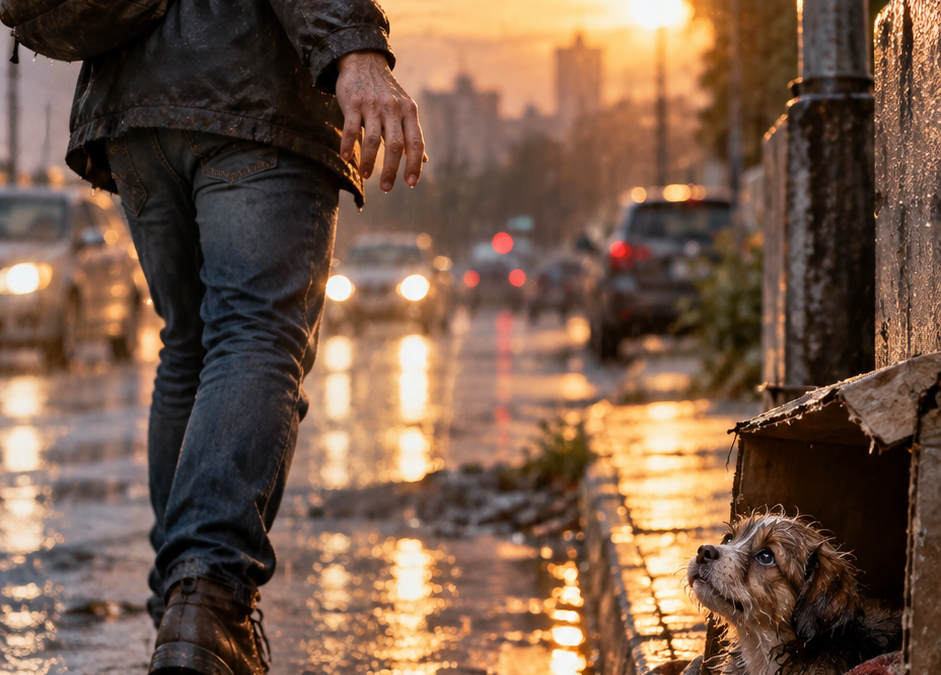
𝗣𝗔𝗥𝗧 𝟮
The first thing I noticed when I reached her was how hot the metal was.
I grabbed the cart without thinking and immediately jerked my hand away.
The puppy didn’t have that option.
Part of her body was pressed against the lower frame.
Her paw pads rested on asphalt that had been cooking in direct sun for hours.
I crouched.
“Hey.”
Her eyes moved toward me.
“Hi.”
Brilliant opening.
Exactly the sort of sophisticated emergency communication you’d expect from a man with absolutely no idea what he was doing.
The paper on the cart fluttered again.
VESPER.
I looked at her.
“That you?”
One ear moved weakly.
I decided that counted.
A uniformed security guard approached from the storefront.
For one stupid second, I felt relief.
Finally.
Someone official.
He stopped several feet away.
“Sir, don’t touch it.”
I stared at him.
“What?”
“The dog.”
“I gathered that.”
“Store policy. Liability.”
I looked at the puppy.
Then back at him.
“Liability.”
“Animal control has procedures.”
“Did you call them?”
He hesitated.
That was answer enough.
“How long has she been here?”
“I don’t know.”
“How long have you known?”
“Somebody reported it maybe twenty minutes ago.”
“And she’s still tied to a cart.”
“We can’t just—”
The puppy made a sound.
Barely.
A dry little rasp.
We both looked down.
That ended the conversation for me.
I pulled the keychain multitool from my pocket.
The guard stepped forward.
“Sir, seriously, you should wait.”
“For what?”
“Animal control.”
“How long?”
“I don’t know.”
“Ten minutes?”
He didn’t answer.
“Twenty?”
Still nothing.
I pointed toward Vesper.
“She doesn’t have your administrative timeline.”
A man passing with a grocery bag stopped just long enough to glance over.
“It’s just a dog,” he said.
I looked at him.
He shrugged.
“Someone will deal with it.”
Then he walked away.
That sentence stayed with me for years.
Someone will deal with it.
Perhaps the most efficient excuse human beings ever invented.
Nobody has to be cruel if everybody agrees responsibility belongs to a stranger.
I knelt beside Vesper.
The security guard muttered something behind me.
I ignored him.
“Okay, girl.”
Her eyes followed the multitool.
“I’m cutting these.”
She flinched when I touched the first plastic tie.
I stopped immediately.
“Not hurting you.”
Her chest rose.
Fell.
Too slow.
I slid the blade beneath the tie.
My hands shook.
It annoyed me.
I had worked around industrial equipment, climbed ladders thirty feet above concrete, and sat through enough corporate meetings to prove I had endured genuine danger.
Now a two-pound multitool and a half-conscious puppy had my fingers trembling.
The first tie snapped.
Then the second.
The tape around her paws was worse.
It had been wrapped tightly enough to pull fur.
I tried peeling one edge.
Vesper jerked.
A tiny cry escaped her.
I froze.
“Sorry.”
Her eyes closed.
“No. Stay with me.”
A woman nearby had stopped with a toddler.
The child pointed.
“Mommy, she’s thirsty.”
The mother looked uncomfortable, then handed me a half-full water bottle.
“Here.”
“Thank you.”
The security guard said, “Don’t give her too much.”
At least that was useful.
I poured a little into the bottle cap.
Touched it to Vesper’s mouth.
Nothing.
I wet my finger.
Touched her lip.
Her tongue moved.
Once.
Then again.
I held the cap closer.
She licked.
Slowly.
Her mouth shook.
“That’s it.”
Another lick.
“Easy.”
The toddler crouched several feet away.
“Is she going to die?”
His mother whispered his name sharply.
I couldn’t answer.
Because I had suddenly become terrified the answer was yes.
I returned to the tape.
Slow.
Tiny sections.
Fur came loose.
Her skin beneath looked red.
One paw had swollen slightly.
When the last strip came free, Vesper tried to move.
Her front legs folded.
I caught her.
She didn’t fight.
She simply collapsed against my forearm.
She was cold.
That made no sense.
The air was brutal.
The pavement radiated heat.
Yet her body didn’t feel warm enough.
I had no medical knowledge beyond the obvious conclusion that this was bad.
Very bad.
I took off my overshirt and wrapped her.
The security guard finally crouched.
“There’s a veterinary hospital about ten minutes east.”
“Name?”
He told me.
I memorized it.
The woman with the toddler gave me the rest of the water.
“Take it.”
I nodded.
The child waved at Vesper.
“Bye, puppy.”
Vesper didn’t move.
I carried her to the car.
The same car I’d nearly used to leave her behind.
That thought made something ugly twist in my chest.
I put her on the passenger seat on top of my shirt, turned the air-conditioning high but not directly onto her, and searched the vet address with one hand.
Nine minutes.
Maybe twelve with traffic.
I looked at Vesper.
“You’ve got twelve minutes.”
No response.
“That’s all I’m asking.”
Her eyes opened.
Barely.
“Stay annoying.”
I pulled out.
At the first red light, her head rolled sideways.
“Vesper.”
Nothing.
“Vesper.”
One ear twitched.
My heart punched against my ribs.
“Good.”
The light stayed red.
“Come on.”
I looked left.
No traffic.
Looked right.
Still red.
For one irrational second, I considered treating traffic law as a suggestion.
Then it changed.
I drove.
Mission Valley blurred around us.
Stores.
Intersections.
Heat.
The whole city continuing with impressive enthusiasm despite the fact that one tiny dog in my passenger seat seemed to be disappearing.
I kept checking her chest.
Rise.
Fall.
Pause.
Rise.
“Don’t do that.”
My voice sounded angry.
Fear often does.
“You don’t get to make me turn around and then die anyway.”
Her paw shifted.
“That’s right.”
I touched it.
“I’m still not a dog person, by the way.”
No response.
“Just establishing expectations.”
At the clinic, I parked crooked across two spaces.
A problem for later.
I carried Vesper inside.
The receptionist looked up.
“Hi, I need you to—”
“She was tied outside in the heat.”
The woman reached for a clipboard.
“Okay, for strays we need—”
Vesper’s body went limp against my arm.
I stared at the receptionist.
“I don’t think she has time for your form.”
My voice cracked.
Too loud.
Several people looked over.
The receptionist finally looked directly at the puppy.
Everything changed.
“Tech!”
A door opened.
A woman in scrubs rushed out.
“How long exposed?”
“I don’t know.”
“Age?”
“I don’t know.”
“Name?”
“Vesper.”
“Yours?”
“No.”
She took the puppy.
Vesper’s head lifted weakly as she left my arms.
For less than a second, our eyes met.
Then the doors closed.
I stood there holding nothing.
That was the moment I learned how heavy an empty pair of arms can feel.
The receptionist quietly placed the clipboard in front of me again.
This time I took it.
Name.
Daniel Harper.
Age.
Fifty-two.
Phone.
Address.
Financial responsibility.
I stopped at that line.
The receptionist said, “Since she’s a stray, we can contact county services, but emergency treatment—”
“I’ll cover it.”
She looked at me.
“Sir, you should understand—”
“I’ll cover it.”
I signed.
My signature looked terrible.
I sat.
The waiting room had eight chairs, two fake plants, an aquarium, and a television showing a cooking program nobody watched.
Across from me, a golden retriever slept with his head on his owner’s shoe.
A woman held a cat carrier.
Someone laughed softly near reception.
Ordinary veterinary life.
Meanwhile, behind two doors, a dog I’d known for twenty minutes was apparently fighting not to die.
I leaned forward.
Hands together.
Then I noticed something stuck to my shirt.
The paper from the cart.
VESPER.
I must have grabbed it without realizing.
I turned it over.
Blank.
One word.
A name.
The only thing whoever left her had bothered to provide.
I wanted to be furious.
Actually, I was furious.
At the person who tied her there.
At the man who said just a dog.
At the security guard hiding behind liability.
At everyone who walked past.
At myself for almost joining them.
Especially myself.
An hour passed.
Then another.
Finally a veterinarian came through the doors.
“Mr. Harper?”
I stood too quickly.
“Yes.”
“I’m Dr. Reyes.”
She looked exhausted but not defeated.
That distinction mattered.
“She’s critically dehydrated. Her blood sugar is dangerously low. Her paw pads have thermal injury, and the constriction around her legs caused some swelling.”
“Is she going to live?”
Dr. Reyes paused.
I hated that pause.
“She’s responding to fluids.”
“That isn’t what I asked.”
“It’s the answer I can give you.”
I looked toward the doors.
“Can I see her?”
“For a minute.”
Vesper lay on a padded treatment table under a light blanket.
An IV catheter was taped to one shaved leg.
She looked even smaller surrounded by medical equipment.
I stood beside her.
“Hey.”
Her ear moved.
Dr. Reyes noticed.
“She knows your voice.”
“She’s known it three hours.”
“Three important hours.”
Vesper made a faint squeak.
My chest tightened.
It was the first real vocal sound I’d heard from her.
“That’s good?”
Dr. Reyes nodded.
“Very.”
I bent closer.
“Complain all you want.”
Her eyelids fluttered.
“That’s apparently your new job.”
Dr. Reyes explained that Vesper needed overnight monitoring.
Fluids.
Glucose.
Pain control.
Treatment for her paws.
Blood tests.
Parasite screening.
Possibly antibiotics depending on results.
I nodded to everything.
Didn’t understand half of it.
Didn’t care.
“Stay with her?”
“You can visit until we close regular access.”
“I can sit outside.”
Dr. Reyes looked at me.
“You don’t have to.”
“I know.”
That became the problem.
I knew.
I could leave.
Nobody was forcing me.
Vesper wasn’t legally mine.
I wasn’t responsible for whatever had happened before noon.
I could pay the bill and let rescue services take over.
Every sensible option remained available.
So why did walking toward the door feel exactly like walking toward my car in the parking lot?
I stayed.
At ten-thirty that night, I sat in my vehicle outside the clinic.
Engine off.
The heat had finally broken.
Traffic moved beyond the lot.
I stared at a lighted treatment-room window.
The door opened.
Dr. Reyes came outside.
“You’re still here.”
“Observant.”
She smiled tiredly.
“She’s holding steady.”
“Steady good?”
“Steady is better than getting worse.”
I nodded.
“Parasites?”
“Yes.”
“Bad?”
“Treatable.”
“Anything else?”
“Malnutrition.”
My jaw tightened.
“So this didn’t start today.”
“No.”
“How long?”
“Hard to know.”
I looked toward the window.
“Someone taped her paws.”
Dr. Reyes didn’t answer.
She didn’t have to.
“People are unbelievable.”
“Some are.”
I looked at her.
She tilted her head toward me.
“You’re in a veterinary parking lot at eleven at night for a dog you say isn’t yours.”
“That’s temporary insanity.”
“Maybe.”
She started back toward the clinic.
“Try to sleep.”
“Not likely.”
Near dawn, I must have drifted off.
A tap on my window woke me.
Dr. Reyes.
I opened the door.
“What happened?”
“Nothing bad.”
My heart slowed a fraction.
“She can probably go home later this morning.”
I stared.
“Home.”
“If somebody can monitor her continuously.”
I looked through the windshield.
“What happens otherwise?”
“We contact rescue and arrange medical foster.”
“How experienced are those fosters?”
“Some very.”
“Better than me?”
“Almost certainly.”
That should have ended it.
Instead I asked, “What would I have to do?”
Dr. Reyes smiled.
Not a big smile.
The restrained smile of someone watching another human being walk willingly into a trap everyone else can already see.
“Come inside.”
Three hours later, I left with Vesper.
Medication.
Ointment.
Feeding instructions.
Syringes.
Emergency numbers.
A schedule complicated enough to resemble military logistics.
And one puppy wrapped in a clean towel.
I put her into the passenger seat.
She looked at me.
“Temporary.”
Her ears moved.
“Medical foster.”
Tail did nothing.
“Do not get ideas.”
She fell asleep.
My apartment revealed its shortcomings immediately.
No dog bed.
No bowls.
No puppy pads.
No toys.
No crate.
No idea.
I owned six coffee mugs and not one object specifically designed to hold dog food.
I used a shallow cereal bowl.
For water, a plastic food container.
I folded two blankets beside the couch.
Vesper looked at them.
Then looked at me.
“This is premium accommodation.”
She lowered her head.
“Ungrateful.”
She was too weak to stand long.
I fed her in tiny amounts.
Soft food.
Water.
Medication.
At first she resisted the syringe.
Then tolerated it.
Then decided perhaps the strange man with the bad technique wasn’t actively trying to murder her.
Progress.
When evening came, a neighbor named Marisol knocked after seeing me carry the puppy upstairs.
“Since when do you have a dog?”
“I don’t.”
She looked around my leg.
Vesper lay on the blanket.
“Daniel.”
“Temporary.”
Marisol laughed.
“What?”
“Nothing.”
“You have a crate?”
“No.”
“Bed?”
“Blankets.”
“Bowls?”
“Containers.”
“Toy?”
“She’s nearly dead, Marisol. I don’t think entertainment is currently the emergency.”
“You’d be surprised.”
Twenty minutes later, she returned with a small crate, two stainless-steel bowls, several puppy pads, and a stuffed rabbit.
“These were my daughter’s dog’s.”
“I’ll return everything.”
“Sure.”
Her tone was irritating.
I tried the crate that night.
Vesper looked inside.
Then at me.
I placed a blanket inside.
She put one paw across the threshold.
Then the metal door shifted slightly.
Clink.
Vesper recoiled so violently she nearly fell.
I caught her.
Her whole body started shaking.
“No.”
I moved the crate away.
“Forget it.”
She pressed into my arm.
“Floor.”
So I slept on the floor.
Technically, I lay on the floor.
Sleep implies success.
Every hour, I checked her breathing.
At midnight, medication.
At one, water.
At three, I woke because Vesper was whimpering.
Her paws twitched in sleep.
Her body jerked.
I touched the floor near her but didn’t grab her.
“Hey.”
Her eyes opened.
Wild.
For one second, she didn’t know where she was.
Then she smelled my hand.
Her breathing slowed.
“Apartment.”
I rubbed my eyes.
“Ugly carpet.”
She watched.
“Neighbor with terrible music.”
A bass line thumped faintly through the wall.
“See?”
One ear moved.
“Home.”
The word came out before I could stop it.
Vesper crawled closer.
Rested her head against my forearm.
I stayed still.
Minutes passed.
Her breathing deepened.
That’s when she licked my wrist.
One small swipe.
I looked at her.
“You shouldn’t do that.”
Another lick.
“Creates expectations.”
Her tail twitched.
I stared.
“Was that a wag?”
Nothing.
“Convenient.”
The next morning, Vesper tried to stand without assistance.
Her front legs held.
Back legs trembled.
She made two steps.
Then vomited.
Every ounce of relief vanished.
I called the clinic.
Dr. Reyes asked questions.
Temperature.
Color of gums.
Frequency.
Fluid intake.
She told me parasite treatment could upset her stomach but wanted her rechecked.
So we went.
Tests confirmed intestinal parasites but no catastrophic infection.
Medication adjusted.
Feeding divided even smaller.
I drove home feeling as if I’d enrolled in a graduate degree with no prerequisites.
I researched everything.
German Shepherd puppy nutrition.
Dehydration.
Burned paw pads.
Parasites.
Behavior after abandonment.
Trauma.
Crate fear.
Heat exposure.
By lunch, the internet had diagnosed Vesper with nineteen diseases and me with anxiety.
I closed the laptop.
She looked up.
“Doctor Google fired.”
Tail twitch.
Her first real breakthrough happened outside.
Not walking.
She wasn’t ready.
I carried her to a shaded strip beside my building.
Set her on grass.
She froze.
Grass moved beneath her paws.
A breeze touched her face.
Her nose came alive.
She sniffed.
One blade.
Another.
A bougainvillea petal lay near her.
She leaned closer.
Sniffed.
Sneezed so violently she fell backward.
I laughed.
Couldn’t help it.
Vesper stared at me.
My laugh stopped.
“Sorry.”
Her head tilted.
Then, for the first time, her mouth opened slightly in what looked almost like a puppy smile.
I laughed again.
She didn’t flinch.
“All right.”
Her tail moved.
One full wag.
Something inside my chest gave way.
“That’s cheating.”
Another wag.
“You can’t nearly die and then do that.”
She sneezed again.
I sat on the ground.
For the first time in years, I didn’t care who saw me.
A fifty-two-year-old man sitting beside a half-bald, underweight German Shepherd puppy discussing emotional manipulation.
San Diego had seen stranger things.
The shopping-cart trigger appeared three days later.
We were outside again.
Vesper could walk maybe twenty yards before tiring.
A metal cart rattled along the sidewalk near a convenience store.
The sound hit her before I understood what it was.
Her body dropped.
Ears flat.
Tail tucked.
She scrambled backward.
The leash tightened.
I immediately moved toward her instead of pulling.
“Vesper.”
Her eyes were enormous.
Cart wheel rattling.
Metal clanging.
She tried to hide behind my legs.
I crouched.
Blocked her view.
“You’re not there.”
Her body shook against me.
“Not that parking lot.”
The cart rolled away.
Sound faded.
She remained pressed into my knee.
I waited.
No forcing her forward.
No stupid encouragement to “face her fear.”
Fear isn’t conquered because a human being decides the schedule would be narratively convenient.
Eventually she lifted her head.
Sniffed.
Looked around.
I stood.
“Home?”
Vesper took one step.
Then another.
We went home.
For the next week, I worked on the sound carefully.
Cart videos at low volume.
Treat.
Stop.
A small folding utility cart in the hallway.
Far away.
Treat.
Closer another day.
No reaction?
Treat.
Vesper began associating rattles with food instead of panic.
Not perfectly.
But gradually.
That was when I learned healing often looks boring from the outside.
People want dramatic before-and-after moments.
Traumatized puppy becomes happy dog.
Five-minute montage.
Inspirational soundtrack.
Reality is repetition.
A sound.
A treat.
A step.
A setback.
Another step.
At night Vesper still woke suddenly.
During the day she improved.
She learned my routines.
Coffee at six-thirty.
Medication.
Breakfast.
Work laptop.
Short potty break.
Nap.
Lunch.
Another break.
By the second week, she followed me everywhere.
Bathroom included.
“Privacy.”
Vesper sat outside.
I closed the door.
Scratch.
I opened it.
She looked up.
“You’re unreasonable.”
Tail wag.
I began leaving the door open.
Standards decline rapidly under canine occupation.
Then she got sick again.
It happened on a Thursday.
Morning had been good.
She ate.
Walked.
Tried to steal part of my toast.
At noon she refused food.
By two, her body felt hot.
By four, she could barely stand.
I called Dr. Reyes.
“Bring her immediately.”
I wrapped Vesper in a towel.
Carried her to the car.
The memory of the first drive came roaring back.
Same weight against my chest.
Same fear.
Only worse now.
Because the first time she had been a stranger.
This time she wasn’t.
At the emergency clinic, a technician took her.
Vesper looked back over the woman’s shoulder.
My chest actually hurt.
Dr. Reyes met me ten minutes later.
“Her blood sugar dropped again. Fever. We may be dealing with secondary infection while her immune system is still compromised.”
“What does that mean?”
“It means she stays.”
“How bad?”
“Serious.”
“How serious?”
Dr. Reyes looked directly at me.
“Serious enough that I’m glad you didn’t wait.”
I sat.
That waiting room had become too familiar.
Same television.
Same aquarium.
Different terror.
I called my sister Claire.
She answered.
“Daniel?”
“She’s sick.”
“Vesper?”
The fact that my sister already knew her name said more about my last two weeks than I wanted to admit.
“Yeah.”
“How bad?”
“I don’t know.”
My voice failed.
Silence.
Then Claire said, “Stay with her.”
“I can’t do anything.”
“Stay anyway.”
I leaned forward.
“Why does that help?”
“Maybe it helps you.”
I closed my eyes.
“That’s annoyingly reasonable.”
“I’m your sister. It’s my job.”
At three-fourteen in the morning, Dr. Reyes came into the waiting room.
“Come with me.”
Those words almost stopped my heart.
Vesper lay on a blanket in recovery.
IV.
Monitor.
Her head lifted when I entered.
Only an inch.
Then fell.
I knelt.
“Hey.”
She moved again.
Her muzzle touched my wrist.
Dr. Reyes stood behind me.
“She’s responding better.”
I didn’t look away.
“Meaning?”
“Meaning I think she’s turning the corner.”
My eyes burned.
Vesper pressed her nose harder against me.
I put my forehead near hers.
“You fight.”
Her ears twitched.
“I’ve got you.”
Dr. Reyes left us for a few minutes.
When she returned, she carried a clipboard.
“There’s something else.”
I looked up.
“County stray hold expires soon. The rescue group can take over once she’s medically cleared, or…”
“Or?”
“You can formalize foster-to-adopt.”
I stared at the paper.
Two weeks earlier, I would have laughed.
I had spent years telling people pets didn’t fit my life.
Too much responsibility.
Too restrictive.
Too expensive.
Too emotional.
Excellent arguments.
Very logical.
Vesper lifted one paw.
It landed weakly against my sleeve.
I took the pen.
“Where?”
Dr. Reyes smiled.
“Here.”
I signed.
No shaking this time.
Back home several days later, Vesper’s recovery changed.
Not suddenly.
But decisively.
She ate with appetite.
Gained weight.
Started developing energy.
Then too much energy.
I learned that a healthy German Shepherd puppy is not an animal.
It is a home demolition program with ears.
The dog who had barely been able to stand discovered socks.
Shoelaces.
Chair legs.
Cardboard.
Couch cushions.
Electrical cords, which were quickly relocated beyond her jurisdiction.
One morning I found toilet paper extending from the bathroom into the living room.
Vesper stood in the middle.
Very pleased.
I stared.
She wagged.
“No.”
More wagging.
“What happened?”
She sat.
“Don’t sit like you’re innocent.”
Head tilt.
“You did this.”
Tail.
I pointed at the paper.
“Evidence everywhere.”
She picked up the cardboard roll and ran.
I chased her.
“I am fifty-two!”
She ran faster.
“That is not an advantage!”
Around the couch.
Through the hallway.
Back toward the kitchen.
For perhaps thirty seconds, I forgot entirely that I wasn’t a dog person.
I was simply an idiot chasing a puppy.
When I caught her, we both ended up on the floor.
Vesper rolled onto her back.
Tongue out.
I laughed until my stomach hurt.
Then stopped.
She was exposing her belly.
Completely.
No defensive curling.
No tension.
Trust.
I put my hand gently on her chest.
Her heartbeat was strong.
I remembered barely feeling it in the parking lot.
“Look at you.”
She licked my chin.
“Disgusting.”
Another lick.
I didn’t move away.
Once her vaccinations and health allowed it, I took her to Balboa Park.
Leashed.
The original version of me would like the record corrected on that point.
No dramatic off-leash miracle with a recovering puppy.
I wasn’t completely reckless.
Vesper stepped onto the grass and froze.
The park was enormous compared with my apartment courtyard.
Dogs.
Children.
Birds.
Bicycles.
Wind moving through trees.
Her nose worked constantly.
Then she saw a squirrel.
Every trauma in her past was temporarily suspended in favor of a more urgent philosophical question.
What was that?
She lunged.
I nearly lost my shoulder.
“Apparently you’re healthy.”
The squirrel escaped.
Vesper looked at me accusingly.
“I didn’t warn him.”
We walked slowly.
Ten minutes.
Rest.
Another five.
Then Vesper did something I’d never seen.
She ran in a little circle on the leash.
Not away.
Around me.
Awkward.
Paws too big.
Back legs still regaining strength.
But joyful.
Pure puppy nonsense.
Then she crashed into my shoes.
I bent over her.
Her tail hammered the ground.
“I guess.”
I sighed.
Vesper looked up.
“I guess I may be a dog person.”
She licked my hand.
“No.”
I scratched behind her ear.
“That’s not right.”
Her ears lifted.
“I’m your person.”
That felt different.
More accurate.
Adoption day arrived three weeks later.
The rescue called it “Belonging Day.”
I thought that was unbearably sentimental.
Then I arrived and nearly cried over the sign.
So apparently my resistance to sentimentality had become theoretical.
Vesper sat in the passenger seat wearing her green harness.
She was still thin compared with a healthy shepherd puppy.
But no ribs.
Bright coat returning.
Ears getting stronger.
Eyes curious instead of empty.
At the rescue office, the volunteer placed paperwork in front of me.
“Daniel Harper adopting Vesper.”
“Correct.”
“Permanent.”
I looked at her.
“That’s generally what adoption means.”
She smiled.
“I ask because you originally wrote ‘temporary’ on every foster form.”
I looked down.
Vesper sat on my foot.
“Administrative evolution.”
The volunteer laughed.
I signed.
She brought out a green collar with a silver tag.
VESPER HARPER.
My phone number.
Microchip number registered.
Backup rescue contact.
When the collar clicked, Vesper’s body stiffened for half a second.
I immediately touched her shoulder.
She looked at me.
Then relaxed.
The tag jingled.
No panic.
Just sound.
The automatic doors opened as we left.
Outside, a shopping cart rattled across the walkway.
Vesper stopped.
My heart sank.
Old fear returned to her eyes.
I didn’t pull.
Didn’t speak immediately.
The cart passed.
Vesper moved closer to my leg.
Then stepped forward.
One step.
Another.
She walked past it.
I almost laughed.
“Show-off.”
Tail wag.
At home, I gave her a proper bed beside my desk.
Expensive.
Orthopedic.
Highly rated.
She sniffed it.
Walked away.
Slept on my foot.
Naturally.
The scrap of paper with her name stayed in my desk drawer.
VESPER.
I sometimes took it out.
Not because I wanted to stay angry.
Because I wanted to remember how easy it would have been not to turn back.
That fact disturbed me.
People like stories where rescuers are naturally heroic.
They see suffering and immediately act.
I wasn’t that man.
I hesitated.
Made excuses.
Started my car.
Almost left.
I think that matters.
Because heroism is a poor standard for ordinary people.
You shouldn’t need to feel heroic.
Sometimes you simply have to interrupt your own excuse.
Months passed.
Vesper grew.
German Shepherd puppies do not grow gradually.
They expand overnight.
One day she was small enough to carry easily.
The next I was looking at her and wondering who had replaced my puppy with a small police horse.
Her ears became enormous.
Then proportional.
Her chest broadened.
She discovered barking.
God help the delivery drivers.
The first time she barked at the door, I jumped.
Vesper looked proud.
“What was that?”
Bark.
“I heard you.”
Another.
“The entire building heard you.”
She trotted toward the door.
“Nobody is invading.”
Tail.
“It’s Amazon.”
This did not reassure her.
Apparently parcels were a national security concern.
Training helped.
Sit.
Down.
Stay.
Leave it.
Place.
Heel.
Vesper learned quickly.
Too quickly.
She also learned patterns I hadn’t intended to teach.
If she sat beautifully while I cooked, chicken occasionally appeared.
Therefore, cooking meant mandatory sitting.
If she brought me a toy while I was on a conference call, sometimes I threw it without thinking.
Therefore, conference calls were interactive enrichment sessions.
If she stared at me long enough during breakfast, I occasionally surrendered a blueberry.
Therefore, human weakness could be weaponized.
I had created a lawyer.
One morning Claire visited.
Vesper greeted her like a returning war hero.
Claire stared at me.
“You said you weren’t a dog person.”
“I’m not.”
Vesper stood on her hind legs and put her paws on my shoulders.
Claire laughed.
“Right.”
“She’s an exception.”
“She’s wearing a bandana.”
“Gift.”
“Her name is embroidered on it.”
“Marisol.”
“You have dog treats in your pocket.”
“Training.”
Claire looked at Vesper.
“How many toys?”
“Unknown.”
“Daniel.”
“Inventory changes.”
She laughed so hard she had to sit down.
Vesper climbed beside her.
I pointed.
“No couch.”
Vesper looked at me.
Then at Claire.
Claire patted the cushion.
Vesper climbed up.
“Betrayal.”
Claire scratched her ears.
“You lost this war weeks ago.”
Maybe.
But there were still hard moments.
A shopping cart outside a store could freeze Vesper completely.
Tape tearing from a package made her leave the room.
If someone reached quickly toward her paws, she recoiled.
Hot pavement terrified her.
So we worked.
Never forced.
Never rushed.
At a distance from carts.
Reward calm.
Closer when ready.
Back away when overwhelmed.
Touch paw.
Treat.
Hold paw.
Treat.
Brief examination.
Treat.
Eventually she allowed me to trim nails without fear.
The first time, I almost celebrated more than she did.
“You have no idea how impressive that was.”
Vesper ate cheese.
“Apparently cheese is enough.”
Heat remained different.
San Diego summers required planning.
Walk early.
Walk late.
Protect paws.
Water.
Shade.
I bought boots.
Vesper hated them.
She walked like gravity had become unpredictable.
One paw up.
Then another.
Stiff-legged.
I laughed.
She glared.
“Safety.”
She lifted both front feet almost simultaneously and fell against the couch.
“Strong objection noted.”
Eventually she adjusted.
Seeing her cross warm pavement in protective boots felt absurdly satisfying.
The asphalt did not own her anymore.
Neither did the cart.
Neither did the tape.
Fear lost territory inch by inch.
The person who had tied her there was never identified.
Security footage was incomplete.
The cart had been outside camera range.
No microchip registered beforehand.
No useful witnesses.
At first, I wanted the person found.
Badly.
I imagined consequences.
Charges.
Court.
Public shame.
Something.
I wanted a villain with a face because anger prefers an address.
The rescue coordinator, Lena, told me something I didn’t like.
“Sometimes you don’t get that.”
“What?”
“An answer.”
“Someone did this.”
“I know.”
“They tied her paws.”
“I know.”
“And nothing happens?”
“Something happened.”
I looked at her.
She nodded toward Vesper.
The puppy was chewing a rope toy.
“She lived.”
“That’s not punishment.”
“No.”
Lena shrugged.
“It’s better.”
At the time, I disagreed.
Later, I understood.
Whoever left Vesper had tried, intentionally or otherwise, to reduce her life to a shopping cart in a parking lot.
That became less important every month.
Vesper grew.
Learned.
Played.
Slept.
Barked.
Loved.
Her life became so much bigger than the ugliest thing done to her that eventually the parking lot felt like a prologue.
That was a better defeat.
Cruelty wants permanence.
It didn’t get it.
One year after I found her, I went back to the same store.
I almost didn’t bring Vesper.
Then decided the choice should be hers.
We parked on the opposite side of the lot.
Late afternoon.
Warm, not dangerous.
She wore boots.
Harness.
Plenty of water in the car.
I opened the door.
Vesper stepped out.
Sniffed.
At first, nothing.
Then a shopping cart rattled.
Her head snapped toward it.
Body tense.
I waited.
“You want to go home?”
She looked at me.
Then at the cart.
A woman pushed it toward the store.
Vesper watched.
Her ears slowly came forward.
She sniffed.
Then took one step.
Another.
We walked.
Not toward the exact place.
No need.
Just through the lot.
Vesper stayed beside my leg.
A cart rolled past.
She flinched.
Didn’t stop.
At the entrance, I turned.
“Enough?”
She sniffed a planter.
Apparently yes.
We walked back to the car.
On the way, a little boy spotted her.
“Can I pet her?”
His father looked at me.
I crouched beside Vesper.
“Want to say hi?”
The boy held his hand low.
Perfect.
Vesper sniffed.
Then licked him.
The boy laughed.
Vesper’s tail started.
I recognized him.
Not the exact child from the rescue day.
Just another kid.
Didn’t matter.
For a moment, the parking lot contained something other than pain.
A puppy—no, a young dog now—standing where she had almost died, choosing curiosity.
I looked across the asphalt.
The cart she’d been tied to was long gone.
The people were gone.
The tape.
The heat.
Everything.
Vesper leaned against my leg.
“You won.”
Her ears moved.
I scratched her chest.
“Do you know that?”
Tail wag.
“Probably not.”
She licked my hand.
“Good.”
Maybe dogs don’t need to understand victory.
They live it.
Vesper became my routine.
Then my companion.
Then something closer to family than I had expected to admit.
When I worked late, she waited.
When I was sick, she slept beside the couch.
When I had a bad day, she somehow knew not to demand play immediately.
She would sit near me.
Quiet.
That surprised me most.
German Shepherds have a reputation for intelligence.
What nobody tells you is how observant intelligence can feel.
Vesper learned my moods.
If I was irritated, she gave me space.
If I was sad, she pressed her body against my leg.
If I laughed, she often brought a toy as if happiness clearly required escalation.
One winter, Claire asked why I had always insisted I wasn’t a dog person.
I shrugged.
“Never had one.”
“That’s not a reason.”
“I liked freedom.”
“From what?”
“Responsibility.”
Claire looked toward Vesper, asleep by the window.
“And how’s that working?”
I smiled.
“Poorly.”
She waited.
I sighed.
“Our dad.”
Claire’s expression changed.
We hadn’t spoken about him in years.
Our father loved dogs.
Always had one.
When I was fourteen, our shepherd mix, Benny, died.
Dad took it badly.
Really badly.
He had raised that dog from a puppy.
After Benny died, he never got another.
I remember thinking grief looked humiliating.
A grown man standing in the garage crying over a collar.
I decided somewhere in adolescence that loving animals meant voluntarily creating future pain.
So I opted out.
Elegant solution.
No dog.
No loss.
Decades later, Vesper dismantled the strategy by nearly dying before I even had a chance to love her.
The pain arrived first.
Then attachment.
The universe has a cruel sense of humor.
Claire looked at me.
“You were afraid.”
“No.”
“Daniel.”
“I was practical.”
“You slept on a bathroom floor with a puppy.”
“Medical necessity.”
She laughed.
Then softened.
“Dad would’ve loved her.”
I looked at Vesper.
“Yeah.”
That night, I opened an old box in my closet.
Inside was Benny’s collar.
I’d kept it without remembering I had.
Brown leather.
Cracked.
Tag scratched.
Vesper sniffed it.
Then sat.
I rubbed the old metal between my fingers.
Dad crying in the garage.
For the first time, the memory didn’t embarrass me.
It made sense.
“Oh.”
Vesper tilted her head.
“I owe him an apology.”
Tail wag.
“He has been dead twelve years, so timing is poor.”
Vesper rested her head on my knee.
Love doesn’t become foolish because it ends painfully.
That was what I had misunderstood.
Loss isn’t evidence that attachment was a mistake.
It’s evidence that something mattered enough to leave an empty place.
Vesper gave me that lesson without knowing she was teaching anything.
The years moved.
She became a magnificent shepherd.
Seventy pounds.
Athletic.
Alert.
Deep black saddle.
Rich tan legs.
The giant ears finally fit.
People stopped us constantly.
“Beautiful dog.”
“Thank you.”
“Police dog?”
“No.”
“Protection trained?”
“Only against cardboard boxes and delivery trucks.”
Once, a man asked, “How much did she cost?”
I looked at Vesper.
Emergency treatment.
Medication.
Parasite treatment.
Food.
Training.
Insurance.
Destroyed shoes.
Two rugs.
One remote control.
A section of baseboard.
“Emotionally or financially?”
He laughed.
I didn’t.
Vesper became comfortable enough around shopping carts that we could walk through store parking lots without panic.
Occasionally she still looked.
That’s fine.
Healing is not amnesia.
I never wanted her to forget danger completely.
I wanted danger to become information instead of destiny.
She also developed a strange relationship with abandoned objects.
If we found a glove on a trail, she would sniff it repeatedly.
A child’s toy near a bench?
Investigation.
Empty grocery bag?
Suspicious.
Maybe coincidence.
Maybe part of her.
One afternoon, near a neighborhood market, we heard a puppy crying from behind a dumpster.
Vesper froze.
Then pulled.
Hard.
“Vesper.”
She pulled again.
I followed.
Behind the dumpster was a small terrier mix tangled in a broken leash.
No owner nearby.
Vesper approached slowly.
The terrier barked frantically.
Vesper stopped.
Lay down.
Waited.
The crying softened.
I called animal control and a local rescue.
While we waited, Vesper stayed.
No pushing.
No barking.
Just lying nearby.
I watched her.
The dog that had once been ignored in a parking lot now refusing to leave another frightened animal alone.
That got me.
“Show-off.”
Vesper looked at me.
Tail thump.
The terrier eventually approached.
They touched noses.
Rescue arrived.
The dog was reunited with his family the next day.
That evening, Vesper slept beside my desk.
I stared at her.
“Someone dealt with it.”
Her ears moved.
The sentence from years earlier.
Someone will deal with it.
This time someone had.
Us.
I liked that better.
Vesper’s adoption anniversary became a private tradition.
I called it Turnaround Day.
Because that was literally what I had done.
Turned the car around.
First anniversary: steak.
Second: hike.
Third: beach at sunrise.
She hated waves initially, then discovered chasing foam.
Fourth: long walk through Balboa Park.
Fifth: I donated to the rescue that helped us.
Not because of obligation.
Because by then I’d seen enough to understand what “someone will deal with it” actually requires.
Someone has to fund the clinic.
Someone has to foster.
Someone has to clean kennels.
Someone has to answer the phone at midnight.
Someone has to drive.
Someone has to stay.
None of it happens through abstract compassion.
Compassion is logistics with a heartbeat.
At fifty-eight, I changed jobs.
Less travel.
I told colleagues it was because I wanted balance.
True.
I didn’t mention I had become unwilling to spend five nights a month away from Vesper.
That would have damaged my carefully maintained image as a rational adult.
At sixty, I bought a small house with a yard.
The realtor showed me the kitchen.
I asked about fencing.
She showed me the renovated bathroom.
I asked whether the backyard had shade.
She showed me the garage.
I asked whether dogs were allowed under HOA rules.
She smiled.
“You have a dog.”
“I’ve mentioned that.”
“You’ve mentioned nothing else.”
Fair.
Vesper approved the yard.
She ran three circles.
Rolled in grass.
Dug one unauthorized hole.
Then slept on the patio.
Closing day, I stood in the doorway.
Vesper beside me.
The apartment where she’d recovered was behind us.
Ahead, house.
Yard.
Space.
“I bought you real estate.”
She walked inside.
No gratitude.
Typical.
Age reached her gradually.
Gray appeared around the muzzle.
She stopped jumping into the car and waited for the ramp.
Walks shortened.
Her hearing softened.
But shopping carts no longer mattered.
Thunder barely mattered.
Tape noises didn’t matter.
Her old triggers became smaller than her life.
She had spent years overwriting them.
One ordinary morning, I found the original piece of paper in a drawer.
VESPER.
Ink faded.
I sat at the table.
She slept nearby.
I had never known whether the person who wrote her name was the person who tied her there.
Maybe someone before them.
Maybe the abandoner.
Maybe someone who cared.
No explanation ever surfaced.
I used to hate that.
Now I didn’t.
A mystery only controls you if you keep believing the missing answer is necessary.
It wasn’t.
Vesper’s story had an answer.
She stayed.
She lived.
She was loved.
At twelve years old, Vesper moved more slowly.
Arthritis.
Medication.
More naps.
Still hungry.
Especially for chicken.
Some instincts remain immortal.
One evening, I sat on the porch while she lay beside me.
Sun setting over San Diego.
Warm breeze.
Her breathing slow.
I looked at her paws.
The same paws once bound with tape.
Now gray fur between the toes.
Nails trimmed.
Safe.
I reached down.
Touched one.
She didn’t move.
That alone nearly broke me.
A dog once terrified of having her paws touched now slept through it.
I held her paw gently.
“Remember the cart?”
Her ear moved.
“Of course you don’t.”
Maybe she did.
I hoped she didn’t.
“I almost left.”
Vesper opened her eyes.
Looked at me.
“I’ve never forgiven myself for that.”
She lifted her head.
Then slowly placed it on my knee.
I laughed.
“You’re terrible at guilt.”
Tail tap.
“Fine.”
I stroked her head.
“Maybe turning back counts.”
It had taken me years to understand that too.
People make a fetish of perfect moral instinct.
As if the only good person is someone who never hesitates.
But sometimes the most important decision happens after hesitation.
You can start walking away.
Then stop.
You can make the wrong choice for five seconds and still change the next ten years.
Turning back matters.
Vesper taught me that before she taught me anything else.
Her last year was quiet.
More vet visits.
Joint injections.
Blood tests.
A special diet.
A ramp to the porch.
A bed in every room because apparently one seventy-pound dog required more furniture than I did.
Claire visited often.
Marisol still came by occasionally and reminded me she’d been right from day one.
Annoying woman.
One afternoon, Marisol looked at Vesper sleeping.
“You know, you never returned that crate.”
“She hated it.”
“Still mine.”
“It’s been twelve years.”
“Interest.”
I laughed.
The crate had become storage in the garage.
Vesper had never used it.
Probably fitting.
No more bars.
The end came gently, which was the only kindness left to ask for.
Cancer.
Advanced.
Dr. Reyes had retired years earlier, but our current vet explained the options.
Treatment might buy time.
Not much.
Could make Vesper miserable.
I looked at her.
She still ate.
Still wanted the yard.
Still rested comfortably.
So we managed pain.
Watched.
Waited.
The hardest part of loving a dog is the final responsibility.
Not avoiding death.
Preventing suffering.
I hated it.
Every part.
I remembered my father crying over Benny’s collar.
Finally understood that grief wasn’t the humiliating part.
Love required courage at the end too.
Vesper’s last morning was sunny.
Of course.
San Diego behaving beautifully at an offensively inappropriate time.
I sat with her in the yard.
She sniffed the air.
A distant shopping cart rattled on the street.
I noticed.
Vesper didn’t.
That mattered.
She had outgrown the sound completely.
Claire came.
Marisol too.
The veterinarian came to the house.
Vesper lay on her favorite blanket.
Head on my leg.
I scratched behind her ears.
Same place from Balboa Park.
“Good girl.”
Her eyes looked at me.
Old now.
Still hers.
“I wasn’t a dog person.”
Claire started crying.
I smiled through my own tears.
“Remember?”
Vesper breathed slowly.
“Then you had to make a liar out of me.”
Tail moved.
Barely.
I leaned down.
“I’m here.”
That was the final promise.
Not don’t die.
Not stay.
I had asked enough of her.
“I’m here.”
Her body relaxed.
The medication took effect.
Her breathing slowed.
Then stopped.
I stayed.
Hand on her chest.
Long after there was nothing left to feel.
The house became unbearable afterward.
Not because it was empty.
Because Vesper had left herself everywhere.
Hair behind furniture.
Scratches on the door.
Green collar.
Bowls.
Beds.
A dent in the couch cushion.
The yard path where she walked.
Silence shaped exactly like her.
I found the note again.
VESPER.
Sat on the floor.
Cried harder than I had at my father’s funeral.
And this time I wasn’t ashamed.
Dad had been right.
Love hurts when it leaves.
Still worth it.
Months later, I returned to the parking lot alone.
Same store.
Different carts.
Different security staff.
Different summer.
I parked near where I had first seen her.
Sat in the car.
Looked into the mirror.
For a moment, I could see everything.
Tiny body.
Tape.
Heat.
Those eyes.
My hand on the gearshift.
The decision.
Then I got out.
Walked across the lot.
Nothing remained.
Of course.
Places don’t preserve our most important moments just because we need them to.
I stood there anyway.
A shopping cart rolled past.
I smiled.
“You won, girl.”
Nobody heard.
That was fine.
Vesper’s victory wasn’t dramatic.
The person who tied her there never faced me.
Never apologized.
Never watched her run through Balboa Park.
Never saw her grow into a beautiful shepherd.
Never watched her sleep belly-up because she trusted the world enough to become vulnerable.
Never knew the dog they’d discarded became the center of somebody else’s life.
Maybe that was punishment enough.
They got one afternoon.
I got twelve years.
Fear got a parking lot.
Love got everything after.
That’s a landslide victory if I’ve ever seen one.
About six months after Vesper died, Claire called.
“There’s a dog at the rescue.”
“No.”
“You didn’t even let me finish.”
“No.”
“Daniel.”
“I’m not ready.”
“Okay.”
That should have been the end.
Then she said, “German Shepherd mix.”
I closed my eyes.
“You’re evil.”
“Probably.”
“Age?”
“Five.”
Not a puppy.
Good.
Bad.
I didn’t know.
“History?”
“Owner died.”
I swallowed.
“Name?”
“Rosie.”
I didn’t go that day.
Or the next.
I went a week later.
Just to look.
That’s what I told myself.
Rosie sat in the back of the kennel.
Black and tan.
Older.
White patch on her chest.
She looked at me.
No dramatic connection.
No magical recognition.
Good.
I didn’t want another Vesper.
There could never be one.
The volunteer opened the gate.
Rosie approached.
Sniffed.
Then sat on my shoe.
I laughed.
“That’s manipulative.”
Her tail moved.
I stayed an hour.
Went home alone.
Returned two days later.
Then again.
A month after that, Rosie slept in Vesper’s old bed.
Not replacing her.
Nothing replaces anybody.
She simply occupied a place that love had taught me how to make.
That’s Vesper’s final gift.
She didn’t turn me into someone who loved one dog.
She turned me into someone no longer afraid of loving another.
I still have the paper.
VESPER.
Faded.
Creased.
Protected in a small frame now.
People sometimes see it and ask what it means.
I tell them.
“That’s the name of the dog who taught me to turn around.”
They usually expect more.
There isn’t more.
That’s the whole thing.
My life changed because I saw suffering, drove away for a few seconds, looked in a mirror, and reconsidered.
No heroic instinct.
No expertise.
No prophecy.
Just one decision corrected in time.
Vesper had been tied to a shopping cart in the San Diego heat while dozens of people passed.
I almost became one of them.
Instead, I turned back.
She survived.
She became family.
She lived long enough for the sounds that once terrified her to become meaningless background noise.
She lived long enough to teach a man who avoided dogs because he feared losing them that grief isn’t evidence you loved the wrong thing.
She lived long enough to grow old.
That may be the most satisfying ending an abandoned puppy can have.
Not simply rescued.
Not merely adopted.
Old.
Loved long enough to become gray.
Safe long enough to forget why she once needed saving.
And whenever I hear someone say, “I’m not a dog person,” I never argue.
I smile.
Because I know better than most how quickly one pair of eyes can make that sentence obsolete.








