I Was Told to Let This Dying Dog Go, but I Couldn’t Forget What She Did When I Reached for Her
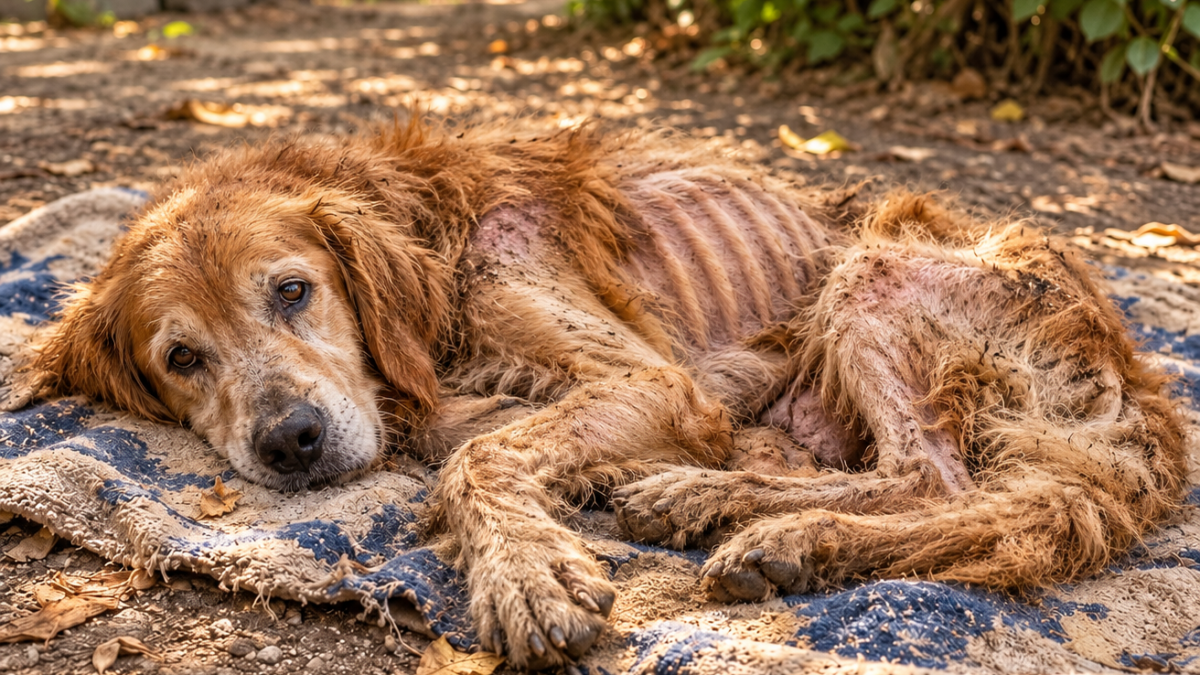
𝗙𝗨𝗟𝗟 𝗦𝗧𝗢𝗥𝗬
“I told her I would stay.”
Hannah glanced at Sarita.
“She probably doesn’t understand promises.”
“Maybe not,” I said. “But I do.”
Hannah smiled and began checking her patient.
Sarita’s temperature had stabilized slightly, but her blood pressure remained concerning. Her anemia was severe, her body was dehydrated, and the combination of infections was complicating every decision.
We still didn’t fully understand why her bones were so fragile.
Celeste estimated that Sarita was only three or four years old.
Yet her body looked as though it had endured a lifetime of illness.
Her nails were overgrown, several of them curling sideways. Her paws were scarred, and thick calluses covered her hips and elbows.
As the veterinary team cleaned her skin, they discovered old pressure sores, healed abrasions, and patches where her fur had disappeared.
None of those injuries could tell us precisely what had happened.
But one thing was becoming clear.
Sarita had been deteriorating for a very long time.
Someone must have seen her losing weight. Someone had watched her skin worsen and her legs grow weaker.
I kept imagining the day she could no longer stand.
Had she tried to follow someone?
Had she cried?
Had anyone noticed when she stopped moving altogether?
I looked at the little dog beneath the blanket and felt a kind of anger that I knew could become dangerous if I allowed it to consume me.
Whatever had happened, I couldn’t change her past.
I could only help determine what happened next.
The following morning, Celeste brought me coffee and three pages of preliminary results.
“We’re beginning treatment for the infections,” she said. “Her nutrition will have to be introduced carefully, and we need to protect those fractures.”
“What about physical therapy?”
“Not yet.”
“When?”
“When her bones and her overall condition make it safe.”
I hated having no date to circle on a calendar.
There was no promise that she would stand in a week or walk in a month. We couldn’t even promise that she would survive until Friday.
For the first several days, we concentrated entirely on keeping her alive.
Her food was measured into small portions. Her medication schedule covered a whiteboard. We documented her temperature, appetite, bloodwork, and every sign that her body was either responding or struggling.
On the third day, I held a small dish near her muzzle.
Sarita sniffed it, then turned away.
“Please, sweetheart. Just a little.”
Celeste, standing behind me, folded her arms.
“Don’t pressure her.”
“I’m not.”
“You’re making that face again.”
“What face?”
“The face that says you’re convinced wanting something badly enough counts as medical treatment.”
I looked back at Sarita.
Then she extended her tongue and licked the edge of the dish.
Celeste leaned forward.
Sarita licked it again.
“Well,” Celeste whispered, “maybe your face deserves partial credit.”
I laughed for the first time since receiving that terrible morning phone call.
It was such a small amount of food that it barely covered the bottom of the dish.
But she had eaten voluntarily.
For the rest of that day, I kept remembering the movement of her tongue and the slight change in her eyes.
On day five, she surprised us again.
Hannah was changing her bedding when Sarita suddenly lifted her head.
Not very far.
Not for very long.
But she did it without anyone helping her.
“Wait,” Hannah whispered.
She started counting.
“One. Two. Three. Four.”
Sarita’s neck began trembling, and her chin slowly returned to the blanket.
I covered my mouth.
Hannah looked at me.
“Are you crying?”
“No.”
“You’re absolutely crying.”
“She lifted her head.”
“I noticed.”
“She actually lifted her head.”
Hannah smiled.
“I know.”
We recorded the moment on her whiteboard.
Four seconds.
The next day, she managed six.
Then eight.
Then eleven.
But while we celebrated those tiny improvements, her medical results reminded us that the danger was far from over.
Some blood values improved while others stalled. One follow-up image showed early healing, but another area of bone fragility remained concerning.
Celeste consulted additional specialists. A veterinary internist even requested permission to discuss Sarita’s case anonymously with colleagues because her combination of infections, malnutrition, anemia, and unusual skeletal fragility was so complicated.
I agreed immediately.
If anything learned from Sarita could someday help another animal, I wanted it documented.
But privately, I had a much simpler wish.
I wanted her to survive long enough to enjoy being alive.
Two weeks after her rescue, something unexpected happened.
One of the technicians was cleaning Sarita’s ears when she noticed a faded blue-green mark.
At first, it looked like an old scar.
Then Hannah examined it beneath a brighter light.
“There are numbers here.”
I leaned closer.
Four tiny digits had been tattooed inside her ear.
They were old and partially blurred, but still readable.
Monica, our rescue director, photographed the tattoo and began contacting registration offices and organizations that maintained breeding records.
Two days later, she called me into her office.
“Sit down.”
I felt my stomach tighten.
“Is something wrong?”
“We found her registration.”
On the computer screen was a record from a private breeder who had once operated outside the city.
The dog’s description matched Sarita.
Small mixed-breed female.
Approximately four years old.
The same identification number.
Registered name: Starita.
I stared at it.
“Starita?”
Monica nodded.
“One letter different.”
The woman who had found her had almost unknowingly given Sarita her original name.
For reasons I couldn’t explain, that coincidence made me emotional.
Before she had become a suffering animal lying on a roadside blanket, Sarita had possessed a name, a registration number, and a documented identity.
Someone had known exactly who she was.
“And the owner?” I asked.
“Rafael Mendez. At least according to the old records.”
“Have you contacted animal control?”
“Already done.”
Rafael had previously bred small dogs for sale. His operation had attracted complaints involving noise, sanitation, and outdoor housing, although those complaints had not resulted in major charges.
His breeding license had eventually expired.
The property had changed hands, and Rafael had moved away almost a year earlier.
When animal control visited the old address, the new owner remembered finding several makeshift kennels behind a storage shed.
Most were empty.
One had contained an old water bowl, a rusted chain, and deteriorating bedding.
He had disposed of everything before investigators arrived.
We couldn’t prove Sarita had occupied that particular enclosure.
Still, I couldn’t stop thinking about the calluses on her elbows and hips.
I imagined her lying on a hard surface for hours, shifting her painful body whenever she could, waiting for someone to notice that something was terribly wrong.
That afternoon, Monica found me sitting outside the clinic.
“Don’t let this consume you,” she said.
I looked at her.
“Someone owned her.”
“I know.”
“Someone watched her get this sick.”
“We’re still investigating.”
“She couldn’t even reach a bowl of water.”
Monica sat beside me.
“Anger can make you work harder, but it can’t be the only thing keeping you going.”
I knew she was right.
But every time I closed my eyes, I saw Sarita’s motionless legs.
I wanted answers.
More than anything, I wanted someone to explain how a dog could become so desperately ill while the people responsible continued their ordinary lives.
Yet every morning, when I walked into the clinic, Sarita reminded me which problem required my attention first.
She had begun recognizing my footsteps.
Whenever I approached her kennel, her ears would move slightly, and her eyes would follow me.
By the beginning of her third week, Celeste decided she was stable enough to begin extremely gentle rehabilitation.
Dr. Marcus Lee, a veterinary rehabilitation specialist, joined her treatment team.
During our first session, he placed Sarita on a thick padded surface and carefully supported her joints.
“Everything we do needs to be slow,” he told me.
“How slow?”
“Slower than you’re going to like.”
I sighed.
“Everyone keeps telling me that.”
“Then maybe you should listen.”
He began with tiny passive movements intended to maintain joint mobility without placing dangerous pressure on her healing bones.
There was no standing.
No walking.
Not even an attempt to make her support her own weight.
But when he gently touched one of her paws, Sarita pulled it back.
Marcus stopped immediately.
“Did you see that?”
“Yes.”
“She initiated that movement.”
“Is that good?”
“It’s very encouraging.”
I leaned close to her face.
“Did you hear that? You’re officially showing off.”
Sarita stared at me suspiciously.
Over the following days, she began revealing a personality none of us had expected.
The helpless little dog who had once been unable to reach my hand turned out to possess an astonishingly stubborn temperament.
If she disliked a medication, she clamped her mouth shut.
If she wanted someone to adjust her blanket, she moved a paw until we noticed.
If I passed her kennel without stopping, she made a low, offended sound that seemed designed specifically to make me feel guilty.
Hannah found the whole thing hilarious.
“She’s training you.”
“She’s recovering.”
“Both things can be true.”
By day twenty-six, Sarita had apparently decided that subtle communication was no longer sufficient.
I was walking down the hallway carrying clean towels when I heard a sharp little bark.
I stopped.
Hannah appeared in the doorway of the treatment room.
“Was that her?”
Another bark answered her.
I nearly dropped the towels.
Sarita was staring directly at me.
“You barked!”
She barked again.
Hannah started laughing.
“Apparently, she has complaints.”
I hurried over and crouched beside the kennel.
“What is it? You need something?”
Her tail moved once.
Only once.
But after everything we had endured, that tiny movement felt enormous.
I spent the rest of the day smiling.
That night, I went home, sat on my kitchen floor, and cried.
I wasn’t sad.
I was exhausted from hoping so desperately.
People often imagine animal rescue as a dramatic moment followed by a happy reunion.
They rarely see the weeks of medications, repeated blood tests, emergency pharmacy trips, sleepless nights, and frightening setbacks.
They don’t see how much laundry one critically ill animal produces or how carefully every meal must be measured.
They don’t hear the conversations about whether another treatment is helping or simply placing additional strain on a body that has already suffered too much.
I was beginning to understand that loving Sarita would require accepting uncertainty.
And then, in her fourth week, uncertainty came crashing back into our lives.
When I arrived at the clinic one morning, Celeste was standing beside her kennel.
I knew something was wrong before she spoke.
“She developed a fever overnight.”
“How bad?”
Her answer made my stomach drop.
Sarita was lethargic again.
Her breathing had become faster, her anemia had worsened, and one of her infections wasn’t responding as consistently as we had hoped.
The little dog who had been barking at us only days earlier now lay almost motionless.
The rehabilitation sessions stopped.
Additional tests were ordered, and her medications were adjusted under the supervision of her veterinary team.
For the first time since that awful first night, I found myself wondering whether we were approaching the end.
“What if her body can’t keep doing this?” I asked.
Celeste sat beside me.
“That’s possible.”
I stared at the floor.
“Then what have we been doing for an entire month?”
“Giving her a month she wouldn’t have had otherwise.”
“That’s not enough.”
“No,” she answered softly. “But we don’t always get to decide how much time is enough.”
I wanted to argue.
Instead, I walked into Sarita’s room and sat beside her.
For three hours, I watched her IV line drip.
Eventually, I began talking because I couldn’t tolerate the silence anymore.
I told her about Molly, the first dog I had ever rescued.
I told her about the time I accidentally locked myself inside our supply room and had to call for help.
I complained about Hannah’s terrible coffee.
From the doorway, Hannah called, “She doesn’t need lies while she’s sick.”
I smiled weakly.
Then I kept talking.
I described my backyard and promised that if she ever became strong enough, I would let her investigate every corner of it.
I told her about the kitchen, where sunlight fell across the floor in the afternoon, and the old couch with cushions I had been meaning to replace.
Near sunset, Sarita finally opened her eyes.
I placed my fingers beside her muzzle.
She moved toward them.
Less than an inch.
Exactly as she had done on the morning we found her.
I felt tears running down my cheeks.
“There you are.”
By the following morning, her fever had begun to fall.
The setback cost us nearly ten days of progress, but gradually her appetite returned, her breathing steadied, and the veterinary team resumed planning for rehabilitation.
Meanwhile, the investigation into her past was moving forward.
Animal control located Rafael Mendez in a neighboring county.
Initially, he denied owning Sarita.
When investigators showed him her registration records, he changed his account and claimed he had sold her several years earlier.
He couldn’t provide the buyer’s name.
He had no receipt, phone number, or reliable record of the alleged transaction.
Investigators continued searching for anyone who could explain what had happened.
Then a former employee came forward.
Her name was Elena.
She had seen a local news report about the critically ill dog rescued outside town. When she recognized the ear tattoo, she contacted animal control.
Her statement gave us the first detailed account of Sarita’s earlier life.
Sarita had been used for breeding.
Elena remembered her as a small, quiet dog who was easy to handle.
After her second litter, she began developing skin problems. She lost weight, grew weaker, and eventually had difficulty walking.
Elena said she repeatedly urged Rafael to seek veterinary care.
According to her statement, Rafael refused to spend more money on an animal who wasn’t producing enough income.
When Sarita became too weak to stand reliably, she was moved to a small enclosure behind the property.
Elena quit not long afterward.
Months later, when she returned to collect some paperwork, she asked what had become of the little dog.
Rafael told her Sarita was gone.
She assumed he had either surrendered or euthanized her.
Now she feared something much worse had happened.
When Monica told me what Elena had said, I walked outside and stood behind the clinic.
I couldn’t stop thinking about the idea that Sarita had been considered valuable when she could produce puppies but disposable when she needed medical care.
Her worth had apparently been calculated according to what someone could earn from her.
I thought about her painful fractures and the sores covering her body.
I imagined her growing weaker behind a storage shed while ordinary life continued just beyond the enclosure.
For a terrible moment, I wanted to drive to Rafael’s house and confront him.
Monica found me before I reached my car.
“Don’t.”
I turned.
“I didn’t say anything.”
“You don’t have to.”
“He should have to look at her.”
“He may have to answer for what happened. Animal control is building a case.”
“How long is that going to take?”
“I don’t know. But you won’t help Sarita by making yourself part of the investigation.”
I looked away.
She was right, although I hated admitting it.
The most important breakthrough came shortly afterward, when investigators discovered two previous veterinary visits recorded under Sarita’s original registration number.
One had been routine.
The other had occurred almost a year before her rescue.
The veterinarian’s notes documented significant weight loss, skin disease, anemia, and early mobility problems.
Further diagnostic testing and follow-up had been recommended.
Several tests had been declined.
The clinic had recorded that refusal and advised urgent reevaluation if her weakness became worse.
No follow-up was documented.
That discovery changed the investigation.
There was now evidence that someone responsible for Sarita had been informed that she required medical attention.
I wondered how different her life might have been if those recommendations had been followed.
Would her infections have been controlled before they became so severe?
Would proper nutrition and treatment have protected her from some of the damage she had suffered?
We couldn’t know.
But we did know she had been left to deteriorate when she urgently needed help.
The Tuesday Monica told me about those records was also the day Sarita attempted something we had scarcely dared to imagine.
Standing.
Marcus had fitted a support sling beneath her abdomen during rehabilitation. Her paws were touching a padded mat, but the sling was carrying nearly all her weight.
He was helping her practice carefully controlled movements when her front paws suddenly pressed downward.
“Don’t move,” he whispered.
I froze.
Her shoulders trembled.
Then one of her hind paws pushed against the mat.
For the briefest moment, her body rose.
She couldn’t hold herself upright, and the sling continued supporting her, but the effort came from Sarita.
I gasped.
“Did she just try to stand?”
Marcus smiled.
“She certainly did.”
Sarita collapsed gently back into the sling, panting with exhaustion.
I crouched in front of her.
“That was enough, sweetheart. You did enough.”
She looked offended, as though I had interrupted something important.
The following session, she tried again.
Then she managed to push upward for three seconds.
Five.
Eight.
As her infections came under better control and her fractures continued healing, her muscles slowly began responding to the rehabilitation program.
Eventually, we allowed ourselves to discuss walking.
Not as a promise.
As a possibility.
Six and a half weeks after her arrival, Sarita stood independently for the first time.
I nearly missed it.
Marcus was finishing a routine exercise when he gradually reduced the support beneath her hips.
Her paws remained planted.
He removed one hand.
Sarita stayed upright.
I looked at him.
“Is she standing?”
“Yes.”
“On her own?”
“Yes.”
Her legs were trembling so violently that I could see the movement across her entire body.
But she was standing.
Hannah passed the doorway.
“Get Celeste!”
Our veterinarian hurried inside, expecting some kind of emergency.
Then she saw Sarita.
Nobody spoke.
We were all watching a tiny dog who had once been unable to lift her head.
Three seconds passed.
Then four.
Then five.
Her front legs started buckling, and Marcus caught her before she could fall.
I burst into tears.
Hannah covered her mouth.
Even Celeste turned away for a moment to wipe her eyes.
Marcus knelt beside Sarita.
“Good girl.”
I kissed the top of her head.
“You stood, sweetheart.”
Her tail moved.
That evening, Hannah updated the whiteboard.
Five seconds.
Underneath, she wrote two words.
ON HER OWN.
Two weeks later, Sarita took her first step.
It wasn’t graceful.
She leaned too far forward, moved one paw, and nearly fell sideways before Marcus caught her.
I screamed.
He looked at me.
“You’re frightening her.”
“She walked!”
“She moved one foot.”
“That’s walking!”
He shook his head, trying not to smile.
At the next session, she managed two steps.
Then four.
Then seven.
Eventually, we stopped counting after twenty.
Her growing confidence created a new problem.
Sarita had absolutely no interest in accepting her physical limitations.
Whenever we placed a soft barrier around her exercise area, she tried to investigate the other side.
When Marcus established a controlled walking lane, she attempted to turn around midway through a session because she smelled treats.
Celeste watched one of these little rebellions and laughed.
“Three weeks ago, you were begging her to move.”
“I remember.”
“Now you have a dog who refuses to stop.”
Sarita barked at us.
By the third month, she could cross a small room without being carried.
Her movements remained slow and uneven, but she was using her own legs.
The first time I saw her walk from her bed to her water bowl, I stood perfectly still.
She lowered her head and drank.
Such an ordinary thing.
Yet I remembered that shallow bowl beside the blanket on the morning we found her.
I remembered how desperately she had needed water and how completely her body had failed her.
Now she could get it herself.
I didn’t realize how much that mattered until I found myself crying in front of the entire treatment team.
When Celeste finally announced that Sarita no longer required continuous hospitalization, I had already prepared my house.
I had agreed to foster her during the next stage of her recovery.
Non-slip mats covered the floors. Baby gates blocked the stairs, and an orthopedic bed waited beside my bedroom.
I had inspected the backyard for holes, sharp objects, and anything that might endanger her still-vulnerable bones.
I thought I was prepared.
Then Sarita came home.
Within two hours, she had discovered the kitchen.
Within four, she had located the cabinet containing her treats.
Within six, she had developed a personal disagreement with my washing machine.
That evening, I found her standing in front of the couch.
“No.”
She looked at me.
“You’re not jumping.”
One paw lifted.
“Sarita.”
She barked.
I laughed, gently picked her up, and placed her beside me.
She turned around twice before settling against my leg.
Within minutes, she was asleep.
I sat there for nearly an hour, afraid to move and disturb her.
For the first time since I had met her, Sarita was sleeping somewhere that didn’t smell of disinfectant.
A few days later, animal control called.
Charges had been filed against Rafael Mendez for neglect, failure to provide necessary veterinary care, and additional violations associated with his former breeding operation.
The legal process would take time.
I knew that.
But hearing that Sarita’s suffering had been formally acknowledged gave me a kind of relief I hadn’t expected.
Meanwhile, her recovery continued.
Twice a week, I took her back to Marcus.
He introduced small ground poles to help improve her coordination.
At first, she touched nearly every one.
As her strength improved, she began stepping over them.
Her bandages were gradually removed, her muscles became stronger, and her coat started returning where her damaged skin had healed.
She gained weight steadily.
Her eyes changed more than anything else.
When I first saw her, she had seemed almost resigned to whatever happened around her.
Now she was interested in everything.
Birds.
Cars.
Leaves moving across the driveway.
My neighbor mowing his lawn.
And, above all, the refrigerator.
One Saturday morning, I opened the back door and took her into the fenced yard on a long training line.
She stepped onto the grass.
Then stopped.
Her nose lifted.
Something had caught her attention.
She moved forward.
Three quick steps.
Then five.
Before I fully understood what she was doing, Sarita broke into a crooked little run.
“Sarita!”
I hurried after her, terrified she would fall.
Her ears bounced while her paws carried her across the yard.
She wasn’t particularly fast, and her gait wasn’t completely normal.
But she was running.
She reached a patch of soft dirt near the fence, lowered her nose, and began digging.
I stopped behind her.
“You have got to be kidding me.”
Dirt flew between her back legs.
“Sarita, those bones cost more than my car!”
She ignored me.
When she finally turned around, her entire muzzle was covered in dirt.
I laughed so hard I had to sit down.
The dog who once couldn’t lift her head was digging up my backyard.
I took a picture and sent it to Celeste.
Her response came almost immediately.
“Best orthopedic outcome imaginable.”
I never filled in that first hole.
It wasn’t the last one, either.
Four months after the original rescue call, Sarita looked almost unrecognizable.
Her body had filled out, her coat had returned in soft patches, and her skin had healed dramatically.
Her legs retained some unusual angles from the damage they had suffered, and we knew she would always require careful monitoring.
But she could walk.
She could play.
She could run short distances.
She could destroy my garden.
Then, during a routine follow-up, another complication appeared.
Celeste noticed tenderness in her abdomen.
Additional testing revealed a reproductive condition that required surgery.
I felt the same cold fear I had experienced during our first drive to the clinic.
“After everything she’s been through?”
“I know,” Celeste said.
“Is she strong enough?”
“She’s much stronger than she was when she arrived. But any surgery carries risk.”
I looked at Sarita, who was sitting between us licking her paw.
She seemed completely unconcerned about our conversation.
On the morning of surgery, she was far more upset about missing breakfast than anything else.
She stared at me throughout the drive.
“I know you’re hungry.”
Her eyes narrowed.
“It’s doctor’s orders.”
She made an irritated little noise.
“You can complain to management.”
Fortunately, the surgery went well.
The recovery took several weeks, and although we were relieved, I found myself slipping back into old habits.
Every time Sarita moved slowly, I worried.
Every morning, I checked her gums.
Every night, I watched her breathing.
I had spent so many months fearing that she might die that I no longer knew how to relax when she was simply tired.
One evening, after Celeste had cleared her for gentle outdoor activity, I carried Sarita into the backyard.
Sunlight touched her face.
A butterfly passed near her nose.
She watched it with enormous concentration.
Then she looked up at me.
I realized I was holding my breath.
I lowered her gently onto the grass.
“Go ahead, sweetheart.”
She remained beside me.
“Go be a dog.”
She sniffed the grass, then walked toward her favorite hole.
Halfway there, she looked back.
I almost called her to return.
Instead, I let her continue.
For so long, all I had wanted was to protect her.
But I was beginning to understand that protecting Sarita couldn’t mean preventing her from living.
The legal hearing took place after she had recovered sufficiently from surgery.
I left her safely at home.
I didn’t want to bring her into a courtroom where photographs, records, and arguments would reduce her once again to everything she had suffered.
Monica came with me.
Elena testified.
The veterinarian who had examined Sarita before her rescue provided the previous clinic records and explained the recommendations that had been documented.
Animal control presented the registration information, the identification tattoo, and photographs taken when Sarita arrived in critical condition.
I submitted a written statement describing how we had found her.
The defense argued that nobody could establish precisely what had caused every fracture.
That was true.
Our medical team had never claimed to know the exact cause of each injury.
They also argued that Sarita’s complicated infections might have progressed despite medical treatment.
That possibility was real.
But the central issue wasn’t whether Rafael had personally caused every disease or fracture.
It was whether he had known she needed veterinary care and failed to provide it.
The earlier medical records mattered.
Elena’s testimony mattered.
The registration history and documented timeline mattered.
During the hearing, one of Sarita’s original photographs appeared on the courtroom monitor.
I looked away.
Her body seemed impossibly small beneath that familiar blanket.
Even after months of watching her recover, I couldn’t look at that photograph without remembering the terrible fear of our first morning together.
Across the courtroom, Rafael stared at the screen.
His expression changed.
I couldn’t tell whether he felt regret, embarrassment, fear, or something else entirely.
I no longer wanted to guess.
During a break, he approached me in the hallway.
“You’re the woman with the dog?”
I looked at him.
“Sarita.”
“What?”
“Her name is Sarita.”
He exhaled.
“Starita.”
“No,” I said quietly. “Sarita.”
His expression tightened.
“I didn’t do all that to her.”
For months, I had imagined confronting him.
I had rehearsed angry speeches while driving to the clinic, washing Sarita’s blankets, and watching her endure painful treatment.
Now that he was standing in front of me, none of those speeches seemed worth delivering.
I asked one question.
“When she stopped walking, why didn’t you take her back to the veterinarian?”
He glanced toward the courtroom doors.
“You don’t know what things cost.”
I almost laughed.
After months of specialist consultations, medications, hospitalization, imaging, rehabilitation, and surgery, I knew exactly what veterinary care could cost.
“You’re right,” I said. “Care is expensive.”
He looked at me.
“But leaving her to suffer was a choice.”
He turned away.
That was the only conversation we ever had inside the courthouse.
There was no confession.
No dramatic confrontation.
No moment when everyone suddenly understood everything.
The ruling established the neglect supported by the evidence.
Rafael was ordered to pay fines and restitution toward part of Sarita’s documented veterinary expenses. The court also imposed restrictions preventing him from owning or breeding animals for a specified period.
The financial award covered only a fraction of what her treatment had cost.
But the case had established an official record of what she had endured.
When I stepped outside the courthouse, Monica touched my shoulder.
“How do you feel?”
I thought about it.
For months, I had wanted Rafael to face consequences.
Now that he had, I felt strangely quiet.
I took out my phone.
My lock screen showed Sarita in the backyard with dirt covering her nose.
“I want to go home.”
When I opened my front door that afternoon, Sarita came running toward me.
Not walking.
Running.
Her paws tapped across the hallway mats, her ears bounced, and she nearly lost her balance turning the corner.
I knelt.
“Hey, troublemaker.”
She pressed herself against me and began licking my chin.
I held her close.
“You don’t have to know what happened today.”
She wagged her tail.
“You just have to keep being you.”
Over the following months, Sarita’s bloodwork continued improving, and her anemia resolved.
Her infectious diseases remained under veterinary management, with regular follow-up.
Her bone condition improved, her fractures healed, and Marcus gradually reduced her formal rehabilitation sessions.
At her final scheduled session, he arranged the same padded lane where she had taken her first steps.
Sarita stood at one end.
I crouched at the other.
“Come here, sweetheart.”
Marcus released the support lead.
She walked toward me.
Her rear leg still angled slightly differently, and her stride shortened when she became tired.
But she crossed the entire lane without assistance.
When she reached me, I scratched behind her ears.
Marcus smiled.
“Remember our first session?”
“I remember everything.”
“I told you it would be slow.”
“And I hated hearing it.”
“You’ve gotten better at patience.”
I looked down at Sarita.
“I had a very stubborn teacher.”
Formal rehabilitation eventually ended, although home exercises, controlled activity, and veterinary monitoring remained part of our lives.
The most beautiful changes were often the least dramatic.
Sarita discovered sprinklers and decided they were unacceptable.
She discovered peanut butter and immediately became its greatest admirer.
She developed an obsession with squirrels and learned that sitting beside the kitchen counter sometimes resulted in unexpected treats.
She barked at the mail carrier before deciding he might actually be a friend.
She stole my socks.
She learned to push open the bathroom door when it wasn’t fully latched.
I learned to lock it.
Most importantly, she began expecting things.
A comfortable bed.
Fresh blankets.
Breakfast at exactly the correct time.
The sunny corner of the couch.
Attention whenever she considered it necessary.
One morning, she woke me five minutes before my alarm.
I opened one eye.
“It’s 5:55.”
Her tail thumped against the floor.
“Breakfast is at six.”
She placed a paw on the mattress.
“You’re becoming unbelievably demanding.”
She barked.
I got up.
There was something wonderfully satisfying about watching a dog who had once accepted every miserable condition because she possessed no power to change it become so completely certain that her needs mattered.
Several months later, Elena asked whether she could see Sarita.
We arranged to meet at a quiet park.
Elena was already waiting near a bench when we arrived.
She held a new leash she had brought as a gift.
When she saw Sarita walking beside me, she covered her mouth.
“Oh my God.”
Sarita stopped.
Elena knelt slowly.
“Starita?”
My little dog tilted her head.
Elena began crying.
“I’m so sorry.”
I remained a few feet away while she extended one hand.
She didn’t grab Sarita or try to force her closer.
She waited.
After a few moments, Sarita stepped forward and sniffed her fingers.
Then she allowed Elena to touch her face.
“I thought you were dead,” Elena whispered.
Her voice broke.
“I should have done more. I should have checked when he told me you were gone.”
I sat beside her on the bench.
“You spoke to investigators when you learned she was alive.”
“But I left her there.”
“You told him she needed treatment.”
“I could have done more.”
I didn’t tell her she was wrong.
Perhaps there had been other choices she could have made.
Perhaps she would always wonder about them.
But punishing herself indefinitely wouldn’t change Sarita’s past.
“If you ever see an animal being neglected again,” I said, “don’t wait.”
Elena nodded.
“I won’t.”
Before leaving, she reached into her bag and handed me an old photograph.
It showed Sarita as a young dog, standing beside a plastic kiddie pool.
Her coat was full.
Her ears were raised.
A faded blue collar circled her neck.
On the back, someone had written:
Starita — 9 months.
I stared at that picture for a long time.
I had only ever known Sarita as a gravely ill dog fighting to recover.
Now I was looking at an earlier version of her.
Healthy.
Young.
Standing on four strong legs.
She hadn’t been born helpless.
I took the photograph home and placed it in a frame.
Beside it, I put another picture.
Sarita in my backyard.
Dirt on her nose.
Mouth open.
Eyes bright.
Those two photographs told a story that went far beyond illness.
One captured the life she had before her suffering.
The other showed the life she had found afterward.
By the end of the year, Sarita was doing so well that Marcus discharged her from formal rehabilitation.
He handed me a folder of home-care instructions and medical records.
I opened it.
The first page contained her original intake photograph.
I closed the folder immediately.
“Still difficult?” he asked.
“Very.”
“You don’t have to keep looking at that picture.”
“I don’t want to forget.”
He nodded.
But over time, I realized that remembering her suffering didn’t mean I had to relive it every day.
Sarita certainly wasn’t interested in spending her life being treated as a victim.
She wanted warm blankets, good food, sunshine, and the freedom to dig holes wherever she pleased.
There was one final piece of her future we still needed to settle.
Technically, I had been fostering her.
By then, the distinction had become ridiculous.
Her bed was in my bedroom.
Her medication chart hung on my refrigerator.
Her toys were scattered throughout the house.
My neighbors knew her name.
The delivery driver carried treats specifically for her.
She had claimed half my couch and destroyed more flowers than I cared to count.
Nevertheless, the rescue still needed to complete its adoption procedures.
One afternoon, Monica called.
“We need to talk about Sarita.”
I immediately became nervous.
“What happened?”
“Nothing. She’s medically stable enough for adoption.”
I went quiet.
“Are you seriously thinking about placing her somewhere else?”
Monica laughed.
“I was going to ask whether you wanted to adopt her.”
“She’s not leaving.”
“So that’s a yes?”
“She’s already home.”
“I thought you might say that.”
The official adoption took place on a Friday.
There was no elaborate ceremony.
Just paperwork, signatures, and one deeply offended little dog who didn’t appreciate having her paw pressed onto an ink pad.
When Monica handed me her adoption certificate, I crouched beside Sarita.
“Well, apparently you live with me now.”
She sneezed.
“Try to control your excitement.”
At home, I placed the adoption certificate beside her old photograph.
Starita at nine months.
Sarita at her adoption.
Her new name belonged to the life she had built after everything that had happened.
One year after the morning we found her, I woke before my alarm.
The bedroom was quiet.
Sunlight had just begun reaching through the curtains.
Sarita was asleep beside my bed.
I watched her breathing.
Some habits are difficult to abandon.
Her chest rose.
Then fell.
Then rose again.
One eye opened.
“Good morning, sweetheart.”
Her tail thumped.
I got dressed and took her outside.
The grass was wet with dew.
Sarita walked toward the back fence, her gait still slightly uneven but her movements confident.
She stopped beside the first hole she had ever dug.
Rain and time had softened its edges, but I had never filled it in.
I had tried once.
Sarita immediately reopened it.
Apparently, we had different opinions about landscaping.
She sniffed inside.
Then looked at me.
“Don’t.”
She scratched once.
“Sarita.”
Another scratch.
“Today is supposed to be sentimental. Please cooperate.”
She began digging faster.
I laughed.
That ridiculous hole had become one of the most precious things in my backyard.
She had made it with legs that once couldn’t support her body.
With paws that had once been almost useless.
It was a reminder that the ordinary things other dogs did without thinking had once seemed impossible for her.
Several months later, I took Sarita back to Celeste’s clinic for a routine examination.
A family was sitting in the waiting room with a frightened dog wrapped in a blanket.
When Sarita walked past, the woman holding him smiled.
“She’s adorable.”
“Thank you.”
“She seems so confident.”
I looked down at Sarita.
The woman couldn’t possibly have known what those words meant to me.
She didn’t know about the fractures, the infections, the sleepless nights, or the whiteboard where we had once celebrated a four-second head lift.
She simply saw a happy little dog walking beside her owner.
And I liked that.
Sarita’s suffering didn’t need to be the first thing strangers noticed forever.
Inside the examination room, Celeste listened to her heart.
“Good.”
She checked her joints.
“Good.”
Then she reviewed her latest bloodwork.
“Very good.”
I raised an eyebrow.
“That sounds suspiciously optimistic.”
“I occasionally allow myself some optimism.”
At that exact moment, Sarita attempted to hop down from the low examination platform before either of us could catch her.
“Sarita!”
She landed safely and looked back at us.
Celeste pressed a hand to her chest.
“That dog is going to shorten my life.”
“Welcome to my house.”
We both laughed.
On the drive home, I realized that an entire year had passed since I had first placed my hand beside a dying dog’s muzzle.
I had once wondered whether she would survive the next twenty minutes.
Now I was complaining because she was too confident.
The following months brought more ordinary happiness.
Sarita learned which neighbors carried treats.
She discovered that freshly washed blankets were preferable to any other sleeping surface.
She stole socks, chased leaves, barked at cardboard boxes, and occasionally spent fifteen minutes choosing the perfect place to lie down before immediately changing her mind.
One evening, I found the original blanket in a storage bin.
It was the same one we had used to carry her into the rescue vehicle.
I had washed it months earlier and put it away.
A small tear remained near one corner.
I sat on the floor holding it.
Sarita wandered into the room.
She sniffed the blanket, stepped onto it, turned around twice, and lay down.
My throat tightened.
“Do you know what that is?”
She rested her chin on her paws.
“That blanket carried you when you couldn’t walk.”
Her eyes slowly closed.
I folded one edge around her.
She fell asleep.
For the first time, the memory of that terrible morning felt peaceful rather than frightening.
The blanket that had once carried her broken body had become nothing more than a comfortable place to sleep.
Not long afterward, our rescue received another emergency call about a dog who could barely move.
A new volunteer found me in the hallway.
“They said he might not survive.”
“What does the veterinarian say?”
“They’re examining him now.”
“Good.”
She hesitated.
“What if it’s too late?”
I looked through the window toward the yard.
Sarita was investigating something beneath a bench.
“We listen to the veterinary team,” I said. “We find out what can be treated and what kind of life the animal might realistically have.”
“And if everyone thinks there’s no hope?”
“We don’t decide the ending before we know the facts.”
The volunteer followed my gaze.
“Is that Sarita?”
“Yes.”
“The dog who couldn’t walk?”
At that moment, Sarita spotted us through the glass.
She ran toward the door.
The volunteer stared.
“That dog?”
I smiled.
“That dog.”
Sarita reached me and placed her front paws against my legs.
“You’re supposed to be setting a professional example,” I told her.
She licked my face.
The volunteer laughed.
Sarita had changed the way I approached difficult rescue cases.
Not because every critically ill animal could recover.
Not because medical judgment should ever be replaced by blind optimism.
But because I had learned how dangerous it could be to make assumptions before understanding an animal’s condition.
Sometimes an animal truly cannot be saved without prolonging suffering.
Other times, a reasonable path forward exists, although it demands more patience and resources than anyone initially imagined.
Sarita had been one of those cases.
She had needed an entire team willing to concentrate on the next small improvement instead of demanding immediate results.
Almost eighteen months after the hearing, I stopped at a farm supply store outside town.
Sarita came with me.
She wore her harness and walked beside the shopping cart while I picked up a few things for the rescue.
We turned into an aisle.
Rafael Mendez was standing at the other end.
I recognized him immediately.
He recognized me.
Then he saw Sarita.
For a moment, none of us moved.
He looked older than I remembered.
Sarita, meanwhile, seemed mostly interested in a display of dog treats.
Rafael stared at her.
“That’s her?”
“Yes.”
“She walks.”
I almost smiled at how inadequate those words were.
“She runs.”
His eyes lowered.
Sarita tugged gently toward the treats.
I let her investigate.
Finally, Rafael said, “I didn’t think she’d make it.”
I looked at him.
For months, I had imagined what it would feel like to encounter the person who had allowed her to become so sick.
I had pictured anger.
Confrontation.
A desperate need to make him understand what he had done.
But standing there with Sarita beside me, I felt something different.
“You decided what her life was worth before she had finished living it.”
He didn’t answer.
I didn’t raise my voice.
There was nothing I could say in that aisle that would improve Sarita’s life by even one second.
So I walked away.
She trotted beside me.
At the checkout, I bought the expensive treats she had chosen.
Outside, I opened the bag.
“Sit.”
She sat immediately.
“One.”
I handed her a treat.
She swallowed it almost without chewing.
“Apparently, manners are optional.”
Her tail wagged.
I glanced back through the store window.
Rafael was no longer visible.
I realized that whether he regretted what had happened was no longer something I needed to know.
Sarita’s life didn’t depend on his remorse.
She had a home.
She had people who loved her.
She had a future that belonged entirely to her.
That night, she slept beside me on the couch.
Her legs twitched occasionally.
I imagined she was dreaming about running.
I rubbed her shoulder, feeling the thick fur that had grown over skin once covered in painful sores.
Some scars remained.
Others were difficult to see beneath her coat.
I knew where they were.
I always would.
But I refused to let those scars become the only way I saw her.
She wasn’t simply an animal who had survived neglect.
She was my demanding, stubborn, affectionate little dog who expected breakfast on time and considered every flower bed a personal invitation.
On the second anniversary of her rescue, I decided to take her back to the place where we had first found her.
I had avoided it until then.
Some memories still frightened me.
But that morning, when Sarita woke me by pawing at the mattress and insisting I get out of bed, I looked at her and realized I was ready.
We drove to the outskirts of town.
The area had changed.
Seasonal rain had brought grass to the dusty ground.
Someone had removed the old debris, and a new fence stood nearby.
I parked.
Sarita used the small ramp I kept for her joints and stepped down beside me.
She sniffed the air.
Then she began walking.
I watched carefully.
Would she recognize this place?
Would something about the smell or surroundings frighten her?
There was no way to know what she remembered.
She showed no hesitation.
Instead, she discovered a patch of loose dirt.
Of course she did.
Within thirty seconds, she was digging.
I started laughing.
“You really are unbelievable.”
She looked up.
Dirt covered her nose.
I knelt beside her.
Two years earlier, I had knelt almost in that exact place, wondering whether the little dog lying beneath a blanket would survive the next few minutes.
Now she was rearranging the landscape.
I placed my palm against the ground.
Just as I had done on that first morning.
“Sarita.”
She looked at me.
Then she walked closer.
Her nose touched my palm.
Not less than an inch this time.
All the way.
She pushed her head beneath my hand and demanded scratches.
I obliged.
“Look how far you’ve come.”
She closed her eyes as I rubbed behind her ears.
We stayed until the late afternoon.
Sarita explored the grass, investigated the fence, and returned repeatedly to the little hole she had begun excavating.
I watched her move with the easy confidence of an animal who knew someone would be there when she wanted to return.
Before leaving, I sat on the ground and let her rest beside me.
For the first time, I could look at the place where her story had nearly ended without feeling that the past was swallowing everything that had happened afterward.
The drive home was quiet.
Sarita slept in her padded passenger-seat bed, her head resting comfortably along one edge.
Every now and then, I glanced over.
I thought about everyone who had helped her.
The woman who made the first call.
The volunteer who drove us to the clinic.
Hannah, who had spent countless nights monitoring her.
Celeste, who had refused to promise more than medicine could reasonably offer.
Marcus, who had patiently guided her through every painful stage of rehabilitation.
Monica, who had followed the evidence when we discovered the identification tattoo.
Elena, who had finally spoken about what she knew.
The investigators, veterinarians, and everyone who had contributed their time or resources to giving a desperately sick dog a chance.
And Sarita herself.
She had endured every treatment, setback, and exhausting rehabilitation session without knowing why we kept asking her to try again.
She had lifted her head.
She had eaten.
She had survived her fever.
She had pushed one trembling paw into a padded mat.
Then she had stood.
Then walked.
Then run straight into my flower beds.
People sometimes ask me whether I think we made the right decision when we brought her to the clinic that first morning.
I understand why they ask.
She was in terrible condition, and no one could have guaranteed that treatment would work.
There are animals for whom allowing a peaceful death is the most compassionate decision.
But Sarita’s doctors identified a reasonable path forward, and her condition gradually responded to treatment.
She was given that chance.
And she made the most of it.
Today, when she wakes me before sunrise, I no longer automatically reach over to check whether she’s breathing.
Usually, I’m too busy trying to convince her that breakfast can wait another five minutes.
She has different ideas.
She scratches at the back door when she wants to go outside.
She steals the warmest spot on the couch.
She still believes my garden belongs to her.
And whenever I open the door on a sunny afternoon, she races across the yard with her ears bouncing, her tail raised, and her crooked little legs carrying her toward whatever new trouble she has decided to investigate.
Sometimes she stops near the fence, turns around, and looks at me.
I remember another look.
A tiny dog lying helpless on a blanket, moving her nose less than an inch toward a stranger’s hand.
Back then, I didn’t know whether she would survive.
I certainly didn’t know that one day I would have to chase her across my backyard to stop her from destroying my flowers.
But I knew she deserved to be examined, treated if treatment was reasonable, and given the chance to live without unnecessary suffering.
Two years later, watching Sarita disappear into the sunlight, I no longer think about how close she came to dying every time I see her.
I think about how much she loves being alive.
And when she comes running back to me, with dirt on her nose and another ruined flower bed behind her, I kneel and open my arms.
She presses her little body against me, warm and happy and wonderfully impatient.
Then she turns around and races back toward the garden.
I don’t follow her immediately.
I let her run.
Because after everything Sarita endured, she has earned the right to spend the rest of her life going exactly where her own four feet want to take her.








