𝗙𝗨𝗟𝗟 𝗦𝗧𝗢𝗥𝗬 I Was Still Holding My Walmart Receipt When the Officer Pointed His Gun at My Chest
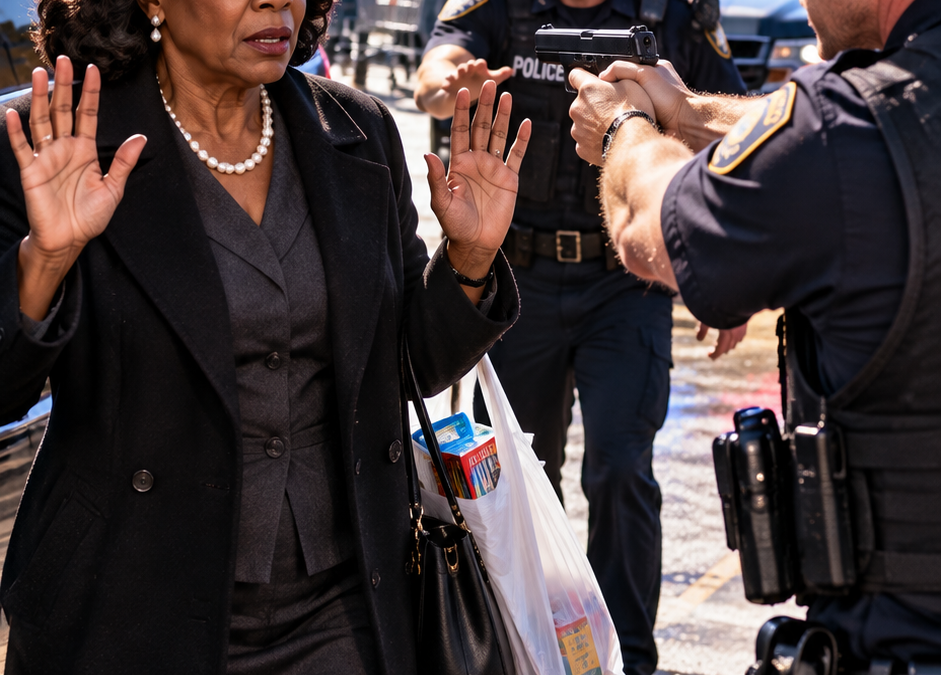
𝗙𝗨𝗟𝗟 𝗦𝗧𝗢𝗥𝗬
I glanced around the parking lot.
There were dozens of Black women shopping that afternoon, several of whom were wearing dark coats. Black SUVs were hardly uncommon in suburban North Carolina.
“How old was the person described in the report?”
Vaughn’s jaw tightened.
“What?”
“The suspect’s age. What did the caller report?”
He stared at me as though I had just challenged him to a fight.
“Thirty to forty.”
I waited.
He looked directly at my face.
I was sixty-two.
The discrepancy was obvious enough that I saw the younger officer approaching behind him pause when he heard the answer.
Officer Eli Turner appeared to be in his late twenties, lean and serious, with sandy hair and the expression of someone who was already questioning the situation.
He glanced at me, then toward my Navigator.
“Detective, can I speak with you?”
“Not now.”
“Sir, the vehicle doesn’t match.”
Vaughn didn’t lower his pistol.
“What are you talking about?”
“The caller provided a partial plate beginning with four-seven-K. This one begins with nine-T-two.”
“Descriptions change.”
“So does the suspect’s age, apparently,” I said.
Vaughn turned his attention back toward me.
“One more smart remark, and you’re going to make this much worse for yourself.”
I had spent thirty years learning to recognize when a discussion was no longer about facts.
This was one of those moments.
I stopped arguing.
My hands remained raised while a small crowd began gathering near the store entrance.
Across the parking lane, a young Walmart employee had stopped pushing a long row of shopping carts. He was thin, with dark hair falling across his forehead and a store vest hanging over a gray sweatshirt.
I noticed him pull out his phone.
He held it steadily in our direction.
I would later learn that his name was Jordan Lee, a nineteen-year-old community college student who worked thirty hours a week to help his mother pay their bills.
That afternoon, he was the only person nearby who seemed willing to create a record of what was happening.
I looked toward Vaughn’s chest.
His body camera was mounted just below his shoulder.
“Officer, is your camera recording?”
“Turn around.”
“I asked whether your camera is recording.”
“Turn around! Now!”
I complied.
Slowly, I turned toward my Navigator, keeping both hands visible.
I could feel the officer approaching behind me.
Then he grabbed my left arm.
His grip was unnecessarily hard, and when he pushed me against the SUV, my shoulder struck the door.
A woman near the cart return gasped.
Someone else called out that I hadn’t done anything.
Vaughn ignored them.
“Stay right there.”
“I’m not moving.”
He pulled the shopping bag from my hand.
The plastic tore.
My niece’s colored pencils spilled beneath the vehicle, and the sketchpad landed beside my shoe. The receipt fluttered against the rear tire.
I stared at the supplies scattered across the pavement.
For some reason, the sight of that little birthday present made the situation feel more frightening than the gun had.
It was such an ordinary thing.
Something I had purchased for a child I loved.
And suddenly it was lying on dirty asphalt because a man with a badge had decided that I belonged to a category of people he could handle however he pleased.
“Detective,” Eli said, “there’s no weapon in the bag.”
Vaughn opened my purse.
“That’s not your call.”
I felt him searching through the compartments while I stood against the Navigator.
He removed my wallet.
“Be careful with that,” I said.
He ignored me.
Then he opened it.
The change was immediate.
His movements stopped.
For several seconds, he stared at the federal identification displayed behind the clear leather window.
It contained my photograph, my full name, and my official title.
The Honorable Lorraine E. Carter.
United States District Judge.
Eli moved closer.
He read the credential.
Then he looked at me.
“Judge Carter?”
I turned carefully.
Vaughn lowered his weapon.
I straightened my coat and looked at the wallet in his hand.
“Yes.”
His confidence had disappeared so quickly that I almost didn’t recognize him.
“Ma’am, I didn’t realize—”
“That’s the problem, Detective.”
He swallowed.
I retrieved my identification.
“Your partner told you I didn’t match the reported vehicle. You acknowledged that the caller described somebody more than twenty years younger than me. You had no verified report that I possessed a weapon.”
Vaughn glanced toward the gathering crowd.
I continued.
“When you write your report tonight, remember how many cameras cover this parking lot.”
He didn’t answer.
I collected the torn bag, retrieved the sketchpad, and picked up what colored pencils I could reach.
As I straightened, I noticed a man standing near the Walmart entrance.
He was broad-shouldered, with a shaved head, mirrored sunglasses, and a gray jacket bearing the logo of Sentinel Retail Solutions.
Unlike the other shoppers, he wasn’t watching me.
His attention was fixed almost entirely on Vaughn.
When he noticed me looking at him, he removed his sunglasses.
Then he turned and walked quickly toward a gray sedan.
I watched him drive away.
At the time, I had no reason to believe he mattered.
Later, I would understand that his departure was one of the most important moments captured on the parking lot cameras.
I drove home without turning on the radio.
My hands were steady enough to control the vehicle, but when I parked in my driveway and tried to remove the key, I realized my fingers were trembling.
I sat behind the wheel for several minutes.
I kept thinking about the instant Vaughn had pointed his gun toward me.
There had been a moment when I genuinely believed that if I reached into my purse, moved too quickly, or spoke in the wrong tone, he might shoot me.
That realization unsettled me more than I wanted to admit.
I was accustomed to believing that reasoned explanations could resolve misunderstandings.
Vaughn had shown me how little reasoning mattered to somebody determined not to listen.
Inside the house, I placed the damaged art supplies on my dining room table.
Nathan’s photograph stood on the bookshelf nearby.
I looked at it for a long time.
He had always been better than I was at understanding when people needed comfort more than a practical solution.
I wished desperately that he were there.
Instead, I poured myself a glass of water, opened my laptop, and began writing down everything I remembered.
The time.
The location.
The officer’s words.
The position of his weapon.
The younger officer’s attempt to correct him.
The man in the Sentinel jacket.
Every detail I could preserve while it remained fresh.
Three hours later, my daughter, Maya, was standing inside a television studio in Raleigh when a producer approached her carrying a phone.
Maya was thirty-five and had spent twelve years building a reputation as an investigative reporter who cared far more about original documents than official explanations.
She had inherited my eyes.
Unfortunately, she had also inherited my stubbornness.
We hadn’t spoken in more than two months.
Our last conversation had ended with Nathan’s name, years of resentment, and a door slammed so hard that a photograph fell from the hallway wall.
When the producer showed her the video from Walmart, she initially refused to believe what she was watching.
It was fourteen seconds long.
Fourteen seconds of her mother standing beside a black SUV with both hands raised while a police officer pointed a gun toward her chest.
She watched it again.
Then she called me.
I didn’t answer immediately.
I wasn’t ready to have the conversation I knew would follow.
Meanwhile, Officer Eli Turner was finishing his shift.
He later explained that he’d reviewed his body camera footage before submitting his report.
His recording showed the entire encounter from the moment he stepped out of the patrol vehicle until Vaughn discovered my federal identification.
I never reached into my purse.
I never reached toward my coat.
I never made a sudden movement.
Vaughn had taken my shopping bag and searched my belongings while I remained compliant.
But Vaughn’s own body camera had stopped recording shortly before he approached me.
At 8:41 that evening, the Pine Ridge Police Department released its first official statement.
The statement described me as an individual behaving suspiciously during an investigation involving an armed retail theft suspect.
It also claimed that I had made a movement causing an officer to believe I might have been reaching for a weapon.
I read it twice.
Then I placed my phone on the dining room table.
The torn Walmart bag lay beside it, and Nathan’s pearls were still resting against my throat.
I understood what the department had decided.
It wasn’t preparing to apologize.
It was preparing a different version of the story.
At 11:18 that night, I heard a car turn sharply into my driveway.
A moment later, my front door opened.
Maya stood in the hallway carrying her laptop.
“We published tonight.”
I looked up.
“No.”
She stopped.
“Mom, there are already thirty thousand views on Jordan’s video.”
“Then thirty thousand people have seen fourteen seconds.”
“They saw a police officer point a gun at you!”
“They saw one officer.”
Maya dropped her laptop onto the dining room table.
“What else do you need?”
I looked toward the police department’s statement.
“A video can expose one officer. I want to know why an entire department believes it can lie to protect him.”
My daughter stared at me.
I could see the familiar frustration building behind her eyes.
She wanted me to be angry.
I was angry.
She wanted me to be frightened.
I was more frightened than I had allowed myself to admit.
But I also knew that public outrage could disappear long before a false report became part of an official record.
If I wanted answers, I needed evidence.
Neither of us mentioned the argument that had kept us apart for two months.
Instead, I pushed a chair away from the table.
“If you’re staying, sit down.”
Maya hesitated.
Then she sat.
It wasn’t forgiveness.
But it was a beginning.
On Sunday morning, my attorney, Rebecca Sloan, arrived shortly before nine.
Rebecca had spent twenty-six years handling federal employment and civil rights cases. She was short, solidly built, and almost aggressively uninterested in explanations that couldn’t be supported by records.
She placed three folders on my dining room table.
“I’ve requested the dispatch audio, incident logs, original emergency call, and preservation of all body camera and parking lot footage.”
Maya leaned forward.
“Did the 911 call actually exist?”
“Yes,” Rebecca said. “But there are several problems with it.”
She opened the first folder.
The caller had described a Black woman between thirty and forty years old wearing a black coat and approaching a black SUV near Walmart’s garden center.
The caller alleged that the woman had stolen electronics and might be carrying a firearm.
There was no description of her face.
No height.
No hairstyle.
No clear identification of stolen merchandise.
And nothing indicating that the caller had personally witnessed a theft.
Most importantly, the partial license plate didn’t match mine.
Rebecca pointed toward the caller information.
“The number was prepaid. It was activated the day before the call, and there’s no subscriber information.”
I studied the description.
A Black woman.
A black coat.
A black SUV.
A particular area of the parking lot.
Maya looked at me.
“That doesn’t describe a shoplifter.”
I slowly closed the folder.
“No.”
The thought forming in my mind was becoming difficult to ignore.
“It describes me.”
Across town, Jordan Lee was learning how expensive doing the right thing could become.
His Walmart manager, Denise Holloway, called him into the personnel office.
Corporate management had become concerned about the video he recorded.
They asked him to remove it.
Jordan refused.
He had filmed a police officer pointing a gun at a woman who was standing still with her hands raised. He hadn’t fabricated anything or altered the recording.
He simply refused to pretend he hadn’t witnessed it.
The following morning, his work schedule dropped from thirty hours to eight.
He stared at the employee scheduling application, trying to calculate how he would pay his portion of the rent and remain enrolled in college.
At police headquarters, Eli Turner was facing a different decision.
He reviewed his body camera footage again.
Then he compared it with the department’s official statement.
There was no sudden movement toward a weapon.
No attempted flight.
No physical resistance.
He knew the statement was false.
He also knew that correcting a senior detective could damage his career.
Eli’s father had been a sheriff’s deputy who lost his job after signing an inaccurate report. The consequences had followed their family for years.
Eli understood exactly how costly one dishonest document could become.
He inserted a blank USB drive into the digital evidence workstation.
Before he could export anything, Captain Russell Wade entered the room.
“Working late?”
“Finishing the Walmart report.”
Wade glanced at the monitor.
Then at the USB drive.
“Make sure you follow evidence policy.”
“I will.”
Wade smiled without warmth.
“I know you will.”
After the captain left, Eli removed the drive without copying the footage.
He wasn’t ready.
Not yet.
By Monday afternoon, Maya was sitting inside a small electronics repair shop on Grant Avenue.
Its owner, Marcus Green, was forty-eight, broad-shouldered, and deeply familiar with what happened when a police officer decided somebody was guilty before examining the evidence.
Two years earlier, Vaughn and several other officers had entered his business and seized sixty refurbished laptops.
Marcus had produced invoices for every machine.
None of the serial numbers appeared in stolen property databases.
No criminal charges were filed.
But police kept the computers for eight months.
By the time he recovered them, many had become outdated, customers had canceled orders, and his business had suffered approximately forty thousand dollars in losses.
“Did you file a complaint?” Maya asked.
“Three.”
“What happened?”
Marcus pointed toward a filing cabinet.
“Nothing.”
He had once watched his older brother spend eleven months in prison for a crime later overturned.
That experience had taught him how easily an official allegation could become more powerful than the truth.
When Maya showed him the Walmart video, he recognized Vaughn immediately.
He also recognized the confidence with which the detective handled me.
“He knew somebody would back him up,” Marcus said.
That evening, Maya began examining the city’s purchasing agreements and police funding records.
Two years earlier, Pine Ridge had established a Retail Crime Suppression Unit using a substantial grant intended to address organized retail theft.
The number of arrests attributed to the unit had increased dramatically.
One private company appeared repeatedly in equipment leases, surveillance contracts, consulting agreements, and technology purchases.
Sentinel Retail Solutions.
The same company whose employee I’d seen watching Vaughn at Walmart.
Another name appeared throughout the early contracts.
Deputy Chief Gordon Pike.
He had personally recommended Sentinel’s technology to the city council.
Maya called me shortly after nine that evening.
“I think this is bigger than Vaughn.”
I was reviewing a case file in my study.
“What have you found?”
“Sentinel has a financial relationship with the retail crime unit. I’m still trying to understand how the payments work.”
Before I could answer, another call came through.
It was a woman named Priya Shaw.
She worked in municipal auditing.
Priya explained that she had been comparing police activity reports against funding requests and Sentinel’s invoices.
Then she said something that made me sit upright.
“If the numbers I’m looking at are correct, they’re not just arresting the wrong people.”
“What are they doing?”
Her voice dropped.
“They’re manufacturing crime statistics.”
The following morning, Maya went directly to Priya’s office.
Three monitors covered the small desk.
One displayed police arrest records.
Another showed the grant applications.
The third contained invoices from Sentinel Retail Solutions.
Priya had spent years learning that numbers could be technically correct while the conclusions drawn from them were deeply misleading.
The retail crime unit had reported 684 organized retail theft incidents during the previous eighteen months.
But Priya could identify criminal charges connected to only 171 of them.
Many incident reports contained no verified stolen merchandise.
Others identified no retailer as a victim.
Some had no corresponding court record.
Yet all 684 had been included in the statistics used to support funding requests.
Then Priya showed Maya the Sentinel contract.
The company received additional compensation when its surveillance network identified qualifying retail crime incidents.
More incidents meant more money for Sentinel.
Higher incident totals also supported the police department’s requests for larger budgets, more officers, more surveillance equipment, and additional technology.
Maya studied the spreadsheets.
“So the worse the city appears, the more money the people running this program receive?”
Priya removed her glasses.
“I’m saying the financial arrangement rewards higher incident counts. If those incidents aren’t legitimate, somebody has been building budgets with statistics that don’t represent actual crimes.”
The implications were serious.
An innocent person stopped during a questionable investigation could become another recorded crime incident.
That incident could then support the financial and administrative justification for more surveillance.
Which could generate more stops.
And more incidents.
It was a system capable of feeding itself.
Across town, Marcus began contacting other people who had complained about Vaughn or the Retail Crime Suppression Unit.
By noon, he had six names.
By Tuesday, fourteen.
By Wednesday night, thirty-one.
One was Carla Simmons, a thirty-seven-year-old mother raising three children while working two jobs.
Six months earlier, a self-checkout machine had failed to print her receipt after she purchased diapers, cereal, and cough medicine.
A store employee stopped her outside.
Vaughn arrived eleven minutes later.
Carla showed Maya the bank statement proving that she’d paid for everything.
She had never been arrested.
She had never been charged.
But her name appeared in the retail crime unit’s records beside an organized-pattern indicator.
Another was Tyler Brooks, a twenty-year-old community college student detained in an electronics store because the headphones he was wearing matched a model reported stolen.
His sister had given him the headphones for Christmas.
The serial number proved they belonged to him.
No charge followed.
The incident remained in the database.
Then there was Luis Mendoza, a forty-three-year-old delivery driver detained for four hours after officers found a company laptop in his vehicle.
His employer confirmed ownership within twenty minutes.
His detention still appeared in the program as a retail crime intervention.
One story became five.
Five became twelve.
Before long, Marcus had collected thirty-one names, each connected to an encounter that had been counted as evidence of a retail crime problem without producing a conviction.
My dining room began filling with folders.
Maya spread them across the table while I examined dates, reports, and whatever original documents people had been able to preserve.
At one point, she stopped and looked at me.
“You knew there were problems with this unit.”
“I suspected there were.”
“You always suspect. You always wait. You always need another document.”
“Maya, that’s how evidence works.”
“That’s how you work.”
I looked up.
Her expression had changed.
Suddenly, we weren’t talking about the police department anymore.
“Dad was dying,” she said. “And you stayed at the courthouse until eight at night because there was always another document.”
I felt the old familiar pain settle beneath my ribs.
“Maya—”
“No. I want to know why.”
Nathan’s photograph stood on the bookshelf behind me.
For five years, I had avoided answering that question honestly.
My daughter deserved better.
But I still couldn’t make myself speak.
Maya grabbed her coat.
“You know what? Forget it.”
She left.
I remained at the dining room table long after the front door closed.
Eventually, I opened a federal case management folder I hadn’t reviewed in several weeks.
Then I saw a date that made me stop.
Three months earlier, I had signed a discovery order in a civil rights lawsuit involving the Pine Ridge Police Department.
The plaintiffs had requested arrest and detention data from the Retail Crime Suppression Unit.
The city had resisted producing the underlying records.
I had ordered disclosure.
The deadline was the following Monday.
Exactly one week after the Walmart encounter.
I stared at the document.
For the first time, the timing began to look deliberate.
Across town, Eli Turner was reviewing police vehicle access logs when he discovered something that confirmed my suspicion.
At 2:49 p.m., somebody had searched my Navigator’s license plate.
The user account belonged to Derek Vaughn.
The supposed 911 call wasn’t received until 3:06 p.m.
Vaughn had looked up my vehicle seventeen minutes before anyone reported an armed shoplifter.
Eli checked the timestamps three times.
Then he photographed the screen and placed his phone inside his jacket.
He still didn’t report what he’d found.
But the distance between what he knew and what he was willing to ignore was becoming harder to live with.
Jordan, meanwhile, had discovered that losing most of his Walmart hours was threatening his education.
One afternoon, he sat outside his community college’s financial aid office, staring at his reduced work schedule.
Professor Helen Morris found him there.
She’d spent thirty years teaching students who sometimes disappeared halfway through a semester because life had become more expensive than their education.
Without asking him to explain the video, she handed him an emergency scholarship application.
Jordan looked at it.
“I didn’t ask for this.”
“I know.”
“Why are you helping me?”
She adjusted her glasses.
“Because doing the right thing shouldn’t automatically make tuition harder to pay.”
That evening, I returned home shortly after nine.
A cardboard box was sitting outside my front door.
There was no postage.
No shipping label.
I carried it inside and opened it on the dining room table.
The damaged children’s art set lay inside.
The same crushed corner.
The same colored pencils I’d watched scatter across the Walmart parking lot.
I lifted the box.
Beneath it was a folded sheet of white paper.
Two words had been written in thick black marker.
DROP THE ORDER.
I read them again.
Then I looked toward the dark windows.
For the first time, I understood that the encounter at Walmart might never have been an ordinary police mistake.
Somebody wanted me to abandon the discovery order.
And somebody wanted me to know they were willing to come to my home.
I called Rebecca.
She arranged for the box and note to be documented and secured.
Then she asked whether I intended to withdraw the order.
“No.”
“Are you certain?”
I looked toward Nathan’s photograph.
“Completely.”
The following Thursday, the department’s response escalated.
An assistant loss-prevention manager at Walmart named Melissa Grant reported that a review of store surveillance appeared to show me leaving the electronics department with an unpaid tablet.
The device was valued at $899.
By ten that morning, local television stations were carrying the allegation.
Maya watched from my kitchen.
“Somebody leaked this before the investigation was even finished.”
I placed my Walmart receipt beside the art supplies.
Colored pencils.
Sketchpad.
Birthday card.
No tablet.
“I never touched one.”
Then Derek Vaughn appeared on television.
He wore a dark jacket over his uniform and stood before a cluster of reporters.
“I’m not accusing Judge Carter of anything,” he said. “But new evidence suggests our initial investigation may have been more accurate than people assumed.”
I muted the television.
“He knows exactly what he’s doing.”
That afternoon, officers arrived with a warrant to search my Lincoln Navigator.
Rebecca stood beside me while they opened the rear cargo compartment.
One officer lifted a shopping bag.
Inside was a sealed tablet.
Its factory packaging was completely intact.
For several seconds, I couldn’t speak.
I hadn’t purchased it.
I hadn’t touched it.
I hadn’t placed it in my vehicle.
Yet there it was.
Something the police could hold up in court.
Something a prosecutor could describe as physical evidence.
And something the public could use to convince itself that Vaughn had been right all along.
By evening, reporters were waiting outside my home.
“Judge Carter, did you steal the tablet?”
“Will you step down while the investigation continues?”
“Did your judicial position influence the police response?”
I walked past them without answering.
Inside the house, I sat at the dining room table and stared at Nathan’s photograph.
Maya sat opposite me.
For the first time since the Walmart stop, she saw something in my expression that I had tried desperately to conceal.
Fear.
Not simply fear of prosecution.
Fear that the truth could be overwhelmed by evidence somebody else had manufactured.
I had spent more than thirty years believing that careful examination could separate fact from fiction.
Now I was confronting the possibility that powerful people had learned to create the facts they needed.
Maya reached across the table.
“Mom.”
I looked at her.
“We’re going to figure this out.”
I wanted to believe her.
But I couldn’t promise myself that the evidence would always arrive before the damage became permanent.
That evening, Marcus held a meeting at Green Tech Exchange.
He pushed the display tables against the walls and arranged twelve folding chairs between shelves of refurbished computers.
Twelve people came.
Then nineteen.
Then thirty-four.
By seven thirty, more than seventy people were crowded inside the shop.
Some had been detained.
Some had been searched.
Some had lost property for months.
Others had discovered their names appeared in retail crime records despite never being convicted of anything.
Marcus stood near the counter.
“This started getting attention because of Judge Carter,” he told them. “But it didn’t start happening when it happened to her.”
Nobody interrupted.
They understood.
The problem had existed long before a federal judge became one of its targets.
Back at my house, Maya finally asked the question I’d avoided for years.
“Why did you stay away from the hospital when Dad was dying?”
I removed my glasses.
She was staring at Nathan’s photograph.
“I spent years believing your work mattered more to you than he did.”
Her voice trembled.
“And sometimes, I still think that.”
I looked down at my hands.
When Nathan became ill, I had tried to approach the situation the way I approached every difficult problem.
I gathered information.
I consulted specialists.
I examined treatment options.
I made schedules.
But pancreatic cancer didn’t care how thoroughly I prepared.
Every week, the strongest man I had ever known became weaker.
And every week, I discovered there was another thing I couldn’t fix.
“In court,” I finally said, “I could read the law. I could examine evidence. I could make a decision and understand why I was making it.”
Maya didn’t move.
“At the hospital, I watched your father suffer. I could ask every question, read every medical report, and speak to every doctor, but I couldn’t save him.”
My voice began to break.
“So I stayed at work because I was afraid.”
Her expression changed.
“You were afraid?”
“Terrified.”
I swallowed.
“I was losing the person I loved most in the world, and I didn’t know how to sit beside him and accept that there was nothing I could do.”
Maya looked toward the photograph.
“So you stayed away.”
“Yes.”
I closed my eyes.
“And I have regretted it every day since.”
For a long moment, neither of us spoke.
Then my daughter reached across the table and took my hand.
I held on.
It didn’t erase the months we’d spent apart or the years of grief we’d never discussed properly.
But for the first time, we were looking at the same memory without trying to make the other person responsible for all of its pain.
Twenty minutes later, my phone rang.
Jordan.
“I saw him.”
I straightened.
“Who?”
“The Sentinel security guy from Walmart.”
He’d been shown a frame from newly obtained shopping center surveillance.
The man in the gray jacket had appeared near my vehicle again.
At 3:14 that morning, a Sentinel van entered the secured section of the shopping center parking area where my Navigator had been temporarily held pending the search.
A broad-shouldered man stepped out.
He approached the vehicle carrying something small.
Then he opened the rear door.
Maya leaned toward the recording.
“How did he get inside?”
Rebecca paused the video.
“He has a key.”
The cameras belonged to the commercial property company rather than the police department.
Whoever arranged the visit apparently hadn’t realized they were recording.
The man leaned into my vehicle for eleven seconds.
Then he returned to the van and drove away.
Jordan identified him as the same Sentinel employee who had been watching Vaughn during the original Walmart stop.
I stared at the frozen image.
The tablet no longer looked like evidence against me.
It looked like a message from the people who wanted the discovery order withdrawn.
That same evening, Eli Turner was summoned to Deputy Chief Gordon Pike’s office.
Pike had spent twenty-eight years learning which problems could be handled quietly and which required direct intervention.
He invited Eli to sit.
Eli remained standing.
Pike slid a photograph across the desk.
It showed Eli’s wife, Rachel, walking beside their seven-year-old son, Caleb, outside his elementary school.
The boy wore a red backpack.
Eli stared at the photograph.
“Why do you have this?”
Pike folded his hands.
“You have a family. Don’t turn a professional mistake into something that destroys their lives.”
Eli felt the phone recording inside his jacket.
He said nothing.
Pike continued speaking.
He warned Eli that people sometimes convinced themselves they were protecting the truth when they were really destroying everything around them.
The meeting lasted only a few minutes.
But when Eli left, he understood the threat.
For months, he’d told himself he didn’t have enough evidence.
That the problems belonged to somebody else’s investigation.
That keeping quiet was the safest way to protect his family.
Now the man demanding his silence had shown him a photograph of his wife and child.
At 11:38 that night, Eli drove east toward Raleigh.
On the passenger seat sat an envelope containing the body camera evidence, the photograph of Vaughn’s license plate search, and the recording from Pike’s office.
At 12:21 a.m., he parked outside the FBI field office.
He remained behind the wheel for almost a minute.
Then he picked up the envelope and opened the car door.
Shortly before one the following morning, he sat across from two federal investigators.
Special Agent Naomi Reed had spent sixteen years investigating public corruption. She had the patient, controlled manner of someone who understood that frightened witnesses often needed silence more than encouragement.
She listened to the recording of Pike threatening Eli’s family.
Then she pressed stop.
“Start at the beginning.”
Eli looked down.
“The beginning is further back than Judge Carter.”
Over the next three hours, he explained how Sentinel worked with the Retail Crime Suppression Unit.
Sentinel’s software generated lists of vehicles and people classified as high risk.
Initially, Eli had believed the lists were based on verified criminal investigations.
Over time, he’d realized the truth was very different.
Some people were flagged because police had stopped them before.
Others lived in neighborhoods designated as high-loss areas.
Some made frequent cash purchases.
Others had filed complaints against Pine Ridge police.
Once somebody appeared on the list, they attracted additional surveillance.
That surveillance increased the likelihood of another police encounter.
And every new encounter became another reason for the system to classify the person as suspicious.
Naomi leaned back.
“So the system treats police attention as evidence that further police attention is justified.”
Eli nodded.
“Yes.”
Then he explained the part that directly involved me.
Sentinel’s license plate reader had recorded my Navigator entering the Walmart shopping center.
Deputy Chief Pike had viewed the alert.
Seventeen minutes before the supposed emergency call, Vaughn searched my plate.
Investigators later traced the prepaid phone through store surveillance and purchase records.
The buyer was a Sentinel security contractor.
The same broad-shouldered man Jordan had seen watching the original confrontation.
The same man later recorded opening my Navigator while it was being held for the search.
The pattern was no longer difficult to understand.
My discovery order threatened to expose the retail crime unit’s underlying data.
The Walmart stop appeared designed to frighten me into abandoning it.
When that failed, somebody escalated.
First the threatening package.
Then the tablet.
Eli lowered his voice.
“I knew some things were wrong before this.”
Naomi looked at him.
“How long?”
“Months.”
“Did you report them?”
“No.”
“Why?”
He swallowed.
“Every time, I found a reason not to.”
He stared toward the dark window.
“I told myself I didn’t have enough evidence. I told myself it wasn’t my case. I told myself I had a family.”
Naomi didn’t praise him.
She didn’t tell him that coming forward erased the months he’d spent remaining silent.
She simply continued documenting his statement.
By Monday, federal prosecutors, state investigators, and the FBI were working from a secured office in Raleigh.
Assistant United States Attorney Daniel Cross coordinated the warrant applications.
Priya became essential to the investigation.
Pike had already ordered several police databases cleaned as part of what internal communications described as routine maintenance.
But municipal financial records were automatically mirrored into an independent auditing archive.
Police administrators didn’t control those copies.
The grant invoices remained.
The Sentinel bonus payments remained.
So did the incident totals, access histories, and deletion requests.
Pike could erase information from a server he controlled.
He couldn’t erase records he didn’t know had been preserved elsewhere.
Jordan surrendered the original Walmart video from his phone.
Investigators examined the metadata and confirmed that its creation time matched the encounter and that the recording hadn’t been altered.
Marcus helped connect investigators with the people who had appeared in the retail crime unit’s records without being convicted.
Carla Simmons gave a statement.
So did Tyler Brooks.
And Luis Mendoza.
Dozens of other people came forward.
Each account required independent verification, but the growing collection of records gave investigators a clearer understanding of how the program operated.
The following Thursday morning, several law enforcement teams executed coordinated search warrants.
At 5:06 a.m., federal agents entered Pine Ridge Police Department.
Five minutes later, another team arrived at Sentinel Retail Solutions headquarters.
State investigators went to Derek Vaughn’s home.
Agents served a warrant at Gordon Pike’s residence.
Technicians secured the city’s digital storage facility.
Every important location was reached before anyone involved could coordinate another round of explanations or evidence destruction.
At police headquarters, employees watched federal investigators secure evidence lockers and preserve computer systems.
At Sentinel, workers were directed away from their terminals while technicians copied relevant data.
One administrator attempted to shut down a server remotely.
The effort failed to prevent the investigation from accessing the records already preserved in the independent audit archive.
By afternoon, Vaughn was sitting in a federal interview room.
He still seemed convinced that confidence could substitute for an explanation.
“I responded to the information available to me.”
Daniel Cross sat opposite him.
“Information from whom?”
“Dispatch.”
“You searched Judge Carter’s license plate before dispatch received the call.”
Vaughn’s jaw tightened.
“I search vehicles all day.”
Daniel activated the monitor.
Eli’s body camera recording appeared.
There I was, standing beside my Navigator with both hands visible.
Then raised.
I never reached into my purse.
I never reached inside my coat.
The footage showed Vaughn taking my shopping bag and opening my purse.
He looked away from the screen.
“I believed there was a threat.”
Daniel changed the display.
An access log appeared.
2:49 p.m. — Vehicle query: Lorraine E. Carter.
Beneath it was the emergency dispatch record.
3:06 p.m. — 911 call received.
Seventeen minutes.
Daniel said nothing.
For the first time since that Saturday in the Walmart parking lot, Derek Vaughn had no explanation ready.
The investigation continued for months.
There were hearings, forensic examinations, witness interviews, and arguments over the meaning of individual records.
My name remained in the news long after I wanted the attention to end.
But the focus gradually moved beyond the officer who had pointed his gun at me.
Investigators documented a system in which unreliable risk classifications produced police encounters, questionable encounters became reported crime incidents, and inflated incident totals helped generate additional funding.
The surveillance company benefited financially from the same numbers that supported the department’s requests for more resources.
The discovery order I’d refused to withdraw became one part of a much larger examination of the program.
One year after the Walmart encounter, Vaughn stood before a federal judge and pleaded guilty to false statements, obstruction of justice, and civil rights violations connected to my stop and the effort to conceal what followed.
I chose not to attend.
I had already spent too much time watching that man exercise control over my life.
I didn’t need to watch him lose control of his own.
Gordon Pike fought the charges longer.
He had spent decades controlling paperwork and apparently believed paperwork would continue protecting him.
But the contracts, access histories, preserved audit records, recordings, and testimony built a case larger than any one allegation.
Pike and several Sentinel executives were convicted in connection with the conspiracy to manipulate retail crime data, obstruct investigators, and misuse public systems to protect the arrangement.
Pine Ridge dissolved the Retail Crime Suppression Unit.
An independent audit reopened hundreds of incident files.
Some required corrections.
Others required apologies.
Many required compensation.
The city and Sentinel established a settlement fund for people whose property, employment, or reputations had been damaged by improper investigations.
Marcus Green received compensation for the sixty laptops held for eight months and the business losses that followed.
When Maya asked what he intended to do with the money, he didn’t talk about buying a bigger house or replacing his aging car.
He expanded Green Tech Exchange.
A second repair bench appeared near the back wall.
Then a classroom table.
Then six refurbished computers where teenagers could learn basic diagnostics and repairs.
He hired two young men after school who had once appeared in Sentinel’s database as retail theft risks.
Neither had been convicted of anything.
On their first day, Marcus handed them tool kits.
“People can put a label on you,” he told them. “That doesn’t mean you have to live inside it.”
Jordan’s life changed more quietly.
A community journalism foundation awarded him a scholarship after reviewing his original recording and the employment pressure he had experienced afterward.
He changed his major from business administration to journalism.
His mother asked whether journalism paid better.
“Probably not,” he admitted.
She shook her head.
Then she hugged him.
By spring, Jordan was interning at the Pine Ridge Ledger.
He traded his Walmart vest for a press badge and began carrying a reporter’s notebook instead of pushing shopping carts.
Priya Shaw became the director of the city’s newly established data integrity office.
Her first major policy required automated systems used to classify people as high risk to document where their information came from, who had accessed it, and how an individual could challenge an inaccurate classification.
At her first staff meeting, she reminded everyone that a number didn’t become neutral simply because it appeared in a spreadsheet.
Then she opened the first audit.
Eli’s ending wasn’t as simple.
Investigators concluded that although he eventually provided critical evidence, he’d failed to report earlier misconduct.
He was suspended for several months.
His badge remained locked away during the administrative review.
Rachel was angry with him.
Not because he’d spoken to the FBI.
Because he’d waited so long to do it.
Eli accepted the consequences.
After additional training and an ethics evaluation, he was offered a position with the professional standards division of the North Carolina State Bureau of Public Safety.
He spent his first year speaking with younger officers about the decisions they made long before a scandal appeared on television.
Whether to correct a partner.
Whether to change one sentence in a report.
Whether to ask another question when an explanation didn’t make sense.
And whether to remain silent because speaking up might become inconvenient.
He returned repeatedly to one lesson.
Silence doesn’t always keep you neutral.
Sometimes it simply gives the wrong person more time.
Maya transformed the Pine Ridge investigation into a six-part television series.
It traced the Walmart encounter backward through surveillance contracts, automated risk scores, government grants, and the ordinary people whose names had been converted into statistics.
The series won a regional journalism award.
She placed the plaque in her office and rarely mentioned it.
The achievement she valued most happened every Sunday at six o’clock.
She drove to my house for dinner.
No laptop.
No interview notes.
No case files.
Those were the rules.
I broke them twice during the first month.
Maya threatened to confiscate my briefcase.
For the first time in years, we could argue about something ordinary without Nathan’s memory standing between us like an accusation.
One Sunday evening, I brought his old jewelry box to the dining room table.
The walnut finish had faded around the corners from decades of being opened and closed.
Inside lay the pearl necklace I’d been wearing on the day Vaughn stopped me.
Maya picked it up.
“You wear these whenever something important happens.”
I smiled.
“Your father gave them to me after my first federal appointment.”
“What did he say?”
I looked toward Nathan’s photograph.
“He said power only meant something when it helped people without power receive fair treatment.”
Maya lowered her eyes.
For years, Nathan’s name had entered our conversations like an accusation.
That evening, it entered the room like family.
On Saturday, October 25, 2025, I returned to the Walmart where everything had begun.
Not for a hearing.
Not to collect evidence.
Not because a reporter requested an interview.
My niece was turning ten, and I had promised her a better art set.
I walked through the same automatic doors, found the professional version she’d wanted the previous year, and paid for it.
Then I carefully placed the receipt inside my purse.
I laughed quietly when I realized I’d checked for it three times before leaving the store.
Outside, my black Lincoln Navigator was parked in almost the same row.
“Judge Carter!”
I turned.
Jordan Lee was standing near the entrance with a press badge clipped to his jacket and a notebook tucked beneath one arm.
He looked a little older.
Not much.
Just enough.
“Working?” I asked.
“Unfortunately.”
I smiled.
“Good.”
Across the parking lot, a young patrol officer was helping an elderly man lift a folded wheelchair into the trunk of a sedan.
The officer waited patiently while the man adjusted its position twice.
Nobody was shouting.
Nobody was giving unnecessary commands.
Nobody had a weapon drawn.
I watched them for a moment.
Pine Ridge wasn’t suddenly perfect.
No city becomes perfect because an investigation exposes a corrupt system.
Institutions require continuous scrutiny, honest people willing to correct mistakes, and citizens who refuse to allow an official label to replace the truth.
But that afternoon, I could see ordinary life continuing in a place that had once frightened me.
A horn sounded behind me.
Maya leaned across the passenger seat of her car.
“Mom! Dinner!”
I walked toward her.
“Your place or mine?”
“Mine. And we’re not talking about court.”
I opened the door.
“That rule remains unreasonable.”
She laughed.
We drove away from Walmart without sirens following us.
There were no television cameras waiting at the curb.
No police officer shouting for me to raise my hands.
No gun aimed at my chest.
Just a mother and daughter debating what to have for dinner on an ordinary Saturday afternoon.
I looked through the window as the parking lot disappeared behind us.
For most of my life, I’d understood justice in terms of evidence, arguments, legal standards, and decisions that could withstand scrutiny.
The past year hadn’t changed my respect for any of those things.
It had changed my understanding of what they meant to people who lived every day beneath decisions they had little power to challenge.
Marcus hadn’t needed to become a judge to deserve the return of his property.
Carla hadn’t needed a television reporter to prove she’d paid for her groceries.
Jordan hadn’t needed a scholarship to make his video worth preserving.
And I hadn’t needed federal credentials to deserve a lawful encounter with a police officer.
Those principles were true before Derek Vaughn opened my wallet.
They remained true after he learned my name.
I reached toward the seat between Maya and me and took her hand.
For years, I’d let my fear of losing Nathan become distance between my daughter and me. Now we were driving to dinner together, laughing about something neither of us would remember by the following week.
After everything that had happened, the simplicity of that moment felt extraordinary.
Ordinary life had never seemed so precious.
And for the first time since the Walmart parking lot, I was finally able to enjoy it.








