𝗙𝗨𝗟𝗟 𝗦𝗧𝗢𝗥𝗬 I Was Ready to Close My Failing Garage When Four Strangers Appeared in the Rain
𝗙𝗨𝗟𝗟 𝗦𝗧𝗢𝗥𝗬
I looked around my shop.
The oil stains on the floor.
The old wooden workbench.
The shelves filled with parts I could identify by touch.
The faded photograph of my wife beside the office window.
“Maybe it has,” I said.
I folded the offer and handed it back.
“But I haven’t.”
Walter sighed.
“My offer won’t stay on the table forever.”
“Then don’t leave it there on my account.”
He left without another word.
But after his white SUV disappeared down Miller Road, I stood in the doorway longer than I wanted to admit.
I couldn’t keep refusing him forever.
The bills were getting bigger.
The appointments were getting fewer.
And the roof was apparently trying to become a waterfall.
Three years earlier, I would have talked everything over with my wife.
Lillian had always known how to separate my pride from my judgment.
She could tell me I was being stubborn without making me feel foolish, and she could make a terrible situation look manageable simply by placing a cup of coffee beside me and asking what we needed to do first.
Then cancer took her.
After forty-one years of marriage, I discovered that silence could be heavier than any engine block I had ever lifted.
Some evenings, I still turned toward the office expecting to hear her voice.
“Elijah, have you eaten anything today?”
Or, “That customer isn’t paying you because you keep telling him not to worry about it.”
She had painted a wooden sign for the garage years earlier.
It hung on the wall above the coffee maker.
The lettering had faded, but I could still read it from anywhere in the shop.
If you can help somebody get home, help them.
I looked at that sign almost every evening before closing.
Sometimes it comforted me.
Sometimes it made me miss her so badly that I had to turn away.
That Friday, I was exhausted.
I had worked most of the afternoon on a farmer’s pickup and charged him less than the repair was worth because I knew his wife had been in the hospital.
I had eaten a cheese sandwich standing beside the workbench.
My back hurt.
And the weather was getting worse.
I decided to close early.
I checked the locks on the parts cabinet, emptied the coffee pot, and shut down the working lift.
Then I walked toward the rear corner of the garage.
A motorcycle sat beneath a dusty canvas cover.
I lifted one side and exposed a weathered fuel tank.
The faded paint caught the overhead light.
A strip of old chrome gleamed beneath the dust.
It was a 1969 Harley-Davidson.
My younger brother Samuel had bought it when we were young men with considerably more dreams than money.
He used to joke that one day we would restore it and ride west until Kentucky disappeared behind us.
He had been saying that since before he joined the Army.
Vietnam changed him.
When he returned, he was quieter.
He still smiled.
He still loved motorcycles.
But sometimes a loud noise would stop him in the middle of a sentence, and there were nights when he sat on my porch until sunrise without telling me what had kept him awake.
I never pushed him to talk.
Back then, we didn’t know as much about the things people carried home from war.
I simply made coffee and sat beside him.
Years passed.
We worked.
We married.
Life filled our calendars with responsibilities.
The ride west became something we talked about whenever we had enough time to imagine a future without bills or obligations.
Then Samuel died before we could make it happen.
I kept his motorcycle.
I rebuilt the carburetor, replaced the tires, cleaned the engine, and polished the chrome whenever I had time.
But some parts were difficult to find, and there were always more urgent repairs waiting in my service bays.
One day turned into another.
One year became ten.
Then twenty.
Eventually, Samuel’s Harley had been waiting beneath that cover for thirty-two years.
I rested my palm against the fuel tank.
“Not tonight, Sam.”
I lowered the canvas.
Then I turned off the workbench light and reached for the garage door chain.
That was when I heard the engine.
At first, I thought it was thunder.
Then came a coughing mechanical rattle that I recognized immediately.
Somebody’s motorcycle was struggling to stay alive.
The sound grew louder.
Then weaker.
Finally, it stopped altogether.
A few seconds later, headlights appeared through the rain.
Four motorcycles emerged from the darkness.
One rider was pushing his machine along the shoulder.
Another walked beside him.
The remaining two followed slowly, their boots splashing through water that had begun collecting along the edge of the road.
I looked at the clock.
Then I looked at Lillian’s sign.
I sighed.
“All right, sweetheart.”
I released the garage door chain and switched the lights back on.
Then I stepped outside.
The rain soaked my shirt almost immediately.
The oldest-looking rider was pushing a dark blue Harley-Davidson that seemed thoroughly determined to make his evening miserable.
He pressed the starter.
The engine turned over, coughed twice, and fell silent.
I listened.
“Well,” I said, “that doesn’t sound particularly happy.”
The rider looked up.
“You the mechanic?”
I glanced toward the large faded letters painted above the garage.
“On my better days.”
One of the other riders laughed.
The tension eased slightly.
The man pushing the Harley introduced himself as Cole Bennett.
He was accompanied by Jack Mercer, a broad-shouldered man in his forties with a quiet expression, and two other riders named Ray Dawson and Megan Price.
All four were soaked.
Rainwater dripped from their helmets and ran down their jackets.
They looked exhausted.
I noticed the patches stitched across their leather vests.
A motorcycle club.
I didn’t recognize the emblem, but five words were embroidered beneath it.
No Brother Rides Alone.
Megan explained that they had contacted a towing service.
“Three hours,” she said. “Maybe four.”
I looked toward the highway.
Visibility had dropped to less than a hundred yards.
Water was gathering along the shoulder.
I shook my head.
“You can wait three hours out here if you want.”
Then I pointed toward the open service bay.
“Or you can push her inside.”
Cole didn’t need another invitation.
They rolled the motorcycle beneath the awning and into the garage while I cleared space beside the lift.
I grabbed my shop towel, dried my hands, and crouched next to the Harley.
“Tell me what happened.”
Cole removed his helmet.
“We were riding south when it started losing power. At first, I thought it was bad fuel.”
“Did it hesitate under acceleration?”
“Yeah.”
“Any electrical problems before tonight?”
“The lights flickered a couple of times last week.”
I nodded.
That gave me somewhere to start.
I checked the battery first.
Then the terminals.
Then the fuses.
The obvious possibilities weren’t the problem.
Jack stood nearby without interfering.
I appreciated that.
Nothing irritates an old mechanic faster than somebody explaining how to repair a motorcycle they have just spent an hour failing to repair themselves.
Twenty minutes passed.
Then forty.
The rain hammered the roof.
At one point, a stream of water began dripping directly onto the floor beside Megan’s boots.
She looked up.
“Your roof leaks?”
“Only when it rains.”
Ray laughed.
“Doesn’t sound like much of a problem in a storm.”
“You’d be surprised.”
I removed the seat and examined the wiring beneath the fuel tank.
Then I found it.
A damaged connector.
Part of the wiring had overheated, leaving the insulation brittle and the contact surfaces badly deteriorated.
It wasn’t the kind of problem Cole could have solved with a roadside toolkit.
I sat back on my stool.
“Found your trouble.”
Cole looked relieved.
“Can you fix it?”
“The wiring, yes.”
“And the connector?”
I stood up.
“That’s where things get interesting.”
I searched the parts drawers.
Then the cabinets.
Then the cramped room behind my office, where I had been collecting old motorcycle parts since the seventies.
I found three connectors that looked promising.
None would fit correctly.
When I returned to the garage, Cole read my expression.
“No luck?”
“Not in the parts room.”
Jack looked toward the rain.
“Then we wait for the tow.”
I wasn’t listening.
My eyes had moved toward the rear of the garage.
Toward Samuel’s motorcycle.
I knew that old Harley carried a compatible connector.
I also knew I had spent thirty-two years refusing to remove anything from it that I couldn’t immediately replace.
For several seconds, I simply stood there.
Then I walked toward the dusty canvas cover.
Jack noticed.
“Elijah?”
I pulled back the cover.
The 1969 Harley sat exactly where I had left it.
Its old chrome reflected the shop lights.
I rested my hand on the tank.
“Come on, Sam,” I whispered.
Cole approached.
“Is that yours?”
“My brother’s.”
“It’s beautiful.”
“She used to be.”
I crouched beside the motorcycle and examined the wiring beneath the seat.
The connector was there.
Old.
Faded.
But usable.
Cole realized what I was thinking.
“No.”
I looked at him.
“No, sir. You are not taking a part off your brother’s bike for me.”
I smiled faintly.
“Didn’t ask for permission.”
Jack stepped closer.
“Seriously, Elijah. We’ll wait until morning. We can call somebody for the part.”
“Not many somebody’s carrying this connector in the middle of a storm.”
“We can get a hotel.”
“The nearest decent one is miles away, and I don’t much like the thought of you riding out there in this weather.”
Cole looked toward Samuel’s motorcycle again.
“That thing clearly means something to you.”
I remained silent.
He was right.
But I had begun wondering whether the meaning I had attached to that motorcycle had become an excuse for leaving it unfinished.
For thirty-two years, I had protected it so carefully that I had allowed it to become a monument to everything Samuel and I had never done together.
Lillian used to tell me that memories weren’t supposed to prevent people from living.
I hadn’t always listened.
I picked up my tools.
“A machine sitting still is a memory,” I told Cole.
Then I looked toward his stranded Harley.
“A machine that gets somebody home still has a purpose.”
I removed the connector carefully.
My fingers were steady.
My chest wasn’t.
It was only a few inches of old wire and metal.
Something any parts supplier would have considered nearly worthless.
But I remembered Samuel sitting beside me on the garage floor, laughing because I had dropped a wrench onto my own foot.
I remembered him talking about riding across the country.
I remembered the day we brought the motorcycle into my garage for what we both believed would be a short restoration.
And I remembered promising him, shortly before he died, that I would finish it someday.
Now I was taking one of its original parts to repair a stranger’s motorcycle.
It felt almost like breaking that promise.
Then I imagined Samuel standing beside me.
He would have laughed at the idea that I was letting four people sit in the rain because I couldn’t bear to use a piece of metal.
He would have reached for the wrench himself.
I carried the connector across the garage.
“All right, Cole. Let’s get you home.”
For the next hour, I repaired the damaged wiring, cleaned the contacts, and carefully fitted the connector into Cole’s Harley.
I worked slowly.
Old machines don’t respond well to impatience.
Neither do old men.
Megan warmed her hands around a cup of coffee in the little office.
Ray watched the rain through the front windows.
Jack stayed close to the workbench, occasionally passing me a tool when I asked.
Every now and then, I noticed him looking toward the back of the garage.
At first, I assumed he was admiring Samuel’s motorcycle.
Then Megan discovered the photograph.
It hung beside Lillian’s wooden sign.
Two young Black men stood beside the same Harley-Davidson beneath the Kentucky sun.
One wore mechanic’s coveralls.
The other wore an Army uniform.
My mother had taken that photograph before Samuel left for Vietnam.
Megan moved closer.
“Elijah, is that you?”
I glanced up.
“Unfortunately.”
She smiled.
“And that’s your brother?”
“Samuel.”
Jack turned toward the office.
He looked at the photograph.
Then he went completely still.
“Samuel Brooks?”
Something in his voice made me stop working.
“That’s right.”
Jack stepped closer to the frame.
“Where did he serve?”
“The Army.”
“Vietnam?”
I put down my wrench.
“Yes.”
Jack studied Samuel’s face.
He wasn’t simply curious anymore.
He looked like a man trying to remember something important enough that he was afraid of getting it wrong.
“Did you know him?” I asked.
Jack slowly shook his head.
“No.”
I watched him.
His answer was honest.
But it wasn’t complete.
He reached into his jacket and removed his phone.
He looked at Samuel’s photograph again.
Then he put the phone away without using it.
“Finish Cole’s motorcycle,” he said quietly. “We should let you work.”
I didn’t press him.
There are some memories a person has to approach carefully.
I had learned that from Samuel.
Still, Jack kept looking toward the photograph throughout the next hour.
And I couldn’t shake the feeling that something had changed the moment he read my brother’s name.
Eventually, I tightened the final connection and lowered Cole’s seat.
“All right,” I said. “Try it.”
Cole turned the ignition.
Pressed the starter.
The engine came alive with a deep, steady rumble.
All four riders smiled.
I listened for several seconds.
Then I nodded.
“Let her idle.”
Cole leaned against the workbench.
“That is the most beautiful sound I’ve heard all night.”
I grinned.
“That’s because you weren’t listening to her coughing an hour ago.”
The tension in the garage finally eased.
Megan laughed.
Ray clapped Cole on the shoulder.
Jack looked toward Samuel’s motorcycle one more time.
Then Cole reached for his wallet.
“How much do I owe you?”
I began putting my tools away.
“Nothing tonight.”
He stared at me.
“Elijah, you spent nearly two hours on this thing.”
“I noticed.”
“You gave me a part from your brother’s motorcycle.”
“Also noticed.”
“Then tell me what I owe you.”
I glanced toward Lillian’s sign.
“Sometimes helping somebody is enough.”
Cole shook his head.
“I can’t let you do that.”
“Well, the good news is you don’t have to.”
He pulled several bills from his wallet and placed them on my workbench.
I picked them up and pushed them back into his hand.
“Buy yourself breakfast.”
“Elijah—”
“I mean it.”
Jack stepped forward.
“At least let us pay for the connector.”
I looked toward Samuel’s Harley.
“You can’t pay me for something I wasn’t using.”
Jack followed my gaze.
“You were saving it.”
I thought about that.
“Maybe I was saving it too long.”
He didn’t answer.
Instead, he turned toward the photograph.
“Your brother ever talk much about Vietnam?”
I shook my head.
“Not nearly as much as I wish he had.”
“Did he ever mention a man named Thomas Mercer?”
The name sounded vaguely familiar.
I searched through memories that had become soft around the edges.
“Mercer?”
Jack waited.
“Maybe. He didn’t talk about many names from those years.”
Jack nodded slowly.
“My father served over there.”
“Your father?”
“Thomas Mercer.”
I looked at him.
“You’re saying he knew Sam?”
“I think so.”
“What makes you think that?”
Jack glanced toward the photograph.
“My father used to tell me a story about a soldier named Samuel Brooks.”
I leaned against the workbench.
“What kind of story?”
He hesitated.
“I need to make sure I remember it correctly before I tell you.”
I wanted to ask more.
But headlights suddenly swept across the garage windows.
A white SUV pulled beneath the awning.
Walter Briggs stepped out carrying an umbrella.
He looked at the motorcycles inside, then at the four riders, then at me.
“Still open, apparently.”
I folded my arms.
“Seems that way.”
Walter walked just far enough into the garage to avoid the rain.
“I was driving past and saw the lights.”
“Very observant.”
He glanced toward the aging equipment and the bucket collecting water beneath the roof.
“My offer won’t stay available forever, Elijah.”
I could feel Jack watching us.
I looked at Walter.
“Then don’t leave it there on my account.”
Walter’s smile disappeared.
For a moment, I thought he might argue.
Instead, he turned around, walked back to his SUV, and drove away.
Jack waited until the taillights vanished.
“He wants your shop?”
“He wants the property.”
“Are you selling?”
“Not if I can help it.”
Jack examined the leaking roof, the worn workbenches, the flickering light above the second bay.
Then he looked toward Lillian’s sign.
“You’ve been here a long time.”
“Longer than most of the people who tell me I should leave.”
He smiled.
Then he stepped outside beneath the awning and took out his phone.
I assumed he was checking the weather.
I had no idea he was about to send a message that would bring nearly a hundred strangers to my road before sunrise.
It was a little after midnight when Jack opened a private motorcycle network used by riding chapters across Kentucky, Tennessee, and several neighboring states.
I learned later that he took a photograph of my garage and typed a message explaining what I had done.
He told the riders about four stranded strangers, an old mechanic, and a connector taken from a motorcycle that had belonged to my late brother.
He included Samuel’s name.
He also included the motto stitched across their jackets.
No Brother Rides Alone.
Within minutes, responses began arriving.
A roofer in Bowling Green offered materials.
An electrician in Louisville said he could bring supplies.
A parts distributor in Lexington asked what my garage needed.
A retired mechanic offered a hydraulic lift that had been sitting unused in his warehouse.
Other riders asked for the address.
Jack answered them quietly while I worked inside.
He didn’t want to turn me into a charity project.
He had seen how hard I worked.
He had also seen how uncomfortable I became whenever someone suggested I needed rescuing.
So when people offered money, he told them to bring business, tools, parts, and practical help instead.
I knew nothing about any of it.
By twelve-thirty, the rain had weakened to a steady drizzle.
Cole’s motorcycle had been running smoothly for fifteen minutes.
I shut it off and checked the repaired wiring once more.
“That should get you home,” I told him. “But have the connector replaced properly when the weather clears.”
Cole accepted the key.
“I’ll bring this one back.”
“Don’t make a special trip.”
He looked toward Samuel’s motorcycle.
“There is every reason to make a special trip.”
Megan accepted one of the old rain ponchos I found in the cabinet.
I gave the other to Cole.
Ray thanked me for the coffee, and Jack shook my hand.
Before putting on his helmet, he looked directly at me.
“Your full name is Elijah Brooks?”
“Has been for sixty-eight years.”
“And Samuel Brooks was your brother?”
“Still is, as far as I’m concerned.”
Jack’s expression softened.
“Thank you, Elijah.”
I squeezed his hand.
“Just get home safely.”
The motorcycles started one after another.
I stood beneath the awning and watched their taillights disappear into the wet Kentucky darkness.
Then I went back inside.
The garage was quiet again.
I swept up the small pieces of damaged wire, washed the coffee cups, and returned my tools to their drawers.
Before turning out the lights, I stopped beside Samuel’s motorcycle.
I lifted the canvas.
There was now an empty place beneath the seat where the connector had been.
For the first time in thirty-two years, his motorcycle was missing a part because I had given it away.
I rested my hand against the tank.
“Sorry, Sam.”
The rain tapped softly against the roof.
“I think you’d understand.”
I covered the Harley, switched off the last light, and drove home.
I didn’t know that Jack had stopped at an all-night gas station across the county.
I didn’t know that messages were spreading through motorcycle clubs in two states.
And I certainly didn’t know that a seventy-four-year-old man named Arthur Hail had just read Samuel’s name on his phone and was preparing to open a wooden box he had kept for decades.
Arthur lived outside Clarksville, Tennessee.
He had been a close friend of Jack’s father.
When Thomas Mercer died, Arthur inherited several boxes of photographs, military papers, and belongings that Thomas had never managed to return to the people for whom they were intended.
One of those boxes carried my brother’s name.
Jack called Arthur from the gas station.
The conversation lasted less than three minutes.
But by the time he ended it, the plan for the following morning had changed completely.
Arthur had something Thomas wanted Samuel to know.
And Jack had finally found the family Thomas had spent years searching for.
The riders gathering around Jack began calling friends.
Garage doors opened across Kentucky and Tennessee.
Pickup trucks were loaded.
Engines awakened in dark driveways.
A man in Bowling Green secured roofing panels to his truck.
An electrician in Louisville packed wiring supplies and lighting fixtures.
The retired mechanic prepared his hydraulic lift for transport.
A motorcycle parts distributor arranged an initial shipment for Brooks Auto and Cycle Repair.
Meanwhile, Arthur loaded the old wooden box into his pickup.
Then he drove to a collector outside Clarksville.
Under a heavy canvas cover inside an enclosed trailer stood a 1969 Harley-Davidson.
The collector had owned it for years.
It wasn’t a perfect restoration.
Its greatest value lay in the original components, usable wiring, switches, chrome, and period-correct parts that had become increasingly difficult to find.
When Arthur explained why they needed it, the collector agreed to let it go.
By 2:40 in the morning, the first riders had gathered at a truck stop north of my town.
By 3:15, there were twenty-seven.
By four, more than sixty motorcycles had arrived from different highways.
Jack stood beneath the truck stop lights as Arthur pulled into the parking lot with the enclosed trailer.
The older man climbed out and handed Jack a dark wooden box.
“Everything’s here,” Arthur told him.
Jack studied the faded name carved into its lid.
Thomas Mercer.
He didn’t open it.
Not yet.
He wanted me to be the first person outside Arthur’s family to see what Thomas had left behind.
The riders waited while the final trucks arrived.
Then Jack put on his helmet.
One motorcycle started.
Another followed.
Soon, the entire parking lot filled with the low rumble of engines.
The convoy moved toward Miller Road as the eastern sky began changing from black to gray.
I was still asleep when they arrived.
Deputy Harris discovered the gathering during his early patrol.
At first, he thought a major accident had blocked the highway.
Then he saw the motorcycles, the trucks, and the crowd outside my garage.
He contacted Jack, learned why they were there, and made sure the gathering remained safely organized along the road.
Then he called me.
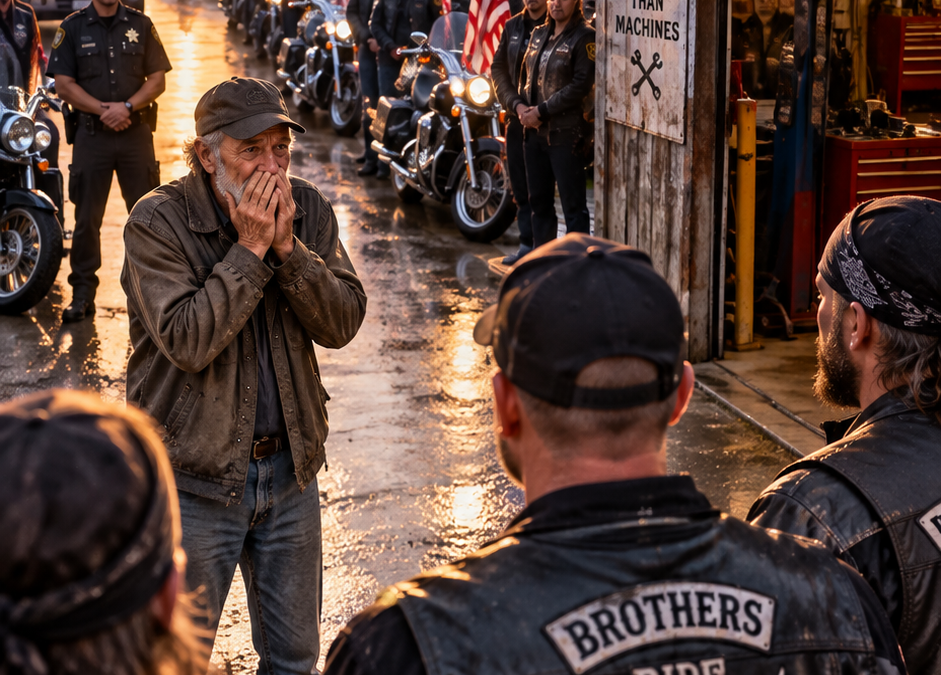
Which brought me back to that strange morning, standing beside my pickup and staring at nearly a hundred people who had apparently decided that my forgotten little garage was the most important address in Kentucky.
Jack stood in front of me.
Cole, Megan, and Ray were beside him.
I looked from one face to another.
“Would somebody please tell me what’s going on?”
Cole stepped forward.
“First, I promised you something.”
He held out a small packet containing a replacement connector.
“This is for your brother’s Harley. We’ve got the proper part for mine coming, too.”
I stared at it.
“You found one already?”
“Turns out when enough motorcycle people start making phone calls, somebody knows somebody who has what you need.”
I accepted the packet.
My throat tightened unexpectedly.
It was such a small thing.
A connector.
But Cole had remembered exactly what giving away that part had meant to me.
Then Jack gestured toward the trucks parked behind the motorcycles.
A man approached and introduced himself as a roofing contractor from Bowling Green.
He explained that his truck carried enough material to replace the leaking section above my service bays.
An electrician stepped forward and offered to inspect the aging wiring and repair the flickering lights.
A parts distributor handed me a business card.
He told me Brooks Auto and Cycle Repair now had a commercial account and that the initial shipment had already been paid for by riders from across the region.
I stared at him.
“Paid for?”
“Yes, sir.”
“By who?”
He gestured toward the crowd.
“Your customers.”
I shook my head.
“I don’t understand.”
Another truck pulled forward.
Its flatbed carried a nearly new hydraulic lift.
The driver explained that he was a retired mechanic who had no further use for it.
He wanted me to have it.
I stepped backward.
“No. Absolutely not.”
Jack smiled.
“Elijah—”
“No. I can’t take all this.”
The crowd grew quiet.
I looked around at the motorcycles lining the road, the trucks loaded with materials, the strangers standing in the morning mist.
“I fixed one motorcycle.”
Jack approached slowly.
“You spent hours helping four people you didn’t know. You took a part from your brother’s Harley so we wouldn’t have to spend the night stranded in a storm.”
“That doesn’t mean you owe me a roof.”
“We’re not here because we owe you.”
“Then why?”
Jack gestured toward the road.
“Because every person standing here needs someone who knows how to fix a motorcycle. And last night, we found a mechanic who still cares whether people make it home.”
I looked at the crowd again.
He continued.
“This isn’t charity, Elijah. It’s business. These people need repairs, inspections, tires, service, and someone they can trust.”
A man near the front raised his hand.
“My bike needs a new clutch.”
Another called out.
“Mine needs a carburetor adjustment.”
A woman beside a red touring motorcycle smiled.
“I’ve got two bikes at home that haven’t run in six months.”
People began laughing.
Jack looked at me.
“Today, they chose you.”
For years, I had watched customers disappear toward the bright signs at Briggs Automotive.
I had begun believing that there was no longer a place for an aging mechanic who still preferred listening to an engine before connecting it to a computer.
Now I stood in front of a road filled with people who had traveled through the night because they trusted what Jack had told them about me.
I didn’t know what to say.
Then Jack glanced toward the enclosed trailer.
“There’s something else.”
I groaned.
“Lord have mercy, son. What else could there possibly be?”
Arthur Hail stepped forward.
He was a thin older man with silver hair and hands that looked as though they had spent as many years around engines as mine.
He introduced himself and shook my hand.
Then he walked toward the trailer and released the rear latch.
The doors opened.
Inside, beneath a heavy canvas cover, sat a motorcycle.
Arthur and Jack carefully pulled the cover away.
A 1969 Harley-Davidson.
The same year and model as Samuel’s.
I stopped breathing for a moment.
The motorcycle wasn’t new.
Its paint had faded.
The chrome carried its age.
But the engine, wiring, switches, and other original components were intact.
I stepped toward the trailer.
“Where did you find that?”
Arthur smiled.
“A collector outside Clarksville.”
I stared at the machine.
“He just gave it to you?”
“Not exactly. But when we explained why we needed it, he agreed to let it go.”
I touched the edge of the trailer.
For thirty-two years, I had been searching for parts for Samuel’s Harley, buying what I could afford and postponing what I couldn’t.
Now an almost complete donor motorcycle sat in front of my garage.
Jack stepped beside me.
“You gave away part of your brother’s motorcycle to get Cole home.”
I swallowed.
“We thought your brother’s bike deserved another chance to run, too.”
I looked at him.
I wanted to thank him.
But the words wouldn’t come.
My hands were shaking.
For a moment, I imagined Samuel standing beside that trailer, grinning like a boy because he had found another Harley we could take apart.
Then Jack said something that made me turn toward him.
“Elijah, that’s not the main reason we came.”
I stared at him.
“Son, if there’s anything bigger than that motorcycle in the trailer, I don’t think my heart can take it.”
He smiled gently.
Then Arthur walked to his pickup and returned carrying a small wooden box.
Its surface had darkened with age.
There were scratches along the lid and faded lettering carved near the center.
Jack took it carefully.
He turned it toward me.
I read the name.
Thomas Mercer.
I looked at Jack.
“Your father?”
He nodded.
“My father.”
I stared at the box.
“What does this have to do with Samuel?”
Jack opened the lid.
Inside were old photographs, folded military papers, and several letters tied together with faded string.
He removed one envelope.
The handwriting on its front was more than fifty years old.
Three words were written across it.
For Samuel Brooks.
I felt my knees weaken.
“Where did you get that?”
“My father spent years trying to find your brother.”
I looked toward Samuel’s photograph visible through the office window.
Jack continued.
“He used to tell me about a soldier who refused to leave him behind when things went wrong overseas.”
I could barely hear him.
“That soldier was Samuel.”
Arthur stepped closer.
“Thomas carried that story with him for the rest of his life.”
Jack held out the envelope.
“There’s something my father wanted your brother to know.”
I took it with both hands.
The paper felt impossibly fragile.
Around me, nearly a hundred riders stood quietly beneath the clearing Kentucky sky.
Nobody moved.
Nobody interrupted.
I opened the envelope.
The letter inside had yellowed.
Thomas Mercer’s handwriting leaned slightly to the right.
I unfolded it carefully and began reading.
Thomas wrote about serving overseas with Samuel.
He described the fear and uncertainty of those years, the long nights when home seemed impossibly far away, and the comfort of having someone beside him who refused to abandon a friend.
He didn’t describe Samuel as fearless.
He described him as faithful.
A man whose courage came from knowing that other people were depending on him.
During one dangerous period of their service, Thomas had found himself frightened, exhausted, and uncertain whether he would ever see his family again.
Samuel had stayed beside him.
He had talked about Kentucky, about his older brother’s garage, and about a motorcycle he intended to ride across America when they got home.
When Thomas began losing hope, Samuel reminded him that people were waiting for him on the other side of the ocean.
Thomas wrote that he had never forgotten Samuel’s voice.
Or the way Samuel refused to leave him to face those frightening days alone.
After returning to America, Thomas had searched for him.
He had tried old military contacts.
He had written letters.
He had asked other veterans whether they remembered a Samuel Brooks from Kentucky.
But the years passed, addresses changed, and eventually the trail disappeared.
Thomas had written the letter because there were two words he still owed my brother.
Thank you.
I stopped reading.
For several seconds, I couldn’t see the page.
Tears had blurred the words.
Jack stood beside me without speaking.
I looked at Samuel’s name on the envelope.
My little brother.
The boy who had spent his childhood following me around the garage, asking to borrow tools he wasn’t old enough to use.
The young man who had left for Vietnam and returned carrying memories he could never quite explain.
The brother who had promised to ride west with me someday.
For decades, I had wondered what he had experienced overseas.
Now, fifty years later, I was holding a letter from a man whose life Samuel had helped preserve.
And the letter had reached me because I had taken a connector from Samuel’s motorcycle to help four strangers get home.
I looked at Jack.
“Sam never told me.”
Jack nodded.
“My father barely told anyone. But he told me enough that I remembered your brother’s name.”
I wiped my face with my sleeve.
“That sounds like Sam.”
My voice broke on the last word.
Jack placed a hand on my shoulder.
“Last night, you did the same thing my father always said your brother did for him.”
I shook my head.
“I just fixed a motorcycle.”
“You made sure we weren’t alone in that storm.”
I looked at the wooden box.
Then toward Lillian’s sign.
For the first time in years, I felt as though the people I had lost were standing close enough for me to hear them.
Samuel with his impossible dreams about riding west.
Lillian reminding me that helping somebody get home was worth more than a perfect business plan.
And somewhere beyond them, Thomas Mercer, whose gratitude had spent half a century searching for the right address.
I held the letter against my chest.
I didn’t care that nearly a hundred strangers were watching an old man cry.
For the first time since Samuel died, I had learned something new about the life he lived.
Something important.
Something he had never managed to tell me himself.
And I had almost closed the garage before four strangers arrived to bring it home.
The rest of that morning passed in a blur.
Nobody made speeches.
Nobody treated me like a helpless old man whose failing business had finally attracted a group of wealthy benefactors.
They simply went to work.
The roofing contractor climbed onto the building and began assessing the damage.
The electrician inspected the panel and traced the wiring responsible for the flickering lights.
Two mechanics helped unload the hydraulic lift and move it into the second bay.
Other riders lined up outside the office to schedule repairs.
I spent half an hour trying to convince people that I couldn’t possibly work on every motorcycle in Kentucky.
Nobody seemed particularly concerned.
Jack helped organize appointments.
Megan answered telephone calls.
Ray brought in coffee and breakfast sandwiches for everyone.
Cole stood beside me while I installed the replacement connector in Samuel’s Harley.
When the old wiring was back together, I looked at him.
“You didn’t have to do all this.”
He smiled.
“Neither did you.”
By noon, Brooks Auto and Cycle Repair had more appointments booked than I had seen in months.
The garage was filled with voices.
Engines started and stopped outside.
Tools clinked against concrete.
Men and women who had traveled through the night were laughing beside people they had only just met.
I stood in the doorway and watched.
For years, the shop had been growing quieter.
After Lillian died, even the busy days felt lonely.
Now people were calling my name from three different directions, asking where I wanted a tool cabinet moved and whether I preferred the new lift against the east wall.
I felt exhausted.
I also felt more alive than I had in a long time.
At one point, Jack found me standing beneath Lillian’s sign.
“You doing all right?”
I nodded.
“Just trying to figure out how I’m going to thank everybody.”
He looked around.
“Fix their motorcycles.”
I laughed.
“That much I can do.”
Then I looked at him.
“Your father must’ve been a good man.”
“He was.”
“He raised a good son.”
Jack’s expression softened.
For several seconds, he couldn’t answer.
Then he held out his hand.
I ignored it and pulled him into a hug.
That was when I finally understood what his club’s motto meant.
No Brother Rides Alone.
It wasn’t simply something stitched onto leather jackets.
It was a promise people had chosen to keep.
And somehow, after spending years believing I was slowly being forgotten, I had become part of that promise.
The following weeks changed my garage.
The roof stopped leaking.
The lights no longer flickered.
The second hydraulic lift worked every morning.
The new parts account meant I could repair motorcycles I had previously been forced to turn away because I couldn’t afford to keep the necessary components in stock.
Word spread.
Riders began traveling from other counties to bring me their machines.
Some arrived because they had heard the story about the storm.
Others came because someone had recommended my work.
A few simply wanted to meet the old mechanic who had apparently convinced half the motorcycle clubs in Kentucky that kindness was still alive on Miller Road.
I didn’t mind.
As long as they understood I was going to charge them for the repairs.
I had learned my lesson about giving everything away.
Mostly.
Walter Briggs drove past several times.
He noticed the new roof.
The freshly painted service doors.
The trucks delivering motorcycle parts.
The growing line of appointments.
Eventually, he stopped in again.
This time, he didn’t bring a purchase offer.
He stood in my newly organized second bay, examining the hydraulic lift.
“Business seems to have picked up.”
“A little.”
“I heard about those motorcycle people.”
“Good folks.”
He looked around.
“I suppose you aren’t interested in selling anymore.”
I wiped my hands on my shop towel.
“Not today, Walter.”
He nodded.
For once, he didn’t argue.
After he left, I looked toward the back corner.
Samuel’s Harley was still there.
But things were different now.
I had parts.
I had working equipment.
And I had friends who kept appearing on Saturdays with tools, coffee, and opinions about how a 1969 Harley-Davidson ought to be restored.
Jack became a regular visitor.
So did Cole, Megan, and Ray.
Sometimes Arthur came up from Tennessee carrying another piece of Thomas’s old collection.
He brought photographs, letters, and small memories I never would have known existed.
One Saturday, he showed me a photograph of Samuel sitting beside Thomas in front of a military tent.
Both men were smiling.
Samuel had one arm draped over Thomas’s shoulder.
I stared at that picture for a long time.
It was one of the few images I had ever seen of my brother from his time overseas.
I placed it in a new frame beside the photograph our mother had taken before he left.
For years, Samuel had existed in my garage mostly through unfinished promises.
Now his story was becoming fuller.
He had been more than the brother I missed.
He had been somebody’s friend.
Somebody’s source of hope.
Somebody’s reason to believe he might make it home.
That knowledge changed the way I worked on his motorcycle.
I stopped treating every part as something sacred that couldn’t be touched.
I began treating the machine as something that deserved to run.
Jack helped rebuild the electrical system.
Cole worked beside me on the engine.
Ray tracked down several components we still needed.
Megan insisted on taking photographs of the restoration because she said nobody would believe how much work went into it.
By late summer, the motorcycle was nearly finished.
On a cool evening, we rolled it outside.
The paint still showed its age.
The chrome wasn’t perfect.
And I had deliberately left several small scratches in the fuel tank because they belonged to Samuel’s history.
I stood beside the bike with one hand resting on the handlebars.
Jack was on my left.
Cole stood near the rear wheel.
Megan held her phone, ready to record.
Ray grinned.
“Well, Elijah. You going to start it or marry it?”
I laughed.
“Give an old man a second.”
I turned the ignition.
Then pressed the starter.
The engine turned over.
Coughed once.
And came alive.
A deep, steady rumble filled the evening air.
I stood motionless.
For thirty-two years, I had imagined hearing that sound again.
I had convinced myself that finishing Samuel’s motorcycle would mean admitting he was never coming back.
But as the engine settled into a smooth idle, I discovered that the opposite was true.
It made him feel closer.
I could almost see him standing beside me, grinning and asking whether I had finally remembered how to tune a Harley.
Jack placed his hand on my shoulder.
“Sounds good.”
I nodded.
Then I laughed.
And before I could stop myself, I began crying.
Nobody said anything.
They simply stood beside me while the motorcycle idled.
After a while, I shut it off.
The sudden silence felt peaceful.
I looked toward the road stretching west beyond the garage.
Samuel and I had never taken that ride.
But now I had friends who would have gladly ridden beside me if I decided to try.
And for the first time in decades, the thought of getting on that motorcycle didn’t feel like something I was doing without my brother.
It felt like something I was finally doing for both of us.
A few weeks later, rain returned to Miller Road.
Not the violent storm that had brought Jack and his friends into my life.
Just a steady autumn rain that turned the trees dark and left the highway shining beneath the evening lights.
I was preparing to close when I heard a motorcycle struggling outside.
The engine coughed.
Stopped.
Then attempted to start again.
I looked at the clock.
It was nearly seven.
My back hurt.
I had been working since early morning, and there was a hot dinner waiting for me at home.
For a moment, I considered switching off the lights before the rider noticed the garage was still open.
Then I heard footsteps beneath the awning.
A young man stood beside an aging motorcycle, rainwater dripping from his jacket.
He couldn’t have been much older than twenty.
His helmet was scratched, his boots were soaked, and he kept glancing down at an almost empty wallet.
When he noticed me, he looked embarrassed.
“Sir, I’m sorry. I know you’re closing.”
I walked toward him.
“What happened?”
“She just died on me about a mile back. I tried everything I know.”
I listened while he attempted to start the motorcycle again.
The engine turned over.
Then stopped.
I glanced at the rain.
Then toward Lillian’s wooden sign.
If you can help somebody get home, help them.
I smiled.
“Push her inside.”
The young man’s shoulders relaxed immediately.
“Really?”
“Unless you enjoy standing in the rain.”
He laughed and began rolling the motorcycle toward the open bay.
I stepped aside and held the door.
As he passed, I glanced toward the back corner of the garage.
Samuel’s Harley stood uncovered beneath the lights.
Beside it hung the old photograph of my brother and Thomas Mercer.
The letter Thomas had written was carefully preserved inside my office.
And above the workbench, Lillian’s sign remained exactly where she had placed it all those years ago.
I had once believed that the people I loved were slowly disappearing from my life, leaving behind only unfinished projects and rooms that grew quieter every year.
But a storm had brought four strangers to my door.
A small electrical connector had brought an old promise back to life.
And a road filled with motorcycles had taught me that the kindness Lillian spent her life encouraging had never truly gone anywhere.
It had simply been traveling.
Sometimes it took thirty-two years to return.
Sometimes it arrived before sunrise.
And sometimes it came in the form of a frightened young rider standing outside an old garage, hoping somebody would help him find his way home.
I rolled my stool beside his motorcycle and reached for my toolbox.
“All right, son,” I said. “Let’s see what we can do.”








