𝗙𝗨𝗟𝗟 𝗦𝗧𝗢𝗥𝗬 I Walked Into My Daughter’s Boyfriend’s Gym Ready for a Fight I Couldn’t Afford to Win
𝗙𝗨𝗟𝗟 𝗦𝗧𝗢𝗥𝗬
I came out of the living room.
“Marcy?”
She looked at me.
Then she began crying harder.
I moved toward her, but she stepped backward.
“Dad, please don’t do anything.”
I stopped.
“What happened?”
She covered her face.
“He’s going to be so angry.”
“Who?”
She didn’t answer.
She didn’t have to.
I took a slow breath.
“Did Dustin hurt you?”
She looked toward the window.
For several seconds, I thought she wasn’t going to answer.
Then she whispered, “He said if I leave him, his uncle will hurt all of us.”
Ellen put an arm around her.
I stared at my daughter.
“What exactly did he say?”
“He said nobody can protect me from them. He said his uncle has people everywhere.”
My hands tightened.
“Has Frank threatened you personally?”
She shook her head.
“No.”
“Have you ever spoken to him about this?”
“No. Dustin says I shouldn’t.”
I tried to organize the information.
Dustin was intimidating her.
He was using his uncle’s reputation to make her believe she couldn’t leave.
And my daughter was frightened enough to think that telling her parents might put us in danger.
I wanted to promise that none of those threats could touch her.
But I had no idea what Frank Delaney was actually capable of doing.
So I made a different promise.
“You’re staying here tonight. We’ll figure out the rest together.”
Marcy suddenly grabbed my shirt.
“Dad, you don’t understand these people.”
I looked at her.
“Then help me understand.”
She shook her head.
“Just promise you won’t go over there.”
I hesitated.
She noticed.
“Please.”
I looked toward Ellen.
Her expression was unmistakable.
“All right,” I said.
But the truth was that I was already imagining what I would say when I eventually confronted Dustin.
I was thinking like an instructor preparing to deal with a dangerous young man.
Not like a father whose daughter desperately needed to believe she could ask for help without setting off another confrontation.
A few days later, Marcy returned to her apartment.
She told us she needed space to think.
Ellen encouraged her to stay with us longer, but Marcy insisted that she wanted to collect her belongings and work out what to do next.
We asked her to call if she needed anything.
She agreed.
Then the phone call I’d been dreading finally came.
I was driving home from the hardware store when Ellen called.
She sounded frightened.
“Daniel, where are you?”
“Ten minutes away. What’s wrong?”
“I’m at the hospital.”
My hands tightened around the steering wheel.
“Why?”
“Marcy’s in the emergency room.”
The traffic in front of me seemed to disappear.
“What happened?”
“She has a concussion and bruised ribs.”
I gripped the wheel harder.
“Where’s Dustin?”
“I don’t know.”
“Did he do this?”
Ellen hesitated.
“She’s telling everyone she fell down the stairs.”
I felt my jaw tighten.
Something inside me decided that I already knew the truth.
And that decision was the beginning of my next mistake.
“I’ll be there,” I said.
I ended the call.
Then I reached the intersection where I should have turned toward the hospital.
Instead, I turned in the opposite direction.
Toward Dustin’s gym.
I convinced myself that I was going there to talk.
To look him in the eye.
To let him know that Marcy wasn’t alone and that frightening her would have consequences.
But somewhere beneath those reasonable explanations was a much uglier desire.
I wanted to see him frightened.
I wanted him to understand what it felt like to be physically vulnerable in front of someone stronger.
And I was too angry to recognize how closely that desire resembled the behavior I’d spent fifteen years teaching Marines to resist.
The gym occupied a converted industrial building near the edge of town.
Music thumped through the walls.
When I entered, the smell of sweat, disinfectant, and old leather immediately surrounded me.
Heavy bags swung from steel frames.
Two fighters were sparring inside a cage.
A group of younger men stood near the weight benches, laughing at something one of them had said.
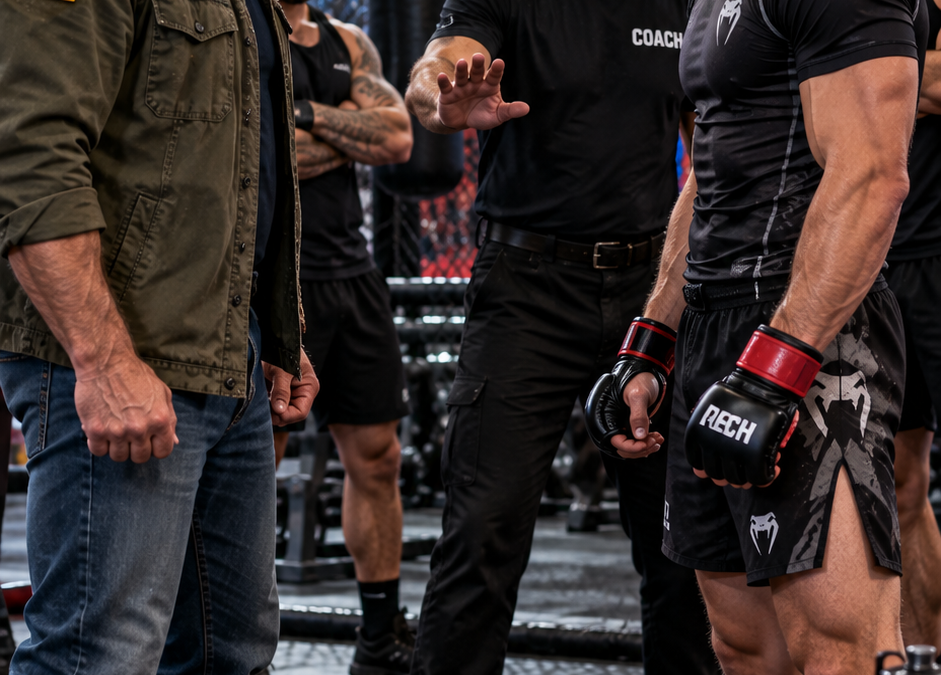
Dustin was beside the cage with his coach and three friends.
He noticed me almost immediately.
His grin widened.
“Well, well. Daddy finally came to visit.”
The men around him turned.
I stopped several feet away.
“Dustin.”
He folded his arms.
“What’s up, old man?”
“Marcy’s in the emergency room.”
For a fraction of a second, his expression changed.
Then the smirk returned.
“She’s clumsy.”
I took another step.
“She has a concussion and bruised ribs.”
He shrugged.
“Then maybe she should watch where she’s going.”
His friends laughed.
I looked at him.
“You’ve been grabbing my daughter. You’ve been frightening her. You’ve been threatening her with your uncle’s connections.”
Dustin’s smile disappeared.
“You don’t know anything about my relationship.”
“I know she’s afraid of you.”
He stepped closer.
“Your daughter needs to learn some respect.”
Something cold settled in my chest.
I stared at him.
“That’s what you think this is about?”
He smiled again.
“She didn’t think an old man like you could protect her.”
His coach looked me over.
Gray beard.
Work boots.
Carpenter’s clothes.
A little more weight around my middle than I’d carried twenty years earlier.
“What are you going to do, Grandpa?” he asked. “Give us a stern lecture?”
Dustin’s friends began shifting around me.
One moved toward my left.
Two drifted behind me.
The coach stepped near the entrance.
I watched their movements.
For fifteen years, I’d trained young Marines who believed size, aggression, and confidence were interchangeable.
They were not.
But I also knew I had no reason to turn an argument into a fight inside a crowded civilian gym.
I looked directly at Dustin.
“I came here to talk.”
He laughed.
“Then start talking.”
I took a slow breath.
“I spent fifteen years as a Marine Corps hand-to-hand combat instructor. I trained Marines preparing for some of the most demanding jobs in the service, and I taught more than three thousand people how to handle themselves under pressure.”
The laughter became uncertain.
One of Dustin’s friends stopped smiling.
I looked around the group.
“And the first thing I taught them was that surrounding somebody because you’re offended isn’t a demonstration of courage.”
Dustin scoffed.
His coach, however, had stopped moving.
He was staring at me.
Not at my shoulders.
Not at my hands.
At my face.
Then he spoke quietly.
“Garrison?”
I looked at him.
He seemed familiar now.
His hair was thinning, his face had broadened, and there were lines around his mouth that hadn’t existed the last time I’d seen him.
But his eyes were unmistakable.
“Tom?”
He let out a disbelieving laugh.
“Staff Sergeant Daniel Garrison.”
For a moment, the years fell away.
Camp Lejeune.
The martial arts instructor course.
2004.
A young corporal with remarkable athletic ability and a temper that had caused him almost as many problems as his opponents.
“Thomas Ellis,” I said.
He nodded.
Dustin looked between us.
“You’ve got to be kidding.”
Tom ignored him.
He turned toward the three younger men.
“Back up.”
One of them blinked.
“Coach?”
“I said back up.”
They moved away.
Dustin remained where he was.
His expression had changed.
He was no longer completely certain that the room would respond the way he expected.
I looked at Tom.
“I came here to talk.”
He studied my face.
Then he glanced toward Dustin.
“About your daughter?”
“Yes.”
“What’s happened?”
“She’s in the emergency room.”
The last traces of amusement disappeared from his face.
“What?”
Dustin looked away.
I saw it.
Tom saw it too.
“She fell,” Dustin muttered.
My hands curled instinctively.
Then I remembered Marcy gripping my shirt.
Dad, please don’t do anything.
I forced my fingers open.
“Maybe she did.”
Dustin looked surprised.
“Then why are you here?”
“Because she’s afraid of you.”
His expression hardened.
I continued.
“She’s afraid to leave you. She’s afraid of your uncle. And she’s afraid that if she tells anybody what’s been happening, something will happen to her family.”
Tom slowly turned toward Dustin.
“Your uncle?”
Dustin scoffed.
“Don’t turn this into something it isn’t.”
“I’m not making anything up,” I said. “I’m telling you what my daughter told me.”
Dustin folded his arms.
“She gets emotional.”
I stared at him.
I’d heard variations of those words throughout my life.
She’s sensitive.
She’s dramatic.
She misunderstood.
Little phrases people used when they wanted to dismiss another person’s fear without considering whether they might be responsible for it.
Tom stepped between us.
Not dramatically.
Just enough to interrupt the confrontation.
“Dan, you need to go to the hospital.”
I looked at him.
“And Dustin needs to stay here,” he added.
Dustin stared.
“Excuse me?”
Tom turned toward him.
“If your girlfriend is in the ER and her father is standing in my gym telling me she’s afraid of you, nobody needs to be having this conversation while they’re angry.”
“This is my family’s gym.”
Tom shook his head.
“No. Your uncle helped finance the lease. I run the gym.”
For the first time, Dustin looked genuinely uncertain.
That detail registered somewhere beneath my anger.
I’d imagined arriving at a gym full of men entirely loyal to him.
I’d imagined an organization prepared to protect a violent man because his uncle possessed money and influence.
Instead, I saw three younger fighters staring at the floor.
A coach who looked deeply uncomfortable.
And Dustin standing between us, suddenly discovering that the people around him weren’t prepared to support everything he said.
Tom looked at me again.
“Go see your daughter.”
I studied him.
“You’re telling me to leave?”
“I’m asking you to remember what you taught me.”
That stopped me.
Twenty-two years earlier, Corporal Ellis had gotten into an argument with another Marine outside a training facility.
It hadn’t become a serious fight, but his temper had nearly cost him his place in the course.
I’d pulled him aside afterward.
I could still remember what I’d said.
If you have enough skill to hurt somebody, you have enough skill to walk away.
At the time, he’d hated hearing it.
Now he was giving the lesson back to me.
I looked at Dustin.
Every instinct in my body wanted a confession.
An explanation.
Something that would make me feel as though I had defended my daughter.
But anger makes terrible investigators.
I knew that.
I’d taught it.
So I nodded.
“Fine.”
Dustin’s smile returned, although it looked less convincing now.
“That’s what I thought.”
Tom turned sharply.
“Don’t.”
One word.
Dustin closed his mouth.
I walked out.
And twelve minutes later, when I finally reached the hospital, I discovered how much damage I’d nearly done by going to the wrong place first.
Ellen was sitting outside Marcy’s examination room when I arrived.
She stood the moment she saw me.
“Where were you?”
I stopped in front of her.
There was no point lying.
“Dustin’s gym.”
Her eyes closed.
“Daniel.”
“I didn’t touch anybody.”
She looked at me.
“That is not the point.”
“I know.”
“Do you?”
I glanced toward the examination room.
“Is she awake?”
“Yes.”
“How is she?”
“She’s frightened. She’s in pain. And she’s been asking where you are.”
I lowered my head.
Ellen and I had been married for thirty-three years. In all that time, she’d rarely raised her voice at me.
She didn’t need to.
When she was disappointed, she spoke quietly, and somehow that made her words much harder to ignore.
“I thought you understood what she needed,” she said.
“I do.”
“Then why did you go looking for him instead of coming here?”
I stared at the floor.
Because I was angry.
Because I wanted Dustin to feel powerless.
Because confronting him was something I understood, while sitting beside my injured daughter and accepting that I couldn’t simply undo what had happened was something I had no training for.
“I made a mistake,” I said.
Ellen’s shoulders relaxed slightly.
“Then go tell your daughter.”
Marcy was lying in a hospital bed with the back raised.
A bruise darkened one side of her forehead, and she held herself carefully, avoiding movements that aggravated her ribs.
A cup of ice water sat beside the bed.
The television was playing with the sound muted.
She looked up when I entered.
Then her eyes moved over my clothes.
“You went there.”
It wasn’t a question.
I pulled a chair beside her bed.
“Yes.”
Her eyes filled immediately.
“Dad.”
“Nothing happened.”
“You promised you would handle it.”
“I thought confronting Dustin was how I needed to handle it.”
She turned toward the window.
“And now?”
I sat down.
“Now I think I need to start by listening to you.”
She looked at me.
For a moment, I saw the little girl who’d once believed her father could fix anything.
A flat tire.
A broken window.
A frightening thunderstorm.
When she was ten, she’d told Ellen that fathers were people who always knew where the flashlights were during a blackout.
I’d loved being that person.
Somewhere along the way, I’d confused being dependable with always having an answer.
“Can you tell me what happened?” I asked.
Marcy looked toward Ellen.
Then back at me.
“Not if you’re going to return to the gym.”
“I won’t.”
“Promise?”
I nodded.
“I promise.”
She took a slow breath.
“We argued.”
“About what?”
“I told him I wanted some space.”
She adjusted the blanket over her lap.
“He said I was embarrassing him. That people at the gym had been asking questions.”
“What questions?”
“I don’t know. He wouldn’t tell me.”
She swallowed.
“He kept saying I’d made him look weak.”
I felt my jaw tighten.
But I said nothing.
“I told him I didn’t care what his friends thought. I told him I was tired of being watched every time I went somewhere without him.”
Her voice began trembling.
“He got angry.”
She stopped.
I waited.
Finally, she continued.
“I left his apartment. I was crying. I missed a step outside and fell.”
For several seconds, I couldn’t speak.
“You fell?”
She nodded.
“Yes.”
“And your ribs?”
“I hit the railing.”
I stared at her.
That wasn’t the story I’d constructed in my head.
I’d heard she had a concussion and bruised ribs, remembered the marks Ellen had seen on her arm, and immediately concluded Dustin had beaten her badly enough to send her to the hospital.
The reality was more complicated.
That didn’t make her situation safe.
But it mattered that I understood what had actually happened.
Ellen moved closer.
“Sweetheart, what about the bruises on your arms?”
Marcy closed her eyes.
“That was Dustin.”
I leaned forward.
“Tell me.”
“He grabs me during arguments.”
She looked down at her hands.
“Sometimes he grabs both arms and won’t let go until I agree to listen.”
“How often?”
“I don’t know. A few times.”
“Does he hurt you?”
She nodded.
“Sometimes.”
I wanted to ask a dozen questions.
Instead, I took a breath.
“Has he hit you?”
“No.”
Her eyes filled.
“He’s never punched me or kicked me, Dad.”
I nodded.
“Okay.”
“But he scares me.”
Ellen reached for her hand.
“Grabbing you hard enough to leave bruises isn’t acceptable.”
“I know.”
Marcy’s voice broke.
“I kept thinking he’d stop.”
She told us about the beginning of their relationship.
How Dustin had been funny and attentive.
How he’d remembered little things she mentioned and surprised her with thoughtful gifts.
How he’d driven forty minutes through a storm when her car broke down.
How he’d once brought Ellen her favorite lemon cookies because Marcy had mentioned them during a conversation.
For a while, he’d made her feel as though she were the most important person in his life.
Then the jealousy began.
He questioned her friendships.
Complained when she didn’t answer messages quickly.
Accused her of embarrassing him whenever she disagreed with him in front of other people.
Every time she tried to explain that his behavior frightened her, he reminded her of how happy they’d been.
He promised to change.
Sometimes he did, briefly.
Then another argument occurred, and everything started again.
I finally understood why asking her why she hadn’t simply left would be so unhelpful.
She’d been waiting for the person she’d loved at the beginning to return.
And Dustin had been using that hope to keep her beside him.
“What about his uncle?” I asked.
Marcy looked uncomfortable.
“Dustin says Frank can make people regret causing trouble.”
“Has Frank ever threatened you?”
She shook her head.
“Not directly.”
“What has he said to you?”
“Nothing.”
I frowned.
“You’ve never spoken to him about your relationship?”
“No.”
“Then what makes you think he would hurt us?”
Marcy looked embarrassed.
“Because Dustin says he will.”
I sat back.
It was possible Frank Delaney was exactly as dangerous as the rumors suggested.
But I had no firsthand evidence that he’d threatened my daughter.
And I was beginning to suspect Dustin had worked very hard to prevent her from discovering the difference.
Marcy wiped her eyes.
“I knew you didn’t like him.”
“That’s true.”
“And that’s why I couldn’t tell you.”
That hurt.
“Why?”
She gave me a tired look.
“Because I knew you’d do exactly what you did tonight.”
I started to object.
Then I remembered where I’d just been.
“You’d turn it into a mission,” she continued. “You’d go over there, confront him, and make everything worse.”
I stared at her.
She was right.
Not about everything.
But about enough.
“I’m sorry.”
Marcy blinked.
“For what?”
“For making you think you had to protect me from your problems.”
Her expression changed.
I reached for her hand.
“You should’ve been able to tell me you were frightened without worrying about managing my reaction.”
She squeezed my fingers.
For a while, none of us spoke.
Then she asked what had happened at the gym.
I told her about Tom Ellis.
She recognized the name immediately.
“Tom?”
“You know him?”
“Of course. Everybody knows Tom.”
“What do you think of him?”
“He’s decent.”
The answer came without hesitation.
“Dustin complains about him all the time,” she added.
“Why?”
“Because Tom won’t let him do whatever he wants.”
I thought about the way Dustin had claimed the gym belonged to his family.
Then I remembered Tom correcting him.
His uncle had helped finance the lease.
Tom operated the business.
That was another detail I needed to understand.
Before I could ask anything else, a nurse entered to check Marcy’s condition.
She explained the discharge plan, including the importance of rest and monitoring her symptoms.
When the nurse left, Ellen sat beside our daughter.
“You’re coming home with us.”
Marcy nodded.
No argument.
That told me how exhausted she was.
Then her phone vibrated.
Dustin.
She stared at the screen.
Ellen reached toward it.
Marcy stopped her.
“No. I want to see what he says.”
She opened the message.
Her expression changed.
Then she handed me the phone.
Dustin had written that Tom had instructed him not to contact her, but he wanted her to know he hadn’t sent anyone to threaten her family.
He said he hadn’t learned about her fall until a friend contacted him.
He apologized that she was injured.
Then he asked her to tell me not to make things worse before hearing the entire story.
I read the message twice.
My anger didn’t disappear.
He had grabbed my daughter.
He had frightened her.
And he’d repeatedly used his uncle’s reputation to make her doubt that she could safely leave their relationship.
But there were questions I hadn’t asked.
Questions about Frank.
About the gym.
And about why Tom Ellis had looked so disturbed when I mentioned my daughter’s fear.
The following morning, Tom called me.
He wanted to meet somewhere away from the gym.
We chose a diner near the interstate.
He was already sitting in a booth when I arrived.
There was a cup of coffee in front of him, but no food.
I sat opposite him.
“What’s this about?”
Tom looked exhausted.
“I owe you the truth about last night.”
I waited.
“Those three fighters weren’t preparing to attack you.”
I raised an eyebrow.
“Really?”
“One was going to lock the front door. Another was heading toward the office.”
“And the third?”
Tom looked embarrassed.
“I think he wanted a better view.”
Despite everything, I almost laughed.
“Your positioning was terrible.”
“My knees are terrible.”
I shook my head.
He grew serious.
“Dan, I didn’t recognize you immediately. But once I did, I remembered exactly what you taught me.”
“That explains why you told them to back up.”
“Partly.”
He looked into his coffee.
“I’ve been letting Dustin get away with too much.”
That caught my attention.
“What do you mean?”
Tom explained that Frank Delaney had helped Dustin financially after his mother died of cancer three years earlier.
Dustin had fallen behind on gym membership payments, lost sponsorship opportunities, and accumulated debts.
Frank paid several months of training expenses and contributed money toward improvements to the gym.
But he didn’t own it.
He wasn’t involved in its management.
And he had never guaranteed Dustin unlimited financial support.
“Then why does Dustin tell everybody his family owns the place?”
Tom rubbed his forehead.
“Because I allowed him to.”
“Why?”
“At first, I thought it was harmless bragging.”
“And later?”
He looked ashamed.
“Later, I realized people were treating him differently because they were afraid of offending his uncle.”
I stared at him.
“Did you ever correct that?”
“Not as firmly as I should have.”
He described a series of complaints that had accumulated over the previous year.
Arguments with other fighters.
Disputes over money.
Problems with sparring partners.
A receptionist who’d resigned after Dustin repeatedly made her uncomfortable.
None of the incidents had seemed especially serious when considered alone.
So Tom had handled them individually and allowed Dustin to continue training.
Then he looked at me.
“One day you realize you’ve built an entire wall out of things you kept calling separate bricks.”
I understood exactly what he meant.
But there was something else.
Frank had withdrawn his financial support eight months earlier.
According to Tom, he’d discovered that Dustin was using his name to obtain favors and persuade people to lend him money.
Frank had asked Tom to stop giving his nephew special treatment.
He’d also written a signed statement clarifying that Dustin didn’t represent him or his businesses and had no authority to threaten anyone on his behalf.
Tom handed me a copy.
I read it carefully.
It directed anyone affected by Dustin’s conduct to contact Frank through his attorney, Rachel Bennett.
“Why didn’t Frank make this public?” I asked.
Tom sighed.
“Probably because he hoped his nephew would straighten out.”
I looked at him.
“That was a mistake.”
“Yes.”
He didn’t argue.
Then my phone rang.
Ellen.
Her voice sounded strange.
“Daniel, come home.”
I stood immediately.
“What’s wrong?”
“Marcy found something in Dustin’s old messages.”
“What?”
She took a breath.
“A message from Frank.”
When I returned home, Marcy was sitting at the kitchen table with her laptop open.
Ellen stood behind her.
The message was six months old.
Frank had contacted Marcy directly, explaining that Dustin might be using his name in ways that made her uncomfortable.
He assured her that she owed neither him nor his family anything and that he didn’t expect to interfere in her personal relationship.
I looked at my daughter.
“Why didn’t you tell us about this?”
She stared at the screen.
“Because Dustin said it was a warning.”
I sat down.
“He told you that?”
She nodded.
“He said Frank never contacted somebody unless he was keeping an eye on them. I thought it meant his uncle was watching me.”
I read the message again.
Frank’s words were straightforward.
Dustin had transformed them into something frightening.
And because Marcy was already afraid of him, she’d believed his interpretation rather than her own understanding of the message.
Ellen touched her shoulder.
“Sweetheart, why didn’t you show us?”
“Because I thought you’d be in danger if you knew.”
I closed my eyes.
That sentence would stay with me for a long time.
Dustin had convinced my daughter that every possible source of help was another threat.
If she called me, I might confront him.
If she told Ellen, Ellen would tell me.
If she contacted Frank, she would supposedly be inviting trouble from the very man Dustin claimed was protecting him.
And if she reported Dustin’s conduct, she’d supposedly be challenging someone with enough influence to make her regret it.
Fear had turned every possible exit into another locked door.
Then my phone rang again.
An unfamiliar number.
I answered.
“Daniel Garrison?”
“Speaking.”
“My name is Rachel Bennett. I represent Frank Delaney.”
I put the phone on speaker so Ellen and Marcy could hear.
Rachel explained that Frank had learned of Marcy’s injuries and wanted to clarify what Dustin had been telling her.
My first instinct was to refuse.
“No.”
Marcy looked at me.
I stopped.
There I was again.
Making decisions before asking what my daughter wanted.
I took a breath.
“That wasn’t my decision to make.”
I looked at Marcy.
“Do you want to hear what he has to say?”
She thought for several seconds.
“Yes.”
Rachel explained that Frank had been encouraging Dustin to seek counseling for grief, anger, and financial problems that had worsened after his mother died.
He’d eventually stopped supporting Dustin after discovering that his nephew had used his name to frighten a former business partner.
“Aaron Pike,” Rachel said.
Marcy went pale.
I noticed immediately.
“You know him?”
She nodded.
“Aaron’s the reason Dustin told me never to speak to Frank.”
Rachel hesitated.
Then she explained that Aaron was living in Arizona and had provided Frank with financial records suggesting Dustin had been borrowing money while falsely claiming that his uncle guaranteed repayment.
I looked at my daughter.
She was staring at her hands.
“Marcy?”
Tears filled her eyes.
“I lent Dustin money.”
Ellen sat down.
“How much?”
“Eight thousand dollars.”
I felt the floor shift beneath me.
“Eight thousand?”
She nodded.
“He said he needed it for training expenses. He promised to repay me after he signed a sponsorship deal.”
“Did he?”
She shook her head.
“I was too embarrassed to tell anybody.”
I wanted to ask why.
I wanted to point out that she’d worked for years to save that money.
But I remembered what she’d told me in the hospital.
She needed parents she could confide in, not another pair of people she’d have to protect from her mistakes.
So I reached for her hand.
“We’ll work out what to do about it.”
Marcy wiped her eyes.
Then she suddenly stood.
“My old phone.”
“What about it?”
“Dustin borrowed it last January because his battery had died. He was taking pictures of documents and said he needed to send them to himself.”
She looked toward the hallway.
“I still have it.”
A minute later, she returned carrying an older phone.
She plugged it into a charger.
We waited until the screen came on.
Then she began searching through the photographs.
January seventeenth.
A series of images appeared.
Bank transfers.
Screenshots of text conversations.
Photographs of handwritten financial notes.
Dustin had copied files onto her phone, apparently intending to move them between devices, but some had remained in its photo storage after he’d deleted his own copies.
One screenshot showed an exchange between Dustin and Aaron Pike.
Aaron had confronted him about using Frank’s name to borrow money.
Dustin’s reply made me stare.
His name is the only reason anybody gives me a chance.
I read it twice.
Dustin hadn’t been protected by his powerful uncle.
He’d been pretending to be.
And every person who believed him made his deception more effective.
Then I noticed another name appearing repeatedly in the financial records.
L. Mercer.
I frowned.
“Who’s Mercer?”
Rachel was still on speaker.
Her voice changed.
“Can you tell me the exact name on the account?”
I enlarged the photograph.
“Linda Mercer.”
There was a long pause.
Then Rachel answered.
“That was Dustin’s mother.”
I looked toward Marcy.
“She died three years ago.”
“Yes.”
“Then why are there financial transfers from an account bearing her name dated last year?”
Rachel took a breath.
“Mr. Garrison, that’s one of the questions Frank has been trying to answer.”
For the first time since Ellen called me from the hospital, I began to understand that Dustin’s behavior wasn’t just about a young man using intimidation to control my daughter.
He had also constructed an entire reputation around money, influence, and family protection he might not actually possess.
And somewhere inside that deception were financial records connected to a woman who’d been dead for three years.
Rachel asked Marcy not to delete, forward, or alter anything on the old phone.
“Those photographs may be important,” she explained. “If you’re willing, I’d like to arrange for someone qualified to preserve them properly.”
Marcy looked at me.
I kept my mouth shut.
She thought about it.
“Okay.”
Then she asked a question that surprised us.
“Did Dustin steal from his mother?”
Rachel hesitated.
“We don’t know exactly what happened yet. The account you’re seeing wasn’t her ordinary checking account.”
“What was it?”
“A trust established before she died. Frank became responsible for overseeing it afterward.”
I glanced toward Ellen.
“Then why is Dustin moving money out of it?”
“That’s precisely what needs to be established. He was entitled to certain distributions, but Frank believes there may have been transfers that weren’t properly authorized.”
Marcy stared at the financial records.
“How much money?”
“I’d rather not give you a number before we’ve verified it.”
I respected that answer.
After several weeks of listening to people make increasingly dramatic claims about Frank Delaney, it was refreshing to hear someone admit what she didn’t know.
Rachel offered to arrange a meeting with Frank and an independent attorney if Marcy wanted to discuss the financial records and the threats Dustin had made.
My daughter considered it.
Then she nodded.
“I want to hear what he has to say.”
We met Frank two days later.
The meeting took place in a conference room at Rachel’s office.
I had expected an intimidating man with an entourage and a tendency to remind people how important he was.
Instead, Frank Delaney arrived alone.
He was in his late fifties, wearing an expensive but understated gray suit. He had dark hair going silver at the temples and the weary expression of someone who hadn’t been sleeping particularly well.
He greeted Ellen politely.
Then he looked at Marcy.
“I’m sorry we have to meet under these circumstances.”
She didn’t answer immediately.
Finally, she asked, “Did you threaten me?”
Frank looked genuinely surprised.
“No.”
“Did you tell Dustin you’d hurt my family if I left him?”
“No.”
“Did you know he was saying that?”
His expression hardened.
“I knew he had used my name to intimidate people. I didn’t know exactly what he’d told you.”
Marcy looked down.
“I thought you were watching me.”
Frank closed his eyes briefly.
“Because of the message I sent?”
She nodded.
“I should have called you directly and explained myself,” he said.
“Would I have answered?”
He considered that.
“Probably not.”
I watched him carefully.
I wasn’t prepared to accept that he was harmless simply because his nephew had lied about his involvement.
People didn’t acquire Frank’s reputation entirely by accident, and I knew very little about the way he conducted his businesses.
But I had no evidence he’d threatened my daughter.
And I wasn’t going to confuse rumors with facts simply because doing so made the situation easier to understand.
Frank opened a folder.
“My sister Linda died three years ago.”
His voice changed when he said her name.
“She left Dustin an inheritance, but she didn’t want him to receive everything at once. She knew he had problems managing money.”
He explained that Linda had established a trust with provisions for Dustin’s education, training, and other legitimate needs.
Frank had assumed responsibility for overseeing the remaining funds.
At first, the arrangement worked.
But after Linda died, Dustin began requesting increasingly large distributions.
He wanted money for training.
Travel.
Equipment.
Business opportunities.
Frank provided some financial support personally, separate from the trust, because he’d promised his sister he would help her son establish himself.
Then Dustin began borrowing money from other people.
Some of them believed Frank was guaranteeing repayment.
Others apparently thought they were investing in an MMA career backed by a wealthy businessman.
Eventually, Aaron Pike approached Frank about money Dustin owed him.
That was when the situation began unraveling.
“Aaron showed me messages Dustin had sent,” Frank explained. “They suggested I’d approved loans I knew nothing about.”
I glanced at Marcy.
She was staring at the table.
“Then I discovered irregularities in the trust records,” Frank continued.
“What kind?” I asked.
“Withdrawal instructions I hadn’t approved. Documents bearing signatures that needed to be verified. Transfers to accounts I didn’t recognize.”
He looked toward Rachel.
“We reported the concerns and began reviewing the records.”
Marcy slowly raised her eyes.
“Was Dustin stealing?”
Rachel answered before Frank could.
“There’s evidence suggesting unauthorized transactions, but the investigation needs to establish who initiated them and how.”
Marcy nodded.
Then she asked, “Did Dustin tell you he borrowed eight thousand dollars from me?”
Frank’s face changed.
“No.”
She explained the loan.
The training expenses.
The promised sponsorship deal.
The repeated excuses whenever she asked when he would repay her.
Frank listened without interrupting.
When she finished, he looked down at his hands.
“My sister would have been ashamed of what he’s been doing.”
Marcy’s eyes filled.
“His mother was the reason I kept making excuses for him.”
Frank looked at her.
“He told me he was struggling because he missed her. And I believed him. I still think he does miss her.”
She swallowed.
“But missing somebody doesn’t give you the right to hurt everyone around you.”
Frank nodded.
“No. It doesn’t.”
For the first time since entering the room, I felt a small measure of respect for him.
He wasn’t asking Marcy to excuse Dustin because he’d experienced grief.
He wasn’t promising that money could repair what had happened.
And he wasn’t trying to make his nephew’s conduct disappear.
He was listening.
Something I wished I’d done much sooner.
The following weeks were exhausting.
With Marcy’s consent, the relevant photographs and messages were preserved and reviewed as part of the financial investigation.
Aaron Pike provided additional records from Arizona.
They revealed that Dustin had been using his uncle’s name to support financial promises Frank had never made.
Investigators also established that several withdrawals from Linda Mercer’s trust had been initiated using authorization documents that Frank disputed.
The money had moved through accounts associated with Dustin and his training-related expenses.
Some transactions were legitimate.
Others required further investigation.
It took time to distinguish between them.
That was one of the things I’d learned to appreciate since leaving the gym that first night.
Real problems rarely came with a simple explanation and a convenient villain who confessed everything as soon as someone confronted him.
They involved paperwork.
Conflicting accounts.
People who remembered different details.
And uncomfortable discoveries about decisions everyone wished they’d handled differently.
Tom cooperated with the inquiry.
He provided the gym’s financial records, relevant correspondence, and information about the complaints he’d previously received concerning Dustin.
When he finished, he called me.
“Dan, I owe Marcy an apology.”
“Then you should ask whether she wants to hear it.”
He was quiet for a moment.
“Fair.”
A few days later, Marcy agreed to meet him at our house.
Tom arrived carrying a small box of pastries.
I raised an eyebrow when I opened the door.
“Trying to bribe us?”
“Absolutely.”
He looked toward the kitchen.
“Is she here?”
Marcy came downstairs.
Tom stood.
“Marcy, I’m sorry.”
She stopped near the table.
“For what?”
“For letting Dustin believe he could act however he wanted at my gym.”
She looked at him carefully.
“I complained about the way he treated people.”
“I remember.”
“You told me he was under a lot of pressure.”
Tom nodded.
“I did.”
“You said he just needed time.”
“I know.”
Her voice trembled.
“I believed you.”
Tom looked ashamed.
“I should have listened. I thought I was helping a young man whose mother had died. But I kept making excuses for behavior that should’ve had consequences.”
Marcy wiped her eyes.
“Do you know how many times I wondered whether I was overreacting because everyone seemed to think Dustin was a good guy?”
Tom didn’t answer immediately.
Then he said, “I can only imagine. And I’m sorry I contributed to that.”
It wasn’t an elaborate apology.
He didn’t promise to make everything right.
He didn’t explain away his decisions.
He simply acknowledged them.
Marcy nodded.
“Thank you.”
After he left, I found her sitting beside Ellen in the living room.
“How are you feeling?”
She looked thoughtful.
“Angry.”
I nodded.
“That’s understandable.”
“But also relieved.”
“Why?”
“Because I kept thinking I was the only person who noticed what Dustin was becoming.”
Ellen put an arm around her.
“You weren’t.”
Marcy shook her head.
“But I was the one who thought I had to live with it.”
I sat beside them.
For a long time, we didn’t speak.
Then she looked at me.
“Dad, I want to report what he did.”
I felt my attention sharpen.
“The grabbing?”
“Yes. And the messages about his uncle.”
I nodded.
“We’ll help you.”
“But I don’t want you speaking for me.”
I looked at her.
“Okay.”
She studied my expression.
“I mean it.”
“I know.”
“I want to give my own statement.”
“Then you will.”
She looked relieved.
And I understood how close I’d come to undermining her confidence by behaving as though protecting her meant taking over every decision.
Marcy met with investigators, provided the threatening messages, and described the occasions when Dustin had grabbed her hard enough to leave bruises.
She was also precise about the night she was injured.
She’d fallen on the steps outside his apartment after an argument.
Her concussion had resulted from the fall, and she’d struck her ribs against the railing.
She didn’t claim Dustin had punched or kicked her.
But she explained that he’d repeatedly restrained her during arguments and used fear of his uncle to discourage her from ending the relationship.
Her account was supported by photographs, messages, and other information gathered during the inquiry.
Dustin continued insisting that he’d never intended to hurt her.
He also maintained that the fall had been an accident.
Marcy didn’t dispute that she’d fallen.
What she disputed was his apparent belief that because he hadn’t directly caused every one of her injuries, the rest of his behavior didn’t matter.
Meanwhile, the financial investigation expanded.
The trust records, bank correspondence, and documents Aaron Pike had retained helped establish a pattern of deception.
Dustin had exaggerated his financial backing and used documents that appeared to authorize transfers exceeding what he’d been permitted to receive.
When he could no longer obtain money from Frank, he borrowed from people who still believed his uncle would repay them.
He hadn’t been operating as the representative of a powerful businessman.
He’d been spending money he didn’t have while using another man’s reputation to avoid scrutiny.
Eventually, investigators referred the evidence to prosecutors.
Dustin faced proceedings arising from the financial misconduct, along with the separate allegations concerning his treatment of Marcy.
Tom terminated his membership at the gym.
Frank stopped providing him with financial support.
And the young man who’d spent months telling my daughter that nobody could protect her from his family discovered that his family wasn’t prepared to shield him from the consequences of his conduct.
None of that restored the months Marcy had spent living in fear.
She still became anxious when an unfamiliar number appeared on her phone.
She still checked the locks more often than she used to.
And sometimes, when she heard somebody raising his voice in public, her entire body became tense.
Ellen helped her find a counselor.
I made sure she knew she could stay with us for as long as she wanted.
But I stopped treating every difficult day as a problem I needed to solve immediately.
Sometimes Marcy wanted advice.
Sometimes she wanted to talk.
Sometimes she wanted to sit beside her mother and watch television without discussing Dustin at all.
I learned to ask what she needed instead of assuming I already knew.
Several months later, Dustin entered a plea agreement resolving part of the financial case.
The disposition included restitution obligations to people from whom he’d obtained money through misrepresentation.
Marcy’s eight-thousand-dollar loan became part of the broader effort to recover funds.
She didn’t receive all of it immediately.
And she didn’t pretend that recovering the money would erase what had happened.
The proceedings concerning his conduct toward her were handled separately.
She gave her statement and participated as much as she chose to.
Through the available legal process, she also obtained protective restrictions intended to prevent further unwanted contact.
I accompanied her when she wanted me there.
I waited outside when she preferred privacy.
And when she came home exhausted from another interview or legal appointment, I no longer asked whether she’d said everything I thought she should have said.
I simply asked whether she wanted dinner.
The first time she laughed at that question, I felt as though something in our family had finally begun to heal.
One afternoon, about six months after the hospital visit, Tom called and invited me to speak with a class of young fighters at his gym.
My first instinct was to refuse.
I hadn’t been back since the night I’d confronted Dustin.
I wasn’t eager to return to a place associated with some of the worst mistakes I’d made as a father.
But Tom explained that he’d been reviewing how he trained young athletes.
He wanted someone to speak about discipline, responsibility, and the difference between learning to fight and learning to intimidate people.
I considered it.
Then I agreed.
When I arrived, the gym looked much as it had on my first visit.
Heavy bags.
The cage.
Mats worn from years of training.
Young athletes moving between exercises.
But the atmosphere was different.
Tom introduced me without mentioning Dustin.
He spoke briefly about my military experience and the instructor course we’d completed together.
Then he stepped aside.
I looked at the men and women standing in front of me.
Some were barely twenty.
Others were older.
Most had come because they enjoyed combat sports and wanted to improve their skills.
A few wore expressions I recognized from my years in the Marine Corps.
The unmistakable confidence of someone who believed strength was measured by how frightened other people became when they entered a room.
I began with a question.
“How many of you think the most important part of fighting is knowing how to win?”
Most of them raised their hands.
I nodded.
“That’s what I expected.”
Then I told them something I’d spent fifteen years teaching Marines.
“The more capable you become, the more responsibility you have to recognize when force isn’t necessary.”
I paused.
“Being able to hurt somebody doesn’t make every disagreement a fight. Being insulted doesn’t automatically make you a victim. And being physically stronger than somebody doesn’t give you authority over them.”
Several people shifted.
I continued.
“You want to know how I recognize a disciplined fighter? It’s not the person who tells me how dangerous he is.”
I looked around the room.
“It’s the person who can leave an argument without needing everybody to know what he could have done.”
Tom stood near the back.
Our eyes met.
He smiled faintly.
I thought about the younger version of him, standing outside a training facility at Camp Lejeune, furious because another Marine had challenged his pride.
And I remembered what he’d told me the night I nearly let my own anger take control.
Remember what you taught me.
I finished by telling the class that their training should make the people around them safer, not more frightened.
Afterward, Tom walked me toward the entrance.
“That was good.”
I shrugged.
“You’re biased.”
“Probably.”
He stopped beside the door.
“How’s Marcy?”
“Better.”
“Glad to hear it.”
“She’s starting to feel like herself again.”
Tom nodded.
Then he hesitated.
“Do you ever think about what would’ve happened if I hadn’t recognized you that night?”
I looked toward the cage.
“Sometimes.”
“I think you would’ve walked out anyway.”
I considered that.
“I’m not as certain.”
He studied my face.
“You taught me to walk away, Dan. I just reminded you.”
I looked at him.
“That’s the part of teaching nobody warns you about.”
“What?”
“Eventually, somebody expects you to follow your own advice.”
He laughed.
Then he shook my hand.
For the first time since entering Dustin’s gym that terrible evening, I left without anger burning in my chest.
That night, I returned home to find Marcy sitting on the back porch with Ellen.
They were laughing about something on her phone.
I stopped in the doorway.
For months, I’d become so accustomed to seeing my daughter frightened or exhausted that the sound of her laughter caught me completely off guard.
She looked up.
“Dad! Come here.”
“What did I do?”
“Nothing.”
“That sounds suspicious.”
She turned the phone toward me.
It was an old photograph.
Marcy was eight years old, standing beside me in our backyard, wearing one of my oversized Marine Corps T-shirts.
I’d apparently allowed her to put on my training gloves, which were so large that she could barely lift her hands.
She was grinning at the camera.
I was standing beside her, looking ridiculously proud.
Ellen laughed.
“She found the box of old photographs.”
I sat beside them.
Marcy looked at the picture.
“Remember when I thought you could beat up anybody in the world?”
I smiled.
“I remember you telling your third-grade teacher that.”
She laughed.
“She called Mom.”
“Your mother wasn’t impressed.”
Ellen shook her head.
“Not remotely.”
Marcy looked toward the yard.
For a moment, her smile faded.
Then she said, “I used to think nobody could hurt me as long as you were around.”
I felt my chest tighten.
“Sweetheart—”
“It’s okay.”
She looked at me.
“I know you can’t protect me from everything.”
I reached for her hand.
“I wish I could.”
“I know.”
She squeezed my fingers.
“But I don’t need you to fight everybody who frightens me.”
I nodded.
“I’ve been learning that.”
She smiled.
“I need you to listen when I tell you I’m scared.”
I looked at Ellen.
Then back at our daughter.
“I can do that.”
Marcy leaned her head against my shoulder.
For a while, we sat together watching the last sunlight disappear behind the trees.
I thought about the evening Ellen had called me from the hospital.
The wrong turn I’d made at the intersection.
The young man laughing beside the cage.
The coach who’d recognized me and reminded me that walking away could require more discipline than fighting.
And I thought about everything I’d learned in the months since.
Dustin had built his reputation around the idea that people should fear him.
He’d used money, another man’s name, and the threat of consequences to make himself seem untouchable.
I’d nearly answered that behavior in the one way he understood.
With intimidation of my own.
But if I’d fought him that night, I might have satisfied my anger for a few minutes while destroying my daughter’s confidence in the one place she desperately needed to feel safe.
Instead, I’d eventually done something far more difficult.
I’d listened.
I’d accepted that her story wasn’t as simple as I’d assumed.
I’d learned the difference between what we knew and what we feared.
And I’d allowed my daughter to decide what her own recovery would look like.
Ellen stood and went inside to prepare dinner.
Marcy remained beside me.
“Dad?”
“Yeah?”
“Thanks for being there.”
I looked down at her.
“For what?”
“For not making me feel stupid about everything.”
My throat tightened.
She’d lost money.
She’d spent months frightened of a man she’d once loved.
She’d been injured badly enough to require emergency treatment.
And after everything, she was thanking me for treating her as though she deserved understanding.
I put my arm around her.
“You never had to earn that, sweetheart.”
She rested her head against my shoulder again.
For fifteen years, I’d taught Marines that genuine strength meant knowing when to use the skills they’d learned.
But sitting on that porch with my daughter, I finally understood the lesson I’d almost failed to follow.
Sometimes the most important thing a father can do is put down the fight he wants to have so he can stand beside the person who actually needs him.








