𝗙𝗨𝗟𝗟 𝗦𝗧𝗢𝗥𝗬 I Walked Into a Military K9 Auction With $43 and One Name I Hadn’t Said in Eighteen Months
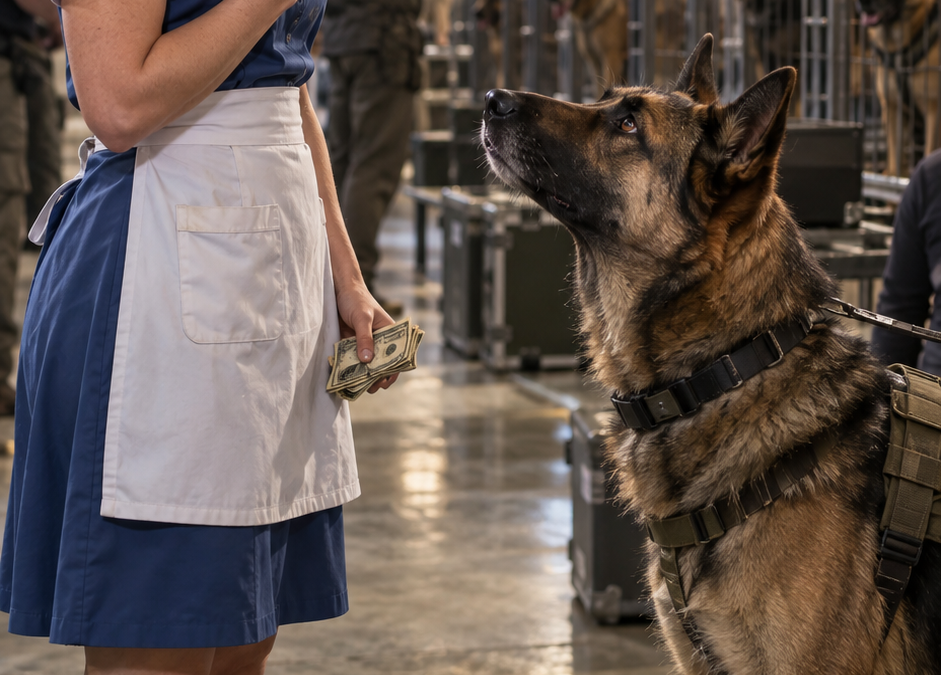
𝗣𝗔𝗥𝗧 𝟮
There was a pause.
“They’re auctioning him.”
For a second, I thought I had misunderstood.
“Say that again.”
“West Coast Tactical K9 Surplus Auction. Noon.”
I looked at the clock behind the bar.
11:15.
My body went cold.
“No.”
“Liv—”
“No. He wasn’t supposed to go to auction.”
“I know.”
“He was supposed to remain in a military program.”
“He got reassigned twice.”
“I know that.”
“Then behavioral review flagged him.”
I stopped breathing.
Mason continued carefully.
“Reactive. Handler-specific. Poor civilian transition.”
The words sounded clinical.
That’s what institutions do when something hurts.
They replace pain with categories.
“Why wasn’t I told?”
“You weren’t listed as an authorized claimant.”
“I’m Danny’s sister.”
“I know.”
“I requested him.”
“I know.”
“They denied it because they said he remained operational property.”
“I know, Liv.”
My shoulder started aching the way it always did when I became angry.
Phantom heat around old shrapnel.
“What changed?”
“Apparently enough paperwork changed.”
I looked toward the empty room.
“When?”
“Auction started at noon.”
“Mason.”
“I found out twenty minutes ago.”
“Where?”
He gave me the address.
Forty minutes away if traffic behaved.
Forty-five if it didn’t.
“What lot?”
“Nineteen.”
I was already untying my apron before I realized I was doing it.
Then I stopped.
“Who else is bidding?”
Another pause.
That one frightened me more.
“Mason.”
“Vantage Group registered interest.”
I knew the name.
Not well.
Enough.
Private security contracts.
Logistics.
Biotech subsidiaries.
Several corporate identities connected through parent entities most ordinary people would never bother tracing.
“What do they want with him?”
“I don’t know.”
“What does Vantage need with retired combat dogs?”
“I said I don’t know.”
“That isn’t an answer.”
“No, it isn’t.”
Something in his tone made me go still.
“How many have they bought?”
“Six that I know of.”
“And?”
“And nobody I trust has been able to account for any of them after purchase.”
I closed my eyes.
Rex.
Belgian Malinois.
Seven years old.
Three combat deployments.
Scars along his jaw and ribs.
Trained to search, detect, track, defend, hold ground, and follow commands most people would never know existed.
Danny’s dog.
His partner.
The last living thing that had been beside my brother while he was still alive.
“I have forty-three dollars,” I whispered.
Mason was silent.
I checked my banking app anyway.
$43.17.
Rent had cleared.
Utilities had cleared.
Payday was Friday.
“Mason, I have forty-three dollars.”
“I know.”
“How much do these dogs go for?”
“Depends.”
“That’s not helpful.”
“Could be hundreds. Could be thousands.”
I pressed my fingers against my forehead.
“What am I supposed to do?”
“Show up.”
I almost laughed.
“With forty-three dollars?”
“Show up.”
“Mason—”
“You asked what to do.”
His voice hardened.
“So show up.”
I looked toward my locker.
Toward the photograph hidden inside.
“Why aren’t you there?”
“Two states away.”
Of course.
I had forgotten he was working security training outside Nevada.
“I’ve made calls,” he continued. “Nobody can get there faster than you.”
I was already walking toward the locker.
“If Vantage buys him—”
“Liv.”
“What?”
“Get there first.”
I opened the locker.
Danny’s photograph leaned against the metal wall.
He was crouched on a beach beside Rex.
Danny wore training gear.
Rex was younger then.
Lean.
Alert.
His ears pointed toward the sky.
Danny had one hand on the dog’s neck and the other raised toward the camera in an exaggerated salute.
The photo had been taken near Coronado.
I knew because I was there.
That was the evening Danny taught me the command I would later spend eighteen months wishing I had never learned.
Not a formal tactical command.
Something between the two of them.
A sound built around his own name.
A recall marker.
A grounding cue.
Danny used it when Rex became overloaded during training.
The first time I heard it, I laughed.
“You’re using your own name as a command?”
Danny shrugged.
“He knows it means find me.”
“That’s ridiculous.”
“It works.”
“Until someone calls you.”
“He knows my voice.”
Rex had looked toward him instantly.
Danny smiled.
“See?”
I remembered saying, “One day you’re going to confuse that poor dog.”
Danny rubbed Rex behind the ear.
“Nah. He knows where home is.”
Eighteen months later, Danny died on a hillside overseas.
Rex stayed with him.
I picked up the photograph.
My little brother grinned at me from another life.
I put the picture into my purse.
Then I tied my apron back on.
Frank came through the kitchen doors.
“You’re leaving?”
“Family emergency.”
He looked at my face.
No questions.
“Go.”
“I’ll make up the shift.”
“Olivia.”
I stopped.
“Go.”
So I went.
I did not change clothes.
There wasn’t time.
Blue-and-white waitress uniform.
White apron.
Name tag.
Non-slip shoes.
Hair tied back.
I ran across the parking lot, got into my twelve-year-old Honda, placed Danny’s photograph on the passenger seat, and drove.
11:19.
Forty-one minutes.
My hands stayed at ten and two.
Always.
Even when I was angry.
Especially when I was angry.
I had once been trained to function while the world collapsed around me.
Traffic did not get to make me reckless.
But every red light felt personal.
Every slow truck felt like theft.
Mason sent more information while I drove.
I listened through the car speakers.
“Lot nineteen. Intake says seven-year-old Belgian Malinois. Three combat deployments. Handler deceased.”
I gripped the wheel tighter.
“Behavior note?”
“Severe transition stress. Aggression around unfamiliar handlers. Resource guarding. Hypervigilance.”
“Medical?”
“Old shrapnel injuries. Left jaw. Right shoulder. Otherwise stable.”
“Current handler?”
“Temporary kennel rotation.”
That explained everything.
Rex had lost Danny.
Then lost every replacement after that.
Dogs did not understand administrative reassignment.
They understood smell.
Voice.
Presence.
Routine.
Trust.
And disappearance.
Danny had been the center of Rex’s entire working world.
Then one day Danny stopped moving.
Rex had guarded his body for thirty minutes.
Thirty minutes.
I had read the after-action report so many times I could recite sections from memory.
Contact on the hillside.
Team separated under fire.
Danny critically wounded.
Communications disrupted.
Rex remained beside him.
Three armed threats entered the immediate perimeter.
Rex engaged all three.
When the extraction team finally reached Danny, Rex was bleeding from two wounds and still standing over him.
They had to use a command from one of Danny’s teammates before Rex permitted anyone close enough to touch Danny’s body.
The report called it “protective persistence.”
I called it love because I had never found a better word.
After Danny died, I filed a request to adopt Rex.
Denied.
Active military property.
I appealed.
Denied.
Specialized operational asset.
Then Rex was transferred.
Later transferred again.
I followed what I could through former teammates.
Then the updates stopped.
I had assumed that meant stability.
Sometimes silence means the opposite.
11:41.
Nineteen minutes.
Mason called again.
“One more thing.”
“What?”
“Vantage has someone there.”
“Who?”
“Name is Helena Ward.”
“Background?”
“Corporate acquisition. Former defense logistics.”
“Budget?”
He laughed without humor.
“More than forty-three dollars.”
“I gathered that.”
“Liv.”
“What?”
“Don’t do anything stupid.”
“Define stupid.”
“Anything that ends with your arrest.”
“No promises.”
“Olivia.”
“I’m joking.”
I wasn’t entirely.
He knew.
“Mercer might be there.”
My breath caught.
“Colonel Mercer?”
“Retired now.”
“Why?”
“He heard about the auction independently.”
“Did you call him?”
“No.”
That mattered.
James Mercer had commanded Danny’s unit for four years.
He was also the man who had come to my apartment at 4:17 in the morning eighteen months earlier.
He had not worn dress uniform.
He had worn civilian clothes.
I knew what had happened before he said anything.
People think military families fear the knock at the door.
Sometimes there is no knock.
Sometimes your dead brother’s commanding officer simply stands in your living room because he could not bear to let someone else make the call.
Mercer had sat across from me.
Hands folded.
Eyes red.
And said, “Danny didn’t make it.”
There are sentences your brain refuses to understand even when every word is simple.
I had asked whether Rex was alive before I asked anything else.
Not because the dog mattered more.
Because somewhere inside me, I knew if Rex lived, then someone had been with Danny.
“Is Rex alive?”
Mercer looked surprised.
Then nodded.
“Yes.”
“Was he with him?”
Another pause.
“Until we reached them.”
I broke then.
Completely.
Not when Mercer said Danny was dead.
When he told me Danny had not died alone.
I drove faster.
11:56.
Industrial district.
Concrete buildings.
Fences.
Loading bays.
The warehouse came into view near the end of a service road.
WEST COAST TACTICAL K9 SURPLUS.
Cars filled the lot.
SUVs.
Black trucks.
Several company vehicles.
My Honda looked ridiculous between them.
I parked badly.
Didn’t care.
Before getting out, I picked up Danny’s photograph.
My hands finally started shaking.
There are moments before danger when the body becomes very honest.
It tells you exactly how afraid you are.
During deployments, I had always allowed myself thirty seconds.
No more.
Thirty seconds to feel it.
Then work.
I looked at Danny.
“You better have taught me that stupid command properly.”
He smiled from the photograph.
I put it in my apron pocket.
Then I walked inside.
The room changed when I entered.
I felt it immediately.
Not because I was important.
Because I looked wrong.
Men in tactical clothing.
Security executives.
Former military personnel.
Contractors.
People carrying bidding folders and corporate expense authority.
Then me.
Waitress uniform.
White apron.
Name tag.
OLIVIA.
A man near the entrance looked at me twice.
Another whispered something to his companion.
The second man smirked.
I had experienced that reaction before.
People see clothes before competence.
I had worn scrubs.
Body armor.
Flight helmets during medevac operations.
Blood-covered uniforms.
Now I wore an apron.
None of those fabrics changed what was underneath.
I kept walking.
Registration desk.
A woman looked up.
“Can I help you?”
“I need to register.”
“For bidding?”
“Yes.”
She glanced at my uniform.
Then recovered professionally.
“Identification.”
I handed it over.
She entered my information.
“Payment verification?”
“I’ll handle payment if I win.”
That was not technically an answer.
She studied me.
Apparently decided it was not her problem.
Then handed me a paddle.
Number 118.
I looked toward the staging area.
The warehouse smelled like metal, disinfectant, dog fur, old coffee, and stress.
That last smell is real.
Anyone who has worked around animals knows it.
Fear changes the air.
Behind the main stage, rows of holding pens stretched along the wall.
I heard barking.
Pacing.
Metal rattling.
Whining.
Thirty-one dogs.
Thirty-one animals who had spent years working for people now reduced to lot numbers.
I hated the room instantly.
Not auctions themselves.
Not everyone bidding.
Some buyers were legitimate handlers.
Security programs.
Veterans.
Working-dog facilities.
People who would give these animals structure.
But something about the phrase retired military surplus made my stomach turn.
Lot twelve sold.
Then thirteen.
A Dutch Shepherd.
German Shepherd.
Another Malinois.
The bids climbed easily.
Eight hundred.
Twelve hundred.
Two thousand.
Numbers beyond everything I had.
I held paddle 118 anyway.
My forty-three dollars might as well have been four.
Across the room stood a woman in a charcoal suit.
Mid-forties.
Dark hair.
Tablet.
No visible emotion.
Helena Ward.
I knew before anyone told me.
People who control money carry themselves differently when everyone around them knows it.
She bid twice.
Won twice.
Never looked at the dogs.
Just the tablet.
Lot sixteen.
She raised her paddle.
Won.
Lot seventeen.
Again.
Another dog became Vantage property.
I watched her sign nothing personally.
An assistant handled it.
My anger started becoming dangerous.
Anger is useful when it sharpens you.
Useless when it makes you stupid.
I forced myself to breathe.
Lot eighteen.
Sold.
Then the auctioneer checked his sheet.
“Lot nineteen.”
Everything inside me went still.
The side doors opened.
Two handlers appeared.
Both were large men.
Both leaned backward.
Between them came Rex.
I knew him immediately.
Eighteen months had changed him.
Not enough.
Belgian Malinois.
Dark tan coat.
Black face.
Right ear torn near the tip.
Scar along the left jaw.
But the Rex Danny had photographed on the beach had moved like controlled electricity.
This Rex moved like something cornered.
A heavy agitation muzzle enclosed his mouth.
Two handlers controlled him with catch poles.
He fought both.
Not wildly.
Purposefully.
Every movement was directed.
Every lunge calculated.
That was worse.
His coat looked dull.
His ribs showed slightly.
His eyes moved constantly.
Door.
Handler.
Crowd.
Exit.
Hands.
Movement.
Threat.
Threat.
Threat.
The war had never ended for him.
The room reacted.
Several bidders immediately lowered their paddles.
Liability.
Risk.
Unpredictable aggression.
I saw different words.
Grief.
Loss.
Confusion.
Danny.
The auctioneer began reading.
“Belgian Malinois. Male. Seven years. Prior military working dog. Multiple overseas deployments. Advanced detection and protection training. Current behavioral classification requires experienced placement only.”
Rex slammed against the poles.
One handler cursed.
“Opening bid five hundred.”
Helena raised her paddle.
Without looking up.
Five hundred.
Another bidder countered.
Seven hundred.
Helena.
One thousand.
The numbers climbed.
I stood motionless.
Fifteen hundred.
Two thousand.
One contractor dropped out.
Twenty-five hundred.
Helena again.
Three thousand.
I had forty-three dollars.
Still, I raised my paddle.
The auctioneer stopped.
The entire room seemed to notice.
“Three thousand one hundred.”
Someone laughed softly.
Helena finally looked up.
At me.
Her eyes went first to my paddle.
Then my apron.
Then my face.
She studied me with the expression of someone encountering a clerical error.
Then raised her paddle.
“Thirty-five hundred.”
I raised mine.
“Thirty-six.”
I had no thirty-six hundred dollars.
I had no plan.
Only refusal.
Helena raised hers.
“Four thousand.”
The room became uncomfortable.
Everyone knew.
They knew I could not compete.
Maybe they thought grief had made me delusional.
Maybe it had.
Rex lunged again.
Metal screamed.
The handlers nearly lost balance.
Something inside me broke.
Not emotionally.
Strategically.
I stopped thinking like a bidder.
I started thinking like myself.
I lowered the paddle.
Helena’s expression relaxed.
She thought I was done.
The auctioneer began.
“Four thousand going once—”
I stepped over the velvet rope.
A security guard moved immediately.
“Ma’am.”
I kept walking.
“Ma’am, stop.”
Another guard approached from my left.
I shifted around him automatically.
No contact.
No aggression.
Just movement.
Seven years of entering spaces under pressure had taught my body angles my conscious mind no longer needed to calculate.
The auctioneer stopped.
“Ma’am, you cannot approach the animal.”
I continued.
The first handler saw me.
“Stay back!”
Rex turned.
His entire body oriented toward me.
The handlers braced.
“Ma’am, he’s reactive!”
I knew.
“Stop right there.”
Six feet.
I stopped.
Rex launched himself against the poles.
Both handlers were dragged forward half a step.
A low sound came through his muzzle.
Not barking.
Something deeper.
Warning.
Pain.
Programming.
I stood still.
Hands visible.
No direct challenge.
No sudden movement.
The room behind me disappeared.
I saw only Rex.
His eyes.
They were not Danny’s eyes.
I knew that.
But eighteen months of grief can make a person search for the dead in ridiculous places.
For one second, I saw my brother anyway.
Then Rex’s ears shifted.
Tiny movement.
Recognition?
No.
Impossible.
He had met me only a handful of times.
Years earlier.
But dogs remember scent.
Cadence.
Patterns.
People connected to people.
I had one thing left.
Danny’s voice.
Not truly.
I could not become him.
But Danny and I had grown up in the same house.
Same father.
Same regional vowels.
Same tendency to drop our voices when giving instructions.
After he died, I listened to every voicemail he had ever left me.
Again.
Again.
Again.
Eventually I began practicing the command he had used with Rex.
I told myself I was preserving Danny’s voice.
That was a lie.
Some part of me had always hoped Rex would hear it again.
I straightened.
One handler shouted, “Don’t speak to him!”
Too late.
I took one breath.
Then used the exact cadence Danny had taught me.
His name.
Not the dog’s.
“Danny.”
The effect was instant.
Rex stopped.
Completely.
The catch poles went slack.
Both handlers stumbled forward.
No one moved.
Rex stared at me.
His ears lifted.
His body, which had been pulled tight as wire, changed.
Not relaxed.
Listening.
Then something else happened.
Behind the stage, another dog stopped barking.
Then another.
Then another.
Within seconds, the warehouse became silent.
Thirty-one military dogs.
No barking.
No chains rattling.
No whining.
Just fluorescent lights humming overhead.
I did not understand why.
Maybe they responded to Rex’s sudden stillness.
Maybe the cadence carried some training association.
Maybe thirty-one animals simply felt the change before the humans did.
I didn’t care.
Rex was looking at me.
Only me.
I said the cue again.
Softer.
“Danny.”
His front legs bent.
He sat.
One handler whispered, “What the hell?”
I stepped forward.
“Don’t.”
The handler’s warning came automatically.
I stopped.
Rex’s eyes remained locked on mine.
I reached toward my apron pocket.
Several people tensed.
I pulled out the photograph.
Held it low.
Rex’s nose lifted.
He could not smell a photograph from that distance.
But I needed it.
Not him.
I needed proof that this moment belonged to Danny too.
Then a chair moved behind me.
A man stood.
I heard his voice before I turned.
“Let her through.”
My chest tightened.
Colonel James Mercer walked down the center aisle.
Retired or not, he still carried command like gravity.
People moved for him without being told.
Dark jacket.
Gray at his temples now.
Older than the last time I had seen him.
He stopped beside me.
His eyes went to Rex.
For the first time since Danny died, I saw James Mercer look close to tears.
“Jesus,” he whispered.
“Sir.”
He glanced at me.
“You still call me that?”
“Apparently.”
Mercer looked at my waitress uniform.
“Interesting choice.”
“I was working.”
“I gathered.”
The auctioneer cleared his throat.
“Sir, we need both of you behind the barrier.”
Mercer turned.
“No.”
Just that.
No raised voice.
No threat.
The auctioneer froze.
Mercer looked toward the crowd.
Then at the handlers.
“How long has he been restrained like this?”
One answered carefully.
“Forty minutes.”
“Why?”
“Aggression.”
“Toward whom?”
“Everyone.”
Mercer’s jaw tightened.
He moved one step closer to Rex.
The dog watched him.
No lunge.
Mercer looked at me.
“He remembers something.”
“Maybe.”
“He remembers Danny.”
My throat closed.
The auctioneer tried again.
“Mr. Mercer—”
“Colonel.”
The correction was quiet.
The auctioneer swallowed.
“Colonel Mercer, bidding is still active.”
Mercer turned fully toward the room.
Then said, “Before anyone buys that dog, you’re going to know what you’re buying.”
The warehouse stayed silent.
He pointed toward Rex.
“That animal spent three combat deployments attached to special operations personnel.”
Nobody moved.
“His final handler was Petty Officer Danny Grant.”
My name.
Our name.
I stared at the floor.
Mercer continued.
“Eighteen months ago, during an operation I will not describe here, Grant’s team took fire on elevated terrain.”
His voice stayed controlled.
No drama.
Operators rarely decorate death.
They respect it too much.
“Danny Grant was critically wounded.”
Rex watched Mercer.
“Communications were compromised. The team was temporarily separated.”
I already knew the next part.
I still had to hear it.
“Rex remained with Grant.”
My eyes burned.
“For approximately thirty minutes.”
Mercer looked around the room.
“During that time, three hostile individuals entered their immediate position.”
No one made a sound.
“Rex prevented all three from reaching his handler.”
Helena Ward’s tablet had lowered.
Mercer continued.
“When the recovery element reached them, Rex had suffered two wounds.”
He pointed toward Rex’s jaw.
“One there.”
Then the shoulder.
“One there.”
“He remained standing over Danny.”
I closed my eyes.
“He refused to move until a member of the team used a handler-specific release sequence.”
Mercer’s voice changed slightly.
Just slightly.
“Danny was already gone.”
The words still hurt.
Maybe they always would.
Mercer looked at Rex.
“That dog did his job after the person he trusted most in the world could no longer give him orders.”
He turned toward the auction staff.
“Then we thanked him by moving him from program to program until someone decided his grief was a behavioral problem.”
Nobody interrupted.
Mercer looked at Helena.
“And now we’re selling him.”
Helena’s face remained controlled.
But she did not raise her tablet again.
Mercer pointed toward me.
“The woman standing beside him is Danny Grant’s sister.”
Every eye shifted.
I hated that.
But I stayed.
“She requested custody after her brother died.”
The auction manager stiffened.
Mercer continued.
“Request denied.”
I looked at him.
I hadn’t known he knew that.
“Because at the time Rex was still classified as an operational asset.”
He paused.
“Apparently now he’s disposable enough to sell.”
The word hit the room harder than shouting would have.
The auction manager said, “Colonel, that’s not an accurate characterization.”
Mercer faced him.
“Then characterize it.”
Silence.
Mercer nodded.
“That’s what I thought.”
Helena finally spoke.
Her voice was calm.
Professional.
“Our company submitted a legitimate bid under the auction’s published terms.”
Mercer looked at her.
“I didn’t say otherwise.”
“Then I’m not sure what this speech changes.”
“It changes what everyone knows.”
Helena looked toward Rex.
Then me.
“Sentiment does not alter asset disposition.”
The phrase made my blood run cold.
Asset disposition.
I stepped toward her before I realized it.
Mercer’s hand touched my arm.
Not restraining.
Reminder.
Control.
I stopped.
Helena saw it.
Maybe she saw something else too.
The woman in a waitress uniform was not simply a grieving sister.
I had been trained.
Mercer had been trained.
Half the room had.
People who live around dangerous professionals learn to respect stillness.
Helena’s expression changed.
Only slightly.
Then she closed her tablet.
The auctioneer looked at her.
“Ms. Ward?”
She picked up her bag.
“Vantage withdraws from lot nineteen.”
A murmur moved through the room.
I stared.
That was all.
No apology.
No revelation.
No dramatic confession.
She simply walked toward the exit.
At the door, she stopped.
Looked back at Rex.
Then at me.
“I hope you understand what you’re taking home.”
I met her eyes.
“I understand exactly what I’m taking home.”
She left.
The door closed.
For several seconds, nobody spoke.
Then the auctioneer looked at his sheet.
“Current bid reverts to three thousand six hundred.”
My stomach dropped.
Of course.
I had almost forgotten.
I still had forty-three dollars.
Mercer looked at me.
“You bid thirty-six hundred?”
“I got emotional.”
He stared.
“You have thirty-six hundred dollars?”
“No.”
For the first time that day, James Mercer almost smiled.
“How much do you have?”
“Forty-three seventeen.”
He closed his eyes.
“Jesus Christ, Olivia.”
“I showed up.”
“That you did.”
Another bidder still held a paddle.
A security contractor near the front.
He had been silent through Mercer’s speech.
Now he lowered it.
“No bid.”
The auctioneer looked around.
“Any bid above thirty-six?”
Nothing.
I swallowed.
“Colonel—”
Mercer stepped toward the registration table.
“What’s the final?”
“Three thousand six hundred.”
Mercer took out a checkbook.
I stared.
“No.”
He ignored me.
“James.”
He wrote.
“No.”
He tore out the check.
The auctioneer accepted it.
“For Danny,” Mercer said.
My throat closed.
“I’ll pay you back.”
He looked at me.
“With what?”
“I get paid Friday.”
“Forty-three dollars at a time?”
“However long it takes.”
Mercer shook his head.
“This isn’t a loan.”
“I can’t let you—”
“You can.”
“James.”
His expression changed.
“Olivia.”
I stopped.
“I wasn’t there soon enough.”
Everything inside me went quiet.
Mercer rarely spoke about Danny’s death personally.
Not to me.
Not like this.
“I commanded that operation.”
“That doesn’t mean—”
“I know what it means.”
He looked toward Rex.
“I’ve spent eighteen months knowing that dog held Danny’s position until my men reached him.”
His jaw tightened.
“Let me do one thing for both of them.”
There are moments when refusing kindness becomes another form of pride.
I had learned that badly.
Slowly.
I nodded.
“Thank you.”
Mercer turned away before I could see too much in his face.
Paperwork took twelve minutes.
Longest twelve minutes of my life.
Transfer.
Liability waiver.
Behavior acknowledgment.
Medical history.
Retired working-dog conditions.
I signed everywhere they pointed.
Then the handlers looked toward me.
One still held the catch pole.
“Ma’am, before we release him, we should sedate.”
“No.”
He hesitated.
“He’s been highly reactive.”
“I know.”
“You’re not his handler.”
My chest tightened.
“No.”
I looked at Rex.
“But I know who was.”
The handler studied me.
Then Mercer.
Mercer said, “Give her room.”
They backed away.
One released tension from the pole.
Rex remained seated.
Eyes on me.
The second handler loosened his restraint.
Still no movement.
I approached slowly.
Four feet.
Three.
Two.
I knelt.
My shoulder protested.
I ignored it.
“Rex.”
One ear moved.
That was his current name.
His official name.
But I remembered what Danny called him on the beach.
I lowered my voice.
“Danny.”
Rex stood.
For a fraction of a second, every person in the warehouse tensed.
Then he crossed the remaining distance in three steps.
And hit me with his whole body.
Not attacking.
Leaning.
Hard.
His head pressed beneath my chin.
His chest against mine.
His weight nearly knocked me backward.
I wrapped both arms around his neck.
The first sound that came out of me was not a word.
It was grief.
Raw.
Embarrassing.
Uncontrolled.
I buried my face against his fur.
“You stupid dog.”
Rex pushed closer.
“I’ve been looking for you.”
That wasn’t completely true.
For months, I had also been afraid to find him.
Because Rex was proof.
Proof Danny had existed.
Proof Danny had died.
Proof someone had been beside him.
Sometimes the things we want most are the same things we are most afraid to touch.
Rex’s muzzle rubbed my cheek.
One handler said, “We should remove the agitation muzzle.”
“I’ll do it.”
He handed me the release tool.
I found the buckle.
My hands shook.
Then training took over.
Slow.
Predictable.
No sudden pressure.
The muzzle came free.
Several people stepped farther back.
Rex did nothing.
He sniffed my uniform.
My apron.
My hands.
Then my face.
Finally he licked my cheek.
Once.
I laughed while crying.
“Yeah.”
He sat.
Just sat.
Calm.
The dog who had fought two handlers minutes earlier.
Mercer crouched beside us.
Rex looked at him.
Then leaned forward and smelled his hand.
Mercer whispered, “Hey, brother.”
Rex touched his nose to Mercer’s knuckles.
The colonel looked away quickly.
I pretended not to notice.
The auction eventually resumed.
I did not stay.
Neither did Mercer.
We walked Rex through the parking lot without a muzzle.
No problems.
Every few steps, Rex looked up at me.
Checking.
I knew what that meant.
Handlers call it engagement.
Families call it something else.
Are you still there?
Yes.
Still here.
My Honda created a new problem.
Rex stopped beside it.
Looked inside.
Then looked at me with what I can only describe as disappointment.
Mercer laughed.
“He remembers government vehicles.”
“He’s getting a Honda.”
Rex stared at the back seat.
“Get in.”
Nothing.
I tried again.
He looked away.
Mercer raised an eyebrow.
“Excellent command relationship.”
“Quiet.”
I opened the rear door wider.
Rex still refused.
Then I remembered Danny.
“Danny.”
Rex immediately jumped in.
Mercer laughed so loudly that two people turned.
“I hate this command.”
“You sound exactly like your brother.”
That sentence hit unexpectedly.
I stood with one hand on the door.
“Do I?”
Mercer’s smile disappeared.
“Sometimes.”
I got into the driver’s seat.
Before leaving, I placed Danny’s photograph on the passenger seat.
Rex saw it.
His body changed.
He leaned forward between the seats.
Sniffed.
Then made a sound.
Soft.
Almost a whine.
I stopped breathing.
He smelled the photograph again.
Then lowered his head onto the center console.
I touched the top of his head.
“I’m sorry.”
Rex closed his eyes.
The drive home took an hour because I stopped twice.
First at a pet store.
I had forty-three dollars.
Mercer had tried to give me cash.
I refused.
There are limits.
I bought food.
A bowl.
A leash.
Cheap dog bed.
Total: $39.82.
The cashier looked at Rex.
“Beautiful dog.”
“Yeah.”
“New?”
I looked at him.
“No.”
The cashier smiled, confused.
I did not explain.
The second stop happened because Rex began panting hard when a motorcycle passed.
I pulled into an empty parking lot.
Got out.
Opened the back door.
Rex stayed inside.
Eyes wide.
I sat on the pavement.
Waitress uniform.
Apron.
Parking lot.
Retired combat dog.
No dignity left.
“It’s okay.”
His breathing remained fast.
I did not touch him.
“You’re not working.”
His ears moved.
“No one is coming.”
He stared at me.
I used Danny’s cadence.
“Home.”
That wasn’t a trained command.
Just a word.
But Rex lowered his head.
Ten minutes later, we continued.
My apartment did not allow dogs over forty pounds.
Rex weighed seventy.
I decided that was tomorrow’s problem.
That night, he refused the dog bed.
Refused the couch.
Refused the bedroom.
Instead, he positioned himself beside the front door.
Standing.
Watching.
At midnight, still standing.
At 1:00, still standing.
At 2:20, I woke on the couch and found him pacing the perimeter of the living room.
Window.
Door.
Hallway.
Kitchen.
Repeat.
The auction paperwork had called it hypervigilance.
I called it eighteen months without Danny.
I sat up.
“Rex.”
He stopped.
Looked at me.
I patted the floor beside the couch.
Nothing.
“Danny.”
He came immediately.
My heart broke every time.
Rex lay down beside me.
Not sleeping.
Just lying.
I lowered my hand to his neck.
“You can’t keep waiting for him.”
His eyes stayed on the door.
“I know.”
My voice cracked.
“I do it too.”
That was the first night either of us slept more than two hours.
The next morning, Frank called.
“You coming in?”
I looked at Rex.
He was sitting beside the bathroom door because apparently privacy had ended.
“Complicated.”
“Family emergency okay?”
I looked at Danny’s photograph on the table.
“Not exactly okay.”
“Need another day?”
“I need a favor.”
Twenty minutes later, I was explaining to the owner of a bar why a retired SEAL K9 needed to sleep in the corner during my shifts.
Frank stared at me.
Then at Rex.
Then at me.
“You’re telling me this dog was military?”
“Yes.”
“Like military military?”
“Yes.”
“Explosives?”
“Probably.”
“Attacks?”
“Definitely.”
Frank looked at Rex again.
Rex looked back.
Frank swallowed.
“Corner booth.”
“Thank you.”
“If he eats a customer, you’re fired.”
“Reasonable.”
Rex did not eat anyone.
At first, he hated the bar.
Too many noises.
Dropped glasses.
Men entering quickly.
Drunk voices.
Chairs scraping.
His head snapped toward every disturbance.
For the first week, I kept him leashed beside the corner booth.
Second week, he slept for twenty minutes.
I nearly cried.
Third week, an off-duty sailor dropped a tray.
Rex stood instantly.
But he did not lunge.
He looked at me.
I said, “Easy.”
He sat.
Progress.
I started learning him again.
Not Danny’s Rex.
This Rex.
The older one.
The wounded one.
The dog shaped by everything that happened after my brother died.
He did not like men with baseball caps.
He hated motorcycles.
He could tolerate fireworks from far away but not nearby.
He slept better if there was a wall behind him.
He refused to eat until I sat somewhere in the room.
He checked doors constantly.
And he woke from nightmares.
Dogs dream.
Anyone who tells you otherwise has never watched a combat dog sleeping.
His paws moved.
His breathing changed.
Sometimes a growl formed deep in his chest.
The first time, I tried to touch him.
Bad idea.
He woke explosively.
Teeth exposed inches from my wrist.
We both froze.
I did not pull away.
Rex stared at my hand.
Then at my face.
Recognition returned.
He backed away immediately.
Head low.
Ashamed.
That hurt worse than the teeth.
“Hey.”
He turned away.
“No.”
I moved slowly closer.
“You don’t apologize for nightmares.”
I sat beside him.
Eventually, he leaned against my shoulder.
That sentence was for me too.
Mason visited after a month.
The second Rex saw him, he stood.
Mason stopped in the doorway.
“Hey, buddy.”
Rex stared.
Then walked forward.
Sniffed him.
Sat.
Mason dropped to his knees.
He cried harder than I had ever seen a SEAL cry.
No performance.
No embarrassment.
Just both hands around Rex’s neck and eighteen months of grief finally finding somewhere physical to go.
Afterward, we sat at my kitchen table.
Mason said, “Danny would lose his mind if he saw this.”
“What?”
“You keeping his dog in an apartment with floral curtains.”
“They came with the place.”
“Still criminal.”
I smiled.
Then Mason became serious.
“He’s better.”
“Some days.”
“No. I mean really.”
I looked at Rex sleeping near the wall.
“He still patrols at night.”
“So did Danny.”
That stopped me.
“What?”
“First deployment.”
Mason smiled.
“He’d wake up and check the whole room.”
I had never known.
“Eventually Rex started following him.”
I stared at the dog.
“So which one trained which?”
“Nobody ever figured that out.”
Six months passed.
Rex’s coat improved.
He gained weight.
The constant pacing decreased.
He still watched every entrance.
Probably always would.
But he started sleeping.
Really sleeping.
Sideways.
Legs loose.
Vulnerable.
The first time I saw him do it at the bar, I stood behind the counter and stared until Frank asked whether something was wrong.
“No.”
“What are you looking at?”
“Nothing.”
I turned away before he saw my face.
Mercer visited sometimes.
Always Thursday afternoons.
He claimed coincidence.
It wasn’t.
Rex recognized him more each time.
One Thursday, Mercer sat in the booth beside him while I brought coffee.
“How’s the shoulder?” he asked.
“Still attached.”
“Excellent medical terminology.”
“You retired. Stop evaluating me.”
“Never.”
I filled his cup.
He looked at my waitress uniform.
“You ever miss it?”
I knew what he meant.
“Every day.”
“Would you go back?”
“If my shoulder let me?”
“Yeah.”
I considered lying.
“No.”
He looked surprised.
“I’d go back to parts of it.”
“Which parts?”
“Being useful.”
Mercer nodded.
“That’s not exclusive to the military.”
“I know.”
“Do you?”
I gave him a look.
He smiled.
Then glanced at Rex.
“Maybe he does.”
Mercer eventually connected me with a nonprofit that worked with retired military and police dogs.
At first, I refused.
I didn’t need a project.
I had a job.
An apartment.
A dog.
Enough.
Then they asked me to help with one case.
Former working dog.
Handler deceased.
Severe transition stress.
I almost laughed at the universe’s lack of subtlety.
The dog was named Viper.
German Shepherd.
He refused to let veterinary staff examine an old leg injury.
They needed someone comfortable with medical restraint and operational dogs.
I went once.
Then twice.
Three months later, I was spending two mornings a week at the center.
Not as a medic exactly.
Not as a trainer exactly.
Somewhere between.
My old life and new life stopped feeling like enemies.
Rex came sometimes.
He became strangely useful around traumatized dogs.
Calm ones can teach anxious ones.
Even old soldiers need examples.
A year after the auction, I left the bar.
Frank pretended not to care.
“Who’s going to close properly?”
“You.”
“I don’t know how.”
“You own the place.”
“Different skill set.”
He hugged me before I left.
First time ever.
Rex waited at the door.
No leash.
No harness.
Just Rex.
My dog.
Danny’s dog.
Both could be true.
That evening, I took him to the beach near Coronado.
The same beach where Danny had once trained him.
Technically we were probably not supposed to be in that exact area.
I knew enough old people with old access to solve that.
Sunset.
Cold wind.
Almost nobody around.
Rex walked beside me.
Slow now.
He was eight.
Gray starting around his muzzle.
We reached the stretch where Danny’s photograph had been taken.
I carried the picture with me.
I sat in the sand.
Rex sat beside me.
For a while, we watched the water.
Then I pulled out the photo.
Placed it between us.
“You remember?”
Rex looked at it.
Then toward the ocean.
Maybe coincidence.
Maybe not.
I had stopped needing certainty about everything.
I touched his neck.
“I was angry at you.”
His ear moved.
“Not really.”
I looked at Danny’s smiling face.
“I was angry you came home.”
Saying it hurt.
But truth often does.
“Because he didn’t.”
Rex leaned against me.
“And every time I thought about you, I thought about that.”
I breathed.
“But that wasn’t fair.”
Wind moved through his fur.
“You didn’t leave him.”
My voice broke.
“You stayed.”
Tears came.
I let them.
“You stayed when nobody else could.”
Rex put his head in my lap.
I bent over him.
“Thank you.”
For the first time, I thanked the dog who had guarded my brother’s body.
Not for fighting.
Not for killing.
For staying.
That mattered more.
Danny had not been alone.
I had known that intellectually for eighteen months.
That evening, I finally believed it.
When we stood to leave, Rex walked a few steps.
Then looked back toward the beach.
Toward the place where he and Danny had once trained.
Then toward me.
I smiled.
“Come on.”
He waited.
I knew what he wanted.
Maybe I imagined it.
I didn’t care.
I used the old cue one last time.
“Danny.”
Rex came immediately.
But this time the word did not feel like summoning a ghost.
It felt like carrying someone with us.
Years later, people still told the story of the waitress who walked into a military dog auction and silenced a warehouse.
They got most of it wrong.
Stories do that.
Some versions said all thirty-one dogs obeyed me.
They didn’t.
Some claimed Rex recognized my voice as Danny’s.
He didn’t.
I sounded similar enough to awaken something he remembered.
That was all.
Some said I bought him with forty-three dollars.
I didn’t.
Colonel Mercer paid.
I spent almost all my forty-three dollars on dog food and a bed Rex refused to use.
People like clean stories.
Miracles.
Destiny.
One dramatic command.
Life is messier.
Rex did not become healed the moment I said Danny’s name.
Neither did I.
He had nightmares afterward.
So did I.
He remained wary.
So did I.
Trust came slowly.
Healing came unevenly.
Some days we moved backward.
But we moved.
That was enough.
The part everyone got right was that I entered the warehouse alone.
At least I thought I was alone.
I wasn’t.
I carried Danny’s photograph.
His voice.
His name.
Seven years of my own training.
Eighteen months of grief.
And a dog who had spent just as long waiting for someone to tell him the war was over.
When Rex crossed that concrete floor and leaned against me, I understood something I had missed since my brother died.
Survival does not mean forgetting who didn’t survive.
It means refusing to let their love die in the same place they did.
Danny loved Rex.
Rex loved Danny.
Eventually, Rex trusted me.
And through him, I found parts of my brother that death had not managed to take.
His patience.
His humor.
His loyalty.
His ridiculous belief that his dog understood full conversations.
Sometimes, late in the evening, Rex would lie near my desk while I reviewed files from the working-dog center.
I would say, “Your guy was an idiot.”
His ear would move.
“Absolute idiot.”
Another ear movement.
“But he loved you.”
Rex would open his eyes.
And I would smile.
“Yeah.”
I would touch the old scar along his jaw.
“I know.”
By then, I no longer needed to use Danny’s name to bring Rex back to me.
I could simply say,
“Home.”
And he knew exactly where to go.
Have you finished reading the story and want to read it again?
I Walked Into a Military K9 Auction With $43 and One Name I Hadn’t Said in Eighteen Months
I had forty-three dollars, a waitress uniform, and forty minutes to reach a place I had never intended to enter.
Thirty-one retired military dogs were being sold inside.
One of them had been standing beside my brother when he died.
My name is Olivia Grant.
At 11:15 on a Wednesday morning, I was standing behind a bar wiping down a counter that was already clean when my phone vibrated in the pocket of my blue-and-white uniform.
The morning shift had been almost insultingly quiet.
No lunch crowd yet.
No regulars arguing over baseball.
No sailors coming off night duty looking for eggs, whiskey, or silence.
Just sunlight through the front windows, the low hum of the cooler, and me finding unnecessary work because unnecessary work was still better than standing still with my own thoughts.
I wiped the bar twice.
Restocked napkins.
Checked the cooler temperature.
Counted clean glasses.
Adjusted bottles that did not need adjusting.
My manager, Frank, had once told me I moved around the place like I expected someone to attack it.
He meant it as a joke.
I had smiled.
He never knew how close he had come to the truth.
There are habits your body keeps after your life changes.
I always knew where the exits were.
I knew which stool had the loose leg.
I knew which section of the back wall created a blind angle from the front entrance.
I knew the sound the door made when wind pushed it open versus when a person did.
None of that was useful to a waitress.
All of it had once kept people alive.
For seven years, before the blue-and-white uniform and white apron, I had served as a Navy combat medic embedded with special operations units.
I had been twenty-four when I first deployed.
Thirty-one when a surgeon told me the metal fragments embedded around my left shoulder made another deployment medically indefensible.
I appealed my discharge three times.
Three hearings.
Three variations of the same answer.
No.
My arm worked.
Mostly.
My hand worked.
My training remained.
My mind remained.
But military medicine is not built around mostly.
And neither were the missions I used to support.
So eighteen months earlier, the Navy had given me paperwork, a final medical evaluation, and the kind of polite gratitude institutions use when they have reached the end of what they can legally do with a person.
I had walked out carrying one duffel bag.
No ceremony.
No plans.
No idea what came after a life built entirely around being useful when people were bleeding.
The bar job was supposed to be temporary.
Then temporary became eighteen months.
My hands still needed things to do.
People needed drinks.
Food.
Napkins.
Someone to listen while they complained about spouses or bosses or children who never called enough.
It wasn’t trauma medicine.
That was exactly why it worked.
Nobody died because I brought the wrong beer.
Nobody screamed for morphine.
Nobody called for an evacuation helicopter.
Nobody looked at me and expected me to solve the impossible.
Most days, I considered that peace.
Some days, I knew it was hiding.
My phone vibrated again.
I ignored it.
Then a third time.
I pulled it out.
The name on the screen stopped me.
MASON REED.
I had not heard from Mason in six months.
He had served with my younger brother Danny.
That alone was enough to make my stomach tighten.
Danny had been dead for eighteen months.
Twenty-three years old forever.
There is an age people stop reaching when they die young.
Everyone else continues.
Birthdays arrive.
Hair goes gray.
Bodies soften.
Careers change.
But the dead remain fixed.
Danny was still twenty-three in every photograph.
Still grinning too wide.
Still insisting his beard looked better than it actually did.
Still the youngest member of his SEAL unit.
Still making older operators shake their heads because he could turn almost anything into a joke until the second joking stopped being useful.
I kept a photograph of him in my locker.
Not at home.
At home, photographs had too much space around them.
At work, he stayed behind my spare apron.
A contained grief.
A place I could open and close.
I answered.
“Mason?”
“Liv.”
His voice was wrong.
Too clipped.
“What happened?”
“Where are you?”
“Working.”
“Can you leave?”
I straightened.
“Why?”
He exhaled.
Then said a name I had not heard anyone speak to me in more than a year.
“Rex.”
My hand closed around the phone.
“What about him?”
There was a pause.
“They’re auctioning him.”
For a second, I thought I had misunderstood.
“Say that again.”
“West Coast Tactical K9 Surplus Auction. Noon.”
I looked at the clock behind the bar.
11:15.
My body went cold.
“No.”
“Liv—”
“No. He wasn’t supposed to go to auction.”
“I know.”
“He was supposed to remain in a military program.”
“He got reassigned twice.”
“I know that.”
“Then behavioral review flagged him.”
I stopped breathing.
Mason continued carefully.
“Reactive. Handler-specific. Poor civilian transition.”
The words sounded clinical.
That’s what institutions do when something hurts.
They replace pain with categories.
“Why wasn’t I told?”
“You weren’t listed as an authorized claimant.”
“I’m Danny’s sister.”
“I know.”
“I requested him.”
“I know.”
“They denied it because they said he remained operational property.”
“I know, Liv.”
My shoulder started aching the way it always did when I became angry.
Phantom heat around old shrapnel.
“What changed?”
“Apparently enough paperwork changed.”
I looked toward the empty room.
“When?”
“Auction started at noon.”
“Mason.”
“I found out twenty minutes ago.”
“Where?”
He gave me the address.
Forty minutes away if traffic behaved.
Forty-five if it didn’t.
“What lot?”
“Nineteen.”
I was already untying my apron before I realized I was doing it.
Then I stopped.
“Who else is bidding?”
Another pause.
That one frightened me more.
“Mason.”
“Vantage Group registered interest.”
I knew the name.
Not well.
Enough.
Private security contracts.
Logistics.
Biotech subsidiaries.
Several corporate identities connected through parent entities most ordinary people would never bother tracing.
“What do they want with him?”
“I don’t know.”
“What does Vantage need with retired combat dogs?”
“I said I don’t know.”
“That isn’t an answer.”
“No, it isn’t.”
Something in his tone made me go still.
“How many have they bought?”
“Six that I know of.”
“And?”
“And nobody I trust has been able to account for any of them after purchase.”
I closed my eyes.
Rex.
Belgian Malinois.
Seven years old.
Three combat deployments.
Scars along his jaw and ribs.
Trained to search, detect, track, defend, hold ground, and follow commands most people would never know existed.
Danny’s dog.
His partner.
The last living thing that had been beside my brother while he was still alive.
“I have forty-three dollars,” I whispered.
Mason was silent.
I checked my banking app anyway.
$43.17.
Rent had cleared.
Utilities had cleared.
Payday was Friday.
“Mason, I have forty-three dollars.”
“I know.”
“How much do these dogs go for?”
“Depends.”
“That’s not helpful.”
“Could be hundreds. Could be thousands.”
I pressed my fingers against my forehead.
“What am I supposed to do?”
“Show up.”
I almost laughed.
“With forty-three dollars?”
“Show up.”
“Mason—”
“You asked what to do.”
His voice hardened.
“So show up.”
I looked toward my locker.
Toward the photograph hidden inside.
“Why aren’t you there?”
“Two states away.”
Of course.
I had forgotten he was working security training outside Nevada.
“I’ve made calls,” he continued. “Nobody can get there faster than you.”
I was already walking toward the locker.
“If Vantage buys him—”
“Liv.”
“What?”
“Get there first.”
I opened the locker.
Danny’s photograph leaned against the metal wall.
He was crouched on a beach beside Rex.
Danny wore training gear.
Rex was younger then.
Lean.
Alert.
His ears pointed toward the sky.
Danny had one hand on the dog’s neck and the other raised toward the camera in an exaggerated salute.
The photo had been taken near Coronado.
I knew because I was there.
That was the evening Danny taught me the command I would later spend eighteen months wishing I had never learned.
Not a formal tactical command.
Something between the two of them.
A sound built around his own name.
A recall marker.
A grounding cue.
Danny used it when Rex became overloaded during training.
The first time I heard it, I laughed.
“You’re using your own name as a command?”
Danny shrugged.
“He knows it means find me.”
“That’s ridiculous.”
“It works.”
“Until someone calls you.”
“He knows my voice.”
Rex had looked toward him instantly.
Danny smiled.
“See?”
I remembered saying, “One day you’re going to confuse that poor dog.”
Danny rubbed Rex behind the ear.
“Nah. He knows where home is.”
Eighteen months later, Danny died on a hillside overseas.
Rex stayed with him.
I picked up the photograph.
My little brother grinned at me from another life.
I put the picture into my purse.
Then I tied my apron back on.
Frank came through the kitchen doors.
“You’re leaving?”
“Family emergency.”
He looked at my face.
No questions.
“Go.”
“I’ll make up the shift.”
“Olivia.”
I stopped.
“Go.”
So I went.
I did not change clothes.
There wasn’t time.
Blue-and-white waitress uniform.
White apron.
Name tag.
Non-slip shoes.
Hair tied back.
I ran across the parking lot, got into my twelve-year-old Honda, placed Danny’s photograph on the passenger seat, and drove.
11:19.
Forty-one minutes.
My hands stayed at ten and two.
Always.
Even when I was angry.
Especially when I was angry.
I had once been trained to function while the world collapsed around me.
Traffic did not get to make me reckless.
But every red light felt personal.
Every slow truck felt like theft.
Mason sent more information while I drove.
I listened through the car speakers.
“Lot nineteen. Intake says seven-year-old Belgian Malinois. Three combat deployments. Handler deceased.”
I gripped the wheel tighter.
“Behavior note?”
“Severe transition stress. Aggression around unfamiliar handlers. Resource guarding. Hypervigilance.”
“Medical?”
“Old shrapnel injuries. Left jaw. Right shoulder. Otherwise stable.”
“Current handler?”
“Temporary kennel rotation.”
That explained everything.
Rex had lost Danny.
Then lost every replacement after that.
Dogs did not understand administrative reassignment.
They understood smell.
Voice.
Presence.
Routine.
Trust.
And disappearance.
Danny had been the center of Rex’s entire working world.
Then one day Danny stopped moving.
Rex had guarded his body for thirty minutes.
Thirty minutes.
I had read the after-action report so many times I could recite sections from memory.
Contact on the hillside.
Team separated under fire.
Danny critically wounded.
Communications disrupted.
Rex remained beside him.
Three armed threats entered the immediate perimeter.
Rex engaged all three.
When the extraction team finally reached Danny, Rex was bleeding from two wounds and still standing over him.
They had to use a command from one of Danny’s teammates before Rex permitted anyone close enough to touch Danny’s body.
The report called it “protective persistence.”
I called it love because I had never found a better word.
After Danny died, I filed a request to adopt Rex.
Denied.
Active military property.
I appealed.
Denied.
Specialized operational asset.
Then Rex was transferred.
Later transferred again.
I followed what I could through former teammates.
Then the updates stopped.
I had assumed that meant stability.
Sometimes silence means the opposite.
11:41.
Nineteen minutes.
Mason called again.
“One more thing.”
“What?”
“Vantage has someone there.”
“Who?”
“Name is Helena Ward.”
“Background?”
“Corporate acquisition. Former defense logistics.”
“Budget?”
He laughed without humor.
“More than forty-three dollars.”
“I gathered that.”
“Liv.”
“What?”
“Don’t do anything stupid.”
“Define stupid.”
“Anything that ends with your arrest.”
“No promises.”
“Olivia.”
“I’m joking.”
I wasn’t entirely.
He knew.
“Mercer might be there.”
My breath caught.
“Colonel Mercer?”
“Retired now.”
“Why?”
“He heard about the auction independently.”
“Did you call him?”
“No.”
That mattered.
James Mercer had commanded Danny’s unit for four years.
He was also the man who had come to my apartment at 4:17 in the morning eighteen months earlier.
He had not worn dress uniform.
He had worn civilian clothes.
I knew what had happened before he said anything.
People think military families fear the knock at the door.
Sometimes there is no knock.
Sometimes your dead brother’s commanding officer simply stands in your living room because he could not bear to let someone else make the call.
Mercer had sat across from me.
Hands folded.
Eyes red.
And said, “Danny didn’t make it.”
There are sentences your brain refuses to understand even when every word is simple.
I had asked whether Rex was alive before I asked anything else.
Not because the dog mattered more.
Because somewhere inside me, I knew if Rex lived, then someone had been with Danny.
“Is Rex alive?”
Mercer looked surprised.
Then nodded.
“Yes.”
“Was he with him?”
Another pause.
“Until we reached them.”
I broke then.
Completely.
Not when Mercer said Danny was dead.
When he told me Danny had not died alone.
I drove faster.
11:56.
Industrial district.
Concrete buildings.
Fences.
Loading bays.
The warehouse came into view near the end of a service road.
WEST COAST TACTICAL K9 SURPLUS.
Cars filled the lot.
SUVs.
Black trucks.
Several company vehicles.
My Honda looked ridiculous between them.
I parked badly.
Didn’t care.
Before getting out, I picked up Danny’s photograph.
My hands finally started shaking.
There are moments before danger when the body becomes very honest.
It tells you exactly how afraid you are.
During deployments, I had always allowed myself thirty seconds.
No more.
Thirty seconds to feel it.
Then work.
I looked at Danny.
“You better have taught me that stupid command properly.”
He smiled from the photograph.
I put it in my apron pocket.
Then I walked inside.
The room changed when I entered.
I felt it immediately.
Not because I was important.
Because I looked wrong.
Men in tactical clothing.
Security executives.
Former military personnel.
Contractors.
People carrying bidding folders and corporate expense authority.
Then me.
Waitress uniform.
White apron.
Name tag.
OLIVIA.
A man near the entrance looked at me twice.
Another whispered something to his companion.
The second man smirked.
I had experienced that reaction before.
People see clothes before competence.
I had worn scrubs.
Body armor.
Flight helmets during medevac operations.
Blood-covered uniforms.
Now I wore an apron.
None of those fabrics changed what was underneath.
I kept walking.
Registration desk.
A woman looked up.
“Can I help you?”
“I need to register.”
“For bidding?”
“Yes.”
She glanced at my uniform.
Then recovered professionally.
“Identification.”
I handed it over.
She entered my information.
“Payment verification?”
“I’ll handle payment if I win.”
That was not technically an answer.
She studied me.
Apparently decided it was not her problem.
Then handed me a paddle.
Number 118.
I looked toward the staging area.
The warehouse smelled like metal, disinfectant, dog fur, old coffee, and stress.
That last smell is real.
Anyone who has worked around animals knows it.
Fear changes the air.
Behind the main stage, rows of holding pens stretched along the wall.
I heard barking.
Pacing.
Metal rattling.
Whining.
Thirty-one dogs.
Thirty-one animals who had spent years working for people now reduced to lot numbers.
I hated the room instantly.
Not auctions themselves.
Not everyone bidding.
Some buyers were legitimate handlers.
Security programs.
Veterans.
Working-dog facilities.
People who would give these animals structure.
But something about the phrase retired military surplus made my stomach turn.
Lot twelve sold.
Then thirteen.
A Dutch Shepherd.
German Shepherd.
Another Malinois.
The bids climbed easily.
Eight hundred.
Twelve hundred.
Two thousand.
Numbers beyond everything I had.
I held paddle 118 anyway.
My forty-three dollars might as well have been four.
Across the room stood a woman in a charcoal suit.
Mid-forties.
Dark hair.
Tablet.
No visible emotion.
Helena Ward.
I knew before anyone told me.
People who control money carry themselves differently when everyone around them knows it.
She bid twice.
Won twice.
Never looked at the dogs.
Just the tablet.
Lot sixteen.
She raised her paddle.
Won.
Lot seventeen.
Again.
Another dog became Vantage property.
I watched her sign nothing personally.
An assistant handled it.
My anger started becoming dangerous.
Anger is useful when it sharpens you.
Useless when it makes you stupid.
I forced myself to breathe.
Lot eighteen.
Sold.
Then the auctioneer checked his sheet.
“Lot nineteen.”
Everything inside me went still.
The side doors opened.
Two handlers appeared.
Both were large men.
Both leaned backward.
Between them came Rex.
I knew him immediately.
Eighteen months had changed him.
Not enough.
Belgian Malinois.
Dark tan coat.
Black face.
Right ear torn near the tip.
Scar along the left jaw.
But the Rex Danny had photographed on the beach had moved like controlled electricity.
This Rex moved like something cornered.
A heavy agitation muzzle enclosed his mouth.
Two handlers controlled him with catch poles.
He fought both.
Not wildly.
Purposefully.
Every movement was directed.
Every lunge calculated.
That was worse.
His coat looked dull.
His ribs showed slightly.
His eyes moved constantly.
Door.
Handler.
Crowd.
Exit.
Hands.
Movement.
Threat.
Threat.
Threat.
The war had never ended for him.
The room reacted.
Several bidders immediately lowered their paddles.
Liability.
Risk.
Unpredictable aggression.
I saw different words.
Grief.
Loss.
Confusion.
Danny.
The auctioneer began reading.
“Belgian Malinois. Male. Seven years. Prior military working dog. Multiple overseas deployments. Advanced detection and protection training. Current behavioral classification requires experienced placement only.”
Rex slammed against the poles.
One handler cursed.
“Opening bid five hundred.”
Helena raised her paddle.
Without looking up.
Five hundred.
Another bidder countered.
Seven hundred.
Helena.
One thousand.
The numbers climbed.
I stood motionless.
Fifteen hundred.
Two thousand.
One contractor dropped out.
Twenty-five hundred.
Helena again.
Three thousand.
I had forty-three dollars.
Still, I raised my paddle.
The auctioneer stopped.
The entire room seemed to notice.
“Three thousand one hundred.”
Someone laughed softly.
Helena finally looked up.
At me.
Her eyes went first to my paddle.
Then my apron.
Then my face.
She studied me with the expression of someone encountering a clerical error.
Then raised her paddle.
“Thirty-five hundred.”
I raised mine.
“Thirty-six.”
I had no thirty-six hundred dollars.
I had no plan.
Only refusal.
Helena raised hers.
“Four thousand.”
The room became uncomfortable.
Everyone knew.
They knew I could not compete.
Maybe they thought grief had made me delusional.
Maybe it had.
Rex lunged again.
Metal screamed.
The handlers nearly lost balance.
Something inside me broke.
Not emotionally.
Strategically.
I stopped thinking like a bidder.
I started thinking like myself.
I lowered the paddle.
Helena’s expression relaxed.
She thought I was done.
The auctioneer began.
“Four thousand going once—”
I stepped over the velvet rope.
A security guard moved immediately.
“Ma’am.”
I kept walking.
“Ma’am, stop.”
Another guard approached from my left.
I shifted around him automatically.
No contact.
No aggression.
Just movement.
Seven years of entering spaces under pressure had taught my body angles my conscious mind no longer needed to calculate.
The auctioneer stopped.
“Ma’am, you cannot approach the animal.”
I continued.
The first handler saw me.
“Stay back!”
Rex turned.
His entire body oriented toward me.
The handlers braced.
“Ma’am, he’s reactive!”
I knew.
“Stop right there.”
Six feet.
I stopped.
Rex launched himself against the poles.
Both handlers were dragged forward half a step.
A low sound came through his muzzle.
Not barking.
Something deeper.
Warning.
Pain.
Programming.
I stood still.
Hands visible.
No direct challenge.
No sudden movement.
The room behind me disappeared.
I saw only Rex.
His eyes.
They were not Danny’s eyes.
I knew that.
But eighteen months of grief can make a person search for the dead in ridiculous places.
For one second, I saw my brother anyway.
Then Rex’s ears shifted.
Tiny movement.
Recognition?
No.
Impossible.
He had met me only a handful of times.
Years earlier.
But dogs remember scent.
Cadence.
Patterns.
People connected to people.
I had one thing left.
Danny’s voice.
Not truly.
I could not become him.
But Danny and I had grown up in the same house.
Same father.
Same regional vowels.
Same tendency to drop our voices when giving instructions.
After he died, I listened to every voicemail he had ever left me.
Again.
Again.
Again.
Eventually I began practicing the command he had used with Rex.
I told myself I was preserving Danny’s voice.
That was a lie.
Some part of me had always hoped Rex would hear it again.
I straightened.
One handler shouted, “Don’t speak to him!”
Too late.
I took one breath.
Then used the exact cadence Danny had taught me.
His name.
Not the dog’s.
“Danny.”
The effect was instant.
Rex stopped.
Completely.
The catch poles went slack.
Both handlers stumbled forward.
No one moved.
Rex stared at me.
His ears lifted.
His body, which had been pulled tight as wire, changed.
Not relaxed.
Listening.
Then something else happened.
Behind the stage, another dog stopped barking.
Then another.
Then another.
Within seconds, the warehouse became silent.
Thirty-one military dogs.
No barking.
No chains rattling.
No whining.
Just fluorescent lights humming overhead.
I did not understand why.
Maybe they responded to Rex’s sudden stillness.
Maybe the cadence carried some training association.
Maybe thirty-one animals simply felt the change before the humans did.
I didn’t care.
Rex was looking at me.
Only me.
I said the cue again.
Softer.
“Danny.”
His front legs bent.
He sat.
One handler whispered, “What the hell?”
I stepped forward.
“Don’t.”
The handler’s warning came automatically.
I stopped.
Rex’s eyes remained locked on mine.
I reached toward my apron pocket.
Several people tensed.
I pulled out the photograph.
Held it low.
Rex’s nose lifted.
He could not smell a photograph from that distance.
But I needed it.
Not him.
I needed proof that this moment belonged to Danny too.
Then a chair moved behind me.
A man stood.
I heard his voice before I turned.
“Let her through.”
My chest tightened.
Colonel James Mercer walked down the center aisle.
Retired or not, he still carried command like gravity.
People moved for him without being told.
Dark jacket.
Gray at his temples now.
Older than the last time I had seen him.
He stopped beside me.
His eyes went to Rex.
For the first time since Danny died, I saw James Mercer look close to tears.
“Jesus,” he whispered.
“Sir.”
He glanced at me.
“You still call me that?”
“Apparently.”
Mercer looked at my waitress uniform.
“Interesting choice.”
“I was working.”
“I gathered.”
The auctioneer cleared his throat.
“Sir, we need both of you behind the barrier.”
Mercer turned.
“No.”
Just that.
No raised voice.
No threat.
The auctioneer froze.
Mercer looked toward the crowd.
Then at the handlers.
“How long has he been restrained like this?”
One answered carefully.
“Forty minutes.”
“Why?”
“Aggression.”
“Toward whom?”
“Everyone.”
Mercer’s jaw tightened.
He moved one step closer to Rex.
The dog watched him.
No lunge.
Mercer looked at me.
“He remembers something.”
“Maybe.”
“He remembers Danny.”
My throat closed.
The auctioneer tried again.
“Mr. Mercer—”
“Colonel.”
The correction was quiet.
The auctioneer swallowed.
“Colonel Mercer, bidding is still active.”
Mercer turned fully toward the room.
Then said, “Before anyone buys that dog, you’re going to know what you’re buying.”
The warehouse stayed silent.
He pointed toward Rex.
“That animal spent three combat deployments attached to special operations personnel.”
Nobody moved.
“His final handler was Petty Officer Danny Grant.”
My name.
Our name.
I stared at the floor.
Mercer continued.
“Eighteen months ago, during an operation I will not describe here, Grant’s team took fire on elevated terrain.”
His voice stayed controlled.
No drama.
Operators rarely decorate death.
They respect it too much.
“Danny Grant was critically wounded.”
Rex watched Mercer.
“Communications were compromised. The team was temporarily separated.”
I already knew the next part.
I still had to hear it.
“Rex remained with Grant.”
My eyes burned.
“For approximately thirty minutes.”
Mercer looked around the room.
“During that time, three hostile individuals entered their immediate position.”
No one made a sound.
“Rex prevented all three from reaching his handler.”
Helena Ward’s tablet had lowered.
Mercer continued.
“When the recovery element reached them, Rex had suffered two wounds.”
He pointed toward Rex’s jaw.
“One there.”
Then the shoulder.
“One there.”
“He remained standing over Danny.”
I closed my eyes.
“He refused to move until a member of the team used a handler-specific release sequence.”
Mercer’s voice changed slightly.
Just slightly.
“Danny was already gone.”
The words still hurt.
Maybe they always would.
Mercer looked at Rex.
“That dog did his job after the person he trusted most in the world could no longer give him orders.”
He turned toward the auction staff.
“Then we thanked him by moving him from program to program until someone decided his grief was a behavioral problem.”
Nobody interrupted.
Mercer looked at Helena.
“And now we’re selling him.”
Helena’s face remained controlled.
But she did not raise her tablet again.
Mercer pointed toward me.
“The woman standing beside him is Danny Grant’s sister.”
Every eye shifted.
I hated that.
But I stayed.
“She requested custody after her brother died.”
The auction manager stiffened.
Mercer continued.
“Request denied.”
I looked at him.
I hadn’t known he knew that.
“Because at the time Rex was still classified as an operational asset.”
He paused.
“Apparently now he’s disposable enough to sell.”
The word hit the room harder than shouting would have.
The auction manager said, “Colonel, that’s not an accurate characterization.”
Mercer faced him.
“Then characterize it.”
Silence.
Mercer nodded.
“That’s what I thought.”
Helena finally spoke.
Her voice was calm.
Professional.
“Our company submitted a legitimate bid under the auction’s published terms.”
Mercer looked at her.
“I didn’t say otherwise.”
“Then I’m not sure what this speech changes.”
“It changes what everyone knows.”
Helena looked toward Rex.
Then me.
“Sentiment does not alter asset disposition.”
The phrase made my blood run cold.
Asset disposition.
I stepped toward her before I realized it.
Mercer’s hand touched my arm.
Not restraining.
Reminder.
Control.
I stopped.
Helena saw it.
Maybe she saw something else too.
The woman in a waitress uniform was not simply a grieving sister.
I had been trained.
Mercer had been trained.
Half the room had.
People who live around dangerous professionals learn to respect stillness.
Helena’s expression changed.
Only slightly.
Then she closed her tablet.
The auctioneer looked at her.
“Ms. Ward?”
She picked up her bag.
“Vantage withdraws from lot nineteen.”
A murmur moved through the room.
I stared.
That was all.
No apology.
No revelation.
No dramatic confession.
She simply walked toward the exit.
At the door, she stopped.
Looked back at Rex.
Then at me.
“I hope you understand what you’re taking home.”
I met her eyes.
“I understand exactly what I’m taking home.”
She left.
The door closed.
For several seconds, nobody spoke.
Then the auctioneer looked at his sheet.
“Current bid reverts to three thousand six hundred.”
My stomach dropped.
Of course.
I had almost forgotten.
I still had forty-three dollars.
Mercer looked at me.
“You bid thirty-six hundred?”
“I got emotional.”
He stared.
“You have thirty-six hundred dollars?”
“No.”
For the first time that day, James Mercer almost smiled.
“How much do you have?”
“Forty-three seventeen.”
He closed his eyes.
“Jesus Christ, Olivia.”
“I showed up.”
“That you did.”
Another bidder still held a paddle.
A security contractor near the front.
He had been silent through Mercer’s speech.
Now he lowered it.
“No bid.”
The auctioneer looked around.
“Any bid above thirty-six?”
Nothing.
I swallowed.
“Colonel—”
Mercer stepped toward the registration table.
“What’s the final?”
“Three thousand six hundred.”
Mercer took out a checkbook.
I stared.
“No.”
He ignored me.
“James.”
He wrote.
“No.”
He tore out the check.
The auctioneer accepted it.
“For Danny,” Mercer said.
My throat closed.
“I’ll pay you back.”
He looked at me.
“With what?”
“I get paid Friday.”
“Forty-three dollars at a time?”
“However long it takes.”
Mercer shook his head.
“This isn’t a loan.”
“I can’t let you—”
“You can.”
“James.”
His expression changed.
“Olivia.”
I stopped.
“I wasn’t there soon enough.”
Everything inside me went quiet.
Mercer rarely spoke about Danny’s death personally.
Not to me.
Not like this.
“I commanded that operation.”
“That doesn’t mean—”
“I know what it means.”
He looked toward Rex.
“I’ve spent eighteen months knowing that dog held Danny’s position until my men reached him.”
His jaw tightened.
“Let me do one thing for both of them.”
There are moments when refusing kindness becomes another form of pride.
I had learned that badly.
Slowly.
I nodded.
“Thank you.”
Mercer turned away before I could see too much in his face.
Paperwork took twelve minutes.
Longest twelve minutes of my life.
Transfer.
Liability waiver.
Behavior acknowledgment.
Medical history.
Retired working-dog conditions.
I signed everywhere they pointed.
Then the handlers looked toward me.
One still held the catch pole.
“Ma’am, before we release him, we should sedate.”
“No.”
He hesitated.
“He’s been highly reactive.”
“I know.”
“You’re not his handler.”
My chest tightened.
“No.”
I looked at Rex.
“But I know who was.”
The handler studied me.
Then Mercer.
Mercer said, “Give her room.”
They backed away.
One released tension from the pole.
Rex remained seated.
Eyes on me.
The second handler loosened his restraint.
Still no movement.
I approached slowly.
Four feet.
Three.
Two.
I knelt.
My shoulder protested.
I ignored it.
“Rex.”
One ear moved.
That was his current name.
His official name.
But I remembered what Danny called him on the beach.
I lowered my voice.
“Danny.”
Rex stood.
For a fraction of a second, every person in the warehouse tensed.
Then he crossed the remaining distance in three steps.
And hit me with his whole body.
Not attacking.
Leaning.
Hard.
His head pressed beneath my chin.
His chest against mine.
His weight nearly knocked me backward.
I wrapped both arms around his neck.
The first sound that came out of me was not a word.
It was grief.
Raw.
Embarrassing.
Uncontrolled.
I buried my face against his fur.
“You stupid dog.”
Rex pushed closer.
“I’ve been looking for you.”
That wasn’t completely true.
For months, I had also been afraid to find him.
Because Rex was proof.
Proof Danny had existed.
Proof Danny had died.
Proof someone had been beside him.
Sometimes the things we want most are the same things we are most afraid to touch.
Rex’s muzzle rubbed my cheek.
One handler said, “We should remove the agitation muzzle.”
“I’ll do it.”
He handed me the release tool.
I found the buckle.
My hands shook.
Then training took over.
Slow.
Predictable.
No sudden pressure.
The muzzle came free.
Several people stepped farther back.
Rex did nothing.
He sniffed my uniform.
My apron.
My hands.
Then my face.
Finally he licked my cheek.
Once.
I laughed while crying.
“Yeah.”
He sat.
Just sat.
Calm.
The dog who had fought two handlers minutes earlier.
Mercer crouched beside us.
Rex looked at him.
Then leaned forward and smelled his hand.
Mercer whispered, “Hey, brother.”
Rex touched his nose to Mercer’s knuckles.
The colonel looked away quickly.
I pretended not to notice.
The auction eventually resumed.
I did not stay.
Neither did Mercer.
We walked Rex through the parking lot without a muzzle.
No problems.
Every few steps, Rex looked up at me.
Checking.
I knew what that meant.
Handlers call it engagement.
Families call it something else.
Are you still there?
Yes.
Still here.
My Honda created a new problem.
Rex stopped beside it.
Looked inside.
Then looked at me with what I can only describe as disappointment.
Mercer laughed.
“He remembers government vehicles.”
“He’s getting a Honda.”
Rex stared at the back seat.
“Get in.”
Nothing.
I tried again.
He looked away.
Mercer raised an eyebrow.
“Excellent command relationship.”
“Quiet.”
I opened the rear door wider.
Rex still refused.
Then I remembered Danny.
“Danny.”
Rex immediately jumped in.
Mercer laughed so loudly that two people turned.
“I hate this command.”
“You sound exactly like your brother.”
That sentence hit unexpectedly.
I stood with one hand on the door.
“Do I?”
Mercer’s smile disappeared.
“Sometimes.”
I got into the driver’s seat.
Before leaving, I placed Danny’s photograph on the passenger seat.
Rex saw it.
His body changed.
He leaned forward between the seats.
Sniffed.
Then made a sound.
Soft.
Almost a whine.
I stopped breathing.
He smelled the photograph again.
Then lowered his head onto the center console.
I touched the top of his head.
“I’m sorry.”
Rex closed his eyes.
The drive home took an hour because I stopped twice.
First at a pet store.
I had forty-three dollars.
Mercer had tried to give me cash.
I refused.
There are limits.
I bought food.
A bowl.
A leash.
Cheap dog bed.
Total: $39.82.
The cashier looked at Rex.
“Beautiful dog.”
“Yeah.”
“New?”
I looked at him.
“No.”
The cashier smiled, confused.
I did not explain.
The second stop happened because Rex began panting hard when a motorcycle passed.
I pulled into an empty parking lot.
Got out.
Opened the back door.
Rex stayed inside.
Eyes wide.
I sat on the pavement.
Waitress uniform.
Apron.
Parking lot.
Retired combat dog.
No dignity left.
“It’s okay.”
His breathing remained fast.
I did not touch him.
“You’re not working.”
His ears moved.
“No one is coming.”
He stared at me.
I used Danny’s cadence.
“Home.”
That wasn’t a trained command.
Just a word.
But Rex lowered his head.
Ten minutes later, we continued.
My apartment did not allow dogs over forty pounds.
Rex weighed seventy.
I decided that was tomorrow’s problem.
That night, he refused the dog bed.
Refused the couch.
Refused the bedroom.
Instead, he positioned himself beside the front door.
Standing.
Watching.
At midnight, still standing.
At 1:00, still standing.
At 2:20, I woke on the couch and found him pacing the perimeter of the living room.
Window.
Door.
Hallway.
Kitchen.
Repeat.
The auction paperwork had called it hypervigilance.
I called it eighteen months without Danny.
I sat up.
“Rex.”
He stopped.
Looked at me.
I patted the floor beside the couch.
Nothing.
“Danny.”
He came immediately.
My heart broke every time.
Rex lay down beside me.
Not sleeping.
Just lying.
I lowered my hand to his neck.
“You can’t keep waiting for him.”
His eyes stayed on the door.
“I know.”
My voice cracked.
“I do it too.”
That was the first night either of us slept more than two hours.
The next morning, Frank called.
“You coming in?”
I looked at Rex.
He was sitting beside the bathroom door because apparently privacy had ended.
“Complicated.”
“Family emergency okay?”
I looked at Danny’s photograph on the table.
“Not exactly okay.”
“Need another day?”
“I need a favor.”
Twenty minutes later, I was explaining to the owner of a bar why a retired SEAL K9 needed to sleep in the corner during my shifts.
Frank stared at me.
Then at Rex.
Then at me.
“You’re telling me this dog was military?”
“Yes.”
“Like military military?”
“Yes.”
“Explosives?”
“Probably.”
“Attacks?”
“Definitely.”
Frank looked at Rex again.
Rex looked back.
Frank swallowed.
“Corner booth.”
“Thank you.”
“If he eats a customer, you’re fired.”
“Reasonable.”
Rex did not eat anyone.
At first, he hated the bar.
Too many noises.
Dropped glasses.
Men entering quickly.
Drunk voices.
Chairs scraping.
His head snapped toward every disturbance.
For the first week, I kept him leashed beside the corner booth.
Second week, he slept for twenty minutes.
I nearly cried.
Third week, an off-duty sailor dropped a tray.
Rex stood instantly.
But he did not lunge.
He looked at me.
I said, “Easy.”
He sat.
Progress.
I started learning him again.
Not Danny’s Rex.
This Rex.
The older one.
The wounded one.
The dog shaped by everything that happened after my brother died.
He did not like men with baseball caps.
He hated motorcycles.
He could tolerate fireworks from far away but not nearby.
He slept better if there was a wall behind him.
He refused to eat until I sat somewhere in the room.
He checked doors constantly.
And he woke from nightmares.
Dogs dream.
Anyone who tells you otherwise has never watched a combat dog sleeping.
His paws moved.
His breathing changed.
Sometimes a growl formed deep in his chest.
The first time, I tried to touch him.
Bad idea.
He woke explosively.
Teeth exposed inches from my wrist.
We both froze.
I did not pull away.
Rex stared at my hand.
Then at my face.
Recognition returned.
He backed away immediately.
Head low.
Ashamed.
That hurt worse than the teeth.
“Hey.”
He turned away.
“No.”
I moved slowly closer.
“You don’t apologize for nightmares.”
I sat beside him.
Eventually, he leaned against my shoulder.
That sentence was for me too.
Mason visited after a month.
The second Rex saw him, he stood.
Mason stopped in the doorway.
“Hey, buddy.”
Rex stared.
Then walked forward.
Sniffed him.
Sat.
Mason dropped to his knees.
He cried harder than I had ever seen a SEAL cry.
No performance.
No embarrassment.
Just both hands around Rex’s neck and eighteen months of grief finally finding somewhere physical to go.
Afterward, we sat at my kitchen table.
Mason said, “Danny would lose his mind if he saw this.”
“What?”
“You keeping his dog in an apartment with floral curtains.”
“They came with the place.”
“Still criminal.”
I smiled.
Then Mason became serious.
“He’s better.”
“Some days.”
“No. I mean really.”
I looked at Rex sleeping near the wall.
“He still patrols at night.”
“So did Danny.”
That stopped me.
“What?”
“First deployment.”
Mason smiled.
“He’d wake up and check the whole room.”
I had never known.
“Eventually Rex started following him.”
I stared at the dog.
“So which one trained which?”
“Nobody ever figured that out.”
Six months passed.
Rex’s coat improved.
He gained weight.
The constant pacing decreased.
He still watched every entrance.
Probably always would.
But he started sleeping.
Really sleeping.
Sideways.
Legs loose.
Vulnerable.
The first time I saw him do it at the bar, I stood behind the counter and stared until Frank asked whether something was wrong.
“No.”
“What are you looking at?”
“Nothing.”
I turned away before he saw my face.
Mercer visited sometimes.
Always Thursday afternoons.
He claimed coincidence.
It wasn’t.
Rex recognized him more each time.
One Thursday, Mercer sat in the booth beside him while I brought coffee.
“How’s the shoulder?” he asked.
“Still attached.”
“Excellent medical terminology.”
“You retired. Stop evaluating me.”
“Never.”
I filled his cup.
He looked at my waitress uniform.
“You ever miss it?”
I knew what he meant.
“Every day.”
“Would you go back?”
“If my shoulder let me?”
“Yeah.”
I considered lying.
“No.”
He looked surprised.
“I’d go back to parts of it.”
“Which parts?”
“Being useful.”
Mercer nodded.
“That’s not exclusive to the military.”
“I know.”
“Do you?”
I gave him a look.
He smiled.
Then glanced at Rex.
“Maybe he does.”
Mercer eventually connected me with a nonprofit that worked with retired military and police dogs.
At first, I refused.
I didn’t need a project.
I had a job.
An apartment.
A dog.
Enough.
Then they asked me to help with one case.
Former working dog.
Handler deceased.
Severe transition stress.
I almost laughed at the universe’s lack of subtlety.
The dog was named Viper.
German Shepherd.
He refused to let veterinary staff examine an old leg injury.
They needed someone comfortable with medical restraint and operational dogs.
I went once.
Then twice.
Three months later, I was spending two mornings a week at the center.
Not as a medic exactly.
Not as a trainer exactly.
Somewhere between.
My old life and new life stopped feeling like enemies.
Rex came sometimes.
He became strangely useful around traumatized dogs.
Calm ones can teach anxious ones.
Even old soldiers need examples.
A year after the auction, I left the bar.
Frank pretended not to care.
“Who’s going to close properly?”
“You.”
“I don’t know how.”
“You own the place.”
“Different skill set.”
He hugged me before I left.
First time ever.
Rex waited at the door.
No leash.
No harness.
Just Rex.
My dog.
Danny’s dog.
Both could be true.
That evening, I took him to the beach near Coronado.
The same beach where Danny had once trained him.
Technically we were probably not supposed to be in that exact area.
I knew enough old people with old access to solve that.
Sunset.
Cold wind.
Almost nobody around.
Rex walked beside me.
Slow now.
He was eight.
Gray starting around his muzzle.
We reached the stretch where Danny’s photograph had been taken.
I carried the picture with me.
I sat in the sand.
Rex sat beside me.
For a while, we watched the water.
Then I pulled out the photo.
Placed it between us.
“You remember?”
Rex looked at it.
Then toward the ocean.
Maybe coincidence.
Maybe not.
I had stopped needing certainty about everything.
I touched his neck.
“I was angry at you.”
His ear moved.
“Not really.”
I looked at Danny’s smiling face.
“I was angry you came home.”
Saying it hurt.
But truth often does.
“Because he didn’t.”
Rex leaned against me.
“And every time I thought about you, I thought about that.”
I breathed.
“But that wasn’t fair.”
Wind moved through his fur.
“You didn’t leave him.”
My voice broke.
“You stayed.”
Tears came.
I let them.
“You stayed when nobody else could.”
Rex put his head in my lap.
I bent over him.
“Thank you.”
For the first time, I thanked the dog who had guarded my brother’s body.
Not for fighting.
Not for killing.
For staying.
That mattered more.
Danny had not been alone.
I had known that intellectually for eighteen months.
That evening, I finally believed it.
When we stood to leave, Rex walked a few steps.
Then looked back toward the beach.
Toward the place where he and Danny had once trained.
Then toward me.
I smiled.
“Come on.”
He waited.
I knew what he wanted.
Maybe I imagined it.
I didn’t care.
I used the old cue one last time.
“Danny.”
Rex came immediately.
But this time the word did not feel like summoning a ghost.
It felt like carrying someone with us.
Years later, people still told the story of the waitress who walked into a military dog auction and silenced a warehouse.
They got most of it wrong.
Stories do that.
Some versions said all thirty-one dogs obeyed me.
They didn’t.
Some claimed Rex recognized my voice as Danny’s.
He didn’t.
I sounded similar enough to awaken something he remembered.
That was all.
Some said I bought him with forty-three dollars.
I didn’t.
Colonel Mercer paid.
I spent almost all my forty-three dollars on dog food and a bed Rex refused to use.
People like clean stories.
Miracles.
Destiny.
One dramatic command.
Life is messier.
Rex did not become healed the moment I said Danny’s name.
Neither did I.
He had nightmares afterward.
So did I.
He remained wary.
So did I.
Trust came slowly.
Healing came unevenly.
Some days we moved backward.
But we moved.
That was enough.
The part everyone got right was that I entered the warehouse alone.
At least I thought I was alone.
I wasn’t.
I carried Danny’s photograph.
His voice.
His name.
Seven years of my own training.
Eighteen months of grief.
And a dog who had spent just as long waiting for someone to tell him the war was over.
When Rex crossed that concrete floor and leaned against me, I understood something I had missed since my brother died.
Survival does not mean forgetting who didn’t survive.
It means refusing to let their love die in the same place they did.
Danny loved Rex.
Rex loved Danny.
Eventually, Rex trusted me.
And through him, I found parts of my brother that death had not managed to take.
His patience.
His humor.
His loyalty.
His ridiculous belief that his dog understood full conversations.
Sometimes, late in the evening, Rex would lie near my desk while I reviewed files from the working-dog center.
I would say, “Your guy was an idiot.”
His ear would move.
“Absolute idiot.”
Another ear movement.
“But he loved you.”
Rex would open his eyes.
And I would smile.
“Yeah.”
I would touch the old scar along his jaw.
“I know.”
By then, I no longer needed to use Danny’s name to bring Rex back to me.
I could simply say,
“Home.”
And he knew exactly where to go.








