𝗙𝗨𝗟𝗟 𝗦𝗧𝗢𝗥𝗬 I Stopped for the Man Everyone Else Had Learned Not to See
𝗙𝗨𝗟𝗟 𝗦𝗧𝗢𝗥𝗬
He gave the faintest smile.
“You always talk like that?”
“Only when old soldiers try to outrank infection.”
That earned me half a laugh.
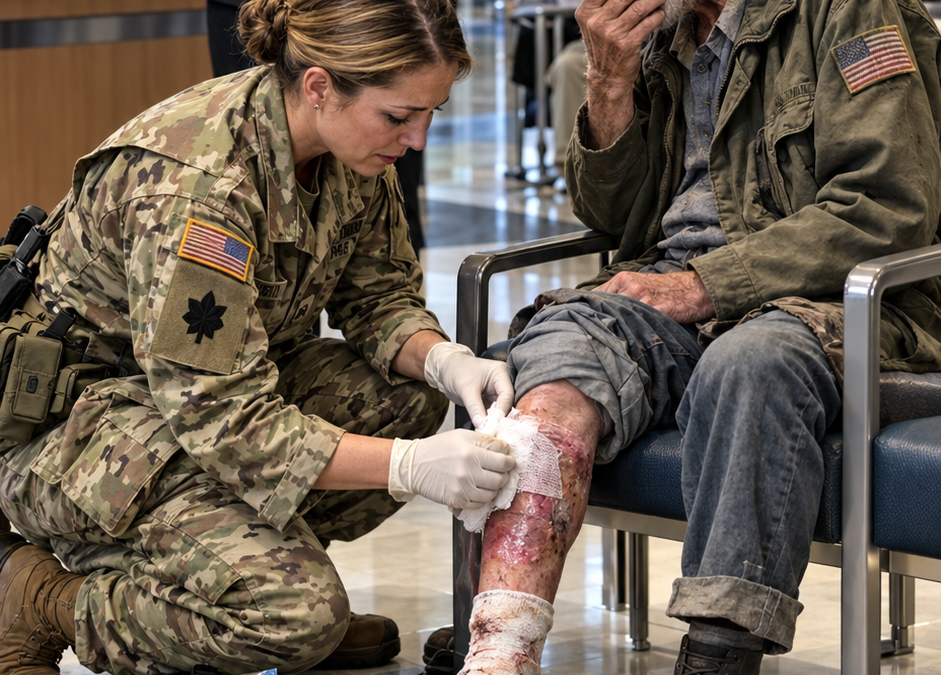
I cleaned the wound as gently as I could. It still hurt him. His jaw tightened, and his fingers dug into the chair, but he did not complain once.
That told me more than groaning would have.
Men like Walter had spent a lifetime learning to measure pain against worse pain. It made them terrible patients.
When I finished cleaning and dressing the wound, I arranged transportation to the VA hospital and called a veterans’ assistance coordinator I trusted. I wrote down the coordinator’s number and tucked it into Walter’s hand.
“You call this number if anything gets confused,” I told him. “If they don’t answer, you call again.”
He looked at the paper.
“People don’t usually give direct numbers.”
“Then today is special.”
Before he left, I noticed old rank stitching inside his cap, faded but still visible along the inner band.
I looked at him more carefully.
“Take care of yourself, Sergeant.”
Walter froze.
Then, slowly, he smiled.
Not brightly.
Not happily.
Like something old had been returned to him.
“Haven’t heard that in a long time.”
I watched him leave in the transport vehicle.
Martin Hale watched me.
There was no gratitude in his face.
Only calculation.
At 0600 the next morning, Colonel Nathan Pierce summoned me to his office.
Pierce was my commanding officer. He was procedural, sharp, and not naturally affectionate toward improvisation. I respected him. Most days, I even trusted him.
That morning, my entire career sat inside an open personnel file on his desk.
Two deployments.
Commendations.
No disciplinary history.
Eleven years of service reduced to a stack of papers and one new document placed directly in front of me.
TEMPORARY SUSPENSION OF DUTIES.
I read it once.
Then again.
“For helping an injured veteran?” I asked.
Pierce sat behind his desk with both hands folded.
“For acting outside your authority while in uniform in a civilian medical facility.”
“So I should have watched him leave?”
“You should have followed procedure.”
“Which procedure? The one where we pretend infection pauses until registration catches up?”
His jaw tightened.
“You know better than to make this emotional.”
“It was already emotional when an old man couldn’t stand.”
“That old man was inside a hospital.”
“Where nobody examined him.”
Pierce exhaled through his nose.
“Major, you are not assigned to Riverside General. You were not functioning in a medical capacity. You did not have authorization to provide care.”
“I had training.”
“You had some training.”
“I had enough to know what I was looking at.”
“That is not the standard.”
“No,” I said. “Apparently the standard is waiting until someone falls far enough to make the paperwork easier.”
His expression hardened.
“Careful.”
I knew I should stop.
I also knew I wouldn’t.
“I’d do it again.”
Silence settled over the office.
Pierce looked at me for a long moment.
Then he nodded toward my access badge.
I removed it and placed it on his desk.
The click of plastic against wood sounded louder than it should have.
By that evening, the story was everywhere.
Someone in the hospital lobby had recorded part of the exchange. The video did not show everything, but it showed enough: me kneeling in uniform in front of Walter Briggs while Martin Hale stood over my shoulder warning me about unauthorized treatment.
The internet loves simple stories.
Soldier suspended for helping veteran.
Hospital denies wounded old man.
Army punishes compassion.
None of those headlines captured the details, but details rarely travel as fast as outrage.
I ignored most of it.
Then my phone received three messages from an unknown number.
He told me what happened.
You did the right thing.
I’m coming tomorrow.
I stared at the screen for a long time.
No signature.
No explanation.
Just those three sentences.
The next morning, Sergeant Michael Torres called before 0800.
Torres had served with me for six years and had the rare talent of making urgency sound like annoyance.
“Major, get to Riverside General.”
“I’m suspended.”
“Then be suspended in motion.”
“What happened?”
“Government vehicles. A lot of them. Colonel Pierce is already inside.”
I sat up.
“What kind of government vehicles?”
“The black kind that make people stand straighter.”
Twenty minutes later, I pulled into Riverside General’s parking lot.
Government SUVs surrounded the entrance. Hospital security stood near the doors trying to look useful. A few local news vans idled near the curb.
Inside the lobby, the air felt different.
Tense.
Expectant.
Colonel Pierce stood near the reception desk. Martin Hale stood beside him, pale but still trying to maintain administrative dignity.
Then the elevator opened.
A silver-haired man stepped into the lobby wearing four stars.
Every service member in sight snapped to attention.
His eyes found me through the glass doors.
Then he saluted.
A four-star general saluted a suspended major.
For half a second, my body forgot what to do.
Then training rescued me.
I returned the salute.
“Major Morgan,” he said.
His voice was calm, controlled, and heavy with something I didn’t yet understand.
“I’m General William Briggs.”
Briggs.
Walter.
My chest tightened.
“Yes,” he said, as if he had watched the realization reach me. “Walter is my father.”
The entire lobby went silent.
“My father served thirty-one years,” General Briggs continued. “Yesterday, your hospital saw an old man without proper paperwork.”
His eyes moved toward me.
“But you saw a soldier.”
Martin Hale opened his mouth.
Colonel Pierce shifted as if preparing to speak.
General Briggs raised one hand.
“I’ve read your reports.”
That stopped both of them.
He opened a leather folder.
“Major Morgan’s suspension is no longer your biggest problem.”
He placed several documents on the desk.
“The review triggered by my father’s treatment uncovered something involving veterans.”
Martin Hale stepped backward.
Only slightly.
But I saw it.
And for the first time, I didn’t see embarrassment on his face.
I saw fear.
Two federal investigators walked through the doors.
They did not look like the kind of people television had trained us to expect. No dark glasses. No shouted orders. No dramatic display of badges.
One was a woman in her late forties named Dana Keene, wearing a gray suit, sensible shoes, and carrying a leather notebook tucked beneath one arm. The other, Thomas Reed, was younger, quiet, and carried a slim government laptop bag.
They walked into the lobby as though they had been there before.
Maybe they had.
General Briggs stood beside the reception desk with one hand resting on the leather folder.
Colonel Pierce remained several feet away from him.
Hale had gone pale.
I looked from one face to another.
“What exactly did you find?” I asked.
General Briggs glanced at Dana Keene.
She answered.
“Major Morgan, yesterday’s incident resulted in a request for an expedited review of several veteran referrals through this hospital.”
“Because of Walter?”
“Because your encounter with Mr. Briggs raised a question,” she said. “Why would an elderly veteran with an obviously worsening wound be redirected without even receiving a basic clinical assessment?”
Hale cleared his throat.
“I think we should be careful with terminology. Mr. Briggs was not denied emergency care. There was a registration issue and—”
Dana turned toward him.
“We’re being careful, Mr. Hale.”
Her tone never sharpened.
That made it more effective.
She opened her notebook.
“The problem is that Walter Briggs was not the first veteran redirected from Riverside General under nearly identical circumstances.”
Nobody spoke.
Outside the tall lobby windows, morning traffic moved along Broad Street. Somewhere down the corridor, a cart rattled across tile.
Normal sounds.
That was what I remembered most.
The world had not changed its volume simply because ours had.
“How many?” I asked.
“We don’t know yet,” Dana said.
General Briggs looked at me.
“That’s why I told you your suspension was the smallest part of this.”
I folded my arms.
“With respect, sir, my suspension and the hospital review aren’t the same issue.”
“No,” he said. “They aren’t.”
Colonel Pierce finally stepped forward.
“General, Major Morgan’s administrative status is a command matter.”
Briggs nodded.
“I understand that perfectly, Colonel.”
There was no anger in his voice.
“I also understand that Major Morgan was suspended before anyone outside your office reviewed the circumstances.”
Pierce’s jaw tightened.
“I followed regulation.”
“I’m not accusing you of anything.”
That seemed to surprise him.
Briggs closed the folder.
“I’m asking you to participate in a broader review.”
Pierce looked toward me.
For the first time since he had handed me the suspension order, he seemed less certain.
Not frightened.
Not ashamed.
Simply aware that the situation had grown larger than the rule he had used to contain it.
Dana Keene asked the hospital to provide a conference room.
Ten minutes later, eight of us sat around an oval table on the second floor.
The blinds were half open.
Rain tapped softly against the windows.
I sat beside Sergeant Torres, who leaned closer while the investigators arranged their notes.
“You all right?” he whispered.
“I’m suspended, sitting in a federal review meeting, and a four-star general just told me his father started the whole thing.”
“So that’s a no?”
I almost smiled.
Across the table sat Martin Hale and Riverside’s chief medical officer, Dr. Evelyn Shaw.
Dr. Shaw appeared genuinely confused.
That mattered.
Hale looked guarded.
That mattered too.
Dana began by placing five printed records on the table.
“These are referral summaries involving veterans over sixty-five who arrived at Riverside General during the past eighteen months.”
She pushed them toward Dr. Shaw.
“Each patient was eventually redirected to another facility before receiving full evaluation here.”
Dr. Shaw scanned the first page.
Then the second.
Her brow furrowed.
“These aren’t emergency department records.”
“No.”
“They’re intake summaries.”
“Yes.”
She looked up.
“I’ve never seen these.”
Hale shifted in his chair.
“Evelyn, intake issues normally wouldn’t rise to your level.”
“Patients with possible infections being redirected should.”
“They weren’t necessarily classified that way at intake.”
Dr. Shaw looked down again.
“Who classified them?”
Nobody answered immediately.
Thomas Reed opened his laptop.
“That is one of the things we’re trying to establish.”
I studied the documents from where I sat.
One name caught my attention.
Harold Mercer.
Age seventy-eight.
Army veteran.
Complaint: persistent swelling and wound irritation.
Disposition: referred to alternative veterans’ provider.
Another.
Samuel Ortiz.
Age sixty-nine.
Vietnam-era service.
Complaint: dizziness, weakness, medication complications.
Disposition: directed to veterans’ outpatient services.
Another.
Louis Grant.
Age eighty-one.
Difficulty breathing.
Transferred after delayed registration review.
I felt something cold settle behind my ribs.
“These men all came here?” I asked.
“Yes,” Dana said.
“And someone decided their veteran status meant they should go somewhere else?”
“That’s what we’re determining.”
General Briggs sat quietly at the far end of the table.
He had not spoken for several minutes.
He looked less like a general now.
More like a son.
“When my father called me,” he said eventually, “he did not ask me to investigate this hospital.”
I turned toward him.
“What did he ask?”
“To make sure you weren’t punished for helping him.”
Something about that answer caught me off guard.
“He called you that night?”
“He called me from his kitchen.”
Briggs rubbed one thumb along the edge of the folder.
“My father and I speak every Sunday.”
He hesitated.
“Usually.”
That single word carried more history than the rest of the sentence.
“He didn’t tell me his leg had gotten that bad. He didn’t tell me he’d been trying to get treatment. He didn’t tell me he’d been taking two buses to appointments.”
His expression changed almost imperceptibly.
“I learned all of that because a stranger stopped beside him in a hospital lobby.”
I looked down.
Walter’s face returned to me.
The worn cap.
The careful way he had spoken.
The embarrassment when his leg buckled.
“You didn’t know?” I asked.
“No.”
There was no defensiveness in his answer.
Only regret.
“My father is very good at telling people he is fine.”
Torres murmured, “Most old sergeants are.”
General Briggs heard him.
A faint smile appeared.
“He would agree with you.”
Dana brought us back to the records.
The review, she explained, had begun when Briggs’ staff contacted a veterans’ assistance liaison to confirm what options Walter had been given. The liaison noticed something unusual.
Several veterans had recently complained about being redirected from Riverside despite arriving with conditions that should at least have received initial medical screening.
No single complaint had seemed extraordinary.
Together, they formed a pattern.
That pattern had led to something else.
Billing irregularities.
Not dramatic embezzlement.
Not bags of cash.
Something quieter.
Riverside had an agreement with a private healthcare coordination company called Northbridge Patient Solutions. Northbridge handled scheduling and referral management for certain government-supported patients, including veterans receiving approved outside care.
For every appropriately processed referral, the company received an administrative fee.
The system was supposed to help veterans navigate civilian treatment.
But somewhere along the way, veterans arriving directly at Riverside had begun being categorized as referral cases even when they had not come through Northbridge.
That classification could trigger administrative payments.
More important, it allowed Riverside intake staff to redirect the patient toward another contracted provider rather than immediately moving them into the hospital’s ordinary care process.
Dr. Shaw removed her glasses.
“You’re saying someone turned walk-ins into paperwork.”
Dana nodded.
“That is one possibility.”
Martin Hale’s face hardened.
“That is a serious allegation.”
“Yes.”
“And you have no evidence anyone deliberately denied care.”
“Not yet.”
“Then I would appreciate it if we stopped speaking as though wrongdoing has already been established.”
Dana regarded him steadily.
“We are establishing facts, Mr. Hale.”
He looked toward General Briggs.
“This entire process began because of who Mr. Briggs’ son happens to be.”
General Briggs did not react.
I did.
“That’s not fair.”
Hale looked at me.
“Major, with respect, a federal review did not happen when Harold Mercer was redirected. It did not happen when Samuel Ortiz was redirected. It happened when Walter Briggs was.”
Silence followed.
I hated that he was right about that.
General Briggs seemed to hate it too.
“That,” he said quietly, “is exactly why this review needs to happen.”
Hale blinked.
Briggs leaned forward.
“If my father received attention only because of my rank, then we have discovered another problem, not an excuse to ignore the first one.”
That ended the argument.
For the next three hours, investigators interviewed staff.
I should have left.
I was suspended.
I had no official role in the hospital inquiry.
But Dana asked me to remain because I had witnessed Walter’s interaction at intake.
So I told them what I remembered.
The clerk’s words.
The administrator’s warning.
Walter trying to stand.
Nobody examining him.
My decision to get the trauma kit.
When I finished, Dr. Shaw asked a question.
“Major, what did the wound look like?”
I described it clinically.
Heat.
Redness.
Swelling.
Drainage.
Walter’s difficulty bearing weight.
Her mouth tightened.
“He should have been assessed.”
Hale looked at her.
“You weren’t there.”
“No,” she said. “But she was.”
It was the first fracture I saw in the hospital leadership.
Not a dramatic fracture.
Just one person deciding that loyalty to an institution did not require pretending an obvious mistake had not happened.
At noon, Dana released me.
General Briggs asked if we could speak privately.
We walked downstairs to the small hospital café.
He bought two coffees.
Four-star general or not, the machine rejected his card twice.
He stared at the screen.
“I command more than sixty thousand people,” he said. “Apparently I cannot operate a coffee kiosk.”
I laughed before I could stop myself.
He handed me a paper cup.
For several seconds, we stood near the window without speaking.
Then he said, “Thank you.”
“You already thanked me.”
“Not as Walter’s son.”
The rain had stopped.
Water clung to the glass.
I remembered my own father, who had died six years earlier. He had never served. He had repaired industrial air conditioners and complained about every necktie he ever had to wear.
When he got sick, I had been deployed.
I made it home before the end.
Barely.
There are certain forms of guilt that are not logical.
You know you did everything you could.
They remain anyway.
“Your father reminded me of mine,” I said.
Briggs looked at me.
“That why you stopped?”
“Maybe.”
I thought about it.
“No. I stopped because everybody else kept walking.”
He nodded slowly.
“My father would like that answer.”
“How is he?”
“Embarrassed.”
“That sounds promising.”
“He’s at the VA hospital. They’re treating the infection. Doctors expect him to recover.”
I released a breath I had not realized I was holding.
“Good.”
“He wants to speak with you.”
“I’d like that.”
Briggs looked toward the hallway.
Then his expression became more serious.
“There is something you should understand about my father.”
I waited.
“He does not like being known as General Briggs’ father.”
“I gathered that.”
“He spent thirty-one years in uniform. Most of those years, I was just Bill.”
A quiet warmth entered his face.
“When I was commissioned, he saluted me and then told me my shoes looked terrible.”
I smiled.
“That sounds like a sergeant.”
“He retired as a command sergeant major.”
I stared at him.
Walter had told the clerk, I’m a veteran.
Nothing else.
No rank.
No decades of service.
No famous son.
“He never mentioned that.”
“He wouldn’t.”
General Briggs looked into his coffee.
“My father taught me that rank should open doors for responsibility, not privilege.”
His gaze returned to mine.
“Which makes yesterday especially difficult.”
I understood.
Walter had spent a lifetime believing a uniform meant people took care of one another.
Then he had sat unnoticed in a waiting room wearing the only evidence of that life on his head.
A faded cap.
We were interrupted by Sergeant Torres.
“Ma’am.”
His tone had changed.
“What?”
“Colonel Pierce wants you back at headquarters.”
I looked at Briggs.
He nodded once.
“Go.”
My suspension had not disappeared.
Not yet.
At headquarters, Pierce was alone.
The same personnel file sat on his desk.
This time it was closed.
He gestured toward the chair.
I sat.
He remained standing for a moment before lowering himself opposite me.
“I owe you an explanation.”
I said nothing.
“I did not suspend you because you helped Mr. Briggs.”
“That is what the order says.”
“The order says you performed treatment outside your assigned authority while identifiable as an Army officer in a civilian medical facility.”
“And the difference is?”
“The difference is that I received a complaint from Riverside before I ever spoke to you.”
That was new.
“What complaint?”
Pierce opened a drawer and removed a printed email.
“It came at 2140 Wednesday night.”
I read it.
The message alleged that I had interfered with hospital operations, ignored instructions from hospital leadership, and created potential liability by providing unauthorized medical care.
The sender was Martin Hale.
But the email had not been sent directly to Pierce.
It had been forwarded through a regional military-community liaison office.
“Why didn’t you tell me?”
“Because the complaint was part of an administrative review.”
“You decided the review before asking me what happened.”
Pierce’s face tightened.
“Yes.”
The word surprised me.
I had expected justification.
Instead, he looked tired.
“I believed I was protecting the command.”
“From what?”
“From this becoming exactly what it became.”
“A story?”
“A public dispute involving an officer, a civilian hospital, veterans’ healthcare, and questions about medical authority.”
He rubbed his forehead.
“I thought a temporary suspension would create distance while we established facts.”
“You punished the person standing closest to the facts.”
“Yes.”
Again, no excuse.
That made it harder to stay angry.
Pierce had been my commander for fourteen months. He was demanding, procedural, sometimes maddening, but I had never considered him dishonest.
“What happens now?”
“I recommended this afternoon that your suspension be rescinded pending formal review.”
I studied him.
“Because General Briggs arrived?”
“No.”
He met my eyes.
“Because I read the hospital incident report.”
He turned another document toward me.
The report listed Walter as ambulatory and stable.
No fall or collapse observed.
I stared at the line.
“He collapsed into me.”
“I know.”
“How?”
“Three witnesses confirmed it.”
He paused.
“Including the registration clerk.”
Something had begun unraveling.
And Pierce had finally noticed.
He leaned back.
“Morgan, I made a decision based on incomplete information.”
“That’s a careful way to say it.”
“I’m still your commanding officer.”
“Temporarily.”
A corner of his mouth moved.
“Your sense of timing remains poor.”
“So I’ve been told.”
His expression sobered.
“I’m sorry.”
Colonel Nathan Pierce did not apologize casually.
I believed him.
That did not make the last twenty-four hours disappear.
But it mattered.
“I accept that,” I said.
He nodded.
Then he handed me my access badge.
I looked at it.
“Already?”
“Your duty status is restored at 1600.”
I took the badge.
“Any restrictions?”
“Yes.”
“What?”
“Do not treat patients in civilian hospital lobbies.”
I looked at him.
He managed three seconds before smiling.
“Unless absolutely necessary.”
“That is a very flexible order, sir.”
“I have recently developed appreciation for flexibility.”
My phone rang before I could answer.
Unknown number.
I nearly ignored it.
Then I remembered the messages.
I answered.
“Major Morgan?”
Walter.
His voice sounded stronger.
“Sergeant.”
He laughed softly.
“You found out.”
“Your son filled in a few details.”
“He tends to do that.”
“How are you feeling?”
“Like six doctors and my son have formed a committee devoted to asking whether I’ve taken my antibiotics.”
“That sounds serious.”
“Terrible situation.”
I smiled.
“I hear you’re recovering.”
“I am.”
A pause.
“Major, I was wondering if you might come by.”
“Of course.”
“Not here.”
I frowned.
“Where?”
“My house.”
“You’re being discharged?”
“Tomorrow morning.”
There was something in his voice.
Something careful.
“I need to show you something.”
“What?”
“If I tell you, you’ll think I’m an old fool.”
“I already cleaned your leg in a hospital lobby. I think we’ve passed formal introductions.”
He chuckled.
“Tomorrow. Eleven o’clock.”
“I’ll be there.”
Walter lived in a small brick house on the west side of Columbus.
The next morning, sunlight broke through a week of clouds. A row of tomato plants grew beside the porch. Someone had painted the railing recently, but not very well. There were white streaks on the brick.
General Briggs’ SUV was parked at the curb.
So was a twelve-year-old pickup truck.
I knocked.
Walter opened the door with a cane in one hand.
“You clean up better when you’re not sitting on a hospital floor,” he said.
“You look better when your leg isn’t trying to kill you.”
“Doctors say it was only planning a small rebellion.”
He waved me inside.
The house smelled like coffee and furniture polish.
Photographs covered one wall.
Walter in uniform.
Walter younger, standing beside a woman with dark hair and a wide smile.
Two boys beside a Christmas tree.
One was unmistakably William Briggs, long before the stars.
The other boy was younger.
I looked closer.
Walter noticed.
“My other son. Daniel.”
“Where is he?”
Walter’s expression softened.
“Arizona.”
There was a distance in the answer that did not sound geographical.
General Briggs appeared from the kitchen carrying three mugs.
“My father believes recovering from infection requires enough coffee to create a second medical problem.”
“Army medicine,” Walter said.
We sat in the living room.
For a while, nobody mentioned the hospital.
Walter asked where I had grown up.
I told him Pennsylvania.
He asked why I joined.
I gave him the answer I usually gave people.
Opportunity.
Service.
Wanting a life larger than the town I came from.
He listened.
Then he said, “That’s the official answer.”
General Briggs closed his eyes.
“Dad.”
“What?”
“You’ve known her eight minutes.”
“Long enough.”
Walter looked back at me.
“What’s the real answer?”
I surprised myself by responding.
“My father.”
Walter waited.
“He wanted me to go to college. We couldn’t afford much. The Army gave me a path.”
“That all?”
“No.”
I looked at the photograph wall.
“He believed people should be useful.”
Walter nodded.
“That sounds like a man I would’ve liked.”
“He would’ve liked you.”
General Briggs handed me coffee.
Walter placed both palms over the top of his cane.
“Useful is a dangerous word.”
I looked at him.
“How?”
“Because eventually you get old enough that people start deciding you aren’t.”
His voice remained calm.
“I spent most of my life being the person everybody called when something went wrong. Then one day I retired and people started carrying my groceries.”
“There are worse things.”
“Oh, absolutely.”
He smiled.
“But pride is not known for logic.”
General Briggs looked at him.
“You could have called me.”
Walter’s smile faded.
“I know.”
“You could have called Daniel.”
“I know.”
“You could have told either of us what was happening.”
Walter glanced toward the window.
There it was.
The real reason I had been invited.
Not the investigation.
A family wound older than the one on Walter’s leg.
“I didn’t want another argument,” Walter said.
William’s voice remained even.
“Helping you is not an argument.”
“It becomes one.”
“How?”
“Because you think helping means taking control.”
The general sat very still.
Walter continued.
“You send cars. Assistants. Doctors. People who call me ‘sir’ because they know who you are.”
“I’m trying to make things easier.”
“For you.”
William looked hurt.
Walter saw it.
His voice softened.
“Bill, I know you love me.”
The use of his childhood name changed the room.
“But sometimes I need to be your father, not an assignment.”
General Briggs looked down at his mug.
I suddenly felt intrusive.
“I can come back.”
“No,” Walter said. “You’re part of why we’re finally saying this.”
Neither man argued.
That made it more painful, not less.
They loved each other.
There was no question about it.
But love had become tangled with responsibility.
William had spent his life solving problems.
Walter had spent his life refusing to become one.
“I wasn’t hiding the leg because I wanted to be stubborn,” Walter said.
General Briggs raised an eyebrow.
“Not entirely.”
Walter conceded the point with a small shrug.
“I thought it would improve.”
“It didn’t.”
“No.”
“And then?”
Walter looked at me.
“Then I started going to appointments.”
My attention sharpened.
“Appointments where?”
“Different places.”
General Briggs frowned.
“You told me you couldn’t get an appointment.”
“I couldn’t get the right appointment.”
Walter pushed himself upright.
“Come with me.”
He led us down a narrow hallway to a back bedroom that had been converted into an office.
A desk stood beneath the window. Boxes were stacked beside an old filing cabinet.
Walter opened the bottom drawer.
Inside were folders.
Many folders.
He took out a thick one secured with a rubber band.
“What is that?” William asked.
Walter looked almost embarrassed.
“Homework.”
He handed it to me.
Inside were copies of appointment letters, referral notices, bills, transportation receipts, and handwritten notes.
Dates.
Names.
Locations.
Times.
I turned page after page.
“These are yours?”
“Some.”
“Whose are the others?”
“Friends.”
General Briggs stared at him.
Walter sat carefully in the desk chair.
“About a year ago, a man from my veterans’ breakfast group got a bill for an appointment he swore he never had.”
“Who?”
“Harold Mercer.”
The name struck me immediately.
I looked at General Briggs.
He recognized it too.
One of Dana Keene’s five records.
Walter continued.
“Harold thought he was losing his memory. His daughter thought so too. Then Samuel Ortiz got a bill that didn’t make sense.”
Another name from the table.
“And Louis Grant?”
Walter’s eyes narrowed slightly.
“You know Louis?”
“He was on the review list.”
Walter leaned back.
“Well.”
General Briggs slowly lowered himself into the chair beside the desk.
“Dad, what have you been doing?”
“Trying to figure out whether my friends were confused or whether somebody else was.”
My pulse quickened.
“You were investigating the referrals.”
“I wouldn’t call it investigating.”
“What would you call collecting eighteen months of records?”
“Being organized.”
General Briggs gave me a look that said this was exactly what growing up with Walter Briggs had been like.
Walter tapped the folder.
“At first I thought it was insurance nonsense. Then I noticed the same company name.”
“Northbridge.”
He nodded.
“Some of the men were being scheduled through them. Others weren’t. But Northbridge kept appearing.”
“Why didn’t you give this to anyone?”
“I did.”
The room went still.
“To whom?” William asked.
Walter turned to the filing cabinet again.
He removed a single envelope.
“I mailed copies six months ago.”
“Where?”
“To the regional veterans’ care office.”
“And?”
“They sent a letter saying the issue had been referred to the appropriate contractor.”
“Northbridge?” I asked.
Walter nodded.
I almost laughed at the absurdity.
“You complained about Northbridge, and they sent the complaint to Northbridge.”
“That was my impression.”
“What did Northbridge say?”
“That the discrepancies resulted from administrative coding errors.”
Walter pointed toward another letter.
“So I started checking.”
General Briggs stared at his father.
“You’ve been riding buses around Columbus for six months checking veterans’ medical referrals?”
“Not every day.”
“Dad.”
“Tuesday breakfasts are slow.”
“This isn’t funny.”
Walter’s humor faded.
“No.”
For a long moment, father and son looked at each other.
William’s anger was not the anger of a general.
It was the helpless anger of a son discovering that his elderly father had been carrying something alone.
“You should have told me.”
“And what would you have done?”
“I would have helped.”
“You would have called three people, and by dinner everyone involved would know General Briggs was asking questions.”
“Yes.”
“That’s why.”
William stood and walked to the window.
Walter watched him.
“I needed to know what happened when nobody important was asking.”
The words landed softly.
That made them heavier.
I looked through the documents again.
Walter had recorded everything.
Not just suspicious bills.
Transportation problems.
Confusing phone calls.
Long waits.
Veterans who had misunderstood letters.
Patients who had been helped successfully.
He had been fair.
Almost painfully fair.
On one page, he had written:
NORTHBRIDGE REP, LENA P. — VERY HELPFUL. CALLED BACK SAME DAY.
On another:
RIVERSIDE NURSE FOUND CORRECT CLINIC. NO ISSUE.
This was not a man collecting grievances.
He was collecting truth.
“Why Riverside?” I asked.
Walter hesitated.
“That’s what I wanted you to see.”
He reached into the folder and removed a photocopied internal-looking form.
At the bottom was an authorization line.
The signature was difficult to read.
But the typed name beneath it was clear.
MARTIN HALE.
General Briggs stared at it.
“What is this?”
Walter answered slowly.
“A referral workflow change. At least, that’s what Harold was told when he asked why he had been redirected.”
I read the page.
It appeared to authorize intake staff to route certain government-supported patients through a centralized verification process before clinical placement.
It was dense bureaucratic language.
Nothing on the page said deny care.
Nothing said veterans should be turned away.
But I could see how an employee under pressure might interpret it that way.
“Where did you get this?” I asked.
“Harold.”
“How did he get it?”
“A woman at Riverside gave it to him.”
“Who?”
Walter reached for a yellow note clipped to the back.
One name was written there.
MELANIE ROSS.
I remembered the registration clerk.
The woman who had told Walter he needed insurance documentation.
“Is Melanie Ross the clerk from Wednesday?”
Walter nodded.
“She slipped that note into my discharge transportation envelope.”
I stared at him.
“She wanted you to have this?”
“She wrote something else.”
He handed me a smaller sheet.
Three words were written across it.
PLEASE KEEP ASKING.
General Briggs read it twice.
Then his phone rang.
He looked at the screen.
“Keene.”
He answered.
“Briggs.”
We watched his expression change as he listened.
“Yes.”
A pause.
“When?”
Another pause.
“I understand.”
He ended the call.
“What?” Walter asked.
“Dana interviewed Melanie Ross this morning.”
I waited.
“And?”
William looked at his father.
“She says she tried to raise concerns about the referral procedure eight months ago.”
Walter’s fingers tightened around the cane.
“With Hale?”
“No.”
William glanced at me.
“With someone at Northbridge.”
“What happened?”
“She was told the process had been approved by Riverside leadership.”
“That doesn’t prove Hale knew patients were being redirected without assessment,” I said.
“No.”
General Briggs looked at the photocopied form.
“But Dana found something else.”
He hesitated.
“The version Riverside produced this morning is different from this one.”
Walter looked up.
“Different how?”
“The hospital’s copy includes a paragraph specifically stating that no referral procedure can delay initial clinical screening.”
I looked back at Walter’s paper.
That paragraph was not there.
For several seconds, none of us spoke.
There were innocent explanations.
Drafts changed.
Policies were updated.
Old copies circulated.
That was what reasonable people were supposed to consider first.
But Walter had written a date on the upper corner of his copy.
Seven months earlier.
The hospital claimed its version had been active for nearly a year.
“Dana wants this document,” William said.
Walter nodded.
“She can have it.”
Then he looked at me.
“That still isn’t why I asked you here.”
I stared at him.
“There’s more?”
Walter gave a tired smile.
“There’s always more when people start keeping records.”
He reached into the filing cabinet one final time.
Instead of another medical form, he removed a photograph.
It was old.
Maybe twenty-five years.
Four soldiers stood in front of a canvas field tent.
Walter was one of them.
Younger, broader through the shoulders, wearing sergeant major insignia.
Beside him stood a man I recognized immediately.
Not because I had met him.
Because I had seen his face every Christmas of my childhood in a framed photograph on our living-room shelf.
My father.
Daniel Morgan.
I forgot how to breathe.
Walter watched my face.
“You know him.”
I took the photograph with both hands.
“My father.”
General Briggs turned toward me.
Walter nodded.
“I thought so.”
I looked at the image again.
My father had never told me he served.
Because as far as I knew, he hadn’t.
“He wasn’t Army.”
“No,” Walter said.
“He repaired industrial systems.”
“He did.”
“What was he doing there?”
Walter’s eyes drifted toward the photograph.
“He was a civilian contractor attached to our unit during a humanitarian operation after a major flood overseas.”
My mind searched through years of family stories.
My father had traveled for work when I was young.
Weeks at a time.
Sometimes months.
I had never asked where.
Children rarely ask the right questions while the people capable of answering them are still alive.
Walter tapped the photograph.
“Your father kept twenty-two soldiers and about sixty local families from losing access to clean water when a purification system failed.”
I sat down.
“He never told me.”
“He didn’t like attention.”
“That sounds like him.”
Walter smiled.
“He also complained constantly.”
“That definitely sounds like him.”
The room blurred for a second.
I blinked hard.
Walter continued.
“I remembered the name Morgan yesterday. Didn’t make the connection until you mentioned Pennsylvania.”
“You knew my father?”
“For three months.”
He pointed to himself and Daniel Morgan in the photograph.
“We argued almost every day.”
“About what?”
“Everything.”
I laughed despite the pressure behind my eyes.
Walter’s smile faded into something gentler.
“But there’s something you should know.”
He opened the back of the photograph frame.
A folded piece of paper had been hidden behind it.
The paper was yellow with age.
He passed it to me.
My father’s handwriting covered one side.
I knew it instantly.
Block letters.
All capitals.
The same handwriting that had labeled every toolbox in our garage.
Walter spoke while I unfolded it.
“Your father wrote that the day we left.”
I read the first line.
WALTER—
IF MY GIRL EVER DECIDES TO WEAR A UNIFORM, TELL HER THE JOB ISN’T ABOUT FOLLOWING EVERY RULE.
My vision blurred.
I kept reading.
IT’S ABOUT KNOWING WHICH RULES EXIST TO PROTECT PEOPLE AND WHICH ONES PEOPLE SOMETIMES HIDE BEHIND.
Walter’s voice became very quiet.
“He talked about you all the time.”
I could not speak.
The final line was shorter.
IF YOU EVER MEET CLARE, TELL HER I KNEW SHE’D STOP.
I looked at Walter.
“How could he know?”
Walter’s eyes shone.
“He didn’t know what you’d stop for.”
A faint smile touched his face.
“He only knew you.”
And suddenly the hospital lobby, my suspension, Walter’s faded cap, and the photograph in my hands no longer felt like separate events.
Something my father had done decades earlier had been quietly carried through Walter’s life.
Until the afternoon I happened to walk past the one chair where Walter Briggs was waiting.
My phone vibrated.
Dana Keene.
I answered.
“Major Morgan,” she said, “we found the original Riverside policy file.”
I looked at Walter.
“And?”
“There were three versions.”
My grip tightened around the phone.
“Which one was actually sent to staff?”
“That’s what we need to determine.”
She paused.
“But Major—someone inside the hospital repeatedly removed the clinical-screening paragraph before distributing the document.”
I looked down at Melanie Ross’s note.
PLEASE KEEP ASKING.
“Who?”
“We don’t know.”
Outside Walter’s window, sunlight fell across the tomatoes growing beside his porch.
Inside, an old photograph rested in my lap.
My father smiled from another lifetime.
For the first time since this began, I understood that the question was no longer simply why Walter Briggs had been overlooked.
It was how many people had quietly noticed something was wrong—and how long they had been waiting for someone else to stop walking.
The answer took six weeks.
Six weeks of interviews.
Six weeks of subpoenas.
Six weeks of Riverside executives suddenly remembering conversations they had forgotten during the first review.
Dana Keene and Thomas Reed followed every version of the policy file from Riverside’s internal system to Northbridge’s referral platform, then back through emails, revisions, and access logs that someone had apparently believed no one would ever examine closely.
The truth was not as simple as I wanted it to be.
Martin Hale had not stood in a dark room plotting to deny medical care to veterans.
That would have been easier to hate.
Instead, he had approved a workflow designed to reduce unpaid administrative burden and redirect government-supported patients into a contractor-managed system.
Northbridge had made money every time a referral was processed.
Riverside had reduced intake pressure.
Veterans had been told the process was designed to help them.
On paper, everyone had an explanation.
In practice, elderly men with infections, dizziness, breathing problems, and medication complications were being handed addresses, phone numbers, and bus routes instead of being assessed by clinicians standing less than fifty yards away.
The missing clinical-screening paragraph became the center of the investigation.
Three versions of the document existed.
One protected patients.
One blurred the requirement.
One removed it entirely.
The version distributed to front-line staff was the one without the protection.
Hale claimed he had never approved that version.
Northbridge claimed it had implemented Riverside’s instructions.
A contractor liaison claimed hospital leadership had requested “streamlined language.”
Melanie Ross said she had asked twice whether patients could be redirected before clinical assessment and had been told, “Follow the workflow.”
Dr. Evelyn Shaw testified that she had never seen the altered version and would never have approved it.
Walter’s folder proved the pattern went back farther than anyone admitted.
His notes were not perfect.
They were better.
Because they were human.
He had written down the names of helpful staff, confusing phone calls, missed callbacks, bus transfers, bill dates, and whether men like Harold Mercer seemed scared to complain because they didn’t want to lose access to care altogether.
When Dana asked why he had kept such careful records, Walter said, “Because old men get dismissed as confused unless they bring receipts.”
That quote appeared in three newspapers the next day.
Walter hated that.
General Briggs loved it.
My own role in the investigation was small after that.
I gave a statement.
Then another.
I turned over photographs of the wound dressing.
I described exactly what Hale had said.
I confirmed that no clinician had assessed Walter before I intervened.
I returned to duty, but nothing felt quite the same.
People congratulated me as if I had won something.
I hadn’t.
An elderly veteran had sat in a hospital lobby with an infected leg because too many people had mistaken process for care.
There was nothing victorious about that.
Still, change came.
Slowly.
Then all at once.
Riverside terminated its referral workflow with Northbridge pending review.
Martin Hale resigned before the final administrative findings were released.
Northbridge lost its government-supported referral contract in the region.
Two employees were referred for further investigation over document alteration and improper classification of patients.
Riverside implemented a new intake policy requiring immediate clinical screening for any patient presenting with visible wounds, breathing difficulty, altered mental status, or mobility impairment, regardless of registration status.
The policy was named after no one.
Walter insisted on that.
“No plaques,” he said. “Plaques are what people put up when they want to stop thinking.”
Instead, Riverside created a veterans’ patient advocate desk near the entrance.
Melanie Ross applied for the position.
Dr. Shaw recommended her.
Dana Keene approved her.
Walter pretended not to be pleased when she got it.
Colonel Pierce wrote a formal correction to my personnel file. The suspension order remained documented as issued and rescinded, but no adverse finding was attached to my record.
He called me into his office the day the correction was complete.
“Major Morgan,” he said, sliding the file toward me, “this matter is administratively closed.”
I opened it.
No disciplinary mark.
No reprimand.
No career stain.
Just a summary of the incident, the rescission, and a note recognizing that emergency judgment had been exercised under unusual circumstances.
I looked up.
“That sentence sounds like it was written by twelve lawyers trapped in an elevator.”
“It was reviewed by at least nine.”
“Efficient.”
Pierce almost smiled.
Then he became serious.
“You understand that I still expect officers under my command to respect boundaries of authority.”
“Yes, sir.”
“And you understand that authority exists for reasons.”
“Yes, sir.”
He studied me.
“And you also understand that sometimes the person nearest the problem has the clearest duty.”
I paused.
“Yes, sir.”
He nodded.
“Good.”
As I stood to leave, he added, “Morgan.”
I turned.
“I’m glad you stopped.”
I thought of my father’s letter.
I knew she’d stop.
“So am I, sir.”
Walter’s leg healed.
Not quickly.
Not cleanly.
He complained about the antibiotics, the dressing changes, the physical therapy, his son’s hovering, the nurse’s cheerful instructions, and the fact that everyone suddenly wanted to discuss his feelings.
But he healed.
A month after the investigation closed, he invited me to Tuesday breakfast.
I arrived at a diner on the west side of Columbus expecting coffee and maybe four old veterans.
There were fourteen of them.
All wearing caps.
All suspiciously interested in the woman who had “made Bill’s boy lose his general voice in a hospital lobby,” according to a man named Samuel Ortiz.
Walter sat at the end of the table like a king pretending not to enjoy court.
Harold Mercer lifted his coffee cup toward me.
“You’re Morgan’s girl?”
I froze.
Walter had told them.
“Daniel Morgan,” Harold clarified. “He fixed our water system overseas.”
I sat slowly.
“You knew my father?”
“Everyone knew your father,” Samuel said. “Could hear him complaining from three tents away.”
The table laughed.
And just like that, my father entered the room.
Not as the sick man I had barely reached in time.
Not as the photograph on our Christmas shelf.
As a younger man with grease on his hands, arguing with sergeants in a flooded country I had never visited, fixing what needed fixing because people needed clean water.
For two hours, they told me stories.
My father refusing to sleep until a pump was running.
My father teaching soldiers enough maintenance to keep systems alive after he left.
My father threatening to “haunt every uniform in this tent” if anyone tried to use contaminated hoses because they were in a hurry.
Walter saved the last story for when the others had started arguing about baseball.
“He told me once,” Walter said, “that his daughter was going to do something useful with her life.”
I looked down at my coffee.
“He said that?”
“He said you were stubborn enough to be a problem and decent enough to be worth the trouble.”
“That sounds like him.”
Walter smiled.
“He was proud before there was anything official to be proud of.”
I thought about the letter.
The line hidden behind an old photograph for decades.
The trust my father had placed in a man I had not met until I knelt in a hospital lobby.
“Why didn’t you send the note sooner?” I asked.
Walter’s expression grew quiet.
“I lost track of him after the operation. Years went by. Then I read his obituary.”
I looked at him.
“You knew he died?”
“Yes.”
“And you still didn’t send it?”
He nodded slowly.
“I told myself it would only hurt you.”
I said nothing.
He rubbed one thumb along his coffee mug.
“That was cowardice dressed up as kindness.”
The honesty landed heavier than an excuse would have.
“I’m sorry,” he said.
For a moment, I was back in the hospital lobby, seeing an old man everyone else had decided was inconvenient.
Only now, he was giving me something more difficult than gratitude.
He was giving me truth.
“I wish I’d had it sooner,” I said.
“I know.”
“But I’m glad I have it now.”
His eyes shone.
He nodded once.
That was all.
Two months later, Riverside held a small ceremony to mark the opening of its new veterans’ patient advocate desk.
Walter attended with a cane, polished shoes, and the same faded Army cap.
General Briggs stood beside him in civilian clothes because Walter had forbidden stars.
“No uniforms,” Walter had said. “This is a hospital, not a parade.”
I came in uniform because Walter told me I had to.
“You started this,” he said.
“No, Sergeant. You did.”
He looked at me.
“Don’t argue with old men in public.”
“You first.”
He smiled.
Melanie Ross stood behind the new desk, nervous and proud. Dr. Shaw spoke briefly about clinical responsibility. Dana Keene attended from the back of the room, observing more than participating.
No one mentioned Martin Hale.
No one mentioned Northbridge by name.
The focus stayed where Walter wanted it.
On the next person who would walk through those doors scared, sick, confused, proud, or too tired to explain himself properly.
When the short ceremony ended, Walter asked for the microphone.
Everyone looked nervous.
I understood why.
Walter Briggs with a microphone was not something any administrator should welcome.
“I’ll be brief,” he said.
General Briggs muttered, “Unlikely.”
Walter ignored him.
“I sat in this lobby because I thought I could handle one more thing by myself. I was wrong.”
The room quieted.
“I also sat here because the system around me made it too easy for people to move me along instead of look at me.”
His voice remained steady.
“I don’t want special treatment because I wore a uniform. I don’t want better care because my son has stars on his shoulders. I want the next old man who walks in here to be seen before he has to prove he matters.”
He turned slightly toward me.
“Major Morgan saw me.”
My throat tightened.
“Then people started asking questions.”
He looked out over the lobby.
“Keep asking.”
That was it.
No thunder.
No applause line.
But people clapped anyway.
Afterward, Walter pressed something into my hand.
The original photograph.
Him.
My father.
Two other soldiers.
A tent in another country.
“I made a copy,” he said. “That one belongs to you.”
I held it carefully.
“Thank you.”
“There’s something else.”
“Walter.”
“It’s not paperwork.”
He handed me a small metal object.
A worn brass compass.
“Your father carried it during that operation. Said it was useless because he knew perfectly well where he was and disliked being second-guessed by magnets.”
I laughed.
“Why did you have it?”
“He left it in my kit. Claimed it was accidental.”
“Was it?”
“No.”
I closed my fingers around it.
For years after my father died, I had carried grief like a sealed box.
Useful when closed.
Dangerous when opened.
Now Walter had opened one corner of it and shown me something I had not expected.
Not more loss.
More life.
My father had existed in places I never knew.
He had mattered to people I had never met.
And somehow, long before I wore a uniform, he had known exactly what kind of officer I would try to become.
That evening, I drove home with the photograph on the passenger seat and the compass in my jacket pocket.
At a red light, I took out the folded note again.
IF MY GIRL EVER DECIDES TO WEAR A UNIFORM, TELL HER THE JOB ISN’T ABOUT FOLLOWING EVERY RULE.
IT’S ABOUT KNOWING WHICH RULES EXIST TO PROTECT PEOPLE AND WHICH ONES PEOPLE SOMETIMES HIDE BEHIND.
IF YOU EVER MEET CLARE, TELL HER I KNEW SHE’D STOP.
The light changed.
Someone honked behind me.
I laughed, wiped my eyes, and drove on.
I still believe in procedure.
I still believe in authority, records, training, and rules written by people who understood what chaos costs.
But I also know what my father knew.
Rules are meant to protect people.
When people start using them to avoid seeing the person in front of them, the rule has become a hiding place.
That Wednesday afternoon, Walter Briggs was not a general’s father.
He was not a case number.
He was not a referral classification.
He was not a liability problem.
He was a soldier in pain, sitting in a chair while everyone waited for someone else to be responsible.
I stopped.
That decision nearly cost me my career.
It gave Walter back his voice.
It gave other veterans a doorway into care.
And it gave me a final message from the man who had believed in me before I had earned a single rank.
Months later, Colonel Pierce asked me during a field readiness review what I considered the most important lesson from the Riverside incident.
I could have given him a polished answer.
Judgment under pressure.
Interagency communication.
Civil-military boundaries.
Instead, I thought about Walter’s faded cap, Melanie’s note, Dana’s notebook, General Briggs trying to buy coffee, and my father’s block letters on yellowed paper.
Then I said the only thing that felt true.
“Sir, sometimes the mission is the person everyone else has learned how not to see.”
Pierce looked at me for a long moment.
Then he nodded.
“Put that in the training brief.”
So I did.
And I began with Walter Briggs.








