𝗙𝗨𝗟𝗟 𝗦𝗧𝗢𝗥𝗬 I Still Hear the Silence That Followed a Five-Month-Old Puppy’s Screams
𝗙𝗨𝗟𝗟 𝗦𝗧𝗢𝗥𝗬
The investigators had to rely on the evidence available to them.
That included the witness report, the puppy’s visible injuries, and the statements they gathered during their visit.
Another concerning detail emerged when Green stepped away from the interview.
His wife spoke with investigators.
According to the court documents, she said she hadn’t personally witnessed him abusing Jinx.
But she also expressed that she didn’t trust him with the puppy when he was angry with her.
That distinction mattered.
She hadn’t claimed to see something she hadn’t witnessed.
She had, however, described a concern about leaving the puppy in his care under certain circumstances.
Investigators had to evaluate those statements alongside the physical evidence and the original report.
The result was a decision that would change Jinx’s life.
Authorities obtained a warrant to seize him so he could receive the medical attention he desperately needed.
When I eventually learned that he had been removed from the home, I felt a kind of relief I hadn’t experienced since the afternoon I first saw him.
For the first time, I knew that Jinx was no longer dependent on the man I had witnessed hurting him.
But getting him out of that situation was only the beginning.
His body had already suffered terrible damage.
And the veterinary examination would reveal injuries far more severe than anyone could dismiss as a frightened puppy’s unfortunate accident.
At the veterinary clinic, the medical team began assessing Jinx’s condition.
The examination uncovered a shattered right femur.
The femur is the large bone in the upper part of the hind leg. Breaking it is a serious injury for any dog, but for a young puppy already weakened by poor physical condition and other wounds, the consequences can be especially severe.
Jinx also had extensive lacerations.
Some injuries were so painful that he cried when the affected areas were touched.
The wound on his neck remained a major concern.
He had severe swelling in his hind legs, and further testing raised concerns about possible trauma to his bladder or a bladder infection.
The urine analysis alone couldn’t establish which explanation was responsible for those findings.
But considered together, the injuries painted a deeply disturbing picture of the suffering Jinx had endured.
I remember the first time I read about his shattered leg.
I stopped and stared at the words.
I could picture him struggling to run away that afternoon.
I remembered the frantic movement of his little paws.
And I wondered how much pain he had already been experiencing before the incident I witnessed.
There were questions I couldn’t answer.
The exact sequence that caused every individual injury wasn’t something I had seen.
I didn’t know how long his femur had been broken or precisely when each wound had occurred.
What I knew was that a five-month-old puppy had been found unable to stand, with a severely damaged leg, extensive wounds, and unmistakable evidence that he needed urgent treatment.
That reality was difficult enough.
As I learned more about his condition, I became increasingly aware of how much courage was required of the people caring for him.
Rescuing an injured animal is often described as a single heroic moment.
Someone discovers a suffering creature.
They lift the animal into a vehicle.
They rush to a veterinary clinic.
And eventually, a happy photograph appears showing the animal resting comfortably beneath a blanket.
But the reality is far more complicated.
The moment an animal reaches safety, the long work of recovery begins.
There are examinations to perform, injuries to assess, treatments to consider, and difficult decisions to make.
There are animals who are too frightened to understand that the unfamiliar people touching them are trying to help.
There are exhausted veterinary professionals who must balance the urgency of treatment against the risk of causing additional pain.
And there are days when progress is measured not by dramatic improvements but by something as simple as an animal eating a little more comfortably or resting without constant distress.
Jinx’s injuries required significant medical treatment.
His broken femur was especially serious.
I had hoped that once he received proper care, the damage to his leg might be repaired and he would eventually recover the ability to run normally.
But the destruction was too severe.
Veterinarians ultimately had to perform a partial amputation of the affected limb.
When I learned about the surgery, I felt an enormous sadness.
Jinx was only five months old when his suffering became known.
He had barely begun his life.
And now, before he had even finished growing, part of one leg had been permanently lost.
I thought about the endless energy of healthy puppies.
The awkward running.
The playful leaps.
The way they sometimes move faster than their coordination allows and tumble over their own paws.
I wondered what Jinx might have been like before he was injured.
Perhaps he had been naturally playful.
Perhaps he loved chasing anything that moved.
Perhaps he had once been an affectionate little dog who followed people around, delighted by every scrap of attention.
I couldn’t know.
And it hurt to realize how little anyone outside his former home knew about the life he had lived before investigators removed him.
The details available to me concerned his injuries, his medical treatment, and the investigation.
They couldn’t tell me what he had once enjoyed or whether anyone had given him the affection he deserved.
But they did tell me that he had survived.
And as painful as the amputation was to contemplate, the surgery represented an attempt to give him a future beyond those terrible injuries.
A future in which his pain could be treated.
A future in which he could recover without remaining trapped in the circumstances that had brought him so close to death.
A future in which being young and vulnerable wouldn’t mean being defenseless.
Photographs released by the Houston SPCA offered glimpses of Jinx during his recovery.
The first time I saw them, I had to prepare myself.
I remembered the puppy’s cries.
I knew he had suffered severe injuries.
But seeing a photograph of a young dog recovering after such extensive medical treatment made everything feel immediate again.
There he was.
Jinx.
No longer just the terrified puppy from that afternoon.
He was a living animal with a face, a name, and an opportunity to heal.
In one photograph, he appeared thin and vulnerable, wearing a protective medical cone.
Other images showed him resting as people cared for him.
One photograph captured a particularly tender moment: a person gently comforting him while he lay on a towel inside an open carrier.
I looked at that picture for a long time.
There was something deeply moving about the simplicity of it.
A hand resting gently against a wounded dog.
A quiet moment of reassurance.
No raised voice.
No sudden movement.
No pressure around his neck.
Just human contact offered for comfort.
I found myself thinking about the contrast between that image and the scene I had witnessed.
Both involved human hands and the body of a helpless puppy.
But the meaning of those interactions couldn’t have been more different.
On the street, I had watched Jinx desperately struggle while someone controlled his movements.
In the recovery photographs, I saw people using their hands to protect and comfort him.
I hoped that, in time, those gentle experiences would become more familiar to him than the fear he had endured.
I couldn’t know exactly how he experienced his recovery.
I wasn’t there to watch every treatment or witness the details of his rehabilitation.
But I understood that physical healing was only one part of what he needed.
He also deserved a life in which human contact could become predictable and safe.
He deserved to discover that a leash didn’t have to mean pain.
That approaching footsteps didn’t have to mean danger.
And that the people responsible for his care would respond to his vulnerability with patience rather than anger.
As the investigation continued, I found myself returning repeatedly to one question.
What would have happened if nobody had reported what they saw?
It was a question I couldn’t answer with certainty.
Jinx might have been discovered by someone else.
Another witness might have contacted authorities.
Perhaps his condition would eventually have prompted intervention.
But I couldn’t assume any of those possibilities would have occurred in time.
The report had brought investigators to the area.
Their examination of Jinx had revealed his terrible condition.
And the evidence they gathered helped them obtain the warrant needed to remove him.
It wasn’t a simple sequence of events.
There were decisions, procedures, medical assessments, and legal requirements that had to be satisfied.
But it had begun with a witness who recognized an animal in danger.
I had spent so much time feeling helpless about the incident that I sometimes forgot the significance of that first call.
I couldn’t erase what I had seen.
I couldn’t undo the injuries Jinx had already suffered.
And I couldn’t personally guarantee that the investigation would produce a conviction.
But I had been able to report what happened.
I had been able to describe what I witnessed.
And that information had become part of a much larger effort to protect him.
As the months passed, I continued following the case whenever reliable information became available.
There were long stretches when I knew very little.
Investigations don’t always proceed quickly, and legal cases involve details that aren’t immediately available to the public.
I understood that.
But understanding didn’t make the waiting easy.
Whenever I saw an animal cruelty story appear in the news, I thought about Jinx.
I wondered whether he was gaining strength.
Whether his wounds had healed.
Whether he had learned to move comfortably after his surgery.
And whether he had begun to recognize the people caring for him as sources of safety.
Some nights, I returned to the memory of his final cry.
Other nights, I tried replacing that memory with the photographs of him receiving veterinary care.
I wanted those images to become the ones I remembered most clearly.
Not the suffering.
The recovery.
Not the moment he went limp.
The fact that he had survived.
But there was still another part of his story that needed to unfold.
The investigation had identified Green and documented the evidence surrounding Jinx’s injuries.
The case would eventually move through the criminal justice system.
I knew that legal proceedings couldn’t restore Jinx’s damaged leg or erase his suffering.
But I also understood that the evidence mattered.
Witness statements mattered.
Veterinary findings mattered.
And the careful work of investigators mattered.
In an animal cruelty case, the victim cannot enter a courtroom and describe what happened.
The animal cannot explain the meaning of a wound or identify the person responsible for causing it.
Instead, the case depends on people who observed relevant events, professionals who can evaluate physical evidence, and investigators who can connect that evidence to the applicable law.
I thought about the veterinarian who examined Jinx’s shattered femur.
The investigators who documented his open neck wound and severe swelling.
The people who reviewed his medical findings.
And the witness statement describing the approximately forty-five seconds during which he had been suspended by his leash.
Each piece of information served a different purpose.
Together, they helped establish what had happened to a puppy who couldn’t speak for himself.
The case also took an unexpected turn when officers arrested Green.
According to information released by the Harris County Precinct 1 Constable’s Office, deputies took him into custody on an animal cruelty warrant in July 2025.
During the arrest, they found a handgun inside his backpack.
Because Green was a convicted felon, the discovery resulted in an additional criminal charge involving unlawful possession of a firearm.
That charge was legally distinct from the animal cruelty case.
I remember feeling overwhelmed by the growing seriousness of the proceedings.
The afternoon I had witnessed had begun with a frightened puppy trying to escape.
Now the investigation involved felony animal cruelty, extensive veterinary evidence, an arrest, and a separate firearm offense.
But throughout everything that followed, I tried to keep my attention on the animal whose suffering had started the case.
Jinx.
The five-month-old puppy who had cried until he lost consciousness.
The young dog whose shattered femur required a partial amputation.
The frightened animal whose life had depended on the intervention of strangers.
His recovery mattered to me more than any headline.
And eventually, I received the news I had been hoping for.
Jinx had been adopted.
When I first learned that he had found a new family, I read the announcement more than once.
After receiving veterinary care through the Houston SPCA and recovering from his injuries, Jinx had been welcomed into a permanent home.
The publicly available information didn’t describe every detail of his new life.
I didn’t know what his adoptive family’s house looked like.
I didn’t know whether he preferred sleeping on a dog bed or curling up beside someone on the couch.
I didn’t know whether his favorite toy was a stuffed animal, a rubber ball, or something he had discovered by accident.
And I didn’t know precisely how quickly he had adjusted to living with the effects of his amputation.
But I knew he had survived.
I knew he had received the care necessary to recover.
And I knew he had been adopted by people who had chosen to bring him into their lives.
That information meant more to me than I can adequately explain.
For months, Jinx had occupied a painful place in my memory.
Whenever I thought about him, I saw the terrible moment when his body stopped moving.
Now, for the first time, I had a different image to hold onto.
I could imagine him resting in a safe home.
I could imagine someone speaking his name gently.
I could imagine a family learning his habits, discovering what made him happy, and helping him adjust to his physical limitations.
Those were images I created in my own mind, not details I had witnessed.
But the fact underlying them was real.
Jinx had a new home.
And the possibility of an ordinary, affectionate life had finally become part of his future.
I found myself thinking about how little dogs ask of us.
They don’t understand the complicated obligations that humans create around ownership.
They don’t read laws or recognize legal boundaries.
They don’t know that a person responsible for an animal has a duty to provide appropriate care and protection.
They simply experience the world through the people and circumstances surrounding them.
A gentle voice can become a source of reassurance.
A predictable meal can become part of a comforting routine.
A familiar hand can communicate safety.
And a frightening experience can leave an animal uncertain about whether the next human interaction will bring comfort or harm.
Jinx had been placed in circumstances where those basic expectations were violently disrupted.
His new family had the opportunity to offer him something different.
Consistency.
Protection.
Medical care when he needed it.
And affection that didn’t disappear when he was frightened, injured, or difficult to manage.
I hoped that one day he would be able to approach a leash without remembering what had happened on that street.
I hoped that he would become comfortable enough to explore his surroundings, play, and enjoy the ordinary pleasures of being a dog.
Most of all, I hoped that the people who adopted him would eventually know him primarily through his personality rather than his medical history.
I wanted Jinx to become more than the puppy who survived a terrible act of cruelty.
I wanted him to have the freedom to become himself.
While Jinx was beginning his new life, the criminal case continued toward its conclusion.
In 2026, the legal outcome was reported publicly.
Carrick Green pleaded guilty to felony animal cruelty.
He received a ten-year prison sentence for that offense.
He also received a separate ten-year sentence for unlawful possession of a firearm by a felon.
The reports didn’t establish in the information available to me whether those sentences would be served concurrently or consecutively, so I didn’t try to turn them into a combined total.
The important facts were clear.
Green had pleaded guilty.
The animal cruelty case had resulted in a substantial prison sentence.
And the investigation that began with the report of a puppy being suspended by his leash had reached a formal legal conclusion.
I remember sitting quietly after reading the news.
For a long time, I didn’t know exactly what I was feeling.
Relief was certainly part of it.
So was sadness.
I thought about the extent of Jinx’s injuries and everything he had lost before he had even reached adulthood.
I thought about the hours the veterinary team must have devoted to his treatment.
I thought about the difficult decisions surrounding his surgery and the effort involved in helping an animal recover from such severe trauma.
And I thought about the simple fact that none of those things should ever have been necessary.
Jinx should have been safe long before anyone had to obtain a warrant to remove him.
He should have received appropriate care before his injuries became so severe.
He should have been able to run, play, and explore the world without fearing the person responsible for protecting him.
The conviction couldn’t restore those lost experiences.
But it did establish criminal accountability for the conduct at the center of the case.
For me, the sentence also marked the end of a long period of uncertainty.
The event I witnessed had not disappeared into a forgotten report.
The evidence had been investigated.
The legal process had reached a conclusion.
And Jinx had survived long enough to begin a new life far removed from the circumstances that had brought him to public attention.
I returned to the photographs released during his recovery.
This time, I didn’t immediately think about the worst moment of his suffering.
I noticed his face.
He was a young pit bull, with the broad little head and expressive eyes that can make puppies seem both extraordinarily determined and completely innocent.
Even in the medical photographs, there were glimpses of the dog he might become once he felt comfortable and secure.
I smiled at one picture in particular.
He was resting while someone gently comforted him.
There was something peaceful about the way he lay against the towel.
I couldn’t know what he was thinking.
I couldn’t claim that he understood the investigation, the conviction, or the chain of events that had brought him to safety.
But I could see that he was receiving care.
And I knew from the later adoption announcement that the story hadn’t ended in that veterinary recovery area.
He had gone home.
That was the part I wanted to remember.
The criminal case would remain in the public record.
The photographs of his injuries would continue circulating whenever someone discussed the incident.
And his name would probably remain connected to the cruelty he had endured.
But Jinx himself didn’t have to spend his future inside that story.
He had an entirely different life ahead of him.
One that no longer depended on the outcome of a criminal investigation.
One in which he could form new relationships, develop familiar routines, and experience the security that every companion animal deserves.
I hoped his new family would discover the little things that made him unique.
Perhaps he loved greeting people at the door.
Perhaps he had a favorite place to sleep.
Perhaps he became excited whenever someone prepared his meals.
Perhaps he had learned to move with extraordinary confidence despite losing part of his leg.
I didn’t know which of those possibilities described him.
The available reports didn’t tell me.
But I liked knowing that somewhere, beyond the photographs and court documents, Jinx was living an ordinary life with people who had chosen him.
And in the end, that possibility brought me more peace than the prison sentence alone ever could.
I still remember that afternoon in July 2025.
I remember the heat.
The traffic.
The frightened puppy trying to escape.
I remember the man lifting him until his paws no longer touched the ground.
And I remember the terrible silence that followed approximately forty-five seconds of struggling.
Those memories haven’t disappeared.
Perhaps they never will.
But they are no longer the only memories I associate with Jinx.
I also remember reading that investigators had obtained a warrant to remove him.
I remember the relief of learning that he had received veterinary treatment.
I remember the sadness I felt when I discovered that his shattered femur had required a partial amputation.
And I remember the extraordinary comfort of learning that he had recovered and been adopted.
The case reached its legal conclusion when Green pleaded guilty and received his sentences.
But Jinx’s story continued beyond the courtroom.
It continued in the care he received from the Houston SPCA, in the recovery that made adoption possible, and in the home where his new family could finally give him the stability he had been denied.
I sometimes think about the contrast between two moments.
In the first, Jinx was a frightened five-month-old puppy suspended helplessly in the air, struggling until his body went limp.
In the second, he was a rescued dog recovering from extensive injuries, receiving gentle care from people who were working to help him heal.
Between those moments stood a witness report, an investigation, a seizure warrant, and the efforts of veterinary professionals who treated the damage they found.
And beyond them stood something even more important.
A new home.
I don’t know exactly what Jinx was doing on the day the prison sentence was announced.
Perhaps he was sleeping.
Perhaps he was eating breakfast.
Perhaps he was resting beside someone who loved him.
Whatever that day looked like, I hope the ordinary comforts of his new life mattered far more to him than the events unfolding in court.
Because the puppy I saw on that Houston street deserved more than survival and a criminal conviction.
He deserved a life in which his next meal, his next comfortable rest, and his next affectionate interaction were no longer uncertain.
And when I think about him now, I try to imagine him moving confidently through his new home, carrying none of the legal significance that humans have attached to his story.
Just Jinx.
A young dog who survived terrible injuries.
A dog whose body had changed permanently but whose future had not ended with his suffering.
A dog who had finally been given the opportunity to live somewhere safe.
I still hear the silence that followed his cries.
But now, whenever that memory returns, I remind myself of something I didn’t know on the day I reached for my phone.
Jinx survived.
He received treatment.
He recovered.
And somewhere in a home of his own, the puppy who once struggled helplessly at the end of a leash finally has people whose responsibility is to keep him safe.
𝗧𝗛𝗘 𝗘𝗡𝗗
I Still Hear the Silence That Followed a Five-Month-Old Puppy’s Screams
The puppy was desperately trying to escape when I first noticed him on that Houston street. Moments later, his cries grew so frantic that I pulled my car over, but nothing prepared me for the terrible silence that followed. As I reached for my phone with trembling hands, I knew I had witnessed something I could never ignore.
It was a hot afternoon in July 2025, the kind of Houston day when heat rose from the pavement and even the air seemed too exhausted to move.
I was driving through a neighborhood I had passed through many times before. Cars moved slowly through the intersection ahead, a delivery truck was parked along the curb, and a few people were walking toward the nearby stores.
Nothing about that afternoon suggested that it would become one of the most disturbing days of my life.
Then I noticed a puppy trying to run away.
He was small, painfully thin, and clearly frightened. His movements were frantic as he attempted to escape the man holding his leash.
At first, I thought the puppy had simply become startled by traffic. Young dogs sometimes panic when they encounter unfamiliar sounds, especially when they haven’t been properly trained or socialized.
But something about this puppy’s movements caught my attention.
He wasn’t running toward anything.
He was trying desperately to get away.
Before he could escape, the man caught him.
What happened next unfolded so quickly that I struggled to understand what I was seeing.
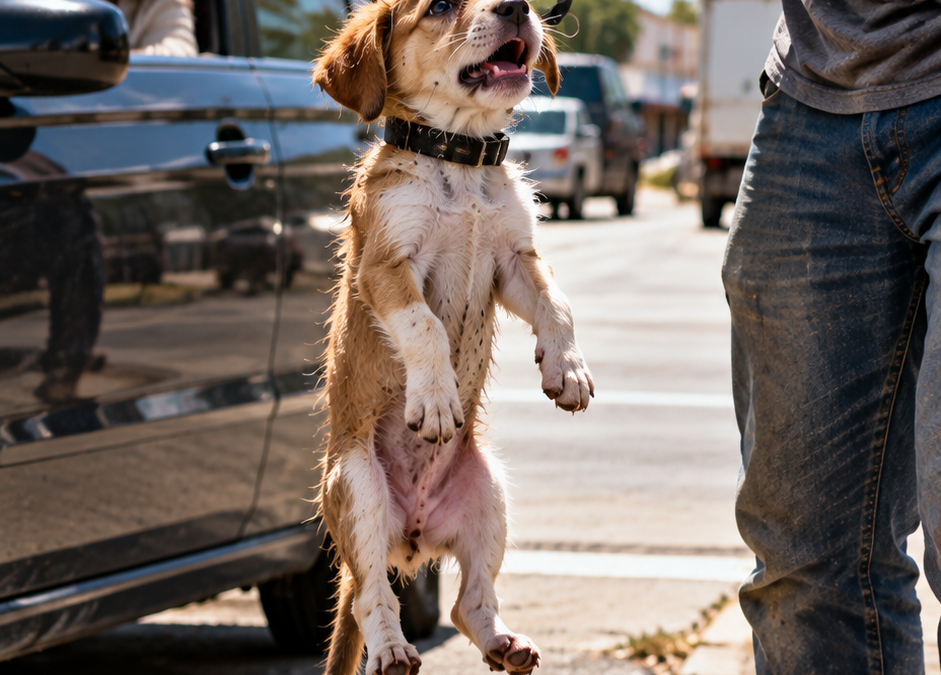
The man lifted the puppy by his leash and collar, raising him off the ground until his paws could no longer touch the pavement.
The puppy immediately began struggling.
His legs kicked desperately beneath him.
His little body twisted as he tried to escape the pressure around his neck.
Then he started crying.
I can still remember that sound.
It wasn’t the ordinary whimper of a puppy who wanted attention or the playful yelp of a dog startled during a game.
It was a sustained, desperate cry.
The sound of an animal in immediate distress.
The man continued holding him suspended while yelling.
I sat frozen behind my steering wheel, unable to believe that what I was witnessing was actually happening.
For approximately forty-five seconds, the puppy struggled.
Forty-five seconds.
I have thought about that length of time more often than I can count.
When you’re waiting for a traffic light to change, forty-five seconds can pass without your noticing.
When you’re standing in a grocery store line, it is barely enough time to become impatient.
But when you’re watching a helpless animal struggling to breathe, every second feels unbearably long.
I wanted the man to lower him.
I wanted the puppy’s paws to touch the ground.
I wanted someone closer to intervene before something irreversible happened.
Instead, the puppy’s movements began to weaken.
His frantic kicking slowed.
The cries became less frequent.
And then, with a suddenness that still makes my stomach tighten whenever I remember it, he went limp.
His little body stopped fighting.
The silence was worse than the screaming.
For several seconds, I couldn’t move.
My hands were gripping the steering wheel so tightly that my fingers hurt.
I remember staring toward the man and the motionless puppy, struggling to understand whether the animal had just lost consciousness or something far worse had happened.
I knew I needed to do something.
I also knew that confronting an already angry stranger could put both me and the puppy in additional danger.
I found a safe place to stop and reached for my phone.
My hands were trembling so badly that I had difficulty entering the information I needed.
I contacted the Houston SPCA.
When someone answered, I began explaining what I had witnessed.
At first, my words came out too quickly.
I described the location, the man, the puppy, and the terrifying moment when the animal had stopped moving.
Then I forced myself to slow down.
There could be no confusion about what I had seen.
A young dog had attempted to escape.
The man caught him.
He lifted the animal by the leash until the puppy was suspended in the air.
The puppy cried and struggled.
Then he lost consciousness.
I repeated the location carefully.
I explained that the animal needed urgent help.
When the call ended, I sat in my car for several moments, staring at the road ahead.
I felt sick.
I had witnessed cruelty before, although never anything quite like this. I knew animals could suffer terrible abuse behind closed doors, where nobody outside the home could see what was happening.
But this had occurred in a public place.
On an ordinary street.
In the middle of an ordinary afternoon.
And the victim was a puppy barely five months old.
I couldn’t stop thinking about how young he looked.
He should have been chasing toys, discovering unfamiliar smells, and falling asleep after exhausting himself with the boundless energy of puppyhood.
Instead, I had watched him struggle helplessly while someone held him suspended by his neck.
I didn’t know his name.
I didn’t know where he lived.
I didn’t know whether anyone had ever treated him gently.
But I knew I couldn’t simply continue driving and pretend that the experience belonged to someone else’s life.
After some time, I drove back through the area.
I was frightened of what I might discover.
Part of me was afraid that the puppy would no longer be alive.
Another part was terrified that I would see him being hurt again.
When I returned, I was relieved to discover that he was still alive.
But that relief was accompanied by an awful understanding.
Surviving what I had witnessed didn’t mean he was safe.
He still needed help.
The image of his small, struggling body followed me home that evening.
I tried doing ordinary things.
I prepared dinner.
I washed dishes.
I answered messages.
But every time the house became quiet, I remembered the puppy’s cries.
And every time I remembered those cries, I heard the silence that had followed them.
I wondered whether the Houston SPCA would be able to locate him.
I wondered whether the man would cooperate with investigators.
I wondered how badly the puppy had been injured.
Most frightening of all, I wondered whether he would still be alive when someone reached him.
I didn’t know then that the report I had made would help begin an investigation that would eventually lead to a felony conviction.
All I knew was that somewhere in Houston, a severely injured puppy was still waiting for someone to protect him.
The following day, Houston SPCA investigators went to the area identified in the report.
I wasn’t present when they met the man, and I wouldn’t learn the full details of their investigation until much later.
But the information that eventually emerged in court documents confirmed that my concerns had been justified.
The man was identified as Carrick Green, a forty-four-year-old Houston resident.
The puppy’s name was Jinx.
And the condition investigators found him in was devastating.
Jinx could barely stand.
His hind legs were severely swollen.
An open wound on his neck revealed serious damage in an area that had already endured the pressure of his leash and collar.
He was underweight, injured, and clearly in need of veterinary treatment.
Reading those details later made my chest tighten.
I had spent the previous evening hoping that he might somehow have escaped the worst consequences of what I witnessed.
Perhaps he had recovered consciousness quickly.
Perhaps he had been given water and allowed to rest.
Perhaps the apparent injuries were less serious than I feared.
But the investigators’ findings destroyed those fragile hopes.
Jinx wasn’t simply frightened.
He was badly hurt.
According to court records, Green offered investigators an explanation for the puppy’s condition.
He claimed that Jinx had gotten loose and become stuck in a fence. When Green attempted to pull him free, he reportedly said, the puppy bit him.
The investigators documented his account.
But the physical condition of the animal and the reported incident required further examination.
Jinx couldn’t explain his injuries.
He couldn’t describe where his pain had started or what had happened before the witness saw him.
The investigators had to rely on the evidence available to them.
That included the witness report, the puppy’s visible injuries, and the statements they gathered during their visit.
Another concerning detail emerged when Green stepped away from the interview.
His wife spoke with investigators.
According to the court documents, she said she hadn’t personally witnessed him abusing Jinx.
But she also expressed that she didn’t trust him with the puppy when he was angry with her.
That distinction mattered.
She hadn’t claimed to see something she hadn’t witnessed.
She had, however, described a concern about leaving the puppy in his care under certain circumstances.
Investigators had to evaluate those statements alongside the physical evidence and the original report.
The result was a decision that would change Jinx’s life.
Authorities obtained a warrant to seize him so he could receive the medical attention he desperately needed.
When I eventually learned that he had been removed from the home, I felt a kind of relief I hadn’t experienced since the afternoon I first saw him.
For the first time, I knew that Jinx was no longer dependent on the man I had witnessed hurting him.
But getting him out of that situation was only the beginning.
His body had already suffered terrible damage.
And the veterinary examination would reveal injuries far more severe than anyone could dismiss as a frightened puppy’s unfortunate accident.
At the veterinary clinic, the medical team began assessing Jinx’s condition.
The examination uncovered a shattered right femur.
The femur is the large bone in the upper part of the hind leg. Breaking it is a serious injury for any dog, but for a young puppy already weakened by poor physical condition and other wounds, the consequences can be especially severe.
Jinx also had extensive lacerations.
Some injuries were so painful that he cried when the affected areas were touched.
The wound on his neck remained a major concern.
He had severe swelling in his hind legs, and further testing raised concerns about possible trauma to his bladder or a bladder infection.
The urine analysis alone couldn’t establish which explanation was responsible for those findings.
But considered together, the injuries painted a deeply disturbing picture of the suffering Jinx had endured.
I remember the first time I read about his shattered leg.
I stopped and stared at the words.
I could picture him struggling to run away that afternoon.
I remembered the frantic movement of his little paws.
And I wondered how much pain he had already been experiencing before the incident I witnessed.
There were questions I couldn’t answer.
The exact sequence that caused every individual injury wasn’t something I had seen.
I didn’t know how long his femur had been broken or precisely when each wound had occurred.
What I knew was that a five-month-old puppy had been found unable to stand, with a severely damaged leg, extensive wounds, and unmistakable evidence that he needed urgent treatment.
That reality was difficult enough.
As I learned more about his condition, I became increasingly aware of how much courage was required of the people caring for him.
Rescuing an injured animal is often described as a single heroic moment.
Someone discovers a suffering creature.
They lift the animal into a vehicle.
They rush to a veterinary clinic.
And eventually, a happy photograph appears showing the animal resting comfortably beneath a blanket.
But the reality is far more complicated.
The moment an animal reaches safety, the long work of recovery begins.
There are examinations to perform, injuries to assess, treatments to consider, and difficult decisions to make.
There are animals who are too frightened to understand that the unfamiliar people touching them are trying to help.
There are exhausted veterinary professionals who must balance the urgency of treatment against the risk of causing additional pain.
And there are days when progress is measured not by dramatic improvements but by something as simple as an animal eating a little more comfortably or resting without constant distress.
Jinx’s injuries required significant medical treatment.
His broken femur was especially serious.
I had hoped that once he received proper care, the damage to his leg might be repaired and he would eventually recover the ability to run normally.
But the destruction was too severe.
Veterinarians ultimately had to perform a partial amputation of the affected limb.
When I learned about the surgery, I felt an enormous sadness.
Jinx was only five months old when his suffering became known.
He had barely begun his life.
And now, before he had even finished growing, part of one leg had been permanently lost.
I thought about the endless energy of healthy puppies.
The awkward running.
The playful leaps.
The way they sometimes move faster than their coordination allows and tumble over their own paws.
I wondered what Jinx might have been like before he was injured.
Perhaps he had been naturally playful.
Perhaps he loved chasing anything that moved.
Perhaps he had once been an affectionate little dog who followed people around, delighted by every scrap of attention.
I couldn’t know.
And it hurt to realize how little anyone outside his former home knew about the life he had lived before investigators removed him.
The details available to me concerned his injuries, his medical treatment, and the investigation.
They couldn’t tell me what he had once enjoyed or whether anyone had given him the affection he deserved.
But they did tell me that he had survived.
And as painful as the amputation was to contemplate, the surgery represented an attempt to give him a future beyond those terrible injuries.
A future in which his pain could be treated.
A future in which he could recover without remaining trapped in the circumstances that had brought him so close to death.
A future in which being young and vulnerable wouldn’t mean being defenseless.
Photographs released by the Houston SPCA offered glimpses of Jinx during his recovery.
The first time I saw them, I had to prepare myself.
I remembered the puppy’s cries.
I knew he had suffered severe injuries.
But seeing a photograph of a young dog recovering after such extensive medical treatment made everything feel immediate again.
There he was.
Jinx.
No longer just the terrified puppy from that afternoon.
He was a living animal with a face, a name, and an opportunity to heal.
In one photograph, he appeared thin and vulnerable, wearing a protective medical cone.
Other images showed him resting as people cared for him.
One photograph captured a particularly tender moment: a person gently comforting him while he lay on a towel inside an open carrier.
I looked at that picture for a long time.
There was something deeply moving about the simplicity of it.
A hand resting gently against a wounded dog.
A quiet moment of reassurance.
No raised voice.
No sudden movement.
No pressure around his neck.
Just human contact offered for comfort.
I found myself thinking about the contrast between that image and the scene I had witnessed.
Both involved human hands and the body of a helpless puppy.
But the meaning of those interactions couldn’t have been more different.
On the street, I had watched Jinx desperately struggle while someone controlled his movements.
In the recovery photographs, I saw people using their hands to protect and comfort him.
I hoped that, in time, those gentle experiences would become more familiar to him than the fear he had endured.
I couldn’t know exactly how he experienced his recovery.
I wasn’t there to watch every treatment or witness the details of his rehabilitation.
But I understood that physical healing was only one part of what he needed.
He also deserved a life in which human contact could become predictable and safe.
He deserved to discover that a leash didn’t have to mean pain.
That approaching footsteps didn’t have to mean danger.
And that the people responsible for his care would respond to his vulnerability with patience rather than anger.
As the investigation continued, I found myself returning repeatedly to one question.
What would have happened if nobody had reported what they saw?
It was a question I couldn’t answer with certainty.
Jinx might have been discovered by someone else.
Another witness might have contacted authorities.
Perhaps his condition would eventually have prompted intervention.
But I couldn’t assume any of those possibilities would have occurred in time.
The report had brought investigators to the area.
Their examination of Jinx had revealed his terrible condition.
And the evidence they gathered helped them obtain the warrant needed to remove him.
It wasn’t a simple sequence of events.
There were decisions, procedures, medical assessments, and legal requirements that had to be satisfied.
But it had begun with a witness who recognized an animal in danger.
I had spent so much time feeling helpless about the incident that I sometimes forgot the significance of that first call.
I couldn’t erase what I had seen.
I couldn’t undo the injuries Jinx had already suffered.
And I couldn’t personally guarantee that the investigation would produce a conviction.
But I had been able to report what happened.
I had been able to describe what I witnessed.
And that information had become part of a much larger effort to protect him.
As the months passed, I continued following the case whenever reliable information became available.
There were long stretches when I knew very little.
Investigations don’t always proceed quickly, and legal cases involve details that aren’t immediately available to the public.
I understood that.
But understanding didn’t make the waiting easy.
Whenever I saw an animal cruelty story appear in the news, I thought about Jinx.
I wondered whether he was gaining strength.
Whether his wounds had healed.
Whether he had learned to move comfortably after his surgery.
And whether he had begun to recognize the people caring for him as sources of safety.
Some nights, I returned to the memory of his final cry.
Other nights, I tried replacing that memory with the photographs of him receiving veterinary care.
I wanted those images to become the ones I remembered most clearly.
Not the suffering.
The recovery.
Not the moment he went limp.
The fact that he had survived.
But there was still another part of his story that needed to unfold.
The investigation had identified Green and documented the evidence surrounding Jinx’s injuries.
The case would eventually move through the criminal justice system.
I knew that legal proceedings couldn’t restore Jinx’s damaged leg or erase his suffering.
But I also understood that the evidence mattered.
Witness statements mattered.
Veterinary findings mattered.
And the careful work of investigators mattered.
In an animal cruelty case, the victim cannot enter a courtroom and describe what happened.
The animal cannot explain the meaning of a wound or identify the person responsible for causing it.
Instead, the case depends on people who observed relevant events, professionals who can evaluate physical evidence, and investigators who can connect that evidence to the applicable law.
I thought about the veterinarian who examined Jinx’s shattered femur.
The investigators who documented his open neck wound and severe swelling.
The people who reviewed his medical findings.
And the witness statement describing the approximately forty-five seconds during which he had been suspended by his leash.
Each piece of information served a different purpose.
Together, they helped establish what had happened to a puppy who couldn’t speak for himself.
The case also took an unexpected turn when officers arrested Green.
According to information released by the Harris County Precinct 1 Constable’s Office, deputies took him into custody on an animal cruelty warrant in July 2025.
During the arrest, they found a handgun inside his backpack.
Because Green was a convicted felon, the discovery resulted in an additional criminal charge involving unlawful possession of a firearm.
That charge was legally distinct from the animal cruelty case.
I remember feeling overwhelmed by the growing seriousness of the proceedings.
The afternoon I had witnessed had begun with a frightened puppy trying to escape.
Now the investigation involved felony animal cruelty, extensive veterinary evidence, an arrest, and a separate firearm offense.
But throughout everything that followed, I tried to keep my attention on the animal whose suffering had started the case.
Jinx.
The five-month-old puppy who had cried until he lost consciousness.
The young dog whose shattered femur required a partial amputation.
The frightened animal whose life had depended on the intervention of strangers.
His recovery mattered to me more than any headline.
And eventually, I received the news I had been hoping for.
Jinx had been adopted.
When I first learned that he had found a new family, I read the announcement more than once.
After receiving veterinary care through the Houston SPCA and recovering from his injuries, Jinx had been welcomed into a permanent home.
The publicly available information didn’t describe every detail of his new life.
I didn’t know what his adoptive family’s house looked like.
I didn’t know whether he preferred sleeping on a dog bed or curling up beside someone on the couch.
I didn’t know whether his favorite toy was a stuffed animal, a rubber ball, or something he had discovered by accident.
And I didn’t know precisely how quickly he had adjusted to living with the effects of his amputation.
But I knew he had survived.
I knew he had received the care necessary to recover.
And I knew he had been adopted by people who had chosen to bring him into their lives.
That information meant more to me than I can adequately explain.
For months, Jinx had occupied a painful place in my memory.
Whenever I thought about him, I saw the terrible moment when his body stopped moving.
Now, for the first time, I had a different image to hold onto.
I could imagine him resting in a safe home.
I could imagine someone speaking his name gently.
I could imagine a family learning his habits, discovering what made him happy, and helping him adjust to his physical limitations.
Those were images I created in my own mind, not details I had witnessed.
But the fact underlying them was real.
Jinx had a new home.
And the possibility of an ordinary, affectionate life had finally become part of his future.
I found myself thinking about how little dogs ask of us.
They don’t understand the complicated obligations that humans create around ownership.
They don’t read laws or recognize legal boundaries.
They don’t know that a person responsible for an animal has a duty to provide appropriate care and protection.
They simply experience the world through the people and circumstances surrounding them.
A gentle voice can become a source of reassurance.
A predictable meal can become part of a comforting routine.
A familiar hand can communicate safety.
And a frightening experience can leave an animal uncertain about whether the next human interaction will bring comfort or harm.
Jinx had been placed in circumstances where those basic expectations were violently disrupted.
His new family had the opportunity to offer him something different.
Consistency.
Protection.
Medical care when he needed it.
And affection that didn’t disappear when he was frightened, injured, or difficult to manage.
I hoped that one day he would be able to approach a leash without remembering what had happened on that street.
I hoped that he would become comfortable enough to explore his surroundings, play, and enjoy the ordinary pleasures of being a dog.
Most of all, I hoped that the people who adopted him would eventually know him primarily through his personality rather than his medical history.
I wanted Jinx to become more than the puppy who survived a terrible act of cruelty.
I wanted him to have the freedom to become himself.
While Jinx was beginning his new life, the criminal case continued toward its conclusion.
In 2026, the legal outcome was reported publicly.
Carrick Green pleaded guilty to felony animal cruelty.
He received a ten-year prison sentence for that offense.
He also received a separate ten-year sentence for unlawful possession of a firearm by a felon.
The reports didn’t establish in the information available to me whether those sentences would be served concurrently or consecutively, so I didn’t try to turn them into a combined total.
The important facts were clear.
Green had pleaded guilty.
The animal cruelty case had resulted in a substantial prison sentence.
And the investigation that began with the report of a puppy being suspended by his leash had reached a formal legal conclusion.
I remember sitting quietly after reading the news.
For a long time, I didn’t know exactly what I was feeling.
Relief was certainly part of it.
So was sadness.
I thought about the extent of Jinx’s injuries and everything he had lost before he had even reached adulthood.
I thought about the hours the veterinary team must have devoted to his treatment.
I thought about the difficult decisions surrounding his surgery and the effort involved in helping an animal recover from such severe trauma.
And I thought about the simple fact that none of those things should ever have been necessary.
Jinx should have been safe long before anyone had to obtain a warrant to remove him.
He should have received appropriate care before his injuries became so severe.
He should have been able to run, play, and explore the world without fearing the person responsible for protecting him.
The conviction couldn’t restore those lost experiences.
But it did establish criminal accountability for the conduct at the center of the case.
For me, the sentence also marked the end of a long period of uncertainty.
The event I witnessed had not disappeared into a forgotten report.
The evidence had been investigated.
The legal process had reached a conclusion.
And Jinx had survived long enough to begin a new life far removed from the circumstances that had brought him to public attention.
I returned to the photographs released during his recovery.
This time, I didn’t immediately think about the worst moment of his suffering.
I noticed his face.
He was a young pit bull, with the broad little head and expressive eyes that can make puppies seem both extraordinarily determined and completely innocent.
Even in the medical photographs, there were glimpses of the dog he might become once he felt comfortable and secure.
I smiled at one picture in particular.
He was resting while someone gently comforted him.
There was something peaceful about the way he lay against the towel.
I couldn’t know what he was thinking.
I couldn’t claim that he understood the investigation, the conviction, or the chain of events that had brought him to safety.
But I could see that he was receiving care.
And I knew from the later adoption announcement that the story hadn’t ended in that veterinary recovery area.
He had gone home.
That was the part I wanted to remember.
The criminal case would remain in the public record.
The photographs of his injuries would continue circulating whenever someone discussed the incident.
And his name would probably remain connected to the cruelty he had endured.
But Jinx himself didn’t have to spend his future inside that story.
He had an entirely different life ahead of him.
One that no longer depended on the outcome of a criminal investigation.
One in which he could form new relationships, develop familiar routines, and experience the security that every companion animal deserves.
I hoped his new family would discover the little things that made him unique.
Perhaps he loved greeting people at the door.
Perhaps he had a favorite place to sleep.
Perhaps he became excited whenever someone prepared his meals.
Perhaps he had learned to move with extraordinary confidence despite losing part of his leg.
I didn’t know which of those possibilities described him.
The available reports didn’t tell me.
But I liked knowing that somewhere, beyond the photographs and court documents, Jinx was living an ordinary life with people who had chosen him.
And in the end, that possibility brought me more peace than the prison sentence alone ever could.
I still remember that afternoon in July 2025.
I remember the heat.
The traffic.
The frightened puppy trying to escape.
I remember the man lifting him until his paws no longer touched the ground.
And I remember the terrible silence that followed approximately forty-five seconds of struggling.
Those memories haven’t disappeared.
Perhaps they never will.
But they are no longer the only memories I associate with Jinx.
I also remember reading that investigators had obtained a warrant to remove him.
I remember the relief of learning that he had received veterinary treatment.
I remember the sadness I felt when I discovered that his shattered femur had required a partial amputation.
And I remember the extraordinary comfort of learning that he had recovered and been adopted.
The case reached its legal conclusion when Green pleaded guilty and received his sentences.
But Jinx’s story continued beyond the courtroom.
It continued in the care he received from the Houston SPCA, in the recovery that made adoption possible, and in the home where his new family could finally give him the stability he had been denied.
I sometimes think about the contrast between two moments.
In the first, Jinx was a frightened five-month-old puppy suspended helplessly in the air, struggling until his body went limp.
In the second, he was a rescued dog recovering from extensive injuries, receiving gentle care from people who were working to help him heal.
Between those moments stood a witness report, an investigation, a seizure warrant, and the efforts of veterinary professionals who treated the damage they found.
And beyond them stood something even more important.
A new home.
I don’t know exactly what Jinx was doing on the day the prison sentence was announced.
Perhaps he was sleeping.
Perhaps he was eating breakfast.
Perhaps he was resting beside someone who loved him.
Whatever that day looked like, I hope the ordinary comforts of his new life mattered far more to him than the events unfolding in court.
Because the puppy I saw on that Houston street deserved more than survival and a criminal conviction.
He deserved a life in which his next meal, his next comfortable rest, and his next affectionate interaction were no longer uncertain.
And when I think about him now, I try to imagine him moving confidently through his new home, carrying none of the legal significance that humans have attached to his story.
Just Jinx.
A young dog who survived terrible injuries.
A dog whose body had changed permanently but whose future had not ended with his suffering.
A dog who had finally been given the opportunity to live somewhere safe.
I still hear the silence that followed his cries.
But now, whenever that memory returns, I remind myself of something I didn’t know on the day I reached for my phone.
Jinx survived.
He received treatment.
He recovered.
And somewhere in a home of his own, the puppy who once struggled helplessly at the end of a leash finally has people whose responsibility is to keep him safe.








