𝗙𝗨𝗟𝗟 𝗦𝗧𝗢𝗥𝗬 I Still Hear the Little Boy Crying Whenever I Think About That Drain
𝗙𝗨𝗟𝗟 𝗦𝗧𝗢𝗥𝗬
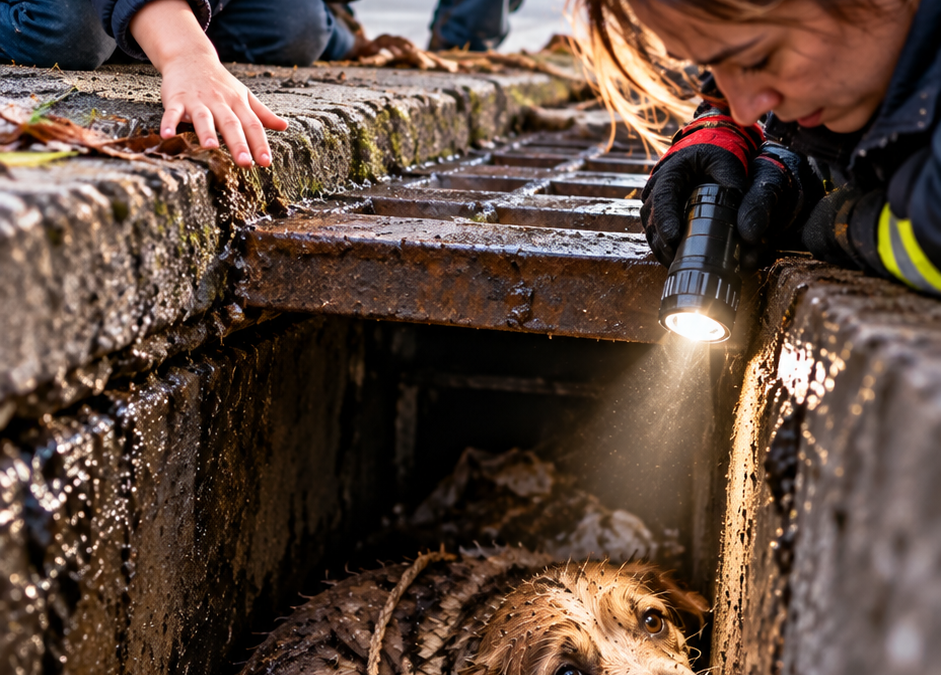
Then I returned my attention to the dog.
We needed to get him out.
The next several minutes were among the most difficult I have ever experienced during a rescue.
We worked carefully around the restraints, trying to loosen and remove them without forcing his injured body into a different position.
Every movement required thought.
Every change in pressure made him flinch.
At one point, I slipped my hand beneath part of the rope and felt how tightly it had been pulled against him.
I could not understand what kind of person could do something like that.
I had seen animals abandoned beside roads, left outside empty houses, and chained without food or water. I had seen injuries caused by deliberate cruelty.
Yet something about this dog made the scene especially unbearable.
Someone had not merely abandoned him.
Someone had restrained him in a place where escape was impossible.
He had been left alone with his pain, his fear, and whatever water he could reach.
My colleague worked beside me in silence.
When we finally loosened part of the restraint, the dog tried to shift his body.
He screamed again.
“Don’t move him yet,” I said.
My colleague stopped immediately.
The dog lowered his head and closed his eyes.
For a few terrible seconds, I thought he might be slipping away.
I touched him gently, avoiding the injured areas.
“Stay with us.”
His eyes opened again.
I had no idea whether he understood the words. Perhaps he recognized nothing more than the change in my voice.
But I kept talking.
I told him that we were going to take him somewhere safe. I told him that there would be clean water and a soft place to sleep. I told him that nobody on our team would leave him behind.
Mostly, I needed him to keep looking at me.
Because as long as those frightened eyes followed my face, I could believe there was still a chance.
We offered him water.
For the first time since our arrival, he responded with something other than fear.
His tongue moved toward the container.
He began drinking.
The sight of him swallowing made my throat tighten.
He was desperately thirsty.
We allowed him to drink carefully, watching his response and trying not to overwhelm his weakened body.
His attention remained fixed on the water.
For a moment, the tension in his face seemed to soften.
Then something changed.
Perhaps the water gave him just enough energy to attempt an escape. Perhaps the presence of so many strangers finally overwhelmed him. Perhaps he was simply following the instinct that had kept him alive for so long.
Whatever the reason, he suddenly tried to run.
His front legs shifted.
His body jerked against the remaining restraints.
And then everything went wrong.
His legs could not support him.
He cried out, struggled, and collapsed back into the drain.
The sound of his body hitting the filthy concrete sent a cold wave through me.
“Easy! Easy!”
I reached toward him, careful not to pull on his injured limbs.
My colleague steadied the portion of his body we could reach.
The dog was panicking now, and the more he struggled, the more obvious it became that something was seriously wrong with his coordination.
His mind was telling him to escape.
His body could not obey.
I have never forgotten that moment.
There is something devastating about watching an animal try to perform the most natural act of self-preservation and discovering that even running away is beyond its strength.
The dog had been hurt so badly that the very instinct meant to protect him was causing him more pain.
I heard somebody behind me begin to cry.
I did not turn around.
If I had looked at the little boy or his mother, I was afraid I might lose the composure I needed to finish the rescue.
I focused on the dog’s breathing.
“You’re okay,” I whispered. “Don’t fight us. Just stay with me.”
But he was not okay.
And pretending otherwise would not help him.
We urgently needed additional support.
When the rest of our team arrived, we explained the situation and prepared to remove him with as little movement as possible.
One rescuer assessed the available space while another brought the equipment we needed to support his body.
I stayed near his head.
By then, he seemed exhausted beyond anything I could properly describe.
His earlier panic had faded into a frightening stillness.
He was conscious, but his responses were slow. His breathing remained shallow, and his eyes occasionally drifted away from us before returning.
I kept thinking about his head injury.
There were no obvious answers beneath that road. We could not determine the full extent of his injuries by looking at him, and every additional minute inside the drain was another minute without medical treatment.
“We need to move now,” I said.
Nobody disagreed.
Working together, we removed the remaining restraints and carefully supported his body for extraction.
We avoided twisting him and kept his movement as controlled as the circumstances allowed.
He whimpered when we began lifting him.
Then his body tensed, and another terrible cry escaped his throat.
I felt the muscles in my arms tighten instinctively.
“Almost there,” I whispered.
The dog could not understand that every painful movement was bringing him closer to safety.
He could not see the veterinary clinic waiting at the end of the drive.
All he knew was that his body hurt and unfamiliar people were carrying him away from the place where he had been trapped.
For a moment, I wondered whether he believed we were taking him somewhere worse.
That thought nearly broke me.
Then, finally, he was out.
We laid him carefully on the prepared support and checked his breathing.
In the daylight, his condition looked even worse.
Filth clung to his fur. His body appeared painfully weak, and the position in which he held himself suggested that even small movements could cause considerable pain.
I could see his eyes more clearly now.
They were filled with fear.
But he was alive.
I looked toward the little boy.
He stood very still beside his parents, staring at the dog we had pulled from the drain.
“Is he safe now?”
I wanted to tell him yes.
Instead, I crouched beside him.
“He’s out of there. We’re taking him to a doctor.”
The boy looked at the dog again.
“Please don’t let him go back.”
I felt those words settle somewhere deep inside me.
“He won’t go back there.”
His mother thanked us while his father tried to comfort him.
I barely remember what I said in response.
My attention was already on the animal lying beside our vehicle.
We had removed him from the drain.
Now we had to find out whether we had reached him in time.
The journey to the veterinary clinic felt longer than it actually was.
One of my colleagues drove while I stayed near the injured dog, watching his breathing and monitoring his response.
Usually, our rescue vehicles are filled with conversation during an emergency. We exchange information, discuss possible injuries, and prepare the clinic for the animal we are bringing in.
That afternoon, however, there was very little to say.
We had already contacted the veterinary team.
They knew we were transporting a severely injured dog who had been found tied inside a roadside drain.
The rest of the journey passed in a silence broken only by the sound of the engine and the occasional movement of the animal beside me.
Every time he shifted, I looked down.
Every time his breathing changed, my heart seemed to stop.
I remember studying the shape of his face.
Beneath the dirt, pain, and fear, he was an ordinary dog.
He might once have slept beside someone’s bed. He might have known the sound of a food bowl being placed on the floor. Perhaps he had been born on the streets and had never experienced a safe home at all.
We knew nothing about his previous life.
We did not know his age with certainty, how long he had been abandoned, or who had tied him up.
We knew only that he had suffered terribly and that his survival now depended on people he had every reason to distrust.
I kept one hand near him without forcing contact.
Occasionally, I spoke his way.
“You’re doing good.”
He looked at me once.
It was a brief glance, almost lost beneath his exhaustion.
But I held on to it.
By the time we reached the clinic, I had made a private decision.
Whatever happened next, this dog would not face it alone.
The veterinary staff met us as soon as we arrived.
We explained how he had been found, the restraints around his body, the extreme pain he displayed when touched, and the failed attempt to stand.
The veterinarian listened carefully while examining him.
The first priorities were stabilization, hydration, pain management, and determining the extent of his injuries.
I stood nearby while the team began working.
The clinic smelled of disinfectant, medication, and clean bedding.
After the stagnant water and filth inside the drain, even that familiar clinical smell brought me an unexpected sense of relief.
He was finally somewhere designed to help him heal.
But safety and recovery were two very different things.
The veterinarian gently checked his gums.
They were pale.
His skin was dry, and his response to a basic hydration assessment was concerning.
“He is severely dehydrated,” the veterinarian explained.
I looked down at him.
His eyes followed the movement of the staff, but he seemed too exhausted to protest.
As they examined his fur, they discovered ticks buried beneath the thick, dirty coat.
The more carefully they inspected him, the clearer it became that his suffering had not begun the moment he was placed inside the drain.
His body had been neglected.
His skin was in poor condition.
He was weak, filthy, dehydrated, and covered with parasites.
I wondered how long he had been living without anyone caring enough to notice that he needed help.
“Can we clean him?” I asked.
“As soon as it’s safe. First, we need to stabilize him.”
I nodded.
Of course.
In my mind, I had already begun imagining him clean, resting comfortably, and eating a proper meal.
But his body needed much more than kindness.
He needed medical treatment, careful handling, and time.
The veterinarian continued the examination, paying particular attention to his head and neurological responses.
His poor coordination, abnormal posture, and severe pain were deeply concerning.
We waited while the team assessed him.
I have never enjoyed waiting for a diagnosis.
During a rescue, there is always something to do. You can carry equipment, contact another team member, clear a path, or comfort an injured animal.
Inside a clinic, those responsibilities gradually pass to the medical professionals.
You are left with the part of rescue that nobody can train you to tolerate.
The uncertainty.
I watched through the doorway while the veterinarian examined him and the staff administered the treatment he needed.
I kept remembering the drain.
His body twisted against the concrete.
The ropes.
The water.
The terrible scream when I first touched his shoulder.
I could not stop wondering whether we had made his injuries worse while trying to save him.
My colleague seemed to understand what I was thinking.
“We got him out as carefully as we could.”
“I know.”
“You saw how little room we had.”
“I know.”
But knowing that we had done our best did not make the waiting easier.
Eventually, the veterinarian returned with the findings.
The dog had suffered blunt force trauma to the head.
He had a traumatic brain injury.
For several seconds, I simply listened.
The diagnosis explained the poor coordination and his inability to control his movements properly.
It also explained why his recovery might be far more complicated than we had initially hoped.
The veterinarian told us that surgery was not required at that stage.
That was the first piece of reassuring news we had received since arriving at the drain.
However, he still needed medication, fluids, monitoring, and extensive supportive care.
And there were no guarantees about how quickly his neurological function would improve.
“Will he walk again?” I asked.
The veterinarian paused.
“We need to see how he responds to treatment.”
I hated that answer.
Not because it was wrong, but because it was honest.
I wanted somebody to promise that the dog would be running within a few weeks, that the injuries would disappear, and that the terrible experience beneath the road would become nothing more than a distant memory.
But brain injuries do not heal simply because the people around the patient desperately want them to.
Some symptoms may improve quickly.
Others can persist for months.
And some damage may never fully resolve.
I looked through the doorway again.
He was lying quietly while the staff cared for him.
For the first time that afternoon, he had a clean surface beneath his body.
It seemed like such a small thing.
Yet after seeing where we had found him, I could hardly look at it without becoming emotional.
That was when we began discussing a name.
Until then, we had called him the dog from the drain, our emergency rescue, or simply sweetheart whenever we approached him.
But I did not want him to remain an anonymous victim defined only by the place where someone had abandoned him.
My colleague suggested Bruno.
I repeated it softly.
“Bruno.”
The name suited him.
It sounded solid and warm, like something that belonged to a dog who might one day regain his strength.
I leaned toward him.
“How do you like that, Bruno?”
His eyes shifted toward me.
My colleague smiled.
“I think he approves.”
Perhaps he did.
Perhaps he was simply responding to the sound of my voice.
It did not matter.
He had a name now.
And from that moment forward, he was Bruno.
Over the next several days, our lives began revolving around his recovery.
His dehydration required careful treatment. His medications had to be administered consistently, and his condition needed close observation.
The veterinary team worked to address the immediate effects of his neglect while monitoring the neurological damage caused by his head injury.
Once his condition permitted it, he was cleaned.
Watching the filth disappear from his coat was unexpectedly emotional.
At the drain, I had struggled to see anything beyond his suffering. He had looked like a broken shape pressed into the concrete, more helpless than any living creature should ever be.
As the dirt came away, I began to see the dog beneath it.
His fur, though still in poor condition, no longer carried the smell of stagnant water.
The ticks were addressed.
His skin received the care it needed.
His body remained weak, but for the first time, he looked like an animal who was being cared for rather than discarded.
One afternoon, I stood beside him while a member of the veterinary staff prepared his food.
He noticed the bowl immediately.
His head lifted.
It was a small movement, but it startled me because he had spent so much of his time lying still.
“Are you hungry, Bruno?”
His eyes followed the bowl.
When the food was placed in front of him, he began eating with extraordinary urgency.
He swallowed every mouthful as though he feared somebody might take the food away before he had finished.
I watched him in silence.
There was something heartbreaking about his determination to leave nothing behind.
He ate until the bowl was empty.
Then he searched it again.
My colleague looked at me.
“Not a single crumb.”
I nodded.
The sight of an abandoned animal eating can be one of the most painful moments of a rescue.
Hunger has a way of revealing what an animal has endured without requiring any explanation.
Bruno could not tell us when he had last eaten a proper meal.
He could not describe the days he had spent searching for scraps or the desperation that might have driven him to trust a stranger.
But watching him eat told me enough.
He understood food as something uncertain.
Something that might vanish.
Something he could not afford to waste.
I wanted him to reach a point where he could leave a few bites behind simply because he knew there would always be another meal.
That became one of the quiet hopes I carried through his recovery.
The first stage of treatment was difficult.
Although Bruno had survived the drain and was receiving the medical attention he desperately needed, his neurological symptoms remained severe.
He struggled to coordinate his movements.
Even when he appeared eager to stand, his legs did not always respond the way he intended.
Some days, he managed to hold himself in a more stable position.
Other days, he seemed unable to make even the smallest movement without losing his balance.
The inconsistency was exhausting to watch.
I learned to measure his progress differently.
A calm night without obvious distress became something to be grateful for.
An improved appetite mattered.
The way his eyes followed us when we entered the room mattered.
The first time he relaxed enough to rest without constantly watching every movement around him, I felt an almost ridiculous surge of happiness.
I began to realize that recovery was not going to be one dramatic moment in which Bruno suddenly stood up and became the dog we imagined he could be.
It would be a series of small changes.
Some so subtle that only the people caring for him every day would notice.
And many accompanied by setbacks.
I remember one morning when he seemed particularly alert.
He had eaten well and was watching us with more interest than usual.
As I approached, he tried to adjust his position.
For a moment, I thought he might push himself upright.
His front legs shifted.
His shoulders rose.
Then his balance failed.
He sank back down.
I instinctively reached toward him, but he had already closed his eyes.
“That’s all right,” I whispered.
He looked so tired.
I could not tell whether he felt frustrated, frightened, or simply exhausted by the effort.
But I knew what I felt.
Helpless.
I wanted to give him the strength that his injured body could not yet produce.
I wanted to explain that every attempt mattered, even when it ended with him lying exactly where he had started.
Instead, I sat beside him and rested my hand gently near his shoulder.
“We’ll try again when you’re ready.”
He did not move.
But after a while, his breathing slowed, and he settled into a quiet sleep.
Those early weeks taught me how much patience genuine recovery requires.
There is a difference between saving an animal from immediate danger and helping that animal recover enough to live comfortably.
The first often happens in a matter of hours.
The second can demand months of work, repeated disappointments, and the willingness to celebrate improvements that other people might barely recognize.
Bruno needed the second kind of rescue as much as he had needed the first.
The veterinary team continued monitoring his condition.
As his medical needs changed, his care focused increasingly on helping him regain strength, mobility, and confidence.
We supported him through the movements he was able to tolerate.
We gave him opportunities to reposition himself and gradually attempt more activity without forcing his injured body beyond its limits.
And we watched.
Always watched.
His balance remained unpredictable.
Sometimes his legs seemed ready to support him, only for his body to lean suddenly in a direction he could not correct.
At other times, he would begin a movement and then stop, as though he could not quite remember how to complete it.
I found myself holding my breath whenever he made a new attempt.
One afternoon, he tried to lift himself while eating.
His attention was entirely on the food.
For the first time, he seemed more interested in reaching the bowl than in worrying about whether his body would cooperate.
He pushed upward.
His legs trembled.
Then he leaned too far and lost his balance.
We supported him and allowed him to settle safely.
He looked toward the bowl again.
“You’re a determined little guy, aren’t you?”
I moved the food within easy reach.
He finished eating.
And then he tried to lift himself again.
I laughed, although my eyes were already burning.
“Okay, Bruno. I see you.”
There were days when his determination frightened me because I worried he might push himself too hard.
But there was something deeply moving about watching a dog who had once been unable to escape a drain begin demanding more from his own body.
He was not content to remain where he was.
Even when the movement failed, even when his legs trembled, he kept showing us that he wanted to get up.
That desire became something we worked with rather than against.
We learned to recognize when he was too tired.
We learned which movements were especially difficult for him.
We learned that forcing progress would not help, but providing the right support at the right moment sometimes made a remarkable difference.
Most importantly, we learned to stop expecting every day to look better than the previous one.
Healing was uneven.
It demanded patience from everyone.
And no matter how determined Bruno appeared, his injured brain needed time.
During those months, I thought often about the little boy who had discovered him.
I remembered his small face, wet with tears, and the urgency in his voice when he begged us not to leave the dog behind.
I wondered whether he understood how serious Bruno’s injuries had been.
He had seen us lift the animal from the drain, and perhaps that moment had looked like the end of the rescue.
For me, it had been the beginning.
The boy had given Bruno a chance.
The veterinary team and our rescuers were now trying to turn that chance into a future.
I sometimes imagined how the boy might react if he could see Bruno eating in his clean enclosure, lifting his head when we entered the room, or struggling to stand beside his food bowl.
I hoped he would understand that his refusal to walk away had mattered.
But I also hoped he would never have to witness another animal suffering the way Bruno had.
By the end of the first month, Bruno had become part of our daily routine.
We checked on him constantly, discussed his progress, and celebrated every improvement.
We also worried.
There were times when his coordination seemed to improve, only for the next day to bring another struggle with balance.
There were mornings when he looked stronger and evenings when exhaustion seemed to erase that progress.
Whenever I became impatient, I reminded myself of the condition in which we had found him.
The filthy water.
The tight ropes.
The way he had screamed when I touched him.
He had survived trauma severe enough to leave him unable to move normally.
Expecting him to recover quickly was unfair.
Still, I could not stop hoping.
Every morning, I entered his room wondering whether that would be the day he surprised us.
And every evening, even when very little had changed, I told him he had done well.
Sometimes I wondered whether I was speaking to him or trying to reassure myself.
Perhaps both.
The second month brought gradual improvements.
Bruno was gaining weight.
His coat began to look healthier, and the hollowness in his body became less pronounced.
His appetite remained strong, although he no longer seemed quite as frantic whenever food appeared.
That change meant more to me than I expected.
The first time he paused during a meal and looked up instead of devouring every bite immediately, I smiled.
“There you go.”
He returned to his food.
I watched him eat at a more relaxed pace.
There was still nothing he enjoyed more than a good meal, but he was beginning to behave like a dog who believed food would be available again tomorrow.
His personality also started emerging from beneath the fear.
He became increasingly aware of what was happening around him.
He watched us enter and leave.
He responded to familiar voices.
And when we approached him gently, his expression no longer carried the same overwhelming terror that had filled his eyes inside the drain.
Trust did not arrive all at once.
It grew through repeated, ordinary experiences.
Hands that offered food.
Hands that adjusted his bedding.
Hands that supported him when his legs failed.
Hands that never struck him.
I could not erase the memory of what somebody had done to him.
But I could help him experience something different.
Every day, we showed him that human contact did not have to end in pain.
There were still moments when he startled or became uncertain.
When that happened, we slowed down.
We gave him space.
We let him recognize our voices and approach each new experience at a pace his body and confidence could manage.
I had seen frightened animals recover physically while remaining terrified of the people around them.
I desperately wanted Bruno to have more than the ability to walk.
I wanted him to feel safe.
One day, while I was sitting beside him, he shifted his head toward my hand.
I remained still.
He sniffed my fingers.
Then he allowed his head to rest against them.
It was such a simple gesture that another person might not have noticed anything unusual.
But I remembered the first time I had touched his shoulder.
I remembered the scream that had stopped everyone around the drain.
Now he was choosing to lean toward me.
I swallowed hard.
“Hello, Bruno.”
He closed his eyes.
I stayed there for a long time, barely moving.
I knew that one gentle moment did not mean all his fear had disappeared.
But it meant something.
For the first time, I felt that we were not simply teaching him to survive his injuries.
We were helping him discover that he could enjoy being alive.
The third month arrived with the slow accumulation of all those small efforts.
By then, Bruno’s strength had improved considerably, although his coordination remained a challenge.
He had begun making more determined attempts to support himself.
We continued working carefully with him, avoiding unnecessary strain while encouraging the movements he could manage.
Then came the day I had spent so many weeks imagining.
It began like countless other days.
Bruno was alert and interested in his surroundings. He had eaten, received the care he needed, and seemed ready for another attempt at standing.
I knelt nearby while a colleague positioned herself where she could support him if he lost his balance.
“All right, buddy,” I said. “Whenever you’re ready.”
Bruno shifted his front legs.
He pushed against the surface beneath him.
His shoulders rose.
I expected him to lean sideways as he had done so many times before.
But he kept pushing.
His hind legs trembled.
For a moment, his body wavered so dramatically that I nearly reached out.
“Easy,” my colleague whispered.
Bruno adjusted.
And then he stood.
Not for long.
Not gracefully.
His legs were shaking, and his body looked uncertain beneath the unfamiliar effort.
But all four paws were beneath him.
He was supporting his own weight.
I stared.
Three months.
Three months after we had pulled him from the drain, Bruno was standing on his own.
“Oh, my God.”
My colleague covered her mouth.
I wanted to shout with happiness, but I was afraid the sudden noise might startle him.
Instead, I lowered my voice.
“That’s it, Bruno. That’s it.”
He remained upright for a few precious moments.
Then his legs began to give way, and we helped him settle safely.
He looked exhausted.
I was trembling almost as much as he was.
My colleague began laughing through her tears.
“He did it.”
I looked at Bruno.
“Yes,” I whispered. “He did.”
I have witnessed many remarkable recoveries, but there is something uniquely powerful about the first time a severely injured animal manages to perform an ordinary movement again.
Standing is something healthy dogs do without thinking.
They rise to greet their families, investigate interesting smells, or run toward the sound of a food bowl.
For Bruno, standing had required three months of medical care, patience, and repeated attempts.
And even that brief moment was not the end of his struggle.
But it changed the way I looked at his future.
Until then, walking had felt like a distant possibility.
Now it felt like something we might eventually witness.
I went home that evening thinking about the dog I had first seen in the darkness.
I remembered his eyes following my flashlight.
I remembered how impossible it had seemed that his twisted, trembling body might someday carry him across a room.
And now he had stood.
For a few seconds, the animal who had once been unable to escape a filthy drain had supported himself on four unsteady legs.
I did not know how long it would take him to do it again.
I did not know whether he would ever recover enough to run.
But for the first time, I allowed myself to imagine a future in which Bruno could choose where he wanted to go.
The weeks that followed were full of cautious optimism.
Standing once did not mean Bruno could suddenly stand whenever he wished.
Some attempts were unsuccessful.
Others lasted only a moment.
His balance still failed unexpectedly, and his body tired easily.
But he had crossed an important threshold.
His muscles were becoming stronger, and his growing confidence encouraged him to attempt movements he had previously avoided.
We continued providing support and watching his responses.
Sometimes he stood long enough to look around before settling back down.
Other times he pushed upward only to discover that his legs were not ready.
On those days, I reminded him of what he had already accomplished.
“You’ve done this before.”
Of course, encouragement alone could not repair neurological damage.
But I had come to believe that the calmness of our voices and the consistency of our care helped him face each difficult attempt.
And gradually, he began doing more.
He could hold himself upright for longer periods.
He became better at correcting small shifts in his balance.
The awkward movements that had once seemed completely beyond his control began looking more purposeful.
He was still far from walking confidently.
Yet every improvement brought us closer.
I remember watching him try to stand beside his food one afternoon.
The smell of his meal had apparently convinced him that lying down was no longer an acceptable position.
He pushed himself upward.
His body leaned.
He corrected slightly.
Then he looked at the bowl.
I laughed.
“You really will do anything for dinner.”
He remained upright just long enough for me to feel an enormous surge of pride.
Then he settled down and began eating.
Watching him, I thought about the first bowl we had placed in front of him at the clinic.
Back then, he had eaten as if every mouthful might be his last.
Now he had enough strength to demand his dinner from a standing position.
There were still difficult days.
There were still moments when his body reminded us that recovery could not be rushed.
But the changes were becoming impossible to ignore.
Bruno was gaining weight.
His coat was improving.
His eyes had lost much of the frightened, haunted expression I remembered from the drain.
And his determination to move was growing stronger.
By the time the fifth month approached, we had started watching for something that once seemed almost unimaginable.
A real step.
Standing had been an extraordinary achievement, but walking demanded even more coordination.
Bruno needed to shift his weight, lift a paw, move it forward, and place it down while keeping the rest of his body balanced.
For a dog recovering from a traumatic brain injury, those movements were not necessarily simple.
He would sometimes begin an attempt confidently and then lose control as soon as he tried to move a leg.
Other times, he seemed to anticipate the difficulty and hesitate before shifting his weight.
We kept supporting him, adjusting our approach to his abilities, and allowing him time to rest.
I learned to distinguish between the moments when he needed assistance and the moments when he was trying to work something out for himself.
There were times when I wanted to reach forward and hold him immediately.
But I also understood that, within the limits of safe rehabilitation, he needed opportunities to develop control over his movements.
I could stand beside him.
I could support him when necessary.
I could protect him from falling.
But I could not take his steps for him.
One morning, almost five months after his rescue, Bruno stood with a determination I recognized immediately.
His attention was fixed ahead of him.
He shifted his weight.
One front paw lifted.
I felt my heart begin racing.
He moved the paw forward and placed it down.
For a moment, I hardly dared to believe what I had seen.
Then he moved again.
A small, awkward step.
And another effort to keep his balance.
I looked at my colleague.
“Did you see that?”
She was already staring at him.
“He’s walking.”
I turned back toward Bruno.
“Come on, sweetheart. You’ve got this.”
His legs trembled.
His movements were uncertain.
But he continued.
They were not the easy, confident steps of a healthy dog.
They were slow and uneven, each one demanding concentration.
But they were real.
After five months of treatment and rehabilitation, Bruno was taking his first steps.
I could barely see him through my tears.
I remembered the day we had carried him out of the drain, terrified that even moving him might cause additional injury.
Now he was moving himself.
I wanted to embrace him, but I knew better than to interrupt his concentration.
So I stayed close and watched.
One step.
Then another.
When he had done enough, we helped him rest.
I crouched beside him.
“You did it, Bruno.”
He looked at me with the same familiar eyes that had followed my flashlight from the darkness.
Only now, they no longer seemed filled entirely with fear.
I rested my hand gently against him.
For a moment, I could not speak.
All the long days, medical appointments, difficult movements, and uncertain nights seemed to gather around that single achievement.
Five months earlier, the idea of watching Bruno walk had felt almost impossible.
Now I had seen it happen.
But what moved me most was not simply that he had taken those steps.
It was that he had never been given a fair chance to live an ordinary life before his rescue.
Somebody had tied him up and abandoned him in a place where he might easily have died unseen.
And yet, after everything that had happened, he was still willing to trust us, eat from our hands, and struggle toward a future he could not possibly understand.
I thought about the little boy again.
His tears.
His refusal to leave.
His desperate question about whether the dog would survive.
I wished I could show him those first steps.
I wished he could see what his simple act of noticing had made possible.
The months that followed brought more changes.
Bruno’s early steps gradually became steadier.
He learned to move with increasing confidence, and the improvements in his strength allowed him to explore more of his surroundings.
There were still moments when I watched him closely, remembering how fragile his balance had once been.
But he was no longer the helpless animal who had needed us to carry him everywhere.
He was becoming independent.
One day, I watched him walk across an open area without the hesitation that had defined so much of his rehabilitation.
He moved forward, paused to investigate something interesting, and then continued.
There was no dramatic celebration.
No extraordinary event.
Just a dog walking because he wanted to.
And somehow, that ordinary moment felt even more beautiful than his first steps.
I had spent so much time imagining the day he would stand that I had almost forgotten the greater purpose behind all our efforts.
We were not trying to produce a remarkable recovery story.
We were trying to give Bruno the freedom to live like a dog.
To investigate smells.
To follow a familiar voice.
To decide when he wanted to rest.
To approach somebody for affection without fearing what might happen next.
To move away from anything that frightened him.
To experience the countless small freedoms that had been stolen from him when somebody tied those ropes around his body.
Watching him walk that day, I understood how much he had regained.
His body had changed dramatically.
He was stronger, healthier, and much more confident in his movements.
His coat had improved, and the fear in his expression had softened.
When I looked at him, I no longer saw only the image of an injured dog lying in filthy water.
I saw Bruno.
A curious, affectionate animal who had developed preferences, habits, and an unmistakable personality.
He still loved his food.
That never changed.
But he had become interested in much more than eating.
He wanted to explore.
He wanted to know where we were going.
And whenever something unfamiliar caught his attention, he approached it with a curiosity that made me smile.
I found myself wondering whether this was the personality he had always possessed.
Had he once been an adventurous dog before suffering whatever cruelty led him to the drain?
Or were we watching him discover a side of himself that he had never been safe enough to express?
There was no way to know.
But I loved watching him become comfortable in his own body.
Eventually, the conversations around Bruno began to change.
For months, our discussions had focused almost entirely on treatment, neurological symptoms, appetite, mobility, and whether he could safely manage the next stage of rehabilitation.
Now we were talking about his future.
A real home.
A family.
A life beyond the veterinary clinic and the rescue environment.
At first, the thought made me unexpectedly emotional.
I had spent so much time worrying about keeping Bruno alive that I had not allowed myself to think seriously about the day he would be ready to leave our daily care.
But that had always been the purpose of rescuing him.
He deserved more than survival.
He deserved a place where he could belong.
As his recovery progressed, we began introducing him to new experiences.
One of the most remarkable things about Bruno was how readily he embraced the world once he had regained the confidence to explore it.
We took him on outings.
He walked through unfamiliar places, investigated new smells, and observed the movement of people around him.
And he enjoyed it.
I remember one of our visits to a store.
There was a time when lifting Bruno out of a drainage channel had felt like a terrible gamble, when every movement had made him scream and every attempt to stand had ended in collapse.
Now he was walking through a place full of unfamiliar sights and sounds.
He stopped to examine things that interested him.
He looked around with the expression of a dog who had discovered that the world contained more than pain and confinement.
I watched him moving confidently and felt an almost overwhelming sense of gratitude.
The contrast was extraordinary.
Inside the drain, he had been unable to choose even the position in which he rested.
Now he could decide which direction to walk.
He could approach a new object, retreat from an unfamiliar sound, or pause simply because something smelled interesting.
Those choices might seem insignificant to a healthy animal.
For Bruno, they represented an entire world of freedom.
At one point, he looked back toward me.
“Having a good time?”
He wagged his tail.
I laughed.
“I’ll take that as a yes.”
There was a warmth in his expression that I had once feared I would never see.
He looked comfortable.
Not merely alive.
Not simply recovering.
Comfortable in a world that had once seemed determined to hurt him.
I thought about the person who had abandoned him.
I did not know who it was, what they had intended, or whether they ever gave Bruno another thought.
But I knew that whatever had happened before we found him did not have to define every day that followed.
The injuries were real.
The months of treatment had been real.
The pain and fear had been real.
Nothing about his recovery could erase those experiences.
But his future no longer belonged to the person who had tied him up.
It belonged to Bruno.
And slowly, confidently, he was stepping into it.
Preparing him for a home brought a different kind of emotion.
We had watched him through the most vulnerable period of his life.
We had seen the frightened animal in the drain, the weak patient at the clinic, the determined dog who could barely lift himself to reach his food, and the trembling survivor who finally stood after three months.
We had celebrated his first steps after five months.
We had watched him regain his strength and learn to trust.
Now he was becoming ready for a new chapter that would take him beyond us.
I wanted that future for him more than anything.
But I also knew how much I would miss the familiar rhythm of his recovery.
The way he looked toward us when we arrived.
The satisfaction of watching him enjoy a meal.
The quiet happiness of seeing him walk across a room without assistance.
Yet I understood that the purpose of our work was not to keep rescued animals dependent on us forever.
It was to help them become healthy and secure enough to live the lives they deserved.
Bruno had endured months of uncertainty.
Now he was ready to experience something different.
Consistency.
Comfort.
Companionship.
A home where clean water and regular meals were ordinary parts of life rather than miracles.
A place where he could sleep without fearing that somebody would drag him into the darkness.
A family who would see his confidence, curiosity, and affectionate nature rather than defining him by the cruelty he had survived.
As we continued preparing him for that future, I found myself thinking about the first promise I had made to him.
He had been lying in the drain, too weak to rise, his body restrained and his eyes following my flashlight.
I had told him that he would not be left there.
At the time, it had been the only promise I knew I could keep.
I could not guarantee that he would survive.
I could not guarantee that his brain injury would heal.
I could not promise that his legs would someday support him.
And I certainly could not promise that the memories of what had happened to him would disappear.
But I could promise that we would carry him out of the drain and give him every chance available to us.
Now I watched him walking freely.
He had survived.
He had stood.
He had taken his first steps.
And he was finally strong enough to begin preparing for life in a home of his own.
Sometimes I think about how differently that afternoon might have ended.
If the little boy had kept walking, Bruno might have remained hidden beneath the road.
If his parents had dismissed his crying or assumed the animal was already dead, help might never have arrived.
If our team had reached the drain too late, the months of treatment and recovery would never have been possible.
But the boy had stopped.
He had looked down.
And when he realized that a living animal was trapped beneath him, he had refused to turn away.
I do not know whether he understood the significance of what he had done.
He was simply a child who saw something suffering and knew that leaving it behind was wrong.
His parents listened.
They asked for help.
And that decision set everything else in motion.
I have often thought that the most remarkable part of Bruno’s story is how ordinary its beginning should have been.
A family out walking.
A child noticing something unusual beside the road.
A simple decision to look more closely.
None of those things required extraordinary courage or specialized knowledge.
But they happened at precisely the moment when Bruno needed them.
The extraordinary part came afterward.
The ropes.
The terrible injuries.
The pain that made him scream when we touched him.
The diagnosis that left us uncertain about whether he would ever walk again.
The long months of treatment.
And the slow, determined recovery that changed our understanding of what his future might hold.
Whenever I remember Bruno, I do not think first about the day he stood or the moment he took his first steps.
Those memories are precious, and I will carry them with me.
But the image that returns most often is the one I saw when I first leaned over the roadside drain.
A frightened dog lying in the darkness.
His body twisted.
His freedom stolen.
His eyes following the narrow beam of my flashlight as though he could not quite believe somebody had finally found him.
I remember the little boy crying behind me.
And I remember realizing that the animal beneath the road had no way of knowing whether the hands reaching toward him would bring more pain or finally carry him to safety.
Today, Bruno is no longer the helpless dog we discovered in that terrible place.
He moves with confidence, explores his surroundings, enjoys outings, and responds to the people caring for him with a trust that once seemed almost impossible.
His body is stronger.
His eyes are softer.
His tail moves freely.
He has become the kind of dog who looks at the world with curiosity rather than constant fear.
And he is ready for the possibility of a good home.
I sometimes imagine him walking through the doorway of that home for the first time, stopping to investigate the unfamiliar smells before discovering a comfortable place to rest.
I imagine a food bowl that never stays empty for long and a gentle voice calling his name.
I imagine him walking across the room simply because he has heard someone he loves arrive.
Perhaps one day he will fall asleep beside that person, completely unaware of how extraordinary his ordinary life has become.
I cannot tell you exactly what Bruno remembers about the drain.
I cannot know whether he dreams about the darkness, the cold water, or the pain of the ropes.
But I hope that as his life fills with new experiences, the memories of his suffering will become less important than the comfort of everything that follows.
He has already been given the chance to discover that people can be gentle.
That food can be plentiful.
That an unfamiliar place can lead to something wonderful.
And that the world is much bigger than the narrow concrete walls in which somebody once left him to die.
The last time I watched Bruno exploring confidently, he paused and glanced back toward me.
For an instant, I saw the frightened dog from the drain in his familiar eyes.
Then he wagged his tail and continued walking.
I stood there smiling, remembering all the days when I would have given anything just to see him rise from the ground.
Now he was moving forward without needing me to carry him.
There is a particular kind of happiness in watching an animal you once held helplessly in your arms become strong enough to walk away and explore the world on his own.
And there is a particular kind of grief in remembering how close he came to never having that chance.
Bruno will never understand how many people worried about him, how carefully his recovery was watched, or how deeply his first steps affected everyone who had cared for him.
He will never know that a little boy’s tears were the beginning of everything.
But he does not need to know.
He only needs to keep living the life that was almost taken from him.
And whenever I think back to that abandoned road, I no longer see only the darkness beneath the drain.
I see a little boy refusing to leave.
I see frightened eyes looking up toward the daylight.
And I see Bruno, months later, standing on his own trembling legs before taking those first difficult steps toward the life he had almost never known.








