I Spent Five Years Avoiding One Memory Until a Veteran’s Service Dog Walked Straight Toward Me
𝗣𝗔𝗥𝗧 𝟮
I had spent enough time around wounded veterans to know how exhausting that could become.
Marcus must have noticed.
Because he came back the following Thursday.
Then again.
Within a month, I stopped giving him a menu.
“Usual?”
“Please.”
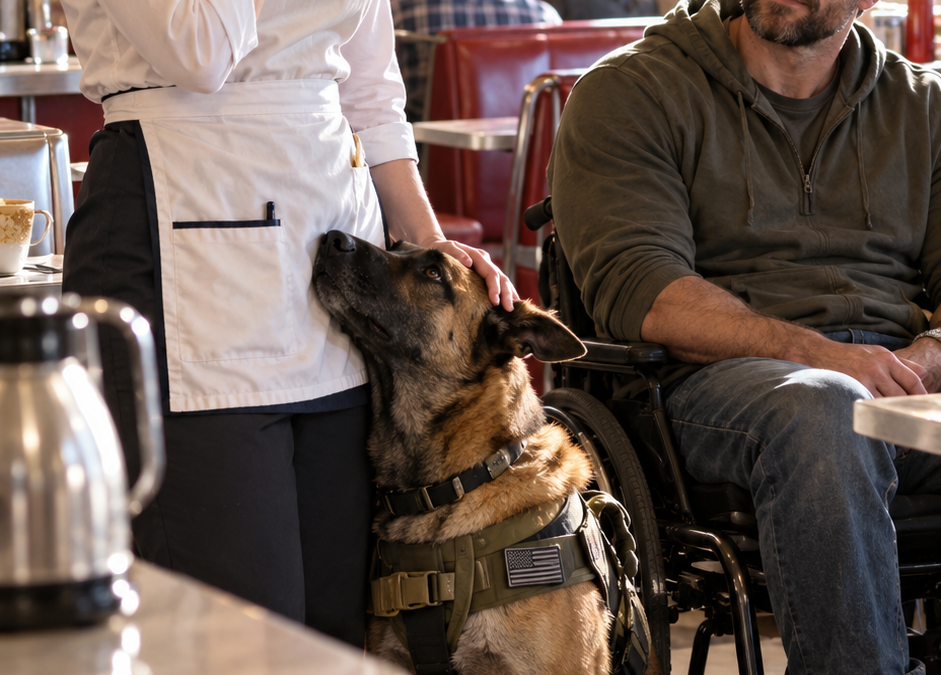
The dog always lay beneath the table.
Quiet.
Alert.
Harnessed.
A mobility service dog.
He retrieved dropped objects, opened certain doors, helped Marcus navigate uneven surfaces, and positioned himself beside the chair when Marcus transferred.
I understood exactly what kind of training that required.
That was the problem.
From the first morning, something about the dog bothered me.
Not fear.
Recognition.
The kind that begins beneath the skin before your mind has enough evidence to justify it.
He was the right breed.
The right size.
The right age.
Dark sable coat.
Strong shoulders.
A small irregular patch near the ribs where the fur grew slightly differently.
I noticed all of it without ever allowing myself to truly look.
That sounds impossible.
It isn’t.
People who have survived things they cannot afford to relive become very good at looking around memories.
I could refill Marcus’s cup while focusing on the rim.
I could place his plate down while watching his hands.
I could step over the dog’s paws while never meeting his eyes.
For three months, I did exactly that.
Then, one Thursday morning, Marcus said something that almost broke the arrangement.
“He doesn’t like people much.”
I was pouring coffee.
“Who?”
Marcus looked beneath the table.
I already knew.
“Bear.”
I continued pouring.
“Service dogs usually aren’t supposed to socialize during work.”
“It isn’t just work.”
Something in his voice made me glance at him.
He rubbed the dog’s shoulder.
“He tolerates trainers. That’s about it.”
I nodded.
Marcus smiled faintly.
“Took eight months before he trusted me.”
“That long?”
“Eight months before he slept deeply enough that I could move without waking him.”
My hand tightened slightly around the coffee pot.
Marcus did not notice.
“He came out of a military working dog program,” he continued. “They retrained him for mobility work after he couldn’t continue active service.”
I looked toward the kitchen.
Anything except the dog.
Marcus scratched behind Bear’s ears.
“They told me he’d been through a lot.”
I knew too much about that sentence.
He had been through a lot.
The military used that phrase because there were some things ordinary language could not carry politely.
A lot could mean gunfire.
Explosions.
Dead handlers.
Burns.
Shrapnel.
Weeks in veterinary recovery.
Months of refusing food unless someone sat beside the kennel.
Marcus looked at me.
“You okay?”
“Fine.”
“You’re holding the coffee pot like it owes you money.”
I loosened my grip.
“Occupational hazard.”
He laughed.
I moved on.
That should have been the end of it.
Instead, that conversation stayed with me for the rest of the morning.
Military working dog.
Retrained.
Trauma.
Trust issues.
Same approximate age.
Same build.
I told myself there had been thousands of Malinois in military service.
I told myself scars were common.
I told myself memory was looking for patterns because memory is cruel that way.
Most importantly, I told myself not to look.
So I didn’t.
Until the following Thursday.
Marcus arrived at 9:14.
Bear beside him.
Same booth.
Same breakfast.
Same coffee.
The diner had started thinning when I walked over with a water pitcher.
Marcus was telling me about a county road crew that had somehow managed to block the only wheelchair-accessible entrance to the veterans center for two days.
“Apparently,” he said, “accessibility is more of a philosophical concept than an engineering requirement.”
I smiled.
“Did you tell them?”
“I may have expressed an opinion.”
“Politely?”
“Depends who wrote the report.”
I reached across the table for his water glass.
And my eyes dropped.
Directly.
Fully.
For the first time.
Bear was already looking at me.
The world seemed to contract.
His ears rose.
His head lifted.
I stopped breathing.
I knew those eyes.
Not logically.
Not yet.
But my body knew them.
Bear stood.
Marcus stopped talking.
The dog stepped out from beneath the table.
“Bear.”
No response.
Marcus frowned.
“Bear, heel.”
The dog continued walking.
That was when I understood how unusual it was.
I had watched him obey Marcus every Thursday for three months.
Instantly.
Without hesitation.
Now he crossed the narrow aisle separating us.
Not excited.
Not pulling.
Not behaving like a pet who had smelled food.
He walked slowly.
Deliberately.
His gaze locked on me.
My hand holding the water pitcher began to shake.
“No,” I whispered.
I do not know whether I was speaking to him or myself.
Bear stopped directly in front of me.
For one second, neither of us moved.
Then he stepped closer.
And pressed the side of his body against my leg.
Completely still.
My knees almost gave out.
Marcus stared at us.
“Bear?”
The dog ignored him.
I put the water pitcher down.
Very carefully.
My heart was beating so violently that I could feel it in my throat.
Marcus looked from the dog to me.
“He’s never done that.”
I could not answer.
“I’m serious, Olivia. Never.”
Bear leaned harder against my leg.
Five years disappeared.
Dust.
Darkness.
Tracer fire cutting across a hillside.
Radio calls overlapping.
The smell of blood and dirt and hot metal.
A dog screaming once when shrapnel tore through his side and then going silent because his handler had fallen.
My hand moved toward Bear’s neck.
Stopped.
Marcus watched me.
“Do you know him?”
I lowered myself to one knee.
Slowly.
Bear turned his head.
His nose touched my wrist.
Then he exhaled.
A soft breath.
Recognition.
My fingers disappeared beneath the fur along his ribs.
I knew where to look.
I had known before touching him.
Still, I needed proof.
My fingertips found a thin crooked scar.
Not clean.
Not surgical.
Field stitching rarely was.
The diner vanished.
Five years earlier, I had made that scar with my own hands.
I heard myself inhale sharply.
Marcus leaned forward.
“What is it?”
My thumb traced the line.
Bear remained completely still.
I had closed that wound under red emergency light with rounds cracking somewhere above us.
I had spoken to him the entire time.
Not because dogs understood medical explanations.
Because I needed him to hear a voice that was not shouting.
“Stay with me, Atlas.”
That had been his name.
Atlas.
Not Bear.
Atlas.
His handler, Ray Dawson, had been lying six feet away.
Dying.
I had known it.
Ray had known it too.
That was one of the things I never admitted when people told me I had done everything possible.
Sometimes the wounded know.
They see it in your face before you say a word.
Ray had grabbed my vest.
“Dog.”
I thought he was delirious.
“Ray, stay still.”
“Atlas.”
“I’m working on you.”
“Save him.”
I hated him for saying it.
For making me hear it.
Because Atlas was bleeding badly too.
A piece of metal had torn through his side.
Ray’s injuries were catastrophic.
I had eleven minutes before the extraction window.
Eleven minutes in which every decision became a moral injury waiting to happen.
I worked Ray first.
Of course I did.
I did everything.
Tourniquet.
Airway.
Pressure.
Medication.
Blood.
I used every tool and every piece of training I had.
Nothing changed the truth.
His body was losing faster than I could replace.
Atlas crawled toward him despite the wound.
I remember shouting at the dog to stay.
He did not.
He dragged himself across the dirt and laid his head against Ray’s arm.
Ray looked down at him.
“Good boy.”
Those were some of his last clear words.
When Ray lost consciousness, I continued.
I continued long after some part of me understood.
Because medics do not get to accept death early.
Then someone shouted that the helicopter was inbound.
I looked at Atlas.
Blood beneath him.
Ray’s hand still resting against his neck.
I had perhaps three minutes.
So I made a decision.
I stabilized the dog.
Cut away fur.
Packed the wound.
Closed what I could.
My gloves were slippery.
My hands were shaking.
“Stay with me, Atlas.”
His eyes never left Ray.
“You are going home.”
I kept saying it.
“You hear me? You are going home.”
The helicopter came in hard.
Dust swallowed everything.
Someone pulled me toward the aircraft.
I refused to board until Atlas was lifted.
Ray came too.
But he died before we reached the surgical team.
Atlas survived.
At least, that was what I had been told.
After that, everything became paperwork.
Debriefings.
Medical reports.
Counseling.
Another deployment.
Another injury.
Medical board.
Discharge.
I never saw Atlas again.
Until he pressed himself against my leg in a diner five years later.
“Olivia?”
Marcus’s voice dragged me back.
I realized I was crying.
Silently.
Tears dropping onto the dog’s fur.
I had not even felt them start.
Marcus’s expression had changed completely.
Shock had become concern.
“Do you two know each other?”
I tried to answer.
Nothing came.
Bear—Atlas—rested his head against my shoulder.
That broke whatever remained of my control.
I put both arms around his neck.
Not tightly.
Just enough to feel him.
Warm.
Alive.
Older.
Real.
“Oh, God.”
Marcus said nothing.
I buried my face briefly against the dog’s fur.
For five years, I had remembered blood.
Now I smelled shampoo.
Leather harness.
Coffee.
A living animal.
When I finally pulled back, Marcus looked stunned.
“I have never seen him do that.”
I wiped my face.
“He’s not supposed to.”
“Olivia.”
I stood.
My legs felt weak.
“I need a minute.”
“Take one.”
I walked behind the counter.
Then into the storeroom.
I closed the door.
And put both hands against the shelf.
My entire body shook.
Not because I had seen Atlas.
Because I had spent five years convincing myself I did not deserve to.
Ray died.
Atlas lived.
That had been the arithmetic.
My mind had transformed it into an accusation.
Why him?
Why not Ray?
Could I have spent those three minutes differently?
Could I have changed something?
Could I have started something earlier?
Did saving the dog mean I had stopped fighting for the man?
No investigation accused me of that.
No doctor.
No commanding officer.
No medic who reviewed the report.
Only me.
I had become prosecutor, witness, and defendant in a trial that never ended.
A knock came softly.
“Olivia?”
Marcus.
“I’ll be out.”
“You don’t have to serve me.”
Despite everything, I almost laughed.
“Your eggs are already gone.”
“Fair point.”
I wiped my face again.
When I returned, Marcus had moved his chair slightly away from the table.
Atlas was lying beside him.
But the dog’s eyes followed me.
I brought Marcus his check even though neither of us cared about breakfast anymore.
He looked at it.
Then at me.
“Can I ask one question?”
I nodded.
“How?”
I knew what he meant.
“How do I know him?”
“Yeah.”
I sat in the chair opposite him.
Technically, I was still working.
I did not care.
“I was Navy medical.”
His expression sharpened.
“Corpsman?”
“Nine years.”
“Forward?”
“Yes.”
Marcus stared at me.
I saw him recalculating every Thursday morning we’d spent together.
Every time I had moved around his chair without awkwardness.
Every time I had ignored questions another civilian might have asked.
Every time I had looked at Atlas and looked away.
He glanced toward the dog.
“You’ve known all along?”
“No.”
“But you suspected.”
I hesitated.
“Something about him felt familiar.”
“Why didn’t you ask?”
I looked at Atlas.
“Because I was afraid you’d answer.”
Marcus understood that immediately.
He leaned back.
“What happened?”
I could have avoided it.
I had avoided it for years.
But Atlas had already crossed the room.
Some doors do not close afterward.
“It was Afghanistan.”
Marcus went completely still.
I continued.
“Night extraction. Ambush.”
His face changed.
Not recognition yet.
But proximity.
“I was attached to a team taking heavy fire on a hillside.”
Marcus’s hand moved to his wheel.
“What year?”
I told him.
All color left his face.
“Month?”
I told him.
He stared at me.
“No.”
I stopped.
Marcus looked at Atlas.
Then back at me.
“What operation?”
I gave him the designation.
He whispered a curse.
My stomach dropped.
“You were there?”
Marcus nodded once.
“I was twenty feet from Dawson.”
Ray.
Hearing the surname spoken aloud was like being struck.
“You knew Ray?”
“Knew him?”
Marcus’s voice cracked.
“He was my brother in everything except blood.”
I could not move.
Marcus looked toward the window.
“I got hit in the first blast.”
His hand touched one leg.
“Spinal injury.”
I had not known.
Of course I hadn’t.
The casualties had been split across extraction helicopters.
“Your bird left before mine arrived,” I said.
“Yeah.”
Marcus swallowed.
“I remember lying there. I could hear Ray.”
He closed his eyes briefly.
“I couldn’t get to him.”
I wanted to tell him it wasn’t his fault.
The sentence rose automatically.
Then I stopped.
I knew what those words sounded like when guilt had already decided otherwise.
So I said something different.
“You were badly injured.”
He looked at me.
“I still heard him.”
“And you couldn’t move.”
“No.”
We sat in silence.
Two people who had spent five years punishing themselves for the same eleven minutes from different positions on the same hillside.
Marcus finally looked at Atlas.
“They told me someone saved him.”
I said nothing.
“The report said one medic refused to load until the dog was evacuated.”
My eyes dropped.
“That was you.”
I nodded.
Marcus stared.
“For five years, I wondered who you were.”
I almost laughed, but there was nothing funny in it.
“For five years, I tried to make sure nobody found out.”
“Why?”
I looked at him.
“Because Ray died.”
Marcus’s eyes hardened—not in anger at me, but against the sentence itself.
“That wasn’t your fault.”
“There it is.”
“What?”
“The sentence.”
He understood.
“People tell you that a lot?”
“Enough.”
“And you don’t believe them.”
“I believe the medical facts.”
“That’s not what I asked.”
I looked away.
Atlas stood again.
He walked toward me.
Marcus did not call him back.
The dog put his head on my knee.
I rested my hand between his ears.
“He was hurt badly,” I said.
“Atlas?”
The name came out naturally.
Marcus froze.
I did too.
He leaned forward.
“What did you call him?”
I closed my eyes.
“Atlas.”
For several seconds, Marcus did not speak.
Then he whispered, “That’s his service name.”
My chest tightened.
“So it is him.”
“You didn’t know?”
“I knew the scar.”
Marcus looked at Atlas as though the dog had just become somebody new.
“The program renamed him Bear for civilian placement.”
I nodded.
“They sometimes do.”
“He was Atlas.”
“Yes.”
Marcus rubbed his face.
“Jesus.”
I moved my fingers through the fur behind Atlas’s ears.
His eyes closed instantly.
I remembered doing exactly that on the helicopter.
Blood everywhere.
My hand on his head.
“Stay with me.”
Marcus noticed.
“He doesn’t let people touch him there.”
I looked up.
“What?”
“Not like that.”
Atlas leaned harder into my hand.
Marcus stared.
“I’ve had him almost four years.”
“He always liked this spot.”
The words left my mouth before I could stop them.
Marcus gave a broken little laugh.
“So he really remembers.”
“Yes.”
“After five years?”
“Some things dogs don’t forget.”
Marcus became quiet.
Then he said, “Neither do we.”
I looked at him.
He was right.
Over the following hour, the story came out in pieces.
Marcus had been evacuated first.
He underwent emergency spinal surgery.
Months of rehabilitation followed.
He had been a SEAL.
The injury ended his operational career.
For the first year, he hated almost everyone who tried to help him.
Therapists.
Doctors.
Family.
Friends.
He hated the chair most of all.
“I used to wake up,” he said, “and forget for about two seconds.”
I knew that experience.
Different loss.
Same cruelty.
“Then I’d try to move my legs.”
He looked down.
“And I’d remember all over again.”
Atlas entered his life eighteen months later.
A veterans mobility program had offered several dogs.
Younger dogs.
Dogs specifically raised from puppies for service work.
Then someone mentioned a former military working dog being retrained.
“Everyone warned me he was difficult.”
Marcus smiled.
“Which probably made me want him more.”
“Sounds reasonable.”
“I wasn’t exactly reasonable.”
According to the trainers, Atlas had trouble bonding.
He followed commands.
Performed tasks.
But trust was different.
He startled awake.
Watched doors.
Refused to sleep deeply.
Did not enjoy strangers touching him.
Marcus understood that.
“People kept telling me we were a bad match because we both had too many problems.”
He scratched Atlas’s neck.
“Maybe that was why it worked.”
The first day they met, Atlas walked past two trainers, sat beside Marcus’s chair, and refused to leave.
I felt something twist in my chest.
“What?”
Marcus noticed my expression.
“Nothing.”
“Olivia.”
I looked at Atlas.
“Ray used to joke that he chose his people.”
Marcus smiled sadly.
“Guess he did.”
For the first time, something about the memory of that hillside changed.
Only slightly.
But enough.
I had always remembered Atlas bleeding.
Now I could picture him walking into a rehabilitation center.
Choosing Marcus.
Learning new commands.
Opening doors.
Picking up keys.
Bracing beside a wheelchair.
Waking Marcus from nightmares.
One life continuing because another had ended.
That did not make Ray’s death acceptable.
Nothing ever would.
But grief had trained me to believe only in what was lost.
Atlas was sitting directly in front of me as evidence that something had survived.
Marcus studied me.
“Can I ask you something harder?”
“You seem committed to that.”
He almost smiled.
“Why did you leave?”
I knew what he meant.
“The Navy?”
He nodded.
I looked at my hands.
“There was another incident six months later.”
“Were you hurt?”
“Yes.”
“Badly?”
“Enough.”
The scars beneath my sleeves tightened as if memory could affect skin.
“Medical board offered an appeal.”
“You didn’t take it.”
“No.”
“Why?”
I looked around the diner.
Coffee cups.
Chrome napkin holders.
Sunlight across a sticky tabletop.
Normality.
“Because I was tired of being the person everyone expected to run toward the worst day of somebody else’s life.”
Marcus said nothing.
“So I stopped.”
“You became a waitress.”
“Yes.”
“Do you like it?”
That question surprised me.
“Most days.”
“That isn’t what I asked.”
I laughed once.
“You always this annoying?”
“Occupational side effect.”
I thought about it.
“The diner gave me something I needed.”
“What?”
“Problems I could actually solve.”
Marcus nodded slowly.
“That makes sense.”
“I wasn’t looking for purpose.”
“Maybe that’s the problem.”
I looked at him.
He did not elaborate.
Then Atlas moved again.
His head settled against my leg.
Marcus watched.
“He only listens to me,” he said quietly.
I raised an eyebrow.
“Apparently not.”
“No.”
His voice softened.
“I’ve told people that for years.”
I ran my hand along Atlas’s neck.
Marcus smiled.
“I think I was wrong.”
The next Thursday, Marcus came back.
So did Atlas.
I told myself I had expected them.
Still, when the bell over the diner door rang at 9:14, my heart jumped.
Atlas saw me immediately.
His ears lifted.
He looked at Marcus.
Marcus removed his hand from the wheel.
“Go ahead.”
Atlas crossed the diner.
This time, I did not retreat.
He stopped beside me.
I crouched.
“Hey, Atlas.”
His tail moved once.
Just once.
But Marcus saw it.
“Unbelievable.”
I smiled.
A real smile.
Not the customer-service version.
Atlas pressed his forehead beneath my chin.
Five years earlier, I had promised him he would go home.
I had never imagined home might eventually bring him back to me.
Marcus and I talked more that morning.
Not only about the operation.
About Ray.
That mattered.
For years, Ray existed in my memory almost entirely as a casualty.
Blood pressure.
Respiration.
Wounds.
Failed interventions.
Time of death.
Marcus gave him back dimensions.
Ray cheated at cards.
He sang badly.
He once convinced an entire team that he could speak fluent Polish, despite knowing perhaps six words.
He called his wife Sarah every opportunity he could.
He carried drawings from his children inside a waterproof bag.
“He talked about them that night,” I said.
Marcus went quiet.
“What did he say?”
I had never told anyone.
“His daughter was scared of thunderstorms.”
Marcus closed his eyes.
“Ellie.”
“He made me promise someone would tell her thunder couldn’t hurt her.”
Marcus laughed through sudden tears.
“That sounds exactly like him.”
For the first time, remembering Ray did not begin with the wound.
It began with a father worrying about his daughter.
That distinction nearly destroyed me.
It also helped.
The next week, Marcus brought photographs.
Ray smiling beside Atlas.
Ray holding his baby son.
Marcus and Ray young and sunburned outside a training facility.
Atlas as a younger dog, ears too large for his head.
I touched one photograph.
“That’s him.”
Marcus smiled.
“Obviously.”
“No.”
I pointed to Ray.
“That’s how I remember him before.”
Before the blood.
Marcus seemed to understand exactly what I meant.
Then he pulled out his phone.
“I need to ask you something.”
I immediately felt guarded.
“What?”
“Ray’s wife is still in touch with me.”
My stomach tightened.
“Sarah?”
“Yes.”
I had never met her.
I knew everything about her.
Her name.
Her children’s names.
The photograph Ray kept laminated in his vest.
The sound of his voice when he said them.
Marcus continued.
“For years she’s wanted to know who stayed with him.”
I looked down.
“She knows someone did.”
“From the report.”
“Marcus—”
“I’m not going to call her without asking you.”
I appreciated that more than he knew.
“I don’t think I can.”
“Okay.”
He accepted the answer immediately.
No persuasion.
No disappointed expression.
Nothing.
That made it worse.
I looked at Atlas.
He was watching me.
Marcus waited.
“What does she want from me?”
“The truth?”
“Please.”
“Nothing.”
I frowned.
“She doesn’t want an explanation. She doesn’t want an apology.”
My throat tightened.
“Then what?”
“To thank you.”
I almost stood.
I genuinely considered walking away.
Thank me?
For what?
Her husband was dead.
“I don’t deserve that.”
Marcus’s expression became firm.
“That’s not your decision.”
I looked at him sharply.
He continued.
“You don’t get to decide what your actions meant to her.”
The words hurt because they were true.
Marcus reached down to Atlas.
“Same way I don’t get to decide what saving this dog meant.”
My eyes filled.
He spoke more gently.
“I spent years thinking everything about that operation ended on that hillside.”
His hand rested on Atlas’s harness.
“Then this stubborn animal kept me alive.”
I looked away.
Marcus continued.
“He made me leave the house.”
I said nothing.
“He made me stop pretending I didn’t need help.”
His voice dropped.
“There was a night about two years after my injury when I wasn’t planning to see morning.”
I turned back immediately.
Marcus looked at Atlas.
“He wouldn’t leave me alone.”
The diner became very quiet.
“He kept pawing at me. Nudging me. Blocking the door.”
Marcus swallowed.
“Finally he brought me the emergency phone the trainers had taught him to retrieve.”
I felt tears rise again.
“So I called someone.”
He looked at me.
“And I’m here.”
I could not speak.
Marcus nodded toward Atlas.
“You stitched him up on a hillside and forced him onto a helicopter.”
My hand covered my mouth.
“Years later, he forced me to stay.”
There are moments when your entire understanding of an event rearranges itself.
Not disappears.
Not heals instantly.
Rearranges.
For five years, I had built my identity around the one life I could not save.
Marcus was asking me to look at the lives connected to the one I did.
Atlas.
Marcus.
Ray’s children.
People I had never met.
Ripples from a decision I had considered almost meaningless because grief had convinced me only failure counted.
Marcus placed his phone on the table.
“You don’t have to do it today.”
I stared at it.
Atlas moved closer.
I put my hand on his head.
“Call her.”
Marcus looked at me carefully.
“You sure?”
“No.”
That made him smile sadly.
“Good enough.”
He found the contact.
Sarah Dawson.
Before pressing call, he looked at me one last time.
I could still stop him.
For three years, I had structured my life around avoiding exactly this.
No uniforms.
No bases.
No old teammates.
No memorial ceremonies.
No conversations with families.
No situations where someone might ask why their person died and I lived.
My heart was pounding.
Then Atlas leaned against me.
The same dog I had told five years earlier that he was going home.
I nodded.
Marcus pressed call.
Sarah answered on the fourth ring.
“Hey, Marcus.”
Her voice was ordinary.
Warm.
I immediately pictured the woman from Ray’s photograph, though five years had surely changed her.
“Sarah.”
Something in Marcus’s tone made her pause.
“What’s wrong?”
“Nothing.”
He looked at me.
“Actually, I don’t know how to say this.”
“Say what?”
Marcus swallowed.
“I found her.”
Silence.
“What?”
“The medic.”
Another silence.
“The one who stayed with Ray.”
I closed my eyes.
For several seconds, there was no sound from the phone.
Then Sarah whispered, “What do you mean you found her?”
“She’s sitting across from me.”
I heard Sarah inhale.
“Are you sure?”
Marcus looked at Atlas.
“I have never been more sure.”
A small broken sound came through the phone.
Then Sarah asked something I did not expect.
“Is she okay?”
My eyes opened.
Not what happened.
Not why couldn’t she save him.
Not where has she been.
Is she okay?
Marcus looked at me.
“She’s trying.”
That almost finished me.
Sarah was crying now.
Quietly.
“Can I talk to her?”
Marcus extended the phone.
My hand would not move.
Atlas nudged my wrist.
Of course he did.
I took the phone.
“Sarah?”
The answer came instantly.
“Olivia?”
Marcus must have told her my name.
“Yes.”
I had rehearsed this conversation in nightmares for years.
In every version, I apologized.
Explained.
Defended decisions.
Listed interventions.
Tried to make medicine justify death.
Now none of those words came.
“I’m sorry.”
Sarah began crying harder.
“No.”
I closed my eyes.
“I’m so sorry I couldn’t—”
“Stop.”
Her voice became stronger.
“Please don’t do that.”
I could barely breathe.
Sarah continued.
“I have had five years to understand that Ray was not coming home from those injuries.”
I pressed my fist against my mouth.
“I know you tried.”
“I should have—”
“No.”
A pause.
Then softly:
“You stayed.”
Those two words broke something open inside me.
Sarah continued.
“They told me everyone was under fire. They told me you stayed until the last possible moment.”
I remembered dirt hitting my helmet.
Someone yelling at me to move.
Ray unconscious.
Atlas bleeding.
“I couldn’t leave him.”
“I know.”
“I’m sorry.”
“I know.”
We cried together.
Strangers who had carried different pieces of the same death for five years.
Then Sarah said, “Marcus told me Atlas is with you.”
I looked down.
The dog had laid his head against my thigh.
“Yes.”
“He remembers you?”
“Yes.”
Sarah laughed through tears.
“Of course he does.”
I smiled.
“He was always stubborn.”
“Ray used to say he never forgot anyone who was kind to him.”
My fingers moved through Atlas’s fur.
Sarah became quiet.
“Do you know what that dog meant to my children?”
I swallowed.
“No.”
“After Ray died, Atlas came home during part of his recovery.”
I had not known that.
“Ellie was seven.”
I remembered the thunderstorm story.
“Our son, Mason, was four.”
Sarah continued.
“They couldn’t understand why their father wasn’t coming back.”
My eyes closed.
“But Atlas did.”
I opened them.
“What?”
“He came home.”
Her voice shook.
“For a while, he slept outside Ellie’s room. She said if Dad’s dog was still there, then part of Dad was still there.”
I could no longer hold back tears.
Sarah continued.
“Mason used to hug him when he missed Ray.”
I bent over slightly.
My hand remained buried in Atlas’s fur.
“The day the program told us Atlas could no longer stay with the family because he needed specialized work and they thought he might be able to retrain, I almost refused.”
Marcus was listening too.
Sarah said, “But I kept thinking about Ray. He would have wanted that dog to keep working.”
I looked at Marcus.
“And eventually he found Marcus.”
“Yeah.”
Sarah’s voice softened.
“So don’t tell me you failed my family.”
I stopped breathing.
“You sent home something my children could hold.”
There are sentences that divide a life into before and after.
That was one.
For five years, I had believed I walked away from that hillside carrying only the evidence of what I could not do.
Sarah told me I had sent something home.
Something living.
Something Ray loved.
Something his children could touch when grief was too abstract for children to understand.
I had never considered that.
Not once.
Two days later, Sarah drove three hours to the diner.
Marcus came too.
So did Atlas.
I almost called in sick.
Instead, I arrived early.
I cleaned the same table twice.
Adjusted sugar packets that did not need adjusting.
Checked the clock every four minutes.
At 1:17, the bell above the door rang.
A woman walked in carrying a worn photo album.
I knew her immediately.
Older than Ray’s photograph.
Of course.
Five years older.
But the same eyes.
She saw me.
Stopped.
I stopped too.
Neither of us knew what the correct greeting was.
There isn’t etiquette for meeting the woman whose husband died under your hands.
Sarah solved it.
She crossed the diner and hugged me.
No introduction.
No hesitation.
I stood rigid for half a second.
Then held her.
She cried against my shoulder.
So did I.
Behind her, Marcus looked away to give us something resembling privacy.
Atlas sat beside his chair.
We took the window booth.
Sarah opened the photo album.
I expected photographs of Ray.
There were.
But there were also dozens of Atlas.
Atlas lying beside Ellie while she read.
Atlas wearing a ridiculous birthday hat.
Atlas asleep beneath a Christmas tree.
Atlas beside Mason on the first day of kindergarten.
Atlas standing beside Ray’s folded flag at a memorial ceremony.
One photograph made me stop.
Ellie, perhaps eight years old, sleeping on the floor with both arms around Atlas’s neck.
Her face buried in his fur.
Sarah touched the photograph.
“That was the first night she slept more than three hours after Ray died.”
I stared at it.
Sarah slid another photo toward me.
Mason sitting beside Atlas.
One small hand holding the dog’s collar.
“He had nightmares.”
I could barely speak.
“Atlas helped?”
“Every night.”
Sarah looked at me.
“You didn’t just save a dog.”
I shook my head.
“Sarah—”
“You need to hear this.”
Her voice was gentle but firm.
“You saved the last piece of Ray our children could actually touch.”
My vision blurred.
I looked down at my hands.
“They told me I did everything right.”
Sarah nodded.
“But you never believed them.”
“No.”
“Believe me.”
I looked at her.
She reached across the table.
“Please.”
I let her take my hand.
For the first time in five years, I stopped trying to argue with someone telling me I had done enough.
Not permanently.
Healing rarely works that cleanly.
But for that moment, I stopped.
We spent hours together.
Sarah told stories.
Marcus added his own.
Eventually, I told them about Ray’s final minutes.
Not the clinical version.
Not all of it.
I told Sarah that he said her name.
That he talked about Ellie.
That he worried about thunderstorms.
Sarah covered her face and laughed.
“He hated thunderstorms.”
“What?”
“He was more afraid of them than Ellie.”
Marcus laughed.
“Absolutely true.”
I stared at both of them.
Then I laughed too.
At first, it felt wrong.
Laughing while discussing a dead man.
Then I realized they had been doing it for years.
Because remembering someone only through death is another way of losing them.
That afternoon, Ray became a person again.
Not a casualty.
Not my failure.
A man who lied about speaking Polish.
A man who hated thunderstorms.
A man who loved his dog and his children.
A man who died.
All of those things could be true together.
That evening, after Sarah left, Marcus stayed behind.
The diner was nearly empty.
Atlas slept beside the booth.
Marcus watched me wipe down the counter.
“What are you doing with your life, Olivia?”
I looked at him.
“I’m currently cleaning ketchup.”
“You know what I mean.”
“I have a job.”
“You have more than a job.”
I stiffened slightly.
“I don’t need rescuing.”
“Good. Because I’m terrible at it.”
That made me smile.
Marcus continued.
“But I know an organization.”
“No.”
“You haven’t heard what it is.”
“If it involves the military—”
“It doesn’t.”
I stopped wiping.
“Not exactly.”
I narrowed my eyes.
He explained.
A nonprofit that trained mobility and psychiatric service dogs for wounded veterans.
Some dogs were purpose-bred.
Others came through specialized working-dog programs.
They employed trainers, rehabilitation specialists, and former military medical personnel who understood both canine behavior and veteran trauma.
I shook my head.
“I haven’t worked in medicine for years.”
“I’m not asking you to be a medic.”
“I don’t train dogs.”
“You understand them.”
“One dog.”
“One dog recognized you after five years.”
“That’s Atlas.”
“Exactly.”
I folded the towel.
“Marcus.”
“They need people who understand both ends of the leash.”
That sentence stayed with me.
Both ends of the leash.
The dog.
The veteran.
Trauma traveling in both directions.
Trust rebuilt in both directions.
“I don’t know if I can do that.”
Marcus shrugged.
“You don’t have to know.”
I looked at him.
He smiled.
“You could talk to them.”
Three weeks later, I drove to the training center.
I almost turned around twice.
The facility sat outside town on several acres.
Training yards.
Indoor obstacle spaces.
Kennels.
Rehabilitation rooms.
Veterans working with dogs.
The first thing I heard when I entered was nails clicking across polished concrete.
My chest tightened.
Then a young Labrador trotted past carrying a wallet in his mouth.
The veteran following behind laughed.
Something about the sound calmed me.
The director, Anne Mercer, interviewed me for almost two hours.
She asked about my military experience.
Medical training.
Trauma.
Working dogs.
My own discharge.
I expected to feel interrogated.
Instead, I felt seen.
At one point, Anne asked, “Why do you want to work here?”
I stared at my hands.
“I don’t know if I do.”
She smiled.
“Good answer.”
“I mean it.”
“So do I.”
I looked through the window into the training yard.
A veteran was learning to transfer from his wheelchair while a large golden retriever positioned itself for balance support.
“I spent years trying to become someone who wasn’t needed in emergencies.”
Anne waited.
“I think maybe I confused peace with being useless.”
She did not interrupt.
I swallowed.
“I don’t want the old life back.”
“You don’t need it back.”
“But I think there are parts of me I shouldn’t have thrown away with it.”
Anne leaned back.
“That sounds like a reason.”
They offered me a position that afternoon.
Veteran integration specialist.
Part training assistant.
Part trauma support.
Part medical liaison.
The title mattered less than the work.
I went home with the offer letter on the passenger seat.
I did not accept immediately.
That night, I sat in my apartment wearing the same long sleeves I always wore.
I thought about the diner.
The predictability.
The safety.
The smallness.
Smallness had saved me for a while.
There was no shame in that.
But safety can become confinement if you never ask whether you still need the walls.
I called Anne the next morning.
“I’ll do it.”
My last Thursday at the diner, Marcus arrived at 9:15.
Atlas walked straight toward me.
By then, nobody thought it was strange.
I knelt.
“You caused a lot of trouble, you know that?”
His tail moved.
Marcus laughed.
“He looks devastated.”
I put both hands around Atlas’s face.
“Five years and you still don’t listen.”
Marcus raised an eyebrow.
“I thought we established that he listens to you more than me.”
I looked at the dog.
“No.”
I smiled.
“He just remembers.”
Six months later, Thursday mornings looked completely different.
I still woke early.
Still drank bad coffee.
Still organized my day around predictable routines.
But now the routines mattered differently.
Veterans arrived at the center carrying the same expression Marcus had once carried into the diner.
Guarded.
Tired.
Suspicious of hope.
Some had visible injuries.
Some did not.
That distinction meant less than people thought.
Dogs arrived nervous too.
Some had been trained from puppies.
Some had histories.
Some had failed other placements.
I understood those dogs.
I understood people who believed being difficult to place meant being impossible to love.
My sleeves eventually started staying up.
Not every day.
But often.
Nobody asked much about the scars.
Veterans rarely do.
They know everyone has something.
Atlas visited every few weeks with Marcus.
Every time the training center door opened and he walked in, he looked around.
Found me.
Then came over before doing anything else.
New employees thought it was adorable.
They had no idea they were watching a five-year-old promise keeping itself.
One afternoon, Marcus sat beside the training yard while I helped a Marine veteran named Daniel work with a young service dog.
Daniel had lost part of his left leg and most of his confidence in crowded public spaces.
The dog, Charlie, kept looking back at him instead of moving forward.
Daniel became frustrated.
“He doesn’t trust me.”
I crouched beside Charlie.
“Maybe he’s checking whether you trust him.”
Daniel looked at me.
“What’s the difference?”
“Everything.”
I stood.
“Don’t pull.”
“I’m not.”
“With your body, you are.”
He exhaled.
Then relaxed the leash.
Charlie looked up.
Daniel waited.
After a few seconds, the dog stepped forward.
Daniel followed.
Marcus watched quietly.
Later, he rolled over.
“You know you’re good at this.”
“Don’t make it weird.”
“I’m serious.”
“So am I.”
Atlas lay beside him.
I scratched the old scar under his fur.
It no longer felt like evidence.
That was perhaps the biggest change.
For years, scars had been records of damage.
Now I understood that sometimes they were also records of survival.
Sarah visited occasionally.
So did Ellie and Mason.
The first time the children came, they were older than the versions I had carried in my imagination.
Ellie was twelve.
Mason nine.
They ran straight to Atlas.
He nearly forgot every year of disciplined service training for about thirty seconds.
Marcus pretended to be offended.
“I feed you.”
Atlas ignored him.
Ellie hugged the dog.
Then looked at me.
“Mom says you’re the reason he came home.”
I froze.
Sarah looked at me from across the room.
No rescue this time.
The answer belonged to me.
“I helped.”
Ellie nodded seriously.
“Thank you.”
Two words.
I accepted them.
That mattered.
“You’re welcome.”
Mason touched Atlas’s scar.
“Is this where he got hurt?”
“Yes.”
“Did you fix it?”
I crouched beside him.
“I did my best.”
He looked at the scar.
“Looks pretty good.”
I laughed.
“Thank you.”
He shrugged.
“He’s old now anyway.”
Atlas lifted his head as if offended.
For one beautiful moment, the room filled with laughter.
Ray was still gone.
Nothing changed that.
But his children were laughing with his dog.
Marcus was alive.
Atlas was alive.
I was alive.
Grief had once told me survival was a debt.
Now I was beginning to understand it could also be an assignment.
Not to justify why you lived.
Not to prove you deserved it.
Simply to use what remained.
One evening after everyone left, I stayed behind to finish paperwork.
The facility was quiet.
Atlas happened to be there because Marcus was attending a veterans meeting down the hall.
The old dog lay beside my desk.
I looked down at him.
“Do you remember that hill?”
His ears moved.
“I do.”
I slid out of the chair and sat on the floor.
Atlas immediately shifted closer.
I found the scar beneath his fur.
Five years earlier, my fingers had touched the same place while blood covered both of us.
I had been twenty-nine.
Exhausted.
Terrified.
Angry.
I had told him he was going home.
At the time, I thought that promise only meant keeping him alive long enough to reach the helicopter.
I understood now that promises can travel farther than we expect.
Atlas went home to Ray’s children.
Then to Marcus.
Then somehow back to me.
Each time, he carried something forward.
I leaned my forehead against his.
“I thought you were the thing I couldn’t look at.”
He exhaled softly.
I smiled.
“Turns out you were the thing I needed to see.”
Marcus appeared in the doorway.
“Talking to my dog?”
“Your dog?”
He grinned.
“Fair.”
He rolled inside.
For a while, neither of us spoke.
Then Marcus asked, “Do you ever still replay it?”
I knew what he meant.
“Yes.”
“Me too.”
“Every week?”
“Not anymore.”
I looked at him.
“Same.”
The memories had not disappeared.
That was never the goal.
I still remembered Ray’s blood.
The helicopter.
The sound of rounds overhead.
The moment I understood there was nothing else I could do.
But now the memory no longer ended there.
It continued.
Atlas in Ellie’s bedroom.
Atlas beside Mason.
Atlas retrieving Marcus’s emergency phone.
Atlas crossing a diner.
Sarah hugging me.
Veterans learning to trust dogs.
Dogs learning to trust veterans.
The story had been longer than the worst eleven minutes.
I simply had not known it.
Marcus rubbed Atlas’s ears.
“You know what Ray would say about all this?”
“No.”
“He’d take full credit.”
I laughed.
“That sounds right.”
“He’d say he trained Atlas to fix us.”
“Did he?”
Marcus thought about it.
“Maybe.”
We sat quietly.
Sunset filtered through the windows of the training center.
Atlas slept between us.
For the first time in years, I could think about Ray Dawson without immediately hearing the sound of his last breath.
I could hear Marcus telling stories about him.
Sarah laughing.
Ellie talking about thunderstorms.
Mason complaining that Atlas stole blankets.
I could remember a whole human life instead of only its ending.
That was the gift I had not known I needed.
I still worked with veterans years later.
I still avoided calling myself healed.
The word suggests a finished process.
People are not wounds that simply close.
We adapt.
We carry.
We learn where the tender places are.
We discover which memories need distance and which ones need to be invited back carefully.
I learned that courage is not always running toward gunfire.
Sometimes courage is answering a phone call you’ve avoided for five years.
Sometimes it is meeting a widow.
Sometimes it is letting someone thank you.
Sometimes it is rolling up your sleeves.
And sometimes it is standing still while an old dog crosses a diner because he remembers you even when you have spent years trying not to remember yourself.
Atlas never stopped visiting me first.
Not once.
Marcus kept joking about it.
“He only listens to me,” he would say whenever new volunteers noticed Atlas abandoning him at the door to find me.
Eventually, we both started laughing before he finished the sentence.
Because we knew better.
Atlas had never belonged completely to either of us.
Part of him belonged to Ray.
Part to Sarah and the children.
Part to Marcus.
Part perhaps to me.
But mostly, Atlas belonged to the long chain of people he had kept connected simply by surviving.
I used to believe the most important thing I had done on that hillside was fail to save a man.
That belief shaped five years of my life.
Now I understand something different.
I could not choose who survived that night.
I could only choose what I did with the time I had.
I fought for Ray.
I fought for Atlas.
One died.
One lived.
Both mattered.
The truth had always been large enough to hold both things.
I was the one who had made it smaller.
One Thursday afternoon, years after that morning in the diner, I stood outside the training center while Marcus loaded his chair into his adapted vehicle.
Atlas was older now.
Gray around the muzzle.
Slower.
But still watching everything.
Marcus looked toward me.
“Ready?”
“For what?”
He nodded at Atlas.
“He refuses to get in.”
I crossed my arms.
“Maybe he doesn’t listen to you.”
“Very funny.”
I walked over.
Atlas looked up.
“Come on, old man.”
He stood.
Slowly.
Then walked toward the van.
Marcus stared at me.
“I hate both of you.”
I laughed.
Atlas paused halfway.
Turned back.
Came to me one last time.
He pressed his head against my leg exactly the way he had that first morning.
My hand rested on his neck.
On the scar.
For a moment, I was twenty-nine again.
Then thirty-four.
Then every version of myself in between.
The medic.
The wounded woman.
The waitress.
The stranger hiding beneath long sleeves.
The woman learning that surviving did not mean betraying the dead.
The person Atlas had somehow recognized through all of them.
“Go home,” I whispered.
His ears moved.
I smiled through tears.
“I kept my promise once.”
I touched my forehead to his.
“You can keep yours now.”
Atlas turned.
Walked back to Marcus.
Climbed into the vehicle.
Marcus gave me a small wave before driving away.
I stood there until the van disappeared beyond the gate.
Then I went back inside.
A new veteran was waiting in the lobby with a young service dog beside him.
He looked nervous.
The dog looked even more nervous.
The veteran glanced at my scars.
Then quickly looked away.
“I’m sorry,” he said.
“For what?”
“I don’t know.”
I smiled.
“Good. Let’s start there.”
The dog watched me carefully.
I crouched a few feet away and waited.
No reaching.
No pressure.
No assumptions.
Eventually, the dog took one step toward me.
Then another.
I thought about Atlas.
About how he had once crossed a diner without permission and broken through five years of silence simply because he remembered who I was.
I no longer believed the past was hunting me.
Some of it had been searching for me.
There is a difference.
And this time, I was finally willing to be found.








