𝗣𝗔𝗥𝗧 𝟮 I Rescued a ‘Puppy’ From a Whiteout—Months Later, Wildlife Control Said He Wasn’t a Dog
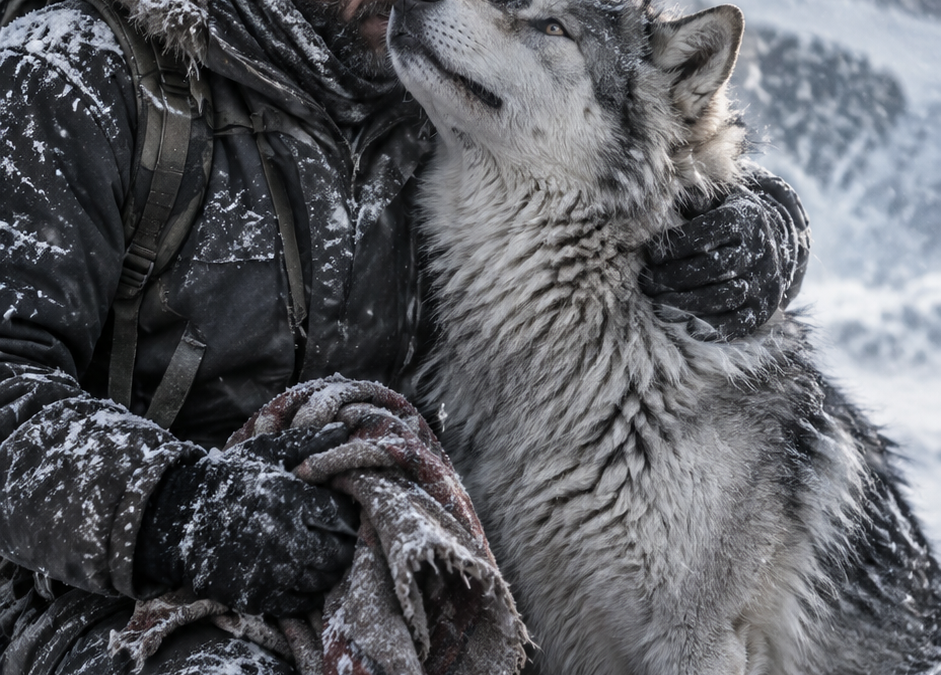
𝗣𝗔𝗥𝗧 𝟮
The veterinary clinic was technically closed.
I made that their problem.
I called while driving ten miles an hour through the storm.
Dr. Helen Evans answered on the fourth ring.
“Michael?”
“I found a puppy.”
There was a pause.
“Of course you did.”
“He’s hypothermic.”
Her voice changed.
“How bad?”
“No shivering.”
Another pause.
“Bring him.”
“I’m coming.”
“Drive slowly.”
“I am.”
“You always say that.”
“I’m literally being passed by snow.”
“That doesn’t count.”
The clinic lights looked like a lighthouse when they finally appeared through the storm.
Dr. Evans met me at the door wearing scrubs under a winter coat.
A technician followed carrying towels.
I brought the puppy inside.
Helen took one look at him and stopped joking.
“Table.”
We laid him on stainless steel.
The warmth of the room hit his coat and began melting the frost.
Water pooled around him.
Helen pressed a stethoscope against his chest.
Her expression changed.
“What?”
She moved it.
Listened again.
“What?”
“His heart.”
“What about it?”
“It’s steady.”
“Is that bad?”
“No.”
She looked at me.
“It’s strange.”
“How?”
“An animal this cold should be crashing.”
The technician carefully cut chunks of frozen fur away from his paws.
The puppy didn’t react.
Not when they inserted an IV.
Not when they checked his gums.
Not when Helen examined the split pads.
He simply watched.
Mostly me.
“Temperature is coming up,” Helen said.
“That’s good.”
“Yes.”
She frowned.
“What now?”
“He’s not shivering.”
“You said that already.”
“He should be.”
“Maybe he’s tough.”
She ignored me.
The scale beeped.
Helen looked at the display.
Then looked at the puppy.
Then reset it.
“What?”
She lifted him slightly and repositioned him.
The number returned.
“Twenty-nine point six.”
“Pounds?”
“He’s how old?”
I studied his teeth.
“Three months?”
“Maybe.”
She stared.
“That’s a very large three-month-old German Shepherd.”
“Congratulations. You’ve discovered genetics.”
“Michael.”
“What?”
She ran her hands over his paws.
Huge.
Even I noticed it then.
“He has enormous feet.”
“So did I at fourteen.”
“You’re not helping.”
The puppy’s eyes shifted between us.
Helen leaned closer to his head.
She examined his ears.
His muzzle.
The width between his eyes.
Then she glanced at me.
“Where exactly did you find him?”
“North side of Elk Ridge Road.”
“Near the national forest?”
“Yes.”
“Any collar?”
“No.”
“Tracks?”
“I was trying not to freeze to death, Helen. I didn’t conduct a census.”
She gave me a look.
“Fine.”
“What?”
“Nothing.”
“That is your veterinarian face for something.”
“I have one face.”
“You absolutely do not.”
She returned to the IV.
“Let’s keep him overnight.”
“No.”
“Michael.”
“He’ll be more comfortable with me.”
“He almost froze to death.”
“And he’ll be more comfortable with me.”
She looked at the puppy.
He was still staring at me.
Helen sighed.
“Fine.”
That was how he came home.
I had lived alone for six years by then.
My cabin sat beyond town near a frozen lake and several miles of trails.
Quiet place.
Good place if you didn’t like neighbors.
Excellent place if you were trying to convince yourself isolation was a lifestyle rather than a symptom.
The puppy said nothing when I carried him inside.
I put water down.
Food.
A blanket near the fireplace.
He stood unsteadily.
Sniffed the bowl.
Then ate.
Slowly.
That surprised me.
Most starving dogs inhale food.
He took one bite.
Chewed.
Looked at me.
Took another.
Measured.
Deliberate.
“What are you doing?”
He kept eating.
“You think I’m stealing it?”
Golden eyes.
Chew.
Swallow.
Next bite.
I sat in the chair.
“Fine. Pace yourself.”
When he finished, he sat.
Not lay down.
Sat.
Watching.
I had never seen a puppy that still.
No wandering.
No chewing furniture.
No whining.
No tail wagging.
Just observation.
“All right.”
I pointed toward him.
“You’re weird.”
One ear flicked.
I almost smiled.
Then the name came to me.
Kale.
I had heard it years earlier overseas from an interpreter who claimed it meant something like warrior of light in an old dialect.
The translation was probably wrong.
Soldiers are terrible historians.
Still, the sound fit him.
“Kale.”
His head moved.
I waited.
“Kale.”
One ear lifted.
“Well, apparently you agree.”
That night I didn’t drink.
That detail mattered.
I had developed a routine after leaving the Army.
Dinner.
Drink.
Television I wasn’t watching.
Another drink.
Walk around the house.
Check locks.
Another drink.
Sleep badly.
Wake worse.
Repeat.
That night, I sat beside the fire listening to Kale breathe.
That was it.
No TV.
No glass.
No pacing.
At some point, I fell asleep in the chair.
When I woke, the fire was almost dead.
The room was dark.
For one violent second, I didn’t know where I was.
That used to happen.
I would wake in Colorado and my brain would still be somewhere else.
Heat.
Dust.
Metal.
Voices shouting.
Blood on gloves.
Then I saw Kale.
He sat beside the window.
Moonlight outlined him.
Head high.
Watching the snow.
I whispered his name.
He turned.
Those eyes caught what little light remained.
Then he walked over.
Lay beside my chair.
No fuss.
I rested my hand on his back.
Warm.
Real.
My breathing slowed.
“Okay.”
That was all I said.
The next morning, I woke on the chair with no memory of another nightmare.
That had not happened in years.
Kale healed fast.
Too fast.
The paw pads improved within days.
By the fifth day, he hated the bandages.
By the seventh, they looked ridiculous because his legs seemed larger.
I thought I imagined that.
Trauma messes with time.
So does loneliness.
You stop noticing ordinary measurements.
Then Kale walked beside my couch and his shoulder reached higher than I remembered.
I stared.
“Stand still.”
He did.
I held my hand over his head.
Then went to the kitchen door where I had marked his height three days earlier.
The difference was nearly two inches.
“That’s not normal.”
Kale yawned.
He seemed unconcerned.
Two weeks later, Dr. Evans weighed him again.
The digital display read forty-eight pounds.
Helen stared.
“No.”
I laughed.
“Apparently yes.”
“No.”
“You’re arguing with electronics now?”
“Michael, he is not even four months old.”
“Maybe your scale is broken.”
“It weighed a Labrador ten minutes ago.”
“Big Labrador?”
She ignored me.
Kale sat calmly on the exam table.
His coat had thickened dramatically.
White-gray.
Dense undercoat.
His chest broader.
His ears fully upright now.
His face had changed too.
Longer muzzle.
Sharper cheeks.
Something less puppy-like.
Helen walked around him.
“Where did you say you found him?”
“Same place as last time.”
“Near wolf habitat.”
I rolled my eyes.
“Here we go.”
“I’m serious.”
“He’s a shepherd.”
“He might be a shepherd mix.”
“Everything is a mix if you go far enough back.”
She touched Kale’s shoulder.
He watched her.
“His proportions are unusual.”
“Unusual isn’t illegal.”
“I didn’t say it was.”
Her face told me she was thinking more than she said.
I hated that.
“Just say it.”
“I’d like to run a DNA panel eventually.”
“No.”
“Why?”
“Because he’s healthy.”
“That’s not the point.”
“Then what is?”
She folded her arms.
“Curiosity.”
I snorted.
“Science can survive the suspense.”
Helen looked at Kale.
Kale looked back.
Then he huffed.
The vet actually stepped back.
I laughed.
“He thinks your science is boring.”
She did not laugh.
That night, I finally heard his real voice.
Something barked outside.
Probably a fox.
Maybe a dog farther down the valley.
Kale woke instantly.
His head rose.
Then the sound came from him.
Low.
Deep.
Not a puppy growl.
Not even a normal dog growl.
It rolled through the floorboards.
I stopped beside the bed.
“Kale.”
He stood facing the door.
The rumble continued.
I had heard wolves before.
People who haven’t think they sound like large dogs.
They don’t.
There is something in the vibration that reaches your spine before your brain identifies it.
Kale’s sound wasn’t a howl.
But it carried that same depth.
The outside animal barked again.
Kale’s lip lifted.
Then silence.
He waited.
Nothing.
The rumble stopped.
He turned toward me.
I forced a laugh.
“Okay.”
Kale walked back to his blanket.
I stared at him.
“That was excessive.”
He lay down.
I didn’t sleep for another hour.
As winter eased, we started walking farther.
Trails around the lake.
Forest service roads.
Snow-covered ridges.
Kale loved cold.
Not tolerated.
Loved.
The colder it was, the more alive he became.
People noticed him.
At first, reactions were simple.
“Beautiful shepherd.”
“What breed?”
“Big puppy.”
Then he kept growing.
The compliments became questions.
Questions became looks.
At the gas station, one man stared while I paid.
Kale sat outside the glass doors.
The man nodded toward him.
“That yours?”
“Yes.”
“That ain’t a shepherd.”
“Good morning to you too.”
“I’m serious.”
“So am I.”
He lowered his voice.
“That’s a wolf.”
I looked through the glass.
Kale was sitting calmly while snow drifted around him.
“He’s waiting beside a propane rack in a gas station parking lot. Not exactly hunting elk.”
The man didn’t smile.
“You better know what you’ve got.”
I paid.
“I do.”
That was a lie.
I knew who I had.
I didn’t know what.
Those are different things.
By then, though, Kale had become part of my life in a way I didn’t know how to explain.
He knew my nightmares before I did.
I would wake and find him beside the bed.
Sometimes he pressed his shoulder against me.
Sometimes he simply stood close enough for me to touch.
I started counting his breathing.
In.
Out.
In.
Out.
Slow.
Real.
No dust.
No screaming.
No helicopter rotors.
No blood.
Cabin.
Colorado.
Kale.
Present.
My therapist noticed.
“You’re sleeping more.”
“Yes.”
“Drinking?”
“Less.”
“How much less?”
“Some nights none.”
She looked impressed.
I hated that.
“What changed?”
I stared at the floor.
“I got a dog.”
“A dog.”
“Large dog.”
She smiled.
“What does he do?”
“Nothing.”
“Nothing?”
“He exists.”
“That helps?”
“Yes.”
She nodded as though that made perfect sense.
“Then it isn’t nothing.”
I still don’t like therapists being right.
The grocery store incident happened in March.
Busy afternoon.
Too many cars.
Too many voices.
Too many carts banging together.
I had just loaded groceries when a car backfired.
One sharp crack.
My body left Colorado before my mind could stop it.
Sound vanished.
Then returned too loud.
My hands went cold.
The parking lot narrowed.
Concrete became sand.
A woman shouting near a cart rack became somebody calling for a medic.
I reached for the truck and missed.
Then Kale was there.
He moved directly in front of me.
Broad body blocking the parking lot.
He pressed against my thighs.
Hard.
Heavy.
Warm.
I grabbed his fur.
Someone nearby said, “Sir?”
Kale ignored them.
Another person whispered, “Is that a wolf?”
I heard nothing except breathing.
Mine.
His.
Mine.
His.
I closed my eyes.
“Kale.”
His head pushed beneath my hand.
“Still here.”
My lungs opened.
Air returned.
The parking lot came back.
Cars.
Snowbanks.
Shopping carts.
Colorado.
Not there.
Here.
I leaned against the truck.
Kale sat.
Watching me.
I laughed once.
Shaky.
“Yeah.”
He blinked.
“You saved me.”
He looked away as if that information bored him.
That became our arrangement.
I had rescued him from one storm.
He pulled me out of every storm after that.
By early summer, Kale was enormous.
Not fat.
Not clumsy.
Powerful.
Long legs.
Heavy chest.
Thick neck.
Massive paws.
People started calling him the snow wolf.
Children loved the nickname.
Parents did not.
Some adults crossed streets when they saw us.
Kale never reacted.
Fear didn’t seem to offend him.
He had the confidence of an animal that did not need anyone’s approval.
That bothered people more than aggression would have.
One night, wolves howled far beyond the ridge.
Kale was sitting on the porch.
His ears lifted.
I stepped beside him.
“You hear your cousins?”
He stared into the darkness.
The howl came again.
Kale did not answer.
Not once.
He simply listened.
That reassured me.
For reasons I couldn’t explain, I wanted him to choose silence.
The first real trouble began with a child near the creek.
A boy named Aaron Mercer—not related to me—had wandered too far from a family picnic area.
I was splitting wood behind the cabin when Kale disappeared into the trees.
He did that occasionally.
Never far.
Never long.
That afternoon he stayed gone.
Thirty minutes.
Forty.
Then I heard screaming.
I dropped the ax.
Ran.
The sound came from the creek.
Another scream.
Child.
I reached the tree line and saw motion.
Aaron was backed against a fallen log.
A coyote stood less than twenty feet away.
Healthy adult.
Too bold.
Possibly habituated to humans.
Kale was between them.
The coyote snapped.
Kale lunged.
The collision was fast.
Violent.
White fur.
Brown-gray fur.
Teeth.
Snowmelt water.
Aaron screamed again.
“Kale!”
He broke contact immediately when he heard me.
The coyote stumbled backward.
Kale drove it another several yards.
Then stopped.
No chase.
No killing.
He stood between the coyote and the child until it disappeared.
That detail mattered later.
At the time, I only cared about Aaron.
“You hurt?”
He was crying.
“No.”
“Bitten?”
“No.”
Kale returned.
Blood marked his shoulder.
I checked him.
No wound.
The blood belonged to the coyote.
Aaron grabbed the back of my coat.
“That wolf saved me.”
“He’s not a wolf.”
Even then, I said it automatically.
Kale looked at me.
I swear he nearly rolled his eyes.
The story reached town before we did.
WHITE WOLF SAVES BOY.
Big dog fights coyote.
Mystery wolfdog protects child.
Everybody loves a wild animal when it behaves heroically.
They become less enthusiastic when paperwork notices.
Wildlife Control arrived the next morning.
Two men.
One clipboard.
One tranquilizer rifle.
That rifle was the first thing I saw.
Not because it was pointed at anyone.
Because I notice weapons.
Always will.
The taller officer raised his hand.
“Mr. Trent?”
“Yes.”
“Colorado Wildlife Control.”
“I can read.”
His partner looked toward the half-open cabin door.
Kale stood inside.
Silent.
“We received a report involving a possible wolf hybrid.”
“You received a report involving a dog saving a child from a coyote.”
“That is one description.”
“It’s the accurate one.”
The man with the clipboard maintained the professional expression bureaucrats use when they have already decided you are emotional.
“We need to verify the animal.”
“He has veterinary records.”
“Breed?”
“German Shepherd mix.”
The officer looked at Kale.
“No German Shepherd reaches that size at his age.”
“Maybe he’s ambitious.”
No smile.
Tough audience.
His partner shifted the tranquilizer rifle.
Kale noticed.
His ears moved.
I stepped farther into the doorway.
“Keep that pointed down.”
“It is down.”
“Keep it there.”
The taller officer sighed.
“Mr. Trent, nobody is here to harm your animal.”
“Excellent. Then take the rifle back to the truck.”
“We don’t know what your animal is.”
“I do.”
“Then you won’t object to DNA verification.”
“Yes, I will.”
“Why?”
“Because I don’t like strangers appearing at my house armed and announcing they need genetic proof that my family belongs here.”
“Family.”
“Yes.”
The officer looked toward Kale again.
Kale stepped forward.
One pace.
Both men froze.
That irritated me.
He hadn’t growled.
Hadn’t bared teeth.
Hadn’t even crossed the threshold.
Still, the sight of him changed them.
“Sir,” the second officer said quietly, “that’s not a normal domestic dog.”
Kale tilted his head.
Then turned around and walked back toward the stove.
I almost laughed.
Apparently being judged by Kale felt worse than being threatened.
The taller officer tore a yellow page from his clipboard.
“Seventy-two-hour DNA compliance order.”
I took it.
“What happens after seventy-two hours?”
“Depends on the result.”
“If he has wolf ancestry?”
“We evaluate percentage, behavior, county regulations, housing conditions, public safety.”
“And until then?”
“Do not remove him from the property except for veterinary care.”
I looked at the tranquilizer gun.
“You showed up because he saved a child.”
“We showed up because a potentially regulated hybrid engaged wildlife near a public area.”
“He protected a kid.”
“Mr. Trent—”
“No. Say it correctly.”
He stared at me.
The child was safe because Kale intervened.
That was not opinion.
That was what happened.
The officer finally nodded.
“Yes.”
“Good.”
Then I closed the door.
I stared at that yellow paper for an hour.
I wish I could say I reacted intelligently.
I didn’t.
I burned it.
That was stupid.
Former Army medic.
Forty-seven years old.
Fully aware that destroying a piece of paper does not destroy an order.
Still satisfying.
Bad strategy.
Great moment.
Helen was less amused.
“You burned it?”
“Yes.”
“Michael.”
“I know.”
“Why?”
“It annoyed me.”
“That is not a legal doctrine.”
“It should be.”
She checked Kale.
Measured him.
Listened to his heart.
Then looked at me.
“I ran some morphology comparisons.”
“That sounds ominous.”
“It means I compared physical markers.”
“Against?”
“Shepherds. Malamutes. Huskies. Wolfdogs.”
I said nothing.
Helen sat.
“Michael.”
“No.”
“I haven’t said anything.”
“You used the sitting voice.”
“There is no sitting voice.”
“There is.”
She rubbed her forehead.
“I think Kale has Arctic wolf ancestry.”
Silence.
“How much?”
“I can’t know without DNA.”
I stared at Kale.
He was lying beside the wall.
Huge.
White-gray.
Golden eyes.
I had known.
Not scientifically.
But somewhere underneath denial, I had known.
“How much?” I repeated.
“Potentially significant.”
“Is he dangerous?”
Helen looked almost offended.
“You know him better than I do.”
“That wasn’t the question.”
“No.”
She glanced at Kale.
“I don’t think he’s dangerous because of ancestry.”
“Thank you.”
“But regulators may not see it that simply.”
“What happens if they classify him?”
“Depends on the jurisdiction.”
“Confiscation?”
“Possible.”
The word landed hard.
“No.”
“Michael.”
“No.”
“Listen.”
“I’m listening.”
“If you fight them badly, they’ll use that against both of you.”
I stared at her.
“You think they can take him and put him in a cage?”
“They could temporarily contain him during evaluation.”
“He won’t tolerate that.”
“We don’t know.”
“I do.”
Kale lifted his head.
Helen lowered her voice.
“Then don’t make this worse.”
That night I packed.
Not much.
Rations.
Medical kit.
Blanket.
Documents.
Kale watched every movement.
He knew something was wrong.
At nine, I clipped a leash to his collar.
His eyes went to the window.
“Just for a few days.”
Head tilted.
“We’re taking a trip.”
Still watching.
“I’m aware lying to you is pointless.”
Headlights appeared between the trees.
My stomach dropped.
Two vehicles.
Engines.
Kale stood.
Three knocks hit the door.
Heavy.
Official.
I looked toward the back.
“Kale.”
He moved before I did.
Through the rear mudroom.
Out into the snow.
I followed.
Running was another bad decision.
I understand that now.
At the time, all I saw was the rifle.
The possible cage.
The dog who had dragged me through months of nightmares.
My body made the choice before my judgment arrived.
The storm had started earlier than forecast.
Snow came sideways.
Within minutes, the cabin lights vanished behind us.
I heard men shouting.
“Kale!”
He was ahead.
White on white.
Barely visible.
Every few yards he stopped and looked back.
Come on.
That was what it felt like.
We climbed toward the ridge.
The wind intensified.
My lungs burned.
Kale moved effortlessly.
Not like a shepherd.
Not even like a dog.
He lowered his body into the wind and flowed through snow.
I understood then why that blizzard had failed to kill him when he was a puppy.
Cold wasn’t his enemy.
It was his country.
I slipped.
Caught myself.
Kept going.
“Kale!”
He turned.
Waited.
Then moved again.
Behind us, voices disappeared.
The storm swallowed everything.
Snow.
Trees.
Direction.
Law.
Fear.
At some point I stopped running from Wildlife Control.
I was simply trying to keep Kale in sight.
Then I lost him.
One moment he was ahead.
The next, nothing.
“Kale!”
No answer.
I pushed forward.
“Kale!”
White.
Nothing.
“Kale!”
The wind stole his name.
My old panic returned.
Not combat this time.
Something simpler.
Loss.
I had once found him in a whiteout.
Now the whiteout had taken him back.
I walked until my legs stopped feeling like mine.
Flashlight died.
My gloves iced over.
The temperature dropped.
I started making mistakes.
Stumbling.
Standing too long.
Forgetting why I had stopped.
I knew those signs.
Hypothermia.
“Move.”
One step.
“Move.”
Another.
“Kale!”
Nothing.
The world narrowed.
Then I saw motion.
Large.
White.
Coming toward me.
“Kale.”
He emerged from the storm.
Not alone.
Something dragged behind him.
At first I thought branches had caught on his collar.
Then I saw a blue jacket.
Human.
Kale had his teeth locked into the sleeve of an unconscious man.
He released when he reached me.
I dropped to my knees.
Pulse.
Faint.
Breathing.
Shallow.
Alive.
“Where did you find him?”
Kale panted.
“Right. Excellent conversation.”
The man was young.
Maybe thirty.
No hat.
One glove missing.
Severe exposure.
I pulled out my emergency blanket.
Wrapped him.
Kale stood on the windward side.
His body blocked the worst gusts.
I leaned toward the stranger.
“Hey!”
No response.
I checked airway.
Pulse again.
Still there.
“Kale.”
He looked at me.
“You went looking.”
It was the only explanation.
He had disappeared because he had found someone else.
I laughed.
Actually laughed.
Half frozen.
Probably delirious.
“You impossible animal.”
Kale lay beside the man.
Pressed against him.
Warmth.
I moved to the other side.
Three bodies in the snow.
One human barely conscious.
One human making bad choices.
One wolfdog apparently running search and rescue without certification.
We stayed that way until the wind weakened.
I don’t know how long.
Then lights appeared.
Search team.
Voices.
Kale stood.
Immediately between us and them.
“Easy.”
He watched the rescuers.
One raised his hands.
“Michael?”
“Yes.”
“We’re search and rescue.”
“There’s another casualty.”
“We see him.”
“Kale found him.”
The team leader stared at the animal.
“That Kale?”
“Depends who’s asking.”
The man almost smiled.
“Right now? Somebody who wants everybody alive.”
Good answer.
I put my hand on Kale’s shoulder.
“Okay.”
He stepped aside.
That was important too.
Wild animals don’t defer because you ask politely.
Kale did.
Because trust is not the same thing as obedience, but sometimes trust produces something stronger.
The missing man survived.
His name was Jason Keller.
Tourist from Arizona.
Took the wrong trail before the storm intensified.
Search teams had been looking for him for hours.
Kale found him first.
By sunrise, every argument about what Kale might theoretically do had collided with what he had actually done.
Saved a child.
Grounded a combat veteran during panic episodes.
Found a lost hiker during a whiteout.
Allowed emergency responders to approach on command.
No bite history.
No attacks on humans.
No roaming incidents except the one caused by me fleeing an order.
That part was mine.
I owned it.
Wildlife Control returned two days later.
No tranquilizer rifle this time.
That was the first thing I noticed.
The taller officer stood on my porch.
His name, I finally bothered to read, was Daniel Briggs.
“Mr. Trent.”
“Officer Briggs.”
He looked at Kale.
Kale sat beside me.
“You understand running made this considerably more complicated.”
“Yes.”
“Destroying the compliance notice also didn’t help.”
“How do you know I destroyed it?”
“You told Dr. Evans.”
I looked toward Helen’s clinic direction as though I could see through mountains.
“Traitor.”
Briggs almost smiled.
Then his expression became serious.
“The missing hiker credited Kale with his survival.”
“He was unconscious.”
“Search-and-rescue reconstruction supports that Kale located him and dragged him several hundred yards.”
I scratched Kale’s neck.
“Show-off.”
Briggs continued.
“The Mercer family also provided a statement regarding the coyote incident.”
“Aaron okay?”
“Fine.”
“Good.”
He held out another document.
I didn’t take it.
“What is that?”
“Not a confiscation order.”
“Strong opening.”
“We still need DNA classification.”
I looked at Kale.
Then at Briggs.
“And if it comes back wolf?”
“We follow the law.”
“There it is.”
He raised one hand.
“Let me finish.”
I waited.
“Behavioral evaluation will be conducted by a qualified specialist. Not by me.”
“Good.”
“We document secure housing.”
“I have it.”
“Veterinary history.”
“Helen has it.”
“No aggressive incidents toward humans.”
“None.”
“Then ancestry alone will not automatically determine disposition under the applicable county framework.”
I narrowed my eyes.
“That is not what your partner implied.”
“My partner made assumptions.”
“And you?”
Briggs looked at Kale.
“I did too.”
There it was.
Small sentence.
Hard sentence.
I respected it.
He continued.
“I saw size, morphology, an unverified hybrid report, and a wildlife confrontation.”
“You saw danger.”
“Yes.”
“What do you see now?”
He took a long breath.
“A difficult case.”
I laughed.
“Still a bureaucrat.”
“Very much so.”
The DNA sample was taken three days later.
Kale allowed Helen to swab his cheek.
He looked deeply insulted.
I enjoyed that more than I should have.
The results arrived almost two weeks later.
German Shepherd.
Alaskan Malamute.
Siberian Husky.
And wolf ancestry.
Significant.
Not enough for anyone to pretend it was some distant genetic footnote.
Helen called me.
“You were wrong.”
“About?”
“He isn’t a German Shepherd.”
“I have noticed.”
“He’s also not simply a wolf.”
“No.”
“He’s exactly what you’ve been saying by accident.”
“What?”
“Kale.”
I looked at him.
He was asleep near the porch door.
“Very scientific.”
“I’m serious.”
She read through the breed percentages.
I listened.
None of it changed anything.
That surprised me.
For months I had been afraid that a number would transform him.
It didn’t.
Kale did not become more dangerous because a laboratory confirmed what was already inside him.
He also did not become romantic wilderness magic.
He was an animal with specific needs.
Powerful prey drive.
Extreme cold tolerance.
Strong territorial awareness.
Unusual social selectivity.
High intelligence.
And an almost ridiculous attachment to me.
We went through the behavioral assessment.
The evaluator was a woman named Dr. Elena Park.
She didn’t walk toward Kale.
Smart.
She sat.
Ignored him.
Asked me questions.
“He ever bitten anyone?”
“No.”
“Snapped?”
“No.”
“Resource guarding?”
“No.”
“Food aggression?”
“No.”
“Fence behavior?”
“Watches.”
“Charges?”
“No.”
“Recall?”
“Excellent unless he believes I’m wrong.”
She looked at me.
“That was not a joke, was it?”
“No.”
Kale eventually approached her.
Sniffed.
Walked away.
She smiled.
“That’s fine.”
“Fine?”
“He doesn’t owe me affection.”
I liked her immediately.
After two hours, she closed her notebook.
“He is not a typical domestic dog.”
My stomach tightened.
She continued.
“But atypical does not mean unstable.”
I exhaled.
“He has excellent impulse control.”
“Yes.”
“Extremely strong handler bond.”
“I’m not sure which one of us handles the other.”
“That part I noticed.”
She looked toward Kale.
“He should not be treated like an ordinary pet.”
“I agree.”
“Secure property. Experienced handling. Controlled introductions. No off-leash public access.”
“Fine.”
“No dog parks.”
“Would rather enlist again.”
She laughed.
“Good.”
Her report recommended controlled private ownership under enhanced conditions rather than seizure.
Wildlife Control accepted it.
Not gracefully at first.
But they accepted it.
Briggs returned once more.
He handed me the final paperwork.
“Kale stays with you.”
I read it twice.
“Say that again.”
“Kale stays.”
I looked at him.
“Legally?”
“Yes.”
“Without somebody arriving tomorrow with a dart gun?”
“Yes.”
“Can I get that embroidered?”
“No.”
I folded the papers.
Briggs stayed on the porch.
“There is something else.”
I waited.
“Our initial response is being reviewed.”
“Why?”
“The rifle.”
I said nothing.
He looked uncomfortable.
“Given the facts available at the time, precaution was permitted. But approaching a bonded animal at a residence with visible chemical restraint equipment can escalate behavior.”
“That is a beautiful government sentence for ‘we nearly caused the thing we were afraid of.’”
Briggs actually smiled.
“Yes.”
That was the closest thing to an apology I expected.
Then he surprised me.
“I’m sorry.”
I looked at him.
Not dramatic.
No audience.
No cameras.
Just a man admitting he had made a judgment too early.
“I appreciate that.”
He nodded toward Kale.
“He did save that kid.”
“Yes.”
“And Keller.”
“Yes.”
Briggs shook his head.
“Strangest case I’ve had.”
“You should get a better job.”
He laughed.
Then left.
That could have been the end.
It wasn’t.
People had heard about Kale.
Veterans especially.
Somebody at the local rehabilitation center asked whether I would bring him for a visit.
I said no.
Immediately.
Not because Kale was dangerous.
Because I hated people turning animals into inspirational props.
Kale was not a mascot.
He wasn’t a miracle with paws.
He wasn’t something to wheel into a room so everybody could clap.
Then I visited the center alone.
That changed my mind.
The room looked familiar in ways I didn’t like.
Men sitting in circles.
Hands restless.
Eyes checking doors.
Bodies present.
Minds elsewhere.
A Marine named Paul sat near the wall.
Forties.
Didn’t speak.
Staff told me he had barely said a full sentence in months.
Not because he couldn’t.
Because he didn’t.
I understood that.
Silence can become armor.
So I agreed to one controlled visit.
One.
Kale entered the room beside me.
Every conversation stopped.
Hard not to notice a white wolfdog weighing more than some people’s teenage sons.
One veteran laughed.
“Jesus, Mike.”
“Yeah.”
“That thing have a saddle?”
“No.”
Kale ignored them.
He walked toward an empty corner and lay down.
Perfect.
No tricks.
No commands.
No performance.
The group continued.
Twenty minutes passed.
Then Paul started shaking.
Small at first.
Hand.
Then knee.
Kale lifted his head.
I noticed.
Nobody else did.
He stood.
Walked across the room.
Stopped several feet from Paul.
I almost called him back.
Then Paul looked up.
Kale waited.
Paul extended one hand.
Kale stepped closer.
Pressed his forehead beneath the hand.
Paul’s fingers disappeared into the thick fur.
His face crumpled.
No sound at first.
Then tears.
Kale stayed.
Paul leaned forward.
Forehead against Kale’s neck.
The room went silent.
One of the counselors reached for a tissue.
Paul shook his head.
Then, after nearly two minutes, he spoke.
“He’s warm.”
Three words.
That was all.
A counselor across the room covered her mouth.
Later I learned it was the longest sentence Paul had spoken in a group session in almost two years.
I hated when people called Kale a miracle after that.
Miracles make things sound easy.
Nothing about Paul was easy.
Nothing about Kale was easy.
Nothing about recovery was easy.
Kale simply created a space where Paul didn’t have to explain himself.
That mattered.
We went back.
Not every day.
Not as a show.
Quietly.
Kale never learned therapy tricks.
He didn’t need them.
He knew pressure.
Distance.
Stillness.
When somebody became restless, he sometimes sat nearby.
When somebody reached, he allowed touch.
When somebody didn’t, he left them alone.
A former infantryman named Dennis once asked me:
“How’d you train him to know?”
“I didn’t.”
“Come on.”
“I’m serious.”
Dennis watched Kale lying near the door.
“So he just knows?”
“I think he notices things before we admit them.”
Dennis nodded.
“Sounds familiar.”
Over time, Wildlife Control’s view of Kale changed too.
Briggs visited the veterans center once.
Unofficially, he said.
He watched from the back.
Kale walked between chairs.
Stopped beside Paul.
Lay down.
Briggs came to me afterward.
“He does this regularly?”
“Unfortunately, he has developed a job.”
“He’s good at it.”
“Don’t tell him. He’ll ask for dental.”
Briggs smiled.
Then his face became serious.
“We received media inquiries after Keller’s rescue.”
“I know.”
“We declined to characterize him as dangerous.”
I looked at him.
“That must have hurt.”
“A little.”
“Progress.”
He nodded.
“Our initial report has also been amended.”
“How?”
He handed me a copy.
I scanned it.
Where the first report had described a suspected wolfdog involved in a wildlife attack, the amended summary described a privately housed wolfdog hybrid that had intervened defensively between a coyote and a minor.
Words matter.
Attack.
Intervened.
Threat.
Protection.
Same teeth.
Completely different story.
I folded the page.
“Thank you.”
Briggs looked at Kale.
“You know what’s funny?”
“Usually no.”
“When we first came to your cabin, I thought he was dangerous because he didn’t act afraid of us.”
“That is funny.”
“Not to me.”
“What changed?”
Briggs thought about it.
“I realized calm and dangerous aren’t the same thing.”
That was probably the best thing he ever said.
Years passed.
Kale never became ordinary.
He never wanted strangers petting him at random.
Never tolerated crowded places for long.
Never behaved like a Labrador at a barbecue.
Good.
He wasn’t one.
He also never became the monster people imagined.
He stayed exactly himself.
Wild enough to hear things I couldn’t.
Disciplined enough to wait when I asked.
Independent enough to ignore foolishness.
Gentle enough to rest his head beneath a shaking veteran’s hand.
The nightmares never completely stopped for me.
That would make a cleaner story.
It would also be a lie.
Some nights I still wake with my heart trying to escape my chest.
Some sounds still pull me backward.
Certain smells.
Certain angles of light.
But I don’t live alone inside those moments anymore.
Kale wakes before I do.
He stands beside the bed.
I touch his fur.
White.
Thick.
Warm.
“Here.”
That word became our ritual.
Here.
Not there.
Here.
He exhales.
I breathe with him.
Eventually I sleep again.
Paul started talking more.
Dennis started fishing again.
Another veteran named Ray began bringing his daughter to family sessions after refusing for a year.
I won’t credit Kale for their recovery.
They did that work.
People deserve ownership of their own survival.
But he helped.
There is no shame in saying something helped.
Sometimes it’s medicine.
Sometimes counseling.
Sometimes another person.
Sometimes an impossible animal you find half frozen beside a mountain road.
The cabin changed too.
I used to think I lived there because I liked solitude.
Eventually I admitted I had been hiding.
Now people visited.
Veterans.
Helen.
Occasionally Briggs, which remains one of life’s stranger developments.
The first time he came without a uniform, Kale stared at him for nearly a full minute.
Briggs stopped in the doorway.
“Does he remember me?”
“Yes.”
“Great.”
“You brought a gun to his house.”
“It was a tranquilizer rifle.”
“Explain the distinction to him.”
Kale finally walked away.
Briggs exhaled.
“I think he forgave me.”
“No.”
“No?”
“He decided you’re boring.”
“I’ll take it.”
One winter evening, years after that first storm, snow began falling hard again.
I stood on the porch.
Kale beside me.
He was older now.
Still massive.
Still bright-eyed.
A little gray around the muzzle, which was unfair considering most of him was already white.
The wind rose.
For a moment I remembered the ditch.
The tiny frozen body.
The pink snow beneath split paw pads.
The blanket.
His eyes opening.
Not yet.
I rested a hand on his shoulder.
“You know I thought I saved you.”
Kale stared at the snow.
“Arrogant, really.”
One ear turned toward me.
“I carried you maybe fifty yards.”
He looked up.
“You’ve been dragging me around for years.”
He leaned against my leg.
Heavy enough to make me adjust my stance.
“Yeah.”
In the distance, a wolf howled.
Kale’s ears rose.
Another howl answered.
I watched him.
He had ignored them when he was young.
That night, for the first time, he lifted his muzzle.
The sound that came from him was deep.
Long.
Not domestic.
Not threatening.
Not sad.
An answer.
The mountains gave it back to us.
Kale lowered his head.
Looked at me.
Then walked inside.
That was the whole story in one moment.
The wild called.
He answered.
Then he came home.
People had spent years trying to decide which side of a line Kale belonged on.
Dog.
Wolf.
Domestic.
Wild.
Safe.
Dangerous.
Legal.
Illegal.
Useful.
Threatening.
The labels mattered for management.
They mattered for safety.
I learned that.
I stopped pretending ancestry was irrelevant.
Kale required more responsibility than an ordinary dog.
More space.
More awareness.
More restraint from me.
Love is not an excuse to ignore what an animal is.
Real love requires the opposite.
You respect what is actually standing in front of you.
Wildlife Control had made one mistake.
I had made the opposite one.
They saw wolf ancestry and initially assumed danger.
I saw family and tried to pretend ancestry didn’t matter.
We were both wrong.
Kale was safer because eventually everyone stopped trying to reduce him to one side of the argument.
He could be part wolf and deeply bonded.
Powerful and gentle.
Independent and trustworthy.
Wild-influenced without being some fantasy creature immune to rules.
The evaluator understood that before the rest of us.
Judge the animal in front of you.
Manage the reality.
Not the myth.
The town eventually stopped crossing the street.
Not everyone.
That would be another lie.
Some people remained nervous.
Fair enough.
Kale was enormous.
Nobody owed him comfort.
He didn’t care.
Children who knew him waved.
Veterans at the center called him Giant.
Helen still called him “your terrible science project.”
Briggs called him Kale.
That was probably the biggest change of all.
Not “the hybrid.”
Not “the animal.”
Kale.
A name.
One afternoon, the boy he had saved from the coyote came to visit with his parents.
Aaron was older.
Taller.
Still remembered everything.
He stood several feet away.
“Can I pet him?”
I looked at Kale.
Kale looked at Aaron.
“Let him decide.”
Aaron held out a hand.
Kale approached.
Sniffed.
Then pushed his enormous head under the boy’s palm.
Aaron smiled.
His father watched quietly.
“That dog changed our family.”
I shook my head.
“He did what he does.”
Aaron scratched behind Kale’s ear.
“Which is?”
I thought about it.
“Shows up.”
That was the answer.
Whiteout.
Parking lot.
Creek.
Mountain storm.
Veterans center.
Nightmares.
Kale showed up.
He didn’t fix everything.
He didn’t need to.
Sometimes presence is the whole job.
The final irony came from Wildlife Control.
They invited Dr. Park to conduct a training seminar for field officers about wolfdog assessment and de-escalation.
Kale’s case was included anonymously at first.
Then Briggs asked permission to use his name.
“What are you teaching?” I asked.
“That appearance and ancestry shouldn’t substitute for behavioral evidence.”
I raised an eyebrow.
“You’re using Kale to teach officers not to do what you did?”
“Yes.”
I smiled.
“That’s almost poetic.”
“Don’t make me regret asking.”
I agreed.
A year later, one of the newer officers met us during a trail inspection.
He looked at Kale.
Then at me.
“Wait.”
I knew what was coming.
“You’re Michael Trent.”
“Unfortunately.”
“And that’s Kale.”
Kale sat.
The young officer grinned.
“We studied your case.”
I looked at Kale.
He looked bored.
“What did you learn?”
The officer thought before answering.
“Don’t create an incident by assuming one already exists.”
I nodded.
“Good lesson.”
That was how the people who once arrived prepared to tranquilize Kale finally lost the argument.
Not because I beat them.
Not because laws disappeared.
Not because Kale became some magical exception.
They lost because the evidence refused to support their fear.
Every investigation they conducted found the same animal.
Stable.
Controlled.
Bonded.
Protective without indiscriminate aggression.
Capable of backing away.
Capable of waiting.
Capable of allowing emergency personnel near injured people.
They came looking for proof that Kale was a threat.
Instead, the file they built became proof that their first judgment had been incomplete.
There was satisfaction in that.
A clean kind.
No revenge.
No humiliation.
Just correction.
Years earlier, Officer Briggs had stood on my porch and whispered:
“That’s not a dog.”
He was right.
Just not in the way he meant.
Kale was not an ordinary dog.
He was also not the monster that sentence implied.
He was Kale.
That turned out to be enough.
Now, some evenings after the veterans center closes, we sit behind the building.
Mountains in front of us.
Pine in the air.
Cold settling between the trees.
Kale lies against my leg.
Veterans leave one by one.
Some talk.
Some don’t.
I understand both kinds.
The mountains turn purple.
Then black.
Sometimes I think about the first night.
The storm.
The ditch.
Those golden eyes opening in the snow.
I had believed I was rescuing a puppy.
What I actually brought home was responsibility.
Complication.
Healing.
Fear.
Loyalty.
A creature I had to learn rather than own.
And a reason to stop disappearing inside myself.
Kale never asked me to become who I was before the war.
That person was gone.
He never cared.
Animals are better about that than people.
They do not demand restoration to an earlier version.
They deal with what remains.
Kale found what remained of me.
Then sat beside it.
That was enough for me to begin again.
Sometimes the wind rises after dark.
The sound moves through the pines exactly the way it did during that first whiteout.
Years ago, that sound would have sent me checking windows.
Doors.
Locks.
Memory.
Now Kale lifts his head.
Listens.
Sometimes he howls.
Sometimes he doesn’t.
Either way, I place my hand against his side.
Feel the slow rise.
The slow fall.
Here.
Still here.
I rescued something from the snow once.
For a long time, I thought it was a puppy.
Then I thought it was a wolfdog.
Eventually I understood that neither description explained why that night mattered.
I had found another living thing refusing to die.
He had found a man who had forgotten how to live.
And somehow, without either of us understanding what we were agreeing to, we carried each other home.
Have you finished reading the story and want to read it again?
I Rescued a ‘Puppy’ From a Whiteout—Months Later, Wildlife Control Said He Wasn’t a Dog
I found him dying inside a whiteout.
Three months later, my veterinarian stopped calling him a German Shepherd.
By the time Wildlife Control came to my door with a tranquilizer rifle, the animal I had rescued was already the only reason I was still alive.
The first thing I saw was his eyes.
Everything else was white.
The road.
The ditch.
The sky.
The spruce trees bending beneath the wind.
My windshield had become a sheet of blowing snow, and the Colorado highway I had driven a hundred times had disappeared so completely that the world outside my truck looked unfinished.
I should never have been out there.
I knew that.
Forty-seven years old, former Army medic, supposedly old enough to recognize when weather had crossed the line from inconvenient to murderous.
But I had spent enough years obeying orders from people standing somewhere warmer than me.
So when the county emergency broadcast warned motorists to shelter in place, I did what people like me sometimes do when we’ve survived too much.
I told myself I knew better.
Then I saw something beside the road.
A shape.
Small.
Motionless.
Almost invisible against the snow.
I hit the brakes.
The truck slid several feet before stopping.
For a second I sat behind the wheel staring into the white.
“Don’t be stupid, Michael.”
That was what I told myself.
Then the shape moved.
Barely.
I was out of the truck before common sense finished arguing.
The cold punched through my coat immediately.
Wind ripped at my hood.
Snow reached nearly to my knees in places, and each step toward the ditch felt like walking against water.
The shape disappeared twice.
Then I saw the eyes again.
Gold.
Open.
Watching me.
“Oh, hell.”
A puppy.
At least that was what I thought.
White coat under the ice.
Dark gray along the back.
Large ears flattened by frost.
Huge paws tucked beneath a body that looked far too thin for them.
He didn’t run when I approached.
Didn’t growl.
Didn’t even lift his head.
That frightened me more than aggression would have.
I crouched.
The puppy’s lashes were frozen together at the corners.
Ice coated the fur around his muzzle.
Blood stained the snow beneath one paw where the pads had cracked open.
“Hey.”
Nothing.
I pulled off one glove and touched his neck.
Cold.
Too cold.
I had touched that kind of cold before.
Different places.
Different bodies.
Same message.
Time is almost gone.
“No.”
His eyes shifted toward me.
I slid both hands underneath him.
He was heavier than I expected.
Much heavier.
But he still fit against my chest.
I zipped my coat around as much of him as I could.
“Not today.”
The words came out through clenched teeth.
“Do you hear me?”
His head rested beneath my chin.
“Not today.”
I had said versions of those words to soldiers.
Sometimes they worked.
Sometimes they didn’t.
I stopped believing that determination could negotiate with death a long time ago.
Still, I said them.
Maybe for him.
Maybe for me.
The truck seemed a mile away.
The storm erased my footprints behind us almost as quickly as I made them.
I stumbled once.
Then again.
The puppy made no sound.
No shivering.
No whimper.
Nothing.
Only the faintest movement of air against my coat.
Breathing.
Still breathing.
When I finally got the passenger door open, I wrapped him in an old Army blanket I kept behind the seat.
Desert tan.
Frayed along one edge.
It had crossed half the world with me.
Now it was wrapped around an animal I had found under a Colorado snowdrift.
Life has a dark sense of humor.
I turned the heater to maximum.
The puppy’s head lay against my forearm.
His eyes opened once.
Slowly.
No panic.
No pleading.
Just that strange golden stare.
I remember thinking he looked less like a frightened puppy than a soldier who had already decided he was not going to die in front of me.
“Good,” I whispered.
“Be stubborn.”
Outside, the whiteout swallowed the highway.
Inside, his heartbeat tapped faintly against my wrist.
And for the first time in a long time, I cared very much whether something survived the night.
PART2
The veterinary clinic was technically closed.
I made that their problem.
I called while driving ten miles an hour through the storm.
Dr. Helen Evans answered on the fourth ring.
“Michael?”
“I found a puppy.”
There was a pause.
“Of course you did.”
“He’s hypothermic.”
Her voice changed.
“How bad?”
“No shivering.”
Another pause.
“Bring him.”
“I’m coming.”
“Drive slowly.”
“I am.”
“You always say that.”
“I’m literally being passed by snow.”
“That doesn’t count.”
The clinic lights looked like a lighthouse when they finally appeared through the storm.
Dr. Evans met me at the door wearing scrubs under a winter coat.
A technician followed carrying towels.
I brought the puppy inside.
Helen took one look at him and stopped joking.
“Table.”
We laid him on stainless steel.
The warmth of the room hit his coat and began melting the frost.
Water pooled around him.
Helen pressed a stethoscope against his chest.
Her expression changed.
“What?”
She moved it.
Listened again.
“What?”
“His heart.”
“What about it?”
“It’s steady.”
“Is that bad?”
“No.”
She looked at me.
“It’s strange.”
“How?”
“An animal this cold should be crashing.”
The technician carefully cut chunks of frozen fur away from his paws.
The puppy didn’t react.
Not when they inserted an IV.
Not when they checked his gums.
Not when Helen examined the split pads.
He simply watched.
Mostly me.
“Temperature is coming up,” Helen said.
“That’s good.”
“Yes.”
She frowned.
“What now?”
“He’s not shivering.”
“You said that already.”
“He should be.”
“Maybe he’s tough.”
She ignored me.
The scale beeped.
Helen looked at the display.
Then looked at the puppy.
Then reset it.
“What?”
She lifted him slightly and repositioned him.
The number returned.
“Twenty-nine point six.”
“Pounds?”
“He’s how old?”
I studied his teeth.
“Three months?”
“Maybe.”
She stared.
“That’s a very large three-month-old German Shepherd.”
“Congratulations. You’ve discovered genetics.”
“Michael.”
“What?”
She ran her hands over his paws.
Huge.
Even I noticed it then.
“He has enormous feet.”
“So did I at fourteen.”
“You’re not helping.”
The puppy’s eyes shifted between us.
Helen leaned closer to his head.
She examined his ears.
His muzzle.
The width between his eyes.
Then she glanced at me.
“Where exactly did you find him?”
“North side of Elk Ridge Road.”
“Near the national forest?”
“Yes.”
“Any collar?”
“No.”
“Tracks?”
“I was trying not to freeze to death, Helen. I didn’t conduct a census.”
She gave me a look.
“Fine.”
“What?”
“Nothing.”
“That is your veterinarian face for something.”
“I have one face.”
“You absolutely do not.”
She returned to the IV.
“Let’s keep him overnight.”
“No.”
“Michael.”
“He’ll be more comfortable with me.”
“He almost froze to death.”
“And he’ll be more comfortable with me.”
She looked at the puppy.
He was still staring at me.
Helen sighed.
“Fine.”
That was how he came home.
I had lived alone for six years by then.
My cabin sat beyond town near a frozen lake and several miles of trails.
Quiet place.
Good place if you didn’t like neighbors.
Excellent place if you were trying to convince yourself isolation was a lifestyle rather than a symptom.
The puppy said nothing when I carried him inside.
I put water down.
Food.
A blanket near the fireplace.
He stood unsteadily.
Sniffed the bowl.
Then ate.
Slowly.
That surprised me.
Most starving dogs inhale food.
He took one bite.
Chewed.
Looked at me.
Took another.
Measured.
Deliberate.
“What are you doing?”
He kept eating.
“You think I’m stealing it?”
Golden eyes.
Chew.
Swallow.
Next bite.
I sat in the chair.
“Fine. Pace yourself.”
When he finished, he sat.
Not lay down.
Sat.
Watching.
I had never seen a puppy that still.
No wandering.
No chewing furniture.
No whining.
No tail wagging.
Just observation.
“All right.”
I pointed toward him.
“You’re weird.”
One ear flicked.
I almost smiled.
Then the name came to me.
Kale.
I had heard it years earlier overseas from an interpreter who claimed it meant something like warrior of light in an old dialect.
The translation was probably wrong.
Soldiers are terrible historians.
Still, the sound fit him.
“Kale.”
His head moved.
I waited.
“Kale.”
One ear lifted.
“Well, apparently you agree.”
That night I didn’t drink.
That detail mattered.
I had developed a routine after leaving the Army.
Dinner.
Drink.
Television I wasn’t watching.
Another drink.
Walk around the house.
Check locks.
Another drink.
Sleep badly.
Wake worse.
Repeat.
That night, I sat beside the fire listening to Kale breathe.
That was it.
No TV.
No glass.
No pacing.
At some point, I fell asleep in the chair.
When I woke, the fire was almost dead.
The room was dark.
For one violent second, I didn’t know where I was.
That used to happen.
I would wake in Colorado and my brain would still be somewhere else.
Heat.
Dust.
Metal.
Voices shouting.
Blood on gloves.
Then I saw Kale.
He sat beside the window.
Moonlight outlined him.
Head high.
Watching the snow.
I whispered his name.
He turned.
Those eyes caught what little light remained.
Then he walked over.
Lay beside my chair.
No fuss.
I rested my hand on his back.
Warm.
Real.
My breathing slowed.
“Okay.”
That was all I said.
The next morning, I woke on the chair with no memory of another nightmare.
That had not happened in years.
Kale healed fast.
Too fast.
The paw pads improved within days.
By the fifth day, he hated the bandages.
By the seventh, they looked ridiculous because his legs seemed larger.
I thought I imagined that.
Trauma messes with time.
So does loneliness.
You stop noticing ordinary measurements.
Then Kale walked beside my couch and his shoulder reached higher than I remembered.
I stared.
“Stand still.”
He did.
I held my hand over his head.
Then went to the kitchen door where I had marked his height three days earlier.
The difference was nearly two inches.
“That’s not normal.”
Kale yawned.
He seemed unconcerned.
Two weeks later, Dr. Evans weighed him again.
The digital display read forty-eight pounds.
Helen stared.
“No.”
I laughed.
“Apparently yes.”
“No.”
“You’re arguing with electronics now?”
“Michael, he is not even four months old.”
“Maybe your scale is broken.”
“It weighed a Labrador ten minutes ago.”
“Big Labrador?”
She ignored me.
Kale sat calmly on the exam table.
His coat had thickened dramatically.
White-gray.
Dense undercoat.
His chest broader.
His ears fully upright now.
His face had changed too.
Longer muzzle.
Sharper cheeks.
Something less puppy-like.
Helen walked around him.
“Where did you say you found him?”
“Same place as last time.”
“Near wolf habitat.”
I rolled my eyes.
“Here we go.”
“I’m serious.”
“He’s a shepherd.”
“He might be a shepherd mix.”
“Everything is a mix if you go far enough back.”
She touched Kale’s shoulder.
He watched her.
“His proportions are unusual.”
“Unusual isn’t illegal.”
“I didn’t say it was.”
Her face told me she was thinking more than she said.
I hated that.
“Just say it.”
“I’d like to run a DNA panel eventually.”
“No.”
“Why?”
“Because he’s healthy.”
“That’s not the point.”
“Then what is?”
She folded her arms.
“Curiosity.”
I snorted.
“Science can survive the suspense.”
Helen looked at Kale.
Kale looked back.
Then he huffed.
The vet actually stepped back.
I laughed.
“He thinks your science is boring.”
She did not laugh.
That night, I finally heard his real voice.
Something barked outside.
Probably a fox.
Maybe a dog farther down the valley.
Kale woke instantly.
His head rose.
Then the sound came from him.
Low.
Deep.
Not a puppy growl.
Not even a normal dog growl.
It rolled through the floorboards.
I stopped beside the bed.
“Kale.”
He stood facing the door.
The rumble continued.
I had heard wolves before.
People who haven’t think they sound like large dogs.
They don’t.
There is something in the vibration that reaches your spine before your brain identifies it.
Kale’s sound wasn’t a howl.
But it carried that same depth.
The outside animal barked again.
Kale’s lip lifted.
Then silence.
He waited.
Nothing.
The rumble stopped.
He turned toward me.
I forced a laugh.
“Okay.”
Kale walked back to his blanket.
I stared at him.
“That was excessive.”
He lay down.
I didn’t sleep for another hour.
As winter eased, we started walking farther.
Trails around the lake.
Forest service roads.
Snow-covered ridges.
Kale loved cold.
Not tolerated.
Loved.
The colder it was, the more alive he became.
People noticed him.
At first, reactions were simple.
“Beautiful shepherd.”
“What breed?”
“Big puppy.”
Then he kept growing.
The compliments became questions.
Questions became looks.
At the gas station, one man stared while I paid.
Kale sat outside the glass doors.
The man nodded toward him.
“That yours?”
“Yes.”
“That ain’t a shepherd.”
“Good morning to you too.”
“I’m serious.”
“So am I.”
He lowered his voice.
“That’s a wolf.”
I looked through the glass.
Kale was sitting calmly while snow drifted around him.
“He’s waiting beside a propane rack in a gas station parking lot. Not exactly hunting elk.”
The man didn’t smile.
“You better know what you’ve got.”
I paid.
“I do.”
That was a lie.
I knew who I had.
I didn’t know what.
Those are different things.
By then, though, Kale had become part of my life in a way I didn’t know how to explain.
He knew my nightmares before I did.
I would wake and find him beside the bed.
Sometimes he pressed his shoulder against me.
Sometimes he simply stood close enough for me to touch.
I started counting his breathing.
In.
Out.
In.
Out.
Slow.
Real.
No dust.
No screaming.
No helicopter rotors.
No blood.
Cabin.
Colorado.
Kale.
Present.
My therapist noticed.
“You’re sleeping more.”
“Yes.”
“Drinking?”
“Less.”
“How much less?”
“Some nights none.”
She looked impressed.
I hated that.
“What changed?”
I stared at the floor.
“I got a dog.”
“A dog.”
“Large dog.”
She smiled.
“What does he do?”
“Nothing.”
“Nothing?”
“He exists.”
“That helps?”
“Yes.”
She nodded as though that made perfect sense.
“Then it isn’t nothing.”
I still don’t like therapists being right.
The grocery store incident happened in March.
Busy afternoon.
Too many cars.
Too many voices.
Too many carts banging together.
I had just loaded groceries when a car backfired.
One sharp crack.
My body left Colorado before my mind could stop it.
Sound vanished.
Then returned too loud.
My hands went cold.
The parking lot narrowed.
Concrete became sand.
A woman shouting near a cart rack became somebody calling for a medic.
I reached for the truck and missed.
Then Kale was there.
He moved directly in front of me.
Broad body blocking the parking lot.
He pressed against my thighs.
Hard.
Heavy.
Warm.
I grabbed his fur.
Someone nearby said, “Sir?”
Kale ignored them.
Another person whispered, “Is that a wolf?”
I heard nothing except breathing.
Mine.
His.
Mine.
His.
I closed my eyes.
“Kale.”
His head pushed beneath my hand.
“Still here.”
My lungs opened.
Air returned.
The parking lot came back.
Cars.
Snowbanks.
Shopping carts.
Colorado.
Not there.
Here.
I leaned against the truck.
Kale sat.
Watching me.
I laughed once.
Shaky.
“Yeah.”
He blinked.
“You saved me.”
He looked away as if that information bored him.
That became our arrangement.
I had rescued him from one storm.
He pulled me out of every storm after that.
By early summer, Kale was enormous.
Not fat.
Not clumsy.
Powerful.
Long legs.
Heavy chest.
Thick neck.
Massive paws.
People started calling him the snow wolf.
Children loved the nickname.
Parents did not.
Some adults crossed streets when they saw us.
Kale never reacted.
Fear didn’t seem to offend him.
He had the confidence of an animal that did not need anyone’s approval.
That bothered people more than aggression would have.
One night, wolves howled far beyond the ridge.
Kale was sitting on the porch.
His ears lifted.
I stepped beside him.
“You hear your cousins?”
He stared into the darkness.
The howl came again.
Kale did not answer.
Not once.
He simply listened.
That reassured me.
For reasons I couldn’t explain, I wanted him to choose silence.
The first real trouble began with a child near the creek.
A boy named Aaron Mercer—not related to me—had wandered too far from a family picnic area.
I was splitting wood behind the cabin when Kale disappeared into the trees.
He did that occasionally.
Never far.
Never long.
That afternoon he stayed gone.
Thirty minutes.
Forty.
Then I heard screaming.
I dropped the ax.
Ran.
The sound came from the creek.
Another scream.
Child.
I reached the tree line and saw motion.
Aaron was backed against a fallen log.
A coyote stood less than twenty feet away.
Healthy adult.
Too bold.
Possibly habituated to humans.
Kale was between them.
The coyote snapped.
Kale lunged.
The collision was fast.
Violent.
White fur.
Brown-gray fur.
Teeth.
Snowmelt water.
Aaron screamed again.
“Kale!”
He broke contact immediately when he heard me.
The coyote stumbled backward.
Kale drove it another several yards.
Then stopped.
No chase.
No killing.
He stood between the coyote and the child until it disappeared.
That detail mattered later.
At the time, I only cared about Aaron.
“You hurt?”
He was crying.
“No.”
“Bitten?”
“No.”
Kale returned.
Blood marked his shoulder.
I checked him.
No wound.
The blood belonged to the coyote.
Aaron grabbed the back of my coat.
“That wolf saved me.”
“He’s not a wolf.”
Even then, I said it automatically.
Kale looked at me.
I swear he nearly rolled his eyes.
The story reached town before we did.
WHITE WOLF SAVES BOY.
Big dog fights coyote.
Mystery wolfdog protects child.
Everybody loves a wild animal when it behaves heroically.
They become less enthusiastic when paperwork notices.
Wildlife Control arrived the next morning.
Two men.
One clipboard.
One tranquilizer rifle.
That rifle was the first thing I saw.
Not because it was pointed at anyone.
Because I notice weapons.
Always will.
The taller officer raised his hand.
“Mr. Trent?”
“Yes.”
“Colorado Wildlife Control.”
“I can read.”
His partner looked toward the half-open cabin door.
Kale stood inside.
Silent.
“We received a report involving a possible wolf hybrid.”
“You received a report involving a dog saving a child from a coyote.”
“That is one description.”
“It’s the accurate one.”
The man with the clipboard maintained the professional expression bureaucrats use when they have already decided you are emotional.
“We need to verify the animal.”
“He has veterinary records.”
“Breed?”
“German Shepherd mix.”
The officer looked at Kale.
“No German Shepherd reaches that size at his age.”
“Maybe he’s ambitious.”
No smile.
Tough audience.
His partner shifted the tranquilizer rifle.
Kale noticed.
His ears moved.
I stepped farther into the doorway.
“Keep that pointed down.”
“It is down.”
“Keep it there.”
The taller officer sighed.
“Mr. Trent, nobody is here to harm your animal.”
“Excellent. Then take the rifle back to the truck.”
“We don’t know what your animal is.”
“I do.”
“Then you won’t object to DNA verification.”
“Yes, I will.”
“Why?”
“Because I don’t like strangers appearing at my house armed and announcing they need genetic proof that my family belongs here.”
“Family.”
“Yes.”
The officer looked toward Kale again.
Kale stepped forward.
One pace.
Both men froze.
That irritated me.
He hadn’t growled.
Hadn’t bared teeth.
Hadn’t even crossed the threshold.
Still, the sight of him changed them.
“Sir,” the second officer said quietly, “that’s not a normal domestic dog.”
Kale tilted his head.
Then turned around and walked back toward the stove.
I almost laughed.
Apparently being judged by Kale felt worse than being threatened.
The taller officer tore a yellow page from his clipboard.
“Seventy-two-hour DNA compliance order.”
I took it.
“What happens after seventy-two hours?”
“Depends on the result.”
“If he has wolf ancestry?”
“We evaluate percentage, behavior, county regulations, housing conditions, public safety.”
“And until then?”
“Do not remove him from the property except for veterinary care.”
I looked at the tranquilizer gun.
“You showed up because he saved a child.”
“We showed up because a potentially regulated hybrid engaged wildlife near a public area.”
“He protected a kid.”
“Mr. Trent—”
“No. Say it correctly.”
He stared at me.
The child was safe because Kale intervened.
That was not opinion.
That was what happened.
The officer finally nodded.
“Yes.”
“Good.”
Then I closed the door.
I stared at that yellow paper for an hour.
I wish I could say I reacted intelligently.
I didn’t.
I burned it.
That was stupid.
Former Army medic.
Forty-seven years old.
Fully aware that destroying a piece of paper does not destroy an order.
Still satisfying.
Bad strategy.
Great moment.
Helen was less amused.
“You burned it?”
“Yes.”
“Michael.”
“I know.”
“Why?”
“It annoyed me.”
“That is not a legal doctrine.”
“It should be.”
She checked Kale.
Measured him.
Listened to his heart.
Then looked at me.
“I ran some morphology comparisons.”
“That sounds ominous.”
“It means I compared physical markers.”
“Against?”
“Shepherds. Malamutes. Huskies. Wolfdogs.”
I said nothing.
Helen sat.
“Michael.”
“No.”
“I haven’t said anything.”
“You used the sitting voice.”
“There is no sitting voice.”
“There is.”
She rubbed her forehead.
“I think Kale has Arctic wolf ancestry.”
Silence.
“How much?”
“I can’t know without DNA.”
I stared at Kale.
He was lying beside the wall.
Huge.
White-gray.
Golden eyes.
I had known.
Not scientifically.
But somewhere underneath denial, I had known.
“How much?” I repeated.
“Potentially significant.”
“Is he dangerous?”
Helen looked almost offended.
“You know him better than I do.”
“That wasn’t the question.”
“No.”
She glanced at Kale.
“I don’t think he’s dangerous because of ancestry.”
“Thank you.”
“But regulators may not see it that simply.”
“What happens if they classify him?”
“Depends on the jurisdiction.”
“Confiscation?”
“Possible.”
The word landed hard.
“No.”
“Michael.”
“No.”
“Listen.”
“I’m listening.”
“If you fight them badly, they’ll use that against both of you.”
I stared at her.
“You think they can take him and put him in a cage?”
“They could temporarily contain him during evaluation.”
“He won’t tolerate that.”
“We don’t know.”
“I do.”
Kale lifted his head.
Helen lowered her voice.
“Then don’t make this worse.”
That night I packed.
Not much.
Rations.
Medical kit.
Blanket.
Documents.
Kale watched every movement.
He knew something was wrong.
At nine, I clipped a leash to his collar.
His eyes went to the window.
“Just for a few days.”
Head tilted.
“We’re taking a trip.”
Still watching.
“I’m aware lying to you is pointless.”
Headlights appeared between the trees.
My stomach dropped.
Two vehicles.
Engines.
Kale stood.
Three knocks hit the door.
Heavy.
Official.
I looked toward the back.
“Kale.”
He moved before I did.
Through the rear mudroom.
Out into the snow.
I followed.
Running was another bad decision.
I understand that now.
At the time, all I saw was the rifle.
The possible cage.
The dog who had dragged me through months of nightmares.
My body made the choice before my judgment arrived.
The storm had started earlier than forecast.
Snow came sideways.
Within minutes, the cabin lights vanished behind us.
I heard men shouting.
“Kale!”
He was ahead.
White on white.
Barely visible.
Every few yards he stopped and looked back.
Come on.
That was what it felt like.
We climbed toward the ridge.
The wind intensified.
My lungs burned.
Kale moved effortlessly.
Not like a shepherd.
Not even like a dog.
He lowered his body into the wind and flowed through snow.
I understood then why that blizzard had failed to kill him when he was a puppy.
Cold wasn’t his enemy.
It was his country.
I slipped.
Caught myself.
Kept going.
“Kale!”
He turned.
Waited.
Then moved again.
Behind us, voices disappeared.
The storm swallowed everything.
Snow.
Trees.
Direction.
Law.
Fear.
At some point I stopped running from Wildlife Control.
I was simply trying to keep Kale in sight.
Then I lost him.
One moment he was ahead.
The next, nothing.
“Kale!”
No answer.
I pushed forward.
“Kale!”
White.
Nothing.
“Kale!”
The wind stole his name.
My old panic returned.
Not combat this time.
Something simpler.
Loss.
I had once found him in a whiteout.
Now the whiteout had taken him back.
I walked until my legs stopped feeling like mine.
Flashlight died.
My gloves iced over.
The temperature dropped.
I started making mistakes.
Stumbling.
Standing too long.
Forgetting why I had stopped.
I knew those signs.
Hypothermia.
“Move.”
One step.
“Move.”
Another.
“Kale!”
Nothing.
The world narrowed.
Then I saw motion.
Large.
White.
Coming toward me.
“Kale.”
He emerged from the storm.
Not alone.
Something dragged behind him.
At first I thought branches had caught on his collar.
Then I saw a blue jacket.
Human.
Kale had his teeth locked into the sleeve of an unconscious man.
He released when he reached me.
I dropped to my knees.
Pulse.
Faint.
Breathing.
Shallow.
Alive.
“Where did you find him?”
Kale panted.
“Right. Excellent conversation.”
The man was young.
Maybe thirty.
No hat.
One glove missing.
Severe exposure.
I pulled out my emergency blanket.
Wrapped him.
Kale stood on the windward side.
His body blocked the worst gusts.
I leaned toward the stranger.
“Hey!”
No response.
I checked airway.
Pulse again.
Still there.
“Kale.”
He looked at me.
“You went looking.”
It was the only explanation.
He had disappeared because he had found someone else.
I laughed.
Actually laughed.
Half frozen.
Probably delirious.
“You impossible animal.”
Kale lay beside the man.
Pressed against him.
Warmth.
I moved to the other side.
Three bodies in the snow.
One human barely conscious.
One human making bad choices.
One wolfdog apparently running search and rescue without certification.
We stayed that way until the wind weakened.
I don’t know how long.
Then lights appeared.
Search team.
Voices.
Kale stood.
Immediately between us and them.
“Easy.”
He watched the rescuers.
One raised his hands.
“Michael?”
“Yes.”
“We’re search and rescue.”
“There’s another casualty.”
“We see him.”
“Kale found him.”
The team leader stared at the animal.
“That Kale?”
“Depends who’s asking.”
The man almost smiled.
“Right now? Somebody who wants everybody alive.”
Good answer.
I put my hand on Kale’s shoulder.
“Okay.”
He stepped aside.
That was important too.
Wild animals don’t defer because you ask politely.
Kale did.
Because trust is not the same thing as obedience, but sometimes trust produces something stronger.
The missing man survived.
His name was Jason Keller.
Tourist from Arizona.
Took the wrong trail before the storm intensified.
Search teams had been looking for him for hours.
Kale found him first.
By sunrise, every argument about what Kale might theoretically do had collided with what he had actually done.
Saved a child.
Grounded a combat veteran during panic episodes.
Found a lost hiker during a whiteout.
Allowed emergency responders to approach on command.
No bite history.
No attacks on humans.
No roaming incidents except the one caused by me fleeing an order.
That part was mine.
I owned it.
Wildlife Control returned two days later.
No tranquilizer rifle this time.
That was the first thing I noticed.
The taller officer stood on my porch.
His name, I finally bothered to read, was Daniel Briggs.
“Mr. Trent.”
“Officer Briggs.”
He looked at Kale.
Kale sat beside me.
“You understand running made this considerably more complicated.”
“Yes.”
“Destroying the compliance notice also didn’t help.”
“How do you know I destroyed it?”
“You told Dr. Evans.”
I looked toward Helen’s clinic direction as though I could see through mountains.
“Traitor.”
Briggs almost smiled.
Then his expression became serious.
“The missing hiker credited Kale with his survival.”
“He was unconscious.”
“Search-and-rescue reconstruction supports that Kale located him and dragged him several hundred yards.”
I scratched Kale’s neck.
“Show-off.”
Briggs continued.
“The Mercer family also provided a statement regarding the coyote incident.”
“Aaron okay?”
“Fine.”
“Good.”
He held out another document.
I didn’t take it.
“What is that?”
“Not a confiscation order.”
“Strong opening.”
“We still need DNA classification.”
I looked at Kale.
Then at Briggs.
“And if it comes back wolf?”
“We follow the law.”
“There it is.”
He raised one hand.
“Let me finish.”
I waited.
“Behavioral evaluation will be conducted by a qualified specialist. Not by me.”
“Good.”
“We document secure housing.”
“I have it.”
“Veterinary history.”
“Helen has it.”
“No aggressive incidents toward humans.”
“None.”
“Then ancestry alone will not automatically determine disposition under the applicable county framework.”
I narrowed my eyes.
“That is not what your partner implied.”
“My partner made assumptions.”
“And you?”
Briggs looked at Kale.
“I did too.”
There it was.
Small sentence.
Hard sentence.
I respected it.
He continued.
“I saw size, morphology, an unverified hybrid report, and a wildlife confrontation.”
“You saw danger.”
“Yes.”
“What do you see now?”
He took a long breath.
“A difficult case.”
I laughed.
“Still a bureaucrat.”
“Very much so.”
The DNA sample was taken three days later.
Kale allowed Helen to swab his cheek.
He looked deeply insulted.
I enjoyed that more than I should have.
The results arrived almost two weeks later.
German Shepherd.
Alaskan Malamute.
Siberian Husky.
And wolf ancestry.
Significant.
Not enough for anyone to pretend it was some distant genetic footnote.
Helen called me.
“You were wrong.”
“About?”
“He isn’t a German Shepherd.”
“I have noticed.”
“He’s also not simply a wolf.”
“No.”
“He’s exactly what you’ve been saying by accident.”
“What?”
“Kale.”
I looked at him.
He was asleep near the porch door.
“Very scientific.”
“I’m serious.”
She read through the breed percentages.
I listened.
None of it changed anything.
That surprised me.
For months I had been afraid that a number would transform him.
It didn’t.
Kale did not become more dangerous because a laboratory confirmed what was already inside him.
He also did not become romantic wilderness magic.
He was an animal with specific needs.
Powerful prey drive.
Extreme cold tolerance.
Strong territorial awareness.
Unusual social selectivity.
High intelligence.
And an almost ridiculous attachment to me.
We went through the behavioral assessment.
The evaluator was a woman named Dr. Elena Park.
She didn’t walk toward Kale.
Smart.
She sat.
Ignored him.
Asked me questions.
“He ever bitten anyone?”
“No.”
“Snapped?”
“No.”
“Resource guarding?”
“No.”
“Food aggression?”
“No.”
“Fence behavior?”
“Watches.”
“Charges?”
“No.”
“Recall?”
“Excellent unless he believes I’m wrong.”
She looked at me.
“That was not a joke, was it?”
“No.”
Kale eventually approached her.
Sniffed.
Walked away.
She smiled.
“That’s fine.”
“Fine?”
“He doesn’t owe me affection.”
I liked her immediately.
After two hours, she closed her notebook.
“He is not a typical domestic dog.”
My stomach tightened.
She continued.
“But atypical does not mean unstable.”
I exhaled.
“He has excellent impulse control.”
“Yes.”
“Extremely strong handler bond.”
“I’m not sure which one of us handles the other.”
“That part I noticed.”
She looked toward Kale.
“He should not be treated like an ordinary pet.”
“I agree.”
“Secure property. Experienced handling. Controlled introductions. No off-leash public access.”
“Fine.”
“No dog parks.”
“Would rather enlist again.”
She laughed.
“Good.”
Her report recommended controlled private ownership under enhanced conditions rather than seizure.
Wildlife Control accepted it.
Not gracefully at first.
But they accepted it.
Briggs returned once more.
He handed me the final paperwork.
“Kale stays with you.”
I read it twice.
“Say that again.”
“Kale stays.”
I looked at him.
“Legally?”
“Yes.”
“Without somebody arriving tomorrow with a dart gun?”
“Yes.”
“Can I get that embroidered?”
“No.”
I folded the papers.
Briggs stayed on the porch.
“There is something else.”
I waited.
“Our initial response is being reviewed.”
“Why?”
“The rifle.”
I said nothing.
He looked uncomfortable.
“Given the facts available at the time, precaution was permitted. But approaching a bonded animal at a residence with visible chemical restraint equipment can escalate behavior.”
“That is a beautiful government sentence for ‘we nearly caused the thing we were afraid of.’”
Briggs actually smiled.
“Yes.”
That was the closest thing to an apology I expected.
Then he surprised me.
“I’m sorry.”
I looked at him.
Not dramatic.
No audience.
No cameras.
Just a man admitting he had made a judgment too early.
“I appreciate that.”
He nodded toward Kale.
“He did save that kid.”
“Yes.”
“And Keller.”
“Yes.”
Briggs shook his head.
“Strangest case I’ve had.”
“You should get a better job.”
He laughed.
Then left.
That could have been the end.
It wasn’t.
People had heard about Kale.
Veterans especially.
Somebody at the local rehabilitation center asked whether I would bring him for a visit.
I said no.
Immediately.
Not because Kale was dangerous.
Because I hated people turning animals into inspirational props.
Kale was not a mascot.
He wasn’t a miracle with paws.
He wasn’t something to wheel into a room so everybody could clap.
Then I visited the center alone.
That changed my mind.
The room looked familiar in ways I didn’t like.
Men sitting in circles.
Hands restless.
Eyes checking doors.
Bodies present.
Minds elsewhere.
A Marine named Paul sat near the wall.
Forties.
Didn’t speak.
Staff told me he had barely said a full sentence in months.
Not because he couldn’t.
Because he didn’t.
I understood that.
Silence can become armor.
So I agreed to one controlled visit.
One.
Kale entered the room beside me.
Every conversation stopped.
Hard not to notice a white wolfdog weighing more than some people’s teenage sons.
One veteran laughed.
“Jesus, Mike.”
“Yeah.”
“That thing have a saddle?”
“No.”
Kale ignored them.
He walked toward an empty corner and lay down.
Perfect.
No tricks.
No commands.
No performance.
The group continued.
Twenty minutes passed.
Then Paul started shaking.
Small at first.
Hand.
Then knee.
Kale lifted his head.
I noticed.
Nobody else did.
He stood.
Walked across the room.
Stopped several feet from Paul.
I almost called him back.
Then Paul looked up.
Kale waited.
Paul extended one hand.
Kale stepped closer.
Pressed his forehead beneath the hand.
Paul’s fingers disappeared into the thick fur.
His face crumpled.
No sound at first.
Then tears.
Kale stayed.
Paul leaned forward.
Forehead against Kale’s neck.
The room went silent.
One of the counselors reached for a tissue.
Paul shook his head.
Then, after nearly two minutes, he spoke.
“He’s warm.”
Three words.
That was all.
A counselor across the room covered her mouth.
Later I learned it was the longest sentence Paul had spoken in a group session in almost two years.
I hated when people called Kale a miracle after that.
Miracles make things sound easy.
Nothing about Paul was easy.
Nothing about Kale was easy.
Nothing about recovery was easy.
Kale simply created a space where Paul didn’t have to explain himself.
That mattered.
We went back.
Not every day.
Not as a show.
Quietly.
Kale never learned therapy tricks.
He didn’t need them.
He knew pressure.
Distance.
Stillness.
When somebody became restless, he sometimes sat nearby.
When somebody reached, he allowed touch.
When somebody didn’t, he left them alone.
A former infantryman named Dennis once asked me:
“How’d you train him to know?”
“I didn’t.”
“Come on.”
“I’m serious.”
Dennis watched Kale lying near the door.
“So he just knows?”
“I think he notices things before we admit them.”
Dennis nodded.
“Sounds familiar.”
Over time, Wildlife Control’s view of Kale changed too.
Briggs visited the veterans center once.
Unofficially, he said.
He watched from the back.
Kale walked between chairs.
Stopped beside Paul.
Lay down.
Briggs came to me afterward.
“He does this regularly?”
“Unfortunately, he has developed a job.”
“He’s good at it.”
“Don’t tell him. He’ll ask for dental.”
Briggs smiled.
Then his face became serious.
“We received media inquiries after Keller’s rescue.”
“I know.”
“We declined to characterize him as dangerous.”
I looked at him.
“That must have hurt.”
“A little.”
“Progress.”
He nodded.
“Our initial report has also been amended.”
“How?”
He handed me a copy.
I scanned it.
Where the first report had described a suspected wolfdog involved in a wildlife attack, the amended summary described a privately housed wolfdog hybrid that had intervened defensively between a coyote and a minor.
Words matter.
Attack.
Intervened.
Threat.
Protection.
Same teeth.
Completely different story.
I folded the page.
“Thank you.”
Briggs looked at Kale.
“You know what’s funny?”
“Usually no.”
“When we first came to your cabin, I thought he was dangerous because he didn’t act afraid of us.”
“That is funny.”
“Not to me.”
“What changed?”
Briggs thought about it.
“I realized calm and dangerous aren’t the same thing.”
That was probably the best thing he ever said.
Years passed.
Kale never became ordinary.
He never wanted strangers petting him at random.
Never tolerated crowded places for long.
Never behaved like a Labrador at a barbecue.
Good.
He wasn’t one.
He also never became the monster people imagined.
He stayed exactly himself.
Wild enough to hear things I couldn’t.
Disciplined enough to wait when I asked.
Independent enough to ignore foolishness.
Gentle enough to rest his head beneath a shaking veteran’s hand.
The nightmares never completely stopped for me.
That would make a cleaner story.
It would also be a lie.
Some nights I still wake with my heart trying to escape my chest.
Some sounds still pull me backward.
Certain smells.
Certain angles of light.
But I don’t live alone inside those moments anymore.
Kale wakes before I do.
He stands beside the bed.
I touch his fur.
White.
Thick.
Warm.
“Here.”
That word became our ritual.
Here.
Not there.
Here.
He exhales.
I breathe with him.
Eventually I sleep again.
Paul started talking more.
Dennis started fishing again.
Another veteran named Ray began bringing his daughter to family sessions after refusing for a year.
I won’t credit Kale for their recovery.
They did that work.
People deserve ownership of their own survival.
But he helped.
There is no shame in saying something helped.
Sometimes it’s medicine.
Sometimes counseling.
Sometimes another person.
Sometimes an impossible animal you find half frozen beside a mountain road.
The cabin changed too.
I used to think I lived there because I liked solitude.
Eventually I admitted I had been hiding.
Now people visited.
Veterans.
Helen.
Occasionally Briggs, which remains one of life’s stranger developments.
The first time he came without a uniform, Kale stared at him for nearly a full minute.
Briggs stopped in the doorway.
“Does he remember me?”
“Yes.”
“Great.”
“You brought a gun to his house.”
“It was a tranquilizer rifle.”
“Explain the distinction to him.”
Kale finally walked away.
Briggs exhaled.
“I think he forgave me.”
“No.”
“No?”
“He decided you’re boring.”
“I’ll take it.”
One winter evening, years after that first storm, snow began falling hard again.
I stood on the porch.
Kale beside me.
He was older now.
Still massive.
Still bright-eyed.
A little gray around the muzzle, which was unfair considering most of him was already white.
The wind rose.
For a moment I remembered the ditch.
The tiny frozen body.
The pink snow beneath split paw pads.
The blanket.
His eyes opening.
Not yet.
I rested a hand on his shoulder.
“You know I thought I saved you.”
Kale stared at the snow.
“Arrogant, really.”
One ear turned toward me.
“I carried you maybe fifty yards.”
He looked up.
“You’ve been dragging me around for years.”
He leaned against my leg.
Heavy enough to make me adjust my stance.
“Yeah.”
In the distance, a wolf howled.
Kale’s ears rose.
Another howl answered.
I watched him.
He had ignored them when he was young.
That night, for the first time, he lifted his muzzle.
The sound that came from him was deep.
Long.
Not domestic.
Not threatening.
Not sad.
An answer.
The mountains gave it back to us.
Kale lowered his head.
Looked at me.
Then walked inside.
That was the whole story in one moment.
The wild called.
He answered.
Then he came home.
People had spent years trying to decide which side of a line Kale belonged on.
Dog.
Wolf.
Domestic.
Wild.
Safe.
Dangerous.
Legal.
Illegal.
Useful.
Threatening.
The labels mattered for management.
They mattered for safety.
I learned that.
I stopped pretending ancestry was irrelevant.
Kale required more responsibility than an ordinary dog.
More space.
More awareness.
More restraint from me.
Love is not an excuse to ignore what an animal is.
Real love requires the opposite.
You respect what is actually standing in front of you.
Wildlife Control had made one mistake.
I had made the opposite one.
They saw wolf ancestry and initially assumed danger.
I saw family and tried to pretend ancestry didn’t matter.
We were both wrong.
Kale was safer because eventually everyone stopped trying to reduce him to one side of the argument.
He could be part wolf and deeply bonded.
Powerful and gentle.
Independent and trustworthy.
Wild-influenced without being some fantasy creature immune to rules.
The evaluator understood that before the rest of us.
Judge the animal in front of you.
Manage the reality.
Not the myth.
The town eventually stopped crossing the street.
Not everyone.
That would be another lie.
Some people remained nervous.
Fair enough.
Kale was enormous.
Nobody owed him comfort.
He didn’t care.
Children who knew him waved.
Veterans at the center called him Giant.
Helen still called him “your terrible science project.”
Briggs called him Kale.
That was probably the biggest change of all.
Not “the hybrid.”
Not “the animal.”
Kale.
A name.
One afternoon, the boy he had saved from the coyote came to visit with his parents.
Aaron was older.
Taller.
Still remembered everything.
He stood several feet away.
“Can I pet him?”
I looked at Kale.
Kale looked at Aaron.
“Let him decide.”
Aaron held out a hand.
Kale approached.
Sniffed.
Then pushed his enormous head under the boy’s palm.
Aaron smiled.
His father watched quietly.
“That dog changed our family.”
I shook my head.
“He did what he does.”
Aaron scratched behind Kale’s ear.
“Which is?”
I thought about it.
“Shows up.”
That was the answer.
Whiteout.
Parking lot.
Creek.
Mountain storm.
Veterans center.
Nightmares.
Kale showed up.
He didn’t fix everything.
He didn’t need to.
Sometimes presence is the whole job.
The final irony came from Wildlife Control.
They invited Dr. Park to conduct a training seminar for field officers about wolfdog assessment and de-escalation.
Kale’s case was included anonymously at first.
Then Briggs asked permission to use his name.
“What are you teaching?” I asked.
“That appearance and ancestry shouldn’t substitute for behavioral evidence.”
I raised an eyebrow.
“You’re using Kale to teach officers not to do what you did?”
“Yes.”
I smiled.
“That’s almost poetic.”
“Don’t make me regret asking.”
I agreed.
A year later, one of the newer officers met us during a trail inspection.
He looked at Kale.
Then at me.
“Wait.”
I knew what was coming.
“You’re Michael Trent.”
“Unfortunately.”
“And that’s Kale.”
Kale sat.
The young officer grinned.
“We studied your case.”
I looked at Kale.
He looked bored.
“What did you learn?”
The officer thought before answering.
“Don’t create an incident by assuming one already exists.”
I nodded.
“Good lesson.”
That was how the people who once arrived prepared to tranquilize Kale finally lost the argument.
Not because I beat them.
Not because laws disappeared.
Not because Kale became some magical exception.
They lost because the evidence refused to support their fear.
Every investigation they conducted found the same animal.
Stable.
Controlled.
Bonded.
Protective without indiscriminate aggression.
Capable of backing away.
Capable of waiting.
Capable of allowing emergency personnel near injured people.
They came looking for proof that Kale was a threat.
Instead, the file they built became proof that their first judgment had been incomplete.
There was satisfaction in that.
A clean kind.
No revenge.
No humiliation.
Just correction.
Years earlier, Officer Briggs had stood on my porch and whispered:
“That’s not a dog.”
He was right.
Just not in the way he meant.
Kale was not an ordinary dog.
He was also not the monster that sentence implied.
He was Kale.
That turned out to be enough.
Now, some evenings after the veterans center closes, we sit behind the building.
Mountains in front of us.
Pine in the air.
Cold settling between the trees.
Kale lies against my leg.
Veterans leave one by one.
Some talk.
Some don’t.
I understand both kinds.
The mountains turn purple.
Then black.
Sometimes I think about the first night.
The storm.
The ditch.
Those golden eyes opening in the snow.
I had believed I was rescuing a puppy.
What I actually brought home was responsibility.
Complication.
Healing.
Fear.
Loyalty.
A creature I had to learn rather than own.
And a reason to stop disappearing inside myself.
Kale never asked me to become who I was before the war.
That person was gone.
He never cared.
Animals are better about that than people.
They do not demand restoration to an earlier version.
They deal with what remains.
Kale found what remained of me.
Then sat beside it.
That was enough for me to begin again.
Sometimes the wind rises after dark.
The sound moves through the pines exactly the way it did during that first whiteout.
Years ago, that sound would have sent me checking windows.
Doors.
Locks.
Memory.
Now Kale lifts his head.
Listens.
Sometimes he howls.
Sometimes he doesn’t.
Either way, I place my hand against his side.
Feel the slow rise.
The slow fall.
Here.
Still here.
I rescued something from the snow once.
For a long time, I thought it was a puppy.
Then I thought it was a wolfdog.
Eventually I understood that neither description explained why that night mattered.
I had found another living thing refusing to die.
He had found a man who had forgotten how to live.
And somehow, without either of us understanding what we were agreeing to, we carried each other home.








