𝗣𝗔𝗥𝗧 𝟮 I Refused to Sell My Family’s Ranch—Then the HOA’s “Deputies” Came Back to a Gate They Didn’t Understand
𝗣𝗔𝗥𝗧 𝟮
My name is Rhett Mulvaney.
I run six hundred and twenty acres on Antler Creek: two hundred and forty mother cows, a hundred and eighty acres of hay, and more work than a man can finish before dark.
I am the third generation on that ground.
My daughter was two semesters away from coming home to become the fourth.
People hear that and sometimes assume staying is easy because somebody handed you a place.
What they hand you is responsibility.
Fences still fall. Cattle still need feeding. Equipment still breaks at the worst possible moment. The bank does not lower its voice because your grandfather once shook hands with the man who founded it.
But there are mornings when the creek catches the first light and you understand why every generation stayed.
Thorncrest Reserve appeared across the road in 2004.
Two hundred and ten houses, a stone entrance, carefully maintained landscaping, and a pond somebody was paid to keep blue.
Our ranch was never part of it.
We had not joined.
We had not been annexed.
Nobody in my family had signed a covenant surrendering our ground to its board.
For twenty years, I assumed that was too obvious to require explanation.
Karen Walcott corrected that assumption on January 12.
She came into my yard wearing white sneakers and carrying a folder.
“I represent an opportunity for your family,” she said.
The offer was $2.6 million.
For everything.
House, barns, pasture, hay ground, water, and the gate my grandfather hung.
“Your family could rest,” she said.
I almost laughed.
Not because the money was small.
Because she had said rest as if everything we loved was something we had been waiting to escape.
“I appreciate the offer. We’re not selling.”
She studied me with the patient expression people use when they believe the answer is only the beginning of negotiation.
“Discuss it with your wife.”
“I don’t need to surprise her with a decision we’ve already made.”
Karen left a card on my truck seat.
“I’ll come back when the number gets serious.”
On February 3, she did.
This time, the offer was $3.2 million.
FINAL was written across the folder tab.
“This is the last time you’ll be asked,” she said.
I want to be honest about that moment.
I considered it.
I thought about the operating note, a winter that had lasted too long, and the hip that complained before my boots touched the floor each morning.
I thought about Greer keeping our books at the kitchen table after everyone else went to bed.
Three-point-two million dollars could make certain worries disappear.
Then I looked past Karen at the gate.
Maisie had called the night before to talk about improving our calving records when she came home.
Not if.
When.
“It’s not for sale,” I said.
Karen’s face changed.
The pleasant expression simply closed.
She reached into her vehicle and returned with another folder.
Thicker.
Tabbed.
Prepared.
“Then let’s talk about compliance.”
She opened a recorded declaration bearing the instrument number 2004-04630 and put her finger on Exhibit D.
“Your parcel falls within our planning boundary.”
“My parcel is outside your subdivision.”
“The association has enforcement jurisdiction over adjacent parcels.”
“Who gave it that?”
“It’s recorded, Mr. Mulvaney.”
“That wasn’t my question.”
She left the copy on our step.
That night, I pulled records from my father’s old file cabinet, the one with the drawer that stuck unless you lifted it while pulling.
My deed.
Parcel 18-062.
The recorded plat.
Karen’s declaration.
I laid them across the kitchen table.
I was comfortable reading a feed analysis, a loan schedule, or a machinery manual.
That declaration might as well have been written to make a straightforward question feel foolish.
Greer sat beside me.
“Did your father ever sign anything with them?”
“No.”
“Did you?”
“No.”
“Then we start there.”
Two days later, she came home from town and stopped inside the door without removing her coat.
“The Phase Three billboard,” she said. “Go look at it.”
I drove to the highway.
The rendering showed a stone entrance and a new spread of houses where the artist had made every tree look mature and every driveway look expensive.
Along the bottom was a list of amenities.
SECOND ENTRANCE: ANTLER CREEK.
My side of the road.
My hay ground.
Back home, Greer said the sign had gone up before the county fair.
Months before Karen’s first offer.
“She’s been advertising access before asking you to sell.”
I stood holding the deed.
Somewhere along the way, another person had begun presenting our land as a feature of something she intended to market.
I told Greer I would call the county.
That was the extent of my plan.
Then the men with light bars arrived.
At eight the next morning, I went to the Wendover County Sheriff’s Office with the citation folded in my shirt pocket.
“I need to speak to somebody about community enforcement,” I told the woman at the window.
She frowned.
“Which department?”
“County enforcement. Two units were at my ranch yesterday.”
She disappeared into the back.
Sheriff Cleon Bidwell came out holding a coffee pot.
He had been sheriff eleven years and had bought hay from my father long before that.
I described the vehicles and vests.
He stopped pouring.
“What exactly did the vest say?”
I repeated it.
He set the pot down.
“Rhett, we don’t have a division by that name.”
For a moment, I felt relief so strong it almost made me lightheaded.
This could be solved.
There had been a misunderstanding.
Someone would make a call.
“We dispatched nobody to Antler Creek,” he continued. “No deputy. No reserve. No code officer.”
I put the citation on the counter.
He read it without speaking.
Then he pulled a report form toward him.
“Start at the beginning.”
By the time I finished, the relief was gone.
He told me to report every future contact, preserve every paper, and avoid confrontation.
“Don’t let their clothes make you argue with them,” he said. “And don’t try to prove anything with your hands.”
Deputy Ruthie Vanderver walked me to my truck.
“Get the plates if you can,” she said. “The back of the vehicle. The markings. Keep your distance.”
“You think they’ll come back?”
She rested her hand on the door frame.
“People willing to act like officers are already crossing a serious line. Don’t test what else they’re willing to cross.”
I drove home believing at least the problem now had a name.
Impersonation.
A real report existed.
I thought that would make Karen hesitate.
Instead, the visits continued.
On March 2, Buster Kegley was bringing mineral tubs down the lane when flashing lights appeared behind him.
He pulled over.
Of course he did.
He was fifty-six years old, had never wanted trouble, and had spent his life stopping when someone wearing a badge told him to stop.
They held him twenty-two minutes.
Asked for his license.
Asked who employed him.
Asked whether he had permission to be on the property.
I reached them as one man was writing.
“He works for me.”
“Sir, stay back.”
“You’re standing on my ranch.”
“We’re conducting a county action.”
I had my phone out, but my hand shook and I had started recording while walking. Half the footage showed my boots.
The man tore off a citation.
I refused to take it.
He placed it on Buster’s hood and weighted it with a rock.
Two hundred and fifty dollars a day.
Unpermitted agricultural operation within association boundaries.
After they left, Buster stood holding his license.
He kept looking at it as if something about his own name had become uncertain.
Finally, he said, “My wife’s going to ask me about this.”
I could have apologized.
I could have promised it would not happen again.
Neither would have been enough.
“I’ll explain it to her if you want.”
He nodded but did not answer.
Vanderver reviewed my fourteen seconds of video.
“It’s a start,” she said.
Four days later, Karen sent an accounting of six alleged violations.
The balance was $8,250.
The final paragraph warned that unpaid assessments could become a lien against Parcel 18-062.
Seeing our legal description beneath her threat made the dispute feel colder.
She was not shouting.
She was creating paperwork that could outlast a conversation.
Greer slid the letter into the folder we had begun keeping.
“She’s building a file,” she said.
“So are we.”
“Yes. But she knows what she wants hers to do.”
On March 18, the men returned while I was in the south pasture.
I had begun locking the gate every evening.
They bypassed it using the gravel apron.
No hesitation.
No search for an opening.
They drove around the chain as if it were decoration.
They taped a county-abatement notice to my shed.
Then, on their way out, one man stopped and cut off my padlock.
They had not needed to cut it to enter.
They cut it after they were finished.
The sound carried across the yard.
One dry pop.
I understood the message.
I stood beside the apron afterward, looking at fresh tire tracks.
Three visits.
The same route every time.
They knew exactly where our boundary could be crossed without touching the gate.
That was the first night I did not sleep.
Dub Whitaker came by the following Saturday with a pie his wife had baked.
Men in our part of the county sometimes arrive carrying food when the thing they need to say is too heavy to bring empty-handed.
We sat at the kitchen table.
He watched the steam rise from his coffee.
“They ran lights on me too.”
I looked up.
“Who?”
He gave me a tired expression.
“You know who.”
Dub had sold forty acres the previous September.
Everyone assumed the price had finally persuaded him.
“Letters mostly,” he said. “A man in a vest a couple of times.”
“Why didn’t you tell me?”
“Because I wanted it over.”
He turned the mug between his hands.
“I sold because I got tired, Rhett.”
Greer stopped moving at the counter.
Dub looked out toward our hay ground.
“I need you to hear that. It works because it doesn’t stop.”
After he left, I called Dorothea Styles.
Greer had heard she handled difficult property disputes and did not confuse an association letterhead with authority.
I talked for eleven minutes.
The offers.
Exhibit D.
The citations.
The sheriff.
The billboard.
She listened.
Then she asked a question I had not considered.
“Who pays those men?”
“I don’t know.”
“They don’t put on equipment and drive out there for nothing. Somebody authorizes the invoices.”
I looked at the kitchen folder.
“Karen said payroll was approved.”
“Then we find out what she meant.”
For the first time, someone had given me a question that pointed beyond the men at my gate.
I could identify their costumes all day.
What I needed was the person signing for them.
The planning department let me examine the Phase Three file in a back room.
PA-24-118.
A thick folder.
A hot copier.
A clerk who explained the fees as though she had said the same sentence for thirty years.
I had never studied a development application.
For forty minutes, I read pages without understanding how they connected.
Then I found the staff report.
Ninety-six lots.
Conditional approval.
A second emergency-access connection to a public road had to be constructed and accepted before May 8.
The fire district required it.
One entrance was not enough.
I studied the maps.
Highway on one side.
Creek to the north.
The practical route crossed my hay ground.
Suddenly, Karen’s offers made sense.
So did the billboard.
Then I turned another page.
A certification dated January 9.
Her signature at the bottom.
The sentence above it read:
Secondary access has been secured by agreement with the Mulvaney ownership.
I read it again.
January 9.
Three days before she first came to ask whether I would sell.
The clerk asked if I needed help.
“No,” I said.
But my hand shook while I made the copy, and the page came out crooked.
I paid a quarter for it.
I still have it.
The file summary listed $16.4 million in presale deposits.
Those deposits did not prove where every dollar was held or how it had been spent.
They proved the scale of the promises surrounding a project whose required access did not exist.
Karen had told the county she possessed an agreement with us.
There was no agreement.
I called Styles from the parking lot and read the sentence.
She went quiet.
Then she asked me to read the date.
I did.
“Send that immediately.”
“She needs the road by May eighth.”
“Yes.”
“So she thought she could make me sell before anybody checked.”
“That is one question the documents raise.”
Then her voice sharpened.
“Understand the deadline, Rhett. If her project depends on getting that access, this may become more aggressive.”
She had been working on the men’s identities.
Our photographs and video, compared with licensing records, led to Blackthorn Protective Group LLC.
A real security company.
Not a law-enforcement agency.
Styles wanted contracts, invoices, and instructions.
I requested the association’s records.
Karen’s response said I was not a member and therefore had no right to inspect them.
I read that twice.
Not a member when I wanted records.
Subject to enforcement when she wanted money.
Greer said, “Keep that letter too.”
The call came that evening.
A woman introduced herself as Philippa Avestri, a Thorncrest board member.
“I voted against Phase Three,” she said. “I want you to know that.”
“What can you tell me about the security company?”
A pause.
“That’s why I’m calling.”
She had searched the minutes.
No vote to hire Blackthorn.
No open-session approval.
No executive-session authorization she could find.
When she asked, Karen called it a vendor matter.
“Then who approves the money?” I asked.
“I don’t know. And I’m tired of being told I don’t need to.”
With her permission, I gave her information to Styles.
That night, Greer laid both hands flat on the kitchen table.
“It’s almost April.”
“I know.”
“May eighth is six weeks away. She has made promises involving millions of dollars and signed something that isn’t true.”
I looked at her.
“What is somebody like that willing to do in six weeks?”
The next night, I found out.
Maisie was driving home from her feed-store shift at 9:40.
Two vehicles came up behind her with flashing lights.
She stopped because we had taught her to stop.
They kept her outside her car for nine minutes.
Spotlight in her face.
License in their hands.
Questions about where she lived and what business she had on the road.
When she called me, her voice was controlled.
Too controlled.
I reached her in four minutes.
The vehicles were already leaving.
Maisie stood in front of her headlights with her arms slightly away from her body.
She looked as though she was still waiting for permission to move.
“Dad, I did everything right.”
Those words nearly broke me.
“I know.”
“I pulled over. I kept my hands where they could see them.”
“I know you did.”
She was shaking.
She had not noticed.
I put my coat around her and waited until she could hold her keys steadily.
We drove home with her car ahead of mine.
At the gate, her headlights swept across the gravel apron.
The open strip.
Their favorite way in.
After everyone went inside, I stood there a long time.
Then I called a fabricator.
Dodge Tolman arrived on April 2.
He walked the apron, studied the grade, and looked at the space beside the gate.
“You want vehicles discouraged or kept out?”
“Kept out.”
He proposed a row of substantial fixed steel bollards, professionally installed, leaving the established entrance as the way onto the property.
The price was $14,200.
I looked toward the house.
Maisie’s car sat beside the porch.
“Do it.”
He offered to bill me in June.
I accepted without pretending I was comfortable with the expense.
The crew started the next morning.
For two days, the yard filled with the sounds of drilling, trucks, and concrete work.
By the end, nine gray columns stood across the bypass route.
They were ordinary security barriers.
Visible.
Permanent.
I wanted vehicles to stop at the gate so whoever was inside them would have to explain why they were there.
At dusk, Maisie walked out and rested her hand on one of the posts.
I watched from beside the shed.
She stayed there for several seconds.
Then she looked at me.
“They can’t just drive around anymore?”
“No.”
She nodded.
It was the first time in weeks that her shoulders looked relaxed.
Two days later, I brought a banker’s box to Bidwell.
The false certification.
The citations.
Karen’s letters.
Photographs.
Avestri’s contact information.
Maisie’s account.
He spent half an hour examining the contents.
Then he closed the lid.
“We’re opening a criminal investigation.”
I drove home with the windows down.
For the second time, I let myself believe the worst had passed.
The next week proved how badly I wanted a simple ending.
On April 10, Styles called.
Blackthorn had filed to dissolve.
The men were independent contractors.
The listed office was a mailbox.
Another company, Caldwell Compliance LLC, had been registered with the same phone number and the same individuals.
“They changed the name?” I asked.
“They changed the paperwork. Their earlier conduct doesn’t disappear with it.”
District Attorney Tobin Wathbone agreed to meet.
He was direct.
The case against the men was developing.
The case against Karen needed more.
“Her position is that she retained a community patrol and didn’t authorize impersonation.”
“She sat there while they did it.”
“That matters. I still need evidence of what she instructed and what she knew.”
I told him about her payroll remark.
He wrote it down.
Then he leaned forward.
“Bring me the connection. Contracts, messages, instructions. Something a defense lawyer can’t explain away as a contractor going beyond the job.”
Two days later, the association sued.
It claimed a prescriptive easement sixty feet wide across the north end of my hay ground.
The exact route the development needed.
A lis pendens was filed against the title.
Styles explained that the pending claim would complicate borrowing against the land.
That afternoon, a public-works employee tied an orange notice to the third bollard.
Unpermitted obstruction within the county right-of-way.
Remove within ten days.
I asked who had complained.
He checked his clipboard.
“Thorncrest Reserve.”
He looked uncomfortable.
I did not blame him for arriving with the assignment he had been given.
But I stood listening to the tag flap against the steel long after he drove away.
On April 14, the bank froze our operating line.
The hay buyer wanted to wait before committing to the summer cutting.
Then Buster came to the shop carrying his hat in both hands.
“They came to my house.”
I stopped working.
“My wife answered.”
“What did they say?”
“Questions. About working here. About whether I understood there was an investigation.”
He turned the hat once.
“She wants me to stay away for a while.”
I told him to take care of his family.
He looked ashamed.
That made me angrier than anything he could have said.
He had done nothing wrong.
After he left, I stood at the bench with my palms flat against the wood.
Karen did not need a court to take the ranch that week.
She was interfering with everything that let me keep it.
Greer put the numbers on the kitchen table that night.
The bollard bill.
Legal expenses.
The frozen line.
Fuel.
Twine.
The uncertain hay contract.
Her handwriting was small and precise.
There was nowhere for optimism to hide between the columns.
“I’m not telling you to sell,” she said.
“I know.”
“I need you to understand what another month looks like.”
“I do.”
Neither of us spoke for a while.
Then I did the thing I still find hardest to admit.
At ten that night, I called Karen.
She answered quickly.
“Mr. Mulvaney.”
“Is the offer still available?”
The silence that followed had satisfaction in it.
“It’s two-point-nine now.”
“You offered three-point-two.”
“In February.”
I looked toward the dark kitchen window.
“The price goes down every week you fight me,” she said. “It will be lower in May.”
She sounded pleasant.
Almost helpful.
“Shall I send the paperwork tomorrow?”
For a few seconds, I pictured signing.
No more lights.
No more strangers questioning my daughter.
No more explaining to a bank why the claim against our land was false.
Then I understood what signing under those conditions would mean to every person who came after us.
“No.”
“Mr. Mulvaney—”
“Don’t send anything.”
“Then I’ll wait.”
I hung up.
Greer stood in the doorway.
“I’m sorry,” I said.
“For asking?”
I nodded.
She came to the table.
“You’re allowed to be tired.”
I sat down.
“You’re not the only one carrying this.”
That was what I needed to hear.
Not a speech about pride.
A reminder that the ranch had never been held by one person alone.
The next morning, we hired a surveyor.
Merritt Colcord’s crew worked the boundary on April 15.
The following morning, he unrolled a sealed survey across my tailgate.
“All nine bollards are inside your property.”
“How far?”
“Twelve feet. The closest point is not a close call.”
I stared at the line.
“Then why did the county tag them?”
“They acted on information that needed checking.”
“Can you put that in something they have to consider?”
He tapped the seal.
“That’s what this is.”
Styles wanted more than defeating the notice.
“Let’s establish the entrance and document the closure clearly,” she said.
On April 21, I filed the survey with public works.
The removal demand was withdrawn.
I obtained the county entrance permit for the existing gate and access.
The bollards received reflective sleeves.
We installed the required warning signs and lighting so the entire line remained plainly visible after dark.
Nothing was concealed.
Nothing depended on a driver being surprised.
At Styles’s direction, we sent certified notices to the association, Karen personally, and Caldwell Compliance’s registered agent.
The letters described the permanent closure beside the gate.
They identified the marked barriers.
They directed all vehicles to the main entrance.
They stated that no permission existed to enter by another route.
Three delivery receipts came back.
Three signatures.
Karen signed hers on April 23.
I filed them beside the crooked copy of her January certification.
Vanderver helped us position four cameras to capture the approach, gate, shed, and upper lane.
“Get the whole sequence,” she said. “Not just whatever happens at the end.”
I walked the entrance with Maisie that evening.
Reflective surfaces caught the last light.
The main gate stood exactly where it had always stood.
A lawful visitor could stop and wait.
An emergency vehicle could use the designated entrance.
There was no puzzle to solve.
That should have been enough.
Styles pursued the security company’s records through the litigation and licensing investigation.
Dissolving a business did not erase the contracts and post orders already created.
State investigator Blythe Kenner began examining the same operation.
The records arrived on April 28.
Twenty-two pages.
Styles opened the packet with me sitting across her conference table.
Special Enforcement Detail—Thorncrest Reserve.
Executed February 6.
Karen Walcott’s signature.
Three days after my final refusal.
Styles turned to Attachment B.
Uniform and vehicle specifications.
A star badge.
Duty vest.
Shoulder patch.
Reflective SHERIFF’S OFFICE lettering.
Light bar.
Public-address system.
Then handwritten instructions in the margin:
They must read as deputies.
No company markings.
I stared at the page.
“She wrote that.”
“Yes.”
There was no planning-boundary argument inside those words.
No concern about a misinterpreted uniform.
She wanted strangers to believe these men were deputies.
The invoices showed association payments coded as landscape compliance.
Avestri had not overlooked a security vote.
The expense had been disguised beneath another description.
The final document was an email from the association’s attorney dated February 24.
It warned Karen that directing private personnel to present themselves as peace officers could expose both her and the association to criminal liability.
It recommended that the practice stop immediately.
Her reply came nine minutes later.
Then keep it out of the minutes.
Styles let me read it twice.
I thought about Buster holding his license.
Maisie standing in her headlights.
My hands on the hood.
Karen had been warned before some of the worst incidents occurred.
She had responded by asking that the record be hidden.
We delivered the packet to Wathbone.
He read the instructions, went back to the signature, then read the email exchange.
“This is the connection,” he said.
For once, I did not feel relief.
I felt grief over how deliberately someone had made my family afraid.
Wathbone explained the arguments he expected.
Karen might claim she had stopped the operation after the attorney’s warning.
She might say the contractors continued without permission.
The records already mattered, but evidence of later direction would make those explanations harder.
Then he looked directly at me.
“I’m not asking you to provoke another visit. Don’t arrange a confrontation.”
“I won’t.”
“Keep reporting. Let us investigate.”
That was all I intended.
On April 30, the court denied the association’s request for an emergency injunction in the easement case.
There would be no immediate order opening my property to their access work.
The larger case could take months.
Karen had eight days.
On May 2, Avestri called during supper.
“There’s an entry on the internal calendar.”
I reached for a pen.
“Monday, May fifth. Six a.m.”
“What does it say?”
“Access secured.”
No listed contractor.
No approved resolution.
No explanation.
I thanked her and called Bidwell.
I gave him the words, date, and time exactly as she had supplied them.
Then I checked our cameras.
Fresh storage.
Charged batteries.
Correct timestamps.
At dusk, I walked the bollard line.
The reflective sleeves were secure.
The signs were visible.
The light worked.
I changed nothing else.
No added obstacle.
No equipment placed in the approach.
No invitation.
I chained the gate as I had every night since March and went inside.
Greer was standing at the sink.
“You called the sheriff?”
“Yes.”
“Then come sit down.”
We sat together without turning on the television.
Outside, the cattle moved softly in the lot.
The ordinary sounds helped.
For a while, we listened to a place that still belonged to us.
I was awake before five-thirty on May 5.
I made coffee and took it to the porch.
Maisie was feeding in the south lot.
The sky held that cold blue light before sunrise, and the fields lay beneath a shallow drift of mist.
At 5:52, brake lights appeared on the curve.
Karen’s Range Rover pulled onto the shoulder four hundred yards up the road.
Headlights off.
Parking lights glowing.
She had arrived early.
I called in what I saw and stayed on the porch.
At 6:08, three vehicles came down from the Thorncrest entrance.
Blue and amber light flashed across the hay ground.
Their reflective decals caught our entrance light.
SHERIFF’S OFFICE.
The loudspeaker came on.
“County enforcement. Open the gate.”
The gate was chained.
The main approach was clear.
The barriers beside it were marked and illuminated.
The lead vehicle could have stopped.
Instead, it turned toward the apron.
I remember setting down my coffee.
The motion was slow and strange, as though my hands were doing something ordinary while the rest of me understood what was about to happen.
The driver accelerated.
I had expected shouting.
Another paper.
Perhaps another attempt to cut a lock.
I had not expected someone to drive into a plainly marked closure.
The lead vehicle struck the fourth and fifth bollards.
The sound rolled across the yard as one enormous metallic note.
The front folded.
Airbags burst.
The light bar tore loose and slid across the gravel, still flashing.
Steam rose through the beams of the headlights.
The second vehicle braked too late.
It struck the rear of the first.
The third stopped in the road.
Then a horn began sounding and would not stop.
I looked toward the south lot.
Maisie had started running.
“Stay back!”
She froze at the fence.
I called 911.
“Collision at forty-four hundred Antler Creek Road. Two vehicles. Possible injuries. Send an ambulance.”
Then I went down and unlocked the gate so emergency responders could enter.
Whatever these men had done, I did not want anyone dying in my driveway.
The lead driver climbed out on his own.
Blood ran from his nose.
He leaned against the door.
I was grateful to see him standing.
Then he pressed the radio on his shoulder.
“Need backup.”
Nothing.
He tried again, giving a unit number.
Still nothing.
He pulled out his phone.
“It’s blocked,” he said loudly. “There’s posts. What do you want me to do?”
I stood beside the open gate.
The barriers had not moved.
The uniforms were still on the men.
But the performance had begun coming apart.
Vanderver arrived at 6:16.
Bidwell had increased patrol attention on the road after the calendar information, and she had been nearby.
Her body camera was running.
She checked the injured driver first.
Then she looked at the vehicles.
No proper agency identification beyond the decals.
No normal patrol equipment inside.
A star badge that did not belong to her office.
She asked the driver which agency employed him.
He looked down the road.
He did not answer.
Karen’s Range Rover started moving.
She pulled up, got out in a wool coat, and walked toward the scene.
I waited for her to look at the injured men.
Instead, she pointed at the third vehicle.
“Get the other truck up there and finish it.”
Vanderver turned.
Karen kept going.
“Go through the field if you have to.”
“Ma’am, step back.”
“You don’t understand.”
Karen’s voice sharpened.
“I authorized this. Those are my officers.”
The deputy went very still.
Then her hand moved to her radio.
I heard Maisie behind me near the yard fence.
For months, Karen had controlled when conversations started and how other people were allowed to answer.
Now she had supplied the sentence nobody else could supply for her.
Bidwell arrived at 6:31.
Kenner followed shortly afterward.
Ambulance personnel treated the drivers while the investigators separated people and began asking questions.
Karen recovered enough composure to attempt the explanation Wathbone had anticipated.
She had hired a patrol service.
She could not control how contractors dressed.
She had discontinued any questionable activity months earlier.
Bidwell asked about the handwritten instructions.
They must read as deputies.
Karen stopped.
He asked about the attorney’s warning.
Then keep it out of the minutes.
She looked toward me.
I did not say anything.
Finally, he asked whether she had received the certified notice describing the bollards and closure.
The delivery receipt bore her signature.
She could dispute what she intended by a uniform specification.
She could not plausibly claim no one had told her the apron was closed.
The injured lead driver, Jud Tarkington, sat on the ambulance step holding an ice pack.
He called Bidwell over.
Then he showed him the orders on his phone.
And a text received at 5:41 that morning from a contact saved as KW.
Do not stop at the gate.
I watched Bidwell read it.
He asked Tarkington another question.
The man answered quietly.
Karen stood beside her vehicle, no longer issuing instructions.
At 7:53, she was placed in handcuffs on Antler Creek Road.
My grandfather’s sign hung above the gate.
I had imagined feeling triumphant if that moment ever came.
Instead, I wanted my daughter to stop being afraid of headlights.
The charges were announced eleven days later.
The case included repeated peace-officer impersonation, conspiracy, and the false filing connected to the January 9 certification.
The three men were charged alongside Karen.
Tarkington entered a cooperation agreement and supplied a lengthy statement.
The investigation continued through records, interviews, and court proceedings.
I learned to stop expecting the criminal process to move at the speed of my need for closure.
May 8 arrived.
The required second entrance did not exist.
The county withdrew Phase Three’s conditional approval.
Ninety-six proposed lots could not proceed on the promises submitted.
The $16.4 million in deposits had to be returned.
The development partner sued the association.
Its insurer denied Karen individual coverage for intentional conduct, leaving her to fund her own defense.
I heard details through Styles.
I did not spend my days following every consequence.
There were cattle to check and a season already getting away from us.
The association abandoned the easement case in June.
Eleven days later, the lis pendens was removed.
The bank called that afternoon.
Our operating line was available again.
The loan officer sounded relieved, as though the whole interruption had been a storm neither of us could have anticipated.
I thanked him because I needed the credit, not because I appreciated the timing.
We recovered the hay contract.
The first cutting brought a worse price than we had hoped.
It still brought a price.
After weeks of uncertainty, that mattered.
Public works corrected its file to reflect Colcord’s survey and voided the obstruction notice.
Our boundary and entrance were now documented clearly.
The barriers stood twelve feet inside our line.
Every dollar of the $8,250 in association citations was canceled.
The association paid my legal fees.
None of those outcomes restored the lost sleep.
They restored our ability to work.
That was more useful.
Thorncrest recalled its board in July by a wide margin.
Avestri became interim chair.
At the first open meeting, the new board read a public apology to my family.
They entered the full statement in the minutes.
For months, Karen had wanted important things kept out of those minutes.
The apology stayed.
Greer read the copy at our kitchen table.
Then she passed it to Maisie.
My daughter took her time.
When she finished, she folded it carefully.
“Are we keeping this?”
“Yes,” Greer said.
“Good.”
Buster returned in August.
His wife sent something baked ahead of him.
Then he arrived one Tuesday and began repairing a waterer as though he had stepped away only to fetch a wrench.
I found him kneeling beside it.
“You’re going to want a new float,” he said.
“Probably.”
He kept working.
“I’m sorry about leaving you short.”
I crouched beside him.
“You protected your family.”
He tightened a fitting.
Still would not look at me.
“You told me to.”
“And I meant it.”
After a moment, he nodded.
That was the whole conversation.
Some apologies need witnesses and minutes.
Others fit beside a stock tank.
I kept the bollards.
In the fall, Dodge returned and installed a narrow controlled access gate within the barrier line, giving the fire district another usable entry when needed.
Dub could also use it, with permission, when high water made his usual route difficult.
I liked that.
The place where people had tried to force their way in became somewhere neighbors could be welcomed through.
The fourth and fifth posts still carried scrape marks.
Maisie wanted the rough edges smoothed.
I told her we would make sure they were safe to touch.
I did not have the paint matched to erase the marks.
They were part of what had happened.
Not a trophy.
A reminder that the boundary had needed defending, and that defending it had required far more than steel.
Greer’s files.
Avestri’s willingness to call.
Dub admitting why he sold.
Vanderver telling me to record the entire approach.
Styles insisting on the signature behind the costumes.
People had helped us hold the line long before the vehicles reached it.
For a while afterward, Maisie still looked up when headlights crossed the windows.
So did I.
Fear does not disappear because somebody enters a charge into a computer.
It leaves in smaller increments.
An uneventful drive home.
A truck stopping normally at the gate.
A deputy arriving with her name, agency, and reason for being there plainly stated.
Ordinary things, repeated until ordinary starts feeling dependable again.
Maisie finished her semesters.
She came home.
We began using the calving records she had designed, and she proved annoyingly correct about several improvements I had resisted.
Greer enjoyed that more than she tried to hide.
The ranch remained work.
It remained expensive.
My hip still hurt in the mornings.
None of those things had ever been reasons to hand it to someone who thought intimidation was a purchase agreement.
The following June, wind pulled the upper wire loose on my grandfather’s sign.
Maisie and I carried a ladder to the gate with fresh cable and tools.
She steadied the sign while I fastened it.
The sheet steel had weathered through generations of winters and summers.
Some letters had softened at the edges.
It still said what my grandfather intended.
When we finished, we stepped back into the road to see whether it hung straight.
Maisie tilted her head.
“A little left.”
I adjusted it.
“There?”
She smiled.
“There.”
We stood looking for another moment.
Then she asked whether I regretted any of it.
“The money. The fighting. Everything.”
I knew the question beneath the question.
Whether the ranch had mattered more to me than what she went through.
I set the pliers on the tailgate.
“I regret that they frightened you.”
She looked down.
“I regret not understanding sooner how far she would go. And I regret every night you had to wonder whether those lights were coming back.”
“That isn’t what I meant.”
“I know. But it’s what I need you to hear.”
She nodded.
Beyond the gate, our cattle moved toward water. The hay ground stretched green along the creek.
There were bills waiting in the house.
Work waiting in the barn.
A future neither of us could guarantee.
But it was still ours to build.
“Do you wish you’d taken the three-point-two?” she asked.
I looked at the sign, then at my daughter standing beneath it.
“No.”
“Not once?”
“I wished it could have been easier,” I said. “That’s different.”
She picked up the tools.
I took the ladder.
Together, we went back through the gate and closed it behind us.
Then we went home for supper.
Have you finished reading the story and want to read it again?
I Refused to Sell My Family’s Ranch—Then the HOA’s “Deputies” Came Back to a Gate They Didn’t Understand
The badges looked real.
Their orders weren’t.
But the woman waiting behind them frightened me most.
Two vehicles with flashing light bars came up Antler Creek Road at 4:20 in the afternoon and stopped on either side of my pickup.
I stood at my own gate with a chain hook in my hand.
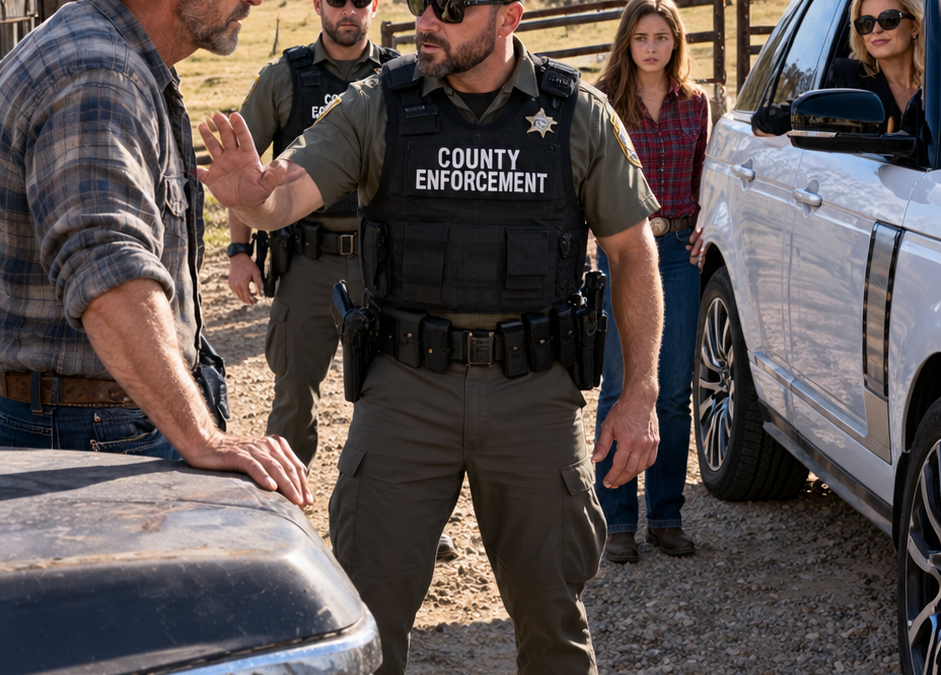
The first man out wore a six-point star and a vest marked COUNTY ENFORCEMENT. He moved toward me without introducing himself, one hand resting against his belt.
“Drop the hook. Hands on the hood.”
I looked at his vest, then at the vehicles.
“What’s this about?”
“You’re obstructing a county action.”
Behind him, another man stepped into the space between me and the gate.
My grandfather’s sheet-metal sign hung overhead. He had cut those letters himself in 1938, back when the road was little more than wagon tracks and the ranch belonged to a younger version of our family.
I set down the hook.
Then I put my hands on my truck.
Inside the yard, my hired man stood holding a bale of hay. He had stopped halfway to the feed bunk and seemed afraid even to lower it.
My daughter watched from the porch steps.
That was the part I hated immediately.
Not the cold metal under my palms.
Not the stranger standing close enough for me to smell his aftershave.
Maisie watching her father obey a man who would not explain why he was there.
“Badge number,” I said.
He tapped the star.
“That’s county business.”
“If you’re giving me an order, it’s my business.”
His expression hardened.
Forty yards back, a white Range Rover idled on the shoulder.
The driver’s window lowered.
Karen Walcott stayed comfortably behind the wheel.
“Look at yourself, Mr. Mulvaney.”
Her voice carried across the road.
“You couldn’t hold this place together if I let you sign the papers.”
I turned my head.
“It’s not for sale.”
The man beside me told me to face forward.
Karen smiled.
“Then my officers come out every day. Payroll’s already approved.”
She paused long enough to make sure I understood that this was a schedule, not a threat made in anger.
“Tell your girl to get used to the lights.”
The window went up.
I looked toward the porch.
Maisie had one hand around the railing. She wasn’t moving.
There were things a father could explain to a daughter studying agriculture and planning to come home: bad markets, hard winters, why a perfectly healthy calf sometimes didn’t make it.
I had no explanation for standing at our own gate while an association president threatened to make armed strangers part of our daily lives.
When the men finally stepped away, they left a citation on my hood.
Then they drove around the gate.
They swung onto the broad gravel apron beside it and turned there, smooth and unhurried, as if someone had shown them exactly where to put their tires.
I noticed the maneuver.
I did not yet understand its importance.
I was still looking at the star on the driver’s chest, trying to decide whether I had just been humiliated by a real officer or threatened by something worse.
Karen’s Range Rover pulled away last.
Only afterward did I realize she had already been parked there when the light bars arrived.
She had not followed them.
She had been waiting.
PART2
My name is Rhett Mulvaney.
I run six hundred and twenty acres on Antler Creek: two hundred and forty mother cows, a hundred and eighty acres of hay, and more work than a man can finish before dark.
I am the third generation on that ground.
My daughter was two semesters away from coming home to become the fourth.
People hear that and sometimes assume staying is easy because somebody handed you a place.
What they hand you is responsibility.
Fences still fall. Cattle still need feeding. Equipment still breaks at the worst possible moment. The bank does not lower its voice because your grandfather once shook hands with the man who founded it.
But there are mornings when the creek catches the first light and you understand why every generation stayed.
Thorncrest Reserve appeared across the road in 2004.
Two hundred and ten houses, a stone entrance, carefully maintained landscaping, and a pond somebody was paid to keep blue.
Our ranch was never part of it.
We had not joined.
We had not been annexed.
Nobody in my family had signed a covenant surrendering our ground to its board.
For twenty years, I assumed that was too obvious to require explanation.
Karen Walcott corrected that assumption on January 12.
She came into my yard wearing white sneakers and carrying a folder.
“I represent an opportunity for your family,” she said.
The offer was $2.6 million.
For everything.
House, barns, pasture, hay ground, water, and the gate my grandfather hung.
“Your family could rest,” she said.
I almost laughed.
Not because the money was small.
Because she had said rest as if everything we loved was something we had been waiting to escape.
“I appreciate the offer. We’re not selling.”
She studied me with the patient expression people use when they believe the answer is only the beginning of negotiation.
“Discuss it with your wife.”
“I don’t need to surprise her with a decision we’ve already made.”
Karen left a card on my truck seat.
“I’ll come back when the number gets serious.”
On February 3, she did.
This time, the offer was $3.2 million.
FINAL was written across the folder tab.
“This is the last time you’ll be asked,” she said.
I want to be honest about that moment.
I considered it.
I thought about the operating note, a winter that had lasted too long, and the hip that complained before my boots touched the floor each morning.
I thought about Greer keeping our books at the kitchen table after everyone else went to bed.
Three-point-two million dollars could make certain worries disappear.
Then I looked past Karen at the gate.
Maisie had called the night before to talk about improving our calving records when she came home.
Not if.
When.
“It’s not for sale,” I said.
Karen’s face changed.
The pleasant expression simply closed.
She reached into her vehicle and returned with another folder.
Thicker.
Tabbed.
Prepared.
“Then let’s talk about compliance.”
She opened a recorded declaration bearing the instrument number 2004-04630 and put her finger on Exhibit D.
“Your parcel falls within our planning boundary.”
“My parcel is outside your subdivision.”
“The association has enforcement jurisdiction over adjacent parcels.”
“Who gave it that?”
“It’s recorded, Mr. Mulvaney.”
“That wasn’t my question.”
She left the copy on our step.
That night, I pulled records from my father’s old file cabinet, the one with the drawer that stuck unless you lifted it while pulling.
My deed.
Parcel 18-062.
The recorded plat.
Karen’s declaration.
I laid them across the kitchen table.
I was comfortable reading a feed analysis, a loan schedule, or a machinery manual.
That declaration might as well have been written to make a straightforward question feel foolish.
Greer sat beside me.
“Did your father ever sign anything with them?”
“No.”
“Did you?”
“No.”
“Then we start there.”
Two days later, she came home from town and stopped inside the door without removing her coat.
“The Phase Three billboard,” she said. “Go look at it.”
I drove to the highway.
The rendering showed a stone entrance and a new spread of houses where the artist had made every tree look mature and every driveway look expensive.
Along the bottom was a list of amenities.
SECOND ENTRANCE: ANTLER CREEK.
My side of the road.
My hay ground.
Back home, Greer said the sign had gone up before the county fair.
Months before Karen’s first offer.
“She’s been advertising access before asking you to sell.”
I stood holding the deed.
Somewhere along the way, another person had begun presenting our land as a feature of something she intended to market.
I told Greer I would call the county.
That was the extent of my plan.
Then the men with light bars arrived.
At eight the next morning, I went to the Wendover County Sheriff’s Office with the citation folded in my shirt pocket.
“I need to speak to somebody about community enforcement,” I told the woman at the window.
She frowned.
“Which department?”
“County enforcement. Two units were at my ranch yesterday.”
She disappeared into the back.
Sheriff Cleon Bidwell came out holding a coffee pot.
He had been sheriff eleven years and had bought hay from my father long before that.
I described the vehicles and vests.
He stopped pouring.
“What exactly did the vest say?”
I repeated it.
He set the pot down.
“Rhett, we don’t have a division by that name.”
For a moment, I felt relief so strong it almost made me lightheaded.
This could be solved.
There had been a misunderstanding.
Someone would make a call.
“We dispatched nobody to Antler Creek,” he continued. “No deputy. No reserve. No code officer.”
I put the citation on the counter.
He read it without speaking.
Then he pulled a report form toward him.
“Start at the beginning.”
By the time I finished, the relief was gone.
He told me to report every future contact, preserve every paper, and avoid confrontation.
“Don’t let their clothes make you argue with them,” he said. “And don’t try to prove anything with your hands.”
Deputy Ruthie Vanderver walked me to my truck.
“Get the plates if you can,” she said. “The back of the vehicle. The markings. Keep your distance.”
“You think they’ll come back?”
She rested her hand on the door frame.
“People willing to act like officers are already crossing a serious line. Don’t test what else they’re willing to cross.”
I drove home believing at least the problem now had a name.
Impersonation.
A real report existed.
I thought that would make Karen hesitate.
Instead, the visits continued.
On March 2, Buster Kegley was bringing mineral tubs down the lane when flashing lights appeared behind him.
He pulled over.
Of course he did.
He was fifty-six years old, had never wanted trouble, and had spent his life stopping when someone wearing a badge told him to stop.
They held him twenty-two minutes.
Asked for his license.
Asked who employed him.
Asked whether he had permission to be on the property.
I reached them as one man was writing.
“He works for me.”
“Sir, stay back.”
“You’re standing on my ranch.”
“We’re conducting a county action.”
I had my phone out, but my hand shook and I had started recording while walking. Half the footage showed my boots.
The man tore off a citation.
I refused to take it.
He placed it on Buster’s hood and weighted it with a rock.
Two hundred and fifty dollars a day.
Unpermitted agricultural operation within association boundaries.
After they left, Buster stood holding his license.
He kept looking at it as if something about his own name had become uncertain.
Finally, he said, “My wife’s going to ask me about this.”
I could have apologized.
I could have promised it would not happen again.
Neither would have been enough.
“I’ll explain it to her if you want.”
He nodded but did not answer.
Vanderver reviewed my fourteen seconds of video.
“It’s a start,” she said.
Four days later, Karen sent an accounting of six alleged violations.
The balance was $8,250.
The final paragraph warned that unpaid assessments could become a lien against Parcel 18-062.
Seeing our legal description beneath her threat made the dispute feel colder.
She was not shouting.
She was creating paperwork that could outlast a conversation.
Greer slid the letter into the folder we had begun keeping.
“She’s building a file,” she said.
“So are we.”
“Yes. But she knows what she wants hers to do.”
On March 18, the men returned while I was in the south pasture.
I had begun locking the gate every evening.
They bypassed it using the gravel apron.
No hesitation.
No search for an opening.
They drove around the chain as if it were decoration.
They taped a county-abatement notice to my shed.
Then, on their way out, one man stopped and cut off my padlock.
They had not needed to cut it to enter.
They cut it after they were finished.
The sound carried across the yard.
One dry pop.
I understood the message.
I stood beside the apron afterward, looking at fresh tire tracks.
Three visits.
The same route every time.
They knew exactly where our boundary could be crossed without touching the gate.
That was the first night I did not sleep.
Dub Whitaker came by the following Saturday with a pie his wife had baked.
Men in our part of the county sometimes arrive carrying food when the thing they need to say is too heavy to bring empty-handed.
We sat at the kitchen table.
He watched the steam rise from his coffee.
“They ran lights on me too.”
I looked up.
“Who?”
He gave me a tired expression.
“You know who.”
Dub had sold forty acres the previous September.
Everyone assumed the price had finally persuaded him.
“Letters mostly,” he said. “A man in a vest a couple of times.”
“Why didn’t you tell me?”
“Because I wanted it over.”
He turned the mug between his hands.
“I sold because I got tired, Rhett.”
Greer stopped moving at the counter.
Dub looked out toward our hay ground.
“I need you to hear that. It works because it doesn’t stop.”
After he left, I called Dorothea Styles.
Greer had heard she handled difficult property disputes and did not confuse an association letterhead with authority.
I talked for eleven minutes.
The offers.
Exhibit D.
The citations.
The sheriff.
The billboard.
She listened.
Then she asked a question I had not considered.
“Who pays those men?”
“I don’t know.”
“They don’t put on equipment and drive out there for nothing. Somebody authorizes the invoices.”
I looked at the kitchen folder.
“Karen said payroll was approved.”
“Then we find out what she meant.”
For the first time, someone had given me a question that pointed beyond the men at my gate.
I could identify their costumes all day.
What I needed was the person signing for them.
The planning department let me examine the Phase Three file in a back room.
PA-24-118.
A thick folder.
A hot copier.
A clerk who explained the fees as though she had said the same sentence for thirty years.
I had never studied a development application.
For forty minutes, I read pages without understanding how they connected.
Then I found the staff report.
Ninety-six lots.
Conditional approval.
A second emergency-access connection to a public road had to be constructed and accepted before May 8.
The fire district required it.
One entrance was not enough.
I studied the maps.
Highway on one side.
Creek to the north.
The practical route crossed my hay ground.
Suddenly, Karen’s offers made sense.
So did the billboard.
Then I turned another page.
A certification dated January 9.
Her signature at the bottom.
The sentence above it read:
Secondary access has been secured by agreement with the Mulvaney ownership.
I read it again.
January 9.
Three days before she first came to ask whether I would sell.
The clerk asked if I needed help.
“No,” I said.
But my hand shook while I made the copy, and the page came out crooked.
I paid a quarter for it.
I still have it.
The file summary listed $16.4 million in presale deposits.
Those deposits did not prove where every dollar was held or how it had been spent.
They proved the scale of the promises surrounding a project whose required access did not exist.
Karen had told the county she possessed an agreement with us.
There was no agreement.
I called Styles from the parking lot and read the sentence.
She went quiet.
Then she asked me to read the date.
I did.
“Send that immediately.”
“She needs the road by May eighth.”
“Yes.”
“So she thought she could make me sell before anybody checked.”
“That is one question the documents raise.”
Then her voice sharpened.
“Understand the deadline, Rhett. If her project depends on getting that access, this may become more aggressive.”
She had been working on the men’s identities.
Our photographs and video, compared with licensing records, led to Blackthorn Protective Group LLC.
A real security company.
Not a law-enforcement agency.
Styles wanted contracts, invoices, and instructions.
I requested the association’s records.
Karen’s response said I was not a member and therefore had no right to inspect them.
I read that twice.
Not a member when I wanted records.
Subject to enforcement when she wanted money.
Greer said, “Keep that letter too.”
The call came that evening.
A woman introduced herself as Philippa Avestri, a Thorncrest board member.
“I voted against Phase Three,” she said. “I want you to know that.”
“What can you tell me about the security company?”
A pause.
“That’s why I’m calling.”
She had searched the minutes.
No vote to hire Blackthorn.
No open-session approval.
No executive-session authorization she could find.
When she asked, Karen called it a vendor matter.
“Then who approves the money?” I asked.
“I don’t know. And I’m tired of being told I don’t need to.”
With her permission, I gave her information to Styles.
That night, Greer laid both hands flat on the kitchen table.
“It’s almost April.”
“I know.”
“May eighth is six weeks away. She has made promises involving millions of dollars and signed something that isn’t true.”
I looked at her.
“What is somebody like that willing to do in six weeks?”
The next night, I found out.
Maisie was driving home from her feed-store shift at 9:40.
Two vehicles came up behind her with flashing lights.
She stopped because we had taught her to stop.
They kept her outside her car for nine minutes.
Spotlight in her face.
License in their hands.
Questions about where she lived and what business she had on the road.
When she called me, her voice was controlled.
Too controlled.
I reached her in four minutes.
The vehicles were already leaving.
Maisie stood in front of her headlights with her arms slightly away from her body.
She looked as though she was still waiting for permission to move.
“Dad, I did everything right.”
Those words nearly broke me.
“I know.”
“I pulled over. I kept my hands where they could see them.”
“I know you did.”
She was shaking.
She had not noticed.
I put my coat around her and waited until she could hold her keys steadily.
We drove home with her car ahead of mine.
At the gate, her headlights swept across the gravel apron.
The open strip.
Their favorite way in.
After everyone went inside, I stood there a long time.
Then I called a fabricator.
Dodge Tolman arrived on April 2.
He walked the apron, studied the grade, and looked at the space beside the gate.
“You want vehicles discouraged or kept out?”
“Kept out.”
He proposed a row of substantial fixed steel bollards, professionally installed, leaving the established entrance as the way onto the property.
The price was $14,200.
I looked toward the house.
Maisie’s car sat beside the porch.
“Do it.”
He offered to bill me in June.
I accepted without pretending I was comfortable with the expense.
The crew started the next morning.
For two days, the yard filled with the sounds of drilling, trucks, and concrete work.
By the end, nine gray columns stood across the bypass route.
They were ordinary security barriers.
Visible.
Permanent.
I wanted vehicles to stop at the gate so whoever was inside them would have to explain why they were there.
At dusk, Maisie walked out and rested her hand on one of the posts.
I watched from beside the shed.
She stayed there for several seconds.
Then she looked at me.
“They can’t just drive around anymore?”
“No.”
She nodded.
It was the first time in weeks that her shoulders looked relaxed.
Two days later, I brought a banker’s box to Bidwell.
The false certification.
The citations.
Karen’s letters.
Photographs.
Avestri’s contact information.
Maisie’s account.
He spent half an hour examining the contents.
Then he closed the lid.
“We’re opening a criminal investigation.”
I drove home with the windows down.
For the second time, I let myself believe the worst had passed.
The next week proved how badly I wanted a simple ending.
On April 10, Styles called.
Blackthorn had filed to dissolve.
The men were independent contractors.
The listed office was a mailbox.
Another company, Caldwell Compliance LLC, had been registered with the same phone number and the same individuals.
“They changed the name?” I asked.
“They changed the paperwork. Their earlier conduct doesn’t disappear with it.”
District Attorney Tobin Wathbone agreed to meet.
He was direct.
The case against the men was developing.
The case against Karen needed more.
“Her position is that she retained a community patrol and didn’t authorize impersonation.”
“She sat there while they did it.”
“That matters. I still need evidence of what she instructed and what she knew.”
I told him about her payroll remark.
He wrote it down.
Then he leaned forward.
“Bring me the connection. Contracts, messages, instructions. Something a defense lawyer can’t explain away as a contractor going beyond the job.”
Two days later, the association sued.
It claimed a prescriptive easement sixty feet wide across the north end of my hay ground.
The exact route the development needed.
A lis pendens was filed against the title.
Styles explained that the pending claim would complicate borrowing against the land.
That afternoon, a public-works employee tied an orange notice to the third bollard.
Unpermitted obstruction within the county right-of-way.
Remove within ten days.
I asked who had complained.
He checked his clipboard.
“Thorncrest Reserve.”
He looked uncomfortable.
I did not blame him for arriving with the assignment he had been given.
But I stood listening to the tag flap against the steel long after he drove away.
On April 14, the bank froze our operating line.
The hay buyer wanted to wait before committing to the summer cutting.
Then Buster came to the shop carrying his hat in both hands.
“They came to my house.”
I stopped working.
“My wife answered.”
“What did they say?”
“Questions. About working here. About whether I understood there was an investigation.”
He turned the hat once.
“She wants me to stay away for a while.”
I told him to take care of his family.
He looked ashamed.
That made me angrier than anything he could have said.
He had done nothing wrong.
After he left, I stood at the bench with my palms flat against the wood.
Karen did not need a court to take the ranch that week.
She was interfering with everything that let me keep it.
Greer put the numbers on the kitchen table that night.
The bollard bill.
Legal expenses.
The frozen line.
Fuel.
Twine.
The uncertain hay contract.
Her handwriting was small and precise.
There was nowhere for optimism to hide between the columns.
“I’m not telling you to sell,” she said.
“I know.”
“I need you to understand what another month looks like.”
“I do.”
Neither of us spoke for a while.
Then I did the thing I still find hardest to admit.
At ten that night, I called Karen.
She answered quickly.
“Mr. Mulvaney.”
“Is the offer still available?”
The silence that followed had satisfaction in it.
“It’s two-point-nine now.”
“You offered three-point-two.”
“In February.”
I looked toward the dark kitchen window.
“The price goes down every week you fight me,” she said. “It will be lower in May.”
She sounded pleasant.
Almost helpful.
“Shall I send the paperwork tomorrow?”
For a few seconds, I pictured signing.
No more lights.
No more strangers questioning my daughter.
No more explaining to a bank why the claim against our land was false.
Then I understood what signing under those conditions would mean to every person who came after us.
“No.”
“Mr. Mulvaney—”
“Don’t send anything.”
“Then I’ll wait.”
I hung up.
Greer stood in the doorway.
“I’m sorry,” I said.
“For asking?”
I nodded.
She came to the table.
“You’re allowed to be tired.”
I sat down.
“You’re not the only one carrying this.”
That was what I needed to hear.
Not a speech about pride.
A reminder that the ranch had never been held by one person alone.
The next morning, we hired a surveyor.
Merritt Colcord’s crew worked the boundary on April 15.
The following morning, he unrolled a sealed survey across my tailgate.
“All nine bollards are inside your property.”
“How far?”
“Twelve feet. The closest point is not a close call.”
I stared at the line.
“Then why did the county tag them?”
“They acted on information that needed checking.”
“Can you put that in something they have to consider?”
He tapped the seal.
“That’s what this is.”
Styles wanted more than defeating the notice.
“Let’s establish the entrance and document the closure clearly,” she said.
On April 21, I filed the survey with public works.
The removal demand was withdrawn.
I obtained the county entrance permit for the existing gate and access.
The bollards received reflective sleeves.
We installed the required warning signs and lighting so the entire line remained plainly visible after dark.
Nothing was concealed.
Nothing depended on a driver being surprised.
At Styles’s direction, we sent certified notices to the association, Karen personally, and Caldwell Compliance’s registered agent.
The letters described the permanent closure beside the gate.
They identified the marked barriers.
They directed all vehicles to the main entrance.
They stated that no permission existed to enter by another route.
Three delivery receipts came back.
Three signatures.
Karen signed hers on April 23.
I filed them beside the crooked copy of her January certification.
Vanderver helped us position four cameras to capture the approach, gate, shed, and upper lane.
“Get the whole sequence,” she said. “Not just whatever happens at the end.”
I walked the entrance with Maisie that evening.
Reflective surfaces caught the last light.
The main gate stood exactly where it had always stood.
A lawful visitor could stop and wait.
An emergency vehicle could use the designated entrance.
There was no puzzle to solve.
That should have been enough.
Styles pursued the security company’s records through the litigation and licensing investigation.
Dissolving a business did not erase the contracts and post orders already created.
State investigator Blythe Kenner began examining the same operation.
The records arrived on April 28.
Twenty-two pages.
Styles opened the packet with me sitting across her conference table.
Special Enforcement Detail—Thorncrest Reserve.
Executed February 6.
Karen Walcott’s signature.
Three days after my final refusal.
Styles turned to Attachment B.
Uniform and vehicle specifications.
A star badge.
Duty vest.
Shoulder patch.
Reflective SHERIFF’S OFFICE lettering.
Light bar.
Public-address system.
Then handwritten instructions in the margin:
They must read as deputies.
No company markings.
I stared at the page.
“She wrote that.”
“Yes.”
There was no planning-boundary argument inside those words.
No concern about a misinterpreted uniform.
She wanted strangers to believe these men were deputies.
The invoices showed association payments coded as landscape compliance.
Avestri had not overlooked a security vote.
The expense had been disguised beneath another description.
The final document was an email from the association’s attorney dated February 24.
It warned Karen that directing private personnel to present themselves as peace officers could expose both her and the association to criminal liability.
It recommended that the practice stop immediately.
Her reply came nine minutes later.
Then keep it out of the minutes.
Styles let me read it twice.
I thought about Buster holding his license.
Maisie standing in her headlights.
My hands on the hood.
Karen had been warned before some of the worst incidents occurred.
She had responded by asking that the record be hidden.
We delivered the packet to Wathbone.
He read the instructions, went back to the signature, then read the email exchange.
“This is the connection,” he said.
For once, I did not feel relief.
I felt grief over how deliberately someone had made my family afraid.
Wathbone explained the arguments he expected.
Karen might claim she had stopped the operation after the attorney’s warning.
She might say the contractors continued without permission.
The records already mattered, but evidence of later direction would make those explanations harder.
Then he looked directly at me.
“I’m not asking you to provoke another visit. Don’t arrange a confrontation.”
“I won’t.”
“Keep reporting. Let us investigate.”
That was all I intended.
On April 30, the court denied the association’s request for an emergency injunction in the easement case.
There would be no immediate order opening my property to their access work.
The larger case could take months.
Karen had eight days.
On May 2, Avestri called during supper.
“There’s an entry on the internal calendar.”
I reached for a pen.
“Monday, May fifth. Six a.m.”
“What does it say?”
“Access secured.”
No listed contractor.
No approved resolution.
No explanation.
I thanked her and called Bidwell.
I gave him the words, date, and time exactly as she had supplied them.
Then I checked our cameras.
Fresh storage.
Charged batteries.
Correct timestamps.
At dusk, I walked the bollard line.
The reflective sleeves were secure.
The signs were visible.
The light worked.
I changed nothing else.
No added obstacle.
No equipment placed in the approach.
No invitation.
I chained the gate as I had every night since March and went inside.
Greer was standing at the sink.
“You called the sheriff?”
“Yes.”
“Then come sit down.”
We sat together without turning on the television.
Outside, the cattle moved softly in the lot.
The ordinary sounds helped.
For a while, we listened to a place that still belonged to us.
I was awake before five-thirty on May 5.
I made coffee and took it to the porch.
Maisie was feeding in the south lot.
The sky held that cold blue light before sunrise, and the fields lay beneath a shallow drift of mist.
At 5:52, brake lights appeared on the curve.
Karen’s Range Rover pulled onto the shoulder four hundred yards up the road.
Headlights off.
Parking lights glowing.
She had arrived early.
I called in what I saw and stayed on the porch.
At 6:08, three vehicles came down from the Thorncrest entrance.
Blue and amber light flashed across the hay ground.
Their reflective decals caught our entrance light.
SHERIFF’S OFFICE.
The loudspeaker came on.
“County enforcement. Open the gate.”
The gate was chained.
The main approach was clear.
The barriers beside it were marked and illuminated.
The lead vehicle could have stopped.
Instead, it turned toward the apron.
I remember setting down my coffee.
The motion was slow and strange, as though my hands were doing something ordinary while the rest of me understood what was about to happen.
The driver accelerated.
I had expected shouting.
Another paper.
Perhaps another attempt to cut a lock.
I had not expected someone to drive into a plainly marked closure.
The lead vehicle struck the fourth and fifth bollards.
The sound rolled across the yard as one enormous metallic note.
The front folded.
Airbags burst.
The light bar tore loose and slid across the gravel, still flashing.
Steam rose through the beams of the headlights.
The second vehicle braked too late.
It struck the rear of the first.
The third stopped in the road.
Then a horn began sounding and would not stop.
I looked toward the south lot.
Maisie had started running.
“Stay back!”
She froze at the fence.
I called 911.
“Collision at forty-four hundred Antler Creek Road. Two vehicles. Possible injuries. Send an ambulance.”
Then I went down and unlocked the gate so emergency responders could enter.
Whatever these men had done, I did not want anyone dying in my driveway.
The lead driver climbed out on his own.
Blood ran from his nose.
He leaned against the door.
I was grateful to see him standing.
Then he pressed the radio on his shoulder.
“Need backup.”
Nothing.
He tried again, giving a unit number.
Still nothing.
He pulled out his phone.
“It’s blocked,” he said loudly. “There’s posts. What do you want me to do?”
I stood beside the open gate.
The barriers had not moved.
The uniforms were still on the men.
But the performance had begun coming apart.
Vanderver arrived at 6:16.
Bidwell had increased patrol attention on the road after the calendar information, and she had been nearby.
Her body camera was running.
She checked the injured driver first.
Then she looked at the vehicles.
No proper agency identification beyond the decals.
No normal patrol equipment inside.
A star badge that did not belong to her office.
She asked the driver which agency employed him.
He looked down the road.
He did not answer.
Karen’s Range Rover started moving.
She pulled up, got out in a wool coat, and walked toward the scene.
I waited for her to look at the injured men.
Instead, she pointed at the third vehicle.
“Get the other truck up there and finish it.”
Vanderver turned.
Karen kept going.
“Go through the field if you have to.”
“Ma’am, step back.”
“You don’t understand.”
Karen’s voice sharpened.
“I authorized this. Those are my officers.”
The deputy went very still.
Then her hand moved to her radio.
I heard Maisie behind me near the yard fence.
For months, Karen had controlled when conversations started and how other people were allowed to answer.
Now she had supplied the sentence nobody else could supply for her.
Bidwell arrived at 6:31.
Kenner followed shortly afterward.
Ambulance personnel treated the drivers while the investigators separated people and began asking questions.
Karen recovered enough composure to attempt the explanation Wathbone had anticipated.
She had hired a patrol service.
She could not control how contractors dressed.
She had discontinued any questionable activity months earlier.
Bidwell asked about the handwritten instructions.
They must read as deputies.
Karen stopped.
He asked about the attorney’s warning.
Then keep it out of the minutes.
She looked toward me.
I did not say anything.
Finally, he asked whether she had received the certified notice describing the bollards and closure.
The delivery receipt bore her signature.
She could dispute what she intended by a uniform specification.
She could not plausibly claim no one had told her the apron was closed.
The injured lead driver, Jud Tarkington, sat on the ambulance step holding an ice pack.
He called Bidwell over.
Then he showed him the orders on his phone.
And a text received at 5:41 that morning from a contact saved as KW.
Do not stop at the gate.
I watched Bidwell read it.
He asked Tarkington another question.
The man answered quietly.
Karen stood beside her vehicle, no longer issuing instructions.
At 7:53, she was placed in handcuffs on Antler Creek Road.
My grandfather’s sign hung above the gate.
I had imagined feeling triumphant if that moment ever came.
Instead, I wanted my daughter to stop being afraid of headlights.
The charges were announced eleven days later.
The case included repeated peace-officer impersonation, conspiracy, and the false filing connected to the January 9 certification.
The three men were charged alongside Karen.
Tarkington entered a cooperation agreement and supplied a lengthy statement.
The investigation continued through records, interviews, and court proceedings.
I learned to stop expecting the criminal process to move at the speed of my need for closure.
May 8 arrived.
The required second entrance did not exist.
The county withdrew Phase Three’s conditional approval.
Ninety-six proposed lots could not proceed on the promises submitted.
The $16.4 million in deposits had to be returned.
The development partner sued the association.
Its insurer denied Karen individual coverage for intentional conduct, leaving her to fund her own defense.
I heard details through Styles.
I did not spend my days following every consequence.
There were cattle to check and a season already getting away from us.
The association abandoned the easement case in June.
Eleven days later, the lis pendens was removed.
The bank called that afternoon.
Our operating line was available again.
The loan officer sounded relieved, as though the whole interruption had been a storm neither of us could have anticipated.
I thanked him because I needed the credit, not because I appreciated the timing.
We recovered the hay contract.
The first cutting brought a worse price than we had hoped.
It still brought a price.
After weeks of uncertainty, that mattered.
Public works corrected its file to reflect Colcord’s survey and voided the obstruction notice.
Our boundary and entrance were now documented clearly.
The barriers stood twelve feet inside our line.
Every dollar of the $8,250 in association citations was canceled.
The association paid my legal fees.
None of those outcomes restored the lost sleep.
They restored our ability to work.
That was more useful.
Thorncrest recalled its board in July by a wide margin.
Avestri became interim chair.
At the first open meeting, the new board read a public apology to my family.
They entered the full statement in the minutes.
For months, Karen had wanted important things kept out of those minutes.
The apology stayed.
Greer read the copy at our kitchen table.
Then she passed it to Maisie.
My daughter took her time.
When she finished, she folded it carefully.
“Are we keeping this?”
“Yes,” Greer said.
“Good.”
Buster returned in August.
His wife sent something baked ahead of him.
Then he arrived one Tuesday and began repairing a waterer as though he had stepped away only to fetch a wrench.
I found him kneeling beside it.
“You’re going to want a new float,” he said.
“Probably.”
He kept working.
“I’m sorry about leaving you short.”
I crouched beside him.
“You protected your family.”
He tightened a fitting.
Still would not look at me.
“You told me to.”
“And I meant it.”
After a moment, he nodded.
That was the whole conversation.
Some apologies need witnesses and minutes.
Others fit beside a stock tank.
I kept the bollards.
In the fall, Dodge returned and installed a narrow controlled access gate within the barrier line, giving the fire district another usable entry when needed.
Dub could also use it, with permission, when high water made his usual route difficult.
I liked that.
The place where people had tried to force their way in became somewhere neighbors could be welcomed through.
The fourth and fifth posts still carried scrape marks.
Maisie wanted the rough edges smoothed.
I told her we would make sure they were safe to touch.
I did not have the paint matched to erase the marks.
They were part of what had happened.
Not a trophy.
A reminder that the boundary had needed defending, and that defending it had required far more than steel.
Greer’s files.
Avestri’s willingness to call.
Dub admitting why he sold.
Vanderver telling me to record the entire approach.
Styles insisting on the signature behind the costumes.
People had helped us hold the line long before the vehicles reached it.
For a while afterward, Maisie still looked up when headlights crossed the windows.
So did I.
Fear does not disappear because somebody enters a charge into a computer.
It leaves in smaller increments.
An uneventful drive home.
A truck stopping normally at the gate.
A deputy arriving with her name, agency, and reason for being there plainly stated.
Ordinary things, repeated until ordinary starts feeling dependable again.
Maisie finished her semesters.
She came home.
We began using the calving records she had designed, and she proved annoyingly correct about several improvements I had resisted.
Greer enjoyed that more than she tried to hide.
The ranch remained work.
It remained expensive.
My hip still hurt in the mornings.
None of those things had ever been reasons to hand it to someone who thought intimidation was a purchase agreement.
The following June, wind pulled the upper wire loose on my grandfather’s sign.
Maisie and I carried a ladder to the gate with fresh cable and tools.
She steadied the sign while I fastened it.
The sheet steel had weathered through generations of winters and summers.
Some letters had softened at the edges.
It still said what my grandfather intended.
When we finished, we stepped back into the road to see whether it hung straight.
Maisie tilted her head.
“A little left.”
I adjusted it.
“There?”
She smiled.
“There.”
We stood looking for another moment.
Then she asked whether I regretted any of it.
“The money. The fighting. Everything.”
I knew the question beneath the question.
Whether the ranch had mattered more to me than what she went through.
I set the pliers on the tailgate.
“I regret that they frightened you.”
She looked down.
“I regret not understanding sooner how far she would go. And I regret every night you had to wonder whether those lights were coming back.”
“That isn’t what I meant.”
“I know. But it’s what I need you to hear.”
She nodded.
Beyond the gate, our cattle moved toward water. The hay ground stretched green along the creek.
There were bills waiting in the house.
Work waiting in the barn.
A future neither of us could guarantee.
But it was still ours to build.
“Do you wish you’d taken the three-point-two?” she asked.
I looked at the sign, then at my daughter standing beneath it.
“No.”
“Not once?”
“I wished it could have been easier,” I said. “That’s different.”
She picked up the tools.
I took the ladder.
Together, we went back through the gate and closed it behind us.
Then we went home for supper.








