I Knew Karen Had Stopped Playing HOA President the Moment I Heard Chainsaws on My Back 40
𝗙𝗨𝗟𝗟 𝗦𝗧𝗢𝗥𝗬
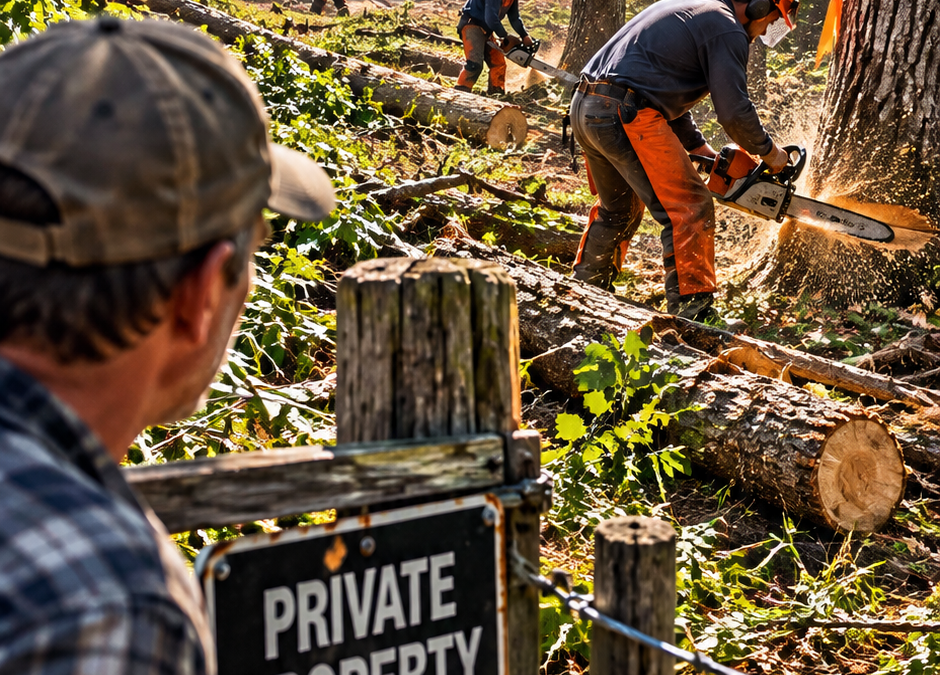
I stood by the fence line and listened.
One saw. Then another.
Then the clank of equipment.
I remember saying, out loud and to no one, “What in God’s name?”
I climbed into my truck, took the rutted lane around the hay field, and headed toward the back section. The farther I went, the tighter my hands got on the steering wheel. A part of me kept trying to explain it away. Maybe a crew had turned around on the wrong access road. Maybe a neighbor had hired someone and the sound was carrying strangely through the woods. Maybe there really had been some honest mistake.
That hope lasted until I cleared the last line of brush and saw them.
There were six men and two trucks—one pickup with toolboxes mounted along the sides, one larger rig with equipment attached—parked in a clearing just inside my timber. Bright survey tape flickered from low branches. Fresh orange paint bands circled trunks throughout the stand. A skidder sat idle a little farther in, and one man in a hard hat was feeding chain into a saw while another checked markings on a clipboard.
My trees.
My ground.
My chest went hot so fast it almost made me dizzy.
I got out of the truck hard enough to slam the door and started walking toward them.
“Hey!” I shouted. “Kill those saws.”
The closest two men turned. One of them raised a hand toward another worker, and the engines wound down one by one until the woods dropped into a sudden unnatural silence.
Everybody looked at me.
I looked back at them and tried to keep my voice steady.
“Who gave you permission to be in here?”
A stocky man in his fifties, sunburned around the neck and jaw, stepped forward. He had the look of somebody used to outdoor work—creased skin, measured movements, eyes that checked a person before speaking.
“You the owner?” he asked.
“I’m Daniel Mercer. This is my property. So I’ll ask again. Who gave you permission to be here?”
He frowned, not hostile yet, just confused. “I’m Travis Boone. I’m the foreman for Boone Timber Services. We were contracted to mark and begin harvest prep on this tract.”
“This tract belongs to me.”
That got a few looks among the crew.
Travis reached into the cab of his truck and pulled out a work folder. “We were given a work order through Pine Hollow Estates Homeowners Association. They’re listed as the contracting party for this parcel.”
“The HOA?”
He nodded.
I took the paperwork from him and looked down at it.
There it was in black and white: Property Owner/Authorized Representative: Pine Hollow Estates HOA. Beneath that was a legal description dense with lot references, tract numbers, and section lines. There was also a marked harvest area map, though I could tell within seconds something about it was off. The shape shown on the attached diagram did not match my back forty. The orientation was wrong. The creek bend was wrong. The western edge bore no resemblance to the boundary I knew by heart.
“This isn’t right,” I said.
Travis kept his eyes on me. “You saying this isn’t the tract?”
“I’m saying somebody sent you onto land they don’t own.”
He took the papers back and looked again, slower this time.
“We were told access came through the east side boundary.”
“Access came through a lie.”
One of the crew muttered something under his breath. Another shifted uncomfortably near a marked white oak that had to be at least seventy years old.
I started walking through the stand, counting the orange bands with every step. One on a hickory. Two on mature oaks. Another on a straight pine near the drainage. Some trees had bark scraped where they’d been measured. Others had flagging tied nearby. No trees were down yet, but the intention was written all over the woods.
I turned back toward Travis. “How many have you marked?”
He glanced toward one of his men.
“Thirty-eight so far,” he said. “Maybe a few more identified for secondary pass.”
Thirty-eight.
I thought of how long some of those trunks had stood there. I thought of storms they’d survived, summers they’d shaded, the fact that half the people causing this trouble hadn’t even been alive when those trees were already big.
“No one cuts another limb,” I said.
Travis raised both palms slightly. “Nobody’s cutting until we figure this out.”
That was the first moment I realized he might not be the enemy in this mess.
“Good,” I said. “Because if one tree falls before this gets sorted, the damage claim will be the least of somebody’s worries.”
He gave a single tight nod.
I had just taken my phone from my pocket when I heard another vehicle coming down the access lane.
Karen.
Even before I saw her, I knew it was her. There’s a particular kind of confidence some people carry when they believe authority belongs to them by nature. It announces them before they speak.
Her SUV rolled up in a cloud of dust and stopped at an angle like she was arriving at a scene she already controlled. She stepped out wearing white sneakers, fitted jeans, and a pale blue blouse that looked better suited for brunch than standing in the middle of the woods. Her phone was in one hand, a folder in the other.
She saw me, saw the crew, and smiled.
“Daniel,” she said, as if this were an appointment we had scheduled. “I was told there was some confusion.”
“Confusion?” I said. “You brought a logging crew onto my property.”
She ignored my tone and turned toward Travis. “Everything all right here?”
Travis didn’t answer immediately. His eyes flicked from her to me and back again.
“He says this is his land,” he said.
Karen gave a soft laugh, the kind meant to make another person look unreasonable. “That area has always been under community control. We purchased the timber rights as part of the tract review.”
“From who?” I asked.
“From the property authority connected to the subdivision boundary.”
“That doesn’t mean anything.”
“It means,” she said, patience sharpening into irritation, “that the HOA has documentation.”
“Then show me the document that gives you the right to sell timber off my back forty.”
She lifted the folder and pulled out several papers, waving them in the air as if volume might become truth if she moved it fast enough.
“Here is the HOA map,” she said. “Here is the board authorization. Here is the agreement for the timber rights.”
“None of that matters if it isn’t your land.”
She stepped closer. “This section of forest has always been shown within the managed tract associated with Pine Hollow.”
“On your map,” I said.
“On the recorded community documents.”
“Then your documents are wrong.”
Her mouth tightened. “No, Daniel. What’s wrong is your refusal to accept the actual boundary situation.”
There was a moment then—one of those moments where anger gets so intense it becomes almost calm. I reached into my truck, took out the weathered document envelope I kept behind the seat, and removed a certified copy of my deed.
I unfolded it carefully, not because I was nervous, but because my father had taught me to handle land papers with the same respect other people handled family Bibles.
“Read it,” I said.
She didn’t take it.
So I read it aloud myself. Parcel description. Reference points. Southern fence line. Creek bend. Northern ridge. The whole back forty explicitly contained within the legal description that had transferred from my father to me.
“The exact boundary is right there,” I said, tapping the page. “The back forty is inside my parcel.”
Karen lifted her own map. “Our plat shows something completely different.”
“Then your plat is a problem for you, not for me.”
By then the crew had gone from cautious to openly uneasy. Nobody likes being trapped in somebody else’s property fight, especially when chainsaws and contract paperwork are involved.
Travis walked over and studied my deed, then Karen’s map. “Ma’am,” he said slowly, “these don’t line up.”
Karen turned to him with the air of somebody addressing an employee who should be more obedient than observant. “The HOA records were reviewed. This is the tract we were told was included.”
“By who?” I asked.
“By our board and counsel.”
“Then one of them needs to come explain why their authority ends at my fence line.”
She folded her arms. “You’re being dramatic.”
I stared at her.
“You brought commercial logging equipment onto private property and marked nearly forty trees,” I said. “If you think dramatic is the issue here, you’re dumber than I thought.”
Her cheeks flushed. “You do not get to speak to me that way.”
“On my land? I absolutely do.”
The next thing that happened changed everything.
One of the younger crew members, maybe twenty-five, had wandered a few yards off while we argued. He was near a large post oak where leaves had built up around the base over years of rain and decay. I noticed him crouch, scrape something with the heel of his boot, then bend lower.
“Hey, Travis,” he called. “Come look at this.”
We all turned.
Travis walked over first. I followed. Karen hesitated, then came behind us.
The young man used a gloved hand to brush aside more leaves and dirt. Beneath the debris, half-buried in the ground, was the top of an old metal marker—weathered, rust-edged, but still firm in place.
My heart gave one hard thud.
I knew that marker.
I hadn’t seen it exposed in years, but I knew it.
When I was twelve, my father had shown it to me during one of our walks through the timber. He had kicked aside leaves and said, “This corner pin matters. Men will argue over paper all day long, but this iron in the ground settles more lies than most lawyers.”
I remembered kneeling beside him, touching the cold metal with my fingertips.
I remembered him saying, “Don’t forget where this is.”
I hadn’t forgotten.
Travis crouched and wiped more dirt away. The marker head was stamped faintly, but enough remained to match a survey monument.
Karen stopped talking so abruptly the silence around her became its own statement.
I looked at her.
She didn’t look at me.
Travis rose slowly and turned between us. “Are we standing on private property?” he asked.
“Yes,” I said.
Karen answered at the same time. “That marker could mean anything.”
I laughed once, without humor.
“Funny,” I said. “It means exactly what my deed says.”
Travis looked at Karen. “Do you have a survey?”
“We have community maps.”
“That’s not what I asked.”
She hesitated just a fraction too long.
“I have enough documentation to authorize this operation.”
“Do you have a survey?”
“The HOA attorney reviewed the parcel.”
Travis’s face changed then. Not angry—worse. Careful. He was realizing there might be real liability in every minute his crew remained on site.
I pulled out my phone.
“I’m calling the county surveyor,” I said. “No one touches another tree until official records verify the line.”
Karen’s voice sharpened. “You can’t just halt contracted work because you’re upset.”
“Watch me.”
I stepped away and made the call.
Our county surveyor, Eli Patterson, was a man I’d known by reputation for years. Precise, patient, not much for theatrics. He had helped settle more than one fence-line dispute in the county, and people trusted him because he loved measurements more than opinions.
I told him what was happening.
He asked three questions: Was there an identifiable monument on site? Did I have my deed? Was commercial activity still underway?
I answered yes, yes, and no—not if I could help it.
He said he could be there within an hour.
That hour felt longer than some whole weeks of my life.
Nobody restarted a saw. Karen paced and made calls, her voice clipped and low. Twice she said the phrase “community-controlled timber area,” and each time I could feel my jaw clench harder. Travis kept his crew busy rolling up some flagging, setting tools aside, and checking the work order again. A few of the men smoked near the trucks. Nobody seemed eager to talk.
I used the time to walk the immediate boundary the way I remembered it, partly to settle myself and partly to think.
There is a particular kind of violation that happens when someone enters your land and begins treating it like inventory. It is not only anger. It is grief mixed with disbelief. Every orange band I passed felt personal. Those trees had been standing there in storms when the lights went out across the county. They had cast shade over my dog when he was still alive and liked to follow me everywhere. They had framed autumn mornings when my father and I sat with thermoses of coffee after a hunt, saying very little because very little needed to be said.
Now strangers had wrapped them in color and counted them for removal because Karen Whitmore had apparently mistaken her own arrogance for title.
By the time Eli Patterson’s truck came bumping up the lane, my anger had settled into something steadier.
He got out carrying a field bag, measuring equipment, and the kind of expression that suggested he’d already guessed what sort of morning this was going to be.
“Daniel,” he said.
“Eli. I appreciate you coming.”
He nodded to the others. “Who’s involved?”
I introduced Travis. Karen introduced herself before I could.
“Karen Whitmore, president of Pine Hollow Estates HOA.”
Eli gave a polite but unreadable nod. “All right. Show me what we’ve got.”
We led him to the exposed marker.
He crouched down, cleaned it properly, then consulted both my deed copy and the coordinate reference from county records on his tablet. After that he asked to see the HOA documents. Karen handed them over with exaggerated confidence, but I noticed her fingers were tighter around the papers now.
Eli took his time.
He looked at the legal description on my deed. Then the work order. Then the HOA map. Then the marker. He said almost nothing for several minutes.
Finally he stood and said, “I’m going to run a few measurements.”
He moved through the timber with methodical focus, checking bearings, distances, and reference points. He located another old point farther north. Then another alignment toward the western edge. We followed him in a loose group, all of us quieter than before. Even Karen, who usually filled silence with certainty, had gone still.
After the third measurement, Eli stopped, looked back toward us, and adjusted his glasses.
“Mr. Mercer’s deed is consistent with the monuments on the ground,” he said.
Karen opened her mouth. He held up a hand, not rude, simply continuing.
“The back forty in question falls within his parcel. The marker we found matches the recorded property map. The boundary line runs here.” He pointed through the stand with his instrument rod. “And the area marked for timber activity lies on Mr. Mercer’s side of that line.”
The words hung there.
No one spoke.
Eli looked directly at Karen. “The HOA does not own this tract.”
Travis exhaled slowly, like a man who had expected bad news and still hated hearing it.
I looked at Karen.
All morning she had been composed in the artificial way some people are composed—because they assume reality can be bullied if their tone remains firm enough. But I saw it break then. Not dramatically. Not all at once. Just a crack in the face she showed the world.
“That can’t be right,” she said.
Eli’s voice stayed even. “It is right.”
“Our map—”
“Your map,” he interrupted, “is not a controlling survey.”
Travis asked, “So the work order references the wrong parcel?”
Eli glanced again at the paperwork. “Yes. This description appears tied to a different tract associated with the HOA boundary area east of here. Not this parcel.”
I said nothing. I didn’t need to.
Karen turned sharply and took out her phone. “I’m calling our attorney.”
“Please do,” I said.
She shot me a look so full of anger it might have been satisfying if I’d been in the mood to enjoy it.
While she made the call, Eli walked the immediate line with me and placed temporary flags along the verified boundary so there could be no further pretense of confusion. I followed him, listening carefully, asking questions, making sure I understood every reference point. I wanted the line clear not just for that day, but forever.
“This old marker did most of the talking,” he said quietly as we moved.
I smiled without much humor. “My father used to say the same.”
Eli looked over. “Smart man.”
“He was.”
“You should consider a fresh formal survey and recorded update if you think this is going to keep being an issue.”
“After today, I think that’s exactly what I’ll do.”
When we walked back, Karen had her attorney on speaker, though I suspected she hadn’t meant for the rest of us to hear as much as we did.
“…no, that’s not what our tract file showed,” she was saying. “The timber area has always been represented as part of the managed woods behind the subdivision.”
A voice came through the phone, male, controlled, already wary. “Karen, who is on site?”
“The owner, the logging company, and the county surveyor.”
There was a brief pause.
“Put the surveyor on if he’s willing.”
Eli took the phone, introduced himself, and succinctly explained what he had found. No drama. No embellishment. Just facts.
I watched Karen while he spoke.
She wasn’t looking at him. She was staring out at the trees as if they had betrayed her personally.
When Eli handed the phone back, the attorney’s tone was notably different.
“Karen,” he said, “I need you to read me the legal description from the timber work order exactly as written.”
She did.
Then he asked for the description from the HOA’s tract authority file.
She read that too.
Another pause.
Longer this time.
“Karen,” he said finally, “those descriptions are not the same parcel.”
Even Travis winced a little.
Karen straightened. “There must be some filing error.”
“There is definitely an error,” the attorney said. “The HOA has authority over a different tract. Based on what I’m hearing, Mr. Mercer’s back forty is not part of the timber agreement.”
Not part of the timber agreement.
There it was. The clean legal version of what I had known from the beginning.
“So what exactly did she sell?” I asked loud enough for the phone to pick it up.
The attorney paused before answering. “Mr. Mercer, I would prefer to review all documents before making further comment.”
“Of course you would.”
Karen snapped, “This is not helping.”
I looked at her. “Neither was trying to sell my trees.”
Travis stepped forward then, perhaps deciding he had heard enough to make the only decision available to him.
“We’re done here,” he said to his crew. Then to me: “Mr. Mercer, no further work will be done on this property. We’re stopping operations immediately.”
I nodded once. “That’s the right call.”
He turned to his men. “Pull the equipment. Remove what flagging you can identify from our mark set. Nobody leaves trash. Nobody touches another tree.”
The crew moved fast.
I could hear the shift in their energy—less tension now, more urgency to be gone. One man began collecting tape. Another loaded saws. The skidder was backed carefully toward the lane. The whole operation reversed itself in a matter of minutes, like a tide going out.
Karen ended the call with her attorney and stood there clutching her folder, suddenly looking smaller than she had when she arrived.
“This could have been handled privately,” she said.
I actually laughed at that.
“You brought a timber crew onto my land without checking a boundary marker,” I said. “What exactly feels private about that to you?”
“The HOA relied on its records.”
“Then the HOA should have learned the difference between records and ownership before trying to profit off my property.”
Her voice dropped lower, more brittle. “You’ve always been hostile toward this community.”
“No,” I said. “I’ve been hostile toward trespass.”
She looked like she wanted to say more, but for once language seemed to fail her.
Good.
Eli finished noting his field observations and told me he’d send formal documentation of the verified line and marker references. I thanked him, and I meant it. Then I asked if he would walk the boundary one more time with me before leaving so I could photograph each relevant point.
He agreed.
So while the logging crew packed up and Karen lingered in a kind of furious silence, Eli and I moved through the woods with a camera, stakes, and a notebook. I documented the old metal marker, the temporary flags, the line bearings, and the visible relationship between the markers and surrounding features.
If there was one thing that morning had taught me, it was that I was done trusting common sense to protect what paperwork already should have.
As we walked, memory kept catching up with me in strange flashes.
My father kneeling at the marker.
My mother standing on the back porch years ago, calling us in for supper.
My dog Scout crashing through leaves after squirrels.
The first stand of young oak I watched come up after a storm took down older trees when I was in my twenties.
Land holds time differently than people do. That’s the best way I can explain it. A person dies, and the world insists on moving. But a piece of ground remembers everything at once. Children, storms, mistakes, promises, grief. It keeps all of it without comment. That morning, what hurt most was not simply that Karen had lied or overreached. It was that she had looked at a place layered with my family’s history and seen only board-approved inventory.
By the time Eli left, the equipment was nearly gone.
Travis came over before getting into his truck.
“I want to say I’m sorry,” he said.
I studied him for a second. “You were sent with bad paperwork.”
“Maybe so. But my crew stepped onto your land and started marking your timber. I should’ve confirmed more before moving in.”
I appreciated that he said it plainly.
“You stopped when it counted,” I said. “That matters.”
He nodded. “For what it’s worth, if they’d had me cut first and ask questions later, we might be having a much uglier conversation.”
I looked past him at the trees. “For what it’s worth, I know.”
He hesitated. “You planning to pursue it?”
“I’m planning to make sure nobody tries this again.”
He understood that answer for what it was.
“Fair enough,” he said.
Then he climbed into his truck and rolled away with the rest of the crew, leaving only tire impressions in the dry earth and a silence so sudden it almost rang in my ears.
Karen was the last to leave.
She stood beside her SUV a moment too long, like she expected the land itself to reconsider on her behalf.
“You’re making this bigger than it needs to be,” she said finally.
I was tired by then—not weak tired, but the deep kind that comes after a long burst of adrenaline and rage.
“Karen,” I said, “you tried to sell rights you didn’t possess. You sent a commercial logging operation onto private property. You marked my timber. You stood here and argued with a deed, a surveyor, and a monument in the ground. If this feels big, it’s because you made it big.”
Her mouth tightened.
“The board will review the records,” she said.
“Good.”
“This may have originated before my term.”
“I don’t care if it originated in the Garden of Eden. You brought the crew.”
For the first time since I had met her, she looked like someone who truly did not know how to recover control of a conversation.
She got into her SUV without another word and left.
I stood alone after that.
Alone, except for the trees.
The woods felt different for a while after a trespass, even a stopped one. Disturbed. Not because any tree had fallen, but because intention leaves a residue. The orange marks still on some trunks looked obscene to me. I took a can of marking paint remover from the barn later that afternoon and worked through the ones I could address immediately. The rest I flagged for cleanup.
I didn’t do any of the other chores I had planned that day.
Instead, I sat on the tailgate of my truck at the edge of the back forty until the sun started angling low through the timber. I thought about how close it had come. If I had been in town that morning, or if the crew had entered from another side before I heard them, or if they had decided to drop a few trees before questions were asked—what then?
You can seek damages for timber. There are statutes for wrongful cutting, formulas for market value, penalties, claims, liability. Lawyers can talk for hours about board authority, negligence, documentation, and contractual misrepresentation.
But no check replaces an old tree.
A cut tree does not come back because a court agrees with you.
I think that was when the delayed shaking hit me. Not visible shaking, maybe, but something inward. The realization of what almost happened settled heavier than the anger had.
My father had been gone six years by then. I wished I could tell him about that morning just to hear the sound he would have made—a low, disgusted breath through his nose, maybe a dry comment about foolish people with paperwork. Then he would have gone with me to the back forty, walked the line, and tapped the old corner marker with his boot as if greeting an old friend.
Instead, I sat there alone and spoke to him in my head.
You were right, Dad. Paper matters. Ground matters too.
The next week, I took action.
First, I hired Eli for a full updated survey with fresh documentation and visible monument verification at critical points. I wanted zero ambiguity left in the county record or on the ground. Second, I had my attorney send a formal notice to the HOA demanding preservation of all records related to the timber transaction: emails, board minutes, maps, parcel descriptions, contract drafts, and communications with Boone Timber Services. If they had created the confusion honestly, the documents would show it. If they had ignored warnings or forced assumptions to fit convenience, those documents would show that too.
Third, I recorded my own account while every detail remained fresh.
The smell of cut chain oil in the air.
The exact number of visible orange marks.
Karen’s statement that the HOA had purchased the timber rights.
Travis’s question: Are we standing on private property?
Eli’s answer: The HOA does not own this tract.
You learn with experience that memory is strongest right after a conflict and most vulnerable once other people start retelling the story in self-protective ways.
The HOA board meeting happened nine days later.
I was not a member and didn’t need their permission to exist, but once word spread through the area, several residents apparently insisted the board address what had happened. A few had heard some version of it already: chainsaws on the wrong land, a property marker found in the woods, the county surveyor proving the crew was outside HOA authority.
I attended because my attorney told me it was wise to listen.
Karen looked different at that meeting than she had in the woods. Less polished somehow. Still controlled, but brittle around the edges. The other board members—three men and one woman besides Karen—had the uneasy expressions of people discovering they might have trusted the loudest person in the room too completely.
Their attorney was there too.
What followed was less dramatic than the scene in the timber, but in some ways more revealing.
The attorney laid out the issue plainly. A tract under HOA management did exist for limited timber review on land associated with a separate parcel east of the developed section. At some point, internally maintained mapping materials had blended or mislabeled that tract in a way that made it appear contiguous with a wooded area behind the subdivision. That wooded area, however, included my back forty, which was and always had been outside HOA ownership.
In other words, somebody had confused two parcels.
A board member asked how such a mistake could happen.
The attorney chose his words with care. “The internal records did not receive adequate cross-verification against the controlling legal descriptions before the timber contract was pursued.”
That was a very lawyerly way of saying nobody checked carefully enough before Karen went out selling rights.
One resident asked whether any trees had been cut.
“No,” the attorney said. “Operations were halted before any harvest occurred.”
Another asked whether the HOA had legal authority over Mr. Mercer’s land.
“No.”
One woman near the back—someone I recognized only vaguely—said, “Then why on earth were contractors sent there?”
No one answered immediately.
Karen did eventually try.
“The board acted in good faith based on the records available,” she said.
I almost stood up then, but my attorney touched my sleeve and gave a tiny shake of his head.
Good faith.
Maybe. Maybe not. I still don’t know whether Karen truly believed the papers she was waving in the woods or whether she believed sheer confidence could turn assumption into ownership. Either way, the result was the same: she had authorized strangers to profit from timber she did not own.
The board voted that night to suspend all timber-related actions pending a full records audit. They also authorized correction of their tract files and boundary materials.
What happened to Karen inside the HOA after that was their business more than mine. I heard rumors. Some said she resigned. Others said she stayed but lost most of her support. A few insisted she blamed outdated records, previous committees, and everyone but herself.
I don’t know which version is truest.
What I know is this:
She never again brought a crew onto my land.
The formal survey was recorded within the month. Fresh copies went into my file cabinet, my attorney’s office, and the county system. I had the key corners re-marked visibly enough that anyone with honest eyes could find them. I also posted the access point more clearly—not because I wanted signs everywhere, but because I had learned the hard way that some people interpret silence as opportunity.
In the weeks that followed, the back forty settled back into itself.
The disturbed earth near the trucks softened after rain. The tire tracks faded. The orange bands disappeared one by one as I finished removing or painting over them. Leaves began falling early that year, drifting down over the places where machines had stood. Squirrels came back. Deer sign showed up along the ridge. A pileated woodpecker resumed hammering at a dead snag like nothing important had happened at all.
Nature has a way of reclaiming insult if you give it time.
One evening in October, I walked out there with a thermos of coffee just before sunset. The air had that first crispness of fall, and the woods smelled like leaves, dry bark, and earth cooling after a warm day. I stopped by the old marker and brushed a little more debris away from the top, not because I needed to see it clearly, but because I wanted to.
I stood there a long while.
It struck me then how much of life is held together by things people stop noticing. Old markers. Old promises. Old lines someone took the trouble to set correctly decades before we arrived. Most of the time, they sit quietly beneath leaves while louder people argue over them.
But when the noise rises high enough, those old truths are often the only things that save you.
I wish I could say the whole ordeal made me less angry than I had been that morning. It didn’t. Even now, if I picture those orange bands around my trees, I feel something tighten inside me. Yet anger wasn’t the last thing left when it was over.
What stayed longer was clarity.
Karen had a contract.
She had an HOA map.
She had board language, assumptions, and the confidence to wave papers she didn’t understand in a man’s face and call it authority.
I had my deed.
I had the county survey.
I had the metal property markers driven into the ground long before Karen or her subdivision ever appeared.
And when the chainsaws went quiet long enough for everyone to actually look at the land beneath their feet, the truth became impossible to ignore.
That is the part I still think about most.
Not Karen’s embarrassment.
Not the attorney’s change in tone.
Not even the relief of watching the logging crew pull away.
It’s the moment the young crewman brushed aside leaves and dirt and uncovered that old marker. The moment the argument shifted away from opinion and into fact. The moment the forest itself, in the form of a rusted piece of iron set there years before, answered a lie without raising its voice.
Sometimes people think power belongs to the person with the folder, the title, or the loudest explanation.
Sometimes it doesn’t.
Sometimes power belongs to the man who knows his land.
By winter, the whole incident had taken on that half-legend quality local disputes often do. People told it in pieces at the feed store and after church. “Did you hear about the HOA that sold timber off the wrong property?” “They had a whole crew out there before somebody found the boundary pin.” “Mercer stopped them cold.” Stories grow in the telling, of course. They always do.
But the simple version was enough.
An HOA sold logging rights to my back forty.
Their timber crew walked in with maps and work orders.
Then they found the property markers no one had bothered to check.
The machines stopped.
The contract fell apart.
And my trees stayed mine.
I still walk that back section often.
Maybe more often now than before.
Not because I’m afraid anymore, but because I understand even better what it means to pay attention. I know where the line runs. I know where the marker sits. I know which stand of oak catches the best light in late afternoon and where the fox crossed after the last rain. I know the hollow where wind sounds different in winter. I know the quiet that returns when trouble finally leaves.
On certain mornings, if the air is still enough, I can stand near that old corner marker and hear almost nothing at all beyond a few birds and the soft movement of leaves. No engines. No arguing. No chainsaws. Just the woods being what they have always been.
Quiet.
Mine.
And, at last, left alone.
𝗧𝗛𝗘 𝗘𝗡𝗗
I Knew Karen Had Stopped Playing HOA President the Moment I Heard Chainsaws on My Back 40
By the time I heard the first chainsaw, something cold had already started moving through my chest. No one came that far back on my land by accident. And when I saw the orange bands wrapped around my trees, I realized Karen had finally done something so reckless even she might not be able to talk her way out of it.
My name is Daniel Mercer, and I have lived on the same piece of land in western Tennessee for most of my life.
People who have never owned land like to talk about acreage as if it’s just a number. Forty acres here, eighty there, a hundred somewhere else. They say it the way they’d talk about square footage in a house they found online. But land isn’t a number when it has raised you. It isn’t a line on a tax map when you know where the creek bends after a hard rain, where the deer bed down in November, where your father once stood with one hand on a fence post and told you, “If you don’t know your boundary, somebody else will be happy to draw it for you.”
Our place wasn’t fancy. It never had been. My grandfather bought the first section after the war, paying it off year by year with tobacco money, cattle money, and whatever extra he could scrape together from hauling hay for other people. My father added to it later. By the time the land passed to me, there was the home place, a hay field, a shallow pond, two weathered barns, and the back forty—a stretch of hardwood and pine that sat quiet behind the open ground like a second world.
The back forty was my favorite part.
It wasn’t because it made me money. In truth, if I’d ever wanted quick money badly enough, I could have cut timber out of it years ago. Plenty of people had told me that. Loggers, neighbors, men leaning over coffee cups at the diner. “You’re sitting on a paycheck back there,” they’d say.
Maybe I was.
But I was also sitting on the only place left that still felt exactly the way it had felt when I was a boy. The same ridgeline. The same deep shade. The same scatter of oak leaves underfoot in fall. The same stillness that swallowed noise and made you feel like the world had backed away for a minute and left you alone.
My father used to take me back there before daylight during deer season. We’d walk in silence, our breath smoking in front of us, the beam from his flashlight wobbling over roots and stones. He taught me how to find old corner markers, how to read the lay of the ground, how to look for blazes cut into ancient trunks by men who were dead before I was born.
“Paper matters,” he told me once, tapping my chest with two fingers. “But ground matters too. Never trust one without checking the other.”
I didn’t know then how often I would think about that sentence later in life.
The trouble with Karen had started two years before the morning of the chainsaws.
Karen Whitmore was the kind of HOA president who believed the title made her important beyond the borders of the subdivision. She lived in a large cream-colored house with stone accents, black shutters, and a front porch big enough to host a wedding. The neighborhood she ran—Pine Hollow Estates—had been built on what used to be part of an old family tract that bordered my land on the east side.
When the development first went in, I kept to myself. I had no interest in their clubhouse, their decorative entrance wall, or the endless little rules they seemed to invent for each other. I didn’t belong to their HOA, had never signed anything with them, and had no reason to think much about them at all.
That changed the first time Karen decided the subdivision’s convenience mattered more than my property line.
It started small. A landscaping crew crossed onto my side to dump limbs near the fence. Then a walking trail on the HOA map edged farther toward my woods than it should have. Then somebody put up little painted signs that made it look like the trail continued through a corner of my land. Every time I objected, Karen acted offended that I was “being difficult.”
“We’ve always treated that area as common use,” she told me once, standing in sunglasses and expensive boots that had never seen real mud.
“You’ve always treated it wrong,” I said.
She smiled the way some people smile when they’ve decided courtesy is just a prettier form of disrespect.
“You should really think more cooperatively, Daniel. The community is growing.”
“That sounds like a community problem.”
She didn’t like me after that, and the feeling was mutual.
Over the next year, there were letters—some from the HOA, some from their attorney—suggesting boundary ambiguities, historical use, access needs, and other phrases dressed up to sound important. I answered with copies of my deed, tax map, and survey records. I wasn’t rude unless provoked, but I was clear. Their neighborhood ended where my property began. No amount of committee language changed that.
The strangest part was that Karen never seemed embarrassed when she was wrong. Most people, when caught pushing too far, step back, regroup, maybe even apologize if they’ve got enough decency left. Karen did the opposite. Every correction only seemed to convince her that the next attempt needed to be more aggressive.
Still, I never expected to find a full timber crew on my back forty.
That morning had started like any other late-summer morning in Tennessee—already warm by eight, the light sharp through the kitchen window, cicadas making that high electric sound from the trees beyond the yard. I had a list of chores in my head before I even finished my coffee. A gate hinge near the lower pasture needed fixing. One mineral feeder had to be moved. I meant to spend the hottest part of the afternoon inside the barn replacing a belt on the old brush hog.
Nothing about the morning suggested a fight.
I was halfway to the pasture when I heard the first saw.
At first it was faint, so faint I nearly dismissed it. A distant mechanical whine rising and dropping beyond the field. Then it came again, louder this time, and my whole body went still. Chainsaws have a way of cutting through every natural sound around them. Birds go quiet. Wind disappears. Even if you can’t see what’s happening, you feel the violence of it before you reach it.
I stood by the fence line and listened.
One saw. Then another.
Then the clank of equipment.
I remember saying, out loud and to no one, “What in God’s name?”
I climbed into my truck, took the rutted lane around the hay field, and headed toward the back section. The farther I went, the tighter my hands got on the steering wheel. A part of me kept trying to explain it away. Maybe a crew had turned around on the wrong access road. Maybe a neighbor had hired someone and the sound was carrying strangely through the woods. Maybe there really had been some honest mistake.
That hope lasted until I cleared the last line of brush and saw them.
There were six men and two trucks—one pickup with toolboxes mounted along the sides, one larger rig with equipment attached—parked in a clearing just inside my timber. Bright survey tape flickered from low branches. Fresh orange paint bands circled trunks throughout the stand. A skidder sat idle a little farther in, and one man in a hard hat was feeding chain into a saw while another checked markings on a clipboard.
My trees.
My ground.
My chest went hot so fast it almost made me dizzy.
I got out of the truck hard enough to slam the door and started walking toward them.
“Hey!” I shouted. “Kill those saws.”
The closest two men turned. One of them raised a hand toward another worker, and the engines wound down one by one until the woods dropped into a sudden unnatural silence.
Everybody looked at me.
I looked back at them and tried to keep my voice steady.
“Who gave you permission to be in here?”
A stocky man in his fifties, sunburned around the neck and jaw, stepped forward. He had the look of somebody used to outdoor work—creased skin, measured movements, eyes that checked a person before speaking.
“You the owner?” he asked.
“I’m Daniel Mercer. This is my property. So I’ll ask again. Who gave you permission to be here?”
He frowned, not hostile yet, just confused. “I’m Travis Boone. I’m the foreman for Boone Timber Services. We were contracted to mark and begin harvest prep on this tract.”
“This tract belongs to me.”
That got a few looks among the crew.
Travis reached into the cab of his truck and pulled out a work folder. “We were given a work order through Pine Hollow Estates Homeowners Association. They’re listed as the contracting party for this parcel.”
“The HOA?”
He nodded.
I took the paperwork from him and looked down at it.
There it was in black and white: Property Owner/Authorized Representative: Pine Hollow Estates HOA. Beneath that was a legal description dense with lot references, tract numbers, and section lines. There was also a marked harvest area map, though I could tell within seconds something about it was off. The shape shown on the attached diagram did not match my back forty. The orientation was wrong. The creek bend was wrong. The western edge bore no resemblance to the boundary I knew by heart.
“This isn’t right,” I said.
Travis kept his eyes on me. “You saying this isn’t the tract?”
“I’m saying somebody sent you onto land they don’t own.”
He took the papers back and looked again, slower this time.
“We were told access came through the east side boundary.”
“Access came through a lie.”
One of the crew muttered something under his breath. Another shifted uncomfortably near a marked white oak that had to be at least seventy years old.
I started walking through the stand, counting the orange bands with every step. One on a hickory. Two on mature oaks. Another on a straight pine near the drainage. Some trees had bark scraped where they’d been measured. Others had flagging tied nearby. No trees were down yet, but the intention was written all over the woods.
I turned back toward Travis. “How many have you marked?”
He glanced toward one of his men.
“Thirty-eight so far,” he said. “Maybe a few more identified for secondary pass.”
Thirty-eight.
I thought of how long some of those trunks had stood there. I thought of storms they’d survived, summers they’d shaded, the fact that half the people causing this trouble hadn’t even been alive when those trees were already big.
“No one cuts another limb,” I said.
Travis raised both palms slightly. “Nobody’s cutting until we figure this out.”
That was the first moment I realized he might not be the enemy in this mess.
“Good,” I said. “Because if one tree falls before this gets sorted, the damage claim will be the least of somebody’s worries.”
He gave a single tight nod.
I had just taken my phone from my pocket when I heard another vehicle coming down the access lane.
Karen.
Even before I saw her, I knew it was her. There’s a particular kind of confidence some people carry when they believe authority belongs to them by nature. It announces them before they speak.
Her SUV rolled up in a cloud of dust and stopped at an angle like she was arriving at a scene she already controlled. She stepped out wearing white sneakers, fitted jeans, and a pale blue blouse that looked better suited for brunch than standing in the middle of the woods. Her phone was in one hand, a folder in the other.
She saw me, saw the crew, and smiled.
“Daniel,” she said, as if this were an appointment we had scheduled. “I was told there was some confusion.”
“Confusion?” I said. “You brought a logging crew onto my property.”
She ignored my tone and turned toward Travis. “Everything all right here?”
Travis didn’t answer immediately. His eyes flicked from her to me and back again.
“He says this is his land,” he said.
Karen gave a soft laugh, the kind meant to make another person look unreasonable. “That area has always been under community control. We purchased the timber rights as part of the tract review.”
“From who?” I asked.
“From the property authority connected to the subdivision boundary.”
“That doesn’t mean anything.”
“It means,” she said, patience sharpening into irritation, “that the HOA has documentation.”
“Then show me the document that gives you the right to sell timber off my back forty.”
She lifted the folder and pulled out several papers, waving them in the air as if volume might become truth if she moved it fast enough.
“Here is the HOA map,” she said. “Here is the board authorization. Here is the agreement for the timber rights.”
“None of that matters if it isn’t your land.”
She stepped closer. “This section of forest has always been shown within the managed tract associated with Pine Hollow.”
“On your map,” I said.
“On the recorded community documents.”
“Then your documents are wrong.”
Her mouth tightened. “No, Daniel. What’s wrong is your refusal to accept the actual boundary situation.”
There was a moment then—one of those moments where anger gets so intense it becomes almost calm. I reached into my truck, took out the weathered document envelope I kept behind the seat, and removed a certified copy of my deed.
I unfolded it carefully, not because I was nervous, but because my father had taught me to handle land papers with the same respect other people handled family Bibles.
“Read it,” I said.
She didn’t take it.
So I read it aloud myself. Parcel description. Reference points. Southern fence line. Creek bend. Northern ridge. The whole back forty explicitly contained within the legal description that had transferred from my father to me.
“The exact boundary is right there,” I said, tapping the page. “The back forty is inside my parcel.”
Karen lifted her own map. “Our plat shows something completely different.”
“Then your plat is a problem for you, not for me.”
By then the crew had gone from cautious to openly uneasy. Nobody likes being trapped in somebody else’s property fight, especially when chainsaws and contract paperwork are involved.
Travis walked over and studied my deed, then Karen’s map. “Ma’am,” he said slowly, “these don’t line up.”
Karen turned to him with the air of somebody addressing an employee who should be more obedient than observant. “The HOA records were reviewed. This is the tract we were told was included.”
“By who?” I asked.
“By our board and counsel.”
“Then one of them needs to come explain why their authority ends at my fence line.”
She folded her arms. “You’re being dramatic.”
I stared at her.
“You brought commercial logging equipment onto private property and marked nearly forty trees,” I said. “If you think dramatic is the issue here, you’re dumber than I thought.”
Her cheeks flushed. “You do not get to speak to me that way.”
“On my land? I absolutely do.”
The next thing that happened changed everything.
One of the younger crew members, maybe twenty-five, had wandered a few yards off while we argued. He was near a large post oak where leaves had built up around the base over years of rain and decay. I noticed him crouch, scrape something with the heel of his boot, then bend lower.
“Hey, Travis,” he called. “Come look at this.”
We all turned.
Travis walked over first. I followed. Karen hesitated, then came behind us.
The young man used a gloved hand to brush aside more leaves and dirt. Beneath the debris, half-buried in the ground, was the top of an old metal marker—weathered, rust-edged, but still firm in place.
My heart gave one hard thud.
I knew that marker.
I hadn’t seen it exposed in years, but I knew it.
When I was twelve, my father had shown it to me during one of our walks through the timber. He had kicked aside leaves and said, “This corner pin matters. Men will argue over paper all day long, but this iron in the ground settles more lies than most lawyers.”
I remembered kneeling beside him, touching the cold metal with my fingertips.
I remembered him saying, “Don’t forget where this is.”
I hadn’t forgotten.
Travis crouched and wiped more dirt away. The marker head was stamped faintly, but enough remained to match a survey monument.
Karen stopped talking so abruptly the silence around her became its own statement.
I looked at her.
She didn’t look at me.
Travis rose slowly and turned between us. “Are we standing on private property?” he asked.
“Yes,” I said.
Karen answered at the same time. “That marker could mean anything.”
I laughed once, without humor.
“Funny,” I said. “It means exactly what my deed says.”
Travis looked at Karen. “Do you have a survey?”
“We have community maps.”
“That’s not what I asked.”
She hesitated just a fraction too long.
“I have enough documentation to authorize this operation.”
“Do you have a survey?”
“The HOA attorney reviewed the parcel.”
Travis’s face changed then. Not angry—worse. Careful. He was realizing there might be real liability in every minute his crew remained on site.
I pulled out my phone.
“I’m calling the county surveyor,” I said. “No one touches another tree until official records verify the line.”
Karen’s voice sharpened. “You can’t just halt contracted work because you’re upset.”
“Watch me.”
I stepped away and made the call.
Our county surveyor, Eli Patterson, was a man I’d known by reputation for years. Precise, patient, not much for theatrics. He had helped settle more than one fence-line dispute in the county, and people trusted him because he loved measurements more than opinions.
I told him what was happening.
He asked three questions: Was there an identifiable monument on site? Did I have my deed? Was commercial activity still underway?
I answered yes, yes, and no—not if I could help it.
He said he could be there within an hour.
That hour felt longer than some whole weeks of my life.
Nobody restarted a saw. Karen paced and made calls, her voice clipped and low. Twice she said the phrase “community-controlled timber area,” and each time I could feel my jaw clench harder. Travis kept his crew busy rolling up some flagging, setting tools aside, and checking the work order again. A few of the men smoked near the trucks. Nobody seemed eager to talk.
I used the time to walk the immediate boundary the way I remembered it, partly to settle myself and partly to think.
There is a particular kind of violation that happens when someone enters your land and begins treating it like inventory. It is not only anger. It is grief mixed with disbelief. Every orange band I passed felt personal. Those trees had been standing there in storms when the lights went out across the county. They had cast shade over my dog when he was still alive and liked to follow me everywhere. They had framed autumn mornings when my father and I sat with thermoses of coffee after a hunt, saying very little because very little needed to be said.
Now strangers had wrapped them in color and counted them for removal because Karen Whitmore had apparently mistaken her own arrogance for title.
By the time Eli Patterson’s truck came bumping up the lane, my anger had settled into something steadier.
He got out carrying a field bag, measuring equipment, and the kind of expression that suggested he’d already guessed what sort of morning this was going to be.
“Daniel,” he said.
“Eli. I appreciate you coming.”
He nodded to the others. “Who’s involved?”
I introduced Travis. Karen introduced herself before I could.
“Karen Whitmore, president of Pine Hollow Estates HOA.”
Eli gave a polite but unreadable nod. “All right. Show me what we’ve got.”
We led him to the exposed marker.
He crouched down, cleaned it properly, then consulted both my deed copy and the coordinate reference from county records on his tablet. After that he asked to see the HOA documents. Karen handed them over with exaggerated confidence, but I noticed her fingers were tighter around the papers now.
Eli took his time.
He looked at the legal description on my deed. Then the work order. Then the HOA map. Then the marker. He said almost nothing for several minutes.
Finally he stood and said, “I’m going to run a few measurements.”
He moved through the timber with methodical focus, checking bearings, distances, and reference points. He located another old point farther north. Then another alignment toward the western edge. We followed him in a loose group, all of us quieter than before. Even Karen, who usually filled silence with certainty, had gone still.
After the third measurement, Eli stopped, looked back toward us, and adjusted his glasses.
“Mr. Mercer’s deed is consistent with the monuments on the ground,” he said.
Karen opened her mouth. He held up a hand, not rude, simply continuing.
“The back forty in question falls within his parcel. The marker we found matches the recorded property map. The boundary line runs here.” He pointed through the stand with his instrument rod. “And the area marked for timber activity lies on Mr. Mercer’s side of that line.”
The words hung there.
No one spoke.
Eli looked directly at Karen. “The HOA does not own this tract.”
Travis exhaled slowly, like a man who had expected bad news and still hated hearing it.
I looked at Karen.
All morning she had been composed in the artificial way some people are composed—because they assume reality can be bullied if their tone remains firm enough. But I saw it break then. Not dramatically. Not all at once. Just a crack in the face she showed the world.
“That can’t be right,” she said.
Eli’s voice stayed even. “It is right.”
“Our map—”
“Your map,” he interrupted, “is not a controlling survey.”
Travis asked, “So the work order references the wrong parcel?”
Eli glanced again at the paperwork. “Yes. This description appears tied to a different tract associated with the HOA boundary area east of here. Not this parcel.”
I said nothing. I didn’t need to.
Karen turned sharply and took out her phone. “I’m calling our attorney.”
“Please do,” I said.
She shot me a look so full of anger it might have been satisfying if I’d been in the mood to enjoy it.
While she made the call, Eli walked the immediate line with me and placed temporary flags along the verified boundary so there could be no further pretense of confusion. I followed him, listening carefully, asking questions, making sure I understood every reference point. I wanted the line clear not just for that day, but forever.
“This old marker did most of the talking,” he said quietly as we moved.
I smiled without much humor. “My father used to say the same.”
Eli looked over. “Smart man.”
“He was.”
“You should consider a fresh formal survey and recorded update if you think this is going to keep being an issue.”
“After today, I think that’s exactly what I’ll do.”
When we walked back, Karen had her attorney on speaker, though I suspected she hadn’t meant for the rest of us to hear as much as we did.
“…no, that’s not what our tract file showed,” she was saying. “The timber area has always been represented as part of the managed woods behind the subdivision.”
A voice came through the phone, male, controlled, already wary. “Karen, who is on site?”
“The owner, the logging company, and the county surveyor.”
There was a brief pause.
“Put the surveyor on if he’s willing.”
Eli took the phone, introduced himself, and succinctly explained what he had found. No drama. No embellishment. Just facts.
I watched Karen while he spoke.
She wasn’t looking at him. She was staring out at the trees as if they had betrayed her personally.
When Eli handed the phone back, the attorney’s tone was notably different.
“Karen,” he said, “I need you to read me the legal description from the timber work order exactly as written.”
She did.
Then he asked for the description from the HOA’s tract authority file.
She read that too.
Another pause.
Longer this time.
“Karen,” he said finally, “those descriptions are not the same parcel.”
Even Travis winced a little.
Karen straightened. “There must be some filing error.”
“There is definitely an error,” the attorney said. “The HOA has authority over a different tract. Based on what I’m hearing, Mr. Mercer’s back forty is not part of the timber agreement.”
Not part of the timber agreement.
There it was. The clean legal version of what I had known from the beginning.
“So what exactly did she sell?” I asked loud enough for the phone to pick it up.
The attorney paused before answering. “Mr. Mercer, I would prefer to review all documents before making further comment.”
“Of course you would.”
Karen snapped, “This is not helping.”
I looked at her. “Neither was trying to sell my trees.”
Travis stepped forward then, perhaps deciding he had heard enough to make the only decision available to him.
“We’re done here,” he said to his crew. Then to me: “Mr. Mercer, no further work will be done on this property. We’re stopping operations immediately.”
I nodded once. “That’s the right call.”
He turned to his men. “Pull the equipment. Remove what flagging you can identify from our mark set. Nobody leaves trash. Nobody touches another tree.”
The crew moved fast.
I could hear the shift in their energy—less tension now, more urgency to be gone. One man began collecting tape. Another loaded saws. The skidder was backed carefully toward the lane. The whole operation reversed itself in a matter of minutes, like a tide going out.
Karen ended the call with her attorney and stood there clutching her folder, suddenly looking smaller than she had when she arrived.
“This could have been handled privately,” she said.
I actually laughed at that.
“You brought a timber crew onto my land without checking a boundary marker,” I said. “What exactly feels private about that to you?”
“The HOA relied on its records.”
“Then the HOA should have learned the difference between records and ownership before trying to profit off my property.”
Her voice dropped lower, more brittle. “You’ve always been hostile toward this community.”
“No,” I said. “I’ve been hostile toward trespass.”
She looked like she wanted to say more, but for once language seemed to fail her.
Good.
Eli finished noting his field observations and told me he’d send formal documentation of the verified line and marker references. I thanked him, and I meant it. Then I asked if he would walk the boundary one more time with me before leaving so I could photograph each relevant point.
He agreed.
So while the logging crew packed up and Karen lingered in a kind of furious silence, Eli and I moved through the woods with a camera, stakes, and a notebook. I documented the old metal marker, the temporary flags, the line bearings, and the visible relationship between the markers and surrounding features.
If there was one thing that morning had taught me, it was that I was done trusting common sense to protect what paperwork already should have.
As we walked, memory kept catching up with me in strange flashes.
My father kneeling at the marker.
My mother standing on the back porch years ago, calling us in for supper.
My dog Scout crashing through leaves after squirrels.
The first stand of young oak I watched come up after a storm took down older trees when I was in my twenties.
Land holds time differently than people do. That’s the best way I can explain it. A person dies, and the world insists on moving. But a piece of ground remembers everything at once. Children, storms, mistakes, promises, grief. It keeps all of it without comment. That morning, what hurt most was not simply that Karen had lied or overreached. It was that she had looked at a place layered with my family’s history and seen only board-approved inventory.
By the time Eli left, the equipment was nearly gone.
Travis came over before getting into his truck.
“I want to say I’m sorry,” he said.
I studied him for a second. “You were sent with bad paperwork.”
“Maybe so. But my crew stepped onto your land and started marking your timber. I should’ve confirmed more before moving in.”
I appreciated that he said it plainly.
“You stopped when it counted,” I said. “That matters.”
He nodded. “For what it’s worth, if they’d had me cut first and ask questions later, we might be having a much uglier conversation.”
I looked past him at the trees. “For what it’s worth, I know.”
He hesitated. “You planning to pursue it?”
“I’m planning to make sure nobody tries this again.”
He understood that answer for what it was.
“Fair enough,” he said.
Then he climbed into his truck and rolled away with the rest of the crew, leaving only tire impressions in the dry earth and a silence so sudden it almost rang in my ears.
Karen was the last to leave.
She stood beside her SUV a moment too long, like she expected the land itself to reconsider on her behalf.
“You’re making this bigger than it needs to be,” she said finally.
I was tired by then—not weak tired, but the deep kind that comes after a long burst of adrenaline and rage.
“Karen,” I said, “you tried to sell rights you didn’t possess. You sent a commercial logging operation onto private property. You marked my timber. You stood here and argued with a deed, a surveyor, and a monument in the ground. If this feels big, it’s because you made it big.”
Her mouth tightened.
“The board will review the records,” she said.
“Good.”
“This may have originated before my term.”
“I don’t care if it originated in the Garden of Eden. You brought the crew.”
For the first time since I had met her, she looked like someone who truly did not know how to recover control of a conversation.
She got into her SUV without another word and left.
I stood alone after that.
Alone, except for the trees.
The woods felt different for a while after a trespass, even a stopped one. Disturbed. Not because any tree had fallen, but because intention leaves a residue. The orange marks still on some trunks looked obscene to me. I took a can of marking paint remover from the barn later that afternoon and worked through the ones I could address immediately. The rest I flagged for cleanup.
I didn’t do any of the other chores I had planned that day.
Instead, I sat on the tailgate of my truck at the edge of the back forty until the sun started angling low through the timber. I thought about how close it had come. If I had been in town that morning, or if the crew had entered from another side before I heard them, or if they had decided to drop a few trees before questions were asked—what then?
You can seek damages for timber. There are statutes for wrongful cutting, formulas for market value, penalties, claims, liability. Lawyers can talk for hours about board authority, negligence, documentation, and contractual misrepresentation.
But no check replaces an old tree.
A cut tree does not come back because a court agrees with you.
I think that was when the delayed shaking hit me. Not visible shaking, maybe, but something inward. The realization of what almost happened settled heavier than the anger had.
My father had been gone six years by then. I wished I could tell him about that morning just to hear the sound he would have made—a low, disgusted breath through his nose, maybe a dry comment about foolish people with paperwork. Then he would have gone with me to the back forty, walked the line, and tapped the old corner marker with his boot as if greeting an old friend.
Instead, I sat there alone and spoke to him in my head.
You were right, Dad. Paper matters. Ground matters too.
The next week, I took action.
First, I hired Eli for a full updated survey with fresh documentation and visible monument verification at critical points. I wanted zero ambiguity left in the county record or on the ground. Second, I had my attorney send a formal notice to the HOA demanding preservation of all records related to the timber transaction: emails, board minutes, maps, parcel descriptions, contract drafts, and communications with Boone Timber Services. If they had created the confusion honestly, the documents would show it. If they had ignored warnings or forced assumptions to fit convenience, those documents would show that too.
Third, I recorded my own account while every detail remained fresh.
The smell of cut chain oil in the air.
The exact number of visible orange marks.
Karen’s statement that the HOA had purchased the timber rights.
Travis’s question: Are we standing on private property?
Eli’s answer: The HOA does not own this tract.
You learn with experience that memory is strongest right after a conflict and most vulnerable once other people start retelling the story in self-protective ways.
The HOA board meeting happened nine days later.
I was not a member and didn’t need their permission to exist, but once word spread through the area, several residents apparently insisted the board address what had happened. A few had heard some version of it already: chainsaws on the wrong land, a property marker found in the woods, the county surveyor proving the crew was outside HOA authority.
I attended because my attorney told me it was wise to listen.
Karen looked different at that meeting than she had in the woods. Less polished somehow. Still controlled, but brittle around the edges. The other board members—three men and one woman besides Karen—had the uneasy expressions of people discovering they might have trusted the loudest person in the room too completely.
Their attorney was there too.
What followed was less dramatic than the scene in the timber, but in some ways more revealing.
The attorney laid out the issue plainly. A tract under HOA management did exist for limited timber review on land associated with a separate parcel east of the developed section. At some point, internally maintained mapping materials had blended or mislabeled that tract in a way that made it appear contiguous with a wooded area behind the subdivision. That wooded area, however, included my back forty, which was and always had been outside HOA ownership.
In other words, somebody had confused two parcels.
A board member asked how such a mistake could happen.
The attorney chose his words with care. “The internal records did not receive adequate cross-verification against the controlling legal descriptions before the timber contract was pursued.”
That was a very lawyerly way of saying nobody checked carefully enough before Karen went out selling rights.
One resident asked whether any trees had been cut.
“No,” the attorney said. “Operations were halted before any harvest occurred.”
Another asked whether the HOA had legal authority over Mr. Mercer’s land.
“No.”
One woman near the back—someone I recognized only vaguely—said, “Then why on earth were contractors sent there?”
No one answered immediately.
Karen did eventually try.
“The board acted in good faith based on the records available,” she said.
I almost stood up then, but my attorney touched my sleeve and gave a tiny shake of his head.
Good faith.
Maybe. Maybe not. I still don’t know whether Karen truly believed the papers she was waving in the woods or whether she believed sheer confidence could turn assumption into ownership. Either way, the result was the same: she had authorized strangers to profit from timber she did not own.
The board voted that night to suspend all timber-related actions pending a full records audit. They also authorized correction of their tract files and boundary materials.
What happened to Karen inside the HOA after that was their business more than mine. I heard rumors. Some said she resigned. Others said she stayed but lost most of her support. A few insisted she blamed outdated records, previous committees, and everyone but herself.
I don’t know which version is truest.
What I know is this:
She never again brought a crew onto my land.
The formal survey was recorded within the month. Fresh copies went into my file cabinet, my attorney’s office, and the county system. I had the key corners re-marked visibly enough that anyone with honest eyes could find them. I also posted the access point more clearly—not because I wanted signs everywhere, but because I had learned the hard way that some people interpret silence as opportunity.
In the weeks that followed, the back forty settled back into itself.
The disturbed earth near the trucks softened after rain. The tire tracks faded. The orange bands disappeared one by one as I finished removing or painting over them. Leaves began falling early that year, drifting down over the places where machines had stood. Squirrels came back. Deer sign showed up along the ridge. A pileated woodpecker resumed hammering at a dead snag like nothing important had happened at all.
Nature has a way of reclaiming insult if you give it time.
One evening in October, I walked out there with a thermos of coffee just before sunset. The air had that first crispness of fall, and the woods smelled like leaves, dry bark, and earth cooling after a warm day. I stopped by the old marker and brushed a little more debris away from the top, not because I needed to see it clearly, but because I wanted to.
I stood there a long while.
It struck me then how much of life is held together by things people stop noticing. Old markers. Old promises. Old lines someone took the trouble to set correctly decades before we arrived. Most of the time, they sit quietly beneath leaves while louder people argue over them.
But when the noise rises high enough, those old truths are often the only things that save you.
I wish I could say the whole ordeal made me less angry than I had been that morning. It didn’t. Even now, if I picture those orange bands around my trees, I feel something tighten inside me. Yet anger wasn’t the last thing left when it was over.
What stayed longer was clarity.
Karen had a contract.
She had an HOA map.
She had board language, assumptions, and the confidence to wave papers she didn’t understand in a man’s face and call it authority.
I had my deed.
I had the county survey.
I had the metal property markers driven into the ground long before Karen or her subdivision ever appeared.
And when the chainsaws went quiet long enough for everyone to actually look at the land beneath their feet, the truth became impossible to ignore.
That is the part I still think about most.
Not Karen’s embarrassment.
Not the attorney’s change in tone.
Not even the relief of watching the logging crew pull away.
It’s the moment the young crewman brushed aside leaves and dirt and uncovered that old marker. The moment the argument shifted away from opinion and into fact. The moment the forest itself, in the form of a rusted piece of iron set there years before, answered a lie without raising its voice.
Sometimes people think power belongs to the person with the folder, the title, or the loudest explanation.
Sometimes it doesn’t.
Sometimes power belongs to the man who knows his land.
By winter, the whole incident had taken on that half-legend quality local disputes often do. People told it in pieces at the feed store and after church. “Did you hear about the HOA that sold timber off the wrong property?” “They had a whole crew out there before somebody found the boundary pin.” “Mercer stopped them cold.” Stories grow in the telling, of course. They always do.
But the simple version was enough.
An HOA sold logging rights to my back forty.
Their timber crew walked in with maps and work orders.
Then they found the property markers no one had bothered to check.
The machines stopped.
The contract fell apart.
And my trees stayed mine.
I still walk that back section often.
Maybe more often now than before.
Not because I’m afraid anymore, but because I understand even better what it means to pay attention. I know where the line runs. I know where the marker sits. I know which stand of oak catches the best light in late afternoon and where the fox crossed after the last rain. I know the hollow where wind sounds different in winter. I know the quiet that returns when trouble finally leaves.
On certain mornings, if the air is still enough, I can stand near that old corner marker and hear almost nothing at all beyond a few birds and the soft movement of leaves. No engines. No arguing. No chainsaws. Just the woods being what they have always been.
Quiet.
Mine.
And, at last, left alone.








