𝗙𝗨𝗟𝗟 𝗦𝗧𝗢𝗥𝗬 I Kept My Hands on the Wheel While the Officer Reached for His Baton
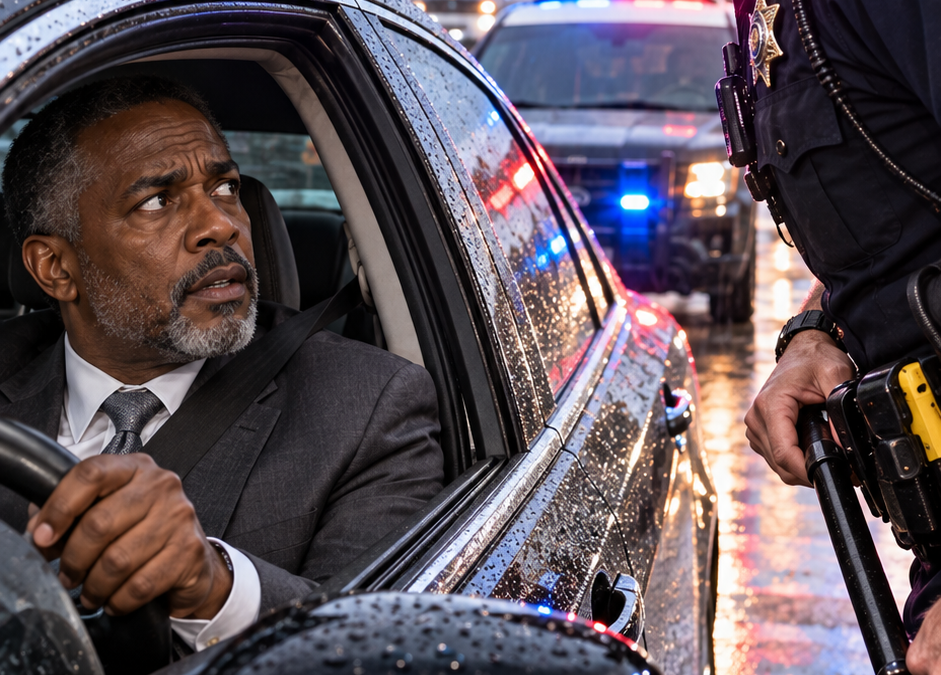
𝗙𝗨𝗟𝗟 𝗦𝗧𝗢𝗥𝗬
“I asked you a question.”
“And I answered the questions you’ve asked. I’m trying to understand whether this remains a stop concerning my license plate.”
His expression tightened.
“Keep both hands on the wheel and stop turning every question into an argument.”
“My hands haven’t moved.”
“Then answer me without giving me an attitude.”
I looked directly at him.
“I’m not giving you an attitude. I’m asking what specific violation caused you to stop me.”
“You were stopped because I had a reason, and you’ll hear it when I decide to explain it.”
I took a breath.
“You told me the plate frame partially covers the registration information. I provided my license and insurance. I’m simply trying to understand why this has become something more.”
He leaned closer.
“Then make this easier on yourself and tell me exactly where you’re coming from before I lose my patience.”
His face was less than two feet from mine.
I could see rainwater clinging to the collar of his uniform.
“Your frustration doesn’t change the reason for the stop, Officer.”
He stared at me.
For a moment, neither of us spoke.
Then his eyes narrowed.
“You’re one of those guys who thinks he knows the law, aren’t you?”
“I think asking a question should be straightforward.”
“Not when you’re deliberately making my job difficult.”
I looked down the road toward the traffic light.
Vehicles continued moving through the intersection. People were entering and leaving the surrounding businesses.
Everything around us was perfectly ordinary.
Yet the officer standing beside my car seemed increasingly determined to turn our conversation into a confrontation.
I didn’t know why.
And that uncertainty was beginning to concern me.
I had learned through years of public administration that authority sometimes changed the way people interpreted questions. A request for an explanation could sound like an accusation to someone who believed obedience was the only acceptable response.
I had encountered that attitude in council meetings, government offices, and disciplinary hearings.
But I had never experienced it while sitting in my own car with an armed officer standing beside me.
I kept my hands on the wheel.
“Officer Ramsay, I don’t want any trouble. If there’s a citation, I’ll accept it and address the matter through the proper process.”
His expression remained unchanged.
“That’s not how this works.”
“Then please explain what you need from me.”
“Get out of the vehicle.”
I looked at him.
“Why?”
“Because I told you to.”
I remained seated.
I understood that officers could direct drivers to exit during lawful traffic stops. But after the extended questioning, his increasingly aggressive posture, and the absence of any explanation for the escalation, I wanted to know what had changed.
“Is there an additional concern?”
He moved closer.
“Get out of the car.”
“Officer, my license and insurance are valid. I’m not attempting to leave, and my hands are visible. I’d like to understand why you’re ordering me out.”
He shook his head.
“You just can’t stop arguing.”
“I’m asking for an explanation.”
“And I’m telling you to get out.”
A few yards behind him, Daniel Cole shifted his position.
I could see the younger officer examining the space between Ramsay and my car.
What I didn’t know at the time was that Daniel had already seen the results of my records check.
My license was valid.
The vehicle was properly registered.
There were no warrants, stolen-vehicle alerts, or immediate safety warnings associated with my name or my sedan.
Nothing in the information returned by dispatch suggested that the stop involved anything beyond the original license plate issue.
Daniel had arrived expecting a routine assist.
Now he was watching his senior partner behave as though a much more serious incident was unfolding.
On the sidewalk, a delivery driver named Marcus Reed had stopped beside his van.
Marcus was forty-one, broad-shouldered, and accustomed to spending long hours navigating traffic throughout the western suburbs.
He later told investigators that he’d initially assumed the officers were simply completing a traffic stop.
But when he saw Ramsay repeatedly leaning into my window, he stopped preparing his next delivery and began watching.
A young woman across the street was doing the same.
Her name was Elena Park.
She was twenty-one, a community college student carrying a canvas backpack and waiting beneath the awning of a pharmacy.
Elena had recently completed a journalism course emphasizing the importance of recording events while they were happening rather than relying entirely on conflicting recollections afterward.
When she saw two police vehicles surrounding my sedan, she raised her phone.
Neither Marcus nor Elena knew my name.
They didn’t know my occupation.
They certainly didn’t know that I chaired the city’s civilian police oversight commission.
They simply saw an older man sitting inside a car while a police officer became increasingly aggressive.
Their decision to record would become one of the most important details of the entire incident.
Ramsay leaned toward my window again.
“Last warning. Get out.”
I looked at him.
“Then I’d like a supervisor present.”
His jaw tightened.
“What did you say?”
“I’m requesting a supervisor before this escalates any further.”
He let out a short, humorless laugh.
“You think calling my sergeant is going to get you out of this?”
“Out of what, Officer?”
That question seemed to irritate him more than anything else I’d said.
He stepped backward.
For a moment, I thought he was finally going to reconsider.
Daniel moved closer.
“Kyle, can I talk to you?”
Ramsay ignored him.
Daniel lowered his voice.
“The records came back clean. It’s a plate-frame violation. Let’s get a supervisor here if that’s what he wants.”
Ramsay turned sharply.
“I have this under control.”
“I’m not saying you don’t.”
“Then stay out of it.”
I watched the exchange through my open window.
Daniel looked toward me.
Then toward Ramsay’s duty belt.
His expression changed.
At that moment, I began to feel genuinely afraid.
I hadn’t threatened anybody.
I hadn’t attempted to escape.
I hadn’t reached for anything inside my car.
Yet the officer who had stopped me seemed to be growing angrier with every passing second, and his partner was no longer entirely comfortable with what was happening.
I looked toward the sidewalk.
More people had stopped.
A restaurant employee stood near a doorway. Two pedestrians watched from a bus shelter. Another driver had lowered his window while waiting at the traffic light.
Several phones were pointed toward my car.
I remember thinking that their presence might encourage Ramsay to slow down.
Instead, it appeared to have the opposite effect.
He noticed the people watching.
His shoulders stiffened.
Then he turned back toward me with a colder expression.
“You’re making a scene.”
I looked at him in disbelief.
“I’m sitting in my vehicle.”
“You’re refusing to cooperate.”
“I provided my documents. I’ve answered your questions. I’m requesting a supervisor.”
“Get out of the damn car!”
I could hear the frustration in his voice.
It was no longer a conversation about my license plate.
It was a contest he had decided he couldn’t afford to lose.
Daniel stepped closer again.
“Kyle, let’s just call the sergeant.”
Ramsay raised one hand toward him.
“I said I’ve got it.”
Then he looked through the window at me.
“Get out now, or we’ll remove you.”
I kept my hands visible.
“Officer, please call your supervisor.”
He took one deliberate step backward.
For a brief moment, the increased distance made me think the situation might finally calm down.
Then his right hand dropped toward his duty belt.
It moved past his radio.
Past the handcuff case.
And closed around the handle of his baton.
I saw Daniel shift forward.
I saw the delivery driver on the sidewalk raise his phone.
Then Ramsay pulled the baton free.
There was no new threat.
No sudden movement from inside my vehicle.
No attempt to start the engine or drive away.
My hands remained where they had been throughout the encounter.
But the officer had apparently reached the end of his patience.
He raised the baton.
And brought it down against my driver’s window.
The first impact sounded like an explosion inside the car.
For a fraction of a second, the glass turned white with fractures.
Then part of the safety pane collapsed inward.
Tiny pieces scattered across my lap, the driver’s seat, the center console, and the floor.
I recoiled instinctively.
My hands came away from the steering wheel just far enough to shield my face from the falling fragments.
I felt glass strike my cheek and scrape across my sleeve.
Someone screamed.
I heard another person shout from the sidewalk.
But Ramsay was already reaching through the shattered window.
He unlocked my door.
Pulled it open.
And seized my upper arm.
“Out! Now!”
I tried to put my feet beneath me.
“Officer, I’m getting out!”
He pulled harder.
My dress shoes slipped on the wet pavement, and my shoulder struck the edge of the door as I stumbled forward.
Before I could regain my balance, he turned me toward the hood.
His hand pressed against my upper back.
Then he forced me forward.
My chest struck the wet metal.
Cold rainwater soaked through my suit jacket.
I spread my hands flat against the hood.
“Officer, I’m not resisting.”
“Then stop moving!”
“I’m standing still!”
He pressed down harder.
My glasses had shifted slightly, and I could feel a thin line of blood forming near one hand where the broken glass had cut my skin.
The baton was still in his other hand.
That frightened me more than I wanted to admit.
He had already shattered my window without identifying any immediate threat.
I didn’t know what he might do next.
So I remained as still as possible.
I concentrated on breathing.
Slowly.
Deliberately.
I remembered something Denise had once told me after a difficult confrontation with an angry parent at her school.
“You can’t control somebody else’s anger, Anthony. Sometimes all you can do is refuse to let it control your next decision.”
I held on to that thought.
Behind Ramsay, Daniel had removed his handcuffs.
But he didn’t approach to place them around my wrists.
I could see him standing a few feet away, watching the officer who had forced me onto the hood.
“Kyle,” he said. “His hands are visible.”
“Then cuff him!”
Daniel looked down at my hands.
I hadn’t moved.
There was no struggle.
No attempt to escape.
No threat toward either officer.
He hesitated.
Ramsay turned toward him.
“Are you going to do your job?”
Daniel didn’t answer immediately.
He remained beside us, holding the unused handcuffs while looking from my wrists to the baton.
I remember feeling both grateful and frightened by his hesitation.
Grateful because he seemed to recognize that the situation had become unnecessary.
Frightened because recognizing a problem wasn’t the same as stopping it.
Ramsay pointed the baton toward my face.
“You could’ve made this easy!”
I kept my voice as steady as I could.
“I’ve done everything I can to keep this calm.”
“Don’t lecture me!”
“I’m not lecturing you.”
“Then shut up!”
I stopped speaking.
The gathering crowd had become impossible to ignore.
Marcus was filming from near the front of my sedan.
Elena remained beneath the pharmacy awning, recording a wider view that included both patrol cars, the shattered window, and the positions of the officers.
Several other people were holding up their phones.
Nobody approached the scene or interfered physically.
But I knew they were watching.
And as I stood bent over the hood with cold water soaking into my clothes, I found myself wondering whether I would have been treated differently if the street had been empty.
Radio traffic began increasing.
Dispatch had received reports that a growing crowd was gathering around an active traffic stop.
Another nearby officer requested clarification after hearing that two patrol units had been at the same location for an unusually long time.
Inside the communications center, the incident no longer resembled an ordinary license plate violation.
Two police vehicles had remained roadside for an extended period.
A crowd was gathering.
And somebody had apparently used force.
Several blocks away, Deputy Chief Robert Hail was returning toward police headquarters after an administrative meeting.
He was fifty-nine and had spent more than three decades in law enforcement.
Unlike Ramsay, Hail had learned that an officer’s authority could become dangerous when pride replaced judgment.
He listened to the radio traffic and noticed the discrepancy between the original reason for the stop and the growing concern at the scene.
He requested the exact location.
Then he asked which officers were involved.
When dispatch identified Ramsay and Cole, he changed direction.
He didn’t announce that he was coming.
Four minutes later, two command vehicles entered the commercial corridor.
I heard their engines before I saw them.
At first, I assumed they were additional patrol units responding to the gathering crowd.
Ramsay apparently thought the same thing.
He still stood beside me with the baton lowered against his thigh.
Daniel remained nearby holding the handcuffs.
My hands were still flat against the hood.
The wet pavement beneath us glittered with broken glass.
The first command SUV stopped behind the patrol cars.
The second pulled in beside it.
Several spectators stepped backward.
A tall, silver-haired man climbed out of the lead vehicle.
I recognized him immediately.
Robert Hail.
We’d met during the preparations for the oversight commission’s first major review. He had attended several administrative discussions about complaint procedures, evidence preservation, and the department’s responsibility to cooperate with independent oversight.
He wasn’t a close friend.
But he knew exactly who I was.
Hail examined the scene as he approached.
First, the crowd.
Then my damaged vehicle.
Then Ramsay’s baton.
Then Daniel’s unused handcuffs.
Finally, he looked toward the man leaning against the hood.
He stopped.
I saw recognition move across his face.
For a moment, he simply stared at me.
Then he turned toward Ramsay.
“Step away from him.”
Ramsay straightened.
“Chief, this guy—”
“Step away.”
The change in Hail’s voice was unmistakable.
Ramsay hesitated.
Then he moved backward.
Hail stepped between us.
“Anthony, are you injured?”
I carefully straightened.
Glass fell from the sleeve of my suit jacket.
“My hand is cut. I think my shoulder’s all right.”
His eyes moved toward the broken driver’s window.
“What happened?”
I looked at Ramsay.
“I’d prefer to give a recorded statement.”
Hail nodded immediately.
“Of course.”
Then he turned toward Daniel.
“Make sure no further force is used. Keep the scene secure.”
Daniel lowered the handcuffs.
Ramsay looked confused.
He glanced from Hail to me, apparently trying to understand why the deputy chief had addressed me by my first name.
I brushed another fragment of glass from my jacket.
“Robert, I need every recording preserved.”
He looked toward me.
I continued.
“Both body cameras. Both patrol vehicle systems. Dispatch audio. Computer-aided dispatch records. Every communication associated with this stop. And the civilian recordings, if the witnesses are willing to provide them.”
Hail reached for his radio.
“Dispatch, flag this incident for immediate evidence preservation. No routine deletion or alteration of associated records.”
Then he ordered both officers to leave their cameras active until a supervisor documented their condition.
A second command vehicle door opened.
Sergeant Miriam Walsh stepped onto the pavement.
She was an experienced patrol supervisor known for treating evidence preservation with almost mechanical precision.
Hail directed her toward the patrol vehicles.
She photographed the active recording indicators on both body cameras, verified the cruiser recording systems, and instructed dispatch to preserve the relevant radio channel.
I watched her work.
It was the first time that afternoon I’d felt the situation returning to something I understood.
Facts.
Records.
Independent witnesses.
A process that didn’t depend entirely on the judgment of the person who had just used force against me.
Hail turned toward Ramsay.
“Do you know who this gentleman is?”
Ramsay stared at him.
“No, sir.”
For several seconds, Hail said nothing.
Then he explained.
“Anthony Brooks was appointed chairman of the Civilian Police Oversight Commission three weeks ago.”
Ramsay’s expression changed.
His eyes moved toward me.
Then toward the body camera mounted on his own chest.
Then toward the shattered window.
I watched the significance of the information settle across his face.
The man he’d just pulled from a car over a minor license plate violation was the chairman of the independent body preparing to review complaints involving his own patrol district.
But I wasn’t interested in watching him become frightened of my title.
I’d already learned what happened when an officer decided another person’s identity determined the respect they deserved.
I looked toward Hail.
“My appointment doesn’t change what happened here.”
“I understand.”
“I want this handled exactly the way it would be handled if I were any other resident.”
He nodded.
“That’s what we’re going to do.”
“No private accommodation. No special process. And I won’t participate in any decision involving my own complaint.”
Hail studied me for a moment.
Then he looked again at my damaged sedan.
I could see that he understood what troubled me most.
The problem wasn’t that Ramsay had failed to recognize somebody connected to police oversight.
The problem was what he had done before learning who I was.
He would have been just as wrong if I’d been a teacher, a mechanic, a delivery driver, or a stranger passing through West Bridge.
I looked toward the sidewalk.
Marcus was still filming.
Elena stood beneath the pharmacy awning, her phone held steadily in both hands.
Hail directed an officer to obtain their contact information and request copies of their recordings.
Nobody attempted to take their phones.
Both were told they were free to leave after providing the information voluntarily.
As the scene settled, I became increasingly aware of how badly my body was shaking.
The adrenaline that had carried me through the confrontation was beginning to fade.
I looked at the small cuts across my hand.
Then at the broken glass scattered beneath the open driver’s door.
I thought about the instant Ramsay raised the baton.
For one terrible moment, I had believed he might strike me rather than the window.
Even now, I couldn’t completely shake that fear.
Hail noticed.
“Anthony, let us get someone to look at those cuts.”
I nodded.
“All right.”
But before leaving the roadside, I looked toward Ramsay one final time.
He was standing several feet away, his baton finally returned to his duty belt.
He no longer looked angry.
He looked uncertain.
I wondered whether he was reconsidering the force he’d used or simply calculating the consequences of using it against someone with a position he hadn’t expected.
I had no way of knowing.
And for the first time that afternoon, I didn’t feel any need to ask him.
The recordings would tell the story.
By the time I reached home, the video had already begun spreading across local social media.
Marcus had uploaded a short clip after returning to his delivery van.
Within an hour, copies were appearing in neighborhood groups, local news feeds, and private messages throughout the western suburbs.
The most disturbing portion wasn’t the moment Ramsay shattered my window.
It was the minute before.
The recording showed me sitting with both hands visible while he repeatedly leaned closer, pointed toward his duty belt, and refused to explain why the encounter was escalating.
Then it showed the baton.
The breaking glass.
And Ramsay dragging me out of the driver’s seat.
Elena’s recording provided a wider view.
It showed both patrol vehicles, the surrounding traffic, the spectators, and my sedan remaining completely stationary throughout the encounter.
Neither civilian video showed me attempting to flee, reach for a weapon, or physically threaten either officer.
My family saw the clips before I arrived home.
Denise was standing near the front door when I pulled into the driveway in the replacement vehicle the department had arranged for me.
She opened the door before I reached the steps.
“Anthony.”
I tried to smile.
“I’m all right.”
Her eyes moved immediately toward my hand.
Then my jacket.
Then my face.
“Don’t tell me you’re all right before I can see for myself.”
She took my arm and led me inside.
There was an unmistakable tremor in her voice, something I almost never heard from a woman who had spent years managing difficult school situations without losing her composure.
She guided me into the kitchen and began examining the small cuts across my hand.
Then she noticed a tiny fragment of glass caught inside the pocket of my suit jacket.
She stopped.
For a moment, she simply stared at it.
“That could’ve been in your eye.”
“I know.”
“He could’ve hit you with that baton.”
“I know.”
She looked toward me.
“Then why are you acting like this was just another difficult meeting?”
I lowered my eyes.
Because I didn’t know how to answer.
Because the moment I allowed myself to admit how frightened I had been, I was afraid the calmness I’d worked so hard to maintain might disappear completely.
Our daughter, Camille, called almost immediately.
She was thirty-one and worked as a physical therapist in downtown Chicago.
She had inherited my habit of choosing words carefully, although she had significantly less patience than I did when someone she loved had been mistreated.
“Dad, I’ve called you six times!”
“I’m home, sweetheart.”
“Are you hurt?”
“Just a few cuts.”
“I saw the video.”
I closed my eyes.
“Camille—”
“I saw him break your window while you were sitting there doing nothing.”
My daughter began crying.
It was the sound that finally broke through the emotional distance I’d been maintaining since the roadside encounter.
I sat down at the kitchen table.
“I’m sorry you had to see that.”
“You don’t need to apologize to me.”
I heard her take a shaky breath.
“What if that other officer hadn’t been there? What if nobody had been recording?”
I looked toward Denise.
She had stopped cleaning my hand.
She was listening.
“I don’t know,” I admitted.
That answer frightened all three of us.
To the public, I was suddenly the newly appointed chairman of a civilian oversight commission who had been mistreated by a police officer.
To Denise and Camille, I was simply the man they loved.
A husband who had left for an ordinary meeting and come home with glass in his clothes.
A father who could have been seriously injured during a traffic stop that should have ended in minutes.
We spent most of that evening together.
Denise made tea, although none of us drank much of it.
Camille remained on the phone longer than usual.
Eventually, she asked me whether I intended to resign from the commission.
“No.”
“Dad, you don’t have to prove anything.”
“I’m not trying to prove anything.”
“Then why put yourself through this?”
I looked down at my bandaged hand.
“Because I keep thinking about the people who don’t have Robert Hail arriving four minutes after something like this happens.”
The room became quiet.
I thought about Marcus and Elena.
Two strangers who had decided that watching wasn’t enough.
They had preserved what they saw.
Without their recordings, I might have been left with a damaged vehicle, injured hands, and an official report written by the officer whose judgment I was challenging.
That possibility stayed with me long after Denise went to bed.
The following morning, I formally removed myself from every commission decision involving my own traffic stop.
I sent written notice to the commissioners and requested that an outside evidence team handle the investigation.
Hail supported the separation.
We both understood that any suggestion of personal retaliation could undermine legitimate findings.
I wasn’t interested in using my new position to punish an officer who had embarrassed me.
I wanted to know whether his decisions violated established standards and whether similar conduct had been allowed to develop elsewhere.
The distinction mattered.
An oversight commission that abandoned its own procedures when its chairman became personally involved would have little credibility when examining anyone else’s conduct.
I provided my statement to the independent investigators.
Then I stepped aside.
Over the following days, the original recordings were preserved and examined.
Both police body cameras.
The cruiser dash camera.
Dispatch logs.
The traffic stop’s electronic records.
Marcus’s video.
Elena’s recording.
Investigators synchronized the available footage and reconstructed the encounter almost second by second.
The original reason for the stop remained exactly what Ramsay had first identified.
A license plate frame partially covering registration information.
I’d provided my license and insurance.
The records check returned no warrant, stolen vehicle alert, or immediate safety warning.
Nothing in the footage showed me making a threatening movement before Ramsay ordered me out of the vehicle.
The recording also showed that I’d asked for clarification and later requested a supervisor before the confrontation escalated.
Ramsay had responded by drawing his baton.
His own body camera captured the movement.
Daniel’s camera showed my hands remaining on the steering wheel.
The dash camera established that my sedan had never moved toward either officer.
And the civilian videos filled in the gaps whenever the officers’ bodies obstructed one another’s cameras.
Together, the recordings left very little uncertainty about the physical sequence.
But the investigation required more than simply watching a video and deciding who looked angrier.
Investigators examined the written reports.
They compared the timing of every command.
They reviewed departmental policy governing traffic stops, vehicle removals, de-escalation, and force.
They also interviewed the officers and civilian witnesses separately.
Ramsay was removed from street duty while the investigation proceeded.
His conduct was being evaluated through the same formal process applicable to any serious use-of-force complaint.
Daniel faced a more complicated question.
He hadn’t shattered my window.
He hadn’t forced me onto the hood.
He hadn’t placed handcuffs around my wrists.
But he’d recognized that the encounter was escalating unnecessarily before Ramsay used the baton.
He had attempted to intervene verbally.
Then he’d hesitated.
When the independent investigators asked him to explain that hesitation, he could have emphasized everything Ramsay had done wrong while describing himself as the officer who tried to calm the situation.
Instead, he acknowledged that he’d seen the danger developing and hadn’t intervened decisively enough.
His statement described my visible hands, the clean records check, and the absence of an immediate threat.
He also admitted that he should have acted sooner.
That admission didn’t erase his responsibility.
But it demonstrated something I believed the department badly needed.
A willingness to tell the truth even when the truth made the witness uncomfortable.
Outside the investigation rooms, public pressure continued building.
Community groups demanded the immediate release of every recording.
Some departmental officials warned that publishing incomplete evidence could transform an administrative investigation into a public trial before the witnesses had been properly interviewed.
Local reporters requested body camera footage, dispatch audio, training records, earlier complaints, and data involving forced removals from vehicles.
Hail faced pressure from both directions.
He resisted attempts to reach immediate conclusions before the evidence review was complete.
But he also rejected suggestions that the department should quietly contain the incident and wait for public attention to disappear.
The original recordings remained protected.
The independent investigators continued their work.
And the commission began examining broader complaint data without my participation in any matter connected to my own stop.
I understood why some residents were frustrated by the delay.
They had watched Ramsay break my window.
They’d seen my hands.
They wanted immediate consequences.
Part of me wanted the same thing.
But years of public service had taught me that public anger could identify a problem much faster than an institution was prepared to admit it existed.
The challenge was turning that anger into findings that could withstand scrutiny.
An incomplete investigation could allow an officer responsible for serious misconduct to challenge the outcome successfully.
A dishonest investigation could also damage the reputation and livelihood of someone whose actions had been justified.
Both possibilities mattered.
I wanted the commission to apply the same standards regardless of who was accused or who had been harmed.
While the investigators examined Ramsay’s conduct, the oversight commission expanded the review we’d been preparing before my traffic stop.
Staff compared complaints from the same patrol district.
Some involved searches.
Others concerned orders to exit vehicles.
Several described confrontations that began with minor administrative violations and escalated after drivers requested explanations.
The findings weren’t as simple as some people expected.
A number of complaints lacked sufficient evidence.
Several involved officers unrelated to Ramsay.
Others concerned legitimate enforcement actions supported by recordings and witness testimony.
Those cases needed to be identified honestly.
But one recurring pattern demanded closer examination.
Too many minor traffic stops appeared to become confrontational shortly after drivers asked why additional commands were being given.
Sometimes those questions were followed by vehicle searches.
Sometimes by restraints.
Sometimes by demands for additional units.
And sometimes, as in my case, by the use of force.
The problem wasn’t that every driver was correct or every officer was wrong.
The problem was that ordinary questions were too frequently being interpreted as challenges to authority rather than opportunities to clarify what was happening.
I couldn’t personally examine the confidential findings connected to Ramsay.
But I remained involved in the broader administrative work that didn’t create a conflict of interest.
I wanted the commission to understand whether department policies, supervision, training, or informal habits had allowed similar encounters to develop repeatedly.
One broken window could bring attention to a problem.
A complete record could reveal how that problem had been permitted to grow.
At home, the incident continued affecting me in ways I hadn’t expected.
The shallow cuts on my hand healed quickly.
My bruised shoulder improved.
The damaged car was sent for repairs.
But I began noticing every police vehicle on the road.
If flashing lights appeared in my rearview mirror, even when they were meant for another driver, my hands tightened on the steering wheel.
Sometimes, while waiting at an intersection, I found myself remembering the sound of the baton striking glass.
Other times, I remembered Ramsay leaning into my window while I tried to keep my voice calm.
I could still see the moment he reached for his duty belt.
Denise noticed.
One evening, we were driving home from dinner when a patrol car passed in the opposite direction.
She looked toward me.
“You’re doing it again.”
“Doing what?”
“Gripping the steering wheel.”
I glanced down.
My fingers had tightened around it without my realizing.
I relaxed my hands.
“I’m fine.”
She looked at me.
“Anthony.”
I sighed.
“I know.”
We drove in silence for several blocks.
Then she spoke again.
“I don’t want you to pretend this didn’t frighten you just because you’re supposed to be the person who stays calm.”
I looked toward the road.
“I thought I was handling it.”
“You are handling it. But you’re also allowed to admit that something happened to you.”
I swallowed.
She reached across the center console and rested her hand on my arm.
For a long moment, I couldn’t speak.
I had spent years listening to citizens describe frightening encounters with public institutions.
I had always tried to remain professional, careful, and focused on the evidence.
Now I understood something I’d previously appreciated only in theory.
A serious encounter didn’t end when the official incident report was filed.
Sometimes it continued for months in the form of sleepless nights, anxiety, uncertainty, and the fear that an ordinary interaction might suddenly become dangerous again.
My broken window could be replaced.
The feeling I’d experienced while standing against that hood would take longer to repair.
Several weeks later, the independent review reached its conclusions.
Investigators found that Ramsay had transformed a minor administrative traffic stop into an unnecessary confrontation without identifying an immediate threat that justified the escalation.
The records check had revealed no dangerous or unusual information.
I’d provided the requested documents.
I’d made no threatening movement.
Yet Ramsay had continued expanding the encounter and eventually ordered me out of the vehicle.
When I requested a supervisor, he reached for his baton and shattered the driver’s window while I remained seated with both hands visible.
The review also found that Daniel had attempted to slow the situation before the glass broke.
Ramsay ignored those warnings and continued escalating after another officer had already recognized that I wasn’t resisting.
The disciplinary process examined his use of force, failure to de-escalate, judgment, and the accuracy of his account afterward.
I received no private briefing.
I participated in no commission vote connected to the case.
And I made no attempt to influence the disciplinary decision.
When the proceedings concluded, Ramsay was terminated from patrol service.
He no longer carried departmental authority on the streets of West Bridge.
Separate questions involving force standards, reporting requirements, and possible policy violations were referred to the appropriate authorities for independent consideration.
I didn’t celebrate the decision.
There was no pleasure in imagining a man losing a career he’d spent nine years building.
But there was also no way to ignore the choices that had brought him to that point.
He’d been given several opportunities to slow down.
His partner had tried to intervene.
I’d requested a supervisor.
There had been no emergency forcing him to act before the facts were clear.
Yet he chose to draw his baton and break my window.
The consequences belonged to those decisions.
Daniel’s outcome was different.
The review credited him for keeping his body camera active, questioning Ramsay’s escalation, and providing an accurate account afterward.
It also found that he’d recognized the danger early enough to intervene more forcefully before the window was shattered.
Daniel accepted that conclusion.
He didn’t attempt to portray himself as the officer who had saved the situation.
He understood that noticing misconduct and preventing it were two very different responsibilities.
He entered an expanded intervention training program designed to teach officers how to interrupt escalating behavior before loyalty to a colleague became silence.
Several months later, he was selected to assist instructors during practical scenarios.
He didn’t teach from the position of someone who had handled every difficult decision perfectly.
He taught from the memory of standing beside my car, holding unused handcuffs, and watching another officer do something he should have tried harder to prevent.
I respected that.
Not because his eventual honesty erased his hesitation.
But because he was willing to use the mistake as a lesson rather than pretend it had never happened.
Deputy Chief Hail also used the investigation to support broader changes.
Officers handling minor administrative stops were required to communicate the reason for the stop clearly before expanding an encounter whenever circumstances allowed.
Requests for a supervisor could no longer be treated automatically as evidence of hostility, resistance, or refusal to cooperate.
Body camera deactivations during coercive encounters received additional auditing, especially when searches, restraints, forced vehicle removals, or significant uses of force occurred afterward.
Traffic stops that escalated into serious force were assigned independent review outside the original officer’s immediate chain of command.
Hail understood that policies couldn’t manufacture good judgment.
But they could make poor decisions harder to conceal.
They could also help supervisors identify troubling patterns before somebody was injured.
The changes weren’t presented as punishment against every officer in the department.
They were safeguards intended to prevent situations where professional authority became indistinguishable from personal pride.
The oversight commission continued examining complaint patterns across the district.
We didn’t assume every allegation represented misconduct simply because my own experience had been captured so clearly.
Some complaints were dismissed when recordings, witness statements, or dispatch records didn’t support them.
Others were sustained after independent evidence confirmed unnecessary searches, poorly explained vehicle removals, or escalation following routine questions.
For the first time, those cases were compared using consistent standards instead of remaining isolated inside separate administrative files.
That comparison revealed something important.
Some officers consistently resolved minor problems without confrontation.
Others repeatedly found themselves in situations where routine questions became arguments and arguments became enforcement actions.
The differences weren’t always explained by the neighborhoods they patrolled or the seriousness of the violations they encountered.
Sometimes they reflected ordinary professional habits.
Whether an officer explained the reason for a stop.
Whether a supervisor encouraged de-escalation.
Whether colleagues intervened when a situation began moving in the wrong direction.
And whether a department examined those decisions before an incident became serious enough to attract public attention.
The commission recommended additional training, clearer reporting standards, better civilian access to complaint procedures, and regular district-level analysis of traffic stop patterns.
I supported those recommendations.
But I also insisted that officers whose actions were justified deserved the protection of a fair review.
Accountability couldn’t become a system that automatically assumed every officer was wrong.
It had to be a process capable of identifying what actually happened.
That was the same standard I’d wanted applied to me when Ramsay stopped my car.
And it remained the standard I wanted applied after his employment ended.
Months passed.
The public attention gradually diminished.
Marcus returned to his delivery routes, although he occasionally contacted our office to ask how the reforms were progressing.
Elena continued her journalism studies.
Her recording became part of the evidence used to reconstruct the encounter, and the experience reinforced her belief that accurate documentation could matter even when the person holding the camera felt powerless to intervene.
Daniel continued his training work.
Hail supervised the implementation of the new policies.
And I returned to the everyday responsibilities of the commission, where progress was generally slower and less dramatic than people imagined.
There were meetings.
Reports.
Disagreements over definitions.
Budget discussions.
Public hearings where frustrated residents and exhausted officers sometimes seemed to be speaking entirely different languages.
But there were also moments when people who had entered a room expecting a fight began to understand that the person sitting opposite them might share more of their concerns than they’d assumed.
Those moments mattered to me.
They reminded me why I’d accepted the position before anybody knew my name.
One afternoon, several months after the incident, my sedan finally returned from the repair shop.
The driver’s window had been completely replaced.
There were no visible fragments of glass.
No scratches around the door frame.
Nothing about the vehicle suggested what had happened on that wet October afternoon.
I stood beside it in the driveway for several minutes.
Denise came outside.
“Ready to drive it again?”
I ran my fingers along the edge of the repaired window.
“I think so.”
She looked at me.
“Do you want me to drive?”
I considered the question.
Then I shook my head.
“No. I’ll drive.”
We climbed inside.
For a moment, I sat behind the wheel without starting the engine.
My hands settled into their familiar position.
Denise fastened her seat belt.
She didn’t ask whether I was nervous.
She simply waited.
I started the car and pulled out of the driveway.
The afternoon was clear and cool.
We had no particular destination beyond a few errands and dinner afterward.
As we entered the commercial corridor where Ramsay had stopped me, traffic began slowing near a familiar intersection.
I recognized the storefronts immediately.
The pharmacy.
The restaurant.
The parking space where Marcus had left his delivery van.
And the section of curb where I’d pulled over beneath flashing red and blue lights.
I felt my shoulders tighten.
Denise noticed.
But before she could say anything, I saw another patrol vehicle stopped across the road.
A young officer stood beside an older sedan.
Its driver was a white-haired man who appeared to be in his seventies.
He sat patiently behind the steering wheel while the officer spoke through his open window.
I slowed with traffic.
For an instant, the sight pulled me back to the afternoon my window had been shattered.
Then I noticed what was different.
The young officer wasn’t leaning aggressively into the car.
His hands weren’t hovering near his baton.
There were no additional patrol vehicles, no gathering spectators, and no driver being forced onto a hood.
The officer simply pointed toward the rear of the sedan.
One license plate light had burned out.
I later learned that the officer’s name was Nathan Lewis.
He was twenty-six and still relatively early in his patrol career.
The driver was Walter Green, a seventy-two-year-old retired postal worker.
Nathan explained the problem, checked the necessary documents, and returned them without extending the encounter into unrelated questioning.
Walter nodded.
The officer stepped backward.
Then he allowed the older man to leave with a warning after confirming that nothing else required attention.
The entire stop took only a few minutes.
I watched Walter’s sedan merge safely back into traffic.
Then I looked toward Denise.
She was studying my face.
“What are you thinking?”
I glanced toward the young patrol officer returning to his cruiser.
“That my stop could’ve looked exactly like that.”
Denise rested her hand on mine.
“Yes.”
The traffic light changed.
I began driving again.
For several moments, neither of us spoke.
I thought about how ordinary Nathan’s actions had appeared.
There had been no dramatic intervention.
No deputy chief arriving in a command vehicle.
No civilian witnesses lifting their phones.
No body camera footage destined to be examined by an independent investigative team.
Just an officer who recognized a minor problem and handled it without turning the encounter into a contest.
That was the future I’d wanted when I accepted the oversight appointment.
Not a city where officers were afraid to enforce the law.
Not a city where every traffic stop became a public accusation.
But a city where ordinary people could expect ordinary problems to be handled with reasonable judgment.
My broken window had been repaired.
The cuts on my hand had healed.
Ramsay’s disciplinary proceedings had ended.
But what happened beside that curb remained part of the city’s official record.
The footage showed how a routine stop could become dangerous when an officer stopped evaluating his own decisions and began treating questions as personal challenges.
Daniel’s testimony showed the cost of hesitation when a colleague recognized an escalating situation but didn’t intervene decisively enough.
Marcus and Elena demonstrated why independent witnesses mattered.
Hail showed that senior leadership could preserve evidence and support accountability without attempting to control the investigation’s outcome.
And the commission’s broader review revealed that a single highly visible incident could provide an opportunity to examine problems that had existed long before the cameras began recording.
But the most important lesson had very little to do with me.
Ramsay’s greatest mistake wasn’t failing to recognize the chairman of the Civilian Police Oversight Commission.
It was believing that the man sitting inside that sedan needed to be somebody important before he deserved patience, explanation, and restraint.
I’d been the same person throughout the encounter.
The same husband.
The same father.
The same citizen.
The same man who had handed over his documents, kept his hands visible, and asked for a supervisor when an ordinary traffic stop began moving toward something dangerous.
My identity hadn’t changed when Robert Hail arrived.
Only Ramsay’s understanding of the consequences had changed.
I glanced toward Denise as we drove through West Bridge.
She was looking out at the passing storefronts, one hand resting comfortably on the center console.
For the first time in months, the sight of a police cruiser hadn’t caused me to spend the rest of the drive reliving what had happened.
I still remembered the sound of breaking glass.
I suspected I always would.
But I’d also remember Walter Green driving away with a warning, his afternoon continuing without injury, humiliation, or fear.
That quiet scene meant more to me than any public apology or disciplinary announcement.
It was a glimpse of the ordinary lawful treatment every driver should be able to expect.
I reached across the console and took Denise’s hand.
The next traffic light turned green.
And we drove home together.








