𝗙𝗨𝗟𝗟 𝗦𝗧𝗢𝗥𝗬 I Inherited the Water Rights to a 2,100-Acre Lake—Then HOA Karen Called the Sheriff to Make Me Pay for My Own Water
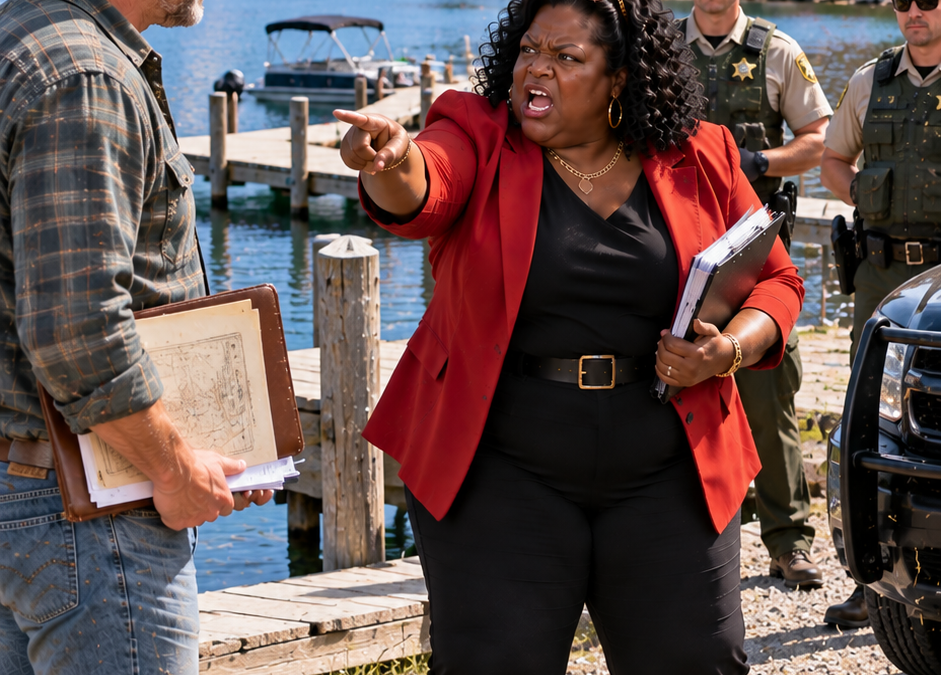
𝗙𝗨𝗟𝗟 𝗦𝗧𝗢𝗥𝗬
Victoria’s smile tightened.
“This is not simply civil. He is refusing HOA authority.”
“I said it sounds civil.”
“Are you refusing to enforce our governing documents?”
“I enforce Montana law.”
Silence.
Victoria put the papers back into her folder.
“This isn’t over, Mr. Brooks.”
“I didn’t think it was.”
She left.
Mason watched the Range Rover disappear.
Then looked at me.
“Advice?”
“I’m listening.”
“Keep every piece of paper she sends you.”
“I was planning to.”
“Good.”
He glanced toward the lake.
“She’s been busy around here.”
Then he drove away.
I stood on my great-grandfather’s dock with Victoria’s violation packet in one hand and an 1887 deed inside my jacket.
I thought the fight was going to be about five hundred dollars a month.
I was wrong.
By the time it ended, we would uncover a $182 million development project, shell companies connected to Victoria, hundreds of thousands of dollars missing from HOA accounts, nighttime sabotage at my dock, and a private success fee worth more than five million dollars if she could somehow make my water rights disappear.
But that morning, all I knew was that Victoria Hale had picked a fight with an old deed.
And I intended to make sure she finished reading it.
PART2
The next morning, I drove into Blackstone and went directly to the county records office.
The archive was in the basement.
Old steel shelving.
Leather-bound ledgers.
Dust.
A smell halfway between paper and machine oil.
I told the clerk what I wanted.
“Mirror Lake. Brooks family. Water rights. Late eighteen hundreds.”
She looked over her glasses.
“How late?”
“1887.”
She smiled.
“That’ll keep you busy.”
It did.
Three hours.
Survey books.
Railroad rights.
Grazing permits.
Property transfers.
Watershed maps.
Nothing.
Then I found a large ledger.
MIRROR LAKE WATERSHED.
I opened it carefully.
There.
BROOKS, ELIAS.
Original purchase.
Riparian authority.
Exclusive water rights.
County seal.
Then transfers.
Elias to his son.
Then my grandfather.
Then Uncle Arthur.
Then the probate transfer to me.
Every step recorded.
No gap.
No revocation.
No surrender.
I called Ethan Ross.
Historic-property attorney.
Young enough that his briefcase looked older than he did.
He arrived twenty minutes later.
“You found it?”
I turned the ledger.
He read.
Then stopped breathing for a second.
“This is extraordinary.”
“I was hoping for useful.”
“It’s both.”
He requested certified copies.
Then pulled newer plats.
“Mirror Lake Estates was formed in 2008.”
“I know.”
“HOA authority attaches to property legally submitted to the declaration.”
“Correct.”
He checked the records.
Then another index.
Then another.
His face changed.
“What?”
“There should be something here.”
“What kind of something?”
“Transfer of lake-management authority.”
He searched again.
Nothing.
“Nathan.”
“Yes?”
“There was never a recorded transfer.”
I looked at him.
“So the HOA doesn’t control the lake?”
“It has been behaving as though it does.”
“That isn’t the same thing.”
“No.”
Someone behind us spoke.
“You finally found it.”
An older woman stood near the shelves.
Silver hair.
Cane.
Sharp blue eyes.
“I’m Grace Collins.”
She shook my hand.
“I’ve lived beside Mirror Lake fifty-three years.”
“You knew my family?”
“I knew your uncle.”
She looked at the ledger.
“And I knew your great-grandfather’s name long before that HOA existed.”
Ethan closed the file.
Grace’s expression darkened.
“Victoria has spent fifteen years convincing people she owns rights she never had.”
“Fifteen?”
“Before she became president, she was the lawyer telling people what the board could do.”
“What happened to the people who challenged her?”
Grace stared at me.
“Some paid.”
Pause.
“Some moved.”
Another.
“Three families lost their homes.”
That landed hard.
“This isn’t just your dock anymore.”
Grace tapped the deed.
“It’s everyone she frightened with paper.”
The first certified letter arrived the following morning.
Then another.
By the end of the week, seven.
Shoreline engineering inspection.
Environmental-impact assessment.
Dock-safety review.
Water infrastructure registration.
Five thousand dollars in “accumulated community water-access fees.”
I had owned the property nine days.
Ethan spread the letters across my kitchen table.
“They’re manufacturing a record.”
“So am I.”
I scanned everything.
Dates.
Postmarks.
Signatures.
Envelopes.
The military teaches you something useful about disputes.
Memory argues.
Documents don’t.
Three mornings later, four government vehicles arrived.
Building inspector.
Environmental compliance.
Shoreline officer.
Health department.
The lead inspector looked embarrassed.
“We received complaints.”
“I guessed.”
“Unauthorized shoreline construction.”
“I haven’t constructed anything.”
“I know. But we have to check.”
“Go ahead.”
They spent nearly three hours on the property.
Dock measurements.
Retaining walls.
Drainage.
Erosion controls.
Septic.
Vegetation.
I recorded openly.
When they finished, the lead inspector removed his hard hat.
“Mr. Brooks, I don’t normally say this.”
“That sounds promising.”
“This is one of the better-maintained lakefront parcels I’ve inspected this year.”
“No violations?”
“None.”
Environmental officer nodded.
“Your shoreline vegetation exceeds conservation recommendations.”
Health inspector added:
“Septic upgrades are newer than required.”
I smiled.
“So somebody wasted your morning.”
Nobody answered.
They didn’t need to.
Every clean inspection became another document.
That afternoon Mason returned.
Coffee in hand.
He sat on my porch.
“You passed.”
“I know.”
“I asked dispatch to review complaint history.”
“And?”
“Eleven complaints.”
“From?”
He looked toward the lake.
“I’m not giving you confidential information.”
“Understood.”
“But I can tell you they originated from the same source.”
“The HOA office?”
He took a sip.
“I didn’t say that.”
“Of course not.”
He stood before leaving.
“One more thing.”
“What?”
“Don’t lose your temper.”
“I’m not planning to.”
“Good.”
“Why?”
“People who use nuisance complaints want a reaction.”
“And if I don’t give them one?”
“They keep pushing.”
He looked at me.
“And eventually they get sloppy.”
He was right.
Letters kept coming.
Community nuisance.
Emergency access obstruction.
Failure to register water infrastructure.
One claimed my dock interfered with emergency access for homeowners half a mile away.
Ethan read it and laughed.
“They’ve stopped pretending.”
“No.”
I put it into a binder.
“They think volume becomes truth.”
I built shelves in the cabin office.
One binder became three.
Then five.
Every inspection.
Every complaint.
Every letter.
Every certified envelope.
Victoria believed she was burying me in paperwork.
She was paying postage on my evidence.
Then a county inspector arrived one Friday afternoon.
He looked at the property.
Looked at his order.
Then quietly folded it.
“You Nathan?”
“Yes.”
He looked toward the road.
“I probably shouldn’t say this.”
“Then don’t.”
He almost smiled.
“Somebody is trying awfully hard to make you leave.”
That was when the shape of the fight changed.
This wasn’t enforcement.
Somebody wanted the property clear.
Monday, I drove to Billings to meet Daniel Pierce.
Engineer.
Old friend.
Worked with me on flood-control projects years earlier.
Daniel believed the same thing I did.
Assume nothing.
Verify everything.
I explained the situation.
He pulled utility maps.
“Show me your shoreline.”
I traced it.
His finger stopped.
“This corridor shouldn’t exist.”
“What corridor?”
He opened another packet.
Regional infrastructure planning.
Large intake pipes.
Pump stations.
Transmission lines.
Everything began at Mirror Lake.
“This isn’t HOA infrastructure,” he said.
“What is it?”
“Regional water expansion.”
I stared at the plans.
“They need guaranteed access.”
“Yes.”
“My rights stop it.”
“Yes.”
Daniel leaned back.
“Nathan, nobody is fighting over your dock.”
I looked at him.
“They want the lake.”
For the first time, Victoria’s behavior made sense.
Not morally.
Economically.
Ethan joined us that afternoon.
He studied the intake plans.
“Any developer wanting this would need permanent water control.”
Daniel pointed to the intake.
“And this sits inside Brooks riparian authority.”
“So without Nathan—”
“The project dies.”
Silence.
Then investigative reporter Rebecca Sloan called me.
She had been researching land companies purchasing lakefront lots.
We met near the courthouse.
She pushed corporate filings across the table.
“Blackwater Land Holdings.”
“Never heard of it.”
“Northern Crest Consulting.”
“No.”
“Blue Summit Environmental?”
“No.”
“All three use the same office suite.”
She turned another page.
Same registered agent.
Victoria Hale.
I stared.
Rebecca brought out a development option.
MIRROR LAKE LUXURY WATERFRONT EXPANSION.
Estimated project value:
$182 million.
“This requires water rights.”
“Yes.”
“They don’t have them.”
“No.”
“Investors believe they will.”
Rebecca nodded.
Then she showed me Victoria’s signature.
Now we knew why five hundred dollars a month mattered.
It wasn’t money.
It was precedent.
If Victoria could establish on paper that the HOA controlled access to Mirror Lake, she could build toward claiming management authority.
Then she could negotiate from a position she did not legally own.
Over the next week, Rebecca pulled more records.
Consulting invoices.
Closed-door meetings.
Environmental studies.
Private negotiations.
The timeline was obvious.
Development planning began first.
My violations came later.
They didn’t discover a problem after I inherited the property.
My inheritance created their problem.
Grace wasn’t surprised.
“They’ve been buying lakefront houses for years.”
“Who?”
“People who never live in them.”
“Investors?”
“Positions.”
She pointed across the lake.
“They were surrounding Arthur.”
My uncle had been the holdout.
Now I was.
Then Rebecca found the missing money.
HOA financial summaries did not match county and tax records.
Reserve funds shrinking.
Consulting payments increasing.
How much?
At first, nobody knew.
But enough to hide.
I stopped reacting.
Started monitoring.
Security cameras.
Motion sensors.
Water-level gauges.
Shoreline cameras.
Everything time-stamped.
Victoria immediately sent a complaint accusing me of using surveillance to intimidate residents.
Ethan read it.
“She’s complaining that you’re recording your own property.”
“Put it in the binder.”
Grace began collecting neighbors’ papers.
Fine notices.
Lien threats.
Receipts.
Meeting minutes.
One retired rancher had nearly ten years of records.
A former teacher showed that board members had docks nearly identical to mine and had never been cited.
Another family had paid “special assessments” that did not appear in HOA financial reports.
Rebecca looked across Grace’s dining room table.
“This is systematic.”
Then Mason stopped by wearing jeans and flannel instead of uniform.
He brought a public survey.
Victoria’s property.
Her mansion occupied a premium shoreline point.
A red easement line ran through the dock.
Then under her retaining wall.
Daniel leaned closer.
“Nathan.”
“What?”
“That’s Brooks.”
My inherited easement.
Victoria’s private waterfront improvements sat partly inside rights she insisted did not exist.
Rebecca smiled without humor.
“So she’s using his rights while denying his rights.”
It got worse.
Old construction plans showed the easement clearly.
Victoria’s architect had written:
EXISTING BROOKS EASEMENT—VERIFY BEFORE CONSTRUCTION.
Final plans?
The line disappeared.
The note disappeared.
County permit staff confirmed revised plans had been submitted by the property owner’s legal representative.
Victoria was herself a real-estate attorney.
This was not ignorance anymore.
She knew what an easement was.
She knew the Brooks rights existed when she built her own dock.
Yet she told me they were irrelevant.
Rebecca matched invoices next.
HOA money paid:
Blue Summit Environmental.
Northern Crest Consulting.
Blackwater Land Holdings.
Companies controlled by Victoria or sharing her business address.
“She’s paying herself,” I said.
Rebecca nodded.
Ethan examined the records.
“Every decision she made as president is about to be questioned.”
Residents began questioning reserve balances.
Board members demanded accounting.
Victoria stopped smiling in meeting photographs.
Then came another certified notice.
EMERGENCY HOA ORDER.
The association was assuming temporary authority over lake-level management because of an “environmental emergency.”
The lake outside my window was completely calm.
Ethan read it twice.
“She’s claiming control of the lake itself.”
“No board vote?”
He checked.
None.
No amendment.
No county filing.
No authority.
“She just declared it.”
“Good.”
He looked at me.
“Good?”
“She signed it.”
That was becoming our pattern.
Victoria escalated.
We preserved.
Rebecca followed the money.
Every consulting invoice approved by Victoria matched transfers to companies connected to Victoria.
Signed by Victoria.
She had built a circular financial system.
HOA money out.
Her companies in.
Then Grace brought us a board agenda.
FINANCIAL RESERVE REVIEW.
Crossed out by hand.
Victoria had removed it.
Directors were finally rebelling.
Then another survey surfaced.
Original plans for Victoria’s shoreline.
Brooks easement marked.
Final version erased.
Rebecca confirmed the revisions came through Victoria’s representation.
Intent.
That word changed everything.
At sunrise two days later, another notice arrived.
EMERGENCY COMMUNITY WATER PROTECTION MEETING.
MANDATORY ATTENDANCE.
Then, in smaller type:
LOCAL MEDIA INVITED.
Victoria wanted an audience.
She believed publicity would crush me.
She had no idea how many reporters now had copies of her own financial records.
Five days before the meeting, my dock camera alerted just after midnight.
Two figures.
Dark jackets.
No flashlights.
One knelt beside the mooring cables.
The other watched the road.
I stayed inside.
Hit record.
Cordless cutting tool.
One steel cable snapped.
Then another.
The dock shifted.
Current caught it.
Both men scrambled for an aluminum boat.
Gone.
I called Mason.
By sunrise, he was watching the footage.
Faces covered.
Mostly.
One jacket had a reflective company logo.
NORTH RIDGE SECURITY.
Mason paused.
“I know them.”
“Who are they?”
“HOA event contractor.”
We photographed the damage.
Cable cuts.
Boat marks.
GPS.
Everything.
“They wanted you angry,” Mason said.
“They got cameras.”
He smiled faintly.
“Better.”
That afternoon a nervous man arrived.
Travis Boone.
Private investigator.
“I worked for Victoria.”
“Worked?”
“I’m done.”
He put a manila envelope on the porch.
Assignments.
Photograph visitors.
Log license plates.
Follow Grace.
Find information on Mason.
Monitor residents questioning HOA finances.
Then emails.
INCREASE PRESSURE UNTIL BROOKS AGREES TO NEGOTIATE.
MAKE COLLINS UNCOMFORTABLE ENOUGH TO STOP ORGANIZING.
Then one line:
COORDINATE WITH DOCK CONTRACTOR AFTER DARK. PAYMENT APPROVED.
Nobody spoke.
Travis looked sick.
“I thought I was doing surveillance.”
“When did you realize?”
“She asked me to interfere with mail.”
He swallowed.
“Then elderly homeowners.”
Grace said quietly:
“You came here.”
“Late.”
“But you came.”
Mason returned before sunset.
Reviewed everything.
“This changes it.”
“How?”
“This isn’t just HOA overreach anymore.”
He tapped the email.
“Coordinated harassment.”
Then the dock footage.
“Property damage.”
Rebecca closed her notebook.
Victoria believed the emergency meeting was her comeback.
Instead, every move she had made was waiting in binders.
Two days before the meeting, Rebecca found the final contract.
PINNACLE SUMMIT DEVELOPMENT.
SUCCESS FEE AGREEMENT.
Recipient:
Victoria Hale.
Compensation:
Three percent of project value upon successful acquisition of permanent water rights.
Daniel calculated it.
$182 million.
Three percent.
Over $5.4 million.
For a long moment, nobody said anything.
Victoria wasn’t protecting Mirror Lake Estates.
She was positioning herself for a five-million-dollar payday.
That was why my dock had to be unsafe.
Why my water rights had to be outdated.
Why my property needed inspections.
Why the HOA suddenly needed emergency control.
Why the county complaints kept multiplying.
Why someone cut my dock loose at midnight.
The entire campaign had one objective.
Get Nathan Brooks to surrender.
The night before the meeting, Ethan arranged everything.
Original deed.
Certified chain.
County filings.
Inspection reports.
Easements.
Engineering plans.
Financial records.
Corporate filings.
Invoices.
Success-fee agreement.
Travis’s emails.
Grace’s documents.
Camera footage.
“No surprises,” Ethan said.
I nodded.
“Deed first.”
Daniel would explain infrastructure.
Rebecca money.
Grace residents.
Mason?
He sat at the end of the table.
“I wait.”
“For what?”
“If this stays a civil meeting, I sit in the back.”
“And if it doesn’t?”
He looked at me.
“I won’t.”
The morning of the meeting, one last envelope appeared beneath my door.
No return address.
LAST CHANCE.
Inside:
Shoreline Cooperation Agreement.
I would surrender permanent shoreline-management authority.
Ethan laughed.
“She’s scared.”
“How do you know?”
“People winning don’t ask for secret agreements hours before public meetings.”
Into the binder it went.
The community center parking lot was full by late afternoon.
TV vans.
Camera crews.
Residents.
Victoria arrived in another tailored blazer.
Smiled for cameras.
She thought this would be her victory.
The room filled beyond capacity.
Victoria stood at the podium.
Photos of my dock behind her with red circles marked:
SAFETY HAZARD.
She began.
“For months, one property owner has refused reasonable community standards.”
Her voice was polished.
“Tonight, the board must act before irresponsible private water control threatens every homeowner’s investment.”
Scattered applause.
Most people stayed quiet.
“Our engineering consultant has determined emergency HOA oversight of lake operations is necessary.”
She pointed toward a chart.
“We therefore recommend immediate authority over all shoreline access and water management.”
Then she looked at me.
“Mr. Brooks, you have one final opportunity to cooperate.”
I stood.
“I appreciate that.”
Her smile widened.
I carried Ethan’s leather briefcase to the front.
Set it on the table.
Opened it.
The room became silent.
First document.
Original Brooks deed.
Second.
Certified county recording.
June 14, 1887.
Third.
Chain of title.
“My family has held these water rights continuously for more than a century.”
Victoria barely glanced down.
“Those documents are irrelevant.”
Ethan stood.
“No.”
He distributed certified copies.
“They are the foundation of the water-right claim.”
He addressed the room.
“The Mirror Lake Estates declaration was created in 2008. It does not lawfully transfer or extinguish the Brooks rights.”
Murmurs.
Victoria tried to interrupt.
“This meeting is not—”
Rebecca stepped forward.
“Neither is this.”
She placed financial records on the table.
“HOA bank statements.”
Corporate filings.
Consulting invoices.
Payment authorizations.
All Victoria.
“These records show association funds paid to companies owned, managed, or connected to Victoria Hale.”
Someone in the audience spoke.
“What?”
Rebecca lifted the contract.
“And this agreement promises Ms. Hale a three-percent success fee if Pinnacle Summit Development obtains permanent Mirror Lake water rights.”
Daniel unrolled the engineering plans.
They covered half the table.
He traced the intake route.
“The proposed $182 million development cannot proceed without legal water access through Nathan Brooks’s inherited rights.”
Someone shouted:
“You told us this would lower dues.”
Another:
“You never told us about a developer.”
Then:
“Where are the reserves?”
“Why were we paying consultants?”
“Is this why my assessment went up?”
Victoria struck the podium.
“Order!”
Nobody stopped.
Grace walked toward the microphone.
No rush.
No raised voice.
“I’ve lived here fifty-three years.”
The room slowly quieted.
“I watched neighbors leave because they were afraid.”
She looked at Victoria.
“I watched people pay fines they didn’t understand because they thought the board spoke for the law.”
Grace held up the certified Brooks record.
“The law was sitting in the county archive the whole time.”
Victoria reached toward it.
“These documents are fabricated.”
Rebecca immediately handed certified copies to the television crews.
“County recorder verified.”
Victoria’s confidence finally broke.
“This is a coordinated attack.”
Ethan answered:
“No.”
He looked at the documents.
“It’s documentation.”
From the back row, Mason stood.
Until then, he had said nothing.
He walked forward with a manila envelope.
“Victoria Hale.”
She stared.
Mason unfolded several papers.
“Based on evidence gathered during an independent investigation, judicially authorized search warrants have been issued for HOA financial records, electronic communications, and business documents relating to suspected financial misconduct, fraud, coordinated harassment, and destruction of property.”
Nobody moved.
Victoria’s face went pale.
“You can’t be serious.”
“I am.”
She took one step back.
“This meeting is adjourned.”
Mason shook his head.
Two investigators entered through the rear doors.
One moved toward the HOA office.
Another secured financial boxes near the stage.
Victoria looked toward her board.
Nobody stood with her.
Television cameras kept recording.
For weeks, she had promised the entire community they would watch me lose Mirror Lake.
Instead, they watched investigators carry away her records.
The meeting ended without a vote.
There was nothing left to vote on.
The next three months showed us how much damage had already been done.
Investigators removed computers.
Accounting records.
Meeting files.
Contracts.
Emails.
The shell companies were connected.
Consulting contracts had been approved without proper votes.
Money reserved for roads, wildfire mitigation, shoreline work, and dock maintenance had been redirected.
Some engineering studies billed to the HOA had never happened.
Legal expenses had been inflated.
Pressure campaigns against homeowners had been paid with homeowner dues.
The audit eventually estimated more than $400,000 had been misused over six years.
Four hundred thousand dollars.
Grace read the number.
Then whispered:
“She didn’t just take money.”
I looked at her.
“She took peace.”
She was right.
Some residents had delayed medical bills to pay HOA assessments.
Others refinanced.
One family had sold.
People rearranged their lives around notices generated by a system Victoria had turned into leverage.
The criminal investigation moved faster once the financial records came in.
Travis cooperated.
Dock footage supported the property-damage allegations.
Engineers verified the development plan.
Bank subpoenas confirmed transfers Rebecca had traced.
No single witness carried the case.
The documents did.
Victoria resigned.
It changed nothing about the investigation.
Formal charges followed involving alleged financial misconduct, fraudulent business practices, falsified records, and coordinated harassment tied to HOA operations.
Pinnacle Summit immediately terminated its agreement with her.
Without legal water access, the luxury development collapsed before construction began.
Then came the civil water-right hearing.
Judge Samuel Whitaker presided.
Two days.
Surveyors.
Title experts.
Hydrologists.
County officials.
Engineers.
HOA counsel.
Then the original 1887 deed.
The judge read quietly.
Finally:
“The language is remarkably clear.”
He looked toward both sides.
“The Brooks chain of title establishes uninterrupted historic water rights. The HOA has produced no legal instrument transferring those rights to the association.”
Then the ruling.
Every lien against me:
Void.
Every lake-access assessment:
Void.
The emergency water-management order:
Void.
HOA authority over the inherited Brooks rights:
None.
I did not celebrate inside the courtroom.
I just exhaled.
That was enough.
The HOA held a special election.
Entire leadership changed.
Grace agreed to serve as interim president only until transparent elections could be completed.
“I don’t want power,” she told the room.
“I want records.”
That might have been the best campaign speech I ever heard.
Rebecca’s reporting expanded statewide.
Other communities started reviewing HOA finances.
Ethan’s office became busier than he wanted.
Mason received recognition for keeping the original dispute where it belonged and allowing evidence to develop before acting.
Daniel went back to engineering.
The regional water project died before it could permanently alter the watershed.
As for me, I had one decision left.
Keep everything private.
The Brooks rights.
The shoreline.
The lake access.
After what happened, nobody would have blamed me.
But that did not feel like what Uncle Arthur or my great-grandfather had protected.
So we built something better.
County officials.
Environmental scientists.
Nearby landowners.
Residents.
Attorneys.
We created the Mirror Lake Conservation Trust.
The historic Brooks water rights remained legally intact.
The watershed gained long-term protection.
Residents received clearly defined recreational access.
Fishing.
Kayaking.
Certain docks.
Environmental conditions.
Written agreements.
No hidden power.
No president with a printer could rewrite them.
No board vote could erase them.
No developer could purchase them without facing the actual title.
Everything recorded.
Everything clear.
That mattered to me more than revenge.
Months later, I stood on the same cedar dock where Victoria first handed me the $500 monthly assessment.
We had restored the worst boards.
Kept the original design.
Kids fished nearby.
Parents talked along the shoreline.
Grace laughed with neighbors she had once avoided because every conversation felt politically dangerous.
Mirror Lake sounded like a lake again.
Not a courtroom.
Not an HOA meeting.
Water against wood.
Birds.
Wind.
I reached into my jacket.
The original deed was inside.
I unfolded it carefully.
The paper was fragile.
Ink faded.
But still readable.
June 14, 1887.
Elias Brooks.
Exclusive riparian rights.
That document had survived 137 years before Victoria decided one modern HOA packet could erase it.
She had been wrong.
But I eventually understood something.
The inheritance was never really the water.
Two thousand one hundred acres sounds enormous.
Three million dollars in waterfront value sounds enormous.
A $182 million development certainly sounds enormous.
But the most valuable thing Uncle Arthur left me was responsibility.
Responsibility to check.
To preserve.
To refuse when necessary.
To share when appropriate.
To know the difference.
Victoria’s mistake was not ambition.
Ambition is normal.
Her mistake was believing a position gave her permission to manufacture reality.
She called something an HOA right.
It became an HOA right.
She called something an emergency.
It became an emergency.
She called a private fee mandatory.
People paid.
She called my dock unsafe.
Inspectors arrived.
She called the lake community property.
Investors believed her.
For years, nobody forced her words to collide with records.
Then they did.
The deed.
Bank statements.
Surveys.
Videos.
Emails.
Invoices.
Those things did not care how confidently she spoke.
I sometimes think about the morning she called the sheriff.
She stood beside my dock with her arms crossed.
Certain Mason would force me to obey.
Instead, he looked at both of us and said:
“Civil dispute.”
At the time, I thought that was anticlimactic.
Now I think it was the first crack.
For years, Victoria had used institutions as extensions of her own authority.
Sheriff.
Inspectors.
Lawyers.
HOA management.
She believed calling an institution meant controlling it.
But legitimate institutions have procedures.
Evidence.
Limits.
Eventually, those limits caught up with her.
I also think about Grace.
Fifty-three years beside the lake.
Watching families lose money.
Homes.
Confidence.
She had survived by staying quiet.
Then one day she saw me carrying an old deed through a county archive and said:
“You finally found it.”
She was waiting for a document.
Really, she was waiting for proof that Victoria could be wrong.
People underestimate how important that can be.
Not everyone needs to be brave first.
Sometimes they need to see that courage has somewhere solid to stand.
For us, that solid ground was paper from 1887.
The conservation trust held its first community day the following summer.
No speeches from me.
Grace insisted.
Children fished.
Daniel gave a short talk about watershed protection.
Ethan explained the access agreements in language normal people could understand.
Rebecca stayed off to one side, notebook closed for once.
Mason showed up with his wife.
Not in uniform.
Somebody grilled burgers.
That evening, after almost everyone left, Grace sat beside me on the dock.
“You know what’s funny?”
“What?”
“Victoria thought you were trying to keep the lake from everyone.”
“I know.”
“And now more people have legal access than they ever did under her board.”
“Difference is they actually have it this time.”
Grace smiled.
“On paper.”
“On paper.”
She looked across the water.
“What are you going to do now?”
I thought about it.
“Fix the cabin roof.”
She laughed.
“After all this?”
“It leaks.”
“Historic water rights, fraud investigations, developers, sheriffs—and your problem is the roof?”
“The roof is actually my problem.”
That felt good to say.
The next morning, I climbed a ladder with a bundle of shingles.
No reporter.
No HOA notice.
No certified mail.
No inspectors.
Just work.
Simple work.
The kind with a visible ending.
By noon, my hands were sore.
By evening, the roof no longer leaked.
I stood on the porch.
Mirror Lake spread below me.
Quiet.
The same water Elias Brooks had looked across more than a century earlier.
I wondered what he would have thought of shell companies and development agreements and HOA presidents.
Probably nothing printable.
But I think he would have understood the final result.
The rights remained intact.
The lake remained protected.
People could use it without pretending they owned what they didn’t.
That was enough.
I keep Victoria’s first violation packet in the same drawer as the deed copy.
Not because they deserve equal importance.
Because they are useful beside each other.
One is thin modern paper.
Bold headings.
Deadlines.
Threats.
DOCK REMOVAL.
$500 MONTHLY ACCESS FEE.
FORECLOSURE ACTION.
The other is old.
Fragile.
Faded.
No dramatic language.
Just a legal description.
Names.
Date.
Seal.
One tried to create authority through volume.
The other simply recorded authority and waited.
The old paper won.
Years from now, somebody else may inherit these rights.
Maybe a niece.
Maybe a nephew.
Maybe they will look at the deed and wonder why anyone cared so much about water.
I hope the conservation trust is still operating.
I hope Mirror Lake still reflects snow on the peaks.
I hope nobody remembers Victoria except as a name in old meeting minutes.
But if they ask what happened, I will tell them the simplest version.
I inherited historic water rights.
An HOA president demanded that I pay her to use them.
She called the sheriff because I refused.
Then she kept pushing until every false complaint, every fake fee, every secret contract, and every dollar she tried to hide ended up pointing in the same direction.
Back at her.
She thought the old deed was the weakest thing I had.
It was the strongest.
Because power can be loud.
Money can move quickly.
Paperwork can be manipulated.
People can be frightened.
But a fact, properly recorded and patiently defended, can sit quietly for 137 years.
Waiting for somebody to read it.
Have you finished reading the story and want to read it again?
I Inherited the Water Rights to a 2,100-Acre Lake—Then HOA Karen Called the Sheriff to Make Me Pay for My Own Water
She tried to charge me $500 a month to use water my family had owned since 1887.
Then she called the sheriff when I refused.
What Victoria Hale didn’t know was that the old deed in my jacket was about to expose a scheme worth far more than the lake itself.
My name is Nathan Brooks.
I was forty-three years old when I inherited Mirror Lake, or at least the part of it that mattered most.
Not the shoreline.
Not the fish.
Not the mountains reflected in the water.
The rights.
Two thousand one hundred acres of water governed by a chain of title that began with my great-grandfather in 1887 and had somehow survived wars, depressions, development booms, bad lawyers, worse politicians, and more than a century of people assuming nobody would ever bother to read the original documents.
Six months before that inheritance, my life had been coming apart.
Divorce.
House sold.
Career behind me.
For almost sixteen years, I had worked as a hydrologist and civil engineer, including time with the Army Corps of Engineers.
Flood-control projects.
Reservoirs.
Watersheds.
Dams.
The kind of work where mistakes do not become embarrassing PowerPoint slides.
They become evacuated towns.
By the time my great-uncle Arthur died, I was tired in a way sleep didn’t fix.
His attorney called and told me I had inherited an old cabin in western Montana.
“Historic waterfront property,” he called it.
I imagined rotten floorboards and a roof that leaked every spring.
He never mentioned the lake rights.
The drive took nearly four hours after I left the interstate.
Pavement turned to gravel.
Cell service disappeared.
Lodgepole pine closed around the road until the forest suddenly opened.
Mirror Lake appeared beneath the mountains like somebody had pulled back a curtain.
I actually stopped the truck.
Crystal water stretching beneath snow-capped peaks.
Morning sun scattered across the surface.
No traffic.
No sirens.
No phones.
Nothing but wind and the sound of small waves touching an old cedar dock.
For the first time in months, my shoulders loosened.
Maybe this could be a beginning.
The cabin sat on the eastern shoreline.
Weathered logs.
Rust-colored metal roof.
Wide porch.
My great-grandfather Elias had built the first dock there by hand nearly 140 years earlier.
I stepped onto the cedar boards.
They creaked beneath me.
I put one hand on a thick support post polished smooth by decades of weather and people.
My grandmother used to keep photographs of this place in her hallway.
My grandfather fishing from that dock.
Uncle Arthur splitting wood.
My mother standing barefoot at the water when she was seventeen.
I smiled.
Then I heard tires.
Fast.
A white Range Rover came up the gravel drive hard enough to throw dust across my yard.
It stopped beside my pickup.
The door opened before the engine completely settled.
A woman stepped out wearing a tailored navy blazer, silver hair cut perfectly, dark sunglasses, leather portfolio under one arm.
She looked over the property before she looked at me.
“You must be Nathan Brooks.”
Not a question.
“I am.”
She extended a hand halfway.
Then apparently decided I hadn’t earned the full gesture.
“Victoria Hale. President of the Mirror Lake Estates Homeowners Association.”
“Nice to meet you.”
“It won’t be.”
That was my introduction to Victoria.
She opened her portfolio.
Pulled out several papers.
“I’m here regarding multiple compliance violations.”
I looked toward my truck.
Then back at her.
“I’ve been here about twenty minutes.”
“Ownership does not exempt anyone from community standards.”
She walked past me.
Straight onto the dock.
“This structure violates current shoreline regulations.”
Her heel clicked against cedar my family had laid before her grandparents were born.
“These railings fail updated safety requirements.”
She flipped a page.
“The dock extends beyond approved community dimensions.”
Then she looked up.
“And beginning this month, you will owe five hundred dollars per month for lake access.”
I thought I had misheard her.
“Lake access?”
“Yes.”
“This lake?”
“The entire community contributes to maintaining Mirror Lake.”
I looked across more than two thousand acres of water.
Then back at Victoria.
“My family has been maintaining rights to this water since the nineteenth century.”
“Previous ownership is irrelevant unless recognized under current HOA governance.”
She handed me the packet.
DOCK REMOVAL—30 DAYS.
LAKE ACCESS ASSESSMENT—$500 MONTHLY.
FAILURE TO COMPLY MAY RESULT IN DAILY FINES, COLLECTION ACTION, AND FORECLOSURE.
I read the first page.
Then folded it.
“Victoria.”
Her mouth curved.
“Yes?”
“I think somebody made a mistake.”
“We hear that frequently.”
“My family didn’t buy a house beside this lake.”
I looked toward the water.
“We bought the rights to the water.”
For the first time, her expression changed.
A small crack.
Gone almost immediately.
“I’ve practiced real-estate law for twenty-two years, Mr. Brooks.”
“I’m sure you have.”
“No private individual owns a navigable lake.”
“I didn’t say I owned the lake.”
I tapped the inside of my jacket.
“I said my family owns the water rights.”
She actually laughed.
Then she pulled out her phone.
“Bring whatever antique document you think you have to the HOA office.”
“I might.”
“Good.”
She dialed.
“Because I think I’ll let the sheriff explain how seriously Montana treats refusal to comply with lawful HOA enforcement.”
I watched her call law enforcement over my refusal to pay for my own water.
Inside my jacket was a brittle deed I had taken from Uncle Arthur’s estate file that morning.
June 14, 1887.
County seal.
Recorded transfer.
Exclusive riparian water rights.
I touched the edge of it with two fingers.
Did not take it out.
Some evidence is more valuable when the other person keeps talking first.
Dust rose again several minutes later.
Sheriff’s cruiser.
Deputy Mason Carter stepped out.
Looked at Victoria.
Looked at me.
Then at the dock.
“Morning.”
Victoria answered first.
“Deputy, this property owner is refusing lawful HOA enforcement.”
Mason looked at me.
“You threatening anybody?”
“No.”
“Damaging association property?”
“No.”
“Blocking a public roadway?”
“No.”
He looked through Victoria’s packet.
Then handed it back.
“Sounds civil.”
Victoria’s smile tightened.
“This is not simply civil. He is refusing HOA authority.”
“I said it sounds civil.”
“Are you refusing to enforce our governing documents?”
“I enforce Montana law.”
Silence.
Victoria put the papers back into her folder.
“This isn’t over, Mr. Brooks.”
“I didn’t think it was.”
She left.
Mason watched the Range Rover disappear.
Then looked at me.
“Advice?”
“I’m listening.”
“Keep every piece of paper she sends you.”
“I was planning to.”
“Good.”
He glanced toward the lake.
“She’s been busy around here.”
Then he drove away.
I stood on my great-grandfather’s dock with Victoria’s violation packet in one hand and an 1887 deed inside my jacket.
I thought the fight was going to be about five hundred dollars a month.
I was wrong.
By the time it ended, we would uncover a $182 million development project, shell companies connected to Victoria, hundreds of thousands of dollars missing from HOA accounts, nighttime sabotage at my dock, and a private success fee worth more than five million dollars if she could somehow make my water rights disappear.
But that morning, all I knew was that Victoria Hale had picked a fight with an old deed.
And I intended to make sure she finished reading it.
PART2
The next morning, I drove into Blackstone and went directly to the county records office.
The archive was in the basement.
Old steel shelving.
Leather-bound ledgers.
Dust.
A smell halfway between paper and machine oil.
I told the clerk what I wanted.
“Mirror Lake. Brooks family. Water rights. Late eighteen hundreds.”
She looked over her glasses.
“How late?”
“1887.”
She smiled.
“That’ll keep you busy.”
It did.
Three hours.
Survey books.
Railroad rights.
Grazing permits.
Property transfers.
Watershed maps.
Nothing.
Then I found a large ledger.
MIRROR LAKE WATERSHED.
I opened it carefully.
There.
BROOKS, ELIAS.
Original purchase.
Riparian authority.
Exclusive water rights.
County seal.
Then transfers.
Elias to his son.
Then my grandfather.
Then Uncle Arthur.
Then the probate transfer to me.
Every step recorded.
No gap.
No revocation.
No surrender.
I called Ethan Ross.
Historic-property attorney.
Young enough that his briefcase looked older than he did.
He arrived twenty minutes later.
“You found it?”
I turned the ledger.
He read.
Then stopped breathing for a second.
“This is extraordinary.”
“I was hoping for useful.”
“It’s both.”
He requested certified copies.
Then pulled newer plats.
“Mirror Lake Estates was formed in 2008.”
“I know.”
“HOA authority attaches to property legally submitted to the declaration.”
“Correct.”
He checked the records.
Then another index.
Then another.
His face changed.
“What?”
“There should be something here.”
“What kind of something?”
“Transfer of lake-management authority.”
He searched again.
Nothing.
“Nathan.”
“Yes?”
“There was never a recorded transfer.”
I looked at him.
“So the HOA doesn’t control the lake?”
“It has been behaving as though it does.”
“That isn’t the same thing.”
“No.”
Someone behind us spoke.
“You finally found it.”
An older woman stood near the shelves.
Silver hair.
Cane.
Sharp blue eyes.
“I’m Grace Collins.”
She shook my hand.
“I’ve lived beside Mirror Lake fifty-three years.”
“You knew my family?”
“I knew your uncle.”
She looked at the ledger.
“And I knew your great-grandfather’s name long before that HOA existed.”
Ethan closed the file.
Grace’s expression darkened.
“Victoria has spent fifteen years convincing people she owns rights she never had.”
“Fifteen?”
“Before she became president, she was the lawyer telling people what the board could do.”
“What happened to the people who challenged her?”
Grace stared at me.
“Some paid.”
Pause.
“Some moved.”
Another.
“Three families lost their homes.”
That landed hard.
“This isn’t just your dock anymore.”
Grace tapped the deed.
“It’s everyone she frightened with paper.”
The first certified letter arrived the following morning.
Then another.
By the end of the week, seven.
Shoreline engineering inspection.
Environmental-impact assessment.
Dock-safety review.
Water infrastructure registration.
Five thousand dollars in “accumulated community water-access fees.”
I had owned the property nine days.
Ethan spread the letters across my kitchen table.
“They’re manufacturing a record.”
“So am I.”
I scanned everything.
Dates.
Postmarks.
Signatures.
Envelopes.
The military teaches you something useful about disputes.
Memory argues.
Documents don’t.
Three mornings later, four government vehicles arrived.
Building inspector.
Environmental compliance.
Shoreline officer.
Health department.
The lead inspector looked embarrassed.
“We received complaints.”
“I guessed.”
“Unauthorized shoreline construction.”
“I haven’t constructed anything.”
“I know. But we have to check.”
“Go ahead.”
They spent nearly three hours on the property.
Dock measurements.
Retaining walls.
Drainage.
Erosion controls.
Septic.
Vegetation.
I recorded openly.
When they finished, the lead inspector removed his hard hat.
“Mr. Brooks, I don’t normally say this.”
“That sounds promising.”
“This is one of the better-maintained lakefront parcels I’ve inspected this year.”
“No violations?”
“None.”
Environmental officer nodded.
“Your shoreline vegetation exceeds conservation recommendations.”
Health inspector added:
“Septic upgrades are newer than required.”
I smiled.
“So somebody wasted your morning.”
Nobody answered.
They didn’t need to.
Every clean inspection became another document.
That afternoon Mason returned.
Coffee in hand.
He sat on my porch.
“You passed.”
“I know.”
“I asked dispatch to review complaint history.”
“And?”
“Eleven complaints.”
“From?”
He looked toward the lake.
“I’m not giving you confidential information.”
“Understood.”
“But I can tell you they originated from the same source.”
“The HOA office?”
He took a sip.
“I didn’t say that.”
“Of course not.”
He stood before leaving.
“One more thing.”
“What?”
“Don’t lose your temper.”
“I’m not planning to.”
“Good.”
“Why?”
“People who use nuisance complaints want a reaction.”
“And if I don’t give them one?”
“They keep pushing.”
He looked at me.
“And eventually they get sloppy.”
He was right.
Letters kept coming.
Community nuisance.
Emergency access obstruction.
Failure to register water infrastructure.
One claimed my dock interfered with emergency access for homeowners half a mile away.
Ethan read it and laughed.
“They’ve stopped pretending.”
“No.”
I put it into a binder.
“They think volume becomes truth.”
I built shelves in the cabin office.
One binder became three.
Then five.
Every inspection.
Every complaint.
Every letter.
Every certified envelope.
Victoria believed she was burying me in paperwork.
She was paying postage on my evidence.
Then a county inspector arrived one Friday afternoon.
He looked at the property.
Looked at his order.
Then quietly folded it.
“You Nathan?”
“Yes.”
He looked toward the road.
“I probably shouldn’t say this.”
“Then don’t.”
He almost smiled.
“Somebody is trying awfully hard to make you leave.”
That was when the shape of the fight changed.
This wasn’t enforcement.
Somebody wanted the property clear.
Monday, I drove to Billings to meet Daniel Pierce.
Engineer.
Old friend.
Worked with me on flood-control projects years earlier.
Daniel believed the same thing I did.
Assume nothing.
Verify everything.
I explained the situation.
He pulled utility maps.
“Show me your shoreline.”
I traced it.
His finger stopped.
“This corridor shouldn’t exist.”
“What corridor?”
He opened another packet.
Regional infrastructure planning.
Large intake pipes.
Pump stations.
Transmission lines.
Everything began at Mirror Lake.
“This isn’t HOA infrastructure,” he said.
“What is it?”
“Regional water expansion.”
I stared at the plans.
“They need guaranteed access.”
“Yes.”
“My rights stop it.”
“Yes.”
Daniel leaned back.
“Nathan, nobody is fighting over your dock.”
I looked at him.
“They want the lake.”
For the first time, Victoria’s behavior made sense.
Not morally.
Economically.
Ethan joined us that afternoon.
He studied the intake plans.
“Any developer wanting this would need permanent water control.”
Daniel pointed to the intake.
“And this sits inside Brooks riparian authority.”
“So without Nathan—”
“The project dies.”
Silence.
Then investigative reporter Rebecca Sloan called me.
She had been researching land companies purchasing lakefront lots.
We met near the courthouse.
She pushed corporate filings across the table.
“Blackwater Land Holdings.”
“Never heard of it.”
“Northern Crest Consulting.”
“No.”
“Blue Summit Environmental?”
“No.”
“All three use the same office suite.”
She turned another page.
Same registered agent.
Victoria Hale.
I stared.
Rebecca brought out a development option.
MIRROR LAKE LUXURY WATERFRONT EXPANSION.
Estimated project value:
$182 million.
“This requires water rights.”
“Yes.”
“They don’t have them.”
“No.”
“Investors believe they will.”
Rebecca nodded.
Then she showed me Victoria’s signature.
Now we knew why five hundred dollars a month mattered.
It wasn’t money.
It was precedent.
If Victoria could establish on paper that the HOA controlled access to Mirror Lake, she could build toward claiming management authority.
Then she could negotiate from a position she did not legally own.
Over the next week, Rebecca pulled more records.
Consulting invoices.
Closed-door meetings.
Environmental studies.
Private negotiations.
The timeline was obvious.
Development planning began first.
My violations came later.
They didn’t discover a problem after I inherited the property.
My inheritance created their problem.
Grace wasn’t surprised.
“They’ve been buying lakefront houses for years.”
“Who?”
“People who never live in them.”
“Investors?”
“Positions.”
She pointed across the lake.
“They were surrounding Arthur.”
My uncle had been the holdout.
Now I was.
Then Rebecca found the missing money.
HOA financial summaries did not match county and tax records.
Reserve funds shrinking.
Consulting payments increasing.
How much?
At first, nobody knew.
But enough to hide.
I stopped reacting.
Started monitoring.
Security cameras.
Motion sensors.
Water-level gauges.
Shoreline cameras.
Everything time-stamped.
Victoria immediately sent a complaint accusing me of using surveillance to intimidate residents.
Ethan read it.
“She’s complaining that you’re recording your own property.”
“Put it in the binder.”
Grace began collecting neighbors’ papers.
Fine notices.
Lien threats.
Receipts.
Meeting minutes.
One retired rancher had nearly ten years of records.
A former teacher showed that board members had docks nearly identical to mine and had never been cited.
Another family had paid “special assessments” that did not appear in HOA financial reports.
Rebecca looked across Grace’s dining room table.
“This is systematic.”
Then Mason stopped by wearing jeans and flannel instead of uniform.
He brought a public survey.
Victoria’s property.
Her mansion occupied a premium shoreline point.
A red easement line ran through the dock.
Then under her retaining wall.
Daniel leaned closer.
“Nathan.”
“What?”
“That’s Brooks.”
My inherited easement.
Victoria’s private waterfront improvements sat partly inside rights she insisted did not exist.
Rebecca smiled without humor.
“So she’s using his rights while denying his rights.”
It got worse.
Old construction plans showed the easement clearly.
Victoria’s architect had written:
EXISTING BROOKS EASEMENT—VERIFY BEFORE CONSTRUCTION.
Final plans?
The line disappeared.
The note disappeared.
County permit staff confirmed revised plans had been submitted by the property owner’s legal representative.
Victoria was herself a real-estate attorney.
This was not ignorance anymore.
She knew what an easement was.
She knew the Brooks rights existed when she built her own dock.
Yet she told me they were irrelevant.
Rebecca matched invoices next.
HOA money paid:
Blue Summit Environmental.
Northern Crest Consulting.
Blackwater Land Holdings.
Companies controlled by Victoria or sharing her business address.
“She’s paying herself,” I said.
Rebecca nodded.
Ethan examined the records.
“Every decision she made as president is about to be questioned.”
Residents began questioning reserve balances.
Board members demanded accounting.
Victoria stopped smiling in meeting photographs.
Then came another certified notice.
EMERGENCY HOA ORDER.
The association was assuming temporary authority over lake-level management because of an “environmental emergency.”
The lake outside my window was completely calm.
Ethan read it twice.
“She’s claiming control of the lake itself.”
“No board vote?”
He checked.
None.
No amendment.
No county filing.
No authority.
“She just declared it.”
“Good.”
He looked at me.
“Good?”
“She signed it.”
That was becoming our pattern.
Victoria escalated.
We preserved.
Rebecca followed the money.
Every consulting invoice approved by Victoria matched transfers to companies connected to Victoria.
Signed by Victoria.
She had built a circular financial system.
HOA money out.
Her companies in.
Then Grace brought us a board agenda.
FINANCIAL RESERVE REVIEW.
Crossed out by hand.
Victoria had removed it.
Directors were finally rebelling.
Then another survey surfaced.
Original plans for Victoria’s shoreline.
Brooks easement marked.
Final version erased.
Rebecca confirmed the revisions came through Victoria’s representation.
Intent.
That word changed everything.
At sunrise two days later, another notice arrived.
EMERGENCY COMMUNITY WATER PROTECTION MEETING.
MANDATORY ATTENDANCE.
Then, in smaller type:
LOCAL MEDIA INVITED.
Victoria wanted an audience.
She believed publicity would crush me.
She had no idea how many reporters now had copies of her own financial records.
Five days before the meeting, my dock camera alerted just after midnight.
Two figures.
Dark jackets.
No flashlights.
One knelt beside the mooring cables.
The other watched the road.
I stayed inside.
Hit record.
Cordless cutting tool.
One steel cable snapped.
Then another.
The dock shifted.
Current caught it.
Both men scrambled for an aluminum boat.
Gone.
I called Mason.
By sunrise, he was watching the footage.
Faces covered.
Mostly.
One jacket had a reflective company logo.
NORTH RIDGE SECURITY.
Mason paused.
“I know them.”
“Who are they?”
“HOA event contractor.”
We photographed the damage.
Cable cuts.
Boat marks.
GPS.
Everything.
“They wanted you angry,” Mason said.
“They got cameras.”
He smiled faintly.
“Better.”
That afternoon a nervous man arrived.
Travis Boone.
Private investigator.
“I worked for Victoria.”
“Worked?”
“I’m done.”
He put a manila envelope on the porch.
Assignments.
Photograph visitors.
Log license plates.
Follow Grace.
Find information on Mason.
Monitor residents questioning HOA finances.
Then emails.
INCREASE PRESSURE UNTIL BROOKS AGREES TO NEGOTIATE.
MAKE COLLINS UNCOMFORTABLE ENOUGH TO STOP ORGANIZING.
Then one line:
COORDINATE WITH DOCK CONTRACTOR AFTER DARK. PAYMENT APPROVED.
Nobody spoke.
Travis looked sick.
“I thought I was doing surveillance.”
“When did you realize?”
“She asked me to interfere with mail.”
He swallowed.
“Then elderly homeowners.”
Grace said quietly:
“You came here.”
“Late.”
“But you came.”
Mason returned before sunset.
Reviewed everything.
“This changes it.”
“How?”
“This isn’t just HOA overreach anymore.”
He tapped the email.
“Coordinated harassment.”
Then the dock footage.
“Property damage.”
Rebecca closed her notebook.
Victoria believed the emergency meeting was her comeback.
Instead, every move she had made was waiting in binders.
Two days before the meeting, Rebecca found the final contract.
PINNACLE SUMMIT DEVELOPMENT.
SUCCESS FEE AGREEMENT.
Recipient:
Victoria Hale.
Compensation:
Three percent of project value upon successful acquisition of permanent water rights.
Daniel calculated it.
$182 million.
Three percent.
Over $5.4 million.
For a long moment, nobody said anything.
Victoria wasn’t protecting Mirror Lake Estates.
She was positioning herself for a five-million-dollar payday.
That was why my dock had to be unsafe.
Why my water rights had to be outdated.
Why my property needed inspections.
Why the HOA suddenly needed emergency control.
Why the county complaints kept multiplying.
Why someone cut my dock loose at midnight.
The entire campaign had one objective.
Get Nathan Brooks to surrender.
The night before the meeting, Ethan arranged everything.
Original deed.
Certified chain.
County filings.
Inspection reports.
Easements.
Engineering plans.
Financial records.
Corporate filings.
Invoices.
Success-fee agreement.
Travis’s emails.
Grace’s documents.
Camera footage.
“No surprises,” Ethan said.
I nodded.
“Deed first.”
Daniel would explain infrastructure.
Rebecca money.
Grace residents.
Mason?
He sat at the end of the table.
“I wait.”
“For what?”
“If this stays a civil meeting, I sit in the back.”
“And if it doesn’t?”
He looked at me.
“I won’t.”
The morning of the meeting, one last envelope appeared beneath my door.
No return address.
LAST CHANCE.
Inside:
Shoreline Cooperation Agreement.
I would surrender permanent shoreline-management authority.
Ethan laughed.
“She’s scared.”
“How do you know?”
“People winning don’t ask for secret agreements hours before public meetings.”
Into the binder it went.
The community center parking lot was full by late afternoon.
TV vans.
Camera crews.
Residents.
Victoria arrived in another tailored blazer.
Smiled for cameras.
She thought this would be her victory.
The room filled beyond capacity.
Victoria stood at the podium.
Photos of my dock behind her with red circles marked:
SAFETY HAZARD.
She began.
“For months, one property owner has refused reasonable community standards.”
Her voice was polished.
“Tonight, the board must act before irresponsible private water control threatens every homeowner’s investment.”
Scattered applause.
Most people stayed quiet.
“Our engineering consultant has determined emergency HOA oversight of lake operations is necessary.”
She pointed toward a chart.
“We therefore recommend immediate authority over all shoreline access and water management.”
Then she looked at me.
“Mr. Brooks, you have one final opportunity to cooperate.”
I stood.
“I appreciate that.”
Her smile widened.
I carried Ethan’s leather briefcase to the front.
Set it on the table.
Opened it.
The room became silent.
First document.
Original Brooks deed.
Second.
Certified county recording.
June 14, 1887.
Third.
Chain of title.
“My family has held these water rights continuously for more than a century.”
Victoria barely glanced down.
“Those documents are irrelevant.”
Ethan stood.
“No.”
He distributed certified copies.
“They are the foundation of the water-right claim.”
He addressed the room.
“The Mirror Lake Estates declaration was created in 2008. It does not lawfully transfer or extinguish the Brooks rights.”
Murmurs.
Victoria tried to interrupt.
“This meeting is not—”
Rebecca stepped forward.
“Neither is this.”
She placed financial records on the table.
“HOA bank statements.”
Corporate filings.
Consulting invoices.
Payment authorizations.
All Victoria.
“These records show association funds paid to companies owned, managed, or connected to Victoria Hale.”
Someone in the audience spoke.
“What?”
Rebecca lifted the contract.
“And this agreement promises Ms. Hale a three-percent success fee if Pinnacle Summit Development obtains permanent Mirror Lake water rights.”
Daniel unrolled the engineering plans.
They covered half the table.
He traced the intake route.
“The proposed $182 million development cannot proceed without legal water access through Nathan Brooks’s inherited rights.”
Someone shouted:
“You told us this would lower dues.”
Another:
“You never told us about a developer.”
Then:
“Where are the reserves?”
“Why were we paying consultants?”
“Is this why my assessment went up?”
Victoria struck the podium.
“Order!”
Nobody stopped.
Grace walked toward the microphone.
No rush.
No raised voice.
“I’ve lived here fifty-three years.”
The room slowly quieted.
“I watched neighbors leave because they were afraid.”
She looked at Victoria.
“I watched people pay fines they didn’t understand because they thought the board spoke for the law.”
Grace held up the certified Brooks record.
“The law was sitting in the county archive the whole time.”
Victoria reached toward it.
“These documents are fabricated.”
Rebecca immediately handed certified copies to the television crews.
“County recorder verified.”
Victoria’s confidence finally broke.
“This is a coordinated attack.”
Ethan answered:
“No.”
He looked at the documents.
“It’s documentation.”
From the back row, Mason stood.
Until then, he had said nothing.
He walked forward with a manila envelope.
“Victoria Hale.”
She stared.
Mason unfolded several papers.
“Based on evidence gathered during an independent investigation, judicially authorized search warrants have been issued for HOA financial records, electronic communications, and business documents relating to suspected financial misconduct, fraud, coordinated harassment, and destruction of property.”
Nobody moved.
Victoria’s face went pale.
“You can’t be serious.”
“I am.”
She took one step back.
“This meeting is adjourned.”
Mason shook his head.
Two investigators entered through the rear doors.
One moved toward the HOA office.
Another secured financial boxes near the stage.
Victoria looked toward her board.
Nobody stood with her.
Television cameras kept recording.
For weeks, she had promised the entire community they would watch me lose Mirror Lake.
Instead, they watched investigators carry away her records.
The meeting ended without a vote.
There was nothing left to vote on.
The next three months showed us how much damage had already been done.
Investigators removed computers.
Accounting records.
Meeting files.
Contracts.
Emails.
The shell companies were connected.
Consulting contracts had been approved without proper votes.
Money reserved for roads, wildfire mitigation, shoreline work, and dock maintenance had been redirected.
Some engineering studies billed to the HOA had never happened.
Legal expenses had been inflated.
Pressure campaigns against homeowners had been paid with homeowner dues.
The audit eventually estimated more than $400,000 had been misused over six years.
Four hundred thousand dollars.
Grace read the number.
Then whispered:
“She didn’t just take money.”
I looked at her.
“She took peace.”
She was right.
Some residents had delayed medical bills to pay HOA assessments.
Others refinanced.
One family had sold.
People rearranged their lives around notices generated by a system Victoria had turned into leverage.
The criminal investigation moved faster once the financial records came in.
Travis cooperated.
Dock footage supported the property-damage allegations.
Engineers verified the development plan.
Bank subpoenas confirmed transfers Rebecca had traced.
No single witness carried the case.
The documents did.
Victoria resigned.
It changed nothing about the investigation.
Formal charges followed involving alleged financial misconduct, fraudulent business practices, falsified records, and coordinated harassment tied to HOA operations.
Pinnacle Summit immediately terminated its agreement with her.
Without legal water access, the luxury development collapsed before construction began.
Then came the civil water-right hearing.
Judge Samuel Whitaker presided.
Two days.
Surveyors.
Title experts.
Hydrologists.
County officials.
Engineers.
HOA counsel.
Then the original 1887 deed.
The judge read quietly.
Finally:
“The language is remarkably clear.”
He looked toward both sides.
“The Brooks chain of title establishes uninterrupted historic water rights. The HOA has produced no legal instrument transferring those rights to the association.”
Then the ruling.
Every lien against me:
Void.
Every lake-access assessment:
Void.
The emergency water-management order:
Void.
HOA authority over the inherited Brooks rights:
None.
I did not celebrate inside the courtroom.
I just exhaled.
That was enough.
The HOA held a special election.
Entire leadership changed.
Grace agreed to serve as interim president only until transparent elections could be completed.
“I don’t want power,” she told the room.
“I want records.”
That might have been the best campaign speech I ever heard.
Rebecca’s reporting expanded statewide.
Other communities started reviewing HOA finances.
Ethan’s office became busier than he wanted.
Mason received recognition for keeping the original dispute where it belonged and allowing evidence to develop before acting.
Daniel went back to engineering.
The regional water project died before it could permanently alter the watershed.
As for me, I had one decision left.
Keep everything private.
The Brooks rights.
The shoreline.
The lake access.
After what happened, nobody would have blamed me.
But that did not feel like what Uncle Arthur or my great-grandfather had protected.
So we built something better.
County officials.
Environmental scientists.
Nearby landowners.
Residents.
Attorneys.
We created the Mirror Lake Conservation Trust.
The historic Brooks water rights remained legally intact.
The watershed gained long-term protection.
Residents received clearly defined recreational access.
Fishing.
Kayaking.
Certain docks.
Environmental conditions.
Written agreements.
No hidden power.
No president with a printer could rewrite them.
No board vote could erase them.
No developer could purchase them without facing the actual title.
Everything recorded.
Everything clear.
That mattered to me more than revenge.
Months later, I stood on the same cedar dock where Victoria first handed me the $500 monthly assessment.
We had restored the worst boards.
Kept the original design.
Kids fished nearby.
Parents talked along the shoreline.
Grace laughed with neighbors she had once avoided because every conversation felt politically dangerous.
Mirror Lake sounded like a lake again.
Not a courtroom.
Not an HOA meeting.
Water against wood.
Birds.
Wind.
I reached into my jacket.
The original deed was inside.
I unfolded it carefully.
The paper was fragile.
Ink faded.
But still readable.
June 14, 1887.
Elias Brooks.
Exclusive riparian rights.
That document had survived 137 years before Victoria decided one modern HOA packet could erase it.
She had been wrong.
But I eventually understood something.
The inheritance was never really the water.
Two thousand one hundred acres sounds enormous.
Three million dollars in waterfront value sounds enormous.
A $182 million development certainly sounds enormous.
But the most valuable thing Uncle Arthur left me was responsibility.
Responsibility to check.
To preserve.
To refuse when necessary.
To share when appropriate.
To know the difference.
Victoria’s mistake was not ambition.
Ambition is normal.
Her mistake was believing a position gave her permission to manufacture reality.
She called something an HOA right.
It became an HOA right.
She called something an emergency.
It became an emergency.
She called a private fee mandatory.
People paid.
She called my dock unsafe.
Inspectors arrived.
She called the lake community property.
Investors believed her.
For years, nobody forced her words to collide with records.
Then they did.
The deed.
Bank statements.
Surveys.
Videos.
Emails.
Invoices.
Those things did not care how confidently she spoke.
I sometimes think about the morning she called the sheriff.
She stood beside my dock with her arms crossed.
Certain Mason would force me to obey.
Instead, he looked at both of us and said:
“Civil dispute.”
At the time, I thought that was anticlimactic.
Now I think it was the first crack.
For years, Victoria had used institutions as extensions of her own authority.
Sheriff.
Inspectors.
Lawyers.
HOA management.
She believed calling an institution meant controlling it.
But legitimate institutions have procedures.
Evidence.
Limits.
Eventually, those limits caught up with her.
I also think about Grace.
Fifty-three years beside the lake.
Watching families lose money.
Homes.
Confidence.
She had survived by staying quiet.
Then one day she saw me carrying an old deed through a county archive and said:
“You finally found it.”
She was waiting for a document.
Really, she was waiting for proof that Victoria could be wrong.
People underestimate how important that can be.
Not everyone needs to be brave first.
Sometimes they need to see that courage has somewhere solid to stand.
For us, that solid ground was paper from 1887.
The conservation trust held its first community day the following summer.
No speeches from me.
Grace insisted.
Children fished.
Daniel gave a short talk about watershed protection.
Ethan explained the access agreements in language normal people could understand.
Rebecca stayed off to one side, notebook closed for once.
Mason showed up with his wife.
Not in uniform.
Somebody grilled burgers.
That evening, after almost everyone left, Grace sat beside me on the dock.
“You know what’s funny?”
“What?”
“Victoria thought you were trying to keep the lake from everyone.”
“I know.”
“And now more people have legal access than they ever did under her board.”
“Difference is they actually have it this time.”
Grace smiled.
“On paper.”
“On paper.”
She looked across the water.
“What are you going to do now?”
I thought about it.
“Fix the cabin roof.”
She laughed.
“After all this?”
“It leaks.”
“Historic water rights, fraud investigations, developers, sheriffs—and your problem is the roof?”
“The roof is actually my problem.”
That felt good to say.
The next morning, I climbed a ladder with a bundle of shingles.
No reporter.
No HOA notice.
No certified mail.
No inspectors.
Just work.
Simple work.
The kind with a visible ending.
By noon, my hands were sore.
By evening, the roof no longer leaked.
I stood on the porch.
Mirror Lake spread below me.
Quiet.
The same water Elias Brooks had looked across more than a century earlier.
I wondered what he would have thought of shell companies and development agreements and HOA presidents.
Probably nothing printable.
But I think he would have understood the final result.
The rights remained intact.
The lake remained protected.
People could use it without pretending they owned what they didn’t.
That was enough.
I keep Victoria’s first violation packet in the same drawer as the deed copy.
Not because they deserve equal importance.
Because they are useful beside each other.
One is thin modern paper.
Bold headings.
Deadlines.
Threats.
DOCK REMOVAL.
$500 MONTHLY ACCESS FEE.
FORECLOSURE ACTION.
The other is old.
Fragile.
Faded.
No dramatic language.
Just a legal description.
Names.
Date.
Seal.
One tried to create authority through volume.
The other simply recorded authority and waited.
The old paper won.
Years from now, somebody else may inherit these rights.
Maybe a niece.
Maybe a nephew.
Maybe they will look at the deed and wonder why anyone cared so much about water.
I hope the conservation trust is still operating.
I hope Mirror Lake still reflects snow on the peaks.
I hope nobody remembers Victoria except as a name in old meeting minutes.
But if they ask what happened, I will tell them the simplest version.
I inherited historic water rights.
An HOA president demanded that I pay her to use them.
She called the sheriff because I refused.
Then she kept pushing until every false complaint, every fake fee, every secret contract, and every dollar she tried to hide ended up pointing in the same direction.
Back at her.
She thought the old deed was the weakest thing I had.
It was the strongest.
Because power can be loud.
Money can move quickly.
Paperwork can be manipulated.
People can be frightened.
But a fact, properly recorded and patiently defended, can sit quietly for 137 years.
Waiting for somebody to read it.








