𝗙𝗨𝗟𝗟 𝗦𝗧𝗢𝗥𝗬 I Inherited 2,600 Acres—Then the HOA Told Me I Was Trespassing on My Own Valley
𝗙𝗨𝗟𝗟 𝗦𝗧𝗢𝗥𝗬
He did.
In 1997, a developer named Raymond Hargrove approached my father.
The valley had been mostly pasture and timber then.
Dad was sixty-one.
He had never wanted to subdivide it himself.
Hargrove did.
But instead of buying the land, he proposed a long-term ground lease.
Fifty years.
Hargrove would develop the valley.
Build roads.
Sell houses.
Create an HOA.
Operate the community.
The underlying acreage would stay in my father’s name.
It was not unheard of.
Complicated, but legal.
The lease revenue was good.
Dad agreed.
The ground lease was signed and recorded in 1998.
By 1999, the first houses were under construction.
By 2001, ninety-six lots had been sold and Whisper Valley HOA had been incorporated.
Then Hargrove did something that should have caused trouble immediately.
He sold houses as if the land question would eventually solve itself.
At closings, buyers received home documents.
Lot designations.
HOA papers.
Maps.
But no deed transferring the underlying 2,600 acres existed.
Not to the HOA.
Not to a land trust.
Not to another developer.
Not to the homeowners.
My father’s attorney repeatedly asked Hargrove to finish the transfer structure.
Hargrove kept saying it was being handled.
Then he died in 2011.
The legal correspondence stopped.
The community didn’t.
That was the strange part.
Whisper Valley functioned perfectly well.
Roads were maintained.
Grass was cut.
Dues were collected.
The pool opened every summer.
Homes were sold and resold.
Board elections happened.
Rules were enforced.
People argued about fences and paint.
And because the neighborhood behaved like a normal subdivision, everyone assumed the legal foundation underneath it must be normal too.
It wasn’t.
I pulled up the county assessor database while sitting there on the shoulder.
The result loaded in less than a minute.
Twenty-six hundred acres.
Family name.
Same title chain.
Same parcel.
Taxes paid continuously.
Every year.
No transfer.
No HOA deed.
No trust.
Nothing.
I stared at the screen.
My attorney continued.
“The current board probably genuinely believes they own it.”
“I know.”
“And I’d be careful with that.”
“I know.”
“Because this isn’t ninety-six squatters.”
“I know.”
“These are homeowners who bought in good faith.”
“I know.”
That distinction mattered to me.
It still does.
Donna Hartwell had not personally stolen 2,600 acres.
She had inherited an institution.
She learned the bylaws.
Learned the rules.
Learned which sections to cite.
Learned how to run hearings.
Learned how to send fines.
What she had never learned was where Whisper Valley’s authority actually came from.
Institutions are dangerous that way.
Once people inside them stop asking foundational questions, routine becomes evidence.
We’ve always done it this way becomes a substitute for title.
My phone buzzed.
Surveyor.
“They’re still watching the east access.”
“Go home.”
“Really?”
“Yes.”
“You sure?”
“I don’t want anybody trespassing before we sort this.”
He laughed again.
“Interesting word choice.”
“I know.”
Three days later, a certified letter reached me at the motel.
Return address:
A law firm in the state capital.
Three names across the top.
Heavy paper.
Expensive logo.
The kind of office that bills for reading your email.
The letter demanded that I immediately stop attempting to enter Whisper Valley community property.
It stated that the HOA had possessed, maintained, governed, and improved the valley openly and continuously for more than twenty-five years.
Then came the legal theory.
Adverse possession.
And then my favorite part.
I was instructed to submit a $250 administrative filing fee if I wished to contest the HOA’s ownership through its internal dispute-resolution process.
I sat at the motel desk and read that twice.
They wanted me to pay the HOA to challenge its ownership of my land.
I turned on my phone recorder.
Read the entire letter aloud.
Date.
Time.
Sender.
Every paragraph.
I had started documenting everything after the gate confrontation.
Voicemails.
Emails.
Letters.
Notes.
Not because I enjoyed it.
Because once people become confident enough to state questionable things in writing, you should let them.
Then preserve them.
I called my attorney.
“They’re claiming adverse possession.”
“I know.”
“You already got the letter?”
“Yes.”
“Pull the lease.”
“I did.”
Adverse possession generally requires use that is hostile to the true owner’s rights.
Not hostile in the everyday sense.
Hostile legally.
Without permission.
That was the problem with the HOA’s theory.
My father had given Hargrove permission.
Explicit permission.
Written permission.
Recorded permission.
Fifty years of permission.
The lease ran until 2048.
“You want me to respond?” my attorney asked.
“Not yet.”
Silence.
“You want to see how far they go.”
“Yes.”
“You enjoy this too much.”
“No.”
I looked out the motel window.
“Actually, I hate it.”
That was true.
Because every day this remained unresolved, ninety-six families lived under a question they didn’t understand.
That evening, Donna called a community meeting.
I didn’t attend.
A woman named Margaret Okafor called me afterward.
I had met Margaret accidentally at a diner two days earlier.
She was seventy-one.
Retired teacher.
Twenty-two years in Whisper Valley.
She recognized me from a description apparently circulating through the neighborhood.
Older pickup.
Out-of-state plates.
Asking questions about land ownership.
She sat across from me without invitation.
“I want to ask you something.”
“Go ahead.”
“Are you trying to take our houses?”
“No.”
She studied my face.
“Donna says you’re trying to claim the community.”
“I’m trying to establish what my family legally owns.”
“That sounds like the same thing.”
“It isn’t.”
I turned my laptop toward her.
County assessor record.
Family name.
She stared.
“Nobody’s ever shown us this.”
“I figured.”
“We were told everything was transferred when the development was completed.”
“Do you have a deed to the underlying land?”
She frowned.
“I have a deed to my house.”
“I know.”
“And my lot.”
“Probably a structural interest or lot designation tied to the development documents.”
She looked uncomfortable.
“I don’t understand the difference.”
“Most people wouldn’t.”
She looked at the screen again.
“Neither did I.”
That night after Donna’s meeting, Margaret called.
“Donna says you’re making a fraudulent ownership claim.”
“What else?”
“She told everyone not to discuss HOA business with outsiders.”
“Outsiders.”
“That means you.”
“I guessed.”
“She also said residents who cooperate with you could face conduct violations.”
I wrote that down.
“Did anyone ask for the deed?”
“One man did.”
“What happened?”
“Donna said all relevant land documents were with counsel.”
“Did she show anything?”
“No.”
Margaret was quiet.
Then:
“People are scared.”
“Of me?”
“No.”
Pause.
“Of finding out something has been wrong for twenty-five years.”
That sentence stayed with me.
The next morning, I began spending my days at the county recorder’s office.
Phyllis ran the records counter.
Nineteen years there.
She understood what I was doing by Day Three.
After that, she began leaving index books and instrument references at the table I used.
I pulled everything.
1952 deed.
My grandfather’s original purchase.
Later transfer to my father.
Probate transfer to me.
Tax records.
Seventy-three years of continuous payments.
No break in ownership.
Then the Hargrove file.
1997 correspondence.
Draft lease terms.
1998 final ground lease.
Fifty pages.
My father’s signature.
Hargrove’s signature.
Notary block.
County recording stamp.
Then the 1999 subdivision permit.
Page four specifically referenced the ground lease.
That mattered.
The county knew the project sat on leased land.
Then the 2001 HOA formation documents.
Twenty-eight pages.
I read them three times.
No deed transfer.
No land conveyance.
No future-transfer clause.
No trust arrangement.
No reference to the lease.
Hargrove had created an HOA to govern a community sitting on land he leased.
Then he wrote the HOA documents as though the underlying land belonged to the association.
Maybe he assumed he would resolve it later.
Maybe he intended to.
Maybe he was careless.
Maybe worse.
I couldn’t prove motive.
I didn’t need to.
The documents were enough.
The 1998 lease destroyed the adverse-possession argument.
Use by permission cannot become hostile simply because everyone later forgets permission existed.
At least not while that lease remains in force.
The HOA had twenty-five years of activity.
I had one lease.
Legally, that difference mattered more than the size of their filing cabinet.
Margaret called again.
Two residents wanted to speak with me.
One was Paul Garrett.
Sixty-four.
Semi-retired contractor.
He had built three original homes in Whisper Valley.
We met at the diner.
Paul brought his closing folder from 1999.
Careful man.
Measured his words.
“Hargrove told every buyer the same thing.”
“What?”
“That the land would eventually be transferred into an HOA trust.”
“In writing?”
“No.”
“At closing?”
“Yes.”
“Anyone else remember?”
“Everybody who bought early.”
He slid the documents toward me.
There was no land-transfer language.
Nothing.
“He said it was paperwork,” Paul continued. “Said the homes were safe. Said the ground arrangement would be settled after the final phase.”
“And nobody followed up?”
He laughed without humor.
“People had mortgages. Kids. Jobs.”
He tapped the folder.
“If the bank closes the loan and the county records the house, most people assume the lawyers did the rest.”
That was the entire story in one sentence.
We assume somebody checked.
I copied Paul’s closing papers.
Another piece.
Not necessary to prove title.
Useful to explain how ninety-six families could honestly believe something that wasn’t reflected in the land records.
That evening, Margaret forwarded me an email Donna had sent community-wide.
Subject:
IMPORTANT UPDATE REGARDING ONGOING PROPERTY DISPUTE.
It described me as a predatory external claimant exploiting an administrative defect for financial gain.
Then:
Residents who provide information to outside parties may be subject to review under Section 14 of the community conduct standards, including fines up to $500 per incident.
I read it slowly.
The HOA didn’t own the land.
Its title claim depended on a legal theory that collapsed under the recorded lease.
And Donna was using the HOA’s authority to threaten residents who might speak to the actual titleholder.
That changed my approach.
Until then, I had been willing to move slowly.
Let the lawyers write.
Let the court calendar work.
But Donna was turning uncertainty into pressure.
I called my attorney.
“Emergency hearing.”
“You sure?”
“Yes.”
“They might beat us to it.”
“They already have.”
Two days later, they filed first.
WHISPER VALLEY HOMEOWNERS ASSOCIATION v. [MY NAME].
Emergency motion for temporary restraining order.
The HOA asked the circuit court to prohibit me from entering, interfering with, surveying, or asserting control over Whisper Valley while title litigation proceeded.
Attached:
Twenty-five years of meeting minutes.
Dues records.
Paving invoices.
Landscaping contracts.
Pool permits.
Gate maintenance.
Insurance records.
Photographs.
A sworn declaration from Donna stating that the HOA had continuously and openly possessed the valley since 1999 without challenge from the alleged titleholder.
Four bankers boxes worth of legitimacy.
Two days later, the judge issued a temporary order.
Thirty days.
I was legally barred from setting foot on the 2,600 acres I owned until a hearing.
I sat in my motel room after my attorney called.
“Say that again.”
“You cannot enter.”
“My land.”
“For now.”
“Based on their adverse-possession claim.”
“Yes.”
I wasn’t angry immediately.
I was almost impressed.
The HOA had no deed.
But it had history.
And history can buy you time.
Donna sent another email that afternoon.
Subject:
VICTORY — BOARD OBTAINS COURT ORDER PROTECTING WHISPER VALLEY.
Margaret forwarded it.
Donna thanked the community.
Said the judge had recognized the HOA’s rights.
Said the board had protected the neighborhood.
Said:
We will not be intimidated.
I imagined ninety-six households reading that.
Relief.
The scary stranger had been stopped.
The board had won.
The court agreed.
Except the court hadn’t ruled on ownership.
Only access pending hearing.
My attorney filed our response forty-eight hours later.
Eleven pages.
Two primary exhibits.
Exhibit One:
The deed.
Unbroken chain.
Probate transfer.
Tax history.
Exhibit Two:
The 1998 recorded ground lease.
Fifty-year term.
Explicit permission to develop and operate a residential community.
The HOA’s entire filing depended on adverse possession.
Adverse possession depended on hostile possession.
The lease proved permission.
Their sixty-three-page motion met two documents.
Three days later, the judge issued a scheduling order.
Twenty-one days to hearing.
One sentence stood out:
The existence of a formal recorded lease appears potentially dispositive as to the adverse possession theory.
Potentially dispositive.
Potentially case-ending.
Margaret called that night.
“People are asking questions.”
“Good.”
“They’re frightened.”
“I know.”
“One family called their mortgage lender.”
“What did the lender say?”
“They don’t know.”
I closed my eyes.
That was exactly what I feared.
This wasn’t about humiliating an HOA.
People had life savings tied up in those houses.
Whatever happened needed to preserve that.
“Tell them something for me.”
“What?”
“The homes are not disappearing.”
“You’re sure?”
“Yes.”
“How?”
“We can restructure the ground lease.”
“What does that mean?”
“It means every homeowner gets documented rights. Roads. Lots. Access. Everything written correctly.”
“So nobody loses their home?”
“No.”
She was quiet.
“Donna isn’t telling them that.”
“I know.”
“Will you?”
“When I can.”
Five days before the hearing, Margaret texted:
TOWN HALL TONIGHT. 7 PM. CLUBHOUSE. YOU SHOULD COME.
I wasn’t invited.
Technically, I wasn’t a resident.
That irony alone almost made me laugh.
I went anyway.
The clubhouse filled early.
Every chair.
People along the walls.
Families.
Older couples.
Children in the hallway.
Almost two hundred people.
Donna stood at the front with a projector remote.
She had prepared a presentation.
Photographs of the valley in 1999.
Red dirt.
New roads.
Partially framed houses.
Then 2005.
Mature landscaping beginning.
Then recent photographs.
Pool.
Playground.
Clubhouse.
Trail system.
She let each image sit.
“Twenty-five years,” she said.
“Twenty-five years of residents paying dues, maintaining roads, raising families, preserving this valley.”
Applause.
“This is what is being challenged.”
Another photograph.
“An outside claimant appeared six weeks ago asserting ownership over land this community has maintained for a quarter century.”
More applause.
“Our attorneys have reviewed his claim.”
She paused.
“It has no merit.”
That was when she saw me.
Her eyes stopped near the back wall.
Just a flicker.
Then she smiled.
“Since Mr. [my name] has joined us tonight, perhaps we should offer him the opportunity to address the community.”
Every head turned.
I understood the setup.
Bring me forward.
Put me in front of frightened homeowners.
If I became angry, Donna won.
If I threatened eviction, Donna won.
If I sounded greedy, Donna won.
I walked to the podium.
I looked at the crowd.
Then said the only thing that mattered.
“I understand why you’re scared.”
Silence.
“You’ve built lives here.”
I looked toward Margaret.
Paul.
Families I didn’t know.
“I’m not here to take those lives away.”
The room changed slightly.
“My family has held title to this land since 1952. There are documents that should have been completed when the development was built, and they weren’t.”
I paused.
“That is what the court will review.”
Donna shifted beside me.
“I believe the records will speak for themselves.”
Then I stepped away.
Less than two minutes.
No lease.
No dramatic reveal.
No threat.
Donna looked almost disappointed.
Then a man near the center raised his hand.
I recognized him later as David.
Eighteen-year resident.
“Donna?”
“Yes?”
“Can you show us the HOA’s deed?”
The question changed the room.
Donna smiled.
“The relevant documents are with legal counsel.”
“I understand.”
David didn’t sit.
“Do we have a deed?”
“The ownership question is under active litigation.”
“So no deed?”
Donna’s expression tightened.
“We have twenty-five years of continuous possession and substantial legal authority.”
David lowered his hand.
But he did not look reassured.
Donna closed the meeting ten minutes later.
She described the community as “united.”
Outside, people gathered in small groups.
Quiet conversations.
Phone numbers exchanged.
Nobody looked united.
The hearing came on a cold morning.
I arrived twenty minutes early.
The accordion folder sat on my passenger seat.
Inside:
Deed.
Lease.
Tax records.
Hargrove correspondence.
Paul’s closing paperwork.
Donna’s letters.
Everything.
The HOA legal team was already inside.
Two attorneys.
Paralegal.
Four bankers boxes.
Donna wore a charcoal blazer.
Hands folded.
Calm.
Judge Patricia Waverly entered at nine.
Early sixties.
Efficient.
The expression of someone who read filings before court and expected lawyers to know that she had.
The HOA went first.
Their attorney was good.
I want to be fair about that.
He didn’t rant.
Didn’t exaggerate.
He built the strongest possible version of their case.
Twenty-five years of continuous use.
Road maintenance.
Homeowner dues.
Insurance.
Landscape contracts.
Pool operation.
Community governance.
Open and notorious possession.
He used the phrase “settled expectations.”
That was smart.
Because ninety-six families had settled expectations.
Then he concluded:
“Whisper Valley has existed as a self-governing community for more than a quarter century. The law recognizes long-standing possession where titleholders abandon their rights.”
He sat.
Judge Waverly wrote something.
Then looked over her glasses.
“Counsel.”
“Yes, Your Honor?”
“Does Whisper Valley HOA possess a deed to the underlying 2,600 acres?”
He stood again.
“No recorded deed in the association’s name, Your Honor, but—”
“I understand.”
She looked toward our table.
“My question is answered.”
My attorney stood.
He carried two documents.
Nothing else.
“Your Honor, Exhibit One.”
1952 warranty deed.
Unbroken chain.
“My client’s grandfather acquired the property in 1952. It later transferred to his father, then to my client through probate. Property taxes have been paid under this chain continuously.”
He placed it on the exhibit table.
“Exhibit Two.”
The ground lease.
“Recorded March 14, 1998. Fifty-year term.”
He opened it.
“Raymond Hargrove, developer.”
Then:
“Titleholder.”
Both signatures.
Notary.
Recording stamp.
“This lease expressly authorizes Hargrove to develop and operate a residential community on the land.”
He sat down.
Judge Waverly picked up the lease.
Read.
Turned pages.
Went back.
Read again.
Nobody moved.
Then she looked toward the HOA attorney.
“Counsel.”
He stood.
“If the original possession was authorized through a recorded lease, how is the hostile element of adverse possession satisfied?”
He hesitated.
“Your Honor, the HOA itself was not an original signatory to—”
“The HOA is claiming through the development history created by Hargrove, correct?”
“Yes.”
“And the use began under permission.”
“Yes, but—”
“Do you have an instrument terminating the lease?”
“No.”
“An assignment converting the leasehold to ownership?”
“No.”
“A deed?”
“No.”
“Any document superseding this agreement?”
Silence.
“No, Your Honor.”
Judge Waverly set the lease down.
“Then your adverse-possession theory has a substantial problem.”
The HOA asked for a recess.
Ten minutes.
Donna moved with her lawyers to the far side of the room.
I couldn’t hear the words.
I didn’t need to.
Her attorney held both hands low.
Palms down.
Calming.
Explaining.
Donna’s face finally changed.
For six weeks, she had been pure institutional confidence.
Gate authority.
Legal counsel.
Board power.
Court order.
Twenty-five years.
Now she was looking at a document signed before Whisper Valley HOA existed.
A lease she had apparently never seen.
A lease that explained the entire community.
Court resumed.
The HOA requested sixty days to investigate additional title history.
Denied.
Judge Waverly ruled.
The temporary restraining order was dissolved immediately.
The HOA’s adverse-possession claim was dismissed with prejudice.
Permanently.
Title to the 2,600 acres was confirmed in my name subject to the existing ground lease and lawful homeowner interests.
Then the judge ordered a compliance hearing within thirty days.
Her final instruction was simple:
“You have ninety-six households whose rights require clarification. Counsel will come prepared with a lawful structure protecting those residents.”
That mattered more to me than winning.
Outside the courtroom, residents had attended.
David was there.
Margaret too.
Three people left immediately.
Not angry.
Just exhausted.
Margaret approached the railing before I left.
She touched my forearm once.
“You meant what you said?”
“What?”
“About the homes.”
“Yes.”
“Nobody loses them?”
“No.”
Her shoulders dropped.
That was the first victory that felt like one.
In the courthouse parking lot, my phone buzzed.
Unknown number.
Text:
We knew something was wrong. We just didn’t know what. Thank you.
I read it twice.
Then opened the truck door.
The estate-transfer envelope sat inside the accordion folder.
Same place it had been the day Donna told me to leave.
I looked at it.
Then put it back.
Thirty days later, we returned for compliance.
Donna wasn’t there.
She resigned eleven days after the ruling.
Two other board members resigned with her.
Personal reasons.
No explanation.
No apology.
That was fine.
The compliance hearing was quieter.
Technical.
Documents instead of accusations.
A revised ground-lease structure was created.
Properly recorded.
Every road identified.
Every lot described.
Every common area defined.
Homeowners received enforceable rights tied directly to the land.
Permanent access.
Utility rights.
Maintenance rights.
Transfer provisions.
Mortgage protections.
Everything that should have existed from the beginning.
The lease no longer relied on assumptions.
Neither did the community.
County records were updated to reflect my family’s title and the residents’ lawful occupancy interests.
Nobody lost a home.
Nobody was evicted.
Nobody had to move.
The only thing that disappeared was the fiction that the HOA owned the entire valley outright.
The accounting came later.
HOA legal fees had crossed $180,000.
Most came from reserve funds.
Residents learned dues had been inflated over years partly to build reserves the board had broad discretion to spend.
Then came separate legal questions.
Former board members.
Resident claims.
Improper fines.
I didn’t follow those lawsuits closely.
That wasn’t my fight.
Three weeks after compliance, Margaret invited me to a community meeting.
This time, residents called it.
Not the board.
Same clubhouse.
Different room.
No podium.
No slideshow.
Chairs in a rough circle.
About a hundred people.
David stood first.
“I owe an apology.”
Nobody interrupted.
“I lived here eighteen years and never once asked to see the land deed.”
He looked around.
“We all assumed somebody else had.”
He sat.
No applause.
It wasn’t a performance.
Margaret was elected interim chair of a transition committee.
Twelve volunteers joined.
Then people began discussing fines.
Mailbox colors.
Fence posts.
Parking.
Old violations.
Some were refunded.
Others canceled.
A few remained legitimate.
That was important too.
I didn’t want the new structure to become revenge against every rule.
Communities still need roads maintained.
Pools insured.
Drainage managed.
Shared property cared for.
The problem had never been cooperation.
It was false authority.
When Margaret called on me, I stood.
Three things.
That was all.
“First, your homes are protected.”
People listened carefully.
“The new recorded ground lease recognizes every lot, structure, access right, utility right, and transfer interest. Nobody is losing a home because of this.”
A woman in the second row began crying quietly.
I continued.
“Second, the main road belongs to the underlying land.”
Donna’s road.
The road she had blocked.
“But the community has used it for twenty-five years.”
I paused.
“I am granting a permanent recorded easement for resident and guest access.”
That drew the first real reaction.
Not cheering.
Relief.
A collective breath.
“And third.”
I looked toward the entrance.
“The sign is coming down.”
Someone laughed nervously.
“Not because I want to erase Whisper Valley.”
I shook my head.
“I don’t.”
“The sign says the land is HOA-owned private community property.”
“It isn’t.”
“Whatever replaces it is up to you.”
I sat down.
Margaret looked around the room.
Then said:
“All right.”
She smiled faintly.
“Let’s talk about what we actually need.”
I left while they were still meeting.
For the first time since I arrived, I felt like I didn’t need to stay.
The next morning, I drove to Whisper Valley early.
No golf cart blocked the entrance.
No security coordinator.
No one asked for a resident pass.
The big HOA sign was gone.
Two bolt holes remained.
Someone had zip-tied a temporary card to the wooden post.
WHISPER VALLEY
ESTABLISHED 1999
That was better.
True.
I parked and walked.
Not as owner.
Not as plaintiff.
Not as somebody gathering evidence.
Just walked.
Past the first homes.
Past the pool.
Past the clubhouse.
A woman pushed a child on a swing.
A dog barked behind a fence.
Someone ran a leaf blower.
Ordinary morning.
I followed the creek.
Old trees stood along the water.
Some had been there before my grandfather bought the valley.
Before roads.
Before Hargrove.
Before Donna.
The creek climbed toward the eastern ridge.
I followed it.
At the top, the entire valley opened below me.
Ninety-six homes.
Roads curving through hills.
Chimney smoke.
Lawns.
Cars.
A school bus turning near the gate.
From up there, nothing looked disputed.
That was the thing.
Land doesn’t know when people misunderstand paperwork.
The grass keeps growing.
The creek moves.
Trees age.
Families live.
Dad used to say land doesn’t argue.
“It waits.”
I understood that differently now.
He had bought the valley in 1952.
Held it.
Paid taxes.
Leased it when opportunity came.
Maybe he assumed lawyers would finish what needed finishing.
Maybe he trusted Hargrove too much.
Maybe everyone did.
But Dad preserved the one thing that mattered.
Title.
When I inherited the valley, I also inherited seventy-three years of patience.
I stood on the ridge for a long time.
Then I thought about Donna.
I never spoke to her again.
I heard she sold her home the following year.
Maybe true.
Maybe not.
I didn’t check.
People expected me to hate her.
I didn’t.
Not anymore.
Donna’s mistake was bigger than arrogance.
She believed repeated practice becomes truth.
Twelve years of board meetings.
Twenty-five years of dues.
Ninety-six households.
Thousands of enforcement letters.
Hundreds of votes.
She assumed all that accumulated behavior must rest on ownership.
Most people would.
But legal foundations don’t strengthen because nobody checks them.
A missing deed remains missing.
A lease remains a lease.
A recorded title remains title.
I didn’t expose a conspiracy.
I found a forgotten document.
That difference matters.
The residents were victims of that forgotten document too.
They had purchased homes believing the ground situation was complete.
Banks had financed them.
Insurers covered them.
Boards governed them.
Nobody stopped to ask whether the land beneath the subdivision had ever actually transferred.
Once we corrected it, everyone was safer.
My title.
Their homes.
Their roads.
Their mortgages.
The HOA itself.
Everything finally rested on documents that matched reality.
Margaret called me a month later.
“Can I ask something?”
“Sure.”
“Would you come to the next board meeting?”
“What for?”
“We want to vote on the new sign.”
I laughed.
“You don’t need me for that.”
“The entrance post sits on your land.”
Fair point.
I went.
Three designs.
One had too much stone.
One looked like a resort.
The third was simple.
WHISPER VALLEY
A RESIDENTIAL COMMUNITY
ESTABLISHED 1999
No HOA ownership claim.
No private-land declaration.
I voted for nothing.
I told them:
“Pick what you want.”
They picked the simple one.
A contractor installed it two weeks later.
Margaret sent me a photograph.
Under it:
Looks better when it tells the truth.
I saved that message.
Paul Garrett helped with the transition committee.
David took over records oversight.
Residents created an online document archive.
Recorded plat.
Ground lease.
Maintenance agreements.
Meeting minutes.
Budgets.
No special permission needed.
No mystery.
A homeowner asked why they were making everything public.
Margaret answered:
“Because we spent twenty-five years assuming documents existed that nobody had seen.”
That became the new standard.
Show the paper.
Not angrily.
Not suspiciously.
Just normally.
The way healthy institutions should work.
The $250 internal claim fee disappeared immediately.
So did the rule threatening residents for talking to outsiders.
Several fines Donna’s board had issued were rescinded.
Others remained.
One man complained that the new board still made him move a broken camper out of the road.
Margaret told him:
“We’re correcting abuse. We’re not abolishing common sense.”
I liked that.
Six months after the hearing, I finally stayed overnight in the valley.
Not in a resident house.
There was an old hunting cabin near the western ridge.
My father had used it occasionally.
Barely more than four walls.
Wood stove.
Cot.
I repaired the roof.
Replaced two windows.
Spent a weekend cleaning decades of dust.
That first night, I sat outside with a lantern.
Lights from Whisper Valley glowed below.
For twenty-five years, those people had lived on family land.
I had grown up elsewhere.
Worked elsewhere.
Barely visited.
Who had more claim to the feeling of that place?
Legally:
Me.
Emotionally:
Them.
Both truths could exist.
That realization changed how I thought about ownership.
A deed gives you legal rights.
It does not make other people’s lives less real.
Donna had been wrong because she confused community with title.
I could have made the opposite mistake.
Confused title with community.
I didn’t want to.
So we wrote the new ground arrangement carefully.
Long-term.
Renewable.
Predictable.
Homeowners could sell.
Finance.
Inherit.
Improve.
The community retained management over genuine common areas.
I retained underlying ownership.
Nobody needed to pretend one erased the other.
That was the arrangement my father should have insisted on in 1998.
Maybe Hargrove should have.
Maybe their lawyers should have.
We fixed it twenty-seven years late.
Better late than never.
The valley continued.
That was the ending I wanted.
No locked gates.
No families packing boxes.
No dramatic evictions.
Just corrected records.
There was one final document.
About a year after the first gate confrontation, the county recorder mailed me the completed land-record update.
Thick envelope.
Official stamp.
The recorded title history.
Revised lease structure.
Easements.
Lot references.
Everything cross-indexed.
I carried it to the old hunting cabin.
There was a small desk inside.
I opened the drawer.
Dad’s letter was there.
I had brought it months earlier.
It’s good land. Hold on to it.
I read the sentence again.
For years, I thought he meant:
Never sell.
Maybe he did.
But standing there after everything, I understood another possibility.
Hold on to it didn’t necessarily mean grip it until nobody else could touch it.
Maybe it meant:
Protect what it is.
Keep the title clean.
Don’t let people destroy it.
Don’t let paperwork become careless.
And don’t confuse ownership with domination.
I folded the letter.
Put it back.
The following spring, I walked the eastern ridge with Margaret.
She had never been up there.
Seventy-two by then.
Still faster uphill than she looked.
Halfway up, she stopped.
“I’m too old for this.”
“You’re the one who wanted to see the view.”
“That was before I remembered gravity.”
We kept going.
At the top, she stared.
“You can see everything.”
“Pretty much.”
She pointed toward the clubhouse.
“That thing caused more trouble than it should’ve.”
“Not the clubhouse.”
“You know what I mean.”
We stood quietly.
Then she asked:
“Were you ever going to throw us out?”
“No.”
“Not even at the beginning?”
“No.”
“Why didn’t you tell Donna that?”
“I tried to tell everybody eventually.”
“No.”
She shook her head.
“At the gate.”
I thought about it.
Donna standing beside the golf cart.
Private community property.
Resident pass required.
Sheriff.
“You think she would’ve believed me?”
Margaret smiled.
“No.”
“Exactly.”
Then she looked back over the valley.
“She really thought it was ours.”
“I know.”
“That’s the strange part.”
“Yes.”
“Not that she lied.”
“No.”
“That she believed it.”
That was exactly right.
Belief had been the engine behind everything.
Donna believed.
The board believed.
Residents believed.
Banks apparently believed.
Maybe Hargrove had believed someday paperwork would catch up.
The county records did not believe.
They didn’t need to.
They just existed.
That’s why I keep copies.
Not because I expect another fight.
Because memory changes.
Institutions change.
People leave.
Files get misplaced.
A statement repeated for twenty-five years begins to sound more authoritative than a deed nobody has opened.
The document doesn’t care.
It waits.
The way land waits.
I still own the 2,600 acres.
Whisper Valley still has ninety-six homes.
The HOA still exists, though its powers are narrower and clearer now.
It manages what it actually manages.
Road maintenance.
Pool.
Landscaping.
Common facilities.
Community rules tied to legitimate homeowner agreements.
Not the earth beneath everything.
Residents pay dues.
They hold meetings.
They argue.
Of course they argue.
One meeting lasted forty minutes over whether trash bins could remain visible after seven in the evening.
I heard about it from Margaret.
“Democracy,” she said.
“Sounds exhausting.”
“You started this.”
“I corrected a deed problem.”
“You corrected all of us.”
“I did not.”
She laughed.
“Whatever helps you sleep.”
I sleep fine.
Mostly.
Once in a while, though, I think about how easily it could have gone differently.
If Dad had lost the lease.
If nobody recorded it.
If property taxes had lapsed.
If Hargrove had received a deed.
If I had ignored the estate papers.
If Donna’s attorneys had found some later conveyance.
Any one of those things might have changed everything.
But none happened.
What happened was simpler.
A family kept ownership.
A developer leased land.
A community grew.
Paperwork stopped halfway.
Time covered the gap.
Then someone finally looked.
That is the whole story.
The dramatic part was never the courtroom.
It was the thirty seconds at the gate.
Donna telling me:
“This valley has been HOA property for twenty-five years.”
And me asking:
“Who owns the land?”
Because that was the question nobody had asked in a quarter century.
The answer was sitting beside me.
Manila envelope.
Rubber band.
County stamp.
My family’s name.
Today, there is no guard stopping me when I enter Whisper Valley.
There shouldn’t be.
But there’s still a gatehouse.
Residents wanted it.
Security mattered to them.
So we wrote access rights properly.
The guard knows me now.
First time I came through after the new documents were recorded, he leaned out the window.
“Morning.”
“Morning.”
Then he smiled.
“Resident?”
“No.”
“Guest?”
“No.”
He looked at the computer screen.
Then at me.
“Oh.”
I knew what he’d found.
“Landowner?”
“That’s the one.”
He laughed.
“Go ahead.”
The gate lifted.
I drove in.
Same gravel road.
Same creek.
Same houses.
Different paperwork.
I passed the post where Donna first stopped me.
The new sign stood there.
WHISPER VALLEY
A RESIDENTIAL COMMUNITY
ESTABLISHED 1999
Nothing more.
Nothing false.
I drove to the eastern ridge.
Parked.
Walked the last half mile.
From the top, the valley was exactly what it had been the first day.
Green.
Wide.
Quiet.
Homes tucked into trees.
Creek reflecting morning light.
A bicycle moving down one road.
A dog running across somebody’s yard.
Smoke from a chimney.
Real lives.
Real community.
Real land.
I thought about Dad.
Good land.
Hold on to it.
I finally understood.
Holding on to something doesn’t always mean keeping everyone else off.
Sometimes it means making sure everyone standing on it knows exactly where they stand.
I stayed on the ridge until the light changed.
Then walked back to the truck.
The accordion folder was on the passenger seat.
I didn’t carry it everywhere anymore.
But that day I had brought it.
Inside was the old estate-transfer envelope.
The deed.
The lease.
The ruling.
The revised ground agreement.
Decades of misunderstanding reduced to paper that finally agreed with itself.
I started the engine.
Drove down through Whisper Valley.
Nobody stopped me.
Nobody threatened the sheriff.
Nobody asked me to pay $250 to file an ownership claim.
At the gate, the guard waved.
I waved back.
Then I drove out onto the county road.
The entrance disappeared in the mirror.
Behind me, ninety-six families kept living their lives on a valley my family still owned.
And for the first time in twenty-five years, everybody knew exactly what that meant.
Have you finished reading the story and want to read it again?
I Inherited 2,600 Acres—Then the HOA Told Me I Was Trespassing on My Own Valley
The HOA president stopped me at the gate to land I had just inherited.
She told me ninety-six families had owned the valley for twenty-five years.
What she didn’t know was that the only recorded deed in the county still carried my family’s name.
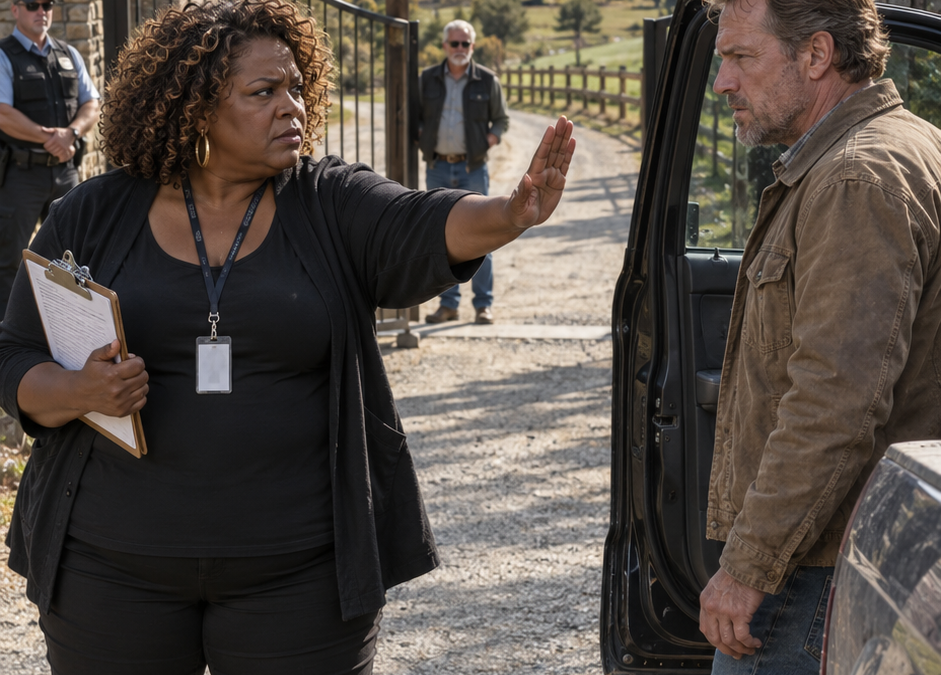
Donna Hartwell stepped out of the golf cart before I had even put my truck in park.
Clipboard in one hand.
Lanyard around her neck.
Chin raised.
Shoulders squared.
The posture of someone who had spent enough years running meetings that she no longer expected people to question where her authority came from.
She lifted one palm toward my windshield.
“Stop right there.”
I rolled down the window.
“This road is private community property,” she said. “You need a resident pass or registered guest authorization to proceed beyond this point.”
I looked past her.
The gravel road dropped into a valley that seemed to open wider the longer you stared at it.
Rolling pasture.
Old hardwood timber.
A creek cutting a silver line along the low ground.
Open meadow stretching toward a ridge nearly two miles away.
Two thousand six hundred acres.
I had driven eleven hours to stand there for the first time since my father died.
“I’m here to inspect property I recently inherited.”
Donna didn’t let me finish.
“Sir.”
Her voice dropped half a register.
Not louder.
More official.
“This is a deed-restricted HOA community. Visitors are required to register at the gatehouse. You cannot simply drive into Whisper Valley.”
She pointed toward the sign beside the road.
WHISPER VALLEY
PRIVATE COMMUNITY
RESIDENTS AND AUTHORIZED GUESTS ONLY
I looked at the sign.
Then at the valley.
Then back at her.
“Who owns the land?”
She answered immediately.
No hesitation.
That was the part I remembered later.
Not even half a second.
“The HOA does.”
“All of it?”
“Whisper Valley has been association property for more than twenty-five years.”
She tapped the clipboard.
“We have recorded covenants, board authority, dues-paying residents, common property, roads, recreation facilities, and legal counsel.”
“And the underlying land?”
She frowned.
“I just answered that.”
“No. You told me who governs the community.”
Her expression hardened.
“I told you who owns it.”
Then she added:
“If you refuse to turn around, I’ll contact our security coordinator and the county sheriff.”
I reached toward the center console.
She stiffened slightly.
I pulled out a notepad.
“What’s your name?”
She almost seemed offended that I had asked.
“Donna Hartwell.”
I wrote it down.
“What’s your position?”
“Board president.”
“How long?”
She hesitated.
“Twelve years.”
I wrote that too.
Then I wrote the time.
Then the exact sentence about the sheriff.
Donna watched me.
“You might want to speak with a real-estate attorney before you start making accusations.”
“I already have.”
Her mouth tightened.
“We have counsel on retainer.”
“Good.”
“I suggest you use yours.”
She turned toward the golf cart.
There was a thick manila envelope on my passenger seat.
Rubber band around it.
Law firm name printed in the upper corner.
Beneath that, stamped in blue:
ESTATE TRANSFER.
Donna never looked at it.
She had already dismissed me.
“I suggest you leave before this becomes unnecessarily difficult,” she called over her shoulder.
Then she drove away.
I sat there with the engine idling.
The same valley my father had bought decades ago lay beyond a private-community sign telling me I needed permission to enter.
I picked up the envelope.
Inside was the deed.
The probate transfer.
Tax history.
And a letter my father had written to me years before he died.
It wasn’t sentimental.
Dad wasn’t built that way.
Three paragraphs.
One sentence underlined:
It’s good land. Hold on to it.
He had bought the valley in 1952.
Seventy-three years later, somebody had built ninety-six houses on it and forgotten to ask who owned the ground.
I called my surveyor.
He was supposed to meet me at a secondary access road along the eastern ridge.
He answered immediately.
“They turned me away.”
“Who?”
“Guy in a polo shirt. Security badge. Said surveys require HOA permission thirty days in advance.”
“Did you argue?”
“No.”
“Good.”
“What do you want me to do?”
“Get lunch.”
He laughed.
“You serious?”
“For now.”
I hung up.
Donna’s golf cart had disappeared behind a stand of trees.
The valley looked peaceful.
That made the situation feel stranger.
Children lived down there.
Families.
People who had probably spent twenty years believing their homes sat on ordinary subdivision lots.
They had mortgages.
Tax bills.
Driveways.
Mailboxes.
They had probably attended hundreds of HOA meetings about trash cans and roof colors and parking.
None of them had any reason to question the dirt itself.
I pulled off the road and parked on a wide shoulder.
Then opened my laptop.
My attorney answered on speaker.
“She mentioned adverse possession?”
“Not directly. Her attorney probably will.”
“Twenty-five years?”
“That’s what she emphasized.”
A pause.
“They’re already thinking about it.”
“Tell me the history again.”
He did.
In 1997, a developer named Raymond Hargrove approached my father.
The valley had been mostly pasture and timber then.
Dad was sixty-one.
He had never wanted to subdivide it himself.
Hargrove did.
But instead of buying the land, he proposed a long-term ground lease.
Fifty years.
Hargrove would develop the valley.
Build roads.
Sell houses.
Create an HOA.
Operate the community.
The underlying acreage would stay in my father’s name.
It was not unheard of.
Complicated, but legal.
The lease revenue was good.
Dad agreed.
The ground lease was signed and recorded in 1998.
By 1999, the first houses were under construction.
By 2001, ninety-six lots had been sold and Whisper Valley HOA had been incorporated.
Then Hargrove did something that should have caused trouble immediately.
He sold houses as if the land question would eventually solve itself.
At closings, buyers received home documents.
Lot designations.
HOA papers.
Maps.
But no deed transferring the underlying 2,600 acres existed.
Not to the HOA.
Not to a land trust.
Not to another developer.
Not to the homeowners.
My father’s attorney repeatedly asked Hargrove to finish the transfer structure.
Hargrove kept saying it was being handled.
Then he died in 2011.
The legal correspondence stopped.
The community didn’t.
That was the strange part.
Whisper Valley functioned perfectly well.
Roads were maintained.
Grass was cut.
Dues were collected.
The pool opened every summer.
Homes were sold and resold.
Board elections happened.
Rules were enforced.
People argued about fences and paint.
And because the neighborhood behaved like a normal subdivision, everyone assumed the legal foundation underneath it must be normal too.
It wasn’t.
I pulled up the county assessor database while sitting there on the shoulder.
The result loaded in less than a minute.
Twenty-six hundred acres.
Family name.
Same title chain.
Same parcel.
Taxes paid continuously.
Every year.
No transfer.
No HOA deed.
No trust.
Nothing.
I stared at the screen.
My attorney continued.
“The current board probably genuinely believes they own it.”
“I know.”
“And I’d be careful with that.”
“I know.”
“Because this isn’t ninety-six squatters.”
“I know.”
“These are homeowners who bought in good faith.”
“I know.”
That distinction mattered to me.
It still does.
Donna Hartwell had not personally stolen 2,600 acres.
She had inherited an institution.
She learned the bylaws.
Learned the rules.
Learned which sections to cite.
Learned how to run hearings.
Learned how to send fines.
What she had never learned was where Whisper Valley’s authority actually came from.
Institutions are dangerous that way.
Once people inside them stop asking foundational questions, routine becomes evidence.
We’ve always done it this way becomes a substitute for title.
My phone buzzed.
Surveyor.
“They’re still watching the east access.”
“Go home.”
“Really?”
“Yes.”
“You sure?”
“I don’t want anybody trespassing before we sort this.”
He laughed again.
“Interesting word choice.”
“I know.”
Three days later, a certified letter reached me at the motel.
Return address:
A law firm in the state capital.
Three names across the top.
Heavy paper.
Expensive logo.
The kind of office that bills for reading your email.
The letter demanded that I immediately stop attempting to enter Whisper Valley community property.
It stated that the HOA had possessed, maintained, governed, and improved the valley openly and continuously for more than twenty-five years.
Then came the legal theory.
Adverse possession.
And then my favorite part.
I was instructed to submit a $250 administrative filing fee if I wished to contest the HOA’s ownership through its internal dispute-resolution process.
I sat at the motel desk and read that twice.
They wanted me to pay the HOA to challenge its ownership of my land.
I turned on my phone recorder.
Read the entire letter aloud.
Date.
Time.
Sender.
Every paragraph.
I had started documenting everything after the gate confrontation.
Voicemails.
Emails.
Letters.
Notes.
Not because I enjoyed it.
Because once people become confident enough to state questionable things in writing, you should let them.
Then preserve them.
I called my attorney.
“They’re claiming adverse possession.”
“I know.”
“You already got the letter?”
“Yes.”
“Pull the lease.”
“I did.”
Adverse possession generally requires use that is hostile to the true owner’s rights.
Not hostile in the everyday sense.
Hostile legally.
Without permission.
That was the problem with the HOA’s theory.
My father had given Hargrove permission.
Explicit permission.
Written permission.
Recorded permission.
Fifty years of permission.
The lease ran until 2048.
“You want me to respond?” my attorney asked.
“Not yet.”
Silence.
“You want to see how far they go.”
“Yes.”
“You enjoy this too much.”
“No.”
I looked out the motel window.
“Actually, I hate it.”
That was true.
Because every day this remained unresolved, ninety-six families lived under a question they didn’t understand.
That evening, Donna called a community meeting.
I didn’t attend.
A woman named Margaret Okafor called me afterward.
I had met Margaret accidentally at a diner two days earlier.
She was seventy-one.
Retired teacher.
Twenty-two years in Whisper Valley.
She recognized me from a description apparently circulating through the neighborhood.
Older pickup.
Out-of-state plates.
Asking questions about land ownership.
She sat across from me without invitation.
“I want to ask you something.”
“Go ahead.”
“Are you trying to take our houses?”
“No.”
She studied my face.
“Donna says you’re trying to claim the community.”
“I’m trying to establish what my family legally owns.”
“That sounds like the same thing.”
“It isn’t.”
I turned my laptop toward her.
County assessor record.
Family name.
She stared.
“Nobody’s ever shown us this.”
“I figured.”
“We were told everything was transferred when the development was completed.”
“Do you have a deed to the underlying land?”
She frowned.
“I have a deed to my house.”
“I know.”
“And my lot.”
“Probably a structural interest or lot designation tied to the development documents.”
She looked uncomfortable.
“I don’t understand the difference.”
“Most people wouldn’t.”
She looked at the screen again.
“Neither did I.”
That night after Donna’s meeting, Margaret called.
“Donna says you’re making a fraudulent ownership claim.”
“What else?”
“She told everyone not to discuss HOA business with outsiders.”
“Outsiders.”
“That means you.”
“I guessed.”
“She also said residents who cooperate with you could face conduct violations.”
I wrote that down.
“Did anyone ask for the deed?”
“One man did.”
“What happened?”
“Donna said all relevant land documents were with counsel.”
“Did she show anything?”
“No.”
Margaret was quiet.
Then:
“People are scared.”
“Of me?”
“No.”
Pause.
“Of finding out something has been wrong for twenty-five years.”
That sentence stayed with me.
The next morning, I began spending my days at the county recorder’s office.
Phyllis ran the records counter.
Nineteen years there.
She understood what I was doing by Day Three.
After that, she began leaving index books and instrument references at the table I used.
I pulled everything.
1952 deed.
My grandfather’s original purchase.
Later transfer to my father.
Probate transfer to me.
Tax records.
Seventy-three years of continuous payments.
No break in ownership.
Then the Hargrove file.
1997 correspondence.
Draft lease terms.
1998 final ground lease.
Fifty pages.
My father’s signature.
Hargrove’s signature.
Notary block.
County recording stamp.
Then the 1999 subdivision permit.
Page four specifically referenced the ground lease.
That mattered.
The county knew the project sat on leased land.
Then the 2001 HOA formation documents.
Twenty-eight pages.
I read them three times.
No deed transfer.
No land conveyance.
No future-transfer clause.
No trust arrangement.
No reference to the lease.
Hargrove had created an HOA to govern a community sitting on land he leased.
Then he wrote the HOA documents as though the underlying land belonged to the association.
Maybe he assumed he would resolve it later.
Maybe he intended to.
Maybe he was careless.
Maybe worse.
I couldn’t prove motive.
I didn’t need to.
The documents were enough.
The 1998 lease destroyed the adverse-possession argument.
Use by permission cannot become hostile simply because everyone later forgets permission existed.
At least not while that lease remains in force.
The HOA had twenty-five years of activity.
I had one lease.
Legally, that difference mattered more than the size of their filing cabinet.
Margaret called again.
Two residents wanted to speak with me.
One was Paul Garrett.
Sixty-four.
Semi-retired contractor.
He had built three original homes in Whisper Valley.
We met at the diner.
Paul brought his closing folder from 1999.
Careful man.
Measured his words.
“Hargrove told every buyer the same thing.”
“What?”
“That the land would eventually be transferred into an HOA trust.”
“In writing?”
“No.”
“At closing?”
“Yes.”
“Anyone else remember?”
“Everybody who bought early.”
He slid the documents toward me.
There was no land-transfer language.
Nothing.
“He said it was paperwork,” Paul continued. “Said the homes were safe. Said the ground arrangement would be settled after the final phase.”
“And nobody followed up?”
He laughed without humor.
“People had mortgages. Kids. Jobs.”
He tapped the folder.
“If the bank closes the loan and the county records the house, most people assume the lawyers did the rest.”
That was the entire story in one sentence.
We assume somebody checked.
I copied Paul’s closing papers.
Another piece.
Not necessary to prove title.
Useful to explain how ninety-six families could honestly believe something that wasn’t reflected in the land records.
That evening, Margaret forwarded me an email Donna had sent community-wide.
Subject:
IMPORTANT UPDATE REGARDING ONGOING PROPERTY DISPUTE.
It described me as a predatory external claimant exploiting an administrative defect for financial gain.
Then:
Residents who provide information to outside parties may be subject to review under Section 14 of the community conduct standards, including fines up to $500 per incident.
I read it slowly.
The HOA didn’t own the land.
Its title claim depended on a legal theory that collapsed under the recorded lease.
And Donna was using the HOA’s authority to threaten residents who might speak to the actual titleholder.
That changed my approach.
Until then, I had been willing to move slowly.
Let the lawyers write.
Let the court calendar work.
But Donna was turning uncertainty into pressure.
I called my attorney.
“Emergency hearing.”
“You sure?”
“Yes.”
“They might beat us to it.”
“They already have.”
Two days later, they filed first.
WHISPER VALLEY HOMEOWNERS ASSOCIATION v. [MY NAME].
Emergency motion for temporary restraining order.
The HOA asked the circuit court to prohibit me from entering, interfering with, surveying, or asserting control over Whisper Valley while title litigation proceeded.
Attached:
Twenty-five years of meeting minutes.
Dues records.
Paving invoices.
Landscaping contracts.
Pool permits.
Gate maintenance.
Insurance records.
Photographs.
A sworn declaration from Donna stating that the HOA had continuously and openly possessed the valley since 1999 without challenge from the alleged titleholder.
Four bankers boxes worth of legitimacy.
Two days later, the judge issued a temporary order.
Thirty days.
I was legally barred from setting foot on the 2,600 acres I owned until a hearing.
I sat in my motel room after my attorney called.
“Say that again.”
“You cannot enter.”
“My land.”
“For now.”
“Based on their adverse-possession claim.”
“Yes.”
I wasn’t angry immediately.
I was almost impressed.
The HOA had no deed.
But it had history.
And history can buy you time.
Donna sent another email that afternoon.
Subject:
VICTORY — BOARD OBTAINS COURT ORDER PROTECTING WHISPER VALLEY.
Margaret forwarded it.
Donna thanked the community.
Said the judge had recognized the HOA’s rights.
Said the board had protected the neighborhood.
Said:
We will not be intimidated.
I imagined ninety-six households reading that.
Relief.
The scary stranger had been stopped.
The board had won.
The court agreed.
Except the court hadn’t ruled on ownership.
Only access pending hearing.
My attorney filed our response forty-eight hours later.
Eleven pages.
Two primary exhibits.
Exhibit One:
The deed.
Unbroken chain.
Probate transfer.
Tax history.
Exhibit Two:
The 1998 recorded ground lease.
Fifty-year term.
Explicit permission to develop and operate a residential community.
The HOA’s entire filing depended on adverse possession.
Adverse possession depended on hostile possession.
The lease proved permission.
Their sixty-three-page motion met two documents.
Three days later, the judge issued a scheduling order.
Twenty-one days to hearing.
One sentence stood out:
The existence of a formal recorded lease appears potentially dispositive as to the adverse possession theory.
Potentially dispositive.
Potentially case-ending.
Margaret called that night.
“People are asking questions.”
“Good.”
“They’re frightened.”
“I know.”
“One family called their mortgage lender.”
“What did the lender say?”
“They don’t know.”
I closed my eyes.
That was exactly what I feared.
This wasn’t about humiliating an HOA.
People had life savings tied up in those houses.
Whatever happened needed to preserve that.
“Tell them something for me.”
“What?”
“The homes are not disappearing.”
“You’re sure?”
“Yes.”
“How?”
“We can restructure the ground lease.”
“What does that mean?”
“It means every homeowner gets documented rights. Roads. Lots. Access. Everything written correctly.”
“So nobody loses their home?”
“No.”
She was quiet.
“Donna isn’t telling them that.”
“I know.”
“Will you?”
“When I can.”
Five days before the hearing, Margaret texted:
TOWN HALL TONIGHT. 7 PM. CLUBHOUSE. YOU SHOULD COME.
I wasn’t invited.
Technically, I wasn’t a resident.
That irony alone almost made me laugh.
I went anyway.
The clubhouse filled early.
Every chair.
People along the walls.
Families.
Older couples.
Children in the hallway.
Almost two hundred people.
Donna stood at the front with a projector remote.
She had prepared a presentation.
Photographs of the valley in 1999.
Red dirt.
New roads.
Partially framed houses.
Then 2005.
Mature landscaping beginning.
Then recent photographs.
Pool.
Playground.
Clubhouse.
Trail system.
She let each image sit.
“Twenty-five years,” she said.
“Twenty-five years of residents paying dues, maintaining roads, raising families, preserving this valley.”
Applause.
“This is what is being challenged.”
Another photograph.
“An outside claimant appeared six weeks ago asserting ownership over land this community has maintained for a quarter century.”
More applause.
“Our attorneys have reviewed his claim.”
She paused.
“It has no merit.”
That was when she saw me.
Her eyes stopped near the back wall.
Just a flicker.
Then she smiled.
“Since Mr. [my name] has joined us tonight, perhaps we should offer him the opportunity to address the community.”
Every head turned.
I understood the setup.
Bring me forward.
Put me in front of frightened homeowners.
If I became angry, Donna won.
If I threatened eviction, Donna won.
If I sounded greedy, Donna won.
I walked to the podium.
I looked at the crowd.
Then said the only thing that mattered.
“I understand why you’re scared.”
Silence.
“You’ve built lives here.”
I looked toward Margaret.
Paul.
Families I didn’t know.
“I’m not here to take those lives away.”
The room changed slightly.
“My family has held title to this land since 1952. There are documents that should have been completed when the development was built, and they weren’t.”
I paused.
“That is what the court will review.”
Donna shifted beside me.
“I believe the records will speak for themselves.”
Then I stepped away.
Less than two minutes.
No lease.
No dramatic reveal.
No threat.
Donna looked almost disappointed.
Then a man near the center raised his hand.
I recognized him later as David.
Eighteen-year resident.
“Donna?”
“Yes?”
“Can you show us the HOA’s deed?”
The question changed the room.
Donna smiled.
“The relevant documents are with legal counsel.”
“I understand.”
David didn’t sit.
“Do we have a deed?”
“The ownership question is under active litigation.”
“So no deed?”
Donna’s expression tightened.
“We have twenty-five years of continuous possession and substantial legal authority.”
David lowered his hand.
But he did not look reassured.
Donna closed the meeting ten minutes later.
She described the community as “united.”
Outside, people gathered in small groups.
Quiet conversations.
Phone numbers exchanged.
Nobody looked united.
The hearing came on a cold morning.
I arrived twenty minutes early.
The accordion folder sat on my passenger seat.
Inside:
Deed.
Lease.
Tax records.
Hargrove correspondence.
Paul’s closing paperwork.
Donna’s letters.
Everything.
The HOA legal team was already inside.
Two attorneys.
Paralegal.
Four bankers boxes.
Donna wore a charcoal blazer.
Hands folded.
Calm.
Judge Patricia Waverly entered at nine.
Early sixties.
Efficient.
The expression of someone who read filings before court and expected lawyers to know that she had.
The HOA went first.
Their attorney was good.
I want to be fair about that.
He didn’t rant.
Didn’t exaggerate.
He built the strongest possible version of their case.
Twenty-five years of continuous use.
Road maintenance.
Homeowner dues.
Insurance.
Landscape contracts.
Pool operation.
Community governance.
Open and notorious possession.
He used the phrase “settled expectations.”
That was smart.
Because ninety-six families had settled expectations.
Then he concluded:
“Whisper Valley has existed as a self-governing community for more than a quarter century. The law recognizes long-standing possession where titleholders abandon their rights.”
He sat.
Judge Waverly wrote something.
Then looked over her glasses.
“Counsel.”
“Yes, Your Honor?”
“Does Whisper Valley HOA possess a deed to the underlying 2,600 acres?”
He stood again.
“No recorded deed in the association’s name, Your Honor, but—”
“I understand.”
She looked toward our table.
“My question is answered.”
My attorney stood.
He carried two documents.
Nothing else.
“Your Honor, Exhibit One.”
1952 warranty deed.
Unbroken chain.
“My client’s grandfather acquired the property in 1952. It later transferred to his father, then to my client through probate. Property taxes have been paid under this chain continuously.”
He placed it on the exhibit table.
“Exhibit Two.”
The ground lease.
“Recorded March 14, 1998. Fifty-year term.”
He opened it.
“Raymond Hargrove, developer.”
Then:
“Titleholder.”
Both signatures.
Notary.
Recording stamp.
“This lease expressly authorizes Hargrove to develop and operate a residential community on the land.”
He sat down.
Judge Waverly picked up the lease.
Read.
Turned pages.
Went back.
Read again.
Nobody moved.
Then she looked toward the HOA attorney.
“Counsel.”
He stood.
“If the original possession was authorized through a recorded lease, how is the hostile element of adverse possession satisfied?”
He hesitated.
“Your Honor, the HOA itself was not an original signatory to—”
“The HOA is claiming through the development history created by Hargrove, correct?”
“Yes.”
“And the use began under permission.”
“Yes, but—”
“Do you have an instrument terminating the lease?”
“No.”
“An assignment converting the leasehold to ownership?”
“No.”
“A deed?”
“No.”
“Any document superseding this agreement?”
Silence.
“No, Your Honor.”
Judge Waverly set the lease down.
“Then your adverse-possession theory has a substantial problem.”
The HOA asked for a recess.
Ten minutes.
Donna moved with her lawyers to the far side of the room.
I couldn’t hear the words.
I didn’t need to.
Her attorney held both hands low.
Palms down.
Calming.
Explaining.
Donna’s face finally changed.
For six weeks, she had been pure institutional confidence.
Gate authority.
Legal counsel.
Board power.
Court order.
Twenty-five years.
Now she was looking at a document signed before Whisper Valley HOA existed.
A lease she had apparently never seen.
A lease that explained the entire community.
Court resumed.
The HOA requested sixty days to investigate additional title history.
Denied.
Judge Waverly ruled.
The temporary restraining order was dissolved immediately.
The HOA’s adverse-possession claim was dismissed with prejudice.
Permanently.
Title to the 2,600 acres was confirmed in my name subject to the existing ground lease and lawful homeowner interests.
Then the judge ordered a compliance hearing within thirty days.
Her final instruction was simple:
“You have ninety-six households whose rights require clarification. Counsel will come prepared with a lawful structure protecting those residents.”
That mattered more to me than winning.
Outside the courtroom, residents had attended.
David was there.
Margaret too.
Three people left immediately.
Not angry.
Just exhausted.
Margaret approached the railing before I left.
She touched my forearm once.
“You meant what you said?”
“What?”
“About the homes.”
“Yes.”
“Nobody loses them?”
“No.”
Her shoulders dropped.
That was the first victory that felt like one.
In the courthouse parking lot, my phone buzzed.
Unknown number.
Text:
We knew something was wrong. We just didn’t know what. Thank you.
I read it twice.
Then opened the truck door.
The estate-transfer envelope sat inside the accordion folder.
Same place it had been the day Donna told me to leave.
I looked at it.
Then put it back.
Thirty days later, we returned for compliance.
Donna wasn’t there.
She resigned eleven days after the ruling.
Two other board members resigned with her.
Personal reasons.
No explanation.
No apology.
That was fine.
The compliance hearing was quieter.
Technical.
Documents instead of accusations.
A revised ground-lease structure was created.
Properly recorded.
Every road identified.
Every lot described.
Every common area defined.
Homeowners received enforceable rights tied directly to the land.
Permanent access.
Utility rights.
Maintenance rights.
Transfer provisions.
Mortgage protections.
Everything that should have existed from the beginning.
The lease no longer relied on assumptions.
Neither did the community.
County records were updated to reflect my family’s title and the residents’ lawful occupancy interests.
Nobody lost a home.
Nobody was evicted.
Nobody had to move.
The only thing that disappeared was the fiction that the HOA owned the entire valley outright.
The accounting came later.
HOA legal fees had crossed $180,000.
Most came from reserve funds.
Residents learned dues had been inflated over years partly to build reserves the board had broad discretion to spend.
Then came separate legal questions.
Former board members.
Resident claims.
Improper fines.
I didn’t follow those lawsuits closely.
That wasn’t my fight.
Three weeks after compliance, Margaret invited me to a community meeting.
This time, residents called it.
Not the board.
Same clubhouse.
Different room.
No podium.
No slideshow.
Chairs in a rough circle.
About a hundred people.
David stood first.
“I owe an apology.”
Nobody interrupted.
“I lived here eighteen years and never once asked to see the land deed.”
He looked around.
“We all assumed somebody else had.”
He sat.
No applause.
It wasn’t a performance.
Margaret was elected interim chair of a transition committee.
Twelve volunteers joined.
Then people began discussing fines.
Mailbox colors.
Fence posts.
Parking.
Old violations.
Some were refunded.
Others canceled.
A few remained legitimate.
That was important too.
I didn’t want the new structure to become revenge against every rule.
Communities still need roads maintained.
Pools insured.
Drainage managed.
Shared property cared for.
The problem had never been cooperation.
It was false authority.
When Margaret called on me, I stood.
Three things.
That was all.
“First, your homes are protected.”
People listened carefully.
“The new recorded ground lease recognizes every lot, structure, access right, utility right, and transfer interest. Nobody is losing a home because of this.”
A woman in the second row began crying quietly.
I continued.
“Second, the main road belongs to the underlying land.”
Donna’s road.
The road she had blocked.
“But the community has used it for twenty-five years.”
I paused.
“I am granting a permanent recorded easement for resident and guest access.”
That drew the first real reaction.
Not cheering.
Relief.
A collective breath.
“And third.”
I looked toward the entrance.
“The sign is coming down.”
Someone laughed nervously.
“Not because I want to erase Whisper Valley.”
I shook my head.
“I don’t.”
“The sign says the land is HOA-owned private community property.”
“It isn’t.”
“Whatever replaces it is up to you.”
I sat down.
Margaret looked around the room.
Then said:
“All right.”
She smiled faintly.
“Let’s talk about what we actually need.”
I left while they were still meeting.
For the first time since I arrived, I felt like I didn’t need to stay.
The next morning, I drove to Whisper Valley early.
No golf cart blocked the entrance.
No security coordinator.
No one asked for a resident pass.
The big HOA sign was gone.
Two bolt holes remained.
Someone had zip-tied a temporary card to the wooden post.
WHISPER VALLEY
ESTABLISHED 1999
That was better.
True.
I parked and walked.
Not as owner.
Not as plaintiff.
Not as somebody gathering evidence.
Just walked.
Past the first homes.
Past the pool.
Past the clubhouse.
A woman pushed a child on a swing.
A dog barked behind a fence.
Someone ran a leaf blower.
Ordinary morning.
I followed the creek.
Old trees stood along the water.
Some had been there before my grandfather bought the valley.
Before roads.
Before Hargrove.
Before Donna.
The creek climbed toward the eastern ridge.
I followed it.
At the top, the entire valley opened below me.
Ninety-six homes.
Roads curving through hills.
Chimney smoke.
Lawns.
Cars.
A school bus turning near the gate.
From up there, nothing looked disputed.
That was the thing.
Land doesn’t know when people misunderstand paperwork.
The grass keeps growing.
The creek moves.
Trees age.
Families live.
Dad used to say land doesn’t argue.
“It waits.”
I understood that differently now.
He had bought the valley in 1952.
Held it.
Paid taxes.
Leased it when opportunity came.
Maybe he assumed lawyers would finish what needed finishing.
Maybe he trusted Hargrove too much.
Maybe everyone did.
But Dad preserved the one thing that mattered.
Title.
When I inherited the valley, I also inherited seventy-three years of patience.
I stood on the ridge for a long time.
Then I thought about Donna.
I never spoke to her again.
I heard she sold her home the following year.
Maybe true.
Maybe not.
I didn’t check.
People expected me to hate her.
I didn’t.
Not anymore.
Donna’s mistake was bigger than arrogance.
She believed repeated practice becomes truth.
Twelve years of board meetings.
Twenty-five years of dues.
Ninety-six households.
Thousands of enforcement letters.
Hundreds of votes.
She assumed all that accumulated behavior must rest on ownership.
Most people would.
But legal foundations don’t strengthen because nobody checks them.
A missing deed remains missing.
A lease remains a lease.
A recorded title remains title.
I didn’t expose a conspiracy.
I found a forgotten document.
That difference matters.
The residents were victims of that forgotten document too.
They had purchased homes believing the ground situation was complete.
Banks had financed them.
Insurers covered them.
Boards governed them.
Nobody stopped to ask whether the land beneath the subdivision had ever actually transferred.
Once we corrected it, everyone was safer.
My title.
Their homes.
Their roads.
Their mortgages.
The HOA itself.
Everything finally rested on documents that matched reality.
Margaret called me a month later.
“Can I ask something?”
“Sure.”
“Would you come to the next board meeting?”
“What for?”
“We want to vote on the new sign.”
I laughed.
“You don’t need me for that.”
“The entrance post sits on your land.”
Fair point.
I went.
Three designs.
One had too much stone.
One looked like a resort.
The third was simple.
WHISPER VALLEY
A RESIDENTIAL COMMUNITY
ESTABLISHED 1999
No HOA ownership claim.
No private-land declaration.
I voted for nothing.
I told them:
“Pick what you want.”
They picked the simple one.
A contractor installed it two weeks later.
Margaret sent me a photograph.
Under it:
Looks better when it tells the truth.
I saved that message.
Paul Garrett helped with the transition committee.
David took over records oversight.
Residents created an online document archive.
Recorded plat.
Ground lease.
Maintenance agreements.
Meeting minutes.
Budgets.
No special permission needed.
No mystery.
A homeowner asked why they were making everything public.
Margaret answered:
“Because we spent twenty-five years assuming documents existed that nobody had seen.”
That became the new standard.
Show the paper.
Not angrily.
Not suspiciously.
Just normally.
The way healthy institutions should work.
The $250 internal claim fee disappeared immediately.
So did the rule threatening residents for talking to outsiders.
Several fines Donna’s board had issued were rescinded.
Others remained.
One man complained that the new board still made him move a broken camper out of the road.
Margaret told him:
“We’re correcting abuse. We’re not abolishing common sense.”
I liked that.
Six months after the hearing, I finally stayed overnight in the valley.
Not in a resident house.
There was an old hunting cabin near the western ridge.
My father had used it occasionally.
Barely more than four walls.
Wood stove.
Cot.
I repaired the roof.
Replaced two windows.
Spent a weekend cleaning decades of dust.
That first night, I sat outside with a lantern.
Lights from Whisper Valley glowed below.
For twenty-five years, those people had lived on family land.
I had grown up elsewhere.
Worked elsewhere.
Barely visited.
Who had more claim to the feeling of that place?
Legally:
Me.
Emotionally:
Them.
Both truths could exist.
That realization changed how I thought about ownership.
A deed gives you legal rights.
It does not make other people’s lives less real.
Donna had been wrong because she confused community with title.
I could have made the opposite mistake.
Confused title with community.
I didn’t want to.
So we wrote the new ground arrangement carefully.
Long-term.
Renewable.
Predictable.
Homeowners could sell.
Finance.
Inherit.
Improve.
The community retained management over genuine common areas.
I retained underlying ownership.
Nobody needed to pretend one erased the other.
That was the arrangement my father should have insisted on in 1998.
Maybe Hargrove should have.
Maybe their lawyers should have.
We fixed it twenty-seven years late.
Better late than never.
The valley continued.
That was the ending I wanted.
No locked gates.
No families packing boxes.
No dramatic evictions.
Just corrected records.
There was one final document.
About a year after the first gate confrontation, the county recorder mailed me the completed land-record update.
Thick envelope.
Official stamp.
The recorded title history.
Revised lease structure.
Easements.
Lot references.
Everything cross-indexed.
I carried it to the old hunting cabin.
There was a small desk inside.
I opened the drawer.
Dad’s letter was there.
I had brought it months earlier.
It’s good land. Hold on to it.
I read the sentence again.
For years, I thought he meant:
Never sell.
Maybe he did.
But standing there after everything, I understood another possibility.
Hold on to it didn’t necessarily mean grip it until nobody else could touch it.
Maybe it meant:
Protect what it is.
Keep the title clean.
Don’t let people destroy it.
Don’t let paperwork become careless.
And don’t confuse ownership with domination.
I folded the letter.
Put it back.
The following spring, I walked the eastern ridge with Margaret.
She had never been up there.
Seventy-two by then.
Still faster uphill than she looked.
Halfway up, she stopped.
“I’m too old for this.”
“You’re the one who wanted to see the view.”
“That was before I remembered gravity.”
We kept going.
At the top, she stared.
“You can see everything.”
“Pretty much.”
She pointed toward the clubhouse.
“That thing caused more trouble than it should’ve.”
“Not the clubhouse.”
“You know what I mean.”
We stood quietly.
Then she asked:
“Were you ever going to throw us out?”
“No.”
“Not even at the beginning?”
“No.”
“Why didn’t you tell Donna that?”
“I tried to tell everybody eventually.”
“No.”
She shook her head.
“At the gate.”
I thought about it.
Donna standing beside the golf cart.
Private community property.
Resident pass required.
Sheriff.
“You think she would’ve believed me?”
Margaret smiled.
“No.”
“Exactly.”
Then she looked back over the valley.
“She really thought it was ours.”
“I know.”
“That’s the strange part.”
“Yes.”
“Not that she lied.”
“No.”
“That she believed it.”
That was exactly right.
Belief had been the engine behind everything.
Donna believed.
The board believed.
Residents believed.
Banks apparently believed.
Maybe Hargrove had believed someday paperwork would catch up.
The county records did not believe.
They didn’t need to.
They just existed.
That’s why I keep copies.
Not because I expect another fight.
Because memory changes.
Institutions change.
People leave.
Files get misplaced.
A statement repeated for twenty-five years begins to sound more authoritative than a deed nobody has opened.
The document doesn’t care.
It waits.
The way land waits.
I still own the 2,600 acres.
Whisper Valley still has ninety-six homes.
The HOA still exists, though its powers are narrower and clearer now.
It manages what it actually manages.
Road maintenance.
Pool.
Landscaping.
Common facilities.
Community rules tied to legitimate homeowner agreements.
Not the earth beneath everything.
Residents pay dues.
They hold meetings.
They argue.
Of course they argue.
One meeting lasted forty minutes over whether trash bins could remain visible after seven in the evening.
I heard about it from Margaret.
“Democracy,” she said.
“Sounds exhausting.”
“You started this.”
“I corrected a deed problem.”
“You corrected all of us.”
“I did not.”
She laughed.
“Whatever helps you sleep.”
I sleep fine.
Mostly.
Once in a while, though, I think about how easily it could have gone differently.
If Dad had lost the lease.
If nobody recorded it.
If property taxes had lapsed.
If Hargrove had received a deed.
If I had ignored the estate papers.
If Donna’s attorneys had found some later conveyance.
Any one of those things might have changed everything.
But none happened.
What happened was simpler.
A family kept ownership.
A developer leased land.
A community grew.
Paperwork stopped halfway.
Time covered the gap.
Then someone finally looked.
That is the whole story.
The dramatic part was never the courtroom.
It was the thirty seconds at the gate.
Donna telling me:
“This valley has been HOA property for twenty-five years.”
And me asking:
“Who owns the land?”
Because that was the question nobody had asked in a quarter century.
The answer was sitting beside me.
Manila envelope.
Rubber band.
County stamp.
My family’s name.
Today, there is no guard stopping me when I enter Whisper Valley.
There shouldn’t be.
But there’s still a gatehouse.
Residents wanted it.
Security mattered to them.
So we wrote access rights properly.
The guard knows me now.
First time I came through after the new documents were recorded, he leaned out the window.
“Morning.”
“Morning.”
Then he smiled.
“Resident?”
“No.”
“Guest?”
“No.”
He looked at the computer screen.
Then at me.
“Oh.”
I knew what he’d found.
“Landowner?”
“That’s the one.”
He laughed.
“Go ahead.”
The gate lifted.
I drove in.
Same gravel road.
Same creek.
Same houses.
Different paperwork.
I passed the post where Donna first stopped me.
The new sign stood there.
WHISPER VALLEY
A RESIDENTIAL COMMUNITY
ESTABLISHED 1999
Nothing more.
Nothing false.
I drove to the eastern ridge.
Parked.
Walked the last half mile.
From the top, the valley was exactly what it had been the first day.
Green.
Wide.
Quiet.
Homes tucked into trees.
Creek reflecting morning light.
A bicycle moving down one road.
A dog running across somebody’s yard.
Smoke from a chimney.
Real lives.
Real community.
Real land.
I thought about Dad.
Good land.
Hold on to it.
I finally understood.
Holding on to something doesn’t always mean keeping everyone else off.
Sometimes it means making sure everyone standing on it knows exactly where they stand.
I stayed on the ridge until the light changed.
Then walked back to the truck.
The accordion folder was on the passenger seat.
I didn’t carry it everywhere anymore.
But that day I had brought it.
Inside was the old estate-transfer envelope.
The deed.
The lease.
The ruling.
The revised ground agreement.
Decades of misunderstanding reduced to paper that finally agreed with itself.
I started the engine.
Drove down through Whisper Valley.
Nobody stopped me.
Nobody threatened the sheriff.
Nobody asked me to pay $250 to file an ownership claim.
At the gate, the guard waved.
I waved back.
Then I drove out onto the county road.
The entrance disappeared in the mirror.
Behind me, ninety-six families kept living their lives on a valley my family still owned.
And for the first time in twenty-five years, everybody knew exactly what that meant.








