𝗙𝗨𝗟𝗟 𝗦𝗧𝗢𝗥𝗬 I Held a 45-Day-Old Puppy as the Veterinarian Read the Number We Were All Afraid Of
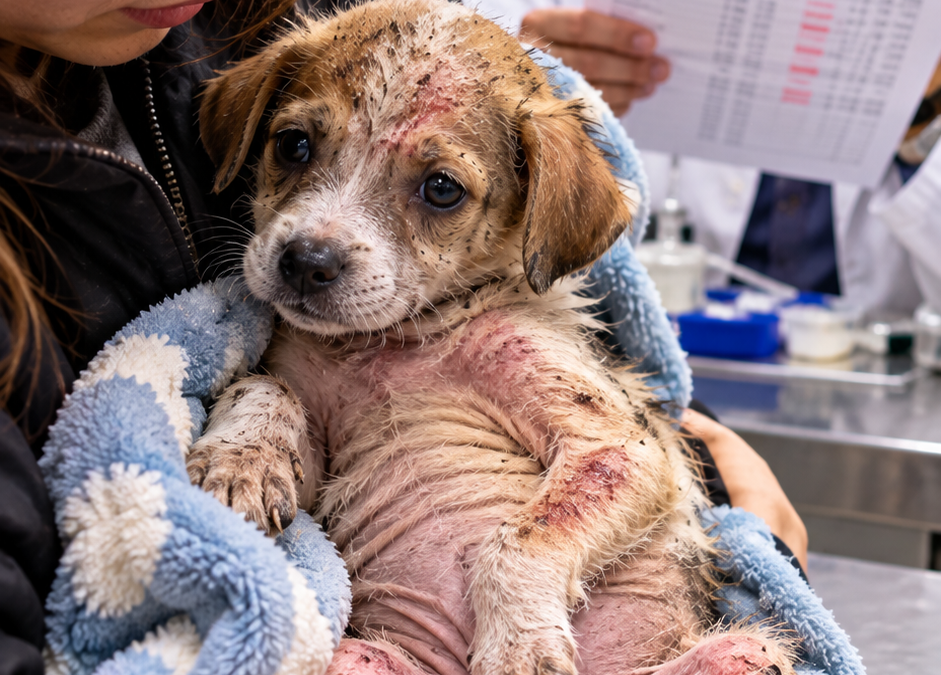
𝗙𝗨𝗟𝗟 𝗦𝗧𝗢𝗥𝗬
He continued explaining the test results.
Her liver and kidneys were also showing signs of trouble.
Then another serious problem emerged.
She had a blood parasite.
I remember looking down at my hands while the veterinarian explained how the infection, anemia, and other complications were placing enormous stress on her already fragile body.
It felt unbearably unfair.
She had only been alive for forty-five days.
She hadn’t had time to learn how to play properly.
She hadn’t had the chance to grow into her little legs.
She hadn’t even experienced a normal, healthy puppyhood.
And now she was fighting an illness that would have been serious for a much stronger animal.
“She’s dealing with several things at once,” the veterinarian said.
I nodded.
“But there are treatment options?”
“Yes. We need to address the parasite, support her organs, treat the mange, and manage her nutrition carefully.”
I looked at Ava.
“Then that’s what we’ll do.”
The veterinarian’s expression softened.
“We’ll give her every appropriate chance.”
I returned to the examination table and gently touched her head.
“Did you hear that, sweetheart?”
Her eyes opened briefly.
“You’re going to have a lot of people looking after you.”
She didn’t understand my words.
But she recognized the touch of my hand.
She moved her muzzle a little closer.
And that tiny movement was enough to make me cry.
The first days of Ava’s treatment were among the longest I can remember.
Her condition required intensive care and frequent monitoring.
The veterinary team developed a treatment plan that addressed her infections, supported her compromised body, and began treating the severe mange that had left her skin so painfully inflamed.
Every intervention had to account for how small and weak she was.
She wasn’t simply a dog with several separate medical problems.
She was a critically ill puppy whose body had almost no reserves left.
Treating one condition didn’t mean we could ignore the others.
Her nutrition had to be managed carefully.
Her temperature needed monitoring.
Her response to medication mattered.
Her skin required gentle treatment, and her injured hind legs couldn’t be placed under unnecessary strain.
There were times when the amount of attention she needed seemed overwhelming.
But whenever I looked at her, I was reminded why every detail mattered.
She was depending entirely on us.
On the first evening, I sat beside her while she rested.
She looked even smaller beneath the clinic blanket.
Her little head was turned toward me, and I could see a faint movement near her nose whenever she breathed.
I leaned closer.
“Hey, baby.”
Her ears twitched.
I smiled.
“That’s right. I’m still here.”
I wasn’t sure why those words seemed so important.
Perhaps because I’d spent the entire day watching people carry her between rooms, examine her, collect samples, and administer treatment.
Everything happening around her must have been unfamiliar.
She couldn’t understand why she was being touched in places that hurt or why she couldn’t simply sleep without somebody checking her condition.
I wanted at least one thing about her new world to become predictable.
A familiar voice.
A gentle touch.
Somebody who would sit quietly beside her without asking her to do anything.
So I stayed as long as I could.
When I finally left that evening, the veterinarian assured me that the team would continue monitoring her.
I walked out of the clinic feeling as though I’d left a part of myself behind.
The next morning, I returned as early as possible.
The technician who greeted me recognized me immediately.
“You’re here for Ava.”
I nodded.
“How was she overnight?”
“She’s still very weak, but we’re continuing her treatment.”
I felt a rush of relief so intense that I nearly started crying in the hallway.
She was alive.
For that morning, it was enough.
I approached her resting area quietly.
“Good morning, beautiful.”
Her eyes opened.
Then she made the smallest movement toward my voice.
I leaned over her.
“There you are.”
She rested her head against my fingers.
I stayed beside her while the veterinary team continued its work.
Her medicated baths and skin treatments required particular care because her skin was so sensitive.
Before seeing Ava, I’d thought of mange primarily as a condition that caused itching and hair loss.
Now I was looking at a tiny animal whose skin had become so inflamed that ordinary handling could make her uncomfortable.
There were places where the fur had disappeared completely.
The exposed patches looked painfully red.
Even when she was resting, she sometimes seemed unable to escape the irritation.
During treatment, we handled her gently and followed the veterinarian’s instructions carefully.
Whenever she became distressed, I spoke softly to her.
“Almost finished, sweetheart.”
She would turn her head toward my voice.
Sometimes she relaxed.
Other times she trembled and needed a moment before we could continue.
I hated watching her endure anything uncomfortable.
But I also understood that the treatments were necessary.
Her skin couldn’t recover without proper medical care.
And until the underlying problems were controlled, her little body would remain vulnerable.
After each treatment, I helped settle her onto clean bedding.
Sometimes she was so tired that she fell asleep almost immediately.
I would sit beside her and watch her chest rise and fall.
I knew I couldn’t measure her progress by whether she seemed happier from one hour to the next.
Healing wasn’t that simple.
But I could offer her comfort.
And I could make sure she never had to endure another painful day without somebody paying attention.
By the third day, I had begun recognizing the particular sounds she made when she wanted something.
There was a tiny whimper that seemed to mean she was uncomfortable.
Another soft sound appeared when she recognized a familiar voice.
And occasionally, when she was awake and feeling a little stronger, she would make a quiet little noise that almost sounded like a complaint.
I began looking forward to those complaints.
They meant she had enough energy to express an opinion.
One afternoon, I was adjusting her bedding when she lifted her head and looked directly at me.
“What?”
She made a small sound.
“Am I taking too long?”
She stared at me.
I laughed.
“All right, Your Majesty.”
I finished arranging the blanket and carefully helped her settle.
She closed her eyes.
I smiled.
It was the first time I’d laughed in several days without immediately feeling frightened afterward.
But the fear never disappeared completely.
Her anemia remained a serious concern.
Her liver and kidney complications required continued attention.
And the blood parasite meant her recovery was dependent on more than simply eating enough food or allowing her skin to heal.
There were mornings when I arrived expecting good news and instead learned that she still needed close observation.
There were evenings when I studied her face, searching for the smallest sign of improvement.
I’d never imagined that watching a puppy breathe could become such an emotionally exhausting experience.
But it did.
Sometimes I lay awake at night thinking about her.
I wondered whether she’d eaten enough.
Whether her temperature was stable.
Whether the medications were working.
Whether the next blood test would bring relief or another frightening conversation.
I reminded myself that she was receiving proper care.
I knew worrying wouldn’t make her recover any faster.
But knowing something and feeling it are two very different experiences.
There were nights when I would have given almost anything to look into the future and know that she’d be all right.
Of course, I couldn’t.
So I returned each morning.
And we kept going.
The first meaningful changes were almost too small to notice.
Ava began responding more consistently when someone approached her.
She showed a little more interest in food.
She lifted her head without immediately letting it fall back onto the blanket.
During treatment, she became increasingly familiar with our voices and gentle handling.
Her body was still weak.
Her skin was still damaged.
And her hind legs continued to make movement difficult.
But something was changing.
I could see it in the way her eyes followed us around the room.
At first, she’d seemed almost disconnected from everything happening around her, as though her body was too exhausted to investigate the world.
Now she was beginning to pay attention.
One morning, I entered the room and found her watching a technician prepare her treatment.
“Good morning, Ava.”
Her head turned.
I stopped walking.
“Did you hear me?”
I spoke again.
“Hey, baby.”
She looked directly at me.
Then her little tail moved.
It was barely noticeable.
A tiny movement against the blanket.
But I saw it.
“Oh, sweetheart.”
I crouched beside her.
“Was that for me?”
Her tail moved again.
I laughed, and before I could stop myself, tears were running down my cheeks.
I had seen animals recover from terrible injuries before.
But there was something uniquely moving about watching this little puppy slowly discover that the people around her were familiar and safe.
She didn’t know how serious her medical condition had been.
She didn’t understand the significance of her blood test results.
She had no idea how many anxious conversations had taken place outside her room.
She simply recognized somebody who had been gentle with her.
And she wagged her tail.
Nine days after her rescue, Ava reached a milestone I will never forget.
The veterinarian was still monitoring her condition closely, and the mange that had covered so much of her body was beginning to improve.
Her skin remained sensitive, but some of the worst inflammation had started to subside.
The patches that had once looked so painfully red were gradually becoming healthier.
There were still areas without fur, and her recovery was far from complete.
But the change was unmistakable.
I remember examining her little face that morning and realizing that I was beginning to see the puppy beneath the illness.
Her eyes looked brighter.
Her expression was more alert.
And when I reached toward her, she moved her head eagerly into my hand.
“Look at you.”
I gently scratched behind her ear.
“You’re starting to feel better, aren’t you?”
She gave a small wiggle.
Then she tried to move.
At first, I thought she was simply adjusting her position.
She shifted her front paws beneath her chest and lifted her head.
Her hindquarters followed awkwardly.
I moved closer, ready to support her if necessary.
“Easy, sweetheart.”
She paused.
Then she pushed again.
For a moment, her entire little body trembled.
I reached toward her.
But before I touched her, she managed to raise herself into a standing position.
I froze.
“Ava?”
She looked at me.
Her injured hind legs were unsteady, and she was clearly relying more heavily on her left one.
But she was standing.
On her own.
I called for the technician.
“Come look at this!”
The technician entered and immediately moved closer.
Ava shifted her weight.
I held my breath.
Then she took a tiny, uncertain step.
It wasn’t graceful.
Her body wobbled, and the movement required obvious effort.
But her left hind leg supported enough of her weight to move her forward.
Then came another small step.
I covered my mouth.
“Oh, my goodness.”
The technician smiled.
“Look at her go.”
Ava stopped and lowered herself back down.
She looked exhausted.
But she had done it.
For the first time since I’d met her, I had watched her stand and take steps despite the injuries that had made even the simplest movements so difficult.
I wanted to scoop her into my arms.
I wanted to laugh and cry and tell everyone in the building.
Instead, I gently helped her settle back onto her bedding.
“That was enough for today, sweetheart.”
She looked at me.
I kissed my fingertips and touched the healthy fur near her head.
“You did something wonderful.”
The rest of that day, I couldn’t stop thinking about those tiny steps.
To somebody who had never seen Ava during her first days in the clinic, the movement might not have looked particularly impressive.
She had stood awkwardly.
She had taken a few unsteady steps.
And then she’d needed to rest.
But I remembered the puppy who had arrived unable to position her injured legs comfortably.
I remembered the frightening conversation about her blood results.
I remembered the way she’d lain almost motionless beneath her blanket while the veterinary team worked to stabilize her.
And now she was trying to walk.
For the first time, I began imagining her running.
Not because anyone had promised she would recover completely.
We still didn’t know exactly how much function she might regain in her hind legs.
But for the first time, there was visible evidence that her world was becoming bigger.
She wanted to move.
She wanted to investigate.
She wanted to do the things healthy puppies do without even thinking about them.
And I was beginning to believe she might get the chance.
As her condition improved, her foster care became an increasingly important part of her recovery.
There was a difference between keeping a critically ill puppy alive and helping that puppy develop into a healthy, confident companion.
Ava needed both.
Her medical treatment remained essential, but she also needed a predictable environment, gentle handling, appropriate nutrition, and opportunities to become comfortable with ordinary daily life.
I began spending more time with her outside the immediate demands of treatment.
Sometimes I sat beside her while she rested.
Other times I placed a small toy close enough for her to investigate without straining her legs.
She seemed fascinated by objects that made a little noise.
At first, she would simply stare at them.
Then she began moving her head toward them.
Eventually, she discovered that she could touch them with her front paws.
One afternoon, I placed a soft toy beside her blanket.
She looked at it suspiciously.
“What do you think?”
Her ears moved.
I nudged it a little closer.
She sniffed it.
Then she gave it a tiny bite.
I laughed.
“Well, somebody’s feeling brave.”
She released the toy and looked at me.
I moved it slightly.
She reached for it again.
We continued until she became tired.
Then she curled up beside it and fell asleep.
I sat there watching her.
For the first time, the room looked like it belonged to a puppy rather than a patient.
There was a blanket.
A toy.
A sleeping little dog.
And the unmistakable feeling that something ordinary and beautiful was beginning to emerge from the fear we’d experienced.
But we still had important medical questions to answer.
Thirteen days after the nine-day milestone, Ava was ready for another veterinary assessment.
Her foster caretaker brought her back to the clinic for an X-ray to help evaluate the condition of her hind legs.
It was an appointment we’d been anticipating.
The progress she’d made was encouraging, but we needed a clearer understanding of her skeletal condition before making assumptions about her long-term mobility.
I remember looking at her legs while we prepared for the visit.
She could move better than she had when she first arrived.
Her left hind leg was showing useful function, and she was becoming more confident about shifting her weight.
But there were still limitations.
And confidence wasn’t a substitute for knowing exactly what was happening beneath her skin.
The veterinary team explained that imaging would help them assess the bones and identify concerns that might influence her ongoing care.
I nodded.
I wanted answers.
But I was frightened of them, too.
Ava had already survived so many medical challenges.
I didn’t want to hear that there was another obstacle waiting for her.
As we traveled to the clinic, I kept one hand near her carrier.
She was awake and watching me.
“You’re going to see your doctor again.”
She tilted her head.
I smiled.
“I know. Not your favorite activity.”
She settled against her blanket.
I thought about how different she looked compared with the day of her rescue.
She was still small.
Still recovering.
Still dealing with physical limitations that most puppies never experience.
But she no longer looked like an animal who had completely run out of strength.
There was life in her eyes.
Curiosity in her movements.
And a growing willingness to interact with the world.
At the clinic, the staff greeted her warmly.
“Well, look who’s here.”
Ava lifted her head when she heard the familiar voice.
I laughed.
“She’s becoming quite the little celebrity.”
The technician smiled.
“She’s certainly making progress.”
The veterinary team carefully assessed her condition and prepared for the X-ray.
I watched her being carried into the examination area.
Even though she was stronger now, seeing her disappear through that doorway stirred the same anxiety I’d felt during her first appointment.
I remembered the veterinarian explaining her anemia.
The concern about her liver and kidneys.
The blood parasite.
The uncertainty surrounding her survival.
For a moment, I was back in that first examination room, holding my breath while somebody studied the results of a test that might change everything.
Then I reminded myself that this appointment was different.
Ava had already made meaningful progress.
The purpose of the imaging was to understand her injured legs and plan appropriately for her future.
Whatever the results, we were no longer starting from nothing.
She had people who knew her.
People who understood her medical history.
People who would continue supporting her recovery.
When the assessment was complete, the veterinary team discussed the next steps in her care.
We would continue monitoring her mobility and supporting her development according to the findings and her response to treatment.
There was no reason to demand that she accomplish everything immediately.
Her body needed time.
And we were going to give it to her.
Back in foster care, Ava’s daily routine became a careful balance between medical attention and the ordinary experiences of growing up.
Her foster caretaker monitored her temperature, digestion, appetite, and behavior.
The condition of her skin was checked regularly.
Her nutrition remained carefully managed.
And her movements were observed so that changes in her hind legs wouldn’t go unnoticed.
I knew that for somebody watching from the outside, those details might seem excessive.
But after seeing her arrive in such critical condition, I understood why nothing could be taken for granted.
A puppy can’t explain when something hurts.
She can’t tell us she’s developing a fever or that her stomach feels uncomfortable.
She can’t describe whether a particular movement causes pain.
She depends on the people around her to notice when something changes.
And Ava had already experienced what happened when a fragile body was overwhelmed by problems it couldn’t solve on its own.
We weren’t going to ignore the little things.
At first, her foster caretaker kept a close watch on nearly everything.
How much she ate.
How she responded after feeding.
Whether she seemed more tired than usual.
How comfortably she rested.
Whether her skin looked irritated after treatment.
And how she positioned her hind legs when she tried to stand.
Those observations helped the veterinary team make informed decisions as her recovery progressed.
But they also created a strange emotional attachment.
When you spend enough time watching an animal for signs of discomfort, you begin noticing everything about her.
The way she lifts her ears when she hears a familiar voice.
The particular expression she makes when she’s deciding whether to investigate something.
The tiny sounds she produces when she wants attention.
The way she settles into her blanket after a satisfying meal.
Ava was becoming more than a medical case.
She was becoming Ava.
One morning, I arrived to find her standing near the edge of her resting area.
I stopped.
“What are you doing over there?”
She looked at me.
Her little tail began wagging.
I crouched.
“Did somebody decide she was finished resting?”
She took a small step toward me.
Then another.
I held out my hand.
“Come here, sweetheart.”
She moved slowly, but with considerably more confidence than she’d shown during her first attempts.
When she reached me, she pressed her head against my fingers.
I laughed.
“Well, hello.”
For several seconds, I simply stroked her head.
Then I realized she was trying to climb closer.
“Oh, no. You’re not supposed to do all the work.”
I carefully lifted her, supporting her body so her hind legs weren’t strained.
She settled against my chest.
I looked down at her.
“Do you have any idea how worried I’ve been about you?”
She responded by trying to lick my chin.
I laughed so hard that another caretaker came to see what was happening.
“What’s going on?”
I turned toward her.
“Apparently, Ava has decided she runs the place.”
The caretaker smiled.
“That sounds about right.”
Ava wiggled in my arms.
I looked at her.
“And you seem very pleased with yourself.”
For the first time, I could hold her without feeling that every movement might exhaust her.
She was still fragile compared with a fully healthy puppy.
But she was gaining strength.
And she was beginning to use that strength to demand affection.
I found the transformation almost impossible to believe.
There had been a time when she was too weak to keep her head lifted.
Now she wanted to be held, stroked, and included in whatever the humans around her were doing.
She was discovering that attention could be enjoyable rather than frightening.
That food could arrive regularly.
That familiar hands could bring comfort.
And that moving toward somebody didn’t have to involve unbearable effort.
Her personality became more apparent with each passing day.
She was affectionate.
Curious.
And increasingly determined to participate in the world around her.
She liked following familiar people whenever her strength and mobility allowed.
She watched everything.
If somebody entered the room carrying supplies, she wanted to investigate.
If a toy moved across the floor, her ears lifted immediately.
If someone sat beside her without offering affection, she seemed personally offended.
I remember one afternoon when I was reviewing her care notes.
I sat on the floor near her blanket, concentrating on the information I needed to record.
Ava was resting beside me.
After a few minutes, I felt something touch my hand.
I looked down.
She had placed one tiny paw against my fingers.
“Yes?”
She stared at me.
I returned to my notes.
A moment later, she nudged my hand again.
I laughed.
“Oh, I’m sorry. Did I forget something?”
She leaned forward.
I scratched behind her ears.
Her little body relaxed.
“That’s what you wanted?”
Her tail moved.
I shook my head.
“You’re going to be trouble.”
She seemed perfectly comfortable with that possibility.
The more she improved, the more difficult it became to reconcile her behavior with the terrible condition in which we’d found her.
Her severe mange had once made even gentle handling a delicate matter.
Now her skin was healing.
The inflammation was fading.
And new fur was beginning to appear in places that had once been painfully exposed.
At first, the regrowth was barely noticeable.
There was a faint softness along areas that had been almost completely bare.
Then small patches appeared.
Gradually, those patches began connecting.
Her coat was returning.
I remember the first time I noticed how much it had changed.
She was resting on a clean blanket when I reached down to stroke her back.
My hand moved across a patch of fur that hadn’t been there during her first week.
I stopped.
“Oh, Ava.”
She looked up.
I ran my fingers gently over the new growth.
“Look at your beautiful coat.”
She leaned into my hand.
I smiled.
“You’re going to be quite the little princess.”
She closed her eyes.
I continued stroking her.
For so long, her skin had been a visible reminder of the suffering she’d experienced.
Now it was beginning to heal.
The difference wasn’t merely cosmetic.
It meant she was no longer enduring the same level of irritation that had once made rest so difficult.
It meant her treatments were helping.
And it meant she was moving closer to the ordinary comfort that every puppy should experience.
A little over a month after treatment began, the transformation was extraordinary.
I remember standing in front of her one morning and realizing that the puppy looking back at me barely resembled the tiny animal I’d first carried into the clinic.
Her coat had grown back beautifully.
What had once been patchy, damaged fur surrounding inflamed skin was now becoming smooth, soft, and silky.
Her little face looked fuller.
Her eyes were brighter.
And the expression she wore when she saw me wasn’t the exhausted uncertainty of a critically ill animal.
It was unmistakable excitement.
I crouched down.
“Ava!”
Her tail began wagging.
She moved toward me.
Not perfectly.
Not with the effortless coordination of a puppy who had never experienced an injury.
But with determination and a growing confidence that filled me with pride.
“Come here, beautiful.”
She approached and pushed her head into my hands.
I gently gathered her close.
“Oh, look at you.”
She squirmed with excitement.
I laughed.
“You have absolutely no idea how beautiful you are.”
She licked my fingers.
I stroked her newly grown fur.
There were still medical considerations.
Her hind legs continued to require attention and appropriate support.
And although her overall recovery had progressed enormously, I knew we had to remain careful about assuming every problem was permanently resolved.
But the puppy in my arms was no longer fighting simply to survive the next few hours.
She was beginning to enjoy her life.
And that distinction meant everything.
As her energy increased, her interest in play became impossible to ignore.
She discovered that toys were more exciting when they moved.
She began exploring unfamiliar corners of her surroundings.
And she seemed particularly interested in following the people who cared for her.
One afternoon, I watched her investigate a small toy lying a short distance away.
She approached it carefully.
Sniffed it.
Then gave it a tentative bite.
I smiled.
“Is that yours?”
She looked at me.
I gently moved the toy.
She immediately reached for it again.
“Oh, really?”
I moved it a little farther.
She followed.
Then she stopped and looked at me as though I’d committed a serious offense.
I laughed.
“All right. I’ll give it back.”
I placed the toy in front of her.
She picked it up and settled down with an expression of complete satisfaction.
I sat beside her.
“You know, there was a time when I would’ve been happy just to see you lift your head.”
She continued chewing.
“And now you’re stealing toys from me.”
Her tail wagged.
I smiled.
“I suppose that’s progress.”
Those playful moments became increasingly common.
They were also important opportunities to observe how her strength and coordination were developing.
She still needed appropriate limits.
Her recovering body couldn’t be treated as though she’d never been ill or injured.
But within those limits, she was discovering the pleasure of moving, exploring, and interacting.
And she was clearly enjoying herself.
I found myself thinking about the other puppies she might have played with if her earliest weeks had been different.
At forty-five days old, she should have been learning ordinary puppy lessons.
How to interact with her littermates.
How to explore new places.
How to respond to unfamiliar sounds.
How to use her growing body without pain.
Instead, she’d spent those crucial early days struggling with illness and injury.
I couldn’t give her that time back.
But I could help make sure the next stage of her life was different.
As she became more comfortable around us, I began noticing how strongly she responded to familiar voices.
Whenever I entered her room, she lifted her head.
If I spoke from across the room, she turned toward me.
And when I sat down nearby, she would often make her way toward me, determined to close the distance between us.
Sometimes she simply wanted to sit beside me.
Other times she wanted attention immediately.
And occasionally, she seemed content just to know I was there.
I cherished those moments.
Not because they proved she was grateful.
Animals don’t owe us gratitude for providing the care they need.
I cherished them because they showed she was becoming comfortable enough to seek companionship.
The frightened, exhausted puppy I’d first met had gradually become an affectionate little dog who expected the people around her to be kind.
That expectation was something I wanted her to carry for the rest of her life.
There were still days when progress seemed slower.
Sometimes she became tired after activity.
Sometimes her injured hind legs reminded us that recovery required continued patience.
And there were moments when I caught myself worrying more than the situation warranted because I remembered how close she’d once been to losing her life.
I’d watch her take a slightly awkward step and immediately feel concerned.
I’d see her pause during play and wonder whether she was uncomfortable.
If she seemed less enthusiastic about food one morning, I’d begin mentally reviewing every medical complication she’d experienced.
Eventually, I had to learn a difficult lesson.
Protecting Ava didn’t mean treating every ordinary moment as another emergency.
She was recovering.
She was growing.
And she needed opportunities to develop confidence in her own body.
That didn’t mean ignoring medical advice or encouraging activities she wasn’t ready for.
It meant recognizing the difference between necessary caution and fear.
I’d spent so much time imagining everything that could go wrong that I sometimes struggled to appreciate what was already going right.
One afternoon, her foster caretaker reminded me of that.
I was watching Ava explore a small area when she paused and carefully adjusted her stance.
I immediately leaned forward.
“Should we help her?”
The caretaker smiled.
“She’s finding her balance.”
I hesitated.
Ava took another step.
Then she continued toward a toy.
The caretaker looked at me.
“She needs to discover what she can do.”
I watched Ava reach the toy and lower her head to investigate it.
For a moment, I remembered her first attempt to stand on the ninth day of treatment.
I’d been so frightened that I almost reached for her before she had the chance to take a step.
Now she was making her way across the floor with growing confidence.
I sat back.
“You’re right.”
Ava picked up the toy.
Then she looked toward us.
I smiled.
“All right, little girl. Show us what you’ve got.”
She wagged her tail.
There were still limits to respect.
But there was also an entire world waiting for her.
And I was finally beginning to understand that helping her recover meant giving her the opportunity to explore it.
As the weeks passed, Ava became increasingly social.
She sought out familiar people.
She responded enthusiastically to affection.
And she developed the sort of lively personality that made it difficult for anyone to spend time around her without smiling.
I remember a particular morning when several people involved in her care were gathered nearby.
Ava was resting when she heard their voices.
Her head lifted.
Her ears moved.
Then she began looking from one person to another, apparently trying to decide who would offer the best opportunity for attention.
I laughed.
“Look at her.”
One of the caretakers crouched.
“Come here, Ava.”
She immediately began moving toward her.
Another person called her name.
Ava stopped and looked in the opposite direction.
I shook my head.
“Oh, now you’re confused.”
She wagged her tail.
Then she returned to the first caretaker, who gently lifted her.
Ava settled into her arms with the unmistakable expression of a puppy who had successfully arranged exactly what she wanted.
Everybody laughed.
I stood there smiling.
There had been a time when the sound of her breathing had filled me with anxiety.
Now the room was filled with laughter because Ava wanted everybody’s attention.
I wished I could somehow show that moment to the version of myself who’d stood beside her examination table on the first day.
I wished I could tell that frightened person that the tiny animal lying beneath the blanket would one day become a lively, affectionate puppy who wanted to play and explore.
But perhaps the uncertainty had made us appreciate the moment more deeply.
We hadn’t been promised this outcome.
We had worked toward it, one careful day at a time.
The veterinarian’s treatment plan had addressed the serious conditions threatening her life.
The foster caretaker’s attention had helped us recognize changes in her health and behavior.
And Ava’s growing strength had allowed her to begin participating in the ordinary experiences of puppyhood.
Watching those things come together was extraordinary.
One evening, I sat beside her after she’d spent part of the afternoon exploring and playing.
She was tired in a way I’d never seen during her first days.
Back then, exhaustion had looked frightening.
Her body had seemed unable to support even the simplest movement, and I’d watched her breathing with constant anxiety.
Now she was tired because she’d been active.
Because she’d investigated her surroundings.
Because she’d spent time interacting with people who loved her.
And because she was beginning to discover what it meant to be a puppy.
She curled up beside me.
I gently stroked her soft fur.
“You had a busy day.”
She closed her eyes.
I smiled.
“I think you enjoyed yourself.”
Her little tail moved once.
Then she fell asleep.
I sat there for a long time.
The room was quiet.
Outside, the evening light was beginning to fade.
And for the first time in weeks, I realized I wasn’t watching her sleep because I was afraid she might stop breathing.
I was watching her because she looked peaceful.
That realization brought tears to my eyes.
Her recovery had changed more than her body.
It had changed the way I looked at her future.
During those first terrifying days, every conversation had centered on immediate survival.
Would her blood levels improve?
Could her body handle the treatment?
Would the parasite respond to medication?
Were her liver and kidneys recovering?
Would her skin finally begin healing?
And how much movement might she regain in her injured hind legs?
Those questions had occupied almost every waking moment.
Now our conversations were different.
We talked about her growing curiosity.
Her appetite.
Her increasing mobility.
Her new coat.
Her affectionate personality.
And the little habits she was developing as she became more comfortable in her surroundings.
Medical care remained important.
But it no longer defined every minute of her life.
I began imagining what the months ahead might hold.
More strength.
More confident movement.
More opportunities to explore.
More ordinary days filled with the small discoveries that make puppyhood such a remarkable stage of life.
I imagined her learning new things, investigating unfamiliar toys, and becoming increasingly comfortable with the people around her.
I didn’t know exactly how her hind legs would develop over time.
Her medical history meant we would have to remain attentive to her needs.
But I no longer felt that uncertainty had to overshadow every possibility.
Ava was already showing us how much could change in a relatively short period.
And she was still growing.
One morning, a little more than a month after her treatment began, I looked through the photographs we’d taken during her recovery.
The first image stopped me.
There she was.
Forty-five days old.
Small enough to fit between my hands.
Her fur missing in large patches.
Her skin painfully inflamed.
Her injured hind legs tucked awkwardly beneath her.
And her eyes filled with the exhaustion of a puppy whose body had been fighting far more than it should ever have had to endure.
I stared at the photograph.
I remembered the veterinarian’s expression when he read her blood results.
Seventeen percent.
I remembered the discussion about her liver and kidneys.
The blood parasite.
The medicated baths.
The careful feeding.
The long days when even the smallest improvement seemed uncertain.
Then I moved to the next photograph.
Ava was resting during treatment, her skin still damaged but beginning to improve.
Another photograph showed her looking more alert.
Then came one taken around the time she first began standing.
Her little body was unsteady, but her head was lifted.
Her eyes were focused.
And she looked as though she was determined to move toward something beyond the edge of the photograph.
I smiled through tears.
I continued looking.
There were photographs of her growing coat.
Her brightening expression.
Her first toys.
And the affectionate little face that had become so familiar to everyone caring for her.
Finally, I reached a recent picture.
Ava was sitting comfortably, her silky coat framing her little face.
She looked healthy, alert, and curious.
I placed the phone beside me and looked toward her.
She was watching me from across the room.
“What?”
She wagged her tail.
I laughed.
“You have no idea how much you’ve changed.”
She tilted her head.
I opened my arms.
“Come here, beautiful.”
She made her way toward me.
Her movements still reflected the challenges she’d experienced with her hind legs.
But she was stronger.
More confident.
And far more interested in reaching me than in worrying about the effort involved.
When she arrived, I gently lifted her into my lap.
She immediately settled against me.
I stroked her fur.
“Do you remember when you were too weak to stand?”
She looked up.
I smiled.
“Of course you don’t. And that’s probably a good thing.”
I rested my cheek gently against her head.
There were so many things I wanted for her.
I wanted her to experience mornings when the most difficult part of her day was deciding which toy to play with.
I wanted her to discover warm sunlight, soft bedding, and the uncomplicated pleasure of a satisfying meal.
I wanted her to grow stronger without having to endure another frightening medical crisis.
And I wanted her to spend the rest of her life surrounded by people who understood that her injured legs didn’t diminish her worth.
She was not simply an animal who had survived something terrible.
She was Ava.
A lively, affectionate puppy with a growing curiosity about the world and a remarkable ability to make the people around her smile.
Her early hardships would always be part of her history.
But they didn’t have to determine everything that came afterward.
As her recovery continued, I found myself thinking about the first time she’d looked at me.
Back then, there had been almost no energy in her expression.
Her eyes had seemed too tired to focus.
And when I’d reached toward her, she’d barely had the strength to move her head.
Now she followed me whenever she could.
She looked for attention.
She initiated play.
And when she became tired, she settled down with the peaceful confidence of a puppy who expected to wake up somewhere safe.
That expectation was one of the most beautiful changes I’d witnessed.
I no longer had to wonder whether she would survive the next night.
Instead, I found myself wondering what new mischief she’d discover the next morning.
I still remember the afternoon she walked toward me with her little tail wagging and stopped beside my feet.
I crouched.
“Hey, sweetheart.”
She lifted her head.
I gently scratched beneath her chin.
“What’s on your mind?”
She pressed herself closer.
I laughed.
“More attention?”
Her tail moved faster.
“Of course.”
I sat on the floor and gathered her into my lap.
She settled against me, soft and warm, her newly grown fur brushing my hands.
Outside, ordinary life continued.
People went to work.
Cars passed.
Somewhere, another puppy was probably chasing a toy across a living room floor.
And for the first time, Ava’s life was beginning to resemble the ordinary childhood she’d been denied.
I looked down at her.
She had already fallen asleep.
Her little body was relaxed.
Her breathing was steady.
And her injured legs rested comfortably as she dreamed.
I gently touched the top of her head.
“Sleep well, beautiful girl.”
I thought about the day we’d first brought her into the clinic.
Back then, I’d been afraid to imagine her future because I didn’t know whether she would live long enough to experience it.
Now that future was unfolding in front of me.
Not perfectly.
Not without continued care.
But with every reason to believe that the little puppy who had once struggled simply to stand would have many more days of exploration, affection, and play ahead of her.
I stayed beside her until the afternoon light began to fade.
When she finally woke, she stretched, lifted her head, and looked at me.
Then her tail began wagging.
I smiled.
“Ready for another adventure?”
She pushed herself upright.
And together, we began another ordinary, beautiful day.
𝗧𝗛𝗘 𝗘𝗡𝗗
I Held a 45-Day-Old Puppy as the Veterinarian Read the Number We Were All Afraid Of
Ava was only forty-five days old when I first held her, and she was already too weak to stand on her own.
Her hind legs were injured, her skin was covered in painful sores, and the veterinarian’s expression changed the moment he examined her blood results.
When he finally told me how serious her condition was, I looked down at the tiny puppy in my arms and wondered whether she would ever have the chance to experience an ordinary childhood.
I remember the first time I saw Ava because she was so much smaller than I had imagined.
I had spent years helping abandoned and injured animals, and I thought I understood what it meant to encounter a puppy in desperate need of care. I had seen neglected dogs arrive at shelters with infected wounds, trembling bodies, and frightened eyes. I had watched veterinarians work through the night to save animals whose owners had given up on them. I had even learned how to accept that sometimes, despite everyone’s best efforts, love and determination weren’t enough.
But Ava was different.
She was barely six weeks old.
At an age when most puppies are tumbling over one another, discovering toys, and learning that the world is an exciting place filled with unfamiliar smells, Ava could hardly move.
Her hind legs were injured, and her little body was covered in severe mange. Large areas of her skin had lost their fur, leaving behind angry, inflamed patches that looked unbearably painful.
The disease had robbed her of the soft coat that should have protected her fragile skin. Every time she tried to shift her weight, she seemed to struggle against a different source of discomfort.
And there was something about her eyes that frightened me more than the visible injuries.
They were the eyes of a puppy who was exhausted.
Not sleepy after an afternoon of playing.
Not tired from running around with her littermates.
Exhausted in a way that seemed impossible for something so young.
When I first learned that she needed help, I was told about her damaged legs and the terrible condition of her skin.
I thought those were the problems we would be treating.
I had no idea that the most dangerous threats to her life were hiding inside her tiny body.
The call came when someone recognized how seriously Ava was suffering and reached out for assistance.
There wasn’t time to debate whether her case was too complicated or whether she would require more resources than we had available.
She needed veterinary attention immediately.
When I arrived and saw her properly, I understood why.
She was lying on a soft piece of fabric, her little body curled awkwardly to accommodate her injured hind legs.
Her skin was red and irritated, and the remaining patches of fur offered almost no protection in the places where she needed it most.
She made a small sound when I approached.
It wasn’t the excited bark of a puppy greeting a stranger.
It was a faint, uncertain whimper.
I knelt beside her.
“Hello, sweetheart.”
Her eyes moved toward me.
I slowly extended my hand, careful not to touch the inflamed areas of her skin.
She lifted her head a fraction.
Then she lowered it again.
I felt my throat tighten.
“Oh, baby.”
I’d prepared myself to see an injured puppy.
I hadn’t prepared myself to see one who looked as though simply remaining awake required more strength than she possessed.
I gently placed my hands around her, supporting her chest and hindquarters.
She was so small that I could almost hold her entire body between my palms.
When I lifted her, she gave a little cry.
I froze immediately.
“I’m sorry. I’m so sorry.”
I adjusted my grip, making sure neither of her injured legs was bearing any weight.
She settled against me.
For a moment, I stood perfectly still, feeling her shallow breathing through the fabric beneath her body.
I wanted to tell her she was safe.
I wanted to make the kind of promise people instinctively make whenever they encounter something helpless and frightened.
But I’d been involved in animal rescue long enough to know how uncertain the next few hours could be.
So I offered her the only promise I could make with confidence.
“We’re going to get you help.”
She closed her eyes.
And we took her to the veterinarian.
The clinic was busy when we arrived.
A dog was barking somewhere in the waiting area. A receptionist was speaking on the telephone, and the familiar smell of disinfectant filled the air.
For everyone else, it was an ordinary day.
For Ava, it might have been the most important day of her life.
A veterinary technician approached us as soon as she saw the tiny bundle in my arms.
“How old is she?”
“Forty-five days.”
The technician looked down.
Her expression changed.
“What’s happened to her legs?”
“We’re not sure exactly how extensive the injuries are. And she has severe mange.”
The technician carefully examined Ava without lifting her unnecessarily.
“Let’s get the doctor.”
Within minutes, we were in an examination room.
I placed Ava on the table, keeping one hand beside her head while the veterinarian assessed her condition.
Under the bright examination lights, the damage to her skin looked even worse.
There were large areas where her fur had disappeared entirely. The exposed skin was inflamed, irritated, and painfully sensitive.
She tried to scratch herself once, but the effort seemed to exhaust her.
The veterinarian examined her hind legs.
Ava whimpered when he carefully checked their movement.
I instinctively reached toward her.
“Easy, sweetheart.”
She pressed her little head against my fingers.
The veterinarian stopped for a moment, allowing her to settle before continuing.
“She’s very weak.”
“I know.”
“Has she been eating?”
I explained what little information we had.
He nodded, although the concern in his expression remained.
“We need to run some tests. There’s more going on here than the skin condition.”
I looked at Ava.
She had already closed her eyes again.
“What do you suspect?”
“Right now, I don’t want to guess. Let’s find out what her body is dealing with.”
I appreciated his caution.
But the uncertainty frightened me.
I had arrived expecting an assessment of her legs and treatment for mange.
Now I was beginning to understand that her condition could be far more complicated.
The veterinary team collected blood samples and continued examining her.
They checked her temperature, hydration, and general condition. They carefully evaluated the affected skin and considered how to provide treatment without adding unnecessary stress to her weakened body.
Through it all, Ava remained almost completely still.
Occasionally, she would open her eyes when somebody spoke.
Sometimes she’d try to reposition herself, only to give up when her injured legs made the movement too difficult.
I stood beside the examination table, stroking the small patch of fur on her head.
“You’re being so brave.”
Of course, bravery wasn’t something she had chosen.
She was simply enduring circumstances no puppy should ever have experienced.
But watching her struggle to lift her head, I desperately needed to believe there was still enough strength inside her to keep going.
When the blood results returned, the veterinarian asked me to come closer.
I recognized the seriousness in his expression before he spoke.
“Her red-cell measurement is only seventeen percent.”
I stared at him.
“Seventeen?”
He nodded.
“That’s dangerously low.”
I looked toward Ava.
She was lying on her blanket, breathing quietly.
“What does that mean for her?”
“It means her blood isn’t carrying enough oxygen to support her body properly. She’s severely anemic, and at her age, that’s especially concerning.”
For a moment, I couldn’t answer.
I’d known she was weak.
I’d known she was suffering.
But hearing that her condition had reached such a dangerous point made everything feel suddenly more urgent.
“Can she survive it?”
“We’re going to treat her and monitor her closely, but she’s critically ill.”
He continued explaining the test results.
Her liver and kidneys were also showing signs of trouble.
Then another serious problem emerged.
She had a blood parasite.
I remember looking down at my hands while the veterinarian explained how the infection, anemia, and other complications were placing enormous stress on her already fragile body.
It felt unbearably unfair.
She had only been alive for forty-five days.
She hadn’t had time to learn how to play properly.
She hadn’t had the chance to grow into her little legs.
She hadn’t even experienced a normal, healthy puppyhood.
And now she was fighting an illness that would have been serious for a much stronger animal.
“She’s dealing with several things at once,” the veterinarian said.
I nodded.
“But there are treatment options?”
“Yes. We need to address the parasite, support her organs, treat the mange, and manage her nutrition carefully.”
I looked at Ava.
“Then that’s what we’ll do.”
The veterinarian’s expression softened.
“We’ll give her every appropriate chance.”
I returned to the examination table and gently touched her head.
“Did you hear that, sweetheart?”
Her eyes opened briefly.
“You’re going to have a lot of people looking after you.”
She didn’t understand my words.
But she recognized the touch of my hand.
She moved her muzzle a little closer.
And that tiny movement was enough to make me cry.
The first days of Ava’s treatment were among the longest I can remember.
Her condition required intensive care and frequent monitoring.
The veterinary team developed a treatment plan that addressed her infections, supported her compromised body, and began treating the severe mange that had left her skin so painfully inflamed.
Every intervention had to account for how small and weak she was.
She wasn’t simply a dog with several separate medical problems.
She was a critically ill puppy whose body had almost no reserves left.
Treating one condition didn’t mean we could ignore the others.
Her nutrition had to be managed carefully.
Her temperature needed monitoring.
Her response to medication mattered.
Her skin required gentle treatment, and her injured hind legs couldn’t be placed under unnecessary strain.
There were times when the amount of attention she needed seemed overwhelming.
But whenever I looked at her, I was reminded why every detail mattered.
She was depending entirely on us.
On the first evening, I sat beside her while she rested.
She looked even smaller beneath the clinic blanket.
Her little head was turned toward me, and I could see a faint movement near her nose whenever she breathed.
I leaned closer.
“Hey, baby.”
Her ears twitched.
I smiled.
“That’s right. I’m still here.”
I wasn’t sure why those words seemed so important.
Perhaps because I’d spent the entire day watching people carry her between rooms, examine her, collect samples, and administer treatment.
Everything happening around her must have been unfamiliar.
She couldn’t understand why she was being touched in places that hurt or why she couldn’t simply sleep without somebody checking her condition.
I wanted at least one thing about her new world to become predictable.
A familiar voice.
A gentle touch.
Somebody who would sit quietly beside her without asking her to do anything.
So I stayed as long as I could.
When I finally left that evening, the veterinarian assured me that the team would continue monitoring her.
I walked out of the clinic feeling as though I’d left a part of myself behind.
The next morning, I returned as early as possible.
The technician who greeted me recognized me immediately.
“You’re here for Ava.”
I nodded.
“How was she overnight?”
“She’s still very weak, but we’re continuing her treatment.”
I felt a rush of relief so intense that I nearly started crying in the hallway.
She was alive.
For that morning, it was enough.
I approached her resting area quietly.
“Good morning, beautiful.”
Her eyes opened.
Then she made the smallest movement toward my voice.
I leaned over her.
“There you are.”
She rested her head against my fingers.
I stayed beside her while the veterinary team continued its work.
Her medicated baths and skin treatments required particular care because her skin was so sensitive.
Before seeing Ava, I’d thought of mange primarily as a condition that caused itching and hair loss.
Now I was looking at a tiny animal whose skin had become so inflamed that ordinary handling could make her uncomfortable.
There were places where the fur had disappeared completely.
The exposed patches looked painfully red.
Even when she was resting, she sometimes seemed unable to escape the irritation.
During treatment, we handled her gently and followed the veterinarian’s instructions carefully.
Whenever she became distressed, I spoke softly to her.
“Almost finished, sweetheart.”
She would turn her head toward my voice.
Sometimes she relaxed.
Other times she trembled and needed a moment before we could continue.
I hated watching her endure anything uncomfortable.
But I also understood that the treatments were necessary.
Her skin couldn’t recover without proper medical care.
And until the underlying problems were controlled, her little body would remain vulnerable.
After each treatment, I helped settle her onto clean bedding.
Sometimes she was so tired that she fell asleep almost immediately.
I would sit beside her and watch her chest rise and fall.
I knew I couldn’t measure her progress by whether she seemed happier from one hour to the next.
Healing wasn’t that simple.
But I could offer her comfort.
And I could make sure she never had to endure another painful day without somebody paying attention.
By the third day, I had begun recognizing the particular sounds she made when she wanted something.
There was a tiny whimper that seemed to mean she was uncomfortable.
Another soft sound appeared when she recognized a familiar voice.
And occasionally, when she was awake and feeling a little stronger, she would make a quiet little noise that almost sounded like a complaint.
I began looking forward to those complaints.
They meant she had enough energy to express an opinion.
One afternoon, I was adjusting her bedding when she lifted her head and looked directly at me.
“What?”
She made a small sound.
“Am I taking too long?”
She stared at me.
I laughed.
“All right, Your Majesty.”
I finished arranging the blanket and carefully helped her settle.
She closed her eyes.
I smiled.
It was the first time I’d laughed in several days without immediately feeling frightened afterward.
But the fear never disappeared completely.
Her anemia remained a serious concern.
Her liver and kidney complications required continued attention.
And the blood parasite meant her recovery was dependent on more than simply eating enough food or allowing her skin to heal.
There were mornings when I arrived expecting good news and instead learned that she still needed close observation.
There were evenings when I studied her face, searching for the smallest sign of improvement.
I’d never imagined that watching a puppy breathe could become such an emotionally exhausting experience.
But it did.
Sometimes I lay awake at night thinking about her.
I wondered whether she’d eaten enough.
Whether her temperature was stable.
Whether the medications were working.
Whether the next blood test would bring relief or another frightening conversation.
I reminded myself that she was receiving proper care.
I knew worrying wouldn’t make her recover any faster.
But knowing something and feeling it are two very different experiences.
There were nights when I would have given almost anything to look into the future and know that she’d be all right.
Of course, I couldn’t.
So I returned each morning.
And we kept going.
The first meaningful changes were almost too small to notice.
Ava began responding more consistently when someone approached her.
She showed a little more interest in food.
She lifted her head without immediately letting it fall back onto the blanket.
During treatment, she became increasingly familiar with our voices and gentle handling.
Her body was still weak.
Her skin was still damaged.
And her hind legs continued to make movement difficult.
But something was changing.
I could see it in the way her eyes followed us around the room.
At first, she’d seemed almost disconnected from everything happening around her, as though her body was too exhausted to investigate the world.
Now she was beginning to pay attention.
One morning, I entered the room and found her watching a technician prepare her treatment.
“Good morning, Ava.”
Her head turned.
I stopped walking.
“Did you hear me?”
I spoke again.
“Hey, baby.”
She looked directly at me.
Then her little tail moved.
It was barely noticeable.
A tiny movement against the blanket.
But I saw it.
“Oh, sweetheart.”
I crouched beside her.
“Was that for me?”
Her tail moved again.
I laughed, and before I could stop myself, tears were running down my cheeks.
I had seen animals recover from terrible injuries before.
But there was something uniquely moving about watching this little puppy slowly discover that the people around her were familiar and safe.
She didn’t know how serious her medical condition had been.
She didn’t understand the significance of her blood test results.
She had no idea how many anxious conversations had taken place outside her room.
She simply recognized somebody who had been gentle with her.
And she wagged her tail.
Nine days after her rescue, Ava reached a milestone I will never forget.
The veterinarian was still monitoring her condition closely, and the mange that had covered so much of her body was beginning to improve.
Her skin remained sensitive, but some of the worst inflammation had started to subside.
The patches that had once looked so painfully red were gradually becoming healthier.
There were still areas without fur, and her recovery was far from complete.
But the change was unmistakable.
I remember examining her little face that morning and realizing that I was beginning to see the puppy beneath the illness.
Her eyes looked brighter.
Her expression was more alert.
And when I reached toward her, she moved her head eagerly into my hand.
“Look at you.”
I gently scratched behind her ear.
“You’re starting to feel better, aren’t you?”
She gave a small wiggle.
Then she tried to move.
At first, I thought she was simply adjusting her position.
She shifted her front paws beneath her chest and lifted her head.
Her hindquarters followed awkwardly.
I moved closer, ready to support her if necessary.
“Easy, sweetheart.”
She paused.
Then she pushed again.
For a moment, her entire little body trembled.
I reached toward her.
But before I touched her, she managed to raise herself into a standing position.
I froze.
“Ava?”
She looked at me.
Her injured hind legs were unsteady, and she was clearly relying more heavily on her left one.
But she was standing.
On her own.
I called for the technician.
“Come look at this!”
The technician entered and immediately moved closer.
Ava shifted her weight.
I held my breath.
Then she took a tiny, uncertain step.
It wasn’t graceful.
Her body wobbled, and the movement required obvious effort.
But her left hind leg supported enough of her weight to move her forward.
Then came another small step.
I covered my mouth.
“Oh, my goodness.”
The technician smiled.
“Look at her go.”
Ava stopped and lowered herself back down.
She looked exhausted.
But she had done it.
For the first time since I’d met her, I had watched her stand and take steps despite the injuries that had made even the simplest movements so difficult.
I wanted to scoop her into my arms.
I wanted to laugh and cry and tell everyone in the building.
Instead, I gently helped her settle back onto her bedding.
“That was enough for today, sweetheart.”
She looked at me.
I kissed my fingertips and touched the healthy fur near her head.
“You did something wonderful.”
The rest of that day, I couldn’t stop thinking about those tiny steps.
To somebody who had never seen Ava during her first days in the clinic, the movement might not have looked particularly impressive.
She had stood awkwardly.
She had taken a few unsteady steps.
And then she’d needed to rest.
But I remembered the puppy who had arrived unable to position her injured legs comfortably.
I remembered the frightening conversation about her blood results.
I remembered the way she’d lain almost motionless beneath her blanket while the veterinary team worked to stabilize her.
And now she was trying to walk.
For the first time, I began imagining her running.
Not because anyone had promised she would recover completely.
We still didn’t know exactly how much function she might regain in her hind legs.
But for the first time, there was visible evidence that her world was becoming bigger.
She wanted to move.
She wanted to investigate.
She wanted to do the things healthy puppies do without even thinking about them.
And I was beginning to believe she might get the chance.
As her condition improved, her foster care became an increasingly important part of her recovery.
There was a difference between keeping a critically ill puppy alive and helping that puppy develop into a healthy, confident companion.
Ava needed both.
Her medical treatment remained essential, but she also needed a predictable environment, gentle handling, appropriate nutrition, and opportunities to become comfortable with ordinary daily life.
I began spending more time with her outside the immediate demands of treatment.
Sometimes I sat beside her while she rested.
Other times I placed a small toy close enough for her to investigate without straining her legs.
She seemed fascinated by objects that made a little noise.
At first, she would simply stare at them.
Then she began moving her head toward them.
Eventually, she discovered that she could touch them with her front paws.
One afternoon, I placed a soft toy beside her blanket.
She looked at it suspiciously.
“What do you think?”
Her ears moved.
I nudged it a little closer.
She sniffed it.
Then she gave it a tiny bite.
I laughed.
“Well, somebody’s feeling brave.”
She released the toy and looked at me.
I moved it slightly.
She reached for it again.
We continued until she became tired.
Then she curled up beside it and fell asleep.
I sat there watching her.
For the first time, the room looked like it belonged to a puppy rather than a patient.
There was a blanket.
A toy.
A sleeping little dog.
And the unmistakable feeling that something ordinary and beautiful was beginning to emerge from the fear we’d experienced.
But we still had important medical questions to answer.
Thirteen days after the nine-day milestone, Ava was ready for another veterinary assessment.
Her foster caretaker brought her back to the clinic for an X-ray to help evaluate the condition of her hind legs.
It was an appointment we’d been anticipating.
The progress she’d made was encouraging, but we needed a clearer understanding of her skeletal condition before making assumptions about her long-term mobility.
I remember looking at her legs while we prepared for the visit.
She could move better than she had when she first arrived.
Her left hind leg was showing useful function, and she was becoming more confident about shifting her weight.
But there were still limitations.
And confidence wasn’t a substitute for knowing exactly what was happening beneath her skin.
The veterinary team explained that imaging would help them assess the bones and identify concerns that might influence her ongoing care.
I nodded.
I wanted answers.
But I was frightened of them, too.
Ava had already survived so many medical challenges.
I didn’t want to hear that there was another obstacle waiting for her.
As we traveled to the clinic, I kept one hand near her carrier.
She was awake and watching me.
“You’re going to see your doctor again.”
She tilted her head.
I smiled.
“I know. Not your favorite activity.”
She settled against her blanket.
I thought about how different she looked compared with the day of her rescue.
She was still small.
Still recovering.
Still dealing with physical limitations that most puppies never experience.
But she no longer looked like an animal who had completely run out of strength.
There was life in her eyes.
Curiosity in her movements.
And a growing willingness to interact with the world.
At the clinic, the staff greeted her warmly.
“Well, look who’s here.”
Ava lifted her head when she heard the familiar voice.
I laughed.
“She’s becoming quite the little celebrity.”
The technician smiled.
“She’s certainly making progress.”
The veterinary team carefully assessed her condition and prepared for the X-ray.
I watched her being carried into the examination area.
Even though she was stronger now, seeing her disappear through that doorway stirred the same anxiety I’d felt during her first appointment.
I remembered the veterinarian explaining her anemia.
The concern about her liver and kidneys.
The blood parasite.
The uncertainty surrounding her survival.
For a moment, I was back in that first examination room, holding my breath while somebody studied the results of a test that might change everything.
Then I reminded myself that this appointment was different.
Ava had already made meaningful progress.
The purpose of the imaging was to understand her injured legs and plan appropriately for her future.
Whatever the results, we were no longer starting from nothing.
She had people who knew her.
People who understood her medical history.
People who would continue supporting her recovery.
When the assessment was complete, the veterinary team discussed the next steps in her care.
We would continue monitoring her mobility and supporting her development according to the findings and her response to treatment.
There was no reason to demand that she accomplish everything immediately.
Her body needed time.
And we were going to give it to her.
Back in foster care, Ava’s daily routine became a careful balance between medical attention and the ordinary experiences of growing up.
Her foster caretaker monitored her temperature, digestion, appetite, and behavior.
The condition of her skin was checked regularly.
Her nutrition remained carefully managed.
And her movements were observed so that changes in her hind legs wouldn’t go unnoticed.
I knew that for somebody watching from the outside, those details might seem excessive.
But after seeing her arrive in such critical condition, I understood why nothing could be taken for granted.
A puppy can’t explain when something hurts.
She can’t tell us she’s developing a fever or that her stomach feels uncomfortable.
She can’t describe whether a particular movement causes pain.
She depends on the people around her to notice when something changes.
And Ava had already experienced what happened when a fragile body was overwhelmed by problems it couldn’t solve on its own.
We weren’t going to ignore the little things.
At first, her foster caretaker kept a close watch on nearly everything.
How much she ate.
How she responded after feeding.
Whether she seemed more tired than usual.
How comfortably she rested.
Whether her skin looked irritated after treatment.
And how she positioned her hind legs when she tried to stand.
Those observations helped the veterinary team make informed decisions as her recovery progressed.
But they also created a strange emotional attachment.
When you spend enough time watching an animal for signs of discomfort, you begin noticing everything about her.
The way she lifts her ears when she hears a familiar voice.
The particular expression she makes when she’s deciding whether to investigate something.
The tiny sounds she produces when she wants attention.
The way she settles into her blanket after a satisfying meal.
Ava was becoming more than a medical case.
She was becoming Ava.
One morning, I arrived to find her standing near the edge of her resting area.
I stopped.
“What are you doing over there?”
She looked at me.
Her little tail began wagging.
I crouched.
“Did somebody decide she was finished resting?”
She took a small step toward me.
Then another.
I held out my hand.
“Come here, sweetheart.”
She moved slowly, but with considerably more confidence than she’d shown during her first attempts.
When she reached me, she pressed her head against my fingers.
I laughed.
“Well, hello.”
For several seconds, I simply stroked her head.
Then I realized she was trying to climb closer.
“Oh, no. You’re not supposed to do all the work.”
I carefully lifted her, supporting her body so her hind legs weren’t strained.
She settled against my chest.
I looked down at her.
“Do you have any idea how worried I’ve been about you?”
She responded by trying to lick my chin.
I laughed so hard that another caretaker came to see what was happening.
“What’s going on?”
I turned toward her.
“Apparently, Ava has decided she runs the place.”
The caretaker smiled.
“That sounds about right.”
Ava wiggled in my arms.
I looked at her.
“And you seem very pleased with yourself.”
For the first time, I could hold her without feeling that every movement might exhaust her.
She was still fragile compared with a fully healthy puppy.
But she was gaining strength.
And she was beginning to use that strength to demand affection.
I found the transformation almost impossible to believe.
There had been a time when she was too weak to keep her head lifted.
Now she wanted to be held, stroked, and included in whatever the humans around her were doing.
She was discovering that attention could be enjoyable rather than frightening.
That food could arrive regularly.
That familiar hands could bring comfort.
And that moving toward somebody didn’t have to involve unbearable effort.
Her personality became more apparent with each passing day.
She was affectionate.
Curious.
And increasingly determined to participate in the world around her.
She liked following familiar people whenever her strength and mobility allowed.
She watched everything.
If somebody entered the room carrying supplies, she wanted to investigate.
If a toy moved across the floor, her ears lifted immediately.
If someone sat beside her without offering affection, she seemed personally offended.
I remember one afternoon when I was reviewing her care notes.
I sat on the floor near her blanket, concentrating on the information I needed to record.
Ava was resting beside me.
After a few minutes, I felt something touch my hand.
I looked down.
She had placed one tiny paw against my fingers.
“Yes?”
She stared at me.
I returned to my notes.
A moment later, she nudged my hand again.
I laughed.
“Oh, I’m sorry. Did I forget something?”
She leaned forward.
I scratched behind her ears.
Her little body relaxed.
“That’s what you wanted?”
Her tail moved.
I shook my head.
“You’re going to be trouble.”
She seemed perfectly comfortable with that possibility.
The more she improved, the more difficult it became to reconcile her behavior with the terrible condition in which we’d found her.
Her severe mange had once made even gentle handling a delicate matter.
Now her skin was healing.
The inflammation was fading.
And new fur was beginning to appear in places that had once been painfully exposed.
At first, the regrowth was barely noticeable.
There was a faint softness along areas that had been almost completely bare.
Then small patches appeared.
Gradually, those patches began connecting.
Her coat was returning.
I remember the first time I noticed how much it had changed.
She was resting on a clean blanket when I reached down to stroke her back.
My hand moved across a patch of fur that hadn’t been there during her first week.
I stopped.
“Oh, Ava.”
She looked up.
I ran my fingers gently over the new growth.
“Look at your beautiful coat.”
She leaned into my hand.
I smiled.
“You’re going to be quite the little princess.”
She closed her eyes.
I continued stroking her.
For so long, her skin had been a visible reminder of the suffering she’d experienced.
Now it was beginning to heal.
The difference wasn’t merely cosmetic.
It meant she was no longer enduring the same level of irritation that had once made rest so difficult.
It meant her treatments were helping.
And it meant she was moving closer to the ordinary comfort that every puppy should experience.
A little over a month after treatment began, the transformation was extraordinary.
I remember standing in front of her one morning and realizing that the puppy looking back at me barely resembled the tiny animal I’d first carried into the clinic.
Her coat had grown back beautifully.
What had once been patchy, damaged fur surrounding inflamed skin was now becoming smooth, soft, and silky.
Her little face looked fuller.
Her eyes were brighter.
And the expression she wore when she saw me wasn’t the exhausted uncertainty of a critically ill animal.
It was unmistakable excitement.
I crouched down.
“Ava!”
Her tail began wagging.
She moved toward me.
Not perfectly.
Not with the effortless coordination of a puppy who had never experienced an injury.
But with determination and a growing confidence that filled me with pride.
“Come here, beautiful.”
She approached and pushed her head into my hands.
I gently gathered her close.
“Oh, look at you.”
She squirmed with excitement.
I laughed.
“You have absolutely no idea how beautiful you are.”
She licked my fingers.
I stroked her newly grown fur.
There were still medical considerations.
Her hind legs continued to require attention and appropriate support.
And although her overall recovery had progressed enormously, I knew we had to remain careful about assuming every problem was permanently resolved.
But the puppy in my arms was no longer fighting simply to survive the next few hours.
She was beginning to enjoy her life.
And that distinction meant everything.
As her energy increased, her interest in play became impossible to ignore.
She discovered that toys were more exciting when they moved.
She began exploring unfamiliar corners of her surroundings.
And she seemed particularly interested in following the people who cared for her.
One afternoon, I watched her investigate a small toy lying a short distance away.
She approached it carefully.
Sniffed it.
Then gave it a tentative bite.
I smiled.
“Is that yours?”
She looked at me.
I gently moved the toy.
She immediately reached for it again.
“Oh, really?”
I moved it a little farther.
She followed.
Then she stopped and looked at me as though I’d committed a serious offense.
I laughed.
“All right. I’ll give it back.”
I placed the toy in front of her.
She picked it up and settled down with an expression of complete satisfaction.
I sat beside her.
“You know, there was a time when I would’ve been happy just to see you lift your head.”
She continued chewing.
“And now you’re stealing toys from me.”
Her tail wagged.
I smiled.
“I suppose that’s progress.”
Those playful moments became increasingly common.
They were also important opportunities to observe how her strength and coordination were developing.
She still needed appropriate limits.
Her recovering body couldn’t be treated as though she’d never been ill or injured.
But within those limits, she was discovering the pleasure of moving, exploring, and interacting.
And she was clearly enjoying herself.
I found myself thinking about the other puppies she might have played with if her earliest weeks had been different.
At forty-five days old, she should have been learning ordinary puppy lessons.
How to interact with her littermates.
How to explore new places.
How to respond to unfamiliar sounds.
How to use her growing body without pain.
Instead, she’d spent those crucial early days struggling with illness and injury.
I couldn’t give her that time back.
But I could help make sure the next stage of her life was different.
As she became more comfortable around us, I began noticing how strongly she responded to familiar voices.
Whenever I entered her room, she lifted her head.
If I spoke from across the room, she turned toward me.
And when I sat down nearby, she would often make her way toward me, determined to close the distance between us.
Sometimes she simply wanted to sit beside me.
Other times she wanted attention immediately.
And occasionally, she seemed content just to know I was there.
I cherished those moments.
Not because they proved she was grateful.
Animals don’t owe us gratitude for providing the care they need.
I cherished them because they showed she was becoming comfortable enough to seek companionship.
The frightened, exhausted puppy I’d first met had gradually become an affectionate little dog who expected the people around her to be kind.
That expectation was something I wanted her to carry for the rest of her life.
There were still days when progress seemed slower.
Sometimes she became tired after activity.
Sometimes her injured hind legs reminded us that recovery required continued patience.
And there were moments when I caught myself worrying more than the situation warranted because I remembered how close she’d once been to losing her life.
I’d watch her take a slightly awkward step and immediately feel concerned.
I’d see her pause during play and wonder whether she was uncomfortable.
If she seemed less enthusiastic about food one morning, I’d begin mentally reviewing every medical complication she’d experienced.
Eventually, I had to learn a difficult lesson.
Protecting Ava didn’t mean treating every ordinary moment as another emergency.
She was recovering.
She was growing.
And she needed opportunities to develop confidence in her own body.
That didn’t mean ignoring medical advice or encouraging activities she wasn’t ready for.
It meant recognizing the difference between necessary caution and fear.
I’d spent so much time imagining everything that could go wrong that I sometimes struggled to appreciate what was already going right.
One afternoon, her foster caretaker reminded me of that.
I was watching Ava explore a small area when she paused and carefully adjusted her stance.
I immediately leaned forward.
“Should we help her?”
The caretaker smiled.
“She’s finding her balance.”
I hesitated.
Ava took another step.
Then she continued toward a toy.
The caretaker looked at me.
“She needs to discover what she can do.”
I watched Ava reach the toy and lower her head to investigate it.
For a moment, I remembered her first attempt to stand on the ninth day of treatment.
I’d been so frightened that I almost reached for her before she had the chance to take a step.
Now she was making her way across the floor with growing confidence.
I sat back.
“You’re right.”
Ava picked up the toy.
Then she looked toward us.
I smiled.
“All right, little girl. Show us what you’ve got.”
She wagged her tail.
There were still limits to respect.
But there was also an entire world waiting for her.
And I was finally beginning to understand that helping her recover meant giving her the opportunity to explore it.
As the weeks passed, Ava became increasingly social.
She sought out familiar people.
She responded enthusiastically to affection.
And she developed the sort of lively personality that made it difficult for anyone to spend time around her without smiling.
I remember a particular morning when several people involved in her care were gathered nearby.
Ava was resting when she heard their voices.
Her head lifted.
Her ears moved.
Then she began looking from one person to another, apparently trying to decide who would offer the best opportunity for attention.
I laughed.
“Look at her.”
One of the caretakers crouched.
“Come here, Ava.”
She immediately began moving toward her.
Another person called her name.
Ava stopped and looked in the opposite direction.
I shook my head.
“Oh, now you’re confused.”
She wagged her tail.
Then she returned to the first caretaker, who gently lifted her.
Ava settled into her arms with the unmistakable expression of a puppy who had successfully arranged exactly what she wanted.
Everybody laughed.
I stood there smiling.
There had been a time when the sound of her breathing had filled me with anxiety.
Now the room was filled with laughter because Ava wanted everybody’s attention.
I wished I could somehow show that moment to the version of myself who’d stood beside her examination table on the first day.
I wished I could tell that frightened person that the tiny animal lying beneath the blanket would one day become a lively, affectionate puppy who wanted to play and explore.
But perhaps the uncertainty had made us appreciate the moment more deeply.
We hadn’t been promised this outcome.
We had worked toward it, one careful day at a time.
The veterinarian’s treatment plan had addressed the serious conditions threatening her life.
The foster caretaker’s attention had helped us recognize changes in her health and behavior.
And Ava’s growing strength had allowed her to begin participating in the ordinary experiences of puppyhood.
Watching those things come together was extraordinary.
One evening, I sat beside her after she’d spent part of the afternoon exploring and playing.
She was tired in a way I’d never seen during her first days.
Back then, exhaustion had looked frightening.
Her body had seemed unable to support even the simplest movement, and I’d watched her breathing with constant anxiety.
Now she was tired because she’d been active.
Because she’d investigated her surroundings.
Because she’d spent time interacting with people who loved her.
And because she was beginning to discover what it meant to be a puppy.
She curled up beside me.
I gently stroked her soft fur.
“You had a busy day.”
She closed her eyes.
I smiled.
“I think you enjoyed yourself.”
Her little tail moved once.
Then she fell asleep.
I sat there for a long time.
The room was quiet.
Outside, the evening light was beginning to fade.
And for the first time in weeks, I realized I wasn’t watching her sleep because I was afraid she might stop breathing.
I was watching her because she looked peaceful.
That realization brought tears to my eyes.
Her recovery had changed more than her body.
It had changed the way I looked at her future.
During those first terrifying days, every conversation had centered on immediate survival.
Would her blood levels improve?
Could her body handle the treatment?
Would the parasite respond to medication?
Were her liver and kidneys recovering?
Would her skin finally begin healing?
And how much movement might she regain in her injured hind legs?
Those questions had occupied almost every waking moment.
Now our conversations were different.
We talked about her growing curiosity.
Her appetite.
Her increasing mobility.
Her new coat.
Her affectionate personality.
And the little habits she was developing as she became more comfortable in her surroundings.
Medical care remained important.
But it no longer defined every minute of her life.
I began imagining what the months ahead might hold.
More strength.
More confident movement.
More opportunities to explore.
More ordinary days filled with the small discoveries that make puppyhood such a remarkable stage of life.
I imagined her learning new things, investigating unfamiliar toys, and becoming increasingly comfortable with the people around her.
I didn’t know exactly how her hind legs would develop over time.
Her medical history meant we would have to remain attentive to her needs.
But I no longer felt that uncertainty had to overshadow every possibility.
Ava was already showing us how much could change in a relatively short period.
And she was still growing.
One morning, a little more than a month after her treatment began, I looked through the photographs we’d taken during her recovery.
The first image stopped me.
There she was.
Forty-five days old.
Small enough to fit between my hands.
Her fur missing in large patches.
Her skin painfully inflamed.
Her injured hind legs tucked awkwardly beneath her.
And her eyes filled with the exhaustion of a puppy whose body had been fighting far more than it should ever have had to endure.
I stared at the photograph.
I remembered the veterinarian’s expression when he read her blood results.
Seventeen percent.
I remembered the discussion about her liver and kidneys.
The blood parasite.
The medicated baths.
The careful feeding.
The long days when even the smallest improvement seemed uncertain.
Then I moved to the next photograph.
Ava was resting during treatment, her skin still damaged but beginning to improve.
Another photograph showed her looking more alert.
Then came one taken around the time she first began standing.
Her little body was unsteady, but her head was lifted.
Her eyes were focused.
And she looked as though she was determined to move toward something beyond the edge of the photograph.
I smiled through tears.
I continued looking.
There were photographs of her growing coat.
Her brightening expression.
Her first toys.
And the affectionate little face that had become so familiar to everyone caring for her.
Finally, I reached a recent picture.
Ava was sitting comfortably, her silky coat framing her little face.
She looked healthy, alert, and curious.
I placed the phone beside me and looked toward her.
She was watching me from across the room.
“What?”
She wagged her tail.
I laughed.
“You have no idea how much you’ve changed.”
She tilted her head.
I opened my arms.
“Come here, beautiful.”
She made her way toward me.
Her movements still reflected the challenges she’d experienced with her hind legs.
But she was stronger.
More confident.
And far more interested in reaching me than in worrying about the effort involved.
When she arrived, I gently lifted her into my lap.
She immediately settled against me.
I stroked her fur.
“Do you remember when you were too weak to stand?”
She looked up.
I smiled.
“Of course you don’t. And that’s probably a good thing.”
I rested my cheek gently against her head.
There were so many things I wanted for her.
I wanted her to experience mornings when the most difficult part of her day was deciding which toy to play with.
I wanted her to discover warm sunlight, soft bedding, and the uncomplicated pleasure of a satisfying meal.
I wanted her to grow stronger without having to endure another frightening medical crisis.
And I wanted her to spend the rest of her life surrounded by people who understood that her injured legs didn’t diminish her worth.
She was not simply an animal who had survived something terrible.
She was Ava.
A lively, affectionate puppy with a growing curiosity about the world and a remarkable ability to make the people around her smile.
Her early hardships would always be part of her history.
But they didn’t have to determine everything that came afterward.
As her recovery continued, I found myself thinking about the first time she’d looked at me.
Back then, there had been almost no energy in her expression.
Her eyes had seemed too tired to focus.
And when I’d reached toward her, she’d barely had the strength to move her head.
Now she followed me whenever she could.
She looked for attention.
She initiated play.
And when she became tired, she settled down with the peaceful confidence of a puppy who expected to wake up somewhere safe.
That expectation was one of the most beautiful changes I’d witnessed.
I no longer had to wonder whether she would survive the next night.
Instead, I found myself wondering what new mischief she’d discover the next morning.
I still remember the afternoon she walked toward me with her little tail wagging and stopped beside my feet.
I crouched.
“Hey, sweetheart.”
She lifted her head.
I gently scratched beneath her chin.
“What’s on your mind?”
She pressed herself closer.
I laughed.
“More attention?”
Her tail moved faster.
“Of course.”
I sat on the floor and gathered her into my lap.
She settled against me, soft and warm, her newly grown fur brushing my hands.
Outside, ordinary life continued.
People went to work.
Cars passed.
Somewhere, another puppy was probably chasing a toy across a living room floor.
And for the first time, Ava’s life was beginning to resemble the ordinary childhood she’d been denied.
I looked down at her.
She had already fallen asleep.
Her little body was relaxed.
Her breathing was steady.
And her injured legs rested comfortably as she dreamed.
I gently touched the top of her head.
“Sleep well, beautiful girl.”
I thought about the day we’d first brought her into the clinic.
Back then, I’d been afraid to imagine her future because I didn’t know whether she would live long enough to experience it.
Now that future was unfolding in front of me.
Not perfectly.
Not without continued care.
But with every reason to believe that the little puppy who had once struggled simply to stand would have many more days of exploration, affection, and play ahead of her.
I stayed beside her until the afternoon light began to fade.
When she finally woke, she stretched, lifted her head, and looked at me.
Then her tail began wagging.
I smiled.
“Ready for another adventure?”
She pushed herself upright.
And together, we began another ordinary, beautiful day.








