𝗙𝗨𝗟𝗟 𝗦𝗧𝗢𝗥𝗬 I Heard My Mother Planning My Future From the Other Side of the Sunroom Door
𝗙𝗨𝗟𝗟 𝗦𝗧𝗢𝗥𝗬
Then he said, “If this is the life you want, we’ll figure out how to get you there.”
My mother knew almost nothing about any of it.
There were occasional telephone calls during the first few years after she left, although she usually seemed distracted.
Sometimes she remembered Christmas.
Sometimes a birthday card arrived several weeks late.
By the time I reached high school, even those gestures had become rare.
She missed my graduation.
She missed my college commissioning ceremony.
She missed the day I received my first assignment.
I eventually stopped inviting her.
I told myself it didn’t matter.
But when I walked across the stage to receive my diploma, I still glanced toward the audience and wondered what it would have felt like to have both parents watching.
Dad was standing in the third row.
He was clapping so enthusiastically that the woman beside him started laughing.
At my commissioning ceremony, he wore the same navy suit he’d worn to my high school graduation.
Afterward, he insisted on taking photographs from every possible angle.
“One more, Claire.”
“Dad, you’ve already taken twenty.”
“Then this one will be twenty-one.”
He put his arm around me while someone took a photograph of the two of us.
That picture eventually became one of my most treasured possessions.
I kept it on my desk wherever the Army sent me.
For years, Dad was the person I called first whenever something important happened.
He celebrated my promotions.
He listened when I was exhausted.
He offered advice when I asked and learned to remain quiet when I simply needed somebody to hear me complain.
When I bought my house at twenty-two, he helped me move.
It was a large older property with a beautiful sunroom, a fireplace, and built-in bookshelves along one wall of the room I immediately decided would become my library.
The mortgage frightened me.
Dad looked around the empty living room and smiled.
“You can manage it.”
“That’s easy for you to say. You’re not the one signing the paperwork.”
He laughed.
“Then it’s a good thing you’ve never been afraid of hard work.”
We spent weekends painting, replacing worn fixtures, and making the house feel like mine.
One afternoon, he arrived carrying an enormous brown leather chair.
It had once belonged to him.
The upholstery was scratched, the cushions were worn, and one armrest had a small stain that no amount of cleaning could remove.
“Absolutely not,” I said when I saw it.
Dad stopped in the doorway.
“What?”
“That thing is hideous.”
“That thing happens to be one of the most comfortable chairs ever manufactured.”
“It looks like it survived two wars and lost both.”
He ignored me and carried it toward the fireplace.
From that day forward, it became his chair.
Whenever he visited, he sat there with a book or the newspaper while I worked in the kitchen.
Sometimes I would come home from a long day to find him asleep in it, his reading glasses sliding down his nose.
I complained about the chair constantly.
But I never seriously considered getting rid of it.
Then, six years before my mother returned, my father died of a sudden heart attack.
He was sixty-two.
There had been no long illness.
No opportunity for the kind of final conversation people imagine they’ll have when someone they love is getting older.
One morning, he called to ask whether I’d remembered to schedule my car for servicing.
That afternoon, he was gone.
For weeks afterward, I kept reaching for my phone whenever something happened that I wanted to tell him about.
I continued paying the mortgage.
Continued serving.
Continued earning promotions.
By thirty, I was a major in the United States Army and owned a home that was worth substantially more than I’d paid for it.
People told me I’d built a successful life.
Sometimes I believed them.
Other times, particularly when I walked through the front door after a long assignment and saw Dad’s empty leather chair beside the fireplace, success felt like an unexpectedly lonely achievement.
My mother knew almost none of this.
As far as she was concerned, I had some sort of government job.
She remembered that I’d joined the Army, but she rarely asked about my responsibilities or the places I’d served.
She didn’t know what my rank meant.
She didn’t know the names of my closest friends.
She didn’t know how much I’d struggled after Dad died.
And she certainly didn’t know that I’d spent years imagining what I might say if she ever appeared on my doorstep and asked whether we could start again.
Then Robert left her.
He’d found someone younger, according to the version my mother eventually told me, and their marriage had collapsed with remarkable speed.
The house she’d shared with him was sold because she couldn’t afford to maintain it alone.
Her financial situation deteriorated.
And one rainy Thursday afternoon, almost nineteen years after driving away from me, she appeared on my porch.
She was holding two suitcases.
Behind her stood a sixteen-year-old boy and a thirteen-year-old girl.
My half-siblings.
Tyler and Sophie.
I’d seen photographs of them occasionally, but we’d never spent enough time together to know one another.
Tyler was tall and thin, with Robert’s dark hair and my mother’s eyes.
Sophie wore an oversized hoodie and held a sketchbook against her chest.
Both looked exhausted.
My mother began crying the moment I opened the door.
“Claire.”
I stared at her.
She looked older.
The woman I remembered had always been carefully dressed, with perfect hair and an expression that suggested she expected the world to accommodate her.
Now her coat was wrinkled.
Her makeup had smudged.
And she was looking at me with an unfamiliar combination of desperation and embarrassment.
“Mom?”
She covered her mouth.
“I didn’t know where else to go.”
I glanced at the children behind her.
Tyler looked at the floor.
Sophie tightened her grip on the sketchbook.
“What’s happened?”
“Robert left.”
I waited.
“We lost the house. I tried to find somewhere else, but everything’s so expensive, and the children can’t keep moving around.”
Her voice broke.
“Claire, I have nowhere else to go.”
I looked at my younger brother and sister.
Whatever mistakes our mother had made, neither of them was responsible.
They’d already lost the home they knew.
They were frightened and embarrassed, standing on a stranger’s doorstep because the adults in their lives had failed to give them stability.
And that stranger happened to be their older sister.
I opened the door wider.
“Come inside.”
For one foolish moment, I believed that perhaps something good could come from having my mother back in my life.
I thought nineteen years might have been enough time for both of us to change.
I thought we might finally get to know each other as adults.
And I thought that, even if we never became close, I could at least give Tyler and Sophie the kind of dependable older sibling I’d once wished I’d had.
I didn’t realize how quickly my mother would begin confusing my willingness to help with permission to take over my life.
The first evening, I ordered pizza.
It was the only sensible option. My mother looked ready to collapse, Tyler had been awake since five that morning, and Sophie was so tired that she nearly fell asleep at the kitchen table.
I showed them their rooms.
Tyler took the upstairs guest bedroom. Sophie chose the smaller room overlooking the backyard, mostly because she liked the afternoon sunlight coming through its windows.
Mom took the room at the end of the hallway.
I carried the suitcases upstairs and found her standing beside the bed, staring at the furniture.
“This is lovely, Claire.”
“Thanks.”
“Did you decorate everything yourself?”
“Mostly. Dad helped when I first moved in.”
Something crossed her face at the mention of him.
Then she smiled.
“You’ve done very well for yourself.”
It was the first time I could remember hearing her say anything that sounded like genuine approval.
I wanted to believe it.
The following morning, I made pancakes.
Tyler came downstairs first. He asked whether he could help and seemed surprised when I handed him a spatula.
Sophie appeared a few minutes later carrying her sketchbook.
She sat at the kitchen island while Tyler and I argued about whether the first pancake was supposed to look like a map of South America.
For the first time in years, my house was full of ordinary family noise.
I discovered that Tyler liked mathematics but hated writing essays. Sophie loved drawing comics, couldn’t stand mushrooms, and had a peculiar talent for remembering every embarrassing thing her brother had ever done.
They were good kids.
Polite.
Funny.
Occasionally argumentative in the ordinary way siblings tend to be.
Within two weeks, I was helping them settle into their new schools.
I attended a meeting with Sophie’s guidance counselor, helped Tyler choose his classes, and showed them where they could find everything in the neighborhood.
On the evenings when I returned from base early enough, we cooked together.
Sometimes Tyler helped with dinner.
Sometimes Sophie sat at the kitchen table drawing elaborate characters while explaining stories that became increasingly difficult for me to follow.
My mother watched us with an expression I couldn’t interpret.
At first, she seemed grateful.
She thanked me for buying groceries, for taking the children to appointments, and for letting them use the spare bedrooms.
She occasionally asked whether there was anything she could do around the house.
I thought we were finding our way toward something better.
Then she began rearranging the furniture.
It started with the living room.
One evening, I came home and discovered that the sofa had been moved to the opposite wall. Several framed photographs were gone from the mantelpiece, and my collection of military books had been relocated to a cabinet.
“Mom?”
She appeared from the kitchen.
“Doesn’t it look so much better?”
I looked around.
“Why did you move everything?”
“The room needed a little warmth.”
“I liked it the way it was.”
She smiled.
“You’re hardly ever home, Claire. It’s nice to have somebody here who understands how to make a house comfortable.”
I stood there for a moment.
I could have argued.
Instead, I told myself she was trying to contribute.
It seemed petty to get upset about a sofa when she’d recently lost her marriage and her home.
So I moved the photographs back and let the rest of it go.
A week later, Dad’s leather chair disappeared.
I noticed immediately.
I came through the front door after a long day, dropped my keys into the bowl beside the entrance, and looked toward the fireplace.
The space was empty.
“Mom?”
She appeared from the dining room.
“What?”
“Where’s Dad’s chair?”
“Oh, that awful thing?”
I stared at her.
“Where is it?”
“In the garage.”
“Why?”
“Because it doesn’t match anything.”
I set down my bag.
“Put it back.”
She looked surprised.
“Claire, it’s falling apart.”
“It’s my chair.”
“It’s ancient.”
“It was Dad’s.”
Her expression tightened.
“Well, your father isn’t here anymore, sweetheart.”
I felt something sharp move through me.
“No. He isn’t.”
She seemed to recognize that she’d said something wrong.
But instead of apologizing, she shrugged.
“I thought you’d want to make the place look a little more modern.”
I went into the garage.
The chair was standing beneath a pile of cardboard boxes.
I pulled the boxes away, dragged it back into the house, and returned it to its place beside the fireplace.
When Mom saw it, she sighed.
“Honestly, Claire.”
I didn’t answer.
I sat down in the chair for a few minutes after she went upstairs.
The leather was cold.
There was still a tiny scratch on the left armrest from the day Dad had helped me move it into the house.
I ran my fingers across it and thought about how easily someone who hadn’t been part of our life could mistake an irreplaceable memory for an ugly piece of furniture.
I should have understood what was happening then.
But I kept making excuses.
My mother had lost her home.
She was trying to feel useful.
She needed time to adjust.
Those explanations became increasingly difficult to believe.
She began making decisions about the house without asking me.
She changed the arrangement of the dining room.
Moved my books.
Replaced the curtains in the downstairs bathroom.
Then she started referring to the property differently.
At first, she’d said “your house.”
Soon, she was saying “the house.”
Eventually, it became “our house.”
I noticed the change one Saturday when she invited a friend over for coffee.
They were standing in my kitchen when I came downstairs.
“Oh, Claire!” Mom said brightly. “I was just showing Barbara our beautiful home.”
I stopped.
Barbara smiled.
“Your mother tells me you’ve all settled in wonderfully.”
I looked at Mom.
She was already opening another cabinet.
I didn’t correct her in front of her friend.
Later, I wished I had.
Because my silence allowed her to continue acting as though my property had somehow become a shared family asset.
The situation finally came to a head when I found a contractor standing in my kitchen.
It was a Saturday morning.
I’d returned from a run and was looking forward to coffee, breakfast, and an afternoon without responsibilities.
Instead, I heard a man discussing the structural wall between the kitchen and dining room.
“If we remove this section,” he was saying, “you’ll have a much more open living space.”
My mother stood beside him, nodding enthusiastically.
“Exactly. That’s what I’ve been telling everyone.”
I stopped in the doorway.
“What’s going on?”
Mom smiled.
“Claire! Perfect timing.”
The contractor turned toward me.
“Good morning. Your mother was showing me some changes she’s considering.”
I looked at him.
“Changes to what?”
“The kitchen and dining area.”
I stared at Mom.
“You’re planning construction work?”
She waved a hand.
“Nothing major. I just thought we could open up the space.”
“We?”
She sighed.
“Oh, don’t start.”
I turned toward the contractor.
“I’m sorry you’ve come all this way, but I haven’t authorized any renovations. We won’t be moving forward.”
He looked uncomfortable.
“Of course. No problem.”
I walked him to the front door, thanked him for his time, and waited until his truck had disappeared before returning to the kitchen.
Mom was standing beside the counter with her arms crossed.
“That was embarrassing.”
“For whom?”
“For me. You made me look ridiculous.”
“You invited a contractor into my home without asking me.”
“You never have time to discuss anything.”
“Then nothing gets changed until I do.”
She rolled her eyes.
“You’re never here anyway.”
I stared at her.
“I live here.”
“You’re always working.”
“That doesn’t make this your house.”
For a moment, her expression became strangely blank.
Then she smiled.
“Of course not, sweetheart. You’re being far too sensitive.”
I recognized the words.
She’d used them when I was a child whenever I became upset about something she didn’t want to discuss.
I didn’t argue further.
But for the first time since she’d moved in, I began seriously considering whether inviting her into my home had been a mistake.
A week later, I came home early from work.
I entered through the garage, set down my bag, and started toward the kitchen.
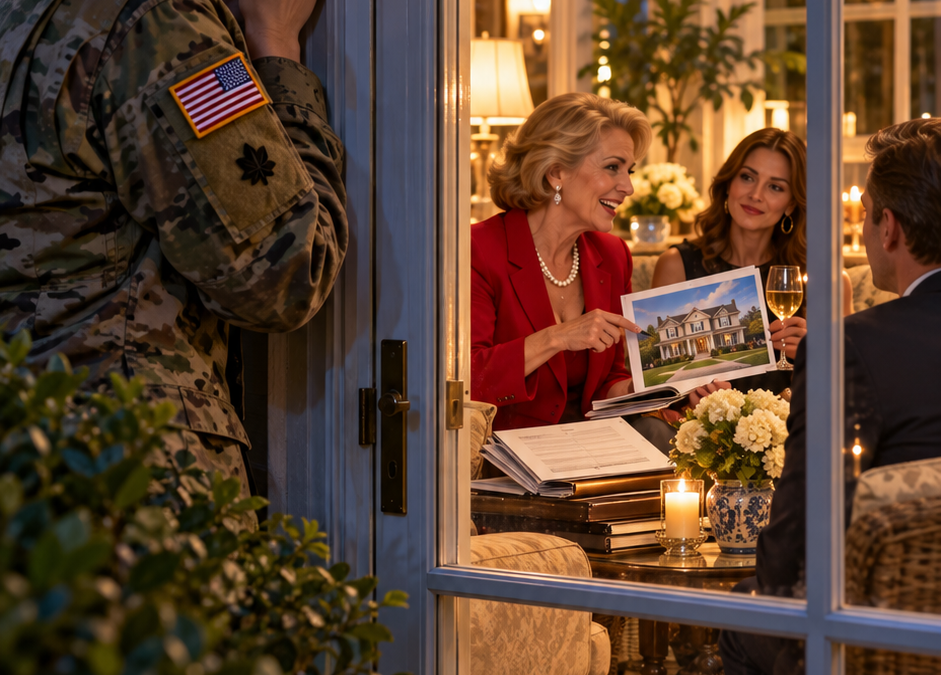
Then I heard Mom laughing in the sunroom.
She was speaking to my aunt Margaret on the telephone.
I hadn’t intended to listen.
But I stopped when I heard my name.
“Claire? Oh, she’s fine. Always working, of course.”
There was a pause.
Then Mom laughed again.
“She has no husband, Margaret. No children. Nothing but that Army job.”
My hand tightened around my keys.
I stood outside the doorway.
“Honestly, I don’t know what she does with herself when she isn’t working. She comes home to that enormous house all alone.”
Another pause.
“Well, that’s what I keep telling her. She’s thirty. Eventually she’ll realize she needs a family around her.”
I started to walk away.
Then she said something that made me stop.
“Who else is she going to leave everything to? Tyler and Sophie will get the house eventually anyway.”
I went completely still.
Mom continued speaking.
“The property must be worth eight hundred thousand dollars by now. Maybe more. I’ve already started thinking about what would make sense for the children when they’re older.”
I stared at the wall.
She was discussing my house.
My mortgage.
My future.
And she was doing it as though I were already absent from all three.
For a moment, I considered walking into the sunroom and demanding an explanation.
Instead, I quietly returned to the garage.
I sat in my car for nearly twenty minutes.
I thought about the little girl who had watched her mother drive away nineteen years earlier.
Then I thought about the woman standing in my sunroom, planning how her younger children might eventually benefit from the life I’d built without her.
I wanted to believe there was some innocent explanation.
Perhaps she was simply imagining a future in which we all remained close.
Perhaps she’d said something careless while speaking to her sister.
But the conversation had revealed something I couldn’t ignore.
My mother had begun treating my life as though it were unfinished simply because I hadn’t married or had children.
And she’d decided that my younger siblings would eventually inherit my home without ever asking what I wanted.
I didn’t confront her.
Not yet.
I needed time to understand exactly what I was dealing with.
Two weeks later, I returned from a three-day military assignment and discovered that my library had disappeared.
Not the shelves.
Not the furniture.
Everything that made it mine.
My books had been packed into cardboard boxes.
The framed photographs of Dad were gone.
In their place were pictures of Mom, Robert, Tyler, and Sophie.
The family she’d chosen when she left us.
I stood in the doorway for several seconds, unable to move.
Then I heard Mom humming somewhere upstairs.
“Mom!”
She appeared carrying a stack of decorative pillows.
“What?”
“Where are my things?”
She glanced toward the boxes.
“Oh. We needed the room.”
“For what?”
“Sophie needs a proper study.”
“She already has a desk in her bedroom.”
“She needs more space.”
I looked around.
The chair where I’d sat reading after difficult days at work had been pushed against the wall. My father’s military photographs were missing from the bookshelves.
Even the small wooden box containing his old watch had disappeared.
“Where are Dad’s pictures?”
Mom sighed.
“Claire, we can’t keep every old thing forever.”
I walked toward the nearest cardboard box and opened it.
Inside were several books, a lamp, and the photograph from my commissioning ceremony.
My father stood beside me in his navy suit.
He was smiling.
My mother hadn’t attended that day.
I lifted the photograph carefully.
“You packed Dad away?”
“Oh, for heaven’s sake.”
I looked up.
“What?”
“Everything in this house is about him. His chair. His photographs. His books. It’s as though nobody else is allowed to live here.”
My chest tightened.
“This is my home.”
“Yes, Claire. You’ve made that very clear.”
“Then why do you keep changing things without asking me?”
She dropped the pillows onto the sofa.
“Because somebody has to make this place comfortable for an actual family.”
I stared at her.
“What does that mean?”
She threw up her hands.
“It means you care more about your stupid Army job and dead things than actual people!”
The words struck harder than I expected.
For a moment, I couldn’t speak.
Then Tyler appeared behind her.
“Mom, stop.”
She ignored him.
“You’re thirty, Claire. No husband. No children. You come home alone every night and act like that uniform makes you important.”
I held Dad’s photograph against my chest.
“That’s enough.”
But she wasn’t finished.
“You’re useless outside the Army.”
The room fell silent.
Tyler looked horrified.
Sophie had appeared at the foot of the stairs, and I could see her eyes filling with tears.
My mother stood in front of me, breathing hard.
For one terrible second, I was eleven again.
Standing in the hallway.
Watching her leave.
Wondering why nothing I did had been enough to make her stay.
Then I looked down at the photograph in my hands.
My father’s smile.
His arm around my shoulders.
The pride in his eyes.
I thought about everything he’d taught me, everything I’d accomplished, and every difficult day I’d survived without my mother.
I no longer needed to convince her that my life mattered.
I looked up.
“Okay.”
She blinked.
“What?”
“Okay.”
I turned and walked upstairs.
Behind me, I heard Tyler say, “You shouldn’t have said that.”
My mother began arguing with him.
I closed my bedroom door.
And for the first time since she’d returned, I stopped wondering how I could make her feel at home.
I began wondering how I could get my own home back.
The following morning, I called a realtor.
Her name was Dana.
She’d helped a friend sell a property several years earlier, and I remembered how practical she’d been about the process.
When she answered, I told her I wanted to discuss selling my house.
“How soon?”
“As soon as reasonably possible.”
She asked whether I’d found another property.
“Not yet.”
“Are you relocating?”
“Not exactly.”
There was a pause.
“Claire, is everything okay?”
I looked toward my bedroom door.
Downstairs, I could hear Mom talking about what color she wanted to paint the newly emptied library.
“No,” I said. “But it will be.”
Dana came to see the house that afternoon.
She examined the property, reviewed recent sales in the neighborhood, and explained what a listing would involve.
The market was strong.
My house had appreciated substantially since I’d purchased it.
And despite my mother’s unauthorized rearranging, the property was in excellent condition.
Dana believed we could attract serious buyers quickly.
I authorized her to proceed.
The listing went live.
Within days, potential buyers began scheduling appointments.
My mother assumed I was having the property appraised for refinancing.
I didn’t correct her immediately.
I wanted to make sure I had a workable plan for Tyler and Sophie before announcing anything that might frighten them.
Three weeks after I’d contacted Dana, I received an offer from Andrew and Melissa Hayes.
They had a five-year-old daughter and another baby on the way.
They’d viewed the property twice.
“They love the library,” Dana told me over the phone.
I almost laughed.
“The library is currently in boxes.”
“They saw the built-in shelves.”
I glanced toward the photograph of Dad sitting beside my computer at work.
“Do they know the kitchen wall is staying exactly where it is?”
Dana chuckled.
“I believe they’re quite comfortable living in a house with walls.”
I smiled.
Then her voice softened.
“Claire, are you absolutely certain you want to do this?”
I looked out my office window.
For eight years, I’d worked to make that house my own.
I’d painted the walls with Dad.
Saved for furniture.
Paid the mortgage.
Filled the library with books.
Spent quiet evenings beside the fireplace reading while snow fell outside.
Selling it should have felt like surrender.
Instead, I felt unexpectedly calm.
My mother had walked into the physical proof of everything I’d survived and begun treating it as something she was entitled to reshape.
I didn’t want to spend the next several years fighting her over rooms, furniture, photographs, and the future she thought I’d already agreed to.
And I didn’t want to remain in the same house simply because leaving might look like admitting defeat.
I could build another home.
I’d already done it once.
“I’m sure, Dana.”
I accepted the Hayes family’s offer.
Closing was scheduled for thirty-one days later.
And for the first time since my mother appeared on my porch, I felt as though I could breathe.
I didn’t tell my mother that evening.
Not because I wanted revenge.
I knew she would be furious, but I was more concerned about how Tyler and Sophie would react. They’d already lost one home, changed schools, and moved in with a sister they barely knew.
I wasn’t going to let them discover they were moving again from an argument between adults.
Two evenings later, I asked Tyler to sit with me on the back porch.
He arrived carrying a glass of iced tea.
“You sound serious.”
“I am.”
He sat opposite me.
At sixteen, he was already becoming good at recognizing when something was wrong. He listened carefully whenever adults spoke, watching their expressions and anticipating changes in their moods.
I recognized that habit.
I’d developed it when I was eleven.
“I’m selling the house,” I said.
Tyler stared at me.
“What?”
“I’ve accepted an offer.”
He looked toward the backyard.
“Does Mom know?”
“Not yet.”
For several seconds, he didn’t speak.
Then he asked, “Because of what she said?”
“Partly.”
His expression tightened.
“You don’t have to sell your house because of us.”
“I’m not selling because of you or Sophie.”
“Then what happens to us?”
I reached across the table.
“I’ve already been looking into apartments near your school. You won’t have to change districts. I’m willing to help Mom with the deposit and the first few months while she gets settled.”
He looked surprised.
“You’d do that?”
“Of course.”
“Even after everything?”
“This isn’t about punishing anyone.”
Tyler rubbed his thumb against the condensation on his glass.
“She shouldn’t have packed up your dad’s things.”
I felt my throat tighten.
“I know.”
“And she shouldn’t have called you useless.”
I looked at him.
For a moment, I saw the little boy he’d probably been when his parents first began arguing.
He hadn’t asked for any of this.
Neither had Sophie.
“Tyler, you don’t have to choose between your mother and me.”
He looked down.
“I know.”
“Whatever happens between us, I’m still your sister.”
His eyes filled.
“Okay.”
After a moment, he told me something I hadn’t expected.
“Mom talked about you before we came here.”
I stared at him.
“What did she say?”
“That you were doing really well. That you had a nice house and a good career.”
“Did she ever tell you why we didn’t know each other?”
He hesitated.
“She said you were close to your dad.”
I looked away.
It wasn’t entirely untrue.
It simply omitted the nineteen years in which she could have tried to know me.
Tyler studied my face.
“I think she thought coming here meant everything would suddenly be okay.”
“What do you mean?”
“Like she could show up, and we’d all become one big family without having to talk about anything that happened before.”
I stared at him.
He shrugged.
“Maybe I’m wrong.”
“No. I think you’re probably right.”
He stood to leave.
Then he paused.
“Claire?”
“Yeah?”
“I like your dad’s chair.”
I looked at him.
“The ugly brown one?”
He smiled.
“Yeah.”
“It’s hideous.”
“I know.”
I laughed.
For a moment, he looked exactly like a sixteen-year-old boy who didn’t have to worry about keeping his family together.
“Don’t worry,” I told him. “I’m taking it with me.”
Sophie cried when I told her.
Not immediately.
At first, she simply sat cross-legged on my bedroom rug, watching me fold clothes into a suitcase for an upcoming assignment.
“Where are you going to live?”
“I’m looking at a townhouse.”
“Is it far?”
“About fifteen minutes.”
She twisted a loose thread around her finger.
“Can we still come over?”
I stopped folding.
“Of course.”
“Even if Mom’s mad at you?”
“Even then.”
Her lower lip trembled.
“Are you selling because I needed the study?”
My heart sank.
I sat beside her.
“No, sweetheart.”
“Because Mom moved your books?”
“Not just because of that.”
She wiped her eyes.
“Then why?”
I thought carefully before answering.
“Sometimes people can love one another and still need to live in different places. I invited Mom here because I wanted to help all of you. But she’s been making decisions about my home without asking me, and that needs to stop.”
Sophie considered my words.
“Are you going to stop talking to her?”
“I don’t know exactly what our relationship will look like.”
“Do you hate her?”
I looked at my little sister.
“No.”
That answer surprised me.
I was angry.
I was hurt.
There were nineteen years of absence between my mother and me, and I still didn’t know what to do with most of it.
But I didn’t hate her.
I simply couldn’t let her continue taking over the life I’d worked so hard to build.
Sophie leaned her head against my shoulder.
“Can I still show you my drawings?”
I put my arm around her.
“Every single one.”
She smiled.
“Even the weird ones?”
“Especially those.”
Mom discovered the sale four days later.
I’d planned to tell her that evening, after Tyler and Sophie left for school.
Unfortunately, the home inspector arrived at ten that morning.
I was upstairs organizing documents when I heard the doorbell.
“Good morning, ma’am. I’m here for the property inspection.”
Silence.
Then my mother’s voice.
“What inspection?”
I closed my eyes.
Not the way I’d planned it.
I came downstairs.
The inspector stood in the entrance holding a tablet. Mom looked at me as though I’d committed an unforgivable betrayal.
“Claire?”
I turned toward the inspector.
“Could you give me five minutes?”
He politely agreed and returned to his truck.
The moment I closed the door, Mom rounded on me.
“What is going on?”
“I sold the house.”
She stared.
“You what?”
“I accepted an offer last week.”
“You sold this house without asking me?”
“Yes.”
Her mouth fell open.
For several seconds, she seemed incapable of speaking.
Then she folded her arms.
“You can’t just do that.”
“I can.”
“We live here!”
“For now.”
“What are we supposed to do?”
“I’ve already been looking into apartments. I’m willing to help with the deposit and the first few months.”
She shook her head.
“I don’t want an apartment.”
I stared at her.
There it was.
Not a question about Tyler’s school.
Not concern about Sophie adjusting to another move.
She simply didn’t want an apartment.
She wanted the house I’d already provided.
“The buyers are scheduled to close next month,” I said.
She stepped backward.
“So this is punishment.”
“No.”
“Of course it is! Because I moved some books?”
“It isn’t about books.”
“Because I said something when I was frustrated?”
“It isn’t about one argument either.”
“Then explain it!”
So I did.
I told her I’d invited her into my home because she and her children needed help.
I told her I’d hoped we might finally establish some kind of relationship after nineteen years apart.
And I told her I’d been willing to accept that getting to know each other would involve awkward conversations, misunderstandings, and mistakes.
“But you didn’t come here and try to learn about my life,” I said. “You started replacing it.”
Her expression shifted.
“I was making room for us.”
“You removed Dad’s photographs.”
“The man has been dead for six years, Claire.”
“He was my father.”
“I know that.”
“Then why did you pack away his things?”
She looked away.
“I thought the room needed updating.”
“No, Mom. You thought my life needed updating.”
She stared at me.
I took a breath.
“And then I heard you talking to Aunt Margaret.”
The color drained from her face.
“What?”
“I heard you discussing who would inherit my house.”
She looked down.
“You were listening to a private conversation?”
“I was walking past the sunroom.”
Her expression tightened.
“What exactly did you hear?”
“That I have no husband, no children, and nothing but an Army job.”
She said nothing.
“And that Tyler and Sophie will eventually get the house anyway.”
She flushed.
“I was speaking hypothetically.”
“About my death.”
“Oh, Claire. Don’t make it sound so awful.”
“I’m repeating what you said.”
“You told me you weren’t planning to have children.”
“I told you I didn’t know whether I would.”
She opened her mouth.
Then closed it.
“You assumed my future was already decided,” I continued. “You assumed I didn’t have anything important in my life simply because it doesn’t look like yours.”
Her shoulders lowered.
For the first time since she’d moved in, she looked uncertain rather than angry.
“I thought we were becoming a family.”
I stared at her.
“Mom, you left when I was eleven.”
Tears filled her eyes.
“I know.”
“You missed almost everything.”
“I know.”
“You didn’t even come when Dad died.”
She covered her face.
“I was ashamed.”
I shook my head.
“Of what?”
“Of how much time had passed. Every year, I thought about calling you, and every year it felt harder.”
“You could have stopped letting the years pass.”
She began crying.
“I know.”
For once, I didn’t rush to make her feel better.
I wasn’t going to erase nineteen years of abandonment simply because she finally seemed prepared to admit they existed.
The inspector rang the doorbell again.
Mom looked toward the entrance.
“So that’s it?”
“The sale is happening.”
“And us?”
I hesitated.
“I’ll help you find somewhere to live.”
“That’s not what I meant.”
“I know.”
I opened the front door.
“We’ll have to figure out the rest.”
For the next two weeks, the house became a strange place.
Boxes appeared in every room.
The buyers scheduled measurements, Dana brought documents, and the entire property slowly began losing the familiar appearance it had worn for eight years.
Mom stopped discussing paint colors.
She also stopped calling it our house.
At first, I thought she was sulking.
Then one morning, I found her sitting at the kitchen table filling out job applications.
“What’s Green Valley Medical?” I asked.
She looked up.
“A dental practice.”
“What position?”
“Front office manager.”
I sat opposite her.
“Have you done that kind of work before?”
“Years ago.”
I realized how little I knew about my own mother.
For nearly two decades, she’d been little more than an absence in my life.
When she returned, I’d been so busy dealing with the disruption she caused that we’d barely had a normal conversation.
“Would you like me to look at your résumé?”
She hesitated.
Then she pushed her laptop toward me.
“Yes.”
We spent the next hour reviewing her employment history.
She’d worked in medical administration before Sophie was born. She understood scheduling, insurance paperwork, and how to handle difficult customers.
“You’re probably qualified to run military logistics,” I joked.
She gave me a horrified look.
“Absolutely not.”
I smiled.
She almost did too.
The following afternoon, Green Valley called to arrange an interview.
Sophie helped Mom choose an outfit.
Tyler drove her because I was working.
When she returned, she seemed lighter than she had in weeks.
“They said they’ll let me know by Friday.”
“That’s good.”
She nodded.
Then, after a moment, she looked at me.
“Thank you for helping with my résumé.”
“You already had the experience. I just moved a few commas.”
“Still.”
It was the first time since she appeared on my porch that she thanked me without immediately asking for something else.
I wished I hadn’t noticed how much that meant to me.
Aunt Margaret called that Thursday.
She was my mother’s older sister and had always existed at the edge of my childhood.
Birthday cards.
Christmas checks.
Occasional telephone calls to Dad.
She lived two states away and had never directly criticized Mom in front of me.
When I was younger, I’d resented her silence.
Now I wondered whether she’d simply believed a child didn’t need another adult explaining how badly her mother had failed her.
“I hear there’s a house sale,” she said.
I sighed.
“Mom called you.”
“She did.”
“To complain?”
“To cry.”
I leaned back in my office chair.
“That sounds worse.”
Margaret laughed softly.
“She told me what she said to you.”
I looked toward my closed office door.
“She actually admitted it?”
“Yes.”
“Did she tell you about planning my inheritance?”
“She did.”
“And?”
“I told her she was an idiot.”
I laughed despite myself.
Margaret continued.
“I think Helen imagined that once you all lived together, everything would somehow work itself out.”
“Without an apology?”
“Apparently.”
“Without asking whether I wanted to live with her?”
“Yes.”
I rubbed my forehead.
“She was discussing my house as though it already belonged to her children.”
“I told her that too.”
Margaret was quiet for a moment.
Then she said, “Your mother has always been very good at imagining a happy ending without doing the difficult work required to get there.”
I stared out the window.
That was exactly what had happened.
Mom had imagined reconciliation without confronting nineteen years of abandonment.
She’d imagined belonging without asking permission.
She’d imagined my house becoming a permanent family home without considering whether I wanted to share it.
And she’d imagined an inheritance without asking what I intended to do with my own life.
“She had a job interview yesterday,” I said.
“I know. She’s hoping they call tomorrow.”
“I hope she gets it.”
“She needs to start taking responsibility for herself.”
“I’ve agreed to help with an apartment.”
“That’s generous of you.”
“It’s mostly for Tyler and Sophie.”
Margaret hesitated.
Then her voice changed.
“Claire, there’s something I’ve wondered for years whether I should give you.”
My hand stopped moving.
“What?”
“Something your father left with me.”
I sat straighter.
“My father?”
“Yes.”
“When?”
“About seven months before he died.”
I stared at the photograph beside my computer.
“What did he leave?”
“An envelope.”
“For me?”
“Yes.”
“Why do you have it?”
“Because he asked me to keep it.”
That didn’t sound like Dad.
He’d never been secretive with me.
Whenever something needed discussing, he’d usually sat me down at the kitchen table and dealt with it directly.
“What exactly did he tell you?”
Margaret took a breath.
“He said I should give it to you if Helen ever came back into your life.”
For several seconds, I couldn’t speak.
My father had died six years earlier.
At the time, my mother was still living with Robert.
I hadn’t spoken to her in months.
As far as I knew, nobody had expected her to return.
“Did Dad know something?”
“I don’t know everything he knew.”
“Did Mom contact him?”
There was a pause.
“That’s something I think he explains in the letter.”
I stood.
“Where is it?”
“In my desk.”
“Can you send it?”
“I’m coming next weekend to see Helen and the children. I’ll bring it with me.”
I glanced at my calendar.
Eight days before closing.
“Please don’t forget.”
“I won’t, sweetheart.”
After we hung up, I sat alone for a long time.
Then I went downstairs and walked into the garage.
Dad’s leather chair was standing beneath an old moving blanket, waiting to be taken to my new home.
I pulled the blanket away and sat down.
For years, I’d believed the story of my family was painfully simple.
Mom left.
Dad stayed.
I grew up.
Life continued.
But apparently, before he died, my father had prepared for the possibility that she might return.
And I needed to know why.
The following Saturday, Aunt Margaret arrived carrying a small overnight bag and a brown envelope.
My mother rushed to greet her.
Tyler and Sophie were delighted to see their aunt, and within minutes the kitchen was filled with conversations about school, moving, and the apartment Mom had finally agreed to rent.
Green Valley had offered her the position.
She was due to begin work the following Monday.
For the first time since arriving, she seemed to have a plan that didn’t depend entirely on me.
I was grateful.
But I could hardly concentrate on anything except the envelope Margaret had placed inside her handbag.
After lunch, she found me alone on the back porch.
“I thought you might prefer to read this privately.”
She handed it to me.
My name was written across the front.
I recognized Dad’s handwriting immediately.
I ran my thumb along the letters.
“When did he give this to you?”
“Seven months before he died.”
“Why didn’t you tell me?”
Margaret sat beside me.
“Because he asked me to wait.”
“Did you know what was inside?”
“No.”
I looked at her.
“You never opened it?”
“It has your name on it.”
I held the envelope for a moment.
Then I carefully opened it.
The letter was three pages long.
The first line made me smile through sudden tears.
Claire, if you’re reading this, I assume your mother has finally decided that coming back into your life is a good idea. I hope you’re doing well, and I hope you’ve remembered to service your car without me reminding you.
I laughed.
Dad had been incapable of discussing anything important without first mentioning my car.
Then I continued reading.
He explained that Helen had contacted him several months earlier.
Her marriage to Robert had apparently been struggling even then.
She’d asked about me.
About my career.
About the house I’d purchased.
And whether I was still single.
Dad had initially hoped she was considering reconnecting with me.
But as the conversation continued, he’d become concerned that she was more interested in whether I could provide help if her circumstances deteriorated.
He’d told her that I was an adult and that if she genuinely wanted a relationship with me, she needed to call me herself.
She hadn’t.
Dad wrote that he hoped he was wrong about her intentions.
He hoped that if she eventually returned, it would be because she wanted to know the daughter she’d left behind.
But he was worried.
Then I reached the paragraph that made me stop reading.
Sweetheart, I know you spent years wondering what you could have done to make your mother stay. You tried being quieter, getting better grades, winning awards, and becoming someone nobody could find fault with. I watched you do all of it, and I wish I could have convinced you sooner that her leaving was never a reflection of your worth.
My eyes filled.
I remembered being eleven.
Waiting for her birthday call.
Wondering whether she would have stayed if I’d behaved differently.
Dad continued.
If she comes back one day, you are allowed to love her. You’re allowed to help her. You’re even allowed to forgive her if that’s what you truly want.
But you do not have to purchase a relationship with the home you’ve built, the money you’ve earned, or the peace you’ve fought so hard to find.
I covered my mouth.
The next paragraph was shorter.
You have always had a generous heart, Claire. Sometimes I worry that people mistake it for an invitation to take more than you intended to give.
Remember that opening your door doesn’t mean surrendering everything inside.
I lowered the letter.
For a long time, I couldn’t speak.
Margaret sat quietly beside me.
Finally, I whispered, “He knew.”
She nodded.
“He knew what you might do if she came back.”
I looked toward the kitchen.
Inside, my mother was helping Sophie pack dishes into a cardboard box.
Tyler was arguing that the large mugs required more packing material than the small ones.
They looked ordinary.
Like a family preparing for a move.
And perhaps, in some complicated way, that’s what we were finally becoming.
But I understood something now that I hadn’t understood when Mom first appeared on my porch.
I could love Tyler and Sophie without giving my mother control over my home.
I could help her find somewhere safe to live without becoming responsible for her future.
And I could decide what relationship I wanted with her without pretending that nineteen years of abandonment had never happened.
I carefully folded the letter.
Then I looked at Margaret.
“Thank you for keeping this.”
She reached for my hand.
“Your father loved you very much.”
I smiled through my tears.
“I know.”
Eight days later, we completed the sale.
The Hayes family arrived with their daughter, who immediately announced that she intended to turn the library into a room for reading and building enormous blanket forts.
I approved of both plans.
Mom moved into a three-bedroom apartment near Tyler and Sophie’s school.
I paid the deposit and helped with the first two months of rent, as I’d promised.
I also made it clear that the arrangement was temporary.
She needed to build a life she could maintain without depending on my income.
For once, she didn’t argue.
On moving day, she approached me while Tyler carried the last box to the truck.
“Claire?”
I turned.
She looked toward Dad’s leather chair.
“You’re taking that with you?”
“Yes.”
She nodded.
Then she looked down.
“I’m sorry I moved his things.”
I waited.
“And I’m sorry for what I said about your career.”
Her voice trembled.
“I know you worked hard for everything you have. I shouldn’t have spoken to you that way.”
I studied her face.
“Mom, the problem wasn’t just what you said.”
“I know.”
“You came back after nineteen years and started acting as though you knew me.”
Her eyes filled.
“I wanted us to become a family.”
“Then you have to get to know the family you actually have. Not the one you’ve imagined.”
She nodded.
“I’d like to try.”
I took a breath.
“So would I.”
Her face brightened slightly.
“But we’re going to live separately. And you need to understand that my decisions about my home, my career, and my future belong to me.”
“I understand.”
I wasn’t certain she fully did.
But I was willing to let her demonstrate whether she’d learned something.
My new townhouse was fifteen minutes away.
It was smaller than the old house, with a sunny kitchen, three bedrooms, and a living room that opened onto a little patio.
I placed Dad’s leather chair beside the window.
His photographs went on the bookshelves.
The picture from my commissioning ceremony returned to my desk.
And for the first time in months, I could walk into a room and know that everything inside it was exactly where I’d left it.
Tyler and Sophie visited frequently.
Sometimes Tyler came over to study. Sometimes Sophie occupied my entire kitchen table with art supplies and insisted that I provide detailed opinions about characters whose complicated fictional histories I could barely remember.
Mom called occasionally.
We had lunch twice.
We were awkward.
Sometimes we disagreed.
Sometimes she said something that reminded me of the mother who’d abandoned me, and I needed a few days before I wanted to speak with her again.
But she was working.
She was paying her own bills.
And she was slowly discovering how to be part of my life without controlling it.
One evening, several months after the move, Sophie came over carrying a framed drawing.
She’d sketched Dad’s old leather chair beside the window.
In the picture, a woman in an Army uniform was sitting in it with a book.
“That’s you,” she explained.
I smiled.
“I recognized the uniform.”
She looked pleased.
“Tyler says the chair is ugly.”
“Tyler has excellent taste.”
She rolled her eyes.
Then she placed the drawing on my bookshelf beside Dad’s commissioning photograph.
I stared at it for a long time.
Nineteen years earlier, I’d watched my mother drive away, convinced that being left behind meant there was something wrong with me.
For most of my adult life, I’d carried that question into everything I did.
My education.
My career.
My relationships.
My determination to become someone nobody could dismiss.
Then my mother returned, moved into my home, and tried to redefine my life according to what she wanted.
But the house had never been proof that I was worthy of being loved.
Neither were my rank, my savings, or the years I’d spent building a successful career.
My father had known that long before I did.
He’d written it down and trusted that someday, if I needed reminding, I would find my way back to his words.
That night, after Sophie went home, I sat in Dad’s chair with his letter resting on my lap.
Outside, the sky darkened.
My new house was quiet.
But it wasn’t empty.
There were photographs of people I loved, books I’d collected, and memories that nobody could pack away without my permission.
I still didn’t know exactly what my relationship with my mother would become.
For the first time, that uncertainty didn’t frighten me.
I had my own life.
And I finally understood that allowing someone back into it didn’t mean handing it over to them.








